Aukus will cost Australia $368bn. What if there was a better, cheaper defence strategy?

Jonathan Barrett and Patrick Commins, Guardian, 15 June 25
As questions swirl around the nuclear submarine deal, some strategists are pushing for an alternative, ‘echidna’ policy that focuses less on offensive capability
As Australia’s nuclear submarine-led defence strategy threatens to fray, strategists say it’s time to evaluate whether the military and economic case of the tripartite deal still stacks up.
The defence tie-up with the US and UK, called Aukus, is estimated to cost up to $368bn over 30 years, although the deal could become even more costly should Donald Trump renegotiate terms to meet his “America first” agenda.
The current deal, struck in 2021, includes the purchase of three American-made nuclear-powered submarines, the construction of five Australian-made ones, as well as sustaining the vessels and associated infrastructure.
Such a price tag naturally comes with an opportunity cost paid by other parts of the defence force and leaves less money to address societal priorities, such as investing in regional diplomacy and accelerating the renewable energy transition.
This choice is often described as one between “guns and butter”, referring to the trade-off between spending on defence and social programs.
Luke Gosling, Labor’s special envoy for defence and veterans’ affairs, last year described Aukus as “Australia’s very own moonshot” – neatly capturing both the risks and the potential benefits.
Opportunity cost
Sam Roggeveen, director of the Lowy Institute’s international security program, says there are cheaper ways to replicate submarine capabilities, which are ultimately designed to sink ships and destroy other submarines.
These include investing in airborne capabilities, more missiles, maritime patrol aircraft and naval mines, he says.
“If you imagine a world without Aukus, it does suddenly free up a massive portion of the defence budget,” says Roggeveen.
“That would relieve a lot of pressure, and would actually be a good thing for Australia.”
Roggeveen coined the term “echidna strategy” to argue for an alternative, and cheaper, defence policy for Australia that does not include nuclear-powered submarines.
Like the quill-covered mammal, the strategy is designed to build defensive capabilities that make an attack unpalatable for an adversary. The strategy is meant to radiate strength but not aggression.
“The uncertainty that Aukus introduces is that we are buying submarines that actually have the capabilities to fire Tomahawk cruise missiles on to an enemy land mass,” says Roggeveen.
“That is an offensive capability that’s ultimately destabilising. We should be focusing on defensive capabilities only.”
Those advocating for a more defensive approach, including Albert Palazzo from the University of New South Wales, point out that it is more costly to capture ground than it is to hold it…………………..
Social cost
…………………..Saul Eslake, an independent economist, says higher defence spending is coming at a time of substantially higher demands on the public purse across a range of areas, from aged care, to disability services and childcare………………………..
Political cost
While expert opinion divides over whether nuclear-powered submarines are the best strategic option for Australia’s long-term defence strategy, there’s a separate question over whether the submarines will be delivered……………………………….. https://www.theguardian.com/world/2025/jun/15/aukus-will-cost-australia-368bn-what-if-there-was-a-better-cheaper-defence-strategy?fbclid=IwY2xjawLHNQpleHRuA2FlbQIxMQBicmlkETFyMEl3YVlwYXlzdE5HaUFzAR7t2VVyRqzmPs-WhsC_dhvz9susqUAqTdxsascsmPSKfkWBQ93MS4DJ24z_9Q_aem_lR5byRgSjQDcUUkIsx-k0w
Plutonium Levels in Sediments Remain Elevated 70 Years After Nuclear Tests

June 24, 2025,
https://www.marinetechnologynews.com/news/plutonium-levels-sediments-remain-650328
Researchers from Edith Cowan University (ECU) in Australia have confirmed plutonium levels in sediment up to 4,500 times greater than the Western Australian coastline.
Three plutonium-based nuclear weapons tests were conducted at the Montebello Islands in the 1950’s, which introduced radioactive contamination to the surrounding environment. The first nuclear test, coded Operation Hurricane, had a weapon’s yield of some 25kT, and formed a crater in the seabed, while the second and third tests, dubbed Operation Mosaic G1 and G2, had weapons yields of around 15kT and 60kT, respectively.
The three tests released radioactive isotopes including plutonium, strontium (90Sr) and caesium (137Cs) into the surrounding marine environment.
“Plutonium is anthropogenic, which means that it doesn’t exist on its own in nature. The only way it is introduced into an environment is through the detonation of nuclear weapons and from releases from nuclear reprocessing plants and, to a lesser extent, accidents in nuclear power plants,” said ECU PhD student and lead author Madison Williams-Hoffman.
“When plutonium is released into a coastal setting in the marine environment, a significant fraction will attach to particles and accumulate in the seabed, while some may be transported long distances by oceanic currents.”
The region is not inhabited by humans and has not been developed, however it is visited by fishing boats, so collecting data on the levels of contamination in the marine environment is important.
Currently, the protected island archipelago and surrounding marine areas also reside within the Montebello Islands Marine Park (MIMP). The MIMP is ecologically significant due to the presence of numerous permanent or migratory species, and its high-value habitat is used for breeding and rearing by fish, mammals, birds and other marine wildlife.
The water and sediment quality within the MIMP are currently described as ‘generally pristine’, and it is fundamental to maintain healthy marine ecosystems in the region.
The concentrations of plutonium at Montebello Islands were between 4 to 4,500 times higher than those found in sediment from Kalumburu and Rockingham from the Western Australian coastline, with the northern area of the archipelago, close to the three detonation sites, having four-fold higher levels than the southern area.
The concentrations of plutonium found in the sediment at Montebello Islands were similar to those found in the sediment at the Republic of Marshall Islands (RMI) test sites, despite 700-fold higher detonation yields from nuclear testing undertaken at RMI.
Plutonium is an alpha emitter so, unlike other types of radiation, it cannot travel through the skin and is most dangerous when ingested or inhaled.
The research was undertaken by Williams-Hoffman, under the co-supervision of Prof. Pere Masqueand at ECU and Dr Mathew Johansen at ANTSO.
AUKUS collapse offers Australia the chance to navigate an innovative future.

(Cartoon by Mark David / @MDavidCartoons)
By Alan Austin | 23 June 2025, https://independentaustralia.net/politics/politics-display/aukus-collapse-offers-australia-the-chance-to-navigate-an-innovative-future,19859
Donald Trump’s likely abandonment of the AUKUS contract offers the Albanese Government a welcome reprieve from a costly folly, as Alan Austin reports.
THE USA LOOKS LIKE it is abandoning the controversial AUKUS contract signed by the miserably inept Morrison Government in its dying days.
The corrupt and incompetent U.S. President Donald Trump wants out. He has proven to the world that the only projects he strongly supports are those that enrich himself and his companies directly. Australia, with other Westminster nations, refuses to pay direct bribes to individual national leaders — as it should.
Now showing advanced cognitive decline and a failing grip on reality, Trump has effectively signalled the contract’s demise by calling for a formal review by Defence Under Secretary Elbridge Colby. Colby has long been a vocal AUKUS critic and will probably recommend cancellation.
Sound reasons to abandon AUKUS
The first pillar of the deal between Australia, the UK and the USA is for the Americans to supply Australia with nuclear-powered attack submarines for its defence, starting with three Virginia-class submarines in the early 2030s.
The second pillar is collaboration between the three nations on new military technology. These include undersea capabilities, artificial intelligence, electronic warfare and advanced cyber, hypersonic and counter-hypersonic capabilities.
Colby’s argument against the AUKUS deal is simply that the USA doesn’t have enough submarines for their own needs and can’t build them fast enough to have any to spare in the foreseeable future. That is true. The current U.S. Administration is the least competent in its history.
Other AUKUS critics have more compelling reasons for its abandonment. The most cogent of these, articulated by former prime ministers Paul Keating and Malcolm Turnbull and others, is that nuclear subs supplied by the USA will necessarily be operated by American personnel and automatically commandeered by the U.S. military in the event of hostilities between the USA and China, over Taiwan or any other conflict.
It would be disastrous for Australia’s relationship with China and other nations, Keating argues, to be dragged into such a war.
Resources lost forever
If AUKUS collapses, Australia has little chance of getting back the billions already invested.
Among the countless failures of the monumentally inept Morrison Coalition Government was leaving out of the contract any penalties for defaults.
In any event, the lifelong criminal grifter currently running the White House has never felt obliged to fulfil contracts, however legally or morally binding.
The losses to Australia as a result of the incompetence of the Coalition from 2014 to 2022 now amount to hundreds of billions of borrowed dollars, including the billions paid out for AUKUS so far.
These simply have to be accepted as penalties citizens must bear for the abject stupidity of those who elected such a hopeless rabble to try to run the country.
Visionary naval future
If AUKUS fails and Australians write off the losses, they can then grasp this as an opportunity to pursue advantageous alternatives.
The future of underwater naval warfare increasingly appears to be in unmanned underwater vessels (UUVs). Australia is well-placed to build these for its own purposes and then sell them to regional neighbours and beyond.
This may seem a quantum leap for shipbuilding in Australia, but it can be accomplished.
Australia proved to the world it could build the Collins-class submarines during the Hawke/Keating period and has successfully procured other military ordnance since then.
In its first term, the Albanese Government began its investment in small UUVs. Australian marine vessel manufacturer Anduril Australia, a subsidiary of the American Anduril Industries, is already building a modest UUV which it calls Ghost Shark.
Although technical information is restricted, military monitor The War Zone has revealed details of the partnership involving Anduril, the Royal Australian Navy (R.A.N.) and the Defence Science and Technology Group.
A Ghost Shark prototype, according to The War Zone, has a 3D-printed exterior, weighs 2.8 tons, is 5.6 metres long and can operate at a depth of 6,000 metres for ten days. Advanced AI technology enables autonomous operations.
The R.A.N. hopes to get three UUVs suitable for both military and non-military missions between 2025 and 2028.
Challenges for the future, beyond Ghost Shark, are for vessels capable of higher speeds, deeper dives, longer missions, greater stealth and more advanced assignments, including accurate delivery of lethal weapons.
If Australia’s current submarines can be replaced with technologically advanced UUVs, costs will be much lower and risks to personnel dramatically reduced. This may allow Australia to cut military spending overall.
Potential partnerships
Australia does not have the resources to build UUVs alone. Just as the Collins-class submarines were built collaboratively with Swedish shipbuilder Kockums, new ventures will require partners.
Possibilities, besides American firms like Anduril, are many. Current UUVs in service include Germany’s Greyshark, France’s XLUUV and vessels from Japan and South Korea.
Prime Minister Anthony Albanese’s discussion topics with his Canadian counterpart, Prime Minister Mark Carney, at last week’s G7 meeting included Canada joining AUKUS. That’s another possible partner.
Grounds for optimism
Australia has shipyards in South Australia and the solid experience of designing, building and maintaining the Collins-class submarines from the 1980s to the present.
Australia enjoys the goodwill of all neighbouring nations, has no current engagement in any conflict and sees no threats on the horizon.
Australians have banished the destructive Coalition parties from any chance of forming government for the foreseeable future.
So, to borrow a line from Michael J Fox in The American President, let’s take this 94-seat majority out for a spin and see what it can do.
Out of pocket and stranded: What happens if Trump pulls out of AUKUS | Four Corners Documentary
Australia backs US strikes on Iran while urging return to diplomacy
Australia’s explicit expression of support for the strikes goes a step further than allies including the UK, Canada and New Zealand
By political reporter Tom Crowley ABC News 23 June 25
In short:
Australia has given its support to US strikes on Iranian nuclear facilities but has repeated calls for de-escalation to avoid a wider war.
Penny Wong said Australia had not received a request for assistance and declined to speculate on how any request would be met.
What’s next?
A National Security Meeting was held in Canberra on Monday morning.
Australia has given its support to US strikes on Iranian nuclear facilities but has repeated calls for de-escalation to avoid a wider war.
Prime Minister Anthony Albanese said on Monday Australia was in favour of action to prevent Iran getting a nuclear weapon, echoing comments made earlier on Monday by Foreign Minister Penny Wong.
“The world has long agreed Iran cannot be allowed to get a nuclear weapon, and we support action to prevent that. That is what this is,” the PM told reporters.
The government initially adopted a more cautious tone, declining to give its explicit support.
Senator Wong said Australia had not received a request for assistance and emphasised the US action was “unilateral” when asked whether Pine Gap, a shared military facility, had been engaged.
While the PM and foreign minister declined to speculate on the response to any such request, Mr Albanese said Australia was “deeply concerned” about the prospect of escalation, placing the onus on Iran.
“We want to see diplomacy, dialogue and de-escalation … Iran had an opportunity to comply, they chose not to and there have been consequences of that,” he said.
Earlier, Senator Wong cited a UN watchdog finding that Iran had acquired enriched uranium at “almost military level”.
“The key question for the international community is what happens next … It’s obviously a very precarious, risky and dangerous moment the world faces,” she said.
The National Security Committee, comprised of key ministers, met in Canberra this morning.
Australia’s explicit expression of support for the strikes goes a step further than allies including the UK, Canada and New Zealand, although all three countries have emphasised the risk of Iran gaining nuclear weapons.
Opposition supports strike, Greens opposed
The Coalition supported the strikes on Sunday and also says it does not want further war, but has put the onus on Iran to negotiate peace.
“We want to see Iran come to the negotiating table to verify where that 400 kilos of enriched uranium is,” Andrew Hastie told ABC Radio National……………………………………..
Dave Sharma, a Liberal senator and former Australian ambassador to Israel, said the government’s response was “underwhelming and perplexing” on Sunday and that support for the strikes “should be a straightforward position for Australia to adopt”.
The Greens are against the strike, with defence spokesperson David Shoebridge calling Donald Trump a “warmonger” and demanding Australia clarify it will not get involved.
“You cannot bomb your way to peace … and the people who are always going to pay the price are the ordinary people on the street,” he said.
……………………………………………….. Five Eyes partners respond
UK Prime Minister Keir Starmer spoke to Mr Trump via phone, emphasising the “grave risk” of Iran’s nuclear program and placing the onus on Iran “returning to the negotiating table as soon as possible”, according to a readout of the call.
A joint statement from the UK, France, Germany and Italy urged Iran not to “take any further action that could destabilise the region” but did not include an explicit position on the strike.
The New Zealand government has “acknowledged” the strike, and called for diplomacy, Foreign Minister Winston Peters saying “ongoing military action in the Middle East is extremely worrying”.
Canadian PM Mark Carney said Iran should not be allowed to obtain a nuclear weapon and that the US strike “was designed to alleviate that threat”, but stopped short of explicitly endorsing it and called for “all parties” to return to the negotiating table. https://www.abc.net.au/news/2025-06-23/australia-backs-us-strikes/105448088
Going to war with China will be an unequivocal disaster for Australia

Perhaps the Honourable Minister should also be and remain quiet – or better still be removed from his portfolio – because he is doing nothing for the Labor cause; and seems to be actively attempting to reduce Labor’s chance at a second term. He should unequivocally realise that if Australia goes to war the Liberal mantra will become, ‘this is on you Labor, you dragged us into this war and it is up to the LNP to get us out.’
the US will not place any of its assets at risk in order to defend Australia, this should be fundamentally and clearly understood by the people of Australia.
19 June 2025 AIMN Editorial, By Dr Strobe Driver https://theaimn.net/going-to-war-with-china-will-be-an-unequivocal-disaster-for-australia/
“Up shit creek in a barbed-wire canoe, without a paddle”: The implausible direction Australia’s current Defence Minister is taking the country.
For those of you who aren’t familiar with the above mentioned expression it means things are about as bad as they can get; likely to get worse; and are as it stands, a continuum of a disaster.
This is where Australia stands at the moment when examining Australia’s role in the Asia-Pacific; the rise of China; the ‘position’ this is placing Australia in terms of it being a ‘middle power’ in the region; the dependence on the United States of America (US) as an ally; and the way in which the current Defence Minister (the Honourable Richard Marles (MP) is approaching the current and future components of the regional strategic situations.
The spat between former prime minister Keating and the current Deputy Prime Minister and Defence Minister Marles is ongoing and is far too detailed to go into here other than to mention Keating believes Marles has essentially ‘ceded Australia’s sovereignty’ to another country (the US); and Marles wants ‘strategic transparency from China in its regional military build-up’ and of course the well-worn argument that Australia will be dragged into a war should the US-China situation become ‘kinetic’ – in other words the fighting becomes real. So, with this in mind let’s ‘cut to the chase’ and figure out how Australia would actually ‘fair’ in the outbreak of a war with China and utilise some rationale.
First and foremost, and as I have previously stated in my book The Brink of 2036, the US having sought and gained assurance that Australia is its ‘closest ally’ decides it will ‘go after’ China over its retrocession claims on Taiwan and a war breaks out – the question that begs is, what does that make Australia? This makes Australia an enemy of China and therefore, the Chinese military is now legally entitled to strike Australia.
China would veto any and all conversation in the UNSC (as it is a Permanent Five (P5) member) and use all of its legal powers to circumvent any and all United Nations’ debate about its use of force against US allies. Secondly, the US will not place any of its assets at risk in order to defend Australia, this should be fundamentally and clearly understood by the people of Australia. The US may come to Australia’s aid – it will utilise discretion – however, should it be deemed necessary, it will only enter into any and all aspects associated with the protection of Australia when its assets are not at a high risk of destruction/incapacitation. Where does this leave Australia? One could safely argue a dyad: alone, unless the US’ intervenes.
For the purpose of this essay war has been declared and therefore, a perspective is needed.
The most telling perspective is that Australia faces a rising power and bearing in mind China has continued its rise exponentially since circa-2010, as before that one could safely argue its rise was only incremental, and thus, it is now a major regional power – soon to become a global one. Hence, Australia will have become the enemy of an enormously powerful country.
What then, would said country do to its middle-power regional enemy? There are no surprises here as it is being played out by Israel in the Gaza strip; and the Russian Federation in Ukraine and moreover, it is exceedingly visible; and easy-to-understand. As a side issue, though an important one, and just to strike further terror into the hearts of Australians, the US and Russia as members of the P5 have shut down through the power of veto any and all conversation about whether Israel’s incursion into Gaza and Russia’s invasion of Ukraine are not warranted. One need not even bother to assume what pathway China will take in its war/fight with Australia. With this in mind let’s move towards China’s kinetic tactics on Australia.
As with any war the first things that need to be destroyed are ‘bases and bridges.’ Bases because they house personnel and vital equipment and bridges which essentially refer to anything (not just bridges over a waterway) that equipment can be transported from in order to get ‘to’ a place/location. China with its significant and enormous amount of missiles and the ability to place them through assets (submarines in particular), will fire hundreds of them into Australian assets – some for advantage and some for ‘publicity,’ that is to say, ‘here’s what we can do.’ The former will be RAAF bases, RAN and RAA bases with a single focus on maintenance and repair facilities; and the latter will be major railway lines (the Ghan; Indo-Pacific; and north east coast public lines); and then major highways the Bruce Highway in particular, will be targeted as will the Darwin-Adelaide highway.
As with any war the first things that need to be destroyed are ‘bases and bridges.’ Bases because they house personnel and vital equipment and bridges which essentially refer to anything (not just bridges over a waterway) that equipment can be transported from in order to get ‘to’ a place/location. China with its significant and enormous amount of missiles and the ability to place them through assets (submarines in particular), will fire hundreds of them into Australian assets – some for advantage and some for ‘publicity,’ that is to say, ‘here’s what we can do.’ The former will be RAAF bases, RAN and RAA bases with a single focus on maintenance and repair facilities; and the latter will be major railway lines (the Ghan; Indo-Pacific; and north east coast public lines); and then major highways the Bruce Highway in particular, will be targeted as will the Darwin-Adelaide highway.
As with any war the first things that need to be destroyed are ‘bases and bridges.’ Bases because they house personnel and vital equipment and bridges which essentially refer to anything (not just bridges over a waterway) that equipment can be transported from in order to get ‘to’ a place/location. China with its significant and enormous amount of missiles and the ability to place them through assets (submarines in particular), will fire hundreds of them into Australian assets – some for advantage and some for ‘publicity,’ that is to say, ‘here’s what we can do.’ The former will be RAAF bases, RAN and RAA bases with a single focus on maintenance and repair facilities; and the latter will be major railway lines (the Ghan; Indo-Pacific; and north east coast public lines); and then major highways the Bruce Highway in particular, will be targeted as will the Darwin-Adelaide highway.
The Honourable Defence Minister should cease and desist with his current monologue and political ineptness toward China and should be upfront with the Australian people in what will happen, should we go down this ‘rabbit hole’ of exceptionalism in the region; and yet, willingly yet aimlessly back the US. Australia will become a failed state if we go to war and it is timely to remind the Australian public there are (approximately) as many personnel in the NYPD as there are personnel in the Australian Defence Force.
Perhaps the Honourable Minister should also be and remain quiet – or better still be removed from his portfolio – because he is doing nothing for the Labor cause; and seems to be actively attempting to reduce Labor’s chance at a second term. He should unequivocally realise that if Australia goes to war the Liberal mantra will become, ‘this is on you Labor, you dragged us into this war and it is up to the LNP to get us out.’
The level of political-ineptness and downright political-maladroitness shown by this minister is however nothing new, as Australia seems to have had a cavalcade of utterly hopeless defence ministers over the past three decades. The real problem this time is this one is politically stupid-to-the-core when Australians need astute, articulate and well-defined decision-making.
Meanwhile, China continues to plan its ongoing rise to ‘pax-Sino’ and we have someone at the helm who is plainly and insufferably politically incompetent when there is a dire need to truly understand the milieu of Australia’s defence needs.
‘Punishment phase’ explained: The punishment phase of aerial bombardment is designed to ‘inflict enough pain on enemy civilians to overwhelm their territorial interests’ and in doing so induce surrender, or hasten total defeat. See: Robert Pape. Bombing To Win: Air Power and Coercion in War. New York: Cornell University Press, 1996, 59.
Dr Strobe Driver – Strobe completed his PhD in war studies in 2011 and since then has written extensively on war, terrorism, Asia-Pacific security, the ‘rise of China,’ and issues within Australian domestic politics. Strobe is a recipient of Taiwan Fellowship 2018, MOFA, Taiwan, ROC, and is an adjunct researcher at Federation University.
Cross your fingers, Australia, and hope the AUKUS deal collapses

he Americans agreed to the deal because they saw it to be in their strategic interest, not ours. As then-U.S. Deputy Secretary of State Kurt Campbell observed (indiscreetly) last year, “we have them locked in now for the next 40 years.”
All that AUKUS and its associated alliance commitments have done for Australia is paint more targets on our back.
The crazy irony is that we are spending huge sums to build a new capability intended to defend us from military threats that are most likely to arise simply because we have that capability
The U.S. sub purchase was a bad deal then and it makes even less sense now.
By Gareth Evans, Project Syndicate, https://www.japantimes.co.jp/commentary/2025/06/18/world/australia-should-hope-for-aukuss-collapse/
MELBOURNE –
The AUKUS partnership, the 2021 deal whereby the United States and the United Kingdom agreed to provide Australia with at least eight nuclear-propelled submarines over the next three decades, has come under review by the U.S. Defense Department.
The prospect of its collapse has generated predictable handwringing among those who welcomed the deepening alliance, and especially among those interested in seeing Australia inject billions of dollars into underfunded, underperforming American and British naval shipyards. But in Australia, an AUKUS breakdown should be a cause for celebration.
After all, there has never been any certainty that the promised subs would arrive on time. The U.S. is supposed to supply three or possibly five Virginia-class submarines from 2032, with another five newly designed SSN-AUKUS-class subs (built mainly in the U.K.) coming into service from the early 2040s. But the U.S. and the U.K.’s industrial capacity is already strained, owing to their own national submarine-building targets and both have explicit opt-out rights.
Some analysts assume that the Defense Department review is just another Trumpian extortion exercise, designed to extract an even bigger financial commitment from Australia. But while comforting to some Australians (though not anyone in the Treasury), this interpretation is misconceived.
There are very real concerns in Washington that even with more Australian dollars devoted to expanding shipyard capacity, the U.S. will not be able to increase production to the extent required to make available three — let alone five — Virginia-class subs by the early 2030s. Moreover, Elbridge Colby, the U.S. under-secretary of defense for policy who is leading the review, has long been a skeptic of the project and he will not hesitate to put America’s own new-boat target first.
Even in the unlikely event that everything falls smoothly into place — from the transfers of Virginia-class subs to the construction of new British boats, with no human-resource bottlenecks or cost overruns — Australia will be waiting decades for the last boat to arrive. But given that our existing geriatric Collins-class fleet is already on life support, this timeline poses a serious challenge. How will we address our capability gap in the meantime?
Cost-benefit analysis should have killed the project from the outset. But in their eagerness to embrace the deal, political leaders on both sides of parliament failed to review properly what was being proposed. Even acknowledging the greatly superior speed and endurance of nuclear-powered subs and accepting the heroic assumption that their underwater undetectability will remain immune from technological challenge throughout their lifetimes, the final fleet size seems hardly fit for the purpose of national defense.
Given the usual operating constraints, Australia would have only two such subs deployed at any one time. Just how much intelligence gathering, archipelagic chokepoint protection, sea-lane safeguarding or even deterrence at a distance will be possible under such conditions? Moreover, the program’s eye-watering cost will make it difficult to acquire the other capabilities that are already reshaping the nature of modern warfare: state-of-the-art drones, missiles, aircraft and cyber defense.
The remaining reason for believing, as former Australian Prime Minister Paul Keating put it, that an American opt-out “will be the moment Washington saves Australia from itself,” concerns AUKUS’s negative implications for Australia’s sovereignty. The Americans agreed to the deal because they saw it to be in their strategic interest, not ours. As then-U.S. Deputy Secretary of State Kurt Campbell observed (indiscreetly) last year, “we have them locked in now for the next 40 years.”
It defies credibility to believe that the U.S. would transfer such a sensitive technology to us — with all the associated emphasis on the “interchangeability” of our fleets and new basing arrangements in Australia — unless it could avail itself of these subs in a future war. I have had personal ministerial experience of being a junior U.S. ally in a hot conflict situation — the first Gulf War in 1991 — and my recollections are not pretty.
Alongside the Pine Gap satellite communications and signals intelligence facility — which has always been a bull’s-eye — one can add Perth’s Stirling submarine base, the Northern Territory, with its U.S. Marine and B-52 bases and possibly a future east-coast submarine base.
The crazy irony is that we are spending huge sums to build a new capability intended to defend us from military threats that are most likely to arise simply because we have that capability — and using it to support the U.S., without any guarantee of support in return should we ever need it.
If the AUKUS project does collapse, it would arguably still be possible for Australia to acquire replacements for its aging submarine fleet within a reasonable time frame — and probably at less cost, while retaining real sovereign control — by purchasing off-the-shelf technology elsewhere. One can even imagine us going back to France, which was snubbed in the AUKUS deal, and making a bid for its new-generation Suffren-class nuclear-powered sub.
But a better defense option may simply be to recognize that the latest revolution in military technology is real and that our huge continent and maritime surroundings will be better protected by a combination of self-managed air, missile, underwater and cyber capabilities than by a handful of crewed submarines. There is no better time to start thinking outside the U.S. alliance box.
Gareth Evans was Australia’s foreign minister (1988-1996), president of the International Crisis Group (2000-2009) and chancellor of the Australian National University (2010-2019). © Project Syndicate, 2025
Why the AUKUS ‘dream’ was never realistic and is likely to die

it has always been clear that Washington will sell us its submarines only if it is absolutely certain Australia would commit them to fight if the US goes to war with China.
The Albanese government has never acknowledged it is willing to make that commitment.
it has always been clear that Washington will sell us its submarines only if it is absolutely certain Australia would commit them to fight if the US goes to war with China.
The Albanese government has never acknowledged it is willing to make that commitment.
Hugh White, Jun 16, 2025, https://www.thenewdaily.com.au/opinion/2025/06/16/aukus-submarines-review-australia
The first clear sign the Trump administration was taking a long hard look at AUKUS came two weeks ago, when US Secretary of Defence Pete Hegseth gave his first major speech on US strategic policy in Asia at the annual Shangri-La Dialogue in Singapore.
In a long presentation that catalogued a host of initiatives with America’s Asian allies, AUKUS was not mentioned once.
This was noteworthy, because under the Biden administration, AUKUS was the poster-child for US military engagement in the region, name-checked at every opportunity. Now we understand why.
The Pentagon’s review of AUKUS, announced last week, marks the first time any of the three partners – the US, Britain and Australia – has tested the AUKUS dream against hard military and strategic realities. It is unlikely to survive.
AUKUS was always a long shot, right from the start. That was clear from the moment, back in September 2021, that then prime minister, Scott Morrison, sprung the dream of an Australian nuclear-powered submarine force on an astonished public. For that dream to be realised, a lot of things would have to go right, and most of them were much more likely to go wrong.
But the flaw that looks set to kill the AUKUS dream is one that was not part of the original plan. The way Morrison and his then defence minister, Peter Dutton, originally conceived it, there would be no need for Australia to acquire US-built Virginia-Class subs in the 2030s before taking delivery of Australian-built subs to replace the Collins-class boats. They were confident that subs built in Australia, almost certainly to a British design, could be delivered fast enough to enter service as the old Collins subs were being retired, ensuring no gap in our capability.
It became clear this was not going to work out only after Labor took office in 2022, as the new government tried to turn Morrison’s vague idea into a viable project. It soon found there was simply no way to bring new Australian-built nuclear subs into service until long after the Collins boats had to be retired.
To save the AUKUS dream, it was necessary to fill the gap between the retirement of the Collins and the delivery of the first of what we now know as the UK-designed, Australian-built SSN-AUKUS class of submarine. That was when the idea of Australia getting ex-US Navy Virginia class boats first surfaced.
It was a desperate measure that vastly increased the already formidable risks of the whole AUKUS idea. One reason is that it meant the Royal Australian Navy had the almost impossible task of managing and operating not one but two very different kinds of nuclear submarine, powered by two very different nuclear power plants.
For a navy that has struggled to keep the much simpler Collins subs at sea, the task of operating just one class of nuclear-powered subs was truly formidable. To expect it to effectively operate two quite different classes of nuclear submarine simultaneously was frankly absurd.
But there is another reason why the decision to buy Virginia subs to cover the capability gap undermined the viability of the whole AUKUS plan.
Very simply, the US has no submarines to spare. The facilities and workforce that build and maintain its submarines have never recovered from the savage cuts imposed in the 1990s after the end of the Cold War. No serious steps were taken to rebuild it even after it became clear China had become a formidable new maritime rival.
The result is that America’s two submarine construction yards have for many years been delivering barely half as many Virginia-class subs as the Pentagon now says America needs – about 1.2 a year instead of two a year.
This problem was acknowledged when the AUKUS partners announced the detailed plan in 2023. It was optimistically claimed that everything necessary would be done to increase production to the level of 2.3 subs a year required to meet US needs and provide extra boats for Australia.
So far, there is no sign of that happening. Elbridge Colby, the senior US official conducting the Pentagon’s AUKUS review, will almost certainly puncture the irresponsible optimism around this crucial issue and make it clear that unless there is a miracle in US submarine production, America will not sell any Virginia-class subs to Australia.
But that’s not all. Even if that miracle is achieved, US leaders and officials still have to ask whether it makes sense for America to pass the extra submarines to Australia rather than bring them into service with the US Navy.
Any subs sold to Australia weaken America at a time when it is already struggling to match China’s fast-growing navy. So it has always been clear that Washington will sell us its submarines only if it is absolutely certain Australia would commit them to fight if the US goes to war with China.
The Albanese government has never acknowledged it is willing to make that commitment. The Biden administration, desperate for its own reasons to keep the AUKUS dream alive, did not press Canberra on this very sensitive point.
The Trump administration will be much tougher. Colby’s review will also certainly conclude that America should not sell Virginia-class subs to Australia, unless Canberra offers much clearer and more public guarantees that Australia will go to war with China if the US ever does.
For Canberra, this could well be a deal-breaker, making the end of the AUKUS dream. It certainly should be.
Hugh White’s new Quarterly Essay, Hard New World: Our Post-American Future, is published this month.
Hugh White, Emeritus Professor of Strategic Studies at the Strategic and Defence Studies Centre, Australian National University
Pacific Rim countries say no to U.S.-China war
The question that the people of the Pacific and Pacific Rim countries are asking is: Why do we have to respond to this demand by the U.S.? We are not threatened by China. Where is the dire urgency that demands such a huge distortion of our public spending on the military?
The indications are that the United States is preparing for war against China, but cannot wage such a war from the West Coast of the USA. It needs military bases, port facilities and airfields in the countries on the west side of the Pacific Rim; for example, South Korea, Japan, the Philippines, Guam, Micronesia and Australia. Without these bases, without the backing of the military forces and munitions and manufacturing capabilities of the Pacific Rim countries, the United States cannot launch and sustain a war against China.
By Bevan Ramsden | 16 June 2025, https://independentaustralia.net/politics/politics-display/pacific-rim-countries-say-no-to-us-china-war,19837
As the U.S. pushes Pacific Rim allies to ramp up military spending for a possible war with China, a new campaign asks: at what cost and for whose benefit? Bevan Ramsden writes.
THE PACIFIC and Pacific Rim countries have a geographical commonality. They are encircled by, or have a border with, the vast, blue, peaceful Pacific Ocean. They also share a political commonality. The people and countries of this region are under pressure to lift their military spending at the expense of addressing their social needs.
The pressure comes from the United States, whose Defence Secretary, Peter Hegseth, at the recent Singapore Defence Summit, declared that the U.S. expects its allies in this region to increase their defence spending to 5% of their GDP. His justification was a “possibly imminent threat” posed by China. He emphasised how the U.S. is “reorienting towards deterring aggression by China” and made it clear that the Donald Trump Administration’s defence strategy revolves around stifling the rise of China.
Responding to this expectation would involve the doubling of South Korean expenditure on military defence, from 2.6% of its GDP to 5%.
It would mean Japan’s military defence spending would have to triple from 1.8 % of its GDP to 5%.
In Australia, such an increase would represent a two-and-a-half times increase from 2% to 5% of its GDP.
These examples show that the 5% target represents a massive increase in military spending, which can only be made by reducing funding for urgent infrastructure, social needs such as health and education and loss of resources to address the real threat to their living environments, the climate crisis.
The question that the people of the Pacific and Pacific Rim countries are asking is: Why do we have to respond to this demand by the U.S.? We are not threatened by China. Where is the dire urgency that demands such a huge distortion of our public spending on the military?
Another commonality among the countries of the Pacific Rim, particularly those on the western and southern rim of the Pacific, is U.S. troops and U.S. military installations stationed on their territory. In the case of South Korea, these are substantial, close to 30,000 and put that country’s military virtually under the control of the U.S.
Japan has 57,000 U.S. troops, including 20,000 on Okinawa, where the U.S. Kadena Air Base is its largest outside of the USA. Clearly, this level of foreign military occupation exerts substantial pressure on Japan’s foreign policy.
The Philippines has four U.S. bases with troops rotating through its territory and training with its defence forces, and is setting up logistic centres for equipment and munitions.
The people of Guam, a territory under direct U.S. control, are subject to 7,000 U.S. troops, with almost a third of the land controlled by the U.S. military. The Joint Region Marianas is a U.S. military command combining the Andersen Air Force Base and the Naval Base Guam.
Andersen Air Force Base hosts B-52 bombers and fighter jets. Naval Base Guam is the home port for four nuclear-powered fast attack submarines and two submarine tenders. American military commanders have referred to the island as their “permanent aircraft carrier”.
Australian governments, in their subservience to the U.S., have signed the Force Posture Agreement, giving the U.S. military unimpeded access to Australia’s ports and airfields and enabling the establishment of a Northern Territory base for its B-52 bombers, some of which are nuclear-capable. The Agreement is giving the U.S. fuel and munitions storage areas to support war operations and an $8 billion port facility for servicing their nuclear submarines and storage of their nuclear waste.
The people of Pacific Rim countries, including Australia, need to ask: Why does the U.S. have these extensive military facilities in our countries and why are they demanding such huge military expenditures from us?
The answer, unfortunately, is not for the benefit of the people of this region but for its own foreign policy objectives, which include maintaining its dominance in the region by “containing” China and preventing the rise of its influence.
The indications are that the United States is preparing for war against China, but cannot wage such a war from the West Coast of the USA. It needs military bases, port facilities and airfields in the countries on the west side of the Pacific Rim; for example, South Korea, Japan, the Philippines, Guam, Micronesia and Australia. Without these bases, without the backing of the military forces and munitions and manufacturing capabilities of the Pacific Rim countries, the United States cannot launch and sustain a war against China.
So the United States needs us but we don’t need such a war.
It would only bring devastation to our lives and our economies, and if it turned nuclear, who would survive?
The Pacific Peace Network, with representatives from the Pacific Rim countries and together with World Beyond War, has produced a solidary campaign which is being launched on 21 June 2025.
This is a campaign in which the people of each country on the Pacific Rim, including Australia, can say no to such a war and no to an increase in military spending for it, through a common petition which is a call on their governments.
The common petition can be accessed here at the World Beyond War website.
This call on governments reads:
For sustainable peace and the survival of our peoples and environment, we ask you:
- refuse to join military preparations for a U.S.-China war;
- declare you will not fight in a U.S.-China war;
- declare neutrality should such a war break out; and
- do not allow your territory or waters to be used in such a war, including the collection and relay of military intelligence, sales of weapons and hosting combatant troops and facilities.
Later this year, the petitions will be presented to their respective governments by peace activists in each country.
Group of Australian MP’s Call for AUKUS Inquiry

Crossbench MPs from the House of Representatives and Senate have written to Deputy Prime Minister and Defence Minister Richard Marles, calling for an urgent parliamentary inquiry into AUKUS.
In April, the UK Parliament’s Defence Committee announced an inquiry into the AUKUS arrangements, and this week the US defence department announced they were undertaking a rapid review of AUKUS.
AUKUS represents Australia’s largest defence investment in decades and is central to our defence and foreign affairs strategy.
Australians are concerned to know more about the strategic and financial implications of this policy which has been jointly adopted by major party governments without significant parliamentary scrutiny.
A full and formal parliamentary inquiry is therefore both important and timely.
Quotes from letter to Deputy Prime Minister, Richard Marles
Allegra Spender, Independent MP for Wentworth
AUKUS is the centrepiece of our defence and foreign policy strategy, but it’s been adopted by the major parties with very poor public engagement. AUKUS will shape Australia’s future for decades with enormous implications both financially, economically, and strategically, but in discussions at the community level, there are consistent questions and concerns that have not been addressed. AUKUS won’t work without wider community interrogation and engagement, and a parliamentary inquiry is the first step to building that.
We also need a more open discussion of the challenges facing AUKUS. Most urgently, the US Navy is currently short of attack submarines and there is a very clear risk that the US President at the time will not be able to certify that the Virginia class submarines can be transferred to Australia without undermining US Navy capability: a requirement of the current enabling legislation. We must publicly face those risks and actively manage them including identifying viable alternatives.
Helen Haines, Independent MP for Indi
In light of the reviews of AUKUS by our two partner nations and the consequential nature of the agreement, it important for our Parliament to apply the same level of scrutiny.
Andrew Wilkie, Independent MP for Clark
More than ever an Australian Inquiry into AUKUS is needed, and President Trump’s caution about the deal gives Australia a great chance to reset. Nuclear subs were always the wrong technology for Australia’s future submarine needs given the shallow littoral and offshore waters in our region, not to mention the ridiculous cost and impractical timeframe.
Nicolette Boele, Independent MP for Bradfield
Any time Parliament commits to spend $368 billion, we should at least have a full parliamentary inquiry. The case for an inquiry on AUKUS is even stronger given the rules of global co-operation have dramatically changed since it was signed.
AUKUS now risks our defence — because we don’t know if these submarines will ever arrive. It risks our budget — because we may waste $368 billion in taxpayer’s money. And it risks our Australian values, which we do not import from the United States.
Sophie Scamps, Independent MP for Mackellar
Circumstances have changed significantly since the AUKUS deal was first announced and it’s only reasonable it be reviewed in the current context.
This is the largest investment in our defence capability in decades, other parties are conducting their own reviews, and the Australian community largely supports a parliamentary inquiry – it’s high time the Government responds.
Senator Jacqui Lambie
We’ve poured billions into AUKUS with nothing to show for it but broken promises and cancelled defence programs. It’s a $368 billion blank cheque to the US and UK with zero guarantee of real capability for decades.
Australians deserve better and it’s time for a full parliamentary inquiry into this dud deal.
Senator David Pocock
With the UK and now the US reviewing AUKUS, Australia is now the only country not actively considering whether the agreement in its current form best serves our national interest. Given the scale and cost of this deal, a transparent review is not just sensible, it’s overdue.
Kate Chaney, Independent MP for Curtin
AUKUS is a monumental strategic commitment with far-reaching implications for our economy, sovereignty, and security posture, yet it continues to unfold with minimal public transparency and virtually no parliamentary accountability. Australians want to understand whether this is the best use of our resources and the right path for our security.
US launches AUKUS review to ensure it meets Donald Trump’s ‘America First’ agenda

By Brad Ryan and Emilie Gramenz in Washington DC, ABC News, 11 June 25
In short:
The US is reviewing the AUKUS security pact with Australia and the UK, which Australia is depending on to acquire nuclear-powered submarines.
A US defence official said it would ensure the pact met President Donald Trump’s “America First” agenda, as the US struggles to build enough submarines for its own fleet.
But Defence Minister Richard Marles said he was “very confident this [AUKUS] is going to happen” and it was only natural for the new US administration to review it.
The Pentagon is reviewing the AUKUS security pact between Australia, the US and the UK to ensure it aligns with President Donald Trump’s “America First” agenda, a US defence official told the ABC.
But Defence Minister Richard Marles said he remained confident the pact would remain intact, and a review was a “perfectly natural” thing for a new administration to do.
The news follows US Defense Secretary Pete Hegseth’s recent request for Australia to significantly boost its defence spending “as soon as possible”.
The US defence official said the review “will ensure the initiative meets … common sense, America First criteria”.
“As Secretary Hegseth has made clear, this means ensuring the highest readiness of our service members, that allies step up fully to do their part for collective defence, and that the defence industrial base is meeting our needs,” the official said.
Under the AUKUS pact, Australia would be armed with nuclear-powered submarines at a cost of more than $350 billion.
Elbridge Colby, who is the under secretary of Defense for Policy and has voiced scepticism about AUKUS, is leading the review, according to the UK’s Financial Times.
Last August, Mr Colby tweeted he was an AUKUS “agnostic”.
“In principle it’s a great idea. But I’ve been very skeptical in practice,” he wrote, but added he’d become “more inclined based on new information I’ve gleaned”.
Mr Marles told ABC Radio Melbourne he was “very confident this [AUKUS] is going to happen”.
“The meetings that we’ve had with the United States have been very positive in respect of AUKUS,” Mr Marles said. “That dates back to my most recent meeting with Pete Hegseth in Singapore.”
……………………………………………. The Australian government paid the US almost $800 million earlier this year — the first in a series of payments to help America improve its submarine manufacturing capabilities.
………… Mr Hegseth met Defence Minister Richard Marles in Singapore, and said Australia needed to lift its defence spending.
Mr Trump himself has said little publicly about the AUKUS pact, and his criticisms of America’s traditional alliances have fuelled anxieties about its future in Canberra and London.
When a reporter asked Mr Trump about AUKUS in February, he appeared to be unfamiliar with the term, replying: “What does that mean?”…………………………..
Under “Pillar I” of the two-pillar AUKUS deal, the first submarine would arrive in Australia no sooner than 2032. It would be a second-hand US Virginia-class vessel.
The US would subsequently supply Australia with between three and five submarines, before Australia began building its own in Adelaide, modelled on British designs.
Mr Albanese was expected to meet Mr Trump on the sidelines of the G7 summit in Canada next week. But that’s now in limbo after the US condemned Australia and several other countries that placed sanctions on two far-right Israeli ministers.
…………..Critics of the deal, including former prime ministers Malcolm Turnbull and Paul Keating, have long warned it is unfair and risky. “I’ve never done a deal as bad as this,” Mr Turnbull told Radio National earlier this year.
The Greens have proposed a “plan B” defence policy that would eventually see AUKUS cancelled.
There are also longstanding concerns around the US’s consistent failure to meet its own submarine-building targets to fully stock its military fleet…………………………………………….https://www.abc.net.au/news/2025-06-12/aukus-pentagon-review-donald-trump-america-first/105406254
AUKUS has serious problems, Australia probably won’t receive any submarines: Malcolm Turnbull
Malcolm Turnbull, former Prime Minister of Australia, says that AUKUS wasn’t a very good deal for the country and that he thinks President Trump would love the deal as the U.S. would receive money without necessarily having to deliver anything in return.
Thu, Jun 5 2025, https://www.cnbc.com/video/2025/06/05/aukus-has-serious-problems-likely-australia-will-not-receive-any-submarines.html
US military waste contractor with flawed safety record backing Australian N-waste dump

Declassified Australia can report that over a 10-year period from 2012 to 2022, during which Amentum managed the WIPP facility, multiple highly hazardous incidents occurred.
Amidst allegations of “gross mismanagement”, the dangerous incidents at the WIPP facility cost US taxpayers at least US$2 billion, and caused a three-year closure of the nuclear waste plant while redesign, repair, and remediation efforts were undertaken.
Jorgen Doyle, June 7, 2025 https://johnmenadue.com/post/2025/06/us-military-waste-contractor-with-flawed-safety-record-backing-australian-n-waste-dump/
A US military mega-contractor assisting an Australian company to develop a proposal for a nuclear waste dump in Central Australia has a flawed safety record in handling nuclear waste storage.
A DECLASSIFIED AUSTRALIA SPECIAL INVESTIGATION
In Alice Springs, Central Arrernte Country, the giant American military contractor, Amentum Holdings, is responsible for the day-to-day running of facilities for the secretive US-Australian Pine Gap satellite surveillance base. Now it’s involved in developing a proposed nuclear waste dump in Central Australia.
Declassified Australia can reveal that Amentum’s Alice Springs-based workforce of 400 people provides a myriad of support services to keep the ever-expanding base functioning, including infrastructure management, facilities operations, and maintenance services.
The proposal for the low-level nuclear waste dump comes as the Australian Government is seeking ways to manage and ultimately dispose of high-level nuclear waste from nuclear reactors in the proposed AUKUS submarines, as well as from other defence-related nuclear and hazardous waste, including visiting US and UK nuclear-powered submarines and warships.
As Declassified Australia exclusively reports, despite Amentum having a problematic record of nuclear waste management overseas, it is now involved in the nuclear waste disposal business in Australia.
Proposed Chandler waste facility
Amentum has been contracted to advise Australian hazardous waste company, Tellus Holdings, on the Chandler nuclear waste dump in Central Australia.
The Chandler nuclear waste dump is proposed to be constructed within a salt formation on Southern Arrernte country, 15km from the Aboriginal community of Titjikala and 120km south of Alice Springs.
The Northern Territory Environmental Protection Authority’s assessment report for the Chandler dump describes the project components as including construction of an underground salt mine at a depth of up to 860 metres, permanent hazardous waste disposal vaults within mined-out salt caverns, temporary above-ground storage facilities for hazardous waste, and associated infrastructure like haul roads, access roads, and salt stockpiles.
In August 2024, Tellus announced that the company had contracted Amentum to conduct a Strategic Review of the project to assess timelines, feasibility and potential international waste streams to be disposed of at the facility.
Sydney-based Tellus Holdings was founded in 2009 and describes its mission as “providing advance[d] end-to-end solutions for managing the world’s most challenging hazardous materials”. The company operates Australia’s first geological repository for low-level nuclear waste which started in 2021 at Sandy Ridge, 240km northwest of Kalgoorlie.
When Tellus’ American-born chief executive Nate Smith, a former attorney at powerful Wall Street law firm Sullivan & Cromwell, was interviewed on ABC Radio last August, he cited the proximity of Amentum’s workforce based in Alice Springs as a strong reason for selecting Amentum to carry out the strategic review of the proposed nuclear waste dump.
Declassified Australia can exclusively reveal that at an NT Defence Week presentation held in Alice Springs in May 2024, an Amentum speaker stated that the company is contracted directly by the US Government, and “employs roughly 400 people” providing services to the Pine Gap base.
According to an attendee at the event, the speaker said Amentum provides the operation services and maintenance of facilities, utilities management, renovation, security, environmental health and safety, catering, and housing services.
The company regularly posts ads for the employment of new contractors to provide services like cleaning, gardening and even swimming pool repair. On some days, the speaker said, there have been as many as 200 contractors for Amentum working on site at the spy base, 15km south of Alice Springs.
Amentum and the US military
Based in Virginia, Amentum is one of the US’s largest military contractors. The company employs 53,000 people across 80 countries, and provides services as diverse as chemical and biological weapons decommissioning, US army helicopter training, to running the Nevada Bombing Range and the Kennedy Space Centre.
As well as supporting the US’s most important satellite surveillance base outside the US at Pine Gap, Amentum also works extensively in managing and maintaining US military facilities, primarily in West Asia and sub-Saharan Africa.
The company operates in Bahrain, Jordan, Kuwait, Saudi Arabia, Qatar and the United Arab Emirates, where it provides operations and maintenance services on US military installations.
In Iraq, it manages and maintains US air force bases; and has previously operated in Afghanistan, where it maintained helicopters for the Afghan Air Force, and serviced airfields and trained Afghan police, until US forces evacuated the country.
In Somalia, Amentum is assisting in the construction of six new military bases, while in Ethiopia it is working to “enhance biosafety and biosecurity” at a vaccine lab and training facility.
Amentum is also involved more directly in training armed militias and military forces. In western Africa, the company operates in Benin, where it trains the country’s armed forces for “counter-terrorism” operations.
However, Amentum’s activities have been subject to controversy, even by the standards of a global military contractor.
Amentum is providing training to three of Libya’s armed groups as part of attempts to unify major armed factions in Tripoli to “counter Russian influence” within the country and across the African continent.
The company is currently defending a case before a US court on charges of human trafficking in Kuwait, through its predecessor companies AECOM and DynCorp. The companies allegedly participated in abusive practices against 29 interpreters working under US Army contracts during the US-led invasion of Iraq, “Operation Iraqi Freedom”. The abusive practices included forced labour under threat of deportation and arrest.
Amentum’s nuclear activities
In addition to its military contracts, Amentum has been working to support the development of nuclear reactors and facilities across a number of countries.
In the UK, Amentum has recently been selected as project manager for the proposed Sizewell C nuclear power plant on the Suffolk coast.
In South Africa, the company is working on extending the life of the country’s only nuclear reactor by 20 years. In the Netherlands, Amentum has been commissioned to undertake technical feasibility studies for two proposed new nuclear reactors.
It is on the American continent that Amentum’s reputation for managing nuclear facilities has suffered serious blows.
In 2012, Amentum formed the Nuclear Waste Partnership, a limited liability company, with BWX Technologies, in order to bid on a US Department of Energy contract to operate and manage a US nuclear weapons waste disposal facility in New Mexico, known as the Waste Isolation Pilot Plant.
Amentum’s experience managing the WIPP nuclear weapons waste disposal facility is cited as one of the reasons Tellus selected Amentum as its partner to carry out the strategic review of the planned Chandler project.
However, Declassified Australia can report that over a 10-year period from 2012 to 2022, during which Amentum managed the WIPP facility, multiple highly hazardous incidents occurred.
The incidents, described by an expert on the WIPP as a “horrific comedy of errors”, transformed a facility once regarded as “the flagship of the [US] Energy Department” into an object of serious concern.
Amidst allegations of “gross mismanagement”, the dangerous incidents at the WIPP facility cost US taxpayers at least US$2 billion, and caused a three-year closure of the nuclear waste plant while redesign, repair, and remediation efforts were undertaken.
Nuclear weapons waste disposal
The WIPP is, like Tellus’ proposed Chandler Project in Central Australia, located within a salt formation. Salt formations are generally considered ideal for the storage of nuclear waste because of their geological stability, capacity to dissipate heat generated by waste, low permeability to water and gasses, and self-sealing properties.
The WIPP site is massive. Its underground footprint currently includes 10 excavated “panels”, each consisting of seven rooms, totalling 100 acres. An 11th panel is under construction, and the US Department of Energy intends to expand the site to eventually consist of nineteen panels.
The facility has received more than 14,000 shipments of military nuclear waste since becoming operational in 1999. Its 800-strong workforce transfers transuranic waste received in drums to storage rooms 655 metres underground for permanent disposal.
The WIPP facility exclusively receives waste from the US’s nuclear weapons program, including tonnes of excess plutonium. Waste originating from 22 Department of Energy facilities, including the infamous Los Alamos National Laboratory (birthplace of the atomic bomb) is transferred to the WIPP facility for long-term storage.
There are proposals for the WIPP to take waste now classified as “high-level” once that waste has been ‘reclassified’ as transuranic (non-uranium) waste. This would pave the way for its storage at WIPP.
“Reclassification of nuclear waste could make disposal simpler and cheaper” is the breezy conclusion of one such proposal written by the editorial staff of Nature journal.
The site is legislated to receive 175,564 cubic metres of waste, and as of 2021, had reached 56.7% of its capacity.
Originally slated to begin closure in 2024, expansion plans and permit modifications have led nuclear watchdog groups to warn that what was only intended as a pilot plant is morphing into “Forever WIPP”.
The US Department of Energy itself now admits that “ final facility closure could begin no earlier than 2083”.
Faulty design and handling at the Waste Isolation Pilot Plant
On 5 February 2014, less than 18 months into the Nuclear Waste Partnership’s management of the WIPP site, a truck caught fire within the facility, and six workers were hospitalised with smoke inhalation.
A subcontractor under the Nuclear Waste Partnership subsequently sued the company for “gross mismanagement of a major construction contract” involving reconstruction of an underground air-monitoring system that failed during the truck fire.
The subcontractor alleged that the Nuclear Waste Partnership, run by Amentum and BWX Technologies, “was such a disorganised project manager that it caused repeated delays and cost overruns, resulting in multiple breaches of contract”.
The subcontractor claimed that NWP “used faulty designs that caused chronic problems and forced crews to redo large and expensive parts of the project”.
The faulty problems cited by the subcontractor included “a flawed design in hollow-roof panels requir[ing] an extensive redesign that dragged on for almost a year and at times forced work to shut down in other areas”.
Further, “[t]he building’s foundation had to be redesigned, requiring crews to move underground pipes they had already installed; and [a] defective design plagu[ed] the building’s control system”.
Less than a fortnight after the truck fire, on 14 February 2014, a barrel containing americium, plutonium, nitrate salts and organic kitty litter ruptured at the facility.
The rupture quickly spread contaminants “through about one-third of the underground caverns and tunnels, up the exhaust shaft, and into the outside environment”, exposing 22 workers at the WIPP facility to low levels of radioactive contamination.
Following the incident, the site was shuttered for three years. Clean-up efforts cost US$640 million, and a further US$600 million in operational costs were accrued during the years 2014-2017 while the site was being remediated and not accepting new waste.
In addition, the US Government paid US$74 million to New Mexico to settle permit violations involving the radiation release and the truck fire two weeks earlier.
Once costs associated with temporarily storing the nuclear waste that had been destined for WIPP are taken into account ( “hotel costs”, including the weekly inspection of more than 24,000 barrels of nuclear waste for leaks), the long-term cost of the incidents to US taxpayers is likely in excess of US$2 billion.
The WIPP site finally reopened in 2017 after three years of remediation efforts. The installation of a new ventilation system to replace the previous one contaminated in the incident of February 14, 2014 cost an additional US$486 million, and was only completed in March 2025.
A safety analysis conducted prior to the WIPP facility becoming operational reassured regulators that the likely frequency of accidents involving the release of radioactive material at the facility would be once every 200,000 years.
However the two serious incidents of February 2014, resulting in a three-year closure of the WIPP facility, occurred just 15 years into the site’s operation.
The US Department of Energy faced years of pressure from nuclear watchdog groups to end the Amentum and BWX partnership responsible for running the WIPP from 2012.
The Department finally decided not to renew Amentum and BWX partnership’s decade-long contract managing the WIPP nuclear weapons waste disposal facility. They exited in 2022.
The proposed Australian project
Back in Central Australia, Amentum’s strategic review of the Chandler Project is due to be completed soon.
Neither Tellus nor Amentum responded to a series of questions put to them about aspects of the nuclear waste dump project.
With Tellus eager to push on, the massive international nuclear waste dump proposed for Southern Arrernte country 120km south of Alice Springs could commence as early as 2028.
‘Fork in the road’: How a failed nuclear plot locked in Australia’s renewable future

The Age By Nick Toscano, June 1, 2025
hen Australians went to the polls and voted Anthony Albanese back as prime minister, they also voted for something that will outlive the next election: the power industry’s guaranteed switch from coal to renewable energy.
What they didn’t vote for were state-owned nuclear reactors, forced delays of coal-fired power station closures and a slew of other Coalition promises widely viewed as threats to the country’s era-defining challenge of cutting harmful emissions while keeping electricity supply and prices steady.
Although times remain testing in the energy sector, a feeling of relief is clear. “The nuclear conversation is dead and buried for the foreseeable future,” said an executive at one of Australia’s biggest power suppliers, who asked not to be named. Even as the Nationals keep arguing for a nuclear future, any genuine suggestion that atomic facilities could still be built in time to replace retiring coal plants after the next election rolls around was now downright “ridiculous”, said another, adding that renewable energy was on track to surpass 60 per cent of the grid by 2028. “That’s great for the energy sector – it simplifies the path forward,” they said.
Make no mistake, a seismic shift across the grid has been well under way for years now. Australia’s coal-fired power stations – the backbone of the system for half a century – have been breaking down often and closing down earlier, with most remaining plants slated to shut within a decade.
At the same time, power station owners including AGL, Origin Energy and EnergyAustralia are joining a rush of other investors in piling billions of dollars into large-scale renewables and batteries to expand the share of their power that comes from the sun, wind and water. The federal government has an ambitious target for renewable energy to make up 82 per cent of the grid by 2030.
Moving to a system dominated by less-predictable renewables will not be easy. It will take much greater preparation to match supply and demand and require the multibillion-dollar pipeline of private investment in the transition to continue. But ousted opposition leader Peter Dutton, before losing the May 3 federal election and his own seat, hatched a plan to change the course dramatically. A grid powered mainly by renewables would never be able to “keep the lights on”, Dutton insisted.
Instead, he declared, a Coalition government would tear up Australia’s legislated 2030 emissions-reduction commitments, cut short the rollout of renewables, force the extensions of coal-fired generators beyond their owners’ retirement plans and eventually replace them with seven nuclear-powered generators, built at the taxpayer’s expense, sometime before 2050
For Australians who wanted to see urgent action to tackle climate change – and investors at the forefront of the shift to cleaner power – the campaign to dump near-term climate targets in favour of nuclear energy came at the worst possible time. Some likened it to a “near-death experience” for the momentum of the shift to a cleaner, modern energy system that would have wiped out investor confidence and killed off billions of dollars of future renewable projects.
“When you reflect on the significance of energy in the campaign, it’s reasonable to say this was a fork in the road,” said Kane Thornton, outgoing chief executive of the Clean Energy Council……………………………………………..
Dutton argued for months that nuclear plants would be the best way to keep prices down, even though almost no one agreed with him.
“I’m very happy for the election to be a referendum on energy – on nuclear,” he said.
In the end, the idea proved too toxic for voters. It delivered big swings against Dutton’s candidates in electorates chosen to host reactors, while support for Labor grew in many of the places selected to develop massive offshore wind farms, which the Coalition had planned to scrap.
The decisive election result “locks in” the government’s ambitious push for an electricity grid almost entirely powered by renewables, said Leonard Quong, the head of Australian research at BloombergNEF.
“The Labor Party’s landslide victory … is a win for climate, clean energy and the country’s decarbonisation trajectory,” he said…………………………………………..https://www.theage.com.au/business/the-economy/fork-in-the-road-how-a-failed-nuclear-plot-locked-in-australia-s-renewable-future-20250523-p5m1qa.html
Solar puts Australia in fast lane to 100% renewables
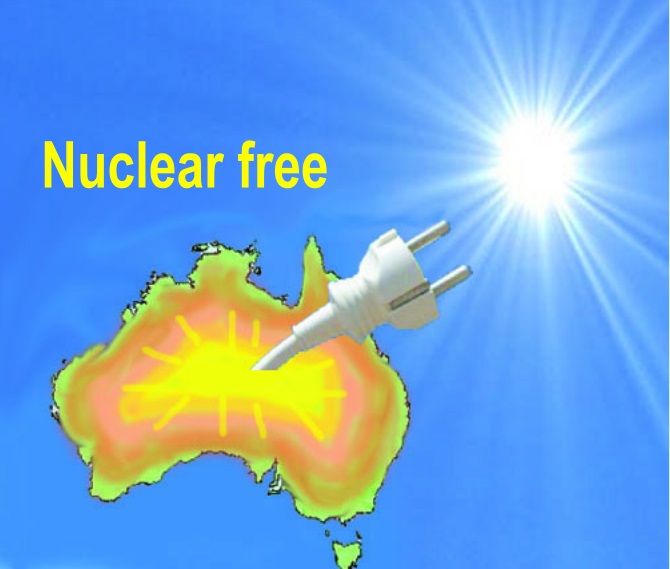
A massive increase in solar power generation capacity is already putting Australia on the fast track to a 100% renewable energy future.
An academic living in cold Canberra retired his gas heaters a few years
ago and installed electric heat pumps for space and water heating. His gas
bill went to zero. He also bought an electric vehicle, so his gas bill went
to zero. He installed rooftop solar panels that export enough solar
electricity to the grid to pay for electricity imports at night, so his
electricity bill also went to zero. That Canberra academic will get his
money back from these energy investments in about eight years. I am that
academic and I’m experiencing how rooftop solar coupled with
electrification of everything provides the cheapest domestic energy in
history. Solar energy is also causing the fastest energy change in history.
Along with support from wind energy, it offers unlimited, cheap, clean and
reliable energy forever. With energy storage effectively a problem solved,
the required raw materials impossible to exhaust – despite some
misconceptions in the community – and an Australian transition gathering
pace, solar and wind are becoming a superhighway to a future of 100%
renewable energy.
PV Magazine 29th May 2025 https://www.pv-magazine.com/2025/05/29/solar-puts-australia-in-fast-lane-to-100-renewables/
Treaty the planet’s best chance to get rid of its worst weapons

By Dave Sweeney | 19 May 2025, https://independentaustralia.net/politics/politics-display/treaty-the-planets-best-chance-to-get-rid-of-its-worst-weapons,19758
From Jakarta to the Vatican, Prime Minister Albanese’s journey underscores a global call to ban the world’s most destructive weapons, writes Dave Sweeney.
ON HIS FIRST overseas trip since his sweeping election victory, Prime Minister Anthony Albanese made for two very different destinations.
The first stop was steamy Jakarta, the capital of Indonesia, the world’s most populous island nation and home to the world’s largest Muslim population with around 240 million or 13 per cent of the globe’s believers.
After Indonesia, the PM switched time zones and belief systems and headed to the Vatican, the world’s smallest sovereign state in terms of area and population, and the (sacred) heartland of the Catholic faith.
These two places are very different worlds, with very different worldviews, but both have an active desire to protect our shared world from its most avoidable existential threat: nuclear war.
Prime Minister Albanese also holds this view.
In December 2018, he championed Federal Labor’s support for the newly adopted UN Treaty on the Prohibition of Nuclear Weapons (TPNW), stating:
“Nuclear weapons are the most destructive, inhumane and indiscriminate weapons ever created. Today we have an opportunity to take a step towards their elimination.”
The TPNW, adopted by the UN in 2017 with more than 120 nations voting in favour, grew from an Australian initiative by the International Campaign to Abolish Nuclear Weapons (ICAN).
ICAN was launched in Melbourne in 2007 and was awarded the 2017 Nobel Peace Prize in recognition of the group’s work ‘to draw attention to the catastrophic humanitarian consequences of any use of nuclear weapons’ and its ‘groundbreaking efforts to achieve a treaty-based prohibition of such weapons’.
The TPNW entered into force in January 2021, an act which has finally and formally seen nuclear weapons be declared unlawful under international humanitarian law.
Supporters of the TPNW have described the Treaty as our planet’s best way to get rid of its worst weapons.
The fragile and fractured global situation starkly highlights the urgency of this task.
Two nuclear weapon states, Israel and Russia, are actively involved in hot wars.
Two more, India and Pakistan, are engaged in risky posturing that could dramatically escalate, while two others, China and the United States, are shaping up for a trade war with hints of worse to come.
Against this grim background, the TPNW is a star that provides some light and hope and a navigation point to help chart a safer and saner course for our shared future.
Nations are embracing this path with half of the world’s countries having signed, ratified or acceded to the Treaty, including Indonesia and the Vatican/Holy See.
When it ratified the TPNW last September, Indonesia – a leading player in the global Non-Aligned Movement – made clear that ‘the possession and use of nuclear weapons cannot be justified for any reason’
Speaking at the time, then Foreign Minister Retno Marsudi posed the fundamental question and delivered the humane answer:
Should fear of nuclear weapons be our guarantee for peace? Indonesia’s answer will forever be no.
Indonesia reaffirms its commitment to a nuclear weapon-free world.
The late Pope Francis was a strong supporter of the TPNW and gave expression to the principle of “blessed are the peacemakers” with the Vatican’s championing and early adoption of the Treaty. The Pope described the very existence of nuclear weapons as “an affront to heaven”. In his final Easter Sunday sermon, shortly before he died, he made a powerful call for peace and weapons abolition.
These calls for nuclear abolition and for ways of addressing conflict that do not risk all that ever was, is or could be on our shared planet are finding a resonance and echo in many other nations.
Labor’s National Platform is clear:
Labor acknowledges the growing danger that nuclear weapons pose to us all and the urgent need for progress on nuclear disarmament.
Labor will act with urgency and determination to rid the world of biological, chemical and nuclear weapons.
Commits itself to redoubling efforts towards a world without nuclear weapons…
Labor in government will sign and ratify the Ban Treaty…
In this year that marks 80 years since the unveiling of the age of Armageddon with the first atom bomb test in New Mexico and the first atom bombings of the Japanese cities of Hiroshima and Nagasaki, it is time to turn a political platform into a prescription for a habitable world.
It is time for Australia to follow the example of Indonesia, the Vatican and many other nations and to show that the pen is mightier than the sword by signing the TPNW.
As they say, Prime Minister, when in Rome…
1 This Month
5 March -Online – Reversing nuclearization:
From nuclear weapons in Belarus and NATO host countries to a European-Nuclear-Weapon Free Zone
11am-12:30pm Eastern Time USA / 5pm-6:30pm CET

of the week – Advocating for a
nuclear free beach – https://www.samuellawrencefoundation.org/
The Samuel Lawrence Foundation advocates for a Nuclear Waste Free Beach at San Onofre, join us and take action!

10 March A LIVE WEBINAR THE REAL EFFECTS OF NUCLEAR POWER
What the Industry Isn’t Telling Us
1:00 PM Mountain, 2 pm Central, 3 pm Eastern. Live on the Keepers of the Water Facebook page

18 March Webinar @ 1 PM EST: An Assessment of SMR Projects: The Case of Canada
register for the zoom:
https://us02web.zoom.us/webinar/register/WN_o8BIIOUvQ2ONJR1nta65DQ#/registration

of the week – STOP SMALL MODULAR REACTORS IN CANADA
To see nuclear-related stories in greater depth and intensity – go to https://nuclearinformation.wordpress.com
-
Archives
- March 2026 (38)
- February 2026 (268)
- January 2026 (308)
- December 2025 (358)
- November 2025 (359)
- October 2025 (376)
- September 2025 (258)
- August 2025 (319)
- July 2025 (230)
- June 2025 (348)
- May 2025 (261)
- April 2025 (305)
-
Categories
- 1
- 1 NUCLEAR ISSUES
- business and costs
- climate change
- culture and arts
- ENERGY
- environment
- health
- history
- indigenous issues
- Legal
- marketing of nuclear
- media
- opposition to nuclear
- PERSONAL STORIES
- politics
- politics international
- Religion and ethics
- safety
- secrets,lies and civil liberties
- spinbuster
- technology
- Uranium
- wastes
- weapons and war
- Women
- 2 WORLD
- ACTION
- AFRICA
- Atrocities
- AUSTRALIA
- Christina's notes
- Christina's themes
- culture and arts
- Events
- Fuk 2022
- Fuk 2023
- Fukushima 2017
- Fukushima 2018
- fukushima 2019
- Fukushima 2020
- Fukushima 2021
- general
- global warming
- Humour (God we need it)
- Nuclear
- RARE EARTHS
- Reference
- resources – print
- Resources -audiovicual
- Weekly Newsletter
- World
- World Nuclear
- YouTube
-
RSS
Entries RSS
Comments RSS
 nuclear-news