Australia – now a world pariah with its anti climate action
Australia turns into ‘anti-climate’ force at Warsaw REneweconomy, By Giles Parkinson on 19 November 2013It has taken just 7 days, but already the reputation of Australia as a constructive force in international climate policy has been completely trashed – both in terms of its domestic actions and in the wrecking ball tactics it has sent to Warsaw.
Australia is now seen as an “anti-climate” nation that is actively working against any consensus at these talks, as its domestic policies are translated onto the international stage.
Australia has – many times over the 20-plus years of UN-led climate talks – been seen as an outlier, courtesy of its huge reliance on coal power and exports. But its actions in Warsaw have come as a shock to negotiators who are dealing with familiar faces who had been constructive, if not progressive, at previous conferences.
As mentioned in our report yesterday, the most common refrain being heard by Australian representatives is: What is going on down there? Continue reading
Australian uranium miner Paladin in a poor situation, battles to survive
 Weak uranium price hurts Paladin http://au.news.yahoo.com/thewest/business/a/-/national/19838677/weak-uranium-price-hurts-paladin/ Nick Sas, The West AustralianNovember 15, 2013, Paladin Energy has underscored the enormity of its battle for survival, admitting its African uranium mines lost $US14.9 million ($15.9 million) in the September quarter despite record production. Continue reading
Trans Pacific Partnership under a cloud, as people wake up to this corporate rot
The WikiLeaks release comes as developments in the US put the Trans Pacific Partnership under a cloud. More than 20 Republican Congressmen have written to President Barack Obama threatening to withdrawing the ”fast track” negotiating authority that allows him to close a deal. An influential group of Democrats is about to do the same.

Australia backs the US at every turn against its own consumers The Age, November 14, 2013 Peter Martin Economics correspondent, In public the Australian government is on the side of consumers. Yet behind closed doors it is siding with the US government to block them at every turn.
The extraordinarily detailed information on negotiating positions released by WikiLeaks shows Australia repeatedly backing the interests of the US against the objections of countries including Canada, New Zealand, Japan, Singapore and Vietnam on questions involving intellectual property. Australia is often the only one of the 12 parties to the Trans Pacific Partnership negotiations to do so…….. Continue reading
Film “Utopia” shows Australia’s history of oppression of Aboriginal people
John Pilger’s film Utopia, about Australia, is to be released in British cinemas on 15 November and in Australia in January

In the lucky country of Australia apartheid is alive and kicking John Pilger The Guardian, Wednesday 6 November 2013 “…….The parliament stands in Barton, a suburb of Canberra named after the first prime minister of Australia, Edmund Barton, who drew up the White Australia Policy in 1901. “The doctrine of the equality of man,” said Barton, “was never intended to apply” to those not British and white-skinned.
Barton’s concern was the Chinese, known as the yellow peril; he made no mention of the oldest, most enduring human presence on Earth: the first Australians. They did not exist. Their sophisticated care of a harsh land was of no interest. Their epic resistance did not happen. Of those who fought the British invaders of Australia, the Sydney Monitor reported in 1838: “It was resolved to exterminate the whole race of blacks in that quarter.” Today, the survivors are a shaming national secret…….
According to the Credit Suisse Global Wealth report, Australia is the richest place on Earth.
Politicians in Canberra are among the wealthiest citizens. Their self-endowment is legendary. …… Continue reading
With Murdoch Block you can free yourself from Rupert Murdoch’s disinformation
 How to block Murdoch Independent Australia, Torin Peel 3 November 2013, Sick of News Corp spin? Technology whiz Torin Peel explains how to erase Rupert Murdoch’s propaganda from your computer screens completely. IF YOU’RE ONE OF THOSE PEOPLE who simply won’t stand for Rupert Murdoch’s crap anymore, now might be the time to completely erase him from your computer screens for good. There are many ways to do this, and they’re remarkably simple.
If you’re ready to block News Corpse, the first way we can do this is using a plugin for Google Chrome. If you don’t use Chrome, I recommend you download it. It’s a lot faster and more modern than Internet Explorer. It’s also a lot easier to use and works better with most web pages, including websites like Twitter and Facebook.
The Google Chrome plugin is called Murdoch Block, and can be added to Chrome with relative ease through the Chrome extensions library…… http://www.independentaustralia.net/business/business-display/how-to-block-murdoch,5861
Trans Pacific Partnership kept secret from Australian citizens, but available to USA corporations
Right now we don’t know exactly what will be in the TPP, because it’s kept completely secret, unless you’re fortunate enough to be a wealthy lobbying organisation in the United States, who are provided access to the text through the US Trade Representative (USTR), and have direct input into it.
We urge the Abbott Government to release the TPP text before it’s too late to fix. Let’s not cripple Australian innovation in the interests of American profits.
 Why can’t Australian citizens read the Trans-Pacific Partnership Agreement? http://www.theguardian.com/commentisfree/2013/oct/30/trans-pacific-partnership-tpp-dfat?CMP=twt_guAs Journalists have been banned from a briefing about the TPP. Why the secrecy – and why can only wealthy lobbyists access the text? Only in Australia could the phrase “public briefing” mean that the meeting will be held behind closed doors, where journalists are not welcome.
Yesterday, the Department of Foreign Affairs and Trade (DFAT) rescinded the invitations of several journalists to attend a public briefing regarding a multilateral trade agreement under negotiation called theTrans-Pacific Partnership Agreement (TPP).
The TPP is an extensive agreement that covers typical topics such as goods and services, but also contains chapters on labour laws, intellectual property, the environment and investor-state dispute settlement provisions. This agreement is currently being negotiated completely opaquely between the US, Japan, Australia, Peru, Malaysia, Vietnam, New Zealand, Chile, Singapore, Canada, Mexico, and Brunei Darussalam. DFAT claims that it will be finished negotiating by the end of the year.
If you’ve never heard of the TPP, here’s a summary of the major issues: Continue reading
Australian rare earths company Lynas still in trouble in Malaysia
Residents though remain highly sceptical and opposition candidates running on an anti-Lynas platform won a raft of seats around the plant, in the May general election.
Lynas lost more than $107 million last financial year, and has informed the market that it’s set to report another quarter of reduced output, as it continues to work on the plant’s operational issues.
Deutsche Bank’s Chris Terry says the company’s share price is now around 40 cents, compared with its peak value of $2.30 in early 2011
Australian rare earths miner Lynas Corporation sparks fresh anger in Malaysia ABC News, Kate Arnott for Newsline 9 Oct 13Australian rare earths miner Lynas Corporation is refusing to publicly disclose the location of a permanent waste storage facility for its processing plant in Malaysia.
Earlier this year, Lynas started commercial production of rare earths, which are used in a wide range of high tech equipment, but the plant on the east coast of peninsular Malaysia has been plagued by operational problems. Continue reading
Uranium company Paladin downgraded by investment analysts
Translating business language – “outperform” – means good to invest. “Sector Perform” mean s not so good
Outperform. The stock’s total return is projected to exceed the average return of the industry (or its sector or its peers). This means the stock will perform better than the competition and is likely rated a “Buy”.
Sector Perform). The stock is expected to perform in line with the average return of the market or sector or its peers. Similar to a “Hold” or a “Neutral” rating.
Paladin Energy Limited Downgraded to Sector Perform at RBC Capital (PDN) North fork vue.com October 2nd, 2013 Paladin Energy Limited (ASX:PDN) was downgraded by investment analysts at RBC Capital from an “outperform” rating to a “sector perform” rating in a note issued to investors on Wednesday, American Banking News reports. They currently have a A$0.80 ($0.75) price target on the stock……..
A number of other analysts have also recently weighed in on PDN. Analysts at TD Securities cut their price target on shares of Paladin Energy Limited (ASX:PDN) from A$0.90 ($0.84) to A$0.65 ($0.61) in a research note to investors on Friday, August 30th. They now have a “hold” rating on the stock. Separately, analysts at BMO Capital Markets cut their price target on shares of Paladin Energy Limited (ASX:PDN) from A$0.80 ($0.75) to A$0.60 ($0.56) in a research note to investors on Friday, August 30th. Finally, analysts at Raymond James downgraded shares of Paladin Energy Limited (ASX:PDN) from an “outperform” rating to a “market perform” rating in a research note to investors on Monday, August 5th. Three equities research analysts have rated the stock with a hold rating and one has issued a buy rating to the stock. The stock presently has an average rating of “Hold” and a consensus price target of A$0.96 ($0.90).
Paladin Energy Ltd (ASX:PDN) is a uranium production company with projects in Australia and two operating mines in Africa. http://www.northforkvue.com/finance/10712/paladin-energy-limited-downgraded-to-sector-perform-at-rbc-capital-pdn/
Cripplingly low uranium price forces Paladin to cut costs
Paladin cuts top-echelon base salaries, overall spending amid low uranium price TIMES COLONIST OCTOBER 2, 2013 PERTH, Australia – Paladin Energy Ltd (TSX:PDN) is cutting the base salaries of its board and management by 10 per cent as part of cost-saving measures due to low spot prices for uranium — its main commodity.
In total, the miner — which lists its shares on the Toronto and Australian stock markets — is aiming to reduce cash costs for its 2014 financial year by US$23 million.
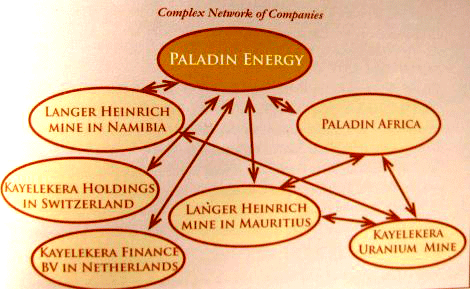
The cuts include a $10.8-million reduction in spending on overhead and exploration and a US$12.4-million reduction in discretionary capital spending at two mines in southern Africa….The Langer Heinrich mine in central Namibia will see its capital spending cut by US$10 million compared with the 2013 financial year while a further $2 million will be cut from the capital budget for the Kayelekera mine in Malawi. http://www.timescolonist.com/business/paladin-cuts-top-echelon-base-salaries-overall-spending-amid-low-uranium-price-1.645930
Australian government colludes with uranium miners in displacing Aboriginals from their homelands
“As an elder of the Yankunytjatjara and the APY Lands I state my absolute disappointment and disgust with the governments of South Australia and the Commonwealth. I say “NO” to mining in APY Lands and I say “NO” to homeless centres being built for our people away from their traditional homelands.”
Elder believes the APY Land is being dismantled http://cooberpedyregionaltimes.files.wordpress.com/2008/11/coober-pedy-regional-times-12-09-2013.pdf, by Yami Lester, (OAM) Order of Australia Medal)
Yankunytjatjara Elder Yami Lester is deeply disturbed by the exodus of Anangu from the APY Lands over the past several years. Big mining has been approved for the area but there are no jobs.. He says many families are not returning, causing a decline in the population of the lands. Lester who was awarded the Order of Australia medal in 1981 for service in the field of Aboriginal Welfare says,“The governments are now impatient to mix Anangu into the mainstream, hundreds of kilometres from their homelands.
Rupert Murdoch’s role in installing Australia’s puppet Prime Minister
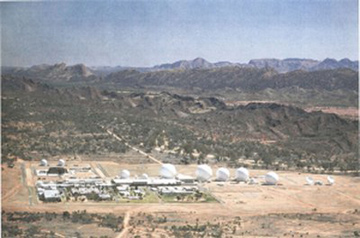 In 1975, the USA – with it’s secret militaristic plans for Pine Gap, in the Central Australian desert – played a critical part in the removal of Australia’s Prime Minister Gough Whitlam
In 2010 multinational mining companies were behind the push to remove Kevin Rudd, and his Mining Super profits tax. I don’t buy the argument that Kevin Rudd was such a difficult personality that Labor had to kick him out. Anyway, Julia Gillard replaced Rudd’s mining tax with a weak as water mining tax. But the corporate powers still weren’t happy.
How were these foreign owned companies, like BHP, able to prevail? Predominantly by promoting the message of climate change denial. And how did this message prevail in Australia, where in 2007, Kevin Rudd was swept to power on a wave of public enthusiasm for action on climate change?
Despite some well informed coverage on climate change, by the Fairfax media, the ABC and SBS, the denialist message, taken up by the right wing politicians and friends of polluting industries, was steadfastly pushed to the public by Rupert Murdoch’s media, with its 70% ownership of Australian media.
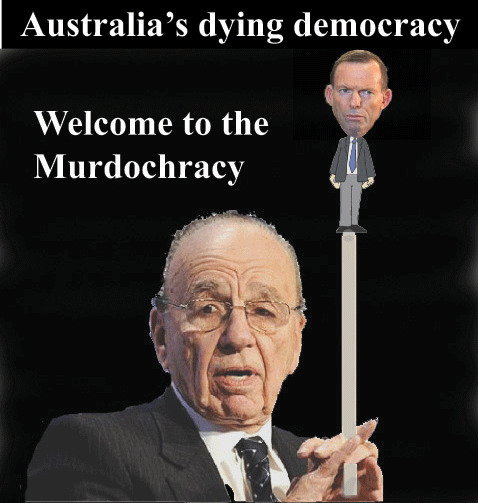
There was an easy puppet waiting there for them. Tony Abbott has but one over-riding value – and that is To Be Topp. There might be a few very right-wing Catholic religious themes in there – (ones which many Catholics would be ashamed of) But as for other trifling subjects like climate change, – well they don’t bother Tony Abbott, as he doesn’t understand them.
Nobody seems to notice the fact that Australia is now President of the United nations Security Council. And the UN has not sanctioned an attack on Syria. But the USA might very well attack Syris unilaterally, with out waiting fir the UN. And what will Australia do?
And how confident do you feel about all this, with the vacuous Tony Abbott at the helm of thegood ship Australia?
Legal firm Ashurst threatening Australian nuclear/uranium critic. Ashurst replies.
Among other things, the Ashurst letter accused the anti-nuclear campaigner of imputing that Mr Walker was ‘’insensitive’’.
 In any case, these kinds of threats to muzzle free speech are on the rise. At a time when the mainstream media is under pressure from falling revenues, lawyers are threatening and shutting down websites around the country at an alarming clip.
 Anti-nuke campaigner braces for legal blast, The Age, December 19, 2012 Michael West Ashurst is at it again.
Acting on instructions from its clients, the big law firm last month was threatening a farmer who had the hide to express his opinion on electricity prices. This month it has been instructed to threaten a 75-year old pensioner who has spoken out against the alleged exploitation of African workers by an Australian uranium miner.
Noel Christina Macpherson Wauchope, who runs the website www.antinuclear.net under the name Christina Macpherson, told BusinessDay she was not in a position to hire lawyers.
“I think they must have thought AntiNuclear Australia was a big organisation, but it is just me,” she said. She was particularly worried that the letter of demand said “STRICTLY CONFIDENTIAL NOT TO BE PUBLISHED” until we explained that there was no legal basis for expecting confidentiality from somebody who simply bobbed out of the blue with a bunch of threats and told you to keep quiet about it.
If you already had some kind of confidential or contractual arrangement with the other party, it might be different…… The price of Noel Wauchope’s concern for the people Karonga was a long and intimidating letter of demand from Ashurst on behalf of the uranium company Paladin Energy and its general manager of international affairs, Greg Walker. If she did not comply with these demands, warned Ashurst, she would face court action.
Curiously, big companies with more than 10 employees are not permitted to sue for defamation yet the concerns notice sent to Noel Wauchope complains about defamation of Paladin.
The Ashurst defamation partner responsible for the letter was unavailable for comment. and did not respond to questions. Neither did Ashurst’s public relations department. Paladin chief executive John Borshoff said he was unaware of the
letter. “I’m not aware about a 75-year old lady,” said Borshoff, “All I know is that these NGOs (Non-Government Organisations) and they are
absolutely maligning us, and we sent them legal letters”.
Neither was Borshoff aware that Paladin was unable to sue for defamation……
Among other things, the Ashurst letter accused the anti-nuclear campaigner of imputing that Mr Walker was ‘’insensitive’’.
In any case, these kinds of threats to muzzle free speech are on the rise. At a time when the mainstream media is under pressure from falling revenues, lawyers are threatening and shutting down websites around the country at an alarming clip.Read more: http://www.theage.com.au/business/antinuke-campaigner-braces-for-legal-blast-20121219-2bm74.html#ixzz2FeGIYe9h
 27 August 2013
Dear Ms Wauchope
Thank you for giving me ths opportunity to respond to the article which you have posted on your websites. I trust that you will post this letter with equal prominence. Fairfax is no longer publishing it, has accepted that I and Ashurst acted ethically and competently at all times, and has withdrawn and apologised for the suggestions in the article to the contrary.
Your article contains a number of errors and says anumber of false and damaging things about me. In particular, when I sent you the letter on 10th December 2012, I had no way of knowing who you were, as we were sending it to you as a domain name registrant. Your site appeared to be published by an organisation. Further, I at all times acted in accordance wit proper legal practise, and my professional obligations to my client.
I hope that you will rethink your decision to continue to publish incorrect and harmful allegations about me.
Kind regards
Ashurst lawyer
Editor’s note: I don’t understand why Fairfax withdrew the article from their online publication, as I thought that the article was true. I understand that the journalist who wrote that article stands by the story and has not accepted the claims made by Ashurst. I am posting below , the article in question, published earlier on this website.
Ashurst Australia responds to article criticising it
27 August 2013
Dear Ms Wauchope
Thank you for giving me ths opportunity to respond to the article which you have posted on your websites. I trust that you will post this letter with equal prominence. Fairfax is no longer publishing it, has accepted that I and Ashurst acted ethically and competently at all times, and has withdrawn and apologised for the suggestions in the article to the contrary.
Your article contains a number of errors and says anumber of false and damaging things about me. In particular, when I sent you the letter on 10th December 2012, I had no way of knowing who you were, as we were sending it to you as a domain name registrant. Your site appeared to be published by an organisation. Further, I at all times acted in accordance wit proper legal practise, and my professional obligations to my client.
I hope that you will rethink your decision to continue to publish incorrect and harmful allegations about me.
Kind regards
Ashurst lawyer
Editor’s note: I don’t understand why Fairfax withdrew the article from their online publication, as I thought that the article was true. I understand that the journalist who wrote that article stands by the story and has not accepted the claims made by Ashurst. I am posting below , the article in question, published earlier on this website.
Australia’s old Has-Been Hawke – in the grip of the nuclear lobby
Greens condemn plan to turn Australia into the world’s nuclear waste dump Australian Greens spokesperson on nuclear policy, Senator Scott Ludlam. 24 August 2013. The Greens have strongly rejected the proposal by former Labor Prime Minister Bob Hawke to turn Australia into a dump for the world’s nuclear waste.
Greens spokesperson Senator Scott Ludlam said the plan was “the worst imaginable way to raise revenue”.
“What Mr. Hawke is proposing is criminal activity. The Parliament passed Greens amendments last year to prohibit the importation of nuclear waste.

“Mr Hawke seems to think the way to fill the Budget hole is to fill a hole in Australia with the world’s nuclear waste. The Labor Party and the Coalition must rule out this dangerous proposal immediately.
“Having seen both the Howard and Rudd-Gillard Governments make an absolute mess of trying to force a dump for Australian nuclear waste on Tenant Creek in the Northern Territory, heaven help us if they were trying to deal with nuclear waste from around the world as well.
“The question is – is Mr Hawke expressing this view as a hobby or as an earner on the side? If he has any commercial interests in a waste management company he should make that clear now
Australian government’s hypocritical pretense of ‘helping’ Julian Assange
 Australia could seek an assurance from Sweden that following the completion of all Swedish legal proceedings that Assange would be deported to Australia. This would be an entirely appropriate outcome for an Australian citizen who has been subject to extradition to a foreign country.
If the Gillard government was able to obtain these diplomatic assurances, which are consistent with international law, then Assange would face his accusers in Sweden and not face the prospect of onward extradition to the United States.
How Australia can end the Assange stalemate The Drum Australia can help Julian Assange negotiate his legal problems while remaining consistent with the norms of international law and with the level of assistance that would be offered to other Australians, writes Donald Rothwell. …….. the UK has indicated that it does not recognise Ecuador’s granting of asylum and if Assange were to leave the Embassy he is liable to arrest and extradition to Sweden.
Ecuador revealed in mid-August – as the Assange matter reached a pivotal point- that Britain had threatened to rely on its Diplomatic and Consular Premises Act and revoke the Ecuadorian Embassy’s diplomatic protection so as to enter and seize Assange.
This threat was extraordinary and without modern precedence and it was unsurprising that the Ecuadorian Government responded with such fury. British Foreign Secretary William Hague has now downplayed any suggestion that the Ecuadorian Embassy will be raided, and emphasised Britain will act consistently with international law.
Nevertheless, Hague and the British government have made it clear that they have a legal obligation to Sweden to extradite Assange and that they will continue to seek his arrest for breach of his bail  conditions……..
Australia has been remarkably silent on some of these recent developments. Throughout the year Assange has been highly critical of what he claims has been a lack of support from the Australian government, but Foreign Minister Bob Carr insists that Assange has received more consular assistance than any other Australian in similar circumstances.
The reality is that Australia can still play a proactive, and perhaps even pivotal role, in seeking to bring about a resolution to the current stalemate. Continue reading
1 This Month

of the week – Shut Down Drone Warfare!


Tell the Ukrainian Government to Drop Prosecution of Peace Activist Yurii Sheliazhenko

Petition to revoke the licensing of the Near Surface Nuclear Disposal Facility (NSDF) at Chalk River. https://www.ourcommons.ca/petitions/en/Petition/Details?Petition=e-7247
To see nuclear-related stories in greater depth and intensity – go to https://nuclearinformation.wordpress.com
-
Archives
- April 2026 (103)
- March 2026 (251)
- February 2026 (268)
- January 2026 (308)
- December 2025 (358)
- November 2025 (359)
- October 2025 (376)
- September 2025 (257)
- August 2025 (319)
- July 2025 (230)
- June 2025 (348)
- May 2025 (261)
-
Categories
- 1
- 1 NUCLEAR ISSUES
- business and costs
- climate change
- culture and arts
- ENERGY
- environment
- health
- history
- indigenous issues
- Legal
- marketing of nuclear
- media
- opposition to nuclear
- PERSONAL STORIES
- politics
- politics international
- Religion and ethics
- safety
- secrets,lies and civil liberties
- spinbuster
- technology
- Uranium
- wastes
- weapons and war
- Women
- 2 WORLD
- ACTION
- AFRICA
- Atrocities
- AUSTRALIA
- Christina's notes
- Christina's themes
- culture and arts
- Events
- Fuk 2022
- Fuk 2023
- Fukushima 2017
- Fukushima 2018
- fukushima 2019
- Fukushima 2020
- Fukushima 2021
- general
- global warming
- Humour (God we need it)
- Nuclear
- RARE EARTHS
- Reference
- resources – print
- Resources -audiovicual
- Weekly Newsletter
- World
- World Nuclear
- YouTube
-
RSS
Entries RSS
Comments RSS
 nuclear-news