Freydenberg said the facility would ‘only’ house low and intermediate level waste. Perhaps he is unaware of the toxicity of this LLILW. Dr Green again: ‘When the spent fuel is removed from the reactor, it is high-level nuclear waste. After some months it cools down and falls below the heat criterion so is reclassified as LLILW.’
The farmer opponents of the Kimba sites are right to be concerned. The spent fuel reprocessing waste will be hazardous for thousands of years.
 South Australia’s nuclear threat continues http://www.eurekastreet.com.au/article.aspx?aeid=45708#.VkuCE9IrLGh Michele Madigan | 17 November 2015
Last Friday 13 November, the federal government released the shortlisted sites of the proposed national radioactive waste facility. No surprise that three are in South Australia, the ‘expendable state‘: Cortlinye and Pinkawillinie near Kimba on Eyre Peninsula, and Barndioota near Hawker, north of Port Augusta.
I wonder if South Australians aren’t beginning to feel like nuclear particles themselves, bombarded on all sides by the nuclear industry. This announcement from the federal government about its nuclear repository plans comes as the state government continues to consider, through its Royal Commission, whether, when and where South Australia will offer to host the world’s high-level nuclear waste.
The six names on the federal government shortlist (the remaining three being Sallys Flat in NSW, Hale in the Northern Territory and Oman Ama in Queensland) are taken from an original list of 28 properties that were offered by their landowners. It’s disturbing to find that the owner of the Cortilinye site, at least, has been misinformed,believing ‘It’s basically only a medical waste facility.’
In reality, only 10–20 per cent of the radioactive waste is medical in origin. And nuclear medicine is in no way affected by the lack of a national repository.
Resources and energy minister Josh Freydenberg’s Friday announcement included a masterly sentence of understatement: ‘Low level waste is those gloves or those goggles or the paper or the plastic that comes into contact with nuclear medicine, and intermediate waste could be, for example, those steel rods that are used in the reactor to actually create these particular products.’
It’s interesting to notice what’s different and what stays the same from the 1998–2004 ‘dump’ campaign in SA.Former science and energy minister Nick Minchin’s ultimately unsuccessful task back then was the imposition of a national dump on a South Australian community. His favourite low-level waste examples were watches that shine in the dark.
Senator Minchin however was not quite as casual as Freydenberg about what the intermediate waste ‘could be’. While Freydenberg seems to be casting around for an arbitrary ‘example’, the ‘steel rods’ he refers to, which are still travelling by sea from France back to Australia, are in fact long-lived intermediate level radioactive waste (LLILLW). As Dr Jim Green of Friends of the Earth explains:
‘Despite the name, spent fuel is orders of magnitude more radioactive than the original uranium ore. The spent fuel reprocessing waste returning from France will be stored at Lucas Heights, south of Sydney, and is then destined for ‘interim’ above-ground storage at one of the six sites.
‘Oddly, the government is making no effort to find a final disposal site for LLILW,’ he adds, even though ‘according to international standards, it should be subject to deep underground disposal, some hundreds of metres underground.’
Freydenberg said the facility would ‘only’ house low and intermediate level waste. Perhaps he is unaware of the toxicity of this LLILW. Dr Green again: ‘When the spent fuel is removed from the reactor, it is high-level nuclear waste. After some months it cools down and falls below the heat criterion so is reclassified as LLILW.’
The farmer opponents of the Kimba sites are right to be concerned. The spent fuel reprocessing waste will be hazardous for thousands of years.
All the while, the push for welcoming the world’s most dangerous material continues within SA — despite 40 per cent of SA’s electricity currently supplied by renewable energy.
It’s interesting how ethics enters the debate on the pro-nuclear side. With uranium just .02 per cent of the nation’s export dollars, Premier Weatherill has quoted ‘some’ who saw that because SA has 70 per cent of Australia’s uranium reserves ‘we’re duty bound to play our role in storing the waste’. In a signed letter to me earlier this month he was more direct.
The environmentalist refutation is more logical. The people do not choose to export uranium, but governments and companies do. If any government imports uranium then, just as with any other product, they import the responsibility of dealing with it.
As South Australia contemplates the renewed prospect of hosting both national and international radioactive waste sites, the stakes are high, especially for local Aboriginal populations whose collective memories include both the British mainland atomic tests of the 1950s and 1960s, and the successful campaign of 1998–2004 opposing a proposed national dump.
‘We live off the land,’ one young man from Coober Pedy wrote informally to the Royal Commission. ‘We go bush, we gather our food out there. We don’t want radioactive waste to destroy our land. It’s going to contaminate everything — our creeks, our water, our family.’
‘We don’t want the nuclear waste to be on our lands,’ Mima Smart, chairperson of Yalata, told me. Yalata is the place to which the people of the Maralinga Lands were removed to in 1952, a year prior to the first mainland explosion in the British nuclear test series.
‘Long ago our people didn’t have any rights and went through the bomb,’ she says. ‘That’s why we haven’t got Old People today. But these days we have our legal rights. How many more people do they want to die like what we seen?’
November 18, 2015
Posted by Christina Macpherson |
AUSTRALIA, wastes |
Leave a comment
 Medical radioactive wastes — the nuclear industry fig leaf, Independent Australia, 17 Nov 15 With modern developments in the non-nuclear production of medical isotopes, perhaps it’s also time to shut down the Lucas Heights nuclear reactor and stop producing dangerous radioactive trash, writes Noel Wauchope.
Watching the Australian media last week, you would be sure that the government’s hunt for a nuclear waste disposal site was solely to do with medical wastes. Rarely do they mention the real impetus for this hasty search, which is Australia’s current obligation to take back processed nuclear wastes from France. Later, we will have to receive similar wastes returning from UK. …..
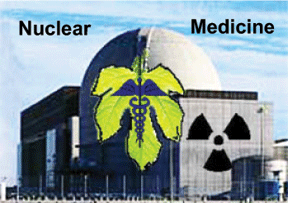
the vast majority of medical radioisotopes have very short half-lives, so there’s no need for them to be moved beyond the site of use…. The real problem is the returning intermediate level wastes from Australia’s used nuclear fuel rods reprocessed overseas….
it must be acknowledged that the medical radioisotopes produced at Lucas Heights do have their valuable uses in diagnostics and in the treatment of cancers.
However, it also must be recognised that all these radioisotopes can be produced without use of a nuclear reactor. This is happening increasingly and, rather like the distributed renewable energy boom, the world could be on the brink of a distributed medical radioisotope boom.
Canada and some in the USA certainly think so, judging by recent reports. The World Nuclear Association reports on University of British Columbia’s success in quadrupling the rate of production of medical radioisotopes using a (non-nuclear) cyclotron. Nova Scotia’s QEII Health Sciences Centre’s cyclotron was granted a Drug Establishment Licence (DEL) from Health Canada in June 2015
In USA, Niowave Inc, NorthStar Medical Radioisotopes and SHINE Medical Technologies, are competing in the market for medical isotopes, produced in a (non-nuclear) linear accelerator.
The non-nuclear production of medical isotopes has it all over the centralised production by nuclear reactor. This is not just because it eliminates the obvious dangers of nuclear wastes, weapons proliferation, terrorism risks, disastrous accident, and radiation emissions.
It’s because the greatest uses of medical radiopharmaceuticals involve very short-lived isotopes…….That makes them much better suited to localised production, in or near hospitals. The delivery of pharmaceuticals to patients is much more secure. In addition, the risk of transport accidents is close to zero……..
With all the fuss about finding a dump sites for ‘Olympic sized pools of medical radioactive waste‘, it is time for the government and media to fess up to the real purpose of this hunt. And with modern developments in the non-nuclear production of medical isotopes, perhaps it’s also time to shut down the Lucas Heights nuclear reactor and stop producing dangerous radioactive trash.https://independentaustralia.net/environment/environment-display/medical-radioactive-wastes–the-nuclear-industry-fig-leaf,8384
November 16, 2015
Posted by Christina Macpherson |
AUSTRALIA, health, spinbuster |
Leave a comment
 When nuclear reactors shut (as they are doing in USA) – where is the income stream to pay Australia for having all that radioactive trash?
 Proponents are talking up the billions that might be made by swallowing our pride and making Australia the world’s nuclear waste dump. But they have been silent about the costs.
And the waste would need to be monitored and problems addressed for millenia
Wasting Australia’s Future: Why We Shouldn’t Become The World’s Nuclear Waste Dump, New Matilda, By Dr Jim Green on November 9, 2015 There are many good reasons why Australia should not set its sights on becoming a dumping ground for nuclear waste. Dr Jim Green takes up the case.
While sceptical about the prospects for nuclear power in Australia, Prime Minister Malcolm Turnbull has given cautious support to the idea of a nuclear fuel leasing industry in Australia. Such an industry would involve uranium mining, conversion (to uranium hexafluouride), enrichment (increasing the ratio of uranium-235 to uranium-238), fuel fabrication, and disposal of the high-level nuclear waste produced by the use of nuclear fuel in power reactors overseas.
In the Prime Minister’s words: “We have got the uranium, we mine it, why don’t we process it, turn it into the fuel rods, lease it to people overseas, when they are done, we bring them back and we have got stable, very stable geology in remote locations and a stable political environment.”
Regardless of its merits, a nuclear leasing industry is an economic non-starter. That much is clear from the data provided in the latest edition of the International Atomic Energy Agency’s Nuclear Technology Review. Uranium miners could be compelled to participate in an Australian nuclear leasing industry. But try telling that to BHP Billiton. The company bluntly stated in its submission to the 2006 Switkowski Review: “BHP Billiton believes that there is neither a commercial nor a non-proliferation case for it to become involved in front-end processing or for mandating the development of fuel leasing services in Australia.”
And there’s no point appealing to the patriotic fervour of Australia’s uranium miners: they are majority foreign-owned. Continue reading →
November 9, 2015
Posted by Christina Macpherson |
AUSTRALIA, wastes |
Leave a comment
You’ll never guess how much this Australian nuclear power plant will cost, http://www.bizjournals.com/pittsburgh/blog/energy/2015/11/youll-never-guess-how-much-this-australian-nuclear.html Matt Stroud, energy reporter for the Pittsburgh Business Times. Nov 6, 2015 A nuclear power plant has never been built in Australia before, but Westinghouse is putting a price tag on a new one they’re hoping to build there.
The price? About $12.3 billion.

In testimony to Australia’s Nuclear Royal Commission — a body that’s investigating whether the
Australian state of South Australia should build the nation’s first nuclear power plant — Westinghouse executive
Rita Bowser said that price was all inclusive,
according to The Advertiser in Adelaide, South Australia. It would include land, environmental safeguards and construction.
“While it’s not exactly our estimate, we think it’s a very good basis for your assessment or comparison,” Bowser testified.
Australia has zero nuclear power plants — and is known for being extremely averse to nuclear energy; it won’t even allow nuclear ships into its ports.
The historical aversion won’t affect the price much, apparently; the company’s guesstimate is in line with its current Vogtle project in Georgia, which has been plagued by cost overruns. It’s less than a comparable Chinese project, set to cost $24 billion. And it’s cheap in comparison to a project proposed in Johannesburg that could cost $100 billion.
The South Australia project’s future is fluid at the moment: the Nuclear Royal Commission hasn’t even decided whether it wants to recommend a nuclear facility.
That decision is set to come in May 2016. Tokyo-based Toshiba Corp. (TYO: 6502) owns 87 percent of the Cranberry-based Westinghouse Electric Co.
November 7, 2015
Posted by Christina Macpherson |
AUSTRALIA, business and costs |
Leave a comment
 Ship carrying nuclear waste heads to Australia, West Australian CHERBOURG, AFP October 16, 2015 A ship carrying 25 tonnes of reprocessed nuclear waste is steaming to Australia despite protests from activists about an “environmental disaster waiting to happen”.
The BBC Shanghai left the northern French port of Cherbourg after approval from local officials, who carried out an inspection on Wednesday, and is due to arrive by the end of the year in NSW. It is laden with radioactive waste from spent nuclear fuel that Australia sent to France for reprocessing in four shipments in the 1990s and early 2000s, the Australian Nuclear Science and Technology Organisation says.
The reprocessing involves removing uranium, plutonium and other materials, with the remaining substances stabilised in glass and stored in a container…….
Greenpeace, French environmental campaign group Robin des Bois (Robin Hood) and a leading Greens MP have called for the shipment, sent by Areva, to be halted. “Areva, almost bankrupt, are using a dustbin ship to carry waste, without any serious inspection!” Denis Baupin a senior MP with the French green party, tweeted.
Greenpeace Australia Pacific said the ship, owned by German firm BBC Chartering, was an “environmental disaster waiting to happen”, claiming the Shanghai was “blacklisted by the United States because of its safety record”……
But Areva’s external relations director, Bernard Monnot, said the ship was “not banned from ports in the United States but banned from transporting material for the American government”.
Nathalie Geismar from Robin des Bois said other ports had found it had a “staggering number of flaws”……
ANSTO said the material would be kept at the Lucas Heights facility in southern Sydney until a nuclear waste dump site, which has yet to be chosen, is found and constructed……https://au.news.yahoo.com/thewest/a/29834316/ship-carrying-nuclear-waste-heads-to-australia/
October 16, 2015
Posted by Christina Macpherson |
AUSTRALIA, wastes |
Leave a comment
Aboriginal women reaffirm fight against nuclear waste dump in South Australia ABC Radio National, The World Today By Natalie Whiting 16 Oct 15 The first shipment of Australia’s nuclear waste to be returned from re-processing in France has now left a French port, and will arrive on our shores by the end of the year. The return of the 25 tonnes of nuclear waste is putting renewed pressure on the Federal Government to find a location for a permanent waste dump.
The shipment began its journey just a day after senior Aboriginal women gathered in Adelaide to mark their fight against a proposed dump in South Australia in the 1990s.
The women say they will fight against any new move to put the waste on their land…..
SA Aboriginal women remember waste dump victory A Federal Government plan to build a
 nuclear waste dump in the South Australian outback in 1998 attracted fierce opposition, especially among local Aboriginal people.
An event in Adelaide last night celebrated the work of a group of women called kupa piti kungka tjuta, who campaigned against the dump. Emily Austin from Coober Pedy was one of them. (centre in picture)
“We used to fight, we travelled everywhere – we went to Sydney, Melbourne, Adelaide,” she said.
“We were telling them that’s poison and you’re going to bury it in our country? “That’s no good.”
The women campaigned for six years until a Federal Court challenge from the South Australian government put an end to the dump. Ms Austin said she could remember the day the court found in South Australia’s favour.
“I was out in the bush hunting and I heard it on the radio in the Toyota. We were all screaming, ‘We won’.
“All the kungkas (women) were happy.”
While the Federal Government is in the midst of a voluntary process for finding a site for a dump, South Australia’s outback is still seen as an ideal location.
The South Australian Government’s attitude to the industry has been shifting.
It has launched a royal commission to investigate possible further involvement in the nuclear fuel cycle.The royal commission is looking at everything from mining uranium, processing, waste storage and nuclear power.
The organiser of last night’s event, Karina Lester, is the granddaughter of one of the women who campaigned and her father was blinded by the British nuclear tests at Maralinga half a century ago.
She said the Aboriginal people in South Australia’s north have a long and tortured history with the nuclear industry. “Maralinga’s had a huge impact because people speak from first-hand experience,” she said.
“People like the amazing kupa piti kungka tjuta, many of those old women who are no longer with us today, they were there the day the ground shook and the black mist rolled.
“It’s an industry that doesn’t sit comfortably with Anungu community.”
Ms Lester said it was good to see the royal commission consulting with people before a decision is made.”Credit to the royal commission that they’ve made an effort to engage with a broader community of Aboriginal communities,” she said.
“But how many of those Anangu are really understanding he technicality of this royal commission and what industry really means?” Ms Austin said she was ready to fight any future attempts to set up a waste dump in the region.
“Oh yeah, I’ve still got fight yet. They might stop yet, they might listen, I dunno,” she said. http://www.abc.net.au/news/2015-10-16/aboriginal-women-fight-against-nuclear-waste-dump-in-sa/6861012
October 16, 2015
Posted by Christina Macpherson |
AUSTRALIA, indigenous issues, opposition to nuclear |
Leave a comment
Why Australia is important to the Small Nuclear lobby.Independent Australia
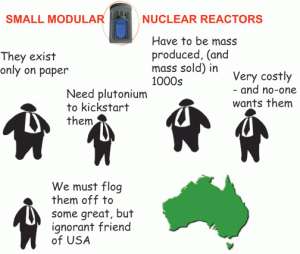 16 October 2015, Elsewhere in the world, proponents of small nuclear reactors are pitted against the large reactors, but here in Australia, as Noel Wauchope reports, proponents of small reactors see them as enabling conventional nuclear and uranium mining to flourish.
 QUIETLY, AND pretty much under the media radar, a dispute is going on in the global nuclear industry between the advocates of “Generation III” — big nuclear reactors, and “Generation IV” — small nuclear reactors…….
the nuclear lobby’s spiel to Australia is something different, and very original. No dispute — because the argument is that small reactors would further the large reactor industry.
First articulated by Oscar Archer on ABC RN, March 2015, the idea is that Australia, in setting up small nuclear reactors, would enable the conventional nuclear industry and uranium mining to flourish:….. As Archer says, Australia would indeed be the pioneer for the new technology.
And that’s what the USA “new nuclear” lobby desperately needs. They need this, because they’re finding it impossible to go ahead in America. Why? Well it’s those pesky safety regulations imposed by the Nuclear Regulatory Commission.
What the “Small Nuclear” lobby needs is a “nuclear friendly” country – one with less stringent safety
regulations – to set up their nuclear reactors on a test site. Hence the enthusiasm of those lobbyists for the South Australia Nuclear Fuel Chain Royal Commission, as shown, for example, in a recent Royal Commission hearing speech by Thomas Marcille of Holtec International nuclear company.
……… the Nuclear Regulatory Commission(NRC) has proved to be real nuisance since it tightened regulations for the licensing process after the Fukushima nuclear disaster. The new nuclear marketers have had to go overseas, first to China, then perhaps to Australia?…. https://independentaustralia.net/environment/environment-display/why-australia-is-important-to-the-small-nuclear-lobby,8263
October 16, 2015
Posted by Christina Macpherson |
AUSTRALIA, marketing, USA |
Leave a comment
Australia’s doctors will begin a campaign on Monday to warn world leaders that failure to make meaningful cuts to carbon dioxide emissions will cause a serious increase in heat-related illness and infectious diseases.
The Royal Australasian College of Physicians will hold a Global Day of Climate Action to put pressure on leaders at the coming United Nations climate talks in Paris in December.
Infectious diseases physician and senior lecturer at the Australian National University medical school, Dr Ashwin Swaminathan, said doctors are trying to raise awareness of serious health impacts caused by climate change. “Doctors want the community and our government representatives to know that health is at stake with climate change,” Dr Swaminathan said.
“The college recognises that climate change poses a risk to the health of all Australians across all regions.”
Health professionals have seen a spike in ambulance call-outs, hospital admissions and deaths during heatwaves, which are projected to increase further without checks on global emissions.
Dr Swaminathan said there will also be increases in water-borne and mosquito-borne diseases, with Australian disease specialists worried in particular about diarrhoea-causing bacteria and disease-carrying mosquitoes. Higher temperatures expand the areas in which these disease carriers can thrive.
Dr Swaminathan said the species of mosquitoes that can carry dengue fever, Ross River fever and Barmah Forest virus will be able to move further south in Australia under changed climate conditions.
Disease and climate change is attracting more attention from doctors. “It’s something that is becoming more discussed at infectious diseases forums,” Dr Swaminathan said.
The Royal Australasian College of Physicians has begun a Doctors for Climate Action campaign which, with the support of 50 medical organisations, is calling on world leaders to commit to meaningful targets for emissions reduction at the United Nations COP 21 Climate Change Conference in Paris.
October 12, 2015
Posted by Christina Macpherson |
AUSTRALIA, climate change |
Leave a comment
Ending subsidies, that amount to almost a quarter of the sale price in some cases, would hugely reduce carbon emissions, new research reveals
Coal subsidies are costing US and Australian taxpayers billions of dollars a year, according to a new report.
The research examined the subsidies given to coal production in the US’s largest coal field, the Powder River Basin, and found they totalled $2.9bn (£1.9bn) a year. This equates to $8 per tonne, almost 25% of the sale price.
Ending the subsidies would lead to cuts in coal use equivalent to shutting up to 32 coal-fired power stations, the researchers found, leading to a large reduction in carbon emissions.
The report also analysed Australia’s exporting of coal for power stations in Asia and found these came to $1.3bn a year, or $4 a tonne. Ending these subsidies would cut demand by up to 7%, a smaller impact than in the US because coal users could buy supplies from other countries.
“The fossil fuel industry has gamed energy market consumers, with numerous subsidies evident over the long term,” said Tim Buckley, at the Institute forEnergy Economics and Financial Analysis, who worked on the report. “Any discussion of cost competitiveness of renewable energy and energy efficiency needs to take into account the decades of extensive subsidies evident for the coal industry and that, in many cases, remain in place today.”
Luke Sussams, senior researcher at Carbon Tracker Initiative, also part of the research team, said: “Policy makers concerned about climate change and a level playing field in energy markets should look to take coordinated action to remove the distortions to production these subsidies create.”
The subsidies given to coal companies included tax breaks, cheap leases, government-funded infrastructure including railways and ports and allowing inadequate funding of clean-up operation after mining ends.
The G20 nations pledged to end fossil fuel subsidies in 2009, but little action has been taken. However, falling oil and coal prices in the last year have seen some countries starting to reduce subsidies.
A recent study by the International Monetary Fund (IMF) took into account not just direct subsidies but also the cost to nations of the damage caused by air pollution and global warming. It estimated coal, oil and gas were being subsidised by $5.3trn a year, more than the total health spending of all the world’s governments. Much of the cost is due to the illness and death caused by air pollution.
“Eliminating coal subsidies in the Powder River Basin and throughout the world, is an obvious, no-regrets climate strategy,” said Doug Koplow, of Earth Track and another member of the research team.
The new report, called Assessing Thermal Coal Production Subsidies, was produced by the Carbon Tracker Initiative, Energy Transition Advisors, the Institute for Energy Economics and Financial Analysis and Earth Track.
September 18, 2015
Posted by Christina Macpherson |
AUSTRALIA, business and costs, climate change, politics, USA |
Leave a comment
 Tony Abbott faces down Pacific island nations’ calls for tougher action on climate change
ABC Radio AM By Eric Tlozek in Port Moresby, 11 Sept 15 Prime Minister Tony Abbott has held his Government’s line on climate change despite pleas from low-lying Pacific island nations for a stronger stance on emissions and temperature rises.
Both Mr Abbott and New Zealand prime minister John Key refused to go further than their existing commitments on global warming at the Pacific Islands Forum in Port Moresby.
Some Pacific island leaders say they are disappointed in the leaders for putting economic growth ahead of the survival of communities in small Pacific nations.

“Australia and New Zealand have made no additional commitments when it comes to climate change,” Mr Abbott told reporters after the meeting last night……….
September 14, 2015
Posted by Christina Macpherson |
AUSTRALIA, climate change, New Zealand, OCEANIA |
Leave a comment
 Submission To The Nuclear Fuel Cycle Royal
Commission Regarding Issues Papers 1 and 4 byYurij Poetzl http://nuclearrc.sa.gov.au/app/uploads/2015/09/Yuri-Poetzl-24-07-2015.pdf

I’m a private citizen and have no vested interest in the nuclear industry; however the nuclear industry does direct ly impact me, my family and my friends As a member of the public I wish to give evidence and express my concerns in regard to the issues being examined by the Royal Commission.
It is valid to examine economics and risks relating to the nuclear industry; however is the Royal Commission a fair and objective examination of the Nuclear Cycle? It has been disclosed that Kevin Scarce Is a shareholder in the Rio Tinto Group,who own and operate  uranium mines in Australia and internationally. ls this a conflict of interest for the Royal Commissioner? It is of great concern that the Royal Commissioner has selected predominantly pro-nuclear experts for the R.C’s Advisory Committee (the single exception being Professor lan Lowe). See Appendix 1.
It also seems remiss that there isn’t any health or medical professionals engaged in the R.C’s Expert Advisory Committee or Key Commission staff. It’s well documented that by-products of the nuclear industry can have adverse effects on the health of the global community for many future generations. The omission of health experts makes me question whether the R.C is truly considering what is in my and the general public’s best interest.
The Public Health Association of Australia have made their position clear in regard to the R.C and the Nuclear Industry, see http :1 /www .phaa. net. au/ documents/item/51 0 or http://www .phaa.net.au/documents/item/264 The Royal Commission could prove to be pivotal in South Australia’s future having significant and far reaching consequences, affecting many future generations; however, was the process leading toward the establishment the Royal Commission flawed?
The S.A. public (and wider global communit y) deserve a balanced and unbiased assessment of the issues raised Appendix 2. Contains questions regarding issues papers 1 and 4 Yours sincerely Yurij Poetzl
Appendix. 1 4 of the 5 Royal Commissions Expert Advisory Committee appear to be pro nuclear. They are Professor Barry Brook, Dr Timothy Stone, John Carlson AM and Dr Leanna Read. Below is a brief summary oftheir involvement in the nuclear industry Professor Barry Brook is an active advocate of the Nuclear Industry. The self described”Promethean Environmentalist” is openly critical of people who have concerns regarding the Industry. Professor Brook is the author of, or contributor to several pro nuclear publications such as; Key role for nuclear energy in global biodiversity conservation, Australia’s nuclear options and, An Open Letter to Environmentalists on Nuclear Energy. To name a few.
Dr Timothy Stone is an advocate for nuclear power generation and nuclear industrial expansion in Australia. In the UK Dr Stone has held the position of Expert Chair ofthe Office for Nuclear Development and he is currently on the board of Horizon Nuclear Power as non-executive Director John Carlson AM has been Director General of the Australian Safeguards and Non-Proliferation Office. In part 6 of the introduction to Mr Carlson’s paper “Nuclear power for Australia”- an outline of the key issues he claims “Nuclear has a major advantage over other energy sources”. Later in the same document Mr Carlson states “Currently both major parties say that nuclear power is “offlimits”. While this is disappointing, at least it ensures neither side is making statements tlhat will later be embarrassing to retract” It is clear that Mr Carlson is pro nuclear providing the appropriate safeguards are met
Dr Leanna Read has publicly stated that she “has an open mind” regarding the Nuclear Industry. Dr Read is a Fellow of the Australian Academy ofTechnological Sciences and Engineering, which advocated for nuclear power in Australia in August 2014. This seems to contradict Dr Read’s claims of impartiality toward the nuclear industry Given the information in Appendix 1, can the Royal Commission be considered truly independent?
Appendix 2
- Question: 1. Even with best practice and best intentions, industrial accidents happen. What infrastructure is currently in place, should a truck loaded with uranium oxide be involved in an accident in the Metropolitan area and whilst doing so, have a breach of its load or catch fire?
- Question: 2. Is it possible to insure against a nuclear mishap and how is Public Liability insurance affected in an accident scenario?
- Question: 3.Many environmentalists believe that The Roxby Downs Indenture Act 1982 al lows wide ranging exemptions from key environmental laws such as the SA Environmental Protection Act 1993, Freedom of information Act 1991 and the Natural Resources Act 2004 critical water resources and Great Artesian Basin. Is this true?
- Question: 4. If the answer to question 3 is true, please explain how these exemptions are in the public interest?
- Question: 5.1s it possible that similar exemptions will be extended to waste dumps, uranium enrichment operations or nuclear power stations?
- Question: 6. Recent revelations by the EPA {Environmental Protection Agency) reveal widespread and irreversible groundwater contamination by industrial practices in several of Adelaide’s suburbs. Wouldn’t it be prudent for the Commissions terms of reference to contain a review of current uranium mining and transport practices?
- Question: 7. Would it be sensible to hold a review of the current condition of waterways and aquifers affected by mining practices before an expansion of SA’s nuclear industry commences?
- Question: 8. Since the proposed expansion of Olympic Dam a few years ago, has the SA public been receiving fair and balanced media coverage on the nuclear Industry, particularly in printed media?
- Question: 9. What has been the ratio of Pro/Con nuclear industry stories and editorials in the Advertiser Newspaper since 201 0?
- Question: 10. What influence has this ratio had on the general public’s current view towards the nuclear industry?
- Question: 11. Will the commission call on medical and health specialists to give their perspectives on the nuclear industry and its impact on workers within the industry and the wider community?
- Question: 12. Can Nuclear Energy really be defined as a low carbon emission energy source when millions of litres of Diesel are consumed in the Nuclear Cycle annually, particularly in the mining and transport of uranium oxide?
- Question: 13. Uranium waste products can take hundreds of thousands of years to halve their level of toxicity. Pyramids are amongst the oldest surviving manmade structures and are no more than 5000 years old. Therefore what assurances are there, that nuclear waste can be safely stored over much longer periods oftime?
- Question 14.1f South Australia is perceived to be a nuclear waste site by the global community, what will the impact be on Tourism, Real Estate, Food, Wine and manufacturing industries be?
- Question 15.Highly toxic Radon gas is released by the mining activities at Roxby downs and apparently can be detected in Antarctica. This gas must pass through Adelaide to get there. What is the effect of Radon gas to workers in the mines and what impact does it have on the wider community?
- Question: 16. What is the volume of airborne radioactive dust released into atmosphere by mining and storage of tailings exposed to the wind?
- Question: 17.What impact does radioactive dust released by mining practices, have on the Australian public, fauna and flora?
- Question: 18.Presumably nuclear waste will be transported from Port Adelaide to its storage destination. What would be the outcome, in the advent of an accident, or fire to the transport within the M etropolitan area?
- Question: 19. 33.6 percent of Australian uranium is exported to North America. The US military has depleted uranium coated ammunitions and armaments, such as bullets and tank shielding. There have been reports claiming an alarming rise of birth defects to children of returned US soldiers and civilians occupying militarised zones. These reports claim the birth defects can be attributed to use of depleted uranium coated ordnance. What checks are in place to guarantee no Australian uranium or its by-products is used to coat US military
- Question: 20. Has uranium coated ordinance or tank shielding been used by the United States Army in war games in central Australia?
- Question: 21. Prior to his selection as “Chair of the Royal Commission” Kevin Scarce had aligned himself with CEDA (the Committee for Economic Development In Australia). CEDA’s Policy Perspectives of Nov 2011 clearly supports and promotes the growth of South Australia’s nuclear industry. Is this a conflict of interest for the Royal Commissioner?
- Question: 22.There are cl ips on You T ube(see Aug 12th 2014) where Kevin Scarce confirms his association with CEDA, using terms like “we were able to get our draft report considered by government. ” Given his connection with CEDA and their pro nuclear stance, is Kevin Scarce truly impartial and unbiased in regard to South Australia’s nuclear issues?
- In Summary To be considered an effective, balanced, honest and legitimate assessment of SA’s role in the nuclear cycle, the Royal Commission needs to assess and answer many more tough questions than the ones listed above. Kind regards Yu.rij Poetzl Adelaide South Australia
September 10, 2015
Posted by Christina Macpherson |
AUSTRALIA, secrets,lies and civil liberties, spinbuster |
3 Comments
South Australia is having a Nuclear Fuel Chain Royal Commission, with the goal of making that State the world’s nuclear toilet, and guinea pig for new experimental nukes. They invited submissions (published at http://nuclearrc.sa.gov.au/submissions/?search=Submissions.) Of course nuclear companies are sending them in. But the rules are that the corporate submissions don’t have to be published. So the nuclear lobby has to rely mainly on non-corporate enthusiasts for published submissions.
And boy – do some of them put in crummy submissions.
I was particularly taken with this one, and the author’s idea that falls from solar paneled roofs are a bigger health problem than Fukushima radiation.
 Geoff Russell, Extract from Submission to the South Australian Nuclear Fuel Chain Royal Commission “……The Royal Commission is uniquely placed to learn from the past, but it will need to deal with the drivers of nuclear fear in the community. To build confidence in the community, the Commission’s report will need to convince both sides of politics to speak with one voice about the misinformation that drove (and drives) the Fukushima evacuation.
Appeasement, in the form of more and more levels of safeguards and protocols to attempt to say that “it can’t happen here” isn’t the answer. There will always be accidents despite every effort to avoid them. Planes still crash, but people understand the relative risks and board them regardless of personal fear.
They understand that fear is their personal problem and not a function of the objective facts. So it’s time to put nuclear accidents into perspective and stop treating them as something fundamentally different.
The fear and irrationality at Fukushima saw people die to avoid a trivial risk. Governments are supposed to protect people from nutters, not act on their behalf.
All energy sources have risks and in a rational world they’d be compared according to proper measures of suffering and disability; the simple trigger sequence logic (“nuclear -> cancer -> end of civilisation”) of decades past shouldn’t be allowed to influence decision making in 2015.
In Australia in 2010-11 there were 7730 Worker’s45 Compensation claims for serious injury resulting from falls from a height. How many were associated with rooftop solar panels? As far as I can see, nobody is even counting, but a million solar rooftops means more people on ladders; many of them amateurs. This is real danger, the kind that can put you in a wheel chair for the rest of your life. A proper comparison of nuclear risks with those of other energy sources will measure and include such risks along with the considerable risks associated with not avoiding continued climate destabilisation because we acted too slowly. We need safe clean energy and climate scientists say we need it fast. The Royal Commission will need to break with past traditions and confront nuclear fear head on and call it for what it is.”
September 6, 2015
Posted by Christina Macpherson |
AUSTRALIA, spinbuster |
Leave a comment
Australia’s inaction on climate change set to dominate Pacific Island talks, Guardian, 6 Sept 15 Australia and New Zealand are expected to face strong criticism from Pacific Island leaders disappointed the nations are not doing more to combat climate change.

The issue will likely dominate this week’s Pacific Islands Forum leaders summit in Port Moresby, ahead of the United Nations climate change conference in Paris later in the year.
Pacific leaders want the world to work on restricting the global warming temperature rise to 1.5C, fearing a 2C target will risk the survival of many tiny islands.
Natural disaster recovery will be fresh on their minds. The summit starts on Monday, six months after Cyclone Pam, which flattened much of Vanuatu and caused heavy flooding on Tuvalu, Kiribati and the Marshall Islands.
Host nation Papua New Guinea is grappling with the opposite problem – what could be its worst drought in 20 years and a potential food crisis.
The prime minister, Peter O’Neill, has said El Niño conditions have been exacerbated by the effects of climate change.
The Solomon Islands and Vanuatu are also experiencing a dry spell………
The Pacific Island Forum runs from 7-11 September. http://www.theguardian.com/world/2015/sep/06/australias-inaction-on-climate-change-set-to-dominate-pacific-island-talks
September 6, 2015
Posted by Christina Macpherson |
AUSTRALIA, climate change, OCEANIA |
Leave a comment
In Muller’s previous presentations on his YouTube show Veritasium, he has consistently confused the 
naturally occurring radioactive potassium K, with the nuclear fission produced radioactive isotopes…..Muller seems to have no understanding of the way in which bananas are used in the body
What Muller and Thomas are doing is following the script from the tobacco and asbestos industries.
This documentary “Uranium – twisting the Dragon’s Tail” is just Series One. I would love to know who helped to fund Gene Pool Productions for PBS and SBS to produce this. I’m betting that Series Two will follow before long, with a glossy and positive story about Generation IV nuclear reactors.
 The half lie of the Dragon’s Tail. Online opinion, By Noel Wauchope Thursday, 27 August 2015 The documentary “Uranium – Twisting the Dragon’s Tail” is the latest glossy and highly sophisticated soft sell for the nuclear industry. It’s also, if you look at it closely, rather confusing.
I will start from the end, because that’s where the main message of this film comes out clearly “Just imagine a world where reactors can produce immense amounts of clean, safe, energy. There is no such thing as a future without uranium.” These final words are said against a background of soaring celestial choirs.
This seems to be the formula now, in nuclear promotion. The 2013 propaganda film “Pandora’s Promise” carried the same positive message – an ever rocketing energy demand to be met by ever increasing, indeed limitless, electrical energy provided by new nuclear reactors.
But, like ‘Pandora’s Promise’, this new documentary devotes the first two thirds of its series to discussing the negative aspects of the nuclear industry. Episode One covers its history, ill effects of radiation, the atomic bomb and its use. Episode Two continues this, with a sympathetic attitude to Australian Aboriginal concerns.
Unlike “Pandora’s Promise” this film does not denigrate anti-nuclear activists, and there is no attempt to ridicule Dr Helen Caldicott, as “Pandora’s Promise” did.
Indeed, the first two episodes are beautifully clear and accurate, as well as entertaining. Really, I couldn’t criticise them.
With the final episode – that’s when the message kicks in, and also when it gets confusing…….
Muller consistently mixes up “natural” radiation with ionising radiation from nuclear fission. He talks about background radiation as “natural”. There’s no mention of the increased ionising radiation in the biosphere as a result of the atomic bomb testing in the 1950s and 60s.
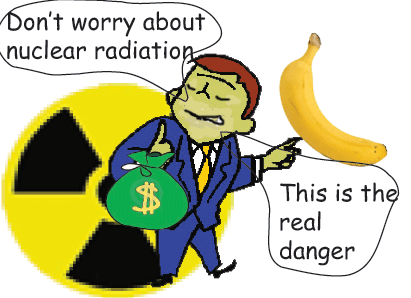
In Muller’s previous presentations on his YouTube show Veritasium, he has consistently confused the naturally occurring radioactive potassium K, with the nuclear fission produced radioactive isotopes, such as caesium 137 and strontium 90. As part of this confusion he constantly uses bananas as a comparison https://www.youtube.com/watch?v=TRL7o2kPqw0.
Cesium-137 is 12 million times more radioactive than potassium-40. Another highly-radioactive fission product, strontium-90, releases almost 20 million times more radiation per unit mass than does potassium-40. Muller seems to have no understanding of the way in which bananas are used in the body. The human species has had thousands of years of experience with bananas and other foods containing potassium 40 (K40). We have a natural trace level of K40 in our bodies. When we eat bananas, our bodies excrete the extra cesium, so by the natural process of homeostasis, our K40 level remains the same. This is not the case with the very recently created radioactive isotopes from nuclear fission; they remain….., there is absolutely no mention of the effects of internal emitters of radiation – that is, the radioactive isotopes breathed in or ingested, that can sit in a body’s organs for years, decades, emitting high dose gamma radiation..
Moving on to the Fukushima nuclear accident, we are told that the psychological effects are the serious ones. What a great piece of spin this is! Of course the psychological effects are extremely serious. Wouldn’t you be worried, if you were a pregnant woman, or if you feared that your child might later get leukaemia, because you decided to return to a radioactive environment? It is the reality of increased risk of fatal illness that accentuates the other disastrous consequences of that accident.
Prof Thomas assures us “The most important studies will be those on the mental effects”. In the context of this documentary, that just makes me envisage more documentaries like this one – with more spin about how we mustn’t worry about ionising radiation…….
The documentary appeared in Australia at a very convenient time for the South Australian Royal Commission. Dr Muller often covers his back with remarks about nuclear weapons “the most savage thing that man has ever built” and like his “feeling that renewables are going so fast – perhaps we can use alternatives”. But ultimately, his is a message of confidence in nuclear power. He says “Every year uranium saves more lives than it has ever destroyed” Really? Where are the facts to back up these kinds of statements? And all is spoken with guru like solemnity, and the backing of soaring holy choral music……..
What Muller and Thomas are doing is following the script from the tobacco and asbestos industries. They know full well that the toll of cancers, heart conditions, birth defects, from persistent exposure to ionising radiation will not become apparent for decades. They would have us believe that it will be impossible to establish ionising radiation as the cause of this toll of suffering and death…….
We are living in a strange time, where science is valued if it brings a benefit to corporations. Dr Derek Muller and Professor Geraldine Thomas are comfortably ensconced in that world. But there must be some scientists out there who are like Sir Richard Doll, and whose work is motivated by the public good.
And we desperately need those scientists.
This documentary “Uranium – Twisting the Dragon’s Tail” is just Series One. I would love to know who helped to fund Gene Pool Productions for PBS and SBS to produce this. I’m betting that Series Two will follow before long, with a glossy and positive story about Generation IV nuclear reactors. http://www.onlineopinion.com.au/view.asp?article=17624
August 27, 2015
Posted by Christina Macpherson |
2 WORLD, AUSTRALIA, media |
Leave a comment
 Was carbon taxation ever given a fair go?……..
Pricing carbon: the simpler, the better..….. If we are to reduce carbon-emitting activities, the prices of those activities must be increased. Appropriate prices are the key here, and one way to make people happier about paying them is to make them as simple and transparent as possible. That’s what a carbon tax does
Politics aside, a simple carbon tax makes more sense than a convoluted emissions trading scheme, The Conversation, David Hodgkinson Associate Professor at University of Western Australia Rebecca Johnston Adjunct Lecturer, Law School at University of Notre Dame Australia July 31, 2015 Writing recently on The Conversation, Clive Hamilton correctly pointed out that an emissions trading scheme (ETS) can in no sense be called a tax – the two are fundamentally different. Under an ETS, the amount of emissions is fixed by the government and the market then sets the price; under a carbon tax, the price of emissions is fixed and polluters decide how much to emit.
In this sense, Hamilton is right to opine that “emissions trading is the opposite of a carbon tax”. But during Australia’s fractious debate about climate policy in recent years, the two have often been conflated together, and we have generally been starved of sober analysis of the contrasting merits of different policy instruments.
To put it more succinctly, what are the actual merits of a carbon tax, specifically as opposed to an ETS?
Start small
A carbon tax could begin at a relatively low level, to avoid economic disruption, and then could increase steadily and predictably over time. This would encourage affected companies to cut their emissions and to use energy more efficiently, in turn encouraging a move to lower-emission technology. As a result, companies that made better progress in cutting their emissions would have fewer costs to pass on to their consumers, leading to more competitive prices.
A carbon tax would provide government revenue which could then be used to reduce or offset other taxes, such as corporate and personal income tax. A carbon tax could be “revenue-neutral”, either through offsetting other taxes or by using the proceeds to subsidise alternative fuel industries and projects.
Taxes are relatively easy to understand, having been around for centuries in one form or another. For Yale University economist William Nordhaus, the advantages are even clearer when compared to the operation of an international ETS. He recently proposed redesigning climate treaties to adopt a “club model” in which participating states enact carbon taxes in concert with one another, which Nordhaus describes as “the easiest way” to deliver costly emissions reductions.
Price-based taxes capture revenue more cheaply and easily than quantitative instruments such as an ETS, not least because tax-collection infrastructure is already in place. Taxation has lower administrative and compliance costs than carbon trading.
Taxation is arguably more direct and transparent than emissions trading, and affords less opportunity for gaming, speculation or corruption; money moves from polluters directly to the government.
A carbon tax provides price certainty and stability (as opposed to the volatility of prices for tradable carbon permits) and a fixed price for carbon emissions across all economic sectors and markets. This price certainty allows corporations more easily to determine the viability of new, clean technology investments.
Finally, the argument for carbon taxation is concisely made by Harvard economist Richard Cooper:
Decisions to consume goods and services made with fossil fuels are made by over a billion households and firms in the world. The best and indeed only way to reach all these decision makers is through the prices they must pay. If we are to reduce CO2-emitting activities, we must raise the prices of those activities. Levying a [tax] … does that directly.
Was carbon taxation ever given a fair go?……..
August 1, 2015
Posted by Christina Macpherson |
2 WORLD, AUSTRALIA, climate change |
Leave a comment


 US and Australian taxpayers pay billions a year to fund coal – report, http://www.theguardian.com/environment/2015/sep/16/us-australian-taxpayers-pay-billions-fund-coal





 nuclear-news