Nuclear promoter Michael Shellenberg’s unhappy interview with national broadcaster, but happy with radio shock jock
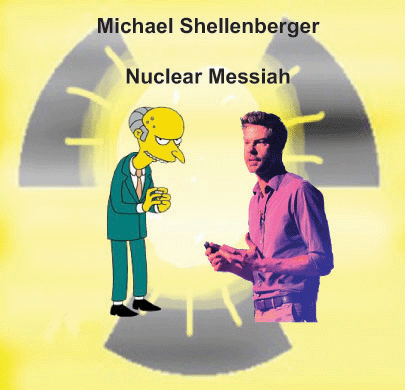
The pro nuclear Twittersphere was alive with angry comments about the ABC’s interview with nuclear propagandist  Michael Shellenberger.
I missed that interview, but apparently the ABC interviewer asked some hard questions.
Shellenberger commented: “fighting to survive a brutal interview by a tough young reporter in Oz On ABC (the Aussie BBC)”
Australia’s own nuclear propagandist, Ben Heard, commented: “Shabby interview. Host evidently unfamiliar with topic”
However, those pro nuclear spinners were happy with shock jock Alan Jones on 2GB Alan Jones Breakfast Show. Jones said:
“Michael has turned on wind and solar with a passion: he’s now advocating for an all-atomic energy future, simply because the latter provides reliable power, whereas the former are a childish nonsense…..
the Finkel review totally ignored nuclear power as an option and pushed harder for more and more renewable energy. So Victoria’s looking at 25% renewables by 2025, South Australia 50%, the ACT 100%, Queensland 50%……
one of the world’s leading new-generation environmental thinkers has said the renewable energy experiment with wind and solar has failed. Michael Shellenberger is a former renewables advocate and adviser to Barack Obama when he was President. [ed. not true. Shellenberger sent an unsolicited submission to President Obama] He is now global champion for nuclear energy, which he said was the only option to replace coal and gas on a global scale. ……”
Shellenberger said:
every major study for the last 40 years finds that nuclear power is the safest way to make reliable electricity. You don’t have the risks that come with coal and fossil fuels, both in terms of mine collapses and air pollution, and the accidents themselves that everyone worries so much about hardly have any impact on people’s lives…
Wind and solar – They’re the worst. Really, all renewables are. The reason is easy to understand, in the sense that the fuels are very dilute, they’re very diffuse, and so you have to cover a huge amount of land with wind and solar……. solar produces huge quantities of toxic waste…… They produce two to three hundred times more toxic waste than nuclear plants, which are the only way of producing electricity that contain all of their potentially harmful waste. Of course it’s been contained so well that nobody has ever been harmed by the radiation from nuclear power waste, ever……
The other problem is that you just end up getting too much wind energy when you don’t need it, like the middle of the night. Solar and wind, it’s like they’re almost set up to destroy cheap, clean, reliable energy.
What happened was that there was a smaller group of anti-human so-called environmentalists that opposed nuclear precisely because it allowed for so much cheap and abundant power, and they thought, “Well, if we’re going to stop the human cancer, we have to cut off its energy supplies.” …..
You’ve got some really crazy anti-nuclear people down there…..
Alan Jones: I’ll tell you something, when you arrive in this country, Michael we’ll have you on again. We can’t hear enough of you. It’s time we had a good healthy dose of common sense,
Examining the hype in Australia about space exploration
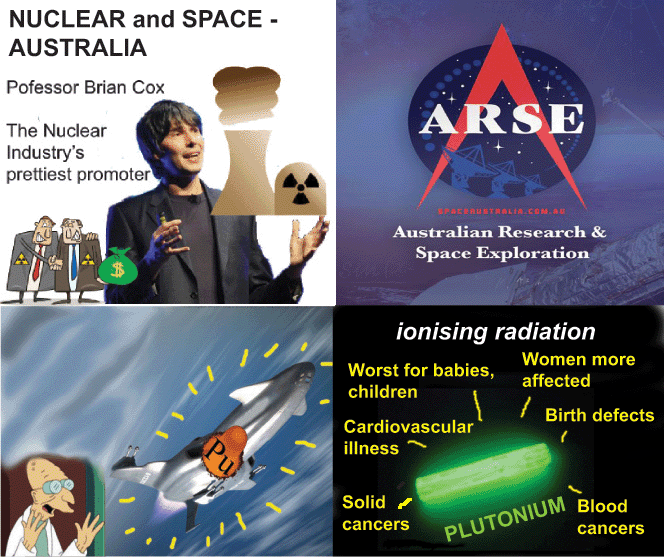
 Australia’s international space agency hype https://independentaustralia.net/environment/environment-display/australias-international-space-agency-hype,10876 s the current hype about space travel justified, and what of the human and environmental cost? Noel Wauchope reports.
ENTHUSIASM for space travel has been mounting since Australia hosted the recent International Astronautical Congress (IAC), held in Adelaide in September.
Then there was the announcement that Australia is getting a space agency!
We are informed by space scientist Dr Megan Clarke:
“ … more than 3000 of the world’s top space experts wildly cheered [and] all aspects of Australian society were united on the need for a national agency.”
In November, the very brilliant and appealing space travel and nuclear power enthusiast, Professor Brian Cox is to tour Australia! Champion astronaut Scott Kelly has just published his exciting book, Endurance: a Year in Space, A Lifetime of Discovery.
Dare anyone throw cold water on all this joy?
Intriguingly, the Australian Government, while proudly hyping up this initiative, has not yet come up with a title for the new agency. However, someone else has and they have set up an elegant and professional-looking website for it: Australian Research and Space Exploration (ARSE).
Let’s start with that most important consideration — money
Although everyone says that space exploration is going to be an economic bonanza, I can’t see how it’s actually going to bring in money. There are some vague suggestions about finding mineral resources on other planets. Even NASA seems hard-put to find any real commercial benefits.
They discuss a few useful scientific and medical technologies — for example, water purification techniques and advanced eye surgery. These are side benefits of space research but surely could have been developed more cheaply with research on Earth directly intended for the purpose. I am reminded of the “benefits” of man walking on the moon in 1966 – we got Teflon – and even that didn’t turn out so well.
What about the costs of space exploration, space travel and sending a man to Mars? It is very hard to locate actual figures. Even three years ago, NASA’s space travel research cost taxpayers US$17.6 billion (AU$22.9 billion) — and costs have surely risen by now. A huge part of the cost is in fitting and fuelling the space rockets’ thermoelectric generators with the production of the plutonium fuel being the most costly part of the expense.
Plutonium fuel
Plutonium 238 fuelled Voyager 1, which is expected to keep going until 2025, the New Horizons trip to Pluto and Cassini, which recently crashed into Saturn. NASA is sanguine about risks of a space exploration accident, claiming that it’s a low probability.
Karl Grossman has described a previous accident, dispersing plutonium widely and the risks involved in the Cassini project thus:
‘ … the Plutonium-238 used in space devices is 280 times more radioactive than the Plutonium-239 used in nuclear weapons.’
A very small amount of Plutonium-238, that cannot be seen, felt, or measured with a Geiger counter is enough to kill you. One nanoparticle inhaled and lodged in the lungs is enough to give anyone lung cancer. In experiments with dogs, there was no dose low enough to NOT cause the death of these animals. Just one nanoparticle the size of dust (1 microgram) that could not even be seen, was enough to kill every dog tested.
There is a long list of space travel accidents, including 19 rocket explosions causing fatalities, as well as nine other crashes/accidents causing fatalities. There seems to be no published research on rockets and space debris that have ended up in the oceans. We can assume that such ocean debris does exist, including the long-lasting radioactive particles of plutonium, to be carried thousands of miles by ocean currents.
Ocean crashes are sometimes reported, but the public is generally unaware of the space junk and the plutonium that goes into the oceans. NASA is very coy about publicly stating that the rocket’s rockets’ thermoelectric generators are, in fact, fuelled by plutonium.
NASA continues research on solar-powered space flights, but that idea seems out of fashion at the moment.
The human toll of space travel
The human toll of space travel is not emphasised. However, Scott Kelly, who holds the U.S. record for time spent in space, has been quite frank about this in his new book. As an identical twin, Scott is an especially useful person for studying the effects of space on the body.
He became, in fact, a laboratory research animal — a sacrificial lamb, perhaps, in the cause of space research:
‘I lost bone mass, my muscles atrophied and my blood redistributed itself in my body, which strained and shrank the walls of my heart. More troubling, I experienced problems with my vision, as many other astronauts had. I had been exposed to more than 30 times the radiation of a person on Earth, equivalent to about ten chest X-rays every day. This exposure would increase my risk of a fatal cancer for the rest of my life.’
Despite Scott’s extraordinary health problems, which linger to this day, he is optimistic and keen about human travel to Mars.
Which brings us to the biggest consideration: the ethics of all this.
I am fascinated that it is stated in Wikipedia, in assessing the cost of sending humans to Mars (over US$500 billion or AU$651 billion), that:
‘The largest limiting factor for sending humans to Mars is funding.’
I think that the human cost should be a bigger “limiting factor”. There’s still the problem of lethal radiation on the trip and on Mars. Plus it’s a one-way trip. Scott Kelly has detailed, especially, the mental distress of being stuck in a spacecraft for months, isolated from human society and from loved ones, as well as the physical problems. Despite all this, Scott is keen on space travel and humans going to Mars. He is carried along, it seems, by a love of adventure, of risk, of achievement and fame.
Comfortable old white men in suits are planning the Mars trip; Younger, enthusiastic young men and women, like Scott Kelly, are mesmerised by the adventure and perceived “glory”. Should we be encouraging them on this suicide mission?
We are constantly being told of the benefits to come, in space travel. What benefits? Are they greater than the huge environmental and personal risks? And the financial costs – the US$500 billion (AU $651 billion), paid for by the tax-payer? That money could go to meet real human needs. There’s something wrong with our priorities when we mindlessly accept enthusiasm for technology, innovation, and so on, as better than healing the health of this planet and its populations.
Nuclear power
And there is one other issue — nuclear power. The space hype coincides with the current drastic downturn in the fortunes of the nuclear industry. To continue with space research/travel, plutonium is needed. And the only way to get it is from nuclear reactors. Space science could be a lifeline for the failing nuclear industry.
It’s no coincidence that the International Astronautical Congress was held in Adelaide — Australia’s hub of nuclear ambition. It’s no coincidence that Professor Brian Cox is visiting, hot from his recent pep talks to the nuclear industry in Wales.
The uncritical hype about space travel ties in well with the pro-nuclear hype, especially in South Australia.
Radiation hazard in Fukushima Olympics – as happened in Australia’s 1956 Olympics
The 1985 Royal Commission report into British Nuclear Tests in Australia discussed many of these issues, but never in relation to the proximity and timing of the 1956 Olympic Games. Sixty years later, are we seeing the same denial of known hazards six years after the reactor explosion at Fukushima?
 Australia’s nuclear testing before the 1956 Olympics in Melbourne should be a red flag for Fukushima in 2020, https://theconversation.com/australias-nuclear-testing-before-the-1956-olympics-in-melbourne-should-be-a-red-flag-for-fukushima-in-2020-85787, The Conversation, Part time tutor in Medical Education, University of Dundee, 20 Oct 17, The scheduling of Tokyo 2020 Olympic events at Fukushima is being seen as a public relations exercise to dampen fears over continuing radioactivity from the reactor explosion that followed the massive earthquake six years ago.
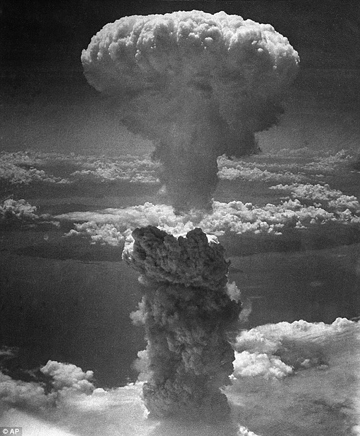 It brings to mind the British atomic bomb tests in Australia that continued until a month before the opening of the 1956 Olympic Games in Melbourne – despite the known dangers of fallout travelling from the testing site at Maralinga to cities in the east. And it reminds us of the collusion between scientists and politicians – British and Australian – to cover up the flawed decision-making that led to continued testing until the eve of the Games.
Australia’s prime minister Robert Menzies agreed to atomic testing in December 1949. Ten months earlier, Melbourne had secured the 1956 Olympics even though the equestrian events would have to be held in Stockholm because of Australia’s strict horse quarantine regimes.
The equestrians were well out of it. Large areas of grazing land – and therefore the food supplies of major cities such as Melbourne – were covered with a light layer of radiation fallout from the six atomic bombs detonated by Britain during the six months prior to the November 1956 opening of the Games. Four of these were conducted in the eight weeks running up to the big event, 1,000 miles due west of Melbourne at Maralinga.
Bombs and games
In the 25 years I have been researching the British atomic tests in Australia, I have found only two mentions of the proximity of the Games to the atomic tests. Not even the Royal Commission into the tests in 1985 addressed the known hazards of radioactive fallout for the athletes and spectators or those who lived in the wide corridor of the radioactive plumes travelling east. Continue reading
Futuristic solar powered car feeds energy back into the grid
Guardian 15th Oct 2017, A futuristic family car that not only uses the sun as power but supplies
energy back to the grid has been hailed as “the future” as the annual
World Solar Challenge wrapped up in Australia. The innovative bi-annual
contest, first run in 1987, began in Darwin a week ago with 41 vehicles
setting off on a 3,000km (1,860-mile) trip through the heart of Australia
to Adelaide. A Dutch car, Nuna 9, won the race for the third-straight time,
crossing the finish line on Thursday after travelling at an average speed
of 81.2kmh (55.5 mph).
https://www.theguardian.com/environment/2017/oct/15/this-is-the-future-solar-powered-family-car-hailed-by-experts
ICAN’s message to Australia: sign nuclear weapons ban treaty
Nobel Peace Prize winners ICAN urge Australia to sign nuclear weapons treaty http://www.sbs.com.au/news/article/2017/10/07/nobel-peace-prize-winners-ican-urge-australia-sign-nuclear-weapons-treaty An Australian-born group that was awarded this year’s Nobel Peace Prize says Australia needs to join global efforts to abolish nuclear weapons.
David Suzuki and 1,461 other scientists speak out for the protection of Australia’s oceans
Conservationist and 1,461 other scientists release statement describing Australia’s oceans as a ‘global asset’ that must be protected, https://www.theguardian.com/environment/2017/sep/27/david-suzuki-australia-sickening-threat-to-marine-reserves-undermines-global-protection
Guardian,Michael Slezak, 26 Sept 17, Growing global momentum to protect the world’s oceans from overfishing could be undermined by Australia, warns renowned conservationist David Suzuki and more than 1,461 other scientists.David Suzuki: Australia’s ‘sickening’ threat to marine reserves undermines global protection He said Australia needed to face up to the interconnected issues of climate change and ocean health, both of which it was failing to address.
“I’m sorry Australia, wake up,” Suzuki said. “The oceans are a mess and a great deal of the mess is a reflection of climate change. Climate change is the overarching issue that is hammering the oceans as well as terrestrial areas. And it is absolutely disgusting that coal is still considered a great economic input to Australia.
“When you’ve got something that [other countries] would die for – you’ve got sunlight up the ying yang, why isn’t Australia the world leader in this incredible form of energy? It makes me sick. You’ve got great research facilities. You’ve got great scientists. You’ve got everything going to be a world leader in the energy of the future and you’re not doing it. And it’s not surprising then that you are doing the same to the oceans. What is it going to take for Australia to wake up to the opportunities?”
Australia is currently considering the world’s biggest downgrading of a protected area with a reduction in the size of its network of marine reserves.
“If Australia does something progressive in 2012, and then walks back from that, what the hell are we going to expect [from] international cooperation?” said Suzuki, who described the move as “sickening”.
In 2012 the Australian government created what was then the world’s largest network of marine reserves. The move followed years of consultation, and despite limited protection for the most biodiverse coastal areas, it was welcomed by environmental groups.
Since then, global momentum has been building for marine protection. In 2014 at the once-a-decade World Parks Congress in Sydney, conservation scientists called for fishing to be banned in 30% of each type of marine habitat globally – a call supported two years later by about 90 countries and hundreds of NGOs that are members of the International Union for Conservation of Nature.
In 2016, the US president Barack Obama created the world’s largest marine reserve by expanding an existing ocean reserve off Hawaii. That year he also established a large marine park in the Atlantic Ocean.
Similarly, Chile, France, Kiribati, New Zealand, Russia and the UK have created large areas where fishing is banned.
In contrast, the Australian government recently announced draft plans to reduce by 40% the amount of its marine parks that are “no-take” fishing or construction zones.
According to WWF-Australia, that would represent the world’s largest downgrading of protected areas on record. More than 433,000 sq km would be downgraded to allow commercial fishing – more than half of that in the Coral Sea marine park, adjacent to the Great Barrier Reef, one of the few remaining large parts of the Pacific Ocean still in good health.
Australian waters contain rich biodiversity ranging from the tropics to Antarctica. A statement signed by Suzuki and 1,461 scientists described these waters as a “global asset” and called on the government to increase protections.
“They support six of the seven known species of marine turtles and more than half of the world’s whale and dolphin species. Australia’s oceans are home to more than 20% of the world’s fish species and are a hot spot of marine endemism. By properly protecting them, Australia will be supporting the maintenance of our global ocean heritage,” the statement said.
It’s absurd to think this is really Australia’s water,” Suzuki told the Guardian. “These oceans belong to the world – you just happen to be the caretakers in that particular area.”
Jessica Meeuwig, director of the Centre for Marine Futures at the University of Western Australia, said Australia’s move set a dangerous international precedent.
“Australia’s move to go backwards undermines that progress,” she said. “In Australia we will be supporting an international benchmark that says we’re happy to have paper parks [areas technically set aside but with minimal actual protections].”
Paper parks have been a major concern in the conservation world.
Meeuwig said Australia’s precedent is particularly dangerous given the Trump administration is mulling cuts to protected areas on land and in the ocean.
“Australia will pip Trump to the post,” she said.
The Trump administration is examining 27 protected areas for the rollback of protections, with a leaked memo revealing 10 – including the two marine parks established by Obama – earmarked to allow “traditional uses” such as mining, logging and hunting.
She said Australia’s unwinding of protections would help normalise radical moves to unwind protection in the US, as well as set a poor example for other countries.
“Such a backwards step just gives other countries an excuse to do less. [Australia is] a developed economy with good governance. If we can’t get this right, all we’re doing is putting the responsibility to protect oceans to nations that have less and are dealing with bigger challenges. That’s not leadership.”
Suzuki, who owns a house in Queensland’s Port Douglas and has spent a lot of time on the Great Barrier Reef, is angry about Australia’s rollback.
“We’re an air-breathing land animal. We’ve trashed the terrestrial environment with vast clearcuts and monocultures of rubber trees and corn and wheat. We’ve used the land and air to spread potent pesticides and toxic compounds. We’ve really fucked up the land that is our ecosystem. And now we go into the oceans that cover 70% of the planet and we’ve trashed that,” he said.
Suzuki said after the devastating bleaching of the Great Barrier Reef in 2016, he visited it and wept.
He said Australia needed to face up to the interconnected issues of climate change and ocean health, both of which it was failing to address.
“I’m sorry Australia, wake up,” Suzuki said. “The oceans are a mess and a great deal of the mess is a reflection of climate change. Climate change is the overarching issue that is hammering the oceans as well as terrestrial areas. And it is absolutely disgusting that coal is still considered a great economic input to Australia.
“When you’ve got something that [other countries] would die for – you’ve got sunlight up the ying yang, why isn’t Australia the world leader in this incredible form of energy? It makes me sick. You’ve got great research facilities. You’ve got great scientists. You’ve got everything going to be a world leader in the energy of the future and you’re not doing it. And it’s not surprising then that you are doing the same to the oceans. What is it going to take for Australia to wake up to the opportunities?”
Australian Aborigines move to block shipments of Scottish nuclear waste
 Australian Aborigines move to block shipments of Scottish nuclear waste http://www.heraldscotland.com/news/15554758.Australian_Aborigines_move_to_block_shipments_of_Scottish_nuclear_waste/?ref=fbshr ABORIGINES in South Australia are fighting a plan to ship nuclear waste from Scotland amid fears it will be dumped on land regarded as culturally and spiritually sacred.
Wallerberdina, around 280 miles north of Adelaide, has been earmarked as a possible location for Australia’s first nuclear waste dump despite claims that it is a priceless heritage site rich in archaeological treasures including burial mounds, fossilised bones and stone tools.
Some have claimed the impact would be similar to “building a waste dump at the heart of the Vatican”.
Now campaigners have appealed to the Scottish Government to halt controversial plans to ship nuclear waste processed at Dounreay in Caithness to Australia, amid concerns that it will eventually end up on the culturally sensitive land.
The waste transfer is part of a deal with saw spent fuel from nuclear reactors in Australia, Belgium, Germany and Italy processed at Dounreay – the nuclear facility in Caithness currently being decommissioned – to enable it to be safely stored after being returned to its country of origin.
The UK government has previously confirmed that “a very small quantity of Australian-owned radioactive waste” is currently stored in the country.
Scottish Government policy allows for the substitution of nuclear waste with a “radiologically equivalent” amount of materials from Sellafield in Cumbria.
The Herald understands that a shipment of such material is due to take place by 2020.
While the waste will be initially stored at a facility near Sydney, concern is growing that it could end up at Wallerberdina, one of two areas under consideration as a nuclear waste dump site.
As well as sparking anger over the site’s cultural and sacred connections, the proposed location has angered local people who still recall British atomic bomb tests in the area in the 1950s without permission from the affected Aboriginal groups.
Thousands were adversely affected with many Aboriginal people left suffering from radiological poisoning
Gary Cushway, a dual Australian/British citizen living in Glasgow, has now written to the First Minister asking that the Scottish Government review the agreement to transfer the material “until a satisfactory final destination for the waste is finalised by the Australian Government.”
He argues that doing so would allow the government to “take the lead in mitigating mistakes of the past that the UK government has made in regards to indigenous Australians.”
The proposed dump site is next to an Indigenous Protected Area where Aborigines are still allowed to hunt, and is part of the traditional home of the Adnyamathanha people, one of several hundred indigenous groups in Australia.
The Herald understands that a shipment of such material is due to take place by 2020.
While the waste will be initially stored at a facility near Sydney, concern is growing that it could end up at Wallerberdina, one of two areas under consideration as a nuclear waste dump site.
As well as sparking anger over the site’s cultural and sacred connections, the proposed location has angered local people who still recall British atomic bomb tests in the area in the 1950s without permission from the affected Aboriginal groups.
Thousands were adversely affected with many Aboriginal people left suffering from radiological poisoning
Gary Cushway, a dual Australian/British citizen living in Glasgow, has now written to the First Minister asking that the Scottish Government review the agreement to transfer the material “until a satisfactory final destination for the waste is finalised by the Australian Government.”
He argues that doing so would allow the government to “take the lead in mitigating mistakes of the past that the UK government has made in regards to indigenous Australians.”
The proposed dump site is next to an Indigenous Protected Area where Aborigines are still allowed to hunt, and is part of the traditional home of the Adnyamathanha people, one of several hundred indigenous groups in Australia.
The Herald understands that a shipment of such material is due to take place by 2020.
While the waste will be initially stored at a facility near Sydney, concern is growing that it could end up at Wallerberdina, one of two areas under consideration as a nuclear waste dump site.
As well as sparking anger over the site’s cultural and sacred connections, the proposed location has angered local people who still recall British atomic bomb tests in the area in the 1950s without permission from the affected Aboriginal groups.
Thousands were adversely affected with many Aboriginal people left suffering from radiological poisoning
Gary Cushway, a dual Australian/British citizen living in Glasgow, has now written to the First Minister asking that the Scottish Government review the agreement to transfer the material “until a satisfactory final destination for the waste is finalised by the Australian Government.”
He argues that doing so would allow the government to “take the lead in mitigating mistakes of the past that the UK government has made in regards to indigenous Australians.”
The proposed dump site is next to an Indigenous Protected Area where Aborigines are still allowed to hunt, and is part of the traditional home of the Adnyamathanha people, one of several hundred indigenous groups in Australia.
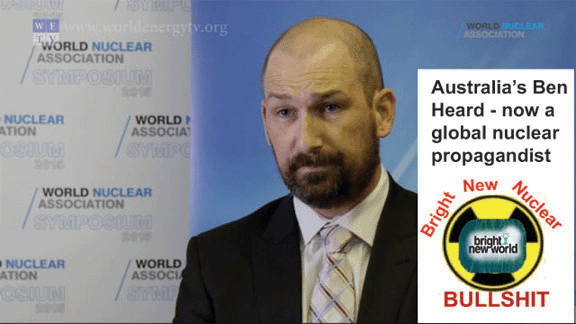
Australian nuclear shill Ben Heard’s attack on renewable energy: refuted by 6 international academics
 Response to ‘Burden of proof: A comprehensive review of the feasibility of 100% renewable-electricity systems’ AUTHORS W. Browna,(a) , T. Bischof-Niemz (b) , K. Blok(c) , C. Breyerc(d) , H. Lund (e) , B.V. Mathiesen (f ) (Their university positions are listed at the end of this post) September 2017
Abstract A recent article ‘Burden of proof: A comprehensive review of the feasibility of 100% renewable-electricity systems’ [by Ben Heard, Barry Brook, Tom Wigley and Corey Bradshaw] claims that many studies of 100% renewable electricity systems do not demonstrate sufficient technical feasibility, according to the authors’ criteria.
Here we analyse the authors’ methodology and find it problematic. The feasibility criteria chosen by the authors are important, but are also easily addressed at low cost, while not affecting the main conclusions of the reviewed studies and certainly not affecting their technical feasibility.
A more thorough review reveals that all of the issues have already been addressed in the engineering and modelling literature. Nuclear power, as advocated by some of the authors, faces other, genuine feasibility problems, such as the finiteness of uranium resources and a reliance on unproven technologies in the medium- to long-term. Energy systems based on renewables, on the other hand, are not only feasible, but already economically viable and getting cheaper every day.
Contents Continue reading
North Korea’s threats to Australia, as Australia backs USA war games in the Pacific
North Korea warns of Australia’s ‘suicidal act’ as ADF joins in vast US-South Korea war games https://au.finance.yahoo.com/news/north-korea-warns-australia-apos-114116583.html, Paul Colgan, Business Insider, 21 August 2017 Prime minister Malcolm Turnbull has called for continued efforts to “bring North Korea to its senses” after the regime warned Australia was “inviting disaster” through its support of US war games in the Pacific.
Around 25 Australian defence personnel are taking part in the Ulchi-Freedom Guardian exercise, a large-scale simulated military operation staged regularly by US and South Korean military forces. The operation started yesterday.
North Korea has noted Australia’s involvement and Turnbull’s recent statement that the nation would “come to the aid” of the US under the provisions of the ANZUS treaty if there was a military confrontation with North Korea.
A spokesman for the regime’s foreign affairs ministry said Australia and other allies could not “avoid counter-measures of justice” from North Korea if they supported the US in a conflict.
The statement said Turnbull had made “reckless remarks that the allies including Australia were together with the U.S. and that ANZUS stood for the mutual defense between the U.S and Australia, should either one of them come under attack, and Australia would back the U.S. in time of emergency.
“Not long after the Australian prime minister had stated that they would join in the aggressive moves of the U.S., even referring to ANZUS which exists in name only, the Australian military announced that they would dispatch their troops to the aggressive nuclear exercises of the U.S.,” the statement said.
“This is a suicidal act of inviting disaster as it is an illustration of political immaturity unaware of the seriousness of the current situation.”
According to a report in The Diplomat, South Korean officials have said this year’s Ulchi-Freedom Guardian exercises will include “a nuclear war game for the first time.”
The exercises may feature simulated use of “counter-weapons-of-mass-destructions (CWMD) operations and sustaining allied maneuvers in the aftermath of a North Korean nuclear attack against core U.S.-South Korea command-and-control nodes”, The Diplomat reported.
Some 50,000 South Korean troops and around 17,500 US military personnel will take part in the exercise, which also involves vast numbers of South Korean government officials.
In response, Turnbull issued a statement saying North Korea had shown no regard for the welfare of its people and no regard for international law.
“We call on all countries to redouble their efforts, including through implementation of agreed UN Security Council resolutions, to bring North Korea to its senses and end its reckless and dangerous threats to the peace of our region and the world.”
The North Korean statement said that “Australia followed the U.S. to the Korean War, the Vietnamese War and the “war on terrorism”, but heavy loss of lives and assets were all that it got in return.”
It added: “The Australian government had better devote time and energy to maintaining peace of its own country, instead of forgetting the lessons learned in the past and joining the U.S. in the moves for nuclear war. Countries like Australia that join the military adventure against the DPRK, blindly following the U.S., will never avoid the counter-measures of justice by the DPRK.”
Climate denial in America and Australia
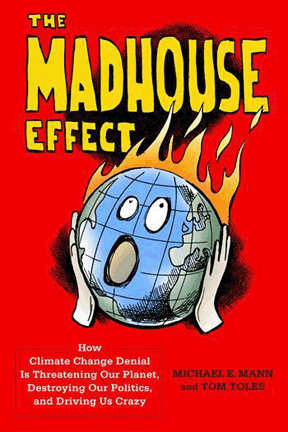 The Madhouse Effect: this is how climate denial in Australia and the US compares, The Conversation August 14, 2017 Michael Mann is well known for his classic “hockey stick” work on global warming, for the attacks he has long endured from climate denialists, and for the good fight of communicating the environmental and political realities of climate change.
Mann’s work, including his recent book The Madhouse Effect, has helped me, as a dual US-Australian citizen, think about the similarities and differences between the US and Australia as we respond to what has been called the climate change denial machine.
In both countries, the denialists and distortionists have undermined public knowledge, public policy, new economic development opportunities, and the very value of the environment. Climate policy is being built upon alternative facts, fake news, outright lies, PR spin and industry-written talking points.
From the carbon industry capture of the two major parties, to the Abbott-Turnbull government parroting industry talking points, to coal industry lobbyists as government energy advisers, to the outright idiotic conspiracy pronouncements of senators funded and advised by the US- based denial machine, the Madhouse Effect is in full force in Australia.
How we can expose and counter this denialist machine? To partly lay out the task, I will discuss three points of contrast between the US and Australia.
Political culture
There is a key difference between the two countries’ political cultures. As much as the denialists have determined Australian energy and climate policy, they have not been as successful, yet, at undermining deep-seeded respect in Australian culture for the common good, for science, for expertise and knowledge…….
Last year, when the government fired climate scientists at CSIRO, there was another huge public backlash. The government had to step back a bit, both on the actual science to be done and the radical agenda change away from science for the public good.
And again, when the government wanted to support the dubious work of Bjorn Lomborg, that caused an outcry from both the university sector and the public. Even though the government wound up paying more than A$600,000 on what The Australian called his “vanity book project”, they couldn’t import him and plant him at any Australian university.
As Mann says, the main issue in implementing good, sound climate policy is no longer simply the science. The main issue is the cultural understanding of, and respect for the role of science in informing political decisions.
That’s not to say there are no attacks on science – clearly, these continue (such as the recent challenges to normal Bureau of Meteorology practices). But, overall, climate denialists and their enablers are outnumbered outliers in Australia, rather the norm.
The power of the carbon industry
My second point of comparison is not quite as positive.
The problem in Australia is less a culture turning against the Enlightenment, and more the direct political power and influence of the carbon industry. ……
even here I think there is some hope. We have seen, over the last few years, an incredible coalition grow – one focused on the end of carbon mining, on protecting communities, on creating real jobs, and on supporting renewables.
Once-unthinkable coalitions of farmers and Aboriginal communities are fighting new mines, new attacks on sacred and fertile land and water.
We have intensive household investment in rooftop solar – and as the feed-in tariffs are undermined, those folks will increasingly invest in battery storage. And we’re finally seeing states move in this direction, with increasing development of utility-scale renewable and storage projects. As hard as the federal government and its allies resist, renewables are growing and the public supports this – even conservative voters. https://theconversation.com/the-madhouse-effect-this-is-how-climate-denial-in-australia-and-the-us-compares-81822
India’s Adani mining giant accused of corruption just as it seeks funds from the Australian government for coal mine
 If true, one effect of the alleged scheme would have been to move vast sums of money from the Adani Group’s domestic accounts into offshore bank accounts where it could no longer be taxed or accounted for.
Adani mining giant faces financial fraud claims as it bids for  Australian coal loan, Exclusive: Allegations by Indian customs of huge sums being siphoned off to tax havens from projects are contained in legal documents but denied by company, Guardian, Michael Safi in Delhi, 16 Aug 17, A global mining giant seeking public funds to develop one of the world’s largest coal mines in Australia has been accused of fraudulently siphoning hundreds of millions of dollars of borrowed money into overseas tax havens.

Indian conglomerate the Adani Group is expecting a legal decision in the “near future” in connection with allegations it inflated invoices for an electricity project in India to shift huge sums of money into offshore bank accounts.
The directorate of revenue intelligence (DRI) file, compiled in 2014, maps out a complex money trail from India through South Korea and Dubai, and eventually to an offshore company in Mauritius allegedly controlled by Vinod Shantilal Adani, the older brother of the billionaire Adani Group chief executive, Gautam Adani.
Vinod Adani is the director of four companies proposing to build a railway line and expand a coal port attached to Queensland’s vast Carmichael mine project.
The proposed mine, which would be Australia’s largest, has been the source of years of intense controversy, legal challenges and protests over its possible environmental impact.
Expanding the coal port to accommodate the mine will require dredging an estimated 1.1m cubic metres of spoil near the Great Barrier Reef marine park. Coal from the mine will also produce annual emissions equivalent to those of Malaysia or Austria according to one study.
One of the few remaining hurdles for the Adani Group is to raise finance to build the mine as well as a railway line to transport coal from the site to a port at Abbot Point on the Queensland coast.
To finance the railway Adani hopes to persuade the Northern Australia Infrastructure Facility (Naif), an Australian government-backed investment fund, to loan the Adani Group or a related entity about US$700m (A$900m) in public money.
While it awaits the decision on the loan, in Delhi the company is also expecting the judgment of a legal authority appointed under Indian financial crime laws in connection to allegations it siphoned borrowed money overseas.
The Adani Group fully denies the accusations, which it has challenged in submissions to the authority.
The investigation
News of the investigation was first reported in India three years ago, but the full customs intelligence document reveals forensic details of the workings of the alleged fraud which have not been publicly revealed.
The 97-page file accuses the Adani Group of ordering hundreds of millions of dollars’ worth of equipment for an electricity project in western India’s Maharashtra state using a front company in Dubai.
To read the pdf click here.
The Dubai company allegedly sold the exact same equipment back to Adani Group-controlled businesses in India at massively inflated prices, in some instances said to be eight times the sale price.
According to the allegations in the file, the effect of these transactions was that the Adani Group spent an average 400% more for the materials. That money was allegedly paid to a company Indian authorities allege was owned through a series of shell companies leading to a Mauritius trust controlled by Vinod Adani.
If true, one effect of the alleged scheme would have been to move vast sums of money from the Adani Group’s domestic accounts into offshore bank accounts where it could no longer be taxed or accounted for.
Because tariffs for using electricity transmission networks are determined partly by what they cost to build, if the DRI’s accusations are correct, the overvaluation of capital goods would have been likely to have led to higher power prices for Indian consumers……
The Australian loan
The Adani Group, or a linked entity, has reportedly been granted “conditional approval” for the US$700m (AU$900m) concessional loan from Naif, the Australian government investment fund.
But due to secrecy around the operation of the investment fund, it is not clear whether the loan application discloses the existence of the DRI notice or the ongoing legal proceedings, or whether the applicant is required to do so under the Naif’s anti-money laundering provisions……
The Guardian is publishing excerpts from the DRI file in the interests of ensuring Naif, as well as the public, have access to as much relevant information as possible in assessing whether Adani or linked companies would be suitable recipients of public money.
In a separate case last year, six Adani subsidiaries were listed among 40 other companies being investigated for allegedly running a similar price-inflation scheme. The companies are accused of inflating the price of coal imports from Indonesia to hide profits in overseas tax havens.
The DRI and the ED did not respond to a request to clarify the status of the investigations.
The alleged money trail…..
How Adani allegedly siphoned money from India….
Who controls the companies?
Key to the alleged fraud, according to investigators, is that EIF, the company subcontracted to purchase the equipment from manufacturers in South Korea and China, was directly controlled by the Adani Group and its associates…. https://www.theguardian.com/world/2017/aug/16/adani-mining-giant-faces-financial-claims-as-it-bids-for-australian-coal-loan
How USA’s Argonne National Laboratory abused a small Australian boy, with plutonium injections
 Paul Langley, https://www.facebook.com/paul.langley.9822/posts/10213752429593121CAL-2, 14 Aug 17, 5 yr-old Simon Shaw and his mum. Simon was flown from Australia to the US on the pretext of medical treatment for his bone cancer. Instead, he was secretly injected with plutonium to see what would happen. His urine was measured, and he was flown back to Australia.
Though his bodily fluids remained radioactive, Australian medical staff were not informed. No benefit was imparted to Simon by this alleged “medical treatment” and he died of his disease after suffering a trip across the world and back at the behest of the USA despite his painful condition. The USA merely wanted a plutonium test subject. They called him CAL-2. And did their deed under the cover of phony medicine.
“Congress of the United States, House of Representatives, Washington, DC 20515-2107, Edward J. Markey, 7th District, Massachusetts Committees, [word deleted] and Commerce, Chairman Subcommittee on Telecommunications and Finance, Natural Resources, Commission on Security and Cooperation in Europe] MEMORANDUM To: Congressman Edward J. Markey From: Staff Subject: The Plutonium Papers Date: 4/20/94
Staff Memo on Plutonium Papers
The medical file for Cal-2 also contains correspondence seeking follow-up from Argonne National Laboratory in the 1980s. Cal-2 was an Australian boy, not quite five years old, who was flown to the U.S. in 1946 for treatment of bone cancer. During his hospitalization in San Francisco, he was chosen as a subject for plutonium injection. He returned to Australia, where he died less than one year later.
Document 700474 is a letter from Dr. Stebbings to an official at the Institute of Public Health in Sydney, Australia, in an attempt to reach the family of Cal-2. This letter reports that the child was “injected with a long-lived alpha-emitting radionuclide.” Document 700471 is a letter from Dr. Stebbings to New South Wales, Australia (names and town deleted), inquiring about recollections of the boy’s hospitalization in 1946. The letter notes that, “those events have become rather important in some official circles here,” but provides few details to the family.
A hand-written note on the letter reports no response through October 8, 1987. Considering the history on the lack of informed consent with these experiments, it is surprising that the letters to Australia failed to mention the word “plutonium.”
The Australian news media has since identified Cal-2 as Simeon Shaw, the son of a wool buyer in New South Wales, and information on the injection created an international incident. The information in the medical file does indicate that at a time when Secretary Herrington told you that no follow-up would be conducted on living subjects, the Department of Energy was desperately interested in conducting follow-up on a deceased Australian patient.
In an effort to determine the full extent of follow-up by the Department after 1986, your staff has requested, through the Department’s office of congressional affairs, the opportunity to speak with Dr. Stebbings, Dr. Robertson, and any other officials who may have been involved in the follow-up. So far, that request has been unsuccessful. It remains an open question as to what was the full extent of follow-up performed in the 1980s, and whether the efforts then would facilitate any further follow-up on subjects now. It seems appropriate for the Interagency Working Group to address these questions as its efforts continue.”
Source: National Security Archives, George Washington University, http://www.gwu.edu/…/…/mstreet/commeet/meet1/brief1/br1n.txt
See also ACHRE Final Report.
NO MORE DUAL USE ABUSE OF AUSTRALIANS MR PRESIDENT. STOP FUNDING SYKES AND FLINDERS UNIVERSITY IN THE DOE QUEST FOR CHEAP CLEANUP OF URANIUM CONTAMINATED SITES.
Mr. President, you are wrong if you think you can do the same again re hormesis funding in Australia as the USA did with CAL-2. We have not forgotten and do not trust you or your paid agents in Australian universities such as Flinders.
World watching Australian government – ready to sacrifice the Great Barrier Reef for Adani coal interests?
 Australia’s Greatest (Dying) Global Asset, JULY 26, 2017 “……..on a local level, it’s a magnet for tourism that generates around $6 billion ($4.8 billion USD) a year. This is what the Australian government seemed intent on protecting when it removed all references to the reef and the way it was being ruined by warming waters, among other things, from a United Nations report on climate change last year.
But it’s also more than that.
“Corals are foundational,” Dr. Cantin told me, comparing the reef to giant forests, like the Amazon. “It’s not just people from tropical countries who care about them.”
And, he said, those who do care are increasingly concerned. The effects of climate change are accelerating beyond what the ecosystem can handle. Rib Reef, where Dr. Cantin was diving, was teeming with color and life just a year ago; now most of it is just coral skeleton covered in algae that looks like soot.
There is still time to adjust. “It’s a big system,” Dr. Cantin says, with areas that can recover if given a decade or so of prime conditions.
 But the world is watching to see what will happen next.
Will tour operators and the Australian government speak with more force about the damage from climate change? Will the giant Adani coal mine, which would bring more coal ships close to the reef, gain final approval? Will more of the reef die — or recover — in the coming year?….https://www.nytimes.com/2017/07/26/world/australia/letter20-great-barrier-reef-climate-change-coral.html
Climate change is killing Australia’s Great Barrier Reef
The uncomfortable truth: The Great Barrier Reef is doomed, Independent Australia Dr Geoff Davies 14 July 2017 The Great Barrier Reef is unlikely to survive as more than a small, sad remnant of its past glory.
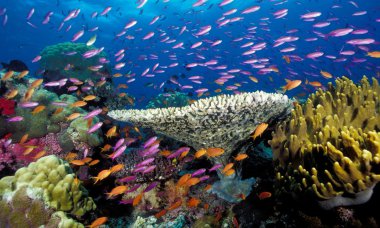
The reason is straightforward. It is well known in climate science that, even if we stopped harmful emissions tomorrow, global warming would not peak for another several decades. By then, most of the Reef will be long gone.
This is not pleasant news and clearly many would prefer it was not said, but there it is, the argument is simple and the conclusion is difficult to avoid.
The recent decision by the United Nations World Heritage Committee not to list the Reef as “in danger” is, of course, farcical. It reflects the crudest of politics, including the blinkered claim that Australia is not reponsible for global warming. Yet Australian governments, state and federal, do everything they can to spruik the coal mining that would ensure the death of the Reef and threaten to tip us into catastrophic warming.
Most news reports of global warming use only words and try for spurious he-said-she-said “balance”, so you don’t get a very clear impression of what is really going on. A good graph is worth millions of such waffle words.
[lengthy explanation given here with graphs]……
Suppose the world suddenly got sane and we set about the emergency reduction of greenhouse gas emissions, as scientists have been urging for several decades now. Even if emissions drop precipitously, there’s still too much already in the atmosphere. It takes a long time for the gases to be absorbed back into the land and ocean. In the meantime, warming will continue for 20 to 40 years — or even longer (the uncertainty is because we don’t know to what depth the oceans carry the extra heat they absorb)…….
Some scientists think corals have some chance of adapting and reversing a portion of the die-off if temperatures peak at “only” 1.5°C, but the corals’ diversity would be greatly reduced. If the peak is above 1.5°C, there is no chance of recovery.
If people like Donald Trump and Tony Abbott continue to be influential then global warming could even accelerate, as we pump out ever-more fossil fuel exhausts. Or natural reinforcings might already be kicking in and tipping the system into runaway. In that case, we would have to forget the Reef and worry about the survival of civilisation.
On the other hand, there is far more we can do to reduce emissions, reduce them quickly and live well as we do it. Leaders like William McDonough and Amory Lovins have long noted our wastefulness and the huge potential of good design and a cycling industrial system. Regenerative agriculture can not only reduce emissions but recapture and store greenhouse gases, all with abundant yields.
The Great Barrier Reef is not just a pretty decoration and earner of tourist dollars. Thousands of ocean species depend on it for food, shelter and breeding — even species that spend most of their lives far away. The effects of the present death will already be reverberating through ocean ecosystems. We depend heavily on the oceans to maintain a habitable planet.
There is a silence about the Reef. The massive bleachings have been prominent in the news, but nothing happens. We know it’s happening, but we don’t want to mention it. Why are we silent?
If our media were functioning properly, this dire prospect could have been widely understood before it became acute. The problem is not just the Murdoch media, which actively obfuscate and lie about global warming.
The media’s interpretation of ‘balance’ is so superficial as to seriously misrepresent the world. For example, paraphrasing a recent report: Much of the northern Great Barrier Reef is dead. But the good news is the southern parts are still mostly healthy. There is no good news. Such a report might reasonably have said, instead: The GBR has begun its death throes………
might there also be shame? We are the generation, out of all of the long history of humanity, that is allowing the glories of a planet to be destroyed. Oh dear, I’m not supposed to make my readers uncomfortable, they might switch off.
The question stares us in the face anyway. How will we face our grandchildren?
Dr Geoff Davies is an author, commentator and scientist. He is a retired geophysicist at the Australian National University and the author of Desperately Seeking the Fair Go (2017). He blogs at BetterNature and tweets at @BetterNatureOz. https://independentaustralia.net/environment/environment-display/the-great-barrier-reef-is-doomed,10501
Climate drowning islands north of Australia – eventually to cause climate refugees
‘The island is being eaten’: how climate change is threatening the Torres Strait
In Boigu, part of Australia but just six kilometres from Papua New Guinea, roads are being washed into the sea, Guardian, Ben Doherty and Michael Slezak, 13 July 17, Torres Strait residents face being forced from their homes by climate change, as their islands are lost to rising seas.
On Boigu Island, the most northerly inhabited island in Australia, just six kilometres from Papua New Guinea, the community’s cemetery faces inundation and roads are being washed into the sea. A seawall installed to protect the community is already failing.
Boigu elder Dennis Gibuma says the situation is worsening every season.
“Our seawall is no longer any good,” he says. “When the high tide and strong winds come together, it breaks. We pray we don’t lose our homes. We don’t want to leave this place.”
Masig Island, to the south-east of Boigu, is less than three kilometres long, and just 800m across at its widest point. Also known as Yorke Island, the low-lying coral cay is steadily being lost to the waves.
“In the short term, we can do what we can. We can’t stop the erosion, our hope is to slow it down.”
But he says he has to face the possibility that his people may have to abandon their ancestral home.
“Long term, we may have to evacuate the island,” he says. “But I am not going. Slowly, I see Masig Island getting out of something I can control.”………
The precise sea level rise around the Torres Strait, and the projected inundation, has not been calculated but low-lying islands are expected to experience a much greater flooding risk than mainland Australia. The department identifies the remote islands of the Torres Strait as some of the most vulnerable, as does the Intergovernmental Panel on Climate Change (IPCC), which warns communities they may be forced to relocate………
Displacement caused by climate change is forecast to be a driver of massive forced migration movements in the 21st century.
Low-lying islands in the Pacific – and Torres Strait islands like Masig and Boigu – are likely to be at the forefront of forced displacement but large and densely populated countries such as Bangladesh also face widespread inundation.
Some forecasts have predicted up to 150 million people could be forcibly displaced by climate change by 2040 – larger than the record number of people already forced from their homes globally.
The US and other militaries have said that climate change poses the greatest security threat to the Asia-Pacific.
But the global legal framework for resettling people displaced from their homes lost to natural disasters or climate change is unclear. The refugee convention – established in 1951 to regularise the resettlement of those displaced by the second world war – does not recognise someone forced from their home by rising seas, or natural disaster, as requiring protection.
Already, more than a dozen Pacific Islanders have attempted to claim refugee status in New Zealand on the grounds that their homes are uninhabitable because of rising seas or climate-related disaster. All have had their claims rejected.
On Masig Island, Hilda Mosby says climate change is already affecting the marine ecosystems on which communities depend for their livelihoods. Climate changeis already affecting her community “big time”, she says.
But the greater existential threat for her home lies ahead….https://www.theguardian.com/environment/2017/jul/13/the-island-is-being-eaten-how-climate-change-is-threatening-the-torres-strait
1 This Month



26 September – International Day for the Total Elimination of Nuclear Weapons


PLEASE OPPOSE HR 8255 AND S.3639 – bills would accelerate satellite deployment, with no environmental review or safeguards – https://ncstd5li.quorum.us/campaign/169331/
To see nuclear-related stories in greater depth and intensity – go to https://nuclearinformation.wordpress.com
-
Archives
- September 2026 (245)
- August 2026 (330)
- July 2026 (355)
- June 2026 (287)
- May 2026 (306)
- April 2026 (356)
- March 2026 (251)
- February 2026 (267)
- January 2026 (308)
- December 2025 (358)
- November 2025 (359)
- October 2025 (375)
-
Categories
- 1
- 1 NUCLEAR ISSUES
- business and costs
- climate change
- culture and arts
- ENERGY
- environment
- health
- history
- indigenous issues
- Legal
- marketing of nuclear
- media
- opposition to nuclear
- PERSONAL STORIES
- politics
- politics international
- Religion and ethics
- safety
- secrets,lies and civil liberties
- spinbuster
- technology
- Uranium
- wastes
- weapons and war
- Women
- 2 WORLD
- ACTION
- AFRICA
- Atrocities
- AUSTRALIA
- Christina's notes
- Christina's themes
- culture and arts
- Events
- Fuk 2022
- Fuk 2023
- Fukushima 2017
- Fukushima 2018
- fukushima 2019
- Fukushima 2020
- Fukushima 2021
- general
- global warming
- Humour (God we need it)
- Nuclear
- RARE EARTHS
- Reference
- resources – print
- Resources -audiovicual
- Weekly Newsletter
- World
- World Nuclear
- YouTube
-
RSS
Entries RSS
Comments RSS
 nuclear-news