Australia’s nuclear bomb test site – touted as tourist site, but it’s still radioactive
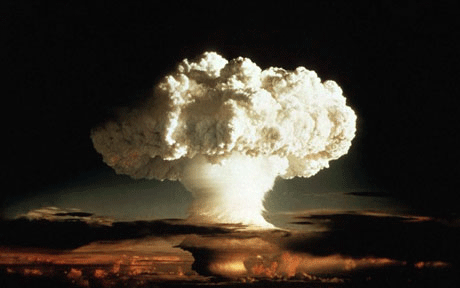 ‘Yes, there is still radiation here’, Gulf News 4 May 18 , Australia’s least likely tourist spot: a test site for atom bombs “……..
“Yes, there is still radiation here,” Robin Matthews ( Australia’s only nuclear tour guide) said as he drove a minibus to the sites where the Australian and British governments dropped seven bombs between 1956 and 1963, which dotted the earth with huge craters and poisoned scores of indigenous people and their descendants.
Back then, the government placed hundreds of human guinea pigs — wearing only shorts and long socks — in the front areas of the test zones. The effects of large doses of radiation were devastating…….
Today, just four people live full time in Maralinga village, a veritable ghost town. Amid the old buildings are new lodgings built for tourists, complete with hot water and Wi-Fi.
In the 1950s and ‘60s, at the height of the Cold War, 35,000 military personnel lived here.
The first nuclear test was conducted in September 1956, two months before the Melbourne Olympics.
That blast — as powerful as the bomb that the US dropped on Hiroshima — was the first of seven atom bombs set off here. But it was the so-called minor tests that were the most harrowing. Carried out in secret, the tests examined how toxic substances, including uranium and plutonium 239, would react when burnt or blown up.
….. Around one area tourists can visit are 22 major pits, each at least 15 metres deep and cased in reinforced concrete to prevent dangerous radiation from seeping out.
The site looks like a recently tilled garden bed, stretching out for hundreds of yards, in a near perfect circle. Dotting the red desert earth are shards of twisted metal. Aside from a few feral camels loping nearby, it is still and silent.
But on October 4 1956, a “nuclear landmine” was detonated here, tearing a crater 40 metres wide and 21 metres deep into the earth.
‘This is their land’
The resulting atomic reaction took only a fraction of a second, but its effects on one indigenous family would last decades. Survivors of the blasts, their children and grandchildren suffered from cataracts, blood diseases, arthritic conditions, stomach cancers and birth defects…….https://gulfnews.com/news/asia/australia/yes-there-is-still-radiation-here-1.2216400
Bushfires near Australia’s nuclear reactor are still dangerous
Firefighters Warn NSW Is “Not Out Of The Woods” On Third Day Of Bushfires, Pedestrian. 16 Apr 18 More than 250 firefighters continue to battle bushfires in NSW’s southwest, which has spread more than 2,400 hectares since Saturday afternoon.
The blaze, which is believed to have originated in the vicinity of Casula, was fanned further by strong winds on Sunday.

More than 500 firefighters from the Rural Fire Service, Fire & Rescue NSW and the Australian Defence Force attempted to contain the blaze over the weekend with help from volunteers and 11 water-bombing helicopters.
The fire tore trough Holsworthy military range, and while approaching suburban areas, has been staved off. Several residents report fighting off embers with hoses and water buckets.
The fire was downgraded from “emergency level” to “watch and act” on 5.30pm Sunday, then again downgraded to “advice” around 2am Monday.
While lower wind conditions are expected to help with containing the fire, RFS Deputy Commissioner Rob Rogers warned that the high temperatures remain an issue.
“Still quite a difficult day ahead (on Monday),” Rogers told the Nine Network. “I think we’ve got a long way to go before we’re out of the woods.”
There’s also a risk that winds could also pick up to 35km/h later today.
The RFS is currently advising residents in Pleasure Point, Sandy Point, Alfords Point, Barden Ridge [ie; Lucas Heights] , Voyager Point, Illawong, Menai & Bangor to “remain vigilant throughout the day and keep themselves up to date by checking the NSW RFS website“……..https://www.pedestrian.tv/news/firefighters-warning-nsw-bushfires/
AUSTRALIA is struggling to contain a growing bushfire that is racing towards a nuclear reactor, amid fears that the blaze could expand beyond their control. By OLI SMITH Apr 16, 2018
Apocalyptic blaze surrounding nuclear reactor sets off emergency
More than 500 Australia firefighters are struggling to tackle a massive bushfire, with several residents urged to seek shelters as evacuation is now “too late”.
Scenes of the blaze, which started yesterday, have been described as “apocalyptic” after the fire ripped through nearly 2,500 hectares of land close to the suburbs of Sydney.
Firefighters failed to stop the out-of-control blaze from burning through a major military base – and a nuclear reactor is the next at-risk location.
The New South Wales Rural Fire Service (RFS) said it was concerned that flying embers could spark even more blazes……
The unseasonably hot Autumn in south-eastern Australia has been blamed for worsening the bushfire after record temperatures for April.
Shane Fitzsimmons, of the RFS, warned that strong 60km per hour winds are expected to push towards residential homes.
He said that the country’s largest army barracks at Holsworthy, where stockpiles of fuel, ammunition and explosive materials are kept, had been hit by the fire.
Australia’s bushfires threatening nuclear reactor: Changing the name of a suburb helps the government keep this quiet.
Lucas Heights nuclear reactor: The untold threat of the Sydney bushfires. https://independentaustralia.net/environment/environment-display/sydney-bushfires-raged-towards-lucas-heights-nuclear-reactor,11401
As fires raged in Sydney, there has not been a peep out of the mainstream media about the fire hazard to Lucas Heights nuclear complex. Noel Wauchope reports.
THE LATEST news on the bushfires raging in Sydney’s south-west is that the firefighters are “cautiously optimistic” and that emergency warning advice has been downgraded to “watch and act”.
However, the fire continues to burn in an easterly direction towards Barden Ridge and weather conditions are still dodgy, as Sydney’s record-breaking heatwave looks like coming to an end.
It’s been an anxious time — the fire has burned over 2,400 hectares. On Sunday (15 April), more than 500 firefighters in almost 100 fire trucks, along with 15 aircraft, battled the blaze throughout the day. Residents were told that it was too late to leave their homes. Heat from the bushfires was impacting the high voltage lines. There is very little rain forecast over the next few days.
So, it has all been a worry. But you wouldn’t know, would you, that the fire is so close to the Lucas Heights nuclear complex? The latest maps shown on The Guardian and NSW Rural Fire Service websites don’t really show how close this fire is getting to Lucas Heights. I have previously written about the safety hazards of Lucas Heights, with its reactor, cooling pond and accumulation of nuclear wastes — the amount of which is not publicly available.
The fires have reached about four kilometres from Lucas Heights. Embers carried by wind can form spot fires well ahead of the firefront — even up to 20 kilometres away. In the dense and rugged bushland, with predicted west to north-west winds up to 30 kilometres per hour – not forgetting that bushfires create their own weather systems – is not that hazardous to the nuclear complex?
But we don’t hear a word about this. What makes the silence easier, is that the residential area previously part of Lucas Heights was renamed Barden Ridge in 1996 to increase the real estate value of the area, as it would no longer be instantly associated with the High Flux Australian Reactor (HIFAR) — and now the Opal nuclear reactor.
Of course, now, because of the name change, there’s no public awareness that Australia’s nuclear reactor is anywhere near the fires. You can bet that the government wants to keep us all in blissful ignorance.
What we do know, is that fires are certainly a hazard to nuclear sites and there is the possibility of radiation release across a wide area, if fire invades a nuclear complex, with the fuel rods in cooling pools at great risk. When fires do happen near a nuclear site, there may be a security panic going on but that is not communicated to the public.
“It’s being fought by security site fire crews, with help from a helicopter able to detect any aerial release of radiation.” Like monitoring is going to help or they’re going to share their data. Not a peep about the radiation numbers during the fires in and around Los Alamos even though they were “monitoring” – comment by Helen Helen Mary Caldicott and Henry Peters, on this article: Wildfire burning in former Nevada nuclear site.
And from this one: Russia emergency minister threatens to ‘deal with’ those spreading radiation ‘rumours’ about wildfires in contaminated areas
Whenever there have been wildfires threatening nuclear sites – in Russia, Europe or the U.S. – the pattern is to downplay, to not mention, the nuclear danger. The publicity pattern is always to ignore the radiation hazard.
For example during the recent Californian wildfires:
“It’s being fought by security site fire crews, with help from a helicopter able to detect any aerial release of radiation.”
As though any amount of monitoring is going to help or that any data would be publicly shared. Not a peep about the radiation numbers during the fires in and around Los Alamos, even though they were “monitoring” it.
And in the case of this fire in Russia, the emergency minister threatened to “deal with” those who spread radiation “rumours”:
For the current Sydney bushfires, it seems as though there will have been a lucky escape for the communities, despite the fact that two giant aircraft, the DC10 Nancybird and the C130 Hercules “Thor” — normally used for aerial water bombing — were not available to help fight the Sydney fire, having been sent back to the U.S., because by March, the fire risk is supposed to be over.
It will have been a much luckier escape that they realised if the nuclear complex remains unscathed — this time! https://independentaustralia.net/environment/environment-display/sydney-bushfires-raged-towards-lucas-heights-nuclear-reactor,11401
Australia’s top secret and expensive shipment of nuclear waste to France
 Tight security for shipment of nuclear waste from Lucas Heights to France, THE AUSTRALIAN, SIAN POWELL, 12 APR 18 A top-secret security operation to send spent radioactive fuel rods from Australia’s nuclear reactor to France for reprocessing is planned for the coming months.
Potentially involving hundreds of state and federal police, the details of the transport operation will remain confidential until after the shipment arrives at La Hague, in northwest France.
Unused uranium and plutonium will then be removed from the fuel rods, and the residual waste eventually returned to Australia for storage. About 500kg of unused low-enriched uranium and 4.5kg of unused plutonium will be recovered from the rods…
The Australian Nuclear Science and Technology Organisation at Lucas Heights in Sydney’s south has confirmed the shipment will be trucked to a port for transport to La Hague midway through this year.
 The route, the port, the time and the ship, as well as the numbers of security personnel, will remain confidential until after the mission is completed.
The last shipment of spent rods was sent to the US in 2009, and both Port Kembla and Port Botany have been used as shipment ports in the past.
When reprocessed nuclear waste was returned to Australia in 2015 for storage at Lucas Heights, more than 500 police were deployed to guard the shipment, and it is expected at least that number will guard the radioactive cargo destined for France.
The radioactive spent fuel rods will be packed into an undisclosed number of immensely tough lead and stainless steel transport casks for the journey to France.
“These casks are purpose-engineered to safely transport this type of material without risk to people or the environment,” said the manager of the multipurpose OPAL Reactor at Lucas Heights, Dave Vittorio. “Even a jet plane strike could not penetrate them.”
The total cost of the project is $45 million, including the contract with France, equipment, staff costs, and incidentals.
…… Australia, like other nations, pays to use the La Hague facility’s infrastructure and expertise. The shipment will be the 10th export of spent nuclear fuel assemblies used in the OPAL reactor’s first 10 years of operation. ….https://www.theaustralian.com.au/news/health-science/tight-security-for-shipment-of-nuclear-waste-from-lucas-heights-to-france/news-story/5549c370206c15aa1bc1a4b2367d6552
20 years ago Australian indigenous land owners stopped Jabiluka uranium mine
Guardian 2nd April 2018, One of Australia’s proudest land rights struggles is passing an important
anniversary: it is 20 years since the establishment of the blockade camp at
Jabiluka in Kakadu national park.
This was the moment at which push would
come to shove at one of the world’s largest high-grade uranium deposits.
The industry would push, and people power would shove right back.
The blockade set up a confrontation between two very different kinds of power:
on the one side, the campaign was grounded in the desire for
self-determination by the Mirarr traditional Aboriginal owners,
particularly the formidable senior traditional owner Yvonne Margarula. They
were supported by a tiny handful of experienced paid staff and backed by an
international network of environment advocates, volunteer activists and
researchers. https://www.theguardian.com/commentisfree/2018/apr/03/20-years-on-from-the-jabiluka-mine-protest-we-can-find-hope-in-its-success
New York Times inadequate coverage of South Australia’s problem about nuclear waste dumping
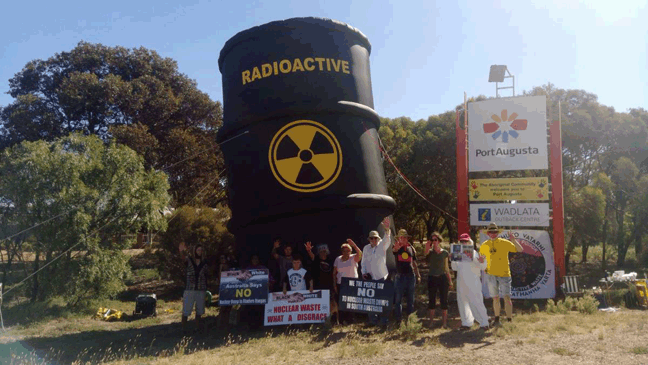
This New York Times author gives a fair coverage to the Kimba radioactive waste dump issue. But it’s misleading in 3 important ways, as if the author completely buys the nuclear lobby’s propaganda.:
- States that “The country has no nuclear power plants.” But fails to mention the Lucas Heights nuclear reactor [which is the source of the really important radioactive trash for Kimba]
- Fails to mention the fact that South Australia has a clear law prohibiting establishment of any nuclear waste facility
- Seems unaware of the huge distances (2000 km) involved, which would mean that the vast majority of medical wastes would no longer be radioactive, in transport from the main points of production and use.
A Farming Town Divided: Do We Want a Nuclear Site that Brings Jobs?, NYT, By MARCH 7, 2018 “……… Now, as the federal government considers whether to build the site on one of these two farms in Kimba, this community of about 650 people finds itself divided and angry. The prospect of jobs and subsidies that the site would bring has split locals between those who want to preserve rural Australia’s way of life and those who say the glory days of farming are over…..
Despite the distances, locals say Kimba always had a strong sense of community, at least until the nuclear site was proposed. Some said the allure of millions of dollars’ worth of grants and subsidies that the government was offering the host community had blinded people to the risks.
Australia’s extreme right wing Senator promises $445 billions to South Australia, if it takes in the world’s radioactive trash
 Cory Bernardi says a nuclear power dump could make us the ‘Saudi Arabia of the south’, news.com.au 26 Feb 18 CORY Bernardi is pushing to reignite a controversial development in South Australia, saying it could make the state the “Saudi Arabia of the south”.
LEADER of the Australian Conservatives party Cori Bernardi is pushing for a nuclear waste dump in South Australia, which he says will transform the state into the economic “Saudi Arabia of the south”.
Speaking at the party’s election launch in South Australia on Sunday, founder and federal Senator Cory Bernardi said he wanted to reopen the debate on an outback nuclear dump.
He called for changes to the law to allow for “all forms of energy production”, including nuclear power, urging authorities to “complete a full rigorous analysis” of the idea.
According to The Advertiser, he claimed the dump would generate up to $6.7 billion in gross state product, allow for $3 billion in annual taxes to be scrapped, and see the state reaping in $445 billion over the next century.
“Imagine that legacy for our children … to draw on in developing this state,” he said. “We would be an economic powerhouse. We would be the strongest state in the Commonwealth.”
Upper House candidate Robert Brokenshire said the party is “committed to looking at all types of energy production including nuclear energy to find the cheapest and most reliable form of energy”.
Labor Premier Jay Weatherill was quick to rule out the suggestion.
“That’s dead,” he said on Sunday. “Labor Party policy has been opposed to a nuclear waste facility in the past and there’s no prospect of changing that in the future.”
Mr Weatherill did not rule out pursuing a High Court case against the Turnbull government if a national nuclear waste dump was to be approved in South Australia, The Australian reported last month.
……..Earlier this month, the Australian Conservatives announced it will field 33 Lower House and two Upper House candidates at the state election on March 17. http://www.news.com.au/technology/environment/cory-bernardi-says-a-nuclear-power-dump-could-make-us-the-saudi-arabia-of-the-south/news-story/eb3f1ada5ed978646f53a2911f0e1c3d
South Australia’s world-leading solar energy system
 Reuters 4th Feb 2018, South Australia’s state premier Jay Weatherill announced a plan on Sunday to create a network of 50,000 home solar systems backed by Tesla Powerwall batteries, ahead of a state election in March.
“We lead the world in renewable energy with the world’s largest battery, the world’s largest solar thermal plant and now the world’s largest virtual power plant,” he said in a televised interview from the state capital of Adelaide. “The size of it is the reason why it’s going to be a success.” The project would begin with a trial on 1,100 public housing homes, the government said on its website.
https://uk.reuters.com/article/uk-australia-power-tesla/south-australia-promises-worlds-largest-virtual-power-plant-idUKKBN1FO029?rpc=401&
The woes of Australian uranium company Paladin – 98% of shares transferred to creditors
 Paladin to return to ASX, most shares in hands of creditors http://www.miningweekly.com/article/paladin-to-return-to-asx-most-shares-in-hands-of-creditors-2018-02-02/rep_id:3650 2ND FEBRUARY 2018 BY: MARIAAN WEBB CREAMER MEDIA SENIOR RESEARCHER AND DEPUTY EDITOR ONLINE JOHANNESBURG (miningweekly.com) – Uranium miner Paladin Energy will apply for its securities to be reinstated to official quotation on the ASX, the Australia-based company said on Friday, announcing the completion of its restructuring and the appointment of two new directors.
My people are still suffering from Australia’s secret nuclear testing
 http://www.canberratimes.com.au/comment/my-people-are-still-suffering-from-australias-secret-nuclear-testing-20171208-h01a3l.html Sue Coleman-Haseldine,
My name is Sue Coleman-Haseldine. I was born into poverty on the margins of Australian society on the Aboriginal mission of Koonibba in 1951. At this time my people were not allowed to vote and we had very few means to be understood, let alone be heard.
I was born into one of the oldest living cultures known on Earth and into a place that I love – a dusty, arid paradise on the edge of a rugged coastline. Our land and waters are central to our outlook and religion and provide the basis for my people’s health and happiness.
And I was born just before the desert lands to our north were bombed by the deadliest weapons on Earth in an extensive, secretive and devastating manner by the Australian and British governments.
In the 1950s, areas known as Emu Fields and Maralinga were used to test nine full-scale atomic bombs and for 600 other nuclear tests, leaving the land highly radioactive. We weren’t on ground zero, but the dust didn’t stay in one place. The winds brought the poison to us and many others.
Aboriginal people, indeed many people at that time, knew nothing about the effects of radiation. We didn’t know the invisible killer was falling amongst us. Six decades on, my small town of Ceduna is being called the Cancer Capital of Australia. There are so many deaths in our region of various cancers. My grand-daughter and I have had our thyroids removed, and there are many others in our area with thyroid problems. Fertility issues appear common.
The impact of the Maralinga and Emu Fields testing has had far-reaching consequences that are still being felt today. Ask a young person from my area, “What do you think you will die from?” The answer is, “Cancer, everyone else is”.
I have lived my life learning about the bomb tests and also learning that the voice of my people and others won’t always be understood or heard. But I learnt from old people now gone that speaking up is important and by joining with others from many different places and backgrounds that our voices can be amplified.
Through these steps I found the International Campaign to Abolish Nuclear Weapons (ICAN), or perhaps ICAN found me.
ICAN – as an organisation, as a collective of passionate, educated people working for a clear goal – has been so important to me. To know that my story and my voice helps bring recognition to the past and can shape the future of nuclear prohibition has strengthened my resolve.
Being involved in ICAN has been a double-edged sword. On one hand and for the first time in my life, I no longer feel alone or isolated. I have met others from many parts of the globe who have similar stories and experiences and who are passionate advocates for a nuclear-free future.
But the flip side of this is my understanding of just how widespread and just how devastating the nuclear weapons legacy is across the globe. To learn that so many weapons still exist sends fear to my heart. ICAN is a worthy winner of the Nobel Peace Prize – in a short time we have gathered support for a treaty to finally outlaw nuclear weapons and help eliminate the nuclear threat.
The vision was reached in part with so many nations adopting the Treaty on the Prohibition of Nuclear Weapons in July 2017. And we should celebrate this win and the opportunity to work together to stop the suffering and assist countries to make amends to nuclear weapons victims by acknowledging the permanent damage done to land, health and culture.
Unfortunately, the Australian government, along with other first world nations, didn’t even participate in the treaty negotiations, and they haven’t signed the treaty yet, but over time we feel confident they will.
A lot has changed since I was born. Aboriginal people now have the right to vote in Australia, but still we battle for understanding about our culture and the Australian nuclear weapons legacy. My home is still remote and most of my people still poor. But we are also no longer alone. We have the means and the will to participate – to share and to learn and to bring about lasting change.
ICAN’s work is not done, our work is not done. We will continue to work together. A world without nuclear weapons is a world we need and are creating. I stand here in hope and gratitude for the opportunity to participate. I stand here with pride and I stand here for our future and the generations to come.
Sue Coleman-Haseldine is a Kokatha woman who lives in Ceduna, South Australia. This is an extract of her speech in Oslo marking the awarding of the Nobel Peace Prize to ICAN.
Aboriginal grandmother to testify on nuclear bomb test damage at Maralinga site, in Australia
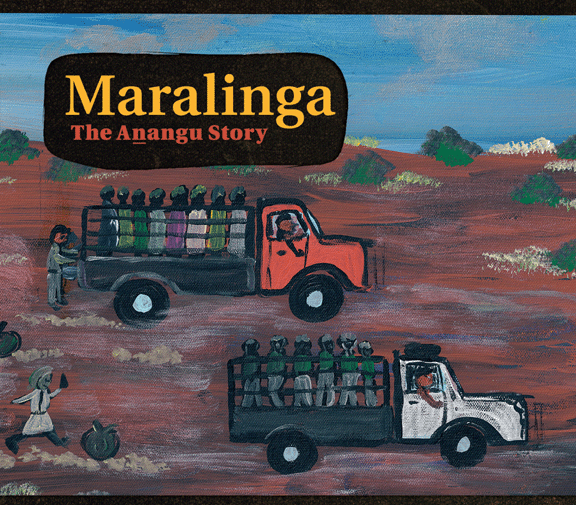 World spotlight shines on Maralinga horror, https://au.news.yahoo.com/a/38090548/world-spotlight-shines-on-maralinga-horror/ Lisa Martin, 30 Nov 17, Sue Coleman-Haseldine was a toddler crawling around in the dirt when the winds brought the black mist.
Her white nappies on the washing line were burnt.
It was in the 1950s when the British began testing nuclear weapons at Maralinga in the South Australian outback.
The legacy of the bombs dropped continues to haunt the 67-year-old Aboriginal grandmother. “We weren’t on ground zero at Maralinga, otherwise we would all be dead,” she told AAP. “I was born and grew up on a mission at Koonibba, but the winds came to us.”
Ceduna, the main township before the Nullarbor, is the cancer capital of Australia, Ms Coleman-Haseldine says. She’s had her thyroid removed and will be on medication for the rest of her life.
Her 15-year-old granddaughter is also battling thyroid cancer..
There are birth defects and cancers right across the community. “It’s changed our genes,” she said.”These diseases weren’t around before the bombs.”
On December 10, Ms Coleman-Haseldine will be in Oslo for the Noble Peace Prize award ceremony.
The International Campaign to Abolish Nuclear Weapons (ICAN) is being recognised for its work to achieve a treaty-based ban on nuclear weapons.
So far 122 countries have adopted the treaty, excluding Australia and countries with nuclear weapons – the US, UK, Russia, China, France, India, Pakistan, North Korea and Israel.
Only three countries have ratified the treaty and 50 are needed for it to become international law.
ICAN is a grassroots movement that began in Carlton, Melbourne more than a decade ago.
In Norway, Ms Coleman-Haseldine will tell the story of her people and their contaminated land.”You’ve got to keep the past alive to protect the future,” she said.
Ms Coleman-Haseldine hopes Australia will reverse its opposition and sign the treaty.
The Turnbull government has ruled that out but the Labor Party will debate the issue at its national conference next year.
Gaol for Australian anti-war protestors at USA’s secret base in theAustralian desert
An American Spy Base Hidden in Australia’s Outback, NYT The trials — and the Australian government’s uncompromising prosecution of the protesters — has put a spotlight on a facility that the United States would prefer remain in the shadows.

— Margaret Pestorius arrived at court last week in her wedding dress, a bright orange-and-cream creation painted with doves, peace signs and suns with faces. “It’s the colors of Easter, so I always think of it as being a resurrection dress,” said Ms. Pestorius, a 53-year-old antiwar activist and devout Catholic, who on Friday was convicted of trespassing at a top-secret military base operated by the United States and hidden in the Australian outback.
From the base, known as the Joint Defense Facility Pine Gap, the United States controls satellites that gather information used to pinpoint airstrikes around the world and target nuclear weapons, among other military and intelligence tasks, according to experts and leaked National Security Agency documents.

As a result, the facility, dotted with satellite dishes and isolated in the desert, has become a magnet for Australian antiwar protesters. ….Over the past two weeks, Ms. Pestorius and five other Christian demonstrators were convicted in two separate trials of breaching the site’s security perimeter last year. They could face seven years in prison……..
Born at the height of the Cold War, Pine Gap was presented to the Australian public in 1966 as a space research facility. But behind the scenes, the station was run by the C.I.A. to collect information from American spy satellites about the Soviet Union’s missile program……Photos taken from the air show a sprawling campus punctuated by white geodesic domes that look like giant golf balls. Inside these spheres, called radomes, are antenna systems that send and receive information from satellites in constant orbit above the earth…..Today, more than 800 people from both countries are believed to work at the base. But the United States is firmly in control.
“Pine Gap has changed and developed enormously,” said Richard Tanter, a senior research associate at the Nautilus Institute and honorary Melbourne University professor who has investigated and criticized the base for years.
In documents leaked by Edward Snowden, the American intelligence contractor turned whistle-blower, Pine Gap is described as playing “a significant role in supporting both intelligence activities and military operations What that actually means, Professor Tanter said, is that the station is involved in real-time contributions to the United States’ global military operations in Afghanistan, Iraq and Syria.
Pine Gap, he added, also “contributes data for C.I.A. drone operations in countries in which the United States is not at war — Yemen, Somalia, Pakistan and so forth. It is also critically important in whatever the United States is going to do on the Korean Peninsula.”
Professor Tanter has gleaned information about the secret site from unexpected public records, including the LinkedIn profiles of Pine Gap contractors and satellite photos that reveal new construction at the site.
Professor Tanter, who is president of the Australian board of the International Campaign for the Abolition of Nuclear Weapons, said he wanted the government to “make a very clearheaded assessment” of whether it is in Australia’s best interest to contribute data for drone assassinations and targeting nuclear weapons..”….. Last year, in the early hours of a cold, dark September morning, Ms. Pestorius, Mr. Dowling and three other “peace pilgrims,” as they call themselves, breached Pine Gap’s security perimeter.
As the activists scrambled up a rocky hill to get closer to the base, and with the police moving in, Ms. Pestorius picked up her viola. Another protester strummed his guitar. As they played a lament for those killed in war, Mr. Dowling held up a large, laminated photograph showing a bloodied young woman with her foot missing.
A sixth activist, Paul Christie, 44, carried out his own protest at Pine Gap days later; he was tried separately and convicted last week, charged, like the others, with entering a prohibited area. During the activists’ back-to-back trials this month, a modest band of supporters gathered at the courthouse. Many were members of the country’s antiwar movement, parts of which are religion-infused.
A Quaker knitted flower brooches. A Buddhist brewed coffee from the back of his van. A collection of colorful banners tied to fences read “Close Pine Gap” and “End the U.S. Alliance and Pine Gap Terror Base.” Mr. Dowling, who said he had been arrested between 50 and 100 times, was found guilty once before of trespassing at Pine Gap, in 2005. The conviction was later overturned.
One of his co-defendants this time was his 20-year-old son Franz, the guitar player at the protest last year. The younger Mr. Dowling and two other defendants — Andrew Paine, 31, and Timothy Webb, 23 — live together in a Dorothy Day Catholic Worker House in Brisbane, where they regularly take in homeless people.
All five were found guilty of entering a prohibited area, and Mr. Paine was convicted of an additional charge of possessing a photographic device.
During their trial, the five — who acted as their own attorneys — tried to argue that they had acted in the defense of others, but Justice John Reeves did not allow it.
Pine Gap has “to bear a big responsibility for all the murder and mayhem that has taken place in Iraq and Afghanistan,” said Jim Dowling….. https://www.nytimes.com/2017/11/23/world/australia/pine-gap-spy-base-protests.html?smid=li-share
Climate Change Performance Index – Sweden rated best, Australia, South Korea, Iran, Saudi Arabia the worst
 ‘Ringing alarm bells’: Australia near the bottom of the heap for climate action http://www.smh.com.au/environment/climate-change/ringing-alarm-bells-australia-near-the-bottom-of-the-heap-for-climate-action-20171115-gzm063.html Peter Hannam
Australia ranks as one of the world’s worst performing nations when it comes to climate action, with only South Korea, Iran and Saudi Arabia faring worse among 56 countries scrutinised by 300 international analysts.
The annual Climate Change Performance Index, led by Germanwatch and other groups, listed Australia as “very low-performing” for its greenhouse gas emissions, energy use and climate policy. It scored a “low’ rating for renewable energy.
The results were released as talks in Bonn, Germany, aimed at shoring up support for the 2015 Paris climate accord enter their final few days.
As in the past three years, Australia has foundered near the bottom of the major tables, prompting the commentators to call on the Turnbull government to “sufficiently implement credible policies” to meet its Paris targets.
Environment and Energy Minister Josh Frydenberg, now in Germany, earlier this week declared Australia remains committed to its pledgeto slice 2005-level emissions by 26-28 per cent by 2030.
Kelly O’Shanassy, chief executive of the Australian Conservation Foundation, said Australia had the highest per capita greenhouse gas emissions of those assessed, and was also one of the world’s largest exporters of fossil fuels.
“Australia’s continued failure to put in place a robust and comprehensive national plan to cut pollution is raising alarm bells around the world,” Ms O’Shanassy said, noting emissions have been increasing since 2013.
“This is a national embarrassment for a wealthy nation with so much at risk from climate change and such abundant sun and wind that could be harvested for clean energy,” she said.
Sweden was the top-ranked nation, marked highly for its efforts to boost low-carbon sources of electricity and its increasing forest cover.
The US was among the big movers in the ranking, sliding from 35th two years ago to just one slot above Australia this year.
It got marked down for its declaration to exit the Paris agreement – a move that left it isolated after Syria – the last nation holding out – recently signed up to the accord.
Australium uranium company Paladin going bust, leaving Malawi with a horrible environmental mess
Paladin has ignored our requests to provide its estimate of the cost of rehabilitating Kayelekera, but we can safely say that the figure will be multiples of the US$10 million bond. Just keeping Kayelekera in care-and-maintenance costs US$10–12 million annually.
As things stand, if Paladin goes bankrupt and fails to rehabilitate Kayelekera, either rehabilitation will be coordinated and funded by the Malawian government (with a small fraction of the cost coming from Paladin’s bond) or the mine-site will not be rehabilitated at all.
It does Australian companies investing in mining ventures abroad no good whatsoever to leave Kayelekera unrehabilitated, a permanent reminder of the untrustworthiness and unfulfilled promises of an Australian miner and the indifference of the Australian government.
The company’s environmental and social record has also been the source of ongoing controversy and the subject of countless critical reports.
Julie Bishop, the WA government, Paladin and its administrators from KPMG need to liaise with the Malawian government and Malawian civil society to sort the rehabilitation of Kayelekera. An obvious starting point would be to prioritise the rehabilitation of Kayelekera if and when Paladin goes bankrupt and its carcass is being divided up. (picture below shows uranium sludge going to river)

Australian uranium miner goes bust ‒ so who cleans up its mess in Africa? By Morgan Somerville and Jim Green, Online Opinion, 8 November 2017, http://onlineopinion.com.au/view.asp?article=19394&page=0
Perth-based uranium mining company Paladin Energy was put into administration in July and the company is teetering on the brink of bankruptcy. Critics of the uranium industry won’t miss the company if it disappears. Other uranium mining companies won’t miss Paladin; in an overcrowded market, they will be pleased to have less competition.
But the looming bankruptcy does pose one major problem. Paladin’s Kayelekera uranium mine in Malawi, the ‘warm heart of Africa’, needs to be rehabilitated and Paladin hasn’t set aside nearly enough money for the job.
Under the leadership of founder and CEO John Borshoff, described as the grandfather of Australian uranium, Paladin has operated two uranium mines over the past decade. The Langer Heinrich mine in Namibia was opened in 2007, and Kayelekera in 2009.
They were heady days ‒ there was an endless talk about a nuclear power ‘renaissance’ and the uranium price tripled between June 2006 and June 2007. The Australian Financial Review reflected on Paladin’s glory days: “John Borshoff was once one of Western Australia’s wealthiest businessmen. The founder of Perth-based Paladin Energy developed an enviable portfolio of African uranium mines supposed to satiate booming global demand for yellowcake. When the company’s Langer Heinrich mine began shipments in March 2007, as the spot price for uranium eclipsed $US100 per pound, Paladin was worth more than $4 billion.”
Paladin was once the best-performed stock in the world according to The Australian newspaper. The company’s share price went from one cent in 2003 to A$10.80 in 2007. Borshoff made his debut on the Business Review Weekly’s ‘Rich 200’ list in 2007 with estimated wealth of A$205 million.
But the good times didn’t last. The uranium bubble burst in mid-2007, and the Fukushima disaster in 2011 ensured that there would be no nuclear power renaissance and that the uranium industry would remain depressed for years to come. Borshoff left Paladin in 2015, and in 2016 Paladin’s new CEO Alexander Molyneux said that “it has never been a worse time for uranium miners”.
The loss-making Kayelekera mine in Malawi was put into care-and-maintenance in July 2014, leaving Paladin with the modest Langer Heinrich mine plus a number of projects the company describes as ‘nonproducing assets’ (such as uranium projects in jurisdictions that ban uranium mining).
Paladin was put into administration in July this year, unable to pay its debts. Even if Paladin sold its 75% stake in Langer Heinrich, its only revenue-raising project, it couldn’t repay all its debts.
Administrators from KPMG are attempting to sort out the mess and bondholders are reportedly being asked to fund a recapitalisation of Paladin. Bankruptcy would seem a much more likely option given the weakness of the company and the weakness of the global uranium market.
Paladin has said that a uranium price of about US$75 per pound would be required for Kayelekera to become economically viable ‒ almost four times the current uranium spot price, and well over twice the current long-term contract price. Even if the uranium price did rebound, Kayelekera would operate for only around four years; it isn’t a large deposit.
The likelihood of uranium prices reaching US$75 in the foreseeable future is near-zero. John Borshoff said in 2013 that the uranium industry “is definitely in crisis … and is showing all the symptoms of a mid-term paralysis”. Former World Nuclear Association executive Steve Kidd said in May 2014 that the industry is set for “a long period of relatively low prices, in which uranium producers will find it hard to make a living”. Nick Carter from Ux Consulting said in April 2016 that he did not anticipate a uranium supply deficit until the late 2020s. Other industry insiders and market analysts have made similar comments about the bleak future for uranium ‒ and the bondholders being asked to recapitalise Paladin would surely know that their money would be better invested in a long-shot at Flemington.
Who cleans up Kayelekera?
Assuming Paladin goes bankrupt, who cleans up the Kayelekera open-pit uranium mine? The company was required to lodge a US$10 million Environmental Performance Bond with Malawian banks, and presumably that money can be tapped to rehabilitate Kayelekera. But US$10 million won’t scratch the surface. According to a Malawian NGO, the rehabilitation cost is estimated at US$100 million ‒ ten times the amount set aside by Paladin. The cost of rehabilitating the Ranger uranium in the Northern Territory ‒ also an open-pit uranium mine, albeit larger than Kayelekera ‒ is estimated at just under US$500 million.
Paladin has ignored our requests to provide its estimate of the cost of rehabilitating Kayelekera, but we can safely say that the figure will be multiples of the US$10 million bond. Just keeping Kayelekera in care-and-maintenance costs US$10–12 million annually.
As things stand, if Paladin goes bankrupt and fails to rehabilitate Kayelekera, either rehabilitation will be coordinated and funded by the Malawian government (with a small fraction of the cost coming from Paladin’s bond) or the mine-site will not be rehabilitated at all.
Is it reasonable for Australia, a relatively wealthy country, to leave it to the overstretched, under-resourced government of an impoverished African nation to clean up the mess left behind by an Australian mining company? If the Malawian government cleans up Paladin’s mess, that will necessarily come at the expense of other priorities. Malawi is one of the poorest countries in the world. According to a 2013 U.N. report, more than half the population live below the poverty line, and about half of all children under the age of five show signs of chronic malnutrition.
Foreign Minister Julie Bishop should intervene to sort out the situation at Kayelekera and to prevent a repetition of this fiasco. We imagine that the Minister’s eyes might glaze over in response to a moral argument about the importance of Australia being a good global citizen. But there is also a hard-headed commercial argument for intervention to clean up Kayelekera.
It does Australian companies investing in mining ventures abroad no good whatsoever to leave Kayelekera unrehabilitated, a permanent reminder of the untrustworthiness and unfulfilled promises of an Australian miner and the indifference of the Australian government. Australia is set to become the biggest international miner on the African continent, perhaps as early as this year, according to the Australia-Africa Minerals & Energy Group. But Australian companies can’t expect to be welcomed if travesties such as Kayelekera remain resolved.
‘Overly sophisticated’
Back in 2006, John Borshoff told ABC television that Australia and Canada have become “overly sophisticated” with their thinking about environmental and social issues associated with the mining industry. Hence Paladin’s focus on projects in Africa.
One advantage ‒ if that’s the word ‒ of mining in Africa is that Paladin hasn’t had to set aside sufficient funds to rehabilitate Kayelekera. The company’s environmental and social record has also been the source of ongoing controversy and the subject of countless critical reports.
Paladin has lost money on Kayelekera, and the economic benefits for Malawi have been pitiful. Paladin has exploited the country’s poverty to secure numerous reductions and exemptions from payments normally required by foreign investors. United Nations’ Special Rapporteur Olivier De Schutter noted in a 2013 report that “revenue losses from special incentives given to Australian mining company Paladin Energy, which manages the Kayelekera uranium mine, are estimated to amount to at least US$205 million (MWK 67 billion), and could be up to US$281 million (MWK 92 billion) over the 13 year lifespan of the mine.”
The official line from Australia’s Department of Foreign Affairs and Trade is that “mining offers African countries an unparalleled opportunity to stimulate growth and reduce poverty. If well managed, the extractives sector can drive innovation, generate revenue to fund critical social services and upgrade productive physical infrastructure, and directly and indirectly create jobs.”
The reality at Kayelekera is starkly different from the picture painted by the bureaucrats in Canberra.
Two years ago, then WA Premier Colin Barnett told a mining conference in South Africa that Australian mining companies have “brought both expertise and ethical standards. It is a matter of pride for many companies that the standards applied in Australia are also applied in Africa.”
But standards at Kayelekera fall a long way short of Australian standards. Moreover, Barnett’s claims sit uncomfortably with the highly critical findings arising from a detailed investigation by the International Consortium of Independent Journalists. The Consortium noted in its 2015 report that since 2004, more than 380 people have died in mining accidents or in off-site skirmishes connected to Australian mining companies in Africa (there have been six deaths at Kayelekera). The reportfurther stated: “Multiple Australian mining companies are accused of negligence, unfair dismissal, violence and environmental law-breaking across Africa, according to legal filings and community petitions gathered from South Africa, Botswana, Tanzania, Zambia, Madagascar, Malawi, Mali, Cote d’Ivoire, Senegal and Ghana.”
Not even Collin Barnett would argue that Paladin is a source of pride for Australia. Quite the opposite. Likewise, Foreign Minister Julie Bishop surely didn’t have Paladin’s open-cut mine in mind when she told the Africa Down Under mining conference in Perth in September that many Australian mining projects in Africa are outposts of good governance and that the “Australian Government encourages the people of Africa to see us as an open-cut mine for lessons-learned, for skills, for innovation and, I would like to think, inspiration.”
Julie Bishop, the WA government, Paladin and its administrators from KPMG need to liaise with the Malawian government and Malawian civil society to sort the rehabilitation of Kayelekera. An obvious starting point would be to prioritise the rehabilitation of Kayelekera if and when Paladin goes bankrupt and its carcass is being divided up. Surely Kayelekera should take precedence over debtors such as French state-owned utility EDF, which is owed US$277 million by Paladin ‒ all the more so since the French state has its own sordid history of uranium mining in Africa.
Morgan Somerville is an International Relations student at La Trobe University. Dr Jim Green is the national nuclear campaigner for Friends of the Earth.
Mainstream media mindlessly regurgitates pro nuclear propaganda
 Mainstream media in various places continues to regurgitate pro nuclear propaganda without any attempt to examine it critically
Bill Gates and China partner on world-first nuclear technology , Cole Latimer, SMH, The Age, and global media outlets, 8 November 17
Bill Gates’ nuclear firm TerraPower and the China National Nuclear Corporation have signed an agreement to develop a world-first nuclear reactor, using other nuclear reactors’ waste
TerraPower chairman Bill Gates and Chinese premier Li Keqiang signed a joint venture agreement to create the Global Innovation Nuclear Energy Technology company, which will build a Travelling Wave Reactor and commercialise the technology…… http://www.smh.com.au/business/energy/bill-gates-and-china-partner-on-worldfirst-nuclear-technology-20171106-gzfrf0.html
1 This Month



26 September – International Day for the Total Elimination of Nuclear Weapons


PLEASE OPPOSE HR 8255 AND S.3639 – bills would accelerate satellite deployment, with no environmental review or safeguards – https://ncstd5li.quorum.us/campaign/169331/
To see nuclear-related stories in greater depth and intensity – go to https://nuclearinformation.wordpress.com
-
Archives
- September 2026 (245)
- August 2026 (330)
- July 2026 (355)
- June 2026 (287)
- May 2026 (306)
- April 2026 (356)
- March 2026 (251)
- February 2026 (267)
- January 2026 (308)
- December 2025 (358)
- November 2025 (359)
- October 2025 (375)
-
Categories
- 1
- 1 NUCLEAR ISSUES
- business and costs
- climate change
- culture and arts
- ENERGY
- environment
- health
- history
- indigenous issues
- Legal
- marketing of nuclear
- media
- opposition to nuclear
- PERSONAL STORIES
- politics
- politics international
- Religion and ethics
- safety
- secrets,lies and civil liberties
- spinbuster
- technology
- Uranium
- wastes
- weapons and war
- Women
- 2 WORLD
- ACTION
- AFRICA
- Atrocities
- AUSTRALIA
- Christina's notes
- Christina's themes
- culture and arts
- Events
- Fuk 2022
- Fuk 2023
- Fukushima 2017
- Fukushima 2018
- fukushima 2019
- Fukushima 2020
- Fukushima 2021
- general
- global warming
- Humour (God we need it)
- Nuclear
- RARE EARTHS
- Reference
- resources – print
- Resources -audiovicual
- Weekly Newsletter
- World
- World Nuclear
- YouTube
-
RSS
Entries RSS
Comments RSS
 nuclear-news