Australia’s Great Barrier Reef in grave danger from global warming
Now the scientists have found that the coping mechanism barrier reef corals use to prepare themselves to face warm summer water is also under threat from global warming, and from human activities such as agriculture, shipping, and fishing.
“As temperature warms, the evidence is that this protective mechanism will no longer function
 How the Great Barrier Reef is going from bad to worse Christian Science
 Monitor, 14 Apr 16 Though the corals of Australia’s Great Barrier Reef historically have managed to adjust to gradually warming seawater of the summer months, they will likely lose their defenses when the ocean warms overall in the near future, say scientists. (at left – coral bleaching )
This was the latest finding from a team of American and Australian coral reef experts from James Cook University, the University of Queensland, and the US National Oceanic and Atmospheric Administration (NOAA).
These same scientists recently reported that their aerial surveys of some of the 3,000 coral reefs that make up this iconic natural wonder off Australia’s northeastern coast have showed that coral bleaching this year is the worst that has ever been observed. This is largely due to a recurring weather event known as El Niño, a storm system that is expected to become more frequent and more severe in the future.
I agree that El Niño is a natural variability; it’s a part of nature, but that variation in patterns and temperatures is superimposed upon a trend of warming,” Scott Heron, a NOAA coral reef scientist based in Australia, tells The Christian Science Monitor in an interview. “There are ups and downs, but now there are just higher ups than ever before, and the downs are not as low,” he says.
Coral bleaching happens when ocean temperatures rise to a point that zooxanthellae – tiny algae that live on corals and provide them with nutrients and their radiant colors – leave their coral homes, thereby rendering coral white or “bleached.” When corals go without zooxanthellae for too long, they die. This affects about a quarter of marine species that depend on coral reefs for shelter, and the humans who depend on those species for their livelihoods.
This year’s is the third major bleaching event in recent history for the 2,300-kilometer-long Great Barrier Reef, which is home to one of the most diverse ecosystems in the world. But this one is much worse than the bleaching events that occurred in 1998 and 2002, say scientists who recently found bleaching in almost 1,100 kilometers of northern barrier reef, from the island of New Guinea to the Australian coastal city of Cairns. The researchers estimate that 30 to 50 percent of the corals there are already be dead.
Now the scientists have found that the coping mechanism barrier reef corals use to prepare themselves to face warm summer water is also under threat from global warming, and from human activities such as agriculture, shipping, and fishing.
“As temperature warms, the evidence is that this protective mechanism will no longer function,” C. Mark Eakin, a scientist with NOAA Coral Reef Watch, tells the Monitor in an interview…….
The most viable immediate remedy, say paper authors, is to reduce the carbon emissions that cause warming and restrict other human activities near the reefs that add more stress, including runoff from agriculture, unsustainable fishing practices, and physical damage to the reef from ship groundings.
“These are all human stressors on reef that have to be minimized or eliminated for reefs to be able to bounce back from these bleaching events, even in a decade or two,” Eakin says.http://www.csmonitor.com/Science/2016/0414/How-the-Great-Barrier-Reef-is-going-from-bad-to-worse
In Australia, and everywhere else, oil and gas lobbies pay shills to obstruct action on climate change
 Australian oil and gas lobby spent millions advocating against climate action: report Tom Arup Environment editor, The Age April 12, 2016
Australia’s peak oil and gas industry lobby group spent almost $4 million last year trying to “obstruct” more ambitious climate change policy, according to British research group InfluenceMap.
It was part of an overall $150 million spent globally in 2015 by five major oil companies and lobby groups.
The Australian Petroleum Production & Exploration Association (APPEA) represents the domestic oil and gas industry and counts among its 70 members giant companies such as Woodside, Shell Australia and Chevron Australia.
According to the analysis, InfluenceMap estimated that APPEA spent about $5.5 million on climate-related advocacy in 2015 though expenditure on staff, public campaigns, advertising and other external public relations.
InfluenceMap then made an assessment of the position, tone and transparency of this work. They determined about $3.9 million of it went towards what they described as “obstructive spending”.
InfluenceMap took its definition of advocacy from a 2013 United Nations report that included activities beyond direct approaches to government, such as advertising, public relations, political contributions and industry group memberships.
The report cited APPEA’s support for less-stringent emissions targets, lobbying to remove Australia’s renewable energy target and its argument that the Turnbull government’s greenhouse gas “safeguard mechanism” should apply only to emissions above business as usual levels, as examples of its opposition to climate policies.
The report also points to consultation, messaging and two publicity campaigns by APPEA “to put pressure on policy makers to support unrestricted conventional & unconventional oil and gas production”. …….
The negative climate advocacy by APPEA calculated by InfluenceMap is a tiny fraction of the estimates it has produced for other major oil players that are assessed in the report.
It says ExxonMobil may have spent $35 million in 2015, while Shell may have spent $29 million.
Alongside APPEA, the report also looked at the spending of two United States industry bodies, the American Petroleum Institute and the Western States Petroleum Association (WSPA), finding negative climate advocacy spending of $85 million and $8 million respectively.
Charlotte Wood, campaigns director of anti-fossil fuels group 350.org Australia, said: “It is astounding that in the 21st century, when we know the scientific consequences of burning fossil fuels, that Australian oil and gas companies have still spent almost $4 million dollars to undermine consensus on climate change.” http://www.theage.com.au/national/australian-oil-and-gas-lobby-spent-millions-advocating-against-climate-action-report-20160412-go47ok.html#ixzz45es17jN8
Australia reduces aid to Africa, while promoting dodgy mining companies there
Last year, the International Consortium of Investigative Journalists released a report called Fatal Extraction: Australian Mining Companies Digging a Deadly Footprint in Africa. It reported that Australian mining companies were the most rapidly expanding of all mining investors in Africa. From 2000 to 2009, prospecting licences held by Australian companies in Botswana alone increased from 14 to 260.
According to the report, Australian mining companies were responsible for multiple cases of negligence, unfair dismissal, violence and environmental law-breaking across Africa. It claims that since 2004 more than 380 people have died in mining accidents or in offsite skirmishes connected to Australian mining companies in 13 countries in Africa.
In comparison with Australia, African tax regulations are relatively flexible, while wages and working conditions, environmental protection, and occupational health and safety laws are weak.
Last year Foreign Minister Julie Bishop announced that the Australian government would actively promote the interests of the mining sector ahead of economic aid to Africa.
Australian miners in South Africa In the wake of a local activist’s murder, Australian mining interests in Africa are being called into question. https://www.thesaturdaypaper.com.au/news/resources/2016/04/09/australian-miners-south-africa/14601240003106 PHILLIP WALKER 9 Apr 16 Thee assassination of South African community activist Sikhosiphi “Bazooka” Radebe was shocking but sadly not surprising.
On the night of his death – March 22 – Radebe had warned his colleagues in the Amadiba Crisis Committee of a hit list. An hour later, two men masquerading as police arrived at Radebe’s house and shot him eight times in the head.
Radebe had been opposing titanium mining at Xolobeni, on the ancestral land of the Pondo people on South Africa’s east coast. The mining company involved is Australian-based Mineral Commodities Limited.
At Radebe’s funeral last weekend, Chief Cinani, representing the Queen and the Royal House of the amaMpondo, criticised the government’s acceptance of Australian investment and investment from the Indian business family the Guptas. “I am blaming the government because the government gave permits for those Australians, while people were saying ‘no’ to the government . It is clear that the business community is ruling the government. It is not only about the Guptas. Now we have seen the Australians. People are coming here with huge sums of money to divide the people.”
Through its director, Mark Caruso, Mineral Commodities Limited (MRC) and its South African subsidiary, Transworld Energy & Minerals Resources (TEM), have long been in dispute with the Amadiba community. The latest tragedy marks an escalation of hostility in a conflict now entering its 10th year.
There were hopes that the international condemnation drawn by the assassination of Radebe might stem the violence, but it is now alleged that after Radebe’s funeral “pro-mining thugs” assaulted three journalists.
Following the killing of Radebe, Caruso issued a statement on behalf of MRC declaring that it was “in no way implicated in any form whatsoever in this incident … This company will not engage in any activity that incites violence.” The Saturday Paper does not suggest Caruso had any involvement in Radebe’s death or any other illegality.
In an email sent last October regarding a taxi contract for the Tormin mine, however, Caruso said he felt “enlivened by the opportunity to grind all resistance to the [sic] my presence and the presence of MSR [another MRC subsidiary] into the animals [sic] of history as a failed campaign.”
In the same email, he cited Ezekiel 25:17: “And I will strike down upon thee with great vengeance and furious anger those who attempt to poison and destroy my brothers. And you will know my name is the Lord when I lay my vengeance upon thee.”
Elsewhere, he raged against the “group of colluding malfeasant, recalcitrant people and groups who chose to use underhanded nefarious elements to achieve their self-interested objectives”.
The correspondence ended: “It is easier to support us, than work against us.”
The South African Department of Environmental Affairs has reported MRC’s Tormin mine, on South Africa’s west coast, for several contraventions including mining in no-go areas and the use of unauthorised roads. MRC also stands accused of poor environmental practices by allowing a cliff face to collapse, and engaging in substandard land rehabilitation.
At both Tormin and Xolobeni, evidence suggests that MRC and its South African subsidiary are creating communities at war with themselves. Families, communities and tribal authorities are pitted against each other through the selective allocation of benefits and favours.
During a public consultation, subheadman elder Samson Gampe captured local feeling when he declared: “A cow that is a stranger in the herd is always chased by the rest of the herd by showing it horns. This is what we have done today, to tell the world that people of Kwanyana do not want this foreign ‘cow’ – this mining proposal … We need a proposal that brings us together, not the one that brings us conflict.”
Through Transworld Energy & Minerals Resources, MRC seeks to mine 2900 hectares at Xolobeni on South Africa’s Wild Coast. The Amadiba Crisis Committee, representing the local community, has blocked mining licence applications on environmental and ownership grounds.
The communal land in question is held in trust by the minister of land reform on behalf of local residents under communal land tenure. The crisis committee is committed to community-owned ecotourism as a more viable option for themselves and the land. Permission to mine one of the five “blocks” was rescinded on appeal last year…….
Last year, the International Consortium of Investigative Journalists released a report called Fatal Extraction: Australian Mining Companies Digging a Deadly Footprint in Africa. It reported that Australian mining companies were the most rapidly expanding of all mining investors in Africa. From 2000 to 2009, prospecting licences held by Australian companies in Botswana alone increased from 14 to 260.
According to the report, Australian mining companies were responsible for multiple cases of negligence, unfair dismissal, violence and environmental law-breaking across Africa. It claims that since 2004 more than 380 people have died in mining accidents or in offsite skirmishes connected to Australian mining companies in 13 countries in Africa.
Among the most notorious incidents is the case of Anvil Mining in south-eastern Democratic Republic of the Congo. In 2005 Anvil vehicles transported Congolese troops under the command of Colonel “Double-Bladed Knife” Ademar to the village of Kilwa, which had been taken the previous day by rebels.
Most villagers had already fled by the time Colonel Ademar’s troops arrived, and the rebels fled within hours. There were reports that Ademar ordered, “Kill everything that breathes.” It is known that 73 men, women and children were summarily murdered.
Following public outcry, Anvil issued a statement saying: “The DRC military requested access to Anvil’s air services and vehicles, to facilitate troop movements in response to the rebel activity. Anvil had no option but to agree to the request”.
Neither Anvil Mining nor any employee has been found guilty of any crime.
In comparison with Australia, African tax regulations are relatively flexible, while wages and working conditions, environmental protection, and occupational health and safety laws are weak. Mining companies attribute conflict to corrupt or brutal officials, or to local issues, rather than acknowledge the role of the mine in these conflicts.
Many mining companies are tempted to use their association with Australia and its friendly reputation to gain a competitive advantage while avoiding the ethical and operational standards that prevail within Australia.
Last year Foreign Minister Julie Bishop announced that the Australian government would actively promote the interests of the mining sector ahead of economic aid to Africa.
“Australia’s aid program has been reshaped in line with our belief that the best way to help countries grow their economies and improve the living standards of their people is to focus on prosperity…” she said. “Mining has made, and continues to make, a substantial contribution to economic development and poverty alleviation in Africa.”
Australian aid to Africa has been slashed since 2014. The mining sector is the only remaining means for Australian embassies to build relationships and promote their public profile in Africa. Even the remnants of the scholarship scheme named Australia Awards have been aligned to suit the mining sector.
Last year, at the Africa Down Under mining conference held in Perth, it was claimed that in Africa “ground discoveries made by Australian companies amount to $687 billion of value”, while investment was only 10 per cent of that amount. Clearly there is significant profit to be made mining in Africa.
While most mining companies may operate in accordance with national laws and the Extractive Industries Transparency Initiative – the minimal standards apply – outrages such as the murder of Sikhosiphi “Bazooka” Radebe undermine any promotional value Australia may seek to achieve.
In his funeral oration, Chief Cinani said: “There is no crisis which can take more than 10 years. A crisis should take place for quite a short time and then the authorities should resolve the problem. The King has said, ‘This must stop.’ Today we are here to say Bazooka has died with the key in his hand, so whoever would like to continue this must go and dig the key from his grave. He has gone with it. That simply means there will be no mining here.”
Australian companies BHP Billiton and Wilson Security linked to Panama corruption papers
BHP Billiton And Wilson Security Linked To Panama Papers
04/04/2016. BHP Billiton, Wilson Security and a major electricity company in Australia are now targets of the Australian Tax Office, after leaked documents linked all three companies to a law firm in Panama and the British Virgin Islands.
http://www.huffingtonpost.com.au/2016/04/04/bhp-biliton-wilson-security-panama-papers_n_9607990.html
Panama Papers: Australian companies BHP, Wilson security caught up in tax probe
April 5, 2016. More than 800 wealthy Australians are being investigated by the Australian Taxation Office over their dealings with a secretive Panama-based law firm used by the rich to hide money.
BHP Billiton and a security firm that guards major government buildings are among hundreds of Australian names linked to a Panama law firm that helps the rich hide money. …
Four Corners claimed that BHP used Mossack Fonseca offices in the British Virgin Islands to register five companies linked to its aluminium, diamonds, steel and finance arms.
Panama Papers Update: Law Firm Mossack Fonseca Listed BHP Billiton’s Two British Virgin Islands Companies As ‘Mandatory High Risk’
April 4, 2016. Panama-based law firm Mossack Fonseca, which is at the center of a massive leak, assessed BHP Billiton Ltd.’s two companies in British Virgin Islands as “mandatory high risk” after the Anglo-Australian mining giant authorized the businesses to receive huge sums of money, the Guardian reported Monday. The exposé related to Mossack FonsecaSunday revealed widespread international corruption connected to offshore tax shelters.
The Panama Papers: BHP Billiton’s face-off with Mossack Fonseca
April 4, 2016. A financial representative for BHP Billiton threatened to fire notorious Panamanian law firm Mossack Fonseca if it went ahead with a due diligence investigation.
BHP-owned companies triggered ‘high risk’ alert at Panama law firm
April 4, 2016. Mossack Fonseca flagged concerns about two of mining giant’s companies in British Virgin Islands because ‘authorised capital is higher than the norm’
Panama Papers: ATO investigating more than 800 Australian clients of Mossack Fonseca
April 4, 2016. The Australian Taxation Office is investigating more than 800 high net wealth Australian clients of the controversial Panama law firm Mossack Fonseca, which is the focus of an unprecedented leak of tax haven records released globally.
More than 11.5 million documents have been leaked from Mossack Fonseca’s files, revealing the secrets of hundreds of thousands of clients – including several thousand Australians – covering a period over almost 40 years, from 1977 until as recently as last December.
The release of the documents on Monday follows a 12-month investigation by media groups including The Australian Financial Review, led by the International Consortium of Investigative Journalists (ICIJ) in Washington.
Australian companies, taxpayers exposed after Panama Papers leak
April 5, 2016. Australian companies BHP Billiton and Wilson Security are among those named in the massive document leak, detailing tax dealings of companies and people from around the world.
The cases are part of a leak of 11.5 million documents from Panama-based firm Mossack Fonseca, which reveals how the rich, including political leaders such as Russian President Vladimir Putin, hide their money.
Australian companies BHP Bilton and Wilson Security among those named in Panama papers leak exposing the use of offshore tax havens
- Australian Tax Office is investigating dealings of 800 high net individuals
- It follows massive leak of Panama papers from law firm Mossack Fonseca
- Secret documents show how law firm allegedly helped clients evade tax
- Treasurer Scott Morrison says government is cracking on tax avoidance
The Australian Taxation Office is investigating more than 800 Australians after a massive leak of financial data revealed how 12 current or former world leaders, a host of celebrities and the global rich are using offshore tax havens to hide their wealth.
Australian-linked organisations and business leaders named in the huge leaks include BHP Billiton, Wilson Security, Gold Coast based company director Ian Taylor, and Hong Kong’s richest man and Australian energy market owner Li Ka-Shing, ABC’s Four Corners reports.
Australia unwise to sell uranium to Ukraine
The Zaporizhia nuclear facility is Europe’s largest and is only 200 kilometres from the conflict zone in eastern Ukraine. Some commentators have described nuclear plants in the region as pre-deployed nuclear targets and there have already been armed incursions during the recent conflict period.

 Australia shouldn’t sell its uranium to Ukraine http://www.smh.com.au/comment/australia-shouldnt-sell-its-uranium-to-ukraine-20160331-gnv0no.html, Dave Sweeney, 31 Mar 16 Foreign Affairs Minister Julie Bishop’s announcement this week to sell Australian uranium to Ukraine is an ill-advised and dangerous retreat from responsibility.
With timing and placement that a satirist could only dream of emulating – April Fool’s Day, the month of the 30th anniversary of the Chernobyl meltdown and while attending a nuclear security summit – Bishop is set to sign a uranium supply agreement this week with Ukrainian President Petro Poroshenko.
Australia, the country that directly fuelled Fukushima now plans to sell uranium to Ukraine, the country that gave the world Chernobyl – hardly a match made in heaven.
Thirty years ago the Chernobyl nuclear disaster spread fallout over large swathes of eastern and western Europe and five million people still live in contaminated areas in Belarus, Ukraine and Russia.
Serious containment and waste management issues remain at Chernobyl with a massive concrete shield now under construction in an attempt to enclose the stricken reactor complex and reduce the chances of further radioactive releases.
Against this backdrop there are deep concerns over those parts of the Ukrainian nuclear sector that are not yet infamous names, including very real security concerns about nuclear facilities being targeted in the current conflict with Russia.
The Zaporizhia nuclear facility is Europe’s largest and is only 200 kilometres from the conflict zone in eastern Ukraine. Some commentators have described nuclear plants in the region as pre-deployed nuclear targets and there have already been armed incursions during the recent conflict period.
Australia has already suspended uranium sales to Russia – it makes scant sense to start selling uranium to Ukraine now. Along with security concerns there are serious and unresolved safety and governance issues that have dropped off the Foreign Minister’s radioactive radar with the sales plan.
Ukraine has 15 nuclear reactors – four are currently running beyond their design lifetime while a further six will reach this in 2020. That means two thirds of Ukraine’s nuclear reactors will be past their use-by date within five years.
On top of that, there is growing regional concern over the risks associated with the Poroshenko administration focus on keeping the reactors running. In rushing to extend operating licences Ukraine is cutting process and safety corners and not complying with its obligations under the Espoo Convention – an international framework agreement around transboundary environmental impact assessment.
In 2013 the Eastern Partnership, a leading East European civil society forum, declared that the absence of environmental impact assessment for nuclear projects posed “a severe threat to people both in Ukraine and in neighbouring states, including EU member states”.
These concerns have been amplified after a series of recent shutdowns, fires and safety concerns at Ukrainian nuclear facilities. Kiev’s response was a 2015 government decree preventing the national nuclear energy regulator from carrying out facility inspections on its own initiative. This coupled with increased pressure on industry whistle-blowers and critics has done nothing to address the real risks facing the nations aging nuclear fleet.
None of these issues have even been touched on by Bishop or by the Mineral Council of Australia’s yellowcake cheer squad who continue to champion a sector that remains in freefall post Fukushima. Price and production has fallen and the high risk, low return uranium sector has been hard hit with an independent market research report showing there are fewer than 1000 jobs in Australia’s embattled uranium sector.
There can be no nuclear business-as-usual in the shadow of Fukushima – a disaster that was fuelled by Australian uranium.
Following Fukushima the UN Secretary-General called for Australia to have a dedicated risk analysis of the impacts of the uranium sector. This has not happened and should take place before any new uranium deals are inked.
This new deal with Ukraine and the recent deal with India – which was signed despite a recommendation by the Joint Standing Committee on Treaties (JSCOT) that Australia not supply uranium to India at this time or on these terms – are deeply irresponsible policy positions. They put the interests of a small and under-performing mining sector ahead of Australia’s national interest and international responsibilities.
And this persistent failure to either respect or reflect the profound human and environmental lessons of past nuclear errors bodes poorly for avoiding future ones.
South Australia’s Nuclear Royal Commission grossly exaggerates benefits of nuclear waste dump
Economic benefits of nuclear dump exaggerated: report, INDAILY, 22 Mar 16 
The multi-billion dollar benefits of establishing a local nuclear waste dump were grossly exaggerated in last month’s royal commission tentative findings, according to a response by the Australia Institute released today……..
The report argues the primary beneficiaries of a nuclear storage industry would not be South Australian taxpayers, but “companies involved in the international nuclear industry, [which] are anxious to reduce financing and other costs, as nuclear power is already uncompetitive with most other generation technologies”.
The Australia Institute is scathing about the methodology of consultancy firm by Jacobs MCM, which provided the data underpinning Scarce’s conclusions.
“Jacobs assume that some 37 countries could send waste to Australia [but] many of these countries are yet to develop nuclear programs, have their own storage options, or have contractual obligations to other countries,” the report argues, adding that the much-cited potential economic benefits to SA “such as over $5 billion per year in revenue… should be closely questioned and have not received adequate scrutiny from the Royal Commission so far”.
“There is no data on the prices that the South Australian proposals might attract [and] estimating the price that environmental externalities might attract in such a market is notoriously difficult,” it says.
Denniss told InDaily: “When it comes to economic modeling it’s always the same: garbage in – garbage out.”
“If the assumptions are wrong, then the conclusions are wrong, and the Jacobs report has a very optimistic assumption for the price that other countries will be willing to pay for storage of nuclear waste,” he said.
“They’re very optimistic about the number of countries that will want to pay for this service and they’re very optimistic about the future of the nuclear industry as a whole, where many people think renewable energy will get cheaper and cheaper and displace the existing nuclear energy industry.
“If any of those assumptions are optimistic, the business base for the dump is exaggerated.”
Deniss argues that “if any other industry said ‘start building us $145 billion worth of infrastructure, it will take 120 years to finish, we’ll start paying you in 10 years, trust us’, they’d be laughed out of town”.
“This proposal is about SA taxpayers picking up the tab to help nuclear companies out of the economic hole they’re in,” he said.
He argues the business case is also predicated on “cheap, above-ground storage… for nearly a century before it’s all ultimately, expensively put underground”.
“But if this project goes belly-up halfway through, SA will be left with all the waste and none of the future revenues,” he said……….
“We’re always vocal opponents of people who use exaggerated economic claims to sell projects that would otherwise be unpopular,” Denniss said today of the institute’s anti-nuclear stance.
“Not many South Australians have a long-term desire to have a nuclear waste dump, but some of them believe if the state can make a lot of money out of it, maybe it’s worth doing… the problem is reports like the Jacobs report exaggerate the likely benefits to SA, while minimising debate about the very real economic and environmental and human risks of having a high-level nuclear waste dump.”
Conservation Council SA chief Craig Wilkins – a former adviser to Parnell who has also held a briefing for Key’s Ashford sub-branch – again seized on the Australia Institute’s research today, saying it “confirms what many South Australians suspect – the dump proposal being pushed by the Royal Commission seems way too good to be true”.
“The big question is: if it such as good deal, then why aren’t other countries rushing to do it?” he said.
“Something just doesn’t add up.”…….
UniSA economist and InDaily columnist Richard Blandy – who has also written against the economic imperative for a waste dump – joined Denniss at a media conference at the Grosvenor Hotel this morning. By chance, over the road in parliament, the Government was introducing legislative changes to allow unfettered debate about the establishment of a nuclear storage facility. http://indaily.com.au/news/2016/03/22/economic-benefits-of-nuclear-dump-exaggerated-report/
South Australian Aborigines strongly resist plans for international nuclear waste importing
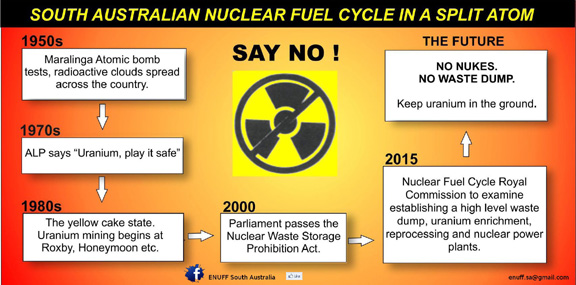
18 Mar 16 Traditional Owners and members of the Aboriginal-led Australian Nuclear Free Alliance (ANFA) have today reaffirmed their opposition to the suggestion that South Australia should host a high level international nuclear waste dump. This announcement comes as the submission period closes for comments on the tentative findings of South Australian Nuclear Fuel Cycle Royal Commission
A major recommendation of the Commission to date has been that South Australia could host an international waste storage and disposal facility. This suggestion is strongly rejected by Aboriginal people across the state because of the risks posed to country and culture. Several Aboriginal communities throughout South Australia live with the negative impacts of the nuclear industry through uranium mining and nuclear weapons testing and are committed to resisting any further nuclear proposals.
“We have long memories; we remember the atomic weapons tests at Maralinga and Emu Fields and the ongoing denial around the lost lives and health impacts for Aboriginal people. We don’t want any nuclear projects here in South Australia and we won’t become the world’s nuclear waste dump,” said Arabunna elder and Australian Nuclear Free Alliance president Kevin Buzzacott.
Enice Marsh, senior Adnyamathanha woman and Australian Nuclear Free Alliance member said:
“Any kind of radioactive waste dump would put our groundwater at risk. Groundwater is about survival; we don’t want to be faced with another huge risk like this.”
Sue Coleman-Haseldine is a Kokatha-Mula woman and co-chair of the Australian Nuclear Free Alliance. She has recently travelled to Vienna to share her family’s experience with the nuclear industry: “They’ve poisoned us once and there’s no way in the world they’re going to do it again.”
“This problem doesn’t stop at South Australia’s border, there is nowhere that should be designated an international waste dump,” Ms Coleman-Haseldine concluded.
Even South Australia’s pro nuclear Royal Commission admits the diseconomic s of the nuclear industry
 The Nuclear Industry Prices Itself Out Of Market For New Power Plants, Climate Progress, BY JOE ROMM MAR 8, 2016 “….. in newly-released findings, South Australia’s nuclear royal commission found that the price of electricity from new nukes greatly exceeded not only business-as-usual projections for electricity prices but also prices in a “strong climate action” case. The Commission concluded “it would not be commercially viable to generate electricity from a nuclear power plant in South Australia in the foreseeable future.”
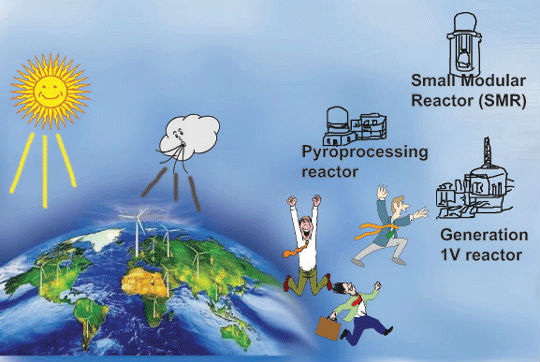
The Commission explicitly looked at plausible electricity prices for a new reactor in 2030 based on both current designs and possible fourth-generation ones, such as small modular reactors (SMRs). The Commission estimated the cost for the most viable nukes at US$7 billion for a typical large 1125-megawatt reactor and $2.8 billion for two 180-megawatt SMRs. The smaller SMRs would be providing electricity for a whopping US$0.17 a kilowatt-hour!
A study done for the Commission found that both large nukes and SMRs “consistently deliver strongly negative NPVs” (net present values) for both 2030 and 2050 — even for the strong climate action scenario. The Commission Chair noted that given how Australia’s National Electricity Market works, renewables are “the first energy that goes into the market” because they have the lowest costs.
The Commission’s findings are consistent with a 2014 Energy Policy study, “The cost of nuclear electricity: France after Fukushima.” Using cost data released by the French government after the Fukushima disaster, the study found the cost of French nuclear plants steadily escalated over the past four decades. Further, it projects “the future cost of nuclear power in France to be at least 76€/MWh (US$0.084/KWh) and possibly 117€/MWh (US$0.129/KWh),” which “compares unfavorably against alternative fuels,”……. such as wind.http://thinkprogress.org/climate/2016/03/08/3757281/nuclear-industry-prices/
Australian Aboriginal people oppose expansion of nuclear industry
 Traditional owners in the Flinders Ranges say nuclear waste dump threatens cultural heritage ABC NORTH AND WEST MICHAEL DULANEY Traditional owners in the Flinders Ranges say a Federal Government nuclear waste dump could destroy significant cultural heritage and countless sacred sites around a permanent spring. The lush vegetation and birdlife along Hookina Creek, 30 kilometres north of Hawker in South Australia, stands out even among the imposing space and scale of the central Flinders Ranges. Its permanent waters are fed by aquifers that bubble up to feed ‘an oasis’ of reeds and large eucalypts bursting from the dry heat and dust of the pastoral landscape.
It is an area integral to the lives of the Adnyamathanha people for generations and whose presence has left a rich cultural and archaeological record along the creek.
These waters are also just a few kilometres from Wallerberdina, a cattle station near Barndioota partly-owned by former Liberal senator Grant Chapman.
It is also one of six sites nominated to host Australia’s first nuclear waste dump.The Adnyamathanha people, who manage the Yappala Indigenous Protected Area which shares a boundary with Barndioota, said they were “shocked” by the prospect of storing Australia’s low and intermediate level nuclear waste so close to a significant cultural site.
Traditional owner Regina McKenzie said the facility would jeopardise their links to a place important for the present — a place where her children have learnt to swim and the family comes to camp — as well as the past, as seen in the tools, paintings and storylines that mark the area.
“The emotional stress we’re feeling is off the charts,” Ms McKenzie said. “We’re still the custodians here; we’ve always looked at it that way.”
The Adnyamathanha people are also worried about the risk from large floods known to hit the area, and elder Enice Marsh pointed out damage around the creek caused by the last flood a decade ago.
Ms Marsh said she feared the loss of her people’s heritage in the region if rising flood waters mixed with radioactive waste. “If we’re going to have that poison stuff here, even if it’s a low-level situation, it’s just absolute madness to put something like this near somewhere that’s so special,” she said.
“It’s everything; it’s a type of importance that you would never be able to describe. “The connection to this land for Adnyamathanha people is their culture, their customs; it’s their identity.”…….
With a final decision from the Government due by the end of the year, Ms McKenzie said the Adnyamathanha people would continue to oppose the expansion of the nuclear industry into their traditional lands.
“We’re feeling as though we’re being forced to do something we don’t want to do,” she said. http://www.abc.net.au/news/2016-02-24/traditional-owners-flinders-ranges-fears-on-nuclear-waste-dump/7195030
Summary of Australia’s Nuclear Fuel Chain Royal Commission Report
the waste-to-fuel fantasies of Senator Edwards and Ben Heard are dead and buried.
 [Wastes storage] timeframes – 150 years in the U.S. report and 120 years in the Royal Commission study – are nothing compared to the lifespan of nuclear waste. It takes 300,000 years for high level waste to decay to the level of the original uranium ore. The Royal Commission report notes that spent nuclear fuel (high level nuclear waste) “requires isolation from the environment for many hundreds of thousands of years.”
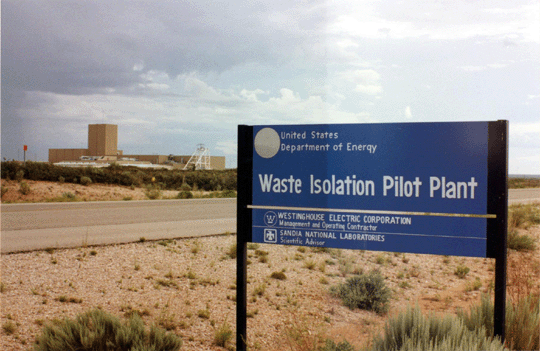 the Waste Isolation Pilot Plant (WIPP) in the U.S. state of New Mexico. WIPP was closed in 2014 because of a chemical explosion which ruptured a nuclear waste barrel and resulted in 23 workers being exposed to radiation. Before WIPP opened, the government estimated one radiation release accident every 200,000 years. But there has been one radiation release accident in the first 15 years of operation of WIPP.
 The Royal Commission’s report is silent about WIPP. It is silent about the Asse repository in Germany, where massive water infiltration has led to the decision to exhume 126,000 barrels of radioactive waste. The report is silent about the fire at a radioactive waste repository in the U.S. state of Nevada last year. And the report is silent about many other problems with the nuclear industry that it should have squarely addressed
Summary of ‘Tentative Findings’ of SA Nuclear Fuel Cycle Royal Commission Friends of the Earth Australia, by Jim Green, national nuclear campaigner, Friends of the Earth 20 Feb 16 What does the report say?
In a nutshell, the Royal Commission is negative about almost all of the proposals it is asked to consider – but positive about the proposal to import high-level nuclear waste from nuclear power plants for disposal in South Australia. Continue reading
Australian Senator’s Impossible Nuclear Dream – analysis by Australia Institute
The impossible dream Free electricity sounds too good to be true. It is. A plan to produce free electricity for South Australia by embracing nuclear waste sounds like a wonderful idea. But it won’t work. The Australia Institute Briefing paper Dan Gilchrist February 2016

Why the Nuclear Lobby and Australian Politicians want Australia as world’s radioactive trash dump
from CaptD 31 Jan 16 The first reason is MONEY and I mean BIG Money. Politicians are always gear for Nuclear  Payback*
* http://www.urbandictionary.com/define.php?term=Nuclear+payback
Those that support nuclear power because nuclear power somehow supports them; no matter what the health implications or other “costs” are for others.
The “other” reason is that the Nuclear Industry and their Utilities are desperate to create a radioactive waste dumping site for waste is that they are going to want to site Small Modular Reactors (SMRs) very soon, which companies like SD’s General Atomic are now working on. Since CA has a law that says no more nuclear reactors, until a waste site is developed, the lack of a disposal site is the biggest roadblock they face preventing them from deploying SMRs in CA.

I believe that most Utilities will want to phase out Nat. Gas fired Peaker plants and install SMR’s “because they don’t emit CO2.” That is, unless they are going to be making big money using nat. gas like SDG&E will be, since they already have a contract to import Nat. Gas from Mexico (which Sempra owns a share of, so they will be kind of buying Nat. Gas from themselves) for use in their two new state of the art Billion Dollar Peaker Plants that the CPUC just approved for them (despite the fact that the cost of Wind and Solar generation continues to drop almost monthly)!
SCE just had the CPUC decide against approving a Nat. Gas Peaker plant for them, so you can bet that they are now getting “very excited” about installing one or more SMR’s at San Onofre, since the grid wiring connection is already in place and they are going to be guarding that “nuclear waste” site for decades to come.
http://www.kpbs.org/news/2016/jan/08/oceanside-takes-stand-relocating-san-onofres-nucle/
BTW: All waste facilities should be run by the Government, that way they will always be responsible for it, since Big Waste Corp.’s can go out of business any time they want as as everybody knows Radiation is FOREVER since 50 or more than 100 years is forever to everyone living today.
Australian Aboriginal company to launch portable solar system, and storage
The products are being launched at Tandanya Aboriginal Cultural centre in Adelaide on Wednesday 2 September. Ms Oberon said Adelaide was chosen for the launch because of the council’s Sustainable City Incentive Scheme, which provides up to $5000 towards the cost in installing solar PV storage across the residential, business, education and community sectors. Funding for the program also has financial support from the South Australian government.
“We felt it was important to acknowledge the South Australian government and the City of Adelaide for such a forward-looking and innovative scheme,” Ms Oberon said.
The company is also hoping other state governments and councils will be encouraged to take up the idea of supporting the uptake of renewable energy storage.
The company’s core mission is based on the fundamental Aboriginal approach of stewardship of the earth and its resources. This means needing to shift out of high-emissions fossil-fuel derived energy.
Aboriginal-owned energy company one-upping Tesla By Willow Aliento, The Fifth Estate Friday 8 January 2016 The renewable energy storage game is about to be disrupted, with Australian Aboriginal-owned company AllGrid Energy announcing the launch of WattGrid, a new 10kWh solar energy storage system it says is around 30 per cent cheaper than the Tesla Powerwall.
Customers also don’t have to wait until 2016. Spokeswoman for AllGrid, Deborah Oberon, said the company expected to be making its first deliveries in the next two to three months.
The $11,999 WattGrid unit comprises an aluminium cabinet containing tubular lead acid gel batteries, and a hybrid 5kW solar inverter with battery management system that has load share capability with the grid and uninterrupted power supply capability.
The unit is also accompanied by a software app, WattsHappening, that allows users to view real-time information and interface with the system.
Beta testing has shown the unit can help solar owners maintain an energy supply profile that can be matched to the demand profile, potentially rendering drawing grid power unnecessary.
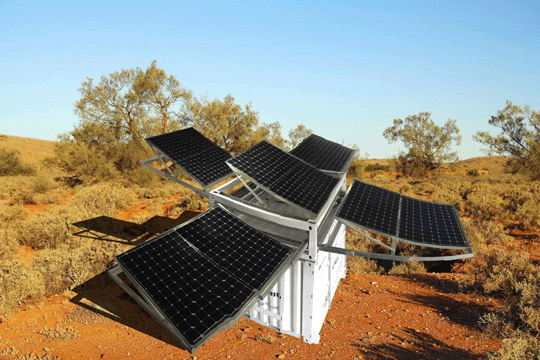
The Queensland-based company is also releasing another product it has developed, the PortaGrid. This is an independent unit comprising solar panels, storage, UPS, inverter and outlets that is suitable for remote and off-grid locations, as well as emergency situations.
The units can be supplied with an inbuilt weather station that will automatically close up the panels in the event of a severe weather hazard such as a cyclone.
The AllGrid company is an alliance between two established firms, Consolidated Industrial Holdings, which operates across the energy efficiency, engineering design and technology sectors, and DICE Australia, an Aboriginal-owned and Aboriginal-operated company in the electrical contracting and general construction services sector………
The products are being launched at Tandanya Aboriginal Cultural centre in Adelaide on Wednesday 2 September. Ms Oberon said Adelaide was chosen for the launch because of the council’s Sustainable City Incentive Scheme, which provides up to $5000 towards the cost in installing solar PV storage across the residential, business, education and community sectors. Funding for the program also has financial support from the South Australian government.
“We felt it was important to acknowledge the South Australian government and the City of Adelaide for such a forward-looking and innovative scheme,” Ms Oberon said.
The company is also hoping other state governments and councils will be encouraged to take up the idea of supporting the uptake of renewable energy storage.
The company’s core mission is based on the fundamental Aboriginal approach of stewardship of the earth and its resources. This means needing to shift out of high-emissions fossil-fuel derived energy.
“It is so important for everyone to shift to renewable energy,” Ms Oberon said.
All the intellectual property involved in the products is owned by the AllGrid business.
Currently the company has one manufacturing facility established in Brisbane where the various parts, some of them manufactured offshore to AllGrid’s specifications, will be assembled by a predominantly Indigenous workforce.
Ms Oberon said if demand in South Australia was great enough, the company would also look to establish a plant in Adelaide.
The PortaGrid product is already attracting interest, she said, with the company in discussions with National Parks about supplying the units for remote sites that currently rely on diesel generators.
“The applicability worldwide of the technology is just enormous,” Ms Oberon said, “particularly in developing countries.”
Talks are underway with a number of groups that are currently running leadership programs with Indigenous people in other nations and setting up training programs in renewable energy for the local peoples.
The company is also investing heavily in research and development………
AllGrid has committed to directing a percentage of all company profits into creating and supporting training and employment programs for Indigenous Australian young people. http://www.eco-business.com/news/aboriginal-owned-energy-company-one-upping-tesla/
Melbourne, Australia, starts the wave of global climate marches
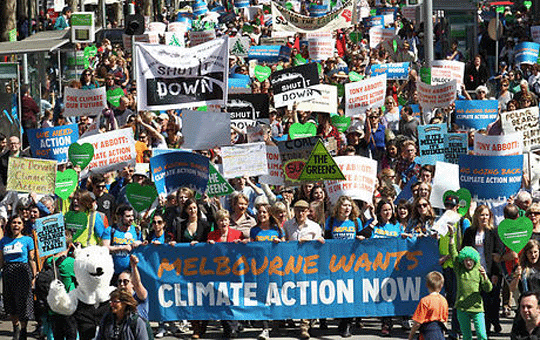 Thousands gather at Melbourne CBD rally ahead of Paris climate summit, The Age, [excellent photos and video] November 27, 2015 -Chloe Booker, Timna Jacks, With Tom Cowie and AAP
Tens of thousands of people have gathered in Melbourne’s CBD to demand world leaders take strong action to protect the planet at the Paris climate change conference.
The so-called People’s Climate March was one of hundreds of rallies being held around the world in the lead up to the crucial meeting. Members of The Cat Empire performed for the crowd, which included Opposition Leader Bill Shorten and Greens Senator Richard Di Natale.
A sea of placards stretched down Bourke Street from Spring Street to Swanston Street and along Swanston Street from Bourke Street to La Trobe Street. There was a stand-off between banked-up traffic and protesters at Exhibition Street as frustrated drivers honked their horns and the crowd erupted in cheers and shouts.
Stunned diners observed the march from outside Bourke Street cafes, and some heckled the demonstrators. Sections of the crowd were more like a party, with some dancing and clapping to a marching band dressed in green-glittered uniforms, while others swayed to the strumming of a guitar. ……..
Andy Parsons, an Environment Victoria volunteer who attended both rallies, said environmentalists supported the right of Aboriginal people to live independently.”The Aboriginal people lived sustainably for thousands of years. Us white people could learn a lot from them,” he said.
Aboriginal man Robbie Thorpe said he saw a parallel between the “genocide” of his people and what he called the “ecocide” of Australia’s natural environment. “We are the custodians of the land and the language. Only we know how to talk to our land. Without the Aboriginal people the land can’t survive and without the land, we can’t survive.” http://www.theage.com.au/victoria/thousands-expected-at-melbourne-cbd-rally-ahead-of-paris-climate-summit-20151127-gl9lz8.html
Indonesia will block its waters to nuclear waste ship travelling to Australia
 Indon to ‘block Aust-bound nuclear waste’ http://www.couriermail.com.au/news/breaking-news/indon-to-block-aust-bound-nuclear-waste/story-fnihsg6t-1227617732008 November 21, 2015 AAP
“WE will block the ship because nuclear waste is very dangerous,” sea security coordinating agenda head Vice Admiral Desi Albert Mamahit told The Jakarta Post newspaper.
“Our ships are on standby, although the ship is still far from Indonesia. We have information about the ship.”On October 16, the Australian Nuclear Science and Technology Organisation (ANSTO) confirmed a project to repatriate radioactive waste from France, where it was sent for reprocessing in the 1990s and early 2000s, and which will now be retained at ANSTO’s Lucas Heights, Sydney, facility.”Consistent with security requirements and practice established during nine previous export operations, ANSTO will not confirm the destination port, land route, or timing,” it said on its website.The Indonesians are concerned about a ship called the MV Trader, which was close to the African coast and expected to pass through the Malacca Strait, according to reports.
1 This Month
To see nuclear-related stories in greater depth and intensity – go to https://nuclearinformation.wordpress.com/

29 Jan. Thursday 7-8 p.m. Webinar – World’s Largest Nuclear Station in Port Hope, ON?


31st January – Challenging the War Machine – a DECLASSIFIED UK SUMMIT


Website of the Week
Now until to February 10, 2026 Radioactive waste storage in France: the debate is finally open! How to participate?
-
Archives
- January 2026 (271)
- December 2025 (358)
- November 2025 (359)
- October 2025 (376)
- September 2025 (258)
- August 2025 (319)
- July 2025 (230)
- June 2025 (348)
- May 2025 (261)
- April 2025 (305)
- March 2025 (319)
- February 2025 (234)
-
Categories
- 1
- 1 NUCLEAR ISSUES
- business and costs
- climate change
- culture and arts
- ENERGY
- environment
- health
- history
- indigenous issues
- Legal
- marketing of nuclear
- media
- opposition to nuclear
- PERSONAL STORIES
- politics
- politics international
- Religion and ethics
- safety
- secrets,lies and civil liberties
- spinbuster
- technology
- Uranium
- wastes
- weapons and war
- Women
- 2 WORLD
- ACTION
- AFRICA
- Atrocities
- AUSTRALIA
- Christina's notes
- Christina's themes
- culture and arts
- Events
- Fuk 2022
- Fuk 2023
- Fukushima 2017
- Fukushima 2018
- fukushima 2019
- Fukushima 2020
- Fukushima 2021
- general
- global warming
- Humour (God we need it)
- Nuclear
- RARE EARTHS
- Reference
- resources – print
- Resources -audiovicual
- Weekly Newsletter
- World
- World Nuclear
- YouTube
-
RSS
Entries RSS
Comments RSS
 nuclear-news