Nuclear lobby spreads confusion as it touts “SMRs” – nuclear fantasy research
Small Modular Reactors don’t exist yet, and the picture below shows that the size of these speculative reactors are far from “small” (red arrow points to tiny human figure). Yet Barry Brook continues to receive funding from the “Australian Research Council” to investigate all things nuclear, including putting these reactors on small islands. How much money has gone to funding pro-nuclear fantasy research?
https://www.facebook.com/groups/1021186047913052/

Noel Wauchope they are now referred to by IAEA as small and medium reactors (SMRs)…..A subcategory of very small reactors – vSMRs – is proposed for units under about 15 MWe, especially for remote communities……..Note that many of the designs described are not yet actually taking shape. ……. There’s a bewildering array of reactor designs, listed in MWe (MegaWatts electic) -not in physical size.
Many UNPAID Australians speak out against nuclear plans of the PAID few nuclear industry proponents
 I am always struck by the fact that opponents of the nuclear industry are very many unpaid people. Just people who care. Some are highly educated academically. Many are not – but then they take the trouble to find out, and speak with the authority of both their local knowledge and wider information.
As for nuclear proponents they’re a small number of paid individuals, with another small number of hangers-on who expect financial benefits from the nuclear industry.
ABC Radio Adelaide Evenings with Peter Goer. Talkback 4 Oct 18. This show was inundated with hundreds of South Australians phoning in and texting about the proposed nuclear waste dump. ALL SAID NO! Are you listening Department of Industry Innovation and Science and Australian Nuclear Science and Technology Organisation !!!??…. IT’S A BIG NO FROM SOUTH AUSTRALIA!!!
Yet again, Australia sets out to wreck international climate talks

 Australia gets out the wrecking ball, again, in international climate talks https://reneweconomy.com.au/australia-gets-out-the-wrecking-ball-again-in-international-climate-talks-17099/
Following Trump, Canada and Australia go backwards on climate change action

The Global Rightward Shift on Climate Change, President Trump may be leading the rich, English-speaking world to scale back environmental policies. The Atlantic , ROBINSON MEYER, AUG 28, 2018 Last Thursday, Malcolm Turnbull was the prime minister of Australia. By the end of this week, he’ll be just another guy in Sydney.
Pacific island nations critical of climate sceptics, call on Australia to act on climate change, and to help them
Key points:
- Mr Sailele says “greater ambition” is needed to stop impact of climate change
- He warns geostrategic competition is creating uncertainty for small Pacific countries
- Australia, New Zealand and the US have been scrambling to reassert influence in the Pacific
Mr Sailele told the Lowy Institute in Sydney that climate change posed an “existential challenge” to low lying islands in the Pacific, and developed countries needed to reduce pollution in order to curb rising temperatures and sea levels.
“We all know the problem, we all know the solutions, and all that is left would be some political courage, some political guts, to tell people of your country there is a certainty of disaster,” Mr Sailele said.
The Prime Minister’s intervention came as some Coalition MPs press the new Prime Minister Scott Morrison to abandon Australia’s promise to cut carbon emissions under the Paris agreement.
New Foreign Minister Marise Payne is also expected to face questions about Australia’s climate change policies at the Pacific Islands Forum leader’s meeting in Nauru next week.
Senator Payne and Pacific leaders are set to sign the “Biketawa Plus” security agreement, which declares that climate change remains the “single greatest threat to the livelihoods, security and wellbeing of the peoples of the Pacific”.
Several other leaders — including Fiji’s Prime Minster Frank Bainimarama and the Marshall Island’s President Hilda Heine — have also called on Australia to do more to cut emissions.
Mr Sailele told the audience that “greater ambition” was needed to stop the destructive impact of climate change.
“While climate change may be considered a slow onset threat by some in the region, its adverse impacts are already being felt by Island communities,” he said……… http://www.abc.net.au/news/2018-08-31/samoan-prime-minister-hits-out-at-climate-change-sceptics/10185142
 |
ReplyForward
|
Aboriginal group’s unwavering struggle against uranium mining in Western Australia
 Fighting for life in the “place of death”https://beyondnuclearinternational.org/2018/08/27/fighting-for-life-in-the-place-of-death/ August 27, 2018
Traditional owners won’t give up 40-year opposition to Yeelirrie uranium mine, By Linda Pentz Gunter
In the local Aboriginal language, the name Yeelirrie means to weep or mourn. It is referred to as a “place of death.” Yeelirrie is on Tjiwarl Native Title lands in Western Australia, where it has long been faithfully protected by Aboriginal traditional owners. The Seven Sisters Dreaming songline is there. It is home to many important cultural sites. And for 40 years, due to resolute indigenous opposition, and thousands of community submissions of protest, it had been spared plans by the Canadian mining company, Cameco, to plunder it for uranium.
The earth guardians know that such a desecration would cause the extinction of multiple species of subterranean fauna. It would release death. It would destroy Yeelirrie.
Now the fate of those tiny creatures hangs in the balance, their future in the hands of three brave women, backed by environmental organizations, after the outgoing Western Australian government decided to allow the Yeelirrie uranium mine project to go forward.
That decision was made in January 2017, despite the fact that, in August 2016, the Western Australia Environmental Protection Agency (WAEPA) had recommended that the Yeelirrie project be rejected.
The Conservation Council of Western Australia (CCWA), which is engaged in contesting the uranium mining permit for Yeelirrie, said the WAEPA had rejected the Yeelirrie mine plan “on the grounds that the project is inconsistent with three of the objectives of the Environmental Protection Act — the Precautionary Principle, the Principle of conservation of biological diversity, and the Principle of intergenerational equity. The EPA decision was based on the overwhelming evidence that the project would make several species of subterranean fauna extinct.”
But former Minister for Environment, Albert Jacob, threw all that aside to approve the Yeelirrie mine in the waning days of Western Australia’s Liberal government, now replaced by Labor, which came in on a mandate to end uranium mining that it now may not be able to enforce.
In February 2018, CCWA and three members of the Tjiwarl community initiated proceedings in the Western Australia Supreme Court in an attempt to invalidate the approval decision made by Jacob. The case was dismissed by the court, a decision said CCWA executive director, Piers Verstegen, that shows that “our environmental laws are deeply inadequate,” and “confines species to extinction with the stroke of a pen.”
However, while the decision was a set-back, Verstegen said, “it’s absolutely not the end of the road for Yeelirrie or the other uranium mines that are being strongly contested here in Western Australia.”
Accordingly, CCWA and the three Tjiwarl women — Shirley Wonyabong, Elizabeth Wonyabong, and Vicky Abdullah (pictured left to right above the headline) vow to fight on, and have begun proceedings in the WA Court of Appeal to review the Supreme Court decision.
“I grew up here, my ancestors were Traditional Owners of country, and I don’t want a toxic legacy here for my grandchildren,” Abdullah told Western Australia Today in an August 2017 article.
“We have no choice but to defend our country, our culture, and the environment from the threat of uranium mining — not just for us but for everyone.”
Yeelirrie is one of four uranium mines proposed for Western Australia. The other three are Vimy’s Mulga Rock project, Toro Energy’s Wiluna project, and Cameco’s and Mitsubishi’s Kintyre project. Each of them is home to precious species, but Yeelirrie got special attention from the WAEPA because the proposed mine there would cause actual extinctions of 11 species, mostly tiny underground creatures that few people ever see.
According to a new animated short film, produced by the Western Australia Nuclear-Free Alliance, all four of these proposed mines could irreparably damage wildlife, habitat and the health of the landscape and the people and animals who depend on it. The film highlights Yeelirrie, but also describes the other three proposed uranium mines and the threats they pose.
At Mulga Rock, in the Queen Victoria Desert, the site is home to the Sandhill Dunnart, the Marsupial Mole, the Mulgara and the Rainbow Bee Eater, according to the film.
Wiluna, a unique desert lake system, could see uranium mining across two salt lakes that would leave 50 million tonnes of radioactive mine waste on the shores of Lake Way, which is prone to flooding.
The Kintyre uranium deposit was excluded from the protection of the Karlamilyi National Park within which it sits so that uranium could be mined there. It is a fragile desert ecosystem where 28 threatened species would be put at risk, including the Northern Quoll, Greater Bilby, Crest Tailed Mulgara, Marsupial Mole and Rock Wallaby.
At Yeelirrie, says the CCWA, “Cameco plans to construct a 9km open mine pit and uranium processing plant. The project would destroy 2,421 hectares of native vegetation and generate 36 million tonnes of radioactive mine waste to be stored in open pits.”
The mine would likely operate for 22 years and use 8.7 million litres of water a day.
Under Australian laws, ‘nuclear actions’ like the Yeelirrie proposal also require approval by the Federal Environment Minister. CCWA and Nuclear-Free Western Australia, have launched a campaign directed at Federal Environment Minister, Josh Frydenberg, calling for a halt to the Yeelirrie mine, given the immense risk it poses to “unique subterranean fauna that have been found nowhere else on the planet.” They point out that the Minister has the opportunity to “protect these unique species from becoming extinct.
“Species have a right to life no matter how great or small,” they wrote. “One extinction can massively disrupt an entire ecosystem. No one should have the right to knowingly eliminate an entire species from our planet forever.”
Black Mist Burnt Country: art under the nuclear cloud of Maralinga
https://www.smh.com.au/entertainment/art-and-design/black-mist-burnt-country-art-under-the-nuclear-cloud-of-maralinga-20180823-p4zz7i.html, By Karen Hardy 24 August 2018 On September 27, 1956, the British exploded an atomic bomb on Pitjantjatjara land in South Australia. The place would become known as Maralinga, which means “thunder” in the now-extinct Garik Aboriginal language.
Black Mist Burnt Country tells the stories of the atomic tests in Australia in the 1950s and ’60s, revisiting the events and locations through the artworks of Indigenous and non-Indigenous contemporary artists across the mediums of painting, print-making, sculpture, photography, video and new media.
Now showing at the National Museum of Australia, it has been touring with great success since September 2016, opening then to commemorate the 60th anniversary of the first test at Maralinga.
Curator JD Mittman, from the Burrinja Dandenong Ranges Cultural Centre, grew up “under the nuclear cloud” in Germany during the 1980s and when he came to Australia he was surprised to learn there had been atomic tests here.
In the collection of the small community arts centre he found a large canvas work by Jonathan Kumintjarra Brown entitled Maralinga Before the Atomic Test.
The question for me was what did ‘after’ look like?”
When he began his research he was surprised to find so many works concerning Australia’s place in the nuclear race.
Artist Arthur Boyd participated in anti-nuclear demonstrations in the 1960s and his Jonah on the Shoalhaven – Outside the City (1976), features a tiny mushroom cloud, blending biblical imagery with contemporary landscape and personal symbolism.
Sidney Nolan’s Central Desert: Atomic Test (1952-57) is part of a classic series of desert landscapes Nolan began in the late 1940s. He added a mushroom cloud on the horizon at a later date.
“Every generation has taken a different approach.”
There are large canvases by Kumintjarra Brown, one Frogmen, shows three men in masks and protective suits, another Black Rain tells the tragic story of a group of Anangu people who were found huddled together, dead, in a crater near the bomb site.
Mittman says it’s important for Australians, particularly generations who may not have even heard of the testing, let alone those of us to whom Maralinga is a familiar word but were unaware of such details as then prime minister Robert Menzies did not even consult cabinet when he gave permission to begin the testing.
“There is great concern among the indigenous community, and I don’t want to speak on their behalf, about the ongoing repercussions of the testing on country.
“And it’s even more than that, the multi-media work from Linda Dement and Jessie Boylan builds a bridge between the past and the present. “There are 15,000 warheads in the world at present, many of them on planes, in submarines, ready to strike within minutes.
He says it’s somewhat fitting that the exhibition opens in Canberra in the same week the International Campaign to Abolish Nuclear Weapons protest arrives in Canberra heading to parliament to urge politicians to ratify the nuclear weapon ban treaty.
Black Mist Burnt Country at the National Museum of Australia until November 18.
The danger if other countries followed Australia on its dismissal of climate action
if all other countries were to follow Australia’s current policy settings, warming could reach over 3°C and up to 4°C.
Climate Change Policy Toppled Australia’s Leader. Here’s What It Means for Others, New York Times, By Somini Sengupta Aug. 24, 2018
Climate change policy toppled the government in Australia on Friday.
How much does that really matter?
It is certain to keep Australia from meeting its emissions targets under the Paris climate agreement.
It’s also a glimpse into what a potent political issue climate change and energy policy can be in a handful of countries with powerful fossil fuel lobbies, namely Australia, Canada and the United States.
In Australia, the world’s largest exporter of coal, climate and energy policy have infused politics for a decade, helping to bring down both liberal and conservative lawmakers.
This week, the failure to pass legislation that would have reined in greenhouse gas emissions precipitated Malcolm Turnbull’s ouster as prime minister. He was elbowed out by Scott Morrison, an ardent champion of the Australian coal industry who is known for having brought a lump of the stuff to Parliament.
It could be a bellwether for next year’s Canadian elections, expected in October, in which Prime Minister Justin Trudeau faces a powerful challenge from politicians aligned with the country’s oil industry. Conservatives have pledged to undo Mr. Trudeau’s plans to put a price on carbon nationwide if they take power. At the provincial level, conservatives won a majority in Ontario after campaigning against the province’s newly enacted cap-and-trade program.
The Australian parallels with the United States are striking. The Trump administration has promised to revive the coal industry, rolled back fuel emissions standards and announced the country’s exit from the Paris pact altogether. Climate change is not a driving issue in the United States midterm election campaign, though it is for liberal Democrats, a recent study by the Yale Program on Climate Change Communication has shown.
Environmental policy and global warming are top priorities for those who describe themselves as liberal Democrats, the study found, after health care and gun control.
……… Robert C. Orr, dean of the School of Public Policy at the University of Maryland, pointed to another parallel: In both Australia and the United States, local leaders have embraced renewable energy even as national politicians promote fossil fuels.
“Australia is a lot like the U.S.,” said Dr. Orr, who is also the special adviser on climate change to the United Nations secretary general. “Climate policy has really been driven from below, from the state, local and business level. That is not going to change.”
Most Australian states have renewable energy targets, and Australians are powering their houses with solar energy at one of the highest rates in the world. But Australia’s emissions have continued to rise.
Australia is among several industrialized nations that are not on track to reduce greenhouse gas emissions to keep global warming below two degrees Celsius as the Paris accord promises, according to independent analyses.
Climate Action Tracker, an alliance of European think tanks that tracks countries’ climate pledges under the agreement, concluded recently that “if all other countries were to follow Australia’s current policy settings, warming could reach over 3°C and up to 4°C.” Those are levels that climate scientists consider “highly insufficient” to stop the worst effects of climate change. https://www.nytimes.com/2018/08/24/climate/australia-climate-change.html
Australian Aboriginal group win injunction to halt vote on nuclear waste dumping
 South Australian Aboriginal group wins injunction to halt nuclear ballot http://www.abc.net.au/news/2018-08-16/aboriginal-group-wins-injunction-to-halt-nuclear-ballot/10129292, By Claire Campbell
More evidence of Israeli secret nuclear bomb test – radioactive sheep in Australia
Radioactive sheep shed light on secret nuclear weapons test, https://nypost.com/2018/08/14/radioactive-sheep-shed-light-on-secret-nuclear-weapons-test/ Christopher Carbone, Fox News, August 14, 2018 Newly discovered data from radioactive sheep provides strong evidence that a mysterious “double flash” detected almost 39 years ago near a remote island group was a nuclear explosion.
Ever since the flash was observed by a US Vela satellite orbiting above Earth in September 1979, there’s been speculation that it was produced by a nuclear weapon test by Israel. International researchers in the journal Science & Global Security analyzed previously unpublished results of radiation testing at a US lab of thyroid organs from sheep in southeastern Australia in order to make their determination.
The flash was located in the area of Marion and Prince Edward islands, which are in the South Indian Ocean about halfway between Africa and Antarctica.
“A new publication sheds further light on the Vela Incident of 1979,” said Professor Nick Wilson of Otago University at Wellington, who highlighted the findings but was not involved with the study itself. “[The research] adds to the evidence base that this was an illegal nuclear weapons test, very likely to have been conducted by Israel with assistance from the apartheid regime in South Africa.”
Wilson, an epidemiologist and member of the Australia-based Medical Association for the Prevention of War, said the test would have violated the Limited Test Ban Treaty signed in 1963, and urged the United Nations to mount a full inquiry.
The researchers conclude that iodine-131, which is an unstable radioactive form of the element iodine found in the thyroids of some Australian sheep, “would be consistent with them having grazed in the path of a potential radioactive fallout plume from a [Sept. 22, 1979] low-yield nuclear test in the Southern Indian Ocean.”
Thyroid samples from sheep killed in Melbourne were regularly sent to the US for testing — monthly in 1979 but also in the 1950s and 1980s, researchers say.
According to a report in the New Zealand Herald, the sheep had been grazing in an area hit by rain four days after the flash incident was observed, which would have been in the downwind path from the suspected explosion site.
Researchers also said the detection of a “hydroacoustic signal” from underwater listening devices at the time is another piece of evidence pointing to a nuclear test.
Israel, which has neither confirmed nor denied the existence of a nuclear program, dismissed the claim that it was responsible for the 1979 incident.
srael’s ambassador to New Zealand, Itzhak Gerberg, told the Herald, when asked if Israel was responsible for the explosion: “Simply a ridiculous assumption that does not hold water.”
However, the country’s former Knesset speaker, Avrum Burg, told a conference in 2013 that “Israel has nuclear and chemical weapons” and called for public discussion.
Commenting on the findings, US nuclear weapons expert Leonard Weiss of Stanford University said in the online Bulletin of the Atomic Scientists that the “important” new evidence “removes virtually all doubt” that the flash was a small-yield nuclear explosion.
Weiss added that there was “growing circumstantial evidence” that it was conducted by Israel.
“Israel was the only country that had the technical ability and policy motivation to carry out such a clandestine test,” he said.
Small Australian town to vote on nuclear waste dump, but Aboriginal land owners excluded from vote

Traditional owners “locked out” of nuclear waste vote, InDaily, 3 Aug 18 Stephanie Richards The head of the Adnyamathanha Traditional Lands Association says the majority of Adnyamathanha people have been denied a vote on a proposed radioactive waste management facility near the town of Hawker in the Flinders Rangers.
Wallerberdina Station, located approximately 30km northwest of Hawker on Adnyamathanha country, has been shortlisted by the Federal Government for a facility that will permanently hold low-level nuclear waste and temporarily hold intermediate level waste.
It is one of three sites, the other two situated close to Kimba, that were shortlisted by the Federal Government to store nuclear waste.
The selection process is entering its final stages, with a postal ballot beginning on August 20 to measure community support for the three nominated sites.
But ATLA CEO Vince Coulthard said the voting guidelines were disrespectful to traditional owners, as the majority of Adnyamathanha people do not live close enough to the proposed Wallerberdina site to be eligible to vote.
The voting range includes residents of the Flinders Ranges Council and those who live within a 50km radius of the Wallerberdina site.
According to Coulthard, there are approximately 2500 Adnyamathanha people in total but only about 300 Adnyamathanha people who live in the voting range.
Coulthard said about 50 Adnyamathanha people who lived outside the voting range had expressed interest in voting, but when ATLA asked Federal Resources Minister Matt Canavan during a consultation trip to Hawker last week if those people could be granted a vote, Coulthard said Canavan told him that only those living in the prescribed voting range could participate.
“It’s a crazy situation,” Coulthard said.
“This is Adnyamathanha country and it is a very important place to the Adnyamathanha nation.
“People have strong connections to land. There’s a large amount of people, many who don’t live on the land but they go back on a regular basis to travel around the land.”
……… Coulthard said he was disappointed that Canavan had not consulted with all ATLA members during his consultation visit.
He said Adnyamathanha people had been “locked out” from the vote, despite holding native title rights over the land.
“Canavan is saying this will strengthen our culture, that this will be good for us, but what it is actually doing is punishing the environment.
“This is a place where we have gone to get bush tucker, where we have come as traditional owners for thousands of years.
They’ve shown us disrespect and this is very hurtful.”
The proposed site holds sacred meaning for Adnyamathanha people, as it is located close to the Hookina Waterhole and ancient burial sites.
…….. Last month, the Federal Government tripled the incentive package for the community that hosts the nuclear waste repository.
The Government had promised to spend more than $10 million in the district where the facility is built, but under new incentives announced by Canavan, the Government increased funding to $31 million.
……. The Government has previously indicated it wants to choose a preferred site before the end of this year. https://indaily.com.au/news/2018/08/03/traditional-owners-locked-out-of-nuclear-waste-vote/
Australia’s beautiful Flinders Ranges to become bonanza nuclear waste site – or nuclear sacrifice zone?

Coalition’s Kimba nuclear dump exploits local area and puts nation at risk https://independentaustralia.net/politics/politics-display/coalitions-kimba-nuclear-dump-exploits-local-area-and-puts-nation-at-risk,11717 Noel Wauchope 23 July 2018,
How is a small rural town to cope with a proposition that may transform the community by providing an economic boon or be a long-term curse?
This is the dilemma facing the towns of Kimba and Hawker, both in the Eyre Peninsula, South Australia.
Individual landowners offered their land to the Turnbull Government for a radioactive waste storage site and the Government’s National RadioactiveWaste Management Facility (NRWMF) team swung into action.
There’s quite a hurry on, about this. Resources Minister Matt Canavan announced that, on 20 August, there will be a local ballot to gauge community support for a nuclear waste dump.
Following that, said Canavan:
“The decision will be made in the second half of this year … We do not want this overlapping with a Federal election.”
Much can be said about this plan, not least that it contravenes South Australian law. One might ask, too, why the inquiry stipulates South Australia when the waste to be stored would have to travel 1,700 km from the Lucas Heights nuclear reactor in Sydney? However, the most notable immediate ramifications concern its impact on Eyre Peninsula rural communities.
As one local resident put it:
‘Stress levels are through the roof for a lot of people within our communities. People are getting sick, and some are just sick and tired of hearing about it, with many wanting the dump to just go away!’
And in the words of another resident:
‘Before a nuclear waste dump came into our lives, people enjoyed cultural activities together … Today it isn’t like that, a once close family ruined and torn apart all because of a proposed nuclear waste dump that could be put on Adnyamathanha traditional lands, which will destroy our culture and … cause cultural genocide.’
Community division is obvious when one reads the submissions that local and Eyre Peninsula residents have sent to a Senate Committee of Inquiry. The Inquiry called for submissions, stipulating fairly narrow Terms of Reference (TOR), about the ‘Selection process for a national radioactive waste management facility in South Australia’.
Among the 40 supporters of the plan, most are local residents, enthusiastic about hosting the waste dump.
Repeatedly, their submissions include phrases like ‘no negative impacts’ and ‘comfortable and satisfied with the prospect of hosting the proposed nuclear waste facility’
Numbers below in brackets refer to the submission numbers listed on the Senate website.
John Hennessy( No 7), is “bubbling with enthusiasm” for nuclear waste dump in Hawker. “Hawker has “ a once in a lifetime opportunity”
Jessica Morgan, (no.37) ” I have stood [at ANSTO] next to and touched the canister containing the intermediate level waste with my 9 month old baby in a carrier on my chest, feeling totally confident of my own safety and that of my child.”
Annie Clements, (No 35) – happy to see nuclear waste dump “powering Kimba community into the future”.
And here we come to another aspect of their support for the waste dump plan. It’s not just that Kimba might be “powered into the future”. It’s the thought that Kimba might not have a future unless it hosts the dump.
Again and again this argument appears in the pro nuclear submissions:
This repository would ensure our towns survival – Ian Carpenter.( No 3 )
Kimba is struggling, population is declining,… we are in need of a life line …. The possibilities this facility could provide a small failing community is endless – Jodie Joyce (No 33)
this project will ensure the long term viability of this small country town – Janice McInnis, ( No 4 )
it will save Kimba ” for many more generations to come– Melanie Orman (No 77)
A third, much repeated, theme in these submissions is that this matter concerns only the local community.
This is frequently expressed with the dismissal of the opinions of people outside the immediate area and also, at times, with downright hostility to those who oppose the dump:
‘People outside our area could be influenced by anti-nuclear scare campaigns and wild allegations that have no relevance to this facility.’ ~ Annie Clements (35)
‘Activists and politicians who have been using [this] project as a vehicle for their anti-nuclear stance should not be entitled to any say …’ ~ Heather Baldock (64)
Outsiders do not care if Hawker dies a slow death due to lack of employment etc – Chelsea Haywood (No. 2)
‘We disagree that we need “broader community views” and the need to stretch the boundaries outside of our District Council. What is happening in our Community is exactly that: our community.’ As residents of Kimba for the last 43 years, plus ++ We see no reason that the rest of SA has a right to tell us what we can and can’t have. It is our back yard, not theirs. ….. . It’s a shame we have to have this inquiry. ~ Margaret and Charlie Milton (34)
These three themes – enthusiasm for the project, distrust of critics, and resistance to the involvement of outsiders, merge into a kind of strong local patriotism allied to trusting loyalty to the federal government, which has run a huge informational campaign in the towns.
As to the 58 submissions opposing the plan, at least half come from residents of the Eyre Peninsula. As with the rest of the opponents, they do express a variety of arguments, but local submissions are most often concerned with the local area.
Above all, they are dissatisfied with the community consultation process, and the lack of clarity about what is meant by “broad community support”. They want the wider community, Eyre Peninsula, South Australia, to be consulted, and, indeed they see the federal nuclear waste facility as a national issue. They also do not believe that the project has Indigenous support.
Readers of all 98 submissions can’t fail to notice that, on the whole, these 55 opposing ones have more comprehensive, detailed, and referenced writing, as compared with the pro nuclear ones. And this is certainly true of the very thoughtful and measured arguments of the farmers from the local areas concerned.
These raise some issues which are rarely mentioned on the pro-nuclear side:
- concern about co-location of low and intermediate level wastes, especially the prospect of stranded “temporary” wastes, with no plan for final disposal;
- transport dangers;
- seismic and flood dangers;
- impacts on agricultural markets and tourism; and
- the fear that this waste dump would lead to a full-scale commercial importation of nuclear waste.
Kay Fels, a Flinders Ranges farmer.(No 63) ‘s submission is representative of the concerns of many others:
our stock (sheep and cattle) may also be stigmatised by the proximity of the waste dump and our organic status compromised Agriculture and tourist industries will be jeopardised as the clean, green image of the Flinders Ranges is tarnished . The sites are located in an area where the underground water table is almost at surface level. This could lead to contamination of the underground water source, so vital to the region. The location is also on a piedmont plain and prone to flooding
Given that the proposal is to store low level waste in an above ground facility, and temporarily store intermediate waste in that same facility, it seems ludicrous that this is even considered given the geological and environmental features and risks involved.
The consultation phase was a tokenism with ANSTO telling us what will be happening, how safe it is and pushing the affirmative – not a true reflection of the community’s views and concerns. The consultative committee is a rubber stamp
Many are strongly sceptical of the consultations held by the Department of Industry Innovation and Science (DIIS), and of the information campaign by Australian Nuclear Science and Technology Organisation (ANSTO) . There is strong criticism of the nomination of Wallerberdina property by non-resident former Liberal Senator Grant Chapman, with close links to the nuclear industry. They also claim hypocrisy of DIIS in biased and misleading information, and dismissal and indeed, exclusion of critics.
‘
I am not against having a LLW facility in Australia. I am against the way in which DIIS have gone about finding a quick fix for something that will affect all South Australians for centuries to come. It should not be up to a small council area to overrule our Prohibition Act 2000, if we are to vote for something of such national importance.” My problem is a complete lack of trust with DIIS in the way in which they have treated ordinary people from Quorn, Hawker and Kimba – Leon Ashton (No 73)
there are far too many discrepancies in the information, consultation process and long term impacts to have such a facility based at Kimba (or Hawker). the consultation process has been an insult to the intelligence of rural people. – Leanne Lienert (No. 50)
Sue Tulloch (no 32) makes a scathing criticism of the federal nuclear waste dump process and “shambolic “Barndioota Consultative Committee.
Aboriginal voices are passionate, at the same time as providing factual information and references:
The Senate took a long time to publish this one – perhaps because they recognised it as the most important one? Regina McKenzie (No 107) , a very well informed traditional indigenous owner of the selected are at Barndioota, focuses on the cultural heritage rights and interests of identified traditional owners and the State/Federal obligations regarding those rights. The Department of Industry, Innovation and Science (DIIS) has ignored Australia’s commitment to United Nations Declaration on the Rights of Indigenous Peoples. DIIS has poorly assessed Aboriginal cultural heritage, and engaged inappropriate consultants. –
In this article, I have avoided the wider arguments expressed in the submissions, including the ones from organisations on both sides of the argument. Through studying 98 submissions, I have tried to get to the feelings of the communities involved – to what it must be like, to be part of a community caught in this dilemma.
Our biggest worry of this process is the detrimental effect it will have and is already having on the local community as a whole. Along with my family we have never seen an event in this area cause so much angst and division in a once very proud close knit community which was the envy of many other communities. – Philip Fels (No 84)
The mental health and well-being of communities is completely ignored in this process and this is a serious issue that needs to be addressed in future frameworks and guidelines. This process makes communities feel powerless – no support is given to those with opposing views, it is a process that is heavily favoured towards those pro-nuclear and when the rules keep changing to suit those in favour it really gives people a sense of hopelessness. Chloe Hannan, Kimba : (No. 61)
As an outsider, I can’t really gauge this social situation. But, whatever the outcome of the federal government’s plan, Kimba and Hawker communities will never be quite the same again
Australia’s nuclear testing before the 1956 Olympics in Melbourne should be a red flag for Fukushima in 2020

Part time tutor in Medical Education, University of Dundee
The scheduling of Tokyo 2020 Olympic events at Fukushima is being seen as a public relations exercise to dampen fears over continuing radioactivity from the reactor explosion that followed the massive earthquake six years ago.
It brings to mind the British atomic bomb tests in Australia that continued until a month before the opening of the 1956 Olympic Games in Melbourne – despite the known dangers of fallout travelling from the testing site at Maralinga to cities in the east. And it reminds us of the collusion between scientists and politicians – British and Australian – to cover up the flawed decision-making that led to continued testing until the eve of the Games.
Australia’s prime minister Robert Menzies agreed to atomic testing in December 1949. Ten months earlier, Melbourne had secured the 1956 Olympics even though the equestrian events would have to be held in Stockholm because of Australia’s strict horse quarantine regimes.
The equestrians were well out of it. Large areas of grazing land – and therefore the food supplies of major cities such as Melbourne – were covered with a light layer of radiation fallout from the six atomic bombs detonated by Britain during the six months prior to the November 1956 opening of the Games. Four of these were conducted in the eight weeks running up to the big event, 1,000 miles due west of Melbourne at Maralinga.
Bombs and games
In the 25 years I have been researching the British atomic tests in Australia, I have found only two mentions of the proximity of the Games to the atomic tests. Not even the Royal Commission into the tests in 1985 addressed the known hazards of radioactive fallout for the athletes and spectators or those who lived in the wide corridor of the radioactive plumes travelling east.
At the time, the approaching Olympics were referred to only once in the Melbourne press in relation to the atomic tests, in August 1956. It is known that D-notices from the government “requesting” editors to refrain from publishing information about certain defence and security matters were issued.
The official history of the tests by British nuclear historian Lorna Arnold, published by the UK government in 1987 and no longer in print, reports tests director William Penney signalling concern only once, in late September 1956:
Am studying arrangements firings but not easy. Have Olympic Games in mind but still believe weather will not continue bad.
This official history doesn’t comment on the implications. And nowhere in the 1985 Royal Commission report is there any reference to the opening of the Olympics, just one month and a day after the fourth test took place 1,000 miles away.
The 1984 report of the Expert Committee on the review of Data on Atmospheric Fallout Arising from British Nuclear Tests in Australia found that the methodology used to estimate the numbers of people who might have been harmed by this fallout at fewer than 10 was inappropriate. And it concluded that if the dose calculations were confined to the communities in the path of the fallout and not merged with the total Australian population “such an exercise would generate results several orders of magnitude higher than those based on conventional philosophy”. There was no mention of the Olympic Games.
Neither Prime Minister Menzies nor his cabinet ever referred publicly to what had been known from the outset – that the British atomic tests in Australia would almost coincide with the Melbourne Olympics. The tests and the Games were planned simultaneously through the first half of the 1950s.
In May 1955, 18 months before the Olympics were due to start, Howard Beale, the Australian minister for supply, announced the building of “the Los Alamos of the British Commonwealth” (a nuclear test site in New Mexico) at Maralinga, promising that “tests would only take place in meteorological conditions which would carry radioactive clouds harmlessly away into the desert”.
An Atomic Weapons Tests Safety Committee was formed by the Australians but was closely controlled by physicist Professor Ernest Titterton, the only Englishman on the panel. The 1985 Royal Commission stated explicitly that the AWTSC was complicit in the firing of atomic detonations in weather conditions that they knew could carry radioactive fallout a thousand miles from Maralinga to eastern cities such as Melbourne.
Hazards of radioactivity
Professor Titterton, who had recently been appointed to a chair in nuclear physics at the Australian National University after working on the Manhattan Project at Los Alamos, and at Aldermaston in England, explained why the atomic devices were being tested in Australia:
Because of the hazards from the radioactivity which follows atomic weapons explosions, the tests are best carried out in isolated regions – usually a desert area … Most of the radioactivity produced in the explosion is carried up in the mushroom cloud and drifts downward under atmospheric airstreams. But particular material in this cloud slowly settles to the ground and may render an area dangerously radioactive out to distances ranging between 50 and several hundred miles … It would therefore be hazardous to explode even the smallest weapons in the UK, and it was natural for the mother country to seek test sites elsewhere in the Commonwealth.
The AWTSC published two scientific papers in 1957 and 1958 which flat out denied that any dangerous levels of radioactivity reached the eastern states. But their measurements relied on a very sparse scattering of sticky paper monitors – rolls of gummed film set out to catch particles of fallout – even though these could be washed off by rain.
Despite their clear denials in these papers, meteorological records show that prior to the Games there was rain in Melbourne which could have deposited radioactivity on the ground.
The AWTSC papers included maps purporting to show the plumes of radioactive fallout travelling north and west from Maralinga in the South Australian desert. The Royal Commission published expanded maps (see page 292) based on the AWTSC’s own data and found the fallout pattern to be much wider and more complex. The Australian scientist Hedley Marston’s study of radioactivity uptake in animals showed a far more significant covering of fallout on a wide swathe of Australian grazing land than indicated by the sticky paper samples of the AWTSC.
The 1985 Royal Commission report into British Nuclear Tests in Australia discussed many of these issues, but never in relation to the proximity and timing of the 1956 Olympic Games. Sixty years later, are we seeing the same denial of known hazards six years after the reactor explosion at Fukushima?
Cancer patients in Queensland, Australia, benefit from nuclear medicine, safely produced at the hospital, with no need of a nuclear reactor
Cancer care in Queensland relies on nuclear medicine made in this concrete bunker http://www.abc.net.au/news/2018-07-03/nuclear-medicine-concrete-bunker-central-to-states-cancer-care/9920624 ABC Radio Brisbane By Hailey Renault
Staff at the Royal Brisbane and Women’s Hospital’s nuclear medicine department get to work in the morning around the same time as a baker starts serving up hot bread.
But instead of kneading dough and priming ovens, the labcoat-clad workers manufacture medicines that diagnose and treat cancer.
It’s a delicate operation with rigorous quality control and testing protocols that start deep in the bowels of the hospital behind several layers of thick concrete.
A vault with walls more than a metre thick houses a particle accelerator called a cyclotron.
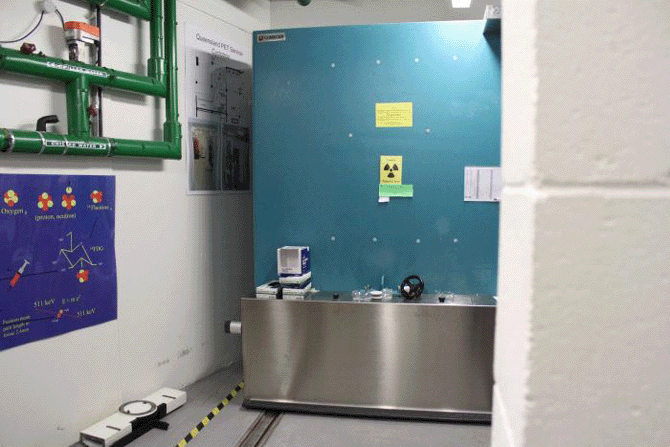
“It creates a proton beam which bombards oxygen-18 water and turns it into fluorine-18. That’s what we attach to those pharmaceuticals,” Dr Marissa Bartlett, manager of the Radiopharmaceutical Centre of Excellence, said.
The cyclotron is switched on at 4:00am every day to make a new batch of radiopharmaceuticals for lifesaving treatments and therapies.
“We make products that are taken up by cancer cells, so when a patient goes under the [PET] scanner the doctors can see pictures and images of where the cancer cells are,” Dr Bartlett told ABC Radio Brisbane’s Katherine Feeney.
“One of the therapies some patients who have cancer can have is a radionuclide therapy, which goes to the cancer cells and uses radiation to kill those cells.”
There’s no hazmat suits in sight — they’re not needed in a lab largely devoid of dangerous chemicals — but Dr Bartlett said lab workers were protected from radiation by a series of lead, lead-glass and concrete shields.
“When the cyclotron is on it generates very large amounts of radiation so it would be extremely dangerous to be anywhere near it when it’s on,” she said.
“In order to have it on campus we have it inside a concrete room. The walls of that room are thicker than I am tall.”
Medicines go direct to patients
Even though Dr Bartlett described the nuclear medicine department as an “obscure little branch” of hospital operations, many Queenslanders would come into contact with the radiopharmaceuticals it produced.
The Cancer Council of Queensland estimates nearly 27,000 people receive a cancer diagnosis each year.
“One of the things that makes this an amazing place to work is that you literally walk past the patients to get to the lab,” Dr Bartlett said.
“They might get news they really don’t want or maybe they’re coming back to see how their cancer is progressing or responding to treatment.
“We’re very aware of the patients who are lining up every day to get the products we make.”
And what happens to any radioactive materials that aren’t used?
“Everything we make has a very short half-life, so we basically store it until it decays away,” Dr Bartlett said.
“Then it’s completely cold and you wouldn’t know that it had been radioactive.”
Climate change brings collapse of ecosystems in Australia
The Conversation 4 July 18 Climate Research Fellow, University of Tasmania, Professor, Environmental Change Biology, University of Tasmania, Senior Lecturer, Macquarie University,
To the chagrin of the tourist industry, the Great Barrier Reef has become a notorious victim of climate change. But it is not the only Australian ecosystem on the brink of collapse.
Our research, recently published in Nature Climate Change, describes a series of sudden and catastrophic ecosystem shifts that have occurred recently across Australia.
These changes, caused by the combined stress of gradual climate change and extreme weather events, are overwhelming ecosystems’ natural resilience.
Variable climate
Australia is one of the most climatically variable places in the world. It is filled with ecosystems adapted to this variability, whether that means living in scorching heat, bitter cold or a climate that cycles between the two.
Despite land clearing, mining and other activities that transform the natural landscape, Australia retains large tracts of near-pristine natural systems.
Many of these regions are iconic, sustaining tourism and outdoor activities and providing valuable ecological services – particularly fisheries and water resources. Yet even here, the combined stress of gradual climate change and extreme weather events is causing environmental changes. These changes are often abrupt and potentially irreversible.
They include wildlife and plant population collapses, the local extinction of native species, the loss of ancient, highly diverse ecosystems and the creation of previously unseen ecological communities invaded by new plants and animals.
Australia’s average temperature (both air and sea) has increased by about 1°C since the start of the 19th century. We are now experiencing longer, more frequent and more intense heatwaves, more extreme fire weather and longer fire seasons, changes to rainfall seasonality, and droughts that may be historically unusual.
The interval between these events has also shortened, which means even ecosystems adapted to extremes and high natural variability are struggling.
As climate change accelerates, the magnitude and frequency of extreme events is expected to continue increasing.
What is ecosystem collapse?
Gradual climate change can be thought of as an ongoing “press”, on which the “pulse” of extreme events are now superimposed. In combination, “presses” and “pulses” are more likely to push systems to collapse.
We identified ecosystems across Australia that have recently experienced catastrophic changes, including:
not all examples can be directly linked to a single weather event, or a series of events. These are most likely caused by multiple interactingclimate “presses” and “pulses”. It’s worth remembering that extreme biological responses do not always manifest as an impact on the dominant species. Cascading interactions can trigger ecosystem-wide responses to extreme events.
The cost of intervention
Once an ecosystem goes into steep decline – with key species dying out and crucial interactions no longer possible – there are important consequences.
Apart from their intrinsic worth, these areas can no longer supply fish, forest resources, or carbon storage. It may affect livestock and pasture quality, tourism, and water quality and supply.
Unfortunately, the sheer number of variables – between the species and terrain in each area, and the timing and severity of extreme weather events – makes predicting ecosystem collapses essentially impossible.
Targeted interventions, like the assisted recolonisation of plants and animals, reseeding an area that’s suffered forest loss, and actively protecting vulnerable ecosystems from destructive bushfires, may prevent a system from collapsing, but at considerable financial cost. And as the interval between extreme events shorten, the chance of a successful intervention falls.
Critically, intervention plans may need to be decided upon quickly, without full understanding of the ecological and evolutionary consequences.
How much are we willing to risk failure and any unintended consequences of active intervention? How much do we value “natural” and “pristine” ecosystems that will increasingly depend on protection from threats like invasive plants and more frequent fires?
We suspect the pervasive effects of the press and pulse of climate change means that, increasingly, the risks of doing nothing may outweigh the risks of acting.
The beginning of this century has seen an unprecedented number of widespread, catastrophic biological transformations in response to extreme weather events.
This constellation of unpredictable and sudden biological responses suggests that many seemingly healthy and undisturbed ecosystems are at a tipping point https://theconversation.com/ecosystems-across-australia-are-collapsing-
1 This Month

of the week – Shut Down Drone Warfare!


Tell the Ukrainian Government to Drop Prosecution of Peace Activist Yurii Sheliazhenko

Petition to revoke the licensing of the Near Surface Nuclear Disposal Facility (NSDF) at Chalk River. https://www.ourcommons.ca/petitions/en/Petition/Details?Petition=e-7247
To see nuclear-related stories in greater depth and intensity – go to https://nuclearinformation.wordpress.com
-
Archives
- April 2026 (91)
- March 2026 (251)
- February 2026 (268)
- January 2026 (308)
- December 2025 (358)
- November 2025 (359)
- October 2025 (376)
- September 2025 (257)
- August 2025 (319)
- July 2025 (230)
- June 2025 (348)
- May 2025 (261)
-
Categories
- 1
- 1 NUCLEAR ISSUES
- business and costs
- climate change
- culture and arts
- ENERGY
- environment
- health
- history
- indigenous issues
- Legal
- marketing of nuclear
- media
- opposition to nuclear
- PERSONAL STORIES
- politics
- politics international
- Religion and ethics
- safety
- secrets,lies and civil liberties
- spinbuster
- technology
- Uranium
- wastes
- weapons and war
- Women
- 2 WORLD
- ACTION
- AFRICA
- Atrocities
- AUSTRALIA
- Christina's notes
- Christina's themes
- culture and arts
- Events
- Fuk 2022
- Fuk 2023
- Fukushima 2017
- Fukushima 2018
- fukushima 2019
- Fukushima 2020
- Fukushima 2021
- general
- global warming
- Humour (God we need it)
- Nuclear
- RARE EARTHS
- Reference
- resources – print
- Resources -audiovicual
- Weekly Newsletter
- World
- World Nuclear
- YouTube
-
RSS
Entries RSS
Comments RSS
 nuclear-news