At long last – some Australian politicians speak up for Australian Julian Assange
 Barnaby Joyce joins calls to stop extradition of Assange to US, The Age, By Rob Harris, October 13, 2019 Former deputy prime minister Barnaby Joyce has joined calls for the Morrison government to try to halt Julian Assange’s potential extradition from Britain to the United States on espionage charges, as the WikiLeaks founder’s supporters intensify their campaign to bring him to Australia.
Mr Joyce joined former foreign minister Bob Carr in voicing concerns over US attempts to have the 48-year-old Australian stand trial in America, where he faces a sentence of 175 years if found guilty of computer fraud and obtaining and disclosing national defence information.
Also seeking to increase pressure on the federal government is actress Pamela Anderson, who is demanding to meet Prime Minister Scott Morrison to request he intervene in the case. She plans to visit Australia next month.
Assange’s supporters say they are increasingly concerned about his health and his ability to receive a fair trial in the US………
Mr Carr has challenged Foreign Minister Marise Payne to make “firm and friendly” representation to US Secretary of State Mike Pompeo, believing Australians would be “deeply uneasy” at a fellow citizen being handed over to the “living hell of a lifetime sentence in an American penitentiary”.
Mr Joyce, who in 2007 was the first Coalition MP to call for the then Howard government to act over the detention of Australian David Hicks in Guantanamo Bay, said his position was principled and he gave “no opinion of Mr Assange whatsoever”.
“If someone was in another country at a time an alleged event occurred then the sovereignty of the land they were in has primacy over the accusation of another nation,” Mr Joyce said.
“It would be totally unreasonable, for instance, if China was to say the actions of an Australian citizen whilst in Australia made them liable to extradition to China to answer their charges of their laws in China. Many in Hong Kong have the same view.”
Assange is serving a 50-week sentence in Belmarsh Prison in south-east London for bail violations after spending seven years inside the Ecuadorian embassy in London in a bid to avoid extradition to Sweden to answer allegations of rape and molestation in 2012.
In June, the then British home secretary, Sajid Javid, signed an extradition request after the US Justice Department filed an additional 18 Espionage Act charges over Assange’s role in obtaining and publishing 400,000 classified US military documents on the war in Iraq in 2010.
Mr Carr, the former NSW premier who served as foreign minister in the Gillard government, said he understood many people would have reservations about the “modus operandi” of Assange and his alleged contact with Russia.
Mr Carr said the Morrison government should make strong representations to the US on behalf of an Australian citizen who “is in trouble because he delivered on our right to know”.
“I think the issue will gather pace and in the ultimate trial there’ll be a high level of Australian public concern, among conservative voters as much as any others.”……..
Mr Carr said the Morrison government should make strong representations to the US on behalf of an Australian citizen who “is in trouble because he delivered on our right to know”.
“I think the issue will gather pace and in the ultimate trial there’ll be a high level of Australian public concern, among conservative voters as much as any others.”…….https://www.theage.com.au/politics/federal/barnaby-joyce-joins-calls-to-stop-extradition-of-assange-to-us-20191013-p53080.html
Pamela Anderson to take on Australian Prime Minister over his neglect of Julian Assange’s plight
Pamela Anderson coming to Australia to petition the Prime Minister to Help Free Julian Assange, Phillip Adams, [No. I don’t think that he is that Phillip Adams] Brisbane, Australia OCT 11, 2019 — By Monique St Clair Pamela Anderson is on her way to Australia, and she’s challenging our Prime Minister on entry.
The former Baywatch superstar is headed to the Gold Coast next month to shoot a series of ‘Unexpected Situation’ commercials for Ultra Tune.
The ads are expected to air over summer, in conjunction with the 2020 Australian Tennis Open and Big Bash Cricket.
She’s no stranger to the land down under, after her affiliation with jailed Wikileaks founder and Australian, Julian Assange, gained world-wide attention.
Late last year, Anderson made a public plea on 60 minutes for Prime Minister Scott Morrison to do more to help. “Defend your friend, get Julian his passport back and take him back to Australia and be proud of him, and throw him a parade when he gets home,” Ms Anderson said.
Scott Morrison then told 1029 Hot Tomato’s Flan, Emily Jade and Christo that he’s had “plenty of mates who’ve asked me if they can be my special envoy to sort the issue out with Pamela Anderson.”
Ms Anderson called out the comments as ‘disappointing’, ‘smutty’, and ‘unnecessary’, and is now – a year later – wanting to address them face to face.
She’s announced she’ll again be petitioning him to intervene on Julian Assange’s behalf.
“What is also important to me about this visit is the opportunity to speak to the Australian people and petition Prime Minister Morrison to intervene on behalf of Australian citizen, Julian Assange, who is being made a scapegoat of and suffered inhumanely for disseminating factual information we all should know about.
“Mr Morrison made a series of personally, disparaging remarks about me and I’d like to challenge him to debate this matter in front of the Australian people,” Ms Anderson said in a recent statement.”
Sources of content : http://www.mygc.com.au/pamela-anderson-challenges-scott-morrison-ahead-of-australia-visit
Australian government warned about taxpayer burden if it chooses nuclear power

Nuclear inquiry hears cost, health risks https://www.9news.com.au/national/environment-groups-front-nuclear-inquiry/79884d6e-f161-4624-9bac-b6f283d96598 By AAP Oct 1, 2019 Taxpayers would be bear the brunt of a potential nuclear energy industry in Australia, a parliamentary committee has been told.
Australian government ‘doesn’t give a damn’about rest of the world

David Attenborough says Australian government ‘doesn’t give a damn’about rest of the world, Telegraph, UK, Giovanni Torre, perth
24 SEPTEMBER 2019
Sir David Attenborough slammed the Australian government’s response to
climate change as the country’s prime minister Scott Morrison skipped
the United Nations Climate Summit in favour of a rally for President Donald
Trump.
While the United Kingdom has reduced its carbon emissions over the past 12
years, emissions from Australia have increased and the country is among the
worst polluters per capita.
Sir David said the current Australian government had departed from the
previous government’s commitment to tackling climate change.
“(They had been) saying all the right things… then you suddenly say, ‘No it
doesn’t matter… it doesn’t matter how much coal we burn… we don’t give a
damn what it does to the rest of the world’,” he said.
Sir David noted that Mr Morrison brought a lump of coal into one of
Australia’s houses of Parliament in 2017, calling out to the opposition:
“Don’t be scared, it won’t hurt you”.
“If you weren’t opening a coal mine okay I would agree, it’s a joke. But you
are opening a coal mine,” he said.
Sir David noted that Mr Morrison had campaigned for re-election on a
platform of support for new coal mines.
Speaking from Chicago, Mr Morrison defended his government’s record on
climate change…… https://www.telegraph.co.uk/news/2019/09/24/david-attenborough-says-australian-government-doesnt-give-damn/?WT.mc_id=tmg_share_fb&fbclid=IwAR0GancZNjQW1CgrE7UF2WExXW2B4HvkM9brL0huaFKom6msYAz79qtjjd0
Donald Trump keen to build a military partnership with Australia’s PM ‘man of titanium’
 Donald Trump suggests China ‘a threat to the world’ while praising Scott Morrison as a ‘man of titanium’ US president signalled he would raise with Morrison a military contribution in Iran but then indicated he did not do so, Guardian, Katharine Murphy Political editor
 Morrison, as a “man of titanium”.
Following a ceremonial welcome for Morrison on Friday Washington time attended by more than 4,000 guests, Trump praised Morrison’s personal fortitude, describing him as “a man of real, real strength, and a great guy”.
The American president signalled he would raise with Morrison a possible military contribution in Iran beyond the current freedom of navigation commitment in the Strait of Hormuz, but later in the day indicated he had not, in fact, raised the issue during a bilateral meeting at the White House.
The Australian prime minister made a point of praising the president’s restraint in relation to Iran to date and made no commitment beyond saying the government would consider any request from the administration on its merits. …….
Trump said he was interested in building a coalition for military action with Australian participation, but then told reporters at a subsequent press conference Iran wasn’t discussed, and Morrison then described Australia’s possible participation as “moot”…….. https://www.theguardian.com/australia-news/2019/sep/21/donald-trump-suggests-china-a-threat-to-the-world-while-praising-scott-morrison-as-a-man-of-titanium
Embarrassing for Australia, Trump suggests they join USA in possibly nuclear war with Iran
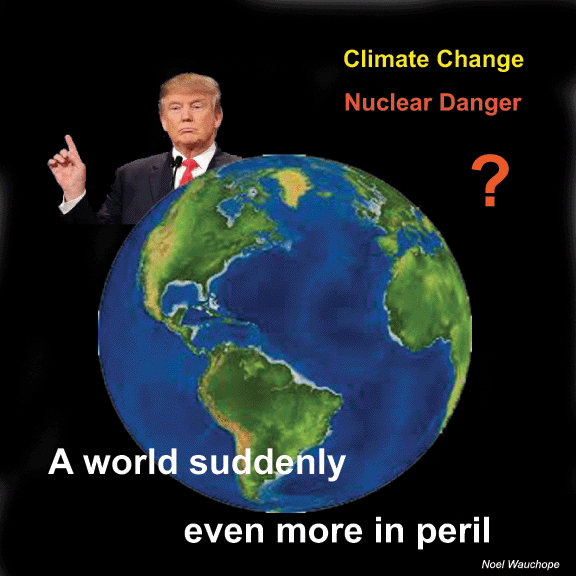 Scott Morrison scrambles to contain political mushroom cloud after Trump raises nuclear option with Iran
The Australian press pack was hyperventilating when the US president made the suggestion Australia might be asked to join a coalition of the willing. Then collective amnesia set in, Guardian Katharine Murphy Political editor @murpharoo 21 Sep 2019 It seemed appropriate, albeit entirely surreal, to be inducted into the vagaries of the Trumpiverse by bearing witness, in the Oval Office, to the American president suddenly raising the spectre of using nuclear weapons against Iran.
Friday’s program in Washington ran like clockwork while everybody had a script. But once we’d cleared the pomp and circumstance of the ceremonial welcome for Scott Morrison on the South Lawn of the White House, once the Australian press pack tumbled out of the sparkling spring sunshine into the Oval Office – we discovered Trump in an expansive mood……..
The president then volunteered he intended to have a quiet word to Scott Morrison over the course of their meetings on Friday, Washington time, about potential military options in Iran, and whether Australia might be persuaded to join a new coalition of the willing. ….
Morrison maintained his best poker face as the president informed the hyperventilating press pack “I always like a coalition”…..
Before we could process the information that Australia might be off to war in Iran, things spiralled. The unheralded military action could be – wait for it – nuclear.
Trump noted America had renovated the arsenal and acquired new nuclear capability, and the rest of the military was “all brand new”……..
With vexed options now tumbling out of Trump’s mouth at a clip, it did seem prudent to check in with the prime minister at this point. What was his position on Australia joining military action in Iran?……
The politically vexed question about whether Australia would do more than protect freedom of navigation in the Strait of Hormuz was therefore moot. If any request was forthcoming, Australia would consider it on its merits, through the prism of national interest, Morrison said, before gathering his host, smiling at the cameras, and exiting, stage right. https://www.theguardian.com/australia-news/2019/sep/21/scott-morrison-scrambles-to-contain-political-mushroom-cloud-after-trump-raises-nuclear-option-with-iran
In Australia, millions unite in 40 organisations to say NO to nuclear power

 Broad coalition representing millions of Australians opposes nuclear power, https://www.sbs.com.au/news/broad-coalition-representing-millions-of-australians-opposes-nuclear-power 17 Sept 19, Some 40 groups have drawn up a statement calling on the federal government to embrace renewable energy rather than going down the path of nuclear.
More than 40 groups representing millions of Australians have come together to issue a clear message to the federal government that the nation’s energy future is renewable, “not radioactive”.
However, the mining industry is calling for the ban on nuclear energy to be lifted.
The coalition of groups has submitted a shared statement in response to the federal parliamentary inquiry into the prospects for nuclear power in Australia.
“The groups maintain nuclear power has no role in Australia’s energy future and is a dangerous distraction from real progress on our pressing energy and climate challenges and opportunities facing Australia,” the Australian Conversation Foundation said.
“[We call] for the federal parliament to embrace renewable energy as the cleanest, quickest, cheapest and most credible way to power Australian homes and workplaces, and re-power regional communities and the national economy.”
The ACF is joined by a broad coalition of faith, union, environmental, aboriginal and public health groups.
These include the ACTU, state and territory trade unions and councils, the Public Health Association of Australia, Uniting and Catholic church organisations, the Smart Energy Council, the Aboriginal-led Australian Nuclear Free Alliance, climate action groups and Greenpeace Australia Pacific.
Their statement raises concerns over the long-life of nuclear waste, the volume of water needed to cool a nuclear reactor, the time needed to build a reactor, the high cost of a plant, security and safety.
However, in its own submission, the Minerals Council of Australia called on the legislated ban on nuclear to be lifted and uranium mining to be mainstreamed with other minerals.
Council chief executive Tania Constable said nuclear energy should be considered as part of the energy mix if Australia is to retain its strong industrial sector with high-paying long-term jobs.
It will also encourage investment and maintain system and price stability through a stable and reliable electricity market while significantly cutting greenhouse gas emissions.
“Australia has lost its comparative advantage in energy,” Ms Constable said in a statement. “Rising prices and falling reliability are forcing businesses to invest overseas instead of Australia.”
Thorium nuclear reactors – expensive, dangerous and leave dangerous radioactive isotopes with long half-lives

New nuclear power proposal needs public debate https://independentaustralia.net/environment/environment-display/new-nuclear-power-proposal-needs-public-discussion,13071 By Helen Caldicott | 4 September 2019 The prospect of thorium being introduced into Australia’s energy arrangements should be subjected to significant scrutiny, writes Helen Caldicott.
AS AUSTRALIA is grappling with the notion of introducing nuclear powerinto the country, it seems imperative the general public understand the intricacies of these technologies so they can make informed decisions. Thorium reactors are amongst those being suggested at this time.
The U.S. tried for 50 years to create thorium reactors, without success. Four commercial thorium reactors were constructed, all of which failed. And because of the complexity of problems listed below, thorium reactors are far more expensive than uranium fueled reactors.
The longstanding effort to produce these reactors cost the U.S. taxpayers billions of dollars, while billions more dollars are still required to dispose of the highly toxic waste emanating from these failed trials.
The truth is, thorium is not a naturally fissionable material. It is therefore necessary to mix thorium with either enriched uranium 235 (up to 20% enrichment) or with plutonium – both of which are innately fissionable – to get the process going.
While uranium enrichment is very expensive, the reprocessing of spent nuclear fuel from uranium powered reactors is enormously expensive and very dangerous to the workers who are exposed to toxic radioactive isotopes during the process. Reprocessing spent fuel requires chopping up radioactive fuel rods by remote control, dissolving them in concentrated nitric acid from which plutonium is precipitated out by complex chemical means.
Vast quantities of highly acidic, highly radioactive liquid waste then remain to be disposed of. (Only is 6 kilograms of plutonium 239 can fuel a nuclear weapon, while each reactor makes 250 kilos of plutonium per year. One millionth of a gram of plutonium if inhaled is carcinogenic.)
So there is an extraordinarily complex, dangerous and expensive preliminary process to kick-start a fission process in a thorium reactor.
When non-fissionable thorium is mixed with either fissionable plutonium or uranium 235, it captures a neutron and converts to uranium 233, which itself is fissionable. Naturally it takes some time for enough uranium 233 to accumulate to make this particular fission process spontaneously ongoing.
Later, the radioactive fuel would be removed from the reactor and reprocessed to separate out the uranium 233 from the contaminating fission products, and the uranium 233 then will then be mixed with more thorium to be placed in another thorium reactor.
But uranium 233 is also very efficient fuel for nuclear weapons. It takes about the same amount of uranium 233 as plutonium 239 – six kilos – to fuel a nuclear weapon. The U.S. Department of Energy (DOE) has already, to its disgrace, ‘lost track’ of 96 kilograms of uranium 233.
A total of two tons of uranium 233 were manufactured in the United States. This material naturally requires similar stringent security measures used for plutonium storage for obvious reasons. It is estimated that it will take over one million dollars per kilogram to dispose of the seriously deadly material.
An Energy Department safety investigation recently found a national repository for uranium 233 in a building constructed in 1943 at the Oak Ridge National Laboratory.
It was in poor condition. Investigators reported an environmental release from many of the 1,100 containers could
‘… be expected to occur within the next five years because some of the packages are approaching 30 years of age and have not been regularly inspected.’
The DOE determined that this building had:
Deteriorated beyond cost-effective repair and significant annual costs would be incurred to satisfy both current DOE storage standards, and to provide continued protection against potential nuclear criticality accidents or theft of the material.
The DOE Office of Environmental Management now considers the disposal of this uranium 233 to be ‘an unfunded mandate’.
Thorium reactors also produce uranium 232, which decays to an extremely potent high-energy gamma emitter that can penetrate through one metre of concrete, making the handling of this spent nuclear fuel extraordinarily dangerous.
Although thorium advocates say that thorium reactors produce little radioactive waste, they simply produce a different spectrum of waste to those from uranium-235. This still includes many dangerous alpha and beta emitters, and isotopes with extremely long half-lives, including iodine 129 (half-life of 15.7 million years).
No wonder the U.S. nuclear industry gave up on thorium reactors in the 1980s. It was an unmitigated disaster, as are many other nuclear enterprises undertaken by the nuclear priesthood and the U.S. government.
Australia’s most expert nuclear shill performs for the industry at a Parliamentary Inquiry

He’s an expert at it.
What the nuclear industry wants is the removal of Australia’s Federal and State legislation that prohibits the nuclear industry in Australia.
Ziggy delivers.
Sure, he makes motherhood statements about nuclear dangers, about costs etc. He even gives a subtle little tick to that distracting fantasy – small modular nuclear reactors.
But Ziggy faithfully conveys the central message of the global nuclear lobby to Australia:
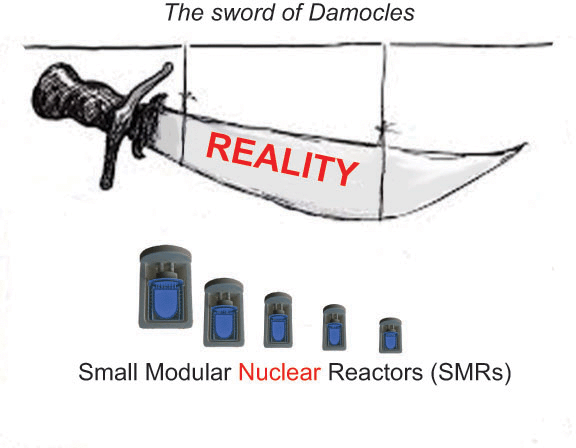
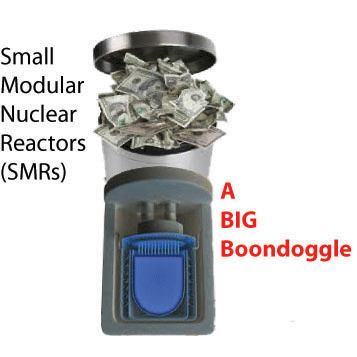
Refuting Australian Financial Review’s disinformation on Small Modular Nuclear Reactors (SMRs)
|
Aaron Patrick, senior correspondent with the Australian Financial Review (AFR), is the latest journalist to enter the nuclear culture wars with some propaganda that’s indistinguishable from that served up in the Murdoch tabloids. There’s lots of misinformation in Patrick’s articles. For example he uncritically promotes a dopey Industry Super Australia report, described by RenewEconomy editor Giles Parkinson as “one of the most inept analyses of the energy industry that has been produced in Australia”. (I’ve asked the authors of the Industry Super report if they intend to withdraw or amend it. No response.) The focus here ‒ and the focus of Patrick’s recent articles ‒ is on small modular reactors (SMRs), which he describes as new, small, safe, cheap and exciting (and he continues to make such claims even as I continue to feed him with evidence suggesting alternative SMR adjectives … non-existent, overhyped, obscenely expensive). Some history is useful in assessing Patrick’s claims. There’s a long history of small reactors being used for naval propulsion, but every effort to develop land-based SMRs has ended in tears. Academic M.V. Ramana concludes an analysis of the history of SMRs thus: “Sadly, the nuclear industry continues to practice selective remembrance and to push ideas that haven’t worked. Once again, we see history repeating itself in today’s claims for small reactors ‒ that the demand will be large, that they will be cheap and quick to construct. “But nothing in the history of small nuclear reactors suggests that they would be more economical than full-size ones. In fact, the record is pretty clear: Without exception, small reactors cost too much for the little electricity they produced, the result of both their low output and their poor performance. … “Worse, attempts to make them cheaper might end up exacerbating nuclear power’s other problems: production of long-lived radioactive waste, linkage with nuclear weapons, and the occasional catastrophic accident.” Patrick quotes an SMR company representative saying that SMRs have been “researched and developed for the best part of 50 years”. Fine … but surely AFR readers ought to be informed that every single attempt to commercialise SMRs over the past 50 years has failed. According to the Coalition’s energy spokesperson (p.34), “new-generation reactors with maximum safety features are now coming into use”. That was 30 years ago, and the spokesperson was Peter McGauran. A wave of enthusiasm for SMRs came and went without a single SMR being built anywhere in the world, and there’s no reason to believe the current wave of enthusiasm will be more fruitful. Diseconomies of scaleInterest in SMRs derives primarily from what they are not: large reactor projects which have been prone to catastrophic cost overruns and delays. Cost estimates for all reactors under construction in western Europe and north America range from A$17.5 billion to A$24 billion, and the twin-reactor V.C. Summer project in South Carolina was abandoned in 2017 after the expenditure of at least A$13 billion, forcing Westinghouse into bankruptcy and almost bankrupting its parent company Toshiba. But SMRs will cost more (per megawatt and megawatt-hour) because of diseconomies of scale: a 250MW SMR will generate 25 per cent as much power as a 1,000MW reactor, but it will require more than 25 per cent of the material inputs and staffing, and a number of other costs including waste management and decommissioning will be proportionally higher. So the nuclear industry’s solution to its wildly expensive and hopelessly uncompetitive large reactors is to offer up even-more-expensive reactors. Brilliant. Small wonder that nuclear lobbyists are lamenting the industry’s crisis and pondering what if anything might be salvaged from the “ashes of today’s dying industry“. Aaron Patrick claims in the AFR that SMRs are “likely” to be installed in North America and Europe. No, they aren’t. William Von Hoene, senior vice-president at Exelon ‒ the largest operator of nuclear power plants in the US ‒ said last year: “Right now, the costs on the SMRs, in part because of the size and in part because of the security that’s associated with any nuclear plant, are prohibitive.” The prevailing scepticism is evident in a 2017 Lloyd’s Register report based on the insights of almost 600 professionals and experts from utilities, distributors, operators and equipment manufacturers. They predict that SMRs have a “low likelihood of eventual take-up, and will have a minimal impact when they do arrive”. Likewise, American Nuclear Society consultant Will Davis said in 2014 that the SMR “universe [is] rife with press releases, but devoid of new concrete.” And a 2014 report produced by Nuclear Energy Insider, drawing on interviews with more than 50 “leading specialists and decision makers”, noted a “pervasive sense of pessimism” resulting from abandoned and scaled-back SMR programs. Independent economic assessmentsSMRs are “leading the way in cost” according to Tania Constable from the Minerals Council of Australia. NSW Deputy Premier John Barilaro claims that SMRs “are becoming very affordable”. But every independent economic assessment finds that electricity from SMRs will be more expensive than that from large reactors. A study by WSP / Parsons Brinckerhoff prepared for the 2015/16 South Australian Nuclear Fuel Cycle Royal Commission estimated costs of US$127‒130 per megawatt-hour (MWh) for large reactors, compared to US$140‒159 for SMRs. The Royal Commission’s final report identified numerous hurdles and uncertainties facing SMRs. A December 2018 report by CSIRO and the Australian Energy Market Operator concluded that “solar and wind generation technologies are currently the lowest-cost ways to generate electricity for Australia, compared to any other new-build technology.” It found that electricity from SMRs would be more than twice as expensive as that from wind or solar power with storage costs included (two hours of battery storage or six hours of pumped hydro storage). A report by the consultancy firm Atkins for the UK Department for Business, Energy and Industrial Strategy found that electricity from the first SMR in the UK would be 30 percent more expensive than that from large reactors, because of diseconomies of scale and the costs of deploying first-of-a-kind technology. A 2015 report by the International Energy Agency and the OECD Nuclear Energy Agency predicted that electricity from SMRs will be 50−100 percent more expensive than that from large reactors, although it holds out some hope that large-volume factory production could reduce costs. An article by four pro-nuclear researchers from Carnegie Mellon University’s Department of Engineering and Public Policy, published in 2018 in the Proceedings of the National Academy of Science, considered options for the development of an SMR industry in the US. They concluded that it would not be viable unless the industry received “several hundred billion dollars of direct and indirect subsidies” over the next several decades. That’s billion with a ‘b’: several hundred billion dollars.
|
|

Parliamentary Inquiry told that renewable energy, not nuclear power, is Australia’s best option
 Nuclear inquiry told “firmed renewables” cheapest and best option for future https://reneweconomy.com.au/nuclear-inquiry-told-firmed-renewables-cheapest-and-best-option-for-future-58109/ , 29 August 2019 A mix of distributed renewable energy generation and firming technologies including battery storage and pumped hydro remains the best path forward for Australia’s future grid, experts have told the federal government’s inquiry into nuclear power.A panel including representatives from Australia’s energy market regulator (AER), rule maker (AEMC) and operator (AEMO) faced questions on Thursday from the House of Representatives Standing Committee on the prerequisites for nuclear energy in Australia. Established by the federal Coalition and chaired by Queensland LNP MP Ted O’Brien, the Committee aims – according to O’Brien – to answer the three main questions of whether nuclear is “feasible, suitable and palatable” in the Australian context.
Trumped Up: Wiki cables show Australia thinks Iran is not the aggressor,
Trumped Up: Wiki cables show Australia thinks Iran is not the aggressor, Michael West, by Prof. Clinton Fernandes — 23 August 2019 Wikileaks cables reveal Iran presents no threat to Australia and little threat to the US. Instead, clear intelligence from the US, Australia and Iran confirms Iran, although portrayed as aggressive, has pursued a defensive military strategy. Clinton Fernandez reports.
Rare earths’ radioactive wastes -a toxic issue in Malaysia
Australian mining company Lynas gets permission to dispose of radioactive waste in Malaysia, dividing locals ABC
Key points:
- Malaysia has renewed the rare earth plant licence of Australian company Lynas
- Green groups say Lynas’ activities pose a threat to the local environment
- Lynas says it will meet the licence obligations set by Malaysia’s Government
Outside of China, the Australian firm, Lynas, is the world’s only major producer of rare earth minerals, which are crucial in the production of high-tech gear including smartphones, laser-guided missiles and electric car batteries.
The ore is dug up at Mount Weld in Western Australia and then shipped to Malaysia, where the cost of processing is significantly lower.
The low-level radioactive waste is a by-product of the enrichment process and Malaysian activists are convinced it poses a threat to local communities.
At a recent protest in Kuantan, several hundred people rallied against the Australian firm and Malaysian Prime Minister Mahathir Mohamad’s decision to extend its licence to operate.
“[The radioactivity] will be passed through our children and our children’s children,” said Moses Lim, a chemical engineer turned activist.
“We may be gone, but our grandchildren will curse us.”
Mr Lim claimed the issue had the potential to “tarnish the good name of Australia” in the minds of millions of Malaysians. But the Prime Minister, 94-year-old Dr Mahathir, dismissed criticism of Lynas’ operations in Malaysia.
“It’s not Chernobyl. This isn’t going to be dangerous,” he said.
‘We just have to accept this fate’
The issue has split the local community, which relies on the hundreds of high-paying jobs that the processing facility provides.
At a local fish market in Kuantan, a mother who declined to offer her name told the ABC she feared radioactive contamination from the facility would make its way into her food.
“I am scared, but I have no choice but to buy the fresh fish from here. We just have to accept this fate,” she said.
“I think Lynas should be shut down for the sake of the surrounding environment.”
But other locals said there was nothing to worry about, blaming politicians for trying to capitalise on the issue by whipping up fear in the community.
Raja Harris bin Raja Salleh, the chief fisher in Balok village, said the residents are “not at all scared”.
“Lynas is the same as other agencies and factories that produce chemicals. The accusations against Lynas are political,” he said.
Toxic waste becomes a toxic issue
The issue of Lynas’ radioactive waste has become politically toxic for the Mahathir-led coalition, which promised in opposition to close the Australian plant.
Now in government after last year’s shock election result, there has been a major backing down.
Lynas is allowed to keep operating its plant and has been given six months to find a suitable site within Malaysia to permanently dispose of 580,000 tonnes of low-level radioactive waste currently stockpiled at the Kuantan facility.
The company has also been given four years to relocate its cracking and leaching processing operation — which creates the radioactive waste — to Western Australia.
Wong Tak, a Malaysian Government MP who attended the Kuantan protest, said the cabinet decision to extend the licence was a “great disappointment”.
The long time anti-Lynas campaigner claimed the issue was serious enough to fracture the Mahathir-led Pakatan Harapan, or Alliance of Hope, Coalition.
“I know the majority of backbenchers are with us, and I will even say the majority of the cabinet are with the people.”
Dr Mahathir has taken a pragmatic approach to the issue, saying the decision to extend the licence was based on expert advice, not the “popular view”.
“Either we get rid of the industry and lose credibility in terms of foreign direct investment, or we can take care of the problem,” he said……
The fate of Lynas in Malaysia is being keenly watched around the world amid concerns rare earth materials could become a bargaining chip in the ongoing US-China trade war.
In 2010, the Chinese supply of rare earths to Japan suddenly stopped for two months following a territorial dispute over Japan’s claim to the Senkaku Islands, which angered China.
The construction of the Lynas plant in Malaysia was largely funded in 2011 by Japan, which needed a reliable supply of rare earths.
China currently holds a near-monopoly on the production of rare earth minerals, with Lynas producing about 13 per cent of global supply.https://www.abc.net.au/news/2019-08-22/malaysians-divided-on-radioactive-waste-from-aussie-miner-lynas/11434122
Australia would be a mug to be conned into buying small modular nuclear reactors
 7 reasons why Small Modular Nuclear Reactrs are a bad idea for Australia, more https://independentaustralia.net/environment/environment-display/seven-reasons-why-small-modular-nuclear-reactors-are-a-bad-idea-for-australia,13010
International news reports that, in a failed missile test in Russia, a small nuclear reactor blew up, killing five nuclear scientists, and releasing a radiation spike.
In Australian news, with considerably less media coverage, Parliament announced an Inquiry into nuclear energy for Australia, with an emphasis on Small Modular Reactors (SMRs). Submissions are due by September 16.
A bit of background. The U.S. government and the U.S. nuclear industry are very keen to develop and export small modular nuclear reactors for two main reasons, both explained in the Proceedings of the National Academy of Sciences, 2018 Firstly, with the decline of large nuclear reactors, there is a need to maintain the technology and the expertise, trained staff, necessary to support the nuclear weapons industry. Secondly, the only hope for commercial viability of small nuclear reactors is in exporting them – the domestic market is too small. So – Australia is seen as a desirable market.
The USA motivation for exporting these so far non-existent prefabricated reactors is clear. The motivation of their Australian promoters is not so clear.
These are the main reasons why it would be a bad idea for Australia to import small modular nuclear reactors.
- COST.Researchers from Carnegie Mellon University’s Department of Engineering and Public Policy concluded that the SMR industry would not be viable unless the industry received “several hundred billion dollars of direct and indirect subsidies” over the next several decades. For a company to invest in a factory to manufacture reactors, they’d need to be sure of a real market for them – Australia would have to commit to a strong investment up front.
The diseconomics of scale make SMRs more expensive than large reactors. A 250 MW SMR will generate 25 percent as much power as a 1,000 MW reactor, but it will require more than 25 percent of the material inputs and staffing, and a number of other costs including waste management and decommissioning will be proportionally higher.
A study by WSP / Parsons Brinckerhoff, commissioned by the 2015/16 South Australian Nuclear Fuel Cycle Royal Commission, estimated costs of A$180‒184/MWh (US$127‒130) for large pressurised water reactors and boiling water reactors, compared to A$198‒225 (US$140‒159) for SMRs.
To have any hope of being economically viable, SMRs would have to be mass produced and deployed, and here is a “Catch-22″ problem The economics of mass production of SMRs cannot be proven until hundreds of units are in operation. But that can’t happen unless there are hundreds of orders, and there will be few takers unless the price can be brought down. Huge government subsidy is therefore required
- Safety problems. Small nuclear reactors still have the same kinds of safety needsas large ones have. The heat generated by the reactor core must be removed both under normal and accident conditions, to keep the fuel from overheating, becoming damaged, and releasing radioactivity. The passive natural circulation coolingcould be effective under many conditions, but not under all accident conditions. For instance, for the NuScale design a large earthquake could send concrete debris into the pool, obstructing circulation of water or air. Where there are a number of units, accidents affecting more than one small unit may cause complications that could overwhelm the capacity to cope with multiple failures.
Because SMRs have weaker containment systems than current reactors, there would be greater damage if a hydrogen explosion occurred. A secondary containment structure would prevent large-scale releases of radioactivity in case of a severe accident. But that would make individual SMR units unaffordable. The result? Companies like NuScale now move to projects called “Medium” nuclear reactors – with 12 units under a single containment structure. Not really small anymore.
Underground siting is touted as a safety solution, to avoid aircraft attacks and earthquakes. But that increases the risks from flooding. In the event of an accident emergency crews could have greater difficulty accessing underground reactors.
Security
Proponents of SMRs argue that they can be deployed safely both as a fleet of units close to cities, or as individual units in remote locations. In all cases, they’d have to operate under a global regulatory framework, which is going to mean expensive security arrangements and a level of security staffing. ‘Economies of scale’ don’t necessarily work, when it comes to staffing small reactors. SMRs will, anyway, need a larger number of workers to generate a kilowatt of electricity than large reactors need. In the case of security staffing, this becomes important both in a densely populated area, and in an isolated one.
- Weapons Proliferation.
The latest news on the Russian explosion is a dramatic illustration of the connection between SMRs and weapons development.
But not such a surprise. SMRs have always had this connection, beginning in the nuclear weapons industry, in powering U.S. nuclear submarines. They were used in UK to produce plutonium for nuclear weapons. Today, the U.S. Department of Energy plans to use SMRs as part of “dual use” facilities, civilian and military. SMRs contain radioactive materials, produce radioactive wastes – could be taken, used part of the production of a “dirty bomb” The Pentagon’s Project Dilithium’s small reactors may run on Highly Enriched Uranium (HEU) , nuclear weapons fuel – increasing these risks.
It is now openly recognised that the nuclear weapons industry needs the technology development and the skilled staff that are provided by the “peaceful” nuclear industry. The connection is real, but it’s blurred. The nuclear industry needs the “respectability” that is conferred by new nuclear, with its claims of “safe, clean, climate-solving” energy.
- Wastes.
SMRs are designed to produce less radioactive trash than current reactors. But they still produce long-lasting nuclear wastes, and in fact, for SMRs this is an even more complex problem. Australia already has the problem of spent nuclear fuel waste, accumulating in one place – from the nuclear reactor at Lucas Heights. With SMRs adopted, the waste would be located in many sites, with each location having the problem of transport to a disposal facility. Final decommissioning of all these reactors would compound this problem. In the case of underground reactors, there’d be further difficulties with waste retrieval, and site rehabilitation.
6. Location.
I have touched on this, in the paragraphs on safety, security, and waste problems. The nuclear enthusiasts are excited about the prospects for small reactors in remote places. After all, aren’t some isolated communities already having success with small, distributed solar and wind energy? It all sounds great. But it isn’t.
With Australia’s great distances, it would be difficult to monitor and ensure the security of such a potentially dangerous system, of many small reactors scattered about on this continent. Nuclear is an industry that is already struggling to attract qualified staff, with a large percentage of skilled workers nearing retirement. The logistics of operating these reactors, meeting regulatory and inspection requirements, maintaining security staff would make the whole thing not just prohibitively expensive, but completely impractical.
- Delay.
For Australia, this has to be the most salient point of all. Economist John Quiggin has pointed out that Australia’s nuclear fans are enthusing about small modular nuclear reactors, but with no clarity on which, of the many types now designed, would be right for Australia. NuScale’s model, funded by the U.S. government, is the only one at present with commercial prospects, so Quiggin has examined its history of delays. But Quiggin found that NuScale is not actually going to build the factory: it is going to assemble the reactor parts, these having been made by another firm, – and which firm is not clear. Quiggin concludes:
Australia’s proposed nuclear strategy rests on a non-existent plant to be manufactured by a company that apparently knows nothing about it.
As there’s no market for small nuclear reactors, companies have not invested much money to commercialise them. Westinghouse Electric Company tried for years to get government funding for its SMR plan, then gave up, and switched to other projects. Danny Roderick, then president and CEO of Westinghouse, announced:
The problem I have with SMRs is not the technology, it’s not the deployment ‒ it’s that there’s no customers. … The worst thing to do is get ahead of the market.
Russia’s programme has been delayed by more than a decade and the estimated costs have ballooned.
South Korea decided on SMRs, but then pulled out, presumably for economic reasons.
China is building one demonstration SMR, but has dropped plans to build 18 more, due to diseconomics of the scheme.
There’s a lot of chatter in the international media, about all the countries that are interested, or even have signed memoranda of understanding about buying SMRs, but still with no plans for actual purchase or construction.
Is Australia going to be the guinea pig for NuScale’s Small and Medium Reactor scheme? If so,when? The hurdles to overcome would be mind-boggling. The start would have to be the repeal of Australia’s laws – the Environment Protection and Biodiversity Conservation (EPBC) Act 1999 Section 140A and Australian Radiation Protection and Nuclear Safety Act 1998. Then comes the overcoming of States’ laws, much political argy-bargy, working out regulatory frameworks, import and transport of nuclear materials, – finding locations for siting reactors, – Aboriginal issues-community consent, waste locations. And what would it all cost?
And, in the meantime, energy efficiency developments, renewable energy progress, storage systems – will keep happening, getting cheaper, and making nuclear power obsolete.
Stifling democracy- Australia’s National Radioactive Waste Management Facility Taskforce is even more repressive than UK’s
 Cumbria Trust 11th Aug 2019 The Guardian has reported that residents in Southern Australia, who face having a nuclear waste storage facility imposed on them, are being forced
to sign an excessively restrictive code of conduct if they wish to attend
community meetings. This prevents them from taking notes, repeating certain
views expressed in the meeting, or trying to take part in the committee
discussions.
This appears to go well beyond the steps required to maintain
an orderly meeting, and serves to suppress democratic accountability. While
the last search process in Cumbria, MRWS, didn’t go to such extreme
lengths, there were some unnecessary restrictions which obstructed local
democracy. Specifically, executive members of the borough councils, and
cabinet members of Cumbria County Council, were told that they could not
give any public indication of whether they were minded to vote for the
process to proceed to the next stage. This ‘predetermination’ rule
allowed senior councillors to completely avoid public scrutiny on the
matter.
https://cumbriatrust.wordpress.com/2019/08/11/australian-troubles-with-community-engagement/
1 This Month

of the week – Shut Down Drone Warfare!


Tell the Ukrainian Government to Drop Prosecution of Peace Activist Yurii Sheliazhenko

Petition to revoke the licensing of the Near Surface Nuclear Disposal Facility (NSDF) at Chalk River. https://www.ourcommons.ca/petitions/en/Petition/Details?Petition=e-7247
To see nuclear-related stories in greater depth and intensity – go to https://nuclearinformation.wordpress.com
-
Archives
- April 2026 (57)
- March 2026 (251)
- February 2026 (268)
- January 2026 (308)
- December 2025 (358)
- November 2025 (359)
- October 2025 (376)
- September 2025 (257)
- August 2025 (319)
- July 2025 (230)
- June 2025 (348)
- May 2025 (261)
-
Categories
- 1
- 1 NUCLEAR ISSUES
- business and costs
- climate change
- culture and arts
- ENERGY
- environment
- health
- history
- indigenous issues
- Legal
- marketing of nuclear
- media
- opposition to nuclear
- PERSONAL STORIES
- politics
- politics international
- Religion and ethics
- safety
- secrets,lies and civil liberties
- spinbuster
- technology
- Uranium
- wastes
- weapons and war
- Women
- 2 WORLD
- ACTION
- AFRICA
- Atrocities
- AUSTRALIA
- Christina's notes
- Christina's themes
- culture and arts
- Events
- Fuk 2022
- Fuk 2023
- Fukushima 2017
- Fukushima 2018
- fukushima 2019
- Fukushima 2020
- Fukushima 2021
- general
- global warming
- Humour (God we need it)
- Nuclear
- RARE EARTHS
- Reference
- resources – print
- Resources -audiovicual
- Weekly Newsletter
- World
- World Nuclear
- YouTube
-
RSS
Entries RSS
Comments RSS
 nuclear-news