Nuclear lobby attack’s Anti Nuclear laws of Australian State of Victoria
Nuclear lobby takes aim at Victoria to tackle prohibitions, Michael West Media, by Noel Wauchope | Feb 26, 2020 Having dithered on real action to tackle global warming, some in the Coalition are now taking a keen interest in solving it — by going nuclear. Noel Wauchope investigates what’s behind the sudden push to overturn legislation prohibiting the exploration and mining of thorium and uranium and puts a definitive case against a nuclear industry in Australia.
A batch of Coalition MP’s are pushing nuclear power as Australia’s answer to climate change. The group includes Katie Allen inner-city Melbourne Liberal, Ted O’Brien, Queensland LNP, Trent Zimmerman, North Sydney Liberal, Bridget Archer Tasmanian Liberal, David Gillespie Nationals NSW, Rick Wilson West Australian Liberal, and Keith Pitt, LNP from North Queensland, who was this week promoted to cabinet as Resources Minister. Former deputy prime minister and Nationals leader, Barnaby Joyce, is also a staunch proponent of nuclear power.
Arguing that nuclear power is the answer to bushfires and a heating climate when these are conversely nuclear’s greatest threat is akin to an argument by the Mad Hatter and the March Hare. The US National Academies Press compiled a lengthy and comprehensive report on risks of transporting nuclear wastes. They concluded that among various risks, the most serious and significant is fire. And indeed, climate change, in general, carries serious threats to nuclear reactors and the entire nuclear fuel chain.
But any port in a storm when you’re trying to sell a product that is expensive, unpopular, illegal in Australia and has the problem of long-lasting toxic wastes.
The Australian public’s renewed enthusiasm for action on climate change was timely. The nuclear lobby had, coincidentally already geared itself up for a campaign to overturn Australia’s State and Federal nuclear prohibition laws. The current Victorian inquiry is the latest in a spate of Parliamentary Inquiries aimed at removing these laws. Submissions are due by this Friday, 28 February.
The Inquiry’s Terms of Reference (TOR) are narrow:……..
It is clear the goal is to remove Victoria’s Nuclear Activities (Prohibitions) Act 1983. The very first TOR makes the mining of uranium and thorium as the prime concern. Given Victoria could run a nuclear power station with uranium/thorium sourced from elsewhere, it is clear that, after years of pressure by thorium lobbyists, the underlying goal of this inquiry is to overturn the legislation prohibiting the exploration and mining of thorium and uranium in Victoria.
The Victorian legislation was brought in to protect this State’s precious agricultural land and iconic ocean coast from polluting mining industries. South Gippsland is particularly rich in thorium.
Nuclear lobby tries to water down Victorian prohibition
The Terms of Reference are overtly biased: with no qualification, they promote the nuclear industry as undoubtedly beneficial to Victoria. This is ludicrous, as the global nuclear industry is in a state of decline.
Meanwhile, the renewable energy technologies of wind, solar and storage are now recognised by CSIRO and the Australian Energy Market Operator as, by far, the cheapest form of low carbon options for Australia, and are likely to dominate the global energy mix in coming decades
This first Term of Reference assumes that the “exploration and production” will result in nuclear power plants for Victoria, otherwise why do it? It also assumes that nuclear power will be effective in lowering C02 emissions.
However, there is no point in this “exploration and production” as it has been repeatedly demonstrated that nuclear power is no solution to climate change as in Dr. Paul Dorfman et al’s response to James Hansen on 20 December 2019 in the Financial Times.…….
The Terms of Reference are overtly biased: with no qualification, they promote the nuclear industry as undoubtedly beneficial to Victoria. This is ludicrous, as the global nuclear industry is in a state of decline.
Meanwhile, the renewable energy technologies of wind, solar and storage are now recognised by CSIRO and the Australian Energy Market Operator as, by far, the cheapest form of low carbon options for Australia, and are likely to dominate the global energy mix in coming decades
This first Term of Reference assumes that the “exploration and production” will result in nuclear power plants for Victoria, otherwise why do it? It also assumes that nuclear power will be effective in lowering C02 emissions.
However, there is no point in this “exploration and production” as it has been repeatedly demonstrated that nuclear power is no solution to climate change as in Dr. Paul Dorfman et al’s response to James Hansen on 20 December 2019 in the Financial Times.……… .https://www.michaelwest.com.au/nuclear-lobby-takes-aim-at-victoria-to-tackle-prohibitions/
Nuclear power for Australia a fantasy – Australian Labor Party
  Labor’s Chris Bowen: Renewables make much more sense than ‘nuclear fantasy’, The New Daily, Colin Brinsden 23 Feb 20, Labor’s Chris Bowen: Renewables make much more sense than ‘nuclear fantasy’, The New Daily, Colin Brinsden 23 Feb 20,
Federal Labor frontbencher Chris Bowen has criticised the Morrison government for even considering nuclear power as an option in the future energy mix, calling it a “fantasy and a furphy”……… Mr Bowen, the former shadow treasurer and now the opposition’s health spokesman, told reporters in Sydney that billions of dollars will be “unleashed” by renewable energy investment that will create jobs. Asked by a journalist if he would be open to nuclear power, Mr Bowen said: “No”. “The economics of nuclear power don’t stack up. You could start building a nuclear power station today and it wouldn’t be ready for decades,” Mr Bowen said. “The idea that this is part of the mix to Australia’s response to global warming is a fantasy and a furphy.”……. https://thenewdaily.com.au/news/national/2020/02/22/labors-bowen-rejects-going-nuclear/ |
|
|
Australian MP calls on #ScottyFromMarketing (Australia’s Prime Minister) to help save Julian Assange from extradition to U.S.
|
A Spanish private security company is under investigation over allegations it spied on Mr Assange while he was living at the Ecuadorian embassy, passing on hundreds of hours of recordings and other surveillance to American intelligence, according to former workers at the Spanish company. The ABC reported on Sunday that Mr Assange’s Australian lawyers, including prominent QC Geoffrey Robertson, were also among those spied on in “Operation Hotel”. Mr Wilkie, who met with Mr Assange as part of Australian parliamentary delegation in London last week, told The Sydney Morning Herald and The Age the actions were “immoral and illegal”. “It alone should be the basis for the extradition to be dropped this week,” Mr Wilkie said. “If the court doesn’t drop the proceedings in light of these allegations, a question mark hangs over the court’s neutrality. It just adds to the injustice that’s being experienced by Julian”. The ABC reported the covert surveillance was uncovered through a public investigation into the Spanish company, UC Global, contracted by the Ecuadorian government to provide security at the embassy. WikiLeaks Spanish lawyer, Aitor Martinez, told the ABC it came to light after Mr Assange was arrested, when former UC Global employees provided a large file of material.
Hundreds of supporters of Julian Assange marched through London on Saturday to pressure the British government into refusing to extradite the WikiLeaks founder to the United States to face spying charges. Famous backers, including Pink Floyd’s Roger Waters, Pretenders singer Chrissie Hynde and fashion designer Vivienne Westwood joined the crowd protesting the US espionage charges against the founder of the secret-spilling website. He will again face an extradition hearing on Monday night (Australian time) relating to US criminal charges against him for his role in the WikiLeaks releases of classified US government material. WikiLeaks adviser Jennifer Robinson, one of the Australian lawyers caught in the spying operation, said the federal government had not done enough to protect Mr Assange. “His Australian lawyers — all of us Australian citizens — have [also] had our rights as lawyers and our ability to give him a proper defence superseded by the US and potentially the UK government,” she told the ABC. “This is something that the Australian government ought to be taking very seriously and ought to be raising, both with the UK and with the United States. It is time the Australian government stands up for this Australian citizen and stops his extradition.” A spokesman for the Department of Foreign Affairs and Trade said the Australian government had discussed Julian Assange’s circumstances with partners, including as recently as during the UK Foreign Secretary Dominic Raab’s visit. “In the past 12 months, we have sought relevant assurances on multiple occasions from the UK,” the spokesman said. |
|

While the Australian government ignores Julian Assange’s plight, two MPs head to UK to help him
 MPs take Assange freedom campaign to UK
https://www.news.com.au/national/breaking-news/mps-take-assange-freedom-campaign-to-uk/news-story/633a9baa272bd155623423565e86e6b4 12 Feb 20,
Tasmanian independent MP Andrew Wilkie and Queensland Nationals MP George Christensen will travel to the United Kingdom to lobby for Julian Assange’s freedom Paul Osborne, Two Australian politicians will travel to the UK this weekend at their own expense to visit Julian Assange in jail and seek his release.
Tasmanian independent MP Andrew Wilkie and Queensland Nationals MP George Christensen, who chair a parliamentary group in support of the WikiLeaks founder, will pay a visit to Belmarsh Prison near London and lobby the British government.
Assange is set to face trial on February 24 to determine whether he should be extradited to the US, where he has been charged with 17 counts of spying and one count of conspiracy to commit computer intrusion.
Australian government happy to criminalise those who speak the truth
 Bravo Alison Broinowski and Independent Australia . I am utterly fed up with the Australian government, and the mainstream media’s abject failure to even consider the plight of Australian citizens speaking truth – especially re Julian Assange. I did admire Ita Buttrose’s spirited defence of the freedom of the press – UP TO A POINT. But she, and the rest of the media pack were completely hypocritical in pretending that the persecution of Julian Assange had nothing to do with them.
|
Assange, Collaery, Snowden, Smethurst: criminalising truth https://independentaustralia.net/life/life-display/assange-collaery-snowden-smethurst-criminalising-truth,13573#.XkDpbKeRTRw.twitter By Alison Broinowski | 9 February 2020 Truth-tellers and whistleblowers need our support in Australia and across the globe, says Dr Alison Broinowski.
ENOUGH IS ENOUGH. You’ve often heard that from leaders clutching at their last straw. Australia, you would think, has had enough this year and it’s only February. Enough of a scorched, smoky summer. Enough eviscerating loss of family. Enough people fleeing for their lives from infection. Enough inaction in the face of existential threats. Enough excuses made. Enough blind eyes turned. Enough lies. But no. There’s more to come. In Australia, telling the truth is now a crime. At least four Australians who did so face secretive trials in the coming weeks, three of them in Canberra. Another is imprisoned in the ACT without you knowing what for or at whose orders. You aren’t allowed to know his name, nor the name of Witness K. You are familiar with the other two: Bernard Collaery, K’s lawyer, and Annika Smethurst, a Newscorp journalist whose home was raided by police last July. The fourth Australian is in pre-extradition detention in London’s high-security Belmarsh prison, also for telling the truth. Evidently, this is now a crime in your allies’ system as well, even though the U.S. has its First Amendment and the UK has a Bill of Rights. Revealing the embarrassing truth is what Chelsea Manning is back in a U.S. gaol for, what Edward Snowden is exiled in Russia for, and what Julian Assange did in 2010 when WikiLeaks published documents selected from more than 700,000 U.S. diplomatic cables, assessment files of Guantánamo Bay detainees, military incident logs, and videos from Iraq and Afghanistan. That’s why Assange, having been in diplomatic exile for seven years in London, faces 175 more years for espionage in a U.S. gaol. The absurdity of such a sentence, when the worst war criminals get 45 years, reflects the fury of the U.S. security state at being caught out and the subservience of its UK colleagues. Those on both sides of the Atlantic determined to get Assange are unrelenting and his extradition hearing begins on 24 February. Almost too late, the Guardian has re-discovered its editorial conscience and begun opposing extradition, not wanting justice for Assange, but press freedom. Professor Nils Melzer, the UN Special Rapporteur on Torture supports that, but has gone further, deploring Assange’s mental and physical state. He has written to the UK and U.S. governments pointing out their responsibility for his treatment. He is to raise Assange’s case this week with Sir Richard Dearlove, who was head of MI6 during the Iraq invasion. Good luck with that. Since Kevin Rudd, Australian prime ministers have been silent if not virulently negative about Assange. In recent months prominent individuals, including Bob Carr and Dick Smith, have pointed to the urgency of his case and advocated his release. In November the Greens’ Peter Whish-Wilson presented a petition with 200,000 signatures to the Senate, calling for Assange to be brought back from the UK to Australia. Late last year, Tasmanian Independent Andrew Wilkie formed the “Bring Assange Home” Friendship Group, which he co-chairs with George Christensen of the Liberal-National Party. It has no Liberal Party member. Wilkie and his supporters are seeking appointments in London this week to make the case for Assange. He says UK Prime Minister Boris Johnson, Australian Prime Minister Scott Morrison, and U.S President Donald Trump have made Assange their “political plaything”. Why can’t Morrison ask Trump, as a favour, to ‘do the right thing by this Australian’? |
|
Ignoring Aboriginal opposition, Australian government chooses nuclear waste dump site
|
Federal Government chooses Kimba farm Napandee on the Eyre Peninsula for nuclear dump, ABC, 1 Feb 2020 The Federal Government has selected a farm on South Australia’s Eyre Peninsula as the site of a controversial nuclear waste dump. Key points:
Jeff Baldock’s Napandee property 20 kilometres west of Kimba will be used to permanently store low-level waste and temporarily store intermediate-level waste. The decision to use the 160-hectare area for what the Government calls a “disposal and storage facility” was made after four years of consultation. Nearly 62 per cent of people voted in favour of the site being used in November, while a site near Hawker in the Flinders Ranges was opposed by Aboriginal traditional owners and residents……. Dump to consolidate nuclear wasteLocal federal Liberal MP Rowan Ramsey said waste would come in from more than 100 sites around Australia, such as hospitals and universities, and the Lucas Heights nuclear reactor in Sydney. Processed medium-level nuclear fuel rods from Lucas Heights will be temporarily stored at Kimba while a permanent site is found for them, he said. Mr Ramsey, who tried to nominate his own property near Kimba for the dump but was barred as a federal MP, said there would be no fly-in, fly-out workers at the facility……. Aboriginal group opposed the voteThe Barngarla Determination Aboriginal Corporation launched legal action in 2018 against the District Council of Kimba, arguing it contravened the Racial Discrimination Act by excluding native title holders from a ballot due to be held that year. The Federal Court dismissed the claim last year because it said no contraventions of the Racial Discrimination Act had been established…….. The Howard government proposed a similar dump in South Australia in 1998 but withdrew its plans after losing a fight with the South Australian Labor government in the Federal Court. In 2007, a property called Mukaty Station in the Northern Territory was put forward to host the nuclear waste facility. The plan was abandoned in 2014, again because of legal action, this time by the area’s traditional owners. A group called No Radioactive Waste Facility for Kimba District held a rally against the decision in the town on Sunday.Friends of the Earth national nuclear campaigner Jim Green said the Federal Government promised the facility would not be approved unless it received at least 65 per cent of community support. “They’ve ignored the traditional owners, ignored South Australians. South Australia’s got legislation banning the imposition of nuclear waste dumps and that’s been ignored and it’s just disrespectful from start to finish,” he said. “South Australians have got greater ambitions for our state than to be someone else’s nuclear waste dump.”https://mobile.abc.net.au/news/2020-02-01/kimba-farm-eyre-peninsula-chosen-for-nuclear-dump/11920514 |
|
Raging wilfires threaten Canberra, Australia’s capital city
Times 2nd Feb 2020, An inferno was raging near the Australian capital, Canberra, yesterday as a heatwave combined with high winds to prolong the country’s devastating bushfire season. The tiny Australian Capital Territory (ACT), between Sydney and Melbourne, declared a state of emergency as the fire, covering 140 square miles, threatened Canberra’s southern suburbs.
Wildfires – drastic climate effects in Australia, but Europe is copping it, too

Wildfires show us how the climate emergency is already affecting Europe, Guardian, Imogen West-Knights We look at the devastation of Australia’s bushfires and don’t believe it could happen here. But it already is, 22 Jan 2020 “……… what we’re seeing in Australia. Since the fire season began there, in the middle of last year, 29 people have died, along with more than a billion animals, and an area comparable in size to the whole of England has been ablaze. It’s a vicious reminder that, for all the sophistication of the modern world, something as primitive as fire can still bring us to our knees. As shocking as the scale of the destruction has been, though, it’s easy to see it on our computer screens here on the other side of the world, in the middle of a British winter, and feel disconnected from it. We accept that the climate emergency is now truly upon us yet still feel that it’s mostly happening to other people, elsewhere.wildfires are increasingly a problem for everyone, including in the UK. Last August, there were almost five times as many of them around the world as there had been the previous August. In the EU, the number of wildfires in the first half of 2019 was three times the annual average for the previous decade. And while they used to be a serious problem only in hotter, southern European countries such as Portugal and Spain, now northern Europe is in trouble too.
The Swedish fires of 2018 were by far the most severe in the country’s history, burning an area almost twice as large as the worst previous wildfire, in 2014. In the UK, 2018 and 2019 were the worst two years on record for wildfires, particularly on moors in the north-west of England and parts of Scotland. One fire last year, at Marsden Moor in Yorkshire, destroyed almost three square miles of land. The damage is on a very different scale to the almost 30,000 square miles that have burned in Australia, of course, but this is still a development we can’t afford to ignore.
Aside from all the more immediate effects – the threat to humans, livestock and wildlife – the recent increase in wildfires has been linked to severe air quality problems. People living up to 62 miles (100km) downwind of fires in the Pennines in 2018 were exposed to toxic fumes. And as there is no sign of cooler weather in the years ahead, it is reasonable to expect more fires in 2020. The EU has now established a fleet of firefighting planes, and the European Forest Institute has warned that unless we take steps to protect the countryside – for instance, by planting less-flammable species and creating barriers to the spread of flames – emergency services won’t be able to prevent the rapid spread and firestorms that have characterised the Australian crisis.
This isn’t all because of the climate crisis – changes to land use and increased urbanisation over several decades are also factors. Weather patterns are noisy data, and it’s difficult to attribute any single wildfire to the climate crisis. The scientific consensus, however, is that it is increasing the intensity and frequency of fire-conducive weather across the world.
Even those fires that are eventually linked to human error, like a still-lit disposable barbecue, are increasingly likely due to warming temperatures. Hotter summers mean more barbecues lit in the first place. The climate crisis is going to change the way we behave in every aspect of our lives. And with the probability of another summer of extreme weather coming, we will need to adapt to new dangers that won’t just be on the other side of the planet but, quite literally, in our own backyards.
It’s not at all clear that we’re ready for what might be coming. There is still a cognitive jump yet to be made when those of us in Europe read about the fires in Australia, from mourning the destruction there to recognising that we face some version of the same threat. When we look at Australia, we’re not looking at the future that might await Europe. That future is already here.
• Imogen West-Knights is a writer and freelance journalist
Vulnerability of nuclear facilities to climate extremes – Australian wildfires as a warning
the task of civil society is to organize more strongly in order to increase awareness regarding the link between the climate crisis and the vulnerability of nuclear facilities so that public opinion may begin to be altered and political powers may be pressured to begin an exit from the innately dangerous nuclear path.

What Australia type fire may tell us about the possibility of nuclear disasters, https://www.dianuke.org/what-australia-type-fire-may-tell-us-about-the-possibility-of-nuclear-disasters/ JANUARY 22, 2020 Australia is one of the countries that have experienced extreme weather events, especially in the last decade due to the effect of global warming. According to experts, system interactions triggered global warming, and extinguishing fires has become impossible due to reduced water resources as a result of excessive evaporation and mismanagement of these resources in the last decade in the country. It is estimated that nearly 1.25 billion animal species and at least 27 people have lost their lives, in addition to annihilation of forests and vegetation due to the fires which could not be controlled for almost four months; other species are threatened with extinction and 1800 houses have reportedly burned down.
Unfortunately, the impact of the events is not limited to the period of their occurrence – while four months of carbon emissions, as much as the annual carbon emission amount to the atmosphere, there are scientific studies indicating that there may be an increase in various diseases, especially asthma, especially among children, with the air quality rising to nearly 21 times the dangerous level. Things could have been much worse if the fires had reached the region where uranium mines are located in Australia, which supplies 12% of the uranium fuel used in nuclear power plants operating worldwide; Australia however, has no nuclear power plant of its own.
Even though the extraction of uranium which is used for nuclear power generation, requires high security standards worldwide, danger to these facilities is possible under all conditions, since in order to obtain 30 tonnes of uranium that is used in a 1200 MW capacity reactor in a year, 440 thousand tons of uranium rock must be extracted from the ground. However, heavy metals such as thorium, radium, radon gas, and nickel which are released in the waste and waste pools following the extraction and other processes, causing heavy substances such as arsenic and mercury getting mixed in the environment and groundwater.
Actually such health-related concerns are not limited to Australia since there are also uranium mines in India, the United States, primarily in Niger and Kazakhistan. For Australia, Ranger Uranium Mine, Olympic Dam and Beverly uranium mines have long been on the radar of environmental organizations. According to Dave Sweeney, a renowned anti-nuclear campaigner at the Australian Protection Foundation (ACF), uranium mining and the processing of the extracted material pose enormous risks to the environment and health. However, Sweeney underlines that there are families working in the uranium mines, who inadvertently carry home radioactive dust from the job site.
‘If the fire reached the mines, it would be a nightmare for the world’
A relatively new scientific study published on January 8, 2019, on this subject also points out the danger in uranium mines, especially for those working in the extraction, grinding and production of nuclear fuel and uranium oxide production. Accordingly, due to the regular exposure of employees to radon gas even at low doses every day, it is possible to develop lung cancer due to the cumulative dose accumulated at the end of 10 years. Sweeney argues that the spread of the fires to the uranium mining areas would have been a “ nightmare for the world” since it would have meant the spread of radioactive particles into the air. This would have been in addition to the already existing dangers posed by the uranium mines, such as, in the case of the Ranger uranium mine, whose license, although it has not expired and rehabilitation has not begun yet, there are mineral wastes stacked in waste pools at the production site.
A warning for the rest of the world
Australian fires can even be considered as a warning in many respects for the rest of the world for the factors which triggered the fires, including the mismanagement of water resources that may occur in other continents within five to ten years and lead to the occurrence of large-scale and non-extinguishable fires. Undoubtedly, any explosion at gas facilities, gas plants, chemical factories, cyanide pools, silver, gold, and copper mines would also have multi-dimensional impacts on the overall pollution levels, but it would be infinitely worse if we were to take the nuclear chain into consideration.
What if similar mega-fires were to break out in the US?
When we look at the issue in terms of the location of nuclear power plants and uranium mines, health, and environment-related risks should be remembered. Considering a note by Dr. Helen Caldicott, author of ‘Nuclear Energy No Solution’ – according to her, an average 1000 megawatts reactor produces 225 kilograms of plutonium annually, and the spread of 500 kilograms of plutonium into the atmosphere is enough to have everyone in the world get exposed to cancer. In this respect, if mega-fires were to break out in the US, it would mean that according to the data of October 2019, 98 commercial reactors and 4000 uranium mines will be at unprecedented risk. At this point, I would like to point out that I do not mean that there will certainly be fires happening at nuclear facilities but, in the case of a fire, nuclear disasters may occur.
Similarly, when we evaluate the map of Australia, where the fire density is seen, over the continent of Europe, we see that 128 reactors pose a risk that according to the map, this number increases to 164 with the addition of 36 reactors from Russia. On the other hand, the possibilities for experiencing such multiple disasters are not limited to fires alone. As experienced in the USA with the Harvey and Irma hurricanes in 2017, there is a danger for the whole world in terms of both, the reactors and the wastes accumulated in the facilities due to extreme weather events such as storm and hurricanes, and the melting of glaciers and rising water levels. Therefore, these reactors should be shut down as soon as possible since there will be a need to wait for 10 years to have used reactor fuel rods transported from nuclear power plant area in case sea level rises become dangerous for nuclear power plants plus the amount of unsolvable waste problem should not be increased. The Fukushima Nuclear Disaster and the radioactive solid wastes stacked in the open area which have since found their way into the sea with each storm can be considered as an example of the susceptibility of nuclear facilities/sites to extreme weather events. The risk and danger posed by these nuclear reactors and their radioactive wastes can be understood more clearly when one considers the fact that the half-life of the plutonium is 24 thousand years and the cancer-causing effects last at least 240 thousand years.
Moreover, according to their half-life, other radioactive isotopes (strontium 90, cesium 137…) extending to tens of millions of years are also spread into the atmosphere. Unfortunately, there are nearly 400 nuclear reactors worldwide, thousands of uranium mines as well as waste facilities in operation, which have the potential of Chernobyl and Fukushima-like disasters.
These grim scenarios are meant to underscore the fact that the reality of the climate crisis often hides within its folds the very real possibility of a multiplicity of disasters. If scientists, who predict that the climate crisis will cause climate migration in the near future, could also take into account the fact that the conditions of the climate crisis may trigger nuclear disasters, and in turn, lead to massive waves of migration, steps can be taken to demand urgent changes in this regard, or at the very least the weak and often demonised voices of opposition to nuclear energy and weapons worldwide may be strengthened.
In this regard, the task of civil society is to organize more strongly in order to increase awareness regarding the link between the climate crisis and the vulnerability of nuclear facilities so that public opinion may begin to be altered and political powers may be pressured to begin an exit from the innately dangerous nuclear path. ‘Children for nuclear-free life’ and the involvement of more well-meaning youth such as Greta Thunberg will go a long way into promoting an appreciation of this little understood and/or acknowledged threat to our environment and health – there is an urgent need to phase out polluting industries including nuclear mines and promote worldwide usage of renewable sources such as solar and wind energy.
The author is a Turkish activist and researcher. Earlier, we published her interview on our website.
Australia May Add Record Amount of Renewable Power in 2020,
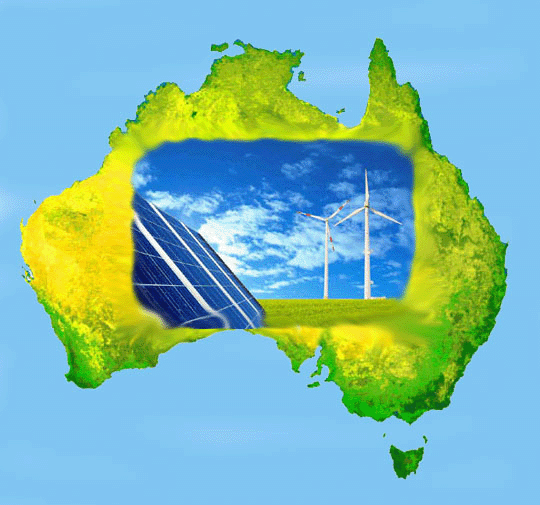 Australia May Add Record Amount of Renewable Power in 2020, Bloomberg, By James Thornhill, January 21, 2020
-
Corporate demand for clean electricity driving growth: Rystad
- Policy uncertainty seen undermining longer term expansion
Australia is set to add a record amount of renewable power in 2020, driven by growing corporate demand for clean electricity and to fill generation gaps created by the retirement of aging coal-fired plants.
New markets are expected to unlock growth as pilot hydrogen projects start and oil, gas and mining projects invest in off-grid renewables generation, according to Rystad Energy. The positive outlook would be a rebound for Australia’s clean energy developers after a sharp drop in investment in 2019.
“We expect the industry to bounce back in the second half of 2020,” Rystad said in a media release, citing projects with corporate power purchase agreements and the winners of government auction schemes that are scheduled to start construction this year.
Nearly 2 gigawatts of large-scale solar projects and 1.6 gigawatts of wind power are due to complete commissioning in the year ahead, up nearly 40% on 2019 levels. Wind and solar developers are also lining up to replace the Liddell coal plant in New South Wales, which is due to close by April 2023.
Still, developers may face headwinds over the longer term. The industry has already met the government’s 2020 target for renewable generation and there is no new target to replace it. Meanwhile, the profitability of projects located a long way from major demand centers has been hit by marginal loss factors — the amount of power lost along transmission lines.
Losing Momentum
Australia renewables investment fell 38% last year “While the outlook for the commissioning of new projects still looks solid in 2020, there is a risk that activity tails off in the years ahead as the impact of falling investment starts to feed through,” said BloombergNEF analyst Leonard Quong. AT TOP https://www.bloomberg.com/news/articles/2020-01-21/australia-may-add-record-amount-of-renewable-power-in-2020

White Kimba, Australia, voted “Yes” to a nuclear waste dump, but the traditional Aboriginal owners held a separate ballot, with a “No” result
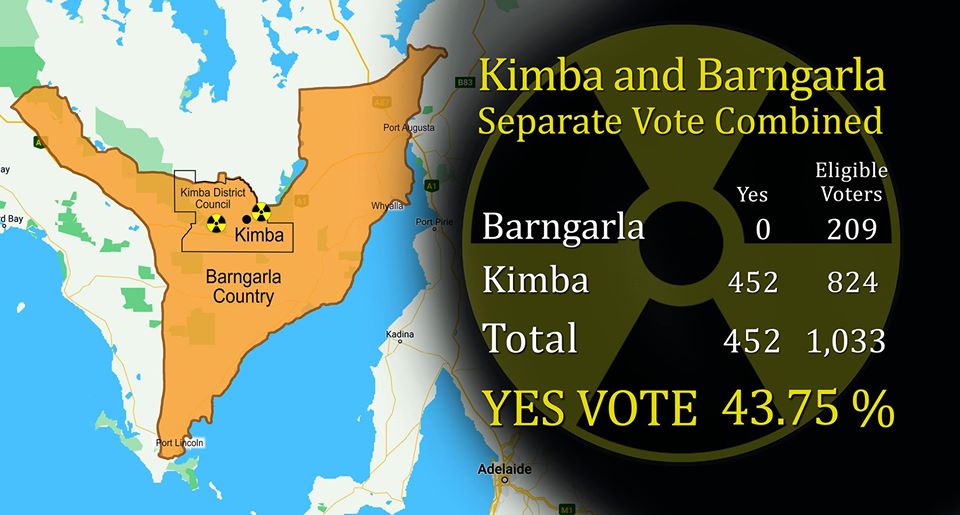
“Barngarla Speak Out” : vimeo.com/382855709
“SAVE SA Farmland – Kimba, Eyre Peninsula” : vimeo.com/381938156
Climate protests in London, Berlin, Madrid, Copenhagen and Stockholm target Australian government
Climate action protesters angry over Australia’s bushfires rally across Europe https://mobile.abc.net.au/news/2020-01-11/scott-morrison-labelled-laughing-stock-europe-climate-protests/11859988 BY EUROPE CORRESPONDENT BRIDGET BRENNAN AND ROSCOE WHALAN IN LONDON
Thousands of people have taken part in demonstrations across Europe, taking aim at what they say is the Australian Government’s lack of action on climate change during the bushfire crisis.
- Demonstrations organised by Extinction Rebellion were held in London, Berlin, Madrid, Copenhagen and Stockholm
- The protesters called for stronger action on climate change in response to the Australian bushfires
- Protesters in London rallied outside Australia House, while protesters chanted outside the Australian embassy in Berlin
Protesters stopped traffic in London and turned out at rallies in Berlin, Madrid, Copenhagen and Stockholm to show their support for victims of the disasters.
At the Strand in London, hundreds gathered outside Australia House, where the High Commission of Australia is located, calling for stronger action on climate change as part of a protest organised by Extinction Rebellion.
Anne Coates travelled from Sheffield, north of London, to attend the rally.
She began to cry when she spoke about watching the effect of the disaster on people who had lost relatives and homes.
“It’s just too much for your heart. You just can’t live with it. It just gets worse and worse every day,” she said.”Absolutely devastating to watch it. It’s like hell. And it seems like governments around the world are in a race to drag us down to hell.”
She said Prime Minister Scott Morrison was “a laughing stock around the world”.
“We’re absolutely furious with him. And I don’t know what’s it going to take. Governments should be listening,” she said.
Many people wore koala hats to represent the massive loss of wildlife in New South Wales, Victoria and South Australia.
Fi Radford from Bristol carried a sign which said “koalas not coal”.
“We’re here to say to the Australian people, challenge your Government on the evidence they’re giving you,” she said.
“Australia, you are custodians of precious species that exist nowhere else in the world. Overturn your Government, they’re leading you to destruction.”
Among the protesters were some of the tens of thousands of Australians living in London.
Harley McDonald-Eckersall from Melbourne said she had been watching on in horror at what has been unfolding in Australia.“It’s been so horrible being away … Australians are extraordinarily resilient — like our First Nations people who have survived genocide and are still caring for the environment,” she said.
Australian Dylan Berthier said he believed the catastrophic conditions in Australia were a wake-up call for the world.
“I think a crisis of this magnitude is a global crisis. I think world leaders have a responsibility to call on the Australian Government to enact new policy that will actually prevent this from happening in the future,” he said.
In Germany, protesters chanted outside the Australian embassy in Berlin.
One man carried a sign which read “Aloha from Berlin” in reference to Mr Morrison’s maligned trip to Hawaii when the bushfires were burning in December.
The climate action group Extinction Rebellion organised the protests across Europe.
Bushfires ‘a warning to the whole world’: UK politicians
The bushfire emergency has been front-page news in the UK for weeks — and has forced Tourism Australia to temporarily pull its new $15 million advertising campaign, fronted by Kylie Minogue.
When the UK Parliament returned earlier this week, Speaker Lindsay Hoyle said what had been happening in Australia should act as a “wake-up call for the world”.
Last year, the Conservative Government in the United Kingdom passed legislation to reach net-zero carbon emissions by 2050 — one of the most ambitious targets set by a major economy.
But many environmental groups have said 2050 is not soon enough.
Labour leadership contender Clive Lewis told the House of Commons: “So as Australia burns, as millions in African states face climate-driven famine, and floods have swept the north of England, will this Government give a damn about this existential threat and act, not posture?”
Shadow Foreign Secretary Emily Thornberry, who is vying to become the new opposition leader, has criticised the Morrison Government.
“I hope that the horrendous wildfires in Australia, brought on by record temperatures, with such devastating impacts for the human and animal populations in New South Wales, will not just wake up Scott Morrison’s Government to its wilful inaction over climate change, but serve as a warning to the whole world,” she said.
Earlier this week, outspoken British television presenter Piers Morgan cut short an interview with Liberal MP Craig Kelly on Good Morning Britain.
Climate change and global warming are real and Australia is right now showing the entire world just how devastating it is,” he said.
“And for senior politicians in Australia to still pretend there’s no protection is absolutely disgraceful.”
In an address to Vatican diplomats this week, Pope Francis also criticised climate inaction.
“Many young people have become active in calling the attention of political leaders to the issue of climate change. Care for our common home ought to be a concern of everyone,” he said.
“Sadly, the urgency of this ecological conversion seems not to have been grasped by international politics, where the response to the problems raised by global issues such as climate change remains very weak and a source of grave concern.”
Thousands march in Australian cities protesting government inaction on climate change
 Sydney CBD climate protest attracts over 30,000 people, SMH, By Janek Drevikovsky and Matt Bungard, January 10, 2020 — More than 30,000 protesters brushed off hot and humid conditions to voice their displeasure at the federal government’s handling of the bushfire crisis and its attitude towards climate change.The event in Sydney’s CBD was set up a few weeks ago by Uni Students for Climate Justice, in conjunction with Extinction Rebellion…….
Protesters chanted, “Hey hey, ho ho ScoMo has got to go” as speakers climbed Town Hall’s side steps, and later moved on to “The liar from the shire, the country is on fire”.
She was given a move-on order by police while protesting outside Kirribilli House last September. Her hope is that Friday’s protest will create change……….
Protests also took place in other Australian capital cities. https://www.smh.com.au/environment/climate-change/sydney-cbd-climate-protest-attracts-thousands-20200110-p53qhq.html?promote_channel=edmail&mbnr=MTM2NDAwMjM&eid=email:nnn-13omn655-ret_newsl-membereng:nnn-04%2F11%2F2013-news_pm-dom-news-nnn-smh-u&campaign_code=13INO009&et_bid=292
Australian government plans to transport nuclear wastes 1000s of kilometres, a dangerous plan in view of bushfires
 Transporting nuclear wastes across Australia in the age of bushfires, Independent Australia, By Noel Wauchope | IN 2020, the final decision on a site for Australia’s interim National Radioactive Waste Facility will be announced, said Resources Minister Matt Canavan on 13 December.
He added: I will make a formal announcement early next year on the site-selection process.”
With bushfires raging, it might seem insensitive and non-topical to be worrying now about this coming announcement on a temporary nuclear waste site and the transport of nuclear wastes to it. But this is relevant and all too serious in the light of Australia’s climate crisis.
The U.S. National Academies Press compiled a lengthy and comprehensive report on risks of transporting nuclear wastes — they concluded that among various risks, the most serious and significant is fire:…..
Current bushfire danger areas include much of New South Wales, including the Lucas Heights area, North and coastal East Victoria and in South Australia the lower Eyre and Yorke Peninsulas. If nuclear wastes were to be transported across the continent, whether by land or by sea, from the Lucas Heights nuclear reactor in Sydney to Kimba in South Australia, they’d be travelling through much of these areas. Today, they’d be confronting very long duration, fully engulfing fires.

Do we know what route the nuclear wastes would be taking to Kimba, which is now presumed to be the Government’s choice for the waste dump? Does the Department of Industry Innovation and Science know? Does the Australian Nuclear Science and Technology Organisation (ANSTO) know? Well, they might, but they’re not going to tell us.
We can depend on ANSTO’s consistent line on this :
‘In line with standard operational and security requirements, ANSTO will not comment on the port, routes or timing until after the transport is complete.’
That line is understandable of course, due to security considerations, including the danger of terrorism.
Spent nuclear fuel rods have been transported several times, from Lucas Heights to ports – mainly Port Kembla – in great secrecy and security. The reprocessed wastes are later returned from France or the UK with similar caution. Those secret late-night operations are worrying enough, but their risks seem almost insignificant when compared with the marathon journey envisaged in what is increasingly looking like a crackpot ANSTO scheme for the proposed distant Kimba interim nuclear dump. It is accepted that these temporary dumps are best located as near as practical to the point of production, as in the case of USA’s sites.
Australians, beset by the horror of extreme bushfires, can still perhaps count themselves as lucky in that, compared with wildfire regions in some countries, they do not yet have the compounding horror of radioactive contamination spread along with the ashes and smoke.
Fires in Russia have threatened its secret nuclear areas……
Many in America have long been aware of the transport danger:
The state of Nevada released a report in 2003 concluding that a steel-lead-steel cask would have failed after about six hours in the fire and a solid steel cask would have failed after about 11 to 12.5 hours. There would have been contamination over 32 square miles of the city and the contamination would have killed up to 28,000 people over 50 years.
The State of Wyoming is resisting hosting a nuclear waste dump, largely because of transportation risks as well as economic risks. In the UK, Somerset County Council rejects plans for transport of wastes through Somerset.
In the years 2016–2019, proposals for nuclear waste dumping in South Australia have been discussed by government and media as solely a South Australian concern. The present discussion about Kimba is being portrayed as just a Kimba community concern.
Yet, when the same kind of proposal was put forward in previous years, it was recognised as an issue for other states, too.
Most reporting on Australia’s bushfires has been excellent, with the exception of Murdoch media trying to downplay their seriousness. However, there has been no mention of the proximity of bushfires to Lucas Heights. As happened with the fires in 2018, this seems to be a taboo subject in the Australian media.
While it has never been a good idea to trek the Lucas Heights nuclear waste for thousands of kilometres across the continent – or halfway around it by sea – Australia’s new climate crisis has made it that much more dangerous. Is the bushfire apocalypse just a one-off? Or, more likely, is this nationwide danger the new normal? https://independentaustralia.net/environment/environment-display/transporting-nuclear-wastes-across-australia-in-the-age-of-bushfires,13465
Australia Will Lose to Climate Change
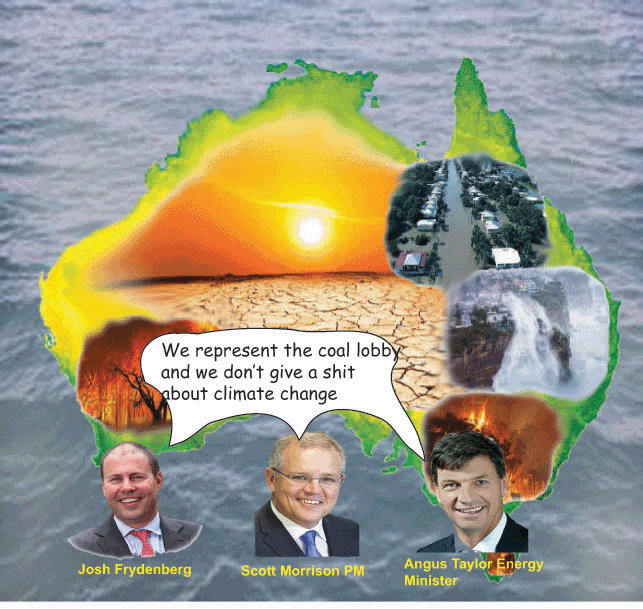
Australia Will Lose to Climate Change https://www.theatlantic.com/science/archive/2020/01/australia-caught-climate-spiral/604423/ Even as the country fights bushfires, it can’t stop dumping planet-warming pollution into the atmosphere.
But now Australia is buckling under the conditions that its fossil fuels have helped bring about. Perhaps the two biggest kinds of climate calamity happening today have begun to afflict the continent.
The first kind of disaster is, of course, the wildfire crisis. In the past three months, bushfires in Australia’s southeast have burned millions of acres, poisoned the air in Sydney and Melbourne, and forced 4,000 tourists and residents in a small beach town, Mallacoota, to congregate on the beach and get evacuated by the navy. A salvo of fires seems to have caught the world’s attention in recent years. But the current Australian season has outdone them all: Over the past six months, Australian fires have burned more than twice the area than was consumed, combined, by California’s 2018 fires and the Amazon’s 2019 fires.
 The second is the irreversible scouring of the Earth’s most distinctive ecosystems. In Australia, this phenomenon has come for the country’s natural wonder, the Great Barrier Reef. From 2016 to 2018, half of all coral in the reef died, killed by oceanic heat waves that bleached and then essentially starved the symbiotic animals. Because tropical coral reefs take about a decade to recover from such a die-off, and because the relentless pace of climate change means that more heat waves are virtually guaranteed in the 2020s, the reef’s only hope of long-term survival is for humans to virtually halt global warming in the next several decades and then begin to reverse it.
Meeting such a goal will require a revolution in the global energy system—and, above all, a rapid abandonment of coal burning. But there’s the rub. Australia is the world’s second-largest exporter of coal power, and it has avoided recession for the past 27 years in part by selling coal.
Though polls report that most Australians are concerned about climate change, the country’s government has so far been unable to pass pretty much any climate policy. In fact, one of its recent political crises—the ousting of Prime Minister Malcolm Turnbull in the summer of 2018—was prompted by Turnbull’s attempt to pass an energy bill that included climate policy. Its 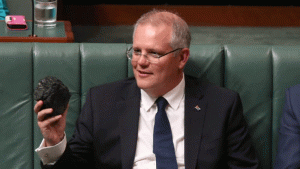 current prime minister, Scott Morrison, actually brought a lump of coal to the floor of Parliament several years ago while defending the industry. He won an election last year by depicting climate change as the exclusive concern of educated city-dwellers, and climate policy as a threat to Australians’ cars and trucks. He has so far attempted to portray the wildfires as a crisis, sure, but one in line with previous natural disasters.
In fact, it is unprecedented. This season’s fires have incinerated more than 1,500 homes and have killed at least 23 people, Prime Minister Morrison said on Saturday.* There were at least twice as many fires in New South Wales in 2019 as there were in any other year this century, according to an analysis by The New York Times. Climate change likely intensified the ongoing epidemic: Hotter and drier weather makes wildfires more common, and climate change is increasing the likelihood of both in Australia. Last year was both the hottest and driest year on record in the country.
Perhaps more than any other wealthy nation on Earth, Australia is at risk from the dangers of climate change. It has spent most of the 21st century in a historic drought. Its tropical oceans are more endangered than any other biome by climate change. Its people are clustered along the temperate and tropical coasts, where rising seas threaten major cities. Those same bands of livable land are the places either now burning or at heightened risk of bushfire in the future. Faced with such geographical challenges, Australia’s people might rally to reverse these dangers. Instead, they have elected leaders with other priorities.
1 This Month

of the week – Shut Down Drone Warfare!


Tell the Ukrainian Government to Drop Prosecution of Peace Activist Yurii Sheliazhenko

Petition to revoke the licensing of the Near Surface Nuclear Disposal Facility (NSDF) at Chalk River. https://www.ourcommons.ca/petitions/en/Petition/Details?Petition=e-7247
To see nuclear-related stories in greater depth and intensity – go to https://nuclearinformation.wordpress.com
-
Archives
- April 2026 (57)
- March 2026 (251)
- February 2026 (268)
- January 2026 (308)
- December 2025 (358)
- November 2025 (359)
- October 2025 (376)
- September 2025 (257)
- August 2025 (319)
- July 2025 (230)
- June 2025 (348)
- May 2025 (261)
-
Categories
- 1
- 1 NUCLEAR ISSUES
- business and costs
- climate change
- culture and arts
- ENERGY
- environment
- health
- history
- indigenous issues
- Legal
- marketing of nuclear
- media
- opposition to nuclear
- PERSONAL STORIES
- politics
- politics international
- Religion and ethics
- safety
- secrets,lies and civil liberties
- spinbuster
- technology
- Uranium
- wastes
- weapons and war
- Women
- 2 WORLD
- ACTION
- AFRICA
- Atrocities
- AUSTRALIA
- Christina's notes
- Christina's themes
- culture and arts
- Events
- Fuk 2022
- Fuk 2023
- Fukushima 2017
- Fukushima 2018
- fukushima 2019
- Fukushima 2020
- Fukushima 2021
- general
- global warming
- Humour (God we need it)
- Nuclear
- RARE EARTHS
- Reference
- resources – print
- Resources -audiovicual
- Weekly Newsletter
- World
- World Nuclear
- YouTube
-
RSS
Entries RSS
Comments RSS
 nuclear-news