Unknowns about Australia’s proposed nuclear submarines, especially weapons proliferation risks
U.S., UK Pledge Nuclear Submarines for Australia, October 2021 Arms Control Association,
By Julia Masterson, Australia could become the first non-nuclear-weapon state to field a nuclear-powered submarine as part of a new trilateral security partnership with the United States and United Kingdom known as AUKUS. The initiative was unveiled at a joint virtual press conference held Sept. 15.
…………… The United States has shared nuclear submarine propulsion technology only with the UK, a product of a series of Cold War agreements aimed to counter Soviet influence in Europe.
The UK Royal Navy operates three nuclear-powered submarine systems: the Vanguard-class ballistic missile submarine and the Astute- and Trafalgar-class attack submarines. Johnson said the AUKUS partnership will provide “a new opportunity to reinforce Britain’s place at the leading edge of science and technology, strengthening our national expertise.”
Morrison said that Australia will work with Washington and London over the next 18 months “to seek to determine the best way forward to achieve” a conventionally armed nuclear-powered submarine fleet. He also said that the submarines will be constructed “in Australia in close cooperation” with the UK and the United States. The submarines will reportedly be finished in time to be fielded in the 2040s. Early reports suggest Australia may lease U.S. or UK nuclear-powered submarines in the meantime, but the details remain unclear.
At a press conference in Canberra on Sept. 16, Morrison noted that “[n]ext-generation nuclear-powered submarines will use reactors that do not need refueling during the life of the boat. A civil nuclear power capability here in Australia is not required to pursue this new capability.”
A senior Biden administration official appeared to confirm on Sept. 20 that the vessels will be powered with HEU, as UK and U.S. submarines are, when they commented on Australia’s fitness for “stewardship of the HEU.” It remains unclear who would supply Australia with the fissile material necessary to fuel the submarines or whether the nuclear-powered submarines might be provided through a leasing arrangement.
Another unknown is whether the submarine design will be based on existing U.S. or UK attack submarines or an entirely new design. One of the reasons that Australia may lease U.S. or UK vessels in the near term is to “provide opportunities for us to train our sailors, [to] provide the skills and knowledge in terms of how we operate,” Australian Defense Minister Peter Dutton told reporters Sept. 19, suggesting the new submarines may share a similar design.
The AUKUS initiative is not limited to the new submarine project. It will also facilitate the sharing of information in a number of technological areas, including artificial intelligence, underwater systems, and quantum, cyber-, and long-range strike capabilities. Morrison said Australia will also enhance its long-range strike capabilities through the purchase of Tomahawk cruise missiles and extended range Joint Air-to-Surface Standoff Missiles.
………. Australian, UK, and U.S. officials have endeavored to assure the international community that the initiative does not pose a heightened proliferation risk………
Most nonproliferation experts, however, say the concern is not necessarily with Australia’s intentions but the precedent that the nuclear-powered submarine-sharing scheme would set. Although Australia’s new submarines would be conventionally armed, they clearly would be deployed for military use and will reportedly utilize HEU, which can also be used for nuclear weapons………
In a Sept. 21 letter to the editor published in The New York Times, Rose Gottemoeller, former U.S. undersecretary of state for arms control and international security, criticized the proposal to share HEU-fueled submarines with Australia. The proposal, she wrote, “has blown apart 60 years of U.S. policy” designed to minimize HEU use. “Such uranium makes nuclear bombs, and we never wanted it in the hands of nonnuclear-weapon states, no matter how squeaky clean,” she said.
As recently as May 2021, the UK and United States declared that they wanted to “reinvigorate” efforts to minimize the use of HEU, according to the official statement laying out the goals for the G7 Global Partnership Against the Spread of Weapons of Mass Destruction. (See ACT, June 2021.) Reducing the production and use of HEU “enjoys broad support but requires more solid political support,” the statement said.
Senior Biden administration officials have called the decision concerning Australia “a one-off,” implying that similar arrangements would not be made with other U.S. allies.
Despite support for the new initiative among the three capitals, the AUKUS partnership risks undermining U.S. and UK relations with allies, particularly France……………
Paris also cancelled a French-UK defense minister’s summit scheduled for the week of Sept. 20.https://www.armscontrol.org/act/2021-10/news/us-uk-pledge-nuclear-submarines-australia
Australia’s nuclear submarines – a gand announcement leading to a grand shambles
Bitter truth is we will likely never get any nuclear subs, https://www.theaustralian.com.au/commentary/yes-weve-cancelled-the-french-but-now-what/news-story/99b43465c2124c01a579672d8ef19349 Greg Sheridan, 30 Sept 21, As things stand, it is unlikely Australia will ever get a nuclear submarine. All that we have done so far is cancel the French submarine. My guess is this delays any submarine at all by at least 10 years. It fills me with regret to say this, but analytically the conclusion is inescapable that the nuclear subs under the AUKUS rubric will probably proceed the way of all our other submarine announcements. They will enjoy a brief flower of credibility before doubts creep in, critics become mobilised, the prime minister who ordered them moves on and eventually they are consigned to the dustbin for a new submarine announcement that can enjoy its brief season in the sun.
Our submarine acquisition process remains a complete shambles and the chances of anything significant emerging from it remain remote.
My colleague Dennis Shanahan reported from the recent prime ministerial trip to the US that the government was not interested in leasing a nuclear submarine from the US over the next several years. Instead it wanted to add new submarines to the allied fleet, rather than take a sub or two out of the existing US and British lines. On its own, this approach probably guarantees that nothing of consequence comes of this initiative.
It is impossible to understand why the Brits are in the mix, apart from PR. If we choose the British Astute sub and don’t modify it, that means ditching the jewel of our defence technology, the US combat system that we have on the Collins, as well as most of the US weapons we use on the Collins. So the US, at the end of all this, would be getting billions of dollars less work from us and our navies would be less integrated.
Malcolm Turnbull was savage in his National Press Club attack on the Morrison government’s decision to ditch the French subs and go nuclear. Turnbull exaggerates the diplomatic cost. However, his technical critique of the nuclear subs proposal was substantial. He drew attention to obvious contradictions in the process.
All we have done so far is cancel the French subs. As of now, we have no future submarine program at all. The Morrison government scored a diplomatic triumph in getting the Americans to agree to transfer nuclear submarine propulsion to us and in the way AUKUS was presented.
But the global reaction was based on the idea, wholly mistaken, that we would be getting the nuclear subs some time soon.In his first press conference, Scott Morrison said the subs would be built in Adelaide and he hoped we might start the build before the end of this decade and get the first one into service before the end of the next decade; that is, 2040. Here are some laws of the physical universe and the operation of logic that cannot be contradicted or transcended. If we do not lease a sub and instead make them all in Adelaide we will not get the first one before 2040. Frankly, even that date involves almost miraculous virtuosity.
Every major, complex naval build we’ve undertaken has come in way over budget and long over schedule.In the history of human habitation of this continent, nothing remotely comparable in complexity to building a nuclear submarine has ever been attempted.
Obviously, it makes no industrial or military sense to build the subs in Adelaide. Doing so will add years to the schedule and tens of billions of dollars to the cost. The French are criticised for prospective delays in their conventional subs, but we could have had them much more quickly if they were built in France.But here is a moral certainty. The dialectics of Australian politics will force both the Coalition and Labor, before the next election, to commit to building all the subs in Adelaide.
Say by some miracle the process stays on track and we actually get a boat in the water by 2040 – pretty unlikely, but not absolutely impossible – that does not mean we have our replacement submarine fleet by 2040. If we can build one nuclear sub every three years after that we will be doing very well. That means we would get our fleet of eight subs by 2061.In terms of military capability in the face of the strategic challenges we face in the next decade or two, that is truly a sick joke. It’s the three-card trick all over again.
The capability gap we have to bridge is not up to 2040 but up to, say, 2055, when we might get the sixth nuclear boat and can therefore replace, one for one, the Collins boats. Of course the nuclear subs will be much more capable than the Collins, but they’re no good at all if they don’t actually exist.
Australian submarine policy right now requires the Collins boats to remain our frontline submarine capability until at least the 2040s. No living Australian prime minister has commissioned a sub that actually got built. The last prime minister to do so was Bob Hawke. The Collins boats were commissioned in the 1980s, yet must serve into the 2040s. The frankly batshit crazy quality of our circumstances is evident in this comparison: it would be as if Britain commissioned a new weapons system under Queen Victoria in 1901 and it was still in service as the main British weapons system at the time of the Beatles in the 1960s.
It is impossible to understand why the Brits are in the mix, apart from PR. If we choose the British Astute sub and don’t modify it, that means ditching the jewel of our defence technology, the US combat system that we have on the Collins, as well as most of the US weapons we use on the Collins. So the US, at the end of all this, would be getting billions of dollars less work from us and our navies would be less integrated.
Alternatively, there is talk of choosing the Astute but putting a US combat system, US weapons and even US propulsion system into it. Dear God in heaven, if we embrace the insanity of designing a new nuclear sub just for Australia, even 2060 will be optimistic for the first boat.Or if we choose the Virginia, as we must, the Brits get nothing, yet Boris Johnson was assuring the British public that AUKUS meant hundreds and hundreds of well-paid jobs in Britain’s north. We made a mistake choosing the British Type 26 frigate, which still is not in service even in Britain and is two years behind schedule and counting. Just imagine a Brit submarine saga.
So the government has solved only the problem that its own incompetent, lazy and inexplicable failure to champion its own defence programs brought about, but so far has substituted nothing concrete for it.
The result is likely no submarine capability for us at all, except museum piece Collins boats and whatever submarine visits the Americans or Brits send along. We should have kept the French subs going, perhaps at a reduced number of six or even three, then gone nuclear in an orderly way.
Instead we have once more followed our own traditions of grand announcement leading to grand shambles.
A cynical interpretation might be that the Liberals never explained, championed or campaigned for their own choice of the French sub. Choosing Marise Payne and then Linda Reynolds as defence ministers was grotesque, by Turnbull and Morrison respectively, as neither could carry the debate or the portfolio.
So the government has solved only the problem that its own incompetent, lazy and inexplicable failure to champion its own defence programs brought about, but so far has substituted nothing concrete for it.The result is likely no submarine capability for us at all, except museum piece Collins boats and whatever submarine visits the Americans or Brits send along. We should have kept the French subs going, perhaps at a reduced number of six or even three, then gone nuclear in an orderly way.
Instead we have once more followed our own traditions of grand announcement leading to grand shambles.
Australia the sucker for cash-strapped U.S, and U.K submarine companies General Dynamics and BAE Systems

UK Prime Minister Boris Johnson is close to BAE, the UK defence contractor whose nuclear subs program is struggling. The submarine program in the US too is foundering, so the game plan by our AUKUS partners is to rope in the dopey Aussies for a hundred billion dollars-plus to finance their distressed submarine sectors.
Both US submarine builder General Dynamics and its British counterpart BAE are looking for a new income stream from Downunder.
$66 Billion Reasons: did Scott Morrison get the French submarines right? By Michael West| September 30, 2021 ….. Michael West investigates the awkward AUKUS alliance and whether Scott Morrison made the right call on French submarines.As if ……….being dead last in the developed world on climate action , Scott Morrison and his Coalition have now burnished their reputation for incompetence on the global stage.
In one fell swoop, the sudden AUKUS declaration, they have achieved a stunning betrayal of the French, further peeved our biggest trading partner China, upset half of Europe, shown the bird to New Zealand and our neighbours in the Asian region, and waved an open cheque-book at the US and the UK military industrial complex.
Yet, in their ardour to crawl back to the Mother Country and bat their debutante eyes at Washington, they appear to have got something right: axing the French submarines. Are our self-described band of “Superior Economic Managers” accidental heroes, or did they mean to get it right?
If they double down and splash $100b plus on nuclear submarines, they will have got it doubly wrong.
Defence correspondent Michelle Fahy has documented here the $90b shocker which is Australia’s deal with French shipbuilder Naval Group. Naval itself has an ugly history of corruption and there are serious questions about how the deal came about in the first place, indeed serious questions about the billions in public money smoked every year in Defence procurement.
Murder, corruption, bombings – the company at centre of Australia’s submarine deal
The arms company at the centre of a deadly criminal saga and numerous global corruption scandals, Naval Group, was selected by the Australian government to build our new fleet of submarines – a deal heralded as ‘one of the world’s most lucrative defence contracts’. How did this happen? In this special investigation Michelle Fahy discovers significant gaps in anti-bribery and corruption measures.
Yet there is upside. Scott Morrison and co have junked a deal which would have delivered a fleet of expensive, obsolete submarines 20 years too late for the war which the government’s champions in the media keep telling us we might have to fight against China. Even though a war with China is nothing more than a grotesque proposition, scaremongering by the weapons lobby and media to distract from corruption and mismanagement at home. Media war porn.
The same might be said of the F-35 Strike Fighter debacle and the BAE frigates scandal. Every large defence procurement is marred by billions of dollars in waste. But here’s the thing with the subs; there is a solid body of work which suggests submarines are already obsolete, nuclear or not. They can be tracked; they are a titanic waste of money.
The National Security College (Federal Government and ANU) published a working paper in May 2020 saying nuclear powered ballistic missile submarines will be detectable at sea.
Meanwhile, the French are complaining we owe them $US66 billion for reneging on the deal with Naval. That’s an ambit claim, to be sure. It might cost the government $5b-$10b all up, some already sunk, the rest to stave off an embarrassing court action; but the result so far is: one, no obsolete subs deal with the French, and two, only a mooted nuclear subs deal with the Brits and Americans which may never happen. Hopefully.
UK Prime Minister Boris Johnson is close to BAE, the UK defence contractor whose nuclear subs program is struggling. The submarine program in the US too is foundering, so the game plan by our AUKUS partners is to rope in the dopey Aussies for a hundred billion dollars-plus to finance their distressed submarine sectors.
The doctrine of the gullible Aussie is getting airplay in the US press. According to war contractor expert Charles Tiefer in Forbes:
“Under the cloud of smoke around the Australian submarine deal, are the unspoken aspects of the enrichment of American military contractors. There is no public mention of which American contractors will build the expensive parts of the expensive Australian submarines.”
Both US submarine builder General Dynamics and its British counterpart BAE are looking for a new income stream from Downunder.
Should the Coalition stay true to its track record of dithering though, it may soon become evident that submarines in general are a leviathan waste of money and public money ought to be expended on something less wasteful.
Scott Morrison might, unwittingly, have got it right. He might not have to spend much on submarines at all. The question then becomes, what has he got us into?
Back to the future
As three former prime ministers in Paul Keating, Malcolm Turnbull and Kevin Rudd have already pointed out, AUKUS puts Australians in greater danger, renders Australia a vassal to foreign power and antagonises our neighbours in the region.
Depending on how you count them, there are probably already four US bases in operation now:
- Pine Gap near Alice Springs, Northern Territory,
- Naval Communication Station Harold E. Holt, north of the town of Exmouth, Western Australia,
- Robertson Barracks in Darwin, Northern Territory,
- Australian Defence Satellite Communications Station near Geraldton, WA.
However, the US military already has access to all major Australian Defence Force (ADF) training areas, northern Australian RAAF airfields, port facilities in Darwin and Fremantle, and probably future access too to an expanded Stirling naval base in Pe
Under AUKUS, this may just be the beginning. It was largely ignored during the AUKUS media blitz and the dramatic cuckolding of the French but Peter Dutton had this to say at his press conference on September 16,
Unveiling plans for new facilities on Australian soil for US naval, air, and ground forces would entail “combined logistics, sustainment, and capability for maintenance to support our enhanced activities, including … for our submarines and surface combatants”. That is on top of “rotational deployments of all types of US military aircraft to Australia”.
If the plan is to shred Australia’s sovereignty and make us a target for China, he is succeeding with aplomb. We are about to be swamped by US military.
Forward to the past
It is poetic too, that at this very time we are striking even stronger and even more unnecessary ties with Westminster and Washington. Boris Johnson’s government is beset by the chaos which is Brexit, such chaos now that it has spawned a global energy emergency. While the EU has the wobbles on its trade deal with Australia, Boris is in the market for a friend.
It is poetic too, that at this very time we are striking even stronger and even more unnecessary ties with Westminster and Washington. Boris Johnson’s government is beset by the chaos which is Brexit, such chaos now that it has spawned a global energy emergency. While the EU has the wobbles on its trade deal with Australia, Boris is in the market for a friend………… https://www.michaelwest.com.au/aukus-french-submarines-scott-morrison/
Australia’s nuclear submarine deal a distraction from international climate action

the main focus of Australia’s government has remained on the continuing mining and export of fossil fuels (for reasons I’ve detailed in The Hill previously). Even while Australian Prime Minister Scott Morrison was in Washington his government was attempting to persuade the Australian States to adopt a “Coalkeeper” policy that seemingly would continue to protect the fossil fuel industry and constrain new renewable energy projects
 |
Is Australia’s nuclear submarine deal a distraction from international climate action? The Hill, BY DAVID SHEARMAN, — 09/28/21 Climate warming and environmental degradation are damaging humanity each and every day and all the decisions we make must be questioned for their human health and survival implications.
The fundamental issue at the UN climate conference COP26 is not the distant target of zero emissions by 2050 but the need to focus on the huge task of delivering emission reductions of 45 percent or more by 2030 to limit a temperature rise to 1.5 degrees Celsius. Currently, the contribution of nations in the Paris Agreement will lead to an emissions rise of 16 percent and a 2.7 degree Celsius rise.
Australia and indeed some other countries must ask themselves if nuclear submarines will be relevant to their likely plight in 2050 or whether the $90 billion (AUD) should be a small down payment on the huge ongoing costs of survival from the predicted climatic ravages which have already commenced worldwide.
One positive has arisen from Australia’s shameful diplomatic treatment of France, whose earlier defense deal with Australia was abruptly canceled and replaced with AUKUS. There will now be much greater scrutiny of the proposed Australia-EU trade deal to ensure Australia complies with climate and environmental needs, as well as with means to assess compliance. Such pressure on Australia’s trading future is already having an impact on policy.
Impact on Australia’s Pacific policy
Trust and cooperation between Australia and France are essential for the needs of the Pacific Island nations. It had been expected that the French through their Pacific territories and commitment to climate change would encourage Australia to recognize its responsibilities.
Over many years, Australia has continued to dismiss the pleas of the islands for a climate policy that would help them avoid inundation. At the time of the 2019 Pacific Island Forum in low-lying Tuvalu, Australia’s Deputy Prime Minister Michael McCormack infamously said that Pacific island nations affected by the climate crisis will continue to survive “because many of their workers come here to pick our fruit.”…………
Even more shaming is Australian indifference to the needs of the Torres Strait Islanders who are the Indigenous peoples of this Australian territory. They have claimed before the UN Human Rights Committee that Australian inaction infringes their human rights. Australia has opposed their claim………
In 2050, conflicts will likely be within countries and between close neighbours over resources such as water and productive land — not based on nuclear threat. Defense services including those of the United States and China will be engulfed in saving lives and infrastructure from fire, flood, storm and drought.
Such conflicts are already with us and U.S. Secretary of State Antony Blinken has cited war in Syria, Mali, Yemen, South Sudan and Ethiopia due to water shortages.
Currently, Australia spends $45 billion (AUD) or 2.1 percent of GDP on defense. It has spent $130 billion on the economic recovery from COVID-19 much by increasing gas mining for export, but less than 2 percent of which has been spent on solutions to reduce emissions and even less on climate adaptation. Indeed, Australia does not have a national coordinated national adaptation policy.
The relevant questions are whether the defesnse agreement between the U.S., UK and Australia to provide nuclear submarines, dubbed AUKUS, has encouraged or coerced Australia to accept and deliver even a 2050 emission target —and how Australia can now cooperate on emission reduction within the Asian Pacific region and particularly the Pacific Island States.
Impact on Australian climate policy
The AUKUS agreement has already resulted in the re-examination of climate policy but discussion has been distracted by worries about AUKUS compromising our sovereignty in the event of armed conflict — and by the diplomatic failure to discuss the issue with Pacific neighbours. There are also concerns about the weakness of U.S. democracy and the possible irrationalities of any future president that could lead to Australian involvement in unnecessary conflict.
However, the main focus of Australia’s government has remained on the continuing mining and export of fossil fuels (for reasons I’ve detailed in The Hill previously). Even while Australian Prime Minister Scott Morrison was in Washington his government was attempting to persuade the Australian States to adopt a “Coalkeeper” policy that seemingly would continue to protect the fossil fuel industry and constrain new renewable energy projects
No wonder many Australian eyebrows were raised when U.S. House Speaker Nancy Pelosi (D-Calif.) hailed Australia as a global leader on climate change.
Currently, Australia is ranked 15 highest of 90 countries for domestic emissions and fifth or sixth if exports of fossil fuels are included. Clearly, Australia is the world’s laggard when the country has the wealth and expertise to take action.
Why America is ecstatic about Morrison’s AUKUS pact

Why Washington was so ecstatic about Morrison’s AUKUS pact, SMH, 28 Sept 21,
Political and international editor ”………….. For many years, a critical element of American war planning has been to defeat China’s navy by bottling it up in the shallow waters of the South China Sea.
It would do this by blocking choke-points that allow passage in and out. And submarines are the most effective tool for achieving this.
If much of China’s navy is contained in those coastal waters, it’s relatively easy for the US to find and destroy. China’s submarines are at their most vulnerable in the shallow littorals nearest their homeland. It’s easier to shoot fish in a barrel than in a pond.
“US forces and their allies will stand a far greater chance of finding Chinese submarines, hemmed into the South China Sea, than China will of finding America’s in the vast Pacific,” as Rory Medcalf of the ANU’s National Security College puts it.
This helps explain why Beijing has put such effort into asserting control of the South China Sea and, just to its north, the East China Sea. In the event of a crisis, China’s priority is to scramble its submarines well beyond the first island chain into the deep waters of the Pacific where they can operate freely, concealed and lethal.
……………In the event of all-out war, the US wants Tokyo’s 22 subs and Canberra’s six to complement the US fleet of 68. Japan’s have been pencilled in to operate in the north and Australia’s in the south.
This is where AUKUS come in. It includes in-principle agreement from Washington and London to supply Australia with nuclear propulsion technology for a new fleet of eight submarines instead of the planned 12 diesel-electric subs, now ditched.
Why was this greeted rapturously in Washington? “The long-term prospect of eight nuclear-powered RAN subs prowling the Pacific resets the naval balance of power,” says Mike Green of the Centre for Strategic and International Studies in Washington.
…….. Australian officials say it will take almost 20 years to actually get the first Australian-built, nuclear propelled sub into the water. ……. The Australian Strategic Policy Institute’s subs expert, Marcus Hellyer says that the only plausible way that Australia could put a nuclear-powered sub in the water in time to be relevant to the looming US-China contest would be if America handed over some of its ageing Los Angeles class subs. The Pentagon is currently pensioning them off. They’d need to be refurbished. But that’d still be a lot faster, taking years rather than the decades of waiting for the first Australian-made one…..
And AUKUS is about much more than subs. “It’s about areas like cyber and emerging technologies…….https://www.smh.com.au/national/why-washington-was-so-ecstatic-about-morrison-s-aukus-pact-20210927-p58v3c.html
Maralinga – ushered in Australia’s nuclear age

A picture in time: Maralinga, the blinding flash that ushered in Australia’s atomic age. https://www.theguardian.com/australia-news/2021/sep/27/a-picture-in-time-maralinga-when-the-atomic-age-reached-australia
Nuclear tests conducted in South Australia from 1956 resulted in swaths of countryside obliterated and decades of highly contaminated land.
The atomic age reached Maralinga with a blinding flash. At 5pm on 27 September 1956, a 15-kilotonne atomic device was detonated at the site in the western plains of South Australia.
The ensuing blast had as much explosive strength as the weapon which fell on Hiroshima 11 years earlier.
More than a decade after that horror struck Japan, Australia had become tangled up in the UK’s nuclear testing program, which saw swaths of countryside obliterated to further the nuclear arms race.
The atomic test at Maralinga was carried out by the British government as part of Operation Buffalo, run by the UK’s Atomic Weapons Research establishment.
In the moments after the detonation, RAAF personnel flew through the mushroom cloud to carry out tests with little instruction or protective equipment to shield them from the radiation.
For the next seven years, major and minor nuclear tests were carried out at Maralinga. The minor tests led to contamination of the area with plutonium-239, which has a radioactive half-life of 24,000 years.
Prior to the test, very little effort was put into finding and notifying the Anangu Pitjantjatjara people who lived on the land. In addition to the obvious immediate dangers of nuclear fallout in the area, the Indigenous community would endure the long term hazards of poisoned land and water for more than thirty years.
Maralinga was not the first nuclear weapons test conducted on Australian soil. Three years earlier, on 3 October 1952, Britain detonated a nuclear weapon on the Montebello Islands off the coast of Western Australia.
A further two detonations were carried out at Emu Field. Britain moved the testing site to Maralinga after previous locations were deemed to be too remote for nuclear weapons tests.
When Maralinga was eventually closed as a testing site in 1967, the British government began the process of cleaning the 3,200 sq km of contaminated land.
By 1968, the Australian and British governments agreed that Britain has successfully decontaminated the area by covering contaminated debris in concrete and ploughing the plutonium-laden soil into the ground.
In 1984, as the land was slated to be returned to the Tjarutja people, scientists found the land was still highly contaminated.
Nine years later, in 1993, following a royal commission, and after mounting pressure, the British government agreed to pay a portion of the estimated $101m cleanup cost.
It wasn’t until 1994, 38 years after the initial blast, that the Australian government paid $13.5m to the Indigenous people of Maralinga as compensation for what had been done to the land.
Maralinga – ushered in Australia’s nuclear age
A picture in time: Maralinga, the blinding flash that ushered in Australia’s atomic age. https://www.theguardian.com/australia-news/2021/sep/27/a-picture-in-time-maralinga-when-the-atomic-age-reached-australia
Nuclear tests conducted in South Australia from 1956 resulted in swaths of countryside obliterated and decades of highly contaminated land.
The atomic age reached Maralinga with a blinding flash. At 5pm on 27 September 1956, a 15-kilotonne atomic device was detonated at the site in the western plains of South Australia.
The ensuing blast had as much explosive strength as the weapon which fell on Hiroshima 11 years earlier.
More than a decade after that horror struck Japan, Australia had become tangled up in the UK’s nuclear testing program, which saw swaths of countryside obliterated to further the nuclear arms race.
The atomic test at Maralinga was carried out by the British government as part of Operation Buffalo, run by the UK’s Atomic Weapons Research establishment.
In the moments after the detonation, RAAF personnel flew through the mushroom cloud to carry out tests with little instruction or protective equipment to shield them from the radiation.
For the next seven years, major and minor nuclear tests were carried out at Maralinga. The minor tests led to contamination of the area with plutonium-239, which has a radioactive half-life of 24,000 years.
Prior to the test, very little effort was put into finding and notifying the Anangu Pitjantjatjara people who lived on the land. In addition to the obvious immediate dangers of nuclear fallout in the area, the Indigenous community would endure the long term hazards of poisoned land and water for more than thirty years.
Maralinga was not the first nuclear weapons test conducted on Australian soil. Three years earlier, on 3 October 1952, Britain detonated a nuclear weapon on the Montebello Islands off the coast of Western Australia.
A further two detonations were carried out at Emu Field. Britain moved the testing site to Maralinga after previous locations were deemed to be too remote for nuclear weapons tests.
When Maralinga was eventually closed as a testing site in 1967, the British government began the process of cleaning the 3,200 sq km of contaminated land.
By 1968, the Australian and British governments agreed that Britain has successfully decontaminated the area by covering contaminated debris in concrete and ploughing the plutonium-laden soil into the ground.
In 1984, as the land was slated to be returned to the Tjarutja people, scientists found the land was still highly contaminated.
Nine years later, in 1993, following a royal commission, and after mounting pressure, the British government agreed to pay a portion of the estimated $101m cleanup cost.
It wasn’t until 1994, 38 years after the initial blast, that the Australian government paid $13.5m to the Indigenous people of Maralinga as compensation for what had been done to the land.
Australia’s Prime Minister Scott Morrison on the defensive as Europe and South-East Asian countries react badly to AUKUS and the nuclear submarines

Morrison in defence mode as AUKUS fallout goes global, Frozen out in Europe, feted in Washington, alarming some of its south-east Asian neighbours: questions are being raised about whether Australia has the right diplomatic skills and resources to perform on the world stage. The Age By Anthony Galloway SEPTEMBER 25, 2021 or six days, the Indonesians knew something big was coming from Australia.
At a meeting in Jakarta on September 9, Australian Foreign Minister Marise Payne let her friend, Indonesian Foreign Minister Retno Marsudi, know a major shift was coming.
“The Foreign Minister of Australia mentioned there will be an announcement, but at the time we didn’t receive any information [about] what sort of announcement because I assume at that time it was not final yet,” Retno said this week.
The following Wednesday, Payne messaged Retno hours before the announcement of the AUKUS defence pact between Australia, the United States and Britain to share military technology and help Canberra build a fleet of nuclear-powered submarines in the face of Beijing’s growing aggression and military might.
The two ministers then talked over the phone, and Retno told Payne she hoped Australia would uphold its obligations to the Treaty on the Non-Proliferation of Nuclear Weapons and its commitment to “contribute to the peace and stability of the region”.
“I mentioned to my good friend Marise that Indonesia really hopes Australia will fulfil that commitment,” Retno said.
Since then, Malaysia has gone even further in expressing its reservations about the agreement, saying this week it will now consult China on how to react to the development.
And French President Emmanuel Macron is continuing to snub Australian Prime Minister Scott Morrison’s offer of a phone call after he was infuriated by Australia’s decision to dump a $90 billion submarine agreement with Paris and instead negotiate the AUKUS deal behind his back.
All of this contrasts sharply with Morrison’s week-long trip to New York and Washington. His interactions with the Americans have been glowing: not just with President Joe Biden, but also Democratic House Speaker Nancy Pelosi and Republican Senate leader Mitch McConnell. The first physical leaders meeting of the “Quad” grouping – Australia, the US, Japan and India – was expected to have a similar air of friendliness to it on Friday.
A week after the announcement of AUKUS, Australia finds itself at the forefront of world politics in a way it has never before been. Frozen out in Europe, feted in Washington, alarming some of its south-east Asian neighbours, and backed in by the Quad, these are unfamiliar times for little old Australia. And questions are being asked about whether we’ve got the right diplomatic skills and resources to perform on the world stage.
The ‘Anglosphere’ is back
When announcing AUKUS, Morrison described it as a “forever partnership”, while British Prime Minister Boris Johnson said it was an agreement among “kindred” nations. This led to a perception it was an alliance, when it is not. AUKUS is an agreement to share military technology including nuclear submarine capability, long-range missiles, cyber, artificial intelligence, quantum technologies and undersea drones.
Former senior diplomat and intelligence official Allan Gyngell, now national president of the Australian Institute of International Affairs, says Australia sent a problematic message to the region that the “Anglosphere is back”.
It reinforces perspectives that Australia is not really a legitimate part of the region, but a junior partner in a three-way partnership between English-speaking countries,” Gyngell says. “However much we say Asia is important to us, it is clear that home is where the heart is and the heart is with our two great and powerful friends.”
Some south-east Asian countries were also said to be uneasy with the focus on “values” and “democracy”. Many countries in the region are anxious about the growing assertiveness of China but they aren’t liberal democracies. They don’t see a nexus between liberal democratic values and the need to counterbalance a stronger, more aggressive China………………….
With the emergence of new formations such as the Quad and AUKUS, south-east Asian nations have been concerned about the power of ASEAN weakening. Australian diplomats have been insisting the nation is committed to “ASEAN centrality” in both private meetings and public statements.
Gyngell says Australia needs to be careful not to dismiss the concerns of south-east Asian nations, adding “we always look to vindication of our own positions and prejudices”.
Europe’s fury
Further afield, the Morrison government is most concerned about the repercussions in Europe, where there is visceral anger stemming from the AUKUS agreement being negotiated in secret all year even though the US and Britain are key members of NATO.
On the sidelines of the United Nations General Assembly, European Council President Charles Michel reminded Morrison of the need for “transparency and loyalty” during an awkward encounter, while German Foreign Minister Heiko Maas described the agreement as “unsettling”.
While the EU contemplates whether to scuttle talks over a free trade deal with Australia, Canberra can also expect a Europe that is less forgiving over its action on climate change………
Not enough focus has been on whether Australia is adequately investing in all the instruments of statecraft, most notably diplomacy and foreign aid, to support its strategic intentions.
Between 2013 and 2020, Australia’s total diplomatic and development budgets fell from 1.5 per cent of the federal budget to 1.3 per cent. The government gutted parts of the foreign aid budget in south-east Asia to pay for its “step-up” in the Pacific…………. https://www.theage.com.au/politics/federal/morrison-in-defence-mode-as-aukus-fallout-goes-global-20210924-p58ui2.html
AUKUS, nuclear submarines and the new dangers of weapons proliferation and war
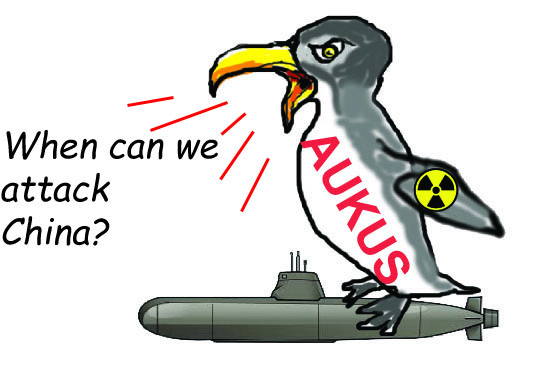
Paul Keating has explained the folly of antagonising China, constantly provoking further militarisation. Regional countries are concerned at the heightened militarisation, and the passage of nuclear submarines through their waters. The use of Highly Enriched Uranium (HEU) fuel brings risks of weapons proliferation. Now the previously nuclear-free zone looks like soon to be bristling with nuclear weapons .
And the big corporations that rule USA policy, UK policy, and now Australian policy, will be rejoicing. Watch as UK’s BAE Systems and USA’s General Dynamics fight it out for the loot from Australian tax-payers.
USA has conned Australia into paying for its super-costly nuclear submarine project

Last week’s AUKUS announcement was nothing more than PR stunt in Australia, with the government merely committing to spend the next 18 months deciding what to buy—which conveniently kicks any actual the decision far enough down the road to avoid the next federal election.
Has PM put Australia on the hook to finance struggling UK, US submarine projects? Michael West Media, By Marcus Reubenstein| September 23, 2021,
“Almost comical”. Experts lambast Scott Morrison’s “crazy” AUKUS deal to buy nuclear submarine tech from parlous UK and US programs. Marcus Reubenstein finds a real prospect Australia will be used to “underwrite” the foundering foreign submarine industry.
Twenty-five years of ongoing maintenance delays for nuclear submarines, chronic shortage of both parts and skilled workers, under capacity at shipyards, and attack class submarines missing from deployments for up to nine months. These sound like potential problems for Australia’s future nuclear submarine fleet but they are actual problems right now confronting the US Navy and its fleet of 70 submarines.
The US is at the cutting edge of nuclear propulsion. It has the largest and most sophisticated submarine fleet in the world, its first nuclear submarine was commissioned 67 years ago, and the US has literally decommissioned twice as many nuclear subs as Australia is planning to buy.
If the US cannot manage to keep its fleet in the water, how can the Morrison government commit up to $100 billion of taxpayer money to secure nuclear submarines and guarantee they will be always operational and ready for deployment?
Professor Hugh White, ANU Professor of Strategic Studies, former Deputy Secretary of Defence and an eminent figure in strategic policy, wrote in The Saturday Paper, “The old plan was to build a conventionally powered version of a nuclear-powered French submarine. It was crazy.”
“The new plan—to buy a nuclear-powered submarine instead—is worse”.
Says White, “There is a reason why only six countries, all of them nuclear-armed, operate nuclear powered subs.”
The sales pitch is underway
Last week’s AUKUS announcement was nothing more than PR stunt in Australia, with the government merely committing to spend the next 18 months deciding what to buy—which conveniently kicks any actual the decision far enough down the road to avoid the next federal election.
The ripples of the announcement, however, reached British shores in double-quick time. Just two days after the AUKUS alliance UK Defence Secretary Ben Wallis announced a $320 million (£170m) grant to be shared between BAE Systems and Rolls Royce to develop technology for Britain’s next generation submarines.
According to Department of Finance figures, In the past twelve months BAE Systems has collected $1.88 billion from Australian taxpayers. The Astute class submarine, touted as one of the two options Australia is considering, is manufactured by BAE Systems.
US Naval analyst, and Forbes Defense columnist, Craig Hooper predicts AUKUS could give the US Navy a big shot in the arm as well. He says a deal with Australia could effectively underwrite major improvements to the US Navy’s outdated submarine maintenance facilities by supporting “America’s decade-long, $US25 billion ($34.6 billion) effort to refit the U.S. Navy’s four aging public shipyards. With yard repair costs already high, America would go to great lengths to welcome any additional bidders for shipyard capability improvements.”
US subs in dry dock In a report published six months ago, the US Congressional Budget Office (CBO) found: “The Navy’s four shipyards have experienced significant delays in completing maintenance on its submarines (all of which are nuclear-powered).” ………. Should Australia go down the nuclear sub path what choice will it have other than to outsource the fleet’s maintenance? …..
Her Majesty’s sub optimal fleet
Britain, touted as the alternative nuclear submarine supplier to Australia, has problems of its own. The Royal Navy operates ten submarines, only four of them were designed and commissioned this century.
Like their American nuclear counterparts there are systemic problems keeping these subs in service……
That report also indicated significant delays to the BAE Systems built Astute hunter-killer submarines, the same class of nuclear submarine being touted for Australian as part of the AUKUS deal………. https://www.michaelwest.com.au/has-pm-put-australia-on-the-hook-to-finance-struggling-uk-us-submarine-projects/
French ambassador says Scott Morrison gave no warning on the nuclear submarine deal
‘Maybe we’re not friends’: French Ambassador claims ScoMo offered no warning about AUKUS deal A powerful French official has slammed Scott Morrison, accusing the Prime Minister of one thing to do with the submarine deal. news.com.au , Helena Burke, 20 Sep 21
The former French Ambassador to Australia has ripped into Scott Morrison for his defence of the AUKUS submarine deal, claiming the Prime Minister lied about warning France about it.
Jean-Pierre Thebault, who had been the French Ambassador in Canberra since 2020, was recalled last week after France expressed outrage at being left out of the new nuclear submarine deal between the US, UK, and Australia.
Speaking to Radio National on Monday, Mr Thebault said France had been completely blindsided by Mr Morrison’s decision to accept the new deal.
“We discover(ed) through the press that the most important person in the Australian government kept us in the dark intentionally until the last minute and was not willing to at least have the decency to enter conversation about the alternative,” Mr Thebault said.
“This is not an Australian attitude towards friends.”
Maybe we’re not friends.”
Mr Morrison had previously rejected that he had not warned France about the new deal, insisting he told French President Emmanuel Macron in June that Australia might scrap its original submarine agreement,,,,
But the French Ambassador insisted France had never been warned about the potential for a new deal which would exclude them. https://www.news.com.au/national/politics/maybe-were-not-friends-french-ambassador-claims-scomo-offered-no-warning-about-aukus-deal/news-story/467293b479eca4741c116ba5ced54751
Former submarines boss blasts ‘hocus pocus’ nuclear deal
Ohff described the centrepiece of the new AUKUS security pact as effectively “spur of the moment between Biden, Johnson and Morrison”, saying: “In the end we won’t get the subs the Government wants to procure – it’s all hocus pocus.”
In the end, the US military is unlikely to agree to the transfer of technology,” he said.
“It’s almost comical – if it wasn’t so serious.”
Former subs boss blasts ‘hocus pocus’ nuclear deal
A former head of ASC has blasted Australia’s “insane deal” with the US and the UK to build nuclear-powered submarines in Adelaide, deriding a “hocus pocus” announcement he says raises major issues about nuclear and defence capability. https://indaily.com.au/news/2021/09/20/former-subs-boss-blasts-hocus-pocus-nuclear-deal/ Tom Richardson @tomrichardson
Hans Ohff, who was managing director and CEO of the then-Australian Submarine Corporation from 1993 to 2002, says he does not believe the mooted submarine deal will materialise as planned for Australia, saying: “I believe it will be stymied because the US military establishment will not underwrite the tacit agreement made between the US President, the British and Australian PMs.”
Ohff insists “there will be no transfer of technical know-how to Australia”, arguing “the submarine propulsion train – not just the reactor – will be a black box accessible only to the US”.
In an emailed statement sent to InDaily’s Your Views, Ohff, who is also a research fellow at Adelaide University, said it was incumbent on the federal government “to inform the Australian people on the strategic, environmental, commercial, and political ramifications and consequences before deciding on the acquisition of nuclear-powered attack submarines”.
“We need to fully appreciate the issues and complexities associated with the design, assembly, operation and maintenance of nuclear submarines powered with highly enriched… weapons-grade uranium,” he said.
“We need to understand that the acquisition of HEU [Highly Enriched Uranium]-235 fissile material would challenge the spirit if not the letter of the Treaty of Non- Proliferation of Nuclear Weapons.”
Speaking to InDaily, he went further, saying the plan would have “unbelievable consequences, both here and in Europe” as well as “massive consequences for Outer Harbor”.It’s almost comical – if it wasn’t so serious… Prime Minister Morrison and his Defence Minister have blown up the bridge behind them
“There are big issues with putting highly enriched uranium reactors anywhere in Australia, let alone Outer Harbor,” he said.
Continue readingAustralia’s nuclear submarines will be obsolete before they are ever in use
Why will they be obsolete?

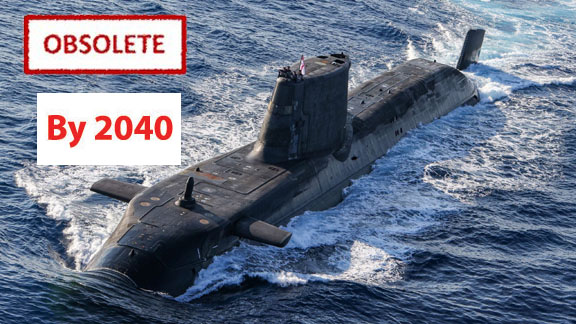
Because of the rapid advances in artificial intelligence (AI), detection systems and signal processing, combined with swarming autonomous unmanned systems – by 2040 these present USA and UK models will probably be too easily detectable, and so, effectively useless.
Why does Australia want nuclear submarines?

Other reasons – helping the USA by buying these very costly submarines which are not particularly useful for monitoring our coastline, but good for long distance. Helping Scott Morrison to look important on the world stage.
US nuclear submarines: a dangerous nonsense for Australia and the region

A third reason concerns the continued use of military might as the way to address conflicts. Bellicose, top-down exercise of power demonstrates a fascination with violence and a corresponding illiteracy about non-violence
. You have to ask whether men in suits, in politics, corporations and in association with media acolytes, ever learn.
US nuclear submarines: a dangerous nonsense https://www.greenleft.org.au/content/us-nuclear-submarines-dangerous-nonsense, Stuart Rees,September 20, 2021Issue 1320Australia Unless you think that force of arms gives security and that revival of alliances with far away governments makes sense, the decision to own and operate United States nuclear submarines should be judged a dangerous nonsense.
There are four reasons for making this claim.
Foreign policy in search of an enemy — in this case China — looks like a guarantee of conflict if not war. Polarisation with little room for dialogue only benefits the arms industry, United States corporations and those in the US, Britain, Australia and China who think a taste for militarism and masculinity will show the benefits of violence. Capacity to learn from the devastation of the past is once again shoved aside.
A second reason concerns Australia’s geography: as though days of empire must not be forgotten, a country located in South East Asia and the Pacific chooses an alliance with elderly friends in Washington and London underscores my submarine despair.
Such a decision reeks of cultural disdain for diverse countries. Even if dialogue with China seems currently blocked, it should make diplomatic sense to communicate about security by being at coffee tables and in tea houses in Malaysia, Vietnam, Indonesia, Cambodia and the Philippines, as well as Pacific Island nations.
Such communication would be about Millennium goals, COVID-19 vaccinations and the future of planet Earth. Alliances with those countries about those issues would make sense.
A third reason concerns the continued use of military might as the way to address conflicts. Bellicose, top-down exercise of power demonstrates a fascination with violence and a corresponding illiteracy about non-violence. You have to ask whether men in suits, in politics, corporations and in association with media acolytes, ever learn.
At a time when surveys of young people record their fear of the future and their despair that powerful, inaccessible men refuse to hear them, they are offered a massive bill for nuclear operating submarines.
Indifference to contracts and derision about trust is a fourth and final reason for disdain about the nuclear submarine alliance.
Whatever the merits of building even one submarine, at least there were years of agreement with French companies to undertake that ship building task. I understand there are up to 60 Australian naval personnel in Cherbourg, France, who have been taken by surprise at US President Joe Biden, British Prime Minister Boris Johnson and Prime Minister Scott Morrison’s announcement.
Who cares? Trust is of no consequence. Contracts can be torn up. Promises were never meant to be kept. Besides, in Morrison’s case, an election looms and boasting about national security by having US submarines gives a potential war-like platform for winning.
There are and there will be no winners.
Can anyone forget the very recent US betrayal and refusal to consult friends and allies in Afghanistan? To distract from that debacle, just pretend that Washington will provide strength and trust in submarines. This is a dangerous nonsense.
[Stuart Rees OAM is Professor Emeritus, University of Sydney, recipient of the Jerusalem (Al Quds) Peace Prize and author of Cruelty or Humanity. He is also the founding Director of the Sydney Peace Foundation. This article was first published at The New Bush Telegraph.]
One white elephant submarine deal replaced with a worse one

Australia’s submarine policy has previously eschewed nuclear propulsion. Now, as a dowry for receiving such largesse, Canberra is offering up Australia as a confirmed US asset in policing the Indo-Pacific. US Navy commanders will be smacking their lips at maintaining attack vessels in Australia as part of the arrangement……
Nuclear white elephants: Australia’s new submarine deal, Green Left, Binoy KampmarkSeptember 16, 2021Issue 1319Australia Few areas of public expenditure are more costly and mindlessly wasteful than submarines. Australia’s effort is particularly impressive.
Pick a real winner by signing a contract for a yet-to-be-designed attack class submarine, supposedly “necessary” in an “increasingly dangerous” region. Ensure the submarine design is based on a nuclear model, but remove that attribute and charge at least twice as much for a less capable weapon. Make sure the order is for 12 of these yet-to-be-designed-and-built systems. And make sure that they are only ready sometime in the 2030s (by which time they risk being obsolete).
The dubious honour for this contract, initially costing $50 billion, went to the French submarine company DCNS (now called Naval Group), which nudged out German and Japanese contenders with pre-existing designs………
The French military establishment praised it as the “contract of the century”. Le Parisien’s editorial lauded the prospect of thousands of jobs. French Defence Minister Jean-Yves Le Drian proclaimed a “50-year marriage” had begun……..
On September 15, the Canberra press gallery was awash with rumours that a divorce was being proposed.
The following day, Prime Minister Scott Morrison announced a security ménage à trois with the United States and Britain, with Australia as the subordinate partner. The glue that will hold this union together is a common suspicion: China.
Replacing the Attack Class submarine will be a nuclear-powered alternative with Anglo-American blessing, based on the US Virginia class or British Astute class.
The joint statement announcing the creation of AUKUS said the three countries were “guided” by “enduring ideals and shared commitment to the international rules-based order”. They resolved “to deepen diplomatic, security, and defence cooperation in the Indo-Pacific region, including by working with partners, to meet the challenges of the twenty-first century.”
AUKUS, they said, would be a new “enhanced trilateral security partnership” to further such goals.
The agreement is nothing less than an announcement to the region that the Anglophone bloc intends to police, oversee and, if necessary, punish…….
The first initiative is a “shared” ambition “to support Australia in acquiring nuclear-powered submarines for the Royal Australian Navy”. US and British expertise will be drawn on to “bring an Australian capability into service at the earliest achievable date” from the submarine programs of both countries…..
Australia’s submarine policy has previously eschewed nuclear propulsion. Now, as a dowry for receiving such largesse, Canberra is offering up Australia as a confirmed US asset in policing the Indo-Pacific. US Navy commanders will be smacking their lips at maintaining attack vessels in Australia as part of the arrangement……
The enduring problem of Australia being able to build these submarines will have US lawmakers pushing for their construction on home soil, a situation that could mirror the Naval Group contract headaches. Australia also lacks a shipyard able to build or maintain such vessels.
In helping create AUKUS, Canberra has exchanged one white elephant of the sea for another. It has also significantly increased the prospects for a potential nuclear conflict in the Indo-Pacific region. The warmongers will be ecstatic.
[Dr Binoy Kampmark lectures at RMIT University, Melbourne. Email bkampmark@gmail.com.] https://www.greenleft.org.au/content/nuclear-white-elephants-australias-new-submarine-deal
1 This Month

of the week – Shut Down Drone Warfare!


Tell the Ukrainian Government to Drop Prosecution of Peace Activist Yurii Sheliazhenko

Petition to revoke the licensing of the Near Surface Nuclear Disposal Facility (NSDF) at Chalk River. https://www.ourcommons.ca/petitions/en/Petition/Details?Petition=e-7247
To see nuclear-related stories in greater depth and intensity – go to https://nuclearinformation.wordpress.com
-
Archives
- April 2026 (44)
- March 2026 (251)
- February 2026 (268)
- January 2026 (308)
- December 2025 (358)
- November 2025 (359)
- October 2025 (376)
- September 2025 (257)
- August 2025 (319)
- July 2025 (230)
- June 2025 (348)
- May 2025 (261)
-
Categories
- 1
- 1 NUCLEAR ISSUES
- business and costs
- climate change
- culture and arts
- ENERGY
- environment
- health
- history
- indigenous issues
- Legal
- marketing of nuclear
- media
- opposition to nuclear
- PERSONAL STORIES
- politics
- politics international
- Religion and ethics
- safety
- secrets,lies and civil liberties
- spinbuster
- technology
- Uranium
- wastes
- weapons and war
- Women
- 2 WORLD
- ACTION
- AFRICA
- Atrocities
- AUSTRALIA
- Christina's notes
- Christina's themes
- culture and arts
- Events
- Fuk 2022
- Fuk 2023
- Fukushima 2017
- Fukushima 2018
- fukushima 2019
- Fukushima 2020
- Fukushima 2021
- general
- global warming
- Humour (God we need it)
- Nuclear
- RARE EARTHS
- Reference
- resources – print
- Resources -audiovicual
- Weekly Newsletter
- World
- World Nuclear
- YouTube
-
RSS
Entries RSS
Comments RSS
 nuclear-news