CSIRO study proves climate change driving Australia’s 800% boom in bushfires.

CSIRO study proves climate change driving Australia’s 800% boom in bushfires, The Age, By Mike Foley, November 26, 2021 Climate change is the dominant factor causing the increased size of bushfires in Australia’s forests, according to a landmark study that found the average annual area burned had grown by 800 per cent in the past 32 years.
The peer-reviewed research by the national science agency, CSIRO — published in the prestigious science journal, Nature — reveals evidence showing changes in weather due to global warming were the driving force behind the boom in Australia’s bushfires.
Lead author and CSIRO chief climate research scientist Pep Canadell said the study established the correlation between the Forest Fire Danger Index – which measures weather-related vegetation dryness, air temperature, wind speed and humidity – and the rise in area of forest burned since the 1930s.
“It’s so tight, it’s so strong that clearly when we have these big fire events, they’re run by the climate and the weather,” Dr Canadell said.
Prime Minister Scott Morrison went to the COP26 climate talks in Glasgow to commit Australia to reach net zero emissions by 2050, and to upgrade his expectations for Australia’s 2030 carbon cuts, but he defied a global push to commit to phasing out fossil-fuel use. Instead, the Coalition government is backing a significant expansion of the gas industry, which it predicts will be 13 per cent larger in 2050 than it is now.
Under the federal government’s gas industry strategy, taxpayers will support the private sector to develop viable new gas fields and develop an extensive network of new pipelines and related infrastructure.
The bushfire royal commission identified climate change as a key risk to ongoing bushfire catastrophe but did not make recommendations about reducing greenhouse emissions to curb the threat.
The CSIRO report found other factors have an impact on the extent and intensity of bushfires such as the amount of vegetation or fuel load in a forest, the time elapsed since the last fire, and hazard reduction burning. But Dr Canadell said the study showed the link between weather and climate conditions and the size of bushfires was so tight, it was clear these factors far outweighed all other fire drivers…………….
oyal c
Mega-fires, which burn more than 1 million hectares, have “markedly” increased with three of the four recorded from 1930 occurring since 2000, while the gap between big blazes has had a “rapid decrease”, the study says.
Last year, the bushfire royal commission reported fuel-load management through hazard reduction burning “may have no appreciable effect under extreme conditions” that typically cause loss of life and property. https://www.theage.com.au/politics/federal/csiro-study-proves-climate-change-driving-australia-s-800-percent-boom-in-bushfires-20211126-p59cgr.html
New files expose Australian govt’s betrayal of Julian Assange and detail his prison torment
The documents obtained by Tranter and provided to The Grayzone provide an unobstructed view of the Australian junior ally’s betrayal of one of its citizens to the imperial power that has hunted him for years. As Julian Assange’s rights were violated at every turn, Canberra appears to have been complicit.
New files expose Australian govt’s betrayal of Julian Assange and detail his prison torment https://thegrayzone.com/2021/11/17/files-australian-julian-assange-prison/ KIT KLARENBERG· NOVEMBER 17, 2021
Documents provided exclusively to The Grayzone detail Canberra’s abandonment of Julian Assange, an Australian citizen, and provide shocking details of his prison suffering
Was the government of Australia aware of the US Central Intelligence Agency plot to assassinate Julian Assange, an Australian citizen and journalist arrested and now imprisoned under unrelentingly bleak, harsh conditions in the UK?
Why have the country’s elected leaders refused to publicly advocate for one of its citizens, who has been held on dubious charges and subjected to torture by a foreign power, according to UN Special Rapporteur on Torture Nils Melzer? What does Canberra know about Julian’s fate and when did it know it?
The Grayzone has obtained documents revealing that the Australian government has since day one been well-aware of Julian’s cruel treatment inside London’s maximum security Belmarsh Prison, and has done little to nothing about it. It has, in fact, turned a cold shoulder to the jailed journalist despite hearing his testimony of conditions “so bad that his mind was shutting down.”
Not only has Canberra failed to effectively challenge the US and UK governments overseeing Assange’s imprisonment and prosecution; as these documents expose in stark detail, it appears to have colluded with them in the flagrant violation of an Australian citizen’s human rights, while doing its best to obscure the reality of his situation from the public.
Continue readingAustralian TV blatantly advertises weapons sales, in absurd claims about China invading Australia

Australian War Propaganda Goes Off the Rails https://consortiumnews.com/2021/11/17/australian-war-propaganda-goes-off-the-rails/ November 17, 2021 In a blatant advert for arms sales masquerading as news, 60 Minutes tries to tie Taiwan to the fantasy of China randomly invading a continent of white foreigners thousands of miles away, writes Caity Johnstone. By Caitlin Johnstone
CaitlinJohnstone.com
60 Minutes Australia has churned out yet another fear-mongering war propaganda piece on China, this one so ham-fisted in its call to beef up military spending that it goes so far as to run a brazen advertisement for an actual Australian weapons manufacturer disguised as news reporting.
This round of psychological conformity-making features Australian former major general Jim “The Butcher of Fallujah” Molan saying that in three to ten years a war will be fought against China over Taiwan and that Australians are going to have to fight in that war to prevent a future Chinese invasion of the land down under.
He argues Australia will need to greatly increase its military spending in order to accomplish this, because it can’t be certain the United States will protect it from Chinese aggression.
“Australia is monstrously vulnerable at the moment; we have this naive faith that American military power is infinite, and it’s not,” says Molan, who is a contributor to government/arms industry-funded think tanks Lowy Institute and Australian Strategic Policy Institute.
Decrying what he calls “panda huggers” (meaning people who aren’t China hawks), Molan claims that “the Chinese Communist Party’s aim is to be dominant in this region and perhaps dominant in the world.” Asked when war might break out, he claims “Given the power that they have in their military they could act any time from now on, and that’s what frightens me more than anything.”
“The next war is not going to be ten or twenty years away, it’s going to be in the next three to ten years,” Molan asserts.
“My estimate is that in a serious fight the Australian Defense Force only has enough missiles for days. This is not going to be resolved in days. And of course we’re not big enough. We should expand the defense force significantly… We should fund defense now based on our assessment of the national security strategy which is based on the war that we want to win.”
“In short do you think Australia needs to prepare for war tomorrow?” the interviewer asks Molan.
“Absolutely,” he replies.
Molan makes the ridiculous argument that if Australia does not to commit to defending Taiwan from the mainland then it won’t be long before they can expect a Chinese invasion at home, as though there’s any line that could be drawn between the resolution to a decades-old Chinese civil war and China deciding to invade a random continent full of white foreigners thousands of miles away.
Suppose we said okay Taiwan you’re on your own up there and the Chinese snapped it up, and the Chinese started looking around the world and they might snap up other liberal democracies like Australia,” Molan argues. “And we might then turn to America and say America well could you give us a bit of a hand here? And the Americans might say what we said to Taiwan. Where do you draw the line? This situation that is developing now is an existential threat to Australia as a liberal democracy.”
Incredibly, the 60 Minutes segment then plunges into several minutes of blatant advertising for Australian defense technology company Defendtex which manufactures weaponized drones designed to be used in clusters, saying such systems could handily be used to defeat China militarily in a cost-effective manner.
The segment also promotes bare-faced lies which have become commonplace in anti-China propaganda, repeating the false claim that Chinese fighter planes have been “breaching Taiwanese airspace” and repeating a mistranslation of comments by Xi Jinping which it used in a previous anti-China segment made to sound more aggressive than they actually were.
This segment follows a cartoonishly hysterical fear porn piece on China put out by the same program this past September which featured Australian Strategic Policy Institute ghouls insisting that Australians must be prepared to fight and die in defense of Taiwan and that a Chinese invasion of Australia is a very real threat. That 60 Minutes segment was preceded by an equally crazy one in May which branded New Zealand “New Xi-Land” for refusing to perfectly align with U.S. dictates on one small foreign policy issue.
To be perfectly clear, there is no evidence of any kind that China will ever have any interest in an unprovoked attack on Australia, much less an invasion, and attempts to tie that imaginary nonsense threat to Beijing’s interest in an island right off its coast which calls itself the Republic of China are absurd.
As we’ve discussed previously, anyone who’d support entering into a war against China over Taiwan is a crazy idiot. In the unfortunate event that tensions between Beijing and Taipei cannot be resolved peacefully in the future there is no justification whatsoever for the U.S. and its allies to enter into a world war between nuclear powers to determine who governs Taiwan.
The cost-to-benefit ratio in a conflict which would easily kill tens of millions and could lead to the deaths of billions if it goes nuclear makes such a war very, very, very far from being worth entering into, especially since there’s no actual evidence that Beijing has any interest in attacking nations it doesn’t see as Chinese territory.
There’s so much propaganda going toward generating China hysteria in westerners generally and Australians in particular, and it’s been depressingly successful toward that end.
Watching these mass-scale psyops take control of people’s minds one after another has been like watching a zombie outbreak in real time; people’s critical thinking faculties just fall out their ears and then all of a sudden they’re all about cranking up military spending and sending other people’s kids off to die defending U.S. interests in some island.
Please don’t become a zombie. Keep your brain. Stay conscious.
Australian Parliament should urgently review the potentially dangerous AUKUS deal
 | |||

Australian Federal Parliament Should Urgently Review the Potentially Dangerous AUKUS Deal https://worldbeyondwar.org/australian-federal-parliament-should-urgently-review-the-potentially-dangerous-aukus-deal/
By Australians for War Powers Reform, November 17, 2021
On September 15 2021, with no public consultation, Australia entered into a trilateral security arrangement with Britain and the United States, known as the AUKUS Partnership. This is expected to become a Treaty in 2022.
At short notice, Australia cancelled its contract with France to purchase and build 12 submarines on 16 September 2021 and replaced it with an arrangement to buy eight nuclear submarines from either Britain or the United States or both. The first of these submarines is unlikely to be available until 2040 at the earliest, with major uncertainties in relation to cost, delivery schedule and the ability of Australia to support such a capability.
Australians for War Powers Reform sees the public announcement of AUKUS as a smokescreen for other undertakings between Australia and the United States, the details of which are vague but which have major implications for Australia’s security and Independence.
Australia said the United States had requested increased use of Australian defence facilities. The US would like to base more bomber and escort aircraft in the north of Australia, presumably at Tindale. The US wants to increase the number of marines deployed in Darwin, which would see numbers rise to around 6,000. The US wants greater home porting of its vessels in Darwin and Fremantle, including nuclear-powered and armed submarines.
Pine Gap is in the process of significantly expanding its listening and war directing capabilities.
Acquiescing to these requests or demands considerably undermines Australian sovereignty.
The US is likely to want oversight, amounting to control, of northern air space and shipping lanes.
If the US deploys Cold War tactics against China, for that is what this military build-up is all about, it is likely to conduct aggressive flight missions up to the edge of Chinese air space with nuclear armed bombers, just as it did against the USSR. The US will patrol shipping lanes with greater frequency and intensity, knowing it has secure home bases only a short distance away, protected by surface-to-surface and surface-to-air missiles which are soon to be installed.
Any one of these flights or naval patrols could trigger a warlike response directed against Australian and US defence facilities and other assets of strategic value, such as oil, fresh water and infrastructure, or a cyber-attack on Australian communications and infrastructure.
Australia could be at war before most Australian politicians are aware of what is happening. In such an event, Parliament will have no say on going to war nor on the conduct of hostilities. Australia will be on a war footing as soon as these arrangements are in place.
AUKUS will be detrimental to national security. The ADF will lose its capacity to act independently.
Australians for War Power Reform believes these arrangements should not come into force, and that AUKUS should not become a Treaty.
We deplore the lack of consultation with neighbours, friends and allies, particularly relating to the storage and home porting of nuclear weapons and other US arms, ammunition and materiel.
We deplore the hostile profile adopted against our recent friend and major trading partner China.
We deplore the activities of the Australian Strategic Policy Institute (ASPI), funded by foreign arms manufacturers and the US State Department, in blind-siding the Australian people with its advocacy for such a deleterious outcome.
Former Prime Minister Paul Keating scathing about Australia’s planned nuclear submarine deal

Mr Keating accused Mr Morrison of ‘wantonly leading Australia into a strategic dead end by its needless provocations against China’.
Australia’s eight nuclear subs by 2040 will be like ‘throwing toothpicks at a mountain’ when facing China, ex-PM declares in scathing pro-Beijing speech slamming Scott Morrison’s Covid origins probe. Daily Mail UK
- Australia cancelled a $90billion submarine contract with France in September
- Instead Scott Morrison has partnered with US and UK to obtain nuclear boats
- Former Prime Minister Paul Keating said they will be ‘very old’ when ready
- He also blasted Mr Morrison for offending China with call for Covid inquiry
By CHARLIE MOORE, POLITICAL REPORTER FOR DAILY MAIL AUSTRALIA 10 November 2021 In September, Mr Morrison cancelled a contract with France for 12 conventional submarines in favour of a new partnership with the US and UK known as AUKUS which will give Australia the technology to build nuclear boats for the first time.
But Mr Keating said they will take too long to arrive and pale in comparison to China’s navy which already has six nuclear-powered subs and more than 50 diesel-powered subs.
Mr Keating, who led Australia as a Labor Prime Minister between 1991 and 1996, said the eight US-style nuclear submarines would have no impact militarily.
‘These Virginia-class submarines were designed in the 1990s – by the time we have half a dozen of them it’ll be 2045 or 2050 – they’ll be 50 or 60 years old.
‘In other words, our new submarines will be old tech – it’ll be like buying an old 747.
‘And here we are, we’re going to wait 20 odd years to get the first one and 35 to 40 years to get the lot. For what will be then very old boats.’
Mr Keating said Australia was falling in line with the US strategy to use nuclear ‘hunter killer’ submarines to contain China.
‘The whole point of these hunter killer submarines is to round up the Chinese nuclear submarines and keep them in the shallow waters of the Chinese continental shelf before they get to the Mariana Trench and become invisible,’ he said.
‘To stop them having nuclear capability towards the United States.’
The 77-year-old insisted that China has no desire to expand its territory in the east and said Australia should be focussing on its own defence with conventional subs.
[Former Deputy Prime Minister] Kim Beazley and I built the Collins [class submarines]. I built the Anzac frigates, they were built for the defence of Australia. Their range was to stop any incoming vessels, military vessels against us,’ he said. ……….
Mr Keating accused Mr Morrison of ‘wantonly leading Australia into a strategic dead end by its needless provocations against China’.
Instead, he said Australia should show China respect for the way it has brought millions of people out of poverty with rapid economic growth over the past few decades.
‘I think what the Chinese want is the acknowledgement of validity of what they have done and what they have created,’ he said.
Mr Keating, who has frequently defended the Chinese Government, said Beijing does not represent a threat to Australia despite its military build up in the south and east china seas and its sweeping territorial claims in the region.
China does not represent a contiguous threat to Australia,’ he said, insisting it is not like the Soviet Union which wanted communism to spread across the world after the Second World War.
‘China is not about turning over the existing world order. It only wants to reform it, and it wants to reform it because of its only scale,’ he said.
‘It signed up to the World Trade Organisation, it signed up to the International Monetary Fund, it signed up to the World Bank, it signed up to the World Health Organisation.’……………… https://www.dailymail.co.uk/news/article-10184775/Paul-Keating-blasts-Australias-nuclear-submarines-pro-China-speech.html
Pandora Papers: is the world’s biggest leak the world’s biggest cover-up?
Pandora Papers: is the world’s biggest leak the world’s biggest cover-up? https://www.michaelwest.com.au/pandora-papers-is-the-worlds-biggest-leak-the-worlds-biggest-cover-up/ , By Michael West|, October 8, 2021
Where are the US billionaires, the Wall Streeters, the Big Four tax firms Deloitte, EY, KPMG, PwC? Michael West explores the mystery of the Pandora Papers in this first of a two-part series.
In the wake of the stunning Pandora Papers data leak this week, the ABC enthused, “Even by the ICIJ’s standards, this is big. If the documents were printed out and stacked up they would be four times taller than Sydney’s Centrepoint Tower”.
Probably not. If we assume Pandora is like its predecessors Panama Papers and Paradise Papers – where less than 1% of the data was made public – that would represent a stack of documents 12.2 metres high, not 1220 metres, which would get you up to Yogurt World on Level 5 of the Centrepoint food court.
Another “biggest data leak in history”, another trove mega-leaks where billionaires, celebrities, Italian mobsters, Russian oligarchs and foreign heads of state have been outed for their links to tax havens.
But where are the US politicians? Where are the Wall Streeters? Where are the Big Four, the masterminds of global tax avoidance PwC, EY, KPMG and Deloitte?
Conspicuously absent, that’s where. Again.
Beating the B Team
Make no mistake this is fabulous, explosive stuff. The Pandora Papers, like Panama Papers and Paradise papers, are a spectacular data leak but, like the leaks before them, they have blown the lid on the world’s Tax Avoidance B Team.
And, like the others, the data has not actually been made public; not much of it anyway, maybe 1%. The rest is sitting with the International Consortium of Investigative Journalists (ICIJ) in Washington. It has been leaked to the ICIJ alone which in turn leaks bits of it, presumably a very small part of it, to its “global media partners”.
n Australia, these are Nine Entertainment’s AFR, Guardian and ABC who are themselves keeping most of it a secret. This from Guardian Australia:
“Australians who appear in the data include senior figures from the finance and property industries. The Guardian has chosen not to identify them.
“About 400 Australian names are contained in the papers, a cache of 11.9m files from companies hired by wealthy clients to create offshore structures and trusts in tax havens such as Panama, Dubai, Monaco, Switzerland, the Cayman Islands and Samoa.”
Meanwhile Julian Assange
Meanwhile Julian Assange continues to rot in London’s Belmarsh Prison, facing extradition to the US, abandoned by successive Australian governments amid reports of a CIA plot to assassinate him. His crime? Wikileaks made public US war crimes; a real leak, documents actually made public.
In contrast, the Washington-based ICIJ has consistently refused to release its data to the public, preferring instead to conduct a choreographed media circus. Its director, Australian journalist Gerard Ryle, declined to respond to questions for this story, doubly ironic given we used to work together on the newsroom floors at Fairfax and the ICIJ is a self-styled beacon of journalistic integrity dedicated to “expose the truth and hold the powerful accountable, while also adhering to the highest standards of fairness and accuracy”.
One question we put to Ryle was whether ICIJ had received a subpoena from US authorities for this incredible trove of corporate information, say the Department of Justice. If not, why not?
The questions are many, not only because of the sheer magnitude of this set of leaks but also because the effect of the Pandora Papers is to, deservedly, trash a suite of non-US tax havens such as the notorious British Virgin Islands and the upshot will be to drive global wealth towards secrecy jurisdictions in the US such as Rupert Murdoch’s preferred haven of Delaware.
So, what is going on here?
The way ICIJ works is they use a panel of 150 “media partners”, mostly large corporate media organisations around the world, to disseminate the information, or at least the bits of it they deem suitable.
In the case of Panama Papers, an anonymous source dubbed John Doe hacked Panamanian law firm Mossack Fonseca and leaked the data to German journalists who got it to ICIJ for dissemination to its band of media partners.
14 Mossack Fonsecas
This time around, there are 14 Mossack Fonsecas; that is, 14 “offshore service providers” have been hacked. This is hacking on an industrial, possibly sovereign, scale. It is possible these “offshore service providers”, from Hong Kong to the Caribbean, divulged the information voluntarily, but unlikely.
Who benefits? The US and the Big Four. Just as the Panama Papers helped to demolish Panama as a tax haven, compelling clients of Mossack Fonseca to flee to other secrecy jurisdictions to hide their money, the upshot of the Pandora Papers is that, right at this moment, the super rich who secrete their money in the British Virgin Islands, the Seychelles or Cyprus will be thinking long and hard about restructuring to hide their riches via Delaware or another onshore tax haven in the US.
They will also think long and hard about getting the Big Four global tax firms – PwC, Deloitte, EY and KPMG – to manage their affairs. The A Team.
This is of course a speculative conclusion but also, as one regulatory finance source confided to Michael West Media this week, just a matter of putting two and two together. The Washington-based ICIJ never seems to be harassed by US authorities, the Big Four are rarely named, US billionaires are rarely named, blue chip tax avoiders are rarely named, the identity of the vast bulk of wealthy Australians in the data are never named.
Foreign PEPs, mobsters and oligarchs
This is not to disparage the work of Gerard Ryle and his team. The latest mega-leak of almost 12 million documents from offshore finance firms has identified the usual high profile types: crooner Julio Iglesias, cricket star Sachin Tendulkar, pop music diva Shakira, supermodel Claudia Schiffer and “an Italian mobster known as “Lell the Fat One”.
Great headlines, and every one a worthy story, although many will have bona fide reasons for being in tax havens. Rich people avoid tax, full stop. We will discuss the mechanics of secrecy jurisdictions, how it all works and who actually benefits in the sequel to this story.
Besides the crooners, mobsters and Russian oligarchs however, the Pandora Papers have outed an array of ”politically exposed persons” (PEP); former politicians and present heads of state. From King Abdullah of Jordan, Azerbaijan’s ruling Aliyev family, the prime minister of the Czech republic, Andrej Babiš and Ukraine’s president, Volodymyr Zelenskiy, to former British prime minister Tony Blair and three current Latin American heads of state, those identified publicly in Pandora Papers have sent shockwaves around the world.
The Aussie connection
A slew of tax authorities have vowed to take action, including the Australian Tax Office which, on Wednesday, froze more than $80 million in assets and companies linked to Gold Coast property developer Jim Raptis.
Westpac director Steve Harker was also identified as a client of one of the offshore service providers Singapore’s Asiaciti. As the identities of most of the Australians remain a secret, Harker is probably feeling unfairly targeted. What of the other 400 Australians?
No doubt the draconian defamation laws in this country, laws which protect the wealthy, played a part in the decision of local media to keep the names secret. Yet this also goes to the fundamental issue with ICIJ’s arbitrary arrangements and its media partners cherry-picking the data.
If ICIJ were truly fair dinkum about transparency and public interest, it would make the data from all its leaks public so that boffins from around the world, anybody for that matter, could hop in and dig around.
Who is calling the shots? One man apparently, Gerard Ryle. In the wake of the Panama Papers, when we asked Ryle on a number of occasions for an ICIJ log-in to analyse the data, we were denied.
“My path, my call,” said Ryle. We already have our media partners, he said.
Meanwhile, the 2016 Panama Papers remain under lock and key, unavailable to the public, secreted by ICIJ. The data is getting stale now. It is six years old. It is wasted, an insult to the people who risked their lives to put it in the public domain.
In Part II: who guards the guards? The second story in our investigation of the ICIJ and its Offshore Leaks examines what is really going on with international tax avoidance.
Michael West
Michael West established michaelwest.com.au to focus on journalism of high public interest, particularly the rising power of corporations over democracy. Formerly a journalist and editor at Fairfax newspapers and a columnist at News Corp, West was appointed Adjunct Associate Professor at the University of Sydney’s School of Social and Political Sciences. You can follow Michael on Twitter @MichaelWestBiz.
Correcting Alan Finkel’s nuclear fallacies

30 Oct 21 Friends of the Earth has written to Dr. Alan Finkel, Special Adviser to the Australian Government on Low Emissions Technology, correcting a number of his recent statements regarding nuclear power. The letter is online.
Dr. Jim Green, national nuclear campaigner with Friends of the Earth, said:
“Dr. Finkel is honest and intelligent ‒ which is more than can be said for some of the ideologues and idiots promoting nuclear power ‒ but his recent statements regarding nuclear power contain a number of inaccuracies.
“Dr. Finkel’s claim that the Fukushima disaster resulted in a “handful” of radiation deaths is inaccurate. The World Health Organization projects increases in all solid cancers, breast cancer, leukaemia and thyroid cancer. In addition, around 2,000 indirect deaths have been recorded. The economic costs amount to hundreds of billions of dollars and there is an incalculable human toll for the 160,000 evacuees from the disaster.
“Dr. Finkel’s claim that safety is the number one imperative underpinning the design of modern reactors is an industry claim that cannot be substantiated. Nuclear power is, in the words of Bob Carr, “cripplingly expensive” and far more expensive than renewables. The nuclear industry is trying to compete economically ‒ mostly by gouging taxpayers and electricity ratepayers ‒ and that is the number one imperative driving everything the industry does.
“Dr. Finkel’s comments about the ‘beauty’ of small modular reactors ignore the fact that the only SMR operating anywhere in the world, a Russian plant, was nine-years behind schedule, six times over-budget, produces power at an exorbitant A$270 per megawatt-hour, and is used to power fossil fuel mining operations in the Arctic. It is ugly in every respect.
“Dr. Finkel’s claim that high-level nuclear waste is being disposed of in a deep underground repository in Finland is false. The 2006 Switkowski report anticipated completion of this repository in 2010. Now, completion is anticipated in the mid-2020s. No waste has been disposed of.
“The only operating deep underground repository for nuclear waste is in the United States and was closed for three years after a chemical explosion in an underground waste barrel in 2014 ‒ the culmination of staggering mismanagement and regulatory failures.
“Here in Australia, the federal government is trying to establish a national nuclear waste dump on farming land near Kimba in SA despite the unanimous opposition of Barngarla Traditional Owners and NH&MRC guidelines which state that farming land should not be used for nuclear waste repositories.”
“The viability of renewables coupled with multiple storage technologies and demand management is a work in progress but there are promising signs. For example, South Australia has reached a 60% renewable share and the Liberal state government is enthusiastically pursuing a 100% net renewables target by 2030. Moreover, the SA Liberal government states that nuclear is not viable now and will not be viable for the foreseeable future.
“Calls for a discussion about nuclear power overlook the fact that there have been four inquiries over the past five years. The Prime Minister said just a few days ago that the federal government has no intention of repealing legislation banning nuclear power, and no state government is interested.
“Surely this is the time to have a breather from the seemingly endless nuclear debate, rather than starting yet another discussion?”
$6000 a day to one US advisor to Australia on getting nuclear submarines. How much to the 3 new ones?

American-dominated panel advising government on submarines as Defence eyes US and UK choices for nuclear fleet, By defence correspondent Andrew Greene, ABC, 25Oct 21.
Three senior American shipbuilding executives are being paid to advise Australia on submarines, but the defence department and government are refusing to say what their work involves or how much they are costing.
Key points:
- Defence is refusing to discuss the role or salaries of the American officials on the Submarine Advisory Committee
- Senators are expected to examine the work of the submarine committee during Senate Estimates hearings this week
- Industry insiders believe the submarine committee needs a British official given the UK’s role in AUKUS
Senators are this week expected to grill officials over the role of the Submarine Advisory Committee, which was formed by the Turnbull government in 2017, a year after a French company was selected for the now dumped $90 billion Attack-class program.
……… Over the next year and a half, the defence department’s Nuclear-Powered Submarine Task Force will work with Australia’s British and American AUKUS partners to identify the best way to acquire a fleet to replace the scrapped French project……. Retired Admiral Donald Kirkland, Jim Hughes and Donald McCormack are all veterans of the US shipbuilding sector and their current three-year appointments to the committee are due to end in May 2024.
Admiral Kirkland is the chairman of American company Huntington Ingalls Industries (HII), which builds US Virginia-class submarines, Mr Hughes has also worked for HII, and Mr McCormack is an executive director at the US military’s Naval Sea Systems Command.
Questions sent by the ABC to the defence department last week concerning how much Submarine Advisory Committee members are paid, and what interactions they now have with the Nuclear-Powered task force, remain unanswered.
While Defence is yet to respond to questions about remuneration, an 18-month contract from 2018 uncovered by the ABC, shows Admiral Kirkland was paid $675,000 for his advisory services.
Earlier this month, Vice Admiral Jonathan Mead confirmed his secretive “Capability Enhancement Review” completed ahead of the Morrison government’s nuclear submarine announcement had not worked with the advisory committee.
Jostling between British and American companies for Australia’s future nuclear-powered fleet is well underway with early debate emerging over whether a US Virginia-class or UK Astute-class submarine is the best base model
Defence industry insiders are now privately questioning whether the government will appoint any British experts to the Submarine Advisory Panel given the United Kingdom’s membership of AUKUS and the country’s extensive experience with nuclear boats.
Last month, it was revealed former US Navy Secretary Donald Winter was being paid $US6,000 a day as an advisor to the federal government on shipbuilding matters.Defence industry insiders are now privately questioning whether the government will appoint any British experts to the Submarine Advisory Panel given the United Kingdom’s membership of AUKUS and the country’s extensive experience with nuclear boats.
Last month, it was revealed former US Navy Secretary Donald Winter was being paid $US6,000 a day as an advisor to the federal government on shipbuilding matters. https://www.abc.net.au/news/2021-10-26/american-dominated-panel-advising-nuclear-submarine-fleet/100567052
Nuclear power? It’s of zero use to Australia’s emissions plan

I have no problems with nuclear power. But the only way it would be viable is with an extremely high carbon price. I say bring that on!
Except a high carbon price makes renewables an even better investment, and thus nuclear less needed.
And even a high carbon price won’t get enough nuclear plants built soon enough to prevent temperatures rising above 2C.
Nuclear power is too costly, too slow, so it’s zero use to Australia’s emissions plan, EXCELLENT GRAPHS Guardian, Greg Jericho 18 Oct 21, With a 20-year development timeline, nuclear plants won’t be built soon enough to stop temperatures rising above 2C. So why are we wasting precious time debating them?
The catch-22 of nuclear power in Australia is that you would only consider it if you wanted to reduce emissions because of climate change, but if you agree climate change is real and we need to reduce emissions, you would not consider nuclear power.
Currently Australia burns a lot of coal – more than other comparable economies with nuclear power.
Even worse, Victoria relies greatly on the dirtiest and least-efficient brown coal.
But if you think climate change is a load of bunk then, as current head of charging with ChargeFox, Evan Beaver, puts it in his excellent blog post on the issue, “we might as well burn all the coal we have. And we have a lot.”
But if you do agree climate change is real then what we need to do is reduce emissions as fast as possible. As I noted last month, at a certain point there will be so much CO2 in the atmosphere that we won’t be able to limit temperatures rising above either 1.5C or 2C above pre-industrial levels, no matter when we get to net zero afterwards.
Projected cumulative emissions between 2021 and 2050
6,161Gt is the carbon budget to stay below 2C; 3,521Gt is the carbon budget for 1.5C
We must cut emissions fast – at least 50% below 2005 levels by 2030, and probably by about 75% if we want to limit temperature rises to less than 1.5C.
Nuclear power is of zero use on that score.
We know this because nuclear power has already been examined a lot.
One excellent study was in 2006 under the Howard government, by Ziggy Switkowski. It noted that “the earliest that nuclear electricity could be delivered to the grid would be 10 years, with 15 years more probable”.
Alright then. Firstly, not even the National party is insane enough to make nuclear power an election promise.
So let’s assume if the Coalition wins next year’s election, but announces a move to legalise nuclear power, that even with the best intentions, given the task of getting the votes, it’d be lucky for that to happen until the end of 2022.
Now all that has to happen is choose the type of reactor, and oh, pick a spot (have fun).
Ignore the coming election in 2025 and assume everything gets in place by 2024 (not a hope, but hey, let’s play pretend). That means at best we’re looking at 2035 but more likely 2040 before the first nuclear plant comes on line.
That is already too late to help prevent temperatures reaching 2C, and by then an overwhelming amount of our electricity will already be generated by renewables.
That means the need for such a plant is gone. Markets know this, which is why no one will ever invest in such a plant here.
The CSIRO’s latest “GenCost” report suggests the capital costs of small modular reactor (SMR) nuclear power plants by 2030 and even out to 2050 will be greater than renewables, including solar thermal plants.
But perhaps rather surprising is that nuclear becomes even less viable when the CSIRO projects the world getting to net zero by 2050.
The reason is that, under such a scenario, the push for renewables accelerates so greatly that the development of nuclear power effectively stalls, meaning Australia would have to be a leading investor in new plants – thus paying the first mover costs.
As the CSIRO notes, “a major source of discomfort” for nuclear stakeholders is that the high cost estimate of nuclear power “is of theoretical value only” because “a nuclear SMR plant is not planned to be built in Australia anytime soon”………………….
I have no problems with nuclear power. But the only way it would be viable is with an extremely high carbon price. I say bring that on!
Except a high carbon price makes renewables an even better investment, and thus nuclear less needed.
And even a high carbon price won’t get enough nuclear plants built soon enough to prevent temperatures rising above 2C.
Nuclear power: too costly, and too slow. https://www.theguardian.com/business/grogonomics/2021/oct/19/nuclear-power-too-costly-too-slow-so-its-zero-use-to-australias-emissions-plan
Senate Inquiry quizzes Australian Nuclear Science and Technology Organisation and Australian Radiation Protection and Nuclear Safety Agency on infrastructure needs for nuclear submarines.
Nuclear agencies say it’s too early to know what infrastructure is needed to support submarine program
Rex Patrick says it’s ‘beyond comprehension’ Australia could build a nuclear-powered fleet without a domestic industry to support it, Guardian, Tory Shepherd, Fri 15 Oct 2021
Nuclear agencies say it is too early to speculate what legislative and infrastructure changes need to be made to support a nuclear-submarine project.
A senate economics committee inquiry into naval shipbuilding has been running for two years, but a public hearing on Friday was the first since the federal government announced its intention to acquire at least eight nuclear-powered submarines.
Independent senator Rex Patrick called the Australian Radiation Protection and Nuclear Safety Agency and the Australian Nuclear Science and Technology Organisation to appear. The agencies were quizzed over what nuclear infrastructure and industry would be needed to support the project, and what laws would need to be changed – however, they took most of those questions on notice.
Ansto did confirm it was consulted in March about the plan to buy nuclear-powered submarines, about six months ahead of September’s surprise announcement.
“Initial conversations started in March and we had a number of consultations between then and the announcement,” chief executive officer Shaun Jenkinson said.
Arpansa chief executive officer Carl-Magnus Larsson said his agency was briefed on the plan at the end of June or beginning of July.
The prime minister, Scott Morrison, has said there are no plans to develop a civil nuclear industry to support building submarines. He and defence say the nuclear reactors – which will be procured from the United States or the United Kingdom as part of the Aukus agreement – will not need refuelling, and therefore a domestic industry is not necessary.
Ahead of the inquiry, Patrick said: “It’s just unimaginable, it’s beyond comprehension that someone could suggest we’d be operating a nuclear operator in a submarine in a hands-off manner.
“I also want to understand what safety regime they understand to be necessary for this to be carried out,” he added.
Labor senator Kim Carr said there would have to be “extensive onshore facilities” to train people in case there’s an emergency, or a malfunction.
“I’d be interested to know how this can be done without the development of the various sustainment industries.”
“We’d need to have intensive training of all personnel to understand the linkages between the reactor and all the other bits of the boat,” he said.
“You can’t just drop it in. It’s not like a battery in a mobile phone, everything’s connected to everything else.”……….https://www.theguardian.com/world/2021/oct/15/inquiry-to-question-whether-australia-needs-nuclear-industry-to-support-submarine-program
Uncertain delivery date for nuclear submarines. Australia’s existing fleet still in use in 2050?
Nuclear submarines’ uncertain delivery date means ageing Collins class could be in use until , could be more than 50 years old by the time the Aukus deal delivers Australia’s nuclear fleet. Guardian, Daniel Hurst and Tory Shepherd
Fri 15 Oct 2021
Australia’s navy chief has left the door open to keeping some of the existing Collins-class submarines in the water until 2050, amid uncertainty about the exact schedule for acquiring new nuclear-propelled submarines.
The government is already planning to extend the life of the six Collins class submarines by 10 years, with the extensive refitting work set to cost between $3.5bn and $6bn.
But the navy chief, V-Adm Michael Noonan, indicated on Friday that a “potential” option was to refit them a second time to further extend their life.
Given the first Collins-class submarines were commissioned in the late 1990s, that option could see them used until they are about 50 years old…….
The South Australian senator Rex Patrick accused the government of being “extremely reckless” with national security amid the latest revelations…….
At a shipbuilding committee hearing on Friday – the first since the $90bn French deal was dumped – senators explored concerns about Australia facing a “capability gap” while it waited for the new submarines to be ready……….
Labor – which has backed the Aukus plan – said the evidence raised many questions for the government, including whether the Collins class submarines would be able to withstand multiple upgrades of this type.
Labor’s defence spokesperson, Brendan O’Connor, asked: “If enhanced submarine capability is critical to our national security, why would we still have 50-year-old Collins Class vessels in 2050?”……..
The Australian government has set up a taskforce, with 89 members and growing, whose job over the next year and a half is to work with the US and the UK on “identifying the optimal pathway to deliver at least eight nuclear-powered submarines for Australia”……..
It remains unclear precisely how much the Australian government will have to pay to settle contracts with France’s Naval Group and another defence contractor, Lockheed Martin………….. https://www.theguardian.com/world/2021/oct/15/nuclear-submarines-uncertain-delivery-date-means-ageing-collins-class-could-be-in-use-until-2050
AUKUS nuclear submarines deal must be abandoned
AUKUS nuclear submarines deal must be abandoned, Pearls and Irritations, By Brian TooheyOct 13, 2021
Australia doesn’t need nuclear powered submarines, especially given the Australia’s long-standing support for the world’s nuclear non-proliferation goals.
The White House failed to think beyond its Anglo-Saxon allies in London and Canberra when agreeing to sell Australia eight nuclear submarines.
The US’s north Asian allies Korea and Japan are much closer to China and more at risk, however slight. The Japan Times responded with a cool headed article spelling out the folly of the decision. It said the US, “has put at risk long-standing but fragile global pacts to prevent the proliferation of dangerous nuclear technologies”.
It also reported that US Navy ships “use about 100 nuclear bombs worth of Highly Enriched Uranium (HEU) each year”.
Although the US or the UK is supposed to build Australia eight nuclear-powered attack submarines under as new agreement called AUKUS, there is no realistic way this can occur without trashing Australia’s long-standing support for the world’s nuclear non-proliferation goals.
One of the key problems is the US Navy insists it is essential to use uranium enriched to 93 per cent to obtain the main fissile isotope of U-235, the same level as in nuclear weapons. It also insists it couldn’t switch to low levels of enrichment without greatly increasing the costs and size of the submarines as well as the construction time.
This means the US Navy will reject Malcolm Turnbull’s suggestion to get the French to supply non-weapons grade fuel. The British can’t help as they get their HEU fuel from the US. The enrichment to 93 per cent compares to around 40 per cent for Russian and Indian submarines. The French only enrich to 7.5 per cent, China to about 5 per cent and civilian power reactors to around 3.5 per cent. Anything less that 20 per cent is defined as low level enrichment.
The White House’s attitude has changed since the 1980s when the US blocked Canada’s attempts to buy nuclear submarines from the UK or France.
Nevertheless, some members of the US Congress and senior officials want the navy to shift to low enrichment to eliminate proliferation problems.
A nuclear problem
In a letter to The New York Times, former US undersecretary of state for arms control and international security Rose Gottemoeller said the proposal to share HEU-fuelled submarines with Australia “has blown apart 60 years of US policy” designed to minimise the use of HEU uranium.
“Such uranium makes nuclear bombs, and we never wanted it in the hands of non-nuclear-weapon states, no matter how squeaky clean,” she said.
Of the seven nuclear weapons states, five have nuclear submarines. Australia will be the first non-nuclear weapons state to get nuclear submarines. The understandable concern is that other allies will want similar treatment, expanding the risk that weapons grade uranium will be stolen or diverted.
In some interpretations, a loophole exempts naval nuclear reactors from the International Atomic Energy Agency’s anti-proliferation requirements.
But there are numerous other agreements that Australia might have to comply with if it stores HEU in its submarines.
In addition, the AUKUS agreement includes Australian access to other technologies, including Tomahawk long-range cruise missiles for the navy’s Hobart-class destroyers. Because the Tomahawk can be armed with nuclear or conventional explosives, this could make it difficult to comply with the Missile Technology and Control Regime which Australia has strongly backed.
Another hurdle stems from the Howard government’s passage of a parliamentary act in 1999 outlawing just about all nuclear activities, apart from mining and exporting uranium. If circumstances prevent the US from maintaining all the nuclear aspects of Australia’s future submarines, this might spark calls for the rapid construction of nuclear facilities here. But the necessary amendments to the 1999 act could be blocked in the Senate.
Prime Minister Scott Morrison can’t credibly commit Australia to never engaging in nuclear proliferation. In the 1960s, Liberal prime minister John Gorton took preliminary steps to develop Australia’s own nuclear weapons, explaining to the US secretary of state Dean Rusk that he did not trust the US to defend Australia if it had to use nuclear weapons. A prime minister sharing Gorton’s assessment could emerge at any time.
Perhaps the White House will overrule the navy after a protracted battle to ensure the new submarines use low enrichment uranium posing no proliferation problem.
Nuclear submarines are not essential
However, the deal would still make no sense for Australia.
Government sources are widely quoted as saying the cost of the new submarines will be well over $100 billion, yet the first one won’t be operational until after 2040 and the last until after 2060. By then, the submarines would be obsolete death traps, susceptible to detection and destruction by several existing and new technologies.
The time scale reinforces the entire air of unreality about acquiring these submarines, only a couple of which may be operationally available at any one time.
Some commentators suggest Australia must buy the submarines to help the US counter a Chinese threat to Taiwan.
But no one knows what will happen to China or the US in a radically uncertain future. By 2060, China may be the dominant country in Asia, it may have returned to its earlier policy of living in Confucian harmony with its neighbours………………..
|
All nuclear reactors are very expensive, but small nuclear reactors are even more expensive
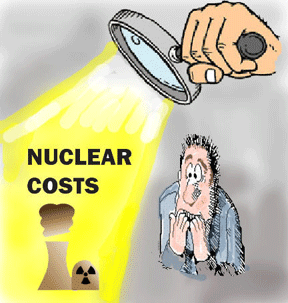
Australian Submarines May Go Nuclear But Our Power Stations Never Will, SOLARQUOTES, October 11, 2021 by Ronald Brakels
- ”…………………….Small Modular Reactors Are More Expensive An SMR is a Small Modular Reactor. There have been claims these will provide cheap energy in the future, but this seems unlikely given their designers have stated that…
- Before cost overruns are considered, SMRs will produce electricity at a higher cost than current nuclear reactor designs.Being more expensive than conventional nuclear power is a major obstacle for any plan to supply energy at a lower cost.
- The advantage of SMRs is they are supposed to be less likely to suffer from disastrous cost overruns. This means they are a more expensive version of a type of generation that is already too expensive for Australia before cost overruns. While any cost overruns that do occur may not be as bad as conventional nuclear, that’s not what I call a good deal.
There is nothing new about small nuclear reactors. India has over a dozen reactors of 220 megawatts or less in operation. But all Indian reactors now under construction are larger because they want to reduce costs. Technically their small reactors aren’t modular because major components weren’t constructed at one site and then moved to where they were used. This leads to another major problem with SMRs…- They don’t exist. Before Australia can deploy an SMR, a suitable prototype reactor will have to be successfully built and operated. Then a commercial version will need to be developed and multiple units constructed overseas without serious cost overruns and used long enough to show they can be operated safely and cheaply. Given nuclear’s prolonged development cycle, this could easily take over 20 years. The very best estimate for the cost of electricity from an SMR I have seen is around 6.2 cents per kilowatt-hour and it relies on everything going perfectly — a rare thing for nuclear power. It also leaves out several costs that have to be paid in the real world. :……….https://www.solarquotes.com.au/blog/submarines-nuclear-not-power-stations/
Nuclear power is too expensive for Australia.

Australian Submarines May Go Nuclear But Our Power Stations Never Will, SOLARQUOTES, October 11, 2021 by Ronald Brakels
Australia recently decided to buy nuclear-powered submarines as part of the AUKUS pact with the UK and United States.
Assuming it goes ahead, the first sub may be ready around 2040. But while our submarines may have nuclear reactors, our power stations never will.
There is a simple reason Australia will never have nuclear power despite deciding to get reactors that wander around under the ocean. The reason is…
- Nuclear power is too expensive for Australia.
- Every other concern — whether it’s safety, waste disposal, decommissioning, insurance, or location — is irrelevant because nuclear energy can’t clear the first and vital hurdle of making economic sense. Some suggest building nuclear power in addition to renewables because the threat from global roasting is so great we should fight emissions using every means at our disposal. But this would be counterproductive because:
- Nuclear power consumes resources that would result in greater emission cuts if used for solar and wind generation plus energy storage.
- In other words, $1 spent on solar power will cut greenhouse gas emissions far more than $1 spent on nuclear energy.Finally, some people say we need nuclear power to provide a steady source of low emission baseload generation, but this suggestion is completely nuts. Even if we built nuclear power stations, they would soon be driven out of the market in the same way coal power is because:
- Nuclear power has exactly the wrong characteristics to be useful in a grid with a high penetration of solar and wind.Australia currently doesn’t have a nuclear power industry, and building submarines with American made sealed reactors that are never refuelled will do next to nothing to make nuclear power more cost-effective. In this article, I’ll explain why nuclear power makes no economic sense in Australia, and at the end, I’ll also whinge a bit about nuclear submarines. ………..
- Nuclear Power Is Ridiculously Expensive The cost of energy from new nuclear isn’t just expensive; it’s ridiculously expensive. Here are examples of reactors under construction in developed countries, using Australian dollars at today’s exchange rate:
Finland’s Olkiluoto #3 reactor: So far, this 1.6 Gigawatt reactor has cost about $14 billion, which is around $8,750 per kilowatt of power output. Construction started in 2005 and was scheduled to be completed in 2009. Due to delays, it’s now scheduled to commence normal operation in February 2022 for a total construction time of 17 years.- France’s Flammanville #3 reactor: The cost of this 1.6 gigawatt reactor is approximately $31 billion. That’s $19,400 per kilowatt. Normal operation is scheduled for 2023 — 16 years after construction began.
- UK’s Hinkley Point C: These two reactors will provide 3.2 gigawatts of power and cost around $42 billion. That’s $13,100 per kilowatt. Construction began in 2018, and they’re currently scheduled to come online in 2026.
- US Vogtle 3 & 4: These two reactors in Georgia (the US state, not where Stalin was born) will total 3.2 gigawatts and, by the time they are complete, may cost over $38 billion. That’s around $12,000 per kilowatt. Construction started in 2013, and they’re expected to come online next year. These are the only commercial reactors being built in the United States.
- As you can see, new nuclear isn’t cheap. Note these aren’t the most expensive reactors under construction in Western Europe and North America, they’re the only ones under construction. If you think these reactors are expensive to build but provide cheap electricity, that’s not the case. The Hinkley Point C reactors under construction will receive a minimum of 21 cents per kilowatt-hour they supply for 35 years after they come online. If the wholesale electricity price goes above 21 cents, they’ll receive that instead. The 21 cents is indexed to inflation, so it will remain ridiculously expensive for the full 35 years. In the US, households in Georgia will have paid around $1,200 each towards the new Vogtle reactors by the time they come online. After that, their electricity bills will increase by around 10% to pay for the new nuclear electricity. For another nuclear power station to be constructed in the US would require a payment per kilowatt-hour similar to or higher than Hinkley Point C. ………………..
………….. Poor Choice For Emission Reductions. Some people ask…“Why not build both nuclear and renewable capacity to reduce CO2 emissions as rapidly as possible?”
The answer is…“Because every dollar invested in nuclear will cut emissions by much less than a dollar spent on renewables.”
If the goal is to cut emissions rapidly, it’s counterproductive to invest in nuclear. Australia doesn’t have existing nuclear capacity or a half-built reactor, so whether it makes sense to keep old reactors operating or complete construction doesn’t come into it.Nuclear capacity isn’t quick to build. Some notable examples:
Olkiluoto 3 — 17 years- Flammanville 3 — 16 years
- Watts Bar 2 — 43 years
- Because Australia has no nuclear power industry, it would take more than five years to build a nuclear power station even if we could start construction today1. But Australia can increase its solar energy generation almost immediately. Extra wind power will take months to arrange, as wind turbine purchases are more complex than just ordering extra solar panels and inverters. Firming the grid with energy storage is also fast. The world’s largest battery, the Hornsdale Power Reserve or “Tesla Big Battery”, was built in 100 days.Whether cost or time are considered, nuclear energy is a poor choice for reducing emissions.
- Nuclear Energy Not Needed For Baseload GenerationOne of the craziest reasons given for building nuclear power in Australia is we need low emission baseload generators. This idea is nuttier than a lumpy chocolate bar because:
- No baseload generators are required.
- Like coal, nuclear power has the wrong characteristics to support a grid with high solar and wind generation.It’s impossible to argue that we need baseload generators that run continuously (except for maintenance). This is because South Australia has none. The state doesn’t continuously import electricity either.
- Despite having no baseload generators, SA still manages to meet demand as well as other states. South Australia had coal baseload generators in the past, but as wind and solar power capacity expanded, there were increasing periods of low or zero wholesale electricity prices2 resulting from solar and wind having zero fuel costs. Because their fuel is free, they have little or no incentive not to provide electricity even if they receive next to nothing for it.
- Because coal power is expensive to start and stop and saves very little money by shutting down because its fuel cost is low — but not zero — it often had no choice other than to keep operating during periods when it was losing money on every kilowatt-hour generated. In 2016 South Australia shut down its last remaining coal power station because it was no longer profitable. This same process is happening throughout Australia as solar, wind, and energy storage capacity increases. In a (hopefully) short period of time, renewables will drive coal power out of the market.
- If it doesn’t make economic sense to keep existing coal power stations around to supply baseload power, it definitely makes no sense to replace them with more expensive nuclear reactors with the same problem – that shutting down saves little money because their fuel cost is low. Building a nuclear power station and then only using it half its potential capacity almost doubles the cost of energy it produces.
………………. Other Nuclear Energy IssuesThere are many issues associated with nuclear power that are often discussed but are irrelevant. I’ll quickly mention and dismiss half a dozen or so:……….https://www.solarquotes.com.au/blog/submarines-nuclear-not-power-stations/
The facts contradict the pro nuclear spin of the Minerals Council of Australia’s report, written by Ben Heard.

“a smaller reactor, at least the water-cooled reactors that are most likely to be built earliest, will produce more, not less, nuclear waste per unit of electricity they generate because of lower efficiencies.”
”Due to the loss of economies of scale, the decommissioning and waste management unit costs of SMR will probably be higher than those of a large reactor (some analyses state that between two and three times higher).”
Small nuclear reactors, huge costs Dr. Jim Green 11 October 2021 Even by the standards of the Minerals Council of Australia (MCA), the new report published by the country’s most influential coal lobby on the subject of small modular nuclear reactors (SMRs) is jiggery-pokery of the highest order.
Why would a mining industry body promote SMRs? After mining for some years — or at most decades — no company would want to take on the responsibility of decommissioning a nuclear reactor and managing high-level nuclear waste for millennia. No companies are cited in the report expressing interest in SMRs to power their mining operations.
Perhaps the MCA – which infamously provided the lump of coal for Scott Morrison to wave around in parliament – thinks that promoting nuclear power will slow the transition from fossil fuels to renewables, and believes that it is in the interests of some of its member companies to slow the transition.
If so, the timing of the report isn’t great, coming in the same week as the Business Council of Australia’s report which argues for a rapid, renewables-led decarbonisation, and Fortescue’s announcement that it plans to build the world’s largest green energy hydrogen manufacturing facility in Queensland.
Perhaps the MCA is doing the bidding of the (mostly foreign-owned) uranium mining companies operating in Australia? The MCA’s CEO Tania Constable said: “Australia should take advantage of growing international interest in nuclear energy and look to expand its already significant uranium sector.”
Perhaps … but there’s no evidence that the two companies mining uranium in Australia — BHP (Olympic Dam) and Heathgate Resources (Beverley Four Mile) — are lobbying for nuclear power. And Australia’s “already significant” uranium industry could hardly be more insignificant — it accounts for about 0.2 percent of Australia’s export revenue and about 0.01 percent of all jobs in Australia.
Bob Carr’s atomic bombshell
The MCA report also came in the same week as Bob Carr’s striking about-face on nuclear power. Having previously supported nuclear power, Carr wrote in The Australian: “In 2010 one enthusiast predicted within 10 years fourth-generation reactors and small modular reactors would be commonplace, including in Australia. None exists, here or abroad.”
The MCA report says SMRs are an “ideal fit” for Australia, citing their enhanced safety, lower cost than large-scale nuclear reactors or equivalent energy production methods, and lower waste production than current reactors.
It’s all nonsense. The safety claims don’t stack up. Nor do the claims about waste. Academic M.V. Ramana notes that “a smaller reactor, at least the water-cooled reactors that are most likely to be built earliest, will produce more, not less, nuclear waste per unit of electricity they generate because of lower efficiencies.”
And a 2016 European Commission document states: “Due to the loss of economies of scale, the decommissioning and waste management unit costs of SMR will probably be higher than those of a large reactor (some analyses state that between two and three times higher).”
SMRs have a similar capacity to many existing coal and gas-fired power plants in Australia, the MCA report states, so would make an ideal replacement. Back to Bob Carr:
“Where is the shire council putting up its hand to host a nuclear power plant? Harder to find than a sponsor for a high-temperature toxic waste incinerator.
“Nobody in the Hunter Valley has urged nuclear for the Liddell site, even on the footprint of this coal-fired power plant scheduled to close. And not even invoking the prospect of a small modular reactor that 10 years back was the vanguard of the nuclear renaissance. About to be planted across the Indonesian archipelago and the rest of Asia, we were promised. Today they exist only on the Rolls-Royce drawing boards they have adorned since the 1970s.”
Economics
The MCA said in June 2020 that SMRs won’t find a market unless they can produce power at a cost of A$60-$80 per megawatt hour (MWh). That’s a big problem for enthusiasts because there’s no chance whatsoever that SMRs will produce power in that cost range.
An analysis by WSP / Parsons Brinckerhoff, prepared for the 2015/16 South Australian Nuclear Fuel Cycle Royal Commission, estimated a cost of A$225 / MWh for a reactor based on the NuScale design, about three times higher than the MCA’s target range.
CSIRO estimates SMR power costs at A$258-338 / MWh in 2020 and A$129-336 / MWh in 2030.
Russia’s floating nuclear plant is said to be the only operational SMR in the world, although it doesn’t fit the ‘modular’ definition of serial factory production.
A 2016 OECD Nuclear Energy Agency report said that electricity produced by the Russian floating plant is expected to cost about US$200 (A$273) / MWh, about four times higher than the target range cited by the MCA and more expensive than power from large reactors (US$129-198 / MWh).
Completion of Russia’s floating plant was nine years behind schedule and construction costs increased six-fold.
Yet, despite a mountain of evidence that SMRs won’t come close to producing power in the A$60-80 / MWh range, the new MCA report asserts that “robust estimates” using “conservative assumptions” suggest that SMRs will produce power at a cost of A$64-77 MWh by 2030.
One wonders who the MCA think they’re kidding.
The MCA report was written by Ben Heard, who recently closed his ‘Bright New World’ nuclear lobby website, just before taking up a full time role with consultancy Frazer-Nash. Heard promotes Canadian SMR-wannabe Terrestrial Energy in the MCA report but does not disclose his role on the company’s advisory board.
Heard also contributed two chapters on nuclear power to a 2020 book titled ‘An Australian nuclear industry: Starting with submarines’.
Dr Jim Green is lead author of a 2019 Nuclear Monitor report on SMRs and national nuclear campaigner with Friends of the Earth Australia.
1 This Month



26 September – International Day for the Total Elimination of Nuclear Weapons


PLEASE OPPOSE HR 8255 AND S.3639 – bills would accelerate satellite deployment, with no environmental review or safeguards – https://ncstd5li.quorum.us/campaign/169331/
To see nuclear-related stories in greater depth and intensity – go to https://nuclearinformation.wordpress.com
-
Archives
- September 2026 (219)
- August 2026 (330)
- July 2026 (355)
- June 2026 (287)
- May 2026 (306)
- April 2026 (356)
- March 2026 (251)
- February 2026 (267)
- January 2026 (308)
- December 2025 (358)
- November 2025 (359)
- October 2025 (375)
-
Categories
- 1
- 1 NUCLEAR ISSUES
- business and costs
- climate change
- culture and arts
- ENERGY
- environment
- health
- history
- indigenous issues
- Legal
- marketing of nuclear
- media
- opposition to nuclear
- PERSONAL STORIES
- politics
- politics international
- Religion and ethics
- safety
- secrets,lies and civil liberties
- spinbuster
- technology
- Uranium
- wastes
- weapons and war
- Women
- 2 WORLD
- ACTION
- AFRICA
- Atrocities
- AUSTRALIA
- Christina's notes
- Christina's themes
- culture and arts
- Events
- Fuk 2022
- Fuk 2023
- Fukushima 2017
- Fukushima 2018
- fukushima 2019
- Fukushima 2020
- Fukushima 2021
- general
- global warming
- Humour (God we need it)
- Nuclear
- RARE EARTHS
- Reference
- resources – print
- Resources -audiovicual
- Weekly Newsletter
- World
- World Nuclear
- YouTube
-
RSS
Entries RSS
Comments RSS
 nuclear-news