Trump blabbed nuclear sub secrets to Australian billionaire member of Mar-a-Lago club, report claims
Andrew Feinberg, Fri, October 6, 2023 https://www.yahoo.com/news/trump-blabbed-nuclear-sub-secrets-211203147.html?guccounter=1
Former president Donald Trump allegedly revealed highly classified information about American nuclear-powered submarines to a wealthy Australian who regularly paid large sums to one of his companies, according to a report from ABC News.
Mr Trump reportedly disclosed the extremely sensitive information to a billionaire member of his Mar-a-Lago social club, which is housed at the location where he allegedly hoarded hundreds of classified documents for more than a year after his term as president — and his authorisation to possess such documents — had come to an end.
Citing sources familiar with the matter, ABC reported that the Aussie high-roller in question allegedly shared the information about US nuclear-powered submarines with “scores” of other people not authorised to have it, including “more than a dozen foreign officials” and journalists of unknown nationality.
Department of Justice investigators working under the supervision of Special Counsel Jack Smith learned of the potential breach as they were investigating Mr Trump’s alleged unlawful retention of national defence information.
Both prosecutors and special agents with the Federal Bureau of Investigation have reportedly spoken to the Mar-a-Lago member, packaging magnate Anthony Pratt, on at least two occasions this year.
Mr Pratt reportedly told investigators that the ex-president told him two pieces of information about the submarines: How many nuclear warheads are carried by American Ohio class ballistic missile submarines, and how close to such vessels a Russian submarine must get to detect them.
Both of those figures are among the US Navy’s most closely guarded secrets. But sources reportedly told ABC that Mr Pratt described what Mr Trump had said to at least 45 other people, including 10 Australian officials and a trio of former prime ministers.
Who Is Anthony Pratt, the Australian Billionaire Trump Allegedly Shared Nuclear Secrets With?
Bloomberg, By Andrew Heathcote, October 6, 2023 #nuclear #antinuclear #nuclear-free #NoNukes
Australian billionaire Anthony Pratt has been hurled into the spotlight after US press reports alleged that former President Donald Trump spilled secrets about US nuclear subs to the businessman.
ABC News first reported that Trump discussed the potentially sensitive information with Pratt — who’s a member of his Mar-a-Lago Club — shortly after leaving office. The report alleges that the businessman then went on to share that information with several others, following the revelations at Trump’s private club.
Here’s a quick rundown of what you need to know about Australia’s ‘cardboard king’…………………………………………..
He’s worth $9.2 billion, according to the Bloomberg Billionaires Index. That makes him the world’s 213th richest person, the data show……………………………
Former Australian prime minister Scott Morrison joined Trump and Pratt on their paper plant tour in 2020. Pratt also has a relationship with President Joe Biden having invited the then vice president to dinner during his Australian visit in 2016. Back in 2013, during the Obama administration he appointed a former US ambassador to his advisory board…………………..
What did Pratt do after Trump’s alleged revelations?
After Trump allegedly shared details on the submarines — reported to be the number of nuclear warheads they carry and how close they can get to Russian subs — Pratt went on to disclose the potentially-sensitive information to “scores of others,” including foreign officials, journalists and employees, according to ABC. He has since been interviewed by US law enforcement agencies, the network reported…………… more https://www.bloomberg.com/news/articles/2023-10-06/who-is-anthony-pratt-the-billionaire-trump-is-accused-of-revealing-secrets-to?leadSource=uverify%20wall
Australian towns battle fire and flood back-to-back
Hours after they were threatened by fire, several Australian towns are
preparing for floods. Bushfires have been burning in Victoria’s Gippsland
region and New South Wales’ South Coast this week – both areas were hit
hard by Australia’s Black Summer bushfires four years ago. Rain is now
offering some reprieve, but it has also triggered flood warnings. The
country has reeled from disaster to disaster in recent years, as it feels
the effects of climate change.
BBC 4th Oct 2023
France attempts to pressure Australia to stop engaging with UN nuclear weapons ban treaty

https://www.icanw.org/france_pressures_australia_to_stop_engaging_with_un_nuclear_weapons_ban_treaty 2 Oct 23 #nuclear #anti-nuclear #Nuclear-Free #NoNukes
Recent statements by a French diplomat to “the Australian” newspaper criticizing Australia’s decision to observe the UN Treaty on the Prohibition of Nuclear Weapons (TPNW) reveal the panicked efforts by nuclear-armed states to undermine the treaty as support for the ban continues to grow. It also shows a European state with a dark colonial legacy continuing to exert pressure on the Pacific – an area heavily impacted by French nuclear testing – instead of respecting national sovereignty.
On 2 October an article in “the Australian” newspaper cited an unnamed French diplomat claiming that Australia’s support for the Treaty on the Prohibition of Nuclear Weapons “undermines the primacy of the Nuclear Non-Proliferation Treaty (NPT)” and “is contradictory with Australia’s ambition to reinforce its partnership with NATO.”
Both of these statements are not only hamfisted attempts at pressuring the Australian government away from the TPNW, they are also factually incorrect: The TPNW was carefully crafted to reinforce, complement, and build on the NPT, which obligates its parties – including France – to negotiate further legal measures to achieve nuclear disarmament under Article VI, and NATO members face no legal barrier to joining the treaty, so long as they commit not to engage in or support any nuclear-weapon-related activities. Moreover, several NATO partners are already TPNW parties (Austria, Ireland, Kazakhstan, Malta, Mongolia, New Zealand) or signatories (Algeria, Colombia).
These declarations show France’s mounting concern over the growing support for the TPNW. The statements themselves are no surprise, as France has stridently protested the TPNW ever since it was adopted at the UN in 2017 with the backing of 122 states. France insists it has a legitimate right under the NPT to possess nuclear weapons, while ignoring its commitments to pursue negotiations in good faith for nuclear disarmament under the same treaty. What is new is the fact that this pressure is being exerted publicly, and on a state that is largely seen as an ally on security issues. Previously, France has limited this kind of pressure for formerly colonised states, particularly in Africa.
Australia’s growing support for the TPNW
The Australian Labor Party, which has been in power since May 2022, adopted a resolution in 2018 committing it to sign and ratify the TPNW in government. This was moved by Anthony Albanese, who now serves as prime minister and has been a vocal supporter of the TPNW. He said at the time: “Our commitment to sign and ratify the nuclear weapon ban treaty in government is Labor at its best.” Labor reaffirmed this position in 2021 and most recently on 18 August 2023. The government also has confirmed its intention to observe the treaty’s upcoming meeting of states parties in New York (2MSP) and is evaluating whether to sign and ratify the treaty.
This is an encouraging step, but ICAN’s Executive Director, former Labor MP Melissa Parke, has criticised the government’s delay in ratifying the treaty: “It’s not enough to keep promising to sign the treaty without acting. We want to see the Prime Minister put pen to paper, without delay. Labor’s commitment on nuclear disarmament and non-proliferation will be hollow if Australia fails to do so.”
Speaking to the revelation that French diplomats are exerting pressure on Australia to consider, she said: “Our two countries have never seen eye to eye on nuclear weapons. France shouldn’t be lecturing Australia on nuclear policy. We can make our own decisions, in our own interests – and for the global common good.”
France’s unresolved nuclear legacy in the Pacific
From 1966 to 1996, France tested 193 nuclear weapons in Maohi Nui/French Polynesia, a Self Governing Territory of France in the Pacific. In 1974, Australia famously took France to the International Court of Justice in a bid to force an end to its atmospheric nuclear testing in the Pacific, as the impacts of nuclear weapons are not contained by national borders. Yet France only ended its Pacific nuclear test explosions once it was confident it had developed non-explosive testing methods sufficiently for new weapons development, and it refuses to acknowledge and address the catastrophic legacy of its nuclear tests to this day.This legacy is also a subject of hot debate at the national level in France. On 28 September, only days before France’s criticisms of Australia, the assembly of French Polynesia unanimously adopted a resolution supporting the TPNW, highlighting the region’s history as the site of numerous French nuclear tests. The resolution underscores the TPNW as a humanitarian disarmament treaty and emphasises the deep concerns of the French Polynesian population regarding this issue. While French Polynesia cannot currently access the assistance and rehabilitation outlined in Articles 6 and 7 of the TPNW due to France’s non-ratification, it sends a resounding message in favour of the treaty to Paris.
Pacific island States support the Treaty on Prohibition of Nuclear Weapons – a problem for Australia in joining AUKUS nuclear military alliance
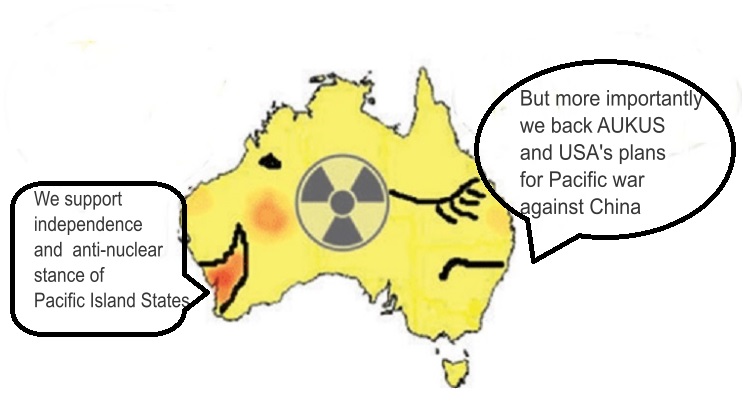
French criticism of nuclear ban treaty highlights Canberra’s dilemma
The Interpreter, NIC MACLELLAN, 2 Oct 23
Can Australia rebuild a strategic military partnership with France at
the same time as independence movements claim Pacific support?
On 28 September, the Assembly of French Polynesia unanimously passed a resolution endorsing the Treaty on the Prohibition of Nuclear Weapons (TPNW), the nuclear ban treaty that entered into force in 2021. Even though France refuses to sign the treaty, and still controls the defence and foreign policy of French Polynesia, the local legislature in Tahiti with its new pro-independence government sees TPNW as setting a new norm in international law. The resolution encourages “the participation of France as an observer state at the next TPNW Meeting of the States Parties”, to be held in New York in late November. It also calls on the French government to “work towards France’s adherence to this new international norm.”
A key reason for this pointed message to Paris are the TPNW provisions that call for assistance to nuclear survivors and clean-up of contaminated nuclear test sites. The Ma’ohi people are still seeking compensation for the health and environmental effects of 193 French nuclear tests at Moruroa and Fangataufa.
Beyond this, French Polynesia’s critique of nuclear weapons echoes the views of the majority of members of the Pacific Islands Forum. Unlike Australia, nine independent Pacific Island countries and Aotearoa-New Zealand have already signed and ratified the TPNW.
At the recent Australian Labor Party (ALP) National Conference in Brisbane, the party re-confirmed its support for signing the TPNW – under restrictive conditions – and agreed to send an observer to the next Meeting of State Parties. However key ALP leaders are opposed to signing, and nuclear weapons states such as the United States and France, having long derided the treaty, are now ramping up their opposition to it.
A front-page story in The Australian on 2 October cited an unnamed French diplomat who criticised Australia over its tentative moves towards signing TPNW, though the story fails to mention last week’s resolution from the Assembly of French Polynesia…………………………………………….
the Australian government has held a series of meetings with key French ministers to rebuild relations disrupted by AUKUS, including a summit between Defence Minister Richard Marles and French counterpart Sebastien Lecornu in September 2022, and a 2+2 meeting of defence and foreign ministers in January. Marles and Lecornu are organising the South Pacific Defence Ministers meeting in Noumea in December, to the dismay of the FLNKS independence movement, which is in the midst of talks with the French state over a new political status for New Caledonia.
Last year, Marles congratulated Emmanuel Macron on his re-election to the French presidency, proclaiming “France is our neighbour. France is a Pacific country. And as such, France deeply matters to Australia.”
But France is a European colonial power, not a Pacific country. It is recognised by the United Nations as the administering power of non-self-governing territories. It has responsibilities for decolonisation under international law. Australian governments may be reluctant to talk publicly about this, but the issue of self-determination is firmly on the regional agenda, posing difficult choices for all Forum member countries (as shown by recent debates over West Papua, Bougainville, Guam, etc).
Another problem is that, in both Australia and France, the perspectives of leaders from Francophone island communities are usually missing from the public debate about France’s role in Indo-Pacific security. It’s rare to see the media or think tanks cite President Louis Mapou of New Caledonia or newly elected President Moetai Brotherson of French Polynesia. Both will be attending the next Pacific Islands Forum summit in Rarotonga as it discusses regional security – for the first time, leaders from both French territories in the Forum are supporters of independence and sharp anti-nuclear critics.
So, can Australia rebuild a strategic military partnership with France at the same time as its Pacific neighbours are seeking an independent and sovereign state?
As Penny Wong travelled to Noumea last April, becoming the first Australian Foreign Minister to address the Congress of New Caledonia, Mapou was eager to strengthen ties with Canberra around trade, investment and people-to-people engagement. He also diplomatically highlighted key differences around Australia’s close alignment with the United States under the AUKUS partnership:
The independence movement of New Caledonia – of which I’m a member – is in favour of non-alignment. We regularly attend the summits of the Non-Aligned Movement. From the earliest days, we have supported a nuclear free Pacific – that’s even set out in the preamble of the draft Constitution of Kanaky that we submitted to the United Nations in 1986. When Australia decides to align itself with the United States in the framework of AUKUS to acquire nuclear submarines, it raises the question: if it starts here, where will it end? How does this impact the Treaty of Rarotonga and the Boe Declaration on security?
The Albanese government has proclaimed its support for a world without nuclear weapons. But talk is easy. It’s getting harder for the ALP government to balance tensions between its role as an AUKUS partner, a strategic partner with France and the “security partner of choice” for the island nations of the Pacific, which are deeply opposed to nuclear weapons. Why should Australia side with a European colonial power against its closest neighbours? https://www.lowyinstitute.org/the-interpreter/french-criticism-nuclear-ban-treaty-highlights-canberra-s-dilemma
Aukus: UK defence giant BAE Systems wins Australian £3.95bn nuclear submarine contract

BBC News By Peter Hoskins, Business reporter 2 October Britain’s biggest defence firm, BAE Systems has won a £3.95bn ($4.82bn) contract to build a new generation of submarines as the security pact between the US, UK and Australia moves ahead.
In March, the three countries announced details of the so-called Aukus pact to provide Australia with nuclear-powered attack submarines by the late 2030s.
The pact aims to counter China’s ambitions in the Indo-Pacific region.
Beijing has strongly criticised the three countries over the deal.
……………………..”This multi-billion-pound investment in the Aukus submarine programme will help deliver the long-term hunter-killer submarine capabilities the UK needs to maintain our strategic advantage and secure our leading place in a contested global order,” UK Defence Secretary Grant Shapps said as the Conservative party conference got under way in Manchester.
………………….Other major UK defence contractors are also getting a boost from the Aukus deal.

In March, it was confirmed that Rolls-Royce Submarines would provide all the nuclear reactor plants that will power the SSN-Aukus vessels.
In June, Rolls-Royce said it would almost double the size of its Raynesway facility in Derby as a result of the deal. On Sunday, Babcock International, which maintains and supports the UK’s submarines, said it had signed a five-year deal with the Ministry of Defence to work on the SSN-Aukus design.
The Aukus security alliance – which was first announced in September 2021 – has repeatedly drawn criticism from China.
However, the three Western countries say the deal is aimed at shoring up stability in the Indo-Pacific more https://www.bbc.com/news/business-66979798
Mission to Free Assange: Australian Parliamentarians in Washington

Australia remains the prized forward base of US ambitions in the Indo-Pacific, the spear pointed against China and any other rival who dares challenge its stubborn hegemony. The AUKUS pact, featuring the futile, decorative nuclear submarines …………also makes that point all too clear.
September 24, 2023, Dr Binoy Kampmark, https://theaimn.com/mission-to-free-assange-australian-parliamentarians-in-washington/
It was a short stint, involving a six-member delegation of Australian parliamentarians lobbying members of the US Congress and various relevant officials on one issue: the release of Julian Assange. If extradited to the US from the United Kingdom to face 18 charges, 17 framed with reference to the oppressive, extinguishing Espionage Act of 1917, the Australian founder of WikiLeaks risks a 175-year prison term.
Nationals MP Barnaby Joyce, Labor MP Tony Zappia, Greens Senators David Shoebridge and Peter Whish-Wilson, Liberal Senator Alex Antic and the independent member for Kooyong, Dr. Monique Ryan, are to be viewed with respect, their pluckiness admired. They came cresting on the wave of a letter published on page 9 of the Washington Post, expressing the views of over 60 Australian parliamentarians. “As Australian Parliamentarians, we are resolutely of the view that the prosecution and incarceration of the Australian citizen Julian Assange must end.”
This is a good if presumptuous start. Australia remains the prized forward base of US ambitions in the Indo-Pacific, the spear pointed against China and any other rival who dares challenge its stubborn hegemony. The AUKUS pact, featuring the futile, decorative nuclear submarines that will be rich scrapping for the Royal Australian Navy whenever they arrive, also makes that point all too clear. For the US strategist, Australia is fiefdom, property, real estate, terrain, its citizenry best treated as docile subjects represented by even more docile governments. Assange, and his publishing agenda, act as savage critiques of such assumptions.
The following views in Washington DC have been expressed by the delegates in what might be described as a mission to educate. From Senator Shoebridge, the continued detention of Assange proved to be “an ongoing irritant in the bilateral relationship” between Canberra and Washington. “If this matter is not resolved and Julian is not brought home, it will be damaging to the bilateral relationship.”
Senator Whish-Wilson focused on the activities of Assange himself. “The extradition of Julian Assange as a foreign journalist conducting activities on foreign soil is unprecedented.” To create such a “dangerous precedent” laid “a very slippery slope for any democracy to go down.”
Liberal Senator Alex Antic emphasised the spike in concern in the Australian population about wishing for Assange’s return to Australia (some nine out of 10 wishing for such an outcome). “We’ve seen 67 members of the Australian parliament share that message in a joint letter, which we’ve delivered across the spectrum.” An impressed Antic remarked that this had “never happened before. I think we’re seeing an incredible groundswell, and we want to see Julian at home as soon as possible.”
On September 20, in front of the Department of Justice, Zappia told reporters that, “we’ve had several meetings and we’re not going to go into details of those meetings. But I can say that they’ve all been useful meetings.” Not much to go on, though the Labor MP went on to state that the delegation, as representatives of the Australian people had “put our case very clearly about the fact that Julian Assange pursuit and detention and charges should be dropped and should come to an end.”
A point where the delegates feel that a rich quarry can be mined and trundled away for political consumption is the value of the US-Australian alliance. As Ryan reasoned, “This side of the AUKUS partnership feels really strongly about this and so what we expect the prime minister [Anthony Albanese] to do is that he will carry the same message to President Biden when he comes to Washington.”
The publisher’s brother, Gabriel Shipton, also suggests that the indictment is “a wedge in the Australia-US relationship, which is a very important relationship at the moment, particularly with everything that’s going on with the US and China and the sort of strategic pivot that is happening.” Assange, for his part, is bound to find this excruciatingly ironic, given his lengthy battles against the US imperium and the numbing servility of its client states.
Various members of Congress have granted an audience to the six parliamentarians. Enthusiasm was in abundance from two Kentucky Congressmen: Republican Senator Rand Paul and Republican House Representative Thomas Massie. After meeting the Australian delegation, Massie declared that it was his “strong belief [Assange] should be free to return home.”
Georgian Republican House member Marjorie Taylor Greene expressed her sense of honour at having met the delegates “to discuss the inhumane detention” of Assange “for the crime of committing journalism,” insisting that the charges be dropped and a pardon granted. “America should be a beacon of free speech and shouldn’t be following in an authoritarian regime’s footsteps.” Greene has shown herself to be a conspiracy devotee of the most pungent type, but there was little to fault her regarding these sentiments.
Minnesota Democrat Congresswoman Ilhan Omar also met the parliamentarians, discussing, according to a press release from her office, “the Assange prosecution and its significance as an issue in the bilateral relationship between the United States and Australia, as well as the implications for freedom of the press both at home and abroad.” She also reiterated her view, one expressed in an April 2023 letter to the Department of Justice co-signed with six other members of Congress, that the charges against Assange be dropped.
These opinions, consistent and venerably solid, have rarely swayed the mad hatters at the Justice Department who continue to operate within the same church consensus regarding Assange as an aberration and threat to US security. And they can rely, ultimately, on the calculus of attrition that assumes allies of Washington will eventually belt up, even if they grumble. There will always be those who pretend to question, such as the passive, meek Australian Foreign Minister, Penny Wong. “We have raised this many times,” Wong responded to a query while in New York to attend the United Nations General Assembly. “Secretary [of State Antony] Blinken and I both spoke about the fact that we had a discussion about the views that the United States has and the views that Australia has.”

Not that this mattered a jot. In July, Blinken stomped on Wong’s views in a disingenuous, libellous assessment about Assange, reminding his counterpart that the publisher had been “charged with very serious criminal conduct in the United States in connection with his alleged role in one of the largest compromises of classified information in the history of our country.” The libel duly followed, with the claim that Assange “risked very serious harm to our national security, to the benefit of our adversaries, and put named sources at grave risk – grave risk – of physical harm, and grave risk of detention.” That gross falsification of history went unaddressed by Wong.
Thus far, Blinken has waived away the concerns of the Albanese government on Assange’s fate as passing irritants at a spring garden party. However small their purchase, six Australian parliamentarians have chosen to press the issue further. At the very least, they have gone to the centre of the imperium to add a bit of ballast to the effort.
In Australia, big batteries and solar push new boundaries on the grid
The rapid evolution of Australia’s energy system continues apace as the
mild weather of spring and new production benchmarks give voice to the new
capacity that has been added over the past 12 months. As noted earlier this
week, spring is the season for new records because of the good conditions
and moderate demand.
In South Australia on Sunday, solar set a new record
of 120 per cent of local demand in the state (the excess was exported to
Victoria) and on Wednesday and Thursday it was the turn of wind and battery
storage. Wind hit a peak of 141.4 per cent of local demand at 4.35am on
Thursday morning. That wasn’t a record in itself, but the big share of
wind and later solar during the daytime was accompanied by a record amount
of activity from the state’s growing fleet of big batteries.
Renew Economy 14th Sept 2023
Nuclear submarines challenge trains 10 year old children for war

By Sue WarehamSep 11, 2023 https://johnmenadue.com/nuclear-subs-challenge-trains-10-year-old-children-for-war/
It’s time for education ministers across the country to show leadership and protect our children from vested interests and pro-war propaganda.
On 19 June, the Defence Department launched its Nuclear-Powered Submarine Propulsion Challenge, for years 7 – 12 students across the nation. The program seeks to engage the enthusiasm of young people for the complex and hugely controversial nuclear submarine program, in the hope that some of the students will want to contribute to this form of war-fighting when they leave school.
The nuclear submarine proposal has implications that go far beyond the understanding of the students targeted for this program (which include those as young as 11 years). They include the nuclear weapons proliferation potential, the consequences of a war – possibly nuclear war – with China, for which the submarines are planned, the problem of high-level, long-lived nuclear waste for which there is no solution anywhere, and the matter of what else will suffer financially as we attempt the gargantuan task of paying for this program. In the absence of any awareness or understanding of this context, the schools program is little more than propaganda.
The program fits with the growing prevalence of private weapons company-sponsored STEM (science, technology, engineering and maths) programs in schools. Their purpose is to create positive brand name associations, such as happy memories, from which can flow varying degrees of attachment to the corporate brand. Company logos are displayed on all materials, and there is often direct contact between students, teachers and company representatives. An underfunded public education system is perfect for the companies’ purposes, because overstretched teachers will welcome material that might make their job a little easier.
There is ample evidence that children are very susceptible to the creation of positive associations with an advertised product. Even into adolescence, children don’t necessarily have the skills to critically assess the intentions behind persuasive marketing tactics, or understand what a brand or product really represents.
The militarisation of STEM education is not confined to our schools (and universities, which comprise a huge network in themselves of weapons company partnerships). The National Youth Science Forum has as its primary sponsor Lockheed Martin, the world’s biggest weapons maker. The Questacon National Science and Technology Centre in Canberra receives major funding for its Engineering is Elementary program from the Defence Department, with ADF engineers being actively involved in delivering the program.
The industry’s need is for a workforce socialised to accept warfare as inevitable and the industry itself as always a force for good. The “Minors and Missiles” report of the Medical Association for Prevention of War outlines the problem, its extent in Australia and how it can be addressed. The new organisation Teachers for Peace works to this end also.
In relation to the nuclear submarine challenge for schools, on 1 July the Adelaide Advertiser published an article “Kids, 10, training for to build a workforce for AUKUS, SA’s $368bn nuclear submarine project”, about the Beacon program in some schools, run in conjunction with weapons giant BAE Systems. Among other activities, it allows students to virtually load and fire weaponry, one student stating “It’s a lot more fun, it’s like playing a video game but it’s a lot more educational”. Such presentation of warfare and its associated hardware to children as a game – which extends also to our war commemoration – is an abuse of their right to aspire to live in a peaceful society.
An additional concern with the Nuclear-Powered Submarine Propulsion Challenge is that it anti-democratically circumvents strong community opposition to a technology – nuclear power – which has been consistently rejected by the Australian people. Barely a person in the country, including in our parliament, was even asked about the nuclear submarines, and yet the opposition to the proposal is strong, with much highly critical commentary. To ignore all that and go straight to the next generation with exciting prizes is reprehensible.
On 31 August, the Federal Executive of the Australian Education Union (AEU) passed a strong resolution reaffirming the AEU’s deep commitment to peace and its opposition to militarism. In relation to the nuclear submarine challenge, the resolution stated that the AEU “condemns this program, and the use of Australian schools by the Defence Department, in drawing secondary students into the government’s development of new industries focused on armament manufacture and industries associated with warfare.”
It continued “A politicised pro-AUKUS curriculum has no place in our schools, alongside other private industries who attempt to use schools as a vehicle for promotion of their own products and profits hidden behind spurious educational benefits for students.”
The AEU is to be applauded. It’s time for education ministers across the country to show the same leadership in protecting our children from vested interests and pro-war propaganda.
Australia: Sovereignty mocked in the ‘proxy war’ in Ukraine
By William Briggs | 11 September 2023 https://independentaustralia.net/politics/politics-display/sovereignty-mocked-in-the-proxy-war-in-ukraine,17887
The cliché that truth is the first casualty of war may be a tired one but it is still true.
But in the war in Ukraine, if truth loses out, then hypocrisy is surely the biggest winner. The war shows this to be the case. Sides get taken in war. The protagonist states win allies to their banner. Third-party countries quickly “prove” to their people that right rests with one side or another. The media quickly step in to do their bit and heaven help any dissenting voice. Such has been the trajectory of the protracted war in Ukraine.
Our own government, in close alignment with the USA, NATO and the majority of the West, quickly made the determination that it was a relatively black-and-white affair. There is a “goody” and a “baddy” and that is as much as the people need to know. The media speak with one voice. There is more than a hint of Animal Farm in this. ‘Four legs good, too legs bad.’ Russia, we must believe, invaded Ukraine to grab territory, to grow an empire, and to return to a faded imperial past.
The courageous Ukrainian people, we must believe, are yearning for freedom, for justice and so they fight back to preserve democracy. It is a nice story, but as more and more authoritative but “dissident” voices have shown, there is a whole lot more to it than cheap slogans.
Three names among these “dissidents” stand out in the current propagandised media world. Seymour Hersch, Jeffrey Sachs and John Pilger. It is a terrible indictment on how distorted reality has become that these most eminent writers and multiple award-winning truth-tellers have been shunted to the sidelines, made virtual pariahs, and ridiculed in some rather important circles.
Who controls the past controls the future: who controls the present controls the past.’ Orwell was warning against the rise of authoritarianism and of the manipulation of thought. Both seem to have arrived.
Those giant figures have repeatedly stated a simple fact and a fact made more obvious with every passing blood-stained week of this unnecessary war. The fact, which cannot be denied is that the war is a proxy war between the USA, NATO and its allies including Australia on one side, and Russia on the other.
The forces that are waging this war may not have committed battle troops to Ukraine, but they train their forces, both in Ukraine and abroad, have special forces units inside Ukraine, and have spent well over $100 billion on providing materiel to ensure that the war, is, if not won, then will result in the economic and social destruction of Russia. Ukraine, in such a scenario, is simply collateral damage.
The hypocrisy, the propagandising, the manner that collective thought is created and dissent is silenced is complete. This Orwellian view of the world would be questioned by Orwell as being too improbable. No country, regardless of its own worldview is permitted to interact with the “enemy”. There has been much said about whether the government of the Democratic Republic of Korea (DPRK) will or will not enter into an arms deal with Russia.
The DPRK has been effectively the subject of sanctions since 1950. It believes that its existence is only guaranteed by perpetually building a deterrence to attack. It sees almost endless war games and drills close to its borders. It believes its sovereignty; its very existence is threatened. It sees no problem with dealing with an enemy of the United States.
White House security adviser Jake Sullivan in a press briefing promised that if Pyongyang provides weapons to Moscow, it is ‘not going to reflect well on North Korea and they will pay a price for this in the international community’.
The two recalcitrant states in this case are both sovereign nations, are both represented at the United Nations and if such a deal eventuates will be doing no more than what 49 nations are doing in pouring weapons, munitions and expertise into Ukraine to assist in the proxy war.
If the media were not quite so blinkered and committed to their role as propagandists for the war, then such a hypocritical position would be clear. Australian Foreign Minister Penny Wong recently stated that “Russia cannot be allowed to infringe upon another country’s sovereignty”. She is quite right. But in the spirit of hypocrisy and hyperbole, the U.S. pledge to impose all manner of penalties on the DPRK for exercising its own sovereign rights is to admit that the world has run mad.
Australian drones have been used in attacks on Russia. Apparently, this is not an “infringement” of sovereignty.
The war is a fact of life. It is a lamentable fact of life. It would be preferable for the war not to have begun. Reason, logic and humanity would demand that the war end. Every call to sense and humanity has been rejected. The most obvious and possible call came from China and its 12-point peace plan. The USA and its allies would not consider it.
Russia, rightly or not, believes that it is facing an existential crisis. The giants of investigative journalism, who have been all but cancelled, silenced from mainstream media and deemed to be irrelevant agree with the basis of Russia’s claims and are wary of the way this proxy war is being prosecuted. The Ukrainian people have been “sold a pup”. They are being used and manipulated by the West, NATO, and primarily by the USA.
Truth died on day one of this awful war. In its place, hypocrisy has unfurled its banner over the battlefield.
In Australia nuclear energy remains weapon of choice for climate deniers and coal lobby.
ReNeweconomy, Giles Parkinson 11 September 2023
The Nationals, and the Liberal Party coalition partners, are in furious
agreement: They are not the slightest bit serious about strong climate
action, and the only difference between former National leader Barnaby
Joyce and current leader David Littleproud is that Joyce wants to stop the
pretence.
Littleproud, let’s remember, believes that net zero 2050 means
not having to do much any time soon. Like too many corporates, and the
fossil fuel industry in particular, it’s an excuse to sit around and do
nothing – make some grand promises and wait for some new technology to come
along that doesn’t disrupt their business plan. Nuclear, and small modular
reactors, are a perfect tool for this. SMRs don’t exist in any western
country, do not have a licence to exist, and no-one – even in the nuclear
industry – seriously believes they will be in commercial production within
a decade, if then.
Renew Economy 11th Sept 2023
Australia’s Navy Pursues Nuclear Submarines and AI-Powered Ghost Sharks

the potential for AI-driven robots to make lethal decisions independently,
https://www.gktoday.in/australias-navy-pursues-nuclear-submarines-and-ai-powered-ghost-sharks 10 Sept 23
Australia’s Navy is adopting two contrasting approaches to advanced submarine technology to address the challenges posed by a rising China. On one hand, Australia is investing in a costly and slow project to acquire up to 13 nuclear-powered attack submarines. On the other hand, Australia is rapidly developing AI-powered unmanned submarines called “Ghost Sharks,” AI-powered subs will be delivered in the near future, offering a cost-effective and swift solution to enhance naval capabilities. The divergent approaches highlight the transformative impact of automation and AI on modern warfare.
How do the cost and delivery timelines of the nuclear submarines and Ghost Sharks differ?
The nuclear submarines are estimated to cost over AUD$28 billion each and will not be delivered until well past the middle of the century. In contrast, Ghost Sharks have a per-unit cost of just over AUD$23 million and will be delivered by mid-2025.
Significance of the Ghost Shark project
The Ghost Shark project illustrates the transformative impact of automation and AI on modern warfare, offering a cost-effective and swift solution to enhance naval capabilities. Such AI-powered unmanned submarines can operate autonomously, descend to greater depths, and be deployed in large numbers without risking human lives. They offer increased flexibility, cost-effectiveness, and the ability to perform maneuvers that might be impossible for crewed submarines.
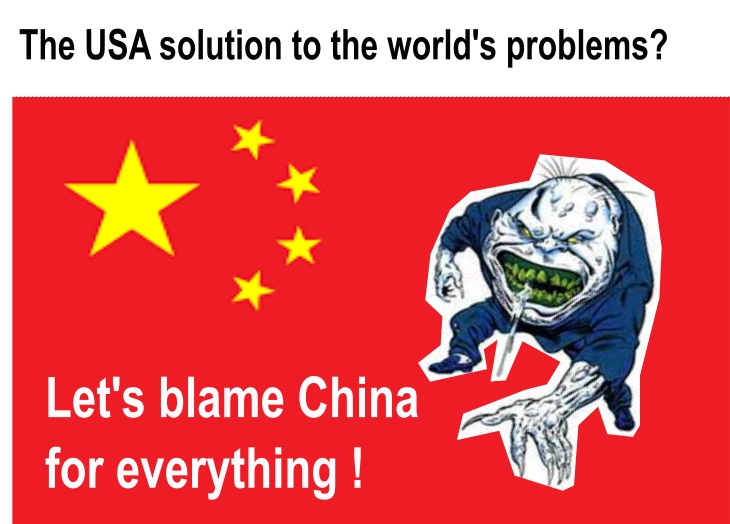
Link to Geopolitical Challenges?
Australia’s investments in advanced submarine technology are linked to the geopolitical challenges posed by a rising China in the Asia-Pacific region. These developments are part of efforts to maintain military capabilities and respond to regional security concerns.
nfluence of AI
AI technology is influencing the development of various military capabilities, including autonomous weapons, fighter drones, swarming aerial drones, and ground combat vehicles. AI is also playing a role in data analysis and decision support for military commanders.
The AI technology arms race has high stakes in terms of military dominance and geopolitical influence. Winning the race could reshape the global political and economic order, with potential consequences for peace and stability in the Asia-Pacific region.
Challenges of AI
Challenges and concerns include the potential for AI-driven robots to make lethal decisions independently, the need for regulation related to the military application of AI, and the ethical considerations of using AI in warfare, including the targeting of combatants and non-combatants.
Private Sector’s Role
Private companies like Anduril are actively involved in developing AI-powered military technologies. They are contributing to the development of autonomous systems, sensor fusion, computer vision, edge computing, and AI, with applications in various defense domains, including submarines, drones, and counter-drone systems.
Educating the US Imperium: Australia’s Mission for Assange

Then there is the issue of whether the delegation’s urgings will have any purchase beyond being a performing flea act. US State Department officials remain glacial in their dismissal of Canberra’s “enough is enough” concerns and defer matters to the US Department of Justice. The unimpressive ambassador Kennedy has been the perfect barometer of this sentiment: host Australian MPs for lunch, keep up appearances, listen politely and ignore their views. Such is the relationship between lord and vassal.
September 6, 2023 Dr Binoy Kampmark https://theaimn.com/educating-the-us-imperium-australias-mission-for-assange/
An odder political bunch you could not find, at least when it comes to pursuing a single goal. Given that the goal is the release of WikiLeaks publisher Julian Assange makes it all the more striking. Six Australian parliamentarians of various stripes will be heading to Washington ahead of Prime Minister Anthony Albanese’s October visit to test the ground of empire, maybe even plant a few seeds of doubt, about why the indictment against their countryman should be dropped.
That indictment, an outrageous, piffling shambles of a document comprising 18 charges, 17 based on that nasty, brutish statute, the Espionage Act of 1917, risks earning Assange a prison sentence in the order of 175 years. But in any instrumental sense, his incarceration remains ongoing, with the United Kingdom currently acting as prison warden and custodian.
In the politics of his homeland, the icy polarisation that came with Assange’s initial publishing exploits (former Australian Prime Minister Julia Gillard was convinced Cablegate was a crime) has shifted to something almost amounting to a consensus. The cynic will say that votes are in the offing, if not at risk if nothing is done; the principled will argue that enlightenment has finally dawned.
The Australian Prime Minister Anthony Albanese and the Opposition leader, Peter Dutton, agree on almost nothing else but the fact that Assange has suffered enough. In Parliament, the tireless work of the independent MP from Tasmania, Andrew Wilkie, has bloomed into the garrulous Bring Julian Assange Home Parliamentary Group.
The Washington mission, which will arrive in the US on September 20, comprises former deputy prime minister Barnaby Joyce, the scattergun former Nationals leader, Labor MP Tony Zappia, Greens Senators David Shoebridge and Peter Whish-Wilson, Liberal Senator Alex Antic and the competent independent member for Kooyong, Dr. Monique Ryan.
What will be said will hardly be pleasing to the ears of the Washington establishment. Senator Shoebridge, for instance, promises to make the case that Assange was merely telling the truth about US war crimes, hardly music for guardians from Freedom’s Land. Sounding like an impassioned pastor, he will tell his unsuspecting flock “the truth about this prosecution.”
Joyce, however, tried to pour some oil over troubled waters by insisting on ABC News that the delegates were not there “to pick a fight”. He did not necessarily want to give the impression that his views aligned with WikiLeaks. The principles, soundly, were that Assange had not committed any of the alleged offences as a US national, let alone in the United States itself. The material Assange had published had not been appropriated by himself. He had received it from Chelsea Manning, a US military source, “who is now walking the streets as a free person.”
To pursue the indictment to its logical conclusion would mean that Assange, or any journalist for that matter, could be extradited to the US from, say, Australia, for the activities in question. This extraterritorial eccentricity set a “very, very bad precedent”, and it was a “duty” to defend his status as an Australian citizen.
The Nationals MP also noted, rather saliently, that Beijing was currently interested in pursuing four Chinese nationals on Australian soil for a number of alleged offences that did not, necessarily, have a nexus to Chinese territory. Should Australia now extradite them as a matter of course? (The same observation has been made by an adviser to the Assange campaign, Greg Barns SC: “You’ve got China using the Assange case as a sort of moral equivalence argument.”)
Broadly speaking, the delegation is hoping to draw attention to the nature of publishing itself and the risks posed to free speech and the journalistic craft by the indictment. But there is another catch. In Shoebridge’s words, the delegates will also remind US lawmakers “that one of their closest allies sees the treatment of Julian Assange as a key indicator on the health of the bilateral relationship.”
Ryan expressed much the same view. “Australia is an excellent friend of the US and it’s not unreasonable to request to ask the US to cease this extradition attempt on Mr Assange.” The WikiLeaks founder was “a “journalist; he should not be prosecuted for crimes against journalism.”
While these efforts are laudable, they are also revealing. The first is that the clout of the Albanese government in Washington, on this point, has been minimal. Meekly, the government awaits the legal process in the UK to exhaust itself, possibly leading to a plea deal with all its attendant dangers to Assange. (The recent floating of that idea, based on remarks made by US ambassador to Australia Caroline Kennedy, was scotched by former British diplomat and Assange confidante Craig Murray in an interview with WBAI radio last week.) Best, then, to leave it to a diverse set of politicians representative of the “Australian voice” to convey the message across the pond.
Then there is the issue of whether the delegation’s urgings will have any purchase beyond being a performing flea act. US State Department officials remain glacial in their dismissal of Canberra’s “enough is enough” concerns and defer matters to the US Department of Justice. The unimpressive ambassador Kennedy has been the perfect barometer of this sentiment: host Australian MPs for lunch, keep up appearances, listen politely and ignore their views. Such is the relationship between lord and vassal.
In Washington, the perspective remains ossified, retributive and wrongheaded. Assange is myth and monster, the hacker who pilfered state secrets and compromised US national security; the man who revealed confidential sources and endangered informants; a propagandist who harmed the sweet sombre warriors of freedom by encouraging a new army of whistleblowers and transparency advocates.
Whatever the outcome from this trip, some stirring of hope is at least possible. The recent political movement down under shows that Assange is increasingly being seen less in the narrow context of personality than high principle. Forget whether you know the man, his habits, his inclinations. Remember him as the principle, or even a set of principles: the publisher who, with audacity, exposed the crimes and misdeeds of power; that, in doing so, he is now being hounded and persecuted in a way that will chill global efforts to do something similar.
Lifetime War Abolisher of 2023 award to David Bradbury

September 7, 2023, The AIM Network, By Sandi Keane
The cracks in Labor ranks over AUKUS won’t be going away despite Albanese staring down dissenters at Labor’s national conference. A pitched battle over the choice of submarine base is guaranteed – and now we discover that Albanese has suffered the mother of all brainsnaps: Australia has agreed to set up a weapons-grade nuclear waste dump. At the heart of the resistance to this militarism has been David Bradbury’s documentary film The Road to War (2013).
Last week, Australia’s legendary political filmmaker, David Bradbury, achieved another media milestone with this much-lauded anti-AUKUS documentary, The Road to War. Adding to the list of International and Australian film awards including two Academy-award nominations (Frontline (1979) and Chile Hasta Quando? (1985), his latest documentary won the World BEYOND War’s Individual ‘Lifetime War Abolisher Award’ – named for David Hartsough, who co-founded World BEYOND War in Virginia, USA in 2014.
The creator of 26 documentary films, Bradbury advances our understanding of war, peace, international relations and peace activism. His films have been broadcast around the world on the BBC, PBS, ZDF (Germany), and TF1-France, as well as ABC, SBS and commercial television networks in Australia……………………………………………..
Bradbury shoots his own footage, traveling widely, and seeking out people with uncomfortable truths to tell – sometimes at great risk. Bradbury has filmed in Iran during the final days of the Shah, in Nicaragua during the CIA-Contra war, and in El Salvador during the days of death squads during the early 1980s. His film on Pinochet’s Chile, Chile Hasta Quando? (1985) was nominated for an Academy Award. He has filmed independence struggles in East Timor and West Papua, and in India, China, and Nepal.
In The Road to War, concern is raised among the Australian experts interviewed by Bradbury about Australia’s AUKUS commitment of hundreds of billions of dollars for new weaponry, nuclear propelled submarines and stealth bombers – to protect us against our biggest trading partner – China. Yes, China. The film shows why it is not in Australia’s, or the world’s interests to be dragged into another US-led war and brings into sharp focus that Australia is being set up as USA’s proxy:
“Basing US B52 and stealth bombers in Australia is all part of preparing Australia to be the protagonist on behalf of the United States in a war against China. If the US can’t get Taiwan to be the proxy or its patsy, it will be Australia,” warns former Australian ambassador to China and Iran, John Lander, in Bradbury’s film.
We all appreciate the Labor Government was still on its toddler legs when it signed the AUKUS agreement and had only 24 hours to decide – or be wedged on Defence by the Coalition in the 2019 federal election.
But the cracks in Labor ranks won’t be going away despite Albanese staring down dissenters at Labor’s national conference and enshrining the tripartite security pact in the party’s policy platform. A pitched battle over the choice of submarine base is guaranteed – and now we discover that Albanese has suffered the mother of all brainsnaps: Australia has agreed to set up a weapons-grade nuclear waste dump. According to the Fact Sheet: Trilateral Australia-UK-US Partnership on Nuclear-Powered Submarines:
“… as part of this commitment to nuclear stewardship, Australia has committed to managing all radioactive waste generated through its nuclear-powered submarine program, including spent nuclear fuel, in Australia.”
Who knew about that? Hats off to Crikey for disclosing the secret no-one is talking about. Where was the spirited public debate about which port such terrorist “bait” will be shipped to, how it would be transported? By truck? Train? Where to? Given the Coalition has had a nuclear waste dump on the back burner for decades, Maralinga is the likely bet.

The lack of debate now resembles the barely reported signing of the Global Nuclear Energy Partnership (GNEP) by Prime Minister John Howard on 5 September 2007. Had the Coalition won the 2007 election on 24 November, Australia was on track to become a global nuclear waste dump. Did anyone know about it then? Like now, it went under the media radar. MSM were MIA.
Back then, Howard had control of both houses. All the ducks were in a row. The Commonwealth Radioactive Waste Management Bill 2005 had passed effectively transferring power to the Minister to nominate nuclear waste dump sites. The ANSTO Bill passed around the same time giving ANSTO the power to accept waste generated outside Australia.
Maralinga in South Australia seemed to tick all the boxes. But they forgot that nuclear waste produces hydrogen when it eventually breaks down and Maralinga is sited right on top of the Great Artesian Basin.
John Large, whose company, Large & Associates handled the salvage of the stricken Russian U-sub, Kursk, told Julie Macken in an interview in New Matilda on 15 November 2006 that when the waste breaks down, it produces hydrogen and “there is simply no way, over a 100,000-year time scale, to stop the fuel leaking out.”
Large was shocked to hear that Australia wanted to go down this path. Question is: “are we about to do just that?”……………………………………………………..
The 2023 War Abolisher Awards and the video of David Bradbury’s acceptance speech can be accessed on the website at War Abolisher Awards.
War Abolisher awardees are honoured for their body of work directly supporting one or more of the three segments of World BEYOND War’s strategy for reducing and eliminating war as outlined in the book A Global Security System, An Alternative to War. They are: Demilitarizing Security, Managing Conflict Without Violence, and Building a Culture of Peace.
You can view a clip from The Road to War below:
Bradbury’s films can be viewed at Frontline Films.
For further information, email david@frontlinefilms.com.au
Editor’s Note: The next showing of Bradbury’s film is scheduled for 21 September at ANU Film Club, Canberra. A variation of this article was published in Pearls and Irritations on 3 September, 2023. https://theaimn.com/lifetime-war-abolisher-of-2023-award-to-david-bradbury/
Australian Teachers in boycott of nuclear submarine project

The Australian: https://www.theaustralian.com.au/nation/teachers-to-ban-indoctrination-on-nuclear-submarines/news-story/d7d7c434d3f4ec2982fb52063eecf1a3?amp
The Australian Education Union will meet to discuss boycotting a science experiment that would see students design nuclear-powered submarines.
By natasha bita. August 29, 2023 The Australian: https://www.theaustralian.com.au/nation/teachers-to-ban-indoctrination-on-nuclear-submarines/news-story/d7d7c434d3f4ec2982fb52063eecf1a3?amp
Pacifist teachers are boycotting a Defence Department “brainwashing’’ program that asks children to design nuclear-powered submarines.
The Australian Education Union federal executive will meet this week to consider a national boycott of the science project, which requires high school students to design a nuclear-powered propulsion system for a submarine.
The union is furious that the Albanese government is spending $368bn on AUKUS nuclear-powered submarines at a time when most public schools are receiving less money than they were supposed to under the Gonski needs-based funding deal.
At a grassroots level, some teachers are boycotting the Nuclear-Powered Propulsion Challenge, which was launched by Deputy Chief of Navy Rear Admiral Jonathon Earley in June as a science, technology, engineering and maths competition.
The controversial STEM challenge asks students to work in teams to submit engineering plans for submarine nuclear propulsion.
Defence devised the program “to inspire students to discover how nuclear propulsion works and how it makes submarines more capable’’.
Winning students from each state and territory will visit HMAS Stirling in Western Australia, tour a Collins-class submarine, dine with submariners and use a training simulator to “drive” a submarine through Sydney Harbour.
AEU branch meetings in Victoria have resolved to block the project in schools, and environmental group Friends of the Earth is now pushing for a national boycott.
Friends of the Earth nuclear-free co-ordinator Sanne de Swart said the Defence Department had made a “blatant attempt to normalise nuclear power and indoctrinate children into building instruments of death’’.
She said the STEM project was “indoctrinating” students and failed to address the health and environmental risks of nuclear power.
“It fails to acknowledge Australia’s significant and devastating history with nuclear, including the atomic bomb tests, uranium mining and the attempts to impose nuclear waste dumps,’’ she said.
Union members at Virtual School Victoria voted to condemn the program.
“We resolve to refuse to refer students to this program or others like it, and we will refuse to promote it within our schools,’’ the branch stated.
A union meeting of public school teachers in the regional Victorian town of Benalla also called on the state’s Education Department to “cease all involvement in this and similar programs’’.
“The government spending of $368bn on AUKUS nuclear submarines will require whole new industries in Australia, and beginning to draw our brightest teenage students into a war industry is outrageous,’’ their motion states. “A politicised pro-AUKUS curriculum has no place in our schools.’’
Melbourne primary school teacher Emma Kefford is planning to vote for a boycott at a meeting of the AUE’s inner-city branch on Thursday. She said she was “pretty disturbed’’ that the Defence Department was providing curriculum material to schools.
“I think it contradicts some of the other values in the Australian curriculum,’’ she said. “These inventions seem pretty exciting to young people, but they’re often removed from the realities of war and the horrors it entails.’’
The Victorian Education Department promotes the challenge on its website, saying: “We’re encouraging schools to register teams of 3 to 5 students to work together on the project.’’
The South Australian government also promotes the program on its website, as a way to “get young Australian minds thinking like engineers and scientists, by completing activities based on nuclear submarine engineering’’.
A spokesman for federal Education Minister Jason Clare said he did not share the concerns. The Defence Department was asked how many schools were participating but did not respond.
1 This Month

To see nuclear-related stories in greater depth and intensity – go to https://nuclearinformation.wordpress.com
-
Archives
- September 2026 (194)
- August 2026 (330)
- July 2026 (355)
- June 2026 (287)
- May 2026 (306)
- April 2026 (356)
- March 2026 (251)
- February 2026 (267)
- January 2026 (308)
- December 2025 (358)
- November 2025 (359)
- October 2025 (375)
-
Categories
- 1
- 1 NUCLEAR ISSUES
- business and costs
- climate change
- culture and arts
- ENERGY
- environment
- health
- history
- indigenous issues
- Legal
- marketing of nuclear
- media
- opposition to nuclear
- PERSONAL STORIES
- politics
- politics international
- Religion and ethics
- safety
- secrets,lies and civil liberties
- spinbuster
- technology
- Uranium
- wastes
- weapons and war
- Women
- 2 WORLD
- ACTION
- AFRICA
- Atrocities
- AUSTRALIA
- Christina's notes
- Christina's themes
- culture and arts
- Events
- Fuk 2022
- Fuk 2023
- Fukushima 2017
- Fukushima 2018
- fukushima 2019
- Fukushima 2020
- Fukushima 2021
- general
- global warming
- Humour (God we need it)
- Nuclear
- RARE EARTHS
- Reference
- resources – print
- Resources -audiovicual
- Weekly Newsletter
- World
- World Nuclear
- YouTube
-
RSS
Entries RSS
Comments RSS
 nuclear-news