Australia: Sovereignty mocked in the ‘proxy war’ in Ukraine
By William Briggs | 11 September 2023 https://independentaustralia.net/politics/politics-display/sovereignty-mocked-in-the-proxy-war-in-ukraine,17887
The cliché that truth is the first casualty of war may be a tired one but it is still true.
But in the war in Ukraine, if truth loses out, then hypocrisy is surely the biggest winner. The war shows this to be the case. Sides get taken in war. The protagonist states win allies to their banner. Third-party countries quickly “prove” to their people that right rests with one side or another. The media quickly step in to do their bit and heaven help any dissenting voice. Such has been the trajectory of the protracted war in Ukraine.
Our own government, in close alignment with the USA, NATO and the majority of the West, quickly made the determination that it was a relatively black-and-white affair. There is a “goody” and a “baddy” and that is as much as the people need to know. The media speak with one voice. There is more than a hint of Animal Farm in this. ‘Four legs good, too legs bad.’ Russia, we must believe, invaded Ukraine to grab territory, to grow an empire, and to return to a faded imperial past.
The courageous Ukrainian people, we must believe, are yearning for freedom, for justice and so they fight back to preserve democracy. It is a nice story, but as more and more authoritative but “dissident” voices have shown, there is a whole lot more to it than cheap slogans.
Three names among these “dissidents” stand out in the current propagandised media world. Seymour Hersch, Jeffrey Sachs and John Pilger. It is a terrible indictment on how distorted reality has become that these most eminent writers and multiple award-winning truth-tellers have been shunted to the sidelines, made virtual pariahs, and ridiculed in some rather important circles.
Who controls the past controls the future: who controls the present controls the past.’ Orwell was warning against the rise of authoritarianism and of the manipulation of thought. Both seem to have arrived.
Those giant figures have repeatedly stated a simple fact and a fact made more obvious with every passing blood-stained week of this unnecessary war. The fact, which cannot be denied is that the war is a proxy war between the USA, NATO and its allies including Australia on one side, and Russia on the other.
The forces that are waging this war may not have committed battle troops to Ukraine, but they train their forces, both in Ukraine and abroad, have special forces units inside Ukraine, and have spent well over $100 billion on providing materiel to ensure that the war, is, if not won, then will result in the economic and social destruction of Russia. Ukraine, in such a scenario, is simply collateral damage.
The hypocrisy, the propagandising, the manner that collective thought is created and dissent is silenced is complete. This Orwellian view of the world would be questioned by Orwell as being too improbable. No country, regardless of its own worldview is permitted to interact with the “enemy”. There has been much said about whether the government of the Democratic Republic of Korea (DPRK) will or will not enter into an arms deal with Russia.
The DPRK has been effectively the subject of sanctions since 1950. It believes that its existence is only guaranteed by perpetually building a deterrence to attack. It sees almost endless war games and drills close to its borders. It believes its sovereignty; its very existence is threatened. It sees no problem with dealing with an enemy of the United States.
White House security adviser Jake Sullivan in a press briefing promised that if Pyongyang provides weapons to Moscow, it is ‘not going to reflect well on North Korea and they will pay a price for this in the international community’.
The two recalcitrant states in this case are both sovereign nations, are both represented at the United Nations and if such a deal eventuates will be doing no more than what 49 nations are doing in pouring weapons, munitions and expertise into Ukraine to assist in the proxy war.
If the media were not quite so blinkered and committed to their role as propagandists for the war, then such a hypocritical position would be clear. Australian Foreign Minister Penny Wong recently stated that “Russia cannot be allowed to infringe upon another country’s sovereignty”. She is quite right. But in the spirit of hypocrisy and hyperbole, the U.S. pledge to impose all manner of penalties on the DPRK for exercising its own sovereign rights is to admit that the world has run mad.
Australian drones have been used in attacks on Russia. Apparently, this is not an “infringement” of sovereignty.
The war is a fact of life. It is a lamentable fact of life. It would be preferable for the war not to have begun. Reason, logic and humanity would demand that the war end. Every call to sense and humanity has been rejected. The most obvious and possible call came from China and its 12-point peace plan. The USA and its allies would not consider it.
Russia, rightly or not, believes that it is facing an existential crisis. The giants of investigative journalism, who have been all but cancelled, silenced from mainstream media and deemed to be irrelevant agree with the basis of Russia’s claims and are wary of the way this proxy war is being prosecuted. The Ukrainian people have been “sold a pup”. They are being used and manipulated by the West, NATO, and primarily by the USA.
Truth died on day one of this awful war. In its place, hypocrisy has unfurled its banner over the battlefield.
In Australia nuclear energy remains weapon of choice for climate deniers and coal lobby.
ReNeweconomy, Giles Parkinson 11 September 2023
The Nationals, and the Liberal Party coalition partners, are in furious
agreement: They are not the slightest bit serious about strong climate
action, and the only difference between former National leader Barnaby
Joyce and current leader David Littleproud is that Joyce wants to stop the
pretence.
Littleproud, let’s remember, believes that net zero 2050 means
not having to do much any time soon. Like too many corporates, and the
fossil fuel industry in particular, it’s an excuse to sit around and do
nothing – make some grand promises and wait for some new technology to come
along that doesn’t disrupt their business plan. Nuclear, and small modular
reactors, are a perfect tool for this. SMRs don’t exist in any western
country, do not have a licence to exist, and no-one – even in the nuclear
industry – seriously believes they will be in commercial production within
a decade, if then.
Renew Economy 11th Sept 2023
Australia’s Navy Pursues Nuclear Submarines and AI-Powered Ghost Sharks

the potential for AI-driven robots to make lethal decisions independently,
https://www.gktoday.in/australias-navy-pursues-nuclear-submarines-and-ai-powered-ghost-sharks 10 Sept 23
Australia’s Navy is adopting two contrasting approaches to advanced submarine technology to address the challenges posed by a rising China. On one hand, Australia is investing in a costly and slow project to acquire up to 13 nuclear-powered attack submarines. On the other hand, Australia is rapidly developing AI-powered unmanned submarines called “Ghost Sharks,” AI-powered subs will be delivered in the near future, offering a cost-effective and swift solution to enhance naval capabilities. The divergent approaches highlight the transformative impact of automation and AI on modern warfare.
How do the cost and delivery timelines of the nuclear submarines and Ghost Sharks differ?
The nuclear submarines are estimated to cost over AUD$28 billion each and will not be delivered until well past the middle of the century. In contrast, Ghost Sharks have a per-unit cost of just over AUD$23 million and will be delivered by mid-2025.
Significance of the Ghost Shark project
The Ghost Shark project illustrates the transformative impact of automation and AI on modern warfare, offering a cost-effective and swift solution to enhance naval capabilities. Such AI-powered unmanned submarines can operate autonomously, descend to greater depths, and be deployed in large numbers without risking human lives. They offer increased flexibility, cost-effectiveness, and the ability to perform maneuvers that might be impossible for crewed submarines.
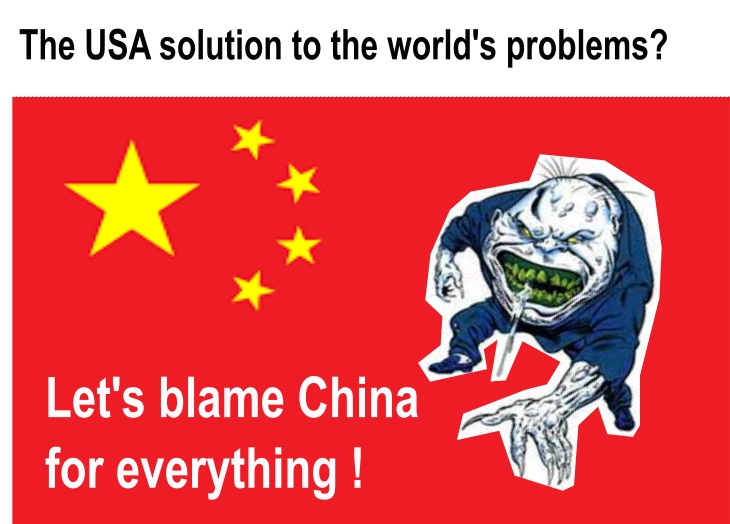
Link to Geopolitical Challenges?
Australia’s investments in advanced submarine technology are linked to the geopolitical challenges posed by a rising China in the Asia-Pacific region. These developments are part of efforts to maintain military capabilities and respond to regional security concerns.
nfluence of AI
AI technology is influencing the development of various military capabilities, including autonomous weapons, fighter drones, swarming aerial drones, and ground combat vehicles. AI is also playing a role in data analysis and decision support for military commanders.
The AI technology arms race has high stakes in terms of military dominance and geopolitical influence. Winning the race could reshape the global political and economic order, with potential consequences for peace and stability in the Asia-Pacific region.
Challenges of AI
Challenges and concerns include the potential for AI-driven robots to make lethal decisions independently, the need for regulation related to the military application of AI, and the ethical considerations of using AI in warfare, including the targeting of combatants and non-combatants.
Private Sector’s Role
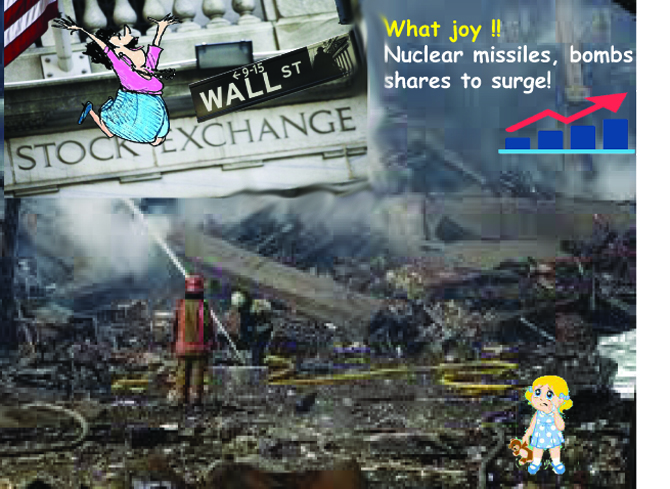
Private companies like Anduril are actively involved in developing AI-powered military technologies. They are contributing to the development of autonomous systems, sensor fusion, computer vision, edge computing, and AI, with applications in various defense domains, including submarines, drones, and counter-drone systems.
Educating the US Imperium: Australia’s Mission for Assange

Then there is the issue of whether the delegation’s urgings will have any purchase beyond being a performing flea act. US State Department officials remain glacial in their dismissal of Canberra’s “enough is enough” concerns and defer matters to the US Department of Justice. The unimpressive ambassador Kennedy has been the perfect barometer of this sentiment: host Australian MPs for lunch, keep up appearances, listen politely and ignore their views. Such is the relationship between lord and vassal.
September 6, 2023 Dr Binoy Kampmark https://theaimn.com/educating-the-us-imperium-australias-mission-for-assange/
An odder political bunch you could not find, at least when it comes to pursuing a single goal. Given that the goal is the release of WikiLeaks publisher Julian Assange makes it all the more striking. Six Australian parliamentarians of various stripes will be heading to Washington ahead of Prime Minister Anthony Albanese’s October visit to test the ground of empire, maybe even plant a few seeds of doubt, about why the indictment against their countryman should be dropped.
That indictment, an outrageous, piffling shambles of a document comprising 18 charges, 17 based on that nasty, brutish statute, the Espionage Act of 1917, risks earning Assange a prison sentence in the order of 175 years. But in any instrumental sense, his incarceration remains ongoing, with the United Kingdom currently acting as prison warden and custodian.
In the politics of his homeland, the icy polarisation that came with Assange’s initial publishing exploits (former Australian Prime Minister Julia Gillard was convinced Cablegate was a crime) has shifted to something almost amounting to a consensus. The cynic will say that votes are in the offing, if not at risk if nothing is done; the principled will argue that enlightenment has finally dawned.
The Australian Prime Minister Anthony Albanese and the Opposition leader, Peter Dutton, agree on almost nothing else but the fact that Assange has suffered enough. In Parliament, the tireless work of the independent MP from Tasmania, Andrew Wilkie, has bloomed into the garrulous Bring Julian Assange Home Parliamentary Group.
The Washington mission, which will arrive in the US on September 20, comprises former deputy prime minister Barnaby Joyce, the scattergun former Nationals leader, Labor MP Tony Zappia, Greens Senators David Shoebridge and Peter Whish-Wilson, Liberal Senator Alex Antic and the competent independent member for Kooyong, Dr. Monique Ryan.
What will be said will hardly be pleasing to the ears of the Washington establishment. Senator Shoebridge, for instance, promises to make the case that Assange was merely telling the truth about US war crimes, hardly music for guardians from Freedom’s Land. Sounding like an impassioned pastor, he will tell his unsuspecting flock “the truth about this prosecution.”
Joyce, however, tried to pour some oil over troubled waters by insisting on ABC News that the delegates were not there “to pick a fight”. He did not necessarily want to give the impression that his views aligned with WikiLeaks. The principles, soundly, were that Assange had not committed any of the alleged offences as a US national, let alone in the United States itself. The material Assange had published had not been appropriated by himself. He had received it from Chelsea Manning, a US military source, “who is now walking the streets as a free person.”
To pursue the indictment to its logical conclusion would mean that Assange, or any journalist for that matter, could be extradited to the US from, say, Australia, for the activities in question. This extraterritorial eccentricity set a “very, very bad precedent”, and it was a “duty” to defend his status as an Australian citizen.
The Nationals MP also noted, rather saliently, that Beijing was currently interested in pursuing four Chinese nationals on Australian soil for a number of alleged offences that did not, necessarily, have a nexus to Chinese territory. Should Australia now extradite them as a matter of course? (The same observation has been made by an adviser to the Assange campaign, Greg Barns SC: “You’ve got China using the Assange case as a sort of moral equivalence argument.”)
Broadly speaking, the delegation is hoping to draw attention to the nature of publishing itself and the risks posed to free speech and the journalistic craft by the indictment. But there is another catch. In Shoebridge’s words, the delegates will also remind US lawmakers “that one of their closest allies sees the treatment of Julian Assange as a key indicator on the health of the bilateral relationship.”
Ryan expressed much the same view. “Australia is an excellent friend of the US and it’s not unreasonable to request to ask the US to cease this extradition attempt on Mr Assange.” The WikiLeaks founder was “a “journalist; he should not be prosecuted for crimes against journalism.”
While these efforts are laudable, they are also revealing. The first is that the clout of the Albanese government in Washington, on this point, has been minimal. Meekly, the government awaits the legal process in the UK to exhaust itself, possibly leading to a plea deal with all its attendant dangers to Assange. (The recent floating of that idea, based on remarks made by US ambassador to Australia Caroline Kennedy, was scotched by former British diplomat and Assange confidante Craig Murray in an interview with WBAI radio last week.) Best, then, to leave it to a diverse set of politicians representative of the “Australian voice” to convey the message across the pond.
Then there is the issue of whether the delegation’s urgings will have any purchase beyond being a performing flea act. US State Department officials remain glacial in their dismissal of Canberra’s “enough is enough” concerns and defer matters to the US Department of Justice. The unimpressive ambassador Kennedy has been the perfect barometer of this sentiment: host Australian MPs for lunch, keep up appearances, listen politely and ignore their views. Such is the relationship between lord and vassal.
In Washington, the perspective remains ossified, retributive and wrongheaded. Assange is myth and monster, the hacker who pilfered state secrets and compromised US national security; the man who revealed confidential sources and endangered informants; a propagandist who harmed the sweet sombre warriors of freedom by encouraging a new army of whistleblowers and transparency advocates.
Whatever the outcome from this trip, some stirring of hope is at least possible. The recent political movement down under shows that Assange is increasingly being seen less in the narrow context of personality than high principle. Forget whether you know the man, his habits, his inclinations. Remember him as the principle, or even a set of principles: the publisher who, with audacity, exposed the crimes and misdeeds of power; that, in doing so, he is now being hounded and persecuted in a way that will chill global efforts to do something similar.
Lifetime War Abolisher of 2023 award to David Bradbury

September 7, 2023, The AIM Network, By Sandi Keane
The cracks in Labor ranks over AUKUS won’t be going away despite Albanese staring down dissenters at Labor’s national conference. A pitched battle over the choice of submarine base is guaranteed – and now we discover that Albanese has suffered the mother of all brainsnaps: Australia has agreed to set up a weapons-grade nuclear waste dump. At the heart of the resistance to this militarism has been David Bradbury’s documentary film The Road to War (2013).
Last week, Australia’s legendary political filmmaker, David Bradbury, achieved another media milestone with this much-lauded anti-AUKUS documentary, The Road to War. Adding to the list of International and Australian film awards including two Academy-award nominations (Frontline (1979) and Chile Hasta Quando? (1985), his latest documentary won the World BEYOND War’s Individual ‘Lifetime War Abolisher Award’ – named for David Hartsough, who co-founded World BEYOND War in Virginia, USA in 2014.
The creator of 26 documentary films, Bradbury advances our understanding of war, peace, international relations and peace activism. His films have been broadcast around the world on the BBC, PBS, ZDF (Germany), and TF1-France, as well as ABC, SBS and commercial television networks in Australia……………………………………………..
Bradbury shoots his own footage, traveling widely, and seeking out people with uncomfortable truths to tell – sometimes at great risk. Bradbury has filmed in Iran during the final days of the Shah, in Nicaragua during the CIA-Contra war, and in El Salvador during the days of death squads during the early 1980s. His film on Pinochet’s Chile, Chile Hasta Quando? (1985) was nominated for an Academy Award. He has filmed independence struggles in East Timor and West Papua, and in India, China, and Nepal.
In The Road to War, concern is raised among the Australian experts interviewed by Bradbury about Australia’s AUKUS commitment of hundreds of billions of dollars for new weaponry, nuclear propelled submarines and stealth bombers – to protect us against our biggest trading partner – China. Yes, China. The film shows why it is not in Australia’s, or the world’s interests to be dragged into another US-led war and brings into sharp focus that Australia is being set up as USA’s proxy:
“Basing US B52 and stealth bombers in Australia is all part of preparing Australia to be the protagonist on behalf of the United States in a war against China. If the US can’t get Taiwan to be the proxy or its patsy, it will be Australia,” warns former Australian ambassador to China and Iran, John Lander, in Bradbury’s film.
We all appreciate the Labor Government was still on its toddler legs when it signed the AUKUS agreement and had only 24 hours to decide – or be wedged on Defence by the Coalition in the 2019 federal election.
But the cracks in Labor ranks won’t be going away despite Albanese staring down dissenters at Labor’s national conference and enshrining the tripartite security pact in the party’s policy platform. A pitched battle over the choice of submarine base is guaranteed – and now we discover that Albanese has suffered the mother of all brainsnaps: Australia has agreed to set up a weapons-grade nuclear waste dump. According to the Fact Sheet: Trilateral Australia-UK-US Partnership on Nuclear-Powered Submarines:
“… as part of this commitment to nuclear stewardship, Australia has committed to managing all radioactive waste generated through its nuclear-powered submarine program, including spent nuclear fuel, in Australia.”
Who knew about that? Hats off to Crikey for disclosing the secret no-one is talking about. Where was the spirited public debate about which port such terrorist “bait” will be shipped to, how it would be transported? By truck? Train? Where to? Given the Coalition has had a nuclear waste dump on the back burner for decades, Maralinga is the likely bet.

The lack of debate now resembles the barely reported signing of the Global Nuclear Energy Partnership (GNEP) by Prime Minister John Howard on 5 September 2007. Had the Coalition won the 2007 election on 24 November, Australia was on track to become a global nuclear waste dump. Did anyone know about it then? Like now, it went under the media radar. MSM were MIA.
Back then, Howard had control of both houses. All the ducks were in a row. The Commonwealth Radioactive Waste Management Bill 2005 had passed effectively transferring power to the Minister to nominate nuclear waste dump sites. The ANSTO Bill passed around the same time giving ANSTO the power to accept waste generated outside Australia.
Maralinga in South Australia seemed to tick all the boxes. But they forgot that nuclear waste produces hydrogen when it eventually breaks down and Maralinga is sited right on top of the Great Artesian Basin.
John Large, whose company, Large & Associates handled the salvage of the stricken Russian U-sub, Kursk, told Julie Macken in an interview in New Matilda on 15 November 2006 that when the waste breaks down, it produces hydrogen and “there is simply no way, over a 100,000-year time scale, to stop the fuel leaking out.”
Large was shocked to hear that Australia wanted to go down this path. Question is: “are we about to do just that?”……………………………………………………..
The 2023 War Abolisher Awards and the video of David Bradbury’s acceptance speech can be accessed on the website at War Abolisher Awards.
War Abolisher awardees are honoured for their body of work directly supporting one or more of the three segments of World BEYOND War’s strategy for reducing and eliminating war as outlined in the book A Global Security System, An Alternative to War. They are: Demilitarizing Security, Managing Conflict Without Violence, and Building a Culture of Peace.
You can view a clip from The Road to War below:
Bradbury’s films can be viewed at Frontline Films.
For further information, email david@frontlinefilms.com.au
Editor’s Note: The next showing of Bradbury’s film is scheduled for 21 September at ANU Film Club, Canberra. A variation of this article was published in Pearls and Irritations on 3 September, 2023. https://theaimn.com/lifetime-war-abolisher-of-2023-award-to-david-bradbury/
Australian Teachers in boycott of nuclear submarine project

The Australian: https://www.theaustralian.com.au/nation/teachers-to-ban-indoctrination-on-nuclear-submarines/news-story/d7d7c434d3f4ec2982fb52063eecf1a3?amp
The Australian Education Union will meet to discuss boycotting a science experiment that would see students design nuclear-powered submarines.
By natasha bita. August 29, 2023 The Australian: https://www.theaustralian.com.au/nation/teachers-to-ban-indoctrination-on-nuclear-submarines/news-story/d7d7c434d3f4ec2982fb52063eecf1a3?amp
Pacifist teachers are boycotting a Defence Department “brainwashing’’ program that asks children to design nuclear-powered submarines.
The Australian Education Union federal executive will meet this week to consider a national boycott of the science project, which requires high school students to design a nuclear-powered propulsion system for a submarine.
The union is furious that the Albanese government is spending $368bn on AUKUS nuclear-powered submarines at a time when most public schools are receiving less money than they were supposed to under the Gonski needs-based funding deal.
At a grassroots level, some teachers are boycotting the Nuclear-Powered Propulsion Challenge, which was launched by Deputy Chief of Navy Rear Admiral Jonathon Earley in June as a science, technology, engineering and maths competition.
The controversial STEM challenge asks students to work in teams to submit engineering plans for submarine nuclear propulsion.
Defence devised the program “to inspire students to discover how nuclear propulsion works and how it makes submarines more capable’’.
Winning students from each state and territory will visit HMAS Stirling in Western Australia, tour a Collins-class submarine, dine with submariners and use a training simulator to “drive” a submarine through Sydney Harbour.
AEU branch meetings in Victoria have resolved to block the project in schools, and environmental group Friends of the Earth is now pushing for a national boycott.
Friends of the Earth nuclear-free co-ordinator Sanne de Swart said the Defence Department had made a “blatant attempt to normalise nuclear power and indoctrinate children into building instruments of death’’.
She said the STEM project was “indoctrinating” students and failed to address the health and environmental risks of nuclear power.
“It fails to acknowledge Australia’s significant and devastating history with nuclear, including the atomic bomb tests, uranium mining and the attempts to impose nuclear waste dumps,’’ she said.
Union members at Virtual School Victoria voted to condemn the program.
“We resolve to refuse to refer students to this program or others like it, and we will refuse to promote it within our schools,’’ the branch stated.
A union meeting of public school teachers in the regional Victorian town of Benalla also called on the state’s Education Department to “cease all involvement in this and similar programs’’.
“The government spending of $368bn on AUKUS nuclear submarines will require whole new industries in Australia, and beginning to draw our brightest teenage students into a war industry is outrageous,’’ their motion states. “A politicised pro-AUKUS curriculum has no place in our schools.’’
Melbourne primary school teacher Emma Kefford is planning to vote for a boycott at a meeting of the AUE’s inner-city branch on Thursday. She said she was “pretty disturbed’’ that the Defence Department was providing curriculum material to schools.
“I think it contradicts some of the other values in the Australian curriculum,’’ she said. “These inventions seem pretty exciting to young people, but they’re often removed from the realities of war and the horrors it entails.’’
The Victorian Education Department promotes the challenge on its website, saying: “We’re encouraging schools to register teams of 3 to 5 students to work together on the project.’’
The South Australian government also promotes the program on its website, as a way to “get young Australian minds thinking like engineers and scientists, by completing activities based on nuclear submarine engineering’’.
A spokesman for federal Education Minister Jason Clare said he did not share the concerns. The Defence Department was asked how many schools were participating but did not respond.
Only Idiots Believe The US Is Protecting Australia From China
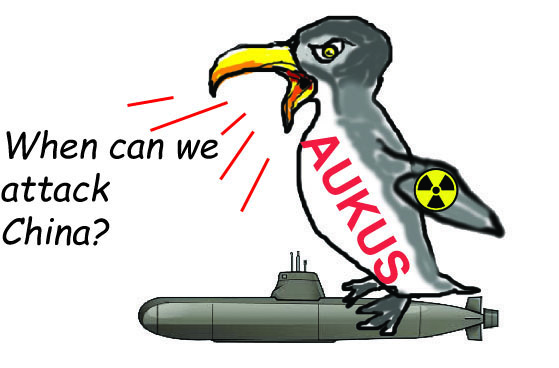
CAITLIN JOHNSTONE, AUG 29, 2023 https://www.caitlinjohnst.one/p/only-idiots-believe-the-us-is-protecting?utm_source=substack&utm_medium=email
The Economist has taken a keen interest in Australia lately, which if you know anything about The Economist is something you never want to see happen to your country. Two articles published in the last few days by the notorious propaganda outlet have celebrated the fact that Australia appears to be the most likely nation to follow the United States into a hot war with China as it enmeshes itself further and further with the US war machine.
In “How Joe Biden is transforming America’s Asian alliances,” The Economist writes the following:
Meanwhile, the ‘unbreakable’ defence relationship with Australia is deepening, following the AUKUS agreement struck in March, amid a flurry of equipment deals and military exercises. Should war break out with China, the Aussies seem the most willing to fight at America’s side. Australian land, sea and air bases are expanding to receive more American forces. Under the AUKUS deal, Australia is gaining its own long-range weapons, such as nuclear-powered (but not nuclear-armed) submarines to be developed jointly with America and Britain. The three partners want to work on other military technologies, from hypersonic missiles to underwater drones.
“Taken together the ‘latticework’ of security agreements, shows how America’s long-heralded pivot to Asia is accelerating.”
In “Australia is becoming America’s military launch-pad into Asia,” The Economist elaborates upon this war partnership with tumescent enthusiasm, calling it a “mateship” and likening it to a “marriage”, and calling for a rollback of US restrictions on sharing military technology with Australia.
“If America ever goes to war with China, American officials say the Aussies would be the likeliest allies to be fighting with them,” The Economist gushes, adding, “Australia’s geographical advantage is that it lies in what strategists call a Goldilocks zone: well-placed to help America to project power into Asia, but beyond the range of most of China’s weapons. It is also large, which helps America scatter its forces to avoid giving China easy targets.”
The Economist cites White House “Asia Tsar” Kurt Campbell reportedly saying of Australia, “We have them locked in now for the next 40 years.”
“Equally, though, Australia may have America locked in for the same duration,” The Economist hastens to add.
Well gosh, that’s a relief.
“How the world sees us,” tweeted former Australian foreign minister Bob Carr when sharing the Economist article.
“Historians will be absolutely baffled by what’s happening in Australia right now: normally countries never voluntarily relinquish their sovereignty and worsen their own security position out of their own accord. They normally have to lose a war and be forced to do so,” commentator Arnaud Bertrand added to Carr’s quip.
As much as it pains me to admit it, The Economist is absolutely correct. The Australian government has been showing every indication that it is fully willing to charge into a hot war with its top trading partner to please its masters in Washington, both before and after the US puppet regime in Canberra changed hands last year.
This sycophantic war-readiness was humorously mocked on Chinese state media back in 2021 by Impact Asia Capital co-founder Charles Liu, who said he didn’t think the US will actually fight a war with China over Taiwan, but the Australians might be stupid enough to fight it for them.
“US is not going to fight over Taiwan,” Liu said. “It’s not going to conduct a war over Taiwan. They may try to get Japanese to do it, but Japanese won’t be so stupid to do it. The only stupid ones who might get involved are the Australians, sorry.”
He had nothing to be sorry about; he was right. Australians are being very, very stupid, and not just our government. A recent Lowy Institute poll found that eight in ten Australians believe the nation’s alliance with the United States is important for Australia’s security, despite three-quarters also saying they believe the alliance makes Australia more likely to be drawn into a war in Asia.
That’s just plain stupid. A war with China is the absolute worst case security scenario for Australia; anything that makes war with China more likely is making us less secure. Making bad decisions which hurt your own interests is what stupid people do.
That’s not to say Australians are naturally dimwitted; we’re actually pretty clever as far as populations go. What’s making us stupid in this case is the fact that our nation has the most concentrated media ownership in the western world, a massive chunk of which is owned by longtime US empire asset Rupert Murdoch. This propaganda-conducive information environment has been distorting Australia’s understanding of the world so pervasively in recent years that on more than one occasion I’ve had total strangers start babbling at me about the dangers of China completely out of nowhere within minutes of striking up conversation with them.
This artificially manipulated information ecosystem has made Australians so pants-on-head idiotic that they think the US empire is filling their country up with war machinery because it loves them and wants to protect them from the Chinese. That’s as stupid as it gets.
The single biggest lie being circulated in Australia right now is that our government is militarising against China as a defensive measure. China has literally zero history of invading and occupying countries on the other side of the planet. You know who does have a very extensive history of doing that? The United States. The military superpower that Australia’s military is becoming increasingly intertwined with. The belief that we’re intertwining ourselves with the world’s most aggressive, destructive and war-horny military force as a defensive measure to protect ourselves against that military force’s top rival (who hasn’t dropped a bomb in decades) is transparently false, and only a complete idiot would believe it.
We’re not militarising to defend ourselves against a future attack by China, we’re militarising in preparation for a future US-led attack on the Chinese military. We’re militarising in preparation to involve ourselves in an unresolved civil war between Chinese people that has nothing to do with us. China has been sorting out its own affairs for millennia and has managed to do so just fine without the help of white people running in firing military explosives at them, and Taiwan is no exception.
The imperial media talk nonstop about how the People’s Republic of China is preparing to seize control of Taiwan using military force, without ever mentioning the fact that that’s exactly what the US empire is doing. The US empire is preparing to wrest Taiwan away from China to facilitate its long-term agenda to balkanize, weaken and subjugate its top rival.
Only a complete blithering imbecile would believe any part of this is being done defensively. It’s being done to secure unipolar planetary domination for the world’s most powerful and destructive government, and only an absolute moron would agree to risk their own country’s security and economic interests to help facilitate it.
TEACHERS ACT AGAINST SCHOOLS NUCLEAR SUBMARINES PROGRAM

the normalisation of militarisation and downplaying of nuclear risks in schools is a grave concern.
“Nuclear and military aspects in the curriculum fail to address health and environmental risks associated with both, as well as the drive to war,”
Education. 28 Aug 2023 https://www.nationaltribune.com.au/teachers-act-against-schools-nuclear-subs-program/
Children being taught to make weapons
Teachers are moving to boycott a new pro-nuclear-fuel brainwashing program being introduced into schools.
There’s growing momentum within unions to ban the Nuclear-powered Submarine Propulsion Challenge, which is a Defence Department initiative backed by the Federal and Victorian governments.
In a blatant attempt to normalise nuclear power and indoctrinate children into building instruments of death, the challenge asks students from years 7 to 12 to design a nuclear-powered propulsion system for a submarine.
Friends of the Earth (FoE) understands that motions calling for a boycott have already been passed in some chapters of the Australian Education Union.
One motion, passed at a recent branch meeting said: “We resolve to refuse to refer students to this program or others like it, and we will refuse to promote it within our schools. We call on the Department of Education to cease all involvement in this and similar programs.”
Another said: “We don’t intend to refer students to this program or others like it, or to promote it within our schools. We call on the Department of Education to cease all involvement in this and similar programs.”
Friends of the Earth is supporting the ban and has written to the Australian Education Union asking them to impose a nationwide boycott.
FoE Nuclear Free Coordinator Sanne De Swart said the normalisation of militarisation and downplaying of nuclear risks in schools is a grave concern.
“Nuclear and military aspects in the curriculum fail to address health and environmental risks associated with both, as well as the drive to war,” Sanne De Swart said.
“It fails to acknowledge Australia’s significant and devastating history with nuclear, including the atomic bomb tests, uranium mining and the attempts to impose nuclear waste dumps, all which have and continue to affect First Nations communities disproportionately .”
South-east Australia marine heatwave forecast to be literally off the scale
Australia’s south-east could be in for a marine heatwave that is literally
off the scale, raising the prospect of significant losses in fishing and
aquaculture. The Bureau of Meteorology has forecast a patch of the Tasman
Sea off Tasmania and Victoria could be at least 2.5C above average from
September to February, and it could get hotter.
Guardian 27th Aug 2023
Assange Be Weary: The Dangers of a US Plea Deal

August 18, 2023
By Binoy Kampmark / CounterPunch, https://scheerpost.com/2023/08/18/assange-be-weary-the-dangers-of-a-us-plea-deal/
At every stage of its proceedings against Julian Assange, the US Imperium has shown little by way of tempering its vengeful impulses. The WikiLeaks publisher, in uncovering the sordid, operational details of a global military power, would always have to pay. Given the 18 charges he faces, 17 fashioned from that most repressive of instruments, the US Espionage Act of 1917, any sentence is bound to be hefty. Were he to be extradited from the United Kingdom to the US, Assange will disappear into a carceral, life-ending dystopia.
In this saga of relentless mugging and persecution, the country that has featured regularly in commentary, yet done the least, is Australia. Assange may well be an Australian national, but this has generally counted for naught. Successive governments have tended to cower before the bullying disposition of Washington’s power. With the signing of the AUKUS pact and the inexorable surrender of Canberra’s military and diplomatic functions to Washington, any exertion of independent counsel and fair advice will be treated with sneering qualification.
The Albanese government has claimed, at various stages, to be pursuing the matter with its US counterparts with firm insistence. Prime Minister Anthony Albanese has even publicly expressed his frustration at the lack of progress in finding a “diplomatic solution” to Assange’s plight. But such frustrations have been tempered by an acceptance that legal processes must first run their course.
The substance of any such diplomatic solution remains vague. But on August 14, the Sydney Morning Herald, citing US Ambassador to Australia Caroline Kennedy as its chief source, reported that a “resolution” to Assange’s plight might be in the offing. “There is a way to resolve it,” the ambassador told the paper. This could involve a reduction of any charges in favour of a guilty plea, with the details sketched out by the US Department of Justice. In making her remarks, Kennedy clarified that this was more a matter for the DOJ than the State Department or any other department. “So it’s not really a diplomatic issue, but I think there absolutely could be a resolution.”
In May, Kennedy met members of the Parliamentary Friends of Julian Assange Group to hear their concerns. The previous month, 48 Australian MPs and Senators, including 13 from the governing Labor Party, wrote an open letter to the US Attorney General, Merrick Garland, warning that the prosecution “would set a dangerous precedent for all global citizens, journalists, publishers, media organizations and the freedom of the press. It would also be needlessly damaging for the US as a world leader on freedom of expression and the rule of law.”
In a discussion with The Intercept, Gabriel Shipton, Assange’s brother, had his own analysis of the latest developments. “The [Biden] administration appears to be searching for an off-ramp ahead of [Albanese’s] first state visit to DC in October.” In the event one wasn’t found, “we could see a repeat of a very public rebuff delivered by [US Secretary of State] Tony Blinken to the Australian Foreign Minister two weeks ago in Brisbane.”
That rebuff was particularly brutal, taking place on the occasion of the AUSMIN talks between the foreign and defence ministers of both Australia and the United States. On that occasion, Foreign Minister Penny Wong remarked that Australia had made its position clear to their US counterparts “that Mr Assange’s case has dragged for too long, and our desire it be brought to a conclusion, and we’ve said that publicly and you would anticipate that that reflects also the positive we articulate in private.”
In his response, Secretary of State Blinken claimed to “understand” such views and admitted that the matter had been raised with himself and various offices of the US. With such polite formalities acknowledged, Blinken proceeded to tell “our friends” what, exactly, Washington wished to do.
Assange had been “charged with very serious criminal conduct in the United States in connection with his alleged role in one of the largest compromises of classified information in the history of our country. The actions that he has alleged to have committed risked very serious harm to our national security, to the benefit of our adversaries, and put named sources at grave risk – grave risk – of physical harm, and grave risk of detention.”
Such an assessment, lazily assumed, repeatedly rebutted, and persistently disproved, went unchallenged by all the parties present, including the Australian ministers. Nor did any members of the press deem it appropriate to challenge the account. The unstated assumption here is that Assange is already guilty for absurd charges, a man condemned.
At this stage, such deals are the stuff of manipulation and fantasy. The espionage charges have been drafted to inflate, rather than diminish any sentence. Suggestions that the DOJ will somehow go soft must be treated with abundant scepticism. The pursuit of Assange is laced by sentiments of revenge, intended to both inflict harm upon the publisher while deterring those wishing to publish US national security information. As the Australian international law academic Don Rothwell observes, the plea deal may well take into account the four years spent in UK captivity, but is unlikely to either feature a complete scrapping of the charges, or exempt Assange from travelling to the US to admit his guilt. “It’s not possible to strike a plea deal outside the relevant jurisdiction except in the most exceptional circumstances.”
Should any plea deal be successfully reached and implemented, thereby making Assange admit guilt, the terms of his return to Australia, assuming he survives any stint on US soil, will be onerous. In effect, the US would merely be changing the prison warden while adjusting the terms of observation. In place of British prison wardens will be Australian overseers unlikely to ever take kindly to the publication of national security information.
Australia: Civil Society faces imposition of an AUKUS military High Level nuclear waste dump

https://nuclear.foe.org.au/wp-content/uploads/AUKUS-nuclear-waste-David-Noonan-brief-13Aug2023.pdf Updated Briefing by David Noonan, Independent Environment Campaigner 13 August 2023
The Federal ALP belatedly disclosed a secret pre-condition in AUKUS plans to buy existing US nuclear submarines: for Australia to keep the US subs military High Level nuclear waste forever.
In a breach of trust the ALP is seeking to ‘normalise’ High Level nuclear waste in Australia. Claims of
‘nuclear stewardship’ in taking on US nuclear subs and in retaining the US sub wastes are a farce.
Disposal of High Level nuclear waste is globally unprecedented, with our AUKUS ‘partners’ the US
and UK having proven unable to do so in over 60 years since first putting nuclear submarines to sea.
New military Agencies are being set up with an ‘Australian Submarine Agency’ (ASA) set up to:
“enable the necessary policy, legal, non-proliferation, workforce, security and safety arrangements”.
A new military nuclear regulator, the statutory ‘Australian Nuclear-Powered Submarine Safety
Regulator’ is to be established. Both Agencies will report directly to the Minister for Defence.
An array of federal legislation is required to manage nuclear submarines, supporting infrastructure
and facilities, from acquisition through to disposal. The Reforming Defence Legislation Review
proposes to take on Defence Act powers to override State and Territory legislation to ‘provide
certainty’ to Defence roles, operations and facilities.

Minister for Defence Richard Marles MP has stated there will be ‘an announcement’ by early 2024 on
a process to manage High Level nuclear waste and to site a waste disposal facility, saying “obviously
that facility will be remote from populations” (ABC News 15 March 2023).
Defence is already working to identify potential nuclear waste disposal sites. Political leaders in WA,
Queensland and Victoria have rejected a High Level nuclear waste disposal site. The SA Labor
Premier has so far only said it should go to a safe ‘remote’ location in the national interest.
AUKUS compromises public confidence in government and sets up a serious clash with
hcivil society:
- Defence must be transparent and made accountable over AUKUS policy, associated rights and
legal issues, and the proposed High Level nuclear waste dump siting process; - Defence must commit to comply with the United Nations Declaration on the Rights of Indigenous
Peoples Article 29 provision of Indigenous People’s rights to “Free, Prior and Informed Consent”
over storage or disposal of hazardous materials on their lands. - Defence must declare whether the SA Nuclear Waste Storage (Prohibition) Act 2000 is intended
to be over-ridden to impose an AUKUS dump on lands and unwilling community in SA.
The public has a right to know who is targeted and a right to Say No to imposition of nuclear wastes.
The ALP National Platform (2021, Uranium p.96-98) makes a commitment to oppose overseas waste:
- Labor will: 8. d. Remain strongly opposed to the importation and storage of nuclear waste
that is sourced from overseas in Australia.
In contrast, AUKUS proposes Australia buy existing US military nuclear reactors in subs that are to be
up to 10-12 years old, loaded with intractable US origin weapons grade High Level nuclear wastes.
An AUKUS military nuclear dump is likely to be imposed on community in SA or in NT, with override
of State laws, compulsory land acquisition, and disregard for Indigenous Peoples rights to Say No.
Woomera is being targeted as a ‘favoured location’ for an AUKUS nuclear dump, in an
untenable affront to democratic rights in SA and to Indigenous People’s rights
SA community and the Barngarla People have just overcome federal plans to store ANSTO nuclear
fuel wastes and ILW on agricultural land near Kimba that had divided community on Eyre Peninsula.
The Bargarla People won a hard fought court case against the Federal Government that set aside the
Kimba dump siting decision by Coalition Minister Pitt as affected by bias and pre-judgement.
In response, Labor Minister Hon Madeleine King MP decided to not appeal the Judge’s finding of
apprehended bias, saying “The judgement was clear, and the Government is listening.”
The next day the national press reports: “Woomera looms as national nuclear waste dump site
including for AUKUS submarine high-level waste (afr.com) (11 August 2023). The article states the
AFR understands the Woomera rocket range is the ‘favoured location’ for the submarine waste.
The federal gov may also decide to ‘co-locate’ AUKUS submarine waste with ANSTO nuclear fuel
wastes and long lived ILW. However, the regulator says ANSTO wastes can be securely retained at the
Lucas Heights reactor site for decades. An imposed AUKUS dump will discredit any associated plans.
A suite of public interests are already at stake. For instance, which Ports will be requisitioned for
roles in AUKUS nuclear waste plans? (the federal gov previously targeted the Port of Whyalla).
AUKUS nuclear waste dump plans trigger the United Nations Declaration on the Rights of Indigenous
Peoples (adopted by United Nations, Sept 2007) in Indigenous People’s Article 29 rights to “Free,
Prior and Informed Consent” over storage or disposal of hazardous materials on their lands.
Traditional owners must have a right to Say No to nuclear wastes, see “AUKUS nuclear waste dump
must be subject to Indigenous veto” (By Michelle Fahy May 2023): “Bipartisan secrecy and Defence’s
poor record with Indigenous groups at Woomera are red flags for consultations over an AUKUS
nuclear waste dump. Human rights experts say government must establish an Indigenous veto right.”
The “Woomera Protected Area” (WPA) a large Defence weapon testing range in SA had already been
flagged by other State Premiers as a site for a military High Level nuclear waste disposal facility.
Most of the WPA is State owned Crown land and not federal owned Defence lands. Siting a nuclear
dump on the WPA would be imposed through compulsory land acquisition and over-ride of SA laws.
Storage and disposal of nuclear wastes compromises the safety and welfare of the people of South
Australia, that is why it is prohibited by the SA Nuclear Waste Storage (Prohibition) Act 2000.
The Objects of this Act cover public interest issues at stake, to protect our health, safety and welfare:
“The Objects of this Act are to protect the health, safety and welfare of the people of South
Australia and to protect the environment in which they live by prohibiting the establishment
of certain nuclear waste storage facilities in this State.”
Defence are already ignoring Aboriginal Heritage law and contravening protections in SA, see
“Defence bombing Indigenous site in Woomera” (May 2023). Defence is now further ‘angling for
exemption from State laws it admits serve important public purposes’.
The SA Premier is yet to say if he will support an Indigenous right to Say No to an AUKUS dump in SA.
South Australians have a democratic right to decide their own future and to reject an AUKUS dump.
Australian Opposition’s likely embrace of nuclear energy is high-risk politics
Crazy brave, or just crazy? If, as seems likely, the opposition embraces
nuclear power in its 2025 election policy, it will be taking a huge
political gamble. The Coalition might argue this would be the best (or
only) way to ensure we achieve net zero by 2050.
But “nuclear” is a trigger word in the political debate, and the reactions it triggers are
mostly negative. Opposition Leader Peter Dutton has been open since the
election about nuclear energy being on the Coalition’s agenda. It’s a “no
surprises” tactic – but one that has allowed the government, especially
Climate Change Minister Chris Bowen, to regularly attack and ridicule the
idea.
The Conversation 10th Aug 2023
Reducing the risks of nuclear war — the role of health professionals
By – Kamran Abbasi, Parveen Ali, Virginia Barbour, Kirsten Bibbins‐Domingo, Marcel GM Olde Rikkert, Andy Haines, Ira Helfand, Richard C Horton, Bob Mash, Arun Mitra, Carlos A Monteiro, Elena N Naumova, Eric J Rubin, Tilman A Ruff, Peush Sahni, James Tumwine, Paul Yonga and Chris Zielinski
Med J Aust || doi: 10.5694/mja2.52054, 7 August 2023
In January 2023, the Science and Security Board of the Bulletin of the Atomic Scientists moved the hands of the Doomsday Clock forward to 90 s before midnight, reflecting the growing risk of nuclear war.1 In August 2022, the UN Secretary‐General António Guterres warned that the world is now in “a time of nuclear danger not seen since the height of the Cold War”.2 The danger has been underlined by growing tensions between many nuclear armed states.1,3 As editors of health and medical journals worldwide, we call on health professionals to alert the public and our leaders to this major danger to public health and the essential life support systems of the planet — and urge action to prevent it.
Current nuclear arms control and non‐proliferation efforts are inadequate to protect the world’s population against the threat of nuclear war by design, error, or miscalculation. The Treaty on the Non‐Proliferation of Nuclear Weapons (NPT) commits each of the 190 participating nations “to pursue negotiations in good faith on effective measures relating to cessation of the nuclear arms race at an early date and to nuclear disarmament, and on a treaty on general and complete disarmament under strict and effective international control”.4 …………………………………………
Any use of nuclear weapons would be catastrophic for humanity. Even a “limited” nuclear war involving only 250 of the 13 000 nuclear weapons in the world could kill 120 million people outright and cause global climate disruption leading to a nuclear famine, putting 2 billion people at risk.7,8 A large‐scale nuclear war between the USA and Russia could kill 200 million people or more in the near term, and potentially cause a global “nuclear winter” that could kill 5–6 billion people, threatening the survival of humanity.7,8. Once a nuclear weapon is detonated, escalation to all‐out nuclear war could occur rapidly. The prevention of any use of nuclear weapons is therefore an urgent public health priority and fundamental steps must also be taken to address the root cause of the problem — by abolishing nuclear weapons.
The health community has had a crucial role in efforts to reduce the risk of nuclear war and must continue to do so in the future.9 In the 1980s the efforts of health professionals, led by the International Physicians for the Prevention of Nuclear War (IPPNW), helped to end the Cold War arms race by educating policy makers and the public on both sides of the Iron Curtain about the medical consequences of nuclear war. This was recognised when the 1985 Nobel Peace Prize was awarded to the IPPNW (http://www.ippnw.org).10
In 2007, the IPPNW launched the International Campaign to Abolish Nuclear Weapons, which grew into a global civil society campaign with hundreds of partner organisations. A pathway to nuclear abolition was created with the adoption of the Treaty on the Prohibition of Nuclear Weapons in 2017, for which the International Campaign to Abolish Nuclear Weapons was awarded the 2017 Nobel Peace Prize……………………………………………………………..
We now call on health professional associations to inform their members worldwide about the threat to human survival and to join with the IPPNW to support efforts to reduce the near‐term risks of nuclear war, including three immediate steps on the part of nuclear‐armed states and their allies: first, adopt a no first use policy;12 second, take their nuclear weapons off hair‐trigger alert; and, third, urge all states involved in current conflicts to pledge publicly and unequivocally that they will not use nuclear weapons in these conflicts. We further ask them to work for a definitive end to the nuclear threat by supporting the urgent commencement of negotiations among the nuclear‐armed states for a verifiable, timebound agreement to eliminate their nuclear weapons in accordance with commitments in the NPT, opening the way for all nations to join the Treaty on the Prohibition of Nuclear Weapons…………….. more https://www.mja.com.au/journal/2023/219/5/reducing-risks-nuclear-war-role-health-professionals
USA flexes its belligerent muscles in Western Australia, showing off its nuclear submarines

US military shows off nuclear capable submarine in Western Australia By 9News Staff Aug 4, 2023 https://www.9news.com.au/national/us-military-shows-off-nuclear-capable-submarine-in-western-australia/9b152141-2e3f-4a2a-a73f-37b7a02738cb
The United States military is flexing its nuclear fleet of submarines in Western Australia.
The arrival of the USS North Carolina is the first visit since a landmark defence deal was signed earlier this year.
Australia is buying eight of the nuclear-powered Virginia class submarines in a deal costing $368 billion.
Australia’s Ambassador to the US Kevin Rudd was on Garden Island touring the 110-metre vessel which can go three months underwater.
WA will permanently house nuclear subs from next decade.
HMAS Stirling is set for an upgrade as thousands more submariners file through Perth.
The public is not allowed to know how long the North Carolina will be docked in Perth – that information is classified even from Australia’s defence minister.
However, there have been reassurances the AUKUS deal is watertight regardless of who is in the White House.
Advisor to the US secretary of defence Abe Denmark said there has been broad bipartisan support.
Rudd described the move as an opportunity to step up the capabilities of the Royal Australian Navy and the sovereign capabilities of Australia “in a highly uncertain period strategically”.
AUKUS, Australia and the drive to war

By John Minns, Aug 2, 2023 https://johnmenadue.com/aukus-australia-and-the-drive-to-war/
My fear is not that AUKUS SSNs, if they arrive, will be late, ineffective, and obsolete. My fear is that they will arrive and will be effective and even lethal. Because, if that is the case, they will play a part in the drive to a potentially devastating war with China that would be a disaster for the entire world.
This was a speech given at an anti-AUKUS protest at the ANU on 28 July 2023
Friends, I have been proud to have been part of a number of protests against the AUKUS alliance and the nuclear submarine deal that is part of it. However, to be truthful, I haven’t always completely agreed with everything that has been said at them.
I heard at one of the protests a speaker opposing the subs deal because they might never arrive, or might be delivered very late, or that, by then, they would be ineffective and obsolete. Apart from the enormous cost, my concern is not that they will be late or obsolete. My fear is that they will arrive and will be effective and even lethal. Because, if that is the case, they will play a part in the drive to a potentially devastating war with China that would be a disaster for the entire world.
In a war with China – what would victory look like? It would certainly not end, like the Second World War, with allied troops occupying Germany and Japan. Even to imagine Australian, British and US troops patrolling the streets of Shanghai is to realise what a ludicrous prospect that is. China – a vast and nuclear-armed country – is not going to be physically occupied.
Would victory mean that China’s dynamic economy would no longer stock the shelves of Kmart and the like around the world and that it would revert to a poor semi-agricultural country. Hardly – unless it is turned into a nuclear wasteland – it will clearly go on to be the largest economy in the world.
Would victory be the successful defence of Taiwan. Well, China has claimed Taiwan since 1949. But it has made no attempt to invade it. In any case, are we prepared to go to war to defend the independence of a place whose independence we don’t recognise and don’t support. It makes no sense.
Would victory mean that China is prevented from interfering in the affairs of other countries – something which every large or wealthy power does – including Australia in the Asia-Pacific. I study Latin America and, when US politicians talk about China’s interference in the domestic affairs of others, I hear, somewhere in my head, roars of bitterly ironic laughter from all over Latin America. Because the US has interfered in the affairs of every country in Latin America and the Caribbean – instigating coups, supporting military dictatorships, blockading harbours, embargoing trade and even military invasion. And it has done so for the last two hundred years – ever since President James Munro in 1823 proclaimed the doctrine that only the US had the right to interfere in the region.
Would victory mean that so-called Chinese military expansionism is halted. Well, it’s true that China has set up military bases on a number of artificial islands. But the US has around 750 foreign military bases in more than 80 countries. To my knowledge, China has one – in Djibouti. If bases and the ability to project military force is the problem, then China is not the main culprit.
Also, the US spends more on its military than the next 10 countries combined and most of them are US allies.
The chances of being killed by the US military are enormously higher than by any other country. A recent research project from Brown University in the US showed that, since 2001, about 900,000 people have been killed directly by the US military – nearly half of those were civilians. On top of that, what the project calls “the reverberating effects” of US military action – such as famine, destruction of sanitation, health care and other infrastructure has led to several times as many civilian deaths as caused directly.
Would victory in a war with China mean the successful defence of our trade routes and shipping lanes. Where do our trade routes and shipping lanes lead? Largely to China! So, would we fight China to defend our trade with China?
Another thing I’ve heard said that I disagree with is that the AUKUS deal might drag Australia into a war with China. Australia is not being dragged anywhere. The Australian government is eagerly jumping into this alliance – with eyes wide open – rather than being forced into something not of its own making.
There has never been a war conducted by our great and powerful friends that Australia has not been eager to join – whether to the Maori Wars in New Zealand, to Sudan and to South Africa in the 19th century, to the First and Second World Wars, to Korea, Malaysia, Vietnam, Afghanistan and Iraq – twice. We should not be protesting calling for Australia’s independence – it is independent – we should be calling for it to use that independence to help halt the drive to war – rather than to enthusiastically join it.
I’ve heard some on the other side of this argument repeat the old cliché – “if you want peace, prepare for war”. It sounds good – a nice juxtaposition of opposites etc. But it is logical and historical rubbish. It is essentially the argument of the National Rifle Association of America. The NRA says that to be safe, we need to have everyone armed. Security comes from allowing all to buy AR-15 assault rifles. We know how that has worked out in practice. Preparing for war to ensure peace is the same argument on an international scale.
When we look at the great periods of arms build-up, we see that they led to war rather than peace. It was the case with the arms build-up – especially the naval build-up – before World War One, with rearmament in the 1930s, with the Cold War arms economy which was accompanied by very hot and devastating wars – in Vietnam and Korea for example – which were among the most destructive on a per capita basis in modern history..
The world today contains great possibilities. We have the resources and the human ingenuity to deal with some of our real problems – like housing, poverty, health, education, climate. Some of that ingenuity is right here at the ANU. Let us set that ingenuity to the task of solving the real problems which affect our lives and our society rather than to the exacting but grisly science of blowing human bodies apart.
1 This Month

of the week – Shut Down Drone Warfare!


Tell the Ukrainian Government to Drop Prosecution of Peace Activist Yurii Sheliazhenko

Petition to revoke the licensing of the Near Surface Nuclear Disposal Facility (NSDF) at Chalk River. https://www.ourcommons.ca/petitions/en/Petition/Details?Petition=e-7247
To see nuclear-related stories in greater depth and intensity – go to https://nuclearinformation.wordpress.com
-
Archives
- March 2026 (244)
- February 2026 (268)
- January 2026 (308)
- December 2025 (358)
- November 2025 (359)
- October 2025 (376)
- September 2025 (257)
- August 2025 (319)
- July 2025 (230)
- June 2025 (348)
- May 2025 (261)
- April 2025 (305)
-
Categories
- 1
- 1 NUCLEAR ISSUES
- business and costs
- climate change
- culture and arts
- ENERGY
- environment
- health
- history
- indigenous issues
- Legal
- marketing of nuclear
- media
- opposition to nuclear
- PERSONAL STORIES
- politics
- politics international
- Religion and ethics
- safety
- secrets,lies and civil liberties
- spinbuster
- technology
- Uranium
- wastes
- weapons and war
- Women
- 2 WORLD
- ACTION
- AFRICA
- Atrocities
- AUSTRALIA
- Christina's notes
- Christina's themes
- culture and arts
- Events
- Fuk 2022
- Fuk 2023
- Fukushima 2017
- Fukushima 2018
- fukushima 2019
- Fukushima 2020
- Fukushima 2021
- general
- global warming
- Humour (God we need it)
- Nuclear
- RARE EARTHS
- Reference
- resources – print
- Resources -audiovicual
- Weekly Newsletter
- World
- World Nuclear
- YouTube
-
RSS
Entries RSS
Comments RSS
 nuclear-news