Australia moves to prop up Aukus with $4.6bn pledge to help clear Rolls-Royce nuclear reactor bottlenecks in UK

Funding revealed on eve of government talks is in addition to billions of dollars to be sent to US
Guardian, Daniel Hurst in Canberra, 21 Mar 24
The Australian government will seek to prop up the Aukus pact by sending A$4.6bn (£2.4bn) to the UK to clear bottlenecks at the Rolls-Royce nuclear reactor production line.
The funding – revealed on the eve of high-level talks between the Australian and UK governments on Friday – is in addition to billions of dollars that will be sent to the US to smooth over production delays there.
The Australian government will also announce on Friday that the government-owned shipbuilder ASC and the British defence firm BAE Systems will jointly build the nuclear-powered submarines for the Royal Australian Navy.
The nuclear reactors for the boats are to be manufactured at Rolls-Royce in the English city of Derby, but doubts have already been raised about whether reactor cores will be made in time for the UK’s first Dreadnought nuclear submarine.
Australia has now allocated £2.4bn over 10 years to expand the production capacity at Derby to deliver reactors for Australia’s submarines, to be known as SSN-Aukus……………………………………..
Cameron and the UK defence secretary, Grant Shapps, arrived in Canberra on Thursday for talks with their Australian counterparts, Penny Wong and Richard Marles.
They will hold an annual 2+2 meeting in Adelaide on Friday, with Aukus expected to be a major focus along with the war in Ukraine, the conflict in the Middle East and China’s position in the Indo-Pacific…………………..
Marles, the deputy prime minister and defence minister, said at the same media conference that the Australian government was “really aware of the stretched industrial base in the UK and in the US”.

Australia’s commitment to help clear backlogs in the US and the UK “was not without controversy” but was necessary for Aukus to succeed, Marles said.
Under the staged plans announced last March, Australia will buy at least three Virginia-class submarines from the US in the 2030s, prior to the domestically built SSN-Aukus entering into service from the 2040s.
But revelations that the US Navy plans to build only one Virginia-class nuclear-powered submarine next year have prompted renewed concerns about lagging performance on US production lines.
Marles, Shapps and the US defence secretary, Lloyd Austin, issued a joint statement on Thursday declaring the three countries remained “fully committed to this shared endeavour” and were “investing significantly” to ensure its success.
Australia plans to set up a joint venture between ASC and BAE Systems to build the SSN-Aukus submarines. This structure will allow the Australian government to be heavily involved in delivering the strategically important project.
But the finer details have yet to be locked in, and ASC and BAE will work cooperatively in the meantime to develop the new submarine construction yard at South Australia’s Osborne shipbuilding precinct.
ASC built Australia’s conventionally powered Collins-class submarines, but has not previously worked with nuclear-powered boats.
In 2014 the then defence minister, David Johnston, was censured by the Senate for saying he “wouldn’t trust them [ASC] to build a canoe”…………………………
Australia and the UK on Thursday also signed a new defence and security cooperation agreement that formalises a commitment to consult each other on threats to sovereignty and regional security.
It includes a status of forces agreement, clearing regulatory hurdles for their forces to operate in each other’s countries.https://www.theguardian.com/world/2024/mar/21/australia-moves-to-prop-up-aukus-with-46bn-pledge-to-help-clear-rolls-royce-nuclear-reactor-bottlenecks-in-uk
How Biden’s budget plunged the Aukus submarines pact into doubt
Alarm in Australia as the US suddenly struggles to fortify its own fleet
Matt Oliver, INDUSTRY EDITOR, 18 March 2024
A year on from the trio’s meeting, the Aukus partnership is suddenly
looking decidedly more fragile. Inside defence circles, there are growing
doubts about America’s ability and willingness to deliver following a
shock proposal from the Biden administration that cuts to the heart of the
deal.
Amid a row at home over government budgets, the White House this
month suggested halving the number of Virginia-class submarines it builds
next year – the very same type it has promised to Australia under Aukus.
That means the US faces a shortfall itself, raising the prospect it may
refuse to sell its existing vessels and leave Canberra in the lurch.
Telegraph 18th March 2024
Former Prime Minister Turnbull says Australia ‘mugged by reality’ on Aukus deal as US set to halve submarine build

“Australian taxpayers should not be footing the bill for America’s dockyards.
We are on the hook to the tune of $3bn as soon as next year as a downpayment for subs that might never arrive and be useless on delivery,”
Former PM says the reality is the US will not make their submarine deficit worse by giving or selling submarines to Australia
Amy Remeikis, Wed 13 Mar 2024 , https://www.theguardian.com/world/2024/mar/13/turnbull-says-australia-mugged-by-reality-on-aukus-deal-as-us-set-to-halve-submarine-build
Australian taxpayers should not be footing the bill for America’s dockyards.
We are on the hook to the tune of $3bn as soon as next year as a downpayment for subs that might never arrive and be useless on delivery,”
The former prime minister Malcolm Turnbull said Australia has been “mugged by reality” over the Aukus submarine deal after the US announced it will halve the number of submarines it will build next year, throwing the Australia end of the agreement into doubt.
With the US president, Joe Biden, continuing to face a hostile Congress, the Pentagon budget draft request includes construction of just one Virginia-class nuclear submarine for 2025.
Under the Aukus agreement, production is meant to be ramped up to ensure Australia will have access to at least three Virginia-class submarines from the US in the 2030s. That is to fill a “capability gap” before nuclear-powered submarines to be built in Adelaide enter into service from the 2040s.
The prime minister, Anthony Albanese, played down the impact of the US budget announcement, insisting that “our plans are very clear”.
“We have an agreement that was reached with the United States and the UK,” Albanese told reporters in Darwin on Wednesday. “That legislation went through the US Congress last year. That was a product of a lot of hard work.”
The defence minister, Richard Marles, said earlier that the US remained committed to the deal.
“As we approach the one-year anniversary of Aukus, Australia, the United States and United Kingdom remain steadfast in our commitment to the pathway announced last March, which will see Australia acquire conventionally armed, nuclear-powered submarines,” he said.
“All three Aukus partners are working at pace to integrate our industrial bases and to realise this historic initiative between our countries.”
Greens senator David Shoebridge, who has been critical of the Aukus deal from the start, said the US budget announcement was the beginning of the end of Aukus.
“When the US passed the law to set up Aukus, they put in kill switches, one of which allowed the US to not transfer the submarines if doing so would ‘degrade the US undersea capabilities’. Budgeting for one submarine all but guarantees this,” he said on X.
4/ The failure is almost too big to wrap your head around.
We are providing billions of dollars to the US, have given up an independent foreign policy and made Australia a parking lot for US weapons. In exchange, we get nothing.
Nothing but a big target and empty pockets.— David Shoebridge (@DavidShoebridge) March 12, 2024
The US budget does include increased spending on the submarine industrial base, which was a key component of the Aukus pillar one deal, as it laid the groundwork to increase production in the coming years.
But Turnbull, an architect of the French submarine deal which was unceremoniously dumped by the Morrison government in favour of the Aukus deal, said Australia was now at the mercy of the United States for a key part of its defence strategy.
He said that the US needed to increase submarine production to meet its own needs before it was able to transfer boats to Australia, but were now only producing about half as many that were needed for the US navy and were struggling to maintain the boats they held, due to labour shortages.
“What does that mean for Australia? It means because the Morrison government, adopted by Albanese, has basically abandoned our sovereignty in terms of submarines, we are completely dependent on what happens in the United States as to whether we get them now,” he told ABC radio.
“The reality is the Americans are not going to make their submarine deficit worse than it is already by giving or selling submarines to Australia and the Aukus legislation actually sets that out quite specifically.skip past newsletter promotion
“So you know, this is really a case of us being mugged by reality. I mean, there’s a lot of Aukus cheerleaders, and anyone that has any criticism of Aukus is almost described as being unpatriotic. We’ve got to be realistic here.”
The ALP grassroots activist group, Labor Against War, want the Albanese government to freeze Aukus payments to the US so as not to “underwrite the US navy industrial shipyards”.
The national convenor of Labor Against War, Marcus Strom, said Australian taxpayers should not be footing the bill for America’s dockyards.
We are on the hook to the tune of $3bn as soon as next year as a downpayment for subs that might never arrive and be useless on delivery,” he said.
“This Labor government managed to junk Scott Morrison’s tax plan. Why would it be so stupid to continue with his war plan?”
While the Pentagon has sought to assure Australia its submarine production will be back on track by 2028, the looming threat of Donald Trump returning to the White House has raised further concerns the deal will be scuttled.
“On Aukus pillar 1 we are effectively in conflict with the needs of the US navy, and you know as well as I do the American government, when it comes to a choice between the needs of the US navy and the Australian navy, are always going to back their own,” Turnbull said.
Marles has previously denied Aukus will erode Australia’s sovereignty. In a speech to parliament last year, Marles said Australia would “always make sovereign, independent decisions on how our capabilities are employed”.
Additional reporting by Daniel Hurst
Reversing Europe’s and Australia’s slide into irrelevance & insecurity – National Press Club of Australia speech- Yanis Varoufakis

First, Australia must restore a reputation tainted by blindly following America into lethal adventures in Iraq, Afghanistan and, today, via its active and crucial complicity in Israel’s deliberate war crimes in Gaza, East Jerusalem and the West Bank.
Children are not starving in Gaza today. No, they are being deliberately starved. Without hesitation or remorse. The famine in Gaza is no collateral damage. It is an intentional policy of starving to death thousands until the rest agree to leave their ancestral homeland.
Second, Australia has a duty to de-escalate the New Cold War. To understand that this can only be done if Australia ends its servility to a United States’ actively creating the threats that they then make us pay through the nose to protect us from.
Imagine an Australia that helps bring a just Peace in Ukraine, as opposed to a mindless forever war. A non-aligned Australia that is never neutral in the face of injustice but, also, not automatically aligned with every warmongering adventure decided in Washington.
Imagine an Australia which, having re-established its credentials as a country that thinks and acts for itself, engages with China in the spirit of peaceful cooperation – a far better way of addressing Beijing’s increasing authoritarianism toward its own peoples than buying useless, hyper-expensive submarines that only succeed in forcing China’s political class to close ranks around a more authoritarian core.
Imagine a truly patriotic Australian Prime Minister who tells the American President to cease and desist from the slow murder of Julian Assange for the crime of journalism – for exposing American war crimes perpetrated behind the back of US citizens in their name.
To conclude, if Europe and Australia are to escape gross irrelevance, we need separate but well-coordinated European and Australian Green New Deals.
DiEM25, our paneuropean movement, is working toward this goal.
Yanis Varoufakis – 14/03/2024
Europe and Australia are facing a common existential threat: a creeping irrelevance caused, on the one hand, by our failure properly to invest and, on the other hand, by our ill-considered slide from a strategic dependence on the United States to a non-strategic, self-defeating servility to Washington’s policy agenda.”
Yanis Varoufakis’s address at the National Press Club in Canberra on Wednesday 13 March, 2024
…………………………………. The three post-war phases that shaped Australia’s and Europe’s habitat
Our present moment in Europe and in Australia has been shaped by three distinct postwar phases.
The first was the Bretton Woods system. America exited the war as the only surplus, creditor country. Bretton Woods, a remarkable recycling mechanism, was, in effect, a dollar zone built on fixed exchange rates, sustained by capital controls, and erected on the back of America’s trade surplus. With quasi-free trade as part of the deal, Washington dollarised Europe, Japan and Australia to generate aggregate demand for the products of its factories – whose productivity had skyrocketed during the war. Subsequently, the US trade surplus sucked the exported dollars back into America. The result was twenty years of high growth, low unemployment, blissfully boring banking and dwindling inequality. Alas, once the United States lost its trade surplus, Bretton Woods was dead in the water.
The second phase was marked by the violent reversal of this recycling mechanism. The United States became the first hegemon to enhance its hegemony by boosting its trade deficit. Operating like a powerful vacuum cleaner, the burgeoning US trade deficit hoovered up the world’s net exports. And how did America pay for them? With dollars which it also hoovered up from the rest of the world as German, Japanese and later Chinese capitalists sent to Wall Street 70% of dollar profits made from their net exports to the US. There, in Wall Street, these foreign capitalists recycled their dollar profits into Treasuries, real estate, shares and derivatives.
This audacious inverted recycling system, built on US deficits, required ever increasing American deficits to remain stable. In the process, it gave rise to even higher growth than the Bretton Woods era, but also to macroeconomic and financial imbalances as well as mind-numbing levels of inequality. The new era came complete with an ideology (neoliberalism), a policy of letting finance rip (financialisation), and a false sense of dynamic equilibrium – the infamous Great Moderation built on hugely immoderate imbalances.
Almost inevitably, on the back of the perpetual tsunami of capital rushing in from the rest-of-the-world to Wall Street, financiers fashioned gigantic pyramids of complex wagers – Warren Buffet’s infamous Weapons of Mass Financial Destruction. When these crashed, to deliver the Global Financial Crisis, two things saved Wall Street and Western capitalism:
- The G7 central banks, that printed a total of $35 trillion on behalf of the financiers from 2009 to last year – a peculiar socialism for bankers. And,
- China, which directed half its national income to investment, thus replacing much of the lost aggregate demand not only domestically but also in Germany, Australia and, of course, in the United States.

The third period is more recent. The era of technofeudalism, as I call it, which took root in the mid-2000s but grew strongly after the GFC in conjunction with the rapid technological change that caused capital to mutate into, what I call, cloud capital – the automated means of behavioural modification living inside our phones, apps, tablets and laptops. Consider the six things this cloud capital (which one encounters in Amazon or Alibaba) does all at once:

- It grabs our attention.
- It manufactures our desires.
- It sells to us, directly, outside any actual markets, that which will satiate the desires it made us have.
- It drives and monitors waged labour inside the workplaces.
- It elicits massive free labour from us, its cloud-serfs.
- It provides the potential of blending seamlessly all that with free, digital payments.
Is it any wonder that the owners of this cloud capital – I call them cloudalists – have a hitherto undreamt of power to extract? They are, already, a new ruling class: today, the capitalisation of just seven US cloudalist firms is approximately the same as the capitalisation of all listed corporations in the UK, France, Japan, Canada and China taken together!
Continue readingMarket has ‘made its decision’ about nuclear energy being too expensive
Labor MP Andrew Charlton says the market has “made its decision” about nuclear energy being too expensive.
Mr Charlton joined Sky News Australia to discuss the latest developments in nuclear energy across the world.
“We saw recently the small nuclear reactor in Idaho was cancelled because of rising costs – that was a market decision to say no to nuclear,” he said.
“Let’s remember, this small nuclear reactor in Idaho is the one that the Liberal Opposition called the future of clean energy – it’s now being cancelled, it’s being scrapped.
“The truth is that the market has made its decision about nuclear energy; it knows that nuclear energy is by far the most costly type of new energy that we could add into the grid, and that’s why it’s not part of the government’s plan.”
Prime Minister of Australia, and Henchmen, Referred to International Criminal Court for Support of Gaza Genocide

By Birchgrove Legal, March 5, 2024, https://worldbeyondwar.org/prime-minister-of-australia-and-henchmen-referred-to-international-criminal-court-for-support-of-gaza-genocide/
Australian Prime Minister Anthony Albanese has been referred to the International Criminal Court as an accessory to genocide in Gaza, making him the first leader of a Western [Western?] nation to be referred to the ICC under Article 15 of the Rome Statute.
A team of Australian lawyers from Birchgrove Legal, led by King’s Counsel Sheryn Omeri, have spent months documenting the alleged complicity and outlining the individual criminal responsibility of Mr Albanese in respect to the situation in Palestine.
The 92-page document, which has been endorsed by more than one hundred Australian lawyers and barristers, was yesterday submitted to the Office of ICC Prosecutor, Karim Khan KC.
The document sets out a number of actions taken by the PM and other ministers and members of parliament, including Foreign Minister Wong and the Leader of the Opposition, for the Prosecutor to consider and investigate. These include:
- Freezing $6 million in funding to the primary aid agency operating in Gaza – UNRWA – amid a humanitarian crisis based on unsubstantiated claims by Israel after the International Court of Justice had found it plausibly to be committing genocide in Gaza.
- Providing military aid and approving defence exports to Israel, which could be used by the IDF in the course of the prima facie commission of genocide and crimes against humanity.
- Ambiguously deploying an Australian military contingent to the region, where its location and exact role have not been disclosed.
- Permitting Australians, either explicitly or implicitly, to travel to Israel to join the IDF and take part in its attacks on Gaza.
- Providing unequivocal political support for Israel’s actions, as evidenced by the political statements of the PM and other members of Parliament, including the Leader of the Opposition.
Ms Omeri KC said the case was legally significant because it focused exclusively on two modes of accessorial liability.
“The Rome Statute provides four modes of individual criminal responsibility, two of which are accessorial,” Omeri said.
“In relation to accessorial liability, a person may be criminally responsible for a crime set out in the Rome Statute if, for the purpose of facilitating the commission of that crime, that person aids, abets or otherwise assists in the commission of the crime, or its attempted commission, including by providing the means for its commission.
“Secondly, if that person in any other way contributes to the commission of the crime or its attempted commission by a group, knowing that the group intends to commit the crime.”
Ms Omeri KC said the Article 15 communication had been carefully drafted by those instructing her and was now a matter for the Prosecutor to consider.
“The Office of the Prosecutor of the ICC is already pursuing an ongoing investigation into the situation in the State of Palestine, which it has been conducting since March 2021,” Omeri said.
“That includes investigating events which have occurred since 7 October 2023. This Article 15 communication will add to the evidence available to the Prosecutor in relation to that situation.
“The Article 15 communication is of a piece with recent domestic legal cases brought against Western leaders in a number of countries such as in the US, against President Biden, and most recently, in Germany, against, among other senior government ministers, Chancellor Scholz.
“These cases demonstrate a growing desire on the part of civil society and ordinary citizens of Western countries to ensure that their governments do not assist in the perpetration of international crimes, especially in circumstances where the ICJ has found a plausible case of genocide in Gaza.”
Principal solicitor at Birchgrove Legal, Moustafa Kheir, said his team had twice written to Mr Albanese, putting him on notice and seeking a response on behalf of the applicants who make up a large consortium of concerned Australian citizens, including those of Palestinian ethnicity.
Mr Kheir said communications were ignored on both occasions.
“Since October we have attempted communications with our Prime Minister as we reasonably believe that he and members of his cabinet are encouraging and supporting war crimes committed by Israel against Palestinian civilians through their political and military assistance,” Kheir said.
“The Prime Minister has ignored our concerns and given the limited avenues we have for recourse under national law, we have been left with little option but to pursue this Article 15 communication to the International Criminal Court.
“Our communication has been endorsed by King’s Counsel Greg James AM and well over 100 senior counsel and barristers, retired judges, law professors and academics from around Australia who wish to test the strength of international law to hold their own democratic leaders accountable given the barriers we face to do it nationally.
“As lawyers and barristers, it is impossible to sit back and watch sustained breaches of international law while Albanese continues to refer to the perpetrator as “a dear friend.”
A copy of the application can be viewed here: ICC-Referral-Australian-Government-Ministers-and-Opposition-Leader-04032024_BLG.pdf
Or here.
AUKUS: Are nuclear-powered submarines a good idea for Australia?
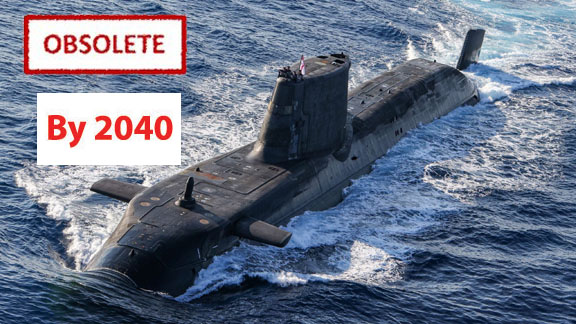
“[So] the question for us is, is it sensible for Australia to commit itself to go to war with the US against China — a war we have no reason to believe the US can win, in order to acquire submarines that we don’t need?”
ABC RN / By Nick Baker and Taryn Priadko for Global Roaming 5 Mar 24
There were always going to be questions about a nuclear-powered submarine deal with a (stated) price tag of up to $368 billion.
But, as the dust settles on the AUKUS security pact and Australians patiently wait for the subs that come with it, some defence experts are warning that the deal could fall apart.
“I think the chance of the plan unfolding effectively is extremely low,” Hugh White, an emeritus professor of strategic studies at the Australian National University, tells ABC RN’s Global Roaming.
Professor White was a defence adviser to the Hawke government and worked as a deputy secretary for strategy and intelligence in the Department of Defence. He’s also been a big critic of AUKUS.
So could AUKUS sink? And what would that mean for Australia’s defence plans?
What is AUKUS?
On September 15, 2021, a new trilateral security partnership between Australia, the UK and the US was announced, called AUKUS (A-UK-US).
Australia was scrapping its earlier $90 billion deal with France for 12 conventional-powered submarines and instead securing nuclear-powered submarines through AUKUS.
More details were announced on March 13 last year, including around the two so-called “pillars” of AUKUS.
Pillar One, which has received the most attention, is the submarines.
The plan is for Australia to buy at least three nuclear-powered Virginia class submarines from the US in the early 2030s.
We will then build at least five of a new, nuclear-powered submarine class dubbed the SSN-AUKUS, likely in Adelaide, in the 2030s, 2040s and beyond.
Pillar Two involves the sharing of technology, in areas like quantum computing, artificial intelligence and hypersonic missiles.
Former prime minister Scott Morrison called AUKUS “the best” decision of his government, while current Prime Minister Anthony Albanese has said it would “strengthen Australia’s national security and stability in our region”.
AUKUS worries
Professor White has two main worries around AUKUS.
“We do need submarines. I think submarines are a very important part of a defensive posture for Australia … [But] I don’t think we need nuclear-powered submarines,” he says.
“They’re so much more expensive. They’re so much more difficult to make. They’re so much more difficult to operate. We’ll end up with far fewer of them in our fleet.”
He says his second concern is far bigger: “I don’t think we’re going to get [the submarines].”
He claims the plan is overly reliant on future decisions and assistance from the US and UK governments, and also full of near-insurmountable technical tasks for Australia.
“I think what’s going to happen … is within the next few years, the whole thing will just come apart in our hands. And we’ll be back to square one trying to work out how to get some more conventional [submarines].”
Allan Behm, the director of the international and security affairs program at the Australia Institute, also doubts the likelihood of the AUKUS deal going ahead as planned.
One reason, he says, is that the technologies, skills and workforce that are required from a country like Australia to build and maintain nuclear-powered subs is pushing our limits, even with the involvement of the US and UK.
“We’re going into a technological domain with which we are totally unfamiliar,” says Mr Behm, who has a 30-year career in the Australian public service and was senior advisor to then-shadow minister for foreign affairs Penny Wong.
“We’re talking about a number of submarines with nuclear propulsion systems in them. And we’ve only got one nuclear reactor in Australia, which is nothing like the very, very highly enriched uranium reactors, the pressure water reactors that exist in nuclear-powered submarines,” he says.
“I think the best parallel would be, how would Australia imagine that it would undertake, conduct and retrieve a moon launch?”
US versus China
If AUKUS goes ahead as planned, is it the best way to keep Australia safe?
It’s been framed as a massive deterrent to China, which keeps building up its military.
Mr Morrison told the ABC last year, AUKUS helps to “change the calculus for any potential aggressors in our region”.
But Professor White says there are pitfalls with this strategy too.
He claims AUKUS could pull Australia into a future US-China conflict over Taiwan, which he contends the US may not win.
“China has focused so strongly and so effectively on building precisely the kinds of forces it needs to prevent the US projecting power by sea and air into the Western Pacific,” he says.
“[So] the question for us is, is it sensible for Australia to commit itself to go to war with the US against China — a war we have no reason to believe the US can win, in order to acquire submarines that we don’t need?”
While Australia has made clear it will have full control over the nuclear-powered submarines under the deal, Professor White says the US may still expect us to support them in a future war.
Cost concerns
The estimated cost of the submarine program will be up to $368 billion over the next 30 years. It’s a figure that has attracted no shortage of criticism.
“It puts so many of our defence eggs in one super expensive basket,” Mr Behm says.
“Short of expanding our defence budget by a considerable amount … we would find ourselves with very constrained capabilities in other fields in order to meet the expenditure targets of this project.”
And, based on other defence projects, he contends there will be cost blowouts.
“Whenever [the Department of] Defence says it’s going to cost you $1, always multiply it by three. And so your $368 billion is, in effect, a lifetime cost of $1 trillion,” he says.
“And you can do a hell of a lot with $1 trillion.”
A safer Australia?
The AUKUS critics have their critics too.
Peter Dean, the director of foreign policy and defence at the University of Sydney’s US Studies Centre, says he has a “diametrically opposed” outlook to Professor White and Mr Behm………………………………………………
Scrap AUKUS, totally rethink defence?
Meanwhile, Professor White, from the anti-AUKUS camp, is advocating a totally different approach to AUKUS.
He says Australia should pivot away from the US and think about “how we can develop our national capability to defend ourselves independently against a major Asian power?”
“Traditionally, Australians have believed that as a very big continent with a relatively small population … we couldn’t possibly defend ourselves. But I don’t think that’s right.”
But he says this would need a change in priorities…………………………………………………
A missing part of the discussion
Mr Behm, also from the anti-AUKUS camp, says there’s an element sometimes missing in discussions about defence.
Diplomacy has got to be central to the way in which you think about your long-term national security,” he says.
“You get much more return on your investment in diplomacy than you ever get out of defence systems, which in the life of almost all of them you never use.”………………………………….
Mr Behm advocates for more emphasis on “how you use the intellectual and cultural resources of the nation to both protect and to promote its deep and long-term security”.
“[So] I would be prepared to argue that the pivot on which our national security rests is the foreign minister.” https://www.abc.net.au/news/2024-03-05/aukus-set-to-sink/103534664
Billionaire mining magnate Andrew Forrest lampoons Australian opposition’s nuclear push as ‘bulldust’

A push by the Coalition to develop nuclear energy generation in Australia has been slammed by mining magnate Andrew “Twiggy” Forrest.
Jack Quail, February 26, 2024 – https://www.news.com.au/technology/environment/climate-change/billionaire-mining-magnate-andrew-forrest-lampoons-coalitions-nuclear-push-as-bulldust/news-story/048f9a45dbb31091a4ed313479922288
Billionaire mining magnate Andrew “Twiggy” Forrest has rubbished a push to develop a local nuclear energy industry, even as fresh polling showed growing voter support for the proposal.
Dr Forrest took a veiled swipe at the opposition over its soon-to-be-unveiled nuclear energy policy, saying its push was “misinformed”, would act to sustain coal and gas powered generation for another two decades, and ultimately would lead to higher power prices.
“If we swallow this new lie that we should stop the rollout of green energy and that nuclear energy will be our fairy godmother, we will be worse off again,” the chair of mining and green energy firm Fortescue told the National Press Club on Monday.
“These misinformed, unscientific, uneconomic, plucked-out-of-thin-air, bulldust nuclear policies of politicians – masquerading as leaders – help no one.”
Dr Forrest, who in 2023 ranked as Australia’s third richest person, made his billions mining iron ore but in more recent years has aggressively pursued investments in renewable energy technologies and fuel, particularly green hydrogen.
Claiming he was “agnostic” on nuclear energy, Dr Forrest said the economics of such a proposal did not stack up when compared with renewable generation.
“Who is going to pay their nuclear electricity bill when it is 4-5 times more expensive than the renewables next door, even ignoring the decade plus it takes to develop nuclear?” Dr Forrest asked.
“With wind and solar, you’re up and running, lowering electricity costs and eliminating pollution within one to three years.”
The Coalition is yet to release a costed nuclear energy policy but has committed to do so ahead of the next federal election, due by May 2025 at the latest.
A Newspoll released by The Australian on Monday revealed 55 per cent of Australians support the replacement of coal-fired power plants with small modular nuclear reactors.
However, such technology is still in development, is yet to prove commercially viable, and would not be deliverable until the mid-2030s at the earliest.
The Albanese government has similarly disparaged the Coalition’s nuclear push, and has retained a ban on nuclear power and banking.
In his address, Dr Forrest also advocated for a “renewable energy-led economy”, recommending the government establish a “climate trigger” to assess the impact of carbon pollution in granting environmental approvals, rapidly expand firmed renewable energy, and introduce a levy on carbon emissions extracted from mining or imported into Australia.
“If we make the right decisions today, it will deliver the most profound and enduring economic growth opportunities ever seen, particularly in regional Australia,” he said.
Calling out the diesel fuel rebate, which costs the federal budget billions annually, Dr Forrest said the subsidy towards mining and fossil fuel companies should be scrapped.
“Massive taxpayer-funded financial support for huge mining companies, including Fortescue, to use imported diesel is indefensible,” Dr Forrest said.
Last week, Fortescue – of which Dr Forrest and his family own a 33 per cent stake – reported a 41 per cent increase in its first-half profit, beating analysts’ estimates and bucking a growing trend of sliding profitability among other major mining firms.
Australia’s opposition leader ‘s ideas for nuclear power are not welcomed by the public

The Victorian towns where Peter Dutton is considering going nuclear
Josh Gordon and Benjamin Preiss, February 25, 2024, https://www.theage.com.au/politics/victoria/the-victorian-towns-where-peter-dutton-is-considering-going-nuclear-20240223-p5f7a3.html
The Coalition is leaving the door open to building nuclear reactors in the Latrobe Valley and Anglesea using land from retired coal-fired power stations as a solution to Victoria’s energy troubles.
But locals warn there would be significant opposition to nuclear reactors being built in their towns, even if the huge legal hurdles to constructing and running them could be overcome.
With Victoria’s energy security under scrutiny after a wild storm earlier this month left hundreds of thousands of homes without power and triggered the shutdown of the state’s largest coal-fired generator, the federal opposition has confirmed it is now in the “advanced stages” of developing an energy policy. Nuclear is set to be a key part of the mix.
Opposition energy spokesman Ted O’Brien told The Age potential locations remained a “work-in-progress”, but he had been advised that “communities with experience hosting coal plants could be ideal potential hosts for zero-emissions nuclear plants”.
That leaves Victoria’s three remaining coal-fired power plants, plus the now decommissioned site of the Hazelwood mine and power station, as strongly preferred locations – with existing connections to the energy grid, and a ready-made workforce preparing for the end of coal-fired generation over the next 15 years.
“We have been very transparent about the fact we are considering zero-emissions nuclear energy as part of Australia’s future energy mix, and we will remain open about the details of our policy when it is announced,” O’Brien said.
The state opposition remains more cautious about the prospect of nuclear in the Latrobe Valley, but it too is not ruling out the idea. Asked about using retired coal-fired power stations as sites for nuclear energy, Opposition Leader John Pesutto said a commonsense approach was needed.
“But for any new industry to succeed it would first need detailed inquiries and thorough examination,” Pesutto told The Age. “It would also require bipartisan support, as this is crucial for investment certainty and to eliminate sovereign risk.”
Other sites in Victoria have also been flagged. Federal Opposition Leader Peter Dutton recently hinted at the possibility of a small modular reactor on the Surf Coast at Anglesea, on the site of Alcoa’s former mine and power station.
“It’s zero emissions, you can put it into an existing brownfield site, so when the coal-fired generation comes to an end, you can put the nuclear modular reactors into that facility,” Dutton said in September.
The argument for nuclear is that plugging into existing infrastructure would be significantly cheaper and would reduce the need for thousands of kilometres of new transmission lines needed to connect wind and solar energy dotted across the grid.
O’Brien has previously pointed to a September 2022 study for the US Department of Energy that found using the infrastructure of an existing coal plant could reduce a nuclear plant’s capital costs by up to 35 per cent. He suggested Australia should look to the US state of Wyoming, which is planning to replace its coal-fired generators with nuclear by about 2030.
But any move towards nuclear power in Victoria would likely encounter strong resistance from communities worried about safety, waste disposal and the cost.
Voices of the Valley president Wendy Farmer said nuclear power would face major opposition from communities worried about the risks.Farmer said residents in the Latrobe Valley had already suffered the consequences of the Hazelwood mine fire in 2014, which burned for 45 days and caused health concerns for those living amid the smoke.
“I would be surprised if there would be any enthusiasm for a reactor,” she said.
Deputy Mayor Mike Bodsworth, who represents the Anglesea ward, said residents were excited by the potential for renewable power generation at the former Alcoa site.
“But nobody I know has ever mentioned nuclear,” he said. “Knowing the general preferences of the local population, I doubt it would be supported.”
The Coalition has been talking up the potential to use small-scale modular reactors to generate power, and argue this, along with gas, will be a key part of Australia’s future energy mix to provide so-called base-load generation along with variable renewables.
In May last year, US company Westinghouse released plans for a small modular reactor. Reuters reported Westinghouse planned to begin building the reactor by 2030.
But many experts say this approach would be prohibitively expensive in Australia, particularly if forced to compete against lower-cost renewable wind and solar generators now being installed at a rapid rate across the country.
The CSIRO’s best guess is that in 2030 the capital cost of a small modular reactor will be $15,844 per kilowatt of electricity generated, compared to $1078 for solar and $1989 for wind.
That suggests replacing Victoria’s three remaining coal-fired plants, which combined to produce up to 4730 megawatts of electricity, with nuclear would involve a capital cost of about $74.9 billion, before even considering the ongoing running, maintenance and waste disposal costs.
The Coalition would also need to get the numbers in state parliament to repeal existing state and federal laws, including Victoria’s Nuclear Activities (Prohibitions) Act of 1983, which bans the construction and operation of nuclear facilities in Victoria.
Victorian Energy Minister Lily D’Ambrosio said nuclear energy was “toxic, risky, will take years to develop and [is] the most expensive form of energy there is”.
“Not only are the sites of our former coal plants privately owned, but there is currently no regulatory framework for approving a nuclear power plant in Australia, there are no nuclear waste storage sites in Australia, and no modular nuclear reactors have made it past the trial phase,” she said.
Federal Energy Minister Chris Bowen said claims of a boom in small modular reactors was a myth, and suggested Dutton should explain to the people around Gippsland why they should accommodate multiple reactors “for no good reason”.
“Anyone who has done their homework knows nuclear is not viable,” Bowen said. “The alleged boom in small modular reactors is a furphy. It’s striking that a party that once prided itself on economic rationalism could embrace a frolic so spectacularly uneconomic.”
In the US, a project run by NuScale Power to build the first commercial small modular reactor was scrapped last year because of soaring costs, leaving taxpayers facing a significant bill. Other projects promising commercially competitive nuclear energy have similarly failed to materialise.
Australian PM Albanese and 85 Other MPs Vote to End Assange Incarceration

“Enough is enough,” PM Albanese said.
By Diego Ramos , ScheerPost, 15 Feb24, https://scheerpost.com/2024/02/15/australian-pm-albanese-and-85-other-mps-vote-to-end-assange-incarceration/—
The Australian House of Representatives voted on Wednesday in favor of a motion supporting the end of Julian Assange’s incarceration and to bring him back to Australia. Among the supporters of the motion is Australian Prime Minister Anthony Albanese, who, regarding the long term prosecution and detention of Assange, declared, “enough is enough.”
In the motion introduced by MP Andrew Wilkie, the argument is made for the release of Assange from Belmarsh Prison in the UK and returned to Australia. This comes ahead of next week’s court ruling on Assange’s extradition appeal.
Wilkie said, “It will send a very powerful political signal to the British government and to the US government that the British government should not entertain the idea of Mr Assange being extradited to the US.”
86 members of the house of representatives, including Albanese, voted in favor of the motion; 42 members voted against it.
Wilkie, speaking to Parliament about Assange stated, “Surely this man has suffered enough. The matter must be brought to an end.”
Adam Bandt, member of Australian Parliament and leader of the Australian Greens, said, “…[T]his sets an incredibly chilling precedent for journalists in the future and for journalists’ ability to hold governments to account, to say uncomfortable things about governments … and to know that you can tell the truth without facing imprisonment and without facing a risk to your own life.”
If Assange’s appeal is rejected, he faces immediate extradition to the United States, where he would be set to face trial for various charges, including the release of confidential military records and diplomatic cables in 2010.
Wilkie said the vote demonstrated that Australia stood “as one,” on the Assange case and “[r]egardless of what you might think of Mr Assange, justice is not being served in this case now.”
Below is a transcript of the motion authored by MP Andrew Wilkie: [on original]
Australian Parliament votes in favour of bringing Assange home
By John Jiggens | 15 February 2024, https://independentaustralia.net/politics/politics-display/parliament-votes-in-favour-of-bringing-assange-home,18333—
In a historic vote, parliamentarians have shown unprecedented support for the return home of imprisoned journalist Julian Assange. Dr John Jiggens reports.
WEDNESDAY 14 FEBRUARY turned out to be an unanticipated Happy Valentine’s Day for Julian Assange supporters. The Australian House of Representatives passed a motion introduced by Tasmanian Independent Andrew Wilkie, on behalf of the Parliamentary Friends of Julian Assange, urging the U.S. and the UK to bring their prosecution of the WikiLeaks founder to a close and allow him to return to his family and home in Australia.
The vote was 86 for Yes (ALP, Greens and Independents) and 42 for No (mostly Liberal and National).
In an unprecedented show of parliamentary support for Assange, two-thirds of the lower house voted for the motion. It was not unanimous because Coalition members overwhelmingly chose to support the U.S. and UK in what the former UN Rapporteur on Torture, Nils Melzer, described as the torture of an Australian journalist.
Greens leader Adam Bandt appealed to the Coalition to support the motion. Assange has become symbolic of journalists around the world who face attacks on press freedom, he argued, ranging from political prosecutions through to murder.
Assange’s prosecution set a chilling precedent for journalists about their ability to hold governments to account and to tell the truth without facing imprisonment and without facing a risk to their own lives.
Bandt said:
“If governments think that participation in the AUKUS agreement and alliance is so critical, surely part of that should be the insistence on human rights and the proper treatment of our citizens — of Australian citizens. If we are sitting around a table with these governments, we should be able to insist that Julian Assange is brought home.”
His appeal fell on deaf ears — it remained AUKUS regardless of any cost.
For Assange, the situation is still perilous. He remains incarcerated in HM Prison Belmarsh in the UK, where he has spent the last five years, locked down for 23 hours each day in a three-metre by two-metre cell, unconvicted of any charges, an innocent man in a living hell, like Dylan’s ‘Hurricane’. Like Nelson Mandela, he walks his long walk to freedom around that tiny cell every day.
In one week, the UK High Court will decide whether he has exhausted all his legal appeals to prevent being extradited to the USA where he would face charges that could see him imprisoned for 175 years under their notorious 1917 Espionage Act for publishing material, which revealed shocking evidence of misconduct by U.S. forces.
As Senator David Shoebridge tweeted on the day of the vote:
‘There are real concerns that if Julian loses next week he will be immediately extradited.’
In this epic David versus Goliath mismatch, one lone Australian journalist pitted against the world’s greatest empire, it was rare good news. Members and supporters of the Parliamentary Friends of Julian Assange tweeted happily.
Andrew Wilkie, Convenor of the Parliamentary Friends of Assange:
‘I successfully moved a motion to recognise the importance of bringing Julian Assange’s extradition to an end. The Govt voted for it in an unprecedented show of political support for Julian. The US must heed these calls & drop the extradition. #FreeAssangeNOW #auspol #politas.’
Adam Bandt, Leader of the Greens:
‘Today – for the first time – the House voted to call on the UK & the USA to bring Julian Assange home. His family, the people and this Parliament want him home.
PM — it’s time we make this a reality.’
Dr Monique Ryan, Independent member, Kooyong:
‘A powerful moment. Today the Government and crossbench called on the United States and the United Kingdom to stop prosecuting Julian Assange so he can come home. This is the ultimate test of our nations’ friendship and I sincerely hope it is heard.’
David Shoebridge, Greens Senator:
‘Today the House of Representatives has voted in favour of a motion from my Parliamentary Friends of Assange colleague @WilkieMP on the need to bring Julian home. This is a genuinely historic moment and a testament to the work of so many for so many years. 86-42 vote.’
Worst places in Australia to be if World War Three hits

For Australia, the question isn’t where to hide in the event of a nuclear war. It’s where not to be — and this is the top of the list.
news.com.au Jamie Seidel Jamie Seidel is a freelance writer | @JamieSeidel 12 Feb 24
For Australia, the question isn’t where to hide in the event of a nuclear war. It’s where not to be. And how to cope afterwards.
………………………………………the bomb is back.
And international analysts fear there’s a growing will to use them…………………………………………………………………………….
The Bulletin of the Atomic Scientists chose to keep their “Doomsday Clock” at 90 seconds to midnight late last month – the closest it has ever been to an apocalypse.
They cited the danger of the Russia-Ukraine war, the slaughter in Gaza, and the worldwide diplomatic, economic and environmental toll associated with 2023 being the hottest year in recorded history.
All it takes is one “incident”. Then the domino effect of “Mutually Assured Destruction” kicks into play.
Those with the largest arsenals – China, Russia and the United States – are still likely to hit strategic targets. At least in the first wave of a nuclear exchange.
Australia in the firing line
……………………………………………………“Once we enter the slippery slope of even limited nuclear exchanges, the end result will be escalation to mutual annihilation — something about which both Vladimir Putin and Xi Jinping may need reminding,” says ANU emeritus strategic studies professor Paul Dibb.
PINE GAP has long been known to top the list. This highly secret US military installation exists to detect and track nuclear missiles. Removing it early in any war would degrade the ability of the US to defend its own soil.
“In the late 1970s, it was made quite clear to me during talks in Moscow that Pine Gap was a priority Soviet nuclear target,” Professor Dibb said in a recent ASPI critique.
“And in 2016, I was warned: ‘In the event of nuclear war between Russia and America, you Australians will find that nuclear missiles fly in every direction.
HAROLD E HOLT Naval Communications Station at Northwest Cape, near Exmouth, Western Australia, is in a similar category. This enormous communications facility has been built to communicate with submarines at depths of up to 30 metres. Eliminating it would sow confusion among US attack and ballistic missile submarine commanders.
From here, the list gets more controversial.
RAAF TINDAL near Katherine in the Northern Territory has recently been adapted to host nuclear-capable US B-52 bombers. Any nuclear-capable delivery system is a likely nuclear target…………………….
HMAS STIRLING, the naval base in Perth’s southern suburbs, is slated to become a regular pitstop call for US and UK nuclear-powered submarines. Eventually, it is hoped to also house Australia’s own. But such submarines are incredibly high-value targets because they combine immense firepower, globe-circling range and virtual invisibility.
OSBORNE NAVAL SHIPYARD in Port Adelaide could potentially join its US and UK cousins on a nuclear warhead list. The nuclear-powered submarines it is expected to begin assembling are among the most lethal ships in the sea. But also the hardest to build, maintain and repair.
“Armed with nuclear submarines, Australia itself will be a target for possible nuclear attacks in the future,” Communist Party mouthpiece Victor Gao threatened shortly after then Prime Minister Malcolm Turnbull dropped the AUKUS nuclear submarine pact bombshell in 2021.
“Do you really want to be a target in a possible nuclear war, or do you want to be free from nuclear menace,” he menaced. [ Ed note – “menaced” – I thought it was a fair question]
MARINE ROTATIONAL FORCE – DARWIN is a rotating force of 2500 US Marine troops, aircrew and sailors based in and around Darwin and at RAAF Base Darwin. While small, it does represent the core upon which a much larger force can be built. And it’s a high-profile US presence far from home shores.
RAAF BASE WILLIAMTOWN, 40km north of Newcastle, NSW, is home base to Australia’s small fleet of F-35 Lightning II stealth fighters. But the one thing these aircraft were explicitly designed to do – be invisible to radar – makes attacking their undefended airfields an obvious shortcut.
GARDEN ISLAND NAVAL BASE, Sydney, is already home to a disproportionately large number of Australia’s otherwise limited number of major surface (and subsurface) combat vessels. And while there are no plans for US or UK nuclear attack submarines to visit, Australia’s own will likely operate from this centralised hub. https://www.news.com.au/national/worst-places-in-australia-to-be-if-world-war-three-hits/news-story/1c0180b0a5f8652b024bfc1fe9444313
Australia’s State governments fight each other to avoid having to store nuclear wastes
Expect weapons-grade NIMBYism as leaders fight over where to store AUKUS nuclear waste

Given that proposals for even low-level nuclear waste sites have been rejected by communities, who is going to take on the radioactive waste created by our new military pact?
ANTON NILSSON, FEB 01, 2024, Crikey,
here should Australia store the waste created by its investment in nuclear-driven submarines? It’s a question no-one knows the answer to yet — although we do know a couple of places where the radioactive waste won’t be stored. As the search for a solution continues, expect politicians to try to kick the radioactive can further down the road — and expect some weapons-grade NIMBYism from state and territory leaders if they’re asked to help out.
In August last year, plans to build a new nuclear waste storage facility in Kimba in South Australia were scrapped. As Griffith University emeritus professor and nuclear expert Ian Lowe put it in a Conversation piece, “the plan was doomed from the start” — because the government didn’t do adequate community consultation before deciding on the spot.
Resources Minister Madeleine King acknowledged as much when she told Parliament the government wouldn’t challenge a court decision that sided with traditional owners in Kimba, who opposed the dump: “We have said all along that a National Radioactive Waste Facility requires broad community support … which includes the whole community, including the traditional owners of the land. This is not the case at Kimba.”
Kimba wasn’t even supposed to store the high-level waste that will be created by AUKUS submarines — it was meant to store low-level and intermediate-level waste, the kind generated from nuclear medicine, scientific research, and industrial technologies. As King told Parliament, Australia already has enough low-level waste to fill five Olympic swimming pools, and enough intermediate-level waste for two more pools.
Where the waste from AUKUS will go is a question without answer. Deputy Prime Minister Richard Marles said in March last year the first reactor from a nuclear-powered submarine won’t have to be disposed of until the 2050s. He added the government will set out its process for finding dump sites within a year — which means Marles has until March this year to spill the details.
“The final storage site of high-level waste resulting from AUKUS remains a mystery,” ANU environmental historian Jessica Urwin told Crikey. “Considering the historical controversies wrought by low- and intermediate-level waste disposal in Australia over many decades, it is hard to see how any Australian government, current or future, will get a high-level waste disposal facility off the ground.”
In his comments last year, Marles gave a hint as to the government’s intentions: he said it would search for sites “on the current or future Defence estate”.
One such Defence estate site that’s been the focus of some speculation is Woomera in South Australia. “A federal government decision to scrap plans for a nuclear waste dump outside the South Australian town of Kimba has increased speculation it will instead build a bigger facility on Defence land at Woomera that could also accommodate high-level waste from the AUKUS submarines,” the Australian Financial Review reported last year.
Urwin said such a proposal could trigger local opposition as well.
Due to Woomera’s proximity to the former Maralinga and Emu Field nuclear testing sites, and therefore its connections to some of the darkest episodes in Australia’s nuclear history, communities impacted by the tests and other nuclear impositions (such as uranium mining) have historically pushed back against the siting of nuclear waste at Woomera,” she said.
Australian Submarine Agency documents released under freedom of information laws in December last year show there is little appetite among state leaders to help solve the conundrum.
A briefing note to Defence secretary Greg Moriarty informed him that “state premiers (Victoria, Western Australia, Queensland, and South Australia) [have sought] to distance their states from being considered as potential locations”. ………………………………………………….. more https://www.crikey.com.au/2024/02/01/aukus-nuclear-waste-storage-australia/
Cost of UK’s flagship nuclear project blows out to more than $A92 billion
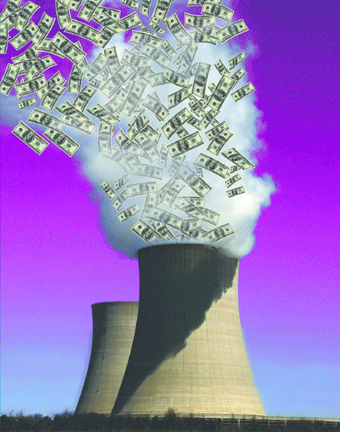
But it also has implications for Australia, because one its main political groupings, the right-wing Liberal and National Party coalition, has decided that Australia should abandon its current plan to dump coal for renewables and storage, and wait for nuclear instead.
Australia currently has a target of 82 per cent renewables by 2030, and AEMO’s latest Integrated System Plan suggests it could be close to 100 per cent renewables within half a decade after that.
Giles Parkinson, Jan 29, 2024, https://reneweconomy.com.au/cost-of-uks-flagship-nuclear-project-blows-out-to-more-than-a92-billion/
The cost of the flagship nuclear project in the United Kingdom has blown out again, this time to a potential $A92.6 billion as a result of yet more problems and delays at the Hinkley C project.
The latest cost blowout was revealed last week by the French-government owned EdF, whose former CEO had originally promised in 2007 that the Hinkley project would be “cooking Christmas turkeys” in England by 2017, at a cost of just £9 billion.
But like virtually every major nuclear project built in western economies, that ambitious deadline was never going to be met. The new start-up date is now for 2030, but more likely 2031 – and that is only for one of the two units.
The budget has leaped from the original promise of £9 billion, to £18 billion, and has since blown out multiple times to now reach £31 billion and £34 billion, and it could be more than £35 billion “in 2015 values,” according to EdF. This translates into current day prices, according to Michael Liebreich, the former head of Bloomberg New Energy Finance, of £48 billion, or $A92.6 billion.
“The cost of civil engineering and the longer duration of the electromechanical phase (and its impact on other work) are the two main reasons for this cost revision,” EdF said in its statement. It has also experienced massive cost over-runs and delays at other similar projects in Flammanville in Fance and Olkiluoto in Finland.
It is yet another crippling blow to the UK plans to make nuclear a centrepiece of its green energy transition. EdF has already had to be bailed out by its own government, and ultimately nationalised, because of the cost blowouts and the huge costs of buying replacement power when half its French nuclear fleet went offline in 2023.
China’s CGN had to be brought in to fund one third of the Hinckley project, but is refusing to contribute more funds because China has been frozen out of other UK projects.
Alison Downes of Stop Sizewell C, a campaign group opposed to the planned Suffolk nuclear plant, told the Financial Times that EDF and the Hinkley project was an “unmitigated disaster”.
She added the UK government should cancel Sizewell C, saying state funding for the project could be better spent on “renewables, energy efficiency or, in this election year, schools and hospitals”.
But it also has implications for Australia, because one its main political groupings, the right-wing Liberal and National Party coalition, has decided that Australia should abandon its current plan to dump coal for renewables and storage, and wait for nuclear instead.
The Coalition had been pushing so-called small modular reactors, but after the failure of the leading technology developer in the US last year, and confirmation by the CSIRO and the Australian Energy Market Operator that SMR costs would be three times more expensive than renewables, several key Coalition members pointed to large scale nuclear such as Hinckley.
Australia currently has a target of 82 per cent renewables by 2030, and AEMO’s latest Integrated System Plan suggests it could be close to 100 per cent renewables within half a decade after that.
This switch to low carbon electricity is critical for Australia’s emissions targets, and for emission cuts in other parts of the economy. Any delay in the roll-out of renewables, in the expectation that nuclear would fill its place, will push that timeline out by at least another decade, if not, and blow out the costs of the energy transition.
“It is not like cost over-runs in nuclear projects are a big secret,” Liebreich writes on his Sub-stack blog.
He cites the world’s leading academic expert on project management, Danish Professor Bent Flyvbjerg, author of How Big Things Get Done, who shows that nuclear plants are worse only than Olympic Games in terms of cost over-runs.
“On average they go 120% over the budget, with 58% of them going a whopping 204% over budget,” Liebreich writes.
The Coalition energy spokesman Ted O’Brien complained in December that the CSIRO/AEMO report focused only on the “investment” cost, and not the “consumer cost.”
It’s not clear what he means by that. But as Liebreich notes, while Hinkley’s construction costs are in the £42 to £48 billion range, its first 35 years of electricity at £87.50 or £92.50/MW in 2012 money, adjusted for inflation, will cost UK energy users a gargantuan £111 or £116 billion, or up to $A223 billion.
Nuclear goes backwards, again, as wind and solar enjoy another year of record growth.

Jim Green 21 January 2024, https://reneweconomy.com.au/nuclear-goes-backwards-again-as-wind-and-solar-enjoy-another-year-of-record-growth/
The nuclear renaissance of the late-2000s was a bust due to the Fukushima disaster and catastrophic cost overruns with reactor projects. The latest renaissance is heading the same way, i.e. nowhere. Nuclear power went backwards last year.
There were five reactor start-ups and five permanent closures in 2023 with a net loss of 1.7 gigawatts (GW) of capacity. There were just six reactor construction starts in 2023, five of them in China.
Due to the ageing of the reactor fleet, the International Atomic Energy Agency (IAEA) anticipates the closure of 10 reactors (10 GW) per year from 2018 to 2050.
Thus the industry needs an annual average of 10 reactor construction starts, and 10 reactor startups (grid connections), just to maintain its current output. Over the past decade (2014-23), construction starts have averaged 6.1 and reactor startups have averaged 6.7.
The number of operable power reactors is 407 to 413 depending on the definition of operability, well down from the 2002 peak of 438.
Nuclear power’s share of global electricity generation has fallen to 9.2 percent, its lowest share in four decades and little more than half of its peak of 17.5 percent in 1996.
Over the two decades 2004-2023, there were 102 power reactor startups and 104 closures worldwide: 49 startups in China with no closures; and a net decline of 51 reactors in the rest of the world.
In China, there were five reactor construction starts in 2023 and just one reactor startup. Put another way, there was just one reactor construction start outside China in 2023. So much for the hype about a new nuclear renaissance.
Small modular reactors and ‘advanced’ nuclear power
Small modular reactors (SMRs) are the subject of endless hype but there were no SMR construction starts or startups last year. The biggest SMR news in 2023 was NuScale Power’s decision to abandon its flagship project in Idaho despite securing astronomical subsidies amounting to around US$4 billion (A$6.1 billion) from the US government.
The pro-nuclear Breakthrough Institute noted in a November 2023 article that efforts to commercialise a new generation of ‘advanced’ nuclear reactors “are simply not on track” and it warned nuclear advocates not to “whistle past this graveyard”:
It wrote:
“The NuScale announcement follows several other setbacks for advanced reactors. Last month, X-Energy, another promising SMR company, announced that it was canceling plans to go public. This week, it was forced to lay off about 100 staff.
“In early 2022, Oklo’s first license application was summarily rejected by the Nuclear Regulatory Commission before the agency had even commenced a technical review of Oklo’s Aurora reactor.
The nuclear renaissance of the late-2000s was a bust due to the Fukushima disaster and catastrophic cost overruns with reactor projects. The latest renaissance is heading the same way, i.e. nowhere. Nuclear power went backwards last year.
There were five reactor start-ups and five permanent closures in 2023 with a net loss of 1.7 gigawatts (GW) of capacity. There were just six reactor construction starts in 2023, five of them in China.
Due to the ageing of the reactor fleet, the International Atomic Energy Agency (IAEA) anticipates the closure of 10 reactors (10 GW) per year from 2018 to 2050.
Thus the industry needs an annual average of 10 reactor construction starts, and 10 reactor startups (grid connections), just to maintain its current output. Over the past decade (2014-23), construction starts have averaged 6.1 and reactor startups have averaged 6.7.
The number of operable power reactors is 407 to 413 depending on the definition of operability, well down from the 2002 peak of 438.
Nuclear power’s share of global electricity generation has fallen to 9.2 percent, its lowest share in four decades and little more than half of its peak of 17.5 percent in 1996.
Over the two decades 2004-2023, there were 102 power reactor startups and 104 closures worldwide: 49 startups in China with no closures; and a net decline of 51 reactors in the rest of the world.
In China, there were five reactor construction starts in 2023 and just one reactor startup. Put another way, there was just one reactor construction start outside China in 2023. So much for the hype about a new nuclear renaissance.
Nuclear decline vs. record renewables growth
The International Energy Agency (IEA) has just released its ‘Renewables 2023’ report and it makes for a striking contrast with the nuclear industry’s malaise.
Nuclear power suffered a net loss of 1.7 GW capacity in 2023, whereas renewable capacity additions amounted to a record 507 GW, almost 50 percent higher than 2022. This is the 22nd year in a row that renewable capacity additions set a new record, the IEA states. Solar PV alone accounted for three-quarters of renewable capacity additions worldwide in 2023.
Nuclear power accounts for a declining share of share of global electricity generation (currently 9.2 percent) whereas renewables have grown to 30.2 percent. The IEA expects renewables to reach 42 percent by 2028 thanks to a projected 3,700 GW of new capacity over the next five years in the IEA’s ‘main case’.
The IEA states that the world is on course to add more renewable capacity in the next five years than has been installed since the first commercial renewable energy power plant was built more than 100 years ago.
Solar and wind combined have already surpassed nuclear power generation and the IEA notes that over the next five years, several other milestones will likely be achieved:
— In 2025, renewables surpass coal-fired electricity generation to become the largest source of electricity generation
— In 2025, wind surpasses nuclear electricity generation
— In 2026, solar PV surpasses nuclear electricity generation
— In 2028, renewable energy sources account for over 42 percent of global electricity generation, with the share of wind and solar PV doubling to 25 percent
Tripling renewables
The IEA states in its ‘Renewables 2023’ report that:
“Prior to the COP28 climate change conference in Dubai, the International Energy Agency (IEA) urged governments to support five pillars for action by 2030, among them the goal of tripling global renewable power capacity. Several of the IEA priorities were reflected in the Global Stocktake text agreed by the 198 governments at COP28, including the goals of tripling renewables and doubling the annual rate of energy efficiency improvements every year to 2030. Tripling global renewable capacity in the power sector from 2022 levels by 2030 would take it above 11 000 GW, in line with IEA’s Net Zero Emissions by 2050 (NZE) Scenario.
“Under existing policies and market conditions, global renewable capacity is forecast to reach 7300 GW by 2028. This growth trajectory would see global capacity increase to 2.5 times its current level by 2030, falling short of the tripling goal.”
In the IEA’s ‘accelerated case’, 4,500 GW of new renewable capacity will be added over the next five years (compared to 3,700 GW in the ‘main case’), nearing the tripling goal.
Tripling nuclear?
The goal of tripling renewables by 2030 is a stretch but it is not impossible. Conversely, the ‘pledge’ signed by just 22 nations at COP28 to triple nuclear power by 2050 appears absurd.
The Labor federal government signed Australia up to the renewables pledge but not the nuclear pledge. The Coalition wants to do the opposite, and also opposes the Labor government’s target of 82 per cent renewable power supply by 2030.
One of the lies being peddled by the Coalition is that nuclear power capacity could increase by 80 percent over the next 30 years. That is based on a ‘high case’ scenario from the IAEA. However the IAEA’s ‘low case’ scenario — ignored by the Coalition — is for another 30 years of stagnation.
So should we go with the IAEA’s high or low scenarios, or split the difference perhaps?
According to a report by the IAEA itself, the Agency’s ‘high’ forecasts have consistently proven to be ridiculous and even its ‘low’ forecasts are too high — by 13 percent on average.
Nuclear power won’t increase by 80 percent by 2050 and it certainly won’t triple; indeed it will struggle to maintain current output given the ageing of the reactor fleet and recent experience with construction projects.
Comparing nuclear and renewables in China
China’s nuclear program added only 1.2 GW capacity in 2023 while wind and solar combined added 278 GW. Michael Barnard noted in CleanTechnica that allowing for capacity factors, the nuclear additions amount to about 7 terrawatt-hours (TWh) of new low carbon generation per year, while wind and solar between them will contribute about 427 TWh annually, over 60 times more than nuclear.
Barnard commented:
“One of the things that western nuclear proponents claim is that governments have over-regulated nuclear compared to wind and solar, and China’s regulatory regime for nuclear is clearly not the USA’s or the UK’s. They claim that fears of radiation have created massive and unfair headwinds, and China has a very different balancing act on public health and public health perceptions than the west. They claim that environmentalists have stopped nuclear development in the west, and while there are vastly more protests in China than most westerners realize, governmental strategic programs are much less susceptible to public hostility.
“And finally, western nuclear proponents complain that NIMBYs block nuclear expansion, and public sentiment and NIMBYism is much less powerful in China with its Confucian, much more top down governance system.
“China’s central government has a 30 year track record of building massive infrastructure programs, so it’s not like it is missing any skills there. China has a nuclear weapons program, so the alignment of commercial nuclear generation with military strategic aims is in hand too. China has a strong willingness to finance strategic infrastructure with long-running state debt, so there are no headwinds there either.
“Yet China can’t scale its nuclear program at all. It peaked in 2018 with 7 reactors with a capacity of 8.2 GW. For the five years since then then it’s been averaging 2.3 GW of new nuclear capacity, and last year only added 1.2 GW …”
Dr. Jim Green is the national nuclear campaigner with Friends of the Earth Australia and a member of the Nuclear Consulting Group.
1 This Month

To see nuclear-related stories in greater depth and intensity – go to https://nuclearinformation.wordpress.com
-
Archives
- September 2026 (194)
- August 2026 (330)
- July 2026 (355)
- June 2026 (287)
- May 2026 (306)
- April 2026 (356)
- March 2026 (251)
- February 2026 (267)
- January 2026 (308)
- December 2025 (358)
- November 2025 (359)
- October 2025 (375)
-
Categories
- 1
- 1 NUCLEAR ISSUES
- business and costs
- climate change
- culture and arts
- ENERGY
- environment
- health
- history
- indigenous issues
- Legal
- marketing of nuclear
- media
- opposition to nuclear
- PERSONAL STORIES
- politics
- politics international
- Religion and ethics
- safety
- secrets,lies and civil liberties
- spinbuster
- technology
- Uranium
- wastes
- weapons and war
- Women
- 2 WORLD
- ACTION
- AFRICA
- Atrocities
- AUSTRALIA
- Christina's notes
- Christina's themes
- culture and arts
- Events
- Fuk 2022
- Fuk 2023
- Fukushima 2017
- Fukushima 2018
- fukushima 2019
- Fukushima 2020
- Fukushima 2021
- general
- global warming
- Humour (God we need it)
- Nuclear
- RARE EARTHS
- Reference
- resources – print
- Resources -audiovicual
- Weekly Newsletter
- World
- World Nuclear
- YouTube
-
RSS
Entries RSS
Comments RSS
 nuclear-news