Virginia, we have a problem

14 Jan 2025, |Peter Briggs, https://www.aspistrategist.org.au/virginia-we-have-a-problem/
Australia’s plan to acquire Virginia-class submarines from the United State is looking increasingly improbable. The US building program is slipping too badly.
This heightens the need for Australia to begin looking at other options, including acquiring Suffren-class nuclear attack submarines (SSNs) from France.
The Covid-19 pandemic dramatically disrupted work at the two shipyards that build Virginias, General Dynamics Electric Boat at Groton, Connecticut, and Huntington Ingalls Industries’ yard at Newport News, Virginia. It badly hindered output at many companies in the supply chain, too. With too few workers, the industry has built up a backlog, and yards are filling with incomplete submarines.
Within six years, the US must decide whether to proceed with sale of the first of at least three and possibly five Virginias to Australia, a boat that will be transferred from the US Navy’s fleet.
Nine months before the transfer goes ahead, the president of the day must certify that it will not diminish USN undersea capability. This certification is unlikely if the industry has not by then cleared its backlog and achieved a production rate of 2.3 a year—the long-term building rate of two a year for the USN plus about one every three years to cover Australia’s requirement.
The chance of meeting that condition is vanishingly small.
The situation in the shipyards is stark. The industry laid down only one SSN in 2021. It delivered none from April 2020 to May 2022. The USN has requested funding for only one Virginia in fiscal year 2025, breaking the two-a-year drumbeat, ‘due to limits on Navy’s budget topline and the growing Virginia class production backlog’.
As of January 2025, five of 10 Block IV Virginias ordered are in the yards, as are five of 12 Block Vs for which acquisition has been announced. (Work has not begun on the other seven Block Vs.)
The building time from laying down until delivery has increased from between 3 and 3.5 years before the pandemic to more than 5 years. The tempo is still slowing: the next Virginia, USS Iowa, is due to be delivered on 5 April 2025, 5.8 years after it was laid down.
On the original, pre-pandemic schedule, all the Block IVs could probably have been delivered to the USN by now. This is a gap that cannot be recovered in a few years, despite all the expensive manpower training and retention programs in hand.
Exacerbating the problem for the yards, the Block V submarines are 30 percent larger, and more complex to build, making a return to shorter build times unlikely. Speaking to their shareholders in October, the chief executives of Huntington Ingalls and General Dynamics blamed their slowing delivery tempo on supply chain and workforce issues. HII says it is renegotiating contracts for 17 Block IV and Block V Virginias.
Furthermore, Electric Boat has diverted its most experienced workers to avoid further slippage in building the first two ballistic missile submarines of the Columbia class, the USN’s highest priority shipbuilding program, in which the Newport News yard also participates.
It gets worse. Many USN SSNs that have joined the US fleet over the past few decades are unavailable for service, awaiting maintenance. The pandemic similarly disrupted shipyards that maintain the SSNs of the Los Angeles and Virginia classes. In September 2022, 18 of the 50 SSNs in commission were awaiting maintenance. The Congressional Budget Office reports lack of spending on spare parts is also forcing cannibalisation and impacting the availability of Virginia class SSNs.
Australia’s SSN plan must worsen the US’s challenge in recovering from this situation, adding to the congestion in shipyards and further over loading supply chains already struggling to deliver SSNs to the USN.
A US decision not to sell SSNs to Australia is inevitable, and on current planning we will have no stopgap to cover withdrawal of our six diesel submarines of the Collins class, the oldest of which has already served for 28 years.
In the end, Australia’s unwise reliance on the US will have weakened the combined capability of the alliance. And Australia’s independent capacity for deterrence will be weakened, too.
As I wrote in December, it is time to look for another solution. One is ordering SSNs of the French Suffren class. The design is in production, with three of six planned boats delivered. It is optimised for anti-submarine warfare, with good anti-surface, land-strike, special-forces and mining capability. It is a smaller design, less capable than the Virginia, but should be cheaper and is a better fit for Australia’s requirements.
Importantly, it requires only half the crew of a Virginia, and we should be able to afford and crew the minimum viable force of 12 SSNs.
Let’s build on the good progress in training, industry and facility preparations for supporting US and British SSNs in Australia, all of which should continue, and find a way to add to the alliance’s overall submarine capability, not reduce it.
The Australian election as a game of cricket: cost of living is the issue, but does Nature bat last?

December 26, 2024 , By Noel Wauchope, https://theaimn.net/the-australian-election-as-a-game-of-cricket-cost-of-living-is-the-issue-but-does-nature-bat-last/
It is not nice to talk about politics at this happy festive time. But you can talk about cricket. Indeed, in Melbourne, it is your patriotic duty. So, I will – sort of.
A prestigious political analyst, Paul Bongiorno, writes in The Saturday Paper about the focus of campaigning for the 2025 Australian federal election. He sees both political parties emphasising the economy, and the “cost of living”. But Bongiorno warns that climate change could suddenly become once more the big factor in the political game, if summer does bring bushfires and floods.
Bongiorno argues that Dutton and the Liberal Coalition are out to stop renewable energy development:
“If the Dutton-led Coalition manages to take the treasury benches, the brakes will be dramatically applied to climate action. The energy transition would be stalled and billions of dollars of new-energy investment put in jeopardy.A key Labor strategist says… it would take only another summer of catastrophic bushfires or floods to significantly jolt public opinion.”
Bongiorno goes on to argue that “The portents here are not favourable for Dutton.” And he cites powerful arguments about “deep flaws” in Dutton’s energy plan’s economic modelling. Bongiorno draws the conclusion that if climate change extremes hit Australia, voters will recognise the value of renewable energy, and vote for the present Labor government’s policies on climate action.
If only that would be the effect of weather disasters – Australian voters embracing action on climate change – the development of renewable energy and energy conservation!
Paul Bongiorno is a much-admired and well-informed analyst. And I am presumptuous to doubt his opinion. But I do doubt it. Look what happened in 2023, with the Australian public first supporting the concept of an Aboriginal Voice to Parliament, but finally voting a resounding “No” to that plan.
How did it happen?
We are in a different era of media and opinion. We are in extraordinary times. When it comes to national elections, people still do vote according to what they see as “their best interest”. It’s just that now, due largely to the power and influence of “social” media, information about “one’s best interest” has become very confusing.
We thought that the Internet would give everyone a voice. And it did. But very soon the new information platforms found money and power could be bought by corporate interests, and indeed, that they themselves could become ultra-lucrative corporations. The media has become a smorgasbord of conflicting information, with so much of it not fact- checked. The “old” media still checks its facts (though I’m not sure about Sky News), but the old media has always been beholden to corporate influence. Even the ABC is circumspect in what it covers, and what it omits – and still makes sure to provide “balance”, even when one side is plainly unreasonable.
Anyway, for the old media to compete – the news has to be preferably exciting, dramatic, even violent. Except for sport and feel-good stuff.
In the new zeitgeist of 24 hour information barrage from so many different outlets, political news can be, and indeed is, swamped by cleverly designed brief messages, from forces like the Atlas Network, from the dominant global fossil fuel corporations. That swamping propelled many Australians to vote against the Aboriginal Voice.
In political news, media emphasis has shifted dramatically away from facts to personalities. In the USA, Donald Trump was seen as a strong, confident, interesting man, as against weak, indecisive, (and female) Kamala Harris. In Australia, there’s an obvious contrast between careful, measured, Anthony Albanese, and strong, outspoken Peter Dutton. In the USA, it didn’t matter that Trump offered few positive policies, so in Australia, the Liberal Coalition does the same.
In the USA, with a population of 334.9 million, approximately 161.42 million people were registered to vote. But only about 64% of these actually did vote in the 2024 general election. in the 2024 general election. So, the majority of Americans don’t vote anyway. Trump was elected by a minority. The rest either didn’t care, or weren’t able to vote.
The Australian election system is so different. With compulsory voting, preferential voting, and the nationwide and highly reliable Australian Electoral Commission (AEC), most Australians do vote. You’d think that with factual news being provided by mainstream media, climate change information would become so important to voters, in the event of summer weather disasters. Paul Bongiorno thinks so.
I think so, too, But the advantage for Peter Dutton in the current national mood might be twofold.
First, Dutton is still that “tough, decisive person” with a tough plan, too – nuclear power instead of renewables. Secondly, the Dutton plan can so easily be marketed as the only real solution to global heating – nuclear power portrayed as “emissions free”, and “cheaper” than solar and wind power.
Never mind that there are substantial greenhouse gas emissions from the total nuclear fuel cycle. Never mind the astronomic cost. Never mind problems of radioactive wastes, safety, and weapons proliferation. The very telling point is that nuclear reactors cannot be up and running in time to have the needed effect on cutting greenhouse emissions. The time for effective action is now, not decades later.
Action on climate change is critical for Australia – and now!
But for the global nuclear lobby, getting Australia as the new poster boy for nuclear power – is critical – now!
Nuclear power should be a dying industry. There is ample evidence of this: reactors shutting down much faster than new ones are built, and of the mind-boggling cost of decommissioning and waste disposal. However, “peaceful” nuclear power is essential to the nuclear weapons industry – with the arms industry burgeoning in tandem with the increasing risk of nuclear war. It seems that the world cannot afford to weaken this war economy.
And the cost and trouble of shutting down the nuclear industry with its tentacles in so many inter-connected industries, and in the media, and in politics, is unimaginable.
The old poster boy, France, has blotted its nuclear copybook recently with its state energy company EDF deep in debt, and things rather crook with its latest nuclear station. But hey! What about Australia, a whole continent, with a national government perhaps ready to institute nuclear power as its prime energy source, and all funded by the tax-payer!
The long-promised nuclear renaissance might really come about – led by Australia, the energetic new nation, with its AUKUS nuclear submarines, with brand-new nuclear waste facilities, and kicking off this exciting new enterprise – nuclear power. This is the opportunity for a global nuclear spin machine to gear up for an onslaught on Australia. They really need the Liberal-National Coalition to win this election.
Dutton will be fed with the right phrases to regurgitate. It’ll be all about a “balanced” economy – nuclear in partnership with renewables and so on, if people have any worries about that. All the same, there are those problems of pesky independent politicians like Monique Ryan and David Pocock, and there’s still the ABC, Channel 9 TV and its print publications.
First, I’m hoping that Australia does avoid bushfires and floods this summer. And second, I’m hoping that in the event of climate disasters, Australians will choose the Labor Party with its real plan for action against climate change, and reject the Coalition with its nuclear power dream. There is a good chance of this result.
I’m hoping that Paul Bongiorno is right, if climate change does bat last in the election game, and that I am wrong about the power of personality politics + slick lies.
The Australian Libera/National Coalition is playing voters for mugs once again with its nuclear costings
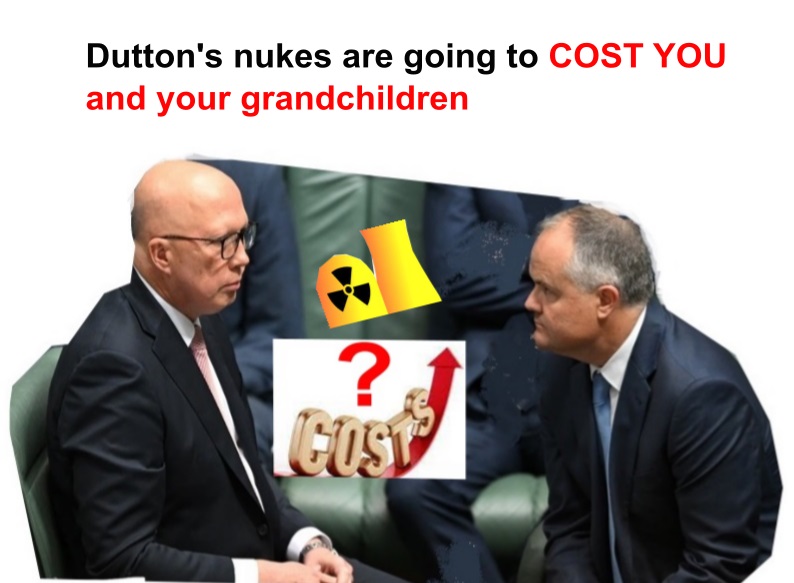
the Coalition documents released on Friday don’t seem to get around to mentioning is that its proposal for nuclear power involves taxpayers taking on all the massive financial risks (apart from the other sorts) and costs.
By Laura Tingle, 7.30 ABC 17 Dec 24
The August 2010 federal election campaign was conducted amid continuing shock waves from the Julia Gillard coup against Kevin Rudd a little less than two months earlier.
So, you may be forgiven for forgetting much that happened in the actual campaign, and specifically, how the federal Coalition didn’t bother releasing the costings of its election promises until just 48 hours before voters went to the polls.
It had already refused to submit the policy promises for independent analysis — which in those days was done by Treasury and the Department of Finance rather than the Parliamentary Budget Office.
That refusal might not have mattered too much to the broad sweep of history if the election result had been different. But a knife-edge result left three crossbench House of Representatives MPs to make the call on which side of politics would get their support and, therefore, be able to form government.
In making their decision the “Three Amigos” — Tony Windsor, Bob Katter and the subsequently infamously loquacious Rob Oakeshott — relied heavily on a Treasury and Finance analysis requested by them post-election.
Its findings? That the Coalition’s claimed budget savings were out by almost $11 billion. In the current age of announcements measured in the hundreds of billions of dollars, that might not sound like a lot.
But given that the claimed cost of Coalition policies was originally only $31.5 billion, that’s a rather spectacular …. miscalculation.
It felt for all the world like the work of an ill-prepared, lazy opposition that thought it could coast to office amid the chaos of a dysfunctional government. And it almost did.
A perfectly timed announcement
There’s something spookily familiar about the circumstances now, as the opposition finally unveiled its much-promised nuclear energy costings on a Friday one week before the country closes down entirely for Christmas.
There may be a lot more detailed modelling in the document prepared by Frontier Economics for the Coalition than there was in 2010.
But the modelling, and more importantly the Coalition’s political message wrapped around it, doesn’t answer the myriad of questions raised by the idea of nuclear energy. And this belated release of what we are led to believe is a signature policy for the election comes as the Coalition still hasn’t released details of most of its other key policies — from tax to immigration.
The decision to release the costing on December 13 feels like the Coalition is once again playing voters for mugs at a time when it is up against a federal government that has spent the year apparently determined to prove it is not very good at politics, or persuading voters that it knows what it is doing.
The Frontier modelling does implicitly raise important questions about the government’s own energy plans: just how much coal-fired power will the system need as we move towards a system that is dominated by renewables, and for how long?; how much gas will be needed (and is it in the right place) to be used to “firm” or underwrite the system?; how much can we really rely on battery technology that is still evolving to store renewables? and just how much transmission infrastructure do we need (and where) for a mostly renewables future?
The government has “sort of” answered these questions. Most analysts will tell you that it is almost impossible to answer them precisely because the wheel is still in spin. Prices and technologies are changing.
But, up against an opposition leader who is better at cut-through messages, it will need to do a lot better than that.
Crucial to the political debate is the fact that much of the uncertainty around these decisions arises because they are being made by individual investors who are taking on all the risks in building new energy capacity.
And this must surely be the threshold point of difference with what the federal Coalition is proposing.
For the one thing that the Coalition documents released on Friday don’t seem to get around to mentioning is that its proposal for nuclear power involves taxpayers taking on all the massive financial risks (apart from the other sorts) and costs.
The Coalition wants this big shift to be overseen by a public sector which it usually loves to point out is notoriously bad at running big projects, either directly or via massive subsidies.
The nuclear divide
The electorate is a lot more disengaged than it was in 2010, but the politically dangerous part of the nuclear policy from the government’s perspective is how it plays to regional Australia and, a bit like Brexit, likely divides the country into two very different blocks of voters.
Many regional voters, most pollsters will tell you, are worried about job losses as coal mining disappears, are unconvinced renewables offer job replacements, and are very exercised about the proliferation of wind and solar farms, and by the transmission lines to link them to the grid.
Earlier talk of small nuclear reactors has disappeared from the model set out using the Frontier modelling, and that modelling doesn’t seem to make provision for the fact that there are usually high costs for a first build, or that most expert opinion says it will take until at least 2040 to have the regulatory system and build in place for a first nuclear reactor to be functional, not 2036………………………………………………………………..
The Coalition has been pledging all year that its plans would lead to lower energy prices for stressed households.
But Peter Dutton had to sidestep on that issue on Friday because there is no clear mechanism for his plans to bring down those costs any time soon.
All the energy experts will be poring over the details for days. One could say they would be poring over them for weeks but (almost as if it was planned that way) the media coverage and the debate seem likely to come to a screeching stop in a week’s time as everything shuts down for Christmas.
Like the 2010 election costings, not many voters may remember the details of any analysis.
But the Coalition will have to be hoping there is no political equivalent of the Three Amigos to answer to this side of the 2025 election.
Laura Tingle is 7.30’s chief political correspondent. https://www.abc.net.au/news/2024-12-14/politics-dutton-release-nuclear-costings/104723416
Australia’s Nuclear Neverland politics: The Lost Boys of Costings | The West Report
It’s hard to take the Coalition’s nuclear energy policy seriously, so we didn’t. And frankly, why would they put taxpayers on the hook for the biggest public funded project in history when renewables are crowding private investment en masse? https://www.youtube.com/watch?v=fSeaybp9oAA
Rupert Murdoch loses his legal battle, leaving future of media empire in the balance

The Conversation, Matthew Ricketson and Andrew Dodd, December 10, 2024
In the seemingly never-ending psychodrama surrounding Rupert Murdoch and his family, life has imitated art. Again.
A report on December 9 in The New York Times revealed details of the recent secret hearing in a Nevada probate court that was literally prompted by the epic HBO drama Succession…………………………..
The probate commissioner in Nevada who heard Rupert Murdoch’s application, Edmund Gorman “resoundingly” ruled against his attempt to change his family trust in a way that would have secured Lachlan’s position atop the global media empire.
Gorman was scathing in his ruling, saying father and son had acted in “bad faith” in their bid to change an “irrevocable” family trust that divides control of Fox News and News Corporation equally among Murdoch’s four eldest children from his first and second marriages: Prudence, Elisabeth, Lachlan and James.
In the 96-page ruling, Gorman described the plan to change the trust as a “carefully crafted charade” to permanently consolidate Lachlan’s executive roles inside News, “regardless of the impacts such control would have over the companies or the beneficiaries” of the family trust……………………………………….
Gorman’s ruling is not the end of the matter, however. It’s technically a recommendation to the Probate Court, which a district judge will ratify or reject.
Whatever the judge decides is open to appeal, which a lawyer for Rupert and Lachlan has already said they plan to do. Meanwhile, the other three siblings have released a statement welcoming the decision and expressing hope that “we can move beyond this litigation to focus on strengthening and rebuilding relationships among all family members”.
Good luck with that. The strongly worded ruling seems likely only to drive the parties further apart………………………………………………………………………………….
Lachlan’s description of James as the trust’s “troublesome beneficiary”.
By “troublesome” the plan was obliquely referring to the split in the family between Lachlan and Rupert – who are wedded to a media empire that is both right-wing and profitable – and James, who severed all ties with the company over its denialist coverage of climate change and its credulous reporting of baseless conspiracy theories about the result of the 2020 US presidential election………………………………………………………………………………….
If Prudence, Elisabeth and James can assert control, sideline Lachlan, and settle on a unified path forward, they can potentially reshape the company and redefine its journalism.
If they have already war-gamed it, and surely by now they have, the three siblings would know their greatest risk is alienating their current audiences, subscribers and advertisers.
In Australia, News operates in a virtual monopoly, so it can shapeshift with fewer consequences. But the US market is awash with emerging right-wing alternatives, each of which is eager to steal a share of the Fox audience. These viewers are the people who make Fox such a valuable commodity, and they’re the reason why it’s been so hard to stand up to Trump and his anti-democratic tactics, even on the odd occasions when Rupert and Lachlan wanted to.
The challenge is to somehow bring those audiences along for whatever transition the siblings envisage for the company. Can it be done, and if so, how?
The company’s own history suggests editorial change can happen quickly and audiences do tend to retain some loyalty. Murdoch’s takeover of The New York Post in the 1970s shows it is possible to radically change a masthead’s editorial position while expanding its audience, in that case from a mostly Democrat-leaning readership to a larger and more conservative one. But that was a moribund newspaper due for a radical makeover. There’s no guarantee it would work in reverse.
Fox News is arguably at the peak of its powers. The incentive to impose change has everything to do with journalistic standards and nothing to do with finances. In 2023–24 the Fox Corporation’s net income was US$1.5 billion (A$2.35 billion).
Even so, it must be possible to introduce incremental changes that reacquaint Fox viewers with more considered and ethical journalism without scaring them off. This wouldn’t work universally. Some of the demagogues who couldn’t cope would have to go – Sean Hannity springs to mind, as does former Fox firebrand Tucker Carlson.
Under new management, News could reintroduce some of the elements lost to Talk-TV in the mid-1980s, when the US scrapped the fairness doctrine that guaranteed balance and greater civility on the airwaves. It could ensure programs canvas different views, ask devil’s-advocate questions, and investigate issues without fear or favour.
Change of this nature wouldn’t be easy. News Corp has an echelon of editors across its global mastheads, most of whom are culture warriors and battle-hardened loyalists. They can and probably would work together to undermine progressive change.
During his tenure as the Australian head of News Corp, well before he became chair of the ABC, Kim Williams saw how the editors sneeringly white-anted his efforts to introduce reform. Even Lachlan Murdoch discovered that senior staff could undercut him. Paddy Manning recounts in his 2022 biography of Lachlan Murdoch, The Successor, that the infamous Roger Ailes did just this as Lachlan was learning the ropes at Fox in the early 2000s.
The three siblings will need resolve to dispense with those who get in their way, and they’ll need to introduce firm but gradual changes that don’t unduly scare their audiences or the market. But if Prudence, James and Elizabeth do share such a vision and are up for a fight, the world could soon be in for a fascinating media transition. more https://theconversation.com/rupert-murdoch-loses-his-legal-battle-leaving-future-of-media-empire-in-the-balance-245665?utm_medium=email&utm_campaign=Latest%20from%20The%20Conversation%20for%20December%2011%202024%20-%203195432592&utm_content=Latest%20from%20The%20Conversation%20for%20December%2011%202024%20-%203195432592+CID_9d007a3b0e7578f878c65cbd5b463722&utm_source=campaign_monitor&utm_term=Rupert%20Murdoch%20loses%20his%20legal%20battle%20leaving%20future%20of%20media%20empire%20in%20the%20balance
Will Donald Trump kill US-UK-Aussie sub defense deal?

The landmark defense agreement between the U.S, U.K. and Australia could be in jeopardy with the maverick Republican back in the White House.
Politico, December 9, 2024, By Stefan Boscia and Caroline Hug
LONDON — There are few issues on which we do not know Donald Trump’s opinion.
After thousands of hours of interviews and speeches over the past eight years, the president-elect has enlightened us on what he thinks on almost any topic which enters his brain at any given moment.
But in the key area of defense, there are some gaps — and that’s leading global military chiefs to pore over the statements of the president’s allies and appointees to attempt to glean some clues, specifically over the $369 billion trilateral submarine program known as AUKUS he will inherit from Joe Biden.
Trump does not appear to have publicly commented on the AUKUS pact — named for its contingent parts Australia, the United Kingdom and the United States — which would see the U.S. share technology with its partners to allow both countries to build state-of-the-art nuclear submarines by the 2040s.
This uncertainty has left ministers and government officials in London and Canberra scrambling to discover how the Republican is likely to view the Biden-era deal when he returns to the White House in January.
Two defense industry figures told POLITICO there were serious concerns in the British government that Trump might seek to renegotiate the deal or alter the timelines.
This is because the pact likely requires the U.S. to temporarily downsize its own naval fleet as a part of the agreement — something Trump may interpret as an affront to his “America First” ideology.
Looking east
There is hope in Westminster that Trump would be in favor of a military project which is an obvious, if unspoken, challenge to China.
The deal would see American-designed nuclear submarines right on China’s doorstep and would form a part of Australia’s attempts to bolster its military might in the Indo-Pacific.
When former U.K. Prime Minister Boris Johnson said in September 2021 that the deal was not “intended to be adversarial toward China,” President Xi Jinping simply did not believe him.
The Chinese leader said AUKUS would “undermine peace” and accused the Western nations of stoking a Cold War mentality.
Mary Kissel, a former senior adviser to Trump’s ex-Secretary of State Mike Pompeo, said “you can assume Trump two will look a lot like Trump one” when it comes to building alliances with other Western countries against China.
“We revivified the Quad [Australia, India, Japan and the U.S.], got our allies to bolster NATO funding and worked to prevent China from dominating international institutions,” she said.
However, the deal also forces the U.S. government to sell Australia three to five active Virginia attack submarines, the best in the U.S. Navy’s fleet, by the early 2030s as a stopgap until the new AUKUS subs are built.
Is America first?
This coincides with a time where there is a widely recognized crunch on America’s industrial defense capacity.
In layman’s terms, the U.S. is currently struggling to build enough submarines or military equipment for its own needs.
One U.K. defense industry figure, granted anonymity to speak freely, said there was “a lot of queasiness” in the U.K. government and a “huge amount of queasiness in Australia” about whether Trump would allow this to happen.
“There is a world in which the Americans can’t scale up their domestic submarine capacity for their own needs and don’t have spare to meet Australia’s needs,” they said.
“If you started pulling on one thread of the deal, then the rest could easily fall away.”
One U.K. government official played down how much London and Canberra are worried about the future of the deal, however.
They said the U.K. government was confident Trump is positive about the deal and that the U.S. was “well equipped with the number of submarines for their fleet.”………………………………………………………………………………………………………………………………..
‘Everyone’s a winner
This attempted U.K.-China reset will likely be high on the list of talking points when Healey meets with his Australian counterpart Richard Marles next month in London for an “AUKMIN” summit.
The Australian Labor government, after all, has conducted a similar reset with the Chinese government since coming to power in 2022 after relations hit a nadir during COVID.
Also at the top of the agenda will be how to sell the incoming president on the AUKUS deal in a positive way.
A second defense industry insider said the British and Australian governments should try to badge the deal in terms that make it look like Trump has personally won from the deal.
“Everybody is worried about America’s lack of industrial capacity and how it affects AUKUS,” they said.
“He is also instinctively against the idea of America being the world’s police and so he may not see the value in AUKUS at all, but they need to let him own it and make him think he’s won by doing it.”………………………………………………………………………..
Pillar II
While the core nuclear submarine deal will get most of the headlines in the coming months, progress on the lesser-known Pillar II of AUKUS also remains somewhat elusive.
Launched alongside the submarine pact, Pillar II was designed to codevelop a range of military technologies, such as quantum-enabled navigation, artificial intelligence-enhanced artillery, and electronic warfare capabilities.
One Pillar II technology-sharing deal was struck on hypersonic missiles just last month, but expected progress on a range of other areas has not transpired.
Ambitions to admit Japan to the Pillar II partnership this year have also gone unfulfilled……………………………………………………………
https://www.politico.eu/article/donald-trump-aukus-kill-us-uk-aussie-sub-defense-deal/
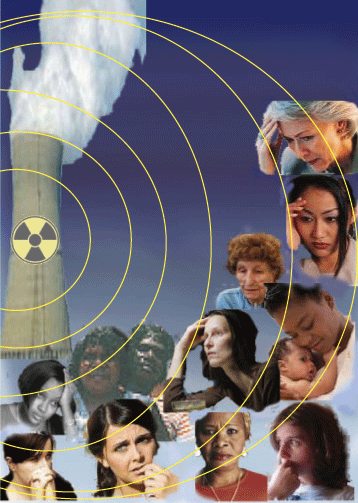
Nuclear energy debate draws stark gender split in Australia ahead of next year’s election.
Lisa Cox, 5 Dec 24, https://www.theguardian.com/environment/2024/dec/04/nuclear-energy-debate-draws-stark-gender-split-in-australia-ahead-of-next-years-election
Survey finds 25 percentage point gender gap across all age brackets on whether nuclear power would be positive for the country, with majority of men saying it would.
New data points to a stark gender split in attitudes towards nuclear energy, with women much more likely to say they don’t support it or think the risks are too great.
Research company DemosAu surveyed 6,000 people on behalf of the Australian Conservation Foundation and found 26% of women thought nuclear energy would be good for Australia, compared with 51% of men.
DemosAu head of research, George Hasanakos, said the 25 percentage point gender gap was “the sharpest divide in attitudes between men and women” that the research firm had seen on any issue.
The polling found the split was pronounced regardless of the age of the people surveyed, with young men and women just as divided as those from older generations.
While 51% of men agreed nuclear energy would be good for Australia, that support dropped when asked if they would be happy to live near a nuclear plant.
A reported 38% of men agreed they would support a nuclear plant being located close to their city, with 44% disagreeing and 18% neutral. Among women, just 18% agreed they would be happy to have a nuclear plant near their city, with 63% disagreeing and 19% neutral.
“Men support nuclear much more than women,” the ACF chief executive, Kelly O’Shanassy, said.
“But as soon as you ask men more details such as ‘Would you be happy to live next door to a plant?’ or ‘Do you think one will be built within the next decade?’ – that level of support really comes down.”
The report found female respondents were more likely to answer “neutral” compared with male respondents. It identified this as both “a risk and opportunity for campaigners on both sides of the issue” as Australia approaches a federal election but said pro-nuclear campaigners would have to contend with widely held safety concerns about nuclear among women.
On the subject of transporting nuclear waste, the poll found 57% of women and 43% of men said it wasn’t worth the risk.
The prime minister, Anthony Albanese, has said the next election will be a referendum on nuclear power.
The Coalition has proposed seven sites where it says it would eventually replace coal-fired power plants with nuclear plants but not how much this would cost. The government has rejected the idea and the federal House of Representatives is conducting an inquiry into the consideration of nuclear power in Australia.
Multiple energy analysts have argued nuclear energy would be more expensive than other options and a nuclear industry would not be possible in Australia until after 2040.
O’Shanassy said among the report’s more interesting findings was that despite the gender gap on many aspects of nuclear, men and women were aligned in the view that renewables were cheaper.
A reported 47% of men agreed renewables would deliver cheaper energy, compared with 31% who disagreed (with 22% neutral).
While 47% of women also agreed renewables would deliver cheaper energy, 20% disagreed and 33% were neutral.
In separate data, the climate advocacy organisation 1 Million Women surveyed an additional 3,351 women among its own supporters and found 93% were concerned about nuclear.
“Nuclear energy is a distraction to meaningful climate solutions and women don’t have the time or patience to entertain the Coalition’s proposal,” its founder, Natalie Isaacs, said.
Consultation, full disclosure, and an environmental audit: Nuclear Free Local Authorities’ triple demand of Australian government over nuke sub waste dump down under

the NFLAs have raised our fundamental objections to any siting of nuclear powered, and possibly nuclear armed, submarines at Garden Island as a violation of Australia’s legal commitments as a signatory to the Treaty of Rarotonga, which established a South Pacific nuclear free zone. The proposal will increase military tensions with China and make Rockingham a target for a counterstrike should war break out.
a White House paper states that Australia ‘has committed to managing all radioactive waste generated through its nuclear-powered submarine program, including spent nuclear fuel, in Australia’.
NFLA 22nd Nov 2024
With an international outlook and solidarity in mind, in response to a consultation by the Australian Federal Government, the UK / Ireland Nuclear Free Local Authorities have posted their objections to plans to station nuclear-powered subs and establish a waste dump in Western Australia.
As part of the AUKUS military pact established between Australia, the United Kingdom and United States, Australia intends to acquire a fleet of nuclear powered submarines, powered by reactors built by Rolls-Royce in Derby, as well as permitting Royal Navy and United States Navy nuclear submarines to operate from Australian naval bases.
In March 2023,the AUKUS Nuclear-Powered Submarine Pathway was announced by the three partners centred on the HMAS Stirling Naval Base on Garden Island in Western Australia’s Cockburn Sound. The Australian Government has allocated AUS $8 billion for base improvements.
Under the AUKUS ‘Force Posture Agreement’, from 2027, US Virginia Class submarines are to be stationed here, with British Astute submarines joining them on rotation in the 2030’s. Around this time, the base will also become the home port of Australia’s first nuclear powered submarines, with three and up to five Virginia Class submarines being purchased from the US (subject to Congressional approval).
The Federal Government has passed new legislation to allow for the domestic storage of nuclear waste from all these submarines, and in July after a limited consultation the Australian Radiation Protection and Nuclear Safety Agency (ARPANSA) issued a licence to the Australian Submarine Agency to prepare a nuclear waste storage site at the base. Without it, visiting United States and British nuclear-powered submarines could not undertake maintenance in Australia, so the nuclear dump is seen as essential to the pact.
The extent and nature of the waste to be stored, and for how long it would be stored, remains unclear. The Conservation Council of Western Australia (CCWA) complained to the regulatory authorities that: ‘The consultation documents provided no details about the volume of waste or how long it would be stored at the island. They also made confused and misleading claims about the types of low-level waste that would be accepted’.
Whilst regulators insist that it would be low-level waste, this claim has been refuted by critic Australian Green Senator David Shoebridge who said the Federal legislators were told in a Senate Estimates Hearing by the Australian Submarine Agency that it would include intermediate waste. It is also contradicted by a White House paper which states that Australia ‘has committed to managing all radioactive waste generated through its nuclear-powered submarine program, including spent nuclear fuel, in Australia’.
This waste would include US Virginia-class submarine reactors, which each weigh over 100 tonnes and contain over 200 kilograms of highly enriched uranium. Ian Lowe, an expert on radiation health and safety, told The Conversation in March 2023 that when the first three AUKUS submarines are at the end of their lives — 30 years from when they are commissioned — Australia will have 600 kilograms of ‘spent fuel’ and ‘potentially tonnes of irradiated material from the reactors and their protective walls’. The fuel being weapons-grade will require ‘military-scale security’.
Australian campaigners have also complained bitterly that the submarine base and the storage site are located in the wrong place.
Mia Pepper, Campaign Director at the CCWA, said that ‘Garden Island in one of the most pristine and diverse environments in the Perth region’ and that ‘This plan for both nuclear submarines and nuclear waste storage will inevitably impact access to parts of Cockburn Sound and Garden Island’.
And when responding to ARPANSA, the CCWA stated that the facility is ‘within an area of dense population’ and in the vicinity of ‘important and diverse heavy industrial facilities, including a major shipping port’. The CCWA also raised the ‘unaddressed community concerns regarding an accident’ on the site and complained about the ‘lack of transparency and rigour’ throughout the regulatory process.
Nor is there any long-term solution to storage. Garden Island would be seen as a temporary store, but it is unclear for how long. A Federal Government proposal to establish a nuclear waste dump at Kimba was resisted by local Indigenous people who launched a successful legal challenge to defeat the plan.
In its response to the consultation being conducted by the Australian Department of Climate Change, Energy, the Environment and Water, the NFLAs have raised our fundamental objections to any siting of nuclear powered, and possibly nuclear armed, submarines at Garden Island as a violation of Australia’s legal commitments as a signatory to the Treaty of Rarotonga, which established a South Pacific nuclear free zone. The proposal will increase military tensions with China and make Rockingham a target for a counterstrike should war break out.
We also called on the Federal Government to conduct a proper consultation and make a full disclosure of the facts, and requested that officials conduct a full environmental audit of the likely impact of the waste storage site…………………………………………. https://www.nuclearpolicy.info/news/consultation-full-disclosure-and-an-environmental-audit-nflas-triple-demand-of-australian-government-over-nuke-sub-waste-dump-down-under/
Nuclear is not really back

Think the Cop29 climate summit doesn’t matter? Here are five things you should know,
Adam Morton in Baku, Guardian, Sat 23 Nov 2024
…………………………………………………..Some media outlets went to great lengths this week to claim that nuclear energy was at the centre of Cop29 talks, and Bowen had been embarrassed by Australia not signing up to a UK-US civil nuclear deal.
Take it from a reporter on the ground: this has no basis in fact.
The UK made a mistake by listing on a press release Australia and another nine countries that it said it expected would sign up to a Generation IV International Forum on nuclear. That sentence were quickly removed once it was pointed out that no one had checked and it wasn’t true. Instead, Australia will continue as an observer, as it was in the forum’s previous iteration.
The slip-up had no obvious impact on the relationship between the countries – Bowen and his UK counterpart, Ed Miliband, held an event to sign a renewable energy agreement shortly after the story broke. And nuclear has been barely visible as an issue at the talks.
Thirty-one countries have signed up to a side pledge to triple nuclear power capacity by 2050, with six new countries joining at Cop29. But the global focus is renewable energy. Cop28 agreed global investment in renewables needs to be tripled by 2030, and the bulk of the non-fossil energy investment is going that way.
Only one country that signed the pledge to triple nuclear, Slovakia, has started work on planning a new plant in the past year. And those plants take about 20 years to build…………………………………………………………. fact.”
https://www.theguardian.com/environment/2024/nov/22/think-the-cop29-climate-summit-doesnt-matter-heres-five-things-you-should-know
Australian government gives firm ‘no’ to joining UK-US agreement to advance nuclear technology
The Conversation, November 19, 2024, Michelle Grattan, Professorial Fellow, University of Canberra
The Albanese government has been put on the spot by a new agreement – which it has declined to join – signed by the United Kingdom and the United States to speed up the deployment of “cutting edge” nuclear technology.
The original version of the British government’s press release announcing the agreement said Australia, among a number of other countries, was expected to sign it.
But the reference was removed from the statement.
The UK Energy Secretary Ed Miliband and the US deputy Secretary of Energy David Turk signed the agreement in Baku during COP29…….
A spokesperson for Energy Minister Chris Bowen, who is at the COP meeting, said: “Australia is not signing this agreement as we do not have a nuclear energy industry.
“We recognise that some countries may choose to use nuclear energy, depending on national circumstances.
“Our international partners understand that Australia’s abundance of renewable energy resources makes nuclear power, including nuclear power through small modular reactors, an unviable option for inclusion in our energy mix for decarbonisation efforts.”
Australia would remain as observers to the agreement to continue to support its scientists in other nuclear research fields, the spokesperson said………
In parliament, acting Prime Minister Richard Marles said for Australia to pursue a path of nuclear energy would add $1200 to the bills of each household in this country.
………………………Update: UK government seeks to clear things up
Later The Guardian reportred: “The UK government has conceded it made a mistake in including Australia in a list of countries that has signed up to a US-UK civil nuclear deal”. https://theconversation.com/albanese-government-gives-firm-no-to-joining-uk-us-agreement-to-advance-nuclear-technology-244041
Trumped: $9B to US and UK shipyards … but why not make Australia make again?

The Government is shy on spending money on a steel works which they would have complete control over, in terms of success, but are happy to recklessly throw money at US shipyards.

Senator David Shoebridge: “The AUKUS submarine deal is a non-refundable $368 billion gamble on the goodwill of some future US President, and the US just elected Donald Trump. You only need to put these two facts side by side to realize what a disaster the whole thing is.”
by Rex Patrick | Nov 16, 2024, https://michaelwest.com.au/aukus-9b-to-us-and-uk-shipyards-but-wait-theres-more/
Make Australia Make Again?
The future of Whyalla’s steelworks is of vital national importance and should matter to all of us. It is critical to Australia’s manufacturing, construction and national security and resilience.
Being frank, the steelworks are in dire straits. They are 60 years old and have been on a rocky road for well over a decade. Its blast furnace has been out of action for over six months now, and whilst there is some optimism that they will get it back up and running it will not change the fact that the steelworks have been in operation for some six decades.
In 2016 when the previous owner, Arrium, went into administration with $4 billion in debts, UK billionaire Sanjeev Gupta’s GFG Alliance bought the steelworks making lots of big promises for a bright future, but it was not to be. At the turn of the decade Greensill Capital, GFG’s financier, collapsed and there’s been trouble ever since.
As it stands, the future of the steelworks, and Whyalla, is in the hands of a court entangled foreign billionaire with a gaping chasm between his promises and delivery. Those promises of a 21st century industrial transformation look very much like ever receding mirages.
The Federal Government needs to have the SA Government bring matters to a head by putting GFG’s South Australian operations into administration (by calling for unpaid and overdue mining royalties), taking an equity stake in the steelworks alongside someone like BlueScope Steel, and investing the necessary billions to build a new green steel industry for Australia.
It would be a part of Make Australia Make Again.
Make America Great Again!
Prime Minister Albanese’s focus is on investment in US industry, not Australian industry.
In September 2023 the Federal Government announced it was pouring $4.7 billion ($US3B) into the US submarine industrial base to assist the largest economy in the world get their submarine production rate up to 2.3 subs per annum (from the current rate of 1.4 subs).
Some $1.5 billion will be paid to the US this financial year, and $1.8 billion next financial year. The remaining $1.4B will follow thereafter.
The Government is shy on spending money on a steel works which they would have complete control over, in terms of success, but are happy to recklessly throw money at US shipyards.
Go figure!
Make Great Britain Great Again Too!
That’s not the end of the story though.
The British are in on this deal of a lifetime too. They’ve managed to pull $4.4B (£2.4 billion) over the next decade from Australian consolidated revenue.
There is no clawback on payment to the United Kingdom either.
Everyone must be feeling pretty chuffed in Groton, Connecticut, and Barrow-in-Furness, England.
But Wait, There’s More!
Whilst the Federal Government has been open about the totals, albeit with a little ‘encouragement’ from Green’s Senator David Shoebridge at Senate Estimates, there’s a dark secret being withheld from the Parliament and the public.
There’s more ‘shared’ cost to come.
FOI returns from the US Department of the Navy reveal that behind the scenes the three AUKUS government participants have been negotiating trilateral cost sharing principles to guide future cost sharing negotiations.
Whilst the Federal Government has been open about the totals, albeit with a little ‘encouragement’ from Green’s Senator David Shoebridge at Senate Estimates, there’s a dark secret being withheld from the Parliament and the public.
There’s more ‘shared’ cost to come.
FOI returns from the US Department of the Navy reveal that behind the scenes the three AUKUS government participants have been negotiating trilateral cost sharing principles to guide future cost sharing negotiations.
Senator David Shoebridge backed this in telling MWM, “Why on earth do cost-sharing principles need to be secret? Of course they should be made public.”
He went on to comment, “Once again, we get more transparency on AUKUS out of the US than Australia.“
“The one-sided secrecy is because the US has a whole lot less to be embarrassed about than Australia. They are the ones getting all our money after all.”
Transactional Trump
Transactional Trump
The approved appropriations in the US for enhancing their submarine industrial base through upgrades as well as recruitment and training of thousands of additional workers amount to $US14.7B. Australia adds another $US3B to that. But the total the US administration is seeking for this work is in the order of $US28.4B.
Of course, there is some quid quo pro in all of this with the Australia Government having committed to spending $8 billion upgrading HMAS Stirling near Rockingham to support the operations of UK and US nuclear powered submarines from 2027, and possibly Australian nuclear submarines from 2035.
There is a danger under the incoming Trump administration that the President will seek a greater contribution from Australia – just as he has demanded that members of NATO pull their weight. And it will be a case of having no choice but to pay, no matter the cost sharing principles negotiated, because our Defence Department simply has no Plan B.
Senator Shoebridge commented, “The AUKUS submarine deal is a non-refundable $368 billion gamble on the goodwill of some future US President, and the US just elected Donald Trump. You only need to put these two facts side by side to realize what a disaster the whole thing is.”
Ships and Steel
Meanwhile, as Australian money is being tossed around the US and UK like it’s free, Albanese is sitting on his hand on the issue of green steel manufacturing in Whyalla.
Anthony Albanese says he wants to revitalise manufacturing and Make Australia Make Again. But in this topsy-turvey world, he’s instead working to deliver on Donald Trump’s slogan to Make America Great Again.
Nuked: The Submarine Fiasco that Sank Australia’s Sovereignty, book by Murray Horton

Global Peace and Justice Aotearoa, 12 Nov 24, Reprinted from Covert Action Magazine
Andrew Fowler’s book Nuked: The Submarine Fiasco That Sank Australia’s Sovereignty (Melbourne University Press, 2024) was not written by a member of the peace movement. That is both a strength and a weakness. A strength, because Andrew Fowler is an award-winning investigative journalist, who has worked in mainstream Australian current affairs TV. So, it can’t be dismissed as “anti-American, anti-military” propaganda.
But it is a weakness because the author never questions the basic tenet of the book’s subject—why does Australia need any submarines at all, regardless of whether they are conventionally powered or nuclear powered. The book’s focus is a forensic analysis of who won the highly lucrative battle to supply Australia’s new subs—it was all set up to be France but then, after hidden, sub-surface maneuvering worthy of one of the book’s subjects, Australia and the U.S. torpedoed the French and did a deal among themselves.
This book is about AUKUS (Australia, UK, U.S.), the new kid on the “Indo-Pacific” block—although it should be pointed out that the UK is an awfully long way away from either the Indo or the Pacific. It is an attempt to build a new Western military alliance, initially between those three countries but with the prospect of other countries (including New Zealand) joining the ill-defined AUKUS Pillar Two at some unspecified time in the future. But let’s not get ahead of ourselves. The book is about the birth of AUKUS, which is all about submarines.
AUKUS
I’ve written about AUKUS previously in Covert ActionMagazine, so I refer you to that for the back story. In 2016 Australia signed a $A50 billion contract for France to build it 12 state of the art conventionally powered submarines for the Australian Navy. It was the largest defence contact in the history of both France and Australia. The right-wing Liberal Party was in Government in Australia, headed by Prime Minister Malcolm Turnbull…………………………………………………………………………………………………………………….
The book names names—the man who fronted the deception and betrayal of France was Scott Morrison, who replaced Turnbull as the Liberal Prime Minister in 2018, in an internal Party coup (a common occurrence in Australian politics). Behind the scenes, the key man was Andrew Shearer, “a vehemently pro-American China hawk” who went on to become Director-General of National Intelligence. Right up until just before AUKUS was announced in 2021, Morrison’s government continued to assure France that it was proceeding with the contract to buy French submarines.
Dumping France For the U.S.
Instead of 12 diesel-powered French subs, Australia signed up to have the U.S. and UK build eight nuclear-powered (but not nuclear-armed) subs for its Navy. The cost is astronomical—up to $A368 billion by 2055. Yes, that’s right—those eight subs will not be ready for more than 30 years. The first of them is unlikely to be ready until the 2040s so, to fill that gap, Australia will buy three existing U.S. subs from the early 2030s, at a cost of up to $A58b, with an option to buy two more. This is a staggering amount to spend on one military project from a country with a population of just under 27 million people.
“(AUKUS) was a clear victory for Washington, which had been concerned for some time that France had a different view on how to deal with the rise of China… There was barely a murmur of opposition from the media. Morrison had pulled off a major achievement of what U.S. public intellectual Noam Chomsky describes as the political art of ‘manufacturing consent’…”.
“How did it happen that the bulk of analysis and criticism of the submarine deal came from two former Prime Ministers, Paul Keating (Labor) and Malcolm Turnbull (Liberal) who, though on opposing sides of politics, were united in warning that the submarine deal stripped away Australia’s sovereignty……………………………..
Australia Expected To Fight Alongside U.S. In War With China
There is only the feeblest pretense that these nuclear submarines (still decades away from reality) will be used to defend Australia. Their role will be to patrol close to the Chinese coast, to hem in the Chinese Navy and, in the event of war, to attack China with cruise missiles. That’s the theory, anyway. The advantage of their being nuclear-powered is that they don’t have to return to port to refuel. U.S. hawks expect Australia to fight on its side in any war with China over Taiwan………………………………………………………………………………………..
Integration With U.S. Military
There is a lot more to the U.S.-Australia military relationship than some exorbitantly expensive nuclear submarines that may or may not ever materialise. There is the top-secret Central Intelligence Agency/National Security Agency Pine Gap spy base near Alice Springs, in central Australia, which is crucial to the global warfighting abilities of the U.S. There is the North West Cape facility on the westernmost point of mainland Australia, which the US Navy uses to communicate with its nuclear attack subs. There is Australia’s increasing involvement with the U.S. military and intelligence satellite programme, in preparation for war in space.
“Australia’s integration with the U.S. military was, of course, well underway before the AUKUS agreement. As already noted, Pine Gap and North West Cape are part of this. But there is also the basing of thousands of U.S. Marines in Darwin (northern coast), the stationing of nuclear-capable B-52s at Tindal (Australian Air Force base, northern Australia), and the stationing of U.S. military throughout the Australian Defence Force, including from the National Reconnaissance Office at the military headquarters in Canberra… Though Defence Minister Richard Marles has ruled out automatic support of the United States in any war over Taiwan, it is difficult to see how Australia won’t be involved. Pine Gap, Tindal, North West Cape and Perth (Western Australia’s biggest city) will all be integral to the battle.”
Change Of Government; No Change Of Foreign Policy
Scott Morrison’s Liberal government was voted out at the 2022 Australian election and was replaced by Anthony Albanese’s Labor Party. But Australia’s commitment to AUKUS remained unchanged………………………………………………………………………………
“Nuked” specifically attributes Labor’s fervent desire not to be seen as “anti-American” to the events of 1975, when the Central Intelligence Agency and its local collaborators, succeeded in getting Gough Whitlam’s Labor government overthrown in a bloodless coup. The U.S. covert state was particularly concerned about Whitlam’s revelations about its Pine Gap spy base and possible threats to close it. Jeremy Kuzmarov has recently written about this in CovertAction Magazine (15/11/23), so I refer you to that.
For half a century the Australian Labor Party has lived in fear of the same thing happening again, and has bent over backwards to prove its loyalty to the U.S.
………The consequences of the fear that drove the ALP leadership to embrace AUKUS with barely a second thought will haunt them for years to come. Just as Morrison was only too willing to trade Australian’s independence for the chance to win an election, so too was Labor. Now it is left to make work a deeply flawed scheme that, more than ever before, ties Australia’s future to whoever is in the White House.”
Jobs For The Boys
And what has happened to Scott Morrison, who retired from politics in 2024? “Along with Trump’s former CIA Director, Mike Pompeo, Morrison became a strategic adviser to U.S. asset management firm DYNE Maritime, which launched a $157 U.S. million fund to invest in technologies related to AUKUS. ………
“Morrison also became Vice-Chair of American Global Strategies (AGS), headed by former Trump National Security Advisor Robert O’Brien. AGS, stacked with former Pentagon, White House and State Department officials, boasts that it ‘assists clients as they navigate U.S. government processes,’ a useful addition to any company wanting to boost profits in the burgeoning area of military spending.”
New Zealand & AUKUS
…………………………………………………………………………… There are plenty of similarities between Australia and New Zealand but also significant differences. Whereas Australian governments of either party fall over themselves to loyally serve the U.S. empire, New Zealand has been nuclear free by law since the 1980s (and it was an Australian Labor government, on behalf of the U.S., which tried to pressure New Zealand to drop the policy. That pressure backfired).
……………………………………………………………….But there is a constant push to get New Zealand further entangled in the U.S. war machine, including Pillar Two of AUKUS (which has been, thus far, only identified as involving “advanced military technology”). New Zealand currently has a very pro-American Government, which is already a non-member “partner” of NATO and which is eager to serve the U.S……………………………………..
Not All New Zealand Politicians Lining Up To Grovel To Uncle Sam.
For a refreshing contrast, here’s an extract from a recent (2/10/24) press statement from Te Pāti Māori, the indigenous party, which has six Members of Parliament (out of 123). “Meanwhile the New Zealand Government is in talks with the United States about joining AUKUS to further support their war efforts. This represents the next phase of global colonisation, and it is being negotiated behind closed doors,” Co-Leader Rawiri Waititi said.
“The U.S. wants to use Aotearoa as a Pacific spy base. This could mean the end of our longstanding nuclear free policy to allow their war ships into our waters. AUKUS threatens our sovereignty as an independent nation, and the Mana Motuhake of every nation in the Pacific. It threatens to drag Aotearoa into World War 3,” said Waititi.
“The New Zealand government is putting everyone in Aotearoa at risk through their complicity. They must end all talks about joining AUKUS immediately. They must sanction Israel and cut ties with all countries who are committing and aiding war crimes,” said Co-Leader Debbie Ngarewa-Packer………………………………. more https://gpja.org.nz/2024/11/12/nuked-the-submarine-fiasco-that-sank-australias-sovereignty-by-murray-horton/
World teeters on brink as Trump and cronies prepare to flood the zone with shit
By Giles ParkinsonNov 10, 2024, https://johnmenadue.com/world-teeters-on-brink-as-trump-and-cronies-prepare-to-flood-the-zone-with-shit/
Are you OK? It seems an important question as the unhinged and unrestrained president Donald Trump is swept back into power and the world contemplates the implications for the climate, for civil discourse, for women, for minorities, for society as a whole, and for our children and their children.
We have, of course, been here before. This time round, however, the guard rails have been removed: Trump will be back in the White House and in control of the Senate, the House of Representatives, the judiciary and, thanks to fellow and like minded billionaires who own it or fund it, mainstream and social media. Only the filibuster stands in his way.
It’s a kick in the guts to those who care about the future. The implications weigh heavy on anyone minded to consider them: Trump is a climate denier who describes the science as a hoax and his vow to wind back policies and frack, frack, frack, will – according to the best estimates – add around four billion tonnes of CO2 equivalent by 2030, when the opposite needs to happen.
That, of course, means that the small window to cap average global warming within the Paris climate target of 1.5°C is all but lost. But by how big a margin it will be missed will depend on the actions elsewhere in the world. That includes Australia but mostly it is China, whose role could get complicated with the threat of a tariff war.
Trump has been especially enabled by the likes of Tesla and Twitter/X boss Elon Musk, who used to say that his prime mission was to end the use of fossil fuels in the grid and transport with electric cars, storage and renewables.
Musk’s technology, the cars and the batteries in particular, have helped tip the balance towards a green energy transition. But he now appears more concerned by other ideological pursuits.
Bizarrely, Musk now dismisses the science – maybe if greenhouse emissions get close to 1,000 parts per million it might be hard to breathe, he has said. He is obsessed about getting to Mars, and is happy to enable and promote misogynists and conspiracy theorists on his social media platform. On earth, or at least in cyberspace and the Metaverse, Musk is, to borrow a phrase, flooding the zone with shit.
What does that mean for Australia?
The good news – and these things are comparative – is that at least in the short term, the green energy transition will continue apace.
While wind and solar stocks plunged in the US in anticipation of Trump’s fossil fuel fracking frenzy, and his planned dismantling of the Inflation Reduction Act, the program in Australia accelerates, as we report here, with added urgency.
Australia is getting close to the half way mark of kicking fossil fuels out of the grid, and replacing them with wind, solar and storage – essential for any significant emissions cuts in the broader economy.
Some argue that the tipping point – aided by new technology, falling prices, better engineering, and deep pocketed investors – has already arrived.
But that won’t stop others from trying to throw a spanner in the nacelle, as it were, and Australia’s conservative Coalition – emboldened by the chutzpah of the Trump campaign and the backing of the Murdoch and Musk media machines – will continue with its campaign of mischief and misinformation.
What the Coalition and Peter Dutton have learned is that if you do flood the zone with shit – it’s the Steve Bannon mantra – then a lot will stick, particularly when you find ways of making people fearful.
So expect to hear a lot about immigration, transgender, women, elites and any other group that can easily be demonised in a tweet or an Instagram post.
The federal Coalition’s pursuit and promotion of nuclear power as a solution for Australia is about as nonsensical and incoherent as anything that Trump has ever proposed, but as the New York Times’ Seth Abramson notes in a depressing analysis, many of the public are too frivolous, selfish, self-interested, ignorant, or petty to care.
And, I would add, they are also too fearful, too impressionable, and too vulnerable to the machinations of billionaires who want to be trillionaires, and their supporting cast of psychopaths, to care.
Which brings it back to those who do care. The world has seen the likes of Trump, Abbott, Morrison before. The work has fallen to others to get on with the job – be it sub-national governments, investors, and campaigners. There is a lot at stake.
In Australia, that means individuals, too. Which is a good thing. The grid has changed so much, thanks largely to the massive popularity of rooftop solar, that consumers and communities here are in a position not enjoyed by others in the world: They are poised, quite literally, to take the power into their own hands, if only they were allowed.
Their ability to do so will grow with the rollout of EVs, vehicle to grid technology, heat pumps, and software that allows and promotes demand management.
The biggest impediment appears to be the system itself, and entrenched interests. Voters in the US and Australia are being hurt by changing economic circumstances and inflation. Trump managed to con the US public by pretending that he wasn’t part of the system, or the problem.
His attack on established and respected institutions is echoed in Australia by Dutton and co, who appear more concerned about protecting the vested and often venal interests of legacy industry – many now crouching behind the veil of net zero by 2050 that they know they can use as an excuse rather than a target.
It seems to be working. Polls put the Coalition at a 52-48 per cent advantage, just six months out from the federal poll. At least in Australia there is strength in minor parties, and their role has never been as crucial as it is now. The world is is in desperate need of grown-ups. Australia cannot afford to follow the American path.
So, when the rest of us are able to pick ourselves up from the floor, and check with others that they are OK, then it might be time to set about convincing doubters that the push to zero emissions offers a safe and more prosperous future, and the chance to be part of a community rather than oppressed by a system.
Sadly, it’s not yet apparent that enough in the green energy industry have learned how to do that, or even that they know that they should.
Good luck, take care, and don’t give up. We won’t.
Airstrip One: How Albanese has integrated Australia into Trump’s military machine
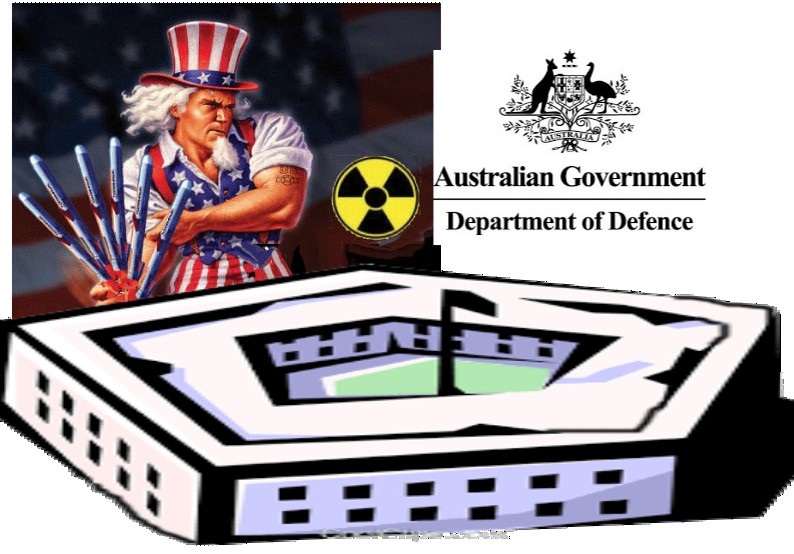
Thanks to the Albanese government, the new Trump administration will find Australia a well-established launch pad for any conflict with China.
Bernard Keane, Nov 11, 2024, https://www.crikey.com.au/2024/11/11/anthony-albanese-australia-us-military-integration-donald-trump/
The next Trump administration will arrive in power to learn that Australia is far more deeply enmeshed in in the US military and intelligence apparatus than in 2020, partly thanks to an eager Albanese government subordinating Australian sovereignty to Washington.
AUKUS is a Biden-era initiative that advocates worry Trump may look askance at, given the pressure it will place on US nuclear submarine production — although the fact that America and the UK can walk away whenever they like, and that Australia is handing $5 billion to each for the privilege of participating, should mitigate Trump’s hostility. That AUKUS will effectively place Australia’s submarine fleet — if it ever arrives — under US control in the 2040s and 2050s may be appealing, but that’s far beyond Trump’s short-term mindset.
But the bigger story of Australian sovereignty under the Albanese government isn’t AUKUS but the steady integration of Australia’s military systems into America’s, and Australia’s transformation into a launch pad for the deployment of American power. The Albanese government has:
- Facilitated “regular and longer visits of US [nuclear submarines] from 2023 to Australia, with a focus on HMAS Stirling. These visits would help build Australia’s capacity in preparation for Submarine Rotational Force-West, an important milestone for the AUKUS Optimal Pathway that would commence as early as 2027”. Submarine Rotational Force-West is the permanent operation of one British and four US nuclear submarines from Perth.
- Allowed US intelligence officials to be embedded in the Defence Intelligence Organisation, a “significant step” toward what Defence Minister (and, as he always insists on being called, Deputy Prime Minister) Richard Marles hailed as “seamless” intelligence ties between the US and Australia.
- Established sharing of satellite imagery “and analysis capability” between Geoscience Australia and the US government.
Established rotation of State Department officials through the Department of Foreign Affairs and Trade “in the areas of technical security, cyber security, and threat analysis”.- Upgraded Top End RAAF airfields to accommodate more US military aircraft, with more upgrades planned, in work hailed by Stars and Stripes as reflecting how “Australians are alarmed at Chinese efforts to gain influence among their South Pacific neighbours”.
- Established facilities for “prepositioning of initial US Army equipment and materiel in Australia at Albury-Wodonga”.
- Continued the Morrison government’s support for the expansion of the Pine Gap surveillance facility, while it is being used, inter alia, to provide intelligence to the Israeli Defence Forces in their genocidal campaign against Palestinians.
- US Marine rotations through Darwin have also been used as “a hub in a lengthy kill web that could protect the region, should Australia face outside threats. ‘Every single day Darwin is becoming more of a hub for us, not just in Australia but through the island chain,’” one American officer says.
In one recent exercise, “Marines set up a bare bones air base on the York Peninsula, Queensland, Australia complete with a fires unit armed with anti-ship missiles and a sensing unit to run air defense … Marines also used their own and Australian aircraft, including C-130s, C-17s and Ospreys to establish an Expeditionary Advanced Base that set up an Osprey maintenance base to extend the aircrafts operations during military exercises. ‘These are real posture gains being made there that will be useful for us in conflict.’”
This demonstrates the validity of Paul Keating’s description of Australia under Albanese as becoming “a continental extension of American power akin to that which it enjoys in Hawaii, Alaska and more limitedly in places like Guam … the national administrator of what would be broadly viewed in Asia as a US protectorate”.
The difference now is that from January, this “continental extension” will be under the control not of a traditional centrist Democrat, but an unstable populist with a deep hostility to China and a stated determination to weaken the country he believes caused the COVID pandemic, as well as an outright hostility to international law and desire to unshackle Israel from any limitations on its mass slaughter of Palestinians. In the event Trump’s proposed trade war with China significantly increases military tensions, Australia will be Airstrip One for the deployment of American power.
Australia US Alliance: Is It Time to Rethink Our Loyalty?
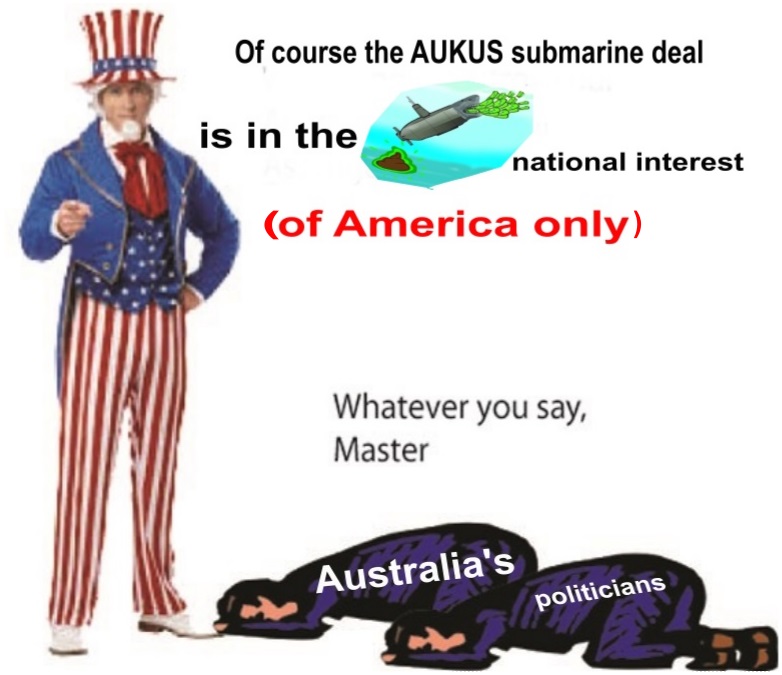
November 10, 2024, by: The AIM Network, By Denis Hay
Australia US alliance has costs. Learn how this impacts Australians and how reallocated funds could benefit citizens.
Introduction
Australia and the United States have been strategic allies for over seventy years. This Australia US alliance, often celebrated with the phrase “old allies and true friends,” is rooted in shared history and mutual defence agreements like the ANZUS Treaty.
However, many Australians are now questioning if the costs of this alliance—both in terms of military and economic impact—outweigh the benefits. This article explores the consequences of Australia’s allegiance to the U.S., the human costs of U.S. interventions, and how Australia’s financial resources might better serve its citizens’ social well-being.
1. The Costly Legacy of the Australia-U.S. Alliance
– Historical Overview: Australia US alliance began formally with the ANZUS Treaty in 1951. Through wars in Korea, Vietnam, Iraq, and Afghanistan, Australia has stood beside the U.S., incurring both financial costs and human losses.
– Casualty Estimates: The human toll of this alliance is staggering. The wars led by the U.S. have resulted in estimated casualties of over 200,000 American troops, 60,000 Australian troops, and millions of civilians globally. For instance, the Iraq War alone caused around 500,000 civilian deaths and displaced over 3 million people.
– The Refugee Crisis: The consequence of U.S.-led wars has been a refugee crisis affecting countless lives. Countries like Syria, Iraq, and Afghanistan have seen millions of citizens fleeing war zones, often with little support from Western nations. Australia’s involvement in these wars contributes to a moral responsibility for the refugee influx, yet the country struggles to support displaced persons adequately.
2. The Social Cost of Alliance-Bound Military Spending
– Military Expenditures at the Cost of Social Welfare: Australia’s defence budget has increased significantly, with estimates of $48.7 billion given in 2023. Much of this spending is tied to keeping military readiness to support the U.S. in conflicts. These funds could otherwise enhance healthcare, education, and housing for Australians.
Military funding without public transparency.
– Impact on Public Services: Redirecting even a part of the defence budget could fund initiatives like universal healthcare, improved mental health services, and housing for the homeless. For example, just 10% of the current defence budget could support building 10,000 public housing units annually or fund a significant expansion of mental health services for underserved communities.
– Consequences of Refugee and Displacement Crises: Australia’s participation in U.S.-led interventions indirectly contributes to refugee crises that strain social services and humanitarian aid. Public sentiment on immigration has also been affected, often creating divisive views within Australian society about who should be supported and who is viewed as a “burden.”
3. A Call for a More Independent and Socially Conscious Foreign Policy
Australia’s alliance with the United States has provided strategic support over the decades, yet many argue that it is time for Australia to pursue a foreign policy that is more reflective of its own interests, values, and the well-being of its citizens.
Despite growing public interest in a more independent, socially conscious approach, Australian governments have hesitated to diverge significantly from U.S.-aligned policies. This reluctance may stem from multiple factors:
1. Fear of Political and Economic Repercussions:
– Australian policymakers often cite strategic security concerns as a reason for adhering closely to U.S. foreign policy, fearing that any independence might jeopardize Australia’s access to American intelligence, technology, and defence resources.
– Economically, a close alliance with the U.S. bolsters trade relations and provides access to powerful American markets. For some politicians, the potential economic fallout of alienating a significant trading and security partner outweighs the call for a more independent stance.
2. Lack of Political Courage and Vision:
– Some critics argue that the Australian government lacks the courage to challenge established norms or take bold steps toward an independent foreign policy. This lack of vision may stem from a longstanding alignment with U.S. interests that has become entrenched in Australia’s political and diplomatic culture.
– Breaking away from such a powerful ally requires a willingness to redefine national priorities, a path that requires courage, strategic foresight, and often a willingness to face criticism from powerful interest groups invested in maintaining the alliance.
3. Disconnect from Public Opinion:
– Surveys show that Australians increasingly favour a more balanced, socially conscious approach to foreign policy, especially as they see the domestic impact of military spending and U.S.-influenced policies. However, successive Australian governments have often ignored this sentiment, raising questions about whether the government genuinely prioritizes the public’s voice in its decisions…………………………..
4. Influence of External Powers and Lobbying:
– Australian foreign policy decisions are also influenced by lobbying from powerful industries, including defence contractors and political think tanks with ties to the U.S. These entities often push for policies that favour a strong alliance with the U.S., as it aligns with their economic and strategic interests.
– The cumulative effect of these influences can stymie efforts for a more independent policy path, effectively sidelining the public’s desire for a foreign policy that prioritizes social well-being and peaceful diplomacy.
In summary, Australia’s reluctance to adopt a more independent, socially conscious foreign policy is a combination of economic dependency, political caution, and a systemic disconnect from the will of the people.
For Australia to shift toward a foreign policy that truly serves its citizens, it would require not only a realignment of political priorities but also a renewed commitment to placing the public’s interests and values at the heart of its foreign relations.
1. The Historical Basis of Australia-U.S. Relations and Its Human Cost……………………………………………….
2. Australia’s Position on U.S. Leaders and Policies
– Unquestioned Loyalty: Australian leaders often affirm support for U.S. presidents and foreign policies without critical evaluation. This approach reflects a hesitancy to challenge U.S. decisions even when they conflict with Australia’s best interests.
– Impact on Australian Sovereignty: The uncritical acceptance of Australia US alliance policies can undermine Australia’s autonomy. For example, Australia’s alignment with U.S. policies on China has strained trade relationships, affecting vital economic sectors like agriculture, tourism, and education. The result is a compromise of national interests to support a symbolic “alliance.”
3. U.S. Military Interventions, Global Casualties, and the Refugee Crisis
– Scope of U.S.-Led Wars: The U.S. has been involved in conflicts worldwide, from the Middle East to Latin America and beyond, often resulting in widespread devastation. These conflicts have had lasting impacts, including millions of civilian deaths and widespread destruction.
– The Refugee Crisis and Australia’s Responsibility: Australia’s support for U.S. interventions creates a moral obligation to help refugees from war-torn countries. However, current refugee policies fall short, leaving many displaced people without adequate support or protection. Accepting more refugees from conflict zones would reflect Australia’s commitment to international human rights and fulfill part of its alliance-driven responsibility.
4. Australia’s Role as a Supporting Partner and Its Consequences
– Participation in Conflicts and Reputational Impact: Australia’s involvement in U.S. wars affects its international reputation, often casting the country as a secondary player rather than an independent, neutral voice in global politics. This alignment can make Australia appear complicit in conflicts driven by U.S. interests, compromising its image as a peaceful nation.
– Economic and Social Impact on Australians: By aligning with U.S. defence priorities, Australia diverts significant public money to defence spending, reducing resources for vital services. Citizens bear the costs through reduced access to affordable healthcare, housing shortages, and an underfunded education system. The pressure to conform to U.S. policies, especially in the Indo-Pacific, risks escalating regional tensions that could directly affect Australians.
5. The Opportunity Cost: How Reallocating Military Spending Could Benefit Australians……………………………………………………………..
Rethinking Australia’s Foreign Policy Approach for the Future
As global dynamics shift, Australia faces a critical juncture in deciding how to position itself on the world stage. A key element of this decision lies in its relationship with China, a rapidly growing economic and political power in the Indo-Pacific region.
While the Australia US alliance has historically shaped much of Australia’s foreign policy, the rise of China presents an opportunity for Australia to pursue a balanced, independent approach that prioritizes regional stability and mutual benefit.
1. China’s Role as Australia’s Major Trading Partner:……………………………………….
2. Promoting Regional Stability and Security:
– As a dominant power in the Indo-Pacific, China’s influence on regional security is substantial. Building a constructive, diplomatic relationship with China could position Australia as a mediator and stabilizer within the region, promoting dialogue over conflict.
– With rising tensions between the U.S. and China, Australia has a unique opportunity to champion a foreign policy that values peace, cooperation, and shared interests, rather than one that escalates division. This approach would reduce the risk of Australia being drawn into potential conflicts that do not serve its national interests.
3. Economic and Diplomatic Benefits of Non-Alignment:………………………….
4. Preparing for a Multipolar World:
– The global power landscape is shifting from U.S.-led dominance to a multipolar world where countries like China, India, and emerging economies play a larger role. For Australia, recognizing and adapting to this reality is crucial for staying relevant and resilient in the international arena…………………………….
Conclusion
Australia US alliance has served strategic purposes in the past, but as global dynamics shift, it’s vital to reassess whether the benefits of this alliance outweigh the costs. The loss of lives, the displacement of millions, and the diversion of public money from critical social services highlight the urgent need for a foreign policy that prioritizes Australia’s long-term interests and humanitarian values.
By adopting a more independent stance, Australia could enhance the social well-being of its citizens and contribute to a more peaceful, stable global community. https://theaimn.com/australia-us-alliance-is-it-time-to-rethink-our-loyalty/
1 This Month
5 March -Online – Reversing nuclearization:
From nuclear weapons in Belarus and NATO host countries to a European-Nuclear-Weapon Free Zone
11am-12:30pm Eastern Time USA / 5pm-6:30pm CET

of the week – Advocating for a
nuclear free beach – https://www.samuellawrencefoundation.org/
The Samuel Lawrence Foundation advocates for a Nuclear Waste Free Beach at San Onofre, join us and take action!

10 March A LIVE WEBINAR THE REAL EFFECTS OF NUCLEAR POWER
What the Industry Isn’t Telling Us
1:00 PM Mountain, 2 pm Central, 3 pm Eastern. Live on the Keepers of the Water Facebook page


18 March Webinar @ 1 PM EST: An Assessment of SMR Projects: The Case of Canada
register for the zoom:
https://us02web.zoom.us/webinar/register/WN_o8BIIOUvQ2ONJR1nta65DQ#/registration

of the week – STOP SMALL MODULAR REACTORS IN CANADA
To see nuclear-related stories in greater depth and intensity – go to https://nuclearinformation.wordpress.com
-
Archives
- March 2026 (46)
- February 2026 (268)
- January 2026 (308)
- December 2025 (358)
- November 2025 (359)
- October 2025 (376)
- September 2025 (258)
- August 2025 (319)
- July 2025 (230)
- June 2025 (348)
- May 2025 (261)
- April 2025 (305)
-
Categories
- 1
- 1 NUCLEAR ISSUES
- business and costs
- climate change
- culture and arts
- ENERGY
- environment
- health
- history
- indigenous issues
- Legal
- marketing of nuclear
- media
- opposition to nuclear
- PERSONAL STORIES
- politics
- politics international
- Religion and ethics
- safety
- secrets,lies and civil liberties
- spinbuster
- technology
- Uranium
- wastes
- weapons and war
- Women
- 2 WORLD
- ACTION
- AFRICA
- Atrocities
- AUSTRALIA
- Christina's notes
- Christina's themes
- culture and arts
- Events
- Fuk 2022
- Fuk 2023
- Fukushima 2017
- Fukushima 2018
- fukushima 2019
- Fukushima 2020
- Fukushima 2021
- general
- global warming
- Humour (God we need it)
- Nuclear
- RARE EARTHS
- Reference
- resources – print
- Resources -audiovicual
- Weekly Newsletter
- World
- World Nuclear
- YouTube
-
RSS
Entries RSS
Comments RSS
 nuclear-news