Economic doubts about South African govt’s nuclear power programme
 Do we really need a nuclear fleet?, Business Report, Mike Kantey, November 25 2012 Despite protestations by thousands of South Africans, our ANC-led government seems determined to spend over R1 trillion on a nuclear fleet, including a uranium enrichment plant, a fuel assembly plant, a reprocessing plant and a high-level waste management facility.
How has this impossibly expensive project been motivated and by whom? Continue reading
Algeria’s program; renewable energy at home and for export
Algeria Targets 22,000 MW Of Renewable Energy By 2030 http://cleantechnica.com/2012/11/22/algeria-targets-22000-mw-of-renewable-energy-by-2030/ NOVEMBER 22, 2012 BY ADAM JOHNSTON
North African country Algeria is upping the ante in the renewable energy game. According to a recent PV-Tech article, the country hopes to have 22 gigawatts (GW) of renewable energy online by the year 2030, with a good part being exported on the international market. State-owned utility Sonelgaz, is expected to build 4.2 GW of renewables itself, providing underlying support towards Algeria’s goal.
Next year will see the first phase of the ambitious project, which will eventually include solar photovoltaic energy, concentrated solar power, and wind energy. As noted by PV Tech:
The first phase, which is expected to start in 2013, will include 1,228MW from PV power plants, followed by 2,475MW of concentrated solar (CSP) and 516MW of wind energy by 2022.
Besides Sonelgaz’s commitment to wind and solar, the utility also has a deal with the Desertec CHP project, to look at possibly exporting 1 GW to European countries.
With lots of sun to harness, Algeria, if it succeeds, could be a renewable energy market to watch out for in the years to come.
Clean Technica (http://s.tt/1uuid)
Read more at http://cleantechnica.com/2012/11/22/algeria-targets-22000-mw-of-renewable-energy-by-2030/#rZLuYkJV7RGcRxAr.99
Africa racing ahead with renewable energy
Africa’s renewable energy sector to be worth $57b by 2020 – UN Ghana Business News, By Emmanuel K. Dogbevi, November 18, 2012 The demand for power in Africa is expected to grow, driving the projected worth of continent’s renewable energy sector to $57 billion by the year 2020, a senior UN official has said. Mr. Said Adejumobi, the Director, Governance and Public Administration Division of the United Nations Economic Commission for
Africa (ECA) told a business forum of investors in Addis Ababa, Ethiopia, that the sector recorded “a staggering 1,583% increase between 2004 and 2011.”
He indicated that the enormous growth amounts to $3.6 billion in 2011 from $750 million in 2004 and is mainly due to the large unmet demand, combined with abundantly available sources of renewable energy in Africa…. The key growth areas in the sector he said, include wind, solar and geothermal power, he therefore emphasised the need for foreign direct investment into the continent’s energy and power infrastructure. “Investment in renewable energy, is a major priority for Africa,” he said.
The Forum according to Sam Cho, who heads the ECA’s private sector section brought together investors, banks, government investment agencies and those in the energy sector to discuss interests, concrete investments and other areas of collaboration. Among those present at the Forum are emerging market investors from China, India, Korea and Brazil, financing departments from the World Bank, the AfDB, DBSA, AFC and Ecobank.
http://www.ghanabusinessnews.com/2012/11/18/africas-renewable-energy-sector-to-be-worth-57b-by-2020-un/
Uranium dust used as pesticide in Tanzania: urgent need to stop this
Action needed’ on uranium use in Tanzania, DW 11 Nov 12, Reports say Tanzanian farmers have used uranium dust as a pesticide. Immediate inspections are needed, says Ute Koczy, a member of the German parliament and Green Party spokeswoman on development issues. Continue reading
How multinational uranium companies diddled Tanzania out of its tax revenue
the transfer of Mantra Resources Limited to ARMZ enables its former shareholders to pocket $1.04 billion without paying capital gains to the Tanzanian government…. Mantra Resources Limited of Australia was supposed to have paid capital gains tax to Tanzania.
Sh320bn loss looming over uranium project , 29 September 2012 By Felix Lazaro, The Citizen Dar es Salaam. Tanzania risks losing about Sh320 billion in mining taxes because of weak legal checks, particularly when it comes to uranium.
Local mining experts said yesterday that the country must go back to the drawing board and put in place a watertight policy and regulations before it allows uranium mining.Earnings from the mineral are believed to have the potential to turn around the lives of thousands of poor Tanzanians.
The chief concern right now, though, is that some subsidiaries of multinational firms licensed to explore uranium in Tanzania are capitalising on a weak legal and institutional framework to transfer ownership to affiliated companies. Continue reading
Doom and gloom for the uranium industry – no improvement in sight
 End of last month, the price had fallen to US$49.25 and for most of September, it hovered at the US$48 mark. This is almost 60% below the entry level target as calculated by Bannerman. The impact on the development of new mines, is obvious.
I believe the commodities boom is over, or at least on hold for another five years. In the meantime, no new mines.
Our Anticipated Uranium Projects Will Not Go Ahead, Except One [analysis] Equities.com Daniel Steinmann All Africa Global Media 22 Sept12, Bannerman Resources, the Australian company driving one of four new uranium projects in Namibia, recently said at a mining conference, the price for uranium U308 needs to be between US$75 and US$90 per pound (0.454kg) to drive any new investment in greenfields uranium mines.
Hidden in this seemingly neutral observation and analysis, are many serious consequences for the further development of the uranium sector Continue reading
Opposition to nuclear power for Nigeria
critics are worried that the project will do the country more harm than good. They say the effect of radioactive substance cuts across both geography and politics, and if not properly managed, may compromise not only the lives of the present generation but also several generations yet unborn.
What Nigeria needs now is investment in safe alternatives that will not harm the environment and the people.
Furore over nuclear power plant in Nigeria The Guardian, 06 SEPTEMBER 2012 00:00 FROM CHUKWUMA MUANYA AND EMEKA ANUFORO, FOCUS PRESIDENT Goodluck Jonathan and the relevant agencies set up to actualize Nigeria’s dream of becoming a “nuclear power” are excited that the national nuclear power programme has reached an advanced stage.
Nigeria and Russian had in June begun implementation of a nuclear power generation agreement signed in June 2009, to facilitate cooperation on the development of nuclear energy for peaceful purposes. Continue reading
In Africa – uranium mining down: solar energy up
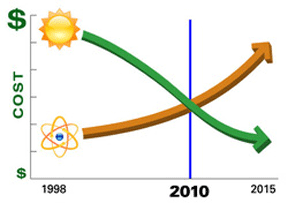 Areva suspends Trekkopje uranium mine project, Paul Langley’s Nuclear history Blog, 24 Aug 12 Areva has decided to suspend the Trekkopje uranium mine project. …. Rumours already started in October Areva planned to abandon the Trekkopje uranium mine project as part of a massive restructuring program that is to be set up in reaction to a drop in demand caused by the German nuclear phase-out and the Fukushima disaster….
Solar Project Aims to Becomes Largest in West Africa By Steve Leone, Associate Editor, RenewableEnergyWorld.com October 25, 2011 DALLAS, Texas — An American-based investment group has secured a power purchase agreement with the Namibian government to build a 500-megawatt photovoltaic power plant near the capital of Windhoek.
If built, the plant would represent the largest solar installation in West Africa, and could eventually include wind generation and grow up to 1 gigawatt. The group, led by Washington-based project developer SSI Energy Solutions (SSIES), is the parent company of Africa Energy Corp., which was set up for the Namibia project. Partners in the project include former SunEdison CEO Jigar Shah, Tom Amis and Nik Patesh of clean-energy law firm Cooley LLP, Eric Henderson of the Beacon Group and Adam Stern and Gary Kleiman of The Gemstone Group……. The project is far bigger than any solar project currently online in the southern hemisphere. South Africa, which borders Namibia, has garned the most interest in the region for large-scale developments…. http://nuclearhistory.wordpress.com/2012/08/23/areva-suspends-trekkopje-uranium-mine-project/
Protest organised against uranium mining in Selous Game Reserve
UNESCO sacrifices wildlife preserve for uranium mine New World Heritage sites are always announced with an especially effective publicity. However, the decision for the boundary change in the Selous Game Reserve was not communicated to the public. Now that the UNESCO has accepted the boundary change, they have made way for a major uranium mine called Mkuju River Uranium Project . It will be owned by Russian ARMZ, a subsidiary of ROSATOM, together with the Canadian company Uranium One.
“Uranium mining is incompatible with World Heritage”
In 2011, the UNESCO announced that „mining activities and dam projects would be incompatible with the status of World Heritage sites“. At the same time, the government of Tanzania announced that they had agreed to a declaration of intent for the construction of a dam in the Rufiji river with a Brasilian Company. The river runs through the centre of the Selous Reserve and is supposed to secure the electricity for the planned uranium mining project.
The „Convention Concerning the Protection of the World Cultural and Natural Heritage“ of UNESCO has been ratified by 189 states. The UN runs a list of 962 World Heritage sites, this includes 188 World Natural Heritages, as well as the Selous Game Reserve in Tanzania.
In the areas where uranium mines are active, there have been severe damages to the environment and the health of the local communities. With their decision, the UNESCO is co-responsible for the future destruction of the environment and human life in the Selous Game Reserve.
Environmental groups accuse the UNESCO of failure and irresponsibility. Their decision appears to be influenced by corporate and lobby interests. Now there is a risk that this case has set a precedent that endangers the protection of other World Heritage sites for similiar interests.
We must not let a World Heritage site be sacrificed. Please support this letter of protest to the UNESCO. https://www.rainforest-rescue.org/mailalert/883/unesco-sacrifices-wildlife-preserve-for-uranium-mine#.UCZ9m-i6aQF.facebook
Tanzania uranium project held up till Australian company Mantra pays taxes
Tanzania: Uranium Project Licence Shelved Till Tax Bill Paid, Beyond Nuclear 12 Aug 12, Dodoma – A SPECIAL mining licence to allow Russian firm, Uranium One start mining at Mkuju River in the Selous Game Reserve buffer zone, will not be issued until Australian Mantra Resources pay over 180 million US dollars (approx. 292.12bn/-) in taxes, the Parliament was told.
$39 billion loss for Australian uranium miner Paladin
 Uranium mine lost K39 billion in 2011 , The Maravi Post, 10 Aug 12 BLANTYRE–The Kayekelera uranium mine in Karonga, which is operated by Paladin Energy Limited of Australia, lost K39 billion in nine months of operation ending March 2012 due to fluctuating prices of the commodity on the international market, the company’s top official has said.
Greg Walker, general manager for international affairs, told the Daily Times Business that the loss was a result of the historic earthquake in Japan that produced a Tsunami in March last year. Spot price for uranium oxide dropped from $75 (some K21, 000) to $47.50 (K13, 000) after the closure of Fukushima nuclear plant in Japan.
Walker said now the price is at $49.50 -K14,000 – saying this was below the direct cost of production at Kayelekera, the country’s biggest investment. Walket told the daily that Paladin have bankrolled $145 million–K41 billion- to keep the mine afloat… http://www.maravipost.com/malawi-news/society/1486-uranium-mine-lost-k39-billion-in-2011.html#.UCbaJ6FlT4Y
Call to protect Selous Game Reserve from uranium mining
The radioactive wastes pose a serious threat to Selous Game Reserve which is home to the world’s largest elephant population and other wildlife. No proven methods exist to keep the radioactive and toxic slush and liquids from seeping into surface waters, aquifers or spreading with the dry season wind into the Reserve.
The environmental groups urge the World Heritage Committee to reconsider its decision on the Selous Game Reserve Boundary Change and call upon the Government of Tanzania to refrain from licensing a uranium mine in Selous Game Reserve or on lands cut out from it.
World Heritage Comittee Decision on Selous Game Reserve Boundary Changes uranium-network.org, Freiburg, Germany Gunter Wippel , Elephants, Rhinos and the environment under threat from 60 million tons of radioactive waste as World Heritage Committee agrees boundary change that will allow uranium mining at the Tanzania Selous Game Reserve – a World Heritage site. Freiburg, Germany, July 30, 2012
A foreign uranium mining conglomerate will be allowed to exploit the precious Selous Game Reserve in Tanzania after the World Heritage Committee (WHC) decided, at its July 2012 session in Russia, to accept what was described as a “minor boundary change” of the site. The change had been requested by the Government of Tanzania, in order to make way for the development of a major uranium mine, Mkuju River Uranium Project, owned by Russian ARMZ and Canadian Uranium One.
The decision to allow the boundary change would allow the Mkuju River uranium project, situated in the South of the Selous Game Reserve at its transition to the Selous Niassa Wildlife Corridor, to go forward. The Tanzanian Government lobbied heavily for the boundary change, after declaring its intent to ” win the battle” against the UNESCO WHC.
Dozens of environmental groups around the world, many of them members of the German-based Uranium Network, decried the WHC decision which could lead to the creation of 60 million tons of radioactive and poisonous waste by the mine during its 10-year lifespan (139 million tons if a projected extension of the mine should be implemented) Continue reading
Environment sacrificed as UNESCO caves in to pressure on Tanzania uranium mining
Uranium Mining Project Posed to Destroy One of World’s Last Remaining Wildlife Heritage in Tanzania http://hamsayeh.net/articles/2110-uranium-mining-project-posed-to-destroy-one-of-worlds-last-remaining-wildlife-heritage-in-tanzania.html , 06 August 2012 UNESCO Fails to Protect World Heritage at Cradle of Mankind by uranium-network.org August 02, 2012
Elephants, Rhinos and the environment under threat from 60 million tons of radioactive waste as World Heritage Committee agrees boundary change that will allow uranium mining at the Tanzania Selous Game Reserve – a World Heritage site. – A foreign uranium mining conglomerate will be allowed to exploit the precious Selous Game Reserve in Tanzania after the World Heritage Committee (WHC) decided, at its July 2012 session in Russia, to accept what was described as a “minor boundary change” of the site. The change had been requested by the Government of Tanzania, in order to make way for the development of a major uranium mine, Mkuju River Uranium Project, owned by Russian ARMZ and Canadian Uranium One.
The decision to allow the boundary change would allow the Mkuju River uranium project, situated in the South of the Selous Game Reserve at its transition to the Selous Niassa Wildlife Corridor, to go forward.
The Tanzanian Government lobbied heavily for the boundary change, after declaring its intent to ” win the battle” against the UNESCO WHC. Continue reading
Russia ahead in the race to sell off nuclear technology to South Africa
Russian nuclear group opens office in South Africa Engineering News, By: Keith Campbell 18th July 2012 South Africa has become only the third country to host a marketing office of Russia’s State-owned nuclear energy group Rosatom. The registration of the office was announced by the group on Wednesday….. Rusatom (spelt with a u) Overseas is a subsidiary of Rosatom (spelt with an o).

Another Rosatom subsidiary, Tenex, already supplies enriched uranium products for the production of nuclear fuel for South Africa. The country currently has one two-reactor NPP, at Koeberg near Cape Town, which has a capacity of 1 800 MWe. This started operation in 1984… http://www.engineeringnews.co.za/article/russian-nuclear-group-opens-office-in-south-africa-2012-07-18
Morocco’s ambitious renewable energy plan
Morocco plans to become 40% renewable by 2020 http://www.evwind.es/noticias.php?id_not=19690 July 16, 2012 The 160-megawatt project is part of the larger, 500 megawatt Concentrating Solar Power Ouarzazate site. Morocco starts an ambitious plan to build out 6 gigawatts of renewable energy by 2020, along with a variety of technologies, including wind power, solar energy, biomass, hydro and other technologies as the country currently imports
90 percent of its energy. Continue reading
1 This Month
10 March A LIVE WEBINAR THE REAL EFFECTS OF NUCLEAR POWER
What the Industry Isn’t Telling Us
1:00 PM Mountain, 2 pm Central, 3 pm Eastern. Live on the Keepers of the Water Facebook page



18 March Webinar @ 1 PM EST: An Assessment of SMR Projects: The Case of Canada
register for the zoom:
https://us02web.zoom.us/webinar/register/WN_o8BIIOUvQ2ONJR1nta65DQ#/registration


of the week – STOP SMALL MODULAR REACTORS IN CANADA
To see nuclear-related stories in greater depth and intensity – go to https://nuclearinformation.wordpress.com
-
Archives
- March 2026 (87)
- February 2026 (268)
- January 2026 (308)
- December 2025 (358)
- November 2025 (359)
- October 2025 (376)
- September 2025 (258)
- August 2025 (319)
- July 2025 (230)
- June 2025 (348)
- May 2025 (261)
- April 2025 (305)
-
Categories
- 1
- 1 NUCLEAR ISSUES
- business and costs
- climate change
- culture and arts
- ENERGY
- environment
- health
- history
- indigenous issues
- Legal
- marketing of nuclear
- media
- opposition to nuclear
- PERSONAL STORIES
- politics
- politics international
- Religion and ethics
- safety
- secrets,lies and civil liberties
- spinbuster
- technology
- Uranium
- wastes
- weapons and war
- Women
- 2 WORLD
- ACTION
- AFRICA
- Atrocities
- AUSTRALIA
- Christina's notes
- Christina's themes
- culture and arts
- Events
- Fuk 2022
- Fuk 2023
- Fukushima 2017
- Fukushima 2018
- fukushima 2019
- Fukushima 2020
- Fukushima 2021
- general
- global warming
- Humour (God we need it)
- Nuclear
- RARE EARTHS
- Reference
- resources – print
- Resources -audiovicual
- Weekly Newsletter
- World
- World Nuclear
- YouTube
-
RSS
Entries RSS
Comments RSS
 nuclear-news