Confusion and secrecy over costs of proposed nuclear energy for South Africa
 Can we afford it?
The department’s nuclear costs study is understood to be complete, but the findings have not been made public.
 Nuclear plan slips under budget radar Mail & Guardian, Africa, 28 FEB 2014 LIONEL FAULL If it goes ahead it will be SA’s largest contract ever, yet Pravin Gordhan failed to mention it. Indications of policy confusion at the highest levels of the government were reinforced this week when the budget failed to build on President Jacob Zuma’s State of the Nation pronouncement that “we expect to conclude the procurement of 9 600MW of nuclear energy”.
The cost of 9 600MW of nuclear power has been estimated at anything between R400-billion and more than R1-trillion, and would dwarf any other tender in South Africa’s history.
In contrast with Zuma’s definitive pronouncement for the coming year, Finance Minister Pravin Gordhan did not mention nuclear at all in his budget speech. He mentioned renewables four times, and shale gas exploration once.
Even the energy department, in the estimates of national expenditure that accompany the budget, did not commit to any looming procurement decisions. Continue reading
AREVA now finding it harder to rip off Niger in uranium projects
 Niger fails to reach uranium mining deal with French nuclear firm Areva Deadlock over royalties as Oxfam points out Areva’s global turnover is more than four times Niger’s entire annual budget Guardian Celeste Hicks in Niamey, 28 Feb 14, Another deadline has passed without agreement in Niger in the government’s ongoing negotiations with the French nuclear company Areva on the renewal of the company’s license to operate in the country.
After months of discussions, the mining minister, Omar Tchiana, said last week that Friday would be the final deadline for the two sides to strike a deal. Now it has been agreed that talks will continue without a fixed deadline.
The negotiations are deadlocked on the issue of the royalties Areva pays Niger for the rights to two large uranium mines, Somair and Cominak in the arid north of the country. The terms of the original deal struck in the early 1970s have never been made public, but government sources say the company pays about 5.5% of its revenues in royalties. Niger wants the terms of a new mining code passed in 2006 to be implemented, which would force Areva to pay between 12% and 15% in royalties, and end a number of tax breaks on materials and equipment.
“Niger has not benefited at all from uranium production for 40 years. These contracts need to be win-win for Niger and not just for the benefit of France and Areva” said Ali Idrissa, the executive co-ordinator of the civil society group Rotab. The issue is of huge significance to the country, which ranks bottom of the UN’s human development index. According to Oxfam, Areva’s annual turnover of €9bn ($12.4bn) is more than four times Niger’s entire annual budget of €2bn…….
the current negotiations between Areva and the government are still less than transparent, and steps towards establishing a FGF and prioritising its spending have not been implemented…….
It is likely that Niger will be able to leverage a better deal from Areva, despite the company’s claims that a higher royalty rate could make the operation prohibitively unprofitable……http://www.theguardian.com/global-development/2014/feb/28/niger-fails-uranium-mining-deal-french-firm-areva
THe Nuclear Medusa AREVA and its uranium mining harm to Niger
 No matter where Uranium is mined on this planet the story is the same. The marketeers operate without conscience. Uranium should not be a marketable commodity.
 World’s Poorest Suffer From Radioactive Sickness as Areva Mines for Uranium http://ecowatch.com/2014/01/24/worlds-poorest-radioactive-areva-uranium/Brandon Baker | January 24, 2014 More than 60 percent of Niger’s population lives on less than $1 per day, and even more have no electricity.
Still, French company Areva keeps contaminating those residents and their environment while mining away for uranium—one of the few resources the world’s poorest country still has. Continue reading
Wide implications for uranium industry of test case in Niger
Niger uranium mining dispute a test case for use of African natural resources by Mark Tran Friday 10 January 2014 theguardian.com The wrangle between Niger and a state-owned French firm over payments for uranium extraction has wider ramifications
The protracted negotiations on uranium mining between Niger andAreva, the French energy multinational, are not just a trial of strength between an African government and a big company. The face-off will also test whether there is more than just pious sentiment to the notion that African countries should derive greater benefit from their natural resources.
Areva, which owns stakes in the Somair and Cominak mines, has been negotiating with Niger over new uranium mining contracts for two years. The mines’ 10-year licences expired on 31 December without a new agreement, although Niger issued a decree on 27 December providing a legal framework under the 2006 mining law for operations to continue.
The company is tight-lipped on discussions……..
The mines have been closed since mid-December for what Areva describes as routine maintenance. Some see the move as hardball tactics by the company to put pressure on the Nigerien government.
At heart of the matter is the country’s desire for a better deal. Niger accounts for more than a third of Areva’s uranium production, and President Mahamadou Issoufou’s government wants to increase the royalties the company pays from 5.5% of revenues to 12%, officials told Reuters…….
Niger is desperately poor, ranking last of the 187 countries in the 2012 UN Human Development Index. Three-quarters of its people live on less than $2 a day and malnutrition is rife, with the country beset by droughts. Although mining made up 70.8% of Niger’s exports in 2010, it contributed only 5.8% of the country’s gross domestic product.
According to a report from Oxfam France and the Niger arm of Publish What You Pay, the transparency group, Areva’s two mines produced uranium worth more than €3.5bn (£2.9bn) in 2010, but Niger received just €459m, or 13% of this amount. In 2012 Areva received tax exemptions worth €320m, the report says….http://www.theguardian.com/global-development/poverty-matters/2014/jan/10/niger-uranium-mining-dispute-african-natural-resource
Uranium mining in Tanzania to destroy environment, health and tourism
poaching, which has been rampant in the Selous and government is doing little to stop it because word has it senior people are benefiting from the trade in blood ivory……
So perhaps, cynical as we know them to be, they let the reserve be poached empty and then shrug and tell us that is is no longer suitable for tourism and did they not always say mining is the future for the country?
No one will dare to really expose the dangers of uranium mining to the Tanzanian public and so most people will only get the uptalk of government and not the downside of the environmental fallout’.
Tanzania conservationists reject uranium mining approvals BY PROF. DR. WOLFGANG H. THOME, ETN AFRICA CORRESPONDENT | DEC 27, 2013 Reactions to media reports in Tanzania, publishing details of approvals for uranium mining given by the country’s Atomic Energy Commission, were swift and harsh, and predicatably given on condition of anonymity, no wonder considering Tanzania’s record of often brutal suppression of dissent, especially when big commercial interests are at stake……
Uranium mining in the Selous has led to world wide protests and led to the government putting a mechanism into place to carve out over 200 square kilometres of the Selous territory to evade sanctions by UNESCO, which had made the Selous Game Reserve a World Heritage Site – for the Tanzanian government not an issue it seems as they habitually ignore that status in favour of ‘development’ Continue reading
One nation that abandoned nuclear weapons – South Africa
Unfortunately, South Africa is still the only state that has ever voluntarily dismantled its entire nuclear weapons capability. Nuclear states continue to do lip service to the goal of nuclear disarmament, but little has been achieved in practice. South Africa has illustrated that long-term security can be far better assured by the abrogation of nuclear weapons than by their retention.
South Africa: Nation that gave up its nuclear arsenal The solution was not the acquisition of greater military power through the development of nuclear weapons but the abolition of apartheid Gulf Times, F.W. de Klerk Former president of South Africa December 25, 2013It will be a mistake to think that the end of the Cold War also ended the threat posed by nuclear weapons. Nuclear-armed states continue to deploy huge arsenals of nuclear weapons, other states continue with their efforts to acquire nuclear weapons and there is the alarming possibility that such weapons may fall into the hands of terrorists. Accordingly, it may be helpful to consider the factors that led South Africa to develop nuclear weapons in the 1970s and the reasons why it decided to dismantle them in 1989…..
Soon after I became president in 1989, foreign minister Pik Botha urged me to take two key steps if we wished to improve South Africa’s relationship with the world: The first was to release Nelson Mandela and the second was to dismantle our nuclear weapons and accede to the Nuclear Nonproliferation Treaty (NPT). Continue reading
Quest for uranium underlies France’s military intervention in Central African Republic
Paris is focusing on the uranium deposits in the Bakouma sub-prefecture of the Mbomou prefecture, in south-eastern CAR.
The primary sources of France’s uranium in southern Algeria and northern Mali and Niger are increasingly threatened ….
escalation of jihadist operations added a sense of urgency to the French quest for the uranium resources
Behind France’s intervention in CAR: Uranium supply security WorldTribune.com By Yossef Bodansky, Senior Editor, Global Information System/Defense & Foreign Affairs 17 Dec 13 Operation Sangaris (a local exotic butterfly) — the French and MISCA (the French acronym for the International Support Mission to the Central African Republic) military intervention in the Central African Republic (CAR) — is escalating.
The French contingent will now be 1,600-troop strong, rather than the 1,200 agreed-upon at the United Nations Security Council (UNSC). The African Union’s (AU’s) MISCA force will grow to a total of 6,000 troops from Francophone African states, rather than the original estimate of 3,500 troops.
The hasty deployment of these forces only aggravates an already explosive situation in the country and region, and sparks new fighting where none existed before the international intervention had been announced. Most notably is the sudden resumption of fighting in Bangui, a city and region which had been completely quiet and secure literally until the day before the arrival of the new French forces.
The French-led Operation Sangaris had nothing to do with the oft-declared threat of “seeds of genocide” in the CAR. The French administration of President François Hollande is driven by the French desire for uranium ores. Continue reading
Catastrophic radioactive spill at Rio Tinto’s Rossing uranium mine
Rössing shuts operations after ‘catastrophic leak’ Namibia Times, December 6, 2013 By Jade McClune & Marshallino Beukes All milling operations at Rössing Uranium Mine ground to an immediate halt after “a catastrophic structural failure” at one of twelve leach tanks in the processing plant on Tuesday.
The incident triggered a veritable crisis, reinforcing widespread fears of a radioactive leak.
Sources at the mine told the Namib Times on Tuesday that they had heard some “kind of explosion”.
The mine has since confirmed that a leak was detected near one of the leach tanks and said there was “a very serious incident”, but did not mention any explosion.
A Red Banner Health and Safety Alert was sent out to all employees of the mine on Wednesday, confirming that there had been a “leach tank failure” at around 18:30 on Tuesday, 3 December.
The actual outcome of the incident was described as “serious” and the “maximum reasonable outcome: critical”……..http://www.namibtimes.net/forum/topics/rossing-shuts-operations-after-catastrophic-leak
Call for a fair deal from AREVA, for Niger
Niger says seeks better uranium terms from French Areva au news 6 Dec 13Paris (AFP) – Niger’s President Mahamadou Issoufou said in Paris on Friday that his country wanted to renew its uranium mining agreement with French nuclear giant Areva, but on more equitable terms….. Areva’s contract to extract uranium in the west African country expires on December 31, after more than four decades of mining at two sites on the southern edge of the Sahara, with a third under development………http://au.news.yahoo.com/thewest/business/world/a/20197961/niger-says-seeks-better-uranium-terms-from-french-areva/
Russia aggressively marketing nuclear power to South Africa
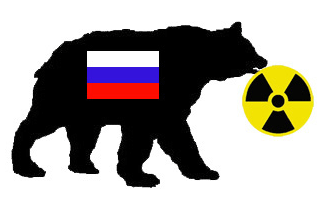
the draft Russian agreement, which Business Day has seen, had a veto clause, which would allow the parties to block the involvement of a third country
Russia turns up heat on ambitions for nuclear build in SA BUSINES DAY LIVE, BY CAROL PATON, 29 NOVEMBER 2013 THE RUSSIAN GOVERNMENT IS PUMPING UP THE PROPAGANDA SURROUNDING THE COUNTRY’S NUCLEAR AMBITIONS IN SOUTH AFRICA WITH A SERIES OF REPORTS ON THE OFFICIAL INTERNATIONAL BROADCASTER VOICE OF RUSSIA THAT A DEAL HAS BEEN STRUCK TO BUILD SOUTH AFRICA’S PLANNED NUCLEAR POWER PLANTS.
Several countries are jockeying for position in South Africa’s nuclear build programme, which envisages the construction of three nuclear power plants to supply 9,600MW at the cost of at least R1-trillion. The government has said the procurement process is close to finalised and there is high expectation among bidders that it will go ahead next year.
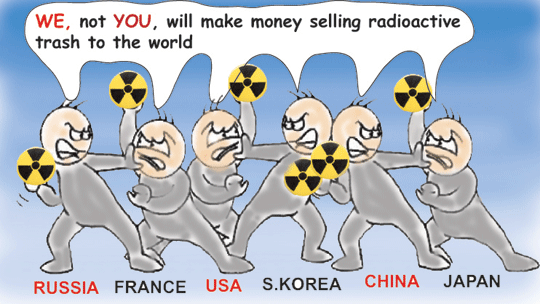
This week, the temperature over the nuclear build was further heightened when state-owned Russian corporation Rosatom hosted a nuclear suppliers’ forum in Johannesburg “with the aim of establishing and developing lasting partnerships in South Africa”.
At the forum on Monday, a memorandum of understanding was signed between the Nuclear Energy Corporation of South Africa (Necsa) and a Rosatom subsidiary. Continue reading
Renewable energy – the way to empower women in Southern Africa
In Southern Africa, women led cooperatives could become part of a decentralised renewable energy  revolution. For instance, solar roof top energy systems generate energy at the place it is needed, increasing efficiency while allowing it to remain under the control of the people who use it.
Renewable energy is never just about energy, but rather about all the opportunities it creates. If society committed to this sustainable option, we would literally and figuratively be putting power in women’s hands.
The benefits extend far beyond environmental preservation, to a society where women are less burdened and abused, but instead empowered, independent and equal.
Southern Africa: Renewable Energy Can Give Women Power http://allafrica.com/stories/201311281197.html BY GLEN TYLER, 27 NOVEMBER 2013 Johannesburg — Climate change is happening fast. Africa is already feeling the negative effects, yet this continent is the least responsible for it.
While Greenpeace continues to campaign and lobby for climate justice and environmental sustainability, corporations and government continue to drag us into climate chaos. However, it is seldom acknowledged that women bear the brunt of this chaos and that climate justice is linked to gender justice. Continue reading
Stolen uranium seized in Durban
Durban uranium stash sparks nuclear alert 2013-11-19 Rowan Philip and Jonathan Erasmus, The Witness Durban – A shopping bag filled with stolen uranium has been seized in a sting operation in Durban, triggering alarm among local and international nuclear watchdog agencies.
The kilogram of the radioactive material confiscated is believed to be a mere sample from a much larger batch, for which police are now hunting.
In a joint operation involving the Durban organised crime unit, crime intelligence and the department of minerals and energy, two men were arrested in their car opposite a shopping centre on the Bluff, following an informant’s tip-off…..
Water shortage affecting uranium mining industry in Namibia
Rio Tinto, Paladin Uranium Mines in Namibia Face Water Shortage, Bloomberg News By Felix Njini November 18, 2013 Uranium mines operated by companies including Rio Tinto Plc (RIO) and Paladin Energy Ltd. in Namibia face a water shortage as a drought in the southwest African nation curbs supply to the operations and three coastal towns.
Volumes from the Omaruru Delta acquifer, about 200 kilometers (124 miles) northwest of the capital, Windhoek, have declined to 4 million cubic meters this year from 9 million cubic meters a year earlier, said Nehemia Abraham, under-secretary for water and forestry in the Ministry of Agriculture.
The source is in the semi-arid Erongo region, which supplies the towns of Swakopmund, Walvis Bay and Henties Bay and suffers from severe shortages. Water from a desalination plant owned by Areva SA (AREVA), the country’s first such facility, isn’t enough to meet needs of Paladin’s Langer Heinrich uranium mine, China Guangdong Nuclear Power Co.’s Husab uranium project and Rio’s Rossing complex.
“The water-supply situation at the coastal area has become too critical,” Abraham said by phone yesterday. “Mining companies in the area will have to operate with less water. We are reviewing the situation now and from end of November we might be unable to get enough water from the aquifer to supply to mines.”
Langer Heinrich spokeswoman Ratonda Murangi didn’t immediately respond to e-mailed questions. Botha Ellis, a spokesman for Rossing, directed queries to Namibia Water Corp., the country’s state-owned utility known as Namwater.
Water Needs
Rossing’s total water requirement for 2012 was 7.48 million cubic meters, 41 percent of which was for fresh water, while the rest was recycled, according to its website.
The three towns use about 4.5 million cubic meters and there is currently no spare capacity from the aquifer, known as Omdel, Abraham said…… http://www.businessweek.com/news/2013-11-18/rio-tinto-paladin-uranium-mines-in-namibia-face-water-shortage
South Africa’s speedy connection – solar energy to the grid
 South African solar plant connects to the grid three months ahead of schedule, Renewable Energy Magazine, Robin Whitlock Friday, 15 November 2013 The 75MW Kalkbult solar plant will generate 135 million kilowatt hours per year and displace 115,000 tons of greenhouse gas emissions A solar plant built by Scatech Solar in cooperation with local partners has become the first utility-scale renewable energy facility to supply electricity to South African public utility Eskom after connecting to the country’s electricity grid three months ahead of schedule.
The 75MW Kalkbult solar PV plant near Petrusville in the Northern Cape, was officially opened on Tuesday 12thNovember. It will generate 135 million kilowatt hours per year, equivalent to the annual electricity consumption of 33,000 households. The plant covers 105 hectares of a working sheep farm and consists of 312,000 solar panels linked to inverters, transformers and a high-voltage sub-station. More than 600 people were employed during its construction, many from the local community…….
The plant is among 47 solar, wind and mini-hydro projects awarded 20-year electricity generation contracts under the South African government’s Renewable Energy Independent Power Producer Procurement Programme (REIPPPP), introduced three years ago by the Department of Energy. Total investment in the programme is estimated at R74 billion which will climb above R100 billion following the government’s acceptance of 17 new bids. The aim of the programme is to help the country combat climate change by reducing its current near-total dependence on coal-based electricity and accompanying high level of greenhouse gas emissions. The Kalbult plant is intended to displace annual greenhouse gas emissions of 115,000 tons.
The project will also add momentum to the country’s Green Economy Accord signed three years ago with the aim of creating 300,000 new jobs in renewable energy generation, energy efficiency, biofuel production, manufacturing in support of green projects and natural resource conservation and rehabilitation. http://www.renewableenergymagazine.com/article/south-african-solar-plant-connects-to-the-20131115
Solar energy for Ghana
Renewables get big boost as 50MW solar plant to be built Ghana Web 15 Nov 13 Ghana’s energy stock will receive 50 megawatts (MW) of solar power by 2015 as Scatec Solar, a Norwegian energy company, plans to build Africa’s second-largest solar power plant through its local partner Scatec Solar Ghana.
The project will cost about €70million and will be sited in the northern part of the country. “We are in discussion with ECG, the main off-taker, and we hope to progress with those discussions. So far everything is going well. We have had engagement with the Energy Commission and the Public Utilities Regulatory Commission (PURC), and we think that with all the efforts from these various institutions Scatec Solar will come onstream as planned,” Fred Nuerte Nuer, Director of Scatec Solar Ghana, said.
When completed, the project will become the first large utilities-scale solar power plant in West Africa and the second-largest in Africa, after the company unveiled a 75MW solar plant in South Africa early this week……
1 This Month

of the week – Shut Down Drone Warfare!


Tell the Ukrainian Government to Drop Prosecution of Peace Activist Yurii Sheliazhenko

Petition to revoke the licensing of the Near Surface Nuclear Disposal Facility (NSDF) at Chalk River. https://www.ourcommons.ca/petitions/en/Petition/Details?Petition=e-7247
To see nuclear-related stories in greater depth and intensity – go to https://nuclearinformation.wordpress.com
-
Archives
- April 2026 (79)
- March 2026 (251)
- February 2026 (268)
- January 2026 (308)
- December 2025 (358)
- November 2025 (359)
- October 2025 (376)
- September 2025 (257)
- August 2025 (319)
- July 2025 (230)
- June 2025 (348)
- May 2025 (261)
-
Categories
- 1
- 1 NUCLEAR ISSUES
- business and costs
- climate change
- culture and arts
- ENERGY
- environment
- health
- history
- indigenous issues
- Legal
- marketing of nuclear
- media
- opposition to nuclear
- PERSONAL STORIES
- politics
- politics international
- Religion and ethics
- safety
- secrets,lies and civil liberties
- spinbuster
- technology
- Uranium
- wastes
- weapons and war
- Women
- 2 WORLD
- ACTION
- AFRICA
- Atrocities
- AUSTRALIA
- Christina's notes
- Christina's themes
- culture and arts
- Events
- Fuk 2022
- Fuk 2023
- Fukushima 2017
- Fukushima 2018
- fukushima 2019
- Fukushima 2020
- Fukushima 2021
- general
- global warming
- Humour (God we need it)
- Nuclear
- RARE EARTHS
- Reference
- resources – print
- Resources -audiovicual
- Weekly Newsletter
- World
- World Nuclear
- YouTube
-
RSS
Entries RSS
Comments RSS
 nuclear-news