Curtains for Autralian uranium miner Paladin’s mine in Malawi
Paladin to shut its uranium mine, Australian Mining, 27 May, 2014 Cole Latimer Paladin has announced it will cease production at its Kayelekera uranium mine in Malawi. It comes after the miner advised it would place the operation in to care and maintenance earlier this year. According to Paladin it is ceasing production “due to reasons beyond the company’s control and related to the depressed uranium prices”. On May 21 it halted all operations at the mine, and will now cease supplying uranium to the global market, causing a drop of around 3.3 million pounds of supply per annum. “The outcome is an unfortunate but direct consequence of the continuing deterioration in the uranium price,” the company said in a statement. “Certain estimates now place up to 60% of current annual global production with costs above the current spot price, which is unsustainable.”…..http://www.miningaustralia.com.au/news/paladin-to-shut-its-uranium-mine
Niger still short-changed in new uranium deal with AREVA
 Niger, Areva in hard-won uranium deal, Yahoo 7 Finance, 26 May 14—The government of Niger and French nuclear energy group Areva announced on Monday that they had signed a deal to renew a decades-old agreement for the operation of two uranium mines.
Under the deal, negotiated for 18 months, Areva agreed that a 2006 mining law sharply increasing taxes on mineral extracted would apply to the Somair and Cominak operations in the north of the country which it partially controls.
“We have heard the government’s legitimate call for higher receipts coming from uranium,” said Luc Oursel, Areva CEO, on a visit to Niamey to sign the deal.
However, a joint statement said that the operations would be exempt from sales tax over the course of the five-year deal.
The revenue issue had been the main sticking point in the talks since the government considered that the previous contracts, which expired at the end of last year, were unfavourable to the country, the fourth-biggest producer of uranium in the world.
The French arm of charity Oxfam, which has been a sharp critic of state-controlled Areva’s uranium dealings with Niger, said the new deal continued to shortchange Nigeriens, who stood to lose “10 to 15 million euros a year.” ($13.6 to $20.5 million)……. https://au.finance.yahoo.com/news/niger-areva-hard-won-uranium-085912953.html
AREVA’ s giant new Imouraren uranium mine stalled due to poor market
 Areva signs uranium deal with Niger, delays new mine May 27, 2014 By Abdoulaye Massalaki NIAMEY (Reuters) – French nuclear group Areva agreed to a reduction in tax breaks and a rise in royalty rates at its uranium mines in Niger on Monday but said the start of production at its giant new Imouraren mine would be delayed until prices improve……https://au.news.yahoo.com/world/a/23870138/areva-signs-uranium-deal-with-niger-delays-new-mine/
Poverty-stricken African nations exploited by mining companies, especially Australian uranium miners
THE SCRAMBLE FOR URANIUM IN AFRICA http://www.phantomreport.com/the-scramble-for-uranium-in-africa 19 May 14, Africa’s resources are extracted by outsiders, with benefits only reaching the involved non-African mining companies and non-African end-users of the commodity. Africa is the next frontier to meet energy needs. Oil and gas are being exploited as never before, exacerbating conflict in Darfur and Nigeria, social inequality in Angola, and environmental damage in Chad.
At the same time, renewed demand for uranium is being explored on the continent more than at any other time in history.
Yet the continent’s huge potential for renewable energy is not fully being realised. The government of Malawi granted a uranium mining licence to an Australian uranium mining company without having any legislation on the mining, handling and transportation of radioactive materials. Malawi is now home to twelve potential uranium mines.
In Niger mining companies from Australia, Canada, France and other parts of the world are scrambling for licences to explore uranium in a country which is already the world’s sixth producer of uranium. In the Central African Republic (CAR) there is a scramble amongst Chinese, American and French companies which are all interested in mining the Bakouma region.
In Tanzania the Australian Omega Corp obtained the Mkuju River concessions through its subsidiary, Mantra Resources. Other Australian juniors are represented in Tanzania, including Sabre Resources, Goldstream Mining, Uranex and Deep Yellow.
In Zambia, the Australian Energy Ventures through its subsidiary Africa Energy Resources started drilling the Kariba Valley in May 2008. Another Australian enterprise, Albion Ltd,, is also undertaking exploration.
Nigeria to get nuclear power plant. Is this a GOOD idea?
Nigeria to get $6bn nuclear plant in 2022 – commission PUNCH, MAY 15, 2014 BY OLUSOLA FABIYI The Nigeria Atomic Energy Commission has revealed that the country will get a nuclear plant in 2022 at a cost of $6b dollars.
The Director, Human Resources of the commission, Professor Simon Mallam, who stated this on Thursday when he appeared before the national conference committee on Energy, also urged the Federal government to explore and develop all sources of energy available in the country…..Mallam further advised that although the country wasted a little time in the nuclear arena, it would still be able to deliver nuclear power by 2022 if the enabling environment and support could be given….http://www.punchng.com/news/nigeria-to-get-6bn-nuclear-plant-in-2022-commission/
Africa’s powerful future with renewable energy
 Renewable energy will power Africa’s ambitious future Adnan Amin May 3, 2014 It’s time to prove wrong the widely held stereotype about renewable energy only being for rich countries.
With smart planning and prudent investment, all African countries can reduce their dependence on fossil fuels and leapfrog into a sustainable future. And, as Africa makes the transition to renewable energy in the coming years, new projects will provide much-needed jobs and power economic growth………Irena’s initiative encourages the deployment of hydro, geothermal, biomass, wind and solar options from Cairo to Cape Town to increase capacity, stabilise the grid, and reduce fossil fuel dependency. It is a regional approach, promoting international cooperation across countries of the eastern and southern African power pools to develop vast energy resources, optimise the energy mix and attract more investment. The plan identifies development zones to cluster renewable plants in areas with high potential, resource planning, new financing models and knowledge and capacity building.
This week, as we convene for the Abu Dhabi Ascent, we are welcoming many African ministers who have engaged with us on this project.
The Africa Clean Energy Corridor is one of the many concrete steps needed that offer a cost-effective, economically viable solution to the climate challenge that lies ahead of us.
With the right combination of policy, investment and rapid deployment, we can make substantial progress in decarbonising the world’s energy mix while generating growth and employment. http://www.thenational.ae/thenationalconversation/comment/renewable-energy-will-power-africas-ambitious-future#ixzz30tYRkXQl
Rio Tinto’s $billion uranium profits at the expense of cancer death sin Africa
Uranium kills in Namibia http://www.news24.com/Columnists/AndreasSpath/Uranium-kills-in-Namibia-20140422 2014-04-22 Andreas Wilson-Späth
That uranium is a radioactive and toxic substance with potentially lethal impacts on the people who dig it out of the ground is generally glossed over by those among us who argue for nuclear power as a clean, green, safe and sustainable source of electricity.
Along with other intractable problems faced by the atomic energy industry – like its propensity to lay to waste entire landscapes if and when things go wrong and the fact that we still don’t have a long-term solution for storing its noxious waste products – this is not in dispute. It’s merely a matter of unintended side-effects. Collateral damage.
For uranium miners in Namibia, however, their occupation in proximity to the metal has much more first-hand and personal consequences. A report soon to be released by Earthlife Namibia and the Labour Resource and Research Institute argues that long-time workers at the Rössing uranium mine are routinely exposed to unhealthy working conditions, radiation and dust.
Rössing, which is located in central Namibia and employs over 1500 people, is majority owned (69%) by British-Australian mining giant Rio Tinto. The next biggest shareholders of the mine are the government of Iran (10%) and our own Industrial Development Corporation (10%).
Rio Tinto officials have consistently denied that they’re to blame for any harm, insisting that their operations at Rössing and elsewhere, including their copper, gold, coal, bauxite, iron ore and diamond mines around the world, are well monitored and run ethically, for the benefit of local communities, respecting human rights and protecting the environment.
But a closer look at the multinational’s global operations reveals that Rio Tinto isn’t quite as squeaky clean as they would like us to believe:
• At the end of last year, radioactive and acidic slurry spilled from a uranium processing tank at Rössing. Two weeks later the damaged rubber lining of a similar tank at the company’s Ranger mine in Australia’s Northern Territory leaked more than a million litres of the stuff.
• In 2013, 33 miners perished when a tunnel collapsed at Rio Tinto’s Grasberg gold and copper mine in Indonesia – the largest portion of the total of 41 deaths at their global operations during that year which international trade union IndustriAll claims the company should have done more to prevent.
• Locals have blamed the Grasberg mine for pollution affecting the environment and population.
• In Madagascar, activists have accused Rio Tinto of “land grabbing and environmental devastation”.
• A lawsuit has been filed against Rio Tinto’s Bingham Canyon mine in the US state of Utah for five-year breaches in air pollution regulations. The organisations that brought the case claim, that on some days the dust from the mine has a similar “effect on people who are consistently outdoors” as “smoking a pack of cigarettes a day”
• In Mongolia, indigenous nomadic herders have raised concerns that an expansion of Rio Tinto’s Oyu Tolgoi copper and gold mine in the Gobi desert would threaten the integrity of the local ecosystem along with their access to fresh water.
Of course Rio Tinto also made over $1 billion in profits last year. I guess in the minds of the company’s executives that justifies the occasional mishap.
– Andreas is a freelance writer with a PhD in geochemistry. Follow him on Twitter:@Andreas_Spath
Will Australia’s scientifically illiterate government be sucked in to buying Small Modular Nuclear Reactors (SMRs)?
 Strange time to suggest a LEGO nuclear future for Australia ,Independent Australia, Noel Wauchope 21 April 2014, By 2022, Australia could have many “Lego-like” small nuclear reactors in operation, dotted about the nation. This is being proposed now, not just by the long-term fervent believers in Small Modular Reactors (SMRs), but in formal submissions to the coming Energy White Paper……
The BHP-funded Grattan Institute’s submission envisages a string of these little nuclear reactors, connected to the grid, along Australia’s Eastern coast.
Keith Orchison reports on the Grattan Institute submission:
‘The Abbott government is being told that now is the time to flick the switch to “technology neutral,” opening the way for nuclear options.’
Orchison described the advantages of SMRs as ‘Lego-like’.
Why now?
In 2014, it was becoming clear that Small Modular Reactors (SMRs) were not likely to become an operational reality for many decades — and perhaps never.
America was the pioneer of small reactor design in the 1970s. Again recently, Westinghouse and Babcock and Wilcox have been the leaders in designing and developing SMRs.
But in 2014, the bottom has fallen out of these projects………..
It should be noted that nowhere in [the original article about China, does the author] Chen mention “small” reactors. However, Australian proponents of ‘small’ reactors welcomed this article, as the Thorium Small Nuclear Reactor is the favourite type proposed for Australia from all 15 possible small designs.
So, while we’re being told that China is racing ahead in the scramble to get these wonderful SMRs, in fact, China has been very much encouraged and helped into this by the U.S. Department of Energy.
This is understandable, seeing that for China it is a government project, with no required expectation of being commercially viable.
In their enthusiasm for China’s thorium nuclear project, writers neglected to mention the sobering points that Stephen Chen made in his South China Morning Post article, such as:
- ‘Researchers working on the project said they were under unprecedented ‘war-like’ pressure to succeed and some of the technical challenges they faced were difficult, if not impossible to solve.’
- ‘… opposition from sections of the Chinese public.’
- ‘… technical difficulties – the molten salt produces highly corrosive chemicals that could damage the reactor.’
- ‘The power plant would also have to operate at extremely high temperatures, raising concerns about safety. In addition, researchers have limited knowledge of how to use thorium.’
- ‘… engineering difficulties .…The thorium reactors would need years, if not decades, to overcome the corrosion issue.’
- ‘These projects are beautiful to scientists, but nightmarish to engineers.’……….
Australia’s SMR enthusiasts discount the known problems of SMRs. Some brief reminders from the September 2013 report, from the United States’ Institute for Energy and Environmental Research:
- ‘Economics: $90 billion manufacturing order book could be required for mass production of SMRs …the industry’s forecast of relatively inexpensive individual SMRs is predicated on major orders and assembly line production.’
- ‘SMRs will lose the economies of scale of large reactors.’
- ‘SMRs could reduce some safety risks but also create new ones.’
- ‘It breaks, you bought it: no thought is evident on how to handle SMR recalls.’
- Not a proliferation solution. ‘The use of enriched uranium or plutonium in thorium fuel has proliferation implications.’
- Not a waste solution: ‘The fission of thorium creates long-lived fission products like technetium-99 (half-life over 200,000 years).’
- Ongoing technical problems. ……….http://www.independentaustralia.net/environment/environment-display/strange-timing-to-suggest-a-lego-nuclear-future-for-australia,6404
Rio Tinto’s AGM faced with facts on radiological impact of Rossing uranium mine
 Radiological Impact of Rössing Uranium Mine – Namibia http://www.facing-finance.org/en/2014/04/radiological-impact-of-rossing-uranium-mine-namibia/ April 17th, 2014 by jdub / facing finance
At the Annual General Meeting of Rio Tinto in London, 15 May  2014, two recent reports about the impact of the uranium mine Rössing near Arandis, Namibia, on the environment and health were presented to the shareholders.
In cooperation with Earthlife Namibia, the French organizationCRIIRAD (Commission de Recherhe et d’Information Independantes sur la Radioactivite) analyzed the radiation of soil, water and sediments samples taken near Rössing´s mine caused by the tailing dams and waste rock dumps. Results show elevated levels of heavy metals and uranium in the samples up to more than 2000 times higher than WHO recommendations.
In their study, Earthlife Namibia surveyed the health status of current and former workers of the mine. Many of them complained of health problems, among them respiratory problems and illnesses due to the constant exposure to radon gas and dust.
CRIIRAD and Earthlife Namibia demand more independent research on radiation at the Rössing mine, a broad independent examination of the health status of workers and access to monitoring data for experts, as well as workers´ unrestricted access to their own medical reports.
Read CRIIRAD´s report here
Read Earthlife Namibia´s report here
Death and disease among uranium workers in Rio Tinto’s mines
Uranium workers dying after time at Namibia mine, report warns http://www.theguardian.com/environment/2014/apr/15/uranium-workers-dying-cancer-rio-tinto-namibia-mine
A study based on questionnaires of current and former workers at the giant Rio Tinto-owned Rössing uranium mine in Namibia says that everyone questioned was aware of people who are now suffering lung infections and unknown illnesses thought to be linked to their work.
The mine, in the Namib desert, produces around 7% of the world’s uranium but was operated with rudimentary safety when it opened in 1976. “People get sick. We are seeing it in people that have worked for Rössing for a long time. They just go back and die after working at Rössing,” one man told researchers working with Earthlife Namibia and the Labour Resource and Research Institute.
The study, which is expected to be published this week, accepts that working conditions in the mine have greatly improved but says that all workers questioned said that they were exposed to high levels of dust.
“Two current workers are on sick leave since 2000 and 2003. One worked as a laboratory technician for 24 years and claims to have proof he was radiated,” says a summary of the paper seen by the Guardian.
Rössing, which mines millions of tonnes of rock a year to extract uranium, employs more than 1,500 people. “Most workers stated that they are not informed about their health conditions and do not know if they have been exposed to radiation or not. Some workers said they consulted a private doctor to get a second opinion,” say the authors.
“The older workers all said they know miners dying of cancers and other illnesses. Many of these are now retired and many have already died of cancers,” says the report.
Aerial view of the discharge channels from Rössing, the world’s largest opencast uranium mine. Photograph: Yann Arthus-Bertrand/CorbisA spokesman for Rio Tinto said that Rössing has been recognised by independent consultants as one of the world’s safest mines. “The health and safety of our employees is the top priority. We have health management systems in place to make sure that everyone goes home safe and healthy every day. Effective controls ensure that radiation exposures to employees are kept well below the Rössing standard for occupational radiation exposure.
“The company keeps detailed records of the health status of its workforce from the day of employment to the day they leave the company. It therefore does not need to speculate on health issues of its employees.”
One former worker said: “Yes, I have cancer now. In the beginning they [Rio Tinto] did not want to give money for the treatment but later when they referred me to a doctor for an operation they gave me money for treatment.”
“Doctors were told not to inform us with our results or tell our illness. They only supply you with medications when you are totally finished up or about to die,” said another.
During the first years of operation, Rössing operated with a migrant labour system which the International Commission of Jurists declared illegal and said was similar to slavery. Black workers lived on the mine premises and were exposed to dust and radiation 24 hours a day and the mine became the focus for protests by anti-apartheid and anti-nuclear groups.
Shares in the mine are owned 69% by UK-based Rio Tinto, and 15% by the government of Iran. The Namibian government has denied supplying Iran with Namibian uranium which could be used for nuclear weapons.
The Erongo region is home to Rössing mine, the oldest and third-largest producer of uranium in the world. The mine sustains the small satellite town (population 7,600) of Arandis, which is visible near the top of the image. Photograph: ALI/EO-1/NASA“Uranium companies generally deny that workers get sick because of exposure to radiation. They blame the bad health conditions to unhealthy lifestyles such as eating habits, tobacco smoking and alcohol,” says the study.
Former Rössing mineworkers and people from communities adversely affected by Rio Tinto mines in west Papua, Madagascar, Namibia, Mongolia and the US will petition Rio Tinto shareholders at Tuesday’s annual meeting in London.
“Rio Tinto is enormous. Its history of attacks on workers’ rights, and environmental destruction has had a particularly damaging impact across the world,” said Richard Solly, co-ordinator of LondonMining Network, an alliance of human rights, development, environmental and solidarity groups.
South Africa’s growth in renewable energy
Africa: South Africa to Procure Still More Renewable Energy http://allafrica.com/stories/201404151599.html15 APRIL 2014 South Africa’s Department of Energy is to increase the amount of energy it will be procuring under the third window of its renewable energy programme for independent power producers, Energy Minister Ben Martins announced on Tuesday.
In November, the department signed agreements with 17 new preferred bidders in the third round of the programme, following the signing off of 47 projects in the first and second rounds, bringing to 64 the total number of renewable energy projects approved by the government since December 2011.
Once they are all operational, the 64 projects – representing foreign and domestic investment of over R100-billion – will add around 3 900 megawatts (MW) of wind, solar photovoltaic and concentrating solar power to South Africa’s energy mix.
On Tuesday, Martins said in a statement that this department would be allocating additional megawatts to the third window of the programme, thus including additional bidders, due to the increasingly competitive pricing offered by the round three bids.
Business Day reported in November that the average price offered for power generated from wind – which received the bulk of the third-round allocation – had dropped from R11.43 per kilowatt hour (kWh) in the first round to R6.65/kWh in the third round.
“The department will, in this regard, follow due procurement process to include additional bidders under window 3,” Martins said, giving no further specifics.
He added that submissions for the fourth window of the programme, which entails the procurement of a further 1 000 MW of renewable energy, was on track to close in August. The programme has five windows altogether.
While renewable energy accounted for less than 1% of South Africa’s energy mix in 2012, this is expected to reach 12% by 2020. According to research released in October by analysts Frost & Sullivan, this would place South Africa in the “global top 15 countries” with regard to the implementation of renewable energy projects.
Announcing the latest 17 preferred bidders in November, Martins noted that South Africa was currently rated as the 12th most attractive investment destination for renewable energy.
“This bodes very well for South Africa, as the programme has achieved international acclaim for fairness, transparency and certainty of programme,” Martins said, adding that there had been a progressive increase in the local content and job creation numbers offered by the bidders.
The department’s director-general, Nelly Magubane, said that some bidders had exceeded the local content requirement of no less than 40%, with some indicating that their projects would involve up to 56% local content.
Martins said the energy sector was expected to play a major role in creating green sector jobs, developing skills and transferring technology into South Africa’s economy.
Employment boost for South Africa due to renewable energy projects
Green energy IPPs create 14 000 jobs http://www.iol.co.za/business/companies/green-energy-ipps-create-14-000-jobs-1.1675332 April 14 2014 Independent power producers (IPPs) using renewable energy had created about 14 000 jobs over the past three years, Energy Minister Ben Martins said on Friday. “One of the imperatives of government is to ensure that all departments assist in job creation. Through the independent power producers programme, more than 14 000 have been created,” Martins said following a summit with 61 IPPs. “At the meeting, we acknowledged and expressed appreciation of the fact that to date more than R100 billion has been invested into this particular sector.” IPPs are entities which either own and or operate facilities that generate electric power. They then sell the power to a utility, central government buyer or to end users. The meeting was also attended by representatives of the Development Bank of Southern Africa, Eskom and the Public Investment Corporation. Diplomats representing Denmark, Spain, Germany, Norway, and the UK were also present at the Pretoria meeting. Martins said the IPP project had brought significant direct foreign investment. – Sapa
Uranium mining affected by water shortage, water prices
 Uranium Miners in Namibia Face Rise in Water Price, Paladin Says http://www.businessweek.com/news/2014-04-04/uranium-miners-in-namibia-face-rise-in-water-price-paladin-says By Felix Njini April 04, 2014 Uranium miners in Namibia, already coping with water shortages in the semi-arid Erongo region, face a steep rise in costs, Paladin Energy (PDN) Ltd. said.
“When we get it, sometimes we have problems with the quality of the water and the cost,” said Simon Solomons, managing director of Paladin’s Langer Heinrich mine. “At the moment there is no long-term solution to the water-supply situation.”
The mines operated by Paladin, Rio Tinto Plc and China General Nuclear Power Group rely on water from a 20 million-cubic-meter capacity desalination plant operated by Areva SA, a French reactor maker. Areva is in talks to sell a majority stake in the plant to state utility Namibia Water Corp. after shelving its Trekkopje project in 2012 as uranium prices slumped in the wake of the Fukushima disaster.
Namwater has “to look for finance to buy the plant,” Solomons said yesterday during a tour of the Subiaco, Western Australia-based company’s mine. “They will pass on those charges to the uranium mines.”
Calls to Namwater weren’t immediately answered.
The three mines, which require as much as 10 million cubic meters of water a year, were previously supplied by the Omaruru Delta aquifer, which has dwindling volumes as demand from the mines and surrounding towns of Swakopmund and Walvis Bay rises.
Langer Heinrich, which consumes 130,000 cubic meters of water a month, has had “no long-term and no firm discussion” with Namwater over supplies, Solomons said.
Namibia is the fourth-largest uranium producer after Kazakhstan, Canada and Australia.
To contact the reporter on this story: Felix Njini in Windhoek at fnjini@bloomberg.net
Nuclear power is getting just too expensive for South Africa
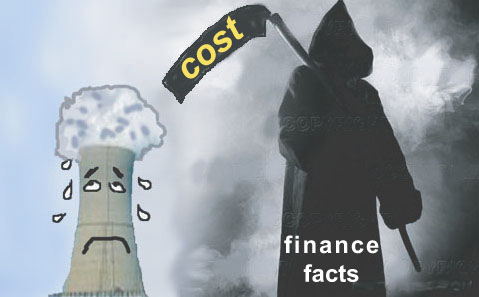 Nuclear development in South Africa likely on hold unless funds incorporated from private sector, Enformable Lucas W Hixson 19 Mar 14 South African President Jacob Zuma and Energy Minister Ben Martins have continuously committed the nation to build up a nuclear industry.
The government has adopted a 20-year Integrated Resource Plan (IRP) which says that coal, nuclear, hydro, shale gas, and renewable energy are all included in potential generation methods of increasing the nation’s power supply. The IRP is revised every two years, the latest update proposes that the nation delay construction of more nuclear plants and instead focus more on coal, hydro and gas.
Energy Minister Martins has said that South Africa’s goal is to be self-sufficient in all aspects of the nuclear energy industry, but there are concerns about whether South Africa’s construction industry is even large enough to handle the additional resources and manpower which would be required.
President Zuma announced that the South African government would work to procure 9,600 MW of energy from nuclear power, based on the IRP released in 2010. The new IRP said that little or no nuclear power will be required.
If President Zuma’s goal of installing 9,600 MW of nuclear energy, the government must find at least 1 trillion rand ($93.2 billion USD), to support a nuclear fleet of three new nuclear power plants in South Africa.
On Tuesday, Rob Adam, president of the Nuclear Industry Association of South Africa and director of the construction group Aveng, spoke at an energy conference in Johannesburg and told attendees that the government would likely be forced to incorporate funds from the private sector to invest in the nuclear industry in South Africa…….
Eskom is not currently fiscally stable enough to finance a nuclear power plant. According to experts in South Africa, given the nation’s tight fiscal budget, it is extremely unlikely that the government would be able to allocate any funds for the proposed nuclear build.
The nuclear proposal is seemingly causing a rift in the South African government. Some agencies like the departments of energy, public enterprises, trade and industry to name a few are big proponents of a nuclear build, while other agencies like the National Planning Commission and the treasury are concerned with the high costs of nuclear energy. http://enformable.com/2014/03/nuclear-development-south-africa-likely-hold-unless-funds-incorporated-private-sector/
Revolutionary new system for solar power in remote parts of Africa
 Renewable energy: Samsung introduces digital village concept Ghana Web 12 Mar 14, Samsung Electronics is developing a concept that will make use of sunshine, which is an abundant natural resource in Africa, to change and improve the lives of inhabitants of rural communities in Africa.
The leading provider of digital solutions will use sunshine as a renewable source of energy in Africa to establish various facilities that can be operated through transportable solar-powered generators.
Officials of Samsung therefore seek to introduce what is called the digital village with solar integrated solutions, a unique concept that harnesses technology in a way that breaks through traditional, social and economic barriers and takes real support and opportunities to people where they live.
Mr Thierry Boulanger, Director of Information Technology (IT) and Business to Business (B2B) Solutions of Samsung Electronics in charge of Africa, said the solar-powered generators constituted the heart of the digital village that could be erected in 60 minutes of arrival.
He said the solar-powered generators could be used to power classrooms, small businesses, government offices, health facilities and remote -controlled gates…….
1 This Month

of the week – Shut Down Drone Warfare!


Tell the Ukrainian Government to Drop Prosecution of Peace Activist Yurii Sheliazhenko

Petition to revoke the licensing of the Near Surface Nuclear Disposal Facility (NSDF) at Chalk River. https://www.ourcommons.ca/petitions/en/Petition/Details?Petition=e-7247
To see nuclear-related stories in greater depth and intensity – go to https://nuclearinformation.wordpress.com
-
Archives
- April 2026 (79)
- March 2026 (251)
- February 2026 (268)
- January 2026 (308)
- December 2025 (358)
- November 2025 (359)
- October 2025 (376)
- September 2025 (257)
- August 2025 (319)
- July 2025 (230)
- June 2025 (348)
- May 2025 (261)
-
Categories
- 1
- 1 NUCLEAR ISSUES
- business and costs
- climate change
- culture and arts
- ENERGY
- environment
- health
- history
- indigenous issues
- Legal
- marketing of nuclear
- media
- opposition to nuclear
- PERSONAL STORIES
- politics
- politics international
- Religion and ethics
- safety
- secrets,lies and civil liberties
- spinbuster
- technology
- Uranium
- wastes
- weapons and war
- Women
- 2 WORLD
- ACTION
- AFRICA
- Atrocities
- AUSTRALIA
- Christina's notes
- Christina's themes
- culture and arts
- Events
- Fuk 2022
- Fuk 2023
- Fukushima 2017
- Fukushima 2018
- fukushima 2019
- Fukushima 2020
- Fukushima 2021
- general
- global warming
- Humour (God we need it)
- Nuclear
- RARE EARTHS
- Reference
- resources – print
- Resources -audiovicual
- Weekly Newsletter
- World
- World Nuclear
- YouTube
-
RSS
Entries RSS
Comments RSS
 nuclear-news