South Africa’s Finance Minister under pressure about govt plans for unaffordable nuclear power
Nuclear must be affordable, says Nene, Business Day, BY CAROL PATON, 24 AUGUST 2015, FINANCE MINISTER NHLANHLA NENE SAYS HE WILL HOLD THE LINE ON THE PROCUREMENT OF NUCLEAR ENERGY IF IT IS UNAFFORDABLE, AND WILL REDUCE THE HEAD COUNT OF THE PUBLIC SERVICE TO ENSURE SPENDING STAYS IN LINE WITH FISCAL TARGETS.
Mr Nene is under enormous political pressure to accede to a presidency-backed plan to procure 9,600MW of nuclear energy capacity at a time when public finances are at their weakest since the mid 1990s.
Underlining this pressure was the appearance of a fake intelligence dossier last week, smearing top Treasury officials as apartheid agents and alleging that they and Mr Nene are part of a conspiracy by the old white establishment to control the Treasury.
The document aroused grave concern among the public, and in political and investor circles, as it is feared it may signal a political attack on the Treasury, which until now has been a strong source of confidence given its ability to exercise tight control over government finances.
The Treasury and Mr Nene say that the document is baseless but appears to be a worrying attempt “to undermine and destablise the institution”.
Mr Nene’s comments, in an exclusive interview with Business Day on Friday, come at a time of keen interest from ratings agencies and the investor community regarding whether the government will stick to self-imposed spending ceilings designed to cut debt in this challenging political context.
Of the challenges, top of the list is whether Mr Nene will be able to hold the line on the nuclear procurement.
Treasury and Department of Energy officials spent most of last week locked in an intense engagement in Cape Town over the financing options for the project.
Mr Nene said that since the Treasury had only just been invited into the process, it was too early to make pronouncements.
However, if it was unaffordable to the country and to consumers, who would have to pay for the energy generated, it could not be done, he said….. the Department of Energy’s discussions with vendors have all assumed the full 9,600MW would be commissioned. The department also envisages using the programme for industrialisation and job creation, and aims to create a nuclear export industry.
It has to date refused to make public its studies or provide evidence that a nuclear procurement of 9,600MW is affordable.
Mr Nene said that as with any project that involved the allocation of resources, the Treasury would have to account to the nation.
“That is why following process is critical…. My job is spelt out in legislation and my role is to uphold and stay within the confines of the Constitution and the Public Finance Management Act.”…..http://www.bdlive.co.za/business/energy/2015/08/24/nuclear-must-be-affordable-says-nene
African National Congress calls for transparency on nuclear tender process
 ANC calls for transparent nuclear tender process, Mail & Guardian, 18 AUG 2015 2FRANZ WILD, STAFF REPORTER
ANC calls for “full, transparent and thorough cost benefit analysis of nuclear power” as SA prepares for a bidding process for new nuclear plants. n a document that will be discussed at its policy review conference in October, the ANC said: “Government must also announce publicly that nuclear energy can only be procured in line with the legal prescripts and after a thoroughgoing affordability assessment.”
The document was released on Monday.
During his State of the Nation address in February, President Jacob Zuma said all countries that bid “will be engaged in a fair, transparent and competitive procurement process to select a strategic partner, or partners, to undertake the nuclear build programme”.
But the Mail & Guardian reported earlier this year that in a “top secret” presentation, the energy department proposed a closed government-to-government procurement of new nuclear power stations instead of a transparent and competitive tender.
The nuclear agreement with Russia, which amaBhungane revealed, states that the government is prepared to give Russia exclusive rights to its nuclear build programme for a minimum of 20 years. During that time, Russia could block South Africa from procuring nuclear technology from any other country.
The Russians would be indemnified from any liability arising from nuclear accidents during the reactors’ lifespan. Russia would be granted a host of regulatory concessions and favourable taxation and other financial treatment. The designated competent authorities are South Africa’s department of energy and Russia’s state-owned Rosatom State Atomic Energy.
With the Russian economy in turmoil and the subsequent high cost of borrowing, the country’s ability to raise the funding for its nuclear ambitions in many countries is being called into question – as is its ability to deliver on time.
For South Africa, it is even more of a mystery how the government will provide the loan guarantees that would be required, given that so many have been extended to ailing parastatals such as Eskom and SAA. The state may have hit its limit………http://mg.co.za/article/2015-08-18-anc-calls-for-transparent-nuclear-tender-process
South Africa’s incorrect environmental assessments for proposed nuclear power stations
 Nuclear deal environmental assessments don’t match proposed plants: DA http://www.timeslive.co.za/politics/2015/08/16/Nuclear-deal-environmental-assessments-dont-match-proposed-plants-DA RDM News Wire | 16 August, 2015
The Environmental Impact Assessments (EIA) conducted to assess and predict the environmental consequences of chosen nuclear build sites – and which are necessary by law – are outdated and obsolete‚ and cannot be used in support of the proposed trillion rand nuclear build programme, the Democratic Alliance says.
The DA said on Sunday that this is yet another reason why Minister of Energy Tina Joematt-Pettersson must “move to scrap this secretive and unaffordable nuclear deal once and for all”.
In a statement‚ DA spokesman on energy Gordon MacKay said this information had come to light in a reply to a DA parliamentary question in which the Minister of Energy revealed that the EIAs – which are needed before construction can begin – were carried out for only three of the proposed sites by Eskom between 2007 and 2008.
“The DA has reviewed the existing EIAs and we have noted deficiencies in at least two respects.
“Firstly‚ the EIA’s have only assessed the suitability and environmental impact of High Pressurized Water Reactors‚ a technology currently being used at South Africa’s sole nuclear site at Koeberg.
“The EIA’s have not considered technology being offered by other bid vendors such as Rossatom’s AES 2006 reactor. This reactor‚ the VVER‚ is a water to water pressurised rector and differs materially from the design evaluated by the EIA. Adoption of technology from vendor nations with designs deviating from Koeberg’s would therefore be ill advised and invalid.
“Secondly‚ the EIA was conducted when the power utility was planning on expanding its nuclear generating fleet through the nuclear-1 project – a much smaller‚ single site project which does not compare to the current proposed build programme‚” Mr MacKay asserted.
“Indeed‚ the Environmental Consultants who did carry out the EIA indicated that the evaluation was only for a single nuclear power station of a maximum of 4‚000 MW‚” he added.
He quoted the consultants as making clear in their report that “In spite of the above-mentioned broad recommendations regarding the number of power stations that could potentially be constructed at each site‚ it must be emphasized that the current application is for a single nuclear power station of a maximum of 4‚000 MW. The cumulative impacts of any additional nuclear power stations on a particular site (if authorised) would have to be confirmed in a new EIA process prior to any further development”.
“This‚” stated MacKay‚ “is significantly less than the current nuclear build programme‚ which is estimated at 9600MW‚ more than double the maximum of 4000 MW stipulated in the EIA. The report also makes it quite clear – anything above 4000MW would have to be confirmed in a new EIA process prior to any further development.
“The fact that the Minister is trying to distort South Africa’s legislative processes‚ in this way‚ is deeply concerning.
“It is now increasingly clear that the proposed trillion rand nuclear deal is ill-thought out‚ and rushed‚ and should not be pursued. The Minister must now put her pride aside‚ and do what is right: scrap the deal‚ once and for all.”
Secrecy and graft in South Africa’s multi $billion nuclear power plan?
Nuclear power plan stirs fears of secrecy and graft Project could cost as much as $100 bn – experts., Money Web Joe Brock, Reuters | 14 August 2015 Fears are growing in South Africa that agreements to build nuclear power plants that could be the most expensive procurement in the country’s history will be made behind closed doors, without the necessary public scrutiny.
Among those voicing concern, two government sources say the Treasury is not being included in procurement discussions, despite the massive budgetary implications of a project that experts say may cost as much as $100 billion.
Construction on the first plant is due to start next year, breakneck speed compared with the years of regulatory and environmental checks for nuclear projects in countries such as Britain and the United States.
The Democratic Alliance, the main opposition party, believes the pace of the deal will prevent proper analysis before contracts are signed and huge sums of money change hands.
“The whole deal has been veiled in secrecy. We have no details on what we’re buying, how much it’s going to cost or how we’re going to pay for it,” shadow energy minister Gordon Mackay told Reuters.
The Department of Energy (DoE) did not respond to requests for comment. It has said several times the procurement process will be transparent and follow procedure.
Finance Minister Nhlanhla Nene was forced this week to deny reports of tensions with the DoE over the plans and said the Treasury was playing a supporting role in the procurement process.
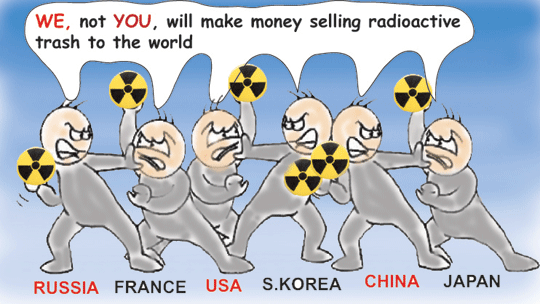 Pretoria has already signed non-binding inter-government agreements for nuclear power support from several countries including France, China and South Korea.
South Africa’s President Jacob Zuma said this week the nuclear plan was at an “advanced stage” and the procurement process should be completed by March.
Following meetings between Zuma and Russian President Vladimir Putin last year, the Russian atomic agency Rosatom said it had agreed a $10 billion contract to build power stations.
However, the DoE denied an agreement had been reached, raising public suspicion in South Africa of backroom dealmaking – an accusation often levelled against the ruling African National Congress under Zuma’s tenure.
The nuclear deal is of huge concern given South Africa’s history of endemic corruption,” said Andrew Feinstein, a former ANC lawmaker and now executive director of Corruption Watch UK.
Feinstein is the author of a book about alleged widespread graft in a $4.8 billion arms deal during the late-1990s.
“I fear that the corruption in this deal might dwarf the arms deal,” he said.
Chronic shortages, mounting debt…….A 2013 study by the University of Cape Town’s Energy Research Centre found more nuclear power was not needed and would not be cost-effective, based on an estimated installed cost of $7 000 per kilowatt.
The DoE has estimated the build would cost $4 200 per kilowatt. Energy experts say this is optimistic and the calculations are based on out-of-date assumptions……..http://www.moneyweb.co.za/news/south-africa/nuclear-power-plan-stirs-fears-of-secrecy-and-graft/
South Africa facing a R1-trillion nuclear financial disaster
 R1-trillion nuclear plans are simply “disastrous” for SA http://businesstech.co.za/news/energy/94677/r1-trillion-nuclear-plans-are-simply-disastrous-for-sa/ 31 July 15 Government’s R1-trillion nuclear build plans are going to turn South Africa’s energy crisis into a jobs crisis, according to the Democratic Alliance.
Earlier in July, the Department of Energy signed two memoranda of understanding with Russian state nuclear energy corporation Rosatom to implement several joint projects for education in the nuclear power industry.
Energy Minister Tina Joemat-Pettersson said that South Africa will start a nuclear build programme in 2015, in a bid to generate an additional 9,600MW of electricity.
The country will have as many as nine new nuclear power plants by 2030, with government pegging the total cost to build these at R500 million – though energy experts have stated R1 trillion was more realistic, and would likely increase.
In a statement issued on 31 July, DA leader Mmusi Maimane said the nuclear deal will drag the country’s economy back, and will cost thousands of South Africans their jobs.
According to the party, the details behind government’s nuclear plans show that the undertaking is unaffordable.
“Whichever funding model is chosen, you can rest assured that it will be paid for by the South African taxpayer, and that we can expect substantial tariff increases over many years.”
These higher prices would price the poor out of electricity usage, and would result in energy-heavy industries – like mining and manufacturing – shedding more jobs, said the DA.
“For a government that claims to be pro-poor – and for a country where 5.2 million people cannot find work and a further 2.4 million have given up looking – this is unfathomable.”
Maimane pointed to a number of flaws in the scheme:
- Even if government’s estimate of R500 million was correct, South Africa cannot afford to build the nuclear reactors. This would result in private-public partnerships being formed, which would be reflected in current and future electricity prices increasing, as citizens would have to pay.
- South Africa lacks the capacity and skills to operate eight nuclear power stations. We lack the capacity and skills to run the one we already have, said Maimane.
- The project goes against the government’s own National Development Plan, which urges caution on nuclear, pointing rather towards gas, wind, and solar energy as a primary source of power.
To date, government has not provided solid details on the nuclear build plans.
“Until the government tells us how much the nuclear deal will cost, how we plan to pay for it, and how they intend to choose the preferred bidder, we cannot begin to entertain the notion of going down this path.”
The DA leader said that, while the party does not oppose nuclear power, the current plan is “not right” for the country, and it will do anything in its power to block the deal.
South Africa is warned – Nuclear power is a dying industry
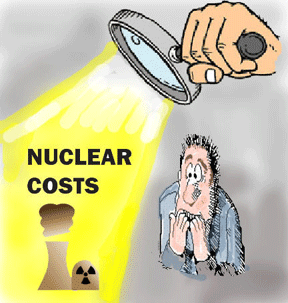 With the South African build is set to cost anywhere up to R1-trillion, that would mean the same cost (adjusted upward with inflation) would have to be born near the end of this century, he says. “Except then you will have no income coming in. Just the cost of powering the reactors while you wind down operations. And the endless cost of looking after the nuclear waste.”
“This is a dying industry and there are just too many unanswered questions for South Africa to go down this path. Except we know the element of corruption can always be present in the nuclear industry,”
 Nuclear a ‘technology of the past‘, Mail & Guardian, 27 JUL 2015 SIPHO KINGS A Russian nuclear activist has labelled South Africa’s pursuit of new nuclear capacity – with Russian support – as “naive” and advised against it. “Nuclear is not technology of the future. This is technology of the past, of the Cold War.” This is the conclusion Vladimir Slivyak, of the Russian environmental group Ecodefense, reaches when talking about nuclear technology. Continue reading
Congo’s forgotten uranium mine
In Congo, silence surrounds forgotten mine that fuelled first atom bombs, Aljazeera America
The US sourced uranium for the weapons used on Japan from Shinkolobwe; though the site is closed, locals mine illegally July 23, 2015 by Tom Zoellner One of the manifest ironies of the nuclear age is just how primitive it all is. A complicated war was brought to an end within a week by a pair of indiscriminate hammer blows. The logic behind the next 45 years of Cold War military strategy — hit us and we both die — was as simplistic as it was problematic. And driving everything was a bomb fashioned out of dirt.
A particular kind of dirt, of course, and one that required a lavish industrial process before it could be made into a fissile device. That dirt is uranium, and it lies all around the world in abundant quantities. A place where it was concentrated to levels of freakish purity is now just a curious footnote of the nuclear age, but at one time, it was treated with intense secrecy.
Shinkolobwe was a small settlement in the Katanga province of what was then the Belgian Congo……….
The mine produced uranium for U.S. nuclear weapons until 1960, when enough uranium mines had opened up in the American Southwest to meet the nuclear hunger, and Shinkolobwe was closed. The Belgians poured concrete down the mineshaft and closed off the pit.
I visited Shinkolobwe in 2007, 120 miles from the city of Lubumbashi over disintegrating roads through the rain forest. A permit to go there cost $80, payable to a member of the presidential staff. We had to walk the last several kilometers until we reached a decrepit fence overgrown with vines.
Sharp’s hill had given way to an immense pit, which had been chewed over for decades by local freelance miners. The mineshaft the Belgians built and then filled with concrete had been dug away to a depth of about 100 feet and fallen over. The scene was disquietingly peaceful. Though we had been told it was heavily guarded, no soldiers or police were there to challenge us.
The birthplace of the Bomb has been forgotten by the outside world but not by everyone. Teams of Congolese miners kept slipping inside the old pit to dig out residual supplies of copper and cobalt, which they sell on the black market. There have been persistent rumors — and some occasional instances — of local businessmen selling uranium to outside parties. There is also evidence that some of the Shinkolobwe uranium has found its way into Iranian centrifuges, though this remains publicly unconfirmed by Western intelligence agencies…….http://america.aljazeera.com/articles/2015/7/23/in-congo-silence-surrounds-forgotten-mine-that-fueled-first-atomic-bombs.html
Ugly Australians, like Paladin Energy, linked to 100s of deaths in uranium mining in Malawi and Namibia
There is a very strong perception that when Australian mining companies come here they take every advantage of regulatory and compliance monitoring weaknesses, and of the huge disparity in power between themselves and affected communities, and aim to get away with things they wouldn’t even think of trying in Australia,”
 Australian miners linked to hundreds of deaths, injuries in Africa, SMH, July 11, 2015 -Will FitzgibbonAustralian mining companies are linked to hundreds of deaths and injuries in Africa, which can go unreported at home. Some of the Australian Securities Exchange-listed companies include state governments as shareholders. One company recorded 38 worker deaths over an eleven-year period.
 In Malawi, litigation continues against Paladin Africa Limited, a subsidiary of Perth-based Paladin Energy, and its subcontractor after an explosion disfigured one worker with such heat that his skin shattered when touched by rescuers. Two others died in the same incident.
Other allegations include employees in South Africa hacking a woman with a machete and Malian police killing two protesters after a mine worker reportedly asked authorities to dislodge a barricade on the road to the mine.
An investigation by the International Consortium of Investigative Journalists, in collaboration with 13 African reporters, uncovered locally-filed lawsuits, violent protests and community petitions criticising some Australian companies. Continue reading
Russia is front-runner in scramble to sell nuclear reactors to South Africa, but who will pay?
South Africa has concluded similar pacts with China, France, the US, Japan and South Korea.
“There are serious questions that need to be answered as to whether South Africa is able to finance this programme and how any investment would have to be repaid,
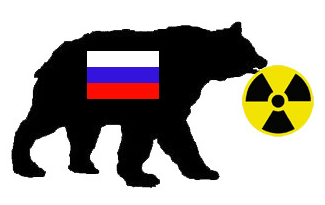 Will Putin pay for SA’s $100bn nuclear plan?, Mail & Guardian, 06 JUL 2015 11:03 MIKE COHEN The awarding of contracts to build SA’s nuclear plants is nearing. Who will pay for the big project? Russia is seen as the frontrunner to win the right to build South African nuclear power plants that may be worth as much as $100-billion. With a six-month deadline to award contracts, who’s going to pay for the country’s biggest project yet remains a mystery.
Price-tag estimates for as many as eight reactors generating 9 600 megawatts, which the government wants to begin operating from 2023 and complete by 2029, range from $37-billion to $100-billion. Bids are due to start this quarter, with Russia’s Rosatom seen as a leader. Areva, EDF, Toshiba’s Westinghouse Electric, China Guangdong Nuclear Power Holding and Korea Electric Power have also shown interest.
The planned investment comes as the government battles to fend off a junk-grade credit rating and the Treasury seeks to rein in the budget deficit. Proceeding with the nuclear plants could result in a large increase in public debt, the International Monetary Fund warned in a report on June 24.
“There appears to be a simple-minded assumption that countries like China or Russia will provide cheap plants and offer finance,” Steve Thomas, professor of energy policy at the University of Greenwich in the UK, who has monitored South Africa’s nuclear plans since 1997, said in a phone interview on June 24. “That’s an illusion.” Continue reading
South Africa’s Democratic Alliance refutes government denials over a nuclear deal.
DA slams nuclear deal July 10 2015 IOL By ANA The DA refutes government denials over a nuclear deal.
Cape Town – South Africa’s inking of two memoranda of understanding with Russia’s state nuclear energy company Rosatom made it clear a deal for a new reactor was already in the pipeline despite government’s denials, the Democratic Alliance said on Friday.
DA energy spokesman Gordon Mackay said he had written to Energy minister Tina Joemat-Petterson following Thursday’s announcement of the agreement on the sidelines of the Brics summit in the southern Russian city of Ufa to demand that she release further details of it.
“That these MOUs reportedly speak of cooperation in order to provide training for five categories of specialists for the South African nuclear industry is the clearest indication yet that Rosatom is the preferred bidder,” Mackay said
“Signing MOUs of this nature, while a competitive bid process is underway, smacks of gross impropriety on behalf of Minister Joemat-Pettersson and can be seen as nothing more than a crude attempt by the Zuma administration to bolster Rosatom’s bid over potential rivals.”
Government on Thursday denied Russia was the preferred bidder for a deal that would increase South Africa’s nuclear power capacity………http://www.iol.co.za/business/news/da-slams-nuclear-deal-1.1883599#.VaBBpF-qpHw
The Ugly Australians, And Other Miners, Leaving Health and Environmental Damage in Namibia
[Paladin’s] Langer Heinrich Uranium mine[Namibia] …
Craton Mining and Exploration [copper] is a subsidiary of Australian-based International Base Metals…..
Rio Tinto owns Rössing Uranium Mine…
[Australian] Deep Yellow Limited (DYL) the Aussinanis uranium project.
Aussies in toxic trail By Shinovene Immanuel, Ndanki Kahiurika 10 July 15 http://www.namibian.com.na/indexx.php?id=28936&page_type=story_detail&category_id=1#sthash.TJSxEgQV.P3bN2nwk.uxfs&st_refDomain=blogs.icerocket.com&st_refQuery=/search?tab=buzz&fr=h&q=uranium+Australia NAMIBIA, a mining frontier for decades, continues to struggle with mining companies which subject workers to dangerous working conditions.
TROUBLING
What ICIJ uncovered and pieced together suggests a troubling track record on the part of Australian companies in the rush for Africa’s minerals, including practices that would be impermissible, even unthinkable, in Australia and other parts of the developed world.
ICIJ found that, at the end of 2014, there were more than 150 Australian-listed active mining companies with recorded properties in Africa. Other estimates, using different criteria, put the number even higher.
Australian companies have 49 mining licences in Namibia; two of those companies are operational.
Even though Australian firms run successful mining companies which contribute to Namibia’s economy and workplace conditions have improved compared to two decades ago, there are still questions about the safety of workers.
Thousands of people, including village chiefs, former employees, human rights defenders and government agencies across Africa have taken Australian companies, their subsidiaries and their contractors to court for alleged negligence, unfair dismissal and eviction or pollution, according to court submissions and judgements unearthed from more than a dozen countries.
Australian uranium mining company Paladin accused of ribbing off impoverished Malawi
 Australian miner accused of dodging tax in world’s poorest country, The Age, July 11, 2015 –Heath Aston Political reporter Tax avoidance tactics of multinational companies have angered Australians, but an Australian mining firm used such methods in Malawi. Tax avoidance tactics of multinational companies have angered the public and placed pressure on the Abbott government to prevent profits being exported offshore.
But an Australian uranium miner is defending the use of identical methods to reduce its tax bill in the world’s poorest country, Malawi.
Between 2009 and 2014, Paladin Energy moved $US183 million out of Malawi to a holding company in the Netherlands and then on to Australia.
A 15-page report by London-based ActionAid has found the Dutch transfers and a special royalties deal – in which Malawi’s mining minister agreed to drop the initial tax rate applied to the uranium mine from 5 per cent to 1.5 per cent – have cost the Malawi public $US43 million.
In Africa’s poorest nation, where per capita GDP is just $US226 a year and life expectancy 55, that money could provide the equivalent of 39,000 new teachers or 17,000 nurses, according to the aid group……..
Paladin’s tax-free transfers to the Netherlands were a combination of management fees and interest payments on loans initiated in Australia. The company loaded its African subsidiary up with huge debts, leaving the Kayelekera uranium mine in northern Malawi with an 80:20 debt to equity ratio – a financing structure known as “thin capitalisation”.
The Dutch structure allowed Paladin to avoid paying a 15 per cent withholding tax to the Malawi government due to a tax treaty between Malawi and the Netherlands which expired in 2014, saving the company $US7.3 million. Paladin closed the mine in February 2014, citing a “sustained low uranium price”.
ActionAid has accused the company of “treaty shopping” and shortchanging the Malawi people. The country’s nursing ranks have the equivalent of four nurses to every 100 in Australia, despite 10 per cent of Malawi’s population being infected with HIV/AIDS……..http://www.theage.com.au/federal-politics/political-news/australian-miner-accused-of-dodging-tax-in-worlds-poorest-country-20150710-gi6uzv.html
Russia’s nuclear industry to “educate” South Africans
Nuclear deal – 200 South Africans to be “educated” during excursions to Russia http://www.biznews.com/briefs/2015/07/09/nuclear-deal-200-south-africans-to-be-educated-during-excursions-to-russia/ ALEC HOGG JULY 9, 2015 Cape Town – The Department of Energy announced in a statement on Thursday that it has signed two memoranda of understanding with Russian state nuclear energy corporation Rosatom at the 7th summit of the Brics (Brazil, Russia, India, China and South Africa) countries in the Russian city of Ufa.
According to the first document, Russia and South Africa aim to implement several joint projects for education in the nuclear power industry.
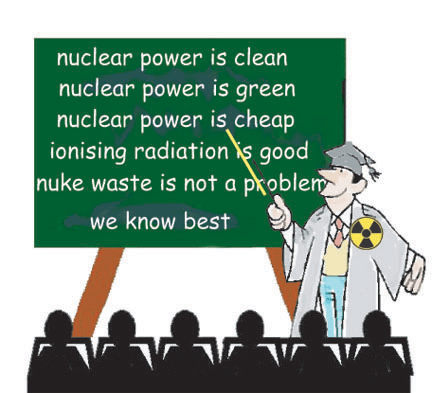
The countries will cooperate to provide training for five categories of specialists for the South African nuclear industry: nuclear power plant personnel, engineers and construction workers, staff for operations not related to the power industry, personnel for nuclear infrastructure, students and teachers.
There will also be education programmes for 200 South African candidates at Russian universities and educational organisations. This memorandum stipulates the development of educational materials and scientific literature on nuclear power, student exchange programmes for students of various levels of training, organisation of internships and summer courses, student competitions and teacher training.
The second memorandum signed in Ufa stipulates joint efforts of the parties to promote nuclear power in South Africa, increasing the awareness of local residents of modern nuclear technologies used in the power industry and in other industries, and ensuring public acceptance of nuclear power.
In particular, the parties have agreed to work out a plan for the implementation of a joint communication programme to be launched in South Africa. This will involve the organisation of round tables and other events aimed at promoting nuclear power and modern nuclear technologies.
A nuclear energy information centre in South Africa is also under consideration. “The parties seek to exchange information and best practices in the nuclear industry by organising working visits and international conferences and exhibitions,” said the Department of Energy. Source: http://www.fin24.com/Economy/Rosatom-seeks-to-educate-SA-on-nuclear-power-20150709
Nigeria’s Akwa Ibom State Leaders Caucus says NO to nuclear power
 Nigeria: Caucus Rejects Siting of Nuclear Plant in Akwa Ibom All Africa, By Idongesit Ashameri, 7 July 15
Uyo — The Akwa Ibom State Leaders Caucus has rejected plans by the Nigerian Atomic Energy Commission (NAEC) to site a Nuclear Power plant in Itu local Government Area of the state. The group attributed their rejection of the Nuclear Power plant to disastrous consequences that failure of nuclear plants had brought in other parts of the world.
The leaders’ caucus questioned why Nigeria, which they said had a perennial incompetence in matters of safety and security, could venture into such a risky project, while countries with known competences, like Germany, Italy, USA, Russia and Japan are shutting down such plants.
Community leaders in Nigeria oppose nuclear power facility
Nigeria: Community leaders oppose nuclear plant site, Star Africa, APA July 3, 2015 The Leaders Caucus of the Akwa Ibom State in south-eastern Nigeria has rejected plans by the Nigerian Atomic Energy Commission (NAEC) to site nuclear power plant in Itu Local Government Area of the state.
He wondered what gave Nigeria, where perennial incompetence in matters of safety and security has become legendary, the impetus to venture into such a risky project, while countries with known competences like Germany, Italy, US, Russia and Japan are shutting down such plants.
Okon said that gambling with such risky issue by Nigeria was a clear and deliberate invitation to disaster of monumental proportions.
Declaring Akwa Ibom as grossly unsuitable for such projects, the leaders noted that the location of nuclear plants all over the world is done far away from human habitation, noting that Akwa Ibom is small and compact, even as there is no distance across the state that is beyond 50km……….http://en.starafrica.com/news/nigeria-community-leaders-oppose-nuclear-plant-site.html
1 This Month

of the week – Shut Down Drone Warfare!


Tell the Ukrainian Government to Drop Prosecution of Peace Activist Yurii Sheliazhenko

Petition to revoke the licensing of the Near Surface Nuclear Disposal Facility (NSDF) at Chalk River. https://www.ourcommons.ca/petitions/en/Petition/Details?Petition=e-7247
To see nuclear-related stories in greater depth and intensity – go to https://nuclearinformation.wordpress.com
-
Archives
- April 2026 (79)
- March 2026 (251)
- February 2026 (268)
- January 2026 (308)
- December 2025 (358)
- November 2025 (359)
- October 2025 (376)
- September 2025 (257)
- August 2025 (319)
- July 2025 (230)
- June 2025 (348)
- May 2025 (261)
-
Categories
- 1
- 1 NUCLEAR ISSUES
- business and costs
- climate change
- culture and arts
- ENERGY
- environment
- health
- history
- indigenous issues
- Legal
- marketing of nuclear
- media
- opposition to nuclear
- PERSONAL STORIES
- politics
- politics international
- Religion and ethics
- safety
- secrets,lies and civil liberties
- spinbuster
- technology
- Uranium
- wastes
- weapons and war
- Women
- 2 WORLD
- ACTION
- AFRICA
- Atrocities
- AUSTRALIA
- Christina's notes
- Christina's themes
- culture and arts
- Events
- Fuk 2022
- Fuk 2023
- Fukushima 2017
- Fukushima 2018
- fukushima 2019
- Fukushima 2020
- Fukushima 2021
- general
- global warming
- Humour (God we need it)
- Nuclear
- RARE EARTHS
- Reference
- resources – print
- Resources -audiovicual
- Weekly Newsletter
- World
- World Nuclear
- YouTube
-
RSS
Entries RSS
Comments RSS
 nuclear-news