Karoo, South Africa, community unaware of hazards of uranium mining
 People should make their voices heard in the public consultations expected to take place over the course of the year 2016, before mining rights are granted.
To register as Interested and Affected Parties write to Ferret Mining at info@ferretmining.co.zaor call 012 753 1284/5.
To stay informed, join the Facebook page Stop Uranium Mining in the Karoo.
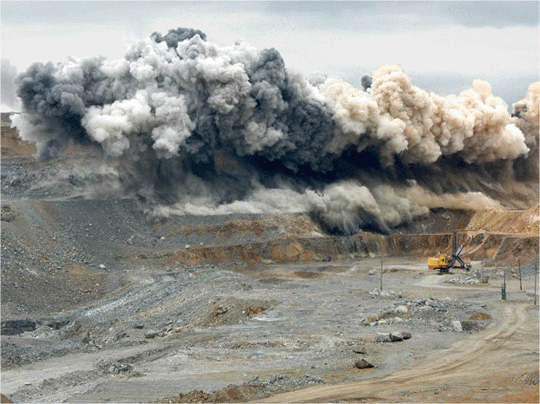
 Uranium Mining Threatens the Karoo, Karoo Space, 18 Jan 16 By Dr Stefan Cramer Images sourced by Dr Stefan Cramer Just as the threat of fracking seemed to recede in the Karoo, the danger of uranium mining has arisen – and it is even more frightening and more likely than shale gas extraction.
The Karoo has long been known to harbour substantial sedimentary uranium deposits. Now an Australian company with Russian funding is planning to get the radioactive mineral out of the ground on a major scale.
The company has quietly accumulated over 750 000 hectares of Karoo properties and concessions around Beaufort West and plans to set up a large Central Processing Plant just outside that town.
While the nation is still debating the pros and cons of fracking, the Environmental Impact Assessment (EIA) as the precursor to mining licences is nearing finalisation. During 2016 the Department of Mineral Resources will make a decision on the industry’s application……….
extensive studies on the risks of uranium mining over many decades are available today.
We can draw on vast experiences on what huge impact the uranium mining industry has had in such diverse places as in Germany, USA, Australia or Niger. The death toll of a hugely dangerous industry is well known and firmly established.
Yet so far there is no public debate, no strategic assessment process in place in the Karoo.
No advocacy groups balance the glossy claims of the industry against sobering experiences on the ground. While global energy prices are depressed, the deepening economic and political crisis makes South Africa less and less attractive to the huge investments necessary to establish an upstream gas industry. Continue reading
Political connections in South Africa’s uranium energy drive
 Uranium Mining Threatens the Karoo, Karoo Space, 18 Jan 16 By Dr Stefan Cramer Images sourced by Dr Stefan Cramer “……..It is particularly interesting to see who the South African partners are in this joint venture. The Black Economic Empowerment partner in this case is Lukisa, which holds a total of 26% of Tasman RSA Mines, primarily in the form of exploration rights and nuclear licenses from the National Nuclear Regulator .
Perhaps more important are the excellent relations Lukisa has with Government and the ruling ANC.
Lukisa was founded by the controversial Andile Nkuhlu then a leading member of the ANC Youth League (ANCYL). He belonged to the faction co-opted by the then mining magnate Brett Kebble, whose assisted suicide made headlines in 2005 after he swindled government out of billions of Rand in shady mining deals.
Andile Nkuhlu was then made chief director in the Department of State Enterprises until his career stumbled in a corruption scandal. He pre-empted his dismissal from the ANC by founding the opposition party Congress of the People (COPE).
When this flopped he was readmitted to the ANC and continued to influence provincial polices in the Eastern Cape. A few years ago he relinquished his position at LUKISA because of deteriorating health, until he succumbed to diabetes complications in December 2015.
Now the company is run by Tefo Maloisane, who is said to have a long history of excellent political connections………http://karoospace.co.za/uranium-mining-threatens-the-karoo/
Radiation hazards in planned uranium mining in the Karoo, South Africa
Uranium Mining Threatens the Karoo, Karoo Space, 18 Jan 16 By Dr Stefan Cramer Images sourced by Dr Stefan Cramer “…..According to its documents, Tasman RSA Mines today controls exclusive prospecting rights over more than 750 000 hectares in a circle of nearly 200 kilometres around Beaufort West.
About 32 000 hectares are directly owned under freehold by the company. Local farmers find it hard to resist purchase offers, as farming in this part of the Karoo is particularly difficult due to low rainfall and poor soils.
Unlike in fracking, farms are permanently damaged by uranium opencast mining………
So far the company has not indicated whether they would use ‘in-situ-leaching’, a particularly dangerous but low-cost method. Here, large quantities of leaching agent are injected underground. The uranium is dissolved and recovered in well fields.
The uranium deposits are scattered over large zone of 200 by 300 kilometres which will necessitate trucking of ores over poorly constructed dust roads for hundreds of kilometres to reach the Central Processing Plant.
For this plant, the company has already applied for a water licence to abstract annually 700 million litres of groundwater annually, roughly half of the total water consumption of the Central Karoo Municipality.
It is still unclear what will happen with the contaminated waste water. A discharge of radioactive waste water into the aquatic environment, above or below ground, would be illegal under South Africa’s strict Water Act.
Most probably contaminated slimes will be delivered to large settling ponds, like those around Johannesburg, from which the remaining water will evaporate. This leaves behind a soft and unstable pile of contaminated soil which can be easily mobilised by the strong prevailing winds in the Karoo into large dust dispersal.
Already today, the environment around Beaufort West is contaminated close to the previous mine sites. First field studies by the author show unprotected nuclear wastes with 10 to 20 times the background radiation.
Dust and Radiation – Two Deadly Impacts
The devastating impacts of uranium mining on people, especially the mine workers, and the environment have been well research and documented. Several studies of large number of cases and with exposure over many years (Wismut AG in the former East Germany, theColorado-Plateau in the USA, and Saskatchewan in Canada, have established a particular direct relationship between occupational exposure to uranium and its decay products and lung diseases.
Mining uranium ore in the Karoo will invariably create huge plumes of contaminated dust. Dust clouds are unavoidable during drilling, blasting and transporting.
Dust suppression by spraying water is only partially effective and creates new problems with contaminated slimes, adding to the environmental cost of groundwater abstraction……..http://karoospace.co.za/uranium-mining-threatens-the-karoo/
Legal obstacle to South Africa’s nuclear energy plan
 Energy department faces legal ordeal on nuclear energy deal, Business Day Live, South Africa BY CAROL PATON, 11 JANUARY 2016 THE CURIOUS DEVELOPMENTS ON GOVERNMENT’S NUCLEAR ENERGY PROCUREMENT PROGRAMME LAST MONTH HAVE SUNK THE DEPARTMENT OF ENERGY DEEPER INTO A LEGAL MESS.
Already, an attempt to challenge the legality and constitutionality of the process has been lodged: Earthlife and the Southern African Faith Communities Environmental Initiative (Safcei) filed papers to oppose it in October.
Now, the muddled events that unfolded last month are likely to make matters worse, making an already controversial process even more contested.
It all began in the last Cabinet meeting of the year on December 7, when it took a decision to issue a request for proposals (RFP) to build 9,600MW of nuclear power-generation.
As important as it is, this decision was not communicated in the normal post-Cabinet media statement by Minister in the Presidency Jeff Radebe.
Official confirmation took place only on December 21 in a government gazette. Like the absence of an official announcement, the gazette, too, was strange. Apart from the fact that it was issued on December 21, when the holiday season was under way, the gazette made use of a two-year-old signature by previous minister Ben Martins to establish its legal basis.
In order to call for proposals for new generation, the minister of energy must first make an official determination in terms of the Electricity Regulation Act of 2006. To do so, she must obtain the concurrence of the National Energy Regulator of SA (Nersa). This, it seems, was done two years ago by Mr Martins and the paperwork then lay in a file in the Department of Energy for the next two years.
Last month, the old document was retrieved and slapped into the government gazette.
There are several reasons why the Department of Energy decided to use an old document to make the determination rather than getting a fresh one from serving Energy Minister Tina Joemat-Pettersson. None of them, though, will make the nuclear deal any smoother……..
key to the legal arguments will be the difference of opinion over whether public consultation to build nuclear power stations has taken place. The department says that it has as it consulted widely over the IRP 2010 and has also engaged in environmental impact assessments. Safcei and Earthlife disagree that this amounts to meaningful consultation.
It is also worth noting that an RFP is only the beginning of the shopping process and does not mean that a decision to build plants has been taken. Reaching a decision on whether nuclear energy is affordable, particularly on the scale that SA has in mind, is a bigger and more difficult decision that the Cabinet will still have to take.
Getting there, though, will mean first navigating the procedural legal hurdles along the way. http://www.bdlive.co.za/business/energy/2016/01/11/energy-department-faces-legal-ordeal-on-nuclear-energy-deal
A nuclear expert has serious concerns about safety, in South Africa’s nuclear project
 Serious Nuclear oversight concerns, News 24, Desmund Bernardo , 3 Jan 16 I started my career within the South African Nuclear industry at Koeberg Nuclear Power Station in 1992. The country was going through a serious transition at the time that brought with it excitement as well as trepidation. I had a bright future ahead of me with continuous growth and opportunity. ………
I now ask myself if the NNR is in itself, as an independent government body, skilled enough and have the qualified staff to license current and future licensed staff at Koeberg and future Nuclear Power stations?
To answer this question I had to use common sense and world-best practice. In the USA the NRC is their equivalent of the South African National Nuclear regulator. Within the NRC you find experts and highly skilled professionals that have reached the highest echelons of the American Nuclear industry. These people are accomplished and the Licensees in the industry treat them with utmost respect. The people that oversee and administer exams have at some stage also received a license to manipulate reactor controls. They know what to look out for…….
Today however the invaluable industry experience is sorely lacking within the NNR. Most of the staff in the NNR has never worked within the Nuclear industry at all. Very few have spent time at a Nuclear Power station never mind holding a license to operate from a control room……
Is the Government honest with us when they say that SA is ready to build more Nuclear power stations? Do the Government and the NNR understand their true duty to public safety? Can the President of South Africa assure the public that the employees within the NNR are capable and skilled? Can the NNR assure the public that they will ensure their safety as a watch-dog?
If you are concerned about the oversight issues in the Nuclear industry, the nuclear new build public participation process is a great opportunity for you to raise your concerns and hold the government accountable. Make your voice heard. http://www.news24.com/MyNews24/serious-nuclear-oversight-concerns-20160103
Rejecting nuclear power, Catholic Church in South Africa calls for a referendum
 South Africa’s Catholic Church Rejects Nuclear Procurement Plans, Calls For Referendum, IBT BY MORGAN WINSOR @MORGANWINSOR ON 12/29/15 The Catholic Church in South Africa urged the government Tuesday to suspend its nuclear power procurement plans until a referendum on the issue is held. The Justice and Peace Commission for the Southern African Catholic Bishops’ Conference said in a statement the risks of adding nuclear energy to the national grid outweigh any economic benefits, according to South Africa’sFin24.
“Although the probability of a nuclear accident is relatively low, the consequences of such an accident cause health hazards for thousands of people and render hundreds of kilometers of land uninhabitable and unsuitable for any use for decades,” said Bishop Abel Gabuza, chairperson of the commission. “The commission has therefore appealed to the government to urgently call for a nuclear referendum.”
Gabuza said the South African government, which is struggling with power shortages and an economic crisis, has yet to show evidence that nuclear procurement is affordable to the country and consumers. The Christian-majority nation should instead focus its efforts and financial resources on renewable energy, he added.
“Given the enormity of the risks that the South African government is asking its citizens to bear through the nuclear option, including the enormous safety risks and economic risks, it is only fair that the government directly consults its people on the matter,” Gabuza said in the statement Tuesday. “A referendum is the best instrument for realizing the common good on this important matter.”…….
The Justice and Peace Commission for the Southern African Catholic Bishops’ Conference said the government should look to Italy as a leading example. In June 2011, the Italian government held a similar referendum to poll its citizens on its plans to generate 25 percent of the country’s electricity from nuclear power by 2030. Well over 90 percent of voters rejected the plans for a return to nuclear power generation, the Guardian reported at the time.
“If our government truly believes that its nuclear decision is serving the best interests of the majority of South Africans, it should not be afraid to emulate the Italian example and open up the matter to a national referendum before the formal bidding process commences,” Gabuza said in the commission’s statement Tuesday, according to Fin24. http://www.ibtimes.com/south-africas-catholic-church-rejects-nuclear-procurement-plans-calls-referendum-2242619
South Africa’s govt quietly confirms nuclear power deal
 Cabinet quietly endorses nuclear deal http://www.bdlive.co.za/business/energy/2015/12/15/cabinet-quietly-endorses-nuclear-deal BY NATASHA MARRIAN, 15 DECEMBER 2015, FINANCE MINISTER PRAVIN GORDHAN CONFIRMED ON MONDAY THAT A DECISION WAS TAKEN BY THE CABINET IN ITS MEETING LAST WEEK TO START THE NUCLEAR PROCUREMENT PROGRAMME.
This opens the path for the Department of Energy to call for proposals to provide 9.6GW of nuclear power without first doing a cost-benefit analysis. But Mr Gordhan was adamant on Monday the procurement would go head only if it was “affordable”. Mr Gordhan confirmed that the decision had been made, yet in a post-Cabinet statement and a media briefing last week, no mention was made of the procurement decision.
On Monday, Business Day reported on the decision and that was the first time it was mentioned in public.
Acting Cabinet spokeswoman Nebo Legoabe said on Monday she did not know why the information was not contained in the Cabinet statement. She had not been in the Cabinet meeting and was unaware of what was discussed.
Mr Gordhan said he was not in the Cabinet meeting either last week as he had been unwell, but confirmed the decision.
“There is, I think, a decision on Wednesday that we are going to move in that direction. Part of that decision … is that there will be a formal procurement process in accordance with South African law.’’
He reiterated that the Treasury would only proceed with plans that were affordable. We can’t spend money that we don’t have and we can’t make commitments when we know we are not going to get the money that is required to be spent in this particular regard,” the minister said.
Mr Gordhan added, however, that this did not mean it would never happen, just that it may have to wait.
Former finance minister Nhlanhla Nene has said repeatedly that nuclear energy would not be procured if SA could not afford it. The African National Congress has also expressed caution, passing a resolution at its national general council in October, calling for ‘‘a full, transparent and thorough cost-benefit analysis of nuclear power’’.
With Carol Paton
Secret nuclear dealings behind the sacking of South Africa’s Finance Minister Nene?
Nene axed: Cabinet denies knowledge of secret nuclear dealings http://mg.co.za/article/2015-12-14-nene-axed-cabinet-denies-knowledge-of-secret-nuclear-dealings/
14 DEC 2015 13:03 MATTHEW LE CORDEUR Cabinet has denied reports that it approved the start of the nuclear procurement programme just before Nhlanhla Nene was removed as finance minister. President Jacob Zuma’s Cabinet has denied claims that it secretly approved the start of the nuclear procurement programme during its meeting just before finance minister Nhlanhla Nene was fired last Wednesday.
Business Day journalist Carol Paton, who has a reputation for excellent sources, wrote on Monday that “the decision was made at the last Cabinet meeting of the year on Wednesday, after which Nhlanhla Nene was fired as finance minister. The approval was not announced by Minister in the Presidency Jeff Radebe in his Cabinet briefing on Friday.”
Acting Cabinet spokesperson Phumla Williams said in a brief response on Monday that she was not aware of this. “(I) saw it in Business Day.”
Nene stalled the 9 600 MW nuclear build programme, saying it was too expensive in the current economic climate. He had allocated R200-million in his mini budget for the departments of energy and finance to investigate the costing of the programme. There were no indications of this having produced any results.
Paton said “several independent studies have found that the cost of new nuclear energy will be greater than energy produced by other technologies”.
The nuclear process has been veiled in secrecy for over a year. As a result, non-governmental organisations (NGOs) Earthlife Africa Jhb and the Southern African Faith Communities Environment Institution approached courts to challenge government’s plans to procure nuclear reactors.
Nomura emerging market analyst Peter Attard Montalto told Fin24 on Monday that if Cabinet had approved the programme, it was very serious. “I believe this move is illegal under the Public Sector Finance Management Act. Major public procurement projects have to have National Treasury cost-benefit analysis and affordability sign off.”
Montalto believed Treasury provided initial evidence to Cabinet that the project was unaffordable, which was the “wrong” answer for Zuma. “Hence Nene was ousted,” he said.
Montalto said Finance Minister Pravin Gordhan had always objected to the nuclear deal due to the cost and the possibility of corruption.
“He was in the Cabinet meeting when it was approved (by a majority) and would not have been presented with funding/guaranteeing, as it was a done deal back at National Treasury. Maybe he even didn’t object to it given it wasn’t his area at cooperative governance?” – Fin24
China keenly marketing nuclear technology to South Africa
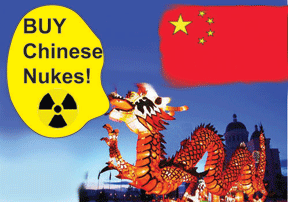 China confident of winning $80b S. Africa nuclear power bid
By Lyu Chang (China Daily): 2015-12-12 Industry officials are confident of China being the front-runner to win the right to build South Africa’s new generation of nuclear power stations.
“We think we are likely to win the bid, after preparing all the documents for the tender,” ZhengMingguang, head of the Shanghai Nuclear Engineering Research and Design Institute, ahigh-tech arm of the State Nuclear Power Technology Corp.
“The nuclear energy industry also involves other issues, so we can’t set any date yet on thefinal bidding process,” he said.
The country hopes to land the contract using its CAP1400 nuclear technology, which isdesigned by SNERDI and based on the AP1000 reactor technology developed by the UnitedStates-based Westinghouse Electric Co LLC.
South Africa currently operates the continent’s only nuclear power plant, near Cape Town, butthe country is currently facing chronic electricity shortages.
The Pretoria government invited tenders in July for an estimated $80 billion contract to buildfour nuclear reactors-the largest contract in the country’s history-which attractedwidespread interest, including from State Nuclear Power Technology Corp, Russia’s stateatomic agency Rosatom and French nuclear firms…….http://www.chinadaily.com.cn/business/2015-12/12/content_22695369.htm
France to spend billions on African renewable energy projects
 COP21: France to spend billions on African renewable energy projects Guardian, 1 Dec 15
François Hollande tells Paris climate summit that his government will double investments in wind, solar and hydropower to €2bn France plans to spend billions of euros in renewable energy and other environmental projects in its former west African colonies and across Africa over the next five years, President François Hollande said on Tuesday.
Africa produces little of the greenhouse gases such as carbon dioxide, produced by burning fossil fuels, linked by scientists to rapid climate change. But it is particularly vulnerable to a changing climate, as much of its population is poor, rural and dependent on rain-fed agriculture.
Hollande told a conference on Africa, held as part of climate change talks in Paris, that his government would double investments in renewable energy generation, ranging from wind farms to solar power and hydroelectric projects, across the continent to €2bn between 2016 and 2020……..
African leaders want the biggest polluting nations to commit to financing as part of contributions to an internationally administered Green Climate Fund, that hopes to dispense $100bn a year after 2020 as a way to finance the developing world’s shift towards renewables. http://www.theguardian.com/environment/2015/dec/01/cop21-france-to-spend-billions-on-african-renewable-energy-projects
Pope and Muslim leaders in call for climate action
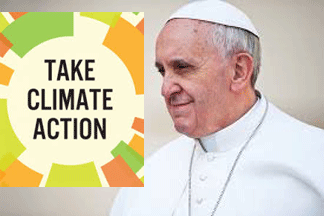 Pope Francis says failure of climate summit would be catastrophic, Guardian 26 Nov 15
Pope meets Muslim and other religious leaders in Nairobi to call for success at the Paris summit and for greater environmental protections in Africa. World leaders must reach a historic agreement to fight climate change and poverty at coming talks in Paris, facing the stark choice to either “improve or destroy the environment”, Pope Francis said in Africa on Thursday.
Francis chose his first visit to the world’s poorest continent to issue a clarion call for the success of the two-week summit, known as COP21, that starts on Monday in the French capital still reeling from attacks that killed 130 people and were claimed by Islamic State.
In a long address in Spanish at the United Nations regional office, Francis said it would be “catastrophic” if particular interests prevailed over the common good of people and the planet or if the conference were manipulated by business interests.
In Kenya, at the start of his three-nation Africa trip, the pope also said dialogue between religions was essential to teach young people that violence in God’s name was unjustified.
Bridging the Muslim-Christian divide and climate issues are major themes of the trip that also takes him to Uganda, which like Kenya has been a victim of extremist attacks, and the Central African Republic, a nation riven by sectarian conflict.
“We are confronted with a choice which cannot be ignored: either to improve or destroy the environment,” the pope said in Nairobi, home to the UN Environment Programme headquarters.
He noted that some scientists consider protection of the Congo basin tropical forest, which spreads over six countries and is the world’s second-largest after the Amazon, essential for the future of the planet because of its biodiversity.
Francis, who took his name from St Francis of Assisi, the patron saint of nature, has made protecting “God’s creation” a plank of his pontificate. In June, he issued a landmark encyclical calling for urgent action to save the planet……. http://www.theguardian.com/environment/2015/nov/26/pope-francis-says-failure-of-climate-summit-would-be-catastrophic
Did China dump nuclear trash in Northern Sudan?

 Sudan: Govt Urged to Investigate ‘Nuclear Waste Dumping’ http://allafrica.com/stories/201511170207.html Khartoum / Merowe — The Sudanese Parliament and the Communist Party of Sudan (CpoS) have called on the government to “immediately investigate the burial of nuclear waste” from China in the Northern State. The director of the governmental Dams Implementation Unit has strongly denied the “presence of containers with chemicals or harmful substances to Sudan from any other country”.
The former director of the Sudan Atomic Energy Commission in Sudan, Mohamed Siddig, said at a conference in Khartoum last Tuesday that 60 containers with nuclear waste were brought from China to Sudan during the construction of the Merowe Dam in the Northern State.
Siddig told the audience that 40 containers were buried in the desert not far from the Merowe Dam construction site. Another 20 containers were disposed of in the desert. He did not mention the date the waste was dumped, however China worked on the dam between 2004 and 2009. On Sunday, the spokesman for the caucus of the independent MPs, Mubarak El Nur, called for an immediate investigation into the alleged crime. The perpetrators should be brought to justice, he stressed.
The chairman of the Northern State’s parliamentary Services Committee, Ali Hassan Bateik, said that the northern MPs will also demand an investigation into the rapid rise of cancer and kidney failure in the region
Medics The medical contingent of the Communist Party demanded that the government disclose the exact sites of the 60 Chinese containers.
In a statement on Sunday, the doctors emphasise the need for holding those involved in the operation accountable: “Charge them with murder, and sentence them to maximum penalties”.
The medics also blame the government for keeping silent on the growing number of people in the area who suffer from kidney failure or cancer.
Rumours The director of the governmental Dams Implementation Unit, Jaafar Mohamed Hammad, however, strongly denied the “presence of containers with chemicals or harmful substances to Sudan from any other country”.
He told the Sudan News Agency (Suna) in Khartoum last week that he will take legal action “against those who spread the rumours” about the dumping of Chinese nuclear waste in the Northern State.
France’s effort to market nuclear technology to South Africa
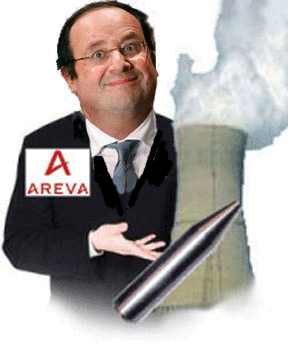 France seeks to win over SA on nuclear energy, Business Day, BY SISEKO NJOBENI, NOVEMBER 06 2015 AMID speculation about SA’s nuclear build programme, the French special envoy for the French-South African nuclear partnership Pascal Colombani is in the country punting his country for the highly anticipated programme.
During his two-day visit to the country, Mr Colombani is scheduled to have meetings “at the political level” as well with relevant public enterprises such as Eskom and the South African Nuclear Energy Co-operation (Necsa). However, he would not say who he was scheduled to meet in government.
“This is my first visit since I have been appointed by President (François) Hollande as his special envoy for the nuclear partnership with SA. Therefore, the overall purpose of my visit is to scale up our co-operation into a long-term strategic partnership in nuclear energy with SA,” Mr Colombani told Fin24.
He said France and SA shared ambitious goals for the development of nuclear energy, “which should become one key component of our strategic partnership”.
Mr Colombani said France was ready to scale up the co-operation between the two countries into a strategic long-term partnership, by supporting the development of SA’s new nuclear programme. Technology, training and safety were at the core of this partnership, he said……http://www.bdlive.co.za/business/energy/2015/11/06/france-seeks-to-win-over-sa-on-nuclear-energy
Pitfalls and huge costs make South Africa’s nuclear programme untenable
The nuclear build is a very risky exercise with numerous potential pitfalls. And there are alternatives. The shortfall in the projected nuclear capacity can be covered by a 50% larger than planned renewable energy investment. Wind and solar energy plants have been operationalised on schedule, and solar panel prices continue falling. The intermittence of renewable energy availability is considered manageable. Finally, energy saving strategies have yet to be fully explored.
 Why SA must abandon nuclear ambitions, The nuclear build is a very risky exercise with numerous potential pitfalls. And there are alternatives. Tech Central, By Hartmut Winkler, 6 Nov 15 It has been an eventful year in South Africa, characterised by power cuts, parliamentary confrontations about wasteful expenditure and student fee protests. There has, however, been an elephant in the room that has impacted all these issues but enjoyed surprisingly scarce attention. The idea, vigorously driven by government, is for the country to build nuclear plants with an expected price tag of R1 trillion.
This equates to 4 000 times the controversial costs to upgrade President Jacob Zuma’s Nkandla residence and 400 times the shortfall the tertiary education sector will experience in 2016 because of the freeze in university fee increases. Continue reading
The financial folly of South Africa’s nuclear power plan
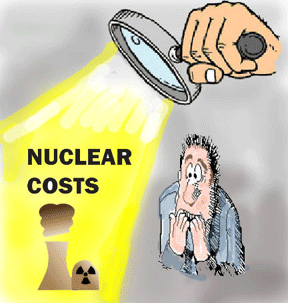 Why South Africa should not build eight new nuclear power stations, Mail &Guardian, 05 NOV 2015 HARTMUT WINKLER South Africa has plans to build new power stations despite many calling for no nuclear energy in the country. t has been an eventful year in South Africa, characterised by power cuts, parliamentary confrontations about wasteful expenditure and student fee protests. There has, however, been a massive elephant in the room that has impacted all these issues but enjoyed surprisingly scarce attention. The idea, vigorously driven by government, is for the country to build nuclear plants with an expected price tag of one trillion rand.
This equates to 4 000 times the controversial costs to upgrade President Jacob Zuma’s Nkandla residence and 400 times the shortfall the tertiary education sector will experience in 2016 because of the freeze in university fee increases………
In South Africa too the need for the continued inclusion of nuclear power in the energy mix was being reexamined. Continue reading
1 This Month


Shut down the radiation-damaged Heysham nuclear reactors now
To see nuclear-related stories in greater depth and intensity – go to https://nuclearinformation.wordpress.com

Say No to NASA’s Reckless Nuclear Reactor on the Moon
Say No to NASA’s Reckless Nuclear Reactor on the Moon
-
Archives
- October 2026 (256)
- September 2026 (339)
- August 2026 (330)
- July 2026 (355)
- June 2026 (287)
- May 2026 (306)
- April 2026 (356)
- March 2026 (251)
- February 2026 (267)
- January 2026 (308)
- December 2025 (358)
- November 2025 (359)
-
Categories
- 1
- 1 NUCLEAR ISSUES
- business and costs
- climate change
- culture and arts
- ENERGY
- environment
- health
- history
- indigenous issues
- Legal
- marketing of nuclear
- media
- opposition to nuclear
- PERSONAL STORIES
- politics
- politics international
- Religion and ethics
- safety
- secrets,lies and civil liberties
- spinbuster
- technology
- Uranium
- wastes
- weapons and war
- Women
- 2 WORLD
- ACTION
- AFRICA
- Atrocities
- AUSTRALIA
- Christina's notes
- Christina's themes
- culture and arts
- Events
- Fuk 2022
- Fuk 2023
- Fukushima 2017
- Fukushima 2018
- fukushima 2019
- Fukushima 2020
- Fukushima 2021
- general
- global warming
- Humour (God we need it)
- Nuclear
- RARE EARTHS
- Reference
- resources – print
- Resources -audiovicual
- Weekly Newsletter
- World
- World Nuclear
- YouTube
-
RSS
Entries RSS
Comments RSS

