Confusion in South Africa- doubts about request for proposals for the procurement of nuclear power
WILL JOEMAT-PETTERSSON ISSUE REQUEST FOR PROPOSALS FOR PROCUREMENT OF NUCLEAR POWER? The request for proposals would mark the official start of South Africa’s nuclear build programme. Eyewitness News, Gaye Davis , 27 Sept 16 CAPE TOWN – Doubt has been cast on whether the request for proposals for the procurement of nuclear power will be issued on Friday as promised by Energy Minister Tina Joemat-Pettersson.

The request for proposals would mark the official start of South Africa’s nuclear build programme, which President Jacob Zuma has made a top priority but which has been shrouded in secrecy and is the subject of much controversy.
Science and Technology Minister Naledi Pandor says she doesn’t believe Joemat-Pettersson will be able to go ahead because the government’s Integrated Resource Plan (IRP) has yet to be updated.
The IRP forecasts the country’s energy demand, spells out generation plans and determines the required mix of energy sources.
Pandor was answering questions at a briefing by economics cluster ministers this afternoon.
Joemat-Pettersson told Parliament on 7 September the nuclear programme would kick off this Friday with the formal issuing of a request for proposals. But Pandor told journalists this afternoon she wasn’t certain the call for proposals could proceed this week.
Pandor says the next economics cluster meeting of Cabinet is set to discuss the versions of both the IRP, which projects energy demand and ways of meeting it, as well as the integrated energy plan – a kind of roadmap for energy provision………http://ewn.co.za/2016/09/27/Will-Joemat-Pettersson-issue-request-for-proposals-for-procurement-of-nuclear-power
Widespread public mistrust f South African government’s nuclear power plans
 Fears mount over true motivations for SA’s planned nuclear deal, Mail and Guardian, Hartmut Winkler 27 Sep 2016 Nuclear energy in South Africa is a very contentious issue. The decision on whether to proceed with the construction of a fleet of nuclear power plants is destined to become the financially most far-reaching and consequential defining moment of the Jacob Zuma presidency.
There is widespread public mistrust of the nuclear expansion process. Its roots lie in the extraordinary announcement in 2014 that the Russian nuclear agency Rosatom had secured therights to build the new South African nuclear plants. The South African government played down the announcement, claiming that it was inaccurate.
But this precipitated a series of media investigations. These uncovered evidence that individuals close to the president and groups linked to the ruling ANC have significant financial interests in the matter.
Civil society organisations are taking government to court in an attempt to have the deal declared illegal. Their attempts to have details of the Russian agreement released are being resisted. This is likely to strengthen their case, and sway public opinion further.
It appears that those with a stake in the nuclear build are hoping to fast-track the process in the face of growing public opposition. This is evident from revelations that, bizarrely, contracts are being awarded, even though a formal process has not been set in motion by government.
The meaning of this is unclear. It has largely confirmed the fears that the nuclear build is being driven for the benefit of the politically connected rather than the national good.
Burning questions
The debate surrounding the nuclear project centres on three highly contested questions:
- Is the country’s future energy generating potential and demand such that an expensive nuclear power station build is effectively unavoidable?
- Can South Africa afford the associated costs and debt, especially in view of massive funding demands in other sectors such as education?
- If approved, would the nuclear build lead to massive overspends, corruption and beneficiation ofpolitically connected individuals?…….
it is difficult to understand why the renewable fraction is not being increased further, and why the national power utility Eskom, under the leadership of Brian Molefe, a nuclear disciple, now opposes new renewable energy developments.
The promotion of nuclear energy at the expense of renewables bucks global trends………
The ANC’s internal nuclear war
The often obscure processes and overhasty developments require an insight into the present machinations within the governing party.
Tensions within the ruling party have escalated to the point where calls for the president’s resignation are now made openly. And even party leaders acknowledge that factions in their ranks are thriving on corruption.
The organisational fracture is equally evident in attitudes towards the nuclear build. Tensions over the issue have been cited as the major reason for Zuma’s dismissal of the financially prudent former Finance Minister Nhlanhla Nene in December 2015.
The official position…….
the legitimacy of the procurement process has already been undermined.
Looking ahead, actual construction would need to be preceded by the closure of funding agreements, the settling of legal disputes and further public engagement. This takes time.
In the unlikely event that the nuclear build actually does come to fruition, it will not commence any time soon.
Hartmut Winkler, Professor of Physics, University of Johannesburg
This article was originally published on The Conversation. Read the original article. http://mg.co.za/article/2016-09-27-questions-mount-over-south-africas-planned-nuclear-power-deal
Investigation of spending by South Africa’s Nuclear Energy Corporation (Necsa)
September, 2016 The Nuclear Energy Corporation of SA (Necsa) incurred R128 million in irregular expenditure in its 2015 financial year because it failed to comply with the government’s preferential procurement regulations‚ the Auditor-General has found.The annual report of Necsa‚ which processes nuclear material and undertakes research and development in the nuclear field‚ was tabled one year late in Parliament on Tuesday.
Necsa management and its board are currently being investigated by a task team appointed by Energy Minister Tina Joemat-Pettersson. The investigation related to “serious mismanagement”‚ the auditor-general said in his report‚ included in the annual report.
The board has been wracked by division and court battles with CEO Phumzile Tshelane put on a suspended suspension last year. No mention of these post-budget developments were made in the annual report.
The auditor-general’s report‚ which was included in the annual report‚ said the full extent of the irregularities was only quantified by the end of March 2016. The Necsa board condoned the irregularities.
Despite the auditor-general’s reservations‚ Necsa received an unqualified audit opinion on its financial statements.
The auditor-general noted that management did not take effective steps to prevent irregular expenditure and fruitless and wasteful expenditure. Non-compliance could have been prevented had compliance been properly reviewed and monitored.
The auditor-general also cast doubt on the going-concern status of the state-funded entity‚ which made a R21m net loss in the 2015 financial year…….
The state funded Necsa to the tune of R580m in 2015 and R599m in the current year.
– TMG Digital/BDLive http://www.timeslive.co.za/local/2016/09/27/Nuclear-corporations-spending-comes-under-scrutiny-of-Auditor-General
South Africa’s Eskom wildly underestimates the cost of planned nuclear build
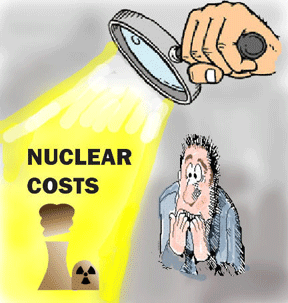
 ‘Eskom’s nuclear build cost and running projections are overheated’ – Analyst SUNDAY TIMES BUSINESS BY ASHA SPECKMAN, 2016-09-25 The price at which Eskom is projecting it will deliver nuclear energy as part of the proposed nuclear build has been rubbished by energy analysts who say South Africa could end up paying much more.
The power utility is targeting R1 per kilowatt-hour for nuclear energy – and this week Eskom’s head of generation, Matshela Koko, said the state-owned company expected to be able to fund the nuclear build programme from its own cash resources.
But energy analysts have scoffed at this, saying cost studies and examples from other projects show the bill to be massive. At the rate proposed, the project would not be viable.
Frank Spencer, an independent analyst, said: “If it comes in at R2/kWh or even R1.50/kWh, it would make absolutely no sense to pursue from a commercial perspective.”
The government and private sector’s expectations of the costs are miles apart.
Eskom spokesman Khulu Phasiwe said projections that the power utility had done put the cost of additional nuclear power at R500-billion. But Spencer estimated the cost would be about R1-trillion……..
He said decommissioning costs associated with dismantling nuclear power stations in future were often omitted from modelling, which eventually inflated the cost of the project.
“I think the expectations are based on what we’re seeing in the UK – [but] the cost of energy let alone the cost of the build programme, and finally what the levellised cost of energy works out to once all of those costs are taken into account, will be significantly higher than that.”…….
Eberhard said: “Nuclear vendors promise low prices but inevitably there are significant cost and time overruns. If these prices are not fixed in a contract then consumers end up with very expensive electricity.”
He cited the Hinkley C facility, where a 35-year contract for the equivalent of R1.65/kWh has been signed, as an example of a contract secured at a low rate……..
Last week, Moody’s placed Eskom’s credit rating on review for downgrade, saying that future tariffs may be affected due to the ongoing growth of independent power producers and a regulator that is hostile to Eskom’s tariff increase requests.
The agency also noted that institutional investors were beginning to display risk aversion to funding state-owned companies…….speckmana@sundaytimes.co.za http://www.timeslive.co.za/sundaytimes/businesstimes/2016/09/25/Eskoms-nuclear-build-cost-and-running-projections-are-overheated—Analyst
South Africa’s nuclear programme will be a disaster.
The nuclear killer lurking in our midst, Pambazuka News Gerard Boyce Sep 22, 2016
South Africa’s nuclear programme will be a disaster. Besides the fallouts being witnessed in the jostling for gains by greedy politicians, the project is likely to gobble up huge amounts of public funds that will be difficult to account for as the government will cite national security concerns of nuclear power, thereby curtailing citizens’ right to accountability.
Nuclear power kills. If ever one had any doubts about the truthfulness of this statement, the past few months in South African politics have surely dispelled them. During this time, the government’s nuclear plans effectively killed the political career of former Finance Minister Nhlanhla Nene whilst indications are that the career of current Finance Minister Pravin Gordhan will soon suffer the same fate. It has slain any semblance of unity in the upper echelons of the ruling African National Congress. It is rumoured that the public spats in which members of various ruling party factions are engaged and that have come to hog national headlines each week are a result of ongoing palace intrigue that is caused by their jostling for position which will enable them to secure the maximum benefits from the potential bonanza that awaits when tenders for the construction of nuclear plants are awarded.
The open hostility exhibited by erstwhile comrades has exposed as a sham the image of a strong and united party and revealed a picture of an organisation riven by factionalism and bitter internal disputes. It is widely predicted that, if this deal is pushed through (as current indications are that it will), the country’s credit rating will be downgraded to junk status. A downgrade will likely plunge the economy into a coma and cause it to be put on life support………
it can become relatively easy for governments to be drawn into continuing to invest in their nuclear programmes even if they see little or no justification for doing so. One has only to observe the decades long (and seemingly never-ending) construction periods of many nuclear plants internationally for evidence thereof. Needless to say, this set of circumstances provides the ideal conditions in which graft and patronage networks are able to thrive and is likely to increase both the opportunity and propensity for certain individuals to engage in corrupt practices.
Secondly, given the destructive purposes to which nuclear technology can be put, a raft of laws and regulations have to be passed in order to prevent this technology falling into the wrong hands. Since each reactor is potentially a national calamity, policymakers justify these regulations as being necessary to protect the welfare and safety of citizens. These laws also serve to provide convenient cover behind which the less than savoury aspects of these deals can be hidden.

To shore up this cover, the global nuclear industry seems to have a built-in failsafe against closer public scrutiny and unwanted attention in that, once established, stakeholders in the industry can always appeal to the nebulous concept of the ‘national interest’ in an attempt to conceal their actions from the public. By elevating every investigation of their operations to a potential national security concern, they are able to shield their operations from investigation and thus to avoid criticism. Arguably, this has the effect of lowering the degree to which this industry feels accountable to the public since being open to investigation and subject to criticism (and thence learning) forms the basis of public accountability…….. Dr Gerard Boyce is a Senior Lecturer in the School of Built Environment and Development Studies at the University of KwaZulu-Natal. He writes in his personal capacity. http://www.pambazuka.org/human-security/nuclear-killer-lurking-our-midst?utm_campaign=shareaholic&utm_medium=twitter&utm_source=socialnetwork
South Africa’s Eskom makes unreliable prediction of its future cash reserves
Eskom’s R150 billion cash-reserves claim is wishful thinking – Natahsa Mazzone http://www.politicsweb.co.za/politics/eskoms-r150-billion-cashreserves-claim-is-wishful- Natasha Mazzone | 23 September 2016
DA says power utility’s profit of R4,6 billion a far cry from the R15 billion need a year to make up amount. The claim by Head of Generation for Eskom, Mr Matshela Koko, that Eskom could pay for the nuclear build programme by using cash-reserves, which he indicated could be R150 billion in 10 years’ time, is wishful thinking.
Eskom recorded a R4.6 billion profit in the 2015/16 financial year, a far cry from the R15 billion in profits it would need to generate consistently for the next 10 years to make up R150 billion.
Considering that by Eskom’s admission electricity demand is down, coupled with economic growth projected at a mere 0.6%, this raises serious questions about the assumptions underlying their projections.
I will therefore be submitting parliamentary questions to Eskom to find out how they intend to generate these massive cash reserves.
The validity of their projections notwithstanding, spending any cash reserves on a nuclear build program would be financially irresponsible. Eskom currently owes its creditors R322 billion underwritten by R350 billion in government guarantees. The entity should rather use excess cash reserves to decrease these liabilities.
Moreover, the fact that Eskom believe they can generate these massive profits whilst pushing for well-above inflation tariff increases on electricity, should be a slap in the face of the majority of poor citizens in our country. Energy and electricity costs are eating into their limited budget and now with these tariff increases, their pockets will be hurting even more.
The big question is why Eskom needs to be building nuclear in the first place when future electricity shortages would be better addressed by cheaper and more sustainable renewable and gas projects. With advancements in storage and battery technologies, these would be the better alternative by 2035.
The Minister is the only person with the prerogative to choose nuclear over any other form of energy, in this vein Mr Koko is overstepping his fiduciary duties to even suggest that Eskom would be investing in Nuclear.
In the context of its massive debt, and repeated requests for above inflation tariff increases, it is irrational to utilise any cash reserves in pursuit of the much maligned nuclear “wonder” programme and once again calls the motivation for the nuke deal into question.
Issued by Natasha Mazzone, DA Shadow Minister of Public Enterprises, 23 September 2016
High Court in South Africa to hear case against government’s nuclear power plan
 Activists seek to bar plan by South African government to expand nuclear power http://af.reuters.com/article/southAfricaNews/idAFJ8N1BD01Z CAPE TOWN, Sept 22 (Reuters) – Activist groups are challenging a plan by South Africa’s government to expand the country’s nuclear power generation capacity on the grounds that the process was unconstitutional, they said on Thursday.
Earthlife Africa Johannesburg and the Southern African Faith Communities Environment Institute said in a statement that the High Court in Cape Town would hear their case on Dec. 13 and 14 this year to block plans to add 9.6 gigawatts of nuclear power. (Reporting by Wendell Roelf; Editing by James Macharia)
South Africa’s Energy Minister is asked to release all nuclear-bid information
 Minister will have to release all nuclear-bid information’, IOL News, 21 September 2016, Craig Dodds Cape Town – The chairman of Parliament’s energy oversight committee is to write to Energy Minister Tina Joemat-Pettersson to request all documents related to nuclear procurement by October 11, after she refused to release them on the basis that they were “sensitive”.
This comes after a legal opinion sought by another parliamentary committee confirmed that it had the right in terms of the National Assembly rules to “summon any person to produce any document it requires in carrying out its functions”………
In a written reply to a request from Mackay earlier this month, Joemat-Pettersson refused to provide a number of key documents related to nuclear procurement.
Majola said the National Assembly rules provided a mechanism for the committee to deal with confidential documents, which gave the chairperson of the committee, and not the minister, the authority to determine what should be kept from public view, and how.
“We will have to ask for the documents. We will go through legal advice to see which of the documents can be dealt with by the committee differently, not which of the documents will not be seen by the committee,” Majola said.
He committed to write to Joemat-Pettersson immediately, requesting that the department furnish the committee with all the documents.http://www.iol.co.za/dailynews/news/minister-will-have-to-release-all-nuclear-bid-information-2070774
South Africa’s Democratic Alliance (DA) demands truth on secretive nuclear contract
 DA DEMANDS ANSWERS OVER NUCLEAR CONTRACT http://ewn.co.za/2016/09/17/DA-demands-answers-over-nuclear-contract The party has called on the Energy Ministry to answer questions about an apparent nuclear contract. Gia Nicolaides | a day ago
JOHANNESBURG – The Democratic Alliance (DA) says the Energy Ministry needs to answer questions about an apparent nuclear contract that has left South Africans in the “dark”.
The Mail & Guardian is reporting that Shantan Reddy, the son of President Jacob Zuma’s friend Vivian Reddy, clinched a contract worth R171 million for the procurement of a nuclear build programme management system.
It’s been listed on the Energy Department‘s website under the “awarded bids” section, despite Deputy President Cyril Ramaphosa recently saying that a final decision to proceed with a nuclear build programme will only be made once there’s been a request for proposals.
The DA’s energy spokesperson Gordan Mackay says, “Since the president made the announcement in 2014 about the nuclear build programme, not a single document has surfaced in Parliament. We have submitted questions again three weeks ago, which she has declined on the basis that the information was sensitive.”
Empire Technology appears to have clinched the multi-million rand contract. (Edited by Shimoney Regter)
Serious questions about South Africa’s nuclear power tender process
Energy department to co-operate with Treasury on nuclear deal, BUSINESS NEWS / 18 September 2016, Pretoria – The energy department will fully co-operate with National Treasury regarding the nuclear new build programme, Energy Minister Tina Joemat-Pettersson insisted on Saturday……………….
The awarding of the contract to Reddy’s company was highly irregular considering that both Joemat-Pettersson and Deputy President Cyril Ramaphosa had been at pains to assure South Africans that no deal had been concluded.
“If there is in fact no nuclear deal yet, why the need to procure a R171-million system to manage it?” Mackay asked.
Alarmingly, the contract with Reddy was awarded on the back of an as yet unidentified tender in the Free State and not publically advertised on the department’s website, as was standard practice. That notwithstanding, the deal with Reddy was personally signed off by the department’s director general.
“This raises serious questions surrounding the tender process that was followed, not least of which is what knowledge the minister had of the deal with Reddy.”
The DA would submit parliamentary questions to Joemat-Pettersson to ascertain, among other things, the reasons for the deviation from the department’s standard procurement process and the basis on which Reddy’s company, an entity with no experience in the nuclear field, was awarded the contract.
Also, whether the minister had any involvement in, or knowledge of the contract and why a contract for the management of the new build programme had been awarded if, by the minster’s account, no deal had been concluded.
“The move is premature at best and once again suggests that protestations by government are a smokescreen to hide the fact that the nuclear new build is a done deal. Moreover, the development ads to the growing body of evidence suggesting that the primary motivation being Zuma’s pursuit of the ill-advised and unaffordable nuclear deal is to enrich his cronies and fund his patronage network.
“The DA has long maintained that the nuclear deal has potential for corruption the likes of which South Africa has never seen. One thing is increasingly clear – the only really beneficiary of the nuclear deal will be Zuma Inc at the expense of an already highly indebted and fragile South African economy,” Mackay said.
African News Agency (ANA) http://www.iol.co.za/business/news/energy-department-to-co-operate-with-treasury-on-nuclear-deal-2069549
South Africa’s economy will be destroyed by this unnecessary nuclear power build
Watch: How South Africa’s nuclear plans will destroy the economy http://businesstech.co.za/news/energy/136935/watch-how-south-africas-nuclear-plans-will-destroy-the-economy/ By Staff Writer September 16, 2016
According to Outa, it is estimated that South Africa will have to borrow as much as R1.2 trillion to fund the plans, which would cripple the economy with R100 billion a year repayments needed.
The debt would be added to the over R1.89 trillion in debt the country already has, pushing the total to R3 trillion – a ‘nuclear bombing’ of the economy.
Outa argued further, saying that the nuclear build is unnecessary (echoing sentiments from energy expert Chris Yelland), with various renewable energy projects set to contribute more than enough power to the grid to meet needs over the next 15 years.
South Africa’s ‘s Nuclear Bomb – Why Government’s #Nuclear Deal Will Destroy SA
Chaotic planning in South Africa: nuclear power not necessary
Nuclear power call is based on outdated plans, warns Yelland, BD Live South Africa
BY CHARLOTTE MATHEWS, 16 SEPTEMBER 2016, SA DID not need to commission huge new inflexible nuclear power capacity because the government’s chaotic planning meant there was a big chance the country would have a surplus of electricity in the next few years, Chris Yelland, the MD of EE Publishers, said on Thursday.
“SA does not have an energy crisis, it has a management crisis,” he said.
Yelland was speaking at the launch of Powermode’s monitoring portal, shortly after Energy Minister Tina Joemat-Pettersson said a request for proposals for 9,600MW of nuclear power would be issued on September 30.
Yelland said government figures released in Parliament this week showed electricity demand since 2011 had trended significantly lower than in the low-growth scenario in the outdated 2010 Integrated Resource Plan, and its 2013 update. Flagging demand reflected slow global growth in recent years and an economy moving towards lower energy intensity.
“Government cannot forecast correctly for five years, let alone 50. If SA moves to nuclear newbuild, it is committing to one vendor for 9,600MW, based on 2010 estimates, which are clearly wrong.”………..
Members of the Energy Intensive Users Group, SA’s biggest power consumers, were installing more solar power to reduce their reliance on Eskom.
As Eskom’s market share was shrinking, its unit costs were rising, requiring ever-higher tariffs, which in turn forced more customers to become self-sufficient. Yelland said Eskom’s next application to recover costs was likely to be for a R22bn clawback, double what it was allowed in 2016.
In the past decade, Eskom’s tariffs have risen fourfold in nominal terms and were now increasing at double its historical average, adjusted for inflation.
Yelland said SA had to move away from centralised planning to a market-driven model for power-generation and create more distributed generation rather than generating most of its power on the Highveld. It needed a greater mix of different sources, not a large amount of new nuclear power. All this would provide the flexibility to meet changing demand patterns.http://www.bdlive.co.za/business/energy/2016/09/16/nuclear-power-call-is-based-on-outdated-plans-warns-yelland
South African govt says no nuclear deals made, but now there is one!
Zuma pals clinch first nuclear deal, Mail and Guardian, Jessica Bezuidenhout 16 Sep 2016 Shantan Reddy, the son of President Jacob Zuma’s friend Vivian Reddy, has clinched what appears to be a landmark deal for the country’s controversial multibillion-rand nuclear programme.
Details of the R171-million contract for “the procurement of the nuclear build programme management system” emerged after an innocuous-looking entry appeared on the department of energy’s website.
Listed under the category “awarded bids”, it is scant on detail, simply naming the winning bidder of BAC-10/2016 as Central Lake Trading 149, a company trading as Empire Technology.
The little-known company’s sole director is Shantan Reddy, the son of flamboyant power and property mogul Vivian Reddy, a longtime friend of the president.
Although there is no suggestion of wrongdoing on the part of Reddy or his company, the awarding of this contract has set off alarm bells with industry experts and politicians because the government continues to maintain that it has not entered into any nuclear deal.
The contract awarded to Reddy’s company, if indeed linked to the “nuclear build”, as stated by the energy department, suggests that work may have already begun behind the scenes.
“Considering that the minister of energy is on record stating no deal has been signed and the deputy president [has said] that South Africa will not commence on nuclear if it can’t afford it, the issuance of a contract is highly irregular,” said Gordon Mackay, the Democratic Alliance’s spokesperson on energy.
The Mail & Guardian briefly spoke to Shantan Reddy about the energy department deal. He asked for questions to be sent on SMS but did not respond by deadline….. (subscribers only) http://mg.co.za/article/2016-09-16-00-zuma-pals-clinch-first-nuclear-deal
Secret nuclear management contract given to donor to South Africa’s President Zuma
‘Predatory elite’ eye nuclear deal http://mg.co.za/article/2016-09-16-00-editorial-predatory-elite-eye-nuclear-deal The looming nuclear deal that seems to be President Jacob Zuma’s biggest pet project (and will be South Africa’s biggest financial and construction deal ever, if it happens) has been questioned by many commentators, including MPs and civil society groups. The deal, which already has links with Russia’s notoriously oligarchic government, worries anyone who can see in it the largest opportunity yet for the looting of state resources by the group currently devoting all their means to that end.
The nation was told, in the National Assembly, that all the necessary checks would be put in place and that the legal and other hurdles would be diligently cleared before the deal went ahead. The intimation was that any serious obstacles to the deal would come to light and could possibly scupper it entirely – a prospect many would welcome.
But the nation was also told, by a different minister in the other House of Parliament, that it was full steam ahead on the project – with the intimation that no objections would be allowed to stand in its way.
The first utterance came from Deputy President Cyril Ramaphosa, who seems to have been given the job of placating the objectors and the intelligentsia, or anyone concerned about the ongoing plans of what unionist Zwelinzima Vavi long ago called “the predatory elite”.
The second utterance came from Zuma’s extremely loyal energy minster, Tina Joemat-Pettersson, so it was to be expected that she would show every sign of wanting to do his bidding as soon as possible.
It has emerged that a contract worth R171-million for a “programme management system” to help get the nuclear deal off the ground has been awarded, in practical secrecy, to a company called Empire Technology. This is wholly owned by Shantan Reddy, the son of controversial businessperson Vivian Reddy, who has given Zuma considerable financial support over the years, including a contribution to the building of the president’s family complex in Nkandla.
That so little is known about the company, and that the deal appears to have gone through so quickly, is cause for concern.
Is the nuclear deal going ahead or not? Will South Africa be taking adequate precautions to ensure that it doesn’t overly indebt the nation? Was the evidence collated and presented to Zuma’s Cabinet? There are no clear answers to any of these questions.
Without a rational and sensible evaluation of the logic of the deal, and an accounting of the costs and benefits to South Africa if it goes ahead, it can’t be seen as much more than another way for the predatory elite to milk money from the state.
South Africa: Jacob Zuma’s disastrous nuclear deal
Zupta’s nuclear deal: either we end it or it ends us, Politics Web, 16 Sept 16, Jacob Zuma’s nuclear deal will be disastrous for South Africa. It will literally bankrupt us, diverting billions of rands from poverty reduction projects, while producing a nuclear white elephant in two decades’ time. But it will make a lot of money for Zuma, the Guptas and ANC cronies in the short-term and they will be long gone by the time we feel the real pain.
In Parliament last week, Energy Minister Tina Joemat-Pettersson confirmed that government is going ahead with the nuclear procurement process and Public Enterprises Minister Lynne Brown confirmed that information on the process will not be made public. In other words: “We’re going to tie you into far more debt that you can ever repay, but this is none of your business.”
This morning, a DA-assisted Mail and Guardian investigation has revealed the first concrete signs of corruption associated with the nuclear deal. A R171 million contract for the “Nuclear New Build Programme Management System” has been issued, potentially irregularly, to the son of Vivian Reddy, a close friend and ally of President Jacob Zuma.
South Africans should be deeply concerned about the government’s nuclear project. Let’s be clear. It is in no way motivated by a genuine desire to secure South Africa’s energy future in the most cost effective and sustainable way. Rather, this huge project is going ahead because Zuma, the Guptas and other ANC elites stand to make millions in bribes and tenders.
Like the Arms Deal, Nkandla and the President’s new jet, there is no intention to use state resources judiciously in order to derive the maximum public benefit. And like these ill-conceived projects, the nuclear deal will have the ultimate effect of stealing from all of us, but particularly the poor, in order to enrich a small group of connected ANC cadres……….
In forging ahead with this ill-conceived plan, our hapless government is locking SA into an over-priced, outdated technology within Eskom’s monopoly, while blocking the development of renewables which are dynamic, increasingly cost-effective and more job-creating. It is no coincidence that Eskom is refusing to sign any new contracts with independent power producers…………http://www.politicsweb.co.za/opinion/zuptas-nuclear-deal-either-we-end-it-or-it-ends-us
1 This Month

of the week – Shut Down Drone Warfare!


Tell the Ukrainian Government to Drop Prosecution of Peace Activist Yurii Sheliazhenko

Petition to revoke the licensing of the Near Surface Nuclear Disposal Facility (NSDF) at Chalk River. https://www.ourcommons.ca/petitions/en/Petition/Details?Petition=e-7247
To see nuclear-related stories in greater depth and intensity – go to https://nuclearinformation.wordpress.com
-
Archives
- April 2026 (68)
- March 2026 (251)
- February 2026 (268)
- January 2026 (308)
- December 2025 (358)
- November 2025 (359)
- October 2025 (376)
- September 2025 (257)
- August 2025 (319)
- July 2025 (230)
- June 2025 (348)
- May 2025 (261)
-
Categories
- 1
- 1 NUCLEAR ISSUES
- business and costs
- climate change
- culture and arts
- ENERGY
- environment
- health
- history
- indigenous issues
- Legal
- marketing of nuclear
- media
- opposition to nuclear
- PERSONAL STORIES
- politics
- politics international
- Religion and ethics
- safety
- secrets,lies and civil liberties
- spinbuster
- technology
- Uranium
- wastes
- weapons and war
- Women
- 2 WORLD
- ACTION
- AFRICA
- Atrocities
- AUSTRALIA
- Christina's notes
- Christina's themes
- culture and arts
- Events
- Fuk 2022
- Fuk 2023
- Fukushima 2017
- Fukushima 2018
- fukushima 2019
- Fukushima 2020
- Fukushima 2021
- general
- global warming
- Humour (God we need it)
- Nuclear
- RARE EARTHS
- Reference
- resources – print
- Resources -audiovicual
- Weekly Newsletter
- World
- World Nuclear
- YouTube
-
RSS
Entries RSS
Comments RSS
 nuclear-news