Nuclear company Orano seeks arbitration over Niger mining licence
World Nuclear News 20th Dec 2024, https://www.world-nuclear-news.org/articles/orano-seeks-arbitration-over-niger-mining-licence
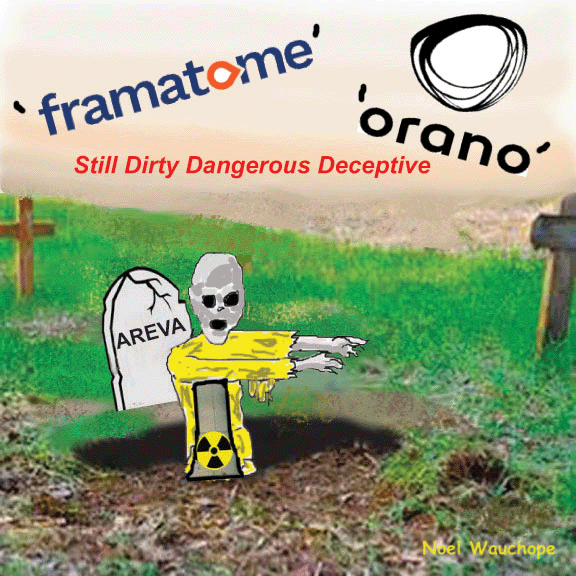
The French company has opened international arbitration proceedings against the State of Niger following the withdrawal of its mining licence for the Imouraren project in June.
“This move comes after several months of unsuccessful attempts at mediation and conciliation,” the company said.
The Imouraren project is about 80km south of Arlit and about 160km north of Agadez and, with mineral reserves of over 200,000 tU, is one of the largest known uranium reserves in the world. Operating company Imouraren SA – owned 66.65% by Orano Expansion and 33.35% by Niger state interests – was awarded an operating permit to mine the deposit in 2009, but development work was suspended in 2015 due to market conditions at the time.
Earlier this year, the company announced it had restarted preparatory work for the project, but within days the Nigerien authorities withdrew the Orano subsidiary’s operating permit.
“The announcement of the withdrawal of the licence took place when Orano presented the State of Niger with a concrete, technical proposal, which would have allowed the IMOURAREN deposit to be exploited as quickly as possible, and after works had resumed since June 2024,” Orano said today. It has engaged law firm Clay Arbitration as its representative.
In July, the Nigerien authorities also withdrew Canadian company GoviEx Uranium’s mining rights for the Madouela uranium project. Earlier this month, the company and its fully owned subsidiary GoviEx Niger Holdings Ltd started proceedings against Niger under the Convention on the Settlement of Investment Disputes Between States and Nationals of Other States, on the basis the state had breached its legal obligations in withdrawing the permit.
How a uranium mine became a pawn in the row between Niger and France

Paul Melly, BBC 8th Dec 2024
In the latest sign of a dramatic deterioration in relations, Niger’s military rulers appear increasingly determined to drive France out of any significant sector in their economy – and particularly uranium mining.
This week the French state nuclear company Orano announced that the junta – which deposed France’s ally, President Mohamed Bazoum, in a coup in July 2023 – had taken operational control of its local mining firm, Somaïr.
The company’s efforts to resume exports have for months been blocked by the regime and it is being pushed into financial crisis.
And the impact could be felt more widely – although Niger accounts for less than 5% of the uranium produced globally, in 2022 it accounted for a quarter of the supply to nuclear power plants across Europe.
So the timing could hardly be more awkward, as Western countries struggle to meet the challenge of climate change and cut their carbon emissions from electricity generation.
For French President Emmanuel Macron, already wrestling with political crisis at home, the potential departure of Orano from Niger is certainly awkward in image terms…………………………………………………………………………………………………………
In this poisonous atmosphere of hostility and mistrust, Orano was an obvious and convenient target for junta retaliation.
The French company’s predominant role in the uranium sector had for years fuelled resentment among many Nigériens, amidst claims that the French company was buying their uranium on the cheap, despite periodic renegotiations of the export deal. Although the mining operations only started years after independence, they were seen as emblematic of France’s ongoing post-colonial influence.
……………….Niger’s junta feels no need to make concessions to Orano because it is now buoyed by a sharp rise in oil exports, thanks to a new Chinese-built pipeline.
With that financial cushion, the regime appears prepared to bear the cost of paralysing and probably dismantling the traditional uranium partnership with France – now its main international opponent.
https://www.bbc.co.uk/news/articles/czjd70mzge2o
Niger takes control of French nuclear firm’s uranium mining operations
Morning Star 5th Dec 2024, https://morningstaronline.co.uk/article/niger-takes-control-french-nuclear-firms-uranium-mining-operations
AUTHORITIES in Niger have taken control of the uranium mining operations of a French nuclear firm, it was reported on Wednesday.
After coming to power in July last year, Niger’s military leaders said they intended to seize back the natural resources of the west African country for the benefit of the people rather than Western interests.
The government said they would revamp rules regulating the mining of raw materials by foreign countries and earlier this year withdrew the permit for French nuclear company Oreno to mine one of the world’s largest uranium deposits.
Orano responded by suspending production of uranium in Niger.
Niger accounts for about 5 per cent of global uranium output, making it one of the world’s top 10 producers of uranium vital for the generation of nuclear weapons and the generation of nuclear power.
Last month, Niger’s Minister of Mines, Colonel Abarchi Ousmane said: “The French state, through its head of state, has declared that it does not recognise the current authorities in Niger. Does it seem possible to you that we, the state of Niger, would allow French companies to continue extracting our natural resources?”
Orano said that it intended “to defend its rights,” but also wanted to work with “stakeholders to re-establish a stable and sustainable mode of operation.”
South Africa Files 750 Pages of ‘Overwhelming’ Evidence in ICJ Genocide Case Against Israel

“The glaring genocide in Gaza is there for all who are not blinded by prejudice to see.”
By Brett Wilkins / Common Dreams, 30 Oct 24
South Africa filed 750 pages of “overwhelming” proof that Israel is committing genocide in Gaza to the International Court of Justice in The Hague, Netherlands on Monday, the deadline for submitting final evidence in the ongoing trial.
South African Ambassador to the Netherlands Vusi Madonsela delivered the legal document—known as a memorial—to the ICJ headquarters in the Dutch city. Under the court’s rules, the contents of the memorial cannot be made public at this time.
According to a statement from the office of South African President Cyril Ramaphosa, the memorial is a “comprehensive presentation of the overwhelming evidence of genocide in Gaza.”
The office said the document “contains evidence which shows how the government of Israel has violated the Genocide Convention by promoting the destruction of Palestinians living in Gaza, physically killing them with an assortment of destructive weapons, depriving them access to humanitarian assistance, causing conditions of life which are aimed at their physical destruction, and ignoring and defying several provisional measures of the International Court of Justice, and using starvation as a weapon of war and to further Israel’s aims to depopulate Gaza through mass death and forced displacement of Palestinians.”
South Africa filed 750 pages of “overwhelming” proof that Israel is committing genocide in Gaza to the International Court of Justice in The Hague, Netherlands on Monday, the deadline for submitting final evidence in the ongoing trial.
South African Ambassador to the Netherlands Vusi Madonsela delivered the legal document—known as a memorial—to the ICJ headquarters in the Dutch city. Under the court’s rules, the contents of the memorial cannot be made public at this time.
According to a statement from the office of South African President Cyril Ramaphosa, the memorial is a “comprehensive presentation of the overwhelming evidence of genocide in Gaza.”
The office said the document “contains evidence which shows how the government of Israel has violated the Genocide Convention by promoting the destruction of Palestinians living in Gaza, physically killing them with an assortment of destructive weapons, depriving them access to humanitarian assistance, causing conditions of life which are aimed at their physical destruction, and ignoring and defying several provisional measures of the International Court of Justice, and using starvation as a weapon of war and to further Israel’s aims to depopulate Gaza through mass death and forced displacement of Palestinians.”
“The evidence will show that undergirding Israel’s genocidal acts is the special intent to commit genocide, a failure by Israel to prevent incitement to genocide, to prevent genocide itself, and its failure to punish those inciting and committing acts of genocide,” Ramaphosa’s office added.
South Africa’s filing comes amid Israel’s ongoing 387-day assault on Gaza, which according to Palestinian and international agencies has killed at least 43,020 people—most of them women and children. At least 101,110 others have been wounded and over 10,000 Gazans are missing and believed dead and buried beneath the rubble of hundreds of thousands of bombed homes and other structures. Millions more Palestinians have been forcibly displaced, starved, or sickened by Israel’s invasion and “complete siege” of Gaza.
The filing also comes one week after senior members of Israeli Prime Minister Benjamin Netanyahu’s far-right Cabinet and national lawmakers spoke at a conference advocating the ethnic cleansing and recolonization of Gaza.
Ramaphosa’s office lamented that “Israel has been granted unprecedented impunity to breach international law and norms for as long as the United Nations Charter has been in existence.”………………………………………………………………https://www.commondreams.org/news/south-africa-icj-genocide-israel
Nuclear Energy Firm Orano Halts Niger Uranium Production
By Boureima HAMA avec Nathalie ALONSO à Paris, October 24, 2024, https://www.barrons.com/news/nuclear-energy-firm-orano-halts-niger-uranium-production-ed2fd6b6
French nuclear fuel firm Orano said on Wednesday it was halting its uranium production in junta-ruled Niger from October 31, citing a “highly deteriorated” situation and its inability to operate.
The Nigerien government, whose leader Abdourahamane Tiani seized power in a July 2023 coup, has previously made clear it would overhaul rules regulating the mining of raw materials by foreign companies.
Orano-owned mining subsidiary “Somair’s worsening financial difficulties have compelled the company to suspend its operations,” in the Artlit region of north Niger where Orano has operated since 1971, the French group’s Paris spokeswoman told AFP on Wednesday.
The Sahel nation’s military rulers have turned their backs on Paris, ordering French troops deployed there to leave and instead forging ties with fellow juntas in Burkina Faso and Mali — as well as Iran and Russia.
Niger’s position as the world’s seventh-largest uranium producer plays an important role in the shifting relations.
Iran has significantly increased its stock of enriched uranium in recent months, while strengthening ties with Niger, according to the International Atomic Energy Agency.
The production of uranium concentrate will cease from October 31 as Orano was unable to export the commodity, in part due to landlocked Niger’s closed border with coastal Benin, the firm said.
“Despite all the efforts deployed” with the military regime “to try and resolve the situation” and obtain export licenses, “all of our proposals were left unanswered”, said the spokeswoman of the group, which specialises in nuclear fuel.
Nigerien authorities did not follow up on an Orano proposal to export uranium by air via Namibia.
“Maintenance will continue but there will be no more production,” she added.
Nigerien authorities did not comment on the matter.
Niamey in June rescinded Orano’s licence to operate in one of the largest deposits in the world, Imouraren, with estimated reserves of 200,000 metric tonnes (220,000 US tons).
Niger’s Council of Ministers on September 19 passed a draft decree proposing to create a state company named “Timersoi National Uranium Company”, without detailing the move.
Planned nuclear plant in a Kenyan top tourist hub and home to endangered species sparks protest
Daily Mail. By Associated Press, 12 October 2024
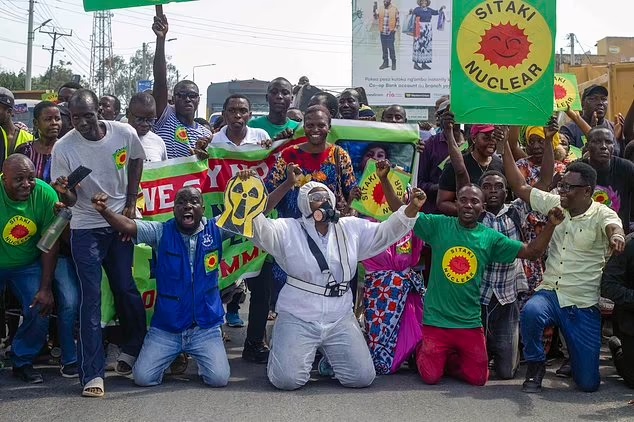
KILIFI, Kenya (AP) – Dozens rallied against a proposal to build Kenya’s first nuclear power plant in one of the country’s top coastal tourist hubs which also houses a forest on the tentative list of the UNESCO World Heritage site.
Kilifi County is renowned for its pristine sandy beaches where hotels and beach bars line the 165-mile-long coast and visitors boat and snorkel around coral reefs or bird watch in Arabuko Sokoke forest, a significant natural habitat for the conservation of rare and endangered species, according to the U.N. organization.
The project, proposed last year, is set to be built in the town of Kilifi – about 522 kilometers (324 miles) southeast of the capital, Nairobi. Many residents have openly opposed the proposal, worried about what they say are the negative effects of the project on people and the environment, leading to a string of protesters which at times turned violent.
Muslim for Human Rights (MUHURI) led the march Friday in Kilifi to the county governor´s office where they handed him a petition opposing the construction of the plant.
Some chanted anti-nuclear slogans while others carried placards with “Sitaki nuclear”, Swahili for “I don´t want nuclear.”
The construction of the 1,000MW nuclear plant is set to begin in 2027 and be operational by 2034, with a cost of 500 billion Kenyan shillings ($3.8 billion).
Francis Auma, a MUHURI activist, told the Associated Press that the negative effects of the nuclear plant outweigh its benefits.
“We say that this project has a lot of negative effects; there will be malformed children born out of this place, fish will die, and our forest Arabuko Sokoke, known to harbor the birds from abroad, will be lost,” Auma said during Friday´s protests.
Juma Sulubu, a resident who was beaten by the police during a previous demonstration, attended Friday’s march and said: “Even if you kill us, just kill us, but we do not want a nuclear power plant in our Uyombo community.”
Timothy Nyawa, a fisherman, participated in the rally out of fear that a nuclear power plant would kill fish and in turn his source of income. “If they set up a nuclear plant here, the fish breeding sites will all be destroyed.”
Phyllis Omido, the executive director at the Centre for Justice Governance and Environmental Action, who also attended the march, said Kenya´s eastern coastal towns depended on eco-tourism as the main source of income and a nuclear plant would threaten their livelihoods.
“We host the only East African coastal forest, we host the Watamu marine park, we host the largest mangrove plantation in Kenya. We do not want nuclear (energy) to mess up our ecosystem,” she said.
Her center filed a petition in Nov. 2023 in parliament calling for an inquiry and claiming that locals had limited information on the proposed plant and the criteria for selecting preferred sites. It also raised concerns over the risks to health, the environment and tourism in the event of a nuclear spill, saying the country was undertaking a “high-risk venture” without proper legal and disaster response measures in place. The petition also expressed unease over security and the handling of radioactive waste in a country prone to floods and drought.
The Senate suspended the inquiry until a lawsuit two layers filed in July seeking to stop the plant´s construction, claiming public participation meetings were rushed and urging the Nuclear Power and Energy Agency (Nupea) not to start the project, was heard………………………. https://www.dailymail.co.uk/wires/ap/article-13952403/Planned-nuclear-plant-Kenyan-tourist-hub-home-endangered-species-sparks-protest.html
African nations are losing up to 5% of their GDP per year with climate change, a new report says

By MONIKA PRONCZUK, September 3, 2024, https://apnews.com/article/africa-climate-change-flooding-droughts-af5beebf70f414098ad2a4a73a19b76c
DAKAR, Senegal (AP) — African nations are losing up to 5% of their GDP every year as they bear a heavier burden than the rest of the world from climate change, a new report said Monday after one of the continent’s hottest years on record.
The World Meteorological Organization said many African nations are spending up to 9% of their budgets for climate adaptation policies.
“Over the past 60 years, Africa has observed a warming trend that has become more rapid than the global average,” said WMO Secretary-General Celeste Saulo, warning that it is affecting everything from food security to public health to peace.
Africa is responsible for less than 10% of global greenhouse gas emissions. But it is the most vulnerable region to extreme weather events including droughts, floods and heatwaves, the WMO said.
The new report focuses on 2023, one of Africa’s three hottest years on record. It urged African governments to invest in early warning systems as well as meteorological services. If adequate measures are not put in place, up to 118 million Africans will be exposed to droughts, floods and extreme heat by 2030, the report warned.
In sub-Saharan Africa, the costs of adapting to extreme weather could be $30-50 billion per year over the next decade, the report estimated.
The effects of climate change have been harrowing. Between September and October 2023, approximately 300,000 people across West Africa were affected by floods, the report said. Zambia experienced the worst drought in 40 years, affecting nearly 6 million people.
The pattern of extreme weather events in Africa continues in 2024, experts said.
In the Sahel region south of the Sahara, flooding has affected over 716,000 people this year, according to the United Nations. In Mali, authorities last week declared a national disaster over floods which have affected 47,000 people since the beginning of the rainy season.
West Africa experienced an unprecedented heat wave earlier this year that led to a surge in deaths.
South Africa halts artillery shells to Poland over fears they will be used against Russia
South Africa has suspended a major arms deal with Poland, leading to Poland canceling the contract
Grzegorz Adamczyk. ReMix, 28 Aug 24
South Africa has withheld the delivery of 155mm artillery shells to Poland, citing concerns that the munitions could be sent to Ukraine, according to Ezra Jele, head of the secretariat of the South African government body overseeing arms contracts. After two years of uncertainty, Poland has canceled the contract.
In early 2022, following Russia’s invasion of Ukraine, Poland, along with several non-NATO countries, placed an order for 55,000 Assegai artillery shells from Denel Munition, a South African company and subsidiary of German arms manufacturer Rheinmetall. At the time, Jan-Patrick Helmsen, managing director of Denel Munition, expressed pride in the deal, noting NATO’s continued trust in their globally recognized technology.
However, later that year, South Africa’s National Conventional Arms Control Committee (NCACC) halted the contract’s fulfillment. While export permits to Poland and other countries were not canceled, they were indefinitely suspended, with no clear timeline for resolution, according to Jele………………………………………………… more https://www.sott.net/article/494487-South-Africa-halts-artillery-shells-to-Poland-over-fears-they-will-be-used-against-Russia
South Africa halts plans for nuclear power.
Minister of Energy and Electricity, Dr Kgosientsho Ramokgopa, has announced
that the Ministerial Determination for the procurement of 2 500MW of
nuclear energy, has been withdrawn. The Minister was speaking during a
media briefing held on Friday in Pretoria. The determination, and the
National Energy Regulator of South Africa’s (Nersa) concurrence of the
process, had come under legal pressure with groups contending that, amongst
others, public comments had not been sought and the procedure had not been
fair.
Business Tech 16th Aug 2024
https://businesstech.co.za/news/energy/787277/south-africa-halts-nuclear-plans-for-now/
French nuclear giant ORANO slips into the red following Niger-French breakup
French nuclear giant Orano ended the first half of the year with a loss of €133 million, weighed down by difficulties in its mining activities in Niger due to a “highly degraded” political context since a military regime came to power a year ago.
Radio Free Europe: 29/07/2024 –
At the end of June 2024, the group noted “the deteriorated situation affecting mining operations in Niger,” Orano’s chief financial officer, David Claverie, said in a statement.
The coup d’état in Niger on 26 July last year led to a halt in imports of critical materials necessary for uranium exploitation in Orano’s Somaïr mine, such as soda ash, carbonate, nitrates and sulphur.
And although uranium extraction continued in the first quarter of 2024 “after several months of early maintenance,” Somaïr’s sales were unable to resume “due to a lack of logistics solutions approved by the Niger authorities”.
The blockage led the mine into “financial difficulty … weighing on its ability to continue its operations”, the statement read.
In late June, Niger decided to withdraw the licence of Imouraren SA, a company jointly operated by Orano, Niger Mining and Korea Electric Power, and which ran the Somaïr mine.
The situation could eventually lead to “insolvency in the short to medium term, in the coming months”, Claverie said……………………………… https://www.rfi.fr/en/international/20240729-french-nuclear-giant-slips-into-the-red-following-niger-french-breakup
France’s Orano loses operating licence at major uranium mine in Niger.
Niger has removed the mining permit of French nuclear fuel producer Orano
at one of the world’s biggest uranium mines, the company said Thursday,
highlighting tensions between France and the African country’s ruling
junta.
RFI 21st June 2024
Kenya’s first nuclear plant: why plans face fierce opposition in country’s coastal paradise

Unease and anger are rising over proposals to build country’s first facility on Kilifi coast, home to white sand beaches, coral reefs and mangrove swamps
Guardian, By Caroline Kimeu in Kilifi, 17 June 24
Kilifi County’s white sandy beaches have made it one of Kenya’s most popular tourist destinations. Hotels and beach bars line the 165 mile-long (265km) coast; fishers supply the district’s restaurants with fresh seafood; and visitors spend their days boating, snorkelling around coral reefs or bird watching in dense mangrove forests.
Soon, this idyllic coastline will host Kenya’s first nuclear plant, as the country, like its east African neighbour Uganda, pushes forward with atomic energy plans.
The proposals have sparked fierce opposition in Kilifi. In a building by Mida Creek, a swampy bayou known for its birdlife and mangrove forests, more than a dozen conservation and rights groups meet regularly to discuss the proposed plant.
“Kana nuclear!” Phyllis Omido, an award-winning environmentalist who is leading the protests, tells one such meeting. The Swahili slogan means “reject nuclear”, and encompasses the acronym for the Kenya Anti-Nuclear Alliance who say the plant will deepen Kenya’s debt and are calling for broader public awareness of the cost. Construction on the power station is expected to start in 2027, with it due to be operational in 2034.
“It is the worst economic decision we could make for our country,” says Omido, who began her campaign last year.
A lawsuit filed in the environmental court by lawyers Collins Sang and Cecilia Ndeti in July 2023 on behalf of Kilifi residents, seeks to stop the plant, arguing that the process has been “rushed” and was “illegal”, and that public participation meetings were “clandestine”. They argue the Nuclear Power and Energy Agency (Nupea) should not proceed with fixing any site for the plant before laws and adequate safeguards are in place. Nupea said construction would not begin for years, that laws were under discussion and that adequate public participation was being carried out. Hearings are continuing to take place.
In November, people in Kilifi filed a petition with parliament calling for an inquiry. The petition, sponsored by the Centre for Justice Governance and Environmental Action (CJGEA), a non-profit founded by Omido in 2009, also claimed that locals had limited information on the proposed plant and the criteria for selecting preferred sites. It raised concerns over the risks to health, the environment and tourism in the event of a nuclear spill, saying the country was undertaking a “high-risk venture” without proper legal and disaster response measures in place. The petition also flagged concerns over security and the handling of radioactive waste in a nation prone to floods and drought. The senate suspended the inquiry until the lawsuit was heard.
………………..Peter Musila, a marine scientist who monitors the impacts of global heating on coral reefs, fears that a nuclear power station will threaten aquatic life. The coral cover in Watamu marine national reserve, a protected area near Kilifi’s coast, has improved over the last decade and Musila fears progress could be reversed by thermal pollution from the plant, whose cooling system would suck large amounts of water from the ocean and return it a few degrees warmer, potentially killing fish and the micro-organisms such as plankton, which are essential for a thriving aquatic ecosystem
It’s terrifying,” says Musila, who works with the conservation organisation A Rocha Kenya. “It could wreak havoc.”
At Mida, those making a living from the land and sea, including workers in tourism, fishers and several dozen beekeeping groups and butterfly farmers around Arabuko-Sokoke Forest, have concerns about their futures. The forest is a Unesco biosphere reserve.
Justin Kenga, 51, a tour operator from the town of Watamu, who has worked in the industry for decades, says: “In tourism, we depend on the biodiversity around us – our tourists are very conscious about the environment – so anything that can alter or destruct our environment, it will destroy our livelihoods.”…………………………………………………………………………………………………………………
……..tensions between anti-nuclear activists and the government are growing. The UN special rapporteur on human rights defenders, Mary Lawlor, expressed concern over police violence against people in Uyombo, a potential plant site, during a protest in April. Activists said their peaceful protest was met with excessive violence, beatings, arrests and intimidation………………………………………. https://www.theguardian.com/global-development/article/2024/jun/17/kenya-plans-first-nuclear-power-plant-kilifi-opposition-activists
From the Hiroshima bomb to Israel’s nuclear weapons, the path leads back to Congo’s uranium
Conspiracies in the Congo Linda Pentz Gunter 16 June 24 https://beyondnuclearinternational.org/2024/06/16/conspiracies-in-the-congo/
It involved the Democratic Republic of Congo (DRC); a Belgian mining company; a fictitious Liberian trading company; a German-named ship — the Scheersberg A; a Spanish crew; a German petrochemical official; an Italian paint company; an Israeli freighter; the Greek island of Crete; a Turkish port; and a confession made in Norway.
If this sounds like the plot for an elaborate work of fiction, it was — it formed the basis of Ken Follett’s 1979 thriller, Triple. But it was also all true. The clandestine operation, which took place in November 1968, smuggled an estimated 200 tonnes of uranium yellowcake out of the DRC, transporting it to Israel. It was orchestrated by Mossad, the Israeli secret intelligence service and came to be known as Operation Plumbat, since the illicit cargo was marked as lead.
The scheme was set in motion when, after the 1967 Arab-Israeli War, France curtailed its weapons supplies to Israel and likely the uranium fuel as well needed for Israel’s Dimona reactor, believed then and still to be at the heart of the country’s nuclear weapons program. The operation concluded with an exchange of ships and cargos on the high seas, the Scheersberg A eventually docking empty in Turkey while the uranium, now aboard an Israeli freighter, made its way to Haifa and eventually to Dimona.
The Plumbat operation was first exposed in April 1977 at a non-proliferation conference in Salzburg, Austria by Paul Leventhal, who went on to found the Nuclear Control Institute in 1981.
Israel officially denies that any of this took place, despite ample documentation and the later confession of one of its Mossad officers after his arrest in Norway. This was yet another bizarre twist in the tale when a Mossad operation in Lillehammer to assassinate one of the 1973 Munich Olympic attackers instead mistakenly took out an innocent Moroccan waiter on his way home from work. One of the agents, in order to prove to Norwegian authorities that he was indeed with Mossad, related the story of Operation Plumbat.
Of course, Israel also officially denies the existence of its nuclear weapons arsenal.
The uranium bound for Israel came from the Shinkolobwe mine in DRC’s Katanga province. The veins of uranium that run through Shinkolobwe bleed everywhere. And so do its victims.
The DRC is the site of the present day genocide that no one talks about. As many as six million people have now died in the ongoing fighting there, mostly over mineral rights. That long and bloody history began in the 1880s when the despotic Belgian king, Leopold II, enslaved and brutalized the country’s population, violence that continued under the subsequent Belgian government that took control in 1908.
The Belgians first began mining uranium at Shinkolobwe in 1921. In 1939, Albert Einstein, by then aware that a nuclear bomb could potentially be built and that Nazi Germany might be pursuing one, alerted President Roosevelt to the need for access to a rich uranium supply. The best such, Einstein said, could be found in what was then known as the Belgian Congo.
Once Nazi Germany had occupied Belgium in 1940, concerns grew that the uranium stockpiled at Shinkolobwe could fall into Hitler’s hands. A plan was quickly developed to ship 1,200 tons of uranium ore to the US where it was first stored on Staten Island and eventually transported to the Manhattan Project’s nuclear bomb factory at Los Alamos in New Mexico.
As recounted in Susan Williams’s non-fiction book, Spies in the Congo, US agents in various guises slipped in and out of the Congo, secretly shepherding the uranium back to the Manhattan Project. A second shipment of 1,000 tons of stockpiled ore soon followed. Wrote Williams, citing Gabrielle Hecht’s book, Being Nuclear, Africans and the Global Uranium Trade: “The miners sorted and packed up the uranium ore by hand and, according to estimates, they could have been exposed to a year’s worth of radiation in about two weeks.”
Seventy percent of the uranium in the Hiroshima atomic bomb came from Shinkolobwe and another ten percent was used in the plutonium bomb dropped on Nagasaki.
However, the colonialist skulduggery didn’t end there. When the DRC gained its independence in June 1960 and Patrice Lumumba became the country’s first democratically elected prime minister, Katanga province abruptly seceded from the country. In an effort to quell the rebellion, Lumumba appealed to the United Nations but was rebuffed. He then turned to the Soviet Union for help, sealing his fate.
The assassination of Lumumba on January 17, 1961 after barely six months in office, appears to have come on direct orders from President Eisenhower, officially out of concerns that Lumumba’s association with the Soviets would create a communist stronghold in the region.
But uranium was also at the heart of the plot and the US may not have acted alone. UK Labour Party peer, David Lea, reported in 2013 that a former MI6 operative, Daphne Park, told him she and MI6 orchestrated the assassination to protect the uranium supply. “Lumumba would have handed over the whole lot to the Russians,” said Park according to Lea.
All of these schemes and intrigues have come about at the price of peace and stability for the Congolese people. Contamination from the radioactive and heavy metals left behind at the mine site continues to poison people and the environment. Other minerals, especially cobalt and copper, have invited further plunder and conflict.
And there could soon be renewed interest in Shinkolobwe’s uranium. “At a time when many nations are engaged in an arms race, stockpiling weapons of mass destruction to prove their ‘strength’, Shinkolobwe mine still risks being seen as an attractive prospect,” wrote young Congolese climate activist, Remy Zahiga in a paper for the Heinrich Böll Stiftung.
Renewed interest may be coming from countries such as France (which inked a deal, thus far unexploited, in 2008) and China, eager to continue and expand their nuclear power programs under the false premise of climate mitigation. China already owns other mines in the DRC. “The existence of hidden entrances and ownership of all surrounding infrastructure would make the Shinkolobwe mine an attractive location should China decide to supplement its current uranium imports,” writes Daniel Allen in his 2024 paper, Uranium Security in the DRC.
And yet, the world looks away.
During an online event hosted by the Peace & Justice Project, an initiative of former UK Labour Party leader, Jeremy Corbyn, and his wife Laura Alvarez, Congo-born London councillor, Michelline Safi-Ngongo, asked with rightful indignation and somewhat rhetorically why the media never talked about the on-going genocide in her country?
The answer was sadly all too obvious, including to her. Black faces. Far away places. Africa, where these things “happen all the time”. Worthy of a shrug, then forgotten. When the West needs uranium or cobalt or copper, workers in the Congo and their families become suddenly expendable.
Linda Pentz Gunter is the international specialist at Beyond Nuclear and writes for and edits Beyond Nuclear International. You can learn more about the Congo’s uranium history in her forthcoming book, Hot Stories. Reflections from a Radioactive World, will be published in autumn 2024. https://beyondnuclearinternational.org/2024/06/16/conspiracies-in-the-congo/
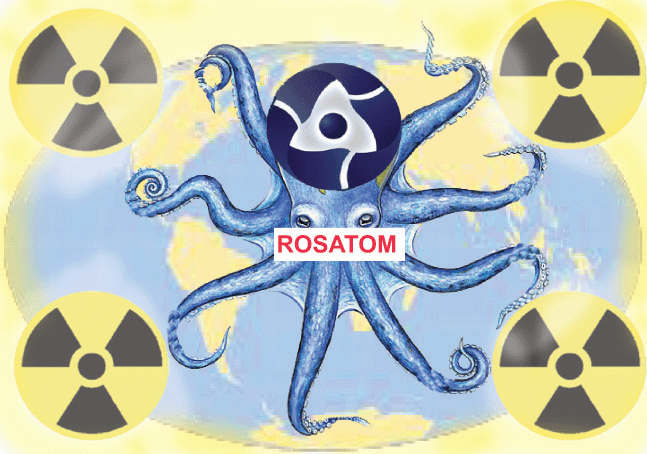
Russia’s state-owned energy company Rosatom is drumming up new nuclear business in Africa
As the sabre-rattling over possible sanctions against Russia’s nuclear
industry intensifies, the country’s state-owned energy company Rosatom is
busily drumming up new business in Africa.
Last month, speaking at the
African Energy Indaba in Cape Town, Rosatom’s chief executive for central
and southern Africa, Ryan Collyer, urged the continent’s most
industrialised country, South Africa, to press go on its nuclear programme
to ensure “stable, affordable and environmentally friendly” power. It
was a message that resonated with South Africa’s energy minister Gwede
Mantashe, who said the country, which has been battling electricity
blackouts for the past 16 years, expects nuclear energy to be part of the
fix.
“The proposal to develop 2,500MW of nuclear power is not a dream —
there’s already an agreement, and the procurement capacity is being
worked on. We’re going to be investing in that capacity,” he told the
conference. While nuclear power provides about 10 per cent of electricity
generated globally, according to the Paris-based International Energy
Agency, the Koeberg plant in Cape Town is the only nuclear power station on
the African continent. Yet a number of African countries have announced
plans to build nuclear power plants in the past year — including Uganda,
Rwanda and Kenya.
FT 2nd April 2024
https://www.ft.com/content/4f1d0d1d-3a98-4b03-8771-54d88ed0a023
South Africa lodges Urgent Complaint with Int’l Court of Justice over Israel’s Plan to Assault Rafah
JUAN COLE, 02/14/2024
Ann Arbor (Informed Comment) – The South African government lodged an urgent complaint on Monday at the International Court of Justice against the plan announced by Israeli Prime Minister Binyamin Netanyahu to attack Rafah in southern Gaza, where 1.4 million people, most of them refugees from elsewhere, have been pushed by the Israeli military. So reports Siyabonga Mkhwanazi at Pretoria’s Independent On Line (IOL) (a consortium of South Africa newspapers).
The IOL says that President Cyril Ramaphosa confirmed Tuesday that South Africa has inquired with the ICJ whether it needs to issue another preliminary judgment to stop Israel’s planned offensive against Rafah. The Court is permitted to issue provisional orders at any time without having to convene to decide the case finally.
Lizeka Tandwa at the Mail & Guardian reports that the further submission to the court pointed out that “Rafah is the last refuge for the surviving people in Gaza.”
Vincent Magwenya, the spokesman for South African’s president, posted this statement to the presidency web site:
………………………………………………………………………https://www.juancole.com/2024/02/complaint-justice-israels.html
1 This Month

of the week – Shut Down Drone Warfare!


Tell the Ukrainian Government to Drop Prosecution of Peace Activist Yurii Sheliazhenko

Petition to revoke the licensing of the Near Surface Nuclear Disposal Facility (NSDF) at Chalk River. https://www.ourcommons.ca/petitions/en/Petition/Details?Petition=e-7247
To see nuclear-related stories in greater depth and intensity – go to https://nuclearinformation.wordpress.com
-
Archives
- March 2026 (237)
- February 2026 (268)
- January 2026 (308)
- December 2025 (358)
- November 2025 (359)
- October 2025 (376)
- September 2025 (257)
- August 2025 (319)
- July 2025 (230)
- June 2025 (348)
- May 2025 (261)
- April 2025 (305)
-
Categories
- 1
- 1 NUCLEAR ISSUES
- business and costs
- climate change
- culture and arts
- ENERGY
- environment
- health
- history
- indigenous issues
- Legal
- marketing of nuclear
- media
- opposition to nuclear
- PERSONAL STORIES
- politics
- politics international
- Religion and ethics
- safety
- secrets,lies and civil liberties
- spinbuster
- technology
- Uranium
- wastes
- weapons and war
- Women
- 2 WORLD
- ACTION
- AFRICA
- Atrocities
- AUSTRALIA
- Christina's notes
- Christina's themes
- culture and arts
- Events
- Fuk 2022
- Fuk 2023
- Fukushima 2017
- Fukushima 2018
- fukushima 2019
- Fukushima 2020
- Fukushima 2021
- general
- global warming
- Humour (God we need it)
- Nuclear
- RARE EARTHS
- Reference
- resources – print
- Resources -audiovicual
- Weekly Newsletter
- World
- World Nuclear
- YouTube
-
RSS
Entries RSS
Comments RSS
 nuclear-news