On Monday, 4 June 2018, comments from the public on the draft Integrated Planning Framework Bill are due to the Department of Performance Monitoring and Evaluation (DPME) in the Presidency.
The call for comments makes the draft bill sound fairly benign, in that the DPME says the bill will provide for the functions of the department and establish an institutional framework for “a new predictable planning paradigm and discipline within and across all spheres of government”.
However, upon analysis, the bill could be the latest worrying development in the relentless bid to push the new-nuclear build programme forward.
On 17 May 2018, Loyiso Tyabashe, senior manager of nuclear new build at Eskom, said at African Utility Week that Eskom is continuing with front-end planning for a nuclear build programme. This despite Cyril Ramaphosa sending clear signals at the World Economic Forum in Davos in January that South Africa does not have money to pursue a major nuclear plant build.
Within this context, consider the following lines contained in the draft integrated planning framework bill, which says that the Minister in the Presidency must:
(c) annually in consultation with the Minister of Finance develop a budget prioritisation framework in order to guide the allocation of resources to organs of state in the national sphere of government;
(d) annually give input to the Minister of Finance in the preparation of the budget on—
the status of the economy and the possible macro-economic interventions;
its alignment with the National Development Plan; and
the proposed capital and development projects and programmes and related expenditure;
Nkosazana Dlamini Zuma is Minister in The Presidency responsible for Planning, Monitoring and Evaluation. This bill would give the minister the ability to develop a budget prioritisation framework that outlines which capital programmes to prioritise and to propose the related expenditure. Capital projects could include such contentious projects as the nuclear build, the Moloto Rail and the Mzimvubu dam.
In February 2018, which is after Cyril Ramaphosa signalled at the World Economic Forum that South Africa has no money for major nuclear expansion, the DPME launched a discussion paper on energy. The DPME’s website notes that enquiries related to this discussion paper could be directed to Tshediso Matona.
Tshediso Matona is the Secretary for National Planning at the DPME and is also the fired former Eskom boss to whom former President Jacob Zuma apologised about the way he was treated when he was fired.
The discussion paper reiterates that “the promulgated IRP 2010-2030 included 9.6 GW of nuclear power generation capacity, which has been confirmed as existing policy on numerous occasions. The Draft IRP 2016 that is in the public domain for consultation following a significant time-lapse since the promulgation of the IRP 2010-2030 in 2011 has a Base Case that requires nuclear power by 2037 (earliest) while a Carbon Budget scenario requires it by 2026.”
The discussion paper does acknowledge that the court case in which the Inter-Governmental Agreements (IGAs) with the United States of America, the Republic of Korea and the Russian Federation were legally challenged, determined the IGAs to be irrational, unlawful and unconstitutional. The court ruled that they should be set aside.
However, the paper then continues to say that the opportunity for small modular reactors to be included in the integrated energy planning framework should be considered. While it says that appropriate realistic costs should be considered, the paper outlines in the line immediately before that small modular reactors have typically been considered prohibitively expensive. With regards to the small modular reactors, the paper refers to revived research and previous research in preparation for the shelved Pebble Bed Modular Reactor which cost about R10-billion before it was shut down.
So, if a smaller nuclear build at an appropriate realistic cost could be possible, should taxpayers be worried? According to two recently released reports by the World Wide Fund for Nature (WWF), there is cause for concern. The WWF reports look at the players’ potential strategies for pushing the nuclear new-build programme as well as the domestic procurement and public finance implications. WWF cautions that suggestions for smaller amounts of installed nuclear capacity appear to be an attempt to gain support for smaller amounts of nuclear energy and use these as a stepping stone towards building the full 9.6 GW.
How might the Integrated Planning Framework Bill play a role in the continued push for nuclear? If the bill is legislated it would give the Minister in the Presidency responsible for Planning, Monitoring and Evaluation the ability to give input to the Minister of Finance on proposed capital and development projects and programmes and related expenditure. The financing would need to come from somewhere.
WWF notes that finance for electricity generating plants typically comes from “corporate finance, government equity, government guarantees, loans from development finance institutions, a long-term loan from an export credit agency, and extra cash generated from regulated tariffs”.
However, says the WWF, it is unlikely that corporate finance would be used; government-to-government loans or financing from state banks or development finance institutions of the vendor’s home country are more likely to be used, with sovereign wealth funds another possibility. In order to enable a loan, National Treasury may need to put up a loan guarantee. Given the alarming trend of State-owned Entities including Eskom needing bailouts, the possibility of the loan being called in would be a risk. The ratings downgrade that Eskom received would also mean that a loan, if it were granted to Eskom, would attract a higher interest rate than previously.
The draft Integrated Planning Framework bill is currently in white paper form. When it comes before Parliament, there is a strong rationale for civil society to study it closely and make submissions to ensure that it is not used as a tool to push corrupt capital projects through the system. DM
SA no longer has agreement with Russians on nuclear, says Radebe, Fin 24, Jun 04 2018 Khulekani Magubane Cape Town –Minister of Energy Jeff Radebe told eNCA on Sunday evening that South Africa no longer had an agreement with the Russians to procure for the development of nuclear energy for the country.
Speaking to journalist and political analyst Karima Brown on the news network’s show The Fix, Radebe said he was of the view that government did not appeal the court ruling in 2017 which invalidated the nuclear deal at that time.
The energy portfolio in national government has seen unparalleled instability with at least five ministers of energy in the past eight years, and a subsequent lack of clarity as to whether the Intergovernmental Framework Agreement which mentions nuclear would still be pursued and what role nuclear would play in the energy mix…….https://www.fin24.com/Economy/sa-no-longer-has-agreement-with-russians-on-nuclear-says-radebe-20180604
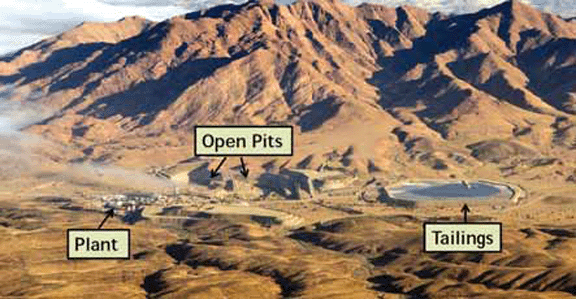
Paladin mothballs Namibia uranium mine Creamer Media’s Mining Weekly 25TH MAY 2018 BY: ESMARIE SWANEPOELCREAMER MEDIA SENIOR DEPUTY EDITOR: AUSTRALASIA PERTH (miningweekly.com) 27 May 18 – Dual-listedPaladin Energy on Friday confirmed that its Langer Heinrich uranium mine, in Namibia, was being placed under care and maintenance, but said that the low-cost openpit operation would be one of the first to resume production when the uranium market normalised.
Paladin in April said that it was unlikely to resume physical mining activities at the mine despite the medium-grade ore stockpile currently feeding the processing plant set to be exhausted before mid-2019.
The ASX and TSX-listed company on Friday said that it had received consent from all the relevant stakeholders to place the operation under care and maintenance, and had now stopped presenting ore to the plant.
There would be a run-down phase of up to three months where various stages of the plant would be progressively suspended and cleaned, and during this time, there would be some continued production of finished uranium.
Eskom continues with front-end nuclear preparation May 17 2018 Carin Smith
Cape Town – Eskom is continuing with front-end planning for a nuclear build programme, Loyiso Tyabashe, senior manager of nuclear new build at Eskom, said at African Utility Week on Thursday.
During a discussion on nuclear energy, Professor Anton Eberhard of the University of Cape Town asked Tyabashe why Eskom was still focusing on nuclear development when it did not seem to be on President Cyril Ramaphosa’s radar.
China to help Uganda build nuclear power plants, Reuters Staff, 17 May 18 KAMPALA (Reuters) – China will help Uganda build and operate nuclear power plants under a deal signed last week.
Uganda has some uranium deposits and President Yoweri Museveni has said his government was keen to exploit them for potential nuclear energy development.
Eight potential sites have been identified in the country’s central, southwest and northern regions that could potentially host nuclear power plants, the government said on Thursday. It signed a deal with Russia last year to cooperate on nuclear power.
China is already a major investor in Ugandan infrastructure projects and China National Nuclear Corporation (CNNC) signed a memorandum of understanding on May 11 to help Uganda build capacity “in the use of atomic energy for peaceful purposes”, Uganda’s energy ministry said in a statement issued on Thursday……
Co-operation between CNNC and Uganda will involve the development of nuclear power infrastructure including the design, construction and operation of nuclear power plants.
In June last year Uganda signed a similar memorandum of understanding with Russian State Atomic Energy Cooperation (ROSATOM) to facilitate the two countries’ cooperation on nuclear power.
The energy minister spoke extensively about successes in renewables and made no mention of nuclear power, at the conference in Cape Town, 15 MAY 2018 TANYA FARBER
Just hours after being sworn in as acting president‚ Jeff Radebe nailed his colours to the renewable energy mast at African Utility Week, on Tuesday.
Radebe was speaking at the Cape Town International Convention Centre‚ where 7‚000 delegates from around the world gathered to talk about water‚ energy and power.
The energy minister‚ who is acting president while President Cyril Ramaphosa and Deputy President David Mabuza are out of the country‚ spoke extensively about successes in renewables and made no mention of nuclear power.
“To date we have concluded 91 projects with a capacity of 63‚000 megawatts (MW). Sixty-two of these projects have the combined capacity of 3‚800MW, which already is connected to the grid‚” he said.
He told delegates that SA had seen a “significant decline in tariffs of about 55% for wind and 76% for solar” energy. About R136bn had been invested in renewable energy‚ with another R56bn to be spent over the next 3-5 years, when the construction of 27 renewable power projects — signed off in April — will begin.
These projects would save water‚ create 39‚000 jobs and reduce carbon dioxide emissions by 23-million tonnes.
Radebe said the resource plan, which maps out the country’s energy mix for the next two decades, would be finalised in August.
The report is seen as the litmus test for whether Ramaphosa’s government has distanced itself from the nuclear aspirations of his predecessor‚ Jacob Zuma.
Although the nuclear deals were deemed unlawful‚ there is a chance they could re-emerge. But if Radebe’s speech was anything to go by‚ nuclear might finally be fading into the background.
Daily Maverick 14th May 2018, If South Africa’s new energy plan contains nuclear power as part of the
country’s future energy mix, it suggests that State Capture is still
embedded in government, anti-nuclear lobby groups say.
The new Integrated Resource Plan (IRP), a road map laying out South Africa’s future energy
mix for the next 20 years, will be presented to Cabinet on 15 August,
Energy Minister Jeff Radebe said last week. An energy policy expert has
warned that a nuclear programme in South Africa is “unfinanceable” –
even if Russia pays.
After South Africa’s controversial nuclear deals signed with Russia, Korea and the US, backed by former President Jacob Zuma, were found to be unlawful and unconstitutional by the Western Cape
High Court in 2017, there has been speculation as to whether this spells
the end of the nuclear expansion programme, or whether the government would
begin afresh.
The new IRP will reveal which way government intends to go.
If the energy minister knows, he is not saying. At a ministerial briefing
of the energy portfolio committee on Tuesday last week, MPs asked Radebe
three times if the government intended pursuing the nuclear programme, and
three times he gave a wait-and-see answer. Anti-nuke campaigner Liz McDaid
of the SA Faith Communities’ Environment Institute (SAFCEI), who with
Earthlife Africa’s director Makoma Lekalakala brought the nuclear court
case against the government, said none of the expert reports on South
Africa’s future electricity mix had found that there was a need for
nuclear power. https://www.dailymaverick.co.za/article/2018-05-14-industry-experts-are-watching-to-see-if-state-capture-still-has-a-role-in-future-of-energy-in-south-africa/
Energy Minister Jeff Radebe says he hopes to present the review of the Integrated Resource Plan to Cabinet by mid-August. Lindsay Dentlinger , 8 May 18, CAPE TOWN – Energy Minister Jeff Radebe says the country’s controversial nuclear build programme is under review.
He says no further decisions will be taken until the long-overdue review of the Integrated Resource Plan (IRP) has been finalised.
Radebe says he hopes to present the document to Cabinet by mid-August.
The minister on Tuesday appeared before Parliament’s Energy Committee for the first time since his appointment in February.
Radebe batted away MPs’ questions about the country’s nuclear power intentions, saying he doesn’t want to pre-empt the determination of the IRP.
The deadline for the review of the outdated 2010 document was changed by each of Radebe’s two predecessors, and he too has set a new date for submission to Cabinet.
For now Radebe says the focus is on complying with a High Court ruling which found government’s cooperation agreements on nuclear to have been unconstitutional.
Radebe said: “The issue of cost…I think those were determined at a time when a decision is taken whether or not to proceed.”
Radebe has given a commitment to MPs that there will be more consultation on the IRP including with the public.
Liz McDaid and Makoma Lekalakala have been awarded the prestigious Goldman Environmental Prize for their role in stopping a controversial nuclear deal between South Africa and Russia.
Now they are urging other women to step up and fight against injustice.
“I think it’s like when you come up against bullies, at a certain point, you actually say enough is enough,” Ms McDaid said.
“It’s within the grasp of ordinary people. Let the politicians keep shouting, but let’s get on and make a difference.”
The fight of their lives
The two women, both aged in their fifties, one white and one black, took on the South African Government in 2014.
Together they led a campaign to stop a multi-billion-dollar deal with Russia, to build a series of nuclear power stations in South Africa.
The agreement had not passed through the normal checks, balances and scrutiny of parliament.
South Arica had also signed deals with the United States and South Korea.
Ms Lekalakala believed the project was unsafe, unnecessary and unaffordable.
“This deal was literally going to bankrupt the country,” she said.
“For us, challenging the abuse of power and protecting our constitutional right, this is fundamental.”
Their organisations — Earthlife Africa and the Southern Africa Faith Communities Environmental Institute — teamed up with other groups, including environmental lawyers, to take on the government.
Ms McDaid said she was confident she and Ms Lekalakla, along with their supporters, would win.
“I think what is really nice is that in a world that is often being led by men, this was a space where two women could actually work together,” she said.
“We have the same sort of energy, same attitudes and value system. So, we worked very well together.”
The environmentalists filed a case against the President of South Africa, the Department of Energy and the Speaker of Parliament.
“To say no nuclear energy should proceed without having satisfied all the legislative and regulatory processes,” Ms McDaid said.
On the 26th of April 2017, the High Court in Cape Town found the Government had not followed due process.
As a result, the deal was declared invalid and unconstitutional.
Ms Lekalakala and Ms McDaid began their activism against the apartheid regime in the 1980s.
Ms McDaid said people should not believe the story that they are powerless.
“We do live in a democracy, we have the right to stand up, we have the right to protest, and so people must use it,” she said.
Liz McDaid and Makoma Lekalakala have been awarded the prestigious Goldman Environmental Prize for their role in stopping a controversial nuclear deal between South Africa and Russia.
Now they are urging other women to step up and fight against injustice.
“I think it’s like when you come up against bullies, at a certain point, you actually say enough is enough,” Ms McDaid said.
“It’s within the grasp of ordinary people. Let the politicians keep shouting, but let’s get on and make a difference.”
The fight of their lives
The two women, both aged in their fifties, one white and one black, took on the South African Government in 2014.
Together they led a campaign to stop a multi-billion-dollar deal with Russia, to build a series of nuclear power stations in South Africa.
The agreement had not passed through the normal checks, balances and scrutiny of parliament.
South Arica had also signed deals with the United States and South Korea.
Ms Lekalakala believed the project was unsafe, unnecessary and unaffordable.
“This deal was literally going to bankrupt the country,” she said.
“For us, challenging the abuse of power and protecting our constitutional right, this is fundamental.”
Their organisations — Earthlife Africa and the Southern Africa Faith Communities Environmental Institute — teamed up with other groups, including environmental lawyers, to take on the government.
Ms McDaid said she was confident she and Ms Lekalakla, along with their supporters, would win.
“I think what is really nice is that in a world that is often being led by men, this was a space where two women could actually work together,” she said.
“We have the same sort of energy, same attitudes and value system. So, we worked very well together.”
The environmentalists filed a case against the President of South Africa, the Department of Energy and the Speaker of Parliament.
“To say no nuclear energy should proceed without having satisfied all the legislative and regulatory processes,” Ms McDaid said.
On the 26th of April 2017, the High Court in Cape Town found the Government had not followed due process.
As a result, the deal was declared invalid and unconstitutional.
Ms Lekalakala and Ms McDaid began their activism against the apartheid regime in the 1980s.
Ms McDaid said people should not believe the story that they are powerless.
“We do live in a democracy, we have the right to stand up, we have the right to protest, and so people must use it,” she said.
ENERGY DEPT: NO NEW NUCLEAR BUILD PROGRAMME, Eyewitness News, Director General of Energy Thabane Zulu says the government doesn’t plan to spend any money on advancing its nuclear programme in this financial year. Lindsay Dentlinger 17 Apr 18 CAPE TOWN – The Department of Energy says there’s no new nuclear build programme.
The R816 million allocated in 2018’s national budget is purely for the ongoing work of the country’s nuclear institutions.
Members of Parliament’s energy committee on Tuesday sought clarity around the future of the country’s nuclear programme, but committee chairperson Fikile Majola says Minister Jeff Radebe should rather be called to do the explaining.
The Director General of Energy Thabane Zulu says the government doesn’t plan to spend any money on advancing its nuclear programme in this financial year.
Portfolio committee on energy chairperson Fikile Majola said on Saturday Radebe would appear before the committee in the week of April 17 to talk about independent power producers (IPP), the nuclear energy programme and the sale of the country’s oil reserves.
Majola said he did not know if a definite decision had been made to scrap the nuclear programme, but Radebe would shed light on this then.
President Cyril Ramaphosa said in Davos, Switzerland, in January the programme was off the table.
This was followed by statements from former finance minister Malusi Gigaba and his successor Nhlanhla Nene to the effect that the nuclear project was unaffordable.
But Majola said he was not aware that nuclear energy was off the table.
“The committee is not aware of what is going to happen besides what the president has said.”
The government signed several agreements this week with the IPPs amounting to R55.6 billion. But this elicited an angry response from the National Union of Mineworkers and National Union of Metalworkers of South Africa.
When the matter was in the High Court in the Western Cape, Radebe said there would not be any nuclear deal until the matter had been brought before Parliament.
However, Ramaphosa has said it was off the table and did not even mention it in his State of the Nation Address.
Russian energy firm Rosatom told Independent Media recently it was still bidding for nuclear contracts and had not heard anything from the government.
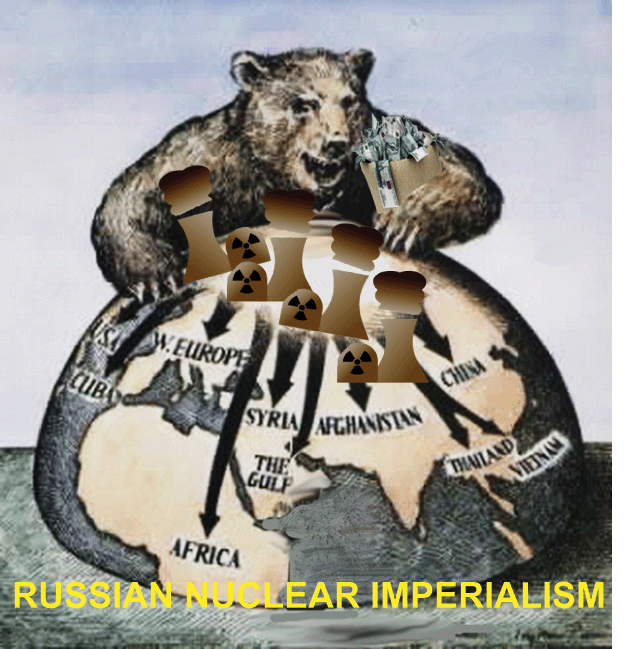
Rosatom has signed multiple agreements in Africa to deliver nuclear energy. In Egypt the Russians bagged a nuclear deal worth $30 billion (R360 billion), with $25bn of it to be vendor financing.
This week, Russian president Vladimir Putin was in Turkey to sign another nuclear deal.
The Russians are to build a nuclear plant on the coast of Turkey. This followed an agreement signed a few years ago.
Head of Rosatom in southern Africa Viktor Polikarpov said recently the company was in Ghana and was moving into East Africa.
The Shocking Story of How One Country Built Nuclear Weapons (And Gave Them Up), National Interest, Dave Majumdar, 28 Mar 18,
The region and the world are undoubtedly safer because of the decisions made in the 1990s to relinquish South Africa’s nuclear program. Moreover, the dismantling of the relatively small program provided a template for how other nuclear powers could think about eliminating their own programs. However, with the exception of the Soviet successor states (which faced dramatically different constraints) no other states have yet taken up South Africa’s example. With the apparent increase in global tensions over the past few years, it seems unlikely that anyone will join South Africa in the post-nuclear club anytime soon.
The Republic of South Africa is the only country in the world to build a nuclear weapons program, then unbuild that program after domestic and international conditions changed. Why did South Africa decide to build nukes, how did it build them and why did it decide to give them up? The answers are largely idiosyncratic, although they may hold some lessons for the future of nuclear weapons development on the Korean Peninsula and elsewhere……..http://nationalinterest.org/blog/the-buzz/the-shocking-story-how-one-country-built-nuclear-weapons-25110
Sudan, Russia to sign accord to develop nuclear power: SUNA agency https://af.reuters.com/article/topNews/idAFKCN1GP0ME-OZATP Reuters Staff, 13 Mar 18KHARTOUM (Reuters) – Sudan will sign a“roadmap” with Russia to build nuclear power stations during a visit to Moscow by Khartoum’s electricity minister, state news agency SUNA said on Monday.
SUNA said Water Resources, Irrigation, and Electricity Minister Moataz Mousa, who left Khartoum on Monday, would meet the head of Russia’s state nuclear agency Rosatom. The trip comes four months after Sudanese President Omar Hassan al-Bashir told his Russian counterpart Vladimir Putin he wanted to discuss nuclear power cooperation with Russia. SUNA quoted a spokesman for the ministry as saying the two sides would sign several memorandums of understanding including the roadmap“to implement a plan to develop nuclear (power) stations”. It did not elaborate. Reporting by Omar Fahmy, editing by David Evans





 nuclear-news