Russia’s Rosatom nuclear firm targets its marketing at African countries
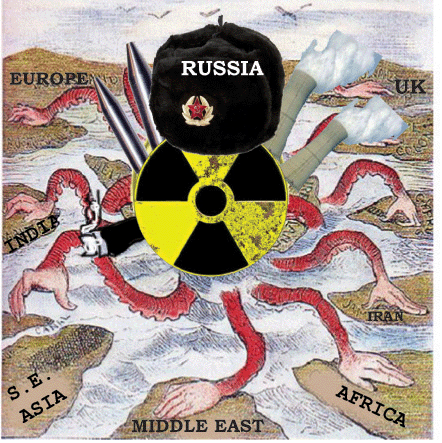
- Russian developer has signed over a dozen agreements in Africa
- Various financing options being considered for the plant build
Rosatom Corp., is eyeing Africa as one of its “priority regions” to build more nuclear reactors and expand its business……(Subscribers only) https://www.bloomberg.com/news/articles/2019-10-30/russia-s-rosatom-focuses-on-africa-for-its-nuclear-expansion
No nuclear in South Africa’s future energy mix
The plan – which builds on a relatively well-received draft announced last year – makes some significant advances in changing South Africa’s energy mix. For example, it significantly ups the contribution of wind as well as solar power to South Africa’s overall energy allocation. The production of power from wind is expected to grow by 900% by 2030, and power from solar photovoltaic by 560%……
Ultimately economic realities dictate that coal and nuclear cannot compete with renewable technologies. These are already much cheaper, and their cost continues to drop by the year.
Even with maximum political will, a nuclear build cannot be realised without convincing investors and the public that it makes economic sense. It doesn’t……..https://theconversation.com/south-africas-future-energy-mix-wind-solar-and-coal-but-no-nuclear-111106
Misuse of funds in South Africa”s nuclear reactor project
Is this outfit similar to Australia’s ANSTO and its Lucas Heights reactor? They both seem like mavericks running their own show without accountability
The letter reveals that Necsa has been making massive operating losses since 2014, which have deteriorated over the years, and has resulted in various ring-fenced funds being irregularly used to meet operating expenses, including salaries.
For example, the letter says that in financial year (FY) 2018/19, Necsa raided R268-million from the Safari low-enriched uranium (LEU) spent Fuel Waste Disposal Fund, which was meant for future disposal of spent nuclear fuel waste, in order to meet operating costs.
The Safari-1 reactor became one of Necsa’s cornerstone facilities, especially during the mid 1990’s, where it’s main application was to be a cost-sustainable facility operating as a commercial production facility of radioisotopes and the rendering of irradiation services.
Furthermore, in FY 2017/18, the letter indicates that Necsa borrowed R58,5-million from its subsidiary, NTP Radioisotopes, which was to be repaid in 2019, but was subsequently unilaterally extended to 2021 when it became clear that Necsa could not afford to repay NTP Radioisotopes.
In FY 2016/17, Necsa is said to have used R100-million of investments of the Safari LEU Spent Fuel Waste Disposal Fund as security for a R100-million overdraft facility from Nedbank, which the bank later withdrew due to the absence of a turnaround strategy to address Necsa’s strained financial position.
This, according to the letter, then forced Necsa to raid R100-million from the Safari LEU Spent Fuel Waste Disposal Fund to meet operating costs, and this R100-million was later repaid to the Fund from government grant funding.
The effect of the unconventional funding interventions in previous years, says the letter, was that about R445-million of ring-fenced funds were used for operations, despite being meant for other purposes, thus negatively affecting Necsa’s liquidity and solvency.
The letter further says that Necsa has been technically bankrupt since about 2016, and has survived using ring-fenced funds, which has cumulatively had an impact on the going concern status on the entity – a challenge which the current board is now faced with.
This letter from the new Necsa board to Parliament follows a damning audit report by the Auditor General of South Africa detailing the maladministration and irregular expenditure under the former Necsa board. The qualified audit report was attached Necsa’s financial statements for FY 2017/18, which were tabled about six months late by the former board.
Necsa’s financial statements for FY 2018/19 are also late, as the new board grapples with the political turmoil and disruptive actions by labour union NEHAWU. It is expected that there will be further explosive revelations by the Auditor General.
The entire former board of Necsa was removed by the former minister of energy, Jeff Radebe, in December 2018, and there is ongoing litigation in this regard.
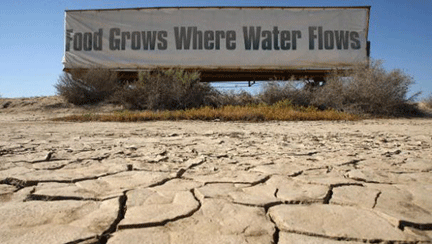
Desertification and Drought – Sahara
|
COMBATING DESERTIFICATION AND DROUGHT
Displaced by the Desert: An expanding Sahara leaves Broken Families and Violence in its Wake, IPS News By Issa Sikiti da Silva 25 Oct 19, “……… In 2012, various groups of Tuareg rebels grouped together to form and administer a new northern state called Azawad. The civil strife that resulted drove many from their homes, with communities often fleeing with their livestock, only to compete for scarce natural resources in vulnerable host communities, according to the United Nations.
After the security situation began to improve in 2013, many returned home to rebuild their lives and livelihoods. But soon it was the turn of the expanding Sahara Desert, drought and land degradation that became the next driver of their displacement. “As time went by, the land became useless and we found ourselves having no more land to work on. Nothing would come out that could feed us, and our livestock kept dying due the lack of water and grass to eat, ” Abdoulaye recalls. “Drought across the Sahel region, followed by conflict in northern Mali, caused a major slump in the country’s agricultural production, reducing household assets and leaving many of Mali’s poor even more vulnerable,” FAO says. “We used to move up and down with our livestock, looking for water and grass, but most of the times we found none. Life was unliveable. The Sahara is coming down, very fast,” Abdoulaye says emotionally……….. Threatened with creeping desertification …The U.N. says nearly 98 percent of Mali is threatened with creeping desertification, as a result of nature and human activity. Besides, the Sahara Desert keeps expanding southward at a rate of 48 km a year, further degrading the land and eradicating the already scarce livelihoods of populations, Reuters reported. The Sahara, an area of 3.5 million square miles, is the largest ‘hot’ desert in the world and home to some 70 species of mammals, 90 species of resident birds and 100 species of reptiles, according to DesertUSA. And it is expanding, its size is registered at 10 percent larger than a century ago, LiveScience reported. The Sahel, the area between The Sahara in the north and the Sudanian Savanna in the south, is the region where temperatures are rising faster than anywhere else on Earth. The cost of land degradation is currently estimated at about $490bn per year, much higher than the cost of action to prevent it, according to UNCCD recent studies on the economics of land desertification, land degradation and drought. Roughly 40 percent of the world’s degraded land is found in areas with the highest incidence of poverty and directly impacts the health and livelihoods of an estimated 1.5 billion people, according to the U.N. In a country where six million tonnes of wood is used per year, reports say Malians are mercilessly smashing their already-fragile landscape, bringing down 4,000 square kilometres of tree cover each year in search for timber and fuel……….. What is being done?Projects such as the U.N. Convention to Combat Desertification’s Land Degradation Neutrality project aimed at preventing and/or reversing land degradation are some of the interventions to stop the growing desert.
Everyone, including terrorists are equal in the face of the expanding SaharaBut there remain gaps and many in Mali still remain affected. Community leader Hassan Badarou spent several years teaching Islam in rural Mali and Niger. He tells IPS Mali has a very complex situation. “It is not easy to live in these areas. People there face double threats. It is double stress to flee from both armed conflict and desertification. And such people need to be welcomed and assisted, and not be seen as a threat to locals livelihoods……….. http://www.ipsnews.net/2019/10/displaced-desert-expanding-sahara-leaves-broken-families-violence-wake/?utm_source=English+-+IPS+Weekly&utm_campaign=2391e81e36-EMAIL_CAMPAIGN_2019_10_24_01_01&utm_medium=email&utm_term=0_eab01a56ae-2391 |
|
China buried nuclear waste in Sudan desert
 Official: China buried nuclear waste in Sudan desert, Dabanga November 12 – 2015 KHARTOUM, China has buried dozens of containers with toxic waste in the desert of Northern Sudan, according to a high-ranking official. The waste was most probably coming from nuclear plants in China.
According to the former director of the Sudan Atomic Energy Commission in Sudan, Mohamed Siddig, 60 containers have been brought to Sudan together with construction materials and machinery for the building of the Merowe Dam (Hamdab Dam) in the Northern part of Sudan. He did not mention the exact year of the import and the date the nuclear waste was disposed. China worked on the dam between 2004 and 2009.
During a conference held by the Sudanese Standards and Metrology Organisation (SSMO) in Khartoum on Tuesday, he disclosed how the Sudanese authorities allowed the import of the waste ‘without inspection’. He told the audience that 40 containers were buried in the desert not far from the Merowe Dam construction site. Another 20 containers were also disposed in the desert, though not buried. Mohamed Siddig was quoted by several local reporters, of whom some did not mention China, but ‘an Asian country’ instead. During the conference, titled ‘Raising awareness of the danger of chemicals’, Siddig said that a ‘number of Asian industrial countries’ had approached African countries to dispose their nuclear and other toxic waste…….https://www.dabangasudan.org/en/all-news/article/official-china-buried-nuclear-waste-in-sudan-s-desert?fbclid=IwAR1ScnDQ-6EcDBv2m2EhIqjnunbBnCpt5Ell_xuiNgFAhQapNqR0dF1ykMI
Russia trying to market nuclear power to Uganda (or to anybody, really)
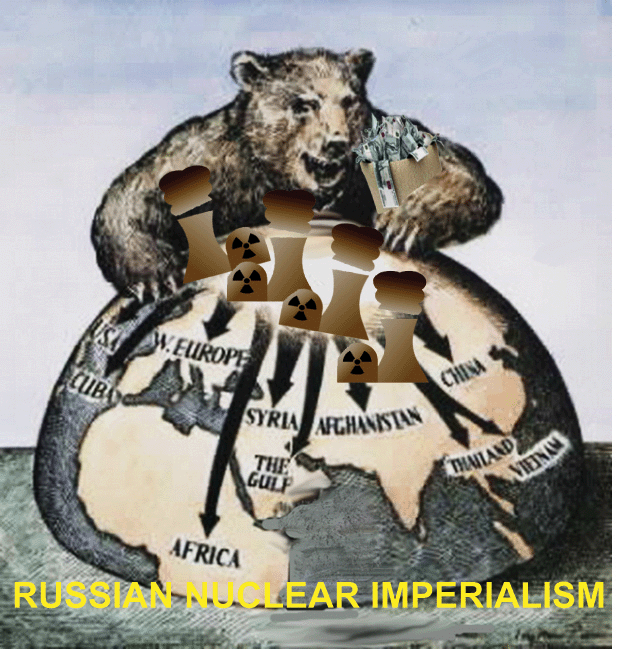 Uganda says Russia to help it develop nuclear energy, KAMPALA (Reuters) 18 Sept 19, – Uganda said on Wednesday it had signed an Inter-Governmental Agreement (IGA) with Russia to help the East African country build capacity to exploit nuclear technology for energy, medical and other peaceful purposes.The government of President Yoweri Museveni has previously said it is eager to use the country’s uranium deposits to boost energy production capacity.
In May last year Uganda also signed a memorandum of understanding with China National Nuclear Corporation (CNNC) to help Uganda build capacity in the use of atomic energy for peaceful purposes.
In an emailed statement, Uganda’s energy ministry said the IGA with Russia was signed in Vienna on Tuesday between Energy Minister Irene Muloni and Nikolai Spasskiy, the deputy director general of Russian state corporation ROSATOM……….
Reporting by Elias Biryabarema in Kampala; Editing by Matthew Lewis https://www.reuters.com/article/us-uganda-russia/uganda-says-russia-to-help-it-develop-nuclear-energy-idUSKBN1W328N
Russia Spreads Influence in Africa Using Nuclear Power
Russia Spreads Influence in Africa Using Nuclear Power – Reports, Moscow Times, 30 Aug 19, Russia is working to win influence in at least 10 African states with high-cost nuclear technology that for the most part does not suit their needs, researchers and NGOs have told The Guardian newspaper.
With booming exports, nuclear energy is one example of Russia’s increasing presence in Africa in recent years. Elsewhere, a businessman known as “Putin’s chef,” Yevgeny Prigozhin, is widely reported to be spearheading Russia’s push to exchange security and electioneering services for mining rights in Africa.
Russia’s state nuclear agency Rosatom has approached the leaders of “dozens” of African countries with various nuclear energy projects in the past two years, The Guardian reported Wednesday. Rosatom has existing deals with Egypt and Nigeria and other various agreements with other countries on the continent.
Few African countries have the capacity to distribute the amount of nuclear energy generated by the type of reactors that Rosatom is exporting, experts told the outlet. Observers also noted that the costly projects favored by Rosatom likely wouldn’t benefit Africa’s poorest populations…….. https://www.themoscowtimes.com/2019/08/29/russia-spreads-influence-in-africa-using-nuclear-power-reports-a67077
South Africa scraps Russian nuclear plant plans
Energy Minister Gwede Mantashe said this week that South Africa is still in the market for nuclear energy, provided it can be purchased economically.
The financially hamstrung Electricity Supply Commission is becoming a millstone around the exchequer’s neck, by failing to meet its crippling debt burden…… http://en.rfi.fr/africa/20190824-south-africa-cancel-russia-nuclear-plant-order-economy-ramaphosa
China buried nuclear waste in Sudan desert
According to the former director of the Sudan Atomic Energy Commission in Sudan, Mohamed Siddig, 60 containers have been brought to Sudan together with construction materials and machinery for the building of the Merowe Dam (Hamdab Dam) in the Northern part of Sudan. He did not mention the exact year of the import and the date the nuclear waste was disposed. China worked on the dam between 2004 and 2009.
During a conference held by the Sudanese Standards and Metrology Organisation (SSMO) in Khartoum on Tuesday, he disclosed how the Sudanese authorities allowed the import of the waste ‘without inspection’. He told the audience that 40 containers were buried in the desert not far from the Merowe Dam construction site. Another 20 containers were also disposed in the desert, though not buried…..
Mohamed Siddig was responsible for the Sudan Radioactive Waste Management programme that started in 1995, a central radioactive waste management facility was established in Soba near Khartoum. The Atomic Energy Committee is responsible for overseeing the safety in activities that involve the use of atomic energy in Sudan, and promoting the use of nuclear techniques.
Gold miners complain
In 2010, the government was already confronted by complaints of local gold diggers, according to the Sudanese newspaper El Tariq. Several gold workers approached the government complaining about many of the worker suffering from cancer and skin diseases. The Sudan authorities downplayed the questions saying the waste they dug up were remnants from earlier times. However witnesses told El Tariq that 500 sealed barrels were discovered in the El Atmur desert area in River Nile State…….https://www.dabangasudan.org/en/all-news/article/official-china-buried-nuclear-waste-in-sudan-s-desert
The sorry history and sorry future of nuclear power in South Africa
 Shutting down SA’s nuclear future https://www.news.uct.ac.za/article/-2019-07-16-shutting-down-sas-nuclear-future16 JULY 2019 | STORY DAVID FIG. Located 33 km west of South Africa’s capital city Pretoria, the Pelindaba precinct has been home to South Africa’s official nuclear research corporation since the 1960s. The Nuclear Energy Corporation of South Africa (NECSA) hosts the country’s earliest nuclear reactor, originally designed to take weapons-grade uranium. It was also the original site for the development of nuclear weapons under the apartheid government between 1978 and 1990.Over the years the corporation has experimented with reactor development, uranium enrichment, fuel fabrication, and the production of isotopes used in nuclear medicine. Shutting down SA’s nuclear future https://www.news.uct.ac.za/article/-2019-07-16-shutting-down-sas-nuclear-future16 JULY 2019 | STORY DAVID FIG. Located 33 km west of South Africa’s capital city Pretoria, the Pelindaba precinct has been home to South Africa’s official nuclear research corporation since the 1960s. The Nuclear Energy Corporation of South Africa (NECSA) hosts the country’s earliest nuclear reactor, originally designed to take weapons-grade uranium. It was also the original site for the development of nuclear weapons under the apartheid government between 1978 and 1990.Over the years the corporation has experimented with reactor development, uranium enrichment, fuel fabrication, and the production of isotopes used in nuclear medicine.
In the years to 1994, it was given relatively free range with budgets and personnel to conduct these experiments. The whims of nuclear scientists were indulged as they were seen to be essential to apartheid’s semi-clandestine weapons, energy and sanctions-busting plans. However, many of these projects – except for the isotopes, which remain lucrative – have been abandoned. In recent years, governance has become dysfunctional. The corporation no longer sustains itself financially, there have been tensions between ministers and the board and the production of medial isotopes ceased for over a year. Long-standing problems Problems in the running of the corporation have been evident for some time. Earlier this year the former energy minister Jeff Radebe dealt with the growing internal problems by suspending and later firing the CEO, Phumzile Tshelane. He also took steps to fire the organisation’s entire board. Radebe acted because he claimed the board had failed in its fiduciary duties. This included oversight of the shut down of the production of isotopes for over a year, rendering NECSA in grave debt. Another reason was the signing of a deal with Russia’s Rosatom to build two “solution reactors” in South Africa. Radebe regarded the co-operation agreement irregular. In December 2018, Radebe appointed former NECSA CEO Rob Adam as the new non-executive chair of the board. In July this year Adam confirmed he had resigned. In seven months the task of restoring NECSA to functionality had become too onerous and time-consuming. Adam’s resignation signals grave difficulties faced by NECSA in its attempts to restructure and improve its balance sheet. Most worrying is that NECSA has spun off its former waste management responsibilities to a recent formation, the National Radioactive Waste Disposal Institute, which has also experienced severe governance problems. The future NECSA was the heir of an earlier Atomic Energy Board, which entered its life at the outset of the apartheid regime on 1 January 1949. At the time there was much debate about where to locate atomic research. Some sections of the scientific establishment argued that it should become part of the government-sponsored Council for Scientific and Industrial Research (CSIR). However, security and military issues prevailed and atomic research was hived off into its own enterprise. South Africa, in deciding on NECSA’s future, should consider that for the present the country has decided to give up its nuclear ambitions, specifically in the area of energy generation. In 2010 the government wound up South Africa’s attempts at designing a high-temperature small-scale reactor, the Pebble Bed Modular reactor. The project failed to attract foreign investors and customers, and Eskom was reluctant to become a guinea pig. Cost and time overruns became too burdensome. Expensive enrichment technologies had also failed to become cost effective, and when unhooked from bomb production, were terminated. Isotope production is still viable. But the question is whether it requires an entire Pelindaba-sized research establishment to proceed. The reactor is now too elderly to have a bright future, and there’s no money to replace it. South Africa’s plans to build a series of nuclear power stations, championed by former president Jacob Zuma, were halted in 2017. This followed litigation by two environmental NGOs – Earthlife Africa and the Southern African Faith Communities’ Environmental Institute. This decision, as well as the draft contents of the Integrated Resource Plan 2018 underscore that, for the time being, extra nuclear capacity is unviable. What to do with the facility Now that South Africa no longer ascribes to a nuclear energy future, it is legitimate to consider what to do with the Pelindaba facility. The suitably pared-down nuclear research establishment needs to be reconceptualised and relocated. NECSA should be dismantled and its legacy projects, where viable, should be housed inside institutions like the CSIR and the universities. Nuclear scientists could be retired or retrained, while the rest of the workforce could be subjected to a “just transition” along the lines proposed in the carbon-intensive industries. Pelindaba as a precinct could be repurposed. First the nuclear waste from previous activities which is housed in numerous buildings and trenches at Pelindaba would need to be decontaminated and removed, so that future users can avoid any exposure to radioactivity. The site could become a new campus dedicated to innovation in the field of sustainable energy and related sciences. Subsidies once dedicated to nuclear research could be redirected to repositioning South Africa as a leading energy innovator in the global South. The new Pelindaba could also be dedicated to finding Africa-wide solutions to the climate crisis. Part of the site could also be dedicated to promoting nuclear disarmament. After all, the Treaty of Pelindaba declared the African continent a nuclear weapons-free zone. South Africa, the first country to give up its nuclear weapons, has a duty to the rest of the continent to champion nuclear disarmament. Repurposing of Pelindaba would be a just, cost-effective and practical solution to the problem of taxpayers continuing to support an increasingly dysfunctional NECSA, especially since nuclear energy is no longer seen as a viable way forward. David Fig, Honorary Research Associate, University of Cape Town. |
|
|

Extreme heat and humidity a killer combination now affecting one third of the African urban population
 Extreme heat to hit one third of the African urban population, Science Daily
- Date:
- June 5, 2019
- Source:
- Université de Genève
- Summary:
- An international team of researchers has combined demographic projections and climate scenarios across Africa for the first time. Their results reveal the number of people who will potentially be exposed to extreme temperatures.
- Climate change, population growth and urbanisation are instrumental in increasing exposure to extreme temperatures. Researchers at the University of Geneva (UNIGE), Switzerland, — in collaboration with the University of Twente (Netherlands) and the EU Joint Research Centre in Ispra (Italy) — assessed a range of possible scenarios regarding the rate of climate change and socio-economic development in 173 African cities for the years 2030, 2060 and 2090. Their results, which are published in the journal Earth’s Future, show that a third of African city-dwellers could be affected by deadly heat waves in 2090. The projections also highlight the influence of socio-economic development on the impact of climate change.
The effects of climate change are felt specifically in countries with tropical climates, which are characterised by high humidity and very high temperatures. Furthermore, countries in these regions — especially in Africa — are experiencing heavy urbanisation and socio-economic development, leading to an explosion in the size of urban populations. A combination of these two factors is having a major impact on the living conditions of city-dwellers in Africa, especially in terms of exposure to extreme — or even lethal — temperatures. “We consider the critical threshold to be 40.6°C in apparent temperature, taking humidity into account,” says Guillaume Rohat, a researcher at UNIGE’s Institute for Environmental Sciences (ISE). In fact, high outdoor humidity levels disrupt our ability to thermoregulate, with potentially fatal consequences………
https://www.sciencedaily.com/releases/2019/06/190605100340.htm
In Kenya, 87% of the electricity is from renewal sources
|
The Best Summary Of Kenya Renewable Energy (& Dirty Energy) You Can Find, Clean Technica, David Zarembka, 24 May 19 I do not need to feel guilty about contributing to global warming when my grandchildren turn on the TV to watch cartoons. This is because I live in rural, western Kenya, where 87% of the electricity is from renewal sources — the nirvana of Green Deal activists.With a population of almost 50 million (one-seventh the size of the US population), electricity capacity is only 2370 MW and peak demand is only 1770 MW. The average Kenyan consumes only 167 kWh of electricity per year. Kenyans also contribute only 0.03 percent of worldwide carbon admission to the atmosphere each year, equal to about 1 percent of what each American contributes.
It is useful to study the sources of electricity in Kenya to see how this renewable rate is achieved.
In 2017, there was a drought and the water levels in the lakes behind the dams that produce electricity fell too low to generate their normal amount of electricity. Then, as frequently happens in a climate such as Kenya’s, in 2018 there was major flooding and all the dams on the Tana River, including Masinga Dam, overflowed, leading to flooding in the lower reaches of the river. Hydropower cannot be considered a reliable source of power, so alternative sources need to be available.
The wind farm is sited in one of the best places for wind in the world. The wind blows off of Lake Turkana and is funneled between two hills, giving an extremely high wind potential. The project uses 365 Vestas 850kW wind turbines. In this day and age, I was disappointed that the wind farm used such small turbines, but the problem was transporting the turbines over 750 miles from the coast on two-lane roads. There is a second smaller wind farm in the Ngong Hills near Nairobi. Originally, it had a capacity of 5.1 MW, but it is now being upgraded with more turbines to 25.5 MW.
|
|


Nuclear power seen as obsolete in South Africa, but they must ramp up renewables, get out of coal
The Dance of Nuclear, Coal, & Renewables in South Africa, Clean Technica May 25th, 2019 by David Zarembka , “……… South Africa has the most mining and industry of any country in Africa and consequently needs the largest amount of electricity – 54,400 megawatts. This can be broken down as follows:
| Type | Capacity [MW] | Percent |
| Coal | 40,036 | 73.6% |
| Gas turbine | 3,449 | 6.3% |
| Hydro | 3,573 | 6.6% |
| Wind | 2,096 | 3.9% |
| Nuclear | 1,860 | 3.4% |
| Solar PV | 1,479 | 2.7% |
| Solar Concentrated | 400 | 0.7% |
| Landfill gas | 7.5 | – |
| Nuclear accounts for 3.4% of power capacity in South Africa, thermal energy sources 79.9%, and renewable sources 16.7% (hydro alone is 9.4%).
Nuclear Power: South Africa has two nuclear power plants in Koeberg near Capetown. Each unit produces 830 MW of power. The first was commissioned in 1984 and the second in 1985. Their closure dates are 2024 and 2025, although there are already attempts to keep them open longer than their 40 year lifespan. The real story, the dance of nuclear power, began in 2010 when South Africa planned to build 8 more nuclear reactors for 9600 MW of additional energy at Koeberg and Thyspunt. These were projected to come online between 2024 and 2030. At different times, the United States, Russia, France, China, and South Korea were involved in negotiations. In March 2017, when the Finance Minister, Pravin Gordhan, opposed these new nuclear plants because South Africa could not afford the costs, he was fired by then President Jacob Zuma and replaced with a minister who approved the projects. Due to major corruption scandals, including the nuclear power projects, President Zuma was ousted on February 18, 2018. Zuma’s replacement, Cyril Ramaphosa, immediately canceled the nuclear projects until 2030. By that time, I am sure nuclear power will be seen as obsolete, like the horse and buggy is today. There is another important side issue to the two nuclear power plants in operation. From mid-2017 through mid-2018, Capetown and the surrounding communities where the nuclear power plants are sited almost ran out of water, as the reservoirs were falling below 30% of capacity. Not only were restrictions placed on washing cars, watering lawns, and filling swimming pools, the water people did receive was rationed. “Day Zero” was announced when the city would run out of water. Since people cut their consumption by more than half, the day was postponed a number of times. Strong rains in June 2018 ended the crisis. Nonetheless, Capetown residents are restricted to 105 liters (26 gallons) of water per person per day. The issue was that the two nuclear power plants were using lots of scarce water. They have now been required to install ocean desalination plants for their water requirements. Coal: South Africa has the seventh highest coal reserves in the world. In 2018, it exported $6.2 billion of coal, mostly to China, Japan, and India. Yet in 2008, 2015, and 2018, South Africa had “load shedding,” planned rolling backouts where parts of the country are routinely without power on a scheduled basis. This was because, due to mismanagement and corruption in Eskom, the public electricity utility, South Africa’s power stations were short of coal. South Africa has 17 coal-fired plants in operation producing 40,036 MW of electricity. Electric consumption has been flat or declining slightly in the last decade. One of the problems with these coal plants is that many are old, needing repairs, and expensive to operate. In the next five years, two coal plants with 3,454 MW of capacity are scheduled to be retired, while from 2025 to 2030 seven coal plants with 7,822 MW of capacity are scheduled to be retired. There are two coal plants under construction for 6,800 MW of additional capacity, but they are already years behind schedule at substantially increased costs. The question then is, “Will renewable energy be able to fill the electricity deficit in the country?” Renewables: South Africa has 2,096 MW of wind power currently providing electricity, 400 MW of concentrated solar power, and 1,479 MW of solar PV. This totals 3,975 MW or 7.3% of the total electric generation capacity. What is most interesting is that as soon as the new Ramphosa government canceled the nuclear power plants, the government approved thousands of MW of renewable power. These included 2,097 MW of wind power, 200 MW of concentrated solar, and 1,094 of solar PV, totaling 3,391 MW of additional renewable energy. This will almost double the amount of wind/solar power in the next few years. South Africa has a plan for energy projection to 2030. The additional generating capacity by that time would be 9.5 GW of wind, 6.8 GW of solar, 6.7 GW of coal, and 2.5 GW of hydropower. This, therefore, assumes that the two coal plants now under construction will be completed, but no more coal plants will be built. Hurrah! Nonetheless, the 2030 projections still indicate that coal will provide 64% of the electricity produced. Wind would then be 13%, solar 8%, nuclear 4%, hydropower 3%, and gas 1%. This implies that the lifespan of the two current nuclear plants will be extended beyond their expiration date. Over the next eleven years, even with the phaseout of 11,276 MW of coal capacity, the use of coal will decline by less that 10%. With the price of wind and solar declining each year, these goals seem to be without sufficient ambition. Boo! South Africa ought to do better than this.https://cleantechnica.com/2019/05/25/the-dance-of-nuclear-coal-renewables-in-south-africa/ David Zarembka I am a retired Quaker peace activist focusing on genocide, war, violent conflict, election violence, and refugees in Rwanda, Burundi, eastern Congo, Uganda, Kenya, and South Sudan. Since 2007, I have lived in a small town in western Kenya, called Lumakanda, in the home area of my Kenyan wife, Gladys Kamonya. I write a weekly blog called “Reports from Kenya” on current happenings in East Africa. To sign up for the weekly blog, contact me at davidzarembka@gmail.com.
|
Mozambique hit again by a deadly cyclone
Deadly cyclone leaves trail of destruction across Mozambique, Aljazeera, 27 Apr 19
At least one killed as second powerful cyclone in six weeks strikes Mozambique. Cyclone Kenneth has killed at least one person and left a trail of destruction in northern Mozambique, destroying houses, ripping up trees and knocking out power, authorities said on Friday.
The cyclone brought storm surges and wind gusts of up to 280km per hour when it made landfall on Thursday evening, after killing three people in the island nation of Comoros.
It was the most powerful storm on record to hit Mozambique’s northern coast and came just six weeks after Cyclone Idai battered the impoverished nation, causing devastating floods and killing more than 1,000 people across a swath of Southern Africa.
The World Food Programme warned that Kenneth could dump as much as 600mm of rain on the region over the next 10 days – twice of that brought by Cyclone Idai …… https://www.aljazeera.com/news/2019/04/cyclone-kills-leaves-trail-destruction-mozambique-190426121837184.html
Nuclear-Climate News – week to 14 April
On the surface, not much seems to be happening in nuclear news. Tensions between Pakistan and India have pulled back from the brink. USA and North Korea remain at a nuclear stalemate, while South Korea tries for moderate progress. The mainstream media continues to regurgitate nuclear lobby propaganda about solving climate change, especially by developing small nuclear reactors.
The optimistic picture that’s often given of Chernobyl’s supposed recovery from the 1986 nuclear catastrophe has been thoroughly contradicted, as three new books reveal. Manual for Survival: A Chernobyl Guide to the Future by – details the dedicated research done in Belarus and Ukraine, on radiation effects, and draws attention to the pervasive and growing effects of ionising radiation, globally. Midnight in Chernobyl: The Untold Story of the World’s Greatest Nuclear Disaster

Once again the twin threats of climate change and ionising radiation come together. As glaciers melt, ionising radiation, (from nuclear bomb testing) is released from ice surface sediments. Good news : how we could get (almost) all our energy from the sun by 2050.
The Threat of Nuclear War Is Still With Us,
Police drag Julian Assange from Embassy. –Extradition of Julian Assange must be opposed. USA govt wants to silence all reports of govt atrocities. Wikileaks has won many awards for fine journalism. What Does Julian Assange’s Arrest Mean for Journalists?
EUROPE. Youth climate change protests across Europe.
JAPAN.
- Will the Japanese people agree to their government welcoming American nuclear weapons inside Japan?
- World Trade Organization upholds South Korea’s right to ban Fukushima seafoods. 50 countries ban Japanese seafoods from Fukushima region, South Korea will maintain the ban, Japan promotes Fukushima food exports.
- Impossible at present to remove all fuel debris from stricken Fukushima nuclear reactors. Tepco makes first effort to remove nuclear fuel debris from Fukushima’s No. 3 reactor.
- Okuma residents reluctant to return : much of the area still highly radioactive.
PAKISTAN. PAKISTAN’S Prime Minister Imran Khan issues warning on conflict with India, the nuclear danger. https://www.youtube.com/watch?v=cFU_ez_naak&t=9s
USA.
- U.S Secretary of State Mike Pompeo says that Russia complies with the New START nuclear arms control treaty. Pompeo avoids questions on ending waivers permitting Iran’s ongoing nuclear work.
- USA Dept of Labor’s program changes delay health care for Cold War nuclear workers (hoping they die first?) Mesothelioma Compensation Center to the rescue of nuclear workers affected by mesothelioma.
- Revised Ohio nuclear ‘bailout’ bill could still exclude wind and solar from clean air credits. Ohio’s FirstEnergy Nuclear Bailout Bill designed to cut funding from renewables and energy efficiency.
- Nuclear energy and Price Anderson Act – too risky for insurance companies – just too dangerous.
- Indian Point nuclear station shut down for nearly two weeks: electricity maintained by gas and renewables.
- Fluor lays off nuclear workers – those involved in the Advanced Mixed Waste Treatment Project. (MOX)
- General Electric avoids class action from Japanese homeowners and businesses affected by the 2011 Fukushima nuclear disaster.
CANADA. SNC-Lavalin nuclear contracts at risk if it’s convicted.
CHINA. China opens fourth border crossing with North Korea, complete with radiation detectors.
FRANCE, The Flamanville EPR risks a new delay , catastrophic for EDF.
FINLAND. Finland’s Olkiluoto 3 nuclear reactor – another delay after delays.
AUSTRALIA Prime Minister Scott Morrison says “no special help” Opposition leader Bill Shorten pleads ignorance of the matter. ‘He uncovered war crimes’: Greens leader urges government to protect Julian Assange, an Australian citizen.
1 This Month


Shut down the radiation-damaged Heysham nuclear reactors now
To see nuclear-related stories in greater depth and intensity – go to https://nuclearinformation.wordpress.com

Say No to NASA’s Reckless Nuclear Reactor on the Moon
Say No to NASA’s Reckless Nuclear Reactor on the Moon
-
Archives
- October 2026 (247)
- September 2026 (339)
- August 2026 (330)
- July 2026 (355)
- June 2026 (287)
- May 2026 (306)
- April 2026 (356)
- March 2026 (251)
- February 2026 (267)
- January 2026 (308)
- December 2025 (358)
- November 2025 (359)
-
Categories
- 1
- 1 NUCLEAR ISSUES
- business and costs
- climate change
- culture and arts
- ENERGY
- environment
- health
- history
- indigenous issues
- Legal
- marketing of nuclear
- media
- opposition to nuclear
- PERSONAL STORIES
- politics
- politics international
- Religion and ethics
- safety
- secrets,lies and civil liberties
- spinbuster
- technology
- Uranium
- wastes
- weapons and war
- Women
- 2 WORLD
- ACTION
- AFRICA
- Atrocities
- AUSTRALIA
- Christina's notes
- Christina's themes
- culture and arts
- Events
- Fuk 2022
- Fuk 2023
- Fukushima 2017
- Fukushima 2018
- fukushima 2019
- Fukushima 2020
- Fukushima 2021
- general
- global warming
- Humour (God we need it)
- Nuclear
- RARE EARTHS
- Reference
- resources – print
- Resources -audiovicual
- Weekly Newsletter
- World
- World Nuclear
- YouTube
-
RSS
Entries RSS
Comments RSS

