South Africa’s Eskom nuclear troubles – the outcome of years of corruption
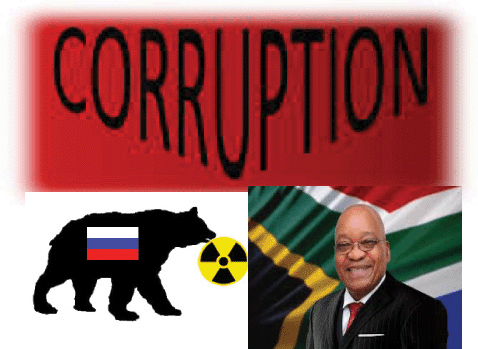 Eskom’s ailing Koeberg nuclear plant a result of years of corruption https://www.thesouthafrican.com/news/eskom-koeberg-nuclear-plant-corruption/ What Eskom continues to do to this country should be viewed as a human rights violation, says Safcei. by Andrea Chothia, 2020-03-12 Eskom’s ailing Koeberg nuclear plant a result of years of corruption https://www.thesouthafrican.com/news/eskom-koeberg-nuclear-plant-corruption/ What Eskom continues to do to this country should be viewed as a human rights violation, says Safcei. by Andrea Chothia, 2020-03-12
The Southern African Faith Communities’ Environment Institute (Safcei) said that Eskom needs to be more realistic about the country’s precarious energy situation and consider whether pushing the Koeberg Nuclear Power Station past its sell-by date is worth risking an energy catastrophe.
Koeberg’s electricity unit 1 has only been up and running for a matter of weeks after it was closed for essential repairs. But after coming back into service in January, it has only returned to cause more problems. About 930 MW of power has been taken off the national grid because of its breakdown.
|
|
Strange turnaround for South Africa’s EFF leader Julius Malema – nuclear best for blacks, renewables for white elites??
Malema goes nuclear on Eskom’s future, Daily Maverick, By Ferial Haffajee• 1 March 2020 Twice in the past month, EFF leader Julius Malema has used high-profile platforms to bat for nuclear energy as a key plank of South Africa’s energy planning. It’s a clear U-turn for the populist leader who was for years vehemently opposed to Zuma’s proposed nuclear deal with Russia.
On Friday, capping a march of thousands of supporters to the Eskom HQ, EFF leader Julius Malema handed over a memorandum to CEO Andre de Ruyter.
In it, he stated a demand he had first made in February in his debate on the state of the nation:
“Eskom should build nuclear power stations using a build, operate and transfer model with a clear illustration of how the private sector will use their money, operate them for an agreed period, transfer operation and maintenance skills to state-employed engineers, artisans, electricians and other skills needed to operate a nuclear power station.”
In his speech in the pouring rain outside Eskom, Malema did not mention nuclear energy, but it is a prominent part of the three-page memorandum, now in Eskom’s hands.
The red sea of EFF marchers who marched for nine kilometres from the Innes Free Park to Megawatt Park signals that Malema and the EFF have entered the energy battle as key protagonists. He appears to now be the political leader of a loose coalition of interests pushing for nuclear energy procurement, the maintenance of coal as a key feedstock for the national grid as well as a slowdown in the pace of renewable energy production.
This places Malema in clear opposition to the “green revolution” pledged by President Cyril Ramaphosa in his 2019 State of the Nation Address and the much larger role for the private sector in energy production outlined by Finance Minister Tito Mboweni in #Budget2020 last week. ….
Nuclear — the black option?
Malema and his deputy president Floyd Shivambu have been long-term opponents of independent power producers selling renewable energy in bid windows opened by Eskom.
There is a growing view across the EFF and sections of the ANC that nuclear is a “black option” for energy professionals who want in on a new market while “renewable energy” is dominated by white capital, in South Africa’s race short-hand.
The reason for this is that the first bid windows featured many European and US multinational companies making a gambit for some of what were then the biggest renewable energy deals in the developing South and also among the most expensive.
Malema’s audacious Eskom march on Friday also revealed a new political front opening up in the energy wars. The EFF aligned with Transform RSA, the movement led by nuclear energy proponent Adil Nchabeleng who is the most prolific and powerful mover behind the lobby opposing renewable energy procurement by Eskom. Nchabeleng was on the EFF stage on Friday; he is also well regarded in the ANC…….
Rosatom, the Russian nuclear agency, uses a build, operate and transfer model across the continent where it has enjoyed great success in getting deals from African leaders.
In addition, it also provides the start-up capital for nuclear power stations in vendor financing deals. Rosatom was close to signing an estimated R1-trillion deal which was strongly punted by former president Jacob Zuma who fired two finance ministers for slow-footing his nuclear ambitions. The company is still hoping South Africa will see the light on energy.
Zuma almost achieved the deal with Russia, but it was stopped in court when Judge Lee Bozalek in April 2017 ruled in favour of the case brought by Earthlife Africa Johannesburg and the Southern African Faith Communities’ Environment Institute (Safcei) against government’s plans to build a fleet of nuclear power stations.
In 2016, Malema set his stall against the nuclear deal. …..
SA’s IRP downgrades nuclear
The pro-nuclear lobby has lost governing party political influence in South Africa – the integrated resource plan launched by Mineral Resources and Energy minister Gwede Mantashe in late 2019 suggested a limited role for nuclear in the future.
It now appears to have powerful new friends in the EFF which has switched its opposition to nuclear power to active support.
While the pro-nuclear, anti-renewables energy lobby says the costs of nuclear are more competitive, the cost of water, solar and other power is steadily coming down. Coal-fired power stations are also quickly losing investor interest as financiers turn away from fossil fuels.
Daily Maverick approached two EFF spokespersons for comment, but did not get a response. DM https://www.dailymaverick.co.za/article/2020-03-01-malena-goes-nuclear-on-eskoms-future/
Algeria’s radioactive legacy from France’s nuclear bomb tests
 Algeria: 60 years on, French nuclear tests leave bitter fallout https://www.dw.com/en/algeria-60-years-on-french-nuclear-tests-leave-bitter-fallout/a-5235435113.02.2020, Author Elizabeth Bryant (Paris)
Decades after the first French nuclear test in Algeria, thousands of victims are still waiting for compensation from the government. Why is France dragging its feet over the issue?
Jean-Claude Hervieux still remembers joining a crowd of soldiers and high-level officials in Algeria’s Sahara desert to witness one of France’s first nuclear tests. Things didn’t go exactly as planned.
Instead of being contained underground, radioactive dust and rock escaped into the atmosphere. Everyone ran, including two French ministers. At military barracks, the group showered and had their radiation levels checked as a crude means of decontamination. “You don’t see nude ministers very often,” Hervieux chuckled.
But as France marks the 60th anniversary of its first nuclear test — near Algeria’s border with Mauritania, on February 13, 1960 — there is not much to laugh about. Critics have long claimed more than three decades of nuclear testing may have left many victims, first in Algeria and later in French Polynesia, where the bulk of testing took place.
But so far, only hundreds have been compensated, including just one Algerian. And as key nuclear testing anniversaries tick by, the unresolved fallout of the nuclear explosions has also fed into longstanding tensions between Paris and its former colony.
It is part of the whole issue of decolonization, and of Algerians asking for French recognition of crimes committed” as a colonial power, said Brahim Oumansour, North African analyst for the Paris-based French Institute of International Relations. For France, he added, doing so might mean “financial compensations in the millions of euros.”
Such issues are off the French government’s current public radar. A major nuclear policy speech last week by President Emmanuel Macron made no mention of them. France’s compensation commission says it has responded to claims that meet criteria set out by law.
The French Defense Ministry and Algerian authorities did not respond to questions about the tests.
A former electrician, Hervieux spent a decade working on the French nuclear tests, first in Algeria and later in French Polynesia. The botched Beryl explosion he witnessed in May 1962 took place two months after Algeria’s independence from France. The desert testing would continue for another four years, thanks to an agreement Paris secured with Algiers. “The showers cleaned our bodies and clothes,” Hervieux said of the Beryl incident, “but not what we breathed in or swallowed.”
Hervieux asked French authorities for the results of his radiation tests. They were bizarre, he said. One claimed to have screened him when he was on vacation; another named his father. He was told yet another had been destroyed on grounds it was contaminated.
Buried everything
Altogether, Paris exploded more than 200 nuclear devices. Most were in remote atolls of French Polynesia, but the first 17 took place in Algeria’s desert. In 1996, French President President Jacques Chirac called a halt to the testing.
When we left Algeria, we dug large holes and we buried everything,” said Hervieux, now 80, of France’s departure from the desert sites, in 1966.
He later joined AVEN, a pressure group for victims of French nuclear tests, although he says he remains healthy.
While he did not witness ill effects in Algeria, Hervieux describes visiting a village in French Polynesia where high radiation levels had been detected. “A local teacher said children were sick and vomiting,” he recalled. “Mothers were asking why their children’s hair was falling out.”
In Algeria, testing sites are still contaminated, activists say, many fenced off by only barbed wire, at best. “I saw radiation levels emitted from minerals, rocks vitrified by the bombs’ heat, which are colossal,” said retired French physicist Roland Desbordes, who has visited the sites. “These aren’t sites buried in the corner of the desert — they’re frequently visited by Algerian nomads,” who recuperate copper and other metals from the detritus.
Indelible scar?
The former president and now spokesman for CRIIRAD, an independent French research group on atomic safety, Desbordes claims the French army has key classified information about the testing it will not open to public scrutiny, including about the health and environmental effects of the explosions. But he believes Algerian authorities also bear some blame.
Each anniversary they talk about how these nuclear tests were not good,” he said, “but it’s also up to them to close off the sites to ensure nobody can access them.”
Reports, including a pair of decade-old documentaries by Algerian reporter Larbi Benchiha, suggest the testing left an indelible scar on local communities. Unaware of the danger, they collected once-buried scrap metal uncovered by desert winds, and turned them into jewelry and kitchen utensils.
Altogether, between 27,000 to 60,000 people from communities surrounding the test sites were affected, according to one Al Jazeera report, citing differing French and Algerian estimates.
But out of more than 1,600 claims filed under a decade-old French compensation law that finally acknowledged health problems from the tests, only 51 have come from Algeria, according to France’s nuclear compensation commission, CIVEN. A separate Supreme Court ruling recently reinstated two extra compensation claims from French Polynesia.
Among other criteria, the 2010 law requires proof of a minimum level of exposure to weapons tests, and offers a list of 23 types of cancers that qualify for compensation.
“There are very few demands and we can only judge those we receive,” said CIVEN Director Ludovic Gerin, who added the Algerian claims didn’t meet compensation criteria.
“We can’t actively search for victims,” he added, “so we’re a bit blocked.”
Vast swarm of locusts ruining the livelihood of 1000s in East Africa
Locust swarm 37 miles long and 25 miles wide threatens crops across swathes of east Africa, ITV News, 17 Jan 2020, A swarm of locusts measured at 37 miles long and 25 miles wide has been tracked in Kenya – and the insects are now threatening to decimate crops across swatches of east Africa.
The most serious outbreak of desert locusts in 25 years is posing an unprecedented threat to food security in some of the world’s most vulnerable countries, authorities say.
Unusual climate conditions are partly to blame.
Kenya’s Intergovernmental Authority on Development said: “A typical desert locust swarm can contain up to 150 million locusts per square kilometre.
“Swarms migrate with the wind and can cover 100 to 150 kilometres in a day. An average swarm can destroy as much food crops in a day as is sufficient to feed 2,500 people.”
Roughly the length of a finger, the insects fly together by the millions and are devouring crops and forcing people in some areas to bodily wade through them.
The outbreak of desert locusts, considered the most dangerous locust species, also has affected parts of Somalia, Ethiopia, Sudan, Djibouti and Eritrea and IGAD warns that parts of South Sudan and Uganda could be next.
The “extremely dangerous” outbreak is making the region’s bad food security situation worse, the United Nations’ Food and Agriculture Organisation has warned.
Hundreds of thousands of acres of crops have been destroyed……. https://www.itv.com/news/2020-01-17/locust-swarm-37-miles-long-and-25-miles-wide-threatens-crops-across-swathes-of-east-africa/?fbclid=IwAR1cn3AzYPruUHLGk_0dgXtQvDvh9bjrehBk7AeCTXeru2AjLKdlmmrYz_g
Nuclear energy for Uganda – a bad option
|
Our nuclear energy option a bad deal, Daily Monitor, TUESDAY JANUARY 7 2020 BY SAM MUCUNGUZI In September 2019, Uganda signed an Inter-Governmental Agreement (IGA) with Russia to build capacity to exploit nuclear technology for energy, medical and other peaceful purposes (the definitions for peaceful can be looked at another day). The government selected Buyende, Nakasongola, Mubende, Lamwo and Kiruhura districts as the potential sites for nuclear power stations. State minister for Energy Simon D’Ujanga attributes the selection of these districts to the presence of water bodies nearby, As we are obsessed with nuclear energy, all seven of Germany’s nuclear power plants are slated to close by 2022, but where will the European country safely bury nearly 28,000 cubic meters of radioactive waste that will stay there for the next million years, as CNN reported? ……. According to the summary of nuclear generation plan from an AF-Consult Switzerland Limited report, the high case scenario for Uganda’s nuclear would involve the setting up of a two-unit nuclear power plant of an installed capacity of 2,300 megawatts (MW). In this scenario, the plant would be commissioned in 2028. Putting up two units with an installed capacity of 2,000MW and the first unit of these two would be commissioned in 2031.The low case scenario would involve the setting up of a one-unit, 1, 000MW nuclear power station, and commissioned in 2034. The summary said the capital expenditure for Uganda’s nuclear power programme 2020–2040 would be about Shs37.2 trillion for the best case scenario. For the low case scenario, the capital expenditure would be Shs18.6
The financing of this project will most likely be oil money which is anticipated at $3.6b ( about Shs13.6 trillion) annually from oil and gas. Oil will last for 25 years, however, if the current and future generation is to benefit, we need to stop looking at investments that don’t worsen the already damaged environment and worsening climate change.
If the superpower with experience, money and technology is closing who are we to venture into this risky and dangerous energy source?
Government has ignored to look at the smart and clean options of renewable energy generation for Uganda. Solar energy, for instance, is cheap, safe and clean, we have all year round good weather. Noor complex for example, located in Sahara desert (Morocco) will produce 580 MW when completed in 2020, and aims to produce enough energy to power over one million homes by the end of the year and reduce carbon emissions by an estimated 760,000 tonnes per year. This is slightly below what Uganda consumes at peak power demand by only 45mw. Noor only cost $625m. Coordinator, Citizens’ Concern Africa https://www.monitor.co.ug/OpEd/Letters/nuclear-energy-government-Inter-Governmental-Agreement-bad-deal/806314-5409596-sua1p0/index.html
|
|
Hazards of Russia’s nuclear colonialism- example South Africa
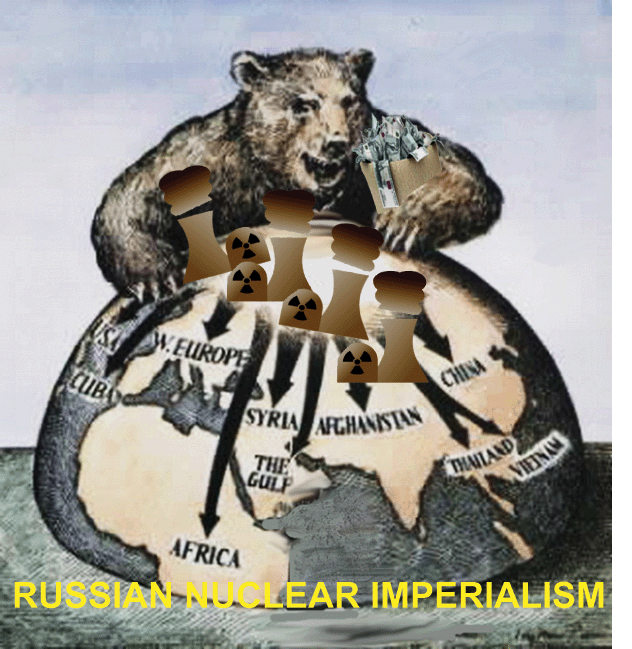
 Africa, Russia squandered close ties with the South African government by overplaying its hand and getting caught up in a corrupt nuclear energy pact. Carnegie Endowment For International Peace (thoroughly researched and referenced) 16 Dec 19,
 SUMMARY
 Amid the widespread attention the Kremlin’s recent inroads in Africa have attracted, there has been surprisingly little discussion of South Africa, a country which, for nearly a decade, unquestionably represented Russia’s biggest foreign policy success story on the continent. As relations soared during the ill-starred presidency of Jacob Zuma (2009–2018), the Kremlin sought to wrest a geopolitically significant state out of the West’s orbit and to create a partnership that could serve as a springboard for expanded influence elsewhere in Africa. Continue reading
 South Africa to create extra space for nuclear waste
Business Times, WED, NOV 27, 2019 [JOHANNESBURG] Radioactive waste storage facilities at South Africa’s nuclear power station Koeberg will fill up next year, the power utility Eskom said Tuesday, adding it has begun creating extra space.
South Africa is the only country on the continent with a civilian nuclear industry, and its two reactors have been in service for more than 30 years.
The Koeberg nuclear power plant, located outside Cape Town, produces 1,860 megawatts contributing about four percent of the national power output.
Eskom in a statement that its “spent fuel pools are essentially full in 2020 and for this reason a project was initiated to create additional space”…….
Koeberg was originally set to be mothballed in 2024, four decades after its inception, but it is being upgraded and it is now expected to operate until 2044.
Environmental campaigners have warned against the nuclear project.
“It is incredibly short-sighted for the government to pursue extending Koeberg’s lifespan, potentially at the expense of our safety,” Melita Steele, Greenpeace Africa’s Climate and Energy Campaign Manager said Tuesday.
“Not only are South Africans going to have to fork out more money for more storage for high-level radioactive waste, but there is also no long-term solution for this waste, which can remain radioactive for hundreds of thousands of years,” Ms Steele said.
Currently, 90 per cent of the country’s electricity is generated from coal-fired stations.
The government last year dropped controversial plans to build new nuclear power stations, deals that had been initiated by former leader Jacob Zuma and that could have bankrupted the country to enrich his allies. https://www.businesstimes.com.sg/energy-commodities/south-africa-to-create-extra-space-for-nuclear-waste
South Africa’s nuclear waste storage almost completely full; a dangerous situation
 Waste storage at Africa’s only nuclear plant brimming, Channel News Asia, 25 Nov 19, CAPE TOWN: Spent fuel storage at South Africa’s Koeberg nuclear plant will reach full capacity by April as state power utility Eskom awaits regulatory approval for new dry storage casks, the company said on Monday (Nov 25).
Storage of high-level radioactive waste is a major environmental concern in the region, as South Africa looks to extend Koeberg’s life for another two decades and mulls extra nuclear power plants.
Koeberg, Africa’s only nuclear facility, is situated about 35km from Cape Town and was connected to the grid in the 1980s under apartheid.
“The Koeberg spent fuel pool storage capacity is currently over 90 per cent full. (These) pools will reach (their) capacity by April 2020,” Eskom told Reuters in a statement.
Koeberg produces about 32 tonnes of spent fuel a year. Fuel assemblies, which contain radioactive materials including uranium and plutonium that can remain dangerous for thousands of years, are cooled for a decade under water in spent fuel pools….
Anti-nuclear lobby group Earthlife Africa said South Africa could not afford the social, environmental and economic costs associated with nuclear waste.
“We have a ticking bomb with high-level waste and fuel rods at Koeberg,” said Makoma Lekalakala, Earthlife Africa’s director. https://www.channelnewsasia.com/news/world/waste-storage-at-africa-s-only-nuclear-plant-brimming-12123664 brimming-12123664
The push for nuclear power in Africa, but what happens to the wastes?

|
What happens to nuclear waste from power plants? DW, 14 Nov 19African countries looking to invest in nuclear energy as a source of clean electricity should consider Europe’s struggles with disposing of radioactive waste. Seventy years after the nuclear age began, no country has built a place to safely store its waste, a report published this week warns, raising concerns for governments mulling nuclear power as an alternative to fossil fuels.More than 60,000 tons of highly radioactive waste in the form of spent nuclear fuel rods are stored in interim sites across Europe, according to the World Nuclear Waste Report, some in old facilities that are running out of capacity and are expected to be used for decades longer than planned. Finland is the only country building a permanent repository underground for nuclear waste that emits large amounts of radiation for tens of thousands of years, according to the report published by the Heinrich Böll Foundation — which is affiliated with the German Green party.
“We are talking about time frames that are beyond the human scale of what we can think of,” said Arne Jungjohann, political scientist and lead editor of the report. “We still don’t know where to put the waste safely in a way that nobody will get harmed, that it is not vulnerable to terrorist attacks, that it is not being stolen to build nuclear bombs.” At the dawn of the nuclear age, radioactive material was diluted and dumped in the environment, before governments moved towards containing it securely underground. But projects from the 1960s onwards only met high safety expectations “to a very limited extent, if at all,” according to the report. That raises difficult questions for developing countries looking to get into nuclear. Nuclear Power in Africa Africa’s urban population is set to double in the next three decades, massively boosting demand for infrastructure and energy. Just half of Africans had access to electricity in 2017, compared to a global average of 88%, World Bank data shows. Eager to connect citizens with electricity grids, but anxious to avoid high-emissions of Western countries, some governments are exploring nuclear as a way to supply cheap and stable energy. South Africa is the only country on the continent that currently operates a nuclear plant, but about a dozen others are considering, planning or building them, according to the World Nuclear Association. Several countries — Algeria, Egypt, Ghana, Kenya, Namibia, Nigeria, Tanzania, Uganda and Zambia — have signed partnership agreements with Russian nuclear energy company Rosatom, a paper published in the journal Issues in Science and Technology found earlier this year, and others have contracts with China…….. attempts to deal with nuclear waste have so far faltered. Excluding Russia and Slovakia due to poor data, the report found that just four countries — France, the UK, Ukraine and Germany — are responsible for more than half of Europe’s nuclear waste, and none have yet found a deep underground store to hold it over centuries. The Heinrich Böll Foundation report found many governments underestimate the cost of storing waste and decommissioning reactors, with inconsistent rules shifting the financial burden from plant operators onto future generations of taxpayers. Unsolved nuclear waste is the “defeating argument against entering into the nuclear age,” said Rebecca Harms, a former Member of the European Parliament who was behind the report. “African countries should consider the nuclear legacies which have been created during the last 50, 60 years and for which we have no solutions.” Demand for energy in Sub-Saharan Africa is set to rise by 60% in the next two decades, but nuclear sources are projected to meet only a small fraction of this, according to the Africa Energy Outlook 2019, a report from the International Energy Agency (IEA) published on Thursday. “What we see in the future economic development of sub-Saharan Africa will be powered by a mix of renewables and natural gas,” said Kieran McNamara, senior energy analyst at the IEA and co-author of the report. “Nuclear just doesn’t feature.” https://www.dw.com/en/what-happens-to-nuclear-waste-from-power-plants/a-51216359 |
|
African countries being conned into nuclear debt, by Russia
 African countries rush to sign nuclear deals with Russia, Daily Maverick By Peter Fabricius• 29 October 2019
But concerns are being raised about whether they can all afford nuclear energy.
The Russian nuclear power corporation Rosatom has already signed nuclear cooperation agreements with about 18 African counties, as Russia accelerates its drive for nuclear business on the continent.
The growing commitment of African countries to high capital cost nuclear energy has raised some concern about whether they are committing themselves to unaffordable debt.
Rosatom director-general Alexey Likhachev revealed a large number of nuclear agreements with African countries after signing an intergovernmental agreement on cooperation in the peaceful uses of nuclear energy with the Ethiopian Minister of Innovation and Technology, Getahun Mekuria Kuma, during the Russia-Africa Summit in Sochi on the Black Sea last week.
Mekuria later told the Russian official news agency Tass that Ethiopia had plants to build a nuclear power plant.
Rosatom later also signed an agreement with Rwanda at the summit on cooperation for the construction of a centre of nuclear science and technology in Rwanda. Rosatom had a strong presence at the economic forum which paralleled the political summit. The Rosatom stand attracted scores of interested African government officials on the sidelines of the forum. …..
Likhachev told journalists after the discussion that Rosatom had now signed memoranda of understanding or intergovernmental agreements with about one-third of countries on the continent – about 18. He could not say how many of these were about scientific cooperation and how many were about producing nuclear energy “because very often those two tracks go hand in hand”.
But he did say in the discussion that about half of the African countries with which Rosatom had signed nuclear agreements were actively discussing joint projects with the corporation, which had been stipulated in contracts. The most advanced joint project is with Egypt, which has contracted Rosatom to build a 4,800MW nuclear power plant……
“We are ready to propose to Ethiopia cutting-edge solutions of nuclear technology. And our Ethiopian partners are invited to visit nuclear facilities in our country.
“Apart from larger capacity nuclear power plants, we also stand ready to offer smaller capacity, modular reactors.”
……..However, the apparent rush to nuclear energy by African countries has raised some concerns that they may be committing themselves to high capital costs of nuclear power production which they will be unable to afford.
Analysts have noted that even South Africa, one of the top two economies on the continent, backed away from an apparent commitment by former president Jacob Zuma to order 9,600MW of nuclear power plant production from Rosatom – at an estimated cost of about R1-trillion.
President Cyril Ramaphosa said after meeting Putin on the sidelines of the summit that the Russian president had once again asked him if South Africa was still interested in building a nuclear power plant and he had told him once again that it still could not afford to.
An African minister at the summit told Daily Maverick that although power plants could be an important source of economic growth, African countries were sinking further into debt and had to be careful to ensure they could afford the infrastructure they built.
Likhachev defended nuclear energy as an economical source of electricity over the long term. ……….
Olivier Nduhungirehe, Rwandan minister in charge of the East African community would not be drawn on the cost and affordability implications, saying the details of the agreement would be announced in due course. https://www.dailymaverick.co.za/article/2019-10-29-african-countries-rush-to-sign-nuclear-deals-with-russia/
Russia’s Rosatom nuclear firm targets its marketing at African countries
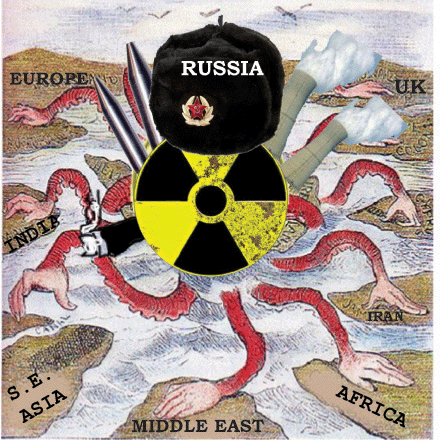
- Russian developer has signed over a dozen agreements in Africa
- Various financing options being considered for the plant build
Rosatom Corp., is eyeing Africa as one of its “priority regions” to build more nuclear reactors and expand its business……(Subscribers only) https://www.bloomberg.com/news/articles/2019-10-30/russia-s-rosatom-focuses-on-africa-for-its-nuclear-expansion
No nuclear in South Africa’s future energy mix
The plan – which builds on a relatively well-received draft announced last year – makes some significant advances in changing South Africa’s energy mix. For example, it significantly ups the contribution of wind as well as solar power to South Africa’s overall energy allocation. The production of power from wind is expected to grow by 900% by 2030, and power from solar photovoltaic by 560%……
Ultimately economic realities dictate that coal and nuclear cannot compete with renewable technologies. These are already much cheaper, and their cost continues to drop by the year.
Even with maximum political will, a nuclear build cannot be realised without convincing investors and the public that it makes economic sense. It doesn’t……..https://theconversation.com/south-africas-future-energy-mix-wind-solar-and-coal-but-no-nuclear-111106
Misuse of funds in South Africa”s nuclear reactor project
Is this outfit similar to Australia’s ANSTO and its Lucas Heights reactor? They both seem like mavericks running their own show without accountability
The letter reveals that Necsa has been making massive operating losses since 2014, which have deteriorated over the years, and has resulted in various ring-fenced funds being irregularly used to meet operating expenses, including salaries.
For example, the letter says that in financial year (FY) 2018/19, Necsa raided R268-million from the Safari low-enriched uranium (LEU) spent Fuel Waste Disposal Fund, which was meant for future disposal of spent nuclear fuel waste, in order to meet operating costs.
The Safari-1 reactor became one of Necsa’s cornerstone facilities, especially during the mid 1990’s, where it’s main application was to be a cost-sustainable facility operating as a commercial production facility of radioisotopes and the rendering of irradiation services.
Furthermore, in FY 2017/18, the letter indicates that Necsa borrowed R58,5-million from its subsidiary, NTP Radioisotopes, which was to be repaid in 2019, but was subsequently unilaterally extended to 2021 when it became clear that Necsa could not afford to repay NTP Radioisotopes.
In FY 2016/17, Necsa is said to have used R100-million of investments of the Safari LEU Spent Fuel Waste Disposal Fund as security for a R100-million overdraft facility from Nedbank, which the bank later withdrew due to the absence of a turnaround strategy to address Necsa’s strained financial position.
This, according to the letter, then forced Necsa to raid R100-million from the Safari LEU Spent Fuel Waste Disposal Fund to meet operating costs, and this R100-million was later repaid to the Fund from government grant funding.
The effect of the unconventional funding interventions in previous years, says the letter, was that about R445-million of ring-fenced funds were used for operations, despite being meant for other purposes, thus negatively affecting Necsa’s liquidity and solvency.
The letter further says that Necsa has been technically bankrupt since about 2016, and has survived using ring-fenced funds, which has cumulatively had an impact on the going concern status on the entity – a challenge which the current board is now faced with.
This letter from the new Necsa board to Parliament follows a damning audit report by the Auditor General of South Africa detailing the maladministration and irregular expenditure under the former Necsa board. The qualified audit report was attached Necsa’s financial statements for FY 2017/18, which were tabled about six months late by the former board.
Necsa’s financial statements for FY 2018/19 are also late, as the new board grapples with the political turmoil and disruptive actions by labour union NEHAWU. It is expected that there will be further explosive revelations by the Auditor General.
The entire former board of Necsa was removed by the former minister of energy, Jeff Radebe, in December 2018, and there is ongoing litigation in this regard.
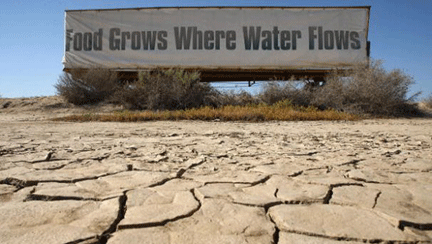
Desertification and Drought – Sahara
|
COMBATING DESERTIFICATION AND DROUGHT
Displaced by the Desert: An expanding Sahara leaves Broken Families and Violence in its Wake, IPS News By Issa Sikiti da Silva 25 Oct 19, “……… In 2012, various groups of Tuareg rebels grouped together to form and administer a new northern state called Azawad. The civil strife that resulted drove many from their homes, with communities often fleeing with their livestock, only to compete for scarce natural resources in vulnerable host communities, according to the United Nations.
After the security situation began to improve in 2013, many returned home to rebuild their lives and livelihoods. But soon it was the turn of the expanding Sahara Desert, drought and land degradation that became the next driver of their displacement. “As time went by, the land became useless and we found ourselves having no more land to work on. Nothing would come out that could feed us, and our livestock kept dying due the lack of water and grass to eat, ” Abdoulaye recalls. “Drought across the Sahel region, followed by conflict in northern Mali, caused a major slump in the country’s agricultural production, reducing household assets and leaving many of Mali’s poor even more vulnerable,” FAO says. “We used to move up and down with our livestock, looking for water and grass, but most of the times we found none. Life was unliveable. The Sahara is coming down, very fast,” Abdoulaye says emotionally……….. Threatened with creeping desertification …The U.N. says nearly 98 percent of Mali is threatened with creeping desertification, as a result of nature and human activity. Besides, the Sahara Desert keeps expanding southward at a rate of 48 km a year, further degrading the land and eradicating the already scarce livelihoods of populations, Reuters reported. The Sahara, an area of 3.5 million square miles, is the largest ‘hot’ desert in the world and home to some 70 species of mammals, 90 species of resident birds and 100 species of reptiles, according to DesertUSA. And it is expanding, its size is registered at 10 percent larger than a century ago, LiveScience reported. The Sahel, the area between The Sahara in the north and the Sudanian Savanna in the south, is the region where temperatures are rising faster than anywhere else on Earth. The cost of land degradation is currently estimated at about $490bn per year, much higher than the cost of action to prevent it, according to UNCCD recent studies on the economics of land desertification, land degradation and drought. Roughly 40 percent of the world’s degraded land is found in areas with the highest incidence of poverty and directly impacts the health and livelihoods of an estimated 1.5 billion people, according to the U.N. In a country where six million tonnes of wood is used per year, reports say Malians are mercilessly smashing their already-fragile landscape, bringing down 4,000 square kilometres of tree cover each year in search for timber and fuel……….. What is being done?Projects such as the U.N. Convention to Combat Desertification’s Land Degradation Neutrality project aimed at preventing and/or reversing land degradation are some of the interventions to stop the growing desert.
Everyone, including terrorists are equal in the face of the expanding SaharaBut there remain gaps and many in Mali still remain affected. Community leader Hassan Badarou spent several years teaching Islam in rural Mali and Niger. He tells IPS Mali has a very complex situation. “It is not easy to live in these areas. People there face double threats. It is double stress to flee from both armed conflict and desertification. And such people need to be welcomed and assisted, and not be seen as a threat to locals livelihoods……….. http://www.ipsnews.net/2019/10/displaced-desert-expanding-sahara-leaves-broken-families-violence-wake/?utm_source=English+-+IPS+Weekly&utm_campaign=2391e81e36-EMAIL_CAMPAIGN_2019_10_24_01_01&utm_medium=email&utm_term=0_eab01a56ae-2391 |
|
China buried nuclear waste in Sudan desert
Official: China buried nuclear waste in Sudan desert, Dabanga November 12 – 2015 KHARTOUM, China has buried dozens of containers with toxic waste in the desert of Northern Sudan, according to a high-ranking official. The waste was most probably coming from nuclear plants in China.
According to the former director of the Sudan Atomic Energy Commission in Sudan, Mohamed Siddig, 60 containers have been brought to Sudan together with construction materials and machinery for the building of the Merowe Dam (Hamdab Dam) in the Northern part of Sudan. He did not mention the exact year of the import and the date the nuclear waste was disposed. China worked on the dam between 2004 and 2009.
During a conference held by the Sudanese Standards and Metrology Organisation (SSMO) in Khartoum on Tuesday, he disclosed how the Sudanese authorities allowed the import of the waste ‘without inspection’. He told the audience that 40 containers were buried in the desert not far from the Merowe Dam construction site. Another 20 containers were also disposed in the desert, though not buried. Mohamed Siddig was quoted by several local reporters, of whom some did not mention China, but ‘an Asian country’ instead. During the conference, titled ‘Raising awareness of the danger of chemicals’, Siddig said that a ‘number of Asian industrial countries’ had approached African countries to dispose their nuclear and other toxic waste…….https://www.dabangasudan.org/en/all-news/article/official-china-buried-nuclear-waste-in-sudan-s-desert?fbclid=IwAR1ScnDQ-6EcDBv2m2EhIqjnunbBnCpt5Ell_xuiNgFAhQapNqR0dF1ykMI
1 This Month

of the week – Shut Down Drone Warfare!


Tell the Ukrainian Government to Drop Prosecution of Peace Activist Yurii Sheliazhenko

Petition to revoke the licensing of the Near Surface Nuclear Disposal Facility (NSDF) at Chalk River. https://www.ourcommons.ca/petitions/en/Petition/Details?Petition=e-7247
To see nuclear-related stories in greater depth and intensity – go to https://nuclearinformation.wordpress.com
-
Archives
- April 2026 (7)
- March 2026 (251)
- February 2026 (268)
- January 2026 (308)
- December 2025 (358)
- November 2025 (359)
- October 2025 (376)
- September 2025 (257)
- August 2025 (319)
- July 2025 (230)
- June 2025 (348)
- May 2025 (261)
-
Categories
- 1
- 1 NUCLEAR ISSUES
- business and costs
- climate change
- culture and arts
- ENERGY
- environment
- health
- history
- indigenous issues
- Legal
- marketing of nuclear
- media
- opposition to nuclear
- PERSONAL STORIES
- politics
- politics international
- Religion and ethics
- safety
- secrets,lies and civil liberties
- spinbuster
- technology
- Uranium
- wastes
- weapons and war
- Women
- 2 WORLD
- ACTION
- AFRICA
- Atrocities
- AUSTRALIA
- Christina's notes
- Christina's themes
- culture and arts
- Events
- Fuk 2022
- Fuk 2023
- Fukushima 2017
- Fukushima 2018
- fukushima 2019
- Fukushima 2020
- Fukushima 2021
- general
- global warming
- Humour (God we need it)
- Nuclear
- RARE EARTHS
- Reference
- resources – print
- Resources -audiovicual
- Weekly Newsletter
- World
- World Nuclear
- YouTube
-
RSS
Entries RSS
Comments RSS
 nuclear-news