Scottish Council calls on big pension fund to stop investing in weapons makers

The Ferret 5th March 2021, Inverclyde Council has called on Scotland’s largest council pension fund to stop investing in arms and to commit to ethical investments. A motion was passed this week after Inverclyde Council was told that Strathclyde Pension Fund (SPF) held shares in 11 of the world’s 20 biggest arms manufacturers, including some involved in the production of nuclear weapons. The council’s decision has been welcomed by Campaign Against Arms Trade, Nuclear Free Local Authorities (NFLA) and Don’t Bank on the Bomb.
https://theferret.scot/inverclyde-council-pension-fund-invest-ethically/
A new setback for France’s Flamanville nuclear reactor
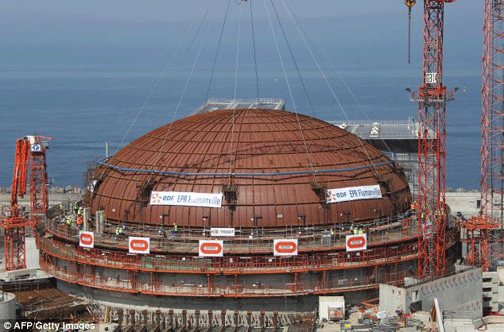 La Presse de la Manche 5th March 2021, Nuclear: a new setback for the Flamanville EPR. A “significant event” was declared on March 2, 2021 to the Nuclear Safety Authority, concerning taps on the main primary circuit of the EPR reactor. While the file of the welds to be resumed on the main secondary circuit , the steam circuit in fact, is still being examined by the Nuclear Safety Authority , EDF declared on March 2 to ASN a new “event”. significant “. It concerns deviations from the study reference system on three taps of the main primary circuit of the Flamanville EPR reactor. |
President Rouhani says that Iran is prepared to fulfil nuclear deal commitments
 Iran prepared to fulfill nuclear deal commitments, president tells Coveney
Hassan Rouhani says United States must lift ‘illegal sanctions’ during Tehran meeting with Minister. Irish Times,7 Mar 21,
In a meeting with Minister for Foreign Affairs Simon Coveney, Mr Rouhani said: “Iran is ready to immediately take compensatory measures based on the nuclear deal and fulfil its commitments just after the US illegal sanctions are lifted and it abandons its policy of threats and pressure.”
The Iranian leader criticised the European signatories of the historic nuclear deal for what he said was their inaction on their commitments to the agreement. He said Iran was the only country that kept its side of the bargain………. https://www.irishtimes.com/news/politics/iran-prepared-to-fulfill-nuclear-deal-commitments-president-tells-coveney-1.4503539
UN’s nuclear watchdog agency will not be ‘bargaining chip’ in Iran nuclear deal,
UN’s nuclear watchdog agency will not be ‘bargaining chip’ in Iran nuclear deal, https://news.un.org/en/story/2021/03/1086092 The head of the UN’s nuclear watchdog agency told journalists on Monday that inspections in Iran should not be used as a “bargaining chip” to revive a troubled nuclear deal.
After speaking to the International Atomic Energy Agency’s (IAEA) Board of Governors, Director General Rafael Grossi told a press conference that while the agency had opened a window of opportunity for diplomacy in Iran, it should not be put in the middle of negotiations between Iran, the United States and other nations over the deal.
On 15 February, Iran announced that it would stop implementing “voluntary transparency measures” in the Joint Comprehensive Plan of Action (JCPOA), known commonly as the Iran nuclear deal, along with other arrangements in Iran’s Safeguards Agreement.
The IAEA chief said to the 35-nation board that a “temporary bilateral technical understanding” had been agreed upon during his visit to the country last month that would enable the UN agency to “resume its full verification and monitoring of Iran’s nuclear-related commitments under the JCPOA if and when Iran resumes its implementation of those commitments”.
Serious concern
The IAEA chief also raised the alarm that nuclear activities in the Democratic People’s Republic of Korea (DPRK), commonly known as North Korea, remains “a cause for serious concern”.
“The continuation of the DPRK’s nuclear programme is a clear violation of relevant UN Security Council resolutions and is deeply regrettable”, Mr. Grossi said, adding that the Vienna-based agency was intensifying its readiness “to play its essential role in verifying North Korea’s nuclear programme”.
Reviewing nuclear safety
The IAEA chief also drew attention to the agency’s Nuclear Safety Review 2021, which provides an overview of the agency’s activities and global trends in nuclear, radiation, transport and nuclear waste safety protcols, as well as in emergency preparedness and response.
“This year, it also identifies the priorities in these areas, and provides an analytical overview of overall trends”, he said.
Moreover, the UN official flagged IAEA’s work in strengthening global preparedness for future pandemics through its Zoonotic Disease Integrated Action (ZODIAC) initiative on diseases, that jump from animals to humans – the common path for viruses such as COVID-19.
He said the initiative will help to reduce the chance that the next outbreak will wreak “the deadly destruction we are suffering today”.
And Mr. Grossi informed the members that last week, IAEA signed revised arrangements with the Food and Agriculture Organization (FAO) to “help Member States respond to emerging challenges from climate change to outbreaks of zoonotic diseases”.
Climate on the table
As the Agency prepares for the 2021 UN Climate Change Conference, known as COP26, scheduled for November in Glasgow, Scotland, Mr. Grossi said that he would personally deliver the message that “nuclear energy has a seat at the tables when the world’s future energy and climate policies are being discussed”.
“Almost five years after the signing of the Paris Agreement, governments are becoming increasingly aware that they must shift from fossil fuels to nuclear and other low-carbon technologies, if they are to reach their net zero objectives”, Mr. Grossi said.
The Director-General concluded by assuring that the agency was continuing its work on advancing gender equality, and invited Member States to join a panel discussion with some of the IAEA’s early women pioneers on 8 March, International Women’s Day.
Iran nuclear deal: a summary
-
- What is the Iran nuclear deal? The 2015 “Joint Comprehensive Plan of Action” (JCPOA), sets out rules for monitoring Iran’s nuclear programme, and paves the way for the lifting of UN sanctions.
- Which countries are involved? Iran, the five members of the Security Council (China, France, Russia, UK, US), plus Germany, together with the European Union.
- What is the UN’s involvement? A UN Security Council resolution to ensure the enforcement of the JCPOA, and guarantee that the UN’s atomic energy agency, the IAEA, continues to have regular access to and more information on Iran’s nuclear programme, was adopted in 2015.
- Why is the deal at risk? The current US Administration pulled out of the deal in 2018 and re-imposed sanctions. In July 2019, Iran reportedly breached its uranium stockpile limit, and announced its intention to continue enriching uranium, posing a more serious proliferation risk.
Most 2011 quake, Fukushima crisis survivors back ending nuclear power
March 6, 2021 (Mainichi Japan) TOKYO (Kyodo) — About four in five survivors of the 2011 earthquake, tsunami and Fukushima nuclear crisis in northeastern Japan support abolishing nuclear power generation immediately or gradually, a Kyodo News survey showed Saturday nearly 10 years after the disaster.
Some 30 percent of respondents said all nuclear power plants should be abolished immediately, with 52 percent supporting phasing out nuclear power and eventually eliminating it.
The poll conducted in November in the three hardest-hit prefectures of Iwate, Miyagi and Fukushima had 300 respondents and found that only 15 percent were in favor of restarting nuclear reactors and relying on them in the future.
Following a magnitude-9.0 earthquake and subsequent tsunami that hit on March 11, 2011, the Nos. 1 to 3 reactors at the Fukushima Daiichi nuclear plant owned by Tokyo Electric Power Company Holdings Inc. suffered meltdowns.
Decommissioning work continues to prove difficult and evacuation orders are still in place in some areas around the complex a decade after the world’s worst nuclear accident since the 1986 Chernobyl disaster.
All reactors in Japan were halted after the nuclear crisis but some have resumed operations in recent years under stricter safety regulations. The government aims for renewable energy to account for 50-60 percent of overall electricity by 2050 while relying on 30-40 percent from thermal power and nuclear energy.
By prefecture, 40 percent of respondents in Fukushima supported an immediate exit from nuclear energy, higher than 27 percent in Iwate and 24 percent in Miyagi.
Hiromi Suzuki, a 59-year-old evacuee from Namie, close to the crippled nuclear plant, said consumers remain concerned that fish from Fukushima may be contaminated with radiation…..https://mainichi.jp/english/articles/20210306/p2g/00m/0na/065000c
How Scotland’s Dunoon became an American nuclear base, and a target
|
60 years on: The day the US Navy came armed with nuclear missiles https://www.heraldscotland.com/news/19140712.60-years-day-us-navy-came-armed-nuclear-missiles/ By Sandra Dick 7 Mar 21, THE sun shone brightly over the calm Holy Loch on a beautiful early March day in 1961, as USS Proteus – 18,000 tons of American might – glided towards her foe.
By late afternoon, she was passing Islay. And as the US Navy vessel drew closer to her final destination, anti-nuclear demonstrators who had been waiting for weeks for the chance to pounce, braced themselves for their attack. The first salvo of a David versus Goliath battle saw protesters in dinghies and canoes pitted against the most menacing of modern warfare, and it would rage – on and off – for months to come. It’s now 60 years since USS Proteus, soon followed by a fleet of US Navy Polaris submarines, set up base close to Dunoon. And although the area was not unfamiliar with submarine activity – Royal Navy submarines were based in the area throughout the Second World War – the Americans, with their terrifying nuclear arsenal, a raging Cold War and the relatively fresh memories of Hiroshima and Nagasaki, meant this was no normal military manoeuvre. The US Navy and Polaris would remain a feature of the Dunoon landscape for the next 31 years. For those who could put aside any concerns of living with nuclear missiles on their doorstep, it brought economic and social benefits – and more than a few weddings between US sailors and local women. For others, the presence of the American nuclear force put a picturesque and peaceful corner of the country in Soviet crosshairs, and propelled Scotland into the very core of a deadly nuclear war machine. The announcement that the Americans were coming was completely unexpected, recalls historian Trevor Royle, who has written about the Holy Loch base in his book on the Cold War in Scotland, ‘Facing The Bear’. “It came as a great surprise to people of Scotland – it was a shock to suddenly have the Cold War on their doorstep,” he says. America needed an operating base for their Polaris fleet,” he adds. “At the time Britain’s nuclear deterrent was V Bomber Force, obsolete bombers that could fly to Moscow and drop bombs but couldn’t get back. It was a one-way mission, and Britain wanted a system which worked better than that.” Faced with being left behind as a nuclear nation, Prime Minister Harold Macmillan struck a deal with President Dwight D. Eisenhower for the Holy Loch to become an extension of US territory and a berth for nuclear bombs. In return, Britain would acquire the Polaris nuclear delivery system, enabling the Royal Navy to operate its own fleet from Faslane. However, the announcement in November 1960, propelled Holy Loch communities into a world of US and Soviet war games, which would see submarines play cat and mouse across fishing grounds and Atlantic waters. Most Scots, says Trevor, accepted what was heading their way. Some, among them taxi drivers and bed and breakfast businesses around Dunoon who had feared cheap foreign holidays were set to scupper the tourist trade, were more than happy. Others were outraged. Isobel Lindsay was just 17 years old at the time and secretary of Lanarkshire CND. Soon, she’d be among hundreds to descend on Dunoon to express outrage at the arrival of nuclear weapons in Scottish waters. “The announcement came out of the blue,” she recalls. “Until then, there had been a small anti-nuclear movement in Scotland. But this ignited it.” The arrival of the Polaris fleet’s support ship, USS Proteus, with its crew of 980 officers and men and the prospect of up to 500 dependent families on the way, signalled a call to action; protestors took to the water in tiny crafts to wave anti-nuclear banners and flags and 1,000 protesters marched along the loch. A week later, the Patrick Henry arrived, the first of ten Polaris submarines and with its 135 crew primed at a minute’s notice to blast off up to 16 Polaris rockets, each capable of destroying a city 1500 miles away. It was greeted by a lone canoeist who, after a valiant 15-minute chase by eight patrol vessels, was deliberately tipped in the water. Isobel, whose father had been among the first British forces to enter Hiroshima in the wake of the 1945 atomic bomb, remembers the protest movement growing in size. “Very quickly there were demonstrations in Glasgow and at the Holy Loch,” she says. “One march was organised from London to a 24-hour sit down that blocked Ardnadam pier. “The police tactics were to leave us sitting there – the sailors had to clamber over us to get to the pier.” Protest songs were hastily written, including Ding Dong Dollar, which set those keen to benefit financially from the base against those opposed to nuclear weapons, while protests were laboriously organised by letter, calls from phone boxes and plotted on maps. By May, a two storey floating barracks had been towed to the Holy Loch, providing accommodation for up to 350 personnel, and attitudes towards the protestors hardened. Canoeists who dared to approached US vessels were sprayed with jet hoses, on land, demonstrators were met by dozens of police, wire mesh, iron railings, barbed wire and ‘black Marias’. In Dunoon, locals picked their way between protestors and US Navy sailors. And while taxi drivers enjoyed a boom in business and generous tips, Glasgow’s prostitutes also descended. “It was a great culture shock,” adds Trevor. “Until then, the only knowledge most people had of Americans came from the movies. The Americans came with the crew cuts and smart clothes. It was like Hollywood had come to Dunoon.” Up to 4,000 Americans were attached to the Holy Loch base, their children attended local schools and accommodation was snapped up. But, says Trevor: “Dunoon was very much a target in the event of any nuclear hostilities. “In addition to Polaris submarines, the Holy Loch was home to Hunter Killer submarines, and they all played the most dangerous games of cat and mouse with their Soviet opposite numbers. “Many fishing boats were caught up, among them the Antares.” The small trawler sank in November 1990 after its nets became tangled with an RN submarine. All four crew lost their lives. By that time, Polaris protestors had turned their attention to Faslane instead. And as the Cold War ended, the US Navy packed up. The last ship left in March 1992. “They left nothing behind,” adds Trevor. “Apart from the American sailors who found themselves in a foreign country and made friends with the local girls, fell in love and married, you would have to search hard to know there had been a US presence there at all.” |
|
Bill in U.S. Congress to stop new nuclear-armed, sea-launched cruise missile
|
Lawmakers aim to prevent sea-based nuclear cruise missile, Defense News,
By: Joe Gould 7 Mar 21, WASHINGTON ― Two Democratic lawmakers are introducing legislation to kill the nuclear-armed, sea-launched cruise missile set to begin development next year and its associated warhead.
Maryland Sen. Chris Van Hollen, a lead appropriator, and House Seapower Subcommittee Chairman Joe Courtney, of Connecticut, planned Thursday to unveil the bill, a copy of which was obtained by Defense News. It’s the latest sign of pressure on President Joe Biden from his own party to scale back nuclear plans formed under the Trump administration. The bill would prohibit research and development, production, and deployment of the missile, known as the SLCM-N, arguing that the Obama administration found a similar weapon, the TLAM-N, redundant and retired it. The lawmakers say the cost of the SLCM-N would top the Congressional Budget Office estimate of $9 billion. In a statement, Courtney said that installing nuclear warheads on Virginia-class attack subs would sap resources from growing the Navy’s fleet and distract from the core mission of attack submarines in the Pacific and European theaters, where they are typically laden with ship-killing, conventional Tomahawk missiles. “This legislation is a common-sense bill that will stop the hemorrhaging of precious Navy dollars for a wasteful program that Congress barely debated.” Courtney said………. https://www.defensenews.com/congress/2021/03/04/lawmakers-aim-to-prevent-sea-based-nuclear-cruise-missile/ |
|
Fukushima nuclear decommissioning not really under control- persistent highly radioactive debris remains

|
FOCUS: Decades-long challenge to scrap Fukushima plant by 2051 in a bind. By Junko Horiuchi, KYODO NEWS – Mar 1, 2021 The decades-long challenge to scrap the Fukushima Daiichi nuclear plant, crippled by the massive earthquake and tsunami disaster that struck northeastern Japan in 2011, is becoming more complex as recent remote-controlled probes have highlighted just how damaged the reactors are.Tokyo Electric Power Company Holdings Inc., operator of the six-reactor nuclear complex, aims to scrap the plant between 2041 and 2051. But critics have cast doubts on the schedule, citing not only the extremely high radiation levels, but problems associated with delayed probes and underdeveloped robots and other technology needed to extract an estimated nearly 900 tons of melted fuel debris.
Decommissioning of the plant, scene of the world’s worst nuclear accident since the 1986 Chernobyl disaster, is crucial for Japan if it wants to stick to using nuclear power safely and show the world that the nuclear crisis is under control. “It is likely that the roadmap will not be completed as scheduled,” said Tetsuro Tsutsui, a member of the Citizens’ Commission on Nuclear Energy, a group comprising academics and nuclear experts. He added the “melted debris is mixed with fractured parts of buildings and concrete material and is highly radioactive, making it hard for robots to clear the debris.” The scrapping of the plant involves the daunting decision on how to dispose of the huge amount of radioactive waste left as a byproduct. This has been made worse as no municipality offered to become the final disposal site when the plant was operating………. “Nearly 10 years have passed following the Fukushima accident but with respect to the long decommissioning process, we are still hovering around the start line. We have a long journey ahead,” said Fukushima Gov. Masao Uchibori in a recent briefing. “The most difficult step is the safe and stable retrieval of the debris but we don’t know what state it is in,” he added. Despite the use of computer simulations and small-scale internal probes using remote cameras, data is scarce about the exact locations and other details of the melted fuel — crucial information to determine the retrieval methods and develop the appropriate technology and robots. Robotic probes at the Nos. 2 and 3 units have captured images of large amounts of material that appear to be melted fuel, but attempts so far have been unsuccessful at the No. 1 unit.
TEPCO opted to start the fuel removal at the No. 2 unit as it has the best grasp of the internal conditions there but no time frame has been set for the two other units In a setback for retrieval efforts, the company said in late December removing melted fuel from the No. 2 unit would be delayed from its initial starting period in 2021 by at least a year as the coronavirus pandemic has stalled the development in Britain of a robotic arm to be used for the extraction. That robotic arm, however, can only extract a few grams of melted fuel debris at a time. To completely remove the hundreds of tons of melted fuel from the reactor larger machinery is required, experts say. In another development that may affect the decommissioning process, a Nuclear Regulation Authority study group said in January a high concentration of radioactive cesium is likely to have accumulated in the lids of the containment vessels for the No. 2 and No. 3 reactors. The regulator’s findings in a new interim report draft on the Fukushima accident came as a shock because it was previously believed that most of the radioactive material remained at the bottom of the reactors in the form of melted nuclear fuel debris…….. TEPCO, whose biggest shareholder is the Japanese government, has not given an estimate of the costs for the debris removal, which would add to the 8 trillion yen ($75 billion) already forecast for the decommissioning process. The utility and the government have also been grappling with the buildup of radioactive water, which is generated in the process of cooling the meltdown reactors……… According to Yasuro Kawai, another member of the commission, the government’s decision to release treated water into the sea is in fact the government’s attempt to minimize the impact of the Fukushima crisis and say dismantling work is on track. “But the roadmap is nothing but pie in the sky,” he said. The commission says it is more logical to keep the debris inside the reactors than to retrieve it and suggests constructing a shield around the reactors and postpone taking out the melted fuel until 100 years or 200 years later when radioactive activity levels have decreased. |
|

Women in government – the key to getting rid of nuclear power

Nuclear withdrawal was thanks to women, says former energy minister, https://www.swissinfo.ch/eng/nuclear-withdrawal-was-thanks-to-women–says-former-energy-minister/46423854 5 Mar 21, Having four women in Switzerland’s seven-person  government played a key role in the decision to phase out nuclear energy ten years ago, according to Doris Leuthard, who was energy minister at the time of the nuclear disaster in Fukushima on March 11, 2011.
The three other female cabinet ministers at the time were Micheline Calmy-Rey and Simonetta Sommaruga from the left-wing Social Democratic Party and Eveline Widmer-Schlumpf from the centre-right Conservative Democratic Party.Leuthard, from the centre-right Christian Democratic Party, admitted that she didn’t immediately realise the scale of the disaster at Fukushima.
“My first reaction was to say that that’s very far away from us, in Japan, in a country that deals seriously and professionally with events of this kind. I didn’t realise right away that it was a major disaster,” she told Le Temps.
In an interviewExternal link with Swiss newspaper Le Temps on Thursday, Leuthard said she would have had a hard time convincing men on the political right to abandon nuclear power.
“I think women are generally more sensitive to the environment and to the risks to which the population is exposed. When safety is at stake, they are willing to look at new solutions, even if it means paying a little more. They were more quickly convinced that we could opt for a new energy mix,” said Leuthard, who stepped down from the government at the end of 2018.
Only gradually did it become clear how serious the disaster was and that Switzerland had to act. On March 14 the government imposed a moratorium on nuclear projects.
“It was a decision that had to be taken quickly because, at the time, we intended to replace the three oldest [nuclear] plants with a modern, new-generation facility. We had to carry out a new risk analysis and see whether we could maintain the nuclear option in our energy policy. We informed the owners of the Swiss power plants, who had submitted applications to build this new-generation facility. It was a difficult moment, as our decision could cause them significant damage. […] I must admit that I didn’t sleep very well for two nights.”
In the end Switzerland did decide in 2011 to phase out nuclear power, which supplies about a third of the country’s electricity production.
In 2017 Swiss voters endorsed a new energy law that aims to promote renewable energy by banning new nuclear power plants and reducing energy consumption.
In December 2019 the 47-year-old Mühleberg nuclear power plant near Bern was permanently switched off – the first of five Swiss nuclear power reactors to be decommissioned. The event was considered so important that viewers could follow the progress live on Swiss television.
Radionuclides from the nuclear industry increase wildfires, and greatly increase their danger

Radionuclides in trace amounts, in the environment, increase wild fires, 30 fold by making them hotter, bigger and, much more profuse. Radionuclides Increase the width and breadth of wildfires, like the huge 90,000 acre wildfire at Idaho National laboratory, where the area is saturated with radionuclides.
govt extends nuclear reactor licenses, deregulates their supervision further. The government does not mandate-shutting the old dangerous nuke, monsters down . They are so expensive and dangerous, with no place safe to store, their extinction level-hoards of hi level nuclear wast
Death Maybe Your Santa Claus But, Pyrophoricity is The Burning Deliverance. https://www.opednews.com/articles/30-years-too-late-by-Terra-Lowe-Danger_Fukushima_Nuclear-210301-909.html–By Terra Lowe , 3 Mar 21,
STP failure Texas nuclear plant was just 3 minutes away from going completely off-line during blackout – Raw Story – .rawstory.com PSYCHOTIC IRRATIONALITY AND STUPIDITY What have the massive gulf coast hurricanes Harvey, Maria, and others, taught me? Harvey taught that catastrophes occur in America and that they are not well managed.
There was the monster cold-spell and failure of the grid in Texas, with temps in the teens in Feb. Almost freezing to death. Many almost dying again of starvation, like during the hurricanes. Almost dying of thirst and, bacteria infested water. Texas is the rightwing devil of the south. Texas is where the South Texas Project nuclear reactors, at Bay city, lost backup . So close to melting down again, like they were during Hurricane Harvey. This occurred in the time, during the blackouts in Texas . There was no water in half of Texas. Even hospitals in Austin. Texas is a total failure, with the pandemic still going.
I write this diatribe-invective, appealing to the sense and sanity, of the American people and people in the WORLD. No one is listening 30 years too late. Its all 30 years too late. The nukeape countries are: Pronuke energy. Pronuclear weapons. Generals are attached at the hip, to nuclear power. Attached to the Nuclear military industrial complexes and stock markets. There are minnions of them in all nuke countries. In Nuke countrys like the USA , France, Russia, Canada .
Australias wildfires, are starting to burn again. Like all the huge wildfires, they are from hydrocarbon residue in soils, drought, global climate change, pryophoric radionuclides like uranium waste, in the soil.
There are MEGA recurring Firestorms and wildfires, that occur in areas where nuclear catastrophes occured in the forests around Fukushima and pripyat and other heavily contaminated areas.. The phenomenon is from the inherent pyrophoricity of the multiple radionuclides, deposited there by the nuclear explosions and meltdowns or dumping for the past 5 to 10 years. Unusual biannual Forest wildfires have b een recurring around Chernobyl for 30 years. Radionuclide wildfires have been raging at Fukushima, Chernobyl, Santa Susana , INL
Santa Susana had two meltdowns in the 1960s. The Woolsey wildfires there, are some of the worst wildfires in history. The Idaho National Laboratory had 2 nuclear reactor meltdowns, in 50 years.
The 2018 INL wildfires, burned 90,000 acres in and around the 50 reactor, Idaho National Laboratory site, spreading deadly radionulide death over the United States in the air.
INL is a 30 square mile area, chocked full of Radionuclide waste. The pyrophoricity of all radionuclides, the Uranium, plutonium, cesium 137 cobalt 60 strontium 90 americium, thorium 90 . Radium and Uranium, from fracking, from nuclear , from uranium mining, from oil refining and burning hydrocarbons.
Areas around Mayak and Hanford have perennial wildfires .
Depleted uranium is used in bullets, mortars, bombs, rockets because of it’s inherent pyrophoricty.
Areas around Los Alamos, have had perennial-massive wild fires for years from the plutonium and americium byproducts of nuclear bomb manufacturing, residue there. Wildfires will happen this year at Los Alamos. It is primed for it from the drought in nothern New Mexico. Primed for it, from climate change, drought and radionuclide pyrophoric catalysis. Plutonium burns, when exposed to air, like the rocky flats, plutonium pit factory fires in arvada in the 60s, 70s, and, 80s in Denver.
Plutonium, depleted uranium, uranium, Amerecium dust contamination, from plutonium pit manufacture, at Los Alamoa catalyze wildfires, there. Wildfire areas have grown since older wildfire, AROUND LOS ALAMOS.
WILDFIRES ARE GROWING. Wildfires engulfed half of Australia, half of the USA, a third of the Amazon in the past 3 years. Continue reading
Ominous news; Antarctic ice is melting at an accelerating rate
https://climatenewsnetwork.net/antarctic-warming-speed-up-alarms-researchers/
The American media sanitises the Biden administration’s killings in Syria
 Purging Inconvenient Facts in Coverage of Biden’s ‘First’ Air Attacks https://fair.org/home/purging-inconvenient-facts-in-coverage-of-bidens-first-air-attacks/ GREGORY SHUPAK 5 Mar 21, When the Biden administration bombed Syria on February 25, the attack killed “at least 22,” most of them members of Iraqi militias, according to the Syrian Observatory for Human Rights, a London-based monitoring organization opposed to the Syrian government. The US said the bombing was retaliation for three rocket
 attacks on US bases in Iraq that it claims were carried out by groups allied with Iran (NBC, 2/25/21). In one of the attacks, rockets fired at Erbil airport killed a military contractor and an Iraqi civilian. The US does not say that its airstrike on Syria was aimed at the group that carried out the Erbil attack, which, as the New York Times (2/26/21) reported, was claimed by a previously unknown armed group calling itself the Guardians of the Blood. United States officials said it appeared to be affiliated with one or more of Iraq’s better-known militias, and Thursday’s strikes in Syria targeted facilities belonging to them. Furthermore, the site that the US bombed in Syria “was not specifically tied to the rocket attacks” (CNN, 2/25/21). A New York Times (2/25/21) report from Helene Cooper and Eric Schmitt ran with the headline, “US Airstrikes in Syria Target Iran-Backed Militias That Rocketed American Troops in Iraq.” However, the 11th paragraph of the article said that “little is known about” Guardians of the Blood, “including whether it is backed by Iran or related to the organizations that used the facilities the American airstrikes targeted on Thursday.” Manufactured amnesia CNN’s Barbara Starr, The less clear the US population is about the frequency and scale of murderous violence its government carries out, the easier it is for the US ruling class to go about its wars. Fortunately for the US state, corporate media help manufacture collective amnesia by expunging US aggression from the record. Liebermann and Nicole Gaouette (2/25/21) said the February 25 airstrikes “mark the US military’s first known action under President Joe Biden,” while their colleague Fareed Zakaria (GPS, 2/28/21) had a segment about them called “Biden’s First Military Action.” Christian Science Monitor (3/2/21) ran an editorial called “Biden’s First Use of Force Overseas.” Yet not even a month before Biden bombed Syria, the US carried out an airstrike in Iraq that it said killed ISIS commander Jabbar Salman Ali Farhan al-Issawi and nine other ISIS fighters (New York Times, 1/29/21). Furthermore, Airwars, a nonprofit monitoring group affiliated with the University of London, suspects the US of carrying out or helping to carry out four bombings in Somalia in the period between Biden’s inauguration and the attack on Syria, killing 2–4 people in one case and 6–12 on two other occasions. The US military stopped disclosing its airstrikes in Afghanistan last year, but it is unlikely that military operations in the US’s longest overseas war came to a halt when Biden took office. Purging inconvenient facts is another way of producing mass forgetfulness and confusion. Flying colors To praise Biden’s killings, corporate media pretended the US was fighting back against a bully. Max Boot of the Washington Post (2/26/21), writing that Biden “is passing his early tests with flying colors” and “is off to an excellent start,” claimed that “if Biden did nothing in response to the latest Iranian provocations, he would have risked sending a message of weakness that would have further emboldened Tehran.” In Boot’s opinion, “Biden ordered the right response: an airstrike on a Syrian base used by Iranian-backed militias.” He praised Biden for negotiating with Iran while simultaneously “engaging in a policy of active containment and deterrence to curb Iran’s destabilizing activities in the region,” which he characterized as “regional aggression.” (The Times‘ February 26 piece used similar language, writing that the prospect of a new nuclear deal with Iran is overshadowed by “the issue of Iran’s destabilizing activities across the Middle East.”)
Forget for a moment that no evidence has been provided that Iran was actually behind the relevant rocket attacks: Boot apparently doesn’t think he even has to say what “Iran’s destabilizing activities in the region” are, nor where its “regional aggression” takes place, let alone offer any proof for these claims. The US murdered an Iranian general who was revered in his country (FAIR.org, 1/21/20), invaded Iraq and causing the death of upward of 1 million people (Jacobin, 6/19/14), resupplied Israel with weaponry (Al Jazeera, 7/31/14) as it slaughtered more than 2,000 Palestinians in Gaza, played a central role in a war that has made Yemen home to the world’s worst humanitarian crisis (Middle East Eye, 11/17/17): For Boot, evidently, nothing on this nonexhaustive list of recent US crimes in the Middle East constitutes “regional aggression” or “destabilizing activities in the region” that need “active containment and deterrence.” Boot was hardly the only journalist who rationalized the American bombing by portraying the US as acting defensively. The Post‘s Jennifer Rubin (2/28/21) said Biden had “responded forcefully” to “Iranian proxy attacks,” and thereby sent an “important…signal to Iran that the new administration will not look the other way on Tehran’s regional conduct simply to encourage discussion about” Iran’s nuclear power program. Cooper and Schmitt (New York Times, 2/25/21) noted that the US dropped “seven 500-pound bombs” on Syria, and described this as Biden taking “a more measured response to the rocket fusillade in Erbil than Mr. Trump’s pitched campaign against Iran and past actions of its proxies in Iraq.” Set aside the absurdity of calling dropping nearly two tons of bombs “measured”; set aside the lack of evidence of Iranian responsibility for the deaths at Erbil; set aside that the US doesn’t claim that it bombed the parties that fired the rockets that killed the contractor and the Iraqi civilian in Erbil, and assume for the sake of argument that Iran is behind those acts. The pretense that the US defended itself by carrying out last week’s airstrikes also necessitates glossing over the fact that the country Washington actually bombed, Syria, is accused of neither sponsoring nor carrying out the rocket attacks on American bases in Iraq that should not be there in the first place. The articles I’ve examined all acknowledge that the US airstrikes hit Syria, but it’s remarkable how little attention they pay to the country, especially considering that the bombing was aimed at groups allied with the Syrian government in that country’s war, so the attack amounts to an intervention on behalf of anti-government forces there. Had the coverage paid more notice to how Biden’s bombing was carried out against a country that the US has helped to decimate (FAIR.org, 3/7/18; Electronic Intifada, 3/16/17), despite Syria not attacking or threatening to attack the US, the narrative that Biden was merely conducting a “response” to bad actors would have been that much more obviously threadbare. Securing consent for running a lethal, worldwide empire requires unremitting propaganda: Redacting the historical record and playing the victim are two useful strategies. |
|
Reuters gives a timeline of events: Fukushima 2011 – 2021
|
Events following Japan’s worst quake and nuclear incident https://www.reuters.com/article/us-japan-fukushima-anniversary-file-idUSKCN2AW034 By Reuters Staff Compiled by Karishma Singh. Editing by Gerry Doyle, 5 Mar 21,
On March 11, Japan marks a decade since a huge earthquake and tsunami left more than 22,000 people dead or missing and triggered the world’s worst nuclear accident since Chernobyl. Here is a brief timeline of events after the 9.0 magnitude quake, the biggest recorded in Japan’s history: March 11, 2011: A 9.0 magnitude quake hits off the coast of northeast Japan, triggering a tsunami that devastates towns and villages. The tsunami swamps backup power and cooling systems at Tokyo Electric Power Co’s (TEPCO) Fukushima Daiichi nuclear plant, eventually causing meltdowns at three of six reactors. Two months later, TEPCO confirms meltdowns occurred. Government declares a nuclear emergency and tells residents within a 3 km radius of the plant to evacuate. The evacuation zone is expanded in stages to a 20 km radius over the next two days. More than 160,000 people are eventually evacuated. March 12: TEPCO begins injecting seawater to cool the reactors’ fuel rods. People stock up on groceries and supplies in Tokyo, about 250 km away, amid radiation fears. Naoto Kan, prime minister at the time, says later he feared he might have to evacuate Tokyo. March 16: Emperor Akihito gives a rare televised address expressing deep worry about the crisis. March 22: Technicians working at the plant attach power cables to all six reactors and start a pump at one to cool overheating nuclear fuel rods. April 4: Engineers release over 10,000 tons of contaminated water – about 100 times more radioactive than legal limits – that had been used to cool overheated fuel rods after running out of storage capacity. May 20: TEPCO’s president, Masataka Shimizu, 66, resigns, taking responsibility for the nuclear crisis. Aug. 26: Kan confirms he will resign. Dec. 16: Japan declares damaged reactors are in a stable state of “cold shutdown”. July 1, 2012: Kansai Electric Power Co restarts the 1,180-megawatt No. 3 unit at its Ohi atomic plant, Japan’s first nuclear reactor to come back online since the Fukushima crisis, despite public concerns about nuclear safety. July 5, 2012: A commission appointed by parliament concludes Fukushima was a “profoundly man-made disaster” that could have been prevented, and mitigated by a more effective response. Dec. 26, 2012: Shinzo Abe elected prime minister after his Liberal Democratic Party wins general election, ousting the Democratic Party of Japan, in power at the time of the crisis. July 22, 2013: TEPCO admits that since the 2011 reactor breaches, radioactive water has continued to leak from the plant into groundwater, making it radioactive, with implications for drinking water and for the Pacific Ocean. Sept. 7, 2013: In a bid led by Abe, Tokyo is declared the host of the 2020 Summer Olympic Games, with a promise of showcasing a reconstructed Fukushima. Abe says the crippled plant is “under control”. April 1, 2014: People begin to return to the 20-km exclusion zone around Fukushima as decontamination of the area is completed. June 3, 2014: TEPCO begins work on an “ice wall” to slow the flow of ground water into the wrecked plant, but the buildup of contaminated water continues, slowing recovery efforts. Nov. 5, 2014: TEPCO removes 400 tonnes of spent uranium fuel from a damaged reactor building, the first of four sets of used rods to be removed in a cleanup expected to last decades. Feb. 7, 2018: TEPCO ordered to pay about 1.1 billion yen ($10 million) to 321 Fukushima residents for damages in a class action suit. Sept. 5, 2018: Japan acknowledges for the first time that radiation at the Fukushima plant killed a worker there, ruling that compensation should be paid to the family of the man in his 50s who died of lung cancer. Sept. 19, 2019: Former TEPCO chairman Tsunehisa Katsumata, and former executives Ichiro Takekuro and Sakae Muto cleared of criminal charges of professional negligence resulting in injury and death in the only criminal case to arise from the crisis. March 1, 2021: TEPCO said it had moved spent uranium fuel from a damaged reactor to a safer location – the second successful operation of its kind and the first to be carried out by remote control, because of the high radiation in the reactor building. |
|
Why the US wastes $billions on nuclear weapons it doesn’t need
 Why the US wastes billions on nuclear weapons it doesn’t need https://responsiblestatecraft.org/2021/01/06/why-the-us-wastes-billions-on-nuclear-weapons-it-doesnt-need/?__cf_chl_captcha_tk__=8e1f6ced7fb78c22d8ac3d4037ffcf46f77449be-1614929046-0-AZABHKV4aYtUa0Prc0Aghu6GdOuAqNKkLcImI5jaNYOawX3Kv1wTCS89zeyDWczWumlm-Idy9-J8PvA8khsD8YLXkgdQyN6C3WAdWw
None of this is true. As Randy Newman sang years ago, it’s money that matters. Contracts, not strategy, drive America’s nuclear force posture.
Strategy was never the sole determinant of America’s nuclear arsenal, but in the early decades of the Cold War, however flawed, it was arguably the major driver. No longer. It is now a thin veneer of justification for a collection of legacy systems and new programs promoted for financial and political profit. The entire process is guided by an army of lobbyists. “The defense sector employed 775 lobbyists and shelled out more than $126 million to influence Congress in 2018,” reports John Carl Baker from the Ploughshares Fund,
The path to a saner nuclear strategy, therefore, goes through the budget, not the other way around. Time spent debating alternative postures will be wasted if not joined by equal or greater efforts to shrink the budgets that fuel current and future weapons plans.
The evidence is everywhere. In the midst of a raging pandemic and economic collapse, Congress last month passed a $740.5 billion Pentagon budget that lavishes almost $70 billion on nuclear weapons and related programs, with little debate and few changes to Donald Trump’s request.
The Strategic Forces Subcommittee of the House Armed Services Committee, for example, held just three hearings last year and only called government witnesses. It then approved Trump’s budget in full. Major challenges to Trump’s policies and budgets were like pebbles thrown at a closed window: noticed but ignored.
It was similar in the Senate. The testimony of the head of the Strategic Command before the Senate Armed Services Committee provides an example of the vapid justification offered for the dozens of different weapon types and scores of options for thermonuclear war that Congress approved.
“Our deterrent underwrites every U.S. military operation around the world and is the foundation and backstop of our national defense,” Gen. Charles Richmond said, arguing that the United States needs to maintain “a credible [nuclear] deterrent” that “requires us to modernize and recapitalize our strategic forces to ensure our Nation has the capability to deter any actor, at any level.”
That was pretty much it for strategy. Thin gruel, but enough to get his budget approved — and keep a river of money flowing through Washington. The modest $88 billion “modernization” program that President Barack Obama authorized in 2010, as a bridge to the major nuclear reductions he wanted, has metastasized into a $2 trillion plan to replace every Cold War submarine, bomber, missile, and warhead with an entirely new generation of the deadliest weapons ever invented. Obama’s cuts died, but the contracts continued.
This plan will keep thousands of weapons deployed until near the end of this century — and, thus, lucrative deals for Lockheed Martin, Raytheon Technologies, Northrop Grumman, Boeing, and General Dynamics, the big five contractors that dominate military and nuclear policy.
They sell nuclear weapons like Kellogg’s sells cereal. It’s not a question of whether we need the product; they just need to convince us to buy it.
They do this in three ways. The first is a pitch that relies on product differentiation, a way to sell essentially the same goods in a variety of shapes, sizes, and packaging. You like shredded wheat? Then maybe you’d like it frosted, or bite-sized, or both. Thus, the familiar triad of bombers, land-based missiles, and submarines is now supplemented by cruise missiles launched from air and sea, a growing variety of ranges and yields, and a new campaign for nuclear hypersonic missiles and weapons in space.
The second is control of the market. These firms dominate in ways that Kellogg’s could only dream of doing. Corporations have thoroughly penetrated the military services generating the weapons requirements through decades of revolving doors and increasing dependence on contractors for core analysis, communication, and even administrative functions. The same is true of the civilian departments that purchase and oversee the weapons development and productions programs.
The Project On Government Oversight, for example, documented at least 380 high-ranking Department of Defense officials and military officers who went to work for weapons contractors. “The truth is,” says Senator Elizabeth Warren, “our existing laws are far too weak to effectively limit the undue influence of giant military contractors at the Department of Defense.”
The third is to do what Facebook and Amazon do so well: eliminate the competition. Contractors have basically absorbed or bought off institutional threats to their programs. In the late 1970s and early 1980s, when the American public and politicians engaged more fully in nuclear strategy, the contractors learned how to game the system. They backed groups and politicians who promoted bogus threats, like a “window of vulnerability” that would allow the Soviet Union to win a nuclear war with a devastating first strike. But the real genius was to place sub-contracts for their biggest, most controversial systems like the MX missile or the B-1 bomber in most or even all of the 435 congressional districts.
The jobs and revenues of these contracts and bases quickly dominated the decision-making processes in these states, They were supplemented by generous campaign contributions that — were they given to a judge and not a congressperson — would be grounds for recusal. Coupled with the fear establishment Democrats have for appearing “weak” on national security, this system of contracts, contributions, and campaigns has effectively gutted meaningful congressional oversight.
Contractors over the past few decades have also constrained the formerly independent analytical establishment. Just as the fossil fuel industry muted criticism of climate change and established alternative experts, when the Cold War ended and bipartisan movements to eliminate nuclear weapons arose, weapons firms flooded think tanks and universities with grants, compromising their independence.
Over just the past five years, at least $1 billion in U.S. government and defense contractor funding went to the top fifty think tanks in America. The key funders from the government, according to a report from the Center for International Policy, “were the Office of the Secretary of Defense, the Air Force, the Army, the Department of Homeland Security, and the State Department.” The defense contractors contributing the most were Northrop Grumman, Raytheon, Boeing, Lockheed Martin and Airbus.
It worked. Once sources for alternative military budgets and exposés, it is rare to find a major think tank report today that is critical of military spending or, even more rare, a specific weapons program. Institutes that benefit from this largess now churn out reports and events favorable to increased military budgets and “great power competition.” This last argument works perfectly for most centrist politicians and analysts. It has just the right amount of fear and nationalism to provide sound bites on television or the campaign trail.
This lavish funding has created a new generation of advocates for super-sizing the arsenal. While there are some brilliant analysts at the large institutes who are truly independent and do not take contractor funding, it is hard to name a significant nuclear weapons proponent who has not benefited directly or indirectly from corporate or government funding. Experts are not asked to disclose these personal or institutional conflicts of interest in their articles or quotes.
This should not be a cause for despair, but for recalibration.
It could start with a simple step every journalist could take: Disclose conflicts of interest in your sources. If an expert won’t disclose their funding, don’t quote them. In Washington, this is practically a death sentence.
It could come from the research institutes themselves: Reaffirm your independence. Decline donations from weapons firms and military departments. If that is too hard, disclose all such grants up front in your reports. We need the intellectual rigor of alternative analysis, but it must be truly independent — and complete the analysis by including the material factors shaping the current posture, not just the stated strategic justifications.
President Joe Biden could assert his power by cutting the nuclear budget and not rubber-stamping Trump’s weapons. “By acting swiftly to cancel or suspend these programs, and to cut the overall Pentagon budget accordingly, Biden will create considerable leverage for negotiations with Congress,” I wrote recently for The American Prospect. “He will arrive at a much better deal by starting at zero and negotiating up rather than by trimming the programs and negotiating down.”
Finally, the independent non-government groups that represent the last, truly independent organizations promoting a saner nuclear policy must recognize a simple fact of life: No alternative nuclear posture or clever op-ed will impact policy, no matter how brilliant. The only strategy that can succeed is to focus on the money. That means teaming up with those fighting to redefine what makes and keeps us safe, who advocate for increased funding to combat climate change, to battle the pandemic, to improve health care, and to address social inequities. They need the funds that are currently locked up in obsolete and dangerous weapons programs.
By linking up, by making cuts to the Pentagon budget part of the strategy of these groups (and by reimaging national security to include these issues), it may be possible to forge a broad united front that is more powerful than the contractors. It can identify alternative revenue streams for states and districts, shame Congress into restoring investigations and oversight, press journalists to disclose conflicts of interest of the experts they quote, convince experts that their work is not complete if it does not factor money into their analysis, and pressure the government to spend taxpayer money on programs that improve our lives, not threaten them.
And if this is too long a list to remember, just hum a little Randy Newman.
French report on the unfairness of France’s nuclear history in Algeria

French report grapples with nuclear fallout from Algerian War https://thebulletin.org/2021/03/french-report-grapples-with-nuclear-fallout-from-algerian-war/?utm_source=Newsletter&utm_medium=Email&utm_campaign=ThursdayNewsletter03042021&utm_content=NuclearRisk_AlgerianWar_03042021&__cf_chl_captcha_tk__=32bfe924bf6171eab26d9deb08cd73459b5e69dc-1614896664-0-AWxxiguytXLkG_ERcOpFeDyCqmv7X1FYZmZBNGAnlwY6ZlI8PgWd2By Austin R. Cooper | March 4, 2021 n January, the French historian Benjamin Stora filed a report commissioned by the French President Emmanuel Macron aimed at “reconciliation of memories between France and Algeria,” which France ruled as the jewel of its colonial empire for more than 130 years.
The Stora Report addressed several scars from the Algerian War for Independence (1954–62), a bloody struggle for decolonization that met savage repression by French troops. One of these controversies stems from French use of the Algerian Sahara for nuclear weapons development.
France proved its bomb in the atmosphere above this desert, naming the inaugural blast , or Blue Jerboa, after the local rodent. Between 1960 and 1966, France detonated 17 nuclear devices in the Algerian Sahara: four atmospheric explosions during the Algerian War, and another 13 underground, most of these after Algerian Independence.
French nuclear ambitions became inextricable from the process of Algerian decolonization. The Saharan blasts drew international outrage, stalled ceasefire negotiations, and later threatened an uneasy peace across the Mediterranean.
The Stora Report signaled that radioactive fallout from the Algerian War has remained a thorn between the two nations. But the document comes up short of a clear path toward nuclear reconciliation.
A United Nations dispute. The French bomb collided with the Algerian War before the first mushroom cloud rose above the Sahara. In November 1959, Algerian allies representing independent states in Africa and Asia contested French plans for the desert in the First Committee on Disarmament at the United Nations.
Part of the French strategy at the United Nations was to drive a wedge between the nuclear issue and what French diplomats euphemistically termed the “Question of Algeria.” French obfuscation continued for decades.
France would not, until 1999, call the bloodshed a war, preferring the line that what happened in Algeria, as part of France, amounted to a domestic dispute, rather than UN business. Macron became, in 2018, the first French president to acknowledge “systemic torture” by French troops in Algeria.
The Afro-Asian challenge to Saharan explosions hurdled France’s diplomatic barricades at the United Nations. The French delegation tried to strike references to the Algerian War as irrelevant. But their African and Asian counterparts painted the desert blasts as a violation of African sovereignty.
The concern was not only for contested territory in Algeria, but also for independent states bordering the desert, whose leaders warned that nuclear fallout could cross their national borders. Radiation measurements taken in the wake of Gerboise bleue proved many of them right.
Nuclear weapons represented another piece of French imperialism on the continent.
Secret negotiations resumed in September 1961, with US Ambassador to Tunisia Walter N. Walmsley serving as France’s backchannel. The US State Department worried that French attachment to the test sites might thwart the decolonization process.
Lead Algerian negotiator Krim Belkacem asked Walmsley if prospects for a ceasefire still hinged on France retaining control of the test sites. Krim got his answer when Franco-Algerian talks resumed the following month, at the end of October 1961.
France did not abandon its goal to continue nuclear explosions in the Sahara. But the Algerian position appeared to have softened. So long as further blasts did not impinge on Algeria’s “eventual sovereignty” over the desert, as one archival document put it, a deal looked possible.
The Evian Accords marked a nuclear compromise. Finally signed in March 1962, the landmark treaty granted France a five-year lease to the Saharan test sites but did not specify terms of use.
Going underground. Advice from the French Foreign Ministry played a key role in pushing France’s weapons program beneath Saharan mountains. French diplomats suggested that underground explosions would present, according to one archival document, “significantly less serious” challenges than atmospheric ones for future relations with Algeria and its African neighbors.
This did not stop Algeria’s first president, Ahmed Ben Bella, from winning political capital with the nuclear issue. In public, Ben Bella cast Saharan blasts as an intolerable violation of Algerian sovereignty, as had his allies at the United Nations. In private, however, Ben Bella acquiesced to the Evian terms and reportedly tried to squeeze French financial aid out of the deal.
The Hoggar Massif shook 13 times before France handed over its two Saharan test sites to Algeria in 1967. An accident occurred during one of these underground blasts, dubbed Béryl, when containment measures failed. Several French soldiers and two high-ranking French officials suffered the highest radiation exposures, but roughly 240 members of “nomadic populations” in the region received lower doses.
Meanwhile, France began construction on its Pacific test range in French Polynesia, the site of nearly 200 nuclear explosions between 1966 and 1996. Most took place underground, but France also conducted atmospheric detonations in Polynesia, and these continued into the 1970s. Even though the Limited Test Ban Treaty had gone into effect in 1963—prohibiting nuclear blasts in the atmosphere, underwater, and in outer space—France refused to sign it.
Contamination and compensation. As part of its reconciliation proposal, the Stora Report encouraged Franco-Algerian cooperation on environmental remediation of the Saharan test sites. An expert report from the International Atomic Energy Agency, however, concluded in 2005 that environmental interventions were “not required” unless human traffic near the sites should increase.
The Stora Report briefly mentioned compensation linked to radiation exposure from French nuclear weapons development, but this deserves a closer look. In 2010, the French Parliament passed a law recognizing these victims and establishing funds and procedures to provide compensation for illness and injury. So far, France has earmarked 26 million euros for this purpose, but almost none of that has gone to Algerians.
Decades earlier, France’s nuclear allies turned to compensation programs in an attempt to reconcile with marginalized groups affected by weapons development without disclosure or consent. In 1993, for example, the United Kingdom settled with Australia as redress for indigenous people and personnel involved in UK explosions conducted in the former colony.
Facing similar lawsuits, the United States provided monetary compensation and health benefits to the indigenous people of the Marshall Islands, where US nuclear planners “offshored” their most powerful blasts during the Cold War arms race. Other US programs have made compensation available to communities “downwind” of the Nevada Test Site and surrounded by the uranium mines fueling the US nuclear arsenal, including Tribal Nations in the Four Corners region.
Compensation programs map a global history of colonial empire, racial discrimination, and dispossession of indigenous land, but postcolonial inequalities look particularly stark from the Sahara. Including appeals, France has granted 545 of 1,739 total requests filed by French soldiers and civilian participants in the nuclear detonations, as well as exposed populations in Algeria and Polynesia. Only 1 of 52 Algerian dossiers has proven successful.
French officials responsible for evaluating these files report that the ones from Algeria often arrive incomplete or in a shoddy state, and pin the blame on the Algerian government’s inability or unwillingness to provide the geographical, historical, and biomedical evidence that French assessment procedures demand. Claims must demonstrate that an individual worked or lived in a fixed area surrounding one of the two Saharan test sites, between February 1960 and December 1967, and suffered at least one of 21 types of cancer recognized as radiation-linked by French statute.
A step toward reconciliation. If Macron really wants to tackle France’s nuclear history in Algeria—and its aftermath—his government should start here. The French Parliament opened the door to Algerian compensation in 2010, and important revisions to the evaluation procedures took place in 2017, but there has never been a level playing field. Macron could, for example, require that French diplomats posted in Algeria help Algerians build their cases and locate supporting documents.
Another option: Macron could declassify archival materials documenting the intensity and scope of radioactive fallout generated by French nuclear blasts. Draconian interpretations of French statutes on the reach of military secrecy continue to block access to the vast majority of military, civil, and diplomatic collections on France’s nuclear weapons program—including radiation effects. Foreign archives have provided useful information, but official documentation from the French government would help exposed populations—like those in the Sahara—understand what happened, evaluate the risks, bolster their claims, and likely find these more successful.
The Stora Report did well to acknowledge nuclear fallout from the Algerian War. Giving Algerians a fair shot at compensation should mark France’s first step toward reconciliation.
1 This Month

Read the Public Inquiry Report, the Commissioners’ report, Surrendering Australia: The AUKUS Deception is available to download for free at aukuspublicinquiry.com. Or just watch the replay of the National Press Club Luncheon.


19 November – Webinar – The Reality of Reprocessing
Time: 11:00 AM Pacific Time (US & Canada) / 2:00 PM Eastern / 7:00 PM UK / 8:00 PM CET
Register for the Zoom Event Here



Shut down the radiation-damaged Heysham nuclear reactors now
To see nuclear-related stories in greater depth and intensity – go to https://nuclearinformation.wordpress.com

Say No to NASA’s Reckless Nuclear Reactor on the Moon
Say No to NASA’s Reckless Nuclear Reactor on the Moon
-
Archives
- November 2026 (103)
- October 2026 (302)
- September 2026 (339)
- August 2026 (330)
- July 2026 (355)
- June 2026 (287)
- May 2026 (306)
- April 2026 (356)
- March 2026 (251)
- February 2026 (267)
- January 2026 (308)
- December 2025 (358)
-
Categories
- 1
- 1 NUCLEAR ISSUES
- business and costs
- climate change
- culture and arts
- ENERGY
- environment
- health
- history
- indigenous issues
- Legal
- marketing of nuclear
- media
- opposition to nuclear
- PERSONAL STORIES
- politics
- politics international
- Religion and ethics
- safety
- secrets,lies and civil liberties
- spinbuster
- technology
- Uranium
- wastes
- weapons and war
- Women
- 2 WORLD
- ACTION
- AFRICA
- Atrocities
- AUSTRALIA
- Christina's notes
- Christina's themes
- culture and arts
- Events
- Fuk 2022
- Fuk 2023
- Fukushima 2017
- Fukushima 2018
- fukushima 2019
- Fukushima 2020
- Fukushima 2021
- general
- global warming
- Humour (God we need it)
- Nuclear
- RARE EARTHS
- Reference
- resources – print
- Resources -audiovicual
- Weekly Newsletter
- World
- World Nuclear
- YouTube
-
RSS
Entries RSS
Comments RSS

