Scientists urge Biden administration to reduce spending on nuclear weapons.
Science Group Urges Biden Administration to Reduce Spending on Nuclear Weapons https://www.ucsusa.org/about/news/biden-administration-urged-reduce-nuclear-spending
Statement by Stephen Young, Global Security Program at the Union of Concerned Scientists.
WASHINGTON (April 9, 2021)—The Biden administration Fiscal Year 2022 budget overview released today indicates that its request for spending on the military will be even higher than the Trump administration’s last defense budget. As the final 2022 budget request develops, the Union of Concerned Scientists (UCS) calls on the administration to make substantial cuts to the proposed $753 billion in military spending by significantly reducing funding for dangerous and unnecessary nuclear weapons, freeing up funds to better meet the nation’s many other challenges and opportunities.
In particular, UCS urges the administration to eliminate funding for the nuclear missile program known as the Ground Based Strategic Deterrent (GBSD) so it will be better positioned to advance President Biden’s spending priorities such as such as COVID relief, infrastructure, climate change solutions, and economic and racial justice.
In advance of the budget release, Sen. Edward J. Markey and Rep. Ro Khanna set a good example by recently introducing the Investing in Cures Before Missiles (ICBM) Act of 2021 that proposes eliminating all funding for the GBSD and diverting $1 billion of that money toward the development of a universal coronavirus vaccine.
Below is a statement by Stephen Young, senior Washington representative and acting co-director of the Global Security Program at the Union of Concerned Scientists.
“It is far past time for the United States to reconsider its nonsensical plans to spend a trillion dollars to build thousands of new nuclear warheads, hundreds of new long-range nuclear-armed missiles, a hundred long-range nuclear-armed bombers, and a dozen new submarines each carrying 16 nuclear-armed missiles. The world survived one massive nuclear arms race during the Cold War; but we should not tempt fate again. That money could be much better invested in protecting everyone in the United States from this pandemic and the next, from the ravages of climate change, and from the injustice of racial inequality.
“The poster child of wasteful spending is the proposal to spend $264 billion for a new land-based nuclear-armed missile. Those missiles, vulnerable to attack and kept on hair trigger alert, actually increase the risk of nuclear war rather than reduce it.
“The United States must stop relying on the Cold War-created threat of mutually assured destruction to maintain national security. Such a precarious approach risks fatal human error in defiance of all common sense.
“We call on the Biden administration to make major cuts to proposed nuclear weapons programs and start us on the path to actual national and international security.”
Iran nuclear talks to continue next week after breakthrough
Iran nuclear talks to continue next week after breakthrough
Iranian deputy foreign minister says all Trump-imposed sanctions must be lifted to revive deal, Guardian, Patrick Wintour Diplomatic editor, 9 Apr 21, Talks on the terms for the US and Iran to come back into compliance with the 2015 nuclear deal are to resume next week after making sufficient progress since Tuesday’s breakthrough agreement on a roadmap for both sides.
The US has not been in direct talks with the Iranian delegation in Vienna this week but is relaying messages mainly to European members of the body that oversees the deal.
Iran is insisting all sanctions imposed by the US since 2016, including those classified by the US as non-nuclear-related, must be lifted, and it is not clear whether Iran will take its steps to come back into compliance until it is satisfied that the lifting of the sanctions has had a practical impact on its ability to conduct business, including exporting its oil.
The Trump administration imposed a wall of sanctions on Iran before and after it left the deal in 2018. The US has in the past drawn a distinction between its willingness to lift nuclear-related sanctions and to retain those not linked to the nuclear deal, such as human rights or terrorism-related sanctions.
“Lifting all US sanctions imposed under the previous US president is a necessary step in reviving the joint comprehensive plan of action [the Iran deal], and only after verifying the lifting of those sanctions Iran will be ready to stop its remedial actions and return to full implementation of the deal,” Iran’s deputy foreign minister, Seyed Araghchi, said at the end of the talks on Friday.
Full-scale talks at the level of foreign ministry deputies will recommence on Wednesday, with technical talks between officials continuing in the interim……………… https://www.theguardian.com/world/2021/apr/09/iran-nuclear-talks-to-continue-next-week-after-breakthrough
Iran frees South Korean ship as more nuclear talks planned in Vienna
Iran frees South Korean ship as more nuclear talks planned in Vienna, WP, By Loveday Morris, Simon Denyer and Kareem Fahim, April 10, 2021 ,
BERLIN — Iran said Friday it had released a South Korean ship seized three months ago and released its captain, easing a source of tension between Tehran and Washington as their negotiating teams held indirect meetings in Vienna aimed at reviving the 2015 nuclear deal.
Iranian forces intercepted the South Korean tanker in the Persian Gulf in January, alleging it was captured for “technical” reasons related to environmental pollution, while also complaining that Seoul had frozen $7 billion of its assets to comply with U.S. sanctions.
On Friday, South Korea also said that the ship, the MT Hankuk Chemi, had been freed, while MarineTraffic.com data showed the ship leaving the port of Bandar Abbas.
It was unclear to what extent Iran’s move was linked to the talks in Vienna, which are expected to stretch for weeks. But Iran’s demand for access to its frozen funds is part of broader negotiations over the revival of the nuclear deal between Tehran and six world powers.
President Donald Trump withdrew from the deal in 2018 and reimposed harsh sanctions. Iran, in retaliation, began increasing its uranium enrichment beyond permitted levels. The Biden administration and Iran have expressed their desires to revive the agreement but have been at an impasse as to how to do so.
Iran and the United States began indirect talks in Vienna on Tuesday. For days, European diplomats have shuttled proposals between the two delegations, holed up in two separate luxury hotels on opposite sides of a tree-lined boulevard in the Austrian capital.
Their hope is to agree to a road map that would lift U.S. sanctions imposed under Trump and recommit Tehran to its agreements under the accord, including limits on uranium enrichment.
Iran and signatories to the deal — excluding the United States — held formal meetings on Friday that “took stock of the discussions held at various levels” over the past days, the European Union said in a statement……….
It’s getting too late for an effective missile deal with Iran.
The window for an Iran missile deal is already closing, Bulletin of the Atomic Scientists, By John Krzyzaniak | April 7, 2021 Calls to limit Iran’s missile program have become all the rage in Washington. In early March, a bipartisan group of 140 US lawmakers urged the Biden administration to pursue a more “comprehensive” deal with Iran that goes beyond the 2015 Joint Comprehensive Plan of Action to include not just Iran’s nuclear program but also its ballistic missile program and its support for non-state groups in the Middle East. Despite this and similar appeals, the prospects for even a modest missile deal with Iran are looking slimmer by the day. While the more ambitious proposals were unrealistic to begin with, the most feasible option—to lock in a 2,000-kilometer range limit on Iran’s ballistic missiles—may soon slip out of reach too.
Proposals for a missile agreement. Despite the heightened interest in constraining Iran’s missile capabilities, there have been few concrete proposals to accomplish that goal, and even fewer that are remotely plausible.
On the more fanciful side, one proposal involves demanding that Iran give up any and all missiles capable of delivering a 500 kilogram (kg) payload to a range of 300 kilometers (km) or more, on the thesis that such missiles are inherently capable of delivering nuclear weapons. After all, the prospect of Iran’s missiles serving as delivery vehicles for nuclear weapons (if Iran ever decides to build them) is what most worries Western policymakers. Avner Golov and Emily B. Landau advocate for a deal to eliminate Iranian missiles that exceed the 500 kg–300 km threshold in a February 2018 article in Foreign Policy.
Setting aside that the definition of what constitutes a “nuclear-capable” missile is contested, there are three additional problems that make this proposal unworkable. First, depending on how different systems are counted, Iran has at least eight missile types that would be covered by such an agreement, and it would have to give them all up. Second, Israel, Saudi Arabia, and the United Arab Emirates also have missiles that exceed the 500 kg–300 km threshold, and Iran would demand that those countries adhere to the same arrangement. Third, verification of such a deal would present a Herculean task involving an extensive, on-the-ground inspection presence.
None of these conditions seems remotely possible given the current political environment. In fact, Golov and Landau themselves admit that getting Iran to agree to a ban on missiles above the 500 kg–300 km threshold would be “extremely unlikely.”
On the more modest side is the recommendation to lock in a 2,000-km range limit on Iran’s ballistic missiles, including by banning the flight testing of missiles that exceed that range, made by Michael Elleman and Mark Fitzpatrick in a 2018 article in Foreign Policy. Robert Einhorn and Vann Van Diepen also include this among their recommendations in a 2019 report for Brookings…………
if Western policymakers want to seize this modest but worthwhile option, they will need to act quickly, as recent events suggest that Iran may be preparing to throw off the self-imposed range limit. If Iran blows past 2,000-km ranges with its missiles, it won’t be easy to put the genie back in the bottle.
Why the window may be closing. The first and most glaring reason why a missile deal focused on capping Iran’s missiles at 2,000 km—or any missile deal for that matter—may be beyond reach is that there has been no revival of the 2015 nuclear agreement. Since the deal was agreed, Iranian officials including the supreme leader have signaled that the nuclear deal would be an important test in determining whether Western countries were good-faith negotiating partners or not. Iranian Foreign Minister Javad Zarif hammered home this point in an interview published in Politico on March 17, when he said, “if the US passes the test of [the nuclear deal] … then we can consider other issues.”
Fast forward six years, and Iranians—both government officials and the broader public—have been embittered by the experience of the 2015 agreement. In Zarif’s eyes, the United States has “miserably failed” the aforementioned test. Even if the deal is revived and the Biden administration lifts sanctions, convincing Iran to negotiate on its ballistic missiles in particular, which Iranian officials have repeatedly insisted are non-negotiable, would be a hard sell.
But it is Iran’s technological progress that is beginning to erode the 2,000-km range limit, increasing the probability that, as time goes by, Iran will officially cast it off……..Fast forward six years, and Iranians—both government officials and the broader public—have been embittered by the experience of the 2015 agreement. In Zarif’s eyes, the United States has “miserably failed” the aforementioned test. Even if the deal is revived and the Biden administration lifts sanctions, convincing Iran to negotiate on its ballistic missiles in particular, which Iranian officials have repeatedly insisted are non-negotiable, would be a hard sell.
But it is Iran’s technological progress that is beginning to erode the 2,000-km range limit, increasing the probability that, as time goes by, Iran will officially cast it off………………https://thebulletin.org/2021/04/the-window-for-an-iran-missile-deal-is-already-closing/?utm_source=Newsletter&utm_medium=Email&utm_campaign=ThursdayNewsletter04082021&utm_content=NuclearRisk_IranDealWindow_04072021
Japanese government and Tepco must pay monthly compensation to 3550 Fukushima residents displaced due to continued radioactivity.
International Bar Association 8th April 2021, In mid-February, the Tokyo High Court ruled that the Japanese government and nuclear plant operator Tokyo Electric Power Company (Tepco) should pay a total of JPY 278m (approximately $2.6m) in damages to a group of survivors of the 2011 Fukushima nuclear disaster.
The ruling came ahead of the ten-year anniversary of the major Tohoku earthquake, which killed and displaced thousands of people. The tsunami caused by the earthquake led to the meltdown of three nuclear reactors at the Fukushima Daiichi Nuclear Power Plant, operated by Tepco.
In September 2020, the Sendai High Court ordered the state and the plant operator to pay approximately $9.5m in
damages in total to 3,550 plaintiffs, finding both negligent for not taking measures to prevent the disaster. The plaintiffs had sought $265m in the form of monthly compensation of $470 each until radiation in the affected region subsided.
https://www.ibanet.org/Article/NewDetail.aspx?ArticleUid=1462911D-400D-422C-ABDA-99D4D5BF78A8
France fully nationalises debt-laden EDF nuclear company, – EDF can now focus on renewable energy.
France reportedly to spend $12bn to buy out EDF minority shareholders
NS Energy 7th April 2021
POWERNUCLEARINVESTMENTBy NS Energy Staff Writer 07 Apr 2021
The move is part of the proposed restructuring of the multinational electric utility company
The French government is reportedly anticipating to spend around 10 billion euros ($11.87bn) to buy out minority shareholders in EDF.
The move is part of the proposed restructuring of the multinational electric utility company, in which the current ownership of the French government stands at 83.7%.
Currently under discussion between Paris and the European Commission, the restructuring is expected to result in the formation of a holding company, EDF SA, Reuters reported.
The holding company will be fully state-owned and the proposed restructuring of EDF is codenamed “Project Hercules.”
CGT union executive Sebastien Menesplier was quoted by the news agency as saying: “We are told the state will invest 10 billion euros to buy back the shares held by minority shareholders in order for EDF SA to become 100% state-owned.”
The French government has initiated Project Hercules in order to secure the future of the debt-laden nuclear unit of EDF.
The project was also conceived to enable more attractive part of the business not get impacted by the group’s liabilities.
The proposed restructuring is planned to include nationalisation of the holding company that will incorporate nuclear assets.
As part of the plans, a separate entity, which will be controlled by the holding company, will be created to hold more lucrative businesses.
EDF earlier said that it would be able to double its growth target for renewable energy if the planned restructuring was given go ahead.
The company expected to expand its renewable energy capacity to 100GW by 2030, if Project Hercules is rolled out.
In February, EDF Renewables, along with its partners Enbridge and wpd, started the construction activities at the 448MW Calvados offshore wind farm in France.
Uncertain future for EDF’s Dungeness nuclear power station. It may have to shut down early.
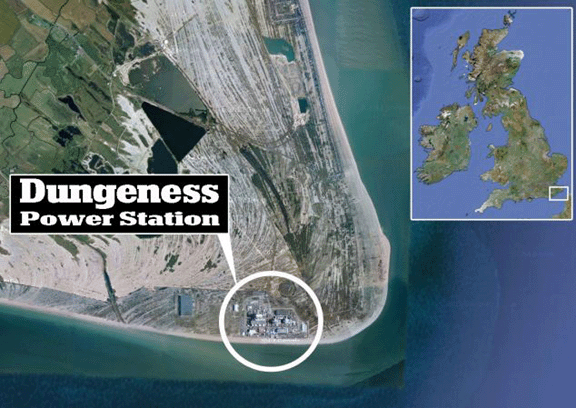
Reuters 8th April 2021, DF Energy, owned by French utility EDF, is exploring a range of scenarios for its Dungeness B nuclear plant in Britain, including bringing forward its decommissioning date of 2028, it said on Thursday. The 1.1 gigawatt Dungeness B plant, in Kent on the south coast of England, has been offline since 2018 as the company has been carrying out inspections and maintenance of pipes carrying steam to the turbine. EDF Energy has also been trying to complete repair work on corrosion identified during inspections of safety back-up systems.
The plant is currently forecast to return to service in August. It was designed in the 1960s and first started generating
electricity in 1983. EDF Energy said it has spent more than 100 million pounds ($138 million) on the plant during its current outage and it has a number of ongoing technical challenges that make its future uncertain.
New defects in France’s Flamanville nuclear project. Doubts that it will start-up on time, – or indeed ever!
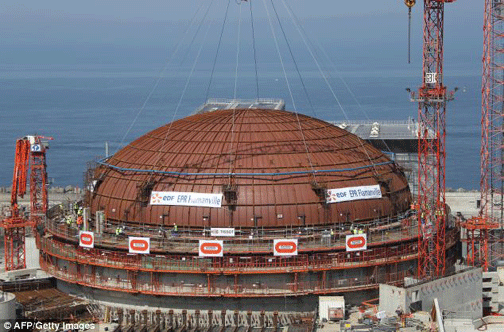
France Info 7th April 2021, Flamanville EPR: “The start-up does not seem possible before 2023” and we can doubt “that it will start one day”, according to negaWatt. “The decision to stop the costs is extremely difficult to take because we are talking about an investment of around 20 billion euros,” said energy expert and spokesperson for the association, Yves Marignac.
La Presse de la Manche 6th April 2021, The Nuclear Safety Authority was notified on March 17, 2021 of the late detection of faults in several pieces of equipment in reactors 1 and 2 at the Flamanville nuclear power plant, in the English Channel.
French Prime Minister visiting Algeria. The question of radioactive dust from nuclear tests will be on the agenda.
*Algeria – French Nuclear Testing**
French atomic tests in Algeria: so much brings the wind. The wind regularly
blows radioactive particles from the Sahara over Europe, a memory of the
atomic tests carried out in Algeria in the 1960s. Will the responsibility
of Paris be on the menu of Jean Castex’s visit to Algiers this weekend.
end?
Liberation 7th April 2021
On April 10 and 11, French Prime Minister Jean Castex will travel to
Algiers, accompanied by eight ministers – including the ministers of
foreign affairs and the armed forces to participate in the 5th session of
the France-Algeria High Level Intergovernmental Committee (CIHN). The
question of the health and environmental consequences of the 17 nuclear
tests carried out by France in the Sahara between 1960 and 1966, as well as
that of nuclear and non-nuclear waste left by France, will be on the menu
of discussions.
ICAN France 7th April 2021
http://icanfrance.org/alerte-presse-les-consequences-des-essais-nucleaires-francais-en-algerie/
Like the other nuclear powers, China wants to put a dirty great radioactive waste dump on indigenous land.
China’s $422m underground lab will probe massive national nuclear waste dump in remote Gansu, Global Construction Review,
9 April 2021 | By GCR Staff
China will spend $422m building an underground laboratory to find a way of storing high-level radioactive waste from the country’s growing fleet of nuclear power plants deep underground.
If successful, a repository that could store a hundred years worth of strontium-90, cesium-137 and plutonium-239 istopes will be built.
Building just the lab itself will be a feat. Wang Ju, vice-president of the Beijing Research Institute of Uranium Geology, told the China Daily newspaper that it would be sited in granite 560m below ground in the Beishan region of Gansu province, in China’s remote northwest . …………..
The offices and laboratories on the surface will have a floor area of 2.4ha within a 247ha site, however the underground complex will require the excavation of 514,200 cubic metres, along with 13.4km of tunnels. At present work is under way on supporting infrastructure, such as paved roads.
The lab, which was listed as a major scientific project in the 13th Five-Year Plan (2016-20), will take seven years to build. If its research proves successful, a long-term underground repository for high-level waste will be added nearby by 2050…….. https://www.globalconstructionreview.com/news/chinas-422m-underground-lab-will-probe-massive-nat/
Texas lawmakers want to ban dangerous radioactive waste.
Texas lawmakers want to ban dangerous radioactive waste.
Texas lawmakers want to ban dangerous radioactive waste. The proposal would give a nuclear waste company a big financial break.
A bill advancing in the House seeks to ban spent nuclear fuel, one of the most dangerous types of radioactive waste, from coming to Texas.
TEXAS TRIBUNE, BY ERIN DOUGLAS APRIL 8, 2021 As a nuclear waste company’s plan to store the most dangerous type of radioactive waste in West Texas moves forward at the federal level, state lawmakers are aiming to ban the materials from entering the state.
Environmental and consumer advocates for years have decried a proposal to build a 332-acre site in West Texas near the New Mexico border to store the riskiest type of nuclear waste: spent fuel rods from nuclear power plants, which can remain dangerously radioactive for hundreds of thousands of years.
A bill advancing in the House, filed by Rep. Brooks Landgraf, R-Odessa, whose district includes Andrews County — where the proposed facility would be located — seeks to stop the plan by banning that type of radioactive waste from being disposed of or stored in Texas.
But House Bill 2692 would also give that same company a big break on state fees it pays for its existing disposal facility for lower-risk radioactive waste.
“This bill bans high-level waste altogether,” Landgraf said during a committee hearing in March, “and focuses on making low-level waste the safest and best, most competitive and most efficient facility it can be.”
Waste Control Specialists has been disposing of the nation’s low-level nuclear waste, including tools, building materials and protective clothing exposed to radioactivity, for a decade in Andrews County. The company is currently pursuing, with a partner, a federal Nuclear Regulatory Commission license to store spent nuclear fuel on a site adjacent to its existing facility.
Waste Control Specialists and Interim Storage Partners — a joint venture between WCS and Orano USA, a subsidiary of one of the world’s biggest nuclear power companies — declined to comment on the proposed bill through a spokesperson.
Interim Storage Partners applied for the license in 2016. Scientists agree that spent nuclear fuel, which is currently stored at nuclear power plants, should be stored deep underground, but the U.S. still hasn’t located a suitable site. The Interim Storage Partners plan proposes storing it in above-ground casks until a permanent location is found. It expects federal regulators to make a decision sometime this year.
The plan faces stiff opposition from Gov. Greg Abbott, some oil companies that operate in the region and environmentalists over concerns about the risk of groundwater contamination and transportation accidents. Abbott wrote to federal regulators last year asking them to deny the license application, stating that the proposal presents a “greater radiological risk than Texas is prepared to allow.”………
The facility currently accepts Class A, B and C radioactive waste, which typically includes a wide range of contaminated items such as radioactive gloves, shoe covers and medical tubes. Some environmental and consumer advocates asked Landgraf to also include a ban on “greater than Class C” waste in his bill as well — it falls into what nuclear waste experts call a gray area between the lower-level categories and spent nuclear fuel. That type of waste is currently banned by the Texas Commission on Environmental Quality, but the Nuclear Regulatory Commission may soon consider regulations that would allow WCS to accept that waste.
Landgraf said he chose not to include a ban on that type of waste in the bill because it is technically not considered “high level” by the federal government, although it is currently treated that way for disposal purposes. Nuclear waste experts have told the Tribune that this category can be wide ranging, both in terms of danger and the time it will remain radioactive………….https://www.texastribune.org/2021/04/08/nuclear-waste-texas-ban/
Pickering Nuclear plant at risk of ‘Fukushima-type accident,
Nuclear plant at risk of ‘Fukushima-type accident,’ Ontario group says, National Observer,
By Charles Mandel | News, Energy | April 8th 2021 Citing the potential for a repeat of the 2011 Fukushima nuclear meltdown, the Ontario Clean Air Alliance wants an interim moratorium on the Pickering Nuclear Generating Station’s (PNGS) operation.
The aging plant is slated for closure in 2024, and the alliance says a moratorium should be imposed until the operators can prove to the public that it poses no risk to public safety. Ontario Power Generation (OPG) operates the plant, which consists of eight CANDU reactors— a type of reactor that uses deuterium oxide, or heavy water, as a moderator and coolant and natural (not enriched) uranium as a fuel. Two of the plant’s reactors have already been permanently shuttered because of their age.
OPG has been lobbying Ontario’s provincial government to keep the plant open until 2025. Currently, it is slated to remain operating until 2024, at which point decommissioning would begin. The OPG gained its last licence renewal for the plant in 2018.
The clean air alliance made its demand March 30 in a letter addressed to Rumina Velshi, president of the Canadian Nuclear Safety Commission (CNSC).
However, Marc Leblanc, CNSC commission secretary, said in a release in early April that an interim moratorium is not under consideration. “The commission sees no basis on which it might reconsider its licensing decision to authorize the operation of the PNGS.”
The CNSC did not return National Observer’s phone calls.
Fears of ‘Fukushima-type accident’
OPG says the plant’s exemplary safety record is proof there is no cause for concern.
However, a number of experts told National Observer the Pickering plant is well past its prime and shouldn’t be allowed to continue operations.
Jack Gibbons, president of the Ontario Clean Air Alliance, cited the plant’s aging pressure tubes as one reason the plant should be shuttered.
“It turns out that OPG does not have the data to show that Pickering’s pressure tubes are still safe for service. If the pressure tubes aren’t fit for service they could potentially rupture or break, and in the worst case scenario there could be a Fukushima-type accident,” Gibbons said.
The clean air alliance notes PNGS has at least twice as many people living within 30 kilometres as any other nuclear station on the continent. A 2018 study the alliance commissioned from Ian Fairlie, an independent consultant on radioactivity in the environment, cites dire consequences should a meltdown occur at PNGS.
It says a Fukushima-level accident at PNGS could cause approximately 26,000 cancers, require the evacuation of more than 150,000 homes and more than 650,000 people, and trigger a $125-billion loss in the value of single-family homes in the Greater Toronto Area.
Aging pressure tubes ‘a prime concern’
The pressure tubes in question are about 10 centimetres in diameter and some six metres long. Each pressure tube in a reactor holds 12 uranium bundles, which are the basis for the nuclear reaction that produces heat and provides the energy. The tubes — there are approximately 400 of them in a reactor — also carry the coolant. But like any aging part, the tubes could fail.
Gordon Edwards, president of the non-profit Canadian Coalition for Nuclear Responsibility, says OPG is “running these plants like no other CANDU reactor in the world.”
He explains that every other CANDU reactor that reaches a certain age is scheduled for refurbishment or re-tubing, which is a replacement of the pressure tubes and feeder pipes that go into the reactor’s core and cool the fuel.
Over their lifespan, the tubes are subjected to great heat, pressure and radiation from the fissioning uranium atoms. Over time, the stress to the tubes can cause them to become brittle and develop blisters that potentially become the site for an elongated crack or a serious rupture.
“Cooling the fuel is essential in nuclear power. If you don’t cool the fuel even after shutdown, you can have a meltdown. That’s what happened at Fukushima. I’m not saying every loss of coolant will lead to a meltdown, but that’s the precipitating cause that could lead to a meltdown. So therefore the integrity of the piping is a prime concern,” Edwards said.
While the Pickering plant must inspect the tubes as a condition of its operating licence, Edwards notes it only tests a fraction of the tubes, fewer than 10 per cent. Nor are the tubes uniform. One might have signs of degradation while the one next to it might be fine. According to Edwards, that makes the sampling less than reassuring.
Frank Greening is a research scientist who worked for OPG for 23 years. During that period, he estimates he spent half the time researching pressure tubes.
Greening says the benchmark for operating performance for CANDU reactors is roughly 30 years at 80 per cent capacity. Pickering reached that benchmark around 2015, but since then the OPG has “kept pushing the envelope, and the limiting factor is the pressure tubes’ fitness for service.”
According to Greening, “every time you turn around, they try and squeeze a little bit more juice out of the lemon. This is a way to keep the nuclear industry gainfully employed, and stretching the lifetime of these reactors as far as they can. I think they’ve gone too far.”……… https://www.nationalobserver.com/2021/04/07/news/ontario-nuclear-plant-risk-fukushima-accident-clean-air-alliance
Japanese government continues Japan’s ”Nuclear Village” generous grants to keep ageing nuclear reactors going.

Lucrative grants offered to keep aging nuclear reactors running, http://www.asahi.com/ajw/articles/14326422
THE ASAHI SHIMBUN
April 7, 2021 The central government is offering billions of yen in new grants to Fukui Prefecture to allow a nuclear plant operator to run its aging reactors beyond their operational life span of 40 years.
Fukui is not the only prefecture in Japan that hosts old reactors, and the grants could create momentum toward the restarts of these units.
“As for an expansion of grants, up to 2.5 billion yen ($22.6 million) will be provided per nuclear plant to a prefecture preparing to respond to the extension of the 40-year life of reactors,” the Ministry of Economy, Trade and Industry said in a document presented to the Fukui prefectural government on April 6.
The ministry’s offer is expected to become a key point of discussions as Fukui Prefecture and the prefectural assembly begin to weigh whether they should approve of the restart of three reactors in question there.
Fukui Governor Tatsuji Sugimoto hailed the central government’s offer, calling it “a step forward.”
He had urged the prefectural assembly to discuss the restart issue in February, but the assembly put off the debate, citing a lack of measures to revitalize the local economy.
Osaka-based Kansai Electric Power Co. is pushing to reactivate the three reactors in Fukui Prefecture–the No. 1 and 2 reactors at the Takahama nuclear plant in Takahama and the No. 3 reactor at the Mihama nuclear plant in Mihama.
The Nuclear Regulation Authority has given its one-time permission to operate those reactors for 20 more years beyond their 40-year life spans.
If the local governments approve the restarts, Fukui Prefecture would receive a combined 5 billion yen under the new grant setup.
The town halls of Takahama and Mihama have already given the greenlight to the restarts. The remaining hurdle is whether the governor and the prefectural assembly will approve them.
The maximum 2.5 billion yen will be made available over a period of five years, according to the industry ministry’s Agency for Natural Resources and Energy.
The offer of the funds came in response to the Fukui prefectural government’s request for additional grants concerning the reactors as a measure to stimulate the local economy.
The prefectural government is expected to discuss how to distribute the grants with Takahama and Mihama.
Other prefectures hosting old reactors operated by companies seeking the 20-year extension will be eligible for the new grants.
The only other facility that has gained the NRA’s permission to operate beyond 40 years is the Tokai No. 2 nuclear plant in Ibaraki Prefecture.
Five other reactors in Japan have been in service for more than 35 years.
The decommissioning process has started for other aging reactors because their operators decided that upgrades and additional safeguard measures required to bring them back online would be too expensive.
(This article was written by Kenji Oda and Takayuki Sato.)
As the Climate Crisis Grows, a Movement Gathers to Make ‘Ecocide’ an International Crime Against the Environment

As the Climate Crisis Grows, a Movement Gathers to Make ‘Ecocide’ an International Crime Against the Environment InsideClimateNews, 7 Apr 21, International lawyers, environmentalists and a growing number of world leaders say “ecocide”—widespread destruction of the environment—would serve as a “moral red line” for the planet.By Nicholas Kusnetz, Katie Surma and Yuliya TalmazanApril 7, 2021 The Fifth Crime: First in a continuing series with NBC News about the campaign to make “ecocide” an international crime.
In 1948, after Nazi Germany exterminated millions of Jews and other minorities during World War II, the United Nations adopted a convention establishing a new crime so heinous it demanded collective action. Genocide, the nations declared, was “condemned by the civilized world” and justified intervention in the affairs of sovereign states.
Now, a small but growing number of world leaders including Pope Francis and French President Emmanuel Macron have begun citing an offense they say poses a similar threat to humanity and remains beyond the reach of existing legal conventions: ecocide, or widespread destruction of the environment.
The Pope describes ecocide as “the massive contamination of air, land and water,” or “any action capable of producing an ecological disaster,” and has proposed making it a sin for Catholics.
The Pontiff has also endorsed a campaign by environmental activists and legal scholars to make ecocide the fifth crime before the International Criminal Court in The Hague as a legal deterrent to the kinds of far-reaching environmental damage that are driving mass extinction, ecological collapse and climate change. The monumental step, which faces a long road of global debate, would mean political leaders and corporate executives could face charges and imprisonment for “ecocidal” acts.
To make their case, advocates point to the Amazon, where fires raged out of control in 2019, and where the rainforest may now be so degraded it is spewing more climate-warming gases than it draws in. At the poles, human activity is thawing a frozen Arctic and destabilizing the ice sheets of Greenland and Antarctica.
Across the globe, climate change is disrupting the reliable seasonal rhythms that have sustained human life for millenia, while hurricanes, floods and other climate-driven disasters have forced more than 10 million people from their homes in the last six months. Fossil fuel pollution has killed 9 million people annually in recent years, according to a study in Environmental Research, more than tuberculosis, malaria and AIDS combined.
One in four mammals are threatened with extinction. For amphibians, it’s four in 10.
Damage to nature has become so extensive and widespread around the world that many environmentalists speak of ecocide to describe numerous environmentally devastated hot spots:
- Chernobyl, the Ukrainian nuclear plant that exploded in 1986 and left the now-deserted area dangerously radioactive;
- The tar sands of northern Canada, where toxic waste pits and strip mines have replaced 400 square miles of boreal forest and boglands;
- The Gulf of Mexico, site of the Deepwater Horizon disaster that killed 11 people, spilled at least 168 million gallons of crude oil into the ocean over 87 days and killed countless marine mammals, sea turtles, fish and migratory birds;
- The Amazon, where rapid deforestation encouraged by Brazilian President Jair Bolsonaro prompted Joe Biden, during his presidential campaign, to propose a $20 billion rescue plan and threaten the Brazilian leader with economic sanctions.
The campaign to criminalize ecocide is now moving from the fringe of advocacy into global diplomacy, pushed by a growing recognition among advocates and many political leaders that climate change and environmental causes are tied inherently to human rights and social justice.
The effort remains a long shot and is at least years from fruition, international and environmental law experts say. Advocates will have to navigate political tensions over whether national governments or the international community have ultimate control over natural resources. And they’ll likely face opposition from countries with high carbon emissions and deep ties to industrial development. …………………
Into the Mainstream
While the campaign for an ecocide law could take years—if it is successful at all—advocates say the effort could bear fruit much sooner: The ecocide campaign has thrust the concept into public discussion.
Mehta doesn’t expect the campaign to catch fire in the United States, but after four years of President Donald Trump, she’s heartened by the arrival of John Kerry, Biden’s special climate envoy. “We don’t expect the U.S. to join the ICC any time soon, but that said, the conversation around ecocide itself, we don’t see any reason why it can’t start happening in the U.S.,” she said.
The State Department released a statement saying that the U.S. “regularly engages with other countries” on “the importance of preventing environmental destruction during armed conflict,” but added, “We do not comment on the details of our communications with foreign governments.”
Mehta’s campaign is also part of a wider effort by activists who have been looking to the courts to force more aggressive action on climate change.
As of July 1, 2020, at least 1,550 climate change cases have been filed in 38 countries, according to a U.N. report.
In the landmark Urgenda case, a Dutch court ruled in 2015 that the government had acted negligently by failing to take aggressive enough action to limit its greenhouse gas emissions. The decision, upheld by the Supreme Court of the Netherlands in 2019, ordered the government to hit specific emissions reductions targets and sparked a series of similar lawsuits in other countries………….. https://insideclimatenews.org/news/07042021/climate-crisis-ecocide-vanuatu-the-fifth-crime/
Japan’s Prime Minister getting ready to release Fukushima waste water into the Pacific ocean?
Reuters 6th April 2021, Japanese Prime Minister Yoshihide Suga will hold a ministerial meeting as early as next week to start discussions on the release of contaminated Fukushima Dai-ichi Nuclear Power Plant water into the ocean, broadcaster FNN said on Tuesday.
Suga is also expected to meet with the head of the national federation of fisheries cooperatives as early as Wednesday to discuss the potential release of the water. The water, which is treated but contains traces of tritium, was used to cool the reactors in the aftermath of the Fukushima Dai-ichi Power Plant’s nuclear disaster in 2011 and is now stored within the grounds of the power plant.
1 This Month

Read the Public Inquiry Report, the Commissioners’ report, Surrendering Australia: The AUKUS Deception is available to download for free at aukuspublicinquiry.com. Or just watch the replay of the National Press Club Luncheon.


19 November – Webinar – The Reality of Reprocessing
Time: 11:00 AM Pacific Time (US & Canada) / 2:00 PM Eastern / 7:00 PM UK / 8:00 PM CET
Register for the Zoom Event Here



Shut down the radiation-damaged Heysham nuclear reactors now
To see nuclear-related stories in greater depth and intensity – go to https://nuclearinformation.wordpress.com

Say No to NASA’s Reckless Nuclear Reactor on the Moon
Say No to NASA’s Reckless Nuclear Reactor on the Moon
-
Archives
- November 2026 (103)
- October 2026 (302)
- September 2026 (339)
- August 2026 (330)
- July 2026 (355)
- June 2026 (287)
- May 2026 (306)
- April 2026 (356)
- March 2026 (251)
- February 2026 (267)
- January 2026 (308)
- December 2025 (358)
-
Categories
- 1
- 1 NUCLEAR ISSUES
- business and costs
- climate change
- culture and arts
- ENERGY
- environment
- health
- history
- indigenous issues
- Legal
- marketing of nuclear
- media
- opposition to nuclear
- PERSONAL STORIES
- politics
- politics international
- Religion and ethics
- safety
- secrets,lies and civil liberties
- spinbuster
- technology
- Uranium
- wastes
- weapons and war
- Women
- 2 WORLD
- ACTION
- AFRICA
- Atrocities
- AUSTRALIA
- Christina's notes
- Christina's themes
- culture and arts
- Events
- Fuk 2022
- Fuk 2023
- Fukushima 2017
- Fukushima 2018
- fukushima 2019
- Fukushima 2020
- Fukushima 2021
- general
- global warming
- Humour (God we need it)
- Nuclear
- RARE EARTHS
- Reference
- resources – print
- Resources -audiovicual
- Weekly Newsletter
- World
- World Nuclear
- YouTube
-
RSS
Entries RSS
Comments RSS

