Subsidies for New Jersey’s nuclear power stations

What ratepayers will pay in subsidies for NJ’s nuclear power plants, nj spotlight, TOM JOHNSON, APRIL 26, 2021 PSEG pushing state regulators to move forward on a yearly subsidy of about $300 million. The state is poised once again to decide whether to subsidize New Jersey’s three remaining nuclear power plants, but unlike two years ago, the question is not so much about whether ratepayers should fund the program, but how much they should pay.
PSEG pushing state regulators to move forward on a yearly subsidy of about $300 million. The state is poised once again to decide whether to subsidize New Jersey’s three remaining nuclear power plants, but unlike two years ago, the question is not so much about whether ratepayers should fund the program, but how much they should pay.
Public Service Enterprise Group, the operator of the three plants in South Jersey, is urging state regulators to approve another yearly subsidy at the same level of roughly $300 million, awarded in April 2019. This time, however, the New Jersey Board of Public Utilities can reduce the level of subsidy, an option not available previously to the annoyance of a couple of BPU commissioners, who nevertheless went along with approving the subsidy anyway………
How other states have dealt with nuclear subsidies
In Illinois, Exelon Generation has threatened to shutter two of its power plants. The governor of Illinois released an analysis earlier this month that recommends $350 million in ratepayer subsidies over five years be approved to keep them open.
Meanwhile in Ohio, nuclear plants were originally awarded ratepayer subsidies of $150 million annually, but they were repealed this spring. That happened after a scandal concerning the speaker of the Ohio House of Representatives and others over bribery allegations involving subsidies intended for FirstEnergy Solutions, a former subsidiary of FirstEnergy, to be approved.
For some critics, all of that raises the question of how long states will have to subsidize these plants.
“This is a habit that won’t go away and only increase over time,’’ said Steven Goldenberg, an attorney for the New Jersey Large Energy Users Coalition, and a participant in the last two zero-emissions credits (ZEC) cases. As the nuclear plants age, the companies will keep asking ratepayers to fund huge capital investments, he said…….
Opponents of the subsidy dispute the company’s claims. The Division of Rate Counsel’s review of PSEG’s applications claims the company overstates its projected costs and underestimates projected revenues……..https://www.njspotlight.com/2021/04/what-ratepayers-will-pay-in-subsidies-for-njs-nuclear-power-plants/
Ukraine opens new nuclear waste site
On 35th anniversary of Chornobyl disaster, Ukraine opens new nuclear waste site,
Ukraine president vows to transform Chornobyl exclusion zone into a revival zone. Ukraine’s president on Monday unveiled a new nuclear waste repository at Chornobyl, the site of the world’s worst civilian nuclear disaster that unfolded exactly 35 years ago…….
Moving forward, the Ukrainian authorities announced they will use the deserted exclusion zone around the Chornobyl power plant to build a storage facility for Ukraine’s nuclear waste for the next 100 years.
The ex-Soviet nation currently has four nuclear power plants operating and has to transport its nuclear waste to Russia. The new repository will allow the government to save up to $200 million US a year…… https://www.cbc.ca/news/world/chornobyl-35th-anniversary-1.6002314
‘If it’s safe, dump it in Tokyo’ – Pacific Islanders don’t want Fukushima waste water
Guardian 26th April 2021, If it’s safe, dump it in Tokyo. We in the Pacific don’t want Japan’s
nuclear wastewater. To Pacific peoples, who have carried the
disproportionate human cost of nuclearism in our region, this is yet
another act of catastrophic and irreversible trans-boundary harm that our
region has not consented to.
While Japan’s plan is for the water to be
diluted first and discharged over the course of about 30 years, and the
Japanese government has tried its hardest to convince the wider public of
the treated water’s safety through the use of green mascots and backing
from American scientists, Pacific peoples are once again calling it for
what it is: an unjust act.
“We need to remind Japan and other nuclear
states of our Nuclear Free and Independent Pacific movement slogan: if it
is safe, dump it in Tokyo, test it in Paris, and store it in Washington,
but keep our Pacific nuclear-free,” said Motarilavoa Hilda Lini, Vanuatu
stateswoman and veteran activist of the Nuclear Free and Independent
Pacific (NFIP) movement, after Japan’s announcement. “We are people of
the ocean, we must stand up and protect it.”
University of Sheffield researchers do detailed study of radioactive materials inside the wrecked Chernobyl nuclear reactor
Yorkshire Post 26th April 2021, University of Sheffield scientists to help clean up waste from ‘world’s
worst’ nuclear accident. On the 35th anniversary of one of the world’s worst nuclear disasters, new Yorkshire-led research has been published that could help to clean up the most dangerous radioactive materials that still
remain at the site in Chernobyl.
Scientists say the revealing findings – which are the most “detailed results” into the chemical makeup of the
radioactive materials inside the plant’s melted core to date – could ”pave the way” to safely remove hazardous waste from the site and help prevent future nuclear disasters.
Dr Claire Corkhill, the project lead, from the University of Sheffield, stressed the urgency to the research as until now only a very limited number of samples have been analysed by scientists round the world. This is because the most dangerous materials that remain inside Chernobyl are so hazardous, hampering efforts to safely contain or remove the materials from the disaster zone. Dr Corkhill, told The Yorkshire Post: “This is such a big breakthrough because it opens up a world of possibilities to develop a deeper understanding of some of the most dangerous materials that still remain in Chernobyl.
Getting the facts straight about Chernobyl, nuclear disasters, and ionising radiation
Fact check: 5 myths about the Chernobyl nuclear disaster
Monday marks the 35th anniversary of the Chernobyl nuclear disaster. What happened in the former Soviet Union on April 26, 1986, is no longer a secret. DW,
Is Chernobyl the biggest-ever nuclear disaster?
The 1986 nuclear disaster at the Chernobyl nuclear power plant near the city of Pripyat in northern Ukraine is often described as the worst nuclear accident in history. However, rarely is this sensational depiction clarified in more detail.
The International Nuclear and Radiological Event Scale (INES) does classify nuclear events on a scale of zero to seven, breaking them down into accidents, incidents and anomalies. It was introduced in 1990 after being developed by the International Atomic Energy Agency (IAEA) and the Nuclear Energy Agency of the Organization for Economic Cooperation and Development (NEA/OECD). Level seven denotes a “major accident,” which means “major release of radioactive material with widespread health and environmental effects requiring implementation of planned and extended countermeasures.”
Both the Chernobyl and 2011 Fukushima disaster have been categorized as such. But INES does not allow for nuclear events to be classified within a level.
If the term nuclear disaster is not only used to describe events, or accidents, in nuclear reactors but also radioactive emissions caused by humans then there are many occasions when human-caused nuclear contamination has been greater than that of the Chernobyl disaster, explained Kate Brown, professor of science, technology and society at the Massachusetts Institute of Technology.
“Let’s take the production of plutonium,” she told DW, referring to the American and Soviet plants that produced plutonium at the center of a nuclear bomb. “Those plants each issued as part of the normal working everyday order at least 350 million curies [a unit of radioactivity — Editor’s note] into the surrounding environment. And that was not an accident.
“Let’s look at, even more dire, the issuance of radioactive fallout in the detonation of nuclear bombs during the periods of nuclear testing ground, which were located throughout the world, ” she continued. “Those just take one isotope, one radioactive iodine, which is harmful to human health because it’s taken up by the human thyroid, causing thyroid cancer or thyroid disease.
“Chernobyl issued 45 million curies of radioactive iodine just in two years of testing, in 1961 and 1962. The Soviets and the Americans issued not 45 million curies, but 20 billion curies of radioactive iodine,” she said. And these tests, she added, were by design — not due to an accident or human error.
Are there mutants in the exclusion zone?
………….. “The influence of ionizing radiation may cause some restructuring in the body, but mostly it simply reduces an organism’s viability,” he explained, giving the example of high embryo fatalities in rodents due to genomic defects that prevented the organism from functioning. Those animals that survive the womb sometimes have disabilities that prevent them from staying alive in the wild. Vishnevsky and his colleagues have conducted research into thousands of animals in the exclusion zone, but have not found any unusual morphological alterations.
“Why? Because we were always dealing with animals that had survived and had won the fight for survival,” he said. He added that it was difficult to compare these animals with creatures that scientists had deliberately exposed to radiation in laboratories.
“That’s a very seductive idea, that human messed up nature and all they have to do is step away and nature rewrites itself,” she said. In reality, however, biologists say that there are fewer species of insects, birds and mammals than before the disaster. The fact that some endangered species can be found in the exclusion zone is not evidence of the area’s health and vitality.
Has nature reclaimed the site of the disaster?
Reports entitled “Life Flourishing Around Chernobyl” and photo series suggesting that the exclusion zone has become a “natural paradise” might give the impression that nature has recovered from the nuclear disaster. But Brown, who has been researching Chernobyl for 25 years, is adamant that this is “not true.”
“That’s a very seductive idea, that human messed up nature and all they have to do is step away and nature rewrites itself,” she said. In reality, however, biologists say that there are fewer species of insects, birds and mammals than before the disaster. The fact that some endangered species can be found in the exclusion zone is not evidence of the area’s health and vitality.
On the contrary: there has been a significant increase in the mortality rate and a lowered life expectancy in the animal population, with more tumors and immune defects, disorders of the blood and circulatory system and early ageing.
Scientists have attributed the apparent natural diversity to species migration and the vastness of the area. “The exclusion zone comprises 2,600 square kilometers [about 1,000 square miles]. And to the north are another 2,000 square kilometers to the north is Belarus’ exclusion zone,” said Vishnevsky. “There are also areas to the east and west where the human population density is extremely low. We have a huge potential for preserving local wild fauna.” That includes lynxes, bears and wolves which need a great deal of space.
But even 35 years after the disaster the land is still contaminated by radiation, a third of it by transuranium elements with a half-life of more than 24,000 years.
Is it safe for tourists to visit Chernobyl?
The exclusion zone was already a magnet for disaster tourists, but in 2019 annual numbers doubled to 124,000 after the success of the HBO miniseries Chernobyl. The State Agency of Ukraine on Exclusion Zone Management has set up a number of routes so tourists can visit the region by land, water or air. It has also drawn up a number of regulations to protect visitors, stipulating that people must be covered from head to toe. They shouldn’t eat any food or drink outside, and they should always follow official paths. It’s estimated that the radiation dose received over a one-day visit does not exceed 0.1 millisievert (mSv) — roughly the same dose that a passenger would be exposed to on a long-distance flight from Germany to Japan, according to Germany’s Federal Office for Radiation
Are there people living in the area?
Today, Pripyat, the closed city built to serve the nuclear plant and house its employees, is often described as a ghost town, as is the nearby city of Chernobyl.
However, neither has been entirely empty since 1986. Thousands of people, usually men, have stayed there, often working two-week shifts and ensuring that the crucial infrastructure in both cities continues to function. After the explosion in reactor No. 4, reactors 1, 2 and 3 continued to operate, closing down only in 1991, 1996 and 2000. Special units of the Ukrainian Interior Ministry police the zone. There are also stores and at least two hotels in Chernobyl, which are mainly for business visitors.
There are also a number of unofficial inhabitants, including people who used to live in the area and have chosen to return. They have settled in villages that were evacuated after the disaster. The exact number of people is unknown: when DW asked the State Agency of Ukraine on Exclusion Zone Management how many people lived in Chernobyl, the official answer was “nobody.”
In 2016, about 180 people were thought to be living in the entire exclusion zone. Because they tended to be older, this number may well have fallen. Even though these locals are officially only tolerated, the state does support them in their everyday lives. Their pensions are delivered once a month, and every two to three months they are supplied with food by a mobile store. https://www.dw.com/en/fact-check-5-myths-about-the-chernobyl-nuclear-disaster/a-57314231
Below – a video from past years tells the earlier story of the chernobyl disaster
Scots financial firms invested £7bn in nuclear weapons

Scots financial firms invested £7bn in nuclear weapons, Billy Briggs The Ferret, April 25, 2021, Three major Scottish financial institutions — NatWest Group, Lloyds Banking Group and Standard Life Aberdeen — invested a total of £7bn in nuclear weapons over a two year period.
A new report, seen by The Ferret, also reveals two Scots universities held £2.4m of investments in companies that undertake work related to nuclear weapons, while 11 council pension funds together had £275m invested in 20 firms in the sector.
The study is by Don’t Bank on The Bomb Scotland, a network of organisations campaigning for banks, universities, pension funds and public bodies to divest from companies involved in the production of nuclear weapons. It says these organisations together held investments worth £7.2bn in nuclear weapons producers between 2018 and 2020.
Don’t Bank on the Bomb is calling for divestment. It argues that organisations investing in nuclear weapon producers are “supporting activities that contravene commitments made under the Nuclear Non-Proliferation Treaty”……
Medact Scotland, Scottish CND, Pax Christi Scotland and the Edinburgh Peace and Justice Centre are all members of Don’t Bank on the Bomb Scotland.
The umbrella group says there is a heightened global nuclear risk at the moment. It points to tensions between the US, Israel and Iran over the latter’s nuclear programme, and deadly clashes between nuclear-armed nations India and China in the western Himalayas. ……..
International law on nuclear weapons was strengthened in January 2021 by the UN Treaty on the Prohibition of Nuclear Weapons (TPNW), the study says. The treaty prohibits the development, production, testing, possession, transfer, use and threat of use of nuclear weapons.
Don’t Bank on the Bomb’s report says the treaty is important to note for investors because financial assistance may be viewed as unlawful under international law.
The roles of three major financial groups based in Edinburgh are highlighted by the report. It says Natwest Group, formerly RBS, held investments worth £2bn in 15 companies between January 2018 and January 2020. These investments were made primarily in the form of loans and through the underwriting of bond issuances, while shareholdings make up a small proportion of the total.
Natwest has a policy which “only partially restricts investment in nuclear weapons producers”, the report claims. Meetings were held with the bank in 2020 and March 2021 and Don’t Bank On The Bomb said it sent an open letter to it, drawing attention to the “catastrophic humanitarian and environmental consequences of nuclear weapons” and the recent entry into force of the TPNW.
The letter called on the bank to exclude nuclear weapons from investment and was co-signed by over 40 civil society organisations, including trade unions, faith organisations and environmental NGOs.,……
Lloyds Banking Group, which is registered in Edinburgh, is also named. It invested £3.4bn in 10 nuclear weapons producers between January 2018 and January 2020, the report says. These investments were made primarily in the form of loans and through the underwriting of bond issuances. ……….
Standard Life Aberdeen, headquartered in Edinburgh, is also cited. The report says the company offers customers some socially responsible investment funds that exclude nuclear weapons producers but adds that most of its funds do not.
“The company owned or managed shares worth over £1.5bn in 20 of the world’s top 28 nuclear weapons producers between January 2018 and January 2020. Standard Life Aberdeen should stop investing in weapons of mass destruction,” the report says. ……..
Both Glasgow University and Strathclyde University also invest in the nuclear weapons industry. The former held shares worth £1.9m in 16 companies as of 30 September 2020. Strathclyde University owned shares worth £473,633 in two companies – BAE Systems and Thales.
Don’t Bank on The Bomb calls for “student activism” to “persuade” these universities to change their investment strategies. It claimed the University of Edinburgh changed its policy on arms investments in 2016 in response to a five year “responsible investment campaign”, led by students. ……….
The report adds that at least six Scots universities have policies that either explicitly or implicitly restrict investment in nuclear weapons producers. “It is clear that the University of Glasgow and the University of Strathclyde are outliers when it comes to nuclear weapons investments in the Scottish higher education sector,” the study says……….
On council pension funds, the study found that 11 funds collectively held shares worth over £275m in 20 companies that undertake work related to nuclear weapons as at 30 September 2020.
Lothian Pension Fund was the largest investor in nuclear weapons, holding shares worth nearly £126m in five nuclear weapons producers. This includes £102m invested in the world’s largest arms company, Lockheed Martin. Strathclyde Pension Fund came second, holding shares worth £120m in 16 companies.
Don’t Bank On the Bomb Scotland said: “Most Scottish local authority pension funds are reluctant to exclude harmful industries from investment. However, a growing number of Scottish councils are taking a stand against nuclear weapons investments by passing a resolution that calls on their pension fund to divest from nuclear weapons producers……. https://theferret.scot/scots-financial-firms-invested-7bn-nuclear-weapons/
Remarkable new photos inside the Chernobyl nuclear power station
PetraPixel.com, ARKADIUSZ PODNIESIŃSKI 25 Apr 21, ”/…………… The reason for my regular visits remains the same: the desire to document the changes taking place in the Chernobyl Exclusion Zone. And there’s been quite a few: from the construction of the New Safe Confinement (which I wrote about in more detail here), to the construction of several new industrial facilities that will make the decommissioning of the plant, including the damaged Reactor 4, possible and much safer. I hope that, under the influence of slow but systematic changes, eventually Chernobyl will not only be known as the site of the largest nuclear disaster in the world………
before we are allowed to enter the main part of the complex, aka the dirty zone, we have to change into protective gear and masks. We are also given a dosimeter that counts the dose of radiation absorbed. When we exit, the procedure is repeated in reverse order and so on in every complex we visit. Sometimes, the procedures take longer than our stay inside the facility.
…….. First, we got to the largest hall where there is a huge pool with more than 21,000 spent fuel assemblies from reactors 1-3. Depending on the location, radiation levels vary from 40 to 800 μSv/h, which is about 200-400 times higher than normal. The ISF-1 is a wet-type spent fuel storage facility, meaning that the fuel assemblies are stored in water. The huge pool consists of five reinforced concrete tanks covered by hundreds of steel plates. As I step on them, I feel rather strange and insecure because I know what lies beneath them. Additionally, every step I take causes the steel flaps to move, causing a sound that echoes throughout the hall. I’m only calmed by the sight of the engineer, who confidently steps on the plates, not looking at me at all. After a moment, the engineer bends down and opens one. The radiation increases, but only slightly. The lack of a cover doesn’t change all that much; the greatest barrier against the radiation is the water.

The fuel assemblies are pulled out in the hall next door. Now I can stay here freely, but the radiation levels during this procedure are very high – about 2 Sv/h. This is already a dose that can cause serious radiation sickness or even death. Due to this, the entire process is controlled remotely through a small window made of thick leaded glass or through a system of monitors and cameras from a small room located several meters above us…..
ISF-2 – the Interim Spent Nuclear Fuel Storage Facility 2
The ISF-2 complex serves as an interim storage facility for dry-type spent fuel assemblies. Before the spent fuel goes there, it is processed first in a building located on the premises.
Inside, my attention is drawn to the “hot chamber”, the heart of the entire building. A huge, hermetically sealed room, completely isolated from the external environment by thick concrete walls; you can look inside through small leaded glass windows located on both sides of the chamber. Cameras resistant to high levels of radiation and remote-controlled machinery and tools have been installed inside. It is here that the spent fuel assemblies from the defunct reactors will be cut in half, dried, and later packed into double-layered steel canisters.
The view of the hot chamber makes me realize how dangerous a task we have before us. And a long-term one, since the radioactive isotopes in the fuel will take thousands of years to decay. 100 years, the storage period for the processed fuel in ISF-2, is just a blink of an eye for radioactive isotopes. What’s next? ISF-3? We don’t know yet…….. This is the problem we will face – well, not us but future generations.
In December 2020, the “hot tests” for the whole complex concluded. At that time, 22 containers with 186 fuel assemblies had been processed for the first time and then packed into two steel canisters and stored in concrete modules behind the main building. It is estimated that the entire fuel processing process will take about 10 years, and the complex will become the world’s largest dry spent fuel storage facility.
ICSRM – the Industrial Complex for Solid Radwaste Management
In addition to the ISF-1 and ISF-2, which deal with spent nuclear fuel, another two facilities have been built on the site for the treatment of solid and liquid radioactive waste collected from the operation and decommissioning of the power plant and from the sarcophagus.
In addition to the ISF-1 and ISF-2, which deal with spent nuclear fuel, another two facilities have been built on the site for the treatment of solid and liquid radioactive waste collected from the operation and decommissioning of the power plant and from the sarcophagus. I visit the first, where low-, intermediate- and high-level waste is processed for temporary or final storage, including concrete, sand, and metal. The huge building contains a system of airtight caissons, hot chambers, and other areas where radioactive waste is cut, fragmented, shredded, sorted by radioactivity level, compressed, and incinerated. All of the work is done using remote-controlled machines to which interchangeable tools can be attached — including a jackhammer, concrete crusher, chainsaw, and hydraulic shears. The processed waste is then encapsulated and sealed in concrete containers before being sent to a radioactive waste repository. Like the ISF-2, the plant has already processed its first batch of radioactive waste and currently is in the final stages of hot testing and certification.
New Safe Confinement
The New Safe Confinement (NSC) is a huge 110-meter-high steel construction that was built to cover the old, worn-out sarcophagus. ………………..

In this labyrinth of near-identical corridors, I quickly lose my sense of direction and, after a while, I stop paying attention to the signs. I blindly follow the dosimetrist. Although the masks prevent us from breathing in radioactive dust, there is nothing we can do to protect ourselves from the gamma radiation penetrating our bodies. Unseen dangers may lurk around every corner. In such a situation, the dosimeters are our eyes; thanks to them we know how far we can go.

The thought that I’m moving through a mysterious labyrinth of radioactive corridors covered by two sarcophagi stresses me out and increases my feelings of uncertainty and confusion. …….
About the author: Arkadiusz Podniesiński is a Polish photographer and filmmaker, a technical diver, and a graduate of Oxford Brookes University in Great Britain. You can find more of his work on his website. This photo essay was also published here. https://petapixel.com/2021/04/24/exclusive-photos-inside-the-chernobyl-nuclear-power-plant/
Extinction Rebellion exposes Zion Lights as yet another nuclear propaganda front

Extinction rebellion 16th Sept 2020, There have been a number of stories in the press in the last few weeks with criticisms about Extinction Rebellion by Zion Lights, UK director of the pro-nuclear lobby group Environmental Progress. It appears that Lights is engaged in a deliberate PR campaign to discredit Extinction Rebellion.
lobbyists such as The Global Warming Policy Foundation and the Genetic Literacy Project (formally funded by Monsanto). The founder of Environmental Progress, Michael Shellenberger, has a record of spreading misinformation around climate change and using marketing techniques to distort the narrative around climate science. He has a reputation for downplaying the severity of the climate crisis and promoting aggressive economic growth and green technocapitalist solutions.
France’s EDF imposes conditions on India, re massive nuclear station planned for Jaitapur. EDF will be “Neither investor in the project nor responsible for construction”.

World Nuclear News 23rd April 2021, French company EDF has submitted to Nuclear Power Corporation of India Ltd (NPCIL) its binding techno-commercial offer to build six EPRs at Jaitapur in Maharashtra. The offer is the culmination of work that began with the 2018signature of an agreement between the two companies and paves the way for discussions towards a binding framework agreement.
https://world-nuclear-news.org/Articles/EDF-submits-offer-for-Jaitapur-project
Le Monde 23rd Aprilo 2021, It is believed to be the largest civilian atomic infrastructure in the world, with an installed capacity of 9,600 megawatts. This offer should initially have been submitted at the end of 2018 to the Nuclear Power Corporation of India Limited (NPCIL) group, the future operator of the plant.
But the approach of India’s spring 2019 general elections had made it untimely in the eyes of nationalist Prime Minister Narendra Modi, who is a candidate for his return to power. If the drafting of the document, more than 7,000 pages, finally took much longer than expected, it is also because of the sensitivity of its central subject: the distribution of responsibilities between the French corporation and the public operator. Indian.
In this case, EDF intends to impose its conditions. While the company chaired by Jean-Bernard Lévy originally said that it would build the entire Jaitapur plant, it now proposes to provide only “engineering studies and equipment”,
without being “Neither investor in the project nor responsible for construction”.
UK govt has a ”contingency plan”, in case Scotland becomes independent, and wants removal of nuclear weapons bases.
UK nuclear subs could leave Scotland for Devon as Indy referendum fears rise
MINISTRY of Defence planners have re-examined a contingency plan to move the Navy’s nuclear deterrent submarines from Scotland to Devon, according to senior sources last night.
EXPRESS, UK, By MARCO GIANNANGELI 25 Apr 21, It comes as the SNP prepares to fight next month’s Scottish Parliament elections on a manifesto that promises a fresh referendum on independence from the UK. Britain’s nuclear weapons system, made up of four Vanguard-class submarines which carry Trident strategic missiles, has been based at HM Naval Base Clyde on Scotland’s west coast since the 1960s. The base is made up of two sites – Faslane on Gareloch, where the submarines are based, and Coulport on Loch Long two miles away, where the warheads are stored.
Last month’s Integrated Review announced the most significant change to its nuclear weapons policy in at least two decades with the decision to abandon a self-imposed cap of 225 warheads, increasing it to 260.
In 2014 the Government ruled out moving the location of its nuclear deterrent bases ahead of Scotland’s referendum, citing the large costs involved, and still outwardly holds to that line.
But the SNP continues to pledge that it would ban nuclear weapons on Scottish soil, should it become independent…….
One senior Whitehall source confirmed last night: “A contingency plan is now in place should circumstances change and an independent Scottish government decide it no longer wants to host Britain’s nuclear deterrent.”
While the SNP is not expected to have a majority at next month’s Holyrood elections, support from Scottish Greens would still ensure a mandate to seek independence…….https://www.express.co.uk/news/politics/1427576/UK-nuclear-submarines-Scotland-devon-faslane
Is the US nuclear community prepared for the extreme weather climate change is bringing?

Is the US nuclear community prepared for the extreme weather climate change is bringing? https://thebulletin.org/2021/04/is-the-us-nuclear-community-prepared-for-the-extreme-weather-climate-change-is-bringing/?utm_source=Newsletter&utm_medium=Email&utm_campaign=ThursdayNewsletter04222021&utm_content=NuclearRisk_NuclearExtremeWeather_04202021 By Susan D’Agostino | April 20, 2021
In May 2000, a planned burn to remove dead, dried underbrush on New Mexico’s drought-stricken Cerro Grande peak in the Bandelier National Monument grew out of control. As the sky darkened with smoke, a wall of flames fueled by high winds burned through tens of thousands of acres of land where people, elk, and bald eagles made their homes. The monstrous blaze escaped the monument’s containment line and headed to the forested birthplace of the atomic bomb—Los Alamos National Laboratory. There, it raced over soil, rocks, and trees contaminated from decades-old nuclear weapons testing, releasing radioactive particles into the air and setting 47 buildings ablaze. As the devastation unfolded, the wildfire inched close to, but stopped short of, a facility containing tritium, a radioactive form of hydrogen.
In May 2000, a planned burn to remove dead, dried underbrush on New Mexico’s drought-stricken Cerro Grande peak in the Bandelier National Monument grew out of control. As the sky darkened with smoke, a wall of flames fueled by high winds burned through tens of thousands of acres of land where people, elk, and bald eagles made their homes. The monstrous blaze escaped the monument’s containment line and headed to the forested birthplace of the atomic bomb—Los Alamos National Laboratory. There, it raced over soil, rocks, and trees contaminated from decades-old nuclear weapons testing, releasing radioactive particles into the air and setting 47 buildings ablaze. As the devastation unfolded, the wildfire inched close to, but stopped short of, a facility containing tritium, a radioactive form of hydrogen.
The US response to potential climate impacts on the country’s various nuclear activities has, in the eyes of many experts, fallen far short of what it needs to be.
“All of these [nuclear] structures were built on the presumption of a stable planet. And our climate is changing very rapidly and presenting new extremes,” Hill said. “There’s harm that stems from that.”
Drought and spent nuclear waste. When forests are drier for long periods of time, they act as kindling for wildfires. Extreme drought exacerbated by climate change is a key driver of wildfires in the Western United States, which are increasing both in frequency and in size. For nuclear infrastructure in the heart of wildfire territory, this trend spells trouble.
Continue readingThe Chernobyl story continues
Chernobyl: The next phase https://www.ebrd.com/news/2021/chernobyl-the-next-phase.html By Axel Reiserer, 23 Apr 2021
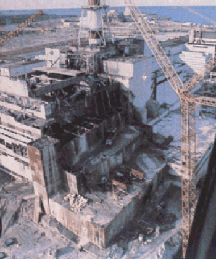
At 01:23:40 on 26 April 1986, the failure of a routine test at the Chernobyl Nuclear Power Plant in Ukraine, then part of the Soviet Union, caused reactor 4 to explode, releasing parts of its radioactive core. It was the worst nuclear accident the world had ever seen, with far-reaching political, economic and ecological consequences. Thirty-five years on, Chernobyl is still as well-known as it was a generation ago.
Fires broke out, causing the main release of radioactivity into the environment. Wind carried contaminated particles over Ukraine, Belarus and Russia, as well as parts of Scandinavia and wider Europe. The 50,000 inhabitants of the adjacent town of Pripyat were evacuated, never to return.
The accident destroyed reactor 4, killing 30 operators and firemen within three months and causing numerous other deaths in weeks and months that followed. To this day, it remains the only accident in the history of the civil use of nuclear power when radiation-related fatalities occurred. The precise number of short- and longer-term victims remains heavily disputed.
By 06:35 on 26 April, all fires at the power plant had been extinguished, apart from the fire inside reactor 4, which continued to burn for many days. Some 5,000 tonnes of boron, dolomite, sand, clay and lead were dropped from helicopters in a bid to extinguish the blaze. When the destroyed reactor was later enclosed in a provisional structure – the so-called sarcophagus – these fuel-containing materials were also walled in.
The sarcophagus was built under extremely hazardous conditions and unprecedented time pressure. By November 1986, a steel and concrete shelter was in place to lock away the radioactive substances inside the ruined reactor building and to act as a radiation shield. It was always intended as a temporary measure, with an estimated lifespan of 20-30 years
The search for a long-term solution started soon after, alongside the massive challenge of cleaning up the accident site. By the end of 1991, the Soviet Union had dissolved and newly independent Ukraine had been left with the Chernobyl legacy. Following a G7 Action Plan to improve nuclear safety in central and eastern Europe, the Nuclear Safety Account was set up at the European Bank for Reconstruction and Development (EBRD) in 1993. Two years later, the scope of the programme was extended to include Chernobyl.
A breakthrough came with the Shelter Implementation Plan in 1997, which provided a road map of how to the tackle the immediate and longer-term tasks. In the same year, the G7 officially invited the EBRD to set up and manage the Chernobyl Shelter Fund, which became the main vehicle for all efforts to ensure that the destroyed reactor 4 remained in an environmentally safe and secure state.
Emergency repairs in 1998 and 1999 prevented the imminent collapse of the sarcophagus, as well as a vent stack that was endangering the adjacent turbine hall over reactor 3, which was still in operation. It was only at the end of 2000 that all nuclear power generation in Chernobyl ceased. The following year saw a landmark decision to build an arch-shaped steel structure, called the New Safe Confinement (NSC), to seal off reactor 4.
In the subsequent years, several tasks were carried out simultaneously. Detailed technical work on the NSC started. The site had to be stabilised and prepared for the construction work. The first project the EBRD managed was the construction of a liquid radioactive waste treatment plant (LRTP) to handle some 35,000 cubic metres of low- and intermediate-level liquid waste at the site. Meanwhile, the safe storage of the spent fuel assemblies from reactors 1, 2 and 3 came into focus.
All this has been achieved. The LRTP has been operational since 2014. A new interim storage facility for the treatment and storage of spent fuel has been built and, after successful hot tests, is currently awaiting a permanent licence from the Ukrainian regulator. The NSC, the most visible Chernobyl project, was slid into position in late 2016 and then handed over to the Ukrainian authorities.
In total, the Bank has managed close to €2 billion in donor funds through the Chernobyl Shelter Fund and Nuclear Safety Account. Of this, the EBRD provided €715 million of its own resources to complete the Interim Storage Facility and New Safe Confinement.
Today, the New Safe Confinement dominates the skyline over Chernobyl, as the sarcophagus once did. The steel structure is 108 metres high and 162 metres long, with a span of 257 metres and a lifetime of at least 100 years. It was assembled in two stages in a cleaned area near the accident site and, despite its size and weight of 36,000 tonnes, was pushed 327 metres into position. It is the largest moveable structure ever built.

This is not where the story ends, however. The fact that the NSC has a lifespan of 100 years means that the next phase of work now has to be planned, agreed and implemented. The estimated 200 tonnes of radioactive nuclear fuel inside reactor 4 are now shielded by the New Safe Confinement. However, parts of the sarcophagus are becoming unstable and will have to be removed at some point. Once this is done, work will come closer to the reactor’s interior.
The EBRD remains a key partner in these efforts. Following a request by Ukraine, in November 2020, the Bank established the new International Chernobyl Co-Operation Account, aimed at creating an integrated plan for the site to serve as the basis for developing and implementing longer-term projects. The new fund will hold it first assembly meeting on Tuesday – fittingly one day after the 35th anniversary. The Chernobyl story continues.
At climate summit, Biden pleases Republicans, includes support for the nuclear industry

Nuclear, carbon capture, technology jobs: Biden hits on climate-change words Republicans like to hear, MarketWatch, April 23, 2021 , Rachel Koning Beals ”……
Addressing the final day of the virtual Leaders Summit on Climate, Biden’s punch list of what he believes are economic benefits in shifting from fossil fuels CL00, +0.99% to renewables and embracing technology to curb emissions included GOP-favored initiatives like modernizing nuclear energy and scaling up carbon capture.
……A diverse “clean” energy portfolio typically includes spending to modernize nuclear energy, and Biden included nuclear in a brief mention Friday. Republican plans have included measures seeking to establish a uranium reserve and speeding up nuclear power plant permits and reactor environmental reviews. …….. https://www.marketwatch.com/story/nuclear-carbon-capture-technology-jobs-biden-hits-on-climate-change-words-republicans-like-to-hear-11619192720
Rising threat of nuclear war is barely noticed. Corporate media likes it that way.
Rising Threat of Nuclear War Is Barely Noticed, Consortium news, By Caitlin Johnstone
CaitlinJohnstone.com 23 Apr 21, U.S. Strategic Command, the branch of the U.S. military responsible for America’s nuclear arsenal, tweeted the following on Tuesday:
“The spectrum of conflict today is neither linear nor predictable. We must account for the possibility of conflict leading to conditions which could very rapidly drive an adversary to consider nuclear use as their least bad option.”
STRATCOM called it a preview of the “posture statement” it submits to U.S. Congress every year. It was a bit intense for Twitter and sparked a lot of alarmed responses. This alarm was due not to any inaccuracy in STRATCOM’s frank statement, but due to the bizarre fact that our world’s increasing risk of nuclear war barely features in mainstream discourse.
STRATCOM has been preparing not just to use its nuclear arsenal for deterrence but also to “win” a nuclear war should one arise from the (entirely U.S. -created) “conditions” which are “neither linear nor predictable.”
And it’s looking increasingly likely that one will as the prevailing orthodoxy among Western imperialists that U.S. unipolar hegemony must be preserved at all cost rushes headlong toward America’s plunge into post-primacy.
The U.S. has been ramping up aggressions with Russia in a way that has terrified experts, and it looks likely to continue doing so. These aggressions are further complicated on increasingly tense fronts like Ukraine, which is threatening to obtain nuclear weapons if it isn’t granted membership to NATO, either of which would increase the risk of conflict.
Aggressions against nuclear-armed China are escalating on what seems like a daily basis at this point, with potential flashpoints in the China Seas, Taiwan, Xinjiang, Hong Kong, India and any number of other possible fronts………
The fact that those in charge of U.S. nuclear weapons now see both Russia and China as a major nuclear threat, and the fact that U.S. cold warriors are escalating against both of them, is horrifying.
The fact that they’re again playing with “low-yield” nukes designed to actually be used on the battlefield makes it even more so. This is to say nothing of tensions between nuclear-armed Pakistan and nuclear-armed India, between nuclear-armed Israel and its neighbors, and between nuclear-armed North Korea and the Western empire.
The Bulletin of the Atomic Scientists has the 2021 Doomsday Clock at 100 seconds to midnight, citing the rising threat of nuclear war:……………
As I all too frequently find myself having to remind people, the primary risk here is not that anyone will choose to have a nuclear war, it’s that a nuke will be deployed amid heightening tensions as a result of miscommunication, miscalculation, misfire, or malfunction, as nearly happened many times during the last Cold War, thereby setting off everyone’s nukes as per Mutually Assured Destruction.
The more tense things get, the likelier such an event becomes. This New Cold War is happening along two fronts, with a bunch of proxy conflicts complicating things even further. There are so very many small moving parts, and it’s impossible to remain in control of all of them.
Thousands of Starter Buttons
People like to think every nuclear-armed country has one “The Button” with which they can consciously choose to start a nuclear war after careful deliberation, but it doesn’t work that way.
There are thousands of people in the world controlling different parts of different nuclear arsenals who could independently initiate a nuclear war. Thousands of “The Buttons.” It only takes one. The arrogance of believing anyone can control such a conflict safely, for years, is astounding.
A 2014 report published in the journal Earth’s Future found that it would only take the detonation of 100 nuclear warheads to throw 5 teragrams of black soot into the Earth’s stratosphere for decades, blocking out the sun and making the photosynthesis of plants impossible. This could easily starve every terrestrial organism to death that didn’t die of radiation or climate chaos first. China has hundreds of nuclear weapons; Russia and the United States have thousands.
This should be the main thing everyone talks about. There is literally no more urgent matter on earth than the looming possibility that everyone might die in a nuclear war.
But people don’t see it.
On a recent “Tucker Carlson Tonight” appearance, former Congresswoman Tulsi Gabbard did a solid job describing the horrors of nuclear war and the very real possibility that it could be inflicted upon the U.S. due to America’s insane brinkmanship with Russia. She spoke earnestly about how “such a war would come at a cost beyond anything we can really imagine,” painting an entirely accurate picture of “hundreds of millions of people dying and suffering, seeing their flesh being burned from their bones.”
Gabbard is correct, and was right to give such a confrontational account of what we are looking at right now. But if you read the replies to Gabbard’s tweet in which she shared a clip from the interview, you’ll see a deluge of commenters accusing her of “hyperbole,” saying she’s being soft on Russian President Vladimir Putin and admonishing her for appearing on Tucker Carlson. It’s like they can’t even hear what she’s saying, how real it is, how significant it is.
Normalcy Bias & Media Malpractice
People’s failure to wrap their minds around this issue is a testament to the power of normalcy bias, a cognitive glitch which causes the U.S. to assume that because something bad hasn’t happened in the past, it won’t happen in the future. We survived the last Cold War by the skin of our teeth, entirely by sheer, dumb luck; the only reason people are around to bleat “hyperbole” is because we got lucky. There’s no reason to believe we’ll get lucky in this New Cold War environment; only normalcy bias says we will. Believing we’ll survive this Cold War just because we survived the last one is as sane as believing Russian roulette is safe because the guy passing you the gun didn’t die.
It’s also a testament to the power of plain old psychological compartmentalization. People can’t handle the idea of everything ending, of everyone they know and love dying, of watching their loved ones die in flames or from radiation poisoning right in front of them, all because someone made a mistake at the wrong time after a bunch of imperialists decided that U.S. planetary domination was worth putting every terrestrial organism at risk.
But mostly it’s testament to the ubiquitous malpractice of the Western media. It’s inconvenient to the agendas of the imperial war machine to have people protesting these insane Cold War games of nuclear brinkmanship, so their media stenographers barely touch on this issue. If mainstream journalism actually existed, this flirtation with nuclear war would be front and center in everyone’s awareness and people would be flooding the streets in protest against their lives being toyed with as casino chips in an insane all-or-nothing gamble.
This is so much bigger than any of the petty little things we spend our mental energy on from day to day……….The rising threat of nuclear war is the most urgent matter in the world and it’s absolute madness that we’re not talking about it all the time. https://consortiumnews.com/2021/04/23/rising-threat-of-nuclear-war-is-barely-noticed/
Attachments areaPreview YouTube video Tulsi Gabbard issues warning about potential war with RussiaTulsi Gabbard issues warning about potential war with RussiaPreview YouTube video Vasili Arkhipov: HeroVasili Arkhipov: Hero
New research on papillary thyroid cancer confirms the accepted science on the harmful effects of ionising radiation.

Our work provides a foundation for further investigation of radiation-induced cancer, particularly with respect to differences in risk as a function of both dose and age, and underscores the deleterious consequences of ionizing radiation exposure.
Radiation-related genomic profile of papillary thyroid cancer after the Chernobyl accident, Science Magazine, Lindsay M. Morton, Danielle M. Karyadi et al. 23 Apr 21,
Abstract
The 1986 Chernobyl nuclear power plant accident increased papillary thyroid cancer (PTC) incidence in surrounding regions, particularly for 131I-exposed children. We analyzed genomic, transcriptomic, and epigenomic characteristics of 440 PTCs from Ukraine (359 with estimated childhood 131I exposure and 81 unexposed children born after 1986). PTCs displayed radiation dose-dependent enrichment of fusion drivers, nearly all in the mitogen-activated protein kinase pathway, and increases in small deletions and simple/balanced structural variants that were clonal and bore hallmarks of non-homologous end-joining repair. Radiation-related genomic alterations were more pronounced for those younger at exposure. Transcriptomic and epigenomic features were strongly associated with driver events but not radiation dose. Our results point to DNA double-strand breaks as early carcinogenic events that subsequently enable PTC growth following environmental radiation exposure.
The accidental explosion in reactor 4 at the Chernobyl (Chornobyl in Ukrainian) nuclear power plant in April 1986 resulted in the exposure of millions of inhabitants of the surrounding areas of Ukraine, Belarus, and the Russian Federation to radioactive contaminants (1). Epidemiologic and clinical research in the ensuing decades has demonstrated increased risk of papillary thyroid carcinoma (PTC) with increasing thyroid gland exposure to radioactive iodine (131I) from fallout, which was deposited on pastures with grazing cows and ingested through milk and leafy greens, particularly during early childhood (2). Together with data from populations exposed to other types of radiation, compelling evidence indicates that PTC risk increases following childhood exposure to ionizing radiation, a recognized carcinogen (2–5)……….
The majority of individuals with PTC were female (n = 335, 76.1%), resided in the Kiev (Kyiv in Ukrainian) region at the time of the accident (n = 286, 65.0%), and were diagnosed during young adulthood (mean = 28.0 years, range: 10.0-45.6),,……..
The pronounced evidence of radiation-related damage that we observed for individuals exposed at younger ages is consistent with epidemiologic analyses that have identified higher thyroid cancer risks with radiation exposure at younger ages …………
our data are consistent with a linear dose-response for the key molecular characteristics associated with radiation dose in the range examined in our analysis (≤1 Gy), which aligns with the extensive radiobiological literature and other epidemiologic evidence regarding DNA damage and cancer risk following ionizing radiation exposure………….
Our work provides a foundation for further investigation of radiation-induced cancer, particularly with respect to differences in risk as a function of both dose and age, and underscores the deleterious consequences of ionizing radiation exposure. https://science.sciencemag.org/content/early/2021/04/21/science.abg2538.full
1 This Month

Read the Public Inquiry Report, the Commissioners’ report, Surrendering Australia: The AUKUS Deception is available to download for free at aukuspublicinquiry.com. Or just watch the replay of the National Press Club Luncheon.


19 November – Webinar – The Reality of Reprocessing
Time: 11:00 AM Pacific Time (US & Canada) / 2:00 PM Eastern / 7:00 PM UK / 8:00 PM CET
Register for the Zoom Event Here



Shut down the radiation-damaged Heysham nuclear reactors now
To see nuclear-related stories in greater depth and intensity – go to https://nuclearinformation.wordpress.com

Say No to NASA’s Reckless Nuclear Reactor on the Moon
Say No to NASA’s Reckless Nuclear Reactor on the Moon
-
Archives
- November 2026 (103)
- October 2026 (302)
- September 2026 (339)
- August 2026 (330)
- July 2026 (355)
- June 2026 (287)
- May 2026 (306)
- April 2026 (356)
- March 2026 (251)
- February 2026 (267)
- January 2026 (308)
- December 2025 (358)
-
Categories
- 1
- 1 NUCLEAR ISSUES
- business and costs
- climate change
- culture and arts
- ENERGY
- environment
- health
- history
- indigenous issues
- Legal
- marketing of nuclear
- media
- opposition to nuclear
- PERSONAL STORIES
- politics
- politics international
- Religion and ethics
- safety
- secrets,lies and civil liberties
- spinbuster
- technology
- Uranium
- wastes
- weapons and war
- Women
- 2 WORLD
- ACTION
- AFRICA
- Atrocities
- AUSTRALIA
- Christina's notes
- Christina's themes
- culture and arts
- Events
- Fuk 2022
- Fuk 2023
- Fukushima 2017
- Fukushima 2018
- fukushima 2019
- Fukushima 2020
- Fukushima 2021
- general
- global warming
- Humour (God we need it)
- Nuclear
- RARE EARTHS
- Reference
- resources – print
- Resources -audiovicual
- Weekly Newsletter
- World
- World Nuclear
- YouTube
-
RSS
Entries RSS
Comments RSS

