3rd generation Nagasaki A-bomb survivor continuing decades-long work for a nuclear-free world.
3rd-gen Nagasaki A-bomb survivor continuing decades-long work for nuclear free world, July 18, 2021 (Mainichi Japan)NAGASAKI — A third-generation atomic bombing survivor from Nagasaki is fulfilling a promise he made to A-bomb survivors, or hibakusha, who have passed on to continue their work for a world without nuclear weapons.
In anticipation of “an age without hibakusha” where already aging A-bomb survivors will no longer be able to directly pass down their stories, Mitsuhiro Hayashida, 29, has returned to his home city of Nagasaki for the first time in a decade to tell a wide range of generations the reality of atomic bombings. He assumed the position of a specially appointed research fellow at the Nagasaki University Research Center for Nuclear Weapons Abolition on July 1.
…………….. Moved by hibakusha who appealed for a world without nuclear arms even though they were sick themselves, Hayashida promised aging A-bomb survivors that he would work with them toward the goal of nuclear abolishment……….
In 2016, he assumed leadership for the International Signature Campaign in Support of the Appeal of the Hibakusha for the Elimination of Nuclear Weapons, calling for all states to sign the Treaty on the Prohibition of Nuclear Weapons which bans all forms of nuclear arms activities including the possession and use of such weapons. The movement collected over 13.7 million signatures and the group submitted them to the U.N.
While the nuclear weapons ban treaty came into effect in January 2021, many hibakusha who treated Hayashida like their grandson have passed away. Wanting to keep his promise he made to the A-bomb survivors, Hayashida returned to Nagasaki in June this year.
He still remembers his late grandfather, who was exposed to the radiation approximately 1.5 kilometers from the hypocenter in the Nagasaki atomic bombing, telling him tearfully about his experience on that fateful morning on Aug. 9, 1945, right before his death. Going forward, Hayashida will be involved in the digitalization of hibakusha testimonies and atomic bombing-related documents. He also plans to work on finding people who are willing to talk about their experience in the bombing.
“For people to feel what the lives of hibakusha were like, which cannot be conveyed just by numbers, I want to record threads of their stories in ways so that people will be able to see their faces, and pass down intimate hibakusha testimonies to the next generations,” Hayashida said.
(Japanese original by In Tanaka, Nagasaki Bureau) https://mainichi.jp/english/articles/20210716/p2a/00m/0na/022000c
 |
|
Significant downsizing of NuScale’s small nuclear reactor project for Idaho – (cost of project unknown)

The company [NuScale] refused to disclose the modular reactor project’s exact costs.
Eastern Idaho nuclear reactor project downsized, Post Register, By KYLE PFANNENSTIEL kpfannenstiel@postregister.com, Jul 16, 2021
A project to build a first-of-its-kind nuclear reactor in eastern Idaho has been significantly downsized.
The initial plan for the Carbon-Free Power Project was to build 12 interconnected miniature nuclear reactor modules to produce a total of 600 megawatts. It would be the first small modular reactor in the United States. After the company tasked with manufacturing the plants said it could make the reactors more power-efficient, planners reduced the project down to six module reactors that could produce 462 MW total.
“After a lot of due diligence and discussions with members, it was decided a 6-module plant producing 462 MW would be just the right size for (Utah Associated Municipal Power Systems) members and outside utilities that want to join,” said LaVarr Webb, UAMPS spokesman.
The project between UAMPS and Portland-based reactor producer NuScale received $1.4 billion from the U.S. Department of Energy last year. The reactor is planned to be built on the DOE’s 890-square mile desert site west of Idaho Falls at Idaho National Laboratory.
…….. now that we have made significant progress, including a large cost-share award from the Department of Energy, and NuScale has received design approval from the (Nuclear Regulatory Commission), we’re seeing more and more utilities express interest in the plant.”
So far, Webb said 28 participants have committed to a total of 103 MW. But, he said, “all are currently evaluating whether to increase or decrease” their commitments.
…….. Others who support the project worry about its incomplete financial support. All but one council member that day voted to continue Idaho Fall’s 5 MW commitment. But two voiced direct concern over the project not having full subscriptions. Council member Jim Francis was the sole nay vote.
Last October, the Idaho Falls City Council halved its then-10 MW commitment. The move maintained the city’s involvement but reduced the risk to customers of the city-ran grid, by Idaho Falls Power, if the investment doesn’t pan out, the Post Register previously reported.
Downsizing the project reduces the project’s costs and the amount of power it can produce, overall.
…….. The company [NuScale] refused to disclose the modular reactor project’s exact costs.
Webb said the project is currently working toward submitting an application to the NRC in 2024 to build and operate the reactor. https://www.postregister.com/news/inl/eastern-idaho-nuclear-reactor-project-downsized/article_0c60abf6-d0ea-5d42-9f9e-3cdb1a49b381.html
Students from North Arizona researched and wrote about the effects of uranium mining, especially on indigenous people.

Navajo youth essay winner looks at uranium trail in Arizona
Picking up the fight — Beyond Nuclear International Diné student wins uranium essay contest, Beyond Nuclear, By Sandra J. Wright, 18 july 21,
Charisma Black, along with other students from northern Arizona, took on a challenge issued by the 4th World Foundation to research uranium mining effects on Black Mesa.
Each writer was also asked to propose actions to limit exposure to radiation.
Black was named the winner of the contest in April. On May 13, she accepted the $500 scholarship award along with a large hand-woven basket filled with traditional clothing and jewelry.
Tommy Rock, an alumnus of Northern Arizona University’s School of Earth Sciences and Environmental Sustainability, presented the award to Black.
Black’s extended family is from the Pinon, Arizona, area of the Navajo Reservation. But her immediate family moved to Phoenix when she was young.
She returned to northern Arizona about two years ago, and is a graduating student of Flagstaff High School. Only 18 years old, Black has spent a lot of time thinking about uranium.
“My greatest concern was for family members,” Black said. “Uranium has shortened my time with some of them. We have to take care of them. I hope things can change for everyone, not just us Navajo and Hopi people.”
Her awareness of the uranium issue began when she was 10 years old……………
Black’s essay spoke to the environmental reality of living on Black Mesa.
“Uranium is a big issue because it contaminates the water source from underground aquifer of both Navajo and Hopi,” Black wrote. “Water that is accessed is being not only depleted at a dramatic rate, water is also undrinkable in areas that only have wells and windmills for drinking.
“This impacts their health, their livestock, their fields, etc.,” she said. “It is becoming unsafe, uninhabitable and unsustainable to live on the land in Black Mesa. New disease and sickness have come to Black Mesa.”
Black concluded that people “have to participate and learn better ways to keep our land, air and water clean for our peoples, animals and other species. We need to continue the advocacy and organizing to bring attention to the issue of uranium contamination on Black Mesa for sustainability, healthy communities and future generations.”………….
Somana Tootsie, the director of the 4th World Foundation, was on hand during the dinner held in Black’s honor.
Tootsie said that the contest was designed to get tribal youth in the region talking about the larger picture of environmental awareness and responsibility.
“This was an opportunity for young people to hold a conversation with their family members about the effects of uranium on their tribes and neighbors,” Tootsie said.
“We received amazing responses and great ideas on what to do to get more attention on the need for the removal or remediation of radioactive materials left exposed throughout northern Arizona,” she said. “We wanted to get them interested in science.”………….
Exposure not just Navajo
Exposure is not limited to the Navajo, Hopi and other tribes of the region. Radiation from the nuclear testing begun during World War II has created “downwinder” victims across the country to the east.
He finds hope that more people are working the devastating effects of the uranium industry.
“We have many grass-roots organizations addressing uranium,” Rock said. “The University of New Mexico has undertaking a study on uranium exposure. Amended by these studies, we have better access to health care from exposure.
The Navajo Nation Environmental Agency has been stepping up,” he said. “We have the Dine’ Uranium Remediation Advisory Committee, which I sit on.”
The uranium industry has definitely affected drinking water across northern Arizona, and people need to be informed of that fact, Rock said.
“We all must face the reality that we need access to potable water,” Rock said. “Not just for us, but for future generations. We need to be informed.
“We live off the land, and uranium has a great impact on our environment,” he said. “We have to educate tribes, chapter houses, communities, and tell them what we are learning, what we are doing.”………….. https://beyondnuclearinternational.org/2021/07/18/picking-up-the-fight/
Nuclear-free Asia Pacific Report
Nuclear-free Asia Pacific Report
By APR editor – July 19, 2021 Over the past 50 years, France has continued to deny the tragedies of nuclear testing in French Occupied Polynesia by propagating the theory of “clean nuclear tests”. Image: Youngsolwara Pacific
Asia Pacific Report newsdesk Moana activists, campaigners, scholars, researchers and Green MPs gathered today in a show of solidarity for Tahiti’s Ma’ohi Lives Matter rally at Auckland University of Technology and vowed to work towards independence for the French-occupied Pacific territory.
A live feed from the Tahitian capital of Pape’ete was screened and simultaneous events happened across the Pacific, such as in Fiji.
Many of the Auckland participants were stalwarts from the early days of the Nuclear-Free and Independent Pacific (NFIP) movement from the 1970s and 1980s and declared their support for pro-independence Tahitian leader Oscar Temaru.
Many speakers protested that Tahitians were still awaiting compensation for the legacy of health problems and the devastation of Moruroa and Fangataufa atolls during 30 years of testing and 193 nuclear blasts, both atmospheric and underground.
The speakers said it was appalling that serious attempts for compensation and a state apology had not happened in the two decades since the tests ended in 1996.
However, reports from Paris at the weekend hinted that the French Polynesian President had indicated that France had for the first time conceded it should compensate Tahiti’s social security agency CPS for the medical costs caused by the tests.
The agency had repeatedly said that since 1995 it had paid out US$800 million to treat a total of 10,000 people suffering from cancer as the result of radiation from the tests.
French PM’s letter
Tahiti’s territorial President Édouard Fritch said he received a letter from French Prime Minister Jean Castex, in which he admitted that the demand for a re-imbursement of the outlays was legitimate…………….
Environmental journalist, author and academic Dr David Robie denounced the “decades of lies, bluster and cover-ups” by French authorities, saying recent allegations published by the book Toxique and investigative website The Moruroa Files were a “game changer” forcing action from Paris…………
The rally participants acknowledged the connection between indigenous struggles in Mā’ohi Nui, Aotearoa, Australia, Hawai’i, Kanaky New Caledonia, Micronesia, Papua New Guinea, Rapa Nui, Solomons, Vanuatu, West Papua, and the rest of Moana.,,,,,,, https://asiapacificreport.nz/2021/07/19/nuclear-free/
A new problem for France’s nuclear company EDF threatens to further delay its plans for new model European Pressurised Reactor (EPR2)
EPR2**
In a discreetly published notice in March, the Institute for Radiation Protection and Nuclear Safety (IRSN) – the technical office of the Nuclear Safety Authority (ASN) – asks the State-owned company EDF to identify the origin of the vibrations affecting the circuit primary water from EPRs, already built or under construction.
And to find a solution to this problem, so that it does not reproduce on its new model of reactor, called EPR 2.
Passed under the radar, the news is yet another hard blow in a story with twists and turns. Indeed, EDF has to date no idea how to solve it.
Consequently, we can already anticipate new years of additional delay inthe development of a technology, supposedly easier to produce and therefore more competitive, on which the group led by Jean-Bernard Levy plays very heavily.
Blast 17th July 2021
Nuclear colonialism
An Australian artist has accused a group of Conservative councillors of
using “bullying strategies” to silence and censor her work after an
installation she created to highlight Britain’s “identity as a colonial
nuclear state” was removed from a park in Essex. The councillors
threatened to “take action against the work” if it was not removed,
according to Metal, the arts organisation that commissioned and then
removed the installation from Gunners Park in Southend.
Guardian 17th July 2021
21
USA’s Department of Energy brushes aside the community’s concerns about the so-called MARVELlous small nuclear reactor plan
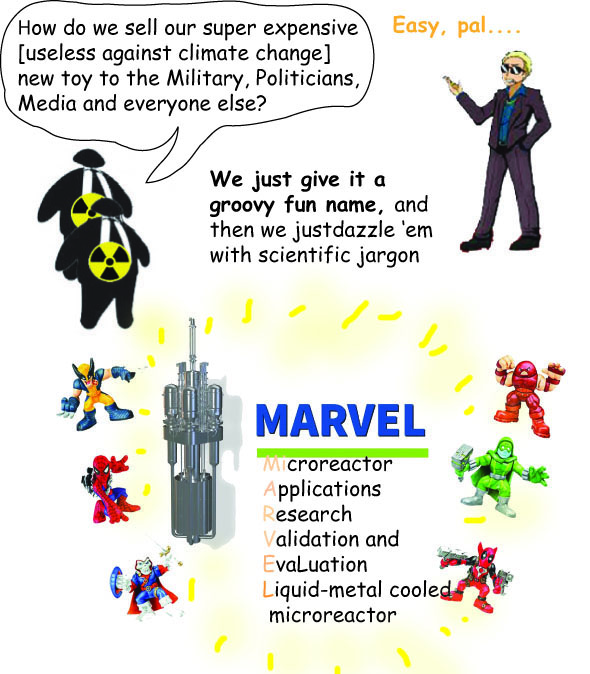
Concerns with nuclear energy must be taken seriously https://www.postregister.com/opinion/guest_column/opinion-concerns-with-nuclear-energy-must-be-taken-seriously/article_4e1e08d1-cad9-56dd-83cc-6ceadb828b24.html 16 July.By IAN COTTEN In June, the Department of Energy released a final environmental assessment for the MARVEL nuclear reactor project proposed to go in at Idaho National Laboratory. The result of the environmental assessment was a proposed finding of no significant impact.
It was incredibly discouraging to read through the DOE’s response to the public’s comments of concern in the final assessment. Many of the responses were copied and pasted responses and/or dismissively replied that the concerns around the proposal were out of scope for the assessment.
All nuclear energy produces highly dangerous, radioactive waste. The U.S. currently has no permanent radioactive waste repository. This means that every ounce of waste produced in this, and all other nuclear projects that take place at INL is destined to be stored in perpetuity at INL, which sits directly atop the Snake River Aquifer. This subsurface body of water is of critical importance to Idaho and provides drinking water to more than 300,000 people and irrigation water for our state’s richest agricultural regions. Continuing to add to the waste that is stored at INL is setting us up for catastrophe.
Littered throughout the assessment are mentions of how safely this reactor will operate and that there will be no impacts on groundwater during normal operations. Of course, project managers with the DOE intend for this reactor to operate as planned and for there to be no impact on the environment. But putting blind faith in a technology that exists only on paper and has no real-life operating experience is a reckless way to approach assessing potential environmental impacts.
It is also important to look at proposals like MARVEL within the larger energy landscape as we look ahead. When looking toward our energy future, the cost of research and development of new technologies must be considered. Every federal dollar that is spent on nuclear energy research, development and implementation is a dollar that cannot be spent on the development of actual renewable energy sources, such as wind and solar. Nuclear energy is considerably more expensive than renewables, often by orders of several magnitudes.
All of the safety concerns listed above should be considered in scope for this project, and the fact that the DOE refused to adequately acknowledge these concerns is disheartening. At the very least, our government should be willing to do their due diligence and prepare a more comprehensive environmental impact statement that assesses the potential health and safety impacts of this proposal in more depth.
While this proposed finding of no significant impact means that the DOE will likely avoid being required to prepare an environmental impact statement, MARVEL is not yet a sure thing. Idahoans who are concerned about this and other nuclear energy development in their state should voice their concerns to their Congress members and other elected officials. Idaho is too valuable to waste on untested, dangerous and dirty nuclear energy projects. Nuclear energy is out of scope for a safe, clean, equitable and renewable energy future.
Automation in nuclear weapon systems: lessons from the man who saved the world

, Medium.com. NinaMiller, 16 July, 21, In 1983, the world came within a phone call of nuclear annihilation. When an alert of incoming ballistic missiles registered at an early warning command centre outside of Moscow, Lieutenant Colonel Stanislav Petrov had to decide whether or not to confirm the signal to his superior, an action which could have sparked a catastrophic nuclear exchange. Rather than escalate the report up to Soviet leadership, Petrov — who felt he ‘was sitting on a hot frying pan’ — decided the missile alert was a system malfunction.
Later called ‘the man who saved the world’, Petrov demonstrated an astute understanding of the limits of machine analysis. What can modern policymakers learn from Petrov’s experience about the impact of automation on accidents in nuclear weapon systems?Available information indicates that US officials are integrating greater amounts of automation and potentially machine learning in nuclear command, control, and communications (NC3). Indeed, the fields in which increased automation is being considered vary from predictive maintenance and data analytics to cybersecurity, tracking of adversary submarines, and early warning systems. Human operators often ‘overtrust’ automated systems in other high-consequence environments like civil aviation and medicine, yet it remains unclear exactly how automation misuse could increase the risk of nuclear accidents or escalation………..
an inherent paradox when it comes to human — machine interaction: the more reliable and useful an automated system is, the less likely human operators are to critically assess and pay attention to its function. In other words, the probability of a catastrophic mistake caused by automation bias or complacency in NC3 will be highest for consistent, highly reliable systems with a high level of automation
Will the next Petrov make the right decision? To decrease the risk of automation misuse and instability, next generation command and control will need to reward vigilance, give operators the time and ability to consult additional information, and ensure that nuclear postures in the United States and elsewhere do not encourage over-reliance on machines in a crisis.
Decision-support systems that develop recommendations for human operators about the use of nuclear weapons are likely to involve the highest risk of automation misuse. Machine advice could be misinterpreted or uncritically trusted when the systems perform well in peacetime and wargames, leading users to develop a ‘learned carelessness’ when using the system. The lumberjack effect is perhaps the most counterintuitive and dangerous paradox — if the Soviet early warning system had been highly reliable and vetted, Petrov might not have hesitated.
As US officials contemplate the proper role of machine learning in a modernized NC3 infrastructure, they should be careful not to take the wrong lessons from Petrov’s experience. Human supervision is not enough. Healthy human-machine teams need opportunities to train together and learn from mistakes, which is difficult or impossible for certain NC3 functions like early warning or force planning. Proposed solutions like explainable AI and enhancing trust in AI could actually be counterproductive if they create false expectations of machine reliability or inadvertently encourage complacency. Nuclear modernization in the United States and elsewhere should take as a starting point that the paradoxes of automation cannot be solved, only mitigated and managed.
Nina Miller is a PhD student in MIT’s Department of Political Science and currently a Research Associate with Lawrence Livermore National Laboratory’s Center for Global Security Research (CGSR). Her research focuses on the intersection of international security, political psychology, and technology. https://medium.com/international-affairs-blog/automation-in-nuclear-weapon-systems-lessons-from-the-man-who-saved-the-world-d39aa2f4da5a
The International Atomic Energy Agency is well aware of that danger we don’t discuss – NUCLEAR TERRORISM

IAEA begins construction of Training Centre to Counter Nuclear Terrorism, NEI Magazine,14 July 2021 The Director General of the International Atomic Energy Agency (IAEA), Rafael Mariano Grossi, on 12 July broke ground for a new facility that will help strengthen countries’ abilities to tackle nuclear terrorism in areas such as the illegal trafficking of nuclear material and the physical protection of facilities and major public events.
The IAEA Nuclear Security Training and Demonstration Centre will be located at the IAEA facility in Seibersdorf, 30 km south of Vienna, and is scheduled to be operational in 2023. “This Centre will help us in supporting countries to remain ahead of the curve in guarding against nuclear terrorism,” Grossi said………….https://www.neimagazine.com/news/newsiaea-begins-construction-of-training-centre-to-counter-nuclear-terrorism-8896130
US and Allies’ military machine – out of Afghanistan (where it’s needed) and into the Pacific – against its new enemy – The Great Barrier Reef

War games on despite pandemic, threat to Great Barrier Reef https://www.greenleft.org.au/content/war-games-despite-pandemic-threat-great-barrier-reef, Kerry SmithJuly 16, 2021 Lurking off the coast of China’s eastern seaboard now are three United States aircraft carrier battle groups (each with about 30 support vessels).
They will be joined by a British aircraft carrier group and Australian and Canadian warships as part of biennial military exercises, which start on July 18 and last until the end of the month.
Talisman Sabre 2021 (TS21) will involve a US expeditionary strike group from the USS America, the amphibious assault ship based at Sasebo Naval Base in Japan, and 17,000 Australian, US and foreign troops in combined land, sea and air war exercises.
According to Stars and Stripes, for the first time, there will be live-fire training: the US Army will fire a Patriot missile defense system from Shoalwater Bay in Queensland at a pair of drone targets on July 16.
This is within the Great Barrier Reef Marine Park and other environmentally and culturally significant areas.
The war games will also take place in Darwin in the Northern Territory and Evans Head, New South Wales.
All are thousands of kilometres away from their home base, and provocatively close to the new declared enemy — China.
Forces from Canada, Japan, New Zealand and the Republic of Korea will take part and Australia-based personnel from India, Indonesia, France and Germany will observe.
Meanwhile, the ABC’s “defence correspondent” hyperventilated on July 14 that a solitary Chinese military ship, outside Australian territorial waters, poses a threat to national security.
The Independent and Peaceful Australia Network (IPAN) is concerned about both the war games and its impact on environmentally and culturally significant sites.
“TS21 will involve amphibious assaults, movement of heavy vehicles, use of live ammunition as well as the use of U.S. nuclear-powered and nuclear-weapon capable vessels,” IPAN spokesperson Annette Brownlie said.
“These activities are incompatible with the protection of the environment and, in particular, the Great Barrier Reef.
“During Talisman Sabre 2013, the US jettisoned four unarmed bombs on the Great Barrier Reef when they had difficulty dropping them on their intended target, Townshend Island,” Brownlie said.
The objective of Talisman Sabre is to further integrate the Australian military with the US — now ranked among the world’s worst polluters.
IPAN said the ADF did not engage in a Public Environment Report process for TS21 and has yet to release an environmental assessment for the areas in which TS21 will take place.
However, the Department of Defence did produce an environmental awareness video for visiting troops that promotes the military use of the Great Barrier Reef. The video reminds troops to consider the reef and not to litter.
“Talisman Sabre is a threat to the reef and to the environment. Putting out a video is a completely inadequate response,” Brownlie said.
This comes as federal environment minister Sussan Ley is lobbying to keep the Great Barrier Reef off the United Nations Educational, Scientific and Cultural Organization World Heritage Committee’s “in danger” list.
Despite a global pandemic, about 1800 foreign military personnel have arrived in Darwin to participate.
Costly dismantling of France’s Brennilis nuclear power plant continues, 35 years after shutdown.
The dismantling of the Brennilis nuclear power plant, in the Monts
d’Arrée (Finistère) will be completed by 2040 and will have cost 850
million euros, the departmental council of Finistère said on Thursday.
These operations began over 35 years ago.
France Bleu 15th July 2021
A worrying combination – nuclear + Bitcoin

Nuclear-Powered Bitcoin Mining Is Coming to the States, Nasdaq, Portfolio Insider, JUL 16, 2021 Amid last month’s heated debate over Bitcoin’s environmental impact, two companies are confident they have the answer on how to mitigate some of the negative effects: nuclear energy.
Nuclear-powered Bitcoin mining is part of a new wave of innovation of companies developing smaller reactors that they say would be faster and cheaper to build than conventional nuclear plants. These Bitcoin nuclear reactors can be small and would generate a lot of power without harmful emissions –[this is a lie]
Bitcoin mining is necessary for releasing new Bitcoins into circulation. To help avoid fraud, miners authenticate transactions on Bitcoin’s blockchain. In return, miners are given new Bitcoin. Miners need to solve extremely complex math problems to verify transactions, which require a large amount of computational power.”Right now, millions of Bitcoin mining devices around the world are generating 130 quintillion of such guesses every second of the day non-stop,” Alex de Vries, a financial economist who runs Digiconomist, told CNBC. “Combined, these machines are now consuming as much electrical energy as a country like the Netherlands.”
Bitcoin mining to go nuclear
Along with other clean ? energy sources like wind, solar and hydro, nuclear energy could be the best power source for Bitcoin mining due to its reliability, cheapness [ whaaa at“} and carbon-free nature (carbon free – that’s a lie). ………. https://www.nasdaq.com/articles/nuclear-powered-bitcoin-mining-is-coming-to-the-states-2021-07-16—
USA keen to market nuclear reactors to Poland (and indeed – to anybody)

Bechtel, Westinghouse join forces to pursue Polish nuclear power plant project, July 16, 2021, RESTON, Va., July 15, 2021 /PRNewswire/ — Bechtel and Westinghouse Electric Company, two leading U.S. companies in the global nuclear industry, today announced they’ve formed a team to pursue new nuclear power plant projects in Poland…….
“Poland is taking steps to transition to a clean energy economy while retaining its energy independence and security. The Westinghouse-Bechtel team offers proven technology and hands-on experience in nuclear project delivery and is ready to immediately support Poland’s transformative vision.”……
This news follows the U.S. Trade and Development Agency announcement on June 30 providing a grant for a front-end engineering design (FEED) for a plant in Poland using proven Westinghouse AP1000 reactors. The FEED is expected to be delivered in 12 months. https://finance.yahoo.com/news/bechtel-westinghouse-join-forces-pursue-170100809.html
Israel determined to“maintain military superiority”, in preparation for a nuclear Iran
Gantz: We must ‘adapt our plans’ to prepare for a nuclear Iran
Prime minister says Israel carefully monitoring situation in Lebanon and that IDF currently in better place than it was in 2006 war against Hezbollah, Tims of Israel, By JUDAH ARI GROSS15 July 2021, Defense Minister Benny Gantz on Wednesday called for Israel to step up its preparations for the possibility of Iran obtaining a nuclear weapon……… Israel has maintained that as it is not part of the nuclear deal, it is free to act as it sees fit to prevent Iran from obtaining an atomic bomb.
In his speech, Gantz called for the government to allow the country’s security services to “maintain military superiority, which ensures our secure existence and advances peace.”
The remark appeared to refer to a report by the Kan broadcaster earlier in the evening that the IDF was asking the government for a major budget increase, in large part to prepare itself to conduct strikes aimed at thwarting Iran’s nuclear pursuit………https://www.timesofisrael.com/gantz-we-must-adapt-our-plans-to-prepare-for-a-nuclear-iran/
Japanese government considers extending maximum nuclear reactor lifespan beyond 60 years
Japan mulls extending maximum nuclear reactor lifespan beyond 60 years, KYODO NEWS – Jul 16, 2021 Japan is considering extending the maximum service period for its nuclear reactors beyond 60 years due to anticipated public opposition to the construction of new plants, sources close to the matter said Thursday.
The government is seeking to make long-term use of existing nuclear plants rather than building new ones or replacing reactors, as sought by the ruling Liberal Democratic Party and some business circles.
But such an extension could spur concerns about the safety of aging reactors that are prone to accidents.
………….The government plans to submit a bill to amend the law regulating nuclear reactors to the ordinary Diet session next year.
It will also discuss inspection and assessment methods to determine whether a reactor should be approved to operate for more than 60 years, referring to cases abroad such as in the United States where they can operate for up to 80 years.
In June, the No. 3 unit at Kansai Electric Power Co.’s Mihama plant in Fukui Prefecture, central Japan, became the country’s first reactor to operate beyond 40 years under the new rules.
According to government sources, a proposal has been floated to revise the law to allow multiple extensions beyond 60 years providing screening standards are met.
There are also calls within the LDP to exclude from the 40-year cap reactors that have been suspended since the Fukushima disaster.
Japan currently has 33 operable nuclear reactors, with another three under construction. But with several set to reach their 60-year maximum lifespan in the 2040s, only about 20 reactors are expected to still be in operation by 2050 under the current rules.
As part of the 2018 basic energy plan, which is being reviewed, the government is aiming for nuclear power to account for 20 to 22 percent of the country’s electricity generation in fiscal 2030 to meet its greenhouse gas emissions reduction goal.
The government estimates that about 30 reactors will be required to cover that level of power generation. https://english.kyodonews.net/news/2021/07/c9d4d95b4cfa-japan-mulls-extending-maximum-reactor-lifespan-beyond-60-years.html
1 This Month

Read the Public Inquiry Report, the Commissioners’ report, Surrendering Australia: The AUKUS Deception is available to download for free at aukuspublicinquiry.com. Or just watch the replay of the National Press Club Luncheon.


19 November – Webinar – The Reality of Reprocessing
Time: 11:00 AM Pacific Time (US & Canada) / 2:00 PM Eastern / 7:00 PM UK / 8:00 PM CET
Register for the Zoom Event Here



Shut down the radiation-damaged Heysham nuclear reactors now
To see nuclear-related stories in greater depth and intensity – go to https://nuclearinformation.wordpress.com

Say No to NASA’s Reckless Nuclear Reactor on the Moon
Say No to NASA’s Reckless Nuclear Reactor on the Moon
-
Archives
- November 2026 (103)
- October 2026 (302)
- September 2026 (339)
- August 2026 (330)
- July 2026 (355)
- June 2026 (287)
- May 2026 (306)
- April 2026 (356)
- March 2026 (251)
- February 2026 (267)
- January 2026 (308)
- December 2025 (358)
-
Categories
- 1
- 1 NUCLEAR ISSUES
- business and costs
- climate change
- culture and arts
- ENERGY
- environment
- health
- history
- indigenous issues
- Legal
- marketing of nuclear
- media
- opposition to nuclear
- PERSONAL STORIES
- politics
- politics international
- Religion and ethics
- safety
- secrets,lies and civil liberties
- spinbuster
- technology
- Uranium
- wastes
- weapons and war
- Women
- 2 WORLD
- ACTION
- AFRICA
- Atrocities
- AUSTRALIA
- Christina's notes
- Christina's themes
- culture and arts
- Events
- Fuk 2022
- Fuk 2023
- Fukushima 2017
- Fukushima 2018
- fukushima 2019
- Fukushima 2020
- Fukushima 2021
- general
- global warming
- Humour (God we need it)
- Nuclear
- RARE EARTHS
- Reference
- resources – print
- Resources -audiovicual
- Weekly Newsletter
- World
- World Nuclear
- YouTube
-
RSS
Entries RSS
Comments RSS

