Penis envy taken to extremes? Space billionaires and carbon emissions

Space tourism: environmental vandalism for the super
-rich https://www.sgr.org.uk/resources/space-tourism-environmental-vandalism-super-rich
As billionaires Jeff Bezos and Richard Branson launch the first flights of their space tourism corporations, Dr Stuart Parkinson, SGR, takes a look at the climate impacts.
Responsible Science blog, 20 July 2021 The past few weeks have seen some frightening impacts of climate change – from record-breaking temperatures and major wildfires in western Canada and the USA to unprecedented floods in Germany and Belgium. The hottest temperature reliably recorded on the Earth’s surface – 54.4C – was logged in Death Valley in California on 9 July. [1] Scientists said the heatwave in Canada and the USA at the end of June was “virtually impossible” without human-induced climate change. [2] One thing that is especially striking is that these events are now happening in some of the wealthiest and weather-resilient nations of the world – but even that didn’t stop major death tolls.
The huge threat of global climate disruption is leading to ever more urgent calls for society to rapidly reduce its carbon emissions. It is also clear that technological change alone will not be enough to tackle the problem. A recent report by the Climate Change Committee – the UK government’s main advisory body on the issue – found that 62% of the necessary measures involve societal and behaviour change. [3] Avoiding air travel is one of the most effective changes individuals can make to cut this pollution. For example, the carbon footprint of a return flight from London to Hong Kong – seated in economy-class – is about 3.5 tonnes of carbon dioxide equivalent (tCO2e) [4] – similar to a UK citizen’s average car use for over 10 months. [5] Research by the Institute for Global Environmental Strategies indicates that a globally-sustainable lifestyle carbon footprint in 2020 was 3.9 tCO2e [6] – which gives a clear indication of just how much our society needs to reduce its impacts now (and this figure falls rapidly to 2.5t CO2e by 2030 and then much lower still for 2040 and 2050).
Against this backdrop, we have billionaires travelling in the inaugural flights of their space tourism corporations. On 11 July, Richard Branson flew in Virgin Galactic’s SpaceShipTwo craft, while on 20 July, Jeff Bezos travelled in Blue Origin’s New Shepard. These activities take the climate impacts of flying to considerably more damaging level.
Let’s look at the New Shepard space-craft. Prof Mike Berners-Lee of Lancaster University – a leading expert in carbon footprint analysis – has estimated that a single flight results in emissions of at least 330 tCO2e. [7] With four passengers, this means each one is responsible for over 82 tCO2e – over 20 times the sustainable level for a whole year! And note, this is a conservative estimate. It does not include the additional heating effects of emissions at high altitude, the carbon footprint of developing and manufacturing the space-craft, or the emissions of running the Blue Origin corporation. Furthermore, the fuel combination used by the latest generation of New Shepard craft now includes liquid hydrogen [8] – a higher carbon fuel than those used in Prof Berners-Lee’s calculations.
What about SpaceShipTwo? Although this craft emits markedly less direct carbon emissions per flight than New Shepard, as SGR discussed back in 2016, [9] it uses a fuel combination which emits significant levels of black carbon into the upper atmosphere. Research by the University of Colorado indicates that this can damage the stratospheric ozone layer – not only leading to higher levels of damaging ultra-violet radiation reaching the Earth’s surface, but also causing a global heating effect likely to be considerably greater than that from the carbon emissions alone.
And the aim of these journeys? A few minutes of ‘zero-gravity’ experience and a nice view. It is hard to see this as anything more than environmental vandalism for the super-rich.
Virgin Galactic claims to want to launch a “new age of clean and sustainable access to space” [10]– but they and the others in the space tourism industry clearly fail to understand the level of their own climate impacts, the rapidly increasing severity of the climate emergency, or the scale of action needed to cut carbon emissions to a sustainable level. If governments are serious about trying to prevent ‘dangerous’ climate change, then there is an important step to take immediately: ban space tourism.
Dr Stuart Parkinson is Executive Director of Scientists for Global Responsibility. He has written on climate science and policy for 30 years, and holds a PhD in climate science.
References………
Environmental degradation, illness, international tensions – small nuclear reactors had bad results in the Arctic
The U.S. military’s first attempts at land-based portable nuclear reactors didn’t work out well in terms of environmental contamination, cost, human health and international relations. That history is worth remembering as the military considers new mobile reactors
the U.S. still has no coherent national strategy for nuclear waste disposal, and critics are asking what happens if Pele falls into enemy hands.
The US Army tried portable nuclear power at remote bases 60 years ago – it didn’t go well https://theconversation.com/the-us-army-tried-portable-nuclear-power-at-remote-bases-60-years-ago-it-didnt-go-well-164138
Paul Bierman Fellow of the Gund Institute for Environment, Professor of Natural Resources, University of Vermont, 21 July 21
In a tunnel 40 feet beneath the surface of the Greenland ice sheet, a Geiger counter screamed. It was 1964, the height of the Cold War. U.S. soldiers in the tunnel, 800 miles from the North Pole, were dismantling the Army’s first portable nuclear reactor.
Commanding Officer Joseph Franklin grabbed the radiation detector, ordered his men out and did a quick survey before retreating from the reactor.
He had spent about two minutes exposed to a radiation field he estimated at 2,000 rads per hour, enough to make a person ill. When he came home from Greenland, the Army sent Franklin to the Bethesda Naval Hospital. There, he set off a whole body radiation counter designed to assess victims of nuclear accidents. Franklin was radioactive.
The Army called the reactor portable, even at 330 tons, because it was built from pieces that each fit in a C-130 cargo plane. It was powering Camp Century, one of the military’s most unusual bases.
Camp Century was a series of tunnels built into the Greenland ice sheet and used for both military research and scientific projects. The military boasted that the nuclear reactor there, known as the PM-2A, needed just 44 pounds of uranium to replace a million or more gallons of diesel fuel. Heat from the reactor ran lights and equipment and allowed the 200 or so men at the camp as many hot showers as they wanted in that brutally cold environment.
The PM-2A was the third child in a family of eight Army reactors, several of them experiments in portable nuclear power.
A few were misfits. PM-3A, nicknamed Nukey Poo, was installed at the Navy base at Antarctica’s McMurdo Sound. It made a nuclear mess in the Antarctic, with 438 malfunctions in 10 years including a cracked and leaking containment vessel. SL-1, a stationary low-power nuclear reactor in Idaho, blew up during refueling, killing three men. SM-1 still sits 12 miles from the White House at Fort Belvoir, Virginia. It cost US$2 million to build and is expected to cost $68 million to clean up. The only truly mobile reactor, the ML-1, never really worked.
The U.S. military’s first attempts at land-based portable nuclear reactors didn’t work out well in terms of environmental contamination, cost, human health and international relations. That history is worth remembering as the military considers new mobile reactors.
Nearly 60 years after the PM-2A was installed and the ML-1 project abandoned, the U.S. military is exploring portable land-based nuclear reactors again.
In May 2021, the Pentagon requested $60 million for Project Pele. Its goal: Design and build, within five years, a small, truck-mounted portable nuclear reactor that could be flown to remote locations and war zones. It would be able to be powered up and down for transport within a few days.
The Navy has a long and mostly successful history of mobile nuclear power. The first two nuclear submarines, the Nautilus and the Skate, visited the North Pole in 1958, just before Camp Century was built. Two other nuclear submarines sank in the 1960s – their reactors sit quietly on the Atlantic Ocean floor along with two plutonium-containing nuclear torpedos. Portable reactors on land pose different challenges – any problems are not under thousands of feet of ocean water.
Those in favor of mobile nuclear power for the battlefield claim it will provide nearly unlimited, low-carbon energy without the need for vulnerable supply convoys. Others argue that the costs and risks outweigh the benefits. There are also concerns about nuclear proliferation if mobile reactors are able to avoid international inspection.
A leaking reactor on the Greenland ice sheet
The PM-2A was built in 18 months. It arrived at Thule Air Force Base in Greenland in July 1960 and was dragged 138 miles across the ice sheet in pieces and then assembled at Camp Century.
When the reactor went critical for the first time in October, the engineers turned it off immediately because the PM-2A leaked neutrons, which can harm people. The Army fashioned lead shields and built walls of 55-gallon drums filled with ice and sawdust trying to protect the operators from radiation.
The PM-2A ran for two years, making fossil fuel-free power and heat and far more neutrons than was safe.
Those stray neutrons caused trouble. Steel pipes and the reactor vessel grew increasingly radioactive over time, as did traces of sodium in the snow. Cooling water leaking from the reactor contained dozens of radioactive isotopes potentially exposing personnel to radiation and leaving a legacy in the ice.
When the reactor was dismantled for shipping, its metal pipes shed radioactive dust. Bulldozed snow that was once bathed in neutrons from the reactor released radioactive flakes of ice.
Franklin must have ingested some of the radioactive isotopes that the leaking neutrons made. In 2002, he had a cancerous prostate and kidney removed. By 2015, the cancer spread to his lungs and bones. He died of kidney cancer on March 8, 2017, as a retired, revered and decorated major general.
Camp Century’s radioactive legacy
Camp Century was shut down in 1967. During its eight-year life, scientists had used the base to drill down through the ice sheet and extract an ice core that my colleagues and I are still using today to reveal secrets of the ice sheet’s ancient past. Camp Century, its ice core and climate change are the focus of a book I am now writing.
The PM-2A was found to be highly radioactive and was buried in an Idaho nuclear waste dump. Army “hot waste” dumping records indicate it left radioactive cooling water buried in a sump in the Greenland ice sheet.
When scientists studying Camp Century in 2016 suggested that the warming climate now melting Greenland’s ice could expose the camp and its waste, including lead, fuel oil, PCBs and possibly radiation, by 2100, relations between the U.S, Denmark and Greenland grew tense. Who would be responsible for the cleanup and any environmental damage?
Portable nuclear reactors today
There are major differences between nuclear power production in the 1960s and today.
The Pele reactor’s fuel will be sealed in pellets the size of poppy seeds, and it will be air-cooled so there’s no radioactive coolant to dispose of.
Being able to produce energy with fewer greenhouse emissions is a positive in a warming world. The U.S. military’s liquid fuel use is close to all of Portugal’s or Peru’s. Not having to supply remote bases with as much fuel can also help protect lives in dangerous locations.
But, the U.S. still has no coherent national strategy for nuclear waste disposal, and critics are asking what happens if Pele falls into enemy hands. Researchers at the Nuclear Regulatory Commission and the National Academy of Sciences have previously questioned the risks of nuclear reactors being attacked by terrorists. As proposals for portable reactors undergo review over the coming months, these and other concerns will be drawing attention.
The U.S. military’s first attempts at land-based portable nuclear reactors didn’t work out well in terms of environmental contamination, cost, human health and international relations. That history is worth remembering as the military considers new mobile reactors.
Environment Working Group recommends stringent health-based standards for radiation exposure from wireless devices
EWG study recommends stringent health-based standards for radiation exposure from wireless devices Medical Network News, 21 July 21, A peer-reviewed study by the Environmental Working Group recommends stringent health-based exposure standards for both children and adults for radiofrequency radiation emitted from wireless devices. EWG’s children’s guideline is the first of its kind and fills a gap left by federal regulators.
The study, published in the journal Environmental Health, relies on the methodology developed by the Environmental Protection Agency to assess human health risks arising from toxic chemical exposures. EWG scientists have applied the same methods to radiofrequency radiation from wireless devices, including cellphones and tablets.
EWG recommends the Federal Communications Commission, or FCC, adjust its woefully outdated health standards for wireless radiation, last revised a quarter-century ago, well before wireless devices became ubiquitous, heavily used appliances synonymous with modern life. The recommendation draws on data from a landmark 2018 study from the National Toxicology Program, or NTP, one of the largest long-term studies on the health effects of radiofrequency radiation exposure.
EWG’s new guidelines, the first developed in the U.S. to focus on children’s health, recommend that children’s exposure overall be 200 to 400 lower than the whole-body exposure limit set by the FCC in 1996.
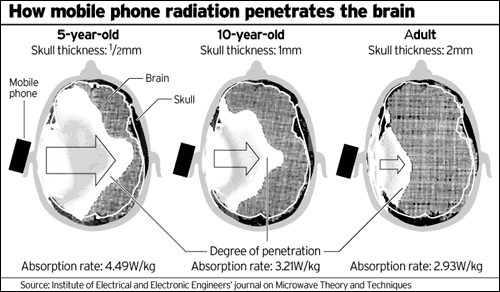
The EWG recommended limit for so-called whole-body Specific Absorption Rate, or SAR, for children is 0.2 to 0.4 milliwatts per kilogram, or mW/kg. For adults, EWG recommends a whole-body SAR limit of 2 to 4 mW/kg, which is 20 to 40 times lower than the federal limit.
The FCC has not set a separate standard for children. Its standards for radiofrequency radiation set a maximum SAR of 0.08 watts per kilogram, or W/kg, for whole-body exposure and an SAR for localized spatial peak – the highest exposure level for a specific part of the body, such as the brain – of 1.6 W/kg for the general population.
The NTP studies examined the health effects of 2G and 3G wireless radiation and found there is “clear evidence” of a link between exposure to radiofrequency radiation and heart tumors in laboratory animals. Similar results were reported by a team of Italian scientists from the Ramazzini Institute.
Cellphone radiation was classified a “possible carcinogen” in 2011 by the International Agency for Research on Cancer, part of the World Health Organization, a conclusion based on human epidemiological studies that found an increased risk of glioma, a malignant brain cancer, associated with cellphone use.
EWG scientists say that more research is needed on the health impacts of the latest generation of communication technologies, such as 5G. In the meantime, EWG’s recommendation for strict, lower exposure limits for all radiofrequency sources, especially for children………
“We have grave concerns over the outdated approach the federal government has relied on to study the health effects of cellphone radiation and set its current safety limit and advice for consumers,” said EWG President Ken Cook. “Government guidelines are a quarter-century old and were established at a time when wireless devices were not a constant feature of the lives of nearly every American, including children.”…………
“The evidence shows that children absorb more radiofrequency radiation than adults, and the developing body of a child is more vulnerable to such effects,” said Olga Naidenko, Ph.D., EWG’s vice president for science investigations and co-author of the study.
“More research on the safety and sustainability of wireless technology is essential,” added Naidenko. “Meanwhile, there are simple steps everyone can take to protect their health, such as keeping wireless devices farther from their bodies.”……
EWG’s recommendation for limits for radiofrequency radiation exposure is its latest effort to advance the public dialogue about science-based standards that protect public health. https://www.news-medical.net/news/20210720/EWG-study-recommends-stringent-health-based-standards-for-radiation-exposure-from-wireless-devices.aspx
Shoddy, shoddy, shoddy: How they built the Bataan Nuclear Power Plant
Shoddy, shoddy, shoddy: How they built the Bataan Nuclear Power Plant, rappler.com, KELVIN S. RODOLFO 21 July 21, There is not enough space to list the multitude of construction errors inspector William Albert found at the Bataan Nuclear Power Plant
The following is the tenth in a series of excerpts from Kelvin Rodolfo’s ongoing book project Tilting at the Monster of Morong: Forays Against the Bataan Nuclear Power Plant and Global Nuclear Energy.Some history A thoughtful congressman, Roilo Golez, once cautioned that the Bataan Nuclear Power Plant’s (BNPP) risks were magnified by a “national lack of a culture of safety that is observed in Japan, the United States, and Western Europe.” The BNPP has been accursed with that lack from the very beginning, and remains so today…………. https://www.rappler.com/voices/thought-leaders/opinion-shoddy-how-
Energy-guzzling Bitcoin must be allied to dangerous costly nuclear power

Bitcoin Miners Embrace Nuclear Power , Yahoo Finance, Editor OilPrice.com, 21 July 21,
”…..The worldwide cryptocurrency production sector is eating up an almost unfathomable amount of energy — as much as entire nations. As of now, Bitcoin mining ranks between Colombia (a country of 50 million people) and Bangladesh (population 163 million) in terms of energy consumption. All told, Bitcoin networks account for an incredible 0.32% of the world’s energy consumption…
The process of “mining” Bitcoin, while virtual, requires an enormous amount of resources because of the considerable computing power necessary to carry out the extremely complex calculations to solve the “proof-of-work” problems that make up the blockchain, the digital ledger that Bitcoin is built upon. Bitcoin is currently being singled out for its massive energy consumption over other cryptocurrencies, not only because it is more than twice the size of the next-most traded cryptocurrency, but because Bitcoin’s especially complex SHA-256 algorithm, which makes Bitcoin one of the most secure cryptocurrencies out there, also makes it one of the most energy-hungry.
The tally of North Korea’s nuclear weapons
Nuclear Notebook: How many nuclear weapons does North Korea have in 2021? Bulletin of the Atomic Scientists
By Hans M. Kristensen, Matt Korda, July 21, 2021 orth Korea has made significant advances over the past two decades in developing a nuclear weapons arsenal. It has detonated six nuclear devices––one with a yield of well over 100 kilotons––and test-flown a variety of new ballistic missiles, several of which may be capable of delivering a nuclear warhead to targets in Northeast Asia and potentially in the United States and Europe. However, there is considerable uncertainty about which of North Korea’s missiles have been fielded with an active operational nuclear capability.
It is widely assumed that North Korea has operational nuclear warheads for medium-range missiles. However, it is unclear whether it has managed to develop fully functioning nuclear warheads that can be delivered by long-range ballistic missiles and, following violent atmospheric reentry, detonate as planned. That said, just because North Korea has not yet publicly demonstrated a capability to deliver a functioning nuclear reentry vehicle on a long-range ballistic missile does not necessarily indicate that it is not working on developing one or could not field one in the future. It is clear from its development efforts and public statements that North Korea ultimately intends to field an operational nuclear arsenal capable of holding regional and US targets at risk.
Due to the lack of clarity surrounding North Korea’s nuclear program, agencies and officials of the US intelligence community, as well as military commanders and nongovernmental experts, struggle to assess the program’s characteristics and capabilities. Based on publicly available information about North Korea’s fissile material production and missile posture, we cautiously estimate that North Korea might have produced sufficient fissile material to build 40 to 50 nuclear weapons and that it might possibly have assembled 10 to 20 warheads for delivery by medium-range ballistic missiles.
North Korea’s nuclear policy
North Korea declared a no-first-use policy following its fourth nuclear test in 2016; however, it diluted its statement with the caveat that it would not “be the first to use nuclear weapons […] as long as the hostile forces for aggression do not encroach upon its sovereignty”………………
Nuclear testing and warhead capabilities
After six nuclear tests––including two with moderate yields and one with a high yield––there is no longer any doubt that North Korea can build powerful nuclear explosive devices designed for different yields. ………………………..
Medium-range ballistic missiles
North Korea has developed three medium-range ballistic missiles (MRBMs), all three of which are likely to be operational. This is the category of missile that is most likely to have an operational nuclear capability…………
Intercontinental ballistic missiles
The most dramatic development has been North Korea’s display and test-launching of large ballistic missiles that appear to have intercontinental range. North Korea has publicly shown five types of missiles in this category: the Taepo Dong-2, the Hwasong-13, the Hwasong-14, the Hwasong-15, and the Hwasong-16. These systems are in various stages of development, and some may simply be mockups or technology demonstrators……………………. https://thebulletin.org/premium/2021-07/nuclear-notebook-how-many-nuclear-weapons-does-north-korea-have-in-2021/
Do Germany and the Netherlands want to say goodbye to US nuclear weapons?
Do Germany and the Netherlands want to say goodbye to US nuclear weapons? Bulletin of the Atomic Scientists By Michal Smetana, Michal Onderco, Tom Etienne, July 21, 2021 Does stationing US nuclear weapons in Europe still make sense? As of 2021, there remain about 100 B61 nuclear bombs stored at military bases in Germany, the Netherlands, Belgium, Italy, and Turkey (Kristensen and Korda 2021). Deployed under NATO’s nuclear sharing policy, these air-deliverable weapons are supposed to serve as a tool of extended deterrence against Russia and assurance of European allies about the willingness of Washington to defend them with all means available.
Yet, there are new—and loud—voices on both sides of the Atlantic that question the need to continue this Cold War-era practice in the 21st century. While certainly not everyone agrees with the recent proposal by Harvard University’s Stephen Walt to “fold America’s nuclear umbrella” altogether (Walt 2021), many politicians in European hosting states advocate for at least an early removal of the remaining US bombs from their soil. Arguably, the debates over the future of US nuclear weapons in Europe are now of paramount importance given the attempts of the new US administration to balance its approach vis-à-vis Moscow (Squassoni 2021) and Europe’s ambition to seek strategic autonomy (Meijer and Brooks 2021)……… (subscribers only) https://thebulletin.org/premium/2021-07/do-germany-and-the-netherlands-want-to-say-goodbye-to-us-nuclear-weapons/
Pentagon review: What happens if ‘nuclear football’ is lost?
Pentagon review: What happens if ‘nuclear football’ is lost? Questions about security procedures arose after Jan. 6, when Vice President Mike Pence was escorted to safety along with a military aide carrying the backup communications system.. 6, when Vice President Mike Pence was escorted to safety along with a military aide carrying the backup communications system.
By The Associated Press NBC News, 21 July 21, WASHINGTON — The Pentagon is taking a rare look at whether it is prepared to deal with the theft or compromise of the portable communications system nicknamed the “nuclear football,” which enables the president or a stand-in to order a nuclear attack.
In announcing the probe Tuesday, the Pentagon inspector general’s office did not disclose what precipitated it, but questions about security procedures arose in the aftermath of the Jan. 6 insurrection at the Capitol.
Vice President Mike Pence was seen on security camera video being escorted to safety, along with a military aide carrying the backup “nuclear football,” as rioters entered the Capitol.
A backup system always accompanies the vice president so that he is able to communicate in the event the president cannot. The “football,” officially called the Presidential Emergency Satchel, enables communication with the office inside the Pentagon that transmits nuclear attack orders.
The inspector general’s office said its review began this month. It gave no timeline for completing it.
“The objective of this evaluation is to determine the extent that DoD processes and procedures are in place and adequate to alert DoD officials in the event that the Presidential Emergency Satchel is lost, stolen, or compromised,” Randolph R. Stone, an assistant inspector general, wrote in a July 19 letter to the director of the White House military office and the director of the Joint Staff at the Pentagon. “This evaluation will also determine the adequacy of the procedures the DoD has developed to respond to such an event.”
Two Democrats who had asked the Pentagon inspector general to review the matter, Reps. Stephen Lynch of Massachusetts and Jim Cooper of Tennessee, said in a joint statement that the Jan. 6 riot raised questions about whether the Pentagon was even aware that Pence’s “nuclear football” was potentially in danger of falling into the hand of insurrectionists………..
“U.S. Strategic Command, which is responsible for U.S. strategic deterrence and nuclear operations, was reportedly unaware that Vice President Pence, his military aide, and the nuclear football were all potentially in danger and only came to understand the gravity of the incident several weeks later when security camera footage was played as a video exhibit during the Senate impeachment trial,” they wrote. https://www.nbcnews.com/politics/national-security/pentagon-review-what-happens-if-nuclear-football-lost-n1274582
Using snakes to monitor Fukushima radiation,
Using snakes to monitor Fukushima radiation, EurekAlert, 21 July 21,
Researchers placed tiny GPS trackers on rat snakes to track their movements at Fukushima
UNIVERSITY OF GEORGIA Ten years after one of the largest nuclear accidents in history spewed radioactive contamination over the landscape in Fukushima, Japan, a University of Georgia study has shown that radioactive contamination in the Fukushima Exclusion Zone can be measured through its resident snakes.
The team’s findings, published in the recent journal of Ichthyology & Herpetology, report that rat snakes are an effective bioindicator of residual radioactivity. Like canaries in a coal mine, bioindicators are organisms that can signal an ecosystem’s health.
An abundant species in Japan, rat snakes travel short distances and can accumulate high levels of radionuclides. According to the researchers, the snakes’ limited movement and close contact with contaminated soil are key factors in their ability to reflect the varying levels of contamination in the zone.
Hanna Gerke, an alumna of UGA’s Savannah River Ecology Laboratory and the Warnell School of Forestry and Natural Resources, said tracked snakes moved an average of just 65 meters (approximately 213 feet) per day.
An abundant species in Japan, rat snakes travel short distances and can accumulate high levels of radionuclides. According to the researchers, the snakes’ limited movement and close contact with contaminated soil are key factors in their ability to reflect the varying levels of contamination in the zone.
Our results indicate that animal behavior has a large impact on radiation exposure and contaminant accumulation,” Gerke said. “Studying how specific animals use contaminated landscapes helps increase our understanding of the environmental impacts of huge nuclear accidents such as Fukushima and Chernobyl.” https://www.eurekalert.org/pub_releases/2021-07/uog-ust072021.php
Small nuclear reactor project cut back to half size, due to financial worries

Eastern Idaho nuclear project goes from 12 to six reactors. IDAHO FALLS, Idaho (AP) 19 July 21— A Utah energy cooperative said it will reduce the number of small modular nuclear reactors it will build in Idaho from 12 to six for a first-of-a-kind project [ totally ineffective against global heating] that is part of a federal effort to reduce greenhouse gasses that cause climate change……
The reactors are being built by Portland, Oregon-based NuScale Power. The U.S. Nuclear Regulatory Commission last year approved NuScale’s application for the small modular reactors, the first time U.S. officials approved a design for a small commercial nuclear reactor.
………….. Idaho Falls has committed to buying 5 megawatts of power from the reactors through the Carbon Free Power Project. The city had been committed to 10 megawatts but cut that in half in October amid concerns about financial risks.
……….. Idaho Falls City Council member John Radford said at a July 8 meeting. “This project is something that can help keep this country on this trajectory to a carbon-free future and maybe a better existence for all of us.” – [a complete untruth!! this Councillor is either ignorant, or lying] https://madison.com/news/national/govt-and-politics/eastern-idaho-nuclear-project-goes-from-12-to-six-reactors/article_cb353af6-5659-5baa-8365-dc575aeeba8d.html
Wiscasset – just one of thousands of American communities stuck with stranded nuclear wastes.

The situation in Wiscasset underscores a thorny issue facing more than 100 communities across the U.S.: What to do with hundreds of thousands of tons of nuclear waste that has no place to go.

All told, the country’s many abandoned nuclear facilities — including Maine Yankee — have cost the federal government billions of dollars, a sum that increases by about $2 million each day
Keeping the spent fuel on the site was meant to be a temporary solution until the dry storage casks, or canisters, could be transported to a permanent home deep underground where they could stay undisturbed for hundreds of thousands of years.
Armed Guards Protect Tons Of Nuclear Waste That Maine Can’t Get Rid Of Maine Public | By By Abigail Curtis, BDN July 19, 2021 In the summertime, the picturesque village of Wiscasset is infamous for its long lines of people hungry to try a lobster roll at Red’s Eats and cars that crawl through town on the often-clogged U.S. Route 1.
But just a few miles south of downtown is a different kind of roadblock: thousands of tons of nuclear waste stored on a coastal peninsula at the now-decommissioned Maine Yankee atomic energy plant that have nowhere to go.
The change in presidential administrations means another chance for the federal government to make good on its promise to remove the waste, so the site can be closed for good. The Biden administration’s Department of Energy seems to be picking up where the Obama administration left off, creating a process for communities to volunteer to host the waste.
“What worries me is that there really isn’t any national leadership right now on this stuff. There isn’t an agency that has a mission and has developed a strategy, that has goals and is willing to act on it,” Don Hudson, the chairman of the Maine Yankee Community Advisory Panel, said. “We’re currently in this limbo.”
That’s a problem because the waste — 1,400 spent nuclear fuel rods housed in 60 cement and steel canisters, plus four canisters of irradiated steel removed from the nuclear reactor when it was taken down — is safe for now, but can’t stay in Wiscasset forever.
The situation in Wiscasset underscores a thorny issue facing more than 100 communities across the U.S.: What to do with hundreds of thousands of tons of nuclear waste that has no place to go.
Securing these remnants of nuclear energy generation is an ongoing task that requires armed guards around the clock and costs Maine Yankee’s owners some $10 million per year, which is being paid for with money from the government.
After the government failed to remove the spent fuel, Maine Yankee and the other two decommissioned nuclear power plants in New England — Connecticut Yankee in East Hampton, Connecticut, and Yankee Atomic in Rowe, Massachusetts — took it to court. So far, they have been awarded a total of $575.5 million in damages during four rounds of litigation, money that has been paid out of the U.S. Judgment fund. A fifth round is happening now, and the lawsuits are likely to continue until the fuel is removed.
Continue readingAfter the lab-leak theory, US-Chinese relations head downhill
The United States and China could work together in sharing biosecurity-related samples, genetic materials and data, developing protocols and countermeasures against biosafety accidents, promoting transparency in dual-use research of concern, countering disinformation, and strengthening compliance with global health laws, including the Biological Weapons Convention and the International Health Regulations.
But the US push to investigate the lab leak and the political context in both countries likely puts the goal of finding the origins of COVID-19 and many other ambitions at risk………
After the lab-leak theory, US-Chinese relations head downhill, Bulletin of the Atomic Scientists, By Yanzhong Huang | July 16, 2021 In October, 2018, more than a year before the COVID-19 pandemic, dozens of international trainees visited the Wuhan Institute of Virology for an expansive workshop meant to “promote the cooperation between China and other countries in the field of biosafety.” The attendees, many from developing countries, took classes on virus handling and bioethics, they listened to speeches by Chinese and UN arms control officials, and learned from eminent scientists. For the organizers, the 10-day event was a chance to showcase China’s expertise in biosafety management. And for this, they could hardly have chosen a more perfect location, a prestigious virology institute that had just months earlier opened the country’s first state-of-the-art, specialized facility for safely studying the world’s most dangerous pathogens, a biosafety-level (BSL) 4 lab.
The marketing plan hasn’t paid out.
Two years on, the lofty vision the workshop at the advanced Chinese biolab embodied—one of international collaboration on disease control and scientific research—has disintegrated as the United States and China tangle in an increasingly nasty fight over the origins of the still-raging coronavirus pandemic. In the United States, President Joe Biden, prominent scientists, and once-skeptical mainstream media outlets have collectively revived a hypothesis that was initially largely framed as a conspiracy theory, that the COVID-19 virus could have escaped from the Wuhan lab. Meanwhile, in China, many are convinced COVID-19 started somewhere else, outside of the country.
The Wuhan Institute of Virology now sits at the forefront of the US-China row on the origins of a once-in-a-century pandemic.
Continue readingCanada’s small nuclear reactor project is looking like just a pipe-dream.

Globe Climate: Canada wants nuclear to power the future. But how? SIERRA BEIN Matthew McClearn is an investigative reporter and data journalist with The Globe. For this week’sdeeper dive, he talks about Canada’s nuclear ambitions. Globe and Mail, 19 July 21
Senior government officials, notably federal Natural Resources Minister Seamus O’Regan, say small modular reactors (SMRs) will help Canada achieve net-zero carbon emissions by mid-century. There’s just one problem: it’s not clear yet whether any will be built.
To be sure, many promises made by SMR vendors seem compelling. By taking advantage of factory-style mass production, they’re supposed to be far cheaper than previous generations of reactors, which tended to be massive and prone to cost overruns. They’d also be easier to deploy……..
A mad scramble to deliver on these promises is now underway. Ontario Power Generation—by far Canada’s most experienced nuclear station operator—plans to select a vendor to build a SMR at its Darlington Station by 2028. Further out, Saskatchewan is considering whether to order its own SMRs to replace coal-fired plants.
Accomplishing all that would silence numerous critics and naysayers. But as I explain in my most recent story, history is littered with reactors that failed to live up to their promises. . Many SMR vendors are very early-stage companies which face years of grueling, expensive R&D work to advance their designs to the point they could actually be built. And they’re competing against renewable technologies including wind and solar, which utilities can purchase and deploy today. It may be premature to count on SMRs to help meet Canada’s emissions targets. https://www.theglobeandmail.com/canada/article-globe-climate-canada-wants-nuclear-to-power-the-future-but-how/https://www.theglobeandmail.com/canada/article-globe-climate-canada-wants-nuclear-to-power-the-future-but-how/
Judge rules distribution of compensation for investors who lost fortunes in multi billion-dollar nuclear reactor failure in South Carolina

Judge OKs distribution for $192M nuclear project settlement, https://www.miamiherald.com/news/business/article252884293.html
BY MEG KINNARD ASSOCIATED PRESS, JULY 19, 2021 OLUMBIA, S.C.
Investors who lost fortunes in the failure of a multi billion-dollar nuclear reactor construction deal in South Carolina will soon begin to see their portions of a $192 million settlement, under a recently approved distribution.
Last week, a federal judge signed off on a plan to disperse the funds among former shareholders in SCANA Corp., the former parent company of South Carolina Electric & Gas. The settlement itself was the largest securities class action recovery obtained in South Carolina when a judge approved it last year, according to attorneys for the investors.
The utility company became embroiled in controversy after announcing in summer 2017 that it was shuttering a nuclear reactor construction project at the V.C. Summer Nuclear Station in Jenkinsville, about 30 miles (48 kilometers) north of Columbia, following the bankruptcy of lead contractor Westinghouse.
Up to that point, SCANA and state-owned utility Santee Cooper, a minority partner in the project, had spent nearly $10 billion on it. The failure cost ratepayers and investors billions and left nearly 6,000 people jobless.
The abandonment spawned multiple lawsuits, some by ratepayers claiming company executives knew the project was doomed and misled consumers as well as regulators as they petitioned for a series of rate increases. State and federal authorities launched investigations, which have led to guilty pleas from two top-level SCANA executives.
More than 737,000 SCE&G customers had already paid more than $2 billion toward the project, which never generated any power. Customers did ultimately see retroactive credits applied to bills after lawmakers passed a temporary rate cut that knocked about $25 a month off the average residential customer’s bill.
SCANA shareholders accused the company of assuring them the project was above board, even as costs and delays spiraled out of control. This, investors alleged, caused SCANA stock to be traded at artificially inflated prices, numbers that plummeted once the project was mothballed. In July 2016, SCANA stock was trading at $76.12 a share but dropped more than 50% after news of the project’s failure, and the investigations surrounding it, became public, according to the investors’ attorneys.
The settlement includes $160 million in cash, with the remaining $32.5 million covered by cash or stock in Dominion Energy. The Virginia-based company took over SCANA in 2019, paying more than $6.8 billion to buy out the company’s stock and assuming its consolidated net debts of $6.6 billion.
Claimants will be required to cash their checks within 120 days or forfeit the award, according to the order.
“We are pleased that the court has approved the settlement distribution plan, and look forward to the distribution of the settlement funds to eligible class members according to the plan,” said Marlon Kimpson, a state senator and attorney representing the investors.
Progressive lawmakers join across the world in a Global Alliance For A Green New Deal.

Labour MP Clive Lewis and Caroline Lucas of the Green Party join lawmakers from US, Brazil, EU and Costa Rica in new global climate justice campaign. Leading progressive lawmakers from the UK, USA, Brazil, Costa Rica, and the European Parliament are among those joining forces in a new Global Alliance for a Green New Deal today, in a bid to promote the case for “a rapid and just transition in response to Covid-19 and the climate and nature crises”.
The Alliance calls for the creation of “a new internationalism based on cooperation, collaboration and global justice” in order to address the interlinked climate, biodiversity, and coronavirus crises. It adds that a ‘Green New Deal’ should be placed at the heart of national and global Covid economic recovery efforts. Among the 21 founding politicians in the Alliance are British MPs Clive Lewis from the Labour Party and the Green
Party’s Caroline Lucas, who both co-chair the All Party Parliamentary Group on the Green New Deal in the UK.
Business Green 19th July 2021
https://www.businessgreen.com/news/4034612/moonshot-moment-uk-mps-join-global-alliance-green-deal
1 This Month

Read the Public Inquiry Report, the Commissioners’ report, Surrendering Australia: The AUKUS Deception is available to download for free at aukuspublicinquiry.com. Or just watch the replay of the National Press Club Luncheon.


19 November – Webinar – The Reality of Reprocessing
Time: 11:00 AM Pacific Time (US & Canada) / 2:00 PM Eastern / 7:00 PM UK / 8:00 PM CET
Register for the Zoom Event Here



Shut down the radiation-damaged Heysham nuclear reactors now
To see nuclear-related stories in greater depth and intensity – go to https://nuclearinformation.wordpress.com

Say No to NASA’s Reckless Nuclear Reactor on the Moon
Say No to NASA’s Reckless Nuclear Reactor on the Moon
-
Archives
- November 2026 (103)
- October 2026 (302)
- September 2026 (339)
- August 2026 (330)
- July 2026 (355)
- June 2026 (287)
- May 2026 (306)
- April 2026 (356)
- March 2026 (251)
- February 2026 (267)
- January 2026 (308)
- December 2025 (358)
-
Categories
- 1
- 1 NUCLEAR ISSUES
- business and costs
- climate change
- culture and arts
- ENERGY
- environment
- health
- history
- indigenous issues
- Legal
- marketing of nuclear
- media
- opposition to nuclear
- PERSONAL STORIES
- politics
- politics international
- Religion and ethics
- safety
- secrets,lies and civil liberties
- spinbuster
- technology
- Uranium
- wastes
- weapons and war
- Women
- 2 WORLD
- ACTION
- AFRICA
- Atrocities
- AUSTRALIA
- Christina's notes
- Christina's themes
- culture and arts
- Events
- Fuk 2022
- Fuk 2023
- Fukushima 2017
- Fukushima 2018
- fukushima 2019
- Fukushima 2020
- Fukushima 2021
- general
- global warming
- Humour (God we need it)
- Nuclear
- RARE EARTHS
- Reference
- resources – print
- Resources -audiovicual
- Weekly Newsletter
- World
- World Nuclear
- YouTube
-
RSS
Entries RSS
Comments RSS

