UN pledges full support to Nagasaki voices fuelling ‘powerful global movement’ against nuclear arms
UN pledges full support to Nagasaki voices fuelling ‘powerful global movement’ against nuclear arms. https://news.un.org/en/story/2021/08/1097372 9 Aug 21, António Guterres has reaffirmed the full support of the United Nations to amplifying the powerful testimony of the survivors of the atomic bomb that was dropped on the Japanese city of Nagasaki, 76 years ago, which has helped build a “powerful global movement against nuclear arms”.
In his message to the Nagasaki Peace Memorial on the 9 August anniversary, the UN Secretary-General said he continued to be humbled by the “selfless acts of the hibakusha, the name given to those who survived and continue to bear witness.
“Your courage in the face of immense human tragedy, is a beacon of hope for humanity”, he said in his address, delivered on his behalf at the ceremony by the UN High Representative for Disarmament Affairs, Izumi Nakamitsu.
“I reaffirm the full support of the United Nations to ensuring that your voices are heard by the world’s people, and especially by younger generations.”
Out of the ashes
The UN chief told the people of the city that was devastated in 1945, just days after the first bomb was dropped by the United States on Hiroshima during the final days of World War Two, that they had built a “cultural metropolis” out of the ashes.
“Your dynamic city exemplifies modernity and progress, while you work diligently to prevent devastation from ever befalling another city”, he said, warning however that the prospect of another nuclear weapon being used, were as dangerous now, as any time since the height of the Cold War between the US and former USSR.
“States are racing to create more powerful weapons, and broadening the potential scenarios for their use. Warlike rhetoric is turned up to maximum volume, while dialogue is on mute”, said the Secretary-General.
Grounds for hope
But two developments this year provide grounds for hope, in the form of the reaffirmation from the US and Russia, “that a nuclear war cannot be won and must never be fought”, together with a commitment to engage in arms control talks.
Secondly, said Mr. Guterres in his message, the Treaty on the Prohibition of Nuclear Weapons has now come into force, representing “the legitimate fears of many States, about the existential danger posed by nuclear weapons.”
And for the parties to the Nuclear Non-Proliferation Treaty, the UN chief said they all parties now need to reinforce “the norm against nuclear weapons” at the upcoming Tenth Review Conference, and take real steps towards elimination.
It is incumbent on all Member States of the UN, “to seek the abolition of the most deadly weapons ever made”, said Mr. Guterres, and together, we must prevent the tragedy of Nagasaki’s nuclear destruction, “from ever occurring again.”
Elon Musk to take part in a project to place advertising in space?

Elon Musk slammed as SpaceX to launch satellite displaying billboard ads in space
ELON MUSK has come under fire from the scientific community after it has emerged a company wants SpaceX to launch a satellite broadcasting billboard ads from space. Express UK By SEBASTIAN KETTLEY, Aug 9, 2021
Background color
The South African billionaire, who does not shy away from controversy, has a lot going on his plate right now. SpaceX is busy assembling and testing the Mars rocket Starship, Starlink is slowly expanding its mega-constellation Internet-beaming satellites and Tesla has recently rolled out the Model S Plaid. A new report has now revealed SpaceX is partnering with a Canadian startup to launch the world’s first space-based ad satellite.
According to Samuel Reid, CEO and co-founder of Geometric Energy Corporation (GEC), the company will pay SpaceX to launch an advertisement satellite into low-Earth orbit (LEO).
This satellite, called CubeSat, will boast a large screen full of purchasable pixels on one side where advertisers will bid to have their logos and products displayed.
Mr Reid told Insider: “There might be companies which want to depict their logo… or might end up being a bit more personal artistic.

“Maybe Coca-Cola and Pepsi will fight over their logo and reclaim over each other.
SpaceX will not play a direct role in the mission but rather act as the launch provider at some point in early 2022, using one of the company’s iconic Falcon 9 rockets.
Once in orbit, the CubeSat will use a selfie stick to broadcast its stream back to Earth via Twitch or YouTube.
Luckily, this means giant billboards are not about to fill up the night skies with advertising.
But the news has sparked an outcry on social media, with scientists and spaceflight enthusiasts alike criticising the move.
Comedy writer James Felton took to Twitter to vent his disapproval
He said: “Going to be difficult to pretend we’re not living in a sci-fi dystopian apocalypse when we take a moment to look up from the raging wildfires engulfing the planet to see the words Drink Pepsi.”
Game programmer and reporter Matthew Chapman said: “No. I draw the line here.
“Congress needs to ban Space Billboards before they become a thing.
“Already SpaceX satellites are creating a minefield of pollution in low-Earth orbit.”
And science writer Amy Shira Teitel said: “Coke vs Pepsi in space? What’s a little more horrendous light pollution between mega-advertising behemoths?
“Hoping this never, ever happens…”
To advertise on the pixel billboard, customers will have to pay using cryptocurrency tokens.
These will include digital tokens like ethereum, though GEC plans to accept dogecoin in the future.
Advertisers will get to select each individual pixel they want and fill them out with a colour of their choice.
Once they fill out enough pixels, a discernable image will emerge on the screen.
Mr Reid said: “I’m trying to achieve something that can democratize access to space and allow for decentralized participation………… https://www.express.co.uk/news/science/1474414/elon-musk-slammed-spacex-launch-satellite-billboard-ads-in-space-scn
Canada’s political leaders oblivious to the dangers in making plutonium accessible?
Our political leaders seem oblivious to the dangers to the entire planet that could result from widespread access to plutonium. If Canada can access plutonium, so can any other country. If many countries have access to plutonium, the possession of nuclear weapons must be regarded as a real possibility. In a nuclear-armed world, any conflict anywhere can turn into a nuclear war. The stakes could not be greater
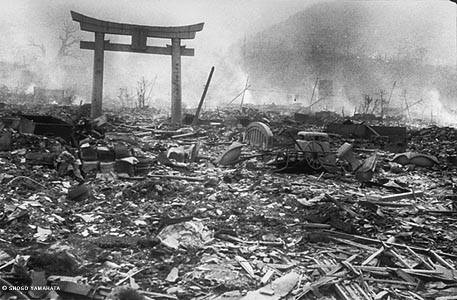
Plutonium: from Nagasaki to New Brunswick, https://nbmediacoop.org/2021/08/09/plutonium-from-nagasaki-to-new-brunswick/ by Gordon Edwards, August 9, 2021 Today, August 9, is the 76th anniversary of the US military’s atomic bombing of the City of Nagasaki in Japan. The nuclear explosive used was plutonium.
The destructive power of plutonium was first revealed on July 16, 1945, when a multicoloured mushroom cloud bloomed over the American desert – the first atomic explosion, top-secret, and much more powerful than expected. Robert Oppenheimer, the man in charge, was awestruck and thought of the words from the Bhagavad-Gita: “I am become Death, the Destroyer of Worlds.”
Three weeks and three days later, on August 9, 1945, the City of Nagasaki was destroyed with a single plutonium bomb.
Plutonium is named for Pluto, god of the dead. It is the primary nuclear explosive in the world’s nuclear arsenals. Even the largest nuclear warheads, based on nuclear fusion, require a plutonium “trigger” mechanism. Access to plutonium is key to the construction of such thermonuclear weapons. Removing the plutonium from nuclear warheads renders them impotent.
Plutonium is not found in nature but is created inside every nuclear power reactor,
including the one at Point Lepreau on the Bay of Fundy. Plutonium is a human-made derivative of uranium. A metallic element heavier than uranium, it is created inside the nuclear fuel along with hundreds of lighter, fiercely radioactive by-products – the fragments of uranium atoms that have been split.
The countries that have nuclear weapons – the five permanent members of the UN Security Council (US, UK, France, Russia and China) as well as India, Pakistan, Israel, and North Korea – have all learned how to separate plutonium from used nuclear fuel for use in weapons. This is done by dissolving the solid fuel assemblies in a hot, highly radioactive chemical bath from which the plutonium is extracted using basic scientific procedures. Any technology for extracting plutonium from used fuel is called reprocessing.
Nuclear advocates have long dreamed of using plutonium as a reactor fuel, thereby increasing the options for new reactor designs and magnifying the longevity of the nuclear age. The problem is, once plutonium has been extracted, it can be used either for weapons or for fuel at the discretion of the country possessing it. Policing methods can be circumvented. As Edward Teller has observed: “There is no such thing as a foolproof system because the fool is always greater than the proof.”
That’s how India exploded its first atomic bomb in 1974, by using plutonium created in a Canadian research reactor given as a gift to India and a reprocessing plant provided by the US. Both the reactor and the reprocessing plant had been designated as “peaceful” facilities intended for non-military use. India declared that the bomb it had detonated was a “Peaceful Nuclear Explosive.”
After the Indian blast, it was quickly determined that several other clients of Canadian technology – South Korea, Argentina, Taiwan, and Pakistan – were also in a position to develop a plutonium-based bomb program. Swift and decisive international action forestalled those threats. In particular, South Korea and Taiwan were discouraged by their US ally from pursuing reprocessing.
Shaken by these shocking developments, in 1977 US President Jimmy Carter – the only head of state ever trained as a nuclear engineer – banned the civilian extraction of plutonium in America and tried to have reprocessing banned worldwide, because of the danger that this nuclear bomb material could fall into the hands of criminals, terrorists, or militaristic regimes bent on building their own nuclear explosive devices. As one White House adviser remarked, “We might wake up and find Washington DC gone, and not even know who did it.”
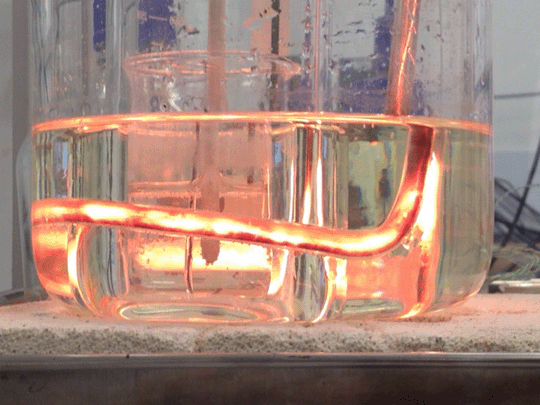
Japan is the only country without nuclear weapons that extracts plutonium from used nuclear fuel, much to the dismay of its neighbours. South Korea is not allowed to do so, despite repeated efforts by South Korea to obtain permission from the US to use a type of reprocessing technology called “pyroprocessing.” Pyroprocessing is currently undergoing experimental tests at a US nuclear laboratory in Idaho.
Now, New Brunswick has been enticed to take the plutonium plunge. The company Moltex Energy, recently established in Saint John from the UK, wants to use plutonium as a nuclear fuel in a type of reactor that is not yet fully conceptualized. The plutonium would be extracted from the thousands of solid irradiated nuclear fuel bundles currently stored at NB Power’s Point Lepreau reactor using a version of the pyroprocessing technology that South Korea has so far been denied.
On a site right beside the Bay of Fundy, the highly radioactive metallic fuel bundles would be dissolved in molten salt at a temperature of several hundred degrees. A strong electrical current would be used to strip the plutonium metal and a few other elements (less than one percent of the mass) out of the dissolved fuel.
After the government of Canada gave $50.5 million to support the Moltex project in March this year, nine retired US government advisors – all of them experts in preventing the proliferation of nuclear weapons – wrote to Prime Minister Justin Trudeau in May, urging him to authorize an independent review of the international implications of the proposed New Brunswick plutonium scheme.
These nine experts, who have worked under six different US presidents, both Republican and Democrat, are deeply concerned that Canada’s support for reprocessing and the civilian use of plutonium could seriously undermine delicate and precarious global non-proliferation efforts that have been underway for many decades.
No reply from the Canadian government has so far been received, although Trudeau’s office acknowledged receipt of the letter and said that the matter has been entrusted to Foreign Affairs Minister Marc Garneau and Natural Resources Minister Seamus O’Regan.
Without any word from these two ministers, Moltex posted a response to the US experts’ letter on their corporate web site, disputing some of the claims made in the letter to Trudeau. In particular, Moltex claims that their proposed technology is not usable for nuclear weapons purposes because the plutonium is not pure, but mixed with other contaminants that cannot easily be removed.
The Moltex response has prompted another letter to Trudeau from the US non-proliferation experts, correcting this and several other misleading comments from Moltex and reiterating their call for a fully independent expert review of the non-proliferation aspects of the Moltex proposal.
Our political leaders seem oblivious to the dangers to the entire planet that could result from widespread access to plutonium. If Canada can access plutonium, so can any other country. If many countries have access to plutonium, the possession of nuclear weapons must be regarded as a real possibility. In a nuclear-armed world, any conflict anywhere can turn into a nuclear war. The stakes could not be greater.
Citizens of New Brunswick and all Canadians who realize the importance of this issue can write to our Prime Minister in support of a non-proliferation review of the Moltex proposal, and raise this matter with candidates and at the door during the next federal election campaign. We can all raise awareness of the legacy of Nagasaki and do our best to ensure that New Brunswick is not implicated by going ahead with the Moltex plutonium extraction scheme.
Dr. Gordon Edwards, President of the Canadian Coalition for Nuclear Responsibility, is based in Montreal.
Nagasaki remembers the atomic bomb, Olympic officials refuse to allow a minute’s silence.

Nagasaki nuclear attack remembered https://www.taipeitimes.com/News/world/archives/2021/08/10/2003762363
ATOMIC BOMB ANNIVERSARY: Small turnout due to COVID-19 did not lessen the observance, also marking the first year of a mostly symbolic nuclear ban treaty
The Japanese city of Nagasaki yesterday commemorated the 76th anniversary of the detonation of a US atomic bomb over the city, with the mayor calling for the global community to build on a new nuclear ban treaty.
Nagasaki was hit by an atomic inferno that killed 74,000 people, three days after the nuclear bomb that hit Hiroshima.
The twin attacks brought forth the nuclear age and gave Japan the bleak distinction of being the only country to be struck by foreign atomic weapons.
Survivors and a handful of foreign dignitaries offered a silent prayer at 11:02am local time, the exact time the second — and last — nuclear weapon used in wartime was dropped. For a second year, the number of people attending was much smaller due to COVID-19 restrictions. The ceremony is the first since an international treaty banning nuclear weapons came into force last year.
“World leaders must commit to nuclear arms reductions and build trust through dialogue, and civil society must push them in this direction,” Nagasaki Mayor Tomihisa Taue said.
The treaty has not been signed by countries with nuclear arsenals, but activists believe it will have a gradual deterrent effect.
Japan has not signed it either, saying the accord carries no weight without being accepted by nuclear-armed states.
The country is also in a delicate position, as it is under the US nuclear umbrella, with US forces responsible for its defence.
As the only country that has suffered atomic bombings during the war, it is our unchanging mission to steadily advance the efforts of the international community, step by step, towards realization of a world free of nuclear weapons,” Japanese Prime Minister Yoshihide Suga said at the ceremony.
On Friday, Japan marked 76 years since the US dropped an atomic bomb on Hiroshima, killing around 140,000 people.
Barack Obama in 2016 became the first sitting US president to visit Hiroshima, but Washington has never acceded to demands for an apology for the bombings.
International Olympic Committee president Thomas Bach traveled to Hiroshima in July, before the start of the Tokyo Games, to mark the start of an Olympic truce — a tradition that calls for a halt to global conflict to allow the safe passage of athletes.
However, city officials were disappointed after the IOC refused a request to stage a minute of silence at the Games to mark Friday’s anniversary.
French nuclear company EDF is postponing its decision on whether or not to go ahead with the Sizewell nuclear project in Britain
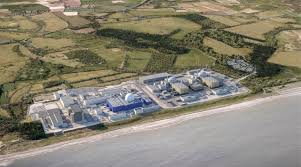
EDF delays final decision on Sizewell C. French energy giant now expects to leave it as late as 2023 before deciding whether to proceed with Suffolk nuclear power project. The timeline for EDF to decide whether to go ahead with the £20bn Sizewell C power station has slipped amid a lengthy planning approval process that is playing out as funding negotiations with ministers continue.
The French power giant now expects to make a final investment decision on the Suffolk plant at the end of 2022 or in 2023, compared to its previous expectations of mid-2022. EDF is in negotiations with the Government about a funding deal for Sizewell C and will also need external investors. Legislation is likely to be brought forward to allow developers to recoup costs during construction from household energy bills.
However, talks have been overshadowed in recent weeks by reports that ministers are seeking ways to block CGN from Sizewell and future UK nuclear projects. CGN has a 20pc development stake in Sizewell with an option to participate in the construction phase.
Telegraph 8th Aug 2021
https://www.telegraph.co.uk/business/2021/08/08/edf-delays-final-decision-sizewell-c/
Comparing the costs of nuclear and solar power
Solar challenging nuclear as potential climate change solution https://www.pv-magazine.com/2021/08/09/solar-challenging-nuclear-as-potential-climate-change-solution/
Research suggests that we can power 80% of the United States with wind, solar, and 12 hours of energy storage, but the replacement of nuclear power plants hasn’t been financially viable. Is that about to change?AUGUST 9, 2021 JOHN FITZGERALD WEAVER Nuclear power delivers almost 20% of all electricity in the United States, and about 50% [ if you don’t count the uranium-nuclear fuel chain] of all low-emission electricity. Moreover, the United States has almost 100 nuclear power units operating more than 90% of the time, providing a steady base of power generation.
But moving forward, it seems nuclear has lost its swagger. Price increases, project delays, and cancellations have caused what may prove to be generational damage to nuclear power’s reputation. pv magazine USA has previously reported on industry pricing models, showing nuclear’s lagging pricing.
Now, Georgia Power’s Vogtle Unit 3 and Unit 4 – the nation’s only nuclear generating units currently under construction – have announced further delays and price increases. Conservative cost estimates suggest the two 1.117 GW facilities will require at least $30 billion to complete, including $3 billion in finance costs and $27 billion in construction costs.
Solar+storage costs
As solar and energy storage professionals, we must be conscious of the limitations of the sun, and the cost of energy storage. As we all know, the sun also sets. And while research suggests we can power 80% of the U.S. with wind, solar, and 12 hours of energy storage, being able to replace a nuclear power plant that runs 24/7/365 in wind, rain, snow, and sleet simply hasn’t been financially viable.
But is it today?
The chart above [ on original] shows the price of solar panels from 1976 through the end of 2019. Here, we see prices fall by more than 99.8% from over $100 per watt down to nearly $0.20 per watt. Below, we see the price of battery packs starting in 2010 and ending in 2020, based on data from Bloomberg New Energy Finance. Here, we see costs fall from $1,191/kWh to $137/kWh – a price decrease of greater than 88%.
In both cases, we can expect prices to continue trending downward in both the middle and long term. And so, what can we expect to pay when we replace a nuclear power plant with solar power plus batteries?
Cash to spend
In order to replace the two nuclear plants while the sun is down, the batteries would need to replicate two 1.117 GW power sources for 16 hours. The total energy storage capacity would be 39.3 GWh, after we add an extra 10% for safe measure.
Roughly speaking, the total cost of these solar+storage facilities would be:
- $8.4 billion for 10.55 GWdc of solar power, fully installed at $0.80/watt
- $527 million for hypothetical power grid upgrades at $0.05/watt
- $7.8 billion for 39.3 GWh of energy storage fully installed at $200/kWh
- Around $16.8 billion grand total, no incentives
So, Georgia, pv magazine USA just saved you more than $13 billion (as of today, anyway).
Some caveats
It’s almost certain that a solar facility of this magnitude – roughly 27,000 acres, or around 0.07% of Georgia’s land – would be split among many landowners in the state. If land lease rates in Georgia are comparable to what might be earned in Pennsylvania, the project could provide as much as $27 million per year in income to Georgia landowners for decades to come.
Furthermore, the solar power plants would start generating electricity and revenue within about three years of the first signature, and two years after groundbreaking. The new Vogtle reactors began construction in 2013 (planning began much earlier), and are projected to complete in 2022-23.
With these considerations in mind, the repowering costs to get a solar+storage facility to a 40 to 80-year lifetime would likely be offset by the fact that the solar facility will enter service at least eight years earlier than the equivalent nuclear site. Additionally, during the solar plant’s operating lifetime, it saves massive amounts of regular operations and maintenance costs,
as well as specialist engineer labor costs. The nuclear facility will easily last 40 years, and potentially as long as 80. However, the ongoing operations and maintenance costs are significant, as well as upgrades and equipment replacements that start to become necessary after 40 years. And sometimes, those $1 billion dollar upgrades go wrong, and a nuclear power plant gets trashed.
When we do repower the batteries and solar panels, they almost certainly will be cheaper, and operate at a higher efficiency, likely stretching the life of the solar facility to 50+ years. Again, this solar+storage facility would generate 20% more juice in the summer (when the power is needed most in Georgia) because we oversized it for the winter.
In the end, it would be best if we had a healthy ecosystem of clean energy generation systems that include nuclear [but nuclear is not clean]. However, if we’re going to debate the costs of nukes vs. solar, then it is no longer a discussion.
Why China is increasing its nuclear deterrence capacity
China needs to increase nuclear capacity to maintain minimum deterrence against rising US coercion, By Hu Xijin Global Times, Aug 07, 2021 On Friday, US Secretary of State Antony Blinken expressed his “deep concern” about the “rapid growth” of China’s nuclear arsenal with Southeast Asian foreign ministers. He accused Beijing of “sharply deviating from its decades-old nuclear strategy based on minimum deterrence.” This is the US’ official response from the highest level after various US think tanks over the past few months have claimed that China is building a great number of “new missile silos” in Yumen of Northwest China’s Gansu Province and in the Hami region in Northwest China’s Xinjiang Uygur Autonomous Region.
Chinese officials have not directly responded to these allegations made by US think tanks. They have neither confirmed nor denied them.It is important to note that China has never abandoned its minimum deterrence nuclear strategy. However, due to the comprehensive strategic threat that the US keeps posing to China, the nuclear capabilities Beijing needs to achieve “minimum deterrence” are now different from the past. As the potential risk stemming from US nuclear coercion against China is clearly increasing, China needs to have sufficient nuclear forces to contain such a risk
Even many ordinary Chinese people feel the urgency of strengthening China’s nuclear deterrent is common sense. We don’t know if those structures shown in the satellite photos in Yumen and Hami are silos or the foundations of wind power plants as some scholars have speculated. But if it does turn out that they really are silos, Chinese public opinion will definitely support the construction of them unconditionally.
Washington is in no moral position to accuse China of this. China has only a fraction of the number of nuclear warheads that the US has. China is also the only nuclear power that has pledged not to be the first to use nuclear weapons. The US has never indicated that it would consider making the same commitment.
There is no information from Beijing on whether it is strengthening its nuclear buildup in the face of a realistic threat from Washington. But even if we were doing that, it would have nothing to do with Southeast Asian countries, or even with Japan and Australia, because China’s nuclear policy also includes another firm commitment of not using or threatening to use nuclear weapons against any non-nuclear-weapon state.
Once China substantially strengthens its nuclear forces, its only purpose will be to deter the US. Since there is already no mutual trust between China and the US, Chinese society is fully convinced that the US’ ultimate strategic goal is to bring China down. While not giving up on maintaining peace between the two countries, we must be prepared for the possibility that a war could eventually occur in the Taiwan Straits or the South China Sea. One of China’s major strategic missions today is to make the most complete layout for that day…………….https://www.globaltimes.cn/page/202108/1230817.shtml
China starting new nuclear power project, with technology from Russia
China started this week construction work on a new US$17-billion nuclear
power plant project, for which it will install Russian nuclear reactors at
the Xudabao project in northeastern China, World Nuclear News reports.
The Xudabao 3 unit is the first of four units at the plant to see the beginning
of construction. Russia’s Rosatom will design the nuclear island and will
provide equipment. The Russian firm will also provide commissioning
services for the equipment it will have supplied. The Russians will also
provide the construction and equipment for the Xudabao 4 unit, whose
construction is expected to begin in 2022. The two units are currently
expected to be commissioned in 2027 or 2028.
Oil Price 6th Aug 2021
Complicit – The countries, companies and think tanks that support the deadly nuclear arms trade

The world spends $137,000 a minute on nuclear weapons
Complicit — Beyond Nuclear International 8 Aug 21, The countries, companies and think tanks that support the deadly nuclear arms trade
From ICAN
A new report from ICAN — Complicit: 2020 Global Nuclear Weapons spending — names names and produces some horrifying spending numbers, made all the more immoral by the desperate needs around the world due to the COVID-19 pandemic, along with the ever worsening conditions brought on by the climate crisis.
As the report notes, “In 2020, during the worst global pandemic in a century, nine nuclear-armed states spent $72.6 billion on their nuclear weapons, more than $137,000 per minute, an inflation adjusted increase of $1.4 billion from last year.”
It goes on to ask the obvious question: Why? The answer lies in the profits to be made by the world’s nuclear weapons companies, not to mention the funding flowing to a few think tanks, some of which have missions that should make taking this money unacceptable. “Not only does this report reveal the massive spending on nuclear weapons during the worst global pandemic in a century, it also shines a light on the shadowy connection between the private companies building nuclear weapons, lobbyists and think tanks,” wrote ICAN’s Susi Snyder in an email to launch the report.
She also narrates this short video above that explains the findings.
“The exchange of money and influence, from countries to companies to lobbyists and think tanks, sustains and maintains a global arsenal of catastrophically destructive weapons. Each person and organisation in this cycle is complicit in threatening life as we know it and wasting resources desperately needed to address real threats to human health and safety”, says the report’s executive summary. It goes on:
“The $72.6 billion spent on nuclear weapons was split between governmental departments and private companies. Companies in France, the United Kingdom and the United States received $27.7 billion from nuclear-weapon-related contracts in 2020, of which $14.8 billion was new.
“Those companies then funded think tanks that research and write about nuclear weapons policies. At least twelve major think tanks that research and write about nuclear weapons in India, France, the United Kingdom, and the United States received collectively between $5 million and $10 million from companies that produce nuclear weapons.
“The CEOs of companies that produce nuclear weapons sit on their advisory boards and are listed as ‘partners’ on their websites.
“And to make sure the enormous budgets are approved to pay for these contracts, those same companies hire lobbyists. In 2020, nuclear weapons producers spent $117 million in lobbying on defence. For every $1 spent lobbying, an average of $236 in nuclear weapon contract money came back.
“Nuclear-armed states spent an obscene amount of money on illegal weapons of mass destruction in 2020, while the majority of the world’s countries support a global nuclear weapons ban. But the story doesn’t stop there. Companies, lobbyists and think tanks are complicit and deserve to be held accountable for their role in building and shaping a world with more than 13,000 life- ending weapons. We need to call on them to cut it out.”
The executive summary of the report then calls out the names of the countries, companies and think tanks complicit in effectively planning the world’s destruction.
Country Spending On Nuclear Weapons In 2020
The United States: $37.4 billion; $70,881 / minute
China: $10.1 billion; $19,149 / minute
Russia: $8 billion; $15,222 / minute
The United Kingdom: $6.2 billion; $11,769 / minute
France: $5.7 billion; $10,786 / minute
India: $2.48 billion; $4,567 / minute
Israel: $1.1 billion; $2,059 / minute
Pakistan: $1 billion; $1,968 / minute
North Korea: $667 million; $1,265 / minute
2020 Total: $72.6 billion; $137,666 / minute
2019 Total: $71.2 billion* $135,424 / minute
*Adjusted for inflation…………………..
more https://beyondnuclearinternational.org/2021/08/08/complicit/
Fire, floods ravage Russia, threaten nuclear research site
Fire, floods ravage Russia, threaten nuclear research site https://www.dailysabah.com/world/europe/fire-floods-ravage-russia-threaten-nuclear-research-site, BY GERMAN PRESS AGENCY – DPA MOSCOW EUROPE AUG 08, 2021 AAfter reports of over 250 fires ravaging through Russia, blazes now threaten a nuclear research center in the city of Sarov, prompting a state of emergency, officials said on Sunday.
The danger level was boosted as fires near Nizhny Novgorod are spreading and the change in status makes it easier to mobilize extra firefighting forces, according to city officials.
But it is only one of 250 fires Russia is currently trying to extinguish throughout the country. The Siberian region of Sakha, in the country’s northeast, has been hit particularly hard. Dozens of houses have burned down and residents have been evacuated to safety.
Meanwhile, state TV showed images of cities in the Irkutsk and Krasnoyarsk regions enveloped in smoke.
Authorities said that, nationwide, about 3.5 million hectares are burning – about the combined area of Serbia and Montenegro. Weather experts and Greenpeace spoke of the worst fires in the history of Russian record keeping.
On the flip side, emergency crews in the Amur region, which borders China, are battling floods after heavy rainfalls. About 80 kilometers (about 50 miles) of streets and six bridges are underwater, with about 24 communities cut off from the outside world due to flooding along the Amur River said the regional transportation minister, Alexander Selenin.
The hard fought campaign continues – to ban nuclear weapons.
Public statement on the nuclear assassination of Hiroshima and Nagasaki https://www.pressenza.com/2021/08/public-statement-on-the-nuclear-assassination-of-hiroshima-and-nagasaki/07.08.21 – World without Wars and Violence It was a warm northern morning on 6 August 1945 in the city of Hiroshima, and despite the war, the atmosphere was somewhat normal, far from the scenes of war, with children going to school and the elderly going to work. Nothing foreshadowed the horror they would later experience when a powerful nuclear bomb would wipe out their lives forever. Neither children nor adults anywhere on earth ever imagined that anyone in this world would be capable of inflicting such an atrocity on their fellow human beings. Women and children burned, mutilated, their skin and eyes hanging out was the first Dantesque image of that horrific morning, then the effects of radiation that caused agony just as painful and prolonged.
World without Wars and Violence remembers with sadness one more year the fateful nuclear explosions of Hiroshima and Nagasaki 76 years ago, and does so in a hopeful attempt to ensure that such a horrific event can never happen again, in the naïve hope that the conscience of the human species has evolved enough not to do something so abhorrent again.
World without Wars and Violence, a member of the International Action Network on Nuclear Weapons (ICAN), a network that received the 2017 Nobel Peace Prize for its contribution to the drafting of a Treaty to Ban Nuclear Weapons. The Treaty was approved at the United Nations on 7 July 2017 with the approval of 122 nations, opened for signature on 20 September 2017, and finally entered into force on 22 January 2021 with 55 states having ratified it to date.
World without War argues that the campaign to ban nuclear weapons has been hard fought and wide-ranging, and will continue to be so until the vast majority of the world’s countries ratify the Treaty, including the nine nuclear weapons states, namely the United States, Russia, China, France, the United Kingdom, Israel, India, Pakistan and North Korea. Although these countries have not signed the Treaty, there are some that have indicated their willingness to do so if the others, especially the United States, do so. And while most European countries do not have them, they do have nuclear missile sites, being allies of the nuclear-weapon states in NATO.
Many efforts are being made at all levels, says World without Wars, to bring about a break with this Atlantic organisation, not only in terms of ratifying the ban on nuclear weapons, but also as an alliance, because it is considered a belligerent and expansionist organisation.
World without Wars also adds that campaigns are being carried out to get cities around the world to adhere to the idea of approving a treaty banning nuclear weapons, which has been very fruitful as more than a hundred cities around the world have given their support to the ban.
Similarly, a Network of Parliamentarians for the Prohibition of Nuclear Weapons has been formed and has been signed by hundreds of parliamentarians around the world. Not to mention the numerous professional organisations such as the Physicians for a Nuclear Ban, who are campaigning for support and holding events. It is worth noting that there are 607 ICAN member organisations in 106 countries, which shows the massiveness of the campaign for the abolition and elimination of these diabolical devices.
In this regard, Beatrice Fihn, ICAN’s executive director, upon receiving the Nobel Peace Prize, said forcefully: “Nuclear weapons as well as chemical weapons, biological weapons, cluster bombs and landmines are now illegal. Their existence is immoral. Their abolition is in our hands. The end is inevitable. But will that end be the end of nuclear weapons or the end of us? We must choose one. We are a movement for rationality, for democracy, for freedom from fear”.
Pope Francis, the leader of the Catholic world, also said: “We must never stop working in support of the major international legal instruments on nuclear non-proliferation and disarmament, including the Treaty on the Prohibition of Nuclear Weapons”.
Despite this enormous support from civil society around the world for the prohibition of nuclear weapons, there is a lack of political will on the part of first world leaders to eliminate nuclear weapons from their nuclear arsenals and to sustain the World without Wars, as they are clearly not respecting the will of the vast majority of the world’s population who want to get rid of them for good as a threat to their very survival. And even though recently at their meeting in Geneva the top representatives of nuclear power, Biden and Putin, declared that a nuclear war should never be started because no one would gain from it, it is not understood why they do not commit themselves to dismantling their arsenals. And the reasons may be, according to this organisation:
Mutual distrust that there is real disarmament between the adversaries.
The stubborn insistence that their existence has prevented a third conventional world war.
The high economic interests involved in the nuclear industry
Trillions of dollars continue to be invested in the maintenance and development of nuclear weapons, with no real commitment to their elimination. Thus, despite the fact that nuclear weapons are now illegal under the Treaty on the Prohibition of Nuclear Weapons (CTBT), the governments that possess them continue to go against the will of their people, their own citizens who elected them, argues World without Wars.
t is incomprehensible how the only country that has been the victim of a nuclear detonation, Japan, can have as a military ally the country that nuclear bombed it, just because it has a nuclear umbrella that is supposed to prevent a nuclear attack by China or North Korea, going against the will of the vast majority of the Japanese population who detest nuclear weapons with good reason.
One of the survivors (hibakusha) of the holocaust, Setzuko Thurlow said on receiving the Nobel Peace Prize in Oslo: “To all presidents and prime ministers of all nations I plead: join this Treaty, eradicate forever the threat of nuclear annihilation. As a thirteen-year-old girl, trapped in smoking rubble, I kept pushing and moving towards the light. I survived. Our light is now the Ban Treaty. To everyone in this room and to everyone listening in the world, I repeat those words I heard calling to me in the ruins of Hiroshima. Don’t give up. Keep pushing. Do you see the light? Crawl towards it.
World without Wars and Violence has taken up his call and is organising marches all over the world where the abolition and total elimination of nuclear weapons is among its cardinal objectives. Precisely on July 18 it launched its Latin American March which begins on September 15 and concludes in Costa Rica on October 2, the International Day of Nonviolence.
Undoubtedly, we must begin to do what has not been done for centuries, what has never been done in the history of humanity, which is to build and strengthen trust between all the countries of the world, to change the paradigm of competition for power and natural resources, of egoistic nationalism, for collaboration and mutual cooperation between all nations, for overcoming racial, religious and political antagonisms and building a Great Universal Human Nation in which the union and tolerance of all cultures prevails over all differences and a multilateralism of true United Nations working for a better common destiny for all the peoples of the earth is achieved.
We are at the final crossroads of our human civilisation, and we have a historic opportunity to move towards a wonderful future for the human species. It all depends on each one of us.
Costs of Ontario’s nuclear program will be the burden of the great-grandchildren of babies born in 2021.
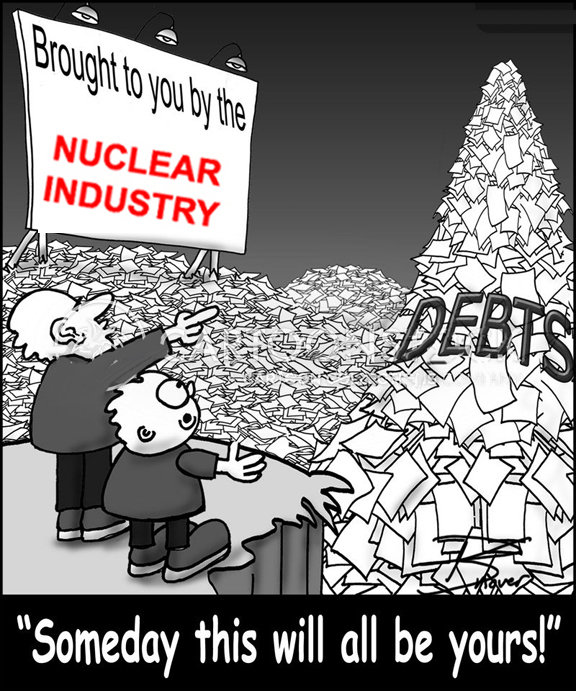
Ontario’s Unfunded Nuclear Decommissioning Liability Is In The $18–$27 Billion CAD Range Clean Technica, By Michael Barnard 8 Aug 21, Ontario’s nuclear program will be a fiscal burden on Ontarian’s to the tune of around $40 billion CAD which will be spent through roughly 2135, finally being paid off by the great-grandchildren of babies born in 2021.
Late last year I worked up the likely amount of public money that would have to be thrown at the nuclear industry in order to successfully and safely decommission the 100 operational reactors and the now shut down ones. Unsurprisingly, the nuclear industry had been very optimistic in its estimates of decommissioning costs and timeframes, when the global empirical averages were trending to a billion USD and 100 years per reactor.
Recently I was asked by an Ontario journalist what I thought the likely situation in Ontario would be, and whether the decommissioning trusts were equally underfunded. I was unsurprised to find that Canada is in the same boat as the US, with highly optimistic schedule and cost projections which belie Canadian empirical experience with the CANDU reactor, and that the fund had nowhere near the money necessary for the job. Let’s run the numbers.
Ontario Power Generation (OPG) is the chunk of the provincial utility that was carved apart in the late 1990s by the Mike Harris Conservatives to handle generation alone. It operates 18 aging CANDU reactors across three sites: Bruce, Pickering, and Darlington.
OPG has a nuclear decommissioning fund of about $5 billion CAD or US$4 billion right now. If the experience of other countries on the actual cost of a billion USD per reactor and an actual timeline of decommissioning of a century holds true, and I see no reason why it doesn’t, that means that there is currently a $17.5 billion CAD gap in Ontario, in addition to the existing $19.3 billion CAD in debt still being serviced from their construction. When the government of the era split up the utility, it moved all of the debt off of the components and into general debt. One of the many appropriate and sensible things that the McGuinty Administration did in the 2000s, in addition to shutting down coal generation entirely, was to move the debt back into the utility and set about servicing it from utility bills.
Most of the reactors at Bruce Nuclear are aging out, with several over 40 years old and the remainder approaching 40. Darlington’s are around 30, so they have a bit of runway. Pickering’s reactors are going to be shut down in 2024 and 2025 and start decommissioning in 2028. While refurbishment could bridge Ontario’s for another 20 years in many cases, that’s expensive and typically won’t pass any economic viability assessment compared to alternatives.
The likelihood is that all reactors in Ontario will reach end of life by 2035, and be replaced by some combination of renewable energy and HVDC transmission from neighboring jurisdictions, with both Manitoba and Quebec having excellent, low-carbon hydroelectric to spare…………
So yes, Ontario’s nuclear program will be a fiscal burden on Ontarians to the tune of around $40 billion CAD which will be spent through roughly 2135, finally being paid off by the great-grandchildren of babies born in 2021.
Nuclear, the gift that keeps on giving. https://cleantechnica.com/2021/08/06/ontarios-unfunded-nuclear-decommissioning-liability-is-in-the-18-27-billion-cad-range/
Now, in the times of the UN Nuclear Ban Treaty, nuclear deterrence continues, but becomes increasingly discredited
Nuclear deterrence is an idea that became a potentially lethal ideology, one that remains influential despite having been increasingly discredited…………….
Spectres Of Nuclear ‘MAD’ness: Between Deterrence And Survival – Eurasia Review August 8, 2021K.M. Seethi With the Treaty on the Prohibition of Nuclear Weapons (TPNW) in place, is there an optimistic scenario of a nuclear-weapon free world? This might certainly be a difficult but persistently challenging question the world has been grappling with ever since the cities of Hiroshima and Nagasaki were devastated by atomic bombs, way back in 1945.
Spectres of nuclear holocaust have been haunting political communities across the world even after the end of Cold War. While the world’s most powerful nuclear-weapon states (NWS) have been locked in a military logjam—often characterised as ‘Mutually Assured Destruction’ (MAD)—a few states in Asia (including threshold states like Iran) still get absorbed in the logic of ‘limited nuclear deterrence.’………………
Nukes Accumulation
Paradoxical it may seem, the Asian continent has again become a hotbed of global nuclear threats with several nuclear-weapon states now spanning fault lines running through East Asia, in the Korean Peninsula, China’s eastern and southern coastline and across the Himalayas in South Asia and West Asia–and all of them presently recalibrating their nuclear profiles. And the share of Asia in the ‘horizontal proliferation’ is quite significant. As per the data brought out by the Stockholm International Peace Research Institute (SIPRI), the NWS—the United States, Russia, the United Kingdom, France, China, India, Pakistan, Israel and North Kore—together have in their arsenal an estimated 13,080 nuclear weapons at the beginning of 2021. While Russia (6255) and the U.S. (5550) possess more than 90 per cent of the world’s nuclear weapons, China has 350 weapons in its inventory, followed by France (290), UK (225), Pakistan (165), India (156), Israel (90), and North.
Nuclear Ban Regime
The efforts seeking a legally mandatory instrument to ban nuclear weapons have long been underway. However, they have found a new relevance in the past decade with the increasing awareness about the humanitarian and environmental costs of use of nuclear arms. ……………… culminated in the passing of a resolution (71/258) by the UN General Assembly in 2017 to negotiate a legally binding instrument to ban nuclear weapons, leading towards their total elimination. And the Conference was held from 27 to 31 March and from 15 June to 7 July in New York which led to the TPNW. (Treaty for the Prohibition of Nuclear Weapons)
The Treaty envisages a broad set of regulations for prohibition on partaking in any nuclear weapon programmes and activities. These regulatory clauses stipulate that the signatories shall “not develop, test, produce, acquire, possess, stockpile, use or threaten to use nuclear weapons.” It also forbids “the deployment of nuclear weapons on national territory and the provision of assistance to any State in the conduct of prohibited activities.” The Treaty also makes it mandatory for the signatories “to provide adequate assistance to individuals affected by the use or testing of nuclear weapons, as well as to take necessary and appropriate measure of environmental remediation in areas under its jurisdiction or control contaminated as a result of activities related to the testing or use of nuclear weapons.”
TPNW was adopted (by a vote of 122 States in favour, with one vote against and one abstention) at the United Nations on 7 July 2017, and opened for signature by the Secretary-General on 20 September 2017. Following the deposit with the Secretary-General of the 50th instrument of ratification or accession of the Treaty on 24 October 2020, it entered into force on 22 January 2021 in accordance with its Article 15 (1).
‘Consensus’ For Opposition!
TPNW, which currently has 86 signatory states, has been totally ignored by the NWS and NATO member states. ‘Consensus’ among the NWS in regard to their opposition to the Treaty could also be a grim reminder. For example, in a joint statement made at the First Committee of the 73rd session of the UN General Assembly in October 2018, Russia, China, UK, U.S. and France had informed that they would not sign the TPNW. The statement says: “We will not support, sign or ratify this Treaty. The TPNW will not be binding on our countries, and we do not accept any claim that it contributes to the development of customary international law; nor does it set any new standards or norms. We call on all countries that are considering supporting the TPNW to reflect seriously on its implications for international peace and security.” ………………………..
Between Deterrence and Survival
In his The Evolution of Nuclear Strategy (1989), Lawrence Freedman says, “The Emperor Deterrence may have no clothes, but he is still Emperor.” David Barash adds: “Despite his nakedness, this emperor continues to strut about, receiving deference he doesn’t deserve, while endangering the entire world. Nuclear deterrence is an idea that became a potentially lethal ideology, one that remains influential despite having been increasingly discredited…………….
Way back in 1955, the well-known Russell-Einstein Manifesto had warned of the perils of nuclear weapons. This declaration put across what Bertrand Russell and Albert Einstein called “the stark and dreadful and inescapable” problem of the nuclear age: “Shall we put an end to the human race; or shall mankind renounce war?” Given the continuing proliferation tempo, both vertically and horizontally, peace loving people across the world can never abandon the dream of achieving the elimination of nuclear weapons from the face of the earth. The risk of catastrophic misuse of nuclear weapons, deliberately or―more likely―by accident or miscalculation, is as grave and immediate as it has ever been. And the existential threat nuclear weapons pose to life on this planet is as significant as those of climate change and global pandemic, and in many ways more immediate.
*The author is Director, Inter University Centre for Social Science Research and Extension (IUCSSRE), Mahatma Gandhi University, Kerala who also served as Dean and Professor of International Relations, MGU. He can be contacted at kmseethimgu@gmail.com https://www.eurasiareview.com/08082021-spectres-of-nuclear-madness-between-deterrence-and-survival-oped/
The ”Think Tanks” that get funding from nuclear weapons makers

The countries, companies and think tanks that support the deadly nuclear arms trade, From ICAN 8 Aug 21, ”’……………Think tank reported income from nuclear weapon producers
Atlantic Council: $835,000 – $1,724,998
Brookings Institution: $275,000 – $549,998
Carnegie Endowment for International Peace: $50,000 – 199,998
Center for New American Security: $1,085,000 – $1,874,991
Center for Strategic and International Studies: $1,530,000 – $2,794,997
Fondation pour la recherche stratégique (FRS): amount not specified
French Institute of International Relations: amount not specified
Hudson Institute: $170,000 – $350,000
International Institute of Strategic Studies: $800,640 – $1,146,744
Observer Research Foundation: $71,539
Royal United Services Institute: $610,210 – $1,445,581
Stimson Center: $50,500
Total $5 – 10 million
Headline photo: “Nuclear Nightmare – Open Your Eyes And Awake !” by Daniel Arrhakis is licensed under CC BY-NC 2.0 https://wordpress.com/read/feeds/72759838/posts/3488978062
more https://wordpress.com/read/feeds/72759838/posts/3488978062
Stockton Professor: Nuclear Power is “Terrible Neighbor
Stockton Professor: Nuclear Power is “Terrible Neighbor” https://ocnjdaily.com/stockton-professor-nuclear-power-terrible-neighbor/ By MediaWize – August 8, 2021 By DR. JOHN AITKEN Ph.D., Adjunct Professor of Physics, Stockton University
Opponents of the Ocean Wind turbine project spoke in favor of using nuclear power as an alternative to the wind power at the July 27 Michael Shellenberger presentation sponsored by Save Our Shores in Ocean City.
The speaker stated that that while climate change is indeed real, the only solution to reducing carbon emissions is nuclear power, contrary to the position of many environmental organizations.
His proposals to pursue solely nuclear power did not mention its disadvantages and costs. Nuclear power operates carbon free as do solar and wind power, but unlike them, nuclear generates large quantities of dangerous waste that are difficult to dispose of and costly to manage.
Nuclear power can supply an unlimited amount of power but creates an unlimited amount of hazardous nuclear waste requiring storage for at least 300 years. Nuclear power may be a useful servant but it is a terrible neighbor.
Take the example of the Oyster Creek nuclear plant 35 miles north of Atlantic City. After approximately 50 years of service it is being decommissioned due to its inability to compete with cheaper natural gas.
In the 1960s, Lacey Township signed up to host the plant. What they did not realize at the time was that they had signed a deal with devil. The town had traded its own long-term safety for the benefits of good paying jobs and reduced property taxes.
Due to environmental and transportation concerns, nuclear waste storage sites in Nevada or Washington state promised by the federal government never materialized, leaving local plants on their own to store their nuclear waste on site for decades if not centuries.
The costs associated with decommissioning the nuclear site, estimated between $800 million and $1.4 billion, are another legacy left by the plant. The original owner/operator of the plant, Exelon, sold the plant to another company who will execute the decommissioning plan. For the rest of this article I will refer to this decommissioning company as DC.
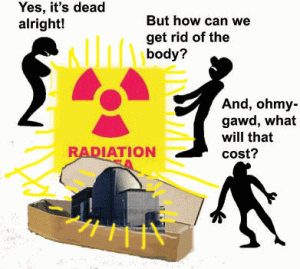
While the project is supported by a decommissioning fund, likely cost overruns will be paid by future generations through their utility bills. The costs cover the removal and deactivation of spent nuclear fuel, control rods, the reactor and associated buildings, which themselves have become radioactive from exposure to radiation.
But now, with decommissioning approaching, the township is paying the piper dearly for the good years. Oyster Creek Nuclear Plant has been shut down. The spent nuclear fuel and radioactive debris from the reactor and the associated buildings will be stored in 68 cylindrical casks, each 22 feet high and 11 feet in diameter, emitting low levels of radiation on the now-defunct site. The casks must remain intact for at least 300 years to allow the radioactivity of the waste inside to decay to handleable levels.
DC is now in charge of the decommissioning project. DC makes no commitment as to how long, decades or even centuries, these casks will have to remain on the Lacey Township site in close proximity to homes and schools.
Nor is there a guarantee that the casks, manufactured by DC, will remain intact during the 300-year storage period. Lacey Township at first sued DC to prevent the storage of these casks on the site. After a long legal battle, Lacey settled the lawsuit with them, acquiescing to the onsite storage on the condition that DC would build and assign another cask for emergency use by the township.
The Lacey Township decision shows it is a virtual prisoner of DC, which now owns the nuclear waste but is also the town’s only hope of restoring the site to radiation-free conditions.
Operating nuclear plants are also a continual hazard to the communities where they are sited. Nuclear plants do not pose a threat of nuclear explosion. Their Achilles heel is the plumbing, which brings water in and out of the reactor vessels.
The water pipes, degraded by the nuclear reactions, develop cracks and eventually leak water with radioactive contaminants. This water can leak into the local water supply and cause cancer or DNA damage to people who drink it.
As shown by the Oyster Creek experience, nuclear power is costly, dangerous and unmanageable. Those in favor of nuclear power should be ready to accept nuclear power stations in their own backyards and relive the Lacey Township experience. Nuclear power makes a terrible neighbor.
1 This Month

Read the Public Inquiry Report, the Commissioners’ report, Surrendering Australia: The AUKUS Deception is available to download for free at aukuspublicinquiry.com. Or just watch the replay of the National Press Club Luncheon.


19 November – Webinar – The Reality of Reprocessing
Time: 11:00 AM Pacific Time (US & Canada) / 2:00 PM Eastern / 7:00 PM UK / 8:00 PM CET
Register for the Zoom Event Here



Shut down the radiation-damaged Heysham nuclear reactors now
To see nuclear-related stories in greater depth and intensity – go to https://nuclearinformation.wordpress.com

Say No to NASA’s Reckless Nuclear Reactor on the Moon
Say No to NASA’s Reckless Nuclear Reactor on the Moon
-
Archives
- November 2026 (103)
- October 2026 (302)
- September 2026 (339)
- August 2026 (330)
- July 2026 (355)
- June 2026 (287)
- May 2026 (306)
- April 2026 (356)
- March 2026 (251)
- February 2026 (267)
- January 2026 (308)
- December 2025 (358)
-
Categories
- 1
- 1 NUCLEAR ISSUES
- business and costs
- climate change
- culture and arts
- ENERGY
- environment
- health
- history
- indigenous issues
- Legal
- marketing of nuclear
- media
- opposition to nuclear
- PERSONAL STORIES
- politics
- politics international
- Religion and ethics
- safety
- secrets,lies and civil liberties
- spinbuster
- technology
- Uranium
- wastes
- weapons and war
- Women
- 2 WORLD
- ACTION
- AFRICA
- Atrocities
- AUSTRALIA
- Christina's notes
- Christina's themes
- culture and arts
- Events
- Fuk 2022
- Fuk 2023
- Fukushima 2017
- Fukushima 2018
- fukushima 2019
- Fukushima 2020
- Fukushima 2021
- general
- global warming
- Humour (God we need it)
- Nuclear
- RARE EARTHS
- Reference
- resources – print
- Resources -audiovicual
- Weekly Newsletter
- World
- World Nuclear
- YouTube
-
RSS
Entries RSS
Comments RSS

