a science fiction novel with a distinctly bizarre premise: that, at some future moment, thanks to the endless burning of fossil fuels, we humans would essentially threaten to burn ourselves off planet Earth. And when the voters of the world’s largest democracy heard that such a thing might, sooner or later, actually happen to us, they would respond by freely electing a genuine madman — who ran his second candidacy in 2024 on the all-too-bluntly apocalyptic slogan “drill, baby, drill” — to “lead” us into a literal hell on earth.
the American people elected as president, twice, a man who, as a businessman, had either four or more likely six bankruptcies to his name,
Our planet is melting in a climate broiler that we control and we’re not only not turning down the heat fast enough, but we Americans elected someone (twice!) determined to turn it up ever higher.
The Personification of an Imperial Power (and Planet) in Decline
Once upon a time, if you had described Donald Trump’s America to me (the second time around), I would have thought you mad as Alice in Wonderland‘s proverbial hatter — or, if you were a fiction writer, I would have considered your plot so ludicrous that, after reading a few pages, I would undoubtedly have tossed your book in the trash.
And yet here we are, not once (yes, all of us can make a mistake once, can’t we?) but twice!
And the one thing you should take for granted is that Donald Trump in the White House a second time around is the all-too-literal personification of imperial decline. In fact, decline is hardly an adequate word for it. We just don’t happen to have another word or phrase that would describe him and his crew aptly enough in all their eerie strangeness. Yes, this country, even in the best of (imperial) times, certainly had its problems. (Remember the Vietnam War, for instance, or President “Tricky Dick” Nixon and the Watergate scandal.) Still, nothing was ever quite like this, was it? Never.
The First American King?
A literal Mad Hatter in command in Washington, D.C. Once upon a time, who would have believed it? In fact, if we could indeed travel into the past and I were able to take you back to 1991 when the Soviet Union collapsed, ending the Cold War, while China had not yet faintly “risen,” the world of that moment might essentially have been considered American property, lock, stock, and proverbial barrel.
This planet could have been thought of then as the property of just one great power — my country, of course — that, in imperial terms, had essentially been left alone on planet Earth in a fashion that might never have happened before in the history of humanity. And if I had then been able to see into our future and had tried to fill you in on the Trumpian world we’re now living through a mere three decades later, you would have quite literally laughed me off the planet (and, believe me, that’s putting it politely).
Truly, who could have ever (ever!) imagined this bizarre Trumpian era of ours in which the joker (in the worst sense of the term) in the ultimate deck of cards is indeed sitting in the White House. Yes, unbelievably enough, he was elected a second time in 2024 by a “sweeping,” “landslide,” “historic” 49.7% of American voters. It’s true, not even 50% of us voted to make him the first American king a second time around.
And if that made you chuckle just a little, well, stop doing so right now! Yes, what happened to us in Trumpian terms was and remains genuinely absurd. Still, given this deeply endangered world of ours, it should be anything but funny. Just imagine for a moment, a president who, before entering the White House, was essentially known for only one thing: being the host of the TV show The Apprentice (“You’re fired!”). Once upon a time, if you had described the (ir)reality we’re now living through, you would have been laughed not just out of the room but off this planet. You would, in short, have been fired.
In fact, if what we’re now experiencing were a novel, it would be considered to have the most ludicrous plot imaginable and, a few pages in, you would undoubtedly have tossed it into — yes, again! — the trash. (Unfortunately, it’s not just you or me but this planet itself that Donald Trump now threatens to toss into that garbage pail.)
So here we are in February 2026 and, like it or not, we’re all apprentices to one Donald J. Trump — oops, sorry, one President Donald J. Trump. And the ongoing TV show he emcees these days from the White House is undoubtedly the wackiest one in our history, as he fires not just everyone but everything that rubs him the wrong way from the Kennedy Center (gone!) to the East Wing of the White House (now rubble) to the U.S. Agency for International Development (once upon a time…).
One way to think about all of this is to go back in time and imagine that, long, long ago, Isaac Asimov or Ray Bradbury wrote a science fiction novel with a distinctly bizarre premise: that, at some future moment, thanks to the endless burning of fossil fuels, we humans would essentially threaten to burn ourselves off planet Earth. And when the voters of the world’s largest democracy heard that such a thing might, sooner or later, actually happen to us, they would respond by freely electing a genuine madman — who ran his second candidacy in 2024 on the all-too-bluntly apocalyptic slogan “drill, baby, drill” — to “lead” us into a literal hell on earth. Now, of course, that “president” is insisting that he be given the largest iced island on this planet, Greenland, that, were all its ice to melt (as indeed is already beginning to happen), could send global sea levels up by 23 feet and quite literally drown this world’s coastal cities. Imagine that!
And now, try to imagine this: in 2026, such terrible fiction is, in fact, our reality and one thing is guaranteed (excuse the colons inside colons but this is a strange, strange world to try to sum up): it’s only going to get worse in the three years to come before Donald Trump’s presidency is officially ended, if, of course, it ever does end. (As he typically said at one point last year, “Based on what I read, I guess I’m not allowed to run. So we’ll see what happens,” and he’s now talking about “nationalizing” — think “Trumpifying” — our elections!)
Given him and everything that’s gone on so far in his second term in office, including the way he recently had Director of National Intelligence Tulsi Gabbard accompany FBI agents to an election voting hub in Fulton County, Georgia, where they “seized hundreds of boxes containing ballots and other documents related to the 2020 election,” I wouldn’t count on anything Trumpian ending according to plan. Whew! That was one long sentence!
A few comments about why China is like it is – first of all, in the last 45 years, there has been no invasions, despite what people like little Marco Rubio of the US and Richard Marles the Australian Defence Minister might say, China is not and does not pose a threat to any of these countries – Japan might think there is a threat, China does not agree, in fact the opposite is true, Japan poses a much larger threat to China than China has ever posed to Japan.
China is concerned about, and in fact does feel threatened by Japan’s military expansion because the last time it happened literally millions of Chinese were murdered by the Japanese. Australia’s defence minister, Marles, asks us to consider why China has the world’s largest military expansion but he’s wrong – we have to hope he’s wrong because he’s been misinformed and is too dim to check out for himself, but more likely he knows he’s lying about this as China spends considerably less money than the US, in terms of not only its population but its geographical size, it’s quite entitled to spend more cash, when on a per capita basis, the amount is tiny compared to the US, on a ratio to GDP, it’s smaller than the US, it’s one third or less than NATO has been required to spend in terms of percentage of GDP and there’s one more very important factor that the US with only two neighbouring countries doesn’t have – that is 14 neighbouring countries with a shared land border.
Here’s another thing. China was invaded when they were weak, the British did it, the Americans did it, the eight nations alliance did it, Britain carved up part of Burma and took away some of China, it carved up India and took away parts of China, the Russians carved up Mongolia and Heilongjiang, taking away parts of China, the Japanese invaded and occupied China for 14 years. The classic twists and mental gymnastics people like Marles make would have us believe that the hundreds of US bases around China are to prevent China from doing what they’ve NEVER done – going out to invade other countries.
He, and several pundits would like us all to believe is that the US is keeping the world safe from China by arming their neighbours, interfering in the Provinces, Regions and the SARs but the reality is, China is building a military that will defend Chinese people inside China and Chinese land that belongs to China now – it’s not looking to reclaim land back, except in disputed regions.
Those disputed regions include parts of Tibet that the British took away and gave to India, parts of the South China Seas that the Japanese took away and both the US and UK, at the end of the Second World War, agreed would come back to China. There’s one military base in Africa, which is in a region shared with many other countries, including the USA, Japan, France, Italy, Germany Spain and even Saudi Arabia. Taiwan is NOT one of these disputed regions – the entire world whether they recognise Beijing or Taipei as the capital, recognises that there is one China and Taiwan is part of it – anyone who suggests that Taiwan is a country is either a liar, deliberately misleading us, or is far too dim to read the Constitution of the Republic of China, which not only claims all of the Chinese Mainland, it also wants those disputed regions back too.
China has something else which its detractors hate to admit and will lie about – that’s a policy of non-interference in the affairs of a sovereign nation – when it invests in another nation, it doesn’t call for democracy or elections, it doesn’t even ask that Communism or Socialism are accepted, it doesn’t send military to protect its assets, it won’t send missionaries to convert their subjects and it won’t impose conditions that force countries to give up their national assets or utilities if they can’t make the payments – if that sounds familiar and if it’s because you’ve been hearing that China will do all of those things and, if you think they have, I’d implore you to find me an example of where it’s happened, outside of opinion pieces written by people who want you to believe they have, almost every incident where we can find any of these things alleged, will be speculative – they’ll tell us what China might do, what China could do, what China may be doing, is alleged to have done or suspected to be involved in.
We might find individual cases of rogue Chinese people, Chinese criminals even and they use these tiny individual examples to tell you that this is “what China does” when that person who has broken the law has usually already been punished by the time they report it in western media and, if they mention that at all, it’ll be after the third paragraph where most of us have stopped reading.
On the other hand, I can find literally hundreds of examples where the USA is doing these things, where the UK and France have done these things, where Germany, Belgium, even Spain and Portugal have done them.
So then some of the comments I have been getting relate to the Port in Darwin, the ports in Panama and the Pirelli saga in Italy. Just for some background here, Sinochem owns 37% of Pirelli, the big Italian tyre company which wants to expand into the USA, of course the US won’t allow that while China has such a controlling interest. The share of Sinochem hasn’t changed, the only change is that the board, and remember Sinochem had controlling interest being the largest single shareholder, has declared that Sinochem no longer has control, giving the board more autonomy, – Sinochem agreed to this, so this isn’t a situation where anything has been taken from China, merely an agreement that the board retains control which a Chinese corporation retains more shares.
Erich, one of my followers said this: “if China doesn’t protect its assets it will lose them like Pirelli in Italy, the Ports in Panama, etc. Maybe at some point China will start caring about these things.”
My response is that it’s not just Erich, it’s literally hundreds of people, probably thousands but many in my responses who are misunderstanding China. China cares very deeply about the assets its people and corporations invest in, particularly overseas, but it will not break international laws, or contractual Agreements in order to protect them from people or governments which do break laws.
China will react to this in the same way it reacts to every other illegal action against it, by negotiations, and where they fail, arbitration, it will, when all else fails, take the appropriate legal action, which might be appeals to the WTO and perhaps even the UN or more likely the local courts – it knows there will be no satisfaction from those appeals but they are the legal mechanisms open to Chinese corporation. China as a government participates in legal and lawful bodies and does not want to overthrow them, to do so, makes China another USA – so the actions China takes, which will definitely be retaliatory, will be legal, they can, and probably will reduce purchases from offending countries, and of course, they will be much more careful in the decisions when investing in those countries both of which are well within their legal rights.
What China will not do is: unilaterally sanction anyone, any country or even any organisation within the country, it will not militarily defend its assets, it will not interfere in the internal affairs of another country but there is no doubt in my mind that if any country persists and acts on threats to China’s investments, there will be repercussions, probably it’s best not to call them retaliations, they are simply normal responses to a situation of risk.
In Australia for example, if they persist with this challenge to the legal investments Landbridge has made, investments that are compliant in every way and even beneficial to the people of the Northern Territory in jobs and payroll taxes, as well as increased business going through it’s port and beneficial to the people of Australia in 4.5 million income tax paid last year, those are the people who will suffer – China will find other suppliers for the things Australia sends – so far, the only one which is not directly sourced elsewhere is iron ore and, if China stops buying that in any great quantity, it will kill Australia’s economy.
Just continuing to use Darwin Port as an example, it is a critical trade hub in Northern Australia, handling minerals, agriculture, and livestock, with 2,295 vessel visits recorded in 2024-25, marking a 31.07% increase on the previous year. Darwin serves as a key gateway to Asia, managing significant exports of manganese, titanium, iron ore, and livestock. Given that China is the major trading partner of Australia, a huge proportion, unfortunately, there’s no way I can find out, would be Chinese owned, flagged, operated or destined ships, they would be travelling between China and Darwin – that’s 44 ships a week, many of which will simply divert to other ports, or, if the asset has been seized they’re more likely to simply stop coming altogether – how can that possibly benefit the warehouses, the truckers, the waste management, the catering and hospitality venues that the sailors use, the customs brokers, the security and surveillance companies – there’s an entire eco-system of industries deriving their income from a well-operated port and Darwin, which is a small city will feel a very heavy impact from no Chinese ships arriving and departing there. There will also be a lot of farmers, miners and other suppliers using that port to ship to China – it will all stop.
So, to think China will just sit back and do nothing is wrong, they are very mindful that their investments are not just at risk but under threat – business leaders in China understand this and are already taking action – there’s an April 2024 KPMG report, that’s almost 2 years old now showing that China’s investments in Australia have declined from a peak in 2016, just after the Free Trade Agreement was signed to the lowest level since 2006. It’s well worth a read if you’re interested, the report defines all kinds of factors but fails to mention the obvious one – Australia simply doesn’t want Chinese investment, they feel threatened by perceptions given to them by media which are completely false.
In keeping with the maxim that one person’s loss is another’s gain, the vast majority of China’s Overseas Direct Investment is now going to One Belt One Road countries – these are safe destinations, they are countries that welcome trade with and investments from China. In the Western world, that’s not many countries. Leaders of Canada and the UK were recently in China seeking investment opportunities, in both cases, they returned to their home countries to media criticism. It remains to be seen how they will handle this but they, as leaders, and their business leaders all know the truth – the media is lying, a few politicians who are actually paid by Washington to further lie about China are losing influence. Some people will assume that I’m either exaggerating about this but the reality is there for all to see, if you don’t believe me, go look up who are the main funders of the Inter Parliamentary Alliance on China (IPAC). It states clearly on its website that it does not accept funds from governments. But then lists the Taiwan Foundation for Democracy, the National Endowment for Democracy, the International Republican movement, Hello Taiwan the National Democratic Institute and others, all of which are government funded and almost all of which can trace their funds back to Washington DC and congressionally approved expenditure.
The vast majority of the Non-US aligned world realises – there is no threat from China and, once again I reiterate something I’ve said many times, the people telling you China is a threat are more likely to damage your economy and your global standing than China ever will – China isn’t a threat, it’s those people telling you it is, who are.
Old-school, white-man’s-burden colonialism is unapologetically back
Rubio used the Munich conference to lay bare the new reality: Washington will no longer pay lip service to being the nice guy or abiding by any red lines
In Munich, the US announced its intent to crush all opposition to its permanent status as imperial top dog, even if that means destroying everything, and all of us, in the process.
S Secretary of State Marco Rubio’s speech at the Munich Security Conference last weekend was another troubling declaration of intent by the Trump administration.
The explicit goal of US foreign policy, according to Rubio, is to resurrect the western colonial order that persisted for some five centuries until the Second World War.
Old-school, white-man’s-burden colonialism is unapologetically back.
In Rubio’s preposterous retelling, Europe’s colonisation of much of the planet, and the rape and pillage of its resources, was a glorious era of western exploration, innovation and creativity. The West brought a “superior” civilisation to backward peoples while maintaining global order.
Reflecting on the era before 1945, he observed: “The West had been expanding – its missionaries, its pilgrims, its soldiers, its explorers pouring out from its shores to cross oceans, settle new continents, build vast empires extending out across the globe.”
That course went into reverse 80 years ago: “The great western empires had entered into terminal decline, accelerated by godless communist revolutions and by anti-colonial uprisings that would transform the world and drape the red hammer and sickle across vast swaths of the map in the years to come.”
According to Rubio, that decline was accelerated by what he dismissed as the “abstractions of international law”, established by the United Nations in the immediate postwar period. In the pursuit of what he derisively termed “a perfect world”, these new universal laws – ones that treated all humans as equal – served only to hamstring western colonialism.
Rubio neglected to mention that the purpose of international law was to prevent a return to the horrors of the Second World War: the extermination of civilians in death camps and the firebombing of European and Japanese cities.
During his speech, Rubio offered Europe the chance to join the Trump administration in reviving “The West’s age of dominance” to “Renew the greatest civilisation in human history.”
“What we want is a reinvigorated alliance that recognises that what has ailed our societies is not just a set of bad policies but a malaise of hopelessness and complacency. An alliance – the alliance that we want is one that is not paralysed into inaction by fear – fear of climate change, fear of war, fear of technology,” he said.
No peace, no order
Quite astonishingly, Rubio was greeted with enthusiastic applause throughout his speech from an audience comprising heads of state, politicians, diplomats and military officials. He is reported to have received a standing ovation from half of the attendees.
They seemed swept up in Rubio’s triumphalist account of empire, one utterly oblivious to the well-documented realities of “western domination” – not least its brutal colonial tyrannies, its industrial-scale genocides and the mass enslavement of native populations.
These were not unfortunate episodes or mistakes in the West’s imperial past. They were integral to it. They were the coercive means by which colonised peoples were stripped of their assets and labour to finance empire.
He also appeared blind to another downside of the colonial West, which was all too evident over those five centuries. Ruthless competition between European states, vying to be first to pillage resources in the Global South, led to endless wars in which Europeans, as well as the people they colonised, were killed.
Empire did not ensure order, let alone peace. Colonialism was about systematised theft – and, as the saying goes, there is rarely honour among thieves.
In the dog-eat-dog world that preceded international law, each colonial power was out for its own advancement against rivals. That culminated in two terrible wars in the first half of the 20th century that decimated Europe itself.
Because Rubio does not understand the past, his vision of the future is inevitably defective as well. Any attempt by the Trump administration to restore overt western colonial rule will prove suicidal. As we shall see, such a venture would spell doom for us all. In fact, we may already be well advanced on that path.
Imperial muscles
There are a number of glaring flaws in Rubio and the Trump administration’s thinking.
First, Rubio’s assertion that the West gave up colonialism some 80 years ago is flatly wrong. At the end of the Second World War, Europe’s physically battered and economically exhausted colonial powers passed the baton of empire to the US. Washington did not end colonialism. It rationalised and streamlined it.
Washington continued the European tradition of overthrowing nationalist leaders and installing weak, obedient clients in their stead.
It also seeded the globe with hundreds of US military bases to project hard power, while exploiting new globalising technologies to project soft power. Economic carrots and sticks, wielded largely out of view through the World Bank and International Monetary Fund, incentivised submission to its diktats by non-western leaders.
The biggest misdirection in Rubio’s remarks was his omission of the real reason the West abandoned overt colonialism after the Second World War and built international institutions such as the United Nations.
It was not an acceptance of defeat or decline by the US, but rather a recognition that, with the rapid development of nuclear arsenals by the superpowers in the wake of the war, a system capable of mediating the worst excesses of power had become a necessity.
It was the only hope of preventing reckless colonial competition and confrontation that could trigger a Third World War likely to spiral quickly into nuclear armageddon.
Nothing has changed over the past eight decades.
Russia and China still have large nuclear arsenals, and Moscow now has hypersonic missiles capable of carrying these warheads at unprecedented speeds.
There is still no failsafe mechanism to prevent misunderstandings from rapidly escalating into mutual attack.
Human nature has not changed since the 1940s – only the arrogance of a superpower determined to prevent great powers like China or Russia from ever ousting it from its imperial perch.
The threat of nuclear annihilation has not diminished. It has grown exponentially as limitations on global resources – those needed to sustain western consumption and endless “economic growth” – put ever greater pressure on the US to discard its mask as the guardian of superior values.
Rubio used the Munich conference to lay bare the new reality: Washington will no longer pay lip service to being the nice guy or abiding by any red lines.
The Trump administration is planning to build a 5,000-person military base in Gaza, sprawling more than 350 acres, according to Board of Peace contracting records reviewed by the Guardian.
The site is envisioned as a military operating base for a future International Stabilization Force (ISF), planned as a multinational military force composed of pledged troops. The ISF is part of the newly created Board of Peace which is meant to govern Gaza. The Board of Peace is chaired by Donald Trump and led in part by his son-in-law Jared Kushner.
The plans reviewed by the Guardian call for the phased construction of a military outpost that will eventually have a footprint of 1,400 metres by 1,100 metres, ringed by 26 trailer-mounted armored watch towers, a small arms range, bunkers, and a warehouse for military equipment for operations. The entire base will be encircled with barbed wire.
The fortification is planned for an arid stretch of flatlands in southern Gaza strewn with saltbush and white broom shrubs, and littered with twisted metal from years of Israeli bombardment. The Guardian has reviewed video of the area. A source close to the planning tells the Guardian that a small group of bidders – international construction companies with experience in war zones – have already been shown the area in a site visit.
The Indonesian government has reportedly offered to send up to 8,000 troops. Indonesia’s president was one of four south-east Asian leaders scheduled to attend an inaugural meeting of the Board of Peace in Washington DC on Thursday.
The UN security council authorized the Board of Peace to establish a temporary International Stabilization Force in Gaza. The ISF, according to the UN, will be tasked with securing Gaza’s border and maintaining peace within the area. It is also supposed to protect civilians, and train and support “vetted Palestinian police forces”.
It is unclear what the ISF’s rules of engagement would be if there is combat, renewed bombing by Israel, or attacks by Hamas. Nor is it clear what role the ISF is meant to play in disarming Hamas, an Israeli condition to proceed with Gaza’s reconstruction.
While more than 20 countries have signed up as members of the Board of Peace, much of the world has stayed away. Although it was set up with the UN’s approval, the organization’s charter appears to grant Trump permanent leadership and control.
“The Board of Peace is a kind of legal fiction, nominally with its own international legal personality separate from both the UN and the United States, but in reality it’s just an empty shell for the United States to use as it sees fit,” said Adil Haque, a professor of law at Rutgers University.
Experts say the funding and governance structures are murky, and several contractors have told the Guardian that conversations with US officials are often conducted on Signal rather than over government email.
The military base contracting document was issued by the Board of Peace, according to a person familiar with the process, and prepared with the help of US contracting officials.
The plans say there is to be a network of bunkers each 6 metres by 4 metres and 2.5 metres tall, with elaborate ventilation systems where soldiers can go for protection.
“The Contractor,” says the document, “shallconduct a geophysical survey of the site to identify any subterranean voids, tunnels, or large cavities per phase.” This provision is likely referencing the large network of tunnels Hamas has built in Gaza.
One section of the document describes a “Human Remains Protocol”. “If suspected human remains or cultural artifacts are discovered, all work in the immediate area must cease immediately, the area must be secured, and the Contracting Officer must be notified immediately for direction,” it says. The bodies of about 10,000 Palestinians are believed to be buried under the rubble in Gaza, according to Gaza’s civil defense agency.
It is unclear who owns the land where the military compound is set to be built, but much of the south Gaza area is currently under Israeli control. The UN estimates that at least 1.9 million Palestinians have been displaced during the war.
Diana Buttu, a Palestinian-Canadian lawyer and former peace negotiator, called building a military base on Palestinian land without the government’s approval an act of occupation. “Whose permission did they get to build that military base?”
Officials from US Central Command referred all questions about the military base to the Board of Peace.
A Trump administration official declined to discuss the military base contract: “As the President has said, no US boots will be on the ground. We’re not going to discuss leaked documents.”
The Israeli government installed security equipment and controlled access to a Manhattan apartment building managed by convicted sex offender Jeffrey Epstein, according to a set of emails recently released by the Department of Justice. The equipment was installed starting in early 2016 at 301 E. 66th Street—the residence where former Israeli Prime Minister Ehud Barak frequently stayed for stretches at a time.
The security operation at “Ehud’s apartment” was in place for at least two years, emails from the DOJ disclosure show, with officials from the Israeli permanent mission to the United Nations corresponding regularly with Epstein’s staff regarding security. The apartment was technically owned by a company connected to Epstein’s brother, Mark Epstein, but was effectively controlled by Jeffrey Epstein. Units in the building were frequently loaned out to Epstein’s contacts and used to house underage models.
Rafi Shlomo, then-director of protective service at the Israeli mission to the United Nations in New York and head of Barak’s security, corresponded with Epstein employees to arrange meetings to discuss security and coordinate installation of specialized surveillance equipment at the 66th Street residence. Shlomo personally controlled access to the apartment for guests and even conducted background checks on cleaners and Epstein’s employees.
Under Israeli law, former prime ministers and other high ranking officials typically receive security services after they leave office. According to the emails, Epstein personally approved the installation of the equipment and authorized meetings between his staff and Israeli security officials.
Ehud Barak and the Israeli mission to the United Nations did not respond to requests for comment.
At the time of Epstein’s death in 2019, Barak downplayed his connection to the disgraced financier, stating that while he had met with Epstein several times, he “didn’t support me or pay me.”
Prime Minister Benjamin Netanyahu recently suggested that Epstein’s close ties to Barak, a longtime Labor Party official and rival of Netanyahu, undermine rather than strengthen the case for Epstein’s ties to Israel. “Jeffrey Epstein’s unusual close relationship with Ehud Barak doesn’t suggest Epstein worked for Israel. It proves the opposite,” Netanyahu said. “Stuck on his election loss from over two decades ago, Barak has for years obsessively attempted to undermine Israeli democracy by working with the anti-Zionist radical left in failed attempts to overthrow the elected Israeli government.”
A January 2016 email exchange between Barak’s wife, Nili Priell, and an Epstein employee—whose name is partially redacted but appears from other communications to be his longtime assistant Lesley Groff—discussed installing alarms and surveillance equipment at the residence, including six “sensors sticked to the windows,” and the ability to remotely control access to the premises. Priell informed Epstein’s staff that, “They can neutralize the system from far, before you need somebody to enter the appartment. the only thing to do is call Rafi from the consulate and let him know who and when is entering.”
The correspondence also indicated that the work done by the Israeli government was significant enough that it required Epstein to personally approve it. “Jeffrey says he does not mind holes in the walls and this is all just fine!” Groff wrote to Barak and Priell.
The mission was in regular touch with Epstein’s representatives over multiple visits by Barak and his wife throughout 2016 and 2017.
In a January 2017 email to Shlomo—with the subject line “Jeffrey Epstein RE Ehud’s apartment”—an Epstein assistant provided Israeli officials with a list of employees who would need access to the apartment, adding, “I understand from you already have a copy of her ID from awhile ago…she is the maid and has been going in and out of the apartment for a long time now!” A few weeks later, they wrote to Epstein himself that, “Rafi, the head of Ehud”s security, is asking if I could meet him at 4pm on Tues. 14th at his office (800 2nd Ave and 42nd) re Ehud’s apartment.” Epstein approved the meeting.
The correspondence continued throughout that year—in August an assistant for Epstein reached out again to Shlomo to inform him of yet another stay by Barak and his wife at the Epstein residence. By November 2017, Shlomo had been replaced by another Israeli official who managed security and surveillance for Barak.
Barak’s longtime aide Yoni Koren, who died in 2023, was another frequent guest at Epstein’s 66th Street apartment. Koren stayed at the apartment on multiple occasions—including in 2013, while he was still actively serving as “bureau chief” for the Israeli Ministry of Defense, according to calendars released by the House Oversight Committee investigation into Epstein and emails released by Distributed Denial of Secrets. Email correspondence from Barak’s inbox also showed Koren exchanging information with Epstein for a wire transfer, as previously reported by Drop Site.
New emails released by the Department of Justice showed that Koren continued to stay at Epstein’s apartment while receiving medical treatment in New York up until the second arrest and death of the financier in 2019.
An excruciatingly painful tropical disease called chikungunya can now be transmitted by mosquitoes across most of Europe, a study has found. Higher temperatures due to the climate crisis mean infections are now possible for more than six months of the year in Spain, Greece and other southern European countries, and for two months a year in south-east England.
Continuing global heating means it is only a matter of time before the disease expands further northwards, the scientists said. The analysis is the first to fully assess the effect of temperature on the incubation time of the virus in the Asian tiger mosquito, which has invaded Europe in recent decades. The study found the minimum temperature at which infections could occur is 2.5C lower than previous, less robust, estimates, representing a “quite shocking” difference, the researchers said.
Comment: The primary recipient of Epstein blackmail information is Israel, the country that ‘produced Epstein’. It will remain ‘useful’ for decades.
At this stage, 25 of Epstein’s targets have negotiated with the federal prosecutor. They have paid substantial sums to avoid prosecution and to ensure their names are not published. In the first 3 million documents released, all references to them have been redacted, while those of their victims appear in full.
While Epstein may have seemed to enjoy committing his crimes, we must not forget that he worked for a secret service, Mossad. The horrors he perpetrated were primarily a means of blackmailing his associates. Although, for the moment, no Ukrainian figure has been directly implicated, numerous elements compel us to investigate who in Ukraine supplied children to the Epstein network.
The Epstein affair has shaken all developed nations. To summarize the facts: billionaire Jeffrey Epstein organized a network of informants for Mossad and the Franco-Swiss branch of the Rothschilds. In order to gain leverage over them, he gradually drew his targets (scientists, financiers, and politicians) into a series of increasingly atrocious games. Initially, he offered them extramarital affairs, then relationships with increasingly younger partners, and finally, he involved them in torture, murder, and cannibalism.People who rise to positions of power in society may feel the need to test the extent of their influence. They can only measure it by the magnitude of their transgressions, engaging in universally condemned practices with impunity.
This type of blackmail is not new.In France, we saw the Doucé affair (1990), and in Belgium, the Dutroux affair (1995-1996). The targets of this blackmail were never brought to light. A few names of prominent figures were merely mentioned, but the high-ranking criminals were never arrested. What is new in the Epstein case is that the US justice system has 9 million pages of documents, a third of which it has already released to the public.
The Doucé and Dutroux cases were blackmail schemes perpetrated by NATO intelligence services. Their targets were not limited to France and Belgium, but extended throughout the European Union. Those targeted were left unmolested and available for future operations.
At this stage, 25 of Epstein’s targets have negotiated with the federal prosecutor. They have paid substantial sums to avoid prosecution and to ensure their names are not published. In the first 3 million documents released, all references to them have been redacted, while those of their victims appear in full.
We don’t know how the US Department of Justice chose the order in which to release the documents it possesses. For the moment, they only implicate European figures and spare its targets in the United States. Perhaps this is a coincidence, perhaps it’s a way to destabilize allies while waiting for public opinion, disgusted, to tire of the situation.
We know, however, that former and current heads of state and government are implicated. Some have leaked economic, financial, or commercial data; others, political, military, or diplomatic secrets. All have committed acts that fall under criminal law and betrayed their country.Each time, unbeknownst to them,the recipient of this information was the State of Israel, or at least a faction within its government.
On a recurring basis, informants, some of whom were manipulated witnesses, others mentally ill and sometimes – much more rarely – genuine witnesses, denounced the participation of personalities in satanic cults.
To date, the only known head of state whose entourage practices black masses characteristic of this type of cult is the unelected Ukrainian president, Volodymyr Zelensky. For several years, appalling rumors have circulated about him without any possibility of verification. However, on January 31, Yulia Mendel, Zelensky’s former press secretary, revealed that his trusted confidant, Andriy Yermak, the former head of his now-disgraced administration, practices black masses [ 1 ] . He brought in Chabad magicians from Israel, Georgia, and Latin America. According to her, “Yermak burned herbs and collected bodily fluids to make dolls.” Within two weeks, the Ukrainian internet was flooded with caricatures and jokes about “Yermak the Magician,” who had predicted to Zelensky that Russia would never intervene in Ukraine.Under the pseudonym “Ali Baba”, Yermak was also at the head of a vast corruption network, revealed during Operation Midas [ 2 ] .
Since his suspension, Yermak has resumed his work as a lawyer. According to the Ukrainian press, he goes to the gym every morning and then to his office in the afternoon. Journalists, who follow him everywhere he goes, have observed him visiting the homes of Oleksandr Kamyshin, the director of the railways, and Rustem Umierov, secretary of the National Security and Defense Council of Ukraine, who is currently under investigation in the Midas case. Most notably, he visited Yevgen Korniychuk, the controversial former Minister of Justice who served as ambassador to Israel (2021-2023). Korniychuk is the son-in-law of Vasyl Onopenko, the president of the Supreme Court. Finally, Yermak’s lawyer, Ihor Fomin, and Yevgen Korniychuk went together to see Timur Mindich (Volodymyr Zelensky’s business associate, now a fugitive) inHerzliya (Israel) [ 3 ]
Among the third of Epstein’s known documents are several Ukrainian passports, but the Justice Department has redacted the names, addresses, and photos of the holders with whom Epstein associated. Furthermore, other documents attest that Epstein traveled to Kyiv several times and tasked the Frenchman Jean-Luc Brunel with shopping there. Brunel was the director of the modeling agencies Karin Models (Paris) and E=MC2 (Miami). He was indicted in France for pimping and had the good sense (like Epstein) to “commit suicide” in La Santé prison. Timur Mindichwas also the director of the Fire Point modeling agency (Kyiv). It remains unknown, however, how many young Ukrainian men and women fell victim to their schemes.
It is in this context that Mr. Volodymyr Vatras, a member of the Legal Commission of the Verkhovna Rada (Parliament), submitted, on February 6, 2026, a draft reform of the Ukrainian Civil Code [ 4 ] .
Besides protecting the reputation of those prosecuted for corruption until their final conviction, this bill lowers the age of marriage to 14.Let’s be clear about what this means: consequently, any prosecution for child abduction or rape of children aged 14 to 18 will become impossible under other Ukrainian laws. The Ukrainian press is calling it “state-sponsored pedophilia” [ 5 ] . Many Ukrainians, citing the Convention on the Rights of the Child, have launched petitions against this regressive reform [ 6 ] . You still haven’t grasped what this means: this reform will be retroactive and will apply to all acts committed after 2014 (i.e., the Maidan coup). This reform abolishes the provisions of the Ukrainian Criminal Code against pedophilia [ 7 ] .
Do you know of any state in the world, today or in the past, that has retroactively lowered the marriage age? No, obviously not.
It is worth recalling that the Ukrainian government accuses Russia of abducting 900,000 children. Moscow, which disputes this figure, maintains that it did not capture them, but rather collected them from the battlefield and brought them to Russia to protect them from the war. To date, Ukraine has only released a list of 339 children whose names the Zelensky administration is demanding. Where are the thousands of others?
The answer lies somewhere in the still-secret 6 million pages of the Epstein case. Hunter Biden’s medical experiments on Ukrainian soldiers outraged you; the Zelensky clique’s abductions of Ukrainian children will make you sick.
Speaking before the Verkhovna Rada on February 11, MP Inna Sovsun declared:
“The standard that the members of the Law Commission are trying to pass, regarding marriage with 14-year-olds, is pure barbarity. It contradicts common sense and European standards. We don’t know how many other problems this code contains. Therefore, I join the demands of lawyers to remove the draft Civil Code from consideration, to examine it carefully again in committee, to discuss it in society, and only then to submit it to Parliament.”
Ruslan Stefanchuk, the Speaker of the Verkhovna Rada and ideologue of the Servant of the People party (Zelensky’s party), was heavily involved both in drafting this Civil Code and in defending it before his assembly. He is a scientist and educator who has long worked with children. He, too, is implicated in the Midas case. But all the experts have pointed out that his statements do not correspond to the text as presented.Stefanchuk was in Washington last week. On February 7, he met with Riley M. Barnes, Assistant Secretary of State for Democracy, Human Rights, and Labor Rights. He explained at length that no Ukrainian children had disappeared, but that 900,000 had been captured by Russia.
Back in Kyiv, Ruslan Stefanchuk faced a public outcry. He admitted that he could not, in its current form, submit the draft of the new Civil Code to a parliamentary vote. But the problem that this reform clumsily attempted to bury remained.
We currently know only a third of the Epstein case. When we have more information, we will need to inventory the information he possessed and examine how Israel used it.
The Military Connection. For Australian workers and the public, the situation is complicated by and made more urgent as a result of the Australia, UK, USA (AUKUS) agreement regarding the building and stationing of nuclear-powered submarines in Australia. We have already seen the creation of a separate Australian Naval Nuclear Power Standards Regulator (ANNPSR) that will be responsible for all standards in the construction, operation, maintenance, decommissioning, and radioactive waste management from the submarines built or stationed here. We can expect pressure from the USA to have these standards align with those in the USA. As such the ANNPSR could become a back door for pressuring the current standards agency ARPANSA to revise and weaken rather than tighten protection standards across the full range of other occupational and public radiation health risks.
Radiation Protection Standards For most of the past century national and international standards agencies have regulated radiation protection based on three fundamental principles.
1 A ”Linear No Threshold ‘ (LNT) model based on scientific evidence that indicates there is no safe level of exposure. Any dose however small can be the one which can cause cancer – sometimes taking years to develop – or genetic damage affecting future generations.
2 That, therefore, all exposures should be kept ‘As Low As Reasonably Achievable’ – known as the ALARA principle
3 And that exposures to workers and the public should be kept below specified annual limits.
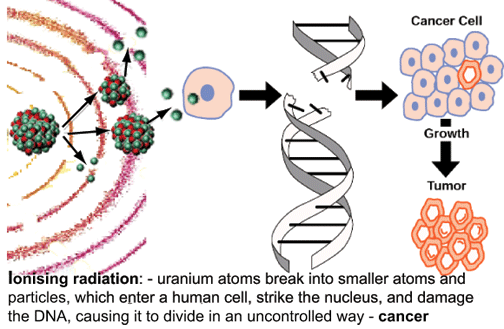
The science behind this protection regime is based on the capacity of ionising radiation to cause damage at the cellular level in the human body. Radiation striking a cell can either cause no damage or it may kill the cell outright – in which case, unless too many cells are killed at once, the body will eliminate the dead cells and function healthily. The problem comes when the cell is merely damaged, and the natural process of repair is imperfect, leaving the cell to replicate in this damaged form – which may in some cases lead to the kind of growth we call a cancer, other long term health or genetic damage. The level of this kind of damage (known as stochastic) is a hit-and-miss affair – a low level of radiation exposure doesn’t determine a health effect but as the level of exposure increases, it increases the probability of the damage.
Current Standards Need Tightening The limits on exposure have been progressively tightened over the years as estimates of the cancer risks, mainly drawn from the Life-Span Studies (LSS) of Japanese survivors of the Hiroshima and Nagasaki atomic bomb blasts in 1945, showed progressively higher rates of this stochastic health damage. Recent evidence from studies of workers in the Nuclear Industries in France the UK and USA (The INWORKS studies) suggest the worker-exposure limits need to again be revised – and significantly tightened. In addition, studies on health of populations living close to nuclear power plants in Europe and the USA show significantly elevated rates of cancer in both children and the elderly directly related to living distance from these facilities.
United States Proposals Would Weaken Current Standards Unfortunately, it appears that the USA is headed in the opposite direction and given the recent behaviour of the current President, may soon pressure other countries to follow suit. In May 2025 US President Donald Trump issued a Directive (EO 14300) Instructing the US Nuclear Regulatory Commission (NRC) to revise all its regulations – in particular, to revise those relating to radiation health and safety. He instructed the NRC to abandon the LNT and ALARA principles and re-set limits on worker and public exposures based on ‘deterministic’ rather than ‘probabilistic’/’stochastic ‘ health outcomes – potentially allowing much higher levels of exposure.
Exactly how the NRC will respond to these directives is unclear. To comply with the president’s orders would put the USA in conflict with national and international agencies such as the International Commission of Radiological Protection (ICRP), the United Nations Scientific Committee on Atomic Radiation (UNSCEAR), the US National Academy of Science’s. Committee on the Biological Effects of Ionising Radiation (the BEIR committee) and other countries’ national agencies including the Australian Radiation Protection and Nuclear Standards Agency (ARPANSA) – all of which have recently reaffirmed commitment to the LN and ARPANSA principles and the current annual limits on worker and public exposure.
TThe draft of the revised NRC regulations on radiation protection is expected on 30 April 2026 with a 30-day period for comments before the final comprehensive revision of all NRC regulations is published in November 2026.
An international Campaign These US proposals have stimulated the beginnings of an international campaign bringing together trade unions, environment and public health groups and communities concerned about current and future exposures from mining, industrial, medical, and nuclear radiation sources. The objectives of this campaign are two-fold:
1 To pressure national and international agencies with responsibility for radiation protection to publicly repudiate any US regulations that align with the Trump Directive and resist any pressures from the US to similarly weaken existing national standards. 2. To build pressure on these national and international agencies to revise and tighten the standards in line with the best available scientific evidence that the health risks are greater than those used to set current standards.
The Military Connection For Australian workers and the public, the situation is complicated by and made more urgent as a result of the Australia, UK, USA (AUKUS) agreement regarding the building and stationing of nuclear-powered submarines in Australia. We have already seen the creation of a separate Australian Naval Nuclear Power Standards Regulator (ANNPSR) that will be responsible for all standards in the construction, operation, maintenance, decommissioning, and radioactive waste management from the submarines built or stationed here. We can expect pressure from the USA to have these standards align with those in the USA. As such the ANNPSR could become a back door for pressuring the current standards agency ARPANSA to revise and weaken rather than tighten protection standards across the full range of other occupational and public radiation health risks.
For further information For references to the scientific evidence and to be kept informed of developments as this campaign evolves contact:
The Lavender case thus exposes the consolidation of a digital necropolitics. Algorithms decide who lives and who dies; corporations provide the infrastructure; intelligence services operate in the shadows; and technocratic language seeks to normalise the unacceptable. Gaza bleeds so that this model may be tested, refined, and then exported.
The revelations by +972 Magazine and Local Call have exposed the darkest core of the contemporary war in Gaza, in which genocide is carried out not only by bombs and missiles, but by data, algorithms and global digital platforms.
The Israeli artificial intelligence system known as Lavender has confirmed what the Palestinian resistance, Lebanon, and Iran have denounced for years: Technology as an organic part of the Zionist war machine, functioning as an instrument of surveillance, target selection, and mass extermination.
The liberal rhetoric of “digital privacy” collapses in the face of the facts. Applications such as WhatsApp insist on the promise of end-to-end encryption, but conceal what is essential, in which metadata are worth more than messages.
“Location, contact networks, patterns of communication, and group affiliations make it possible to map the social life of an entire people. In Gaza, these data have been incorporated into military systems that turn human relationships into algorithmic criteria for death.“
Lavender assessed virtually the entire population of the Gaza Strip, comprising more than 2.3 million people, assigning automated “risk scores”. Merely being in a WhatsApp group, maintaining frequent contact with someone already marked, or displaying digital patterns considered “suspicious” was enough to be placed on execution lists.
Human supervision was deliberately minimal, reduced to seconds, with conscious acceptance of high error rates. Entire families were killed in their homes, treated as “acceptable collateral damage” in an algorithmic equation that normalises massacre.
This is not a technical deviation. It is a policy of extermination. International Humanitarian Law explicitly prohibits indiscriminate attacks and requires distinction between civilians and combatants.
Systems that automate lethal decisions, pre-accepting the death of innocents, constitute crimes against humanity and reinforce the characterisation of genocide as a technologically organised and rationalised process.
The machinery that sustains this model is global. Twenty-first century espionage no longer depends on intercepting messages, but on controlling digital ecosystems.
Private platforms function as permanent sensors of planetary social life, feeding databases accessible to intelligence services such as the Mossad and the CIA, through formal cooperation, legal pressure or the exploitation of vulnerabilities. This represents a structural convergence between big tech companies, the military-industrial complex and the imperial security apparatus.
“Palestine is the laboratory. In an official statement released during the war, Hamas stated on its Telegram channel that “the occupier has turned every modern tool into a weapon against the Palestinian people, using technology to justify the killing of civilians and to conceal genocide behind technical terms”
free translation). The denunciation is clear: Israel is not waging a war against combatants, but against Palestinian existence itself, now mediated by algorithms.
Lebanese Hezbollah has warned that this model forms part of a regional hybrid war, combining digital surveillance, technological sabotage, and selective attacks.
After the attack that occurred in Lebanon in 2024, involving the coordinated explosion of pagers used by its members, Hezbollah declared through institutional channels that “the enemy has turned civilian devices into tools of assassination, proving that its war knows no ethical or human limits” (free translation). The episode revealed a new level in the weaponisation of everyday technology.
This pattern is not isolated. International investigations have already demonstrated the recurring use of military spyware against journalists, activists, and political leaders in various countries, often through smartphones widely available on the global market.
The message is unequivocal: every connected device is a potential instrument of surveillance, control, or death when inserted into the logic of imperial power……………..
The Lavender case thus exposes the consolidation of a digital necropolitics. Algorithms decide who lives and who dies; corporations provide the infrastructure; intelligence services operate in the shadows; and technocratic language seeks to normalise the unacceptable. Gaza bleeds so that this model may be tested, refined, and then exported.
Denouncing this machinery is a historic task. It is not merely a matter of solidarity with the Palestinian people, although that solidarity is urgent and non-negotiable.
Rubio’s speech isn’t just another round of transatlantic posturing. It marks a moment when a top U.S. official openly reframes five centuries of Western expansion — conquest, colonization, and domination — as a civilizational triumph that must be revived.
According to journalist Ben Norton, Rubio’s remarks went beyond simple rhetoric — openly lamenting the end of Western imperial expansion and portraying decolonization movements as destructive forces driven by “godless communist revolutions.”
In a striking address at the Munich Security Conference, U.S. Secretary of State Marco Rubio framed Western history not as a legacy of colonial domination, but as a “great civilization” whose decline must be reversed.
Rubio stated:
“For five centuries before the end of the Second World War, the West had been expanding… its missionaries, its pilgrims, its soldiers, its explorers… building vast empires extending out across the globe. But in 1945… it was contracting.”
He described anti-colonial uprisings as accelerating Western decline and rejected what he called “managed decline,” urging Europe and the United States to renew “the greatest civilization in human history.”
As reported in the Guardian this is something along the lines of “Empire is great. Empire is back. Empire is American.” Adding “The US secretary of state delivered what can only be described as a 22-minute ode to empire. A love letter to conquest and colonialism. A proud defense of the west’s territorial expansion.
Why This Matters
Since the post-World War II wave of decolonization across Africa, Asia, and Latin America, formal empires largely collapsed. Yet Rubio’s framing — praising Western expansion while dismissing colonial crimes as “purported sins” — signals a broader ideological shift.
Norton argues that this speech represents:
A defense of Western imperial legacy
A call for renewed transatlantic unity
A strategic push to restructure global supply chains away from China
An ideological justification for reasserting dominance over the Global South
Context: Competing Global Visions
While Rubio emphasized Western civilizational unity and supply chain control, China’s foreign minister presented an opposing vision centered on multilateralism and sovereign equality at the same conference.
The divide reflects a larger geopolitical struggle between:
A U.S.-led Western alliance seeking strategic dominance
A rising multipolar bloc emphasizing sovereignty and UN-centered governance
For more context on Rubio’s speech and the broader geopolitical stakes, here’s Ben Norton and The Geopolitical Economy Report:
WARNING: DISTRESSING CONTENT Nuclear plant worker Hisashi Ouchi suffered the highest radiation dose in history after 1999 Japan accident, enduring 83 agonising days before death.
Hisashi Ouchi, a 35‑year‑old nuclear plant worker, survived a 1999 criticality accident that delivered the highest recorded radiation dose to a human, enduring 83 days of severe medical complications before dying of multiple organ failure. A government probe later blamed inadequate supervision, safety culture, and training, leading to negligence charges against six plant officials.
Key points:
On September 30, 1999, a criticality accident at a Japanese nuclear fuel processing plant exposed worker Hisashi Ouchi to an estimated 17,000 millisieverts of radiation.
The dose Ouchi received was about 850 times the annual occupational limit for nuclear workers and roughly 140 times higher than the exposure of residents near Chernobyl.
Ouchi was hospitalized at the University of Tokyo Hospital, where he underwent experimental treatments for 83 days, during which his skin sloughed off, his eyelids fell off, and his digestive system collapsed.
Medical staff administered up to ten blood transfusions daily, and painkillers were reported to be ineffective; Ouchi reportedly said, “I can’t take it anymore. I am not a guinea pig.”
He died on December 21, 1999, and the official cause of death was recorded as multiple organ failure
A nuclear facility worker suffered what many consider to be the most agonising death ever recorded after a routine procedure went catastrophically wrong.
Hisashi Ouchi, 35, was exposed to an incomprehensible level of radiation when colleagues accidentally added excessive uranium to a processing vessel, sparking an uncontrolled nuclear chain reaction on September 30, 1999.
The unfortunate Ouchi was positioned nearest to the vessel, consequently subjecting him to 17,000 millisieverts of radiation – equivalent to 200,000 X-rays.
The exposure he received was 850 times the safe yearly limit for nuclear facility workers, 140 times greater than what Chernobyl residents experienced after the 1986 catastrophe, and the most severe dose ever documented in human history.
Within seconds and minutes of his exposure, Ouchi became violently sick. Whilst most individuals subjected to such levels would die within days, Ouchi survived, reports the Mirror.
He was taken to hospital alert but in critical condition, as his white blood cell count had been virtually eliminated, leaving him completely without an immune system.
Medical staff moved him to the University of Tokyo Hospital, where they tried various experimental procedures in a frantic bid to preserve his life.
What ensued was 83 days of torment for the nuclear facility worker.
Radiation had completely obliterated Ouchi’s capacity to heal and regenerate cells, causing his skin to gradually slough away, his blood vessels to fail, and his eyelids to fall off.
Fluids seeped relentlessly from his ravaged flesh and accumulated in his lungs, compelling medics to maintain him on life support.
Making his ordeal even more harrowing, his digestive system collapsed entirely, inflicting excruciating agony and causing litres of fluid to drain from his body daily. Despite numerous skin grafts and stem cell treatments, his body remained unable to recover.
Breathing became impossible without mechanical assistance, and nourishment could only be administered via feeding tube.
The agony became so unbearable that, two months into his treatment, Ouchi’s heart ceased beating, yet medical staff chose to revive him.
His wife reportedly held onto hope that he would survive until at least January 1, 2000, so they could welcome the new millennium together.
During lucid moments, he remained fully aware of his deteriorating condition.
According to accounts, Ouchi eventually reached breaking point and spoke six chilling words to hospital staff: “I can’t take it anymore. I am not a guinea pig.”
Medical professionals were compelled to administer up to ten blood transfusions daily merely to sustain his life. Painkillers appeared utterly ineffective, and at one stage, he reportedly pleaded for the treatment to cease.
Ouchi passed away on December 21, 1999, from multiple organ failure, nearly three months following the incident. Multiple organ failure was recorded as the official cause of death.
Four months afterwards, in April 2000, his colleague Shinohara also died from multiple organ failure at the age of 40.
Supervisor Yokokawa, who had been seated at his workstation when the criticality incident unfolded, managed to survive.
A probe by the Japanese government determined that the accident was due to a lack of regulatory supervision, a deficient safety culture, and insufficient training for employees.
Six officials from the company running the plant were subsequently charged with professional negligence and breaches of nuclear safety laws. In 2003, they received suspended prison sentences for their deadly neglect.
Why do Malcolm Parkin (Letters, February 12) and many others keep going on about the need for small nuclear reactors because the wind does not blow all the time, as if there were no other highly successful ways to produce energy
Have they never heard of the numerous other means of production? What about pumped storage? Nearly 50 years ago, I visited the Cruachan pumped storage site and learned how that could, when demand is high, release the water to produce electricity to fill any shortfall, and pump it back up to store for the next use. There are already places in Scotland where small, local, pumped storage systems are in operation and numerous larger ones are in construction, or operational, such as Foyers on Loch Ness. These systems could power millions of homes, wind or no wind.
Mr Parkin and others seem unaware that there are wave-powered and tidal systems already operating in Scotland and being further developed, for example around Orkney and the Pentland Firth. These have the advantage that there are two tides a day and constant waves all round our coasts, which would never stop providing energy. Such projects could have been much further advanced had Westminster not, years ago, withdrawn the funding for a major one of these schemes, thus retarding progress. Nevertheless, Scotland is a world leader in these technologies, providing 50% of the world’s such energy.
What need is there to consider any form of nuclear reactor? Whilst nuclear power produced may be clean, the building process and materials have an exorbitant cost, take years, and are highly carbon-producing. Storage of waste presents an insurmountable problem, with severe risks for centuries. Witness the ongoing occasional discovery of radioactive particles contaminating the beaches around Dounreay, years after the plant closed.
Small nuclear reactors are not yet fully developed, and our taxes are currently contributing to the “UK-wide” project, Hinckley Point reactor in South-east England, already 10 years late, nearly three times the original cost and still not completed. Moreover, we are now to share the cost of Sizewell C, of the same outdated design in the same area, final cost and operation date still unknown.
Meantime, Scottish renewables producers pay an exorbitant sum to connect to the Grid, whence 40% of their product goes to England, while our consumers pay the highest costs in Europe, and perhaps the world. Rather than moaning about wind energy and supporting nuclear, Mr Parkin and friends might ask why the Scottish Government does not receive payment for this export – an income which could help speed up our transition and make wind turbine eventually obsolete..
Channel 4’s documentary last night on Palestine Action’s proscription as a terrorist organisation was a game of two halves. The first half, which built the government’s case for proscription, was presumably the “balance” needed to avoid a pile-on by the rest of the establishment media. The second half then proceeded to tear down the government’s case brick by brick.
Here are the five main takeaways from the second half:
1. The film reminded us that the government’s proscription of Palestine Action as a terrorist organisation was done at the behest of Elbit Systems – the Israeli arms firm making killer drones for use in Gaza that Palestine Action was chiefly targeting.
Government officials regularly met with Elbit. A 2023 internal Home Office email, two years before proscription, states: “Reassure Elbit Systems UK and the wider sector affected by Palestine Action that the government cares about the harm the group is causing the private sector [arms industries].”
2. A senior Home Office official told the film-makers that there was a widespread belief among staff that the government was “wrong” to proscribe Palestine Action, and there was “disquiet” that the government was using Palestine Action as a way to curtail rights to protest and speech more generally.
3. Lord Hain, a former Labour government minister, explained that, when MPs and Lords were presented with an amendment to the Terrorism Act in 2020 under which Palestine Action has now been proscribed, the government had made explicit reassurances that criminal damage to property – Palestine Action’s modus operandi – would not qualify as terrorism.
He also reminded viewers that, had earlier governments adopted the same approach as Sir Keir Starmer’s government, the Suffragette and anti-apartheid movements would also have been declared terrorist organisations……………………………………………………………………………………………………………………………………………………………………………………………. https://www.jonathan-cook.net/blog/2026-02-10/ban-palestine-action-arms-industry/
Scotiabank’s subsidiary firm, 1832 Asset Management, has sold its remaining shares in Israeli arms manufacturer Elbit Systems Ltd., according to regulatory filings reported on 16 February.
The latest disclosure to the US Securities and Exchange Commission no longer lists Elbit among 1832’s holdings, ending an investment that once made the Canadian bank the company’s largest foreign shareholder.
In a press release on Monday, No Arms in the Arts, a Canada-based arts coalition opposing institutional ties to the arms trade and Israel’s actions in Palestine, and Just Peace Advocates, a Canadian human rights organization, said the sale followed “more than two years of sustained organizing that made the bank’s investment a liability.”
“Scotiabank’s divestment from Elbit Systems signals that investment in companies complicit in Israeli war crimes has become too risky to sustain,” Karen Rodman of Just Peace Advocates said.
“Yet 2025 data showed the ‘Big Five’ Canadian banks holding over $182 billion in companies operating in the occupied Palestinian territory – a clear contradiction of Canada’s stated opposition to illegal settlements that demands immediate government action to align policy with practice,” Rodman added.
Jody Chan of No Arms in the Arts said, “This news comes after years of sustained pressure across the country, with thousands protesting at Scotiabank branches, hundreds of artists refusing to let their work whitewash the bank’s complicity, and many more closing their accounts.”
Chan added, “Against our government’s attempts to use the façade of a ceasefire to normalize Israel’s siege on Gaza, this demonstrates our collective power to define what we find morally unacceptable and force real change.”
The investment drew sustained protests across Canada, including demonstrations at Scotiabank branches and the disruption of the bank-sponsored Giller Prize broadcast in November 2023.
In November 2025, filings showed approximately 165,000 shares worth around $84 million.
By August 2024, 1832 had cut its stake to roughly 700,000 shares, valued at about $315 million at the time. At the end of 2021, the asset manager held more than 2.2 million shares in the company.
As of mid-February 2026, the position stands at zero.
During the period of divestment, Elbit’s share price rose sharply, climbing from below $175 in 2021 to above $400 last year, before spiking past $700 in January 2026.
Scotiabank had previously said it did “not directly hold the shares” and that it could not interfere in the independent investment decisions of its subsidiary’s portfolio managers.
Elbit Systems is Israel’s largest weapons manufacturer and supplies military equipment used in the Israeli genocide of Palestinians in Gaza.
The company reported record profits during that period, openly marketing weapons used in Gaza as “battle-tested” to demand higher premiums in international contracts,
The overcapacity in electricity production in France for the past two years has forced EDF to modulate the output of its nuclear, hydroelectric, and thermal power plants twice as much. A partial estimate (based solely on the nuclear fleet) puts the annual additional cost at 50 million euros.
L’Usine Nouvelle 17th Feb 2026
EDF’s nuclear power plants are designed for this very purpose. When electricity production significantly exceeds consumption, the 57 reactors are capable of reducing their output by 80% in half an hour, then increasing it again. This is called modulation. This feature is used by the grid operator for frequency balancing, but also by EDF to optimize its production based on market prices, or to conserve fuel. The problem is that this modulation, when too frequent, impacts the equipment in the secondary circuit and its maintenance.










 nuclear-news