Japan’s election gives reprieve for nuclear sector.
Japan’s election gives reprieve for nuclear sector, Argus, By Motoko Hasegawa 1 November 2021
Japan’s ruling Liberal Democratic Party (LDP) secured a victory in the 31 October general elections to the lower house of parliament. This allows the government to maintain its updated energy policy, which lays out plans to restart safe nuclear reactors to help reduce the country’s greenhouse gas emissions.
The LDP secured a majority in Japan’s lower house after voting closed, without accounting for parliamentary seats secured by its junior coalition partner Komeito. This could make it easier for the LDP to push forward with its nuclear policy before the next general upper house election next year. Komeito had pledged to strictly adhere to the 40-year lifespan limit for reactors and a future no-nuclear society, as other opposition parties had insisted on.
LDP leader and prime minister Fumio Kishida and cabinet ministers last month endorsed a basic energy policy that did not include plans for construction or replacement of nuclear reactors and only focused on the restart of safe reactors. But the government did not directly prohibit building reactors, in a reprieve for the nuclear industry………….
Japan has restarted 10 nuclear reactors since the 2011 Fukushima nuclear disaster closed all the country’s reactors to enhance their safety measures. But it will have to phase out existing reactors without any capacity additions. All Japanese reactors are allowed to operate for 40 years with a one-time option to extend their lifespan to 60 years under current nuclear safety rules. This has 15 of the existing 33 reactors with a combined capacity of 14,057MW closing by December 2030 and no operational reactors in 2050, assuming a 40-year lifespan. https://www.argusmedia.com/en/news/2269158-japans-election-gives-reprieve-for-nuclear-sector
U.S. Discloses Nuclear Weapons Stockpile Numbers
U.S. Discloses Nuclear Stockpile Numbers, November 2021, By Shannon Bugos, Arms Control Association
The Biden administration has publicly released the total number of nuclear weapons in the U.S. stockpile, a sharp reversal of the previous administration’s refusal to do so for the past three years…………
The U.S. stockpile of nuclear warheads was at 3,750 as of September 2020, according to the administration document. This number captures active and inactive warheads, but not the roughly 2,000 retired warheads awaiting dismantlement. The document lists stockpile numbers going back to 1962, including the warhead numbers from the years when the Trump administration refused to declassify the information.
This number represents an approximate 88 percent reduction in the stockpile from its maximum (31,255) at the end of fiscal year 1967, and an approximate 83 percent reduction from its level (22,217) when the Berlin Wall fell in late 1989,” the document said.
Despite a significant overall reduction, the updated figures show the scale of reductions to the stockpile has diminished in recent years and even reflect a 20 warhead increase between September 2018 and September 2019 under the Trump administration.
The Biden administration also disclosed how many nuclear warheads the Energy Department has dismantled each year since 1994, for a total of 11,683. The Obama administration decided in 2010, for the first time, to release the entire history of the size of the U.S. nuclear weapons stockpile. The Trump administration declassified the stockpile data for 2017, but did not do so again for the following years………… https://www.armscontrol.org/act/2021-11/news/us-discloses-nuclear-stockpile-numbers
Greenpeace is set for a confrontation with security officials at COP26
Greenpeace is set for a confrontation with security officials at COP26
after revealing plans to dock a ship outside the venue without permission.
The climate group’s Rainbow Warrior yacht set sail from Liverpool on
Saturday night, seeking to sail up the Clyde and dock next to the COP26
venue in Glasgow. Port authorities declined the Rainbow Warrior’s request
to berth, with the area under a tight lockdown as world leaders arrive, but
Greenpeace said that the captain has “decided to ignore the warnings”
and will attempt to dock on Monday morning.
iNews 31st Oct 2021
U.S Suspends Nuclear Trade With Chinese Group
U.S 1. Suspends Nuclear Trade With Chinese Group, November 2021
The U.S. Nuclear Regulatory Commission (NRC) has suspended shipments of radioactive materials to China’s state-owned and -operated nuclear company, the China General Nuclear Power Group (CGN). The action includes restrictions on deuterium, a hydrogen isotope used in nuclear reactors and boosted nuclear weapons.
Concerned about China’s growing nuclear weapons program, the NRC decided Sept. 27 that a suspension was “necessary to further the national security interests of the United States and to enhance the United States common defense and security consistent with the Atomic Energy Act of 1954.” ……………..
The United Kingdom is also planning to remove CGN from the nuclear power plant under construction in Suffolk by selling China’s 20 percent stake in the project. https://www.armscontrol.org/act/2021-11/news-briefs/us-suspends-nuclear-trade-chinese-group
Megaprojects like Hinkley Point C nuclear are now blamed for shortages of materials for up to 2500 construction firms
HS2 and Hinkley Point blamed for concrete shortages. Megaprojects have
been accused of gobbling up concrete supplies, while steelmakers face a
magnesium drought caused by China. Ian Anfield, managing director of Hudson
Contract, which provides services to more than 2,500 construction firms,
said small builders cannot compete for materials with mega-projects such
as HS2 and Hinkley nuclear power plant.
The British Merchants Federation
(BMF) and the Construction Products Association (CPA) have set up a task
force with the Government and major schemes including HS2 and the Hinkley
nuclear plant to monitor the situation.
Telegraph 30th Oct 2021
https://www.telegraph.co.uk/business/2021/10/30/hs2-hinkley-point-blamed-concrete-shortages/
Fire at Akkuyu Nuclear Power Plant
Last minute… Fire panic at Mersin Akkuyu Nuclear Power Plant. It has
been reported that a fire broke out in the Akkuyu Nuclear Power Plant,
which is under construction in Mersin. Speaking about the fire, CHP’s Ali
Mahir Basarir said, “This nuclear power plant has been the scourge of
Mersin and Turkey.”
Cumhuriyet 31st Oct 2021
New UHI research into tiny fragments of radioactivewaste flushed into the sea from Dounreay nuclear power plant 40 years ago.
New UHI research is to be carried out into tiny fragments of radioactive
waste flushed into the sea from Dounreay nuclear power plant 40 years ago.
Sand-sized particles of irradiated nuclear fuel got into the plant’s
drainage system in the 1960s and 1970s. Work to clean up the particles
began in the 1980s, after fragments were found washed up on the nearby
foreshore. Dounreay’s operator is funding the research by the University
of the Highlands and Islands (UHI). The UHI environmental research
institute in Thurso, near Dounreay, said the research would “explore a
difficult environmental problem”.
Press & Journal 31st Oct 2021
U.S. Navy reports on cause of incident with nuclear-powered submarine in South China Sea
The US Navy has figured out what a nuclear-powered attack submarine ran into in the South China Sea: report, Yahoo News, Ryan Pickrell, Tue, November 2, 2021,
- The US Navy has completed its investigation into a mysterious submarine incident in the South China Sea.
- USS Connecticut grounded on an uncharted seamount, USNI News first reported.
- The investigation has been sent to the fleet commander, who will consider accountability actions.
The US Navy investigators have determined what a nuclear-powered attack submarine hit in the South China Sea last month, USNI News reported Monday, citing defense officials familiar with the investigation and a legislative official.
The Seawolf-class nuclear-powered attack submarine USS Connecticut collided with an unidentified object on October 2, the Navy revealed five days after the incident. Investigators have reportedly determined the submarine ran aground on an undersea mountain, a seamount, the location of which was uncharted………… As of last Wednesday, the US Navy still was not quite sure what the submarine collided with, though defense officials told USNI News that early indications suggested that Connecticut collided with a seamount, an undersea feature that rises from the ocean’s depth…….
As the investigation into the incident has not yet been publicly released, information is still limited on how the submarine ran into an seamount and to what degree members of the crew and command are responsible……. https://news.yahoo.com/us-navy-figured-nuclear-powered-194721944.html
Mohamed bin Zayed Receives Nazarbayev Prize for a Nuclear-Weapon-Free World and Global Security
BY ASSEL SATUBALDINA in INTERNATIONAL on 1 NOVEMBER 2021
NUR-SULTAN – Crown Prince of Abu Dhabi and Deputy Supreme Commander of the UAE Armed Forces Mohamed bin Zayed received the Nazarbayev Prize for a Nuclear-Weapon-Free World and Global Security on Oct. 28 for his contribution to peace, regional stability, and sustainable economic development during the meeting with Former Kazakhstan President Nursultan Nazarbayev, reports the press service of First President.
The award was established in 2016 with a goal to urge international actors to pursue more vigorous efforts to rid the world of nuclear weapons. King Abdullah II of Jordan was the first person to receive the prestigious award back in 2017 during his visit to Kazakhstan. ……….. https://astanatimes.com/2021/11/mohamed-bin-zayed-receives-nazarbayev-prize-for-a-nuclear-weapon-free-world-and-global-security/
Hidden agenda: Will COP26 let nuclear power in the door and, if so, why?

Hidden agenda — Beyond Nuclear International October 31, 2021 https://beyondnuclearinternational.org/2021/10/31/hidden-agenda/
— The unspoken argument for more nuclear power, By Linda Pentz Gunter

Not that the two things are unconnected. The civilian nuclear power industry is desperately scrambling to find a way into the COP climate solutions. It has rebranded itself as “zero-carbon”, which is a lie. And this lie goes unchallenged by our willing politicians who blithely repeat it. Are they really that lazy and stupid? Possibly not. Read on.
Nuclear power isn’t a climate solution of course. It can make no plausible financial case, compared with renewables and energy efficiency, nor can it deliver nearly enough electricity in time to stay the inexorable onrush of climate catastrophe. It is too slow, too expensive, too dangerous, hasn’t solved its lethal waste problem and presents a potentially disastrous security and proliferation risk.
New, small, fast reactors will make plutonium, essential to the nuclear weapons industry as Henry Sokolski and Victor Gilinsky of the Nonproliferation Policy Education Center continue to point out. Some of these so-called micro-reactors would be used to power the military battlefield. The Tennessee Valley Authority is already using two of its civilian nuclear reactors to produce tritium, another key “ingredient” for nuclear weapons and a dangerous blurring of the military and civil nuclear lines.

So here we are again at another COP (Conference of the Parties). Well, some of us are in Glasgow, Scotland at the COP itself, and some of us, this writer included, are sitting at a distance, trying to feel hopeful.
But this is COP 26. That means there have already been 25 tries at dealing with the once impending and now upon us climate crisis. Twenty five rounds of “blah, blah, blah” as youth climate activist, Greta Thunberg, so aptly put it.
So if some of us do not feel the blush of optimism on our cheeks, we can be forgiven. I mean, even the Queen of England has had enough of the all-talk-and-no-action of our world leaders, who have been, by and large, thoroughly useless. Even, this time, absent. Some of them have been worse than that.
Not doing anything radical on climate at this stage is fundamentally a crime against humanity. And everything else living on Earth. It should be grounds for an appearance at the International Criminal Court. In the dock.
But what are the world’s greatest greenhouse gas emitters consumed with right now? Upgrading and expanding their nuclear weapons arsenals. Another crime against humanity. It’s as if they haven’t even noticed that our planet is already going quite rapidly to hell in a handbasket. They’d just like to hasten things along a bit by inflicting a nuclear armageddon on us as well.
Not that the two things are unconnected. The civilian nuclear power industry is desperately scrambling to find a way into the COP climate solutions. It has rebranded itself as “zero-carbon”, which is a lie. And this lie goes unchallenged by our willing politicians who blithely repeat it. Are they really that lazy and stupid? Possibly not. Read on.
Nuclear power isn’t a climate solution of course. It can make no plausible financial case, compared with renewables and energy efficiency, nor can it deliver nearly enough electricity in time to stay the inexorable onrush of climate catastrophe. It is too slow, too expensive, too dangerous, hasn’t solved its lethal waste problem and presents a potentially disastrous security and proliferation risk.
Nuclear power is so slow and expensive that it doesn’t even matter whether or not it is ‘low-carbon’ (let alone ‘zero-carbon’). As the economist, Amory Lovins, says, “ Being carbon-free does not establish climate-effectiveness.” If an energy source is too slow and too costly, it will “reduce and retard achievable climate protection,” no matter how ‘low-carbon’ it is.
New, small, fast reactors will make plutonium, essential to the nuclear weapons industry as Henry Sokolski and Victor Gilinsky of the Nonproliferation Policy Education Center continue to point out. Some of these so-called micro-reactors would be used to power the military battlefield. The Tennessee Valley Authority is already using two of its civilian nuclear reactors to produce tritium, another key “ingredient” for nuclear weapons and a dangerous blurring of the military and civil nuclear lines.
Keeping existing reactors going, and building new ones, maintains the lifeline of personnel and know-how needed by the nuclear weapons sector. Dire warnings are being sounded in the halls of power about the threat to national security should the civil nuclear sector fade away.
This is more than a hypothesis. It is all spelled out in numerous documents from bodies such as The Atlantic Council to The Energy Futures Initiative. It has been well researched by two stellar academics at the University of Sussex in the UK — Andy Stirling and Phil Johnstone. It’s just almost never talked about. Including by those of us in the anti-nuclear power movement, much to Stirling and Johnstone’s consternation.
But in a way it’s just glaringly obvious. As we in the anti-nuclear movement wrack our brains to understand why our perfectly empirical and compelling arguments against using nuclear power for climate fall perpetually on deaf ears, we are maybe missing the fact that the nuclear-is-essential-for-climate arguments we hear are just one big smokescreen.
At least, let’s hope so. Because the alternative means that our politicians really are that lazy and stupid, and also gullible, or in the pockets of the big polluters, whether nuclear or fossil fuel, or possibly all of the above. And if that’s the case, we must brace ourselves for more “blah, blah, blah” at COP 26 and a truly horrible outlook for present and future generations.
We are grateful, therefore, to our colleagues attending COP 26, who will be promoting— rather than tilting at —windmills as they make their case, one more time, that nuclear power has no place in, and in fact hinders, climate solutions.
And I hope they will also point out that expensive and obsolete nuclear power should never be promoted — under the false guise of a climate solution — as an excuse to perpetuate the nuclear weapons industry.
Linda Pentz Gunter is the International specialist at Beyond Nuclear and writes for and edits Beyond Nuclear International.
A damning new confidential report on France’s future nuclear reactor plans.

| Nuclear. A damning confidential report on future EPRs. It is a real bomb that has just published the information site “Context” about the new generation of nuclear power plants EDF. These EPR2 that Emmanuel Macron is about to order. “Context” has obtained a confidential report from the government which expresses serious doubts about the design, feasibility, cost and timeframe of what should constitute the new wave of French nuclear power plants. Bercy and EDF make no comment. Ouest France 29th Oct 2021 https://www.ouest-france.fr/environnement/nucleaire/nucleaire-un-rapport-confidentiel-accablant-sur-les-futurs-epr-b54a63b8-37d7-11ec-9832-1d0e4716a307 |
Nuclear power is not a solution for anything except perhaps the nuclear industry’s desire for taxpayer dollars.

New nuclear’ wont’ solve challenges https://www.coloradopolitics.com/opinion/counterpoint-new-nuclear-wont-solve-challenges/article_ffab4b6e-38f1-11ec-a03d-733290cbcf3a.html Nuclear power is not a solution for anything except perhaps the nuclear industry’s desire for taxpayer dollars. The nuclear industry sales pitch, such as presented to a largely invitation-only meeting in Pueblo on July 15, promotes “new nuclear” or advanced nuclear, the only thing new is the packaging of the reactors. Even that is still experimental and on the drawing board, with NuScale working with the Nuclear Regulatory Commission on various elements of their design licensing. No operating commercial models have been built, and even if everything goes according to schedule, a pilot plant in Idaho is not expected to be completed until about 2030 — at a cost of 1.3 to 3.6 billion dollars, which they have received from us taxpayers via the Department of Energy. According to widely available statistics of energy costs, nuclear is still the most expensive generation source.
NuScale corporation’s small modular reactors are, in fact, the same light-water nuclear reactors as used to generate power in other settings, using uranium as fuel, requiring cooling water, and generating the same radioactive waste products. To generate power at the level of the coal-fired Comanche 3 power plant in Pueblo County would require at least 12 of the reactors NuScale is proposing. So instead of one large reactor, there would be twelve or more nuclear reactors, with a correspondingly greater probability of error or accidents.

For NuScale as with other nuclear reactors, even if their more experimental proposal for air-cooled versus water-cooled generating capacity is accepted by the NRC, the waste extracted from the reactors every 12-24 months would have to be stored for five years per batch in a pool of cooling water, with the necessity of use and refreshment of this pool for the life of the plant. A corollary of the waste fuel handling is that each of the 12 reactors must be opened and the radioactive fuel transferred and replaced every 24 months at the least, again with a multiplied probability for accidents or errors.
Because there is no long-term national repository for high level nuclear waste, this waste will be stored on-site in the community where it was generated for many years. Because that waste has a half-life of more than 20,000 years (meaning at that point half of the radioactivity will be broken down), it will remain a burden to future generation for as long as any of us can imagine.
Although proponents present nuclear power as a ready, clean solution to the climate crisis, it is neither. The classic nuclear power plants with their iconic cooling towers are aging out of the system, following a long history of operational difficulties, environmental contamination, closure and clean-up issues, as well as the storage of radioactive waste essentially in perpetuity. The “new nuclear” is not new except for means to package it and is at least 10 years or more from even being ready for commercial construction.
The proponents, including NuScale, want to put these plants into closed coal fired power plants, in communities often well within the zones of risk set by the NRC. Because that could rightfully raise community concerns, as well as increasing potential casualties in case of an accident, NuScale is asking the NRC to reduce the zones of protection around their nuclear reactors and radioactive waste sites because of the claimed lower risk for their still-experimental multi-reactor units.
Is Colorado ready for an unproven energy “solution” that will not even be ready for testing for a decade? The answer is “no.” Velma L. Campbell, MD, MPH is a physician specializing in public health, particularly occupational and environmental health. She is the vice chair of the Sangre de Cristo Group of the Sierra Club.
Minister confirms taxpayer will foot bill for UK nuclear power strategy

Minister confirms taxpayer will foot bill for UK nuclear power strategy LBC, TOM SWARBRICK, 31 October 2021 On the fourth time of asking, the Energy minister admitted energy bills will rise to fund the construction of nuclear plants in the UK.
As COP26 gets underway in Glasgow, Tom Swarbrick was joined by Minister for Business, Energy and Clean Growth Greg Hands to discuss the UK’s strategy to achieve net zero.
Tom asked Mr Hands about the Regulated Asset Base model for nuclear, which is the government’s plan to build “at least one large-scale nuclear project” by the end of parliament.
How much are bills going to go up to pay for that?” Tom asked for the first time. The Tory MP dodged the question and insisted that the RAB model “increases our level of choices” for energy production in future.
He repeated that the construction of nuclear plants “creates more options for us.”………..
Before it has been built, how much are prices going to go up as a result of this model?” Tom asked for the third time.
The Energy Minister insisted that “depends on the deals that are being done”, adding that energy bills will “be reduced by around £10.”
Can I just try one more time, and it can be a nod or a shake of the head for an answer,” a dejected Tom said.
“Can you guarantee that through this new way of funding nuclear, that bills will not go up prior to it being built?”
“No, we’re expecting that bill-payers will make a contribution based on the Regular Asset Base model” the Minister confirmed on the fourth time of asking.
“It will end up being cheaper overall for bill-payers by in the region of £10” he repeated, clarifying that the saving is “over the lifetime of that power station.” https://www.lbc.co.uk/radio/presenters/tom-swarbrick/british-taxpayer-will-pay-for-nuclear-energy-program-minister-confirms/
France’s failing EDF nuclear company hopes to save itself by marketing small nuclear reactors
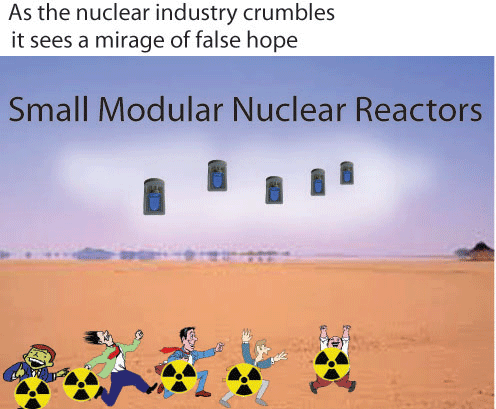
France will act as the shop window for exports of the new SMR technology — billed to be less powerful but easier to produce and run than conventional reactors — with EDF expected to begin building its first “Nuward” reactor in nine years
France’s nuclear drive offers chance of redemption for EDF
New commitments boost state-controlled utility but path ahead remains uncertain , Anna Gross and Sarah White in Paris Ft.com, 31 Oct 21, As the French government signals a future where nuclear power will play an integral rolein achieving carbon neutrality for the country by 2050 [ed. that is a spurious claim] , its state-controlled energy giant EDF remains encumbered by its past. Positioned at the heart of the nuclear debate in France and Europe, EDF struggles under a debt-laden balance sheet and a reputation for being unable to make novel nuclear technologies on time and on budget. But now President Emmanuel Macron has extended an olive branch and seemingly cleared a path for it to expand internationally and attract much-needed investment.
………..Created in 1946 by General Charles de Gaulle, EDF holds emotional power in France, Europe’s last bastion of nuclear power, and is linked with the nation’s industrial past and future. For years it was unclear if Macron, under pressure to move away from nuclear power towards renewables, would give the green light to new reactors long called for by EDF. Shortly after coming to power, Macron committed to reducing nuclear’s share of France’s electricity production from 75 to 50 per cent by 2035.
However, ambitious European climate goals, which hinge on pivoting to forms of energy that emit less carbon than fossil fuels, have put the spotlight on nuclear again and handed France an opportunity to assert its dominance in the field.
For EDF, thawing state tensions and confirmation of France’s desire for a nuclear future bring increased visibility to ensure it can keep training and hiring the people it will need and attract investment. That will be no small task for a company saddled with €41bn of debt and a colossal maintenance and investment programme to fund. UBS estimates a total investment requirement of more than €100bn for it to secure a 20-year life extension for 80 per cent of its nuclear fleet.
If approved, any government subsidies to fund six new reactors — estimated in leaked documents in 2019 to cost around €47bn — and the final price of the nuclear power produced by them, will ultimately be given the green light by Brussels. The cost of this funding could also be influenced by whether or not the EU includes nuclear energy in its taxonomy on “green finance”, making it a more attractive investment prospect. That decision has been delayed indefinitely because of infighting in the EU.
“Whether we can get financing at a low rate or super high rates completely changes the final cost. That’s the real subject, behind the gross number,” said Ursat. EDF faces other hurdles too, including the failure to reach a compromise with Brussels over the restructuring of the utility that would have allowed it to raise the regulated price at which it sells nuclear energy and ringfence some of its activities. It also needs to show it can deliver on its next-generation European Pressurised Reactor (EPR) technology, which it is planning to sell to India, Poland and the Czech Republic.
EPR reactors under construction in Europe — including Flamanville in France and Hinkley Point in the UK — are billions over budget and years behind schedule. The company’s previous chief financial officer quit over concerns about strains Hinkley Point was putting on EDF’s balance sheet.
These setbacks have led some investors and analysts to question EDF’s strategy and growth in the risky and costly field of nuclear power, were it not more than 80 per cent owned by the French government.
“The new reactor at Flamanville is not up and running yet, and some will want to see that project completed before France commits to more reactors with the same design,” said Sam Arie, an analyst at UBS. “From an investor point of view, is there interest in new nuclear projects? Not really.” However, recent soaring energy prices coupled with stringent climate goals seemed to have turned the tide in EDF’s favour. ……….
France will act as the shop window for exports of the new SMR technology — billed to be less powerful but easier to produce and run than conventional reactors — with EDF expected to begin building its first “Nuward” reactor in nine years. …….. https://www.ft.com/content/a1c95212-c122-4a29-8952-14a346381b91
The untold story of the world’s biggest nuclear bomb
The Tsar Bomba is dead; long live the Tsar Bomba. As the United States, Russia, and China seem to be engaged in new arms races in several domains, including unusual and new forms of nuclear delivery vehicles, the Tsar Bomba is a potent example of how nationalism, fear, and high-technology can combine in a fashion that is ultimately dangerous, wasteful, and pointless.
The untold story of the world’s biggest nuclear bomb, Bulletin, By Alex Wellerstein, October 29, 2021 n the early hours of October 30, 1961, a bomber took off from an airstrip in northern Russia and began its flight through cloudy skies over the frigid Arctic island of Novaya Zemlya. Slung below the plane’s belly was a nuclear bomb the size of a small school bus—the largest and most powerful bomb ever created.
At 11:32 a.m., the bombardier released the weapon. As the bomb fell, an enormous parachute unfurled to slow its descent, giving the pilot time to retreat to a safe distance. A minute or so later, the bomb detonated. A cameraman watching from the island recalled:
A fire-red ball of enormous size rose and grew. It grew larger and larger, and when it reached enormous size, it went up. Behind it, like a funnel, the whole earth seemed to be drawn in. The sight was fantastic, unreal, and the fireball looked like some other planet. It was an unearthly spectacle! [1]
The flash alone lasted more than a minute. The fireball expanded to nearly six miles in diameter—large enough to include the entire urban core of Washington or San Francisco, or all of midtown and downtown Manhattan. Over several minutes it rose and mushroomed into a massive cloud. Within ten minutes, it had reached a height of 42 miles and a diameter of some 60 miles. One civilian witness remarked that it was “as if the Earth was killed.” Decades later, the weapon would be given the name it is most commonly known by today: Tsar Bomba, meaning “emperor bomb.”
Designed to have a maximum explosive yield of 100 million tons (or 100 megatons) of TNT equivalent, the 60,000-pound monster bomb was detonated at only half its strength. Still, at 50 megatons, it was more than 3,300 times as powerful as the atomic bomb that killed at least 70,000 people in Hiroshima, and more than 40 times as powerful as the largest nuclear bomb in the US arsenal today. Its single test represents about one tenth of the total yield of all nuclear weapons ever tested by all nations.[2]
At the time of its detonation, the Tsar Bomba held the world’s attention, largely as an object of infamy, recklessness, and terror. Within two years, though, the Soviet Union and the United States would sign and ratify the Limited Test Ban Treaty, prohibiting atmospheric nuclear weapons testing, and the 50-megaton bomb would fall into relative obscurity.
From the very beginning, the United States sought to minimize the importance of the 50-megaton test, and it became fashionable in both the United States and the former Soviet Union to dismiss it as a political stunt with little technical or strategic importance. But recently declassified files from the Kennedy administration now indicate that the Tsar Bomba was taken far more seriously as a weapon, and possibly as something to emulate, than ever was indicated publicly.
And memoirs from former Soviet weapons workers, only recently available outside Russia, make clear that the gigantic bomb’s place in the history of Soviet thermonuclear weapons may be far more important than has been appreciated. Sixty years after the detonation, it’s now finally possible to piece together a deeper understanding of the creation of the Tsar Bomba and its broader impacts.
The Tsar Bomba is not just a subject for history; some of the same dynamics exist today. It is not just the story of a single weapon that was detonated six decades ago, but a parable about political posturing and technical enablement that applies just as acutely today. In a new era of nuclear weapons and delivery competition, the Tsar Bomba is a potent example of how nationalism, fear, and high-technology can combine in a fashion that is ultimately dangerous, wasteful, and pointless.
From kilotons to megatons to gigatons
…………………….. By the spring of 1951, Edward Teller and Stanislaw Ulam at Los Alamos had developed their design for a workable hydrogen bomb
………………. Only a few months later, in July 1954, Teller made it clear he thought 15 megatons was child’s play. At a secret meeting of the General Advisory Committee of the Atomic Energy Commission, Teller broached, as he put it, “the possibility of much bigger bangs.” At his Livermore laboratory, he reported, they were working on two new weapon designs, dubbed Gnomon and Sundial. Gnomon would be 1,000 megatons and would be used like a “primary” to set off Sundial, which would be 10,000 megatons. Most of Teller’s testimony remains classified to this day, but other scientists at the meeting recorded, after Teller had left, that they were “shocked” by his proposal. “It would contaminate the Earth,” one suggested. Physicist I. I. Rabi, by then an experienced Teller skeptic, suggested it was probably just an “advertising stunt.”[4] But he was wrong; Livermore would for several years continue working on Gnomon, at least, and had even planned to test a prototype for the device in Operation Redwing in 1956 (but the test never took place).[5]
All of which is to say that the idea of making hydrogen bombs in the hundreds-of-megatons yield range was hardly unusual in the late 1950s. If anything, it was tame compared to the gigaton ambitions of one of the H-bomb’s inventors. It is hard to convey the damage of a gigaton bomb, because at such yields many traditional scaling laws do not work (the bomb blows a hole in the atmosphere, essentially). However, a study from 1963 suggested that, if detonated 28 miles (45 kilometers) above the surface of the Earth, a 10,000-megaton weapon could set fires over an area 500 miles (800 kilometers) in diameter. Which is to say, an area about the size of France.[6]………………………….
Planning for a 100-megaton bomb……………
Russian accounts by participants claim Arzamas-16 scientists had been inspired, in part, by speculations about gigantic, gigaton-range bombs in the foreign press in May 1960. The physicist and designer Victor Adamski said that Sakharov and others tried to immediately assess the plausibility of the news reports, and came up with the schema that was ultimately used for the Tsar Bomba…………………
Sakharov was already queasy about the long-term deaths from nuclear fallout, and he wanted to minimize the excess radioactivity produced by the test. In 1958, he had calculated that for every megaton of even “clean” nuclear weapons, there would be some 6,600 premature deaths over the next 8,000 years across the globe, owing to carbon atoms in the atmosphere that would become radioactive under the bomb’s neutron flux.[17………………….
An American Tsar Bomba?
………………… Even after denouncing the Tsar Bomba as pointless terrorism, there were scientists and military planners working for the US government who were considering nuclear weapons with yields 20 times larger……………….
The Limited Test Ban Treaty
In 1963, the United States stood at a crossroads. Down one path was a new generation of “very high-yield” nuclear weapons with continued atmospheric nuclear testing. Down the other was the possibility of the Limited Test Ban Treaty, which would ban future atmospheric testing, effectively precluding the development of high-yield weapons.
……………….. even while the United States professed to not care about “very high-yield” weapons, it continued to study them well into the Johnson administration.
…………. the Soviets never broke the Limited Test Ban Treaty, and smaller warheads became the norm. Warheads that could be mounted in multiples and independently targeted on a single missile, or put into submarines, became the core of the arsenal. Large, high-yield weapons would, eventually, be mostly phased out. The dismissal of the uselessness of the Tsar Bomba would become orthodoxy, as even the CIA (eventually) concluded that the Soviets were not going to field such a thing in numbers or try to put superbombs on missiles.
…………….. even if such weapons are now purely relegated to history, we should remember that the decision not to deploy them was not made because the Soviet Union and United States shied away from the shocking megatonnage. It was because massive bombs were harder to use, and something about them symbolized the ridiculousness of the arms race in a way that making thousands of “smaller” weapons (some as big as 20–30 megatons) did not.
The United States did not make 50- to 100-megaton bombs or gigaton bombs, but it made a gigaton arsenal……………. Today it is probably around 2,000 megatons—more than enough to devastate the planet in a full-scale nuclear war.
The Tsar Bomba is dead; long live the Tsar Bomba. As the United States, Russia, and China seem to be engaged in new arms races in several domains, including unusual and new forms of nuclear delivery vehicles, the Tsar Bomba is a potent example of how nationalism, fear, and high-technology can combine in a fashion that is ultimately dangerous, wasteful, and pointless. “Very high-yield” nuclear weapons weren’t necessary for deterrence, and they were explored at the expense of not only other weapons systems, but also the multitude of other things that nations could spend their wealth and resources on. They didn’t bring safety or security. https://thebulletin.org/2021/10/the-untold-story-of-the-worlds-biggest-nuclear-bomb/
1 This Month



19 November – Webinar – The Reality of Reprocessing
Time: 11:00 AM Pacific Time (US & Canada) / 2:00 PM Eastern / 7:00 PM UK / 8:00 PM CET
Register for the Zoom Event Here



Shut down the radiation-damaged Heysham nuclear reactors now
To see nuclear-related stories in greater depth and intensity – go to https://nuclearinformation.wordpress.com

Say No to NASA’s Reckless Nuclear Reactor on the Moon
Say No to NASA’s Reckless Nuclear Reactor on the Moon
-
Archives
- November 2026 (84)
- October 2026 (302)
- September 2026 (339)
- August 2026 (330)
- July 2026 (355)
- June 2026 (287)
- May 2026 (306)
- April 2026 (356)
- March 2026 (251)
- February 2026 (267)
- January 2026 (308)
- December 2025 (358)
-
Categories
- 1
- 1 NUCLEAR ISSUES
- business and costs
- climate change
- culture and arts
- ENERGY
- environment
- health
- history
- indigenous issues
- Legal
- marketing of nuclear
- media
- opposition to nuclear
- PERSONAL STORIES
- politics
- politics international
- Religion and ethics
- safety
- secrets,lies and civil liberties
- spinbuster
- technology
- Uranium
- wastes
- weapons and war
- Women
- 2 WORLD
- ACTION
- AFRICA
- Atrocities
- AUSTRALIA
- Christina's notes
- Christina's themes
- culture and arts
- Events
- Fuk 2022
- Fuk 2023
- Fukushima 2017
- Fukushima 2018
- fukushima 2019
- Fukushima 2020
- Fukushima 2021
- general
- global warming
- Humour (God we need it)
- Nuclear
- RARE EARTHS
- Reference
- resources – print
- Resources -audiovicual
- Weekly Newsletter
- World
- World Nuclear
- YouTube
-
RSS
Entries RSS
Comments RSS

