Australian-UK-US nuclear submarine deal makes the connection clear between civilian and military nuclear activities.

In failing fully to investigate this link between military nuclear and civil energy policy, the UK media have also missed more intimate connections. The senior Energy Ministry figure who negotiated the extraordinarily costly electricity contracts with France from the sole UK nuclear power plant currently under development went on to become the leading official in the Defence Ministry.
This same individual confirmed under questioning by Parliament that the nuclear submarine program is connected to civil nuclear policy. And it is this same person who is reported to have played a lead role in brokering the AUKUS deal.
In the United Kingdom, France, the United States, and Australia, policies in non-military, non-nuclear areas are often shaped by military nuclear interests. The AUKUS alliance is driven, in part, by a longstanding crisis in the nuclear submarine industry’s efforts to realize economies of scale.
In these countries, energy policy is steered towards risky, costly, delay-prone nuclear options rather than alternatives. In the process, policymakers impede progress on vital climate targets. Throughout, the public remains unaware. So, the gravest damage inflicted by hidden nuclear military interests is not their warping effects on non-military policy but on the health of democracy.
Australian-UK-US nuclear submarine deal exposes civilian-military links, https://thebulletin.org/2021/11/australian-uk-us-nuclear-submarine-deal-exposes-civilian-military-links/ Bulletin, By, Phil Johnstone | November 9, 2021 Andy Stirling Andy Stirling is Professor of Science and Technology Policy in the Science Policy Research Unit at Sussex University where he co-directs the ESRC. Phil Johnstone is a Senior Research Fellow at the Science Policy Research Unit at Sussex University. Phil has researched and published widely .
Under the AUKUS agreement, the United States and the United Kingdom plan to transfer nuclear submarine technologies to Australia. One international security scholar characterized the deal as “a terrible decision for the nonproliferation regime,” noting grave concerns for peace and security worldwide. Others have expressed concerns about “loopholes” surrounding nuclear submarine fissile materials, increased nuclear risks in the Pacific, and a potential acceleration of an arms race in the region. Still others doubt the purported efficacy of nuclear-propelled submarine designs.
Within national borders, nuclear activities often depend on expensive access to specific skills, supply chains, regulatory and design capabilities, educational and research institutions, and waste management and security infrastructures. These dependencies are especially strong in national struggles to build, maintain, and operate nuclear-propelled submarines. The AUKUS announcement overturned normally sacrosanct nuclear secrecy on these matters. It also raised bigger questions about energy policy, climate strategies, and democracy itself.
In democratic nuclear weapons states such as the United States, the United Kingdom, and France, shared civil-military nuclear industrial bases are largely—albeit indirectly—funded by electricity consumers. Colossal investments in new nuclear power are underwritten by anticipated revenues from future electricity sales. These investments flow through nuclear construction supply chains and outward to support military nuclear activities. In this way, crucial support is given to military infrastructures, outside of defense budgets and off the public books. But as civil nuclear power declines, this massive hidden funding flow may diminish, which presents problems for nuclear submarines whose costs are not only often prohibitive but escalating.
The AUKUS deal makes more sense when viewed in light of this crisis in the US, UK, and French national nuclear submarine industries. Spiralling civil nuclear construction delays, technological failures, bankruptcies, and fraud exercise little effect on government commitments to civil nuclear power, given pressure to underpin military capability. This is why these governments are failing to recognize the radical technology and market changes that render baseload power, according to industry, “outdated.” This is why policymakers so often neglect renewables and storage options that are outcompeting nuclear power. This is why some argue that nuclear power must persist as a “necessary part of the mix” in nuclear weapons states, despite diverse alternatives offering sufficient volumes of zero carbon power more quickly and cheaply than can nuclear.
Although well documented in the defense policy documents of existing and aspiring nuclear weapons states, these military drivers have been seriously neglected in discussions of energy and climate strategies. Recently however, some countries have begun to acknowledge the strong connections between civil and military nuclear capabilities.
In the United States, for instance, a report led by former energy secretary Ernest Moniz said in 2017 that “a strong domestic supply chain is needed to provide for nuclear Navy requirements. This supply chain has an inherent and very strong overlap with … commercial nuclear energy.” Since then, multiple high level reports have acknowledged that US military nuclear programs depend on a vibrant civil nuclear sector. “The connectivity of the civilian and military nuclear value chain—including shared equipment, services, and human capital—has created a mutually reinforcing feedback loop, wherein a robust civilian nuclear industry supports the nuclear elements of the national security establishment,” according to one study. Civil nuclear activities transfer an effective value of $26.1 billion dollars to the US military nuclear enterprise, according to this study.
In recent years, French press reports have hinted that dwindling civil nuclear power threatens national military nuclear capabilities. President Macron confirmed this when he said that “without civil nuclear power, there can be no military nuclear power.” Military drivers of civil nuclear activities are also acknowledged in more authoritarian nuclear states like Russia and China.
Australia possesses some of the most abundant and competitive renewable energy resources in the world. Yet the Australian nuclear lobby argues that acquiring military nuclear technology will benefit the claimed imperative to establish a civil nuclear industry. Prime Minister Scott Morrison asserted that he is not pushing for a civil nuclear power program, but other prominent voices disagree. Referring to submarine-derived small modular reactors, Australian politician and UK trade advisor Tony Abbott said that “if nuclear power is ok at sea, pretty soon it will be ok on land, too.” The Minerals Council for Australia claims that acquiring military nuclear technology is an “incredible opportunity” because it “connect[s] [Australia]… to the growing global nuclear power industry and its supply chains.”
Australian civil nuclear proponents welcome the aspirations of military nuclear proponents—and the reverse is also true. Australia’s military is concerned that a lack of a civil nuclear industry may pose difficulties for sustaining nuclear submarine competencies. Australian Navy Admiral Chris Barry pointed out that the absence of a civil nuclear industry left a “big gap” in the country’s ability to manage nuclear submarines. Some argue that a civil nuclear sector in Australia could provide the skills and expertise to enable military nuclear capability. Others are concerned that Australia will be the only country with nuclear submarines but no civilian nuclear industry. Military nuclear ambitions drive otherwise-inexplicable civil nuclear attachments.
In the United Kingdom, some worry about a post-imperial loss of a coveted “seat at the top table” of world affairs. Here again, nuclear submarine capabilities take center stage. Former prime minister Tony Blair worried that relinquishing nuclear capabilities would be “too big a downgrading of our status as a nation.” Meanwhile, detailed official energy policy analyses urged the government to set nuclear plans aside, given trends in renewables and related options. But shortly after a Defence Ministry report on submarine capabilities, Tony Blair swapped the open energy policy consultation for a quicker, covert process, after which the government proclaimed a “nuclear renaissance.”
The Royal Courts of Justice found reasoning for this policy insufficient, but Blair doubled down. “Nuclear power is back with a vengeance,” he said, invoking the name of the recently launched ballistic missile submarine, HMS Vengeance. He did not mention the military rationale. Since then, UK government white papers have failed to justify the country’s civil nuclear commitments—for instance by comparing nuclear costs with those of renewable alternatives. The commitment is taken for granted.
In the United Kingdom, the submarine industry’s openness about military pressures for civil nuclear power contrasts with energy policymakers’ silence. Now-declassified defense reports express grave worries that faltering civil nuclear programs undermine provision for essential military skills. Submarine-builder BAE Systems admits that funding for civil programs “masks” military costs. Naval reactor manufacturer Rolls Royce states that their expensive, government-funded efforts on ostensibly civilian small modular reactors can “relieve the burden” on Defence Ministry efforts to retain skills and capabilities for military programs. Numerous other government documents highlight synergies between civil and military nuclear skills. Yet when challenged, the UK Government denies that civil nuclear commitments influence military activities.
Boris Johnson emphasized that the AUKUS deal offers the United Kingdom “a new opportunity to strengthen Britain’s position as a science and technology superpower, and … could reduce the cost of the next generation of nuclear submarines for the Royal Navy.” Indeed, as discussed in this publication, the deal is “…likely to have particular significance for the UK’s nuclear program” because “the UK is struggling through a number of issues related to the revamping of its nuclear enterprise.” Despite government denials, Johnson’s statement confirms that the AUKUS deal is influenced by the same cost pressures and economies of scale associated with dogged maintenance of a shared civil-military industrial base.
In failing fully to investigate this link between military nuclear and civil energy policy, the UK media have also missed more intimate connections. The senior Energy Ministry figure who negotiated the extraordinarily costly electricity contracts with France from the sole UK nuclear power plant currently under development went on to become the leading official in the Defence Ministry. This same individual confirmed under questioning by Parliament that the nuclear submarine program is connected to civil nuclear policy. And it is this same person who is reported to have played a lead role in brokering the AUKUS deal.
In the United Kingdom, France, the United States, and Australia, policies in non-military, non-nuclear areas are often shaped by military nuclear interests. The AUKUS alliance is driven, in part, by a longstanding crisis in the nuclear submarine industry’s efforts to realize economies of scale. In these countries, energy policy is steered towards risky, costly, delay-prone nuclear options rather than alternatives. In the process, policymakers impede progress on vital climate targets. Throughout, the public remains unaware. So, the gravest damage inflicted by hidden nuclear military interests is not their warping effects on non-military policy but on the health of democracy.
Finland’s Greens remain anti-nuclear, despite antics of a breakaway group


‘Which greens, there’s two? One carrying the original Green message, of the 1970s, egalitarian, social democracy, adopted by all other European countries.Green League – The Greens” Known throughout Europe, as the European Greens• Finnish: Vihreä liitto• Swedish: Gröna förbundet
— Paul RichardsNuclear Fuel Cycle Watch Australia, 11 Nov 21, Finland greens are reported to have switched to pro-nuclear power
The other, pro-nuclear group, broke away, branding itself green. Much like the Liberal Party, in Australia, who are hard-right, neocon and neoliberal.Liberal by brand, conservative by demonstrated values. A long con, that thoroughly confuses the Republican idiocracy in the US. A group, who think liberals are, communists. https://www.facebook.com/groups/1021186047913052
Carbon capture and storage – not all that it’s cracked up to be.
Carbon capture has been heralded by some as an important technological solution to the climate crisis. The Ferret, 8 Nov 21
As COP26 continues in Glasgow, the potential impact of carbon capture and storage in reducing emissions is in the spotlight.
Ferret Fact Service looked at how it works, and whether carbon capture is actually a viable solution…………
According to the Center for Climate and Energy Solutions, there are currently 26 large-scale carbon capture projects in use globally, with 34 more in different stages of development.
What are the drawbacks of carbon capture?
Some environmental campaigners have raised questions about the technology.
One issue is the slow progress in getting carbon capture facilities ready. While it has been trumpeted as one of the major tech solutions for the climate crisis, the amount of CO2 currently captured by CCS is small.
Currently operating CCS facilities have the capacity to capture about 40 million tonnes of CO2 each year. The latest global figure for fossil fuel CO2 emissions (2020) was 34 billion tonnes.
Many countries’ climate change plans rely heavily on carbon capture, but some analysts have questioned whether this is a realistic and effective use of environmental budgets that could be spent on renewable energy sources, for example.
The cost of carbon capture development and getting CCS facilities to commercial levels has been criticised.
Another issue is that most of the carbon capture projects won’t be in operation until the next decade. Scientists say significant carbon reductions are required this decade if the world is to reduce global temperature increase.
Currently, much of the carbon captured is being used in enhanced oil recovery (EOR). This is where oil companies use CO2 to obtain oil from previously unreachable reservoirs. Critics argue that this actually exacerbates overall climate change, as it allows more oil to be accessed which is then burned, adding to emissions, despite reducing carbon released during extraction.
There are also fears that carbon capture will be used as a way for countries with heavy fossil fuel production to continue to extract and sell them, which would hamper global attempts to reduce emissions.
Fears have been raised of the potential danger of CO2 leaking from the underground areas it is stored, either gradually or suddenly……… https://theferret.scot/ffs-explains-carbon-capture-storage/
Taiwan’s referendum about unsealing nuclear power plant: but safety risks persist
Yes’ vote will unseal nuclear plant: premier, Taipei Times, 10 Nov 21, By Chien Hui-ju and Kayleigh Madjar / Staff reporter, with staff writer and CNA
- The Fourth Nuclear Power Plant would be unsealed if people vote in favor of its activation in a referendum next month, Premier Su Tseng-chang (蘇貞昌) said yesterday, although one of his ministers earlier said that nuclear power is not an answer to Taiwan’s energy challenges.
- Provisions of the Referendum Act (公民投票法) stipulate that the plant in New Taipei City’s Gongliao District (貢寮) — which has lain dormant since 2015, when it was mothballed by then-president Ma Ying-jeou (馬英九) — must be unsealed if enough people vote that way on Dec. 18.Launched by nuclear power advocate Huang Shih-hsiu (黃士修), referendum No. 17 — one of four referendums to be voted on — asks: “Do you agree that the Fourth Nuclear Power Plant should be unsealed and operated commercially to generate electricity?”
A possible start of the plant has worried people in the area, Su said at the legislature in Taipei, citing feedback from Yilan County.
The plant was sealed by Ma after public opposition rose due to perceived safety risks at the nearly completed facility.
However, Minister of Economic Affairs Wang Mei-hua (王美花) told reporters before the legislative session that anyone who understands the safety concerns and related problems at the plant would know that activation “is not an option.”
Responding to a comment by Huang that Japan’s Kyushu Electric Power restarted a reactor late last year, despite earthquake and volcano concerns, Wang said that every plant is different.
- Taiwan has its own set of circumstances that it must consider, for instance a geological survey after it was built found that the Fourth Nuclear Power Plant is in a fault zone, she said, adding that it has operational problems with its No. 1 generator, which has not passed inspections.
- Activation of the plant would take more than 10 years, she said, citing evaluations from the Atomic Energy Council.All professional decisions on the matter are in the hands of the council, she said.There would be many issues to work through before the facility could generate power were the vote to succeed, including new construction contracts, as well as fixing outdated equipment and interface integration issues, she said.The Democratic Progressive Party is intent on phasing out nuclear power by 2025, and Taiwan’s dependence on such energy has fallen significantly from more than 50 percent in 1985 to only 12.7 percent last year, Taiwan Power Co data showed……… https://www.taipeitimes.com/News/taiwan/archives/2021/11/10/2003767647
Greta Thunberg and youth activists filing legal petition to UN, urging for a declaration of “system-wide climate emergency”
Greta Thunberg and youth climate activists from around the world are
filing a legal petition to the UN secretary-general urging him to declare a
“system-wide climate emergency”. As Cop26 enters its final days,
climate campaigners were due to file a legal document on Wednesday calling
on António Guterres to use emergency powers to match the level of response
adopted for the coronavirus pandemic by pronouncing the climate crisis a
global level 3 emergency – the UN’s highest category.
Guardian 10th Nov 2021
“Cover decision” – a draft outcome of COP26 climate talks – planet still headed for 2.4C of warming above pre-industrial levels
Prime Minister Boris Johnson is returning to the COP26 climate summit in
Glasgow – urging nations to “pull out all the stops” to limit warming. The
first draft of an agreement setting out how countries will cut emissions to
avoid temperature rises of above 1.5C is due to be published later.
The agreement – known as a “cover decision” – is the negotiated outcome of the
COP26 talks. Mr Johnson said negotiators would be working to “turn promises
into action”. Despite the promises made at the summit so far, the planet is
still heading for 2.4C of warming above pre-industrial levels, according to
a report by Climate Action Tracker. A global average temperature rise of
just 2C could mean a billion people are affected by fatal heat and
humidity, the Met Office has warned.
BBC 10th Nov 2021
Investor backlash predicted, if European Union were to include Nuclear and Gas as ”Green” in its EU Taxonomy

Net-Zero Alliance Plans to Reject Gas, Nuclear as Green Assets, https://www.bloomberg.com/news/articles/2021-11-08/net-zero-alliance-plans-to-reject-gas-nuclear-as-green-assetsBy John Ainger and Alastair Marsh9 November 2021
- UN-convened asset owners weigh in on taxonomy debate
- The group favors separate legislation for energy transition
The European Union will likely face investor backlash if it includes natural gas and nuclear energy in its green rulebook, known as the EU taxonomy.
The United Nations-convened Net-Zero Asset Owner Alliance, which is part of the wider finance industry’s $130 trillion climate agreement announced last week, wrote in a document that hasn’t been finalized that it would oppose such a decision. Instead, fossil fuels should go into an extension or separate piece of legislation for transition technologies, the group said.
“The Alliance supports a taxonomy that is credible, usable, as well as science- and evidence-based,” according to the document seen by Bloomberg News. The inclusion of gas “would be inconsistent with the high ambition level of the EU taxonomy framework overall.” For nuclear, “it will be of utmost importance to apply strict criteria when assessing” the principle of do-no-significant-harm, “with respect to the other environmental objectives to identify a potential taxonomy alignment,” it said.
The development marks a blow to those EU members who’d hoped the bloc would take a softer stance on gas and nuclear. It also sets the tone for other investors keen to put their net-zero pledges to work, less than a week after international financial institutions representing 40% of total global assets pledged to work toward carbon neutrality by the middle of the century.
The European Commission is under pressure from member states such as France, which want to include nuclear and gas as key planks of their green transition strategies. The debate has intensified in recent months as energy prices soar amid a lack of supply. A decision on the so-called complementary delegated act is expected in the coming weeks.
Environmental groups have criticized the potential inclusion of gas, arguing it would undermine the EU’s ambition of setting the “gold standard” for green investing. It also would result in the bloc failing to meet its goal of cutting emissions by 55% by 2030 from 1990 levels and becoming carbon neutral by mid-century, they said. For nuclear, meanwhile, there are concerns over the environmental impacts of radioactive waste.
The Net-Zero alliance, whose members include Allianz SE and the California Public Employees’ Retirement System, urged the EU Commission, member states and their expert bodies to make sure any decision arrived at is “science and evidence-based,” according to the document.
:
France and other pro nuclear countries push for nuclear to be included as ”sustainable” in EU taxonomy.

Mairead McGuinness urged to reclassify nuclear power as possible ‘green’ solution for EU https://www.independent.ie/news/environment/mairead-mcguinness-urged-to-reclassify-nuclear-power-as-possible-green-solution-for-eu-41028296.html
Irish Commissioner under pressure amid global warming and energy crisis, John Downing .
November 08 2021 Ireland’s EU Commissioner Mairead McGuinness is under pressure to reclassify nuclear power as “green energy”, giving it a central role in the battle against global warming and easing Europe’s energy crisis.
Commissioner McGuinness hopes to decide in the coming weeks on a controversial move which could also give natural gas a transition role in scaling down carbon emissions burning the planet.
Decision time comes amid a major EU energy crisis, with spiralling prices in every member state, and an increasing demand for real action on the pledged 55pc reduction in carbon emissions by 2030 with zero carbon by 2050.
If Ms McGuinness gets the move through the policy-guiding Commission, the issue will then pass to member governments and the European Parliament where battle-lines are already drawn.
On one side, pro-nuclear countries like France will promote the change as a “pragmatic solution” – but others will speak of “greenwashing” and creating more problems to solve immediate issues.
Ms McGuinness told the Irish Independent that member states must ultimately decide their own energy mix whatever the outcome.
There is an important debate ongoing about the role of nuclear energy and natural gas in the transformation of the EU energy sector and their potential inclusion in the EU taxonomy – a classification system for sustainable investments,” Ms McGuinness said yesterday.
“To be part of the EU sustainable investment taxonomy, an energy source must make a significant contribution to the fight against climate change. Nuclear energy is low carbon,” she added.
But she also warned that other aspects of nuclear power were still being studied, looking at “the requirement to do no significant harm” to the environment.
“Right now our work is focusing on scientific reports on this aspect of nuclear power,” Ms McGuinness said.
EU Commission President Ursula von der Leyen gave a strong hint on the direction of travel when speaking to reporters after a leaders’ summit in Brussels on October 22.
“The energy mix of the future needs more renewable and clean energy. Alongside this, we also need a stable source, nuclear energy, and during the transition, also natural gas.
“That is why – as called for by many leaders – the Commission is going to come forward with a taxonomy proposal in the near future,” said Ms von der Leyen.
A pivotal issue in all of this will be the attitude taken by the new German government which is expected to be in place by December 6, the feast of St Nicholas and an important national day.
Back in June 2011, the now outgoing German chancellor, Angela Merkel, committed to ending all nuclear power in the state by December 2022.
She will be replaced by Social Democrat leader Olaf Scholz, heading a three-party coalition of the Green Party and the Liberal FBD.
The Green Party is, by definition, committed to ending nuclear power generation in Germany but the current energy crisis, aggravated by undue dependence on Russian natural gas, complicates this matter as coalition negotiations continue.
France gets 70pc of its electricity from nuclear power stations.
Ireland is committed to creating a ‘Celtic Interconnector’, taking power from France via an undersea powerline due for completion by 2026.
France and other pro nuclear countries push for nuclear to be included as ”sustainable” in EU taxonomy.
The Children Who Suffered When a U.S. Nuclear Test Went Wrong

The Children Who SufferedWhen a U.S. Nuclear Test Went Wrong https://www.thedailybeast.com/the-children-who-suffered-when-a-us-nuclear-test-went-wrong
YEARS OF SUFFERING
In 1954 the U.S. executed its largest nuclear detonation. The people of the Marshall Islands would endure the effects of fallout for years.Walter Pincus Nov. 07, 2021. During the 1954 Castle Bravo test over Bikini Atoll in the Marshall Islands, America executed its largest nuclear detonation, a thousand times more powerful than the bomb dropped on Hiroshima. Nuclear fallout rained down on inhabitants of atolls more than 100 miles away, including Rongelap.
What follows is an excerpt of Blown to Hell: America’s Deadly Betrayal of the Marshall Islanders, where Dr. Robert A. Conard, a former Navy doctor who was among those who first examined the Marshall Island natives after Bravo, discovers a new impact of the radioactive fallout on children. Beginning in 1956, as an employee of the Atomic Energy Commission’s Brookhaven National Laboratory, Conard led annual medical examinations of the Rongelapese.
Over the years, Dr. Robert A. Conard and pediatricians he brought with him to Rongelap carefully watched the slow development of several children who had been exposed to the 1954 fallout. In the survey done in March 1963, the doctors’ attention was initially focused on two boys who had been one-year-olds at the time of the fallout.
Both showed early signs of cretinism, a condition of stunted physical and mental growth owing to a deficiency of a thyroid hormone often related to iodine deficiency.
Also of particular interest was the development of a palpable nodule in the thyroid gland of 13-year-old Disi Tima, a fisherman’s daughter, who had been exposed to the Bravo fallout when she was four years old.
Over time, radiation causes damage to the structure of nuclear reactors

Fission reactions also produce intense radiation that causes a deterioration in the nuclear reactor‘s structural materials.
At the atomic level, when energetic radiation infiltrates these materials, it can either knock off atoms from their locations, causing point defects, or force atoms to take vacant spots, forming interstitial defects. Both these imperfections disrupt the regular arrangement of atoms within the metal crystal structure.
And then, what starts as tiny imperfections grow to form voids and dislocation loops, compromising the material’s mechanical properties over time.
How prolonged radiation exposure damages nuclear reactors, Phys org, 7 Nov 21, by Vandana Suresh, Texas A&M University. New research from Texas A&M University scientists …By using a combination of physics-based modeling and advanced simulations, they found the key underlying factors that cause radiation damage to nuclear reactors,…..
“Reactors need to run at either higher power or use fuels longer to increase their performance. But then, at these settings, the risk of wear and tear also increases,” said Dr. Karim Ahmed, assistant professor in the Department of Nuclear Engineering. “So, there is a pressing need to come up with better reactor designs, and a way to achieve this goal is by optimizing the materials used to build the nuclear reactors.”
…………… fission reactions also produce intense radiation that causes a deterioration in the nuclear reactor‘s structural materials. At the atomic level, when energetic radiation infiltrates these materials, it can either knock off atoms from their locations, causing point defects, or force atoms to take vacant spots, forming interstitial defects. Both these imperfections disrupt the regular arrangement of atoms within the metal crystal structure. And then, what starts as tiny imperfections grow to form voids and dislocation loops, compromising the material’s mechanical properties over time.
While there is some understanding of the type of defects that occur in these materials upon radiation exposure, Ahmed said it has been arduous to model how radiation, along with other factors, such as the temperature of the reactor and the microstructure of the material, together contribute to the formation defects and their growth.
“The challenge is the computational cost,” he said. “In the past, simulations have been limited to specific materials and for regions spanning a few microns across, but if the domain size is increased to even 10s of microns, the computational load drastically jumps.”
In particular, the researchers said to accommodate larger domain sizes, previous studies have compromised on the number of parameters within the simulation’s differential equations. However, an undesirable consequence of ignoring some parameters over others is an inaccurate description of the radiation damage…….. https://phys.org/news/2021-11-prolonged-exposure-nuclear-reactors.html
China’s Taishan nuclear power plant remains closed, following fuel leak.
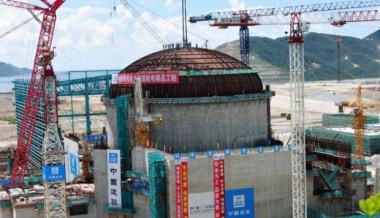
A nuclear reactor in China run by the developers behind Britain’s £20bn
Sizewell C power station remains shut for repair after fuel rods started
leaking.
Inspections are ongoing at the Taishan power plant, where the
reactor was shut in August after radioactivity was found in the cooling
waters. The plant is owned by China General Nuclear (CGN) and France’s
EDF, which are also building the Hinkley Point C plant in Somerset and
Sizewell C in Suffolk, using the same reactor design as at Taishan.
CGN,
which is a minority partner to EDF in Hinkley, has a 20pc development phase
stake in the Sizewell with an option to participate in the construction
phase. The Government is understood to be keen to push CGN out of the
project, however, amid rising concern about Chinese influence in critical
national infrastructure.
There are also hopes that more American investors
would be encouraged to invest if CGN were not involved. Experts have said
cracked fuel rods are “not uncommon” in the industry. An EDF spokesman
said: “The fuel and reactor vessel inspection is still ongoing. The
origin of the fuel rod leakage will only be determined once the analysis is
completed.” The inspection is being carried out under the joint venture
company which runs the plant, TNPJVC, owned 70pc by CGN and 30pc by EDF.
Telegraph 7th Nov 2021
The small nuclear reactor salesmen have bamboozled government officials into funding X-Energy, Terra Power and NuScam’s untested projects.

“I’m frankly speechless at the success that the proponents of these plants have had in bamboozling … a lot of government officials,” said Peter Bradford, a former member of the Nuclear Regulatory Commission and former chair of the Maine and New York utility commissions. “They should be shouldering a much heavier burden when it comes to the credibility of what they are saying.”
This Next-Generation Nuclear Power Plant Is Pitched for Washington State; Can It ‘Change the World’? Hal Bernton / The Seattle Times, 8 Nov 21,
RICHLAND — Near the Columbia River, Clay Sell hopes to launch a new era of nuclear power with four small reactors, each stocked with billiard ball-sized “pebbles” packed full of uranium fuel.
Chief executive officer of Maryland-based X-energy, Sell aims to bring the project online by 2028 as part of a broader attempt to develop safer, more flexible reactors to redefine the nation’s energy future.
These efforts have gained support in the nation’s capital where many Democrats eager to make progress on climate change have joined with Republicans to funnel money into development. The federal Energy Department has received $160 million to help fund X-energy, and the infrastructure bill that cleared Congress on Friday ups that amount to cover almost half the projected $2.2 billion cost of the Washington reactor project.
“We believe what starts here in Washington is going to change the world,” Sell said to public-utility officials gathered Oct. 28 in Kennewick.
X-energy is one of three companies with ties to the Pacific Northwest that have received federal funds to help develop a new generation of small nuclear power plants,
…………………. TerraPower plans to build its project at the site of a Wyoming coal plant in a partnership with a subsidiary of PacifiCorp, a private utility. NuScale is proposing a project in Idaho and has considered eventually locating a unit in Washington state.The nuclear industry, in the Pacific Northwest and elsewhere in the nation, has a history of pitching, and sometimes starting, projects that fail to come to pass. Skeptics say these next-generation projects are being oversold and face big challenges in producing competitively priced power without compromising safety and security, and in a time frame soon enough to help reduce carbon emissions by midcentury.
“I’m frankly speechless at the success that the proponents of these plants have had in bamboozling … a lot of government officials,” said Peter Bradford, a former member of the Nuclear Regulatory Commission and former chair of the Maine and New York utility commissions. “They should be shouldering a much heavier burden when it comes to the credibility of what they are saying.”
The NuScale project in southern Idaho involving small reactors cooled by water is furthest along in development, and has struggled with delays, design changes and escalating cost projections.
NuScale has partnered with a Utah-based utility consortium to develop what initially was proposed to be a power plant with 12 small reactors. The project, which is now forecast to cost $5.1 billion, has since been scaled back to six reactors expected to start coming online in 2029, according to LaVarr Webb, a spokesperson for the Utah Associated Municipal Power Systems.
Though Webb says sign-ups to take power are “going very well,” some utilities have had second thoughts and pulled out of participation in the project. As of early November, the consortium had secured contracts to take 22% of the project’s proposed 462 megawatts of power.
Central Washington site?
Sell has found fervent support for X-energy in the Tri-Cities area, the hub of Washington state’s nuclear industry that has long been buoyed by billions of taxpayer dollars flowing into the cleanup of the federal Hanford site, where plutonium produced for U.S. atomic bombs has left a toxic, radioactive legacy.
The Columbia Generating Station, Washington’s only commercial nuclear power plant, is located at the edge of Hanford. And its operator, Energy Northwest, would manage the X-energy reactors under an agreement announced last year.
A third partner is Eastern Washington’s Grant County Public Utility District, which would own the reactors and be responsible in raising about $1 billion in financing.
This utility boasts an abundance of low-cost hydroelectric power, which has attracted to the county Microsoft, Intuit and other companies that require lots of electricity for data centers and other operations.
…….. The costs of power produced by next-generation nuclear are a key concern and source of uncertainty. Over the past decade, the cost of renewables has plummeted.
Nordt said… a more in-depth financial review is needed, and Grant County might decide not to move forward with any of these projects.
“We may say, ‘You know, hey, the nuclear path was looking favorable, but it’s not for us right now…..
X-energy pushes ahead
X-energy was created by Kam Ghaffarian, an entrepreneurial Iranian immigrant who founded a major NASA contracting company and other ventures. In 2009, he turned his attention to nuclear power
………….X-energy’s four reactors would be able to generate 320 megawatts of power, less than one-third the amount of the roughly 1,200 megawatt capacity of the Columbia Generating Station.
The project, with a reactor dubbed Xe-100, would be the state’s first new nuclear power development since the 1970s, when the Washington Public Power Supply System — the initial name for the Energy Northwest utility consortium — tried to build five large nuclear power plants but finished only one in a disastrous effort based on flawed forecasts of future power demand.
The unfinished plants left a bitter legacy — including the largest municipal bond default in U.S. history and, among some, a deep mistrust of the nuclear power industry.
One of the most visible reminders of the Washington Public Power Supply System, which detractors nicknamed “Whoops,” is a massive concrete-domed building that dominates a 100-acre tract close to the Columbia Generating Station. This was supposed to be WPPSS No. 1 but construction halted in 1982 when it was almost 65% complete.
X-energy’s proposal submitted to the Energy Department calls for installing the reactors on 22 acres of this site, which already includes water intakes from the Columbia River.
Next-generation tech
X-energy’s website promotes the helium-cooled reactor as safely producing electricity “in a process that’s as clean as wind and solar.”
The reactor operates at much higher temperatures than the water-cooled nuclear plants now in operation. It is stocked, like a gumball machine, with the pebbles, each of which holds thousands of fuel particles………
The claims of a meltdown-proof fuel are dismissed as “absurd” by Edwin Lyman, a physicist with the Union of Concerned Scientists who has researched nuclear reactor safety for many years.
Lyman questions whether the X-energy reactor would be safe enough to justify a design that does away with costly leak-tight containment buildings standard for the current generation of water-cooled reactors.
He says the safety of TRISO fuel requires the ability to consistently manufacture it to exacting standards. So far, he said, that has not been demonstrated in the United States.
In a report he published this year, Lyman notes a 2019 test of the fuel at a national laboratory in southern Idaho “had to be terminated prematurely” when monitoring indicated “the fuel began to release fission products at a rate high enough to challenge offsite radiation dose limits.”
If the project moves forward, Lyman calls for the Nuclear Regulatory Commission to take a more cautious licensing approach that would first approve the reactor as a prototype before moving into commercial production.
“A lot of the rationale for why you would embark on this journey is not supported by the evidence,” Lyman said……….
X-energy’s project in Washington also is receiving pushback in from a Northwest tribe.
The Confederated Tribes of the Umatilla Indian Reservation does not support placing small modular reactors such as those proposed by X-energy or any new nuclear missions at Hanford, according to an Aug. 6 letter to the Energy Department from the chair of the tribes’ board, N. Kathryn Brigham.
The federal Hanford reservation includes areas that rank as the most contaminated nuclear sites in North America. The massive task of treating 177 tanks storing a perilous brew of radioactive and chemical waste, some of which are leaking, represents a huge cleanup challenge.
The letter noted that 1855 treaties ceding millions of acres of land called for the preservation of important rights, including hunting, fishing and gathering. Hanford is partially within these treaty territories, and new reactor development could impact those rights and resources, said Brigham’s letter, which called for consultation to discuss the federal government’s trust responsibility under the treaty.
The tribes’ concerns are shared by the Columbia Riverkeeper, a Northwest environmental group that released a September report blasting small nuclear reactors as an “unacceptable solution to climate change.”
X-energy has yet to apply for a Nuclear Regulatory Commission license to operate the reactor, a complex process that includes an extensive safety review, according to Scott Burnell, a commission spokesperson.
“This has to be competitive”……. https://www.chronline.com/stories/this-next-generation-nuclear-power-plant-is-pitched-for-washington-state-can-it-change-the,277542
The biggest delegation of all at COP26 is that of fossil fuel lobbyists

There are more delegates at COP26 associated with the fossil fuel industry
than from any single country, analysis shared with the BBC shows.
Campaigners led by Global Witness assessed the participant list published
by the UN at the start of this meeting. They found that 503 people with
links to fossil fuel interests had been accredited for the climate summit.
These delegates are said to lobby for oil and gas industries, and
campaigners say they should be banned. “The fossil fuel industry has spent
decades denying and delaying real action on the climate crisis, which is
why this is such a huge problem,” says Murray Worthy from Global Witness.
“Their influence is one of the biggest reasons why 25 years of UN climate
talks have not led to real cuts in global emissions.”
BBC 8th Nov 2021
https://www.bbc.co.uk/news/science-environment-59199484
Drill or Drop 8th Nov 2021
At People’s Summit for Climate Justice, campaigners accuse COP26 of failing the climate
| COP26: Campaigners accuse UN talks of failing climate as they hold counter summit for most marginalised. The UN Framework Convention on Climate Change (UNFCCC) was found guilty of “violating its charter” because it had “forged an intimate partnership with the corporations”. At the start of the People’s Summit for Climate Justice, the UNFCCC was also found guilty of failing to: address global social and economic injustices. recognise, promote and protect the rights of nature; The Sudanese diplomat, Lumumba Di Aping, said: “The UNFCCC has allowed itself to be converted at best into a catering company for the G7, at worst into a carbon noose for the global south.” Global Justice Now, one of the summit’s organisers, said: “There’s one technology that the UNFCCC has an unwavering faith in – it is the market. It promotes the ponzi scheme of capitalism. The UNFCCC no longer represents us, we need to represent ourselves.” Drill or Drop 7th Nov 2021 https://drillordrop.com/2021/11/07/cop26-campaigners-accuse-un-talks-of-failing-climate-as-they-hold-counter-summit-for-most-marginalised/ |
The People’s Summit forClimate Justice plans ambitious pressure on governments for real action
| A counter climate summit kicks off in Glasgow on Sunday amid mounting criticism from activists about greenwashed solutions and stalled action from corporations and rich nations inside Cop26. The People’s Summit for Climate Justice will bring together movements and communities from across the world to amplify voices, ideas and solutions it believes are largely absent from Cop – including the global green new deal, polluters’ liability, indigenous ecological knowledge and the gulf between net zero and real zero emissions. Organisers hope that sharing expertise onequitable and transformative non-market solutions to the climate emergencywill help create a powerful grassroots collective to force governments to be more ambitious and less beholden to big business. Guardian 7th Nov 2021 https://www.theguardian.com/environment/2021/nov/07/counter-climate-summit-kicks-off-as-activists-lament-cop26-inaction |
1 This Month



19 November – Webinar – The Reality of Reprocessing
Time: 11:00 AM Pacific Time (US & Canada) / 2:00 PM Eastern / 7:00 PM UK / 8:00 PM CET
Register for the Zoom Event Here



Shut down the radiation-damaged Heysham nuclear reactors now
To see nuclear-related stories in greater depth and intensity – go to https://nuclearinformation.wordpress.com

Say No to NASA’s Reckless Nuclear Reactor on the Moon
Say No to NASA’s Reckless Nuclear Reactor on the Moon
-
Archives
- November 2026 (84)
- October 2026 (302)
- September 2026 (339)
- August 2026 (330)
- July 2026 (355)
- June 2026 (287)
- May 2026 (306)
- April 2026 (356)
- March 2026 (251)
- February 2026 (267)
- January 2026 (308)
- December 2025 (358)
-
Categories
- 1
- 1 NUCLEAR ISSUES
- business and costs
- climate change
- culture and arts
- ENERGY
- environment
- health
- history
- indigenous issues
- Legal
- marketing of nuclear
- media
- opposition to nuclear
- PERSONAL STORIES
- politics
- politics international
- Religion and ethics
- safety
- secrets,lies and civil liberties
- spinbuster
- technology
- Uranium
- wastes
- weapons and war
- Women
- 2 WORLD
- ACTION
- AFRICA
- Atrocities
- AUSTRALIA
- Christina's notes
- Christina's themes
- culture and arts
- Events
- Fuk 2022
- Fuk 2023
- Fukushima 2017
- Fukushima 2018
- fukushima 2019
- Fukushima 2020
- Fukushima 2021
- general
- global warming
- Humour (God we need it)
- Nuclear
- RARE EARTHS
- Reference
- resources – print
- Resources -audiovicual
- Weekly Newsletter
- World
- World Nuclear
- YouTube
-
RSS
Entries RSS
Comments RSS

