The US Bubble of Pretend- our complacent acceptance of preposterous propaganda about Ukraine

PATRICK LAWRENCE: The US Bubble of Pretend, The lack of objective, principled coverage of the war in Ukraine is a degenerate state of affairs. The one thing worse is the extent to which it’s perfectly fine with most Americans. Consortium News, By Patrick Lawrence, 6 Apr 22,
Consortium News It is perfectly obvious by now, to anyone who cares to look, that mainstream media in America and the other Western powers are not reporting the Ukraine crisis accurately.
Let me try that another way: The government-supervised New York Times and the rest of the corporate-owned media on both sides of the Atlantic lie routinely to their readers and viewers as to why Russia intervened in Ukraine, the progress of its military operation, the conduct of Ukrainian forces, and America’s role in purposely provoking and prolonging this crisis.
So far as I know, this is the first war in modern history with no objective, principled coverage in mainstream media of day-to-day events and their context. None. It is morn-to-night propaganda, disinformation and lies of omission — most of it fashioned by the Nazi-infested Zelensky regime in Kiev and repeated uncritically as fact.
There is one thing worse than this degenerate state of affairs. It is the extent to which the media’s malpractice is perfectly fine to most Americans. Tell us what to think and believe no matter if it is true, they say, and we will think and believe it. Show us some pictures, for images are all.
There are larger implications to consider here. Critical as it is that we understand this conflict, Ukraine is a mirror in which we see ourselves as we have become. For more Americans than I wish were so, reality forms only in images. These Americans are no longer occupants of their own lives. Risking a paradox, what they take to be reality is detached from reality.
This majority — and it is almost certainly a majority — has no thoughts or views except those first verified through the machinery of manufactured images and “facts.” Television screens, the pages of purportedly authoritative newspapers, the air waves of government-funded radio stations — NPR, the BBC — serve to certify realities that do not have to be real, truths that do not have to be true.
This leaves us in a sad and very parlous place………………….
Ten days into the Russian intervention, the propaganda coming out of Kiev was already so preposterous The New York Times felt compelled to publish a piece headlined, “In Ukraine’s Information War, a Blend of Fact and Fiction.” This was a baldly rendered apologia for the many “stories of questionable veracity,” as The Times put it, then in circulation. I do love The Times for its delicate phrasing when describing indelicate matters.
There was the “Ghost of Kiev” story, featuring an heroic fighter pilot who turned out to derive from a video game. There were the Snake Island heroes, 13 Ukrainian soldiers who held out to the death on some small speck in the Black Sea, except that it turned out they surrendered, though not before Zelensky awarded them posthumous medals of honor that were not posthumous.
After railing against disinformation for years, The Times wants us to know, disinformation is O.K. in Ukraine because the Ukrainians are our side and they are simply “boosting morale.”
We cannot say we weren’t warned. The Ghost of Kiev and Snake Island turn out now to be mere prelude, opening acts in the most extensive propaganda operation of the many I can recall.
There was the maternity ward the Russians supposedly bombed in Mariupol. And then the theater, and then the art school. All filled with huddling citizens the Russian air force cynically targeted because “this is genocide,” as the ever-intemperate Zelensky does not hesitate to assert.
All of this has been reported as fact in the Times and other major dailies and, of course, by the major broadcasters. There have been pictures. There have been videos, all very persuasive to the eye.
And then, as evidence mounts that these incidents were staged as propaganda to frame the Russians and draw NATO forces directly into the war, a silence worthy of a Catholic chapel descends. We read no more of the maternity ward that turned out to be an improvised Azov base, or the theater, where citizens were herded, photographed in raggedy blankets, and sent away. Ditto the art school: Nothing more on this since the initial reports began to collapse. No body counts, no mention of the fact that Russian jets did not fly over Mariupol on the days in question…………………………..
Bucha is a suburb of 35,000 souls a few miles north of Kiev and one of the cities Russian forces began to evacuate on March 29 as peace talks in Istanbul progressed. Two days later the mayor, Anatoly Fedoruk, celebrated the city’s liberation in a selfie-speech to his citizenry. He made no mention of anything untoward in Bucha’s streets, backyards, or public spaces.
Four days later, April 2, a special unit of the Ukrainian national police deployed to Bucha. And suddenly the place turns out to be a hellhole: bodies in the streets — 410, according to the Prosecutor General’s office in Kiev — evidence of atrocities galore, people bound and shot point blank. The whole nine, in short.
Instant Outrage
The outrage from Washington, London and Paris — “worldwide outrage,” this would be — was instant. No demand for an impartial inquiry, forensic inspections, or any such thing. No one asked why corpses left in the street for five days appeared to be fresh, or why the relatives of the dead left them there until Kiev’s commando unit arrived.
António Guterres, the U.N. secretary-general, was level-headed enough to state, “It is essential that an independent investigation leads to effective accountability.” This is the only sound position at this point. But we know from a long history how far SGs at the U.N. get with this sort of talk.
In my read this is yet another of the false flags the Kiev regime flies almost by the day now. Paying-attention people will not miss the striking similarity between these incidents and the numerous put-up jobs that featured in Washington’s covert operation in Syria and the campaign of those famous “moderate rebels” who desperately wanted to draw the U.S. into the conflict.
As a matter of principle we must await evidence of what happened in Bucha, even as we know we are likely to see as much about events there as we have in Mariupol. We also know that to most people neither evidence nor its absence matters.
We have been told once again what to think and believe, and most of us will think and believe it.
We are to add this to various other “truths” now almost universally accepted: The Russian intervention had nothing to do with NATO expansion and was “unprovoked” — that favored term in the Biden regime. Ukrainian forces have pushed the Russians into retreat: not that the pressure on Kiev was a Russian diversionary tactic to keep Ukrainian forces away from Donbass where the fighting is.
After the Pentagon Papers came out in 1971, Hannah Arendt published an essay in The New York Review of Books called “Lying in Politics.” In it she wrote of America’s slide into a sort of collective psychosis she termed “defactualization.” Facts are fragile, Arendt wrote, in that they tell no story in themselves. They can be assembled to mean whatever one wants them to mean. This leaves them vulnerable to the manipulations of storytellers…………..
It is a half-century since Arendt published “Lying in Politics.” And it is to that time, the 1960s and 1970s, that we must trace the formation of what now amounts to America’s great bubble of pretend. The world as it is has mattered less and less since Arendt’s time, the world as we have wished it to be has mattered more and more…………………………. https://consortiumnews.com/2022/04/05/patrick-lawrence-the-us-bubble-of-pretend/
Incompetence of Britain’s leaders, on energy policy
Jonathon Porritt: This is absolutely the right time for a new Energy
Strategy. Unfortunately, we’ve got absolutely the wrong politicians in
charge of it. The combination of Boris Johnson and Rishi Sunak all but
guarantees that the new Energy Security Strategy will fail on most counts.
– In Boris Johnson, we have a careless showman, drawn unerringly to
‘big ticket’ announcements, groomed by a nuclear industry that knows
exactly how to play to these personality defects. – In Rishi Sunak, we
have a man so detached from the reality of most people’s lives that the
prospect of five million UK citizens finding themselves in fuel poverty by
the end of the year means literally nothing.
Careless Johnson and callous
Sunak is a devastating double-act – with the inconsequential figure of
Kwasi Kwarteng lurking around to pick up the pieces.
Jonathon Porritt 5th April 2022
http://www.jonathonporritt.com/prospects-for-energy-security-marred-by-nuclear-fantasies/
AUKUS hypersonic announcement will ‘escalate global tensions’, warns CND

”………………… In a joint statement on Wednesday, the trio announced that they would now “commence new trilateral cooperation on hypersonics and counter-hypersonics, and electronic warfare capabilities. ”
Growing proliferation
Australia is already co-operating with Washington on hypersonic weapon development as part of the Southern Cross Integrated Flight Research Experiment (SCIFiRE). UK officials said they will not be formally joining SCIFiRE. They will instead co-operate in research and development in the area so they can expand their options.
Hypersonic missiles travel at five times the speed of sound and can be armed with either conventional or nuclear warheads. Faster than cruise missiles, they can in theory evade existing air defence systems. The US, Russia, and China have all undertaken testing of the weapon.
CND General Secretary Kate Hudson said: “The latest expansion of the AUKUS military pact will further escalate global tensions, at a time when the threat of nuclear war is at its highest in decades. The announcement that a programme initially centred on providing a non-nuclear state with nuclear-powered submarines – in itself risking wider nuclear proliferation – will now include hypersonic missiles, is of great concern. This AUKUS expansion will accelerate arms racing in the Asia-Pacific region, leading to increased militarisation, and potentially helping provoke conflict over Taiwan. Not to mention the fact that military budgets are already escalating – what will the opportunity cost be for embarking on a whole new class of weaponry be?” https://cnduk.org/aukus-hypersonic-announcement-will-escalate-global-tensions-warns-cnd/
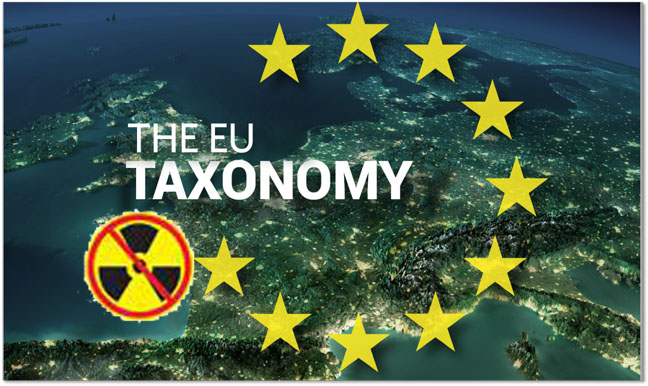
The European Commission Platform on Sustainable Finance concludes that nuclear and gas power are not green
Nuclear and gas power ‘not green’, say EC experts https://environment-analyst.com/global/107948/nuclear-and-gas-power-not-green-say-ec-experts
EC Platform on Sustainable Finance delivers final report on extending sustainable finance rules across the whole EU economy, and includes a bombshell.
A European Commission (EC) expert group has made wide-ranging recommendations on extending the scope of the EU Taxonomy – the classification system that defines environmentally sustainable economic activities – across the European economy.
The EC Platform on Sustainable Finance’s final report will inform important new EU legislation, due in the autumn, which will in turn guide future policy and investment decisions.
The report concludes that gas and nuclear power cannot be described as ‘green’ under the taxonomy’s ‘do no significant harm’ (DNSH) rules – although leaves the final decision to the European Commission.
The expert panel’s final report considers 12 sectors, including manufacturing, transport, agriculture, fishing, building and disaster risk management. It is still finalising criteria for forestry and agriculture.
The report proposes a ‘traffic light’ system, listing red activities requiring urgent transition to avoid significant harm, amber activities that could more easily qualify for taxonomy-recognised investment, and green, low environmental impact (LEnvI) activities.
Welcoming the report, Sebastien Godinot, senior economist at WWF European policy office, commented: “The platform’s recommendations are a crucial step towards the much-needed ‘biodiversity taxonomy’, aimed at driving billions into nature-friendly activities.”
He added: “However, WWF is concerned that some criteria for critical sectors like forestry and agriculture are not [yet] included. The platform must publish recommendations for them no later than May.”
The EU Taxonomy, which came into force earlier this year, provides the technical underpinning for a number of interlinked EU regulations on sustainable finance products, disclosures and reporting. The taxonomy’s purpose is to increase financial flows towards green activities and to reduce green-washing by setting science-based criteria for performance. It is hoped that the taxonomy will become a global ‘gold standard’ for green finance.
The taxonomy is governed by the Taxonomy Regulation, which came into force on 12 July 2020 and identifies activities that improve or diminish six objectives (climate change mitigation, climate change adaptation, sustainable water resources, transitioning to a circular economy, pollution prevention and control and protecting biodiversity and ecosystems). Article 26.2(a) of this regulation requires the commission to report on applying its rules across the wider economy and to define sectors that have no environmental impact or are outside its scope.
At the same time as the taxonomy came into effect, the EC presented the Taxonomy Climate Delegated Act (TCDA). In response to restrictions to Europe’s natural gas supplies at the beginning of the year, the legislation was controversially complemented by a second Delegated Act, which defined nuclear and natural gas powered energy as ‘green’. This caused widespread objections from environmental and climate change groups.
The TCDA is being scrutinised by the European Parliament and the Council, before going back to the EC. The EC is expected to draft a new Delegated Act, building on the platform’s latest recommendations, in the autumn. This should resolve whether nuclear and gas-powered energy will count as sustainable for policy and investment purposes in the EU.
While asserting that nuclear and gas power are not green, the platform’s report gives the commission ‘wiggle room’ by suggesting a “systems-wide approach to the low-carbon transition”.
It says: “The extended Taxonomy framework would acknowledge the reasons why these activities are not green, explaining why, in some cases, [they] may be significantly harmful, but also showing that there is potential for valid and urgent transitions away from significantly harmful performance.”
Nuclear waste management: Is Finland’s Onkalo facility safe?
Nuclear waste management: Is Finland’s Onkalo facility safe? https://www.downtoearth.org.in/news/science-technology/nuclear-waste-management-is-finland-s-onkalo-facility-safe–82252 6 Apr 22,
The facility, set to begin operation in 2024, isn’t based on a foolproof concept
Finland, a nuclear energy champion, claimed it has figured out how to tackle one of the bigger issues with nuclear energy: Safely managing radioactive waste.
The country plans to store its nuclear waste in an underground facility called Onkalo. The structure, named after the Finnish word for “pit”, is a 500-meter-deep underground disposal facility designed to store used nuclear fuel permanently.
The deep geological repository is usually built in places containing a stable rock.Finland can become the first to commission a plant to permanently store spent nuclear fuel. The idea is to encase the waste in corrosion-resistant copper canisters. These will be further encapsulated in a layer of water-absorbing clay. The setup will be buried in an underground tunnel.
The facility is now equipped with 500 sensors to monitor the functioning of the entire system, according to VTT Technical Research Centre of Finland Ltd, a state-owned company and one of the contributors to the project.
“Monitoring brings evidence that the repository will be keeping the outside world safe from the nuclear fuel waste,” Arto Laikari, senior scientist from VTT, said. The state-owned company’s collaborator Posiva, a Finnish nuclear waste management organisation, has submitted the operating license for the facility and is awaiting approval.
In 2023, Posiva will do a final trial run of the disposal mechanism but without radioactive material, Erika Holt, project manager from VTT, told Down To Earth. It is expected to begin operations in 2024.
Problem of disposing nuclear waste
For years, the nuclear industry has been trying to find solutions to the waste problem. They are generated at various steps during the nuclear life cycle: Mining uranium ore, producing uranium fuel and generating power in the reactor.
The waste can remain radioactive for a few hours, several months or even hundreds of thousands of years. Depending on the extent of radioactivity, nuclear wastes are categorised as low-, intermediate- and high-level waste.
About 97 per cent of the waste is either low- or intermediate-level. The remaining is high-level waste, such as used or spent uranium fuel.
A 1,000-megawatt plant creates about 30 tonnes of high-level nuclear waste every year, according to the International Atomic Energy Agency.
“Even at low levels, exposure to this waste will be harmful to people and other living organisms as long as it remains radioactive,” Ramana explained.
Global endeavours
Some nations are storing waste on-site. But it carries the risk of radioactive leakage. In the United States, for instance, spent fuel is stored in a concrete-and-steel container called a dry cask, according to the US Energy Information Administration.
India and a handful of other nations reprocess about 97-98 per cent of the spent nuclear fuel to recover plutonium and uranium, according to data from the Bhabha Atomic Research Centre.
India also recovers other materials like caesium, strontium and ruthenium, which finds application as blood irradiators to screen transfusions, cancer treatment and eye cancer therapeutics, respectively, according to the research institute.
The remaining 1-3 per cent end up in a storage facility. India also immobilises the wastes by mixing them with glass, which is kept under surveillance in storage facilities.
But there are problems with this approach as well. Except for the plutonium and uranium, all the radioactive material present in the spent fuel is redistributed among different waste streams, Ramana said. “These enter the environment sooner or later.”
The plutonium and uranium intended for reuse in other nuclear reactors will also turn into radioactive waste, he added.
Nations like Finland, Canada, France and Sweden are also looking at deep geological repositories to tackle spent nuclear fuel wastes.
In January 2022, the Swedish government greenlit an underground repository for nuclear waste. Construction in Sweden will take at least 10 more years, Johan Swahn, director of MKG Swedish NGO Office for Nuclear Waste Review, a non-governmental environmental organisation, said.
Finland can share its experience with colleagues and partners worldwide, Holt said. “But each country and programme must have their own solutions. Worldwide, we work together to show nuclear energy (and the holistic views for responsible waste management) are viable for meeting CO2 targets,” she added.
Is the approach safe?
Experts associated with the project said that 40-years of theoretical and lab-based studies suggest that the geological repository is safe.
The bedrock provides a natural barrier to protect from radioactive release to the environment, such as water bodies and air, Holt explained.
The use of clay and copper provides a protective layer to ensure no release due to extreme conditions like earthquakes.
But Ramana argues that theoretical safety studies are not foolproof. There are significant uncertainties stemming from various long-term natural processes. These include climate change and the unpredictability of human behaviour over these long periods of time, he added.
Besides, design failure could undermine claims about safety, the expert noted. For instance, a few scientists fear that copper canisters can become corrosive and crack.
Finland’s team chose copper because it corrodes slowly. But Peter Szakálos, a chemist at the KTH Royal Institute of Technology in Stockholm, is not quite sure.
In a 2007 study, Szakálos and his team observed that copper could corrode in pure, oxygen-free water. “It’s just a matter of time — anything from decades to centuries — before unalloyed copper canisters start to crack at Onkalo,” he told Science journal.
On February 14, 2014, radioactive materials such as americium and plutonium leaked out of the Waste Isolation Pilot Plant, a deep geological long-lived radioactive waste repository, following an accident. The facility dealt solely with a special class of wastes from nuclear weapons production.
“If a failure like this happened within two decades of opening the repository, what are the odds that such failures won’t happen over the millennia that these repositories [Finland’s Onkalo] are supposed to operate safely?”
Both the Finnish project and the Swedish decision are very important for the international nuclear industry because the latter can point to these facilities to prove the nuclear waste problem is solved, Swahn said. “But it is very uncertain whether copper as a container material is a good idea.”
The projects may still fail as the understanding of how copper behaves in a repository environment is still developing, the expert added.
Greenpeace maps Ukraine’s nuclear power risks
The extent of the nuclear threat posed by Vladimir Putin’s illegal
invasion of Ukraine is unprecedented, new Greenpeace International mapping
and technical analysis shows. Created with data from the Institute for the
Study of War and the Centre for Information Resilience among others, and
displaying the proximity of Russian troops and military hardware to each of
Ukraine’s 15 commercial nuclear reactors over time, the interactive map
provides a chilling interactive visualisation of the potential for nuclear
catastrophe at regular intervals since the bloody invasion began on
February 24.
Greenpeace 6th April 2022
” Renewable Energy Foundation (REF)” – strongly linked to anti-wind power lobby

Charity linked to UK anti-onshore wind campaigns active again. While the
name of the Renewable Energy Foundation (REF) suggests it is a charity
dedicated to promoting low-carbon electricity, it appears to spend most of
its time campaigning against onshore wind.
When it was founded in 2004,
with the TV personality Noel Edmonds as its chair, the organisation was
clear it wanted to fight against the “grotesque political push” for
onshore renewable energy in the UK. It styles itself on its website as “a
registered charity promoting sustainable development for the benefit of the
public by means of energy conservation and the use of renewable energy”.
However, many in the energy sector believe the charity to be full of
anti-wind lobbyists. In 2008, the REF had what it described as a
“dialogue” with the Charity Commission over whether it was violating
its charitable status by being too political in its campaigning. The
Charity Commission said it assessed the complaint relating to the REF’s
campaigning activities and determined there was no evidence that it was not
charitable, but also provided guidance about how to achieve its objectives
as an organisation.
The REF has strong links to a group accused of climate
science scepticism, the Global Warming Policy Foundation, started by the
former chancellor Nigel Lawson, who has denied global heating is a problem.
Prof Michael Kelly, a trustee of the REF also has a position on the board
of the GWPF. John Constable, an adviser to the GWPF, has been quoted as an
REF spokesperson and was previously its director of policy and research.
Constable answered the Guardian’s questions for this article on behalf of
the REF.
While the REF has been relatively quiet in recent years, growing
pressure on the government to support wind energy to help solve the energy
crisis seems to have led to it becoming more active again. In recent weeks,
the charity has provided anti-onshore wind research to the Telegraph and
Daily Mail. Colin Davie, a trustee of the REF, has appeared on Radio 4’s
Today programme to oppose onshore wind. Constable added that the REF had
“no blanket policy” on renewables – but that the charity did not see
them as a large part of the net zero strategy. He added: “Each proposal
must be judged on its own merits, and providing that local environmental
concerns offer no obstacle, niche applications may be suitable, as they may
be for all renewables.”
Guardian 5th April 2022
Over 70 Russian soldiers suffering from radiation exposure at Chernobyl nucler site
| Over 70 Russian soldiers exposed to radiation at Chernobyl: Ukraine, KYODO NEWS 6 Apr 22, – About 75 Russian soldiers are receiving medical treatment in Belarus after being exposed to radiation during their temporary control of the Chernobyl nuclear power plant in Ukraine, according to Ukraine’s Energy Minister German Galushchenko. Galushchenko said in an online interview Tuesday that the troops apparently suffered from radiation after digging around the grounds of the plant, the site of a 1986 disaster, to defend themselves from the Ukrainian military.The troops were affected “very heavily and are in a very difficult situation and now (being treated) in clinics” in Belarus, Galushchenko said, citing information made available. “I can’t imagine you could order someone to dig into” areas contaminated with “the high level of radiation with signs saying ‘Don’t come in. Don’t stay near,'” he said, speaking in English.”They’re soldiers, and they just follow the orders.”Galushchenko said Ukraine has regained complete control of the nuclear power plant…………….. https://english.kyodonews.net/news/2022/04/33e77e951e22-over-70-russian-soldiers-exposed-to-radiation-at-chernobyl-ukraine.htm |
In Japan, no return to nuclear power any time soon, despite loud voices wanting this,
Nuclear Power’s Growing Fan Base in Japan Faces a Reality Check https://www.bloomberg.com/news/articles/2022-04-06/nuclear-power-s-growing-fan-base-in-japan-faces-a-reality-check By Tsuyoshi Inajima and Shoko Oda, 6 April 2022, Voices calling for Japan to ramp up its use of nuclear power are getting louder, but a rapid return is unlikely even as the nation faces another possible energy crunch this summer.
The global power crisis is causing electricity bills to surge in Japan, while war in Ukraine is pressuring the country to seek alternatives to Russian energy. The fragility of the nation’s power grid was exposed last month when the one-two punch of a strong quake and frigid weather nearly delivered a blackout to Tokyo.
With few resources available to build capacity, and the threat of another power shortage looming with the return of hot, humid weather, lawmakers from both the ruling party and opposition are calling for a quick restart to reactors. Public support is also growing, as a recent survey showed a narrow majority in Japan now support turning idled plants back online
But a web of red-tape governing nuclear reactors born from the Fukushima nuclear disaster 11 years ago means that resuming operations can’t speed up, no matter the political pressure.
“If the Nuclear Regulation Authority approves nuclear reactor restarts based strictly on scientific findings, and not political decisions, then the current pace won’t change anytime soon,” said Reiji Ogino, an analyst at Mitsubishi UFJ Morgan Stanley Securities Co.
Japan’s NRA oversees the restart protocols of the country’s remaining 33 operable nuclear reactors. Ever since Japan turned its fleet of 54 reactors offline after the 2011 disaster, only 10 have restarted under the new rules that ensure the units are safe.
“The NRA is restarting nuclear reactors at a slower pace than everyone had expected,” Ogino said.
That’s putting Japan’s power grid under more strain, which nearly caused the blackout in Tokyo last month. Thermal power plants were knocked out by a magnitude 7.4 earthquake, followed by a blast of cold weather that boosted power demand, threatening outages in the nation’s biggest city. While Tokyo managed to prevent a disaster, the situation could repeat when summer demand spikes as residents turn on their air conditioners.
Seven nuclear power units, while being cleared by the NRA, have yet to finish additional construction work needed to restart. “It’s unlikely that these units will restart before the upcoming peak summer season,” Ogino said.
Syusaku Nishikawa, an analyst at Daiwa Securities Co., forecasts most of the seven reactors won’t resume operations until October next year at the earliest.
One way to speed up the process would be to shift nuclear authority back to the government. Before the independent NRA was created on the back of the Fukushima disaster, the authority existed under Japan’s trade ministry, which had actively pushed for using more atomic power but at the cost of cutting corners. Passing that power back isn’t expected anytime soon, and would be highly controversial.
“Someone has to take responsibility for safety” should the rules change and nuclear power plants that haven’t met standards are allowed to operate, said Nishikawa. “There’s a lot of difficulty in making that political decision.”
Uzbekistan: Nuclear deal with Russia still on the table despite sanctions
Uzbekistan: Nuclear deal with Russia still on the table despite sanctions, eurasianet, Even if Rosatom is not targeted by sanctions, its future projects could still be affected. Apr 6, 2022 When Uzbekistan fired the starting pistol four years ago on plans to go nuclear as a way to address the chronic energy shortages that plague it every winter, the world was a different place.
Russian President Vladimir Putin was not an international pariah. And Shavkat Mirziyoyev, his Uzbek counterpart, was courting him as a guest of honor in Tashkent.
The high point of Putin’s visit was when he and Mirziyoyev symbolically inaugurated the start to a project to build an $11 billion nuclear power plant in an area just east of Bukhara. The work was to be done by Russia’s state-owned Rosatom, a commanding presence in the global nuclear power industry, and to be funded with loans from Moscow………
When Uzbekistan fired the starting pistol four years ago on plans to go nuclear as a way to address the chronic energy shortages that plague it every winter, the world was a different place.
Russian President Vladimir Putin was not an international pariah. And Shavkat Mirziyoyev, his Uzbek counterpart, was courting him as a guest of honor in Tashkent.
The high point of Putin’s visit was when he and Mirziyoyev symbolically inaugurated the start to a project to build an $11 billion nuclear power plant in an area just east of Bukhara. The work was to be done by Russia’s state-owned Rosatom, a commanding presence in the global nuclear power industry, and to be funded with loans from Moscow.
…………………… “It is absolutely the case that projects that have not yet been completed or that still are in the design stages are extremely vulnerable to sanctions difficulties and interference, even if Rosatom is not itself presently subject to such sanctions,” Richard Nephew, the director of the International Security Initiative at Columbia University’s Center on Global Energy Policy, told Eurasianet by email. “Sanctions targeting financial transactions, technology transfers and the like will all undermine efforts to engage in and complete such projects.”
While there are clear risks to proceeding with the project, there are risks to scrapping it, too.
Aside from the certainty that cancellation would antagonize a belligerent Russia, finding a new partner to build a plant that Mirziyoyev said in 2018 would be completed within a decade would take time.
So is building the Russo-Uzbek nuclear power station still viable?
“Possibly, though given the long lead times required to develop and implement nuclear reactor projects, by the time such a project were to begin, it could be covered by sanctions,” said Nephew. “In general, it would not be advisable to start development of such projects now, given this risk.” https://eurasianet.org/uzbekistan-nuclear-deal-with-russia-still-on-the-table-despite-sanctions
Argentina wants China to fully fund $8.3 bln nuclear plant
Argentina wants China to fully fund $8.3 bln nuclear plant amid cash shortfall. By Eliana Raszewski, 6 Apr 22, LIMA, Argentina, (Reuters) – Argentina is pushing China to fully finance a new $8.3 billion nuclear power plant in the country, as the government grapples with high debt levels and looks to bring down its fiscal deficit as part of a recent deal with the International Monetary Fund.
The South American nation signed an agreement with the China National Nuclear Corporation (CNNC) for construction of a nuclear power plant in February. CNNC at the time said it would finance 85% of the cost, with Argentina shouldering the rest.
The country, however, now faces a tighter fiscal outlook. It needs to hit a fiscal balance by 2025 from a 3% deficit last year under terms of a recent $44 billion IMF program, including cutting billions of dollars in energy subsidies.
“We’re aiming for 100% in terms of financing from China to guarantee no delays given the problems we have with funding,” said Jorge Sidelnik, executive director of Argentina’s state operator Nucleoelectrica Argentina, the local partner……………………. https://www.reuters.com/business/energy/argentina-wants-china-fully-fund-83-bln-nuclear-plant-amid-cash-shortfall-2022-04-05/
South Korea’s president-elect wants U.S. nuclear bombers, submarines to return
South Korea’s president-elect wants U.S. nuclear bombers, submarines to return, By Hyonhee Shin, SEOUL, April 6 (Reuters) – Advisers to South Korea’s president-elect sought redeployment of U.S. strategic assets, such as nuclear bombers and submarines, to the Korean peninsula during talks held on a visit to Washington, one of the advisers said on Wednesday……… (subscribers only) https://www.reuters.com/world/asia-pacific/skoreas-president-elect-wants-us-nuclear-bombers-submarines-return-2022-04-06/
Reporting by Hyonhee Shin; Additional reporting by Jeff Mason in Washington; Editing by Clarence Fernandez
Ensuring radiation protection: European Commission takes Portugal to Court to guarantee citizens’ protection from ionising radiation-exposure
Ensuring radiation protection: Commission takes Portugal to Court to guarantee citizens’ protection from ionising radiation-exposure risks https://ec.europa.eu/commission/presscorner/detail/en/IP_22_2215
The Commission is taking legal steps to ensure the protection of citizens, workers and patients against the dangers arising from exposure to ionising radiation. Today, the Commission decided to refer Portugal to the Court of Justice of the European Union for failing to fully transpose the EU’s revised Basic Safety Standards Directive (Council Directive 2013/59/Euratom) into national legislation.
Member States were required to transpose the Directive by 6 February 2018. The Commission has been providing continuous support to the Member States to properly transpose the rules. In November 2019, the Commission sent a reasoned opinion to Portugal requesting it to notify to the Commission all of its transposition measures for the Directive. Since then, Portugal has notified additional transposition measures, but has not yet established a national action plan addressing long-term risks from exposures to radon, as required by the Directive. Therefore, the Commission is referring Portugal to the Court of Justice today.
Background
The Euratom Treaty provides the Commission with the legal basis to establish basic safety standards to protect the health of workers and the general public against dangers arising from ionising radiation. Once fully implemented, the Basic Safety Standards Directive will ensure the highest level of radiation protection of workers, patients and the general public across the EU.
The Directive, which was first adopted in 1959, sets out the requirements on emergency preparedness and response in case of radiological emergency, and provides for radiation protection education, training and provision of information to the public, among others. Emergency preparedness and response provisions were strengthened following the Fukushima nuclear accident in Japan in 2011. The latest revision from December 2013 took account of the scientific and technological progress since the 1990s, and consolidated five earlier legal acts into a single piece of legislation.
The forgotten nuclear threat of North Korea
As the West remains focused on the war in Ukraine, Kim Jong Un has begun testing his most powerful missile to date. New Statesman, By Katie Stallard , 6 Apr 22, Even by the bombastic standards of North Korean propaganda, the video that accompanied Pyongyang’s missile launch on 24 March was extraordinary. The opening sequence showed Kim Jong Un, apparently channelling the late 1980s and Tom Cruise in Top Gun, striding out of a hangar in slow motion, wearing a black leather bomber jacket and dark sunglasses. Kim checked his watch……..
While the action movie-style montage was somewhat dated, the intercontinental ballistic missile (ICBM) test that followed demonstrated significant, and seriously concerning, new capabilities. The missile, which South Korea claimed was an updated version of a previous model rather than the weapon shown in the video, reached a height of more than 6,000 kilometres, 15 times higher than the International Space Station, putting the entire US mainland within range………………………
North Korea has steadily increased the pace and scale of its missile tests in recent months, launching newly developed weapons from submarines and trains, and test-firing what the regime said was its first hypersonic missile. …………………………….
“Kim has told us what he wants,” said Ankit Panda, a senior fellow in the nuclear policy programme at the Carnegie Endowment for International Peace and the author of Kim Jong Un and the Bomb. “He wants better missiles, more precise missiles, and larger missiles capable of carrying multiple warheads.” Kim has also called for the development of tactical nuclear weapons, Panda told me, and the regime is likely to carry out new nuclear tests as it experiments with smaller warheads and more compact designs. https://www.newstatesman.com/international-politics/geopolitics/2022/04/the-forgotten-nuclear-threat-of-north-korea
Chancellor Olaf Scholz reiterated Germany’s determination to close down all nuclear power stations
Scholz Shoots Down Appeal to Reverse Germany’s Nuclear Exit, Bloomberg, German Power Sources, Michael Nienaber and Arne Delfs, 6 April 2022,
Chancellor Olaf Scholz reiterated his opposition to reversing Germany’s exit from nuclear power to help cut reliance on Russian energy, saying the technical challenges would be too great.
Germany is rushing to end its heavy dependence on Russian fossil fuels following the invasion of Ukraine but the process has been complicated by the decision by former Chancellor Angela Merkel’s previous government to shut down the country’s nuclear power plants. The move was prompted by the disaster at Fukushima, Japan in 2011 and the remaining three reactors are due to go off line this year.
1 This Month



19 November – Webinar – The Reality of Reprocessing
Time: 11:00 AM Pacific Time (US & Canada) / 2:00 PM Eastern / 7:00 PM UK / 8:00 PM CET
Register for the Zoom Event Here



Shut down the radiation-damaged Heysham nuclear reactors now
To see nuclear-related stories in greater depth and intensity – go to https://nuclearinformation.wordpress.com

Say No to NASA’s Reckless Nuclear Reactor on the Moon
Say No to NASA’s Reckless Nuclear Reactor on the Moon
-
Archives
- November 2026 (74)
- October 2026 (302)
- September 2026 (339)
- August 2026 (330)
- July 2026 (355)
- June 2026 (287)
- May 2026 (306)
- April 2026 (356)
- March 2026 (251)
- February 2026 (267)
- January 2026 (308)
- December 2025 (358)
-
Categories
- 1
- 1 NUCLEAR ISSUES
- business and costs
- climate change
- culture and arts
- ENERGY
- environment
- health
- history
- indigenous issues
- Legal
- marketing of nuclear
- media
- opposition to nuclear
- PERSONAL STORIES
- politics
- politics international
- Religion and ethics
- safety
- secrets,lies and civil liberties
- spinbuster
- technology
- Uranium
- wastes
- weapons and war
- Women
- 2 WORLD
- ACTION
- AFRICA
- Atrocities
- AUSTRALIA
- Christina's notes
- Christina's themes
- culture and arts
- Events
- Fuk 2022
- Fuk 2023
- Fukushima 2017
- Fukushima 2018
- fukushima 2019
- Fukushima 2020
- Fukushima 2021
- general
- global warming
- Humour (God we need it)
- Nuclear
- RARE EARTHS
- Reference
- resources – print
- Resources -audiovicual
- Weekly Newsletter
- World
- World Nuclear
- YouTube
-
RSS
Entries RSS
Comments RSS

