Is the USA , while not directly involved in the war, giving direct instructions to Ukrainian forces?
US giving intel to Ukraine for operations in Donbas, Defense Secretary says
By Oren Liebermann, Barbara Starr, Jeremy Herb and Katie Bo Lillis, CNN, April 7, 2022
(CNN) Defense Secretary Lloyd Austin said publicly for the first time Thursday that the US is providing intelligence to Ukrainian forces to conduct operations in the Donbas region.
Testifying before the Senate Armed Services Committee, Austin was asked whether the US was providing intelligence to help Ukraine carry out attacks against Russian forces in the separatist-controlled Donbas region or Crimea.
“We are providing them intelligence to conduct operations in the Donbas, that’s correct,” Austin said in response to the question from Republican Sen. Tom Cotton of Arkansas.
Austin did not mention Crimea in his response. He also stated the US is not discouraging Ukraine from launching attacks against Russian forces in these areas.
Austin’s comments were the first time a US official has publicly acknowledged the US role in Ukraine’s operations in the contested region as the fighting shifts away from the capital of Kyiv and toward southeast Ukraine.
A senior defense official told CNN that some of the intelligence provided to Ukraine is “near real time.”……………. more https://edition.cnn.com/2022/04/07/politics/us-intel-ukraine-donbas-operations/index.html
What to do with closed Massachusetts nuclear plant’s wastewater?

Columbian, By Jennifer McDermott, Associated Press April 9, 2022,
1 million gallons of radioactive water could be discharged into bay, evaporated or trucked elsewhere
One million gallons of radioactive water is inside a former nuclear power plant along Cape Cod Bay, and it has got to go.
But where? And will the state intervene as the company dismantling the plant decides? These are the vexing questions.
Holtec International is considering treating the water and discharging it into the bay, drawing fierce resistance from local residents, shell fishermen and politicians. Holtec is also considering evaporating the contaminated water or trucking it to a facility in another state.
The fight in Massachusetts mirrors a current, heated debate in Japan over a plan to release more than 1 million tons of treated radioactive wastewater into the ocean from the wrecked Fukushima nuclear plant in spring 2023. A massive tsunami in 2011 crashed into the plant. Three reactors melted down.
Pilgrim Nuclear Power Station in Plymouth, Mass., closed in 2019 after nearly half a century providing electricity to the region. U.S. Rep. William Keating, a Democrat whose district includes the Cape, wrote to Holtec with other top Massachusetts lawmakers in January to oppose releasing water into Cape Cod Bay. He asked the U.S. Nuclear Regulatory Commission to examine its regulations.
Keating said in late March that Holtec’s handling of the radioactive water could set a precedent because the U.S. decommissioning industry is in its infancy. Most U.S. nuclear plants were built between 1970 and 1990.
Holtec has acquired closed nuclear plants across the country as part of its dismantling business, including the former Oyster Creek Generating Station in New Jersey and Indian Point Energy Center in New York. It’s taking ownership of the Palisades Nuclear Plant on Lake Michigan, which is closing this year.
Pilgrim was a boiling-water reactor. Water constantly circulated through the reactor vessel and nuclear fuel, converting it to steam to spin the turbine. The water was cooled and recirculated, picking up radioactive contamination.
Cape Cod is a tourist hotspot. Having radioactive water in the bay, even low levels, isn’t great for marketing, said Democratic state Rep. Josh Cutler, who represents a district there. Cutler is working to pass legislation to prohibit discharging radioactive material into coastal or inland waters……………….
Vermont Yankee Nuclear Power Station, another boiling-water reactor, was shut down in Vernon, Vt., in 2014. It’s sending wastewater to disposal specialists in Texas and other states. Entergy operated and sold both Vermont Yankee and Pilgrim. NorthStar, a separate and competing corporation in the decommissioning business, is dismantling Vermont Yankee……………………
Why are people worried?
In Duxbury, Kingston and Plymouth Bays, there are 50 oyster farms — the largest concentration in the state, worth $5.1 million last year, according to the Massachusetts Seafood Collaborative. The collaborative said dumping the water would devastate the industry, and the local economy along with it……………..
Towns on the Cape are trying to prohibit the dispersal of radioactive materials in their waters. Tribal leaders, fishermen, lobstermen and real estate agents have publicly stated their opposition as well…………….
Who gets the final say?
Holtec wouldn’t need a separate approval from the NRC to discharge the water into the bay. However, Holtec would need permission from the U.S. Environmental Protection Agency if the water contained pollutants regulated by the Clean Water Act, such as dissolved metals.
If the water contained only radioactive materials regulated by the NRC, Holtec wouldn’t need to ask the EPA for a permit modification, according to the EPA’s water division for New England. Holtec has never given the EPA a pollutant characterization of the water associated with decommissioning, the division’s director said.
Mary Lampert, of Duxbury, is on a panel created by the state to look at issues related to Pilgrim’s decommissioning. She believes the state could use its existing laws and regulations to stop the dumping and plans to press the Massachusetts attorney general to file a preliminary injunction to do so.
The attorney general’s office said it’s monitoring the issue and would take any Clean Water Act violations seriously.
Mary Lampert, of Duxbury, is on a panel created by the state to look at issues related to Pilgrim’s decommissioning. She believes the state could use its existing laws and regulations to stop the dumping and plans to press the Massachusetts attorney general to file a preliminary injunction to do so.
The attorney general’s office said it’s monitoring the issue and would take any Clean Water Act violations seriously. https://www.columbian.com/news/2022/apr/09/what-to-do-with-closed-massachusetts-nuclear-plants-wastewater/
UK government incoherent and inconsistent on energy crisis, and has no solution to the accumulating nuclear wastes
| Does the new government energy strategy tackle the immediate energy crisis? This is the third document in six months that the government has produced, and all that has happened is that they have become less coherent, and less and less connected to what actually matters to most people. What the Prime Minister seems to believe is that we want expensive nuclear ‘jam’ tomorrow, and that we are not that bothered about cheap energy efficiency ‘bread’ today. I think that this is rather like the Chancellors recent Spring Budget, in that it is simply not hearing, or paying attention, to what is actually happening in the country, and what matters to people who have got to live with the immediate crisis of their energy bills. And the way that the government can deal with that right now is to start spending money on energy efficiency, money by the way that the government promised in its manifesto and hasn’t actually delivered. In 2012, we were insulating about 2.5 million houses per year, now we are down to about 20 thousand. If we had carried on at that rate, we would be saving people money right now as this crisis has occurred. So, this is a real failure of the government to be consistent in doing the things that really matter to most people. Why would we want to use nuclear when there are much better options already available? This is the third big government announcement on energy policy in 6 months, and all you have got is if you were an investor why would you invest in whatever the current flavour of the month is for the government? You would wait to see what happens when things settle down. Government incoherence and inconsistency is really slowing down out whole response. The endless announcements, with no real delivery, is really slowing down our ability to deal with climate change. People are right to be terrified by the conclusions of the IPCCC report, they really are very scary indeed. There is a future bill for nuclear waste, which grows. The Nuclear Decommissioning Authority is responsiblefor dealing with nuclear waste in this country, it now spends several billions per year of public money in order to deal with the waste that we have already got. So, it is quite right to question why the government is even thinking about piling on more nuclear waste to be dealt with, when we can’t even deal with the waste that we already have now. We don’t know what to do with the high-level waste, that is the most dangerous waste, not because of its volume but because of its radioactivity. We don’t have a solution for that yet, despite 50 years of trying to find one. Tom Burke 7th April 202 2http://tomburke.co.uk/2022/04/07/does-the-new-government-energy-strategy-tackle-the-immediate-energy-crisis/ |
Negligence uncovered at Diablo Canyon Nuclear Station
Unsettling and Unacceptable’ Negligence Uncovered at Diablo Canyon.
Report Reveals Significant Failure by Nuclear Safety Inspectors at Avila
Beach Power Plant. The Office of the Inspector General issued a damning
report on a significant failure by nuclear safety inspectors charged with
ensuring the safe operation of the Diablo Canyon nuclear power plant in
Avila Beach in southern San Luis Obispo County that led to one of the
plant’s two reactors being shut down for eight days in July 2020.
Santa Barbara Independent 29th March 2022
 | ReplyForward |
Unsettling and Unacceptable’ Negligence Uncovered at Diablo Canyon.
Report Reveals Significant Failure by Nuclear Safety Inspectors at Avila
Beach Power Plant. The Office of the Inspector General issued a damning
report on a significant failure by nuclear safety inspectors charged with
ensuring the safe operation of the Diablo Canyon nuclear power plant in
Avila Beach in southern San Luis Obispo County that led to one of the
plant’s two reactors being shut down for eight days in July 2020.
Santa Barbara Independent 29th March 2022
China Is Accelerating Its Nuclear Buildup Over Rising Fears of U.S. Conflict
China Is Accelerating Its Nuclear Buildup Over Rising Fears of U.S. Conflict
Beijing believes U.S. could turn to nuclear weapons in a war; Ukraine invasion underscores the value of a robust arsenal
By Alastair Gale, April 9, 2022 China has accelerated an expansion of its nuclear arsenal because of a change in its assessment of the threat posed by the U.S., people with knowledge of the Chinese leadership’s thinking say, shedding new light on a buildup that is raising tension between the two countries.
The Chinese nuclear effort long predates Russia’s invasion of Ukraine, but the U.S.’s wariness about getting directly involved in the war there has likely reinforced Beijing’s decision to put greater emphasis on developing nuclear weapons as a deterrent,…(subscribers only) https://www.wsj.com/amp/articles/china-is-accelerating-its-nuclear-buildup-over-rising-fears-of-u-s-conflict-11649509201
Ukraine War Has Upset Uzbekistan’s Nuclear Plans
Ukraine Has Upset Uzbekistan’s Nuclear Plans By Eurasianet – Apr 10, 2022, 10:00 AM CDT
- Four years ago, Uzbekistan turned to nuclear energy as a way to address its chronic energy shortages, relying on Russian investment and expertise to drive the projects forward.
- Today, with Russia facing sanctions from the international community due to its invasion of Ukraine, Uzbekistan’s nuclear future is suddenly looking very uncertain.
Uzbekistan is stuck between a rock and a hard place, not wanting to antagonize Russia by canceling the projects and wanting to avoid sanctions when the projects are completed……………………………………….. https://oilprice.com/Alternative-Energy/Nuclear-Power/Russias-Invasion-Of-Ukraine-Has-Upset-Uzbekistans-Nuclear-Plans.html
Russian soldiers in Chernobyl ‘picked up radioactive material with barehands’ and contaminated inside of plant
| Russian soldiers in Chernobyl ‘picked up radioactive material with bare hands’ and contaminated inside of plant. The Russian soldiers’ disregard for safety may have exposed them to potentially harmful doses of radiation. Employees at the power plant have described how Russian soldiers, who seized the plant for a month in late February, may have been exposed to potentially harmful doses of radiation, which brings a high risk of cancer and other health issues, even decades later. One soldier is already reported to have died. Drone footage released by the Ukrainian military revealed that the soldiers dug trenches in the nearby Red Forest, to this day one of the most radioactive places on earth at the site of one of the world’s worst nuclear disasters. Journalists discovered food wrappings, military gear and even a blackened cooking pot, suggesting the Russian troops had spent an extended period of time in the trenches. Staff at the Chernobyl Power Plant said the Russian soldiers contaminated the power plant with radioactive material they carried back from the forest on their shoes. Telegraph 9th April 2022 https://www.telegraph.co.uk/world-news/2022/04/09/russians-soldiers-chernobyl-picked-radioactive-material-bare/ |
Scotland’s First Minister Nicola Sturgeon has hit back at the UK Government’s plans for new nuclear power plants

| NICOLA Sturgeon has hit back at the UK Government’s plans for new nuclear power plants after The National revealed the Tories were considering building one in Scotland. The First Minister said “nobody’s ever yet worked out what to do with the waste” generated by atomic power and said it was “expensive” compared with renewables. It comes after The National revealed the Tories’ new energy strategy – which said no new nuclear plants would be built in Scotland – contradicted current UK Government policy which officials confirmed was still exploring the possibility of a new site [for a Fusion reactor] in Ayrshire. Speaking at the launch of the SNP’s Glasgow manifesto launch on Saturday, the First Minister told reporters: “We don’t support new nuclear. “It is an expensive form of energy compared to many renewable resources and, increasingly, wind energy and nobody’s ever yet worked out what to do with the waste from nuclear energy. “Scotland has vast renewable potential – we see that in offshore wind. I think one of the missed opportunities – for entirely political reasons – in the UK Government’s was around onshore wind, failing to increase generation from onshore wind. “But we’ve also got vast offshore wind resources which we see in the recent ScotWind auction round, so that’s where we should be focusing. “From the perspective of securing energy, independence and security but also cheaper energy bills in the longer-term renewables is where we need to put our efforts and – pardon the pun – our energies over the period ahead.” The National 9th April 2022https://www.thenational.scot/news/20057654.nicola-sturgeon-hits-back-scottish-nuclear-site-deliberations/ |
UK Government should ‘impose’ energy projects on devolved nations says Conservative editor
| UK Government should ‘impose’ energy projects on devolved nations says Conservative editor. The UK Government should “impose” energy projects on the devolved nations, a Conservative editor has said. Conservative Home deputy editor Henry Hill was responding to the suggestion by Business Secretary Kwasi Kwarteng that they should respect Wales and Scotland’s devolved competencies. Planning powers are devolved to Scotland, meaning that they could block any new nuclear site. The Welsh Government has the power to consent energy projects with a generating capacity of up to 350MW, meaning that the power to give the go-ahead to a nuclear power plant is reserved to Westminster. Kwasi Kwarteng said the nuclear reactors are being planned for England and Wales, insisting there is “huge appetite” for this “particularly in Wales”. But he said: “We have no plans to impose nuclear reactors in Scotland. It is a devolved affair, that is up to people in Edinburgh to decide what their nuclear policy is.” But Henry Hill said that “energy should not be evolved” saying that the UK Government should not “give a veto” to those opposing their energy plans. Nation Cymru 9th April 2022https://nation.cymru/news/uk-government-should-impose-energy-projects-on-devolved-nations-says-conservative-editor/ |
The Windscale nuclear accident 1957, and still not cleaned up. – a warning from history
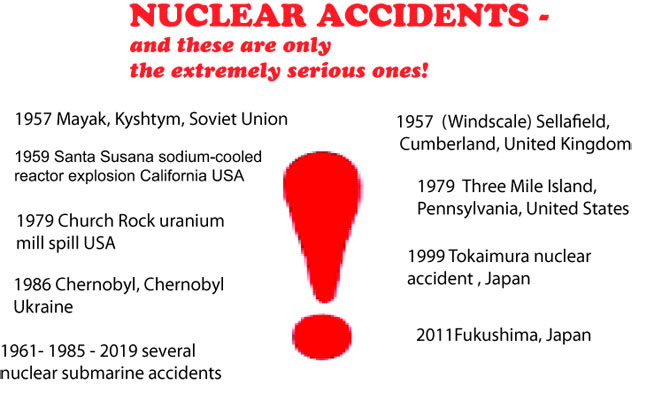
Nuclear power: the warnings from history. The PM wants to keep the lights
on with eight new atomic plants. He’s in denial if he thinks the
catastrophes of the past won’t happen again.
If Johnson is going to use nuclear history to justify his strategy, perhaps he needs to look a little
deeper, because Windscale was also the site of one of the world’s first
serious nuclear accidents. In October 1957, a fire raged for three days in
one of the reactors after changes to increase production.
Through the heroism of staff, and a significant degree of luck, the catastrophe was
contained. But significant radiation was released. Milk from cows within
200 square miles was contaminated. In 1982 officials estimated 260 people
developed cancer and 32 people died as a result. The two first reactors at
Windscale were closed, but the clean-up is still under way today.
Last November the top of the chimney in which the fire blazed was removed as
part of the demolition. The renowned nuclear historian Serhii Plokhy
describes the episode in a forthcoming book and points out: “The existing
nuclear industry is an open-ended liability.” No nuclear power station
has ever been fully decommissioned.
In Atoms and Ashes, Plokhy, 64, a
Ukrainian historian at Harvard, explores the causes and consequences of
Windscale and five other nuclear accidents: at Bikini Atoll in the Pacific
in 1954, Kyshtym in Russia in 1957, Three Mile Island in the US in 1979,
Chernobyl in Ukraine in 1986 and Fukushima in Japan in 2011.While most of
these accidents took place in the formative years of nuclear science,
Plokhy argues they could easily happen again. “Technology was improved as
a result, and every accident contributed to the shaping of subsequent
safety procedures and culture,” he writes.
“And yet nuclear accidents
occur again and again. Many of the political, economic, social, and
cultural factors that led to the accidents of the past are still with us
today, making the nuclear industry vulnerable to repeating old mistakes in
new and unexpected ways.”
Times 9th April 2022
https://www.thetimes.co.uk/article/nuclear-power-latest-warnings-history-chernobyl-ph9q7w80j
Iran MPs Set Conditions for Reviving 2015 Nuclear Deal amid Stalled Talks
VOA News, 10 Apr 22, DUBAI, UNITED ARAB EMIRATES —
Iranian lawmakers have set conditions for the revival of a 2015 nuclear pact, including legal guarantees approved by the U.S. Congress that Washington would not quit it, Iranian state media reported on Sunday.
Iran and the United States have engaged in indirect talks in Vienna over the past year to revive the 2015 nuclear agreement between Tehran and world powers which then-U.S. President Donald Trump left in 2018 and Iran subsequently violated by ramping up its nuclear program.
Negotiations have now stalled as Tehran and Washington blame each other for failing to take the necessary political decisions to settle remaining issues……………………….
The lawmakers also said that “sanctions lifted under the reinstated pact should not be reimposed, and Iran should not be hit by new sanctions.”
Iran’s Foreign Minister Hossein Amirabdollahian said on Sunday U.S. President Joe Biden should issue executive orders to lift some sanctions on Iran to show his goodwill towards reviving the nuclear pact. https://www.voanews.com/a/iran-mps-set-conditions-for-reviving-2015-nuclear-deal-amid-stalled-talks/6522843.html
Workers evacuated from area of USA’s Waste Isolation Pilot Plant nuclear waste repository after ‘abnormal event’
Workers evacuated from area of Carlsbad nuclear waste repository after ‘abnormal event’
https://www.currentargus.com/story/news/2022/04/09/abnormal-event-reported-carlsbad-nuclear-waste-repository-waste-isolation-pilot-plant/9531100002/ Adrian Hedden
Carlsbad Current-Argus An incident at the Waste Isolation Pilot Plant nuclear waste repository near Carlsbad led to the evacuation of workers Saturday night from an area of the facility where waste is prepared for disposal.
The incident was reported at about 8:20 p.m. in the waste handling building.
As a drum of waste was being processed, liquid was found at the bottom of the container which tested positive for radioactive contamination, per a news release from WIPP officials.
All personnel in the area were evacuated and tested for contamination, and operations were temporarily paused. No radioactive contamination was found on any person or in the air as of 10 p.m., per the news release.
Workers were not in the underground at the time of the incident, the release read.
No radiation was released from the site, and there was no risk to the public, read the news release.
WIPP’s Emergency Operations Center and Joint Information Center were activated at the Skeen-Whitlock building in Carlsbad to respond to the incident that occurred at the facility east of Carlsbad near the border of Eddy and Lea counties.
In the UK’s energy plan, the nation has been sold a dud
Jim Watson, director, UCL Institute for Sustainable Resources: Britain was
promised a bold and visionary energy plan. But we’ve been sold a dud.
Does it deliver what it says on the tin?
The answer is straightforward. It fails. At the heart of most definitions of energy security is reliability
of supplies for households and businesses. This is usually complemented by
a focus on affordability.
The new strategy does very little to deal with the immediate impacts of high fossil fuel prices.
While the government has announced some help for households via loans and a
council tax reduction, this is simply not enough. The energy price cap has
already risen to almost £2,000 a year and a further rise is due in the
autumn.
This comes on top of a wider cost of living crisis and high levels
of inflation.is available, but the price is too high for businesses to
function or households to keep warm. While more money to help people pay
their bills is needed, this must be accompanied by action to prevent these
acute impacts in future. This means making homes more efficient and
switching away from fossil fuels for heating. It is nearly a decade since
effective policies for home energy efficiency were cancelled and replaced
with new approaches, such as the green deal, which have failed
spectacularly.
As a result, the steady improvements in efficiency and
financial benefits to households have virtually stopped. A new programme of
home upgrades is urgently needed. This would not only reduce our dependence
on gas, but would also cut bills and carbon emissions.
According to many headlines, nuclear power is the “centrepiece” of the strategy. The
government’s plans are ambitious, but delivery will be difficult. New
nuclear plants will not have an impact for many years. The Treasury’s
fingerprints are visible in the careful caveats in the strategy, including
an insistence that new projects are “subject to a value for money and
relevant approvals”.
This reflects the long history of rising costs
within the nuclear sector, and the financial risks that consumers or
taxpayers will be exposed to.
In short, the government has pulled its
punches and avoided measures that would have a more immediate impact on
energy security – mainly by reducing the amount of energy we need to use.
Instead, it has produced a mixed bag of energy supply proposals. While some
are credible, a large nuclear power programme will require huge amounts of
political and financial capital. History suggests that this will be very
difficult to deliver.
Guardian 9th April 2022
India’s Inadvertent Missile Launch Underscores the Risk of Accidental Nuclear Warfare
Complex weapon systems are inherently prone to accidents, and this latest launch is one of a long history of military accidents in India, Scientific American By Zia Mian, M. V. Ramana on April 8, 2022
Last month, while most of the world focused on the war in Ukraine and worried that a beleaguered Russian leadership might resort to nuclear weapons, thus escalating the conflict into a direct war with the U.S.-led NATO nuclear-armed alliance, a nearly tragic accident involving India and Pakistan pointed to another path to nuclear war. The accident highlighted how complex technological systems, including those involving nuclear weapons, can generate unexpected routes to potential disaster—especially when managed by overconfident organizations.
India and Pakistan possess more than 300 nuclear weapons between them, and have fought multiple wars and faced many military crises. On March 9, two years after their dispute over Kashmir escalated into attacks by jet fighters, the Pakistan Air Force detected “a high speed flying object” inside Indian territory change course and veer suddenly toward Pakistan. It flew deep into Pakistan and crashed. The object was a BrahMos cruise missile, a weapon system developed jointly by India and Russia. India soon stated the launch was an accident.
The firing of the BrahMos missile falls within a long history of accidents involving military systems in India. Military aircraft have strayed across the borders during peacetime. India’s first nuclear submarine was reportedly “crippled” by an accident in 2018, but the government refused to divulge any details. Secrecy has prevented the investigation of an apparent failure of India’s ballistic missile defence system in 2016. Engagements between India and Pakistan can arise from such accidents, as in 1999 when a Pakistani military plane was shot down along the border by India, killing 16 people. Pakistan has had its share of accidents, including a Pakistani fighter jet crashing into the capital city in 2020.
All these weapons systems are inherently accident-prone because of two characteristics identified by organizational sociologist Charles Perrow decades ago—interactive complexity and tight coupling—that combine to make accidents a “normal” feature of the operation of some hazardous technologies. The first characteristic refers to the possibility that different parts of the system can affect each other in unexpected ways, thus producing unanticipated outcomes. The second makes it hard to stop the resulting sequence of events. For Perrow, “the dangerous accidents lie in the system, not in the components,” and are inevitable.
Perhaps the best and most troubling proof of this proposition is in the realm of nuclear weapons—which embody all the properties of high-risk technological systems. Despite decades of efforts to ensure safety, these systems have suffered many failures, accidents and close calls. During 1979–1980, for example, there were several false warnings of Soviet missile attacks, some of which resulted in U.S. nuclear forces being put on alert.
……………………………………The mistake that is of greatest concern is a false alarm of an incoming nuclear attack, possibly directed against nuclear forces. Indian or Pakistani—or Russian or NATO—policy makers may find themselves under immense pressure to launch a preemptive attack, thereby compounding the crisis. The terrible dilemma confronting them would be whether to use their nuclear weapons first or wait for the bombs from the other side to land. Nuclear war, even of a limited nature, between India and Pakistan could lead to millions of deaths in the short term and even graver consequences in the longer term for the region and beyond.
…………… As the legendary analyst of nuclear command and control Bruce Blair warned, among nuclear weapon system managers and operators there is an “illusion of safety” that masks “the systematic potential for tragedy on a monumental scale.” Whether it is India and Pakistan preparing for a fifth war, or the forces of a nuclear-armed Russia struggling ever more violently to subdue Ukraine and stem the flow of lethal NATO weapons, such illusions threaten the destruction of cities and may lead to the killing of nations. https://www.scientificamerican.com/article/indias-inadvertent-missile-launch-underscores-the-risk-of-accidental-nuclear-warfare/
In France, the nuclear waste keeps piling up: new reactors will add to the dilemma

France inches towards nuclear waste solution as more reactors planned
President Macron’s ‘French Nuclear Renaissance’ aims to provide energy independence and greener electricity for France – but the nuclear waste keeps piling up Connexion, By George Kazolias, 8 Apr 22,
Emmanuel Macron has announced plans to launch construction of six new nuclear reactors by 2050, along with studies for a possible eight further ones.
He also wants to prolong the life of existing reactors beyond 50 years in what he is calling the “French Nuclear Renaissance”.
Mr Macron’s vision to “take back control of [France’s] energy and industrial destiny” might be a winner with his electorate, but it clashes with the proposals of most of the left-wing presidential candidates, who want to reduce reliance on nuclear power.
New reactors will add to waste dilemma
Solutions for dealing with the waste already produced by existing power stations, however, are still struggling to get out of the starting blocks – and there is no plan for what would be done with waste from a potential 14 additional ones…………..At present, however, none of France’s nuclear reactor waste has been dealt with in a long-term way. All waste considered radioactive, almost two million cubic tonnes of it, is stored at surface level, in treatment centres and pools, or shallow repositories.
Some 60% of this comes from reactors and the rest is from medical, research, military and other sources.
The other waste, which includes items such as tools, clothing, mops and medical tubes, is not highly radioactive,
……… More problematic is what to do with France’s intermediate and high-level nuclear waste.
In 1998, a site near the village of Bure in the Meuse in north east France was chosen as the final storage place for most of it. It will be stored half a kilometre below ground in a vast network of tunnels and galleries known as a Deep Geological Repository (DGR).
The facility will be big enough for all the nuclear waste accumulated so far, but on-site studies, administrative procedures and opposition to the programme, including court cases and civil disobedience, have slowed its opening.
Deep underground storage could be three years away
The Bure DGR will store the waste in galleries carved out of 160-million-year-old compacted clay rocks. Known by its French acronym, Cigéo, the project currently holds 84% of the 665 hectares required to build the facility. The prefecture of the Meuse gave it a declaration of public utility (DUP) in December – a formal recognition that a proposed project has public benefits that must be obtained for most large construction and infrastructure projects before work can begin.
Once the Conseil d’Etat gives its consent, the prime minister can sign his own DUP. Andra will then have the power to get the rest of the property it needs.
In the meantime, work has continued with digging of wells and galleries to test reversible techniques of stocking waste for up to 100,000 years.
The prime minister is expected to sign off only after the presidential elections, but the final green light might be three years away as the rigorous and independent Nuclear Security Agency studies the permit request to move and store the spent nuclear fuel and other radioactive matter.
Plans are for existing not future waste
Activity at the Cigéo remains high, nevertheless. This year, a 1,700m² building, called The Eclipse, is being built to house companies working on underground trials.
A 100m-long cavity will also be dug to test technologies and conduct experiments. This is the length each cavity will have to be for intermediate-level waste, which is often solidified into concrete.
The nuclear authority is hoping to start storing this type of waste in 2025.
It is impossible to bury the high-level radioactive waste. This is turned into a glass-like substance, but then requires a cooling period of at least 50 years.
The clay storage facilities cannot handle temperatures above 90C.
Senator Sido said: “It is true that the most recent batches cannot be stocked in their present state. They are too hot and need a cooling-off period of several decades. But the first batches can be stocked now.”
The remaining high-level waste might not arrive before 2060. By then, France will have produced at least as much nuclear waste again. For that, it might have to create a new underground facility.
“As far as I know, there is no project in the pipeline for high-level and long-lived waste which will be produced in the future,” Mr Sido said. https://www.connexionfrance.com/article/Practical/Environment/France-inches-towards-nuclear-waste-solution-as-more-reactors-planned
1 This Month



19 November – Webinar – The Reality of Reprocessing
Time: 11:00 AM Pacific Time (US & Canada) / 2:00 PM Eastern / 7:00 PM UK / 8:00 PM CET
Register for the Zoom Event Here



Shut down the radiation-damaged Heysham nuclear reactors now
To see nuclear-related stories in greater depth and intensity – go to https://nuclearinformation.wordpress.com

Say No to NASA’s Reckless Nuclear Reactor on the Moon
Say No to NASA’s Reckless Nuclear Reactor on the Moon
-
Archives
- November 2026 (74)
- October 2026 (302)
- September 2026 (339)
- August 2026 (330)
- July 2026 (355)
- June 2026 (287)
- May 2026 (306)
- April 2026 (356)
- March 2026 (251)
- February 2026 (267)
- January 2026 (308)
- December 2025 (358)
-
Categories
- 1
- 1 NUCLEAR ISSUES
- business and costs
- climate change
- culture and arts
- ENERGY
- environment
- health
- history
- indigenous issues
- Legal
- marketing of nuclear
- media
- opposition to nuclear
- PERSONAL STORIES
- politics
- politics international
- Religion and ethics
- safety
- secrets,lies and civil liberties
- spinbuster
- technology
- Uranium
- wastes
- weapons and war
- Women
- 2 WORLD
- ACTION
- AFRICA
- Atrocities
- AUSTRALIA
- Christina's notes
- Christina's themes
- culture and arts
- Events
- Fuk 2022
- Fuk 2023
- Fukushima 2017
- Fukushima 2018
- fukushima 2019
- Fukushima 2020
- Fukushima 2021
- general
- global warming
- Humour (God we need it)
- Nuclear
- RARE EARTHS
- Reference
- resources – print
- Resources -audiovicual
- Weekly Newsletter
- World
- World Nuclear
- YouTube
-
RSS
Entries RSS
Comments RSS

