Safety concerns about NuScam’s much touted ”small nuclear reactor”
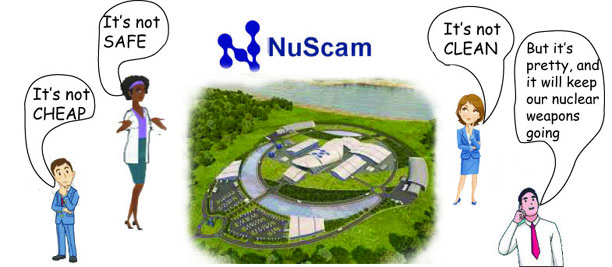
U.S. nuclear power agency seeks staff documentation of NuScale’s quake protection, By Timothy Gardner, WASHINGTON, April 27 (Reuters) – An official with the U.S. nuclear power regulator has ordered staff to supply documents that could lead to a review of a 2020 approval of a new type of nuclear power reactor after an engineer raised concerns about its ability to withstand earthquakes, documents showed on Wednesday. Reporting by Timothy Gardner; Editing by Chris Reese, Kenneth Maxwell and Lisa Shumaker .
Dan Dorman, the executive director for operations at the Nuclear Regulatory Commission (NRC), reviewed a complaint by John Ma, an engineer at the agency, about its approval of the design of NuScale’s nuclear power plant.
NuScale, majority owned by construction and engineering company Fluor Corp (FLR.N), which got approval for the design of a 50-megwatt small modular reactor (SMR), is hoping to build the Carbon Free Power Project with multiple reactors at the Idaho National Laboratory, with the first coming online in 2029 and full plant operation in 2030.
Some see SMRs such as NuScale’s as a way to cut emissions from fossil fuels and to potentially reduce Europe’s dependency on Russian oil and gas. NuScale also wants to build the plants in Poland and Kazakhstan.
In an internal document Ma wrote to NRC officials soon after the 2020 approval, he alleged the design of the building intended to enclose the reactor units and its spent fuel pool did not provide assurance it could withstand the largest earthquake considered without collapsing and may be vulnerable to smaller earthquakes.
“Collapse of the reactor building … could potentially cause an early and large release of radioactive materials into the atmosphere and ground, which could kill people,” Ma wrote.
In February, Dorman wrote to Ma that he concluded the NRC’s basis for accepting NuScale’s measure of strength for the reactor’s building design “was not sufficiently documented,” documents posted on the NRC website on Wednesday showed.
Dorman ordered the agency’s Office of Nuclear Reactor Regulation to document its evaluation of NuScale’s “stress averaging approach” and, if necessary, to update the application and evaluate whether there are “any impacts” to the 2020 design approval.
It was uncertain whether the additional actions would affect the project’s timeline which has been delayed several times………….
A science advocacy group said the concerns Ma raised were troubling.
“NuScale’s business case is based on its assertion that it is a safer nuclear reactor. Now it’s time to prove it by addressing these safety concerns,” said Edwin Lyman, director of nuclear power safety at the Union of Concerned Scientists. https://www.reuters.com/world/us/us-nuclear-power-regulator-seeks-documents-nuscales-protection-against-quakes-2022-04-27/
Is France really the poster boy for nuclear power? Nearly half of its reactors are shut down for maintenance and safety reasons

Nearly half of France’s nuclear reactors taken offline, adding to
electricity demand on European grid. France’s problems have raised
questions about the UK’s big bets on nuclear, which the government calls a
“necessity, not a luxury”.
Currently 27 of France’s 56 reactors have been
shut down due to routine maintenance or defects, forcing EDF to buy
electricity from the European grid instead, at a time of soaring demand
amid the gas crisis. France’s problems have raised questions from critics
about the reliability of nuclear, and about Britain’s recent big bets on
the energy source.
Sky News 29th April 2022
Photovoltaics vs. nuclear power on Mars

Photovoltaics vs. nuclear power on Mars https://www.pv-magazine-australia.com/2022/04/29/photovoltaics-vs-nuclear-power-on-mars/
Solar might be more efficient than nuclear energy to supply power for a six-person extended mission to Mars that will involve a 480-day stay on the planet’s surface before returning to Earth, according to new US research.
APRIL 29, 2022 EMILIANO BELLINI Researchers at the University of California, Berkeley, have compared how PV or nuclear energy could power a crewed outpost for an extended period on Mars and have determined that solar offers the best performance.
“Photovoltaic energy generation coupled to certain energy storage configurations in molecular hydrogen outperforms nuclear fusion reactors over 50% of the planet’s surface, mainly within those regions around the equatorial band, which is in fairly sharp contrast to what has been proposed over and over again in the literature, which is that it will be nuclear power,” said UC Berkeley researcher Aaron Berliner, noting that two energy sources were compared for the power supply of a six-person extended mission to Mars involving a 480-day stay on the planet’s surface before returning to Earth.
The US team considered four different scenarios: nuclear power generation with the miniaturised nuclear fission Kilopower system, PV power generation with battery energy storage, PV power generation with compressed hydrogen energy storage produced via electrolysis, and hydrogen generation with compressed hydrogen energy storage (PEC).
In our calculations, we assumed a capacity factor of 75% to account for the solar flux deviation throughout the Martian year and sized energy storage systems to enable 1 full day of operations from reserve power,” the group explained. “We then calculated the carry-along mass requirements for each of the power generation systems considered.”
The scientists found that, of the three PV-based power generation options, only the photovoltaics-plus-electrolyser system outcompetes the nuclear system based on carry-along mass. They also said that the optimal absorber bandgaps for the PV systems depend heavily on the location on the surface of Mars, the total depth of the air column above a given location, gradients in dust and ice concentrations, and orbital geometry effects that cause different effective air column thicknesses for locations near the poles.
For the first time, U.S. renewable energy output exceeds nuclear generation, EIA finds

Utility Dive, By Elizabeth McCarthy. 28 Apr 22,
Dive Brief:
- The growing number of large solar and wind energy projects resulted in renewable generation beating out nuclear energy last year, the U.S. Energy Information Administration said on Tuesday.
- The nation has seen a steady rise in renewable generation, with the biggest share from solar, which is expected to continue because of the lower cost and greater safety of this intermittent power resource, clean energy advocates say. That is despite the Biden administration’s multi-billion dollar program to keep online baseload nuclear power plants scheduled to retire.
- Natural gas supplies the biggest share of electricity in the county but its share is also expected to decrease over the next three decades. EIA projects solar will replace it as the dominant source of generation in the U.S. by 2050.
- Dive Insight:Utility-scale renewable generation in the U.S. reached 795 million MWh in 2021, compared to 778 million MWh of nuclear generation.“This is a ‘good news’ story,” said Ralph Cavanagh, Natural Resources Defense Council energy program co-director.
- The news gets better for renewables when considering that private investments in clean technology rose to over $27 billion in 2021, up from about $20 billion in 2020, according to a report by the American Investment Council released last week. Private equity companies over the last decade have invested close to $150 billion and backed more than 1,000 clean technology companies in the U.S., it added.
- The biggest mover on the U.S. generation front has been solar as installation costs have dropped 70% over the last decade. That has led “the industry to expand into new markets and deploy thousands of systems nationwide,” according to a Feb. 11 joint statement by the Edison Electric Institute, NRDC and the Solar Energy Industries Association. Supply chain issues pushed up prices last year “but did not eliminate solar power’s competitive advantages in retail and wholesale markets,” the organizations wrote in their joint statement to the National Association of Regulatory Utility Commissioners. EIA’s April 26 analysis does not include rooftop solar or other smaller renewables serving predominantly onsite demand. Factoring in just “end-use solar, the milestone for surpassing nuclear generation would have been reached earlier,” said Syne Salem, an EIA engineer. The tally also excludes small-scale wind and some industrial and commercial combined-heat-and-power systems.
- U.S. nuclear electricity generation fell to its lowest level in a decade, EIA reported, with the retirement of one reactor in 2021, New York’s Indian Point 1040 MW Unit 3. Nuclear generation made up 19% of the electric generation last year and it’s expected to fall to 12% by 2050, EIA concluded.Since 2013, a dozen nuclear units have retired in the U.S. and the decline is projected to continue despite the Department of Energy’s$6 billion program to help extend their operating life.. The owners of three plants that could tap into those DOE funds, Entergy and Pacific Gas & Electric, are continuing to decommission them. The only new nuclear plant being built is the 2,228 MW Vogtle project in Georgia that has seen big cost overruns and delays……………………….. https://www.utilitydive.com/news/for-the-first-time-us-renewable-energy-output-exceeds-nuclear-generation/622899/
Poor outlook for Joe Biden’s $6 billion effort to keep old nuclear reactors going

Biden’s $6B nuclear plan hits ’24th hour’ roadblock
By Peter Behr, Hannah Northey | 04/28/2022 The Biden administration’s $6 billion effort to keep struggling nuclear plants operating is facing a barrier in Michigan and California.
A top energy executive yesterday confirmed that one of the first plants poised to qualify for financial support under the Energy Department’s newly unveiled lifeline — Michigan’s Palisades plant — remains on schedule to close May 31, throwing the Midwestern state’s climate goals into question.
Leo Denault, CEO of Entergy Corp., owner of the Palisades plant, told security analysts yesterday that a buyer who succeeded in acquiring the generator would also bear refueling costs and other expenses.
“We will work with any qualified party,” he said. But he added, “I do want to be very clear. Entergy is exiting the merchant nuclear business. The plant will have to stop operating in May. We’ll be out of fuel.”………………….
Pacific Gas and Electric Co., the Diablo Canyon owner, has also said the DOE offer does not change its intention to close the California facility. Diablo Canyon’s reactors 1 and 2 have planned closing dates of November 2024 and August 2025, respectively……….
A spokesperson for DOE said yesterday they were unable to speak about the unique challenges and closure decisions facing various nuclear plants, nor could they provide a precise number of struggling plants potentially eligible for financial assistance…………………………… https://www.eenews.net/articles/bidens-6b-nuclear-plan-hits-24th-hour-roadblock/
Huge solar storm once almost triggered nuclear war between USA and Russia
 | |||
ED BROWNE , NewsWeek 29 Apr 22, ON 4/29/22 In May 1967, a solar storm brought the world to the brink of what could have been a nuclear war. With the sun now entering a period of increased activity as part of its 11-year solar cycle, experts have discussed whether or not we should be wary of a second such incident.
The world was in the grips of the Cold War in 1967 when the sun belched out one of the largest solar storms ever observed at the time, releasing a colossal radio burst that interfered with communication services here on Earth……………………… https://www.newsweek.com/sun-nuclear-cold-war-1967-repeated-possible-solar-flare-1702239
Japan prepares to dump water ignoring nuclear safety fears
China Daily April, 2022 The Tokyo Electric Power Company has begun construction work to prepare for the discharge of contaminated water from the crippled Fukushima nuclear plant into the Pacific Ocean next spring, Japanese media reports say.
The Japanese government and TEPCO are advancing this plan made by the Japanese government on April 13 last year, in spite of strong opposition at home and abroad.
Given that the water was used to cool the fused reactors at the nuclear plant after the Fukushima region was devastated by a tsunami in March 2011, and contains radioactive material, its potential to cause harm to the marine ecological environment, food safety and human health cannot be underestimated……………………
Japan should earnestly respond to the legitimate concerns of the international community, and reverse its decision to discharge the contaminated water into the ocean, thus fulfilling its international obligations. http://global.chinadaily.com.cn/a/202204/29/WS626b2624a310fd2b29e5a056.html
Russia Just Tested the World’s Largest Nuclear-Tipped Missile
Putin claims the weapon can hit any target on Earth, but there’s less than meets the eye.
BY KYLE MIZOKAMI, APR 29, 2022 Russia has tested the world’s largest and heaviest nuclear missile, the RS-28 Sarmat intercontinental ballistic missile (ICBM). The missile, which lifted off from northern Russia last week, weighs 458,000 pounds, or as much as 11 F-22A Raptor fighters.
Sarmat can deliver up to ten thermonuclear warheads and has the range to strike anywhere on Earth. But as powerful as it is, the missile has distinct trade-offs that could make it less impressive than it sounds……………https://www.popularmechanics.com/military/weapons/a39827639/russia-sarmat-nuclear-tipped-missile/
Russia’s Antiquated Nuclear Warning System Jeopardizes Us All
As the war in Ukraine’s pits Russia against the West, it’s time to look at Moscow’s weak satellite systems, which raise the chances of nuclear conflict. by David K. Shipler
Since Russian President Vladimir Putin announced a heightened nuclear alert level, much of the world has worried that he might go nuclear in his war against Ukraine. But there is another concern: a false alarm from Russian early-warning systems, which experts believe are dangerously vulnerable to errors.
The risk of a catastrophic mistake has been a threat since the outset of the nuclear age, but miscalculation becomes more likely in a period of heightened Russian-American tension. Leaders would have only minutes to make fateful decisions, so each side needs to be able to “see” clearly whether the other has launched missiles before retaliating. Ambiguity in a moment of “crisis perception,” the Rand Corporation has noted, can spark “conflict when one nation misinterprets an event (such as a training exercise, a weather phenomenon, or a malfunction) as an indicator of a nuclear attack.”
Russia and the United States are the most heavily armed of the nine nuclear powers, which include China, France, the United Kingdom, North Korea, Pakistan, India, and Israel. (Iran is poised to join the club.) But only the U.S. has comprehensive surveillance of the globe, provided by three active geosynchronous satellites, with two in reserve, whose infrared receptors can spot missile plumes. That data is supplemented by radar, which gives the U.S. the capacity to double-check that a launch has actually occurred.
Specialists call this verification by both satellite and radar “dual phenomenology.” The Russians don’t have it, at least not reliably. They lack adequate space-based monitoring to supplement their radar.
What they have is a “terrible and dangerous technology shortfall,” according to Theodore Postol, a professor of science, technology, and national security policy at MIT and a former scientific adviser to the chief of naval operations……………………… https://washingtonmonthly.com/2022/04/29/russias-antiquated-nuclear-warning-system-jeopardizes-us-all/
U.S. sees no threat of Russia using nuclear weapons despite rhetoric- official
WASHINGTON, April 29 (Reuters) – The United States does not believe that there is a threat of Russia using nuclear weapons despite a recent escalation in Moscow’s rhetoric, a senior U.S. defense official said on Friday.,,,,,
Reporting by Idrees Ali and Phil Stewart Editing by Frances Kerry We continue to monitor their nuclear capabilities every day the best we can and we do not assess that there is a threat of the use of nuclear weapons and no threat to NATO territory,” the official, speaking on the condition of anonymity, told reporters.
Russian Foreign Minister Sergei Lavrov said on Monday the West should not underestimate the elevated risks of nuclear conflict over Ukraine. read more
Russia said earlier this month that it plans to deploy its newly tested Sarmat intercontinental ballistic missiles, capable of mounting nuclear strikes against the United States, ………………. https://www.reuters.com/world/us-sees-no-threat-russia-using-nuclear-weapons-despite-rhetoric-official-2022-04-29/
Pakistan, India reel under intense heat wave
Market Screener, By Jibran Ahmad and Sumit Khanna, 29 Apr 22,
PESHAWAR, Pakistan/AHMEDABAD,India (Reuters) -Pakistan issued a heat warning after the hottest March in 61 years while in parts of neighbouring India schools were shut and streets deserted as an intense heave wave on Friday showed no signs of abating.
Pakistan’s Federal Minister for Climate Change, Sherry Rehman, urged the federal and provincial governments to take precautionary measures to manage the intense heat wave, which touched highs of 47 degrees Celsius (116.6 Fahrenheit) in parts of the country.
“South Asia, particularly India and Pakistan are faced with what has been a record-breaking heatwave. It started in early April and continues to leave the people gasping in whatever shade they find,” Rehman said in a statement.
Temperatures were predicted to rise by 6 to 8 degrees Celsius above average temperatures after the hottest March on record since 1961, she said.
More than a billion people are at risk of heat-related impacts in the region, scientists have warned, linking the early onset of an intense summer to climate change. For the first time in decades, Pakistan had gone from winter to summer without the spring season, Rehman said.
The government has also told provincial disaster management authorities to prepare urgently for the risk of flash-flooding in northern mountainous provinces due to rapid glacial melting, Rehman said.
Glaciers in the Himalaya, Hindu Kush and Karkoram mountain ranges have melted rapidly, creating thousand of glacial lakes in northern Pakistan, around 30 of which were at risk of sudden hazardous flooding, the climate change ministry said, adding around 7 million people were vulnerable.
A senior scientist at the India Meteorological Department said https://twitter.com/ANI/status/1519938880824176641?s=20&t=NgygE8RS-D4wfM-OJxp9Ew on Friday heat conditions would persist for at least the next three days, but that temperatures would fall after the arrival of monsoons, expected in some parts by May.
The health problems triggered by the heatwave were posing a bigger worry than the expected fourth wave of COVID-19, doctors in India said.
“We are getting many patients who have suffered heatstroke or other heat-related problems,” said Mona Desai, former president of Ahmedabad Medical Association in the western Indian state of Gujarat.
She said that 60-70% of the patients were school-aged complaining of vomiting, diarrhoea, abdominal colic, weakness and other symptoms.
Roads were deserted in Bhubaneshwar, in India’s eastern state of Odisha, where schools have been shut, while neighbouring West Bengal advanced the school summer break by a few days.
Delhi sweltering under extreme heat, electricity shortage
| India is facing the worst electricity shortage in more than six years as Delhi saw its hottest April in 12 years on Thursday at a maximum of 43.5C. The temperatures in the national capital are predicted to linger around 44C with peak summer heat still to come before the cool monsoon rains in June. The extreme heat parching across large swathes of south Asia this week has also prompted health officials in the western state of Gujarat to take measures, as they braced for a potential spike in patients. Meanwhile, the leap in power demand has left India scrambling for coal, with inventories running lowest pre-summer levels in at least nine years. Several states including Rajasthan and Haryana in the north and Andhra Pradesh in the south observed the worst power cuts in over six years as the government struggled to manage surging power demands. Independent 29th April 2022 https://www.independent.co.uk/climate-change/news/india-heatwave-2022-delhi-latest-b2068112.html |
Climate change ‘already’ raising risk of virus spread between mammals
Mammals forced to move to cooler climes amid global warming are
“already” spreading their viruses further – with “undoubtable”
impacts for human health, a new study says. The research, published in
Nature, uses modelling to map how climate change could shift the geographic
ranges of 3,100 mammals species and the viruses they carry by 2070.
It finds that climate change is increasingly driving new encounters between
mammal species, raising the risk of novel disease spread. The world’s
“biodiversity hotspots” and densely populated parts of Asia and Africa
are most likely to be affected. The findings suggest that climate change
could “easily become the dominant [human] driver” of cross-species
virus transmission by 2070, the authors say.
Carbon Brief 28th April 2022
International Atomic Energy Agency very concerned at dangers at Ukraine’s Zaporizhzhia nuclear complex.

Atomic agency: Danger signs at ‘occupied’ nuclear site in Ukraine
Rafael Grossi tells AP the Zaporizhzhia facility requires repairs and the current situation there is ‘not sustainable’. Aljazeera,
The International Atomic Energy Agency’s (IAEA) director-general says the level of safety at Europe’s largest nuclear plant, which is currently under Russian military occupation in Ukraine, is like a “red light blinking” as his organisation tries in vain to gain access to the site.
Rafael Grossi said that the IAEA needs access to the Zaporizhzhia nuclear power plant in southern Ukraine so its inspectors can, among other things, reestablish the site’s connections with the Vienna-based headquarters of the UN agency.
Ukraine’s 15 nuclear reactors gives it one of the largest nuclear power capacities in the world, and Russia’s invasion has essentially turned parts of country into a nuclear minefield.
Again and again since the invasion, nuclear experts have watched in alarm as Russian forces have come uncomfortably close to multiple nuclear plants in Ukraine.
Grossi said the Zaporizhzhia plant requires repairs.
“There are two units that are active, in active operation … others that are in repairs or in cool down. And there are some activities, technical activities and also inspection activities that need to be performed,” Grossi said.
“So the situation as I have described it, and I would repeat it today, is not sustainable as it is,” he said.
“So this is a pending issue. This is a red light blinking.”…………
The IAEA chief said he is continuing to press Russia’s government for access to the Zaporizhzhia plant………
“There cannot be any military action in or around a nuclear power plant,” Grossi said, adding that he has appealed to Russia about this.
“This is unprecedented to have a war unfolding amidst one of the world’s largest nuclear infrastructures, which, of course, makes for a number of fragile or weak points that could be, of course, exploited wittingly or unwittingly,” he added.
“So this requires a lot of activity on our side and cooperation. Cooperation from the Russian side. Understanding from the Ukrainian side so that we can avoid an accident.”…………..
Russia’s invasion of Ukraine, along with US and European support for Ukraine in the conflict, have increased tensions between Russia and the West, but it’s “imperative for us to look for common denominators in spite of these difficulties”, Grossi said.
“We cannot afford to stop. We have to continue. It’s in the world’s interest,” he said of global nuclear safety. https://www.aljazeera.com/news/2022/4/27/un-nuke-chief-wants-ukraine-zaporizhzhia-plant
Despite deteriorating situation, Ukrainian parliament still insisting on NATO accession
RT, https://www.sott.net/article/467169-Despite-deteriorating-situation-Ukrainian-parliament-still-insisting-on-NATO-accession Tue, 26 Apr 2022 The Rada’s chair says accession to the military alliance is Ukraine’s “prospective vision of its future”
The Ukrainian parliament will not vote to remove the passage about the country’s ambition to join NATO from the constitution, the Rada’s chairman, Ruslan Stefanchuk, has revealed.
n an interview with Ukrainian media outlet Ukrainska Pravda published on Monday, Stefanchuk was asked whether Ukrainian lawmakers were going to amend the country’s constitution with respect to Kiev’s ambition to become a NATO member state. The official replied in the negative, adding that “changing the constitution is not an end in itself.” He went on to say that just because some changes are made does not necessarily mean that they have an effect in real life. Stefanchuk warned against “declaratory norms.
The official emphasized that at this point the Ukrainian authorities’ main focus is on ensuring the security of each and every Ukrainian citizen. “Real guarantees are important to us,” Stefanchuk noted.
“For me as a representative of the political leadership of the state precisely this is a priority, so that people no longer die and pay with their lives for the European dream, for the dream of security and the rest,” the Rada’s chairman said.
However, Kiev would not settle for just any kind of guarantees, according to Stefanchuk, who cited the 1994 Budapest Memorandum as an example of empty promises that have failed to materialize. He called for a well-defined agreement which would be able to put Ukraine at ease.
Going back to “what is written in our constitution regarding NATO and the EU,” Stefanchuk described accession to the two organizations as Ukraine’s “prospective vision of its future.”
On March 29, during the last in-person meeting between the Ukrainian and Russian negotiators in Istanbul, Kiev proposed penning an international agreement on security guarantees for Ukraine.
Ten days prior, Stefanchuk indicated that he did not rule out removing the passage on NATO membership from Ukraine’s constitution, depending on “what path the negotiators will take.” The official added that the Rada could start looking for a “model that will either not contradict the constitution or we will change the constitution in this respect.”
The amendment in question, which was added to the Ukrainian constitution back in February 2019, obliges the country’s government to stick to the goal of NATO membership, with the president being the senior guarantor.
Russia attacked the neighboring state in late February, following Ukraine’s failure to implement the terms of the Minsk agreements, first signed in 2014, and Moscow’s eventual recognition of the Donbass republics of Donetsk and Lugansk. The German and French brokered protocols were designed to give the breakaway regions special status within the Ukrainian state. The Kremlin has since demanded that Ukraine officially declare itself a neutral country that will never join the US-led NATO military bloc. Kiev insists the Russian offensive was completely unprovoked and has denied claims it was planning to retake the two republics by force. AT TOP https://www.sott.net/article/467169-Despite-deteriorating-situation-Ukrainian-parliament-still-insisting-on-NATO-accession
1 This Month



19 November – Webinar – The Reality of Reprocessing
Time: 11:00 AM Pacific Time (US & Canada) / 2:00 PM Eastern / 7:00 PM UK / 8:00 PM CET
Register for the Zoom Event Here



Shut down the radiation-damaged Heysham nuclear reactors now
To see nuclear-related stories in greater depth and intensity – go to https://nuclearinformation.wordpress.com

Say No to NASA’s Reckless Nuclear Reactor on the Moon
Say No to NASA’s Reckless Nuclear Reactor on the Moon
-
Archives
- November 2026 (74)
- October 2026 (302)
- September 2026 (339)
- August 2026 (330)
- July 2026 (355)
- June 2026 (287)
- May 2026 (306)
- April 2026 (356)
- March 2026 (251)
- February 2026 (267)
- January 2026 (308)
- December 2025 (358)
-
Categories
- 1
- 1 NUCLEAR ISSUES
- business and costs
- climate change
- culture and arts
- ENERGY
- environment
- health
- history
- indigenous issues
- Legal
- marketing of nuclear
- media
- opposition to nuclear
- PERSONAL STORIES
- politics
- politics international
- Religion and ethics
- safety
- secrets,lies and civil liberties
- spinbuster
- technology
- Uranium
- wastes
- weapons and war
- Women
- 2 WORLD
- ACTION
- AFRICA
- Atrocities
- AUSTRALIA
- Christina's notes
- Christina's themes
- culture and arts
- Events
- Fuk 2022
- Fuk 2023
- Fukushima 2017
- Fukushima 2018
- fukushima 2019
- Fukushima 2020
- Fukushima 2021
- general
- global warming
- Humour (God we need it)
- Nuclear
- RARE EARTHS
- Reference
- resources – print
- Resources -audiovicual
- Weekly Newsletter
- World
- World Nuclear
- YouTube
-
RSS
Entries RSS
Comments RSS

