Stop Sizewell C group questions UK government’s reasons for designating the project under the Regulated Asset Base model – and its secrecy about the plan.
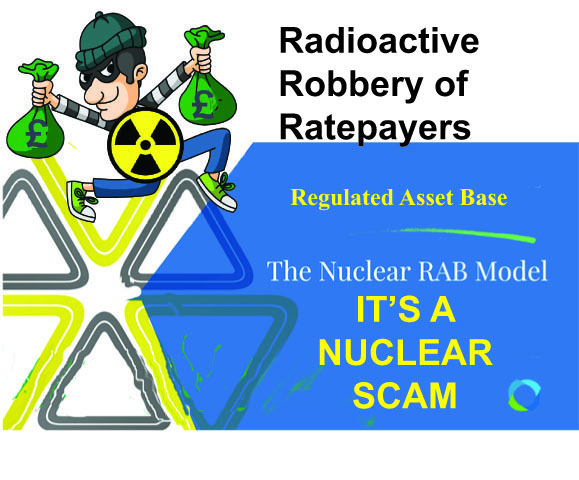
The Secretary of State is intending to designate a company which no one knows who the owners will be. EDF and the government – both apparently intending to be minority partners in Sizewell C with 20% stakes – are continuing to negotiate with each other behind closed doors.
| BEIS has today published draft reasons for designating NNB Generation Co (Sizewell C Co) as the first step towards the company being able to use a RAB funding model. All financial figures have been redacted. The BEIS press statement says “by publishing the draft reasons for designating Sizewell C under the RAB model, the government is going beyond the transparency requirements set out in legislation.” Stop Sizewell C said: “It’s outrageous that ministers are hiding the cost to electricity bill payers and the public purse of Sizewell C, while claiming to be transparent. By redacting the finances, it is impossible to know if the Secretary of State’s judgement on Value for Money is sound. We fail to understand why the government would not impose conditions related to the EPR reactor technology, when it has such a catastrophic track record, and one of the only working examples has been offline for almost a year in China” Additionally we note the following: The Secretary of State is intending to designate a company which no one knows who the owners will be. EDF and the government – both apparently intending to be minority partners in Sizewell C with 20% stakes – are continuing to negotiate with each other behind closed doors. The government intends to take a special share in Sizewell C, as a means of “protecting national security interests”, yet there is no mention of removing China General Nuclear from the project. The Value for Money assessment acknowledges that the (secret) figures provided by NNB require “uplift” (page 22 “ Given that largescale infrastructure projects have a tendency to cost more and take longer to build than expected, the analysis has applied appropriate uplifts to these assumptions”), and conclude that “the estimated return on government investment is positive in the majority of scenarios modelled” (page 22). With no indication of the size of that majority, or the various cost burdens, it is therefore clear that the return was negative in at least some scenarios. The only cost for Sizewell C in the public domain is the original estimate of £20 billion, published over two years ago. Since then there have been major changes to the project and huge price hikes in construction materials. Despite references to lessons learned at other EPR projects, there are no specific conditions linked to design adaptations that will be required for Hinkley Point C and Sizewell C’s reactors basedon the experience of Taishan 1, where problems have led to the reactor being offline for almost a year. (EDF reports, p116 “In addition [to fuel failure], a phenomenon occurring between the assemblies and a component enclosing the core has been identified, which would be linked to hydraulic stresses” and the French regulator, ASN, refers to (p14) “various anomalies observed on the cores of the EPR reactors of Taishan“. Such adaptations could have a serious impact on both cost and timescales. A government condition was attached to an (unused) offer of loan guarantees for Hinkley Point C, that the Flamanville EPR should be operating by December 2020. It is not expected to be operating until mid 2023 at the earliest. Finland’s Olkiluoto EPR is still testing at reduced capacity. Stop Sizewell C 14th June 2022 https://stopsizewellc.org/designation/ |
Hinkley Point C nuclear supply engineers go on strike
| Plating engineers creating products to supply to the Hinkley Point C nuclear power station go on strike today [13 June] in a pay dispute. Dozens of workers at Darchem Engineering, in Stockton-Upon-Tees, will walk out today after welders working for same firm were given an additional pay supplement, while the engineers weren’t. Further strikes are planned for 20,21,28 and 29 June. Industrial action could lead to big delays at Hinkley Point C – the £25 billion nuclear reactor in Somerset. GMB 14th June 2022 https://www.gmb.org.uk/news/hinkley-point-supply-engineers-strike |
UK government’s new financing plan for %20 tax-payer funded Sizewell C nuclear project will increase costs and delays, – is aimed to cut China out.

The government has bought an option to take a 20% stake in the Sizewell C nuclear power plant in a move that could ease China’s state nuclear company out of the project. Ministers took a £100m option to invest in Sizewell C’s holding company in January and said on Tuesday it would convert that into equity if the project reaches a final investment decision.
The venture on the Suffolk coast is jointly owned by EDF and China General Nuclear Power. The government is understood to be keen toremove CGN from the project amid concerns over China’s involvement in critical UK infrastructure. The business secretary, Kwasi Kwarteng, set out the taxpayer-funded financing model for Sizewell C and future projects on Tuesday.
The strategy the government plans to use – a regulated asset
base model – involves taxpayers taking on risk alongside private investors. The government is
attempting to inject urgency into a notoriously slow-moving industry amid a
drive to boost Britain’s domestic energy supplies.
In April Boris Johnson set out plans to approve up to eight reactors by the end of the decade. A
decision on whether to grant Sizewell C planning consent was last month delayed until 8 July. Research by the University of Greenwich Business School seen by the Guardian last month showed the project could cost UK taxpayers more than double government estimates and take five years longer to build.
Guardian 14th June 2022
Two European Parliamentary committees oppose inclusion of nuclear power and gas as environmentally sustainable
MEPs from the two responsible committees on Tuesday opposed the inclusion
of gas and nuclear power on the list of environmentally sustainable
economic activities. On Tuesday, at a joint meeting of the Committee on
Economic and Monetary Affairs and the Committee on the Environment, Health
and Food Safety, MEPs adopted by 76 votes for, 62 against and 4 abstentions
an objection the Commission’s proposal to include specific nuclear and gas
activities in the list of environmentally sustainable economic activities
covered by the EU taxonomy.
European Parliament 14th June 2022
The US-led bloc is unwilling to fight Russia directly and treats Ukraine as a proxy, Dutch PM admits.

NATO pledges more heavy weapons for Ukraine
The US-led bloc is unwilling to fight Russia directly and treats Kiev as a proxy, Dutch PM admits. Rt.com 15 June 22, Ukraine must get more NATO heavy weapons, the military bloc’s head said on Tuesday, ahead of a meeting of a US-led ‘contact group’ set up to discuss the plan’s logistics. NATO is trying to adapt to the “constantly changing” demands from Kiev, according to the American envoy to the bloc.
“Ukraine should have more heavy weapons and NATO allies and partners have provided heavy weapons … and they are also stepping up,” its Secretary General Jens Stoltenberg said on Tuesday in The Hague, where he met with leaders of seven member states ahead of the NATO summit scheduled for the end of June……….
Meanwhile, US Permanent Representative to NATO Julianne Smith was reported as saying that NATO states are trying to adapt to Kiev’s demands for additional weapons, which are constantly changing.
According to the Pentagon, initial efforts to supply Ukraine focused on portable anti-tank and anti-aircraft missiles, but are now shifting to tanks and heavy artillery due to the nature of the current fighting in Donbass.
Mikhail Podolyak, adviser to Ukrainian President Volodymyr Zelensky, has said that Kiev urgently needs 1,000 howitzers, 300 multiple-launch rocket systems, 500 tanks, 2,000 armored vehicles, and 1,000 drones.
While the US has pledged only four HIMARS rocket launchers, the Pentagon’s policy chief, Colin Kahl, on Tuesday revealed that they would be supplied with heavy guided missiles, with a range of 70 kilometers. ……..
Russia attacked the neighboring state in late February, following Ukraine’s failure to implement the terms of the Minsk agreements, first signed in 2014, and Moscow’s eventual recognition of the Donbass republics of Donetsk and Lugansk. The German- and French-brokered Minsk Protocol was designed to give the breakaway regions special status within the Ukrainian state.
The Kremlin has since demanded that Ukraine officially declare itself a neutral country that will never join the US-led NATO military bloc. Kiev insists the Russian offensive was completely unprovoked and has denied claims it was planning to retake the two republics by force. https://www.rt.com/news/557173-ukraine-heavy-weapons-nato/
Japan gov’t to skip 1st U.N. nuclear ban meeting next week
KYODO NEWS 15 June 22, – Japan will not join the first meeting of parties to a U.N. treaty banning nuclear weapons to be held in Vienna next week, Prime Minister Fumio Kishida said Wednesday, despite high expectations for its attendance as the only nation that has suffered atomic bombings.
Japan, which has not signed the Treaty on the Prohibition of Nuclear Weapons, did not complete the procedures for taking part in the three-day meeting, including as an observer, by the Tuesday deadline.
Survivors of the U.S. atomic bombings of Hiroshima and Nagasaki in August 1945, as well as member nations of the U.N. treaty, had hoped that the Japanese government would participate in the gathering that kicks off next Tuesday………………. https://english.kyodonews.net/news/2022/06/740ac3501176-japan-govt-to-skip-1st-un-nuclear-ban-meeting-next-week.html
UK government’s outrageous secrecy on the costs to consumers of the Regulated Asset Base model for funding new nuclear reactors – Stop Sizewell C Group.

The new Sizewell C nuclear power station could receive funding through a
new Government scheme that enables companies to charge consumers to cover
construction costs. Business and Energy Secretary Kwasi Kwarteng has
announced that the £20billion twin reactor will be considered to receive
finance through the Regulated Assets Base (RAB) model……………
However, Alison Downes, of campaign group
Stop Sizewell C, which is opposed to the plans, said: “It’s outrageous that
ministers are hiding the cost to electricity bill payers and the public
purse of Sizewell C, while claiming to be transparent. “By redacting the
finances, it is impossible to know if the secretary of state’s judgement on
value for money is sound.
East Anglian Daily Times 14th June 2022
Fear the fallout of UK government’s unwise Regulated Asset Base funding for new nuclear reactors
As if consumer energy bills aren’t high enough already. The government
seems hell bent on pushing them up some more. It’s poised to press the
button on its regulated asset base funding model for new nuclear power
plants: the financial bedrock of Boris Johnson’s fantasy plans to approve
eight new reactors by 2030.
The prototype is EDF’s Sizewell C, the £20
billion project nicely located on a Suffolk flood plain. By July 8
ministers will decide whether to approve the development consent order for
the 3,200MW nuke, said to be capable of powering six million homes. The
prelude to that?
Business secretary Kwasi Kwarteng going into overdrive on
the techie document front, not least over the joys of the RAB financing
model. As the law firm Slaughter and May noted in a briefing document, “a
major criticism is that . . . risk is passed on to the end consumer during
the construction phase and in a manner that may not best incentivise
developers to minimise the risk of cost overruns”.
Times 15th June 2022
https://www.thetimes.co.uk/article/fear-the-fallout-of-nuclear-funding-hszhd8lfz
An imminent radiological threat – UK’s planned Hinkley and Sizewell nuclear reactors – same design as flawed EPR reactor in China

June 14 marks the first real public reports of the accident at the
Taishan-1 nuclear reactor in China, and the Nuclear Free Local Authorities
have questioned whether the recent findings from the ongoing investigation
indicate that the EPR reactor design intended for Hinkley Point C and
Sizewell C has a ‘fatal flaw’.
Located almost 90 miles west of Hong
Kong, the Taishan-1 and 2 reactors were the first of their kind to enter
service, being of the same EPR (European Pressurised Reactors) design
intended for the Hinkley Point C and Sizewell C plants.
Designed and installed by EDF-subsidiary Framatome, building work started in 2009 and
they began commercial operations in December 2018 and September 2019,
respectively. The project is operated by Taishan Nuclear Power Joint
Venture Co. Ltd, which is jointly owned by CGN (70%) and Framatome, a
subsidiary of EDF (30%).
In late May 2021, American media outlets reported
the venting of radioactive gas at Taishan-1 following an equipment failure.
Rather than authorising an immediate shutdown, Chinese authorities
responded with obfuscation by increasing the safety limits at which the
reactor could operate. Frustrated the French operator reached out to the
international community for technical know-how and equipment to address the
problem, and in memo to the Department of Energy EDF described the
situation at Taishan-1 as ‘an imminent radiological threat to the site
and to the public’.[1]
International pressure finally prevailed and
Taishan-1 was shut-down. The reactor has ever since remained offline whilst
investigations have continued. Information remains hard to come by, but
French nuclear regulators – the ASN or Autorité de sûreté nucléaire
– have revealed that Taishan-1 suffered from two deficiencies which are
unrelated – the failure of springs in the fuel rods and excessive
vibration due to the design of the pressure vessel.
NFLA 14th June 2022
Anger that European Parliament may consider ”greenwashing” nuclear and gas.

It is time to retake the streets. In July, the European Parliament will
vote on a new taxonomy for gas and nuclear and a coalition of grassroot
groups and NGOs from across the world will show up and demand MEPs stop
this unbelievable act of greenwashing.
The Movement Hub 13th June 2022
Julian Assange’s wife Stella Moris reveals how they raise children together while he is in jail waiting an extradition decision
In court, Julian has not been permitted to sit with his lawyers. And despite many applications since January 21, he has not been allowed to attend his own court hearings in person. https://www.abc.net.au/news/2022-06-08/stella-moris-my-life-with-julian-assange-extradition/101132624, My Australian husband Julian Assange is fighting for his life from within the confines of a three-by-two-metre cell in Britain’s harshest prison, Belmarsh.
The US has accused him of espionage as a result of his work with WikiLeaks in 2010-2011 and wants to extradite him to face court.
If his extradition goes ahead, Julian faces a maximum 175-year prison sentence. As his wife, I fear he will be buried in the deepest, darkest corner of the US prison system until he dies.
During another extradition hearing last year a UK magistrate blocked Julian’s transfer to the US over fears of “oppressive” conditions that could drive him to take his life.
On July 3, Julian turns 51. It will be the fourth year he has spent his birthday alone in a cell, without conviction.
Is our time together running out?
When Julian is taken from his cell to the prison yard he tilts his head up so his eyes can focus on the distance. If he narrows his eyes, the double razor wire above becomes a blur. Beyond is the open sky.
Julian recently discovered a family of nesting magpies. He spotted their home subversively nestled between the razor wire. I think our family is like those magpies.
When we are together, we are always a few metres from their nest. Our children — Gabriel, who is five, and Max, three — only have memories of their father within the brutal surroundings of Belmarsh prison.
We don’t know how long our children have left with their father. We don’t know if we can visit him or even talk to him on the phone. If the extradition goes ahead, US authorities retain the right to put Julian in conditions so cruel that no one in his position is likely to survive.
It is impossible for Julian and me to escape a feeling that he is on death row. Our weekly visits may be the only time we have left together. But for how much longer? A few months more, a few weeks, a few days and then only a few hours? I fear in the end we will count the minutes and the seconds.
Guards search inside my children’s mouths
Were it not for our children, this approaching catastrophe would be all-consuming. But Julian and I know these may be the only memories that our children will have of their father. We make our visits as joyous as possible.
I don’t need to explain to Gabriel and Max the reality of this place where we go to visit their father. They live it. The children walk under razor wire and past layers and layers of security to reach their daddy.
Guards search inside their mouths, behind their ears and under their feet. The prison dogs sniff them head to toe, front and back.
Last week, Gabriel slipped some daisies he had picked by the prison walls into his pocket to give to his father. After he passed through the metal detector his daisies were confiscated during the pat-down search by one of the guards, albeit reluctantly.
During visits, our family is allowed to embrace at the beginning and end. We can hold each others’ hands across the table. Julian and I are not allowed to kiss. But Julian would rather kiss his wife and be penalised than have that taken away from him too. So, we kiss.
Precious moments for life lessons
The children love visiting their daddy. Julian reads them stories. Gabriel shares his father’s fascination with numbers. Julian teaches them nifty tricks: the best way to peel an orange, how to open chips without losing any of the contents.
These things may sound small to most people, but they are our precious moments together. A canteen selling chips and oranges and the prison’s collection of children’s books are all that is on offer in the visitor’s hall we share with 30-or-so prisoners and their families once or twice a week.
On March 23, we were married in Belmarsh. The prison – normally filled with tragedy and isolation – was turned on its head for a few hours to celebrate our love and commitment. Our nest in the razor wire.
The last time the media photographed Julian was in 2019, through the scratched windows of a prison van. The UK Authorities insist that our wedding photos not be made public ‘on security grounds’. In court, Julian has not been permitted to sit with his lawyers. And despite many applications since January 21, he has not been allowed to attend his own court hearings in person.
Experts doubt Polish government’s plans to have nuclear by 2033
By Bartosz Sieniawski | EURACTIV.pl 13 June 22, The government’s plan to have its first nuclear plant by 2033 as part of the six reactors it aims to have in operation by 2043 is too ambitious, experts have said.
Poland, which relies heavily on fossil fuels and has no nuclear plants for commercial use, announced in August 2020 it would have six nuclear reactors in operation in the Baltic municipality of Choczewo in the north.
With the climate crisis and the need to become independent from Russian fuel, the government is now eager to build a nuclear power plant as soon as possible, with its representatives assuring that the first plant will be built as planned.
However, some energy experts, including the deputy editor-in-chief of Energetyka24.com, Jakub Wiech, question their optimism.
In an interview with Onet.pl, Wiech said 2033 was an “unrealistic deadline”. According to him, building such a highly specialised facility in a country where no other is standing will not be easy, and there will be delays. It may also be problematic to get the parts that are key to the power plant’s functionality, he added.
“We are talking about parts that have to be ordered well in advance. You have to queue up at factories that make, for example, reactor casings. Another issue is the training of appropriate personnel, who will manage such a unit,” he said………. https://www.euractiv.com/section/energy-environment/news/experts-doubt-polish-governments-plans-to-have-nuclear-by-2033/
Pentagon divulges number of US-funded biolabs in Ukraine.
US insists 46 “peaceful” facilities were all about public health and safety. https://www.rt.com/news/556902-pentagon-ukraine-biolabs-wmd/, The US government has supported 46 biological research facilities in Ukraine over the past 20 years, but as part of a peaceful public health project rather than to develop weapons, the Pentagon said on Thursday. The US military accused Russia and China of “spreading disinformation and sowing mistrust” about its efforts to rid the world of weapons of mass destruction (WMD).
This is the first time the US Department of Defense disclosed the exact number of such facilities its government has supported in Ukraine, in a document titled ‘Fact Sheet on WMD Threat Reduction Efforts.’
According to the Pentagon, the US has “worked collaboratively to improve Ukraine’s biological safety, security, and disease surveillance for both human and animal health,” by providing support to “46 peaceful Ukrainian laboratories, health facilities, and disease diagnostic sites over the last two decades.” These programs have focused on “improving public health and agricultural safety measures at the nexus of nonproliferation.”
The work of these biolabs was “often” conducted in partnership with bodies like the World Health Organization (WHO) and World Organization for Animal Health (OIE), and was “consistent with international best practices and norms in publishing research results, partnering with international colleagues and multilateral organizations, and widely distributing their research and public health findings,” the Pentagon insisted.
Last month, the Russian military said only three laboratories in Ukraine had the required safety levels to conduct the kind of research they were engaged in. Head of the Radioactive, Chemical, and Biological Protection Forces Lieutenant General Igor Kirillov cited Ukrainian government reports to point to a series of problems at one of those facilities in Odessa, by way of example.
In a series of briefings starting in March, the Russian military has presented evidence of the Pentagon’s involvement in funding laboratories in Ukraine. In early May, Kirillov accused Kiev of launching a biological attack against the breakaway region of Lugansk and of conducting “inhumane experiments” on Ukrainian patients. Other evidence suggested attempts to weaponize drones to disperse pathogens, and attempts to destroy compromising materials after Russia sent troops into Ukraine in February.
According to Russia’s Investigative Committee, the US has poured more than $224 million into biological research in Ukraine between 2005 and early 2022. Western pharmaceutical giants, nonprofits and even the US Democratic Party were involved in the scheme, Moscow has said.
To hear the Pentagon explain it, the US had “full approval” of the Russian government to engage “thousands of former Russian biological weapons scientists to conduct peaceful biological research projects for public health purposes.” Earlier in the document, the US military points out it was trying to create “sustainable civilian employment” for scientists with “weapons-related knowledge” in order to “remove incentives to seek or accept of terrorist or other state actor employment and financing.”
US involvement with biological laboratories in Ukraine “remain peaceful efforts to improve nuclear and radiological safety and security, disease surveillance, chemical safety and security, and readiness to respond to epidemics and pandemics such as COVID-19,” the Pentagon said.
Meanwhile, it accused Russia – with the help of China – of seeking “to undermine that work by spreading disinformation and sowing mistrust in the people and institutions all over the world that contribute to WMD threat reduction.”
China has responded to Russian briefings by calling for the US to provide a “fair, objective and professional” explanation of its activities.
The Pentagon insists that Ukraine “has no nuclear, chemical, or biological weapons programs” and that the small amount of highly enriched uranium (HEU) that remains at research institutes in Kiev and Kharkov “is well below the amount needed to produce a nuclear device.”
Seismic blasting in Irish Sea for nuclear waste dump will be devastatingto marine life.
Seismic blasting in Irish Sea for nuclear waste dump will be devastating
to marine life. In a little-known project, the government’s Nuclear Waste
Services is to blast undersea seismic airguns off the Cumbria coast this
summer in the name of ‘scientific research’ – paid for at public
expense. LINDA PENTZ GUNTER reports. IMAGINE being subjected to
ear-shattering blasts every 10 seconds, 24 hours a day for four straight
weeks? By any metric, that would qualify as the most appalling form of
torture. But that is exactly what is about to be inflicted on whales,
dolphins, seals and other marine creatures in the Irish Sea if a new wave
of opposition cannot stop it. The Irish Sea is already the most radioactive
sea in the world, in large part a result of decades of radioactive
discharges from the Sellafield reprocessing facility on the Cumbrian
shoreline. Now, Nuclear Waste Services (NWS) has contracted a company
called Shearwater Geosciences to blast its undersea seismic airguns off the
Cumbria coast this summer, calling it “scientific research.”
Morning Star 12th June 2022
Ukraine war – good chance for France to sell nuclear reactors to India, replacing deal with Russia.

Supply of six nuclear reactors: Question mark on Russia inputs, India evaluates French push at Jaitapur https://indianexpress.com/article/india/supply-of-six-nuclear-reactors-question-mark-on-russia-inputs-india-evaluates-french-push-at-jaitapur-7966435/
The Department of Atomic Energy is actively examining a binding techno-commercial offer submitted by the French state-owned power company to help build six third-generation EPR reactors at Jaitapur in Maharashtra.
by Mihir Mishra , Anil Sasi June 13, 2022
Amid mounting uncertainties over the civil nuclear partnership with Russia in the wake of the Ukraine war, there are indications of fresh progress on the much-delayed deal with French power utility EDF for the supply of six EPR (European Pressurised Water Reactors) nuclear reactors.
The Department of Atomic Energy is actively examining a binding techno-commercial offer submitted by the French state-owned power company to help build six third-generation EPR reactors at Jaitapur in Maharashtra.
A high-level team from EDF was here late last month.
New Delhi had accorded an “in-principle” approval of the site at Jaitapur in Maharashtra for setting up of six reactors of 1650 MWe (megawatt electric) each as part of an umbrella nuclear deal signed with France in September 2008.
However, that proposal has been hanging fire on account of multiple factors, including the slowdown in nuclear projects globally post the Fukushima incident and internal reorganisation at French nuclear utility Areva (which was subsequently taken over by EDF).
If the Jaitapur deal takes off, it would be the largest nuclear power generating site in the country with a total capacity of 9,900 MWe and one of the biggest-ever export deals for the French side.
Sources said the issue of the techno-commercial offer came up during delegation level talks between Prime Minister Narendra Modi and French President Emmanuel Macron in May.
1 This Month



19 November – Webinar – The Reality of Reprocessing
Time: 11:00 AM Pacific Time (US & Canada) / 2:00 PM Eastern / 7:00 PM UK / 8:00 PM CET
Register for the Zoom Event Here



Shut down the radiation-damaged Heysham nuclear reactors now
To see nuclear-related stories in greater depth and intensity – go to https://nuclearinformation.wordpress.com

Say No to NASA’s Reckless Nuclear Reactor on the Moon
Say No to NASA’s Reckless Nuclear Reactor on the Moon
-
Archives
- November 2026 (64)
- October 2026 (302)
- September 2026 (339)
- August 2026 (330)
- July 2026 (355)
- June 2026 (287)
- May 2026 (306)
- April 2026 (356)
- March 2026 (251)
- February 2026 (267)
- January 2026 (308)
- December 2025 (358)
-
Categories
- 1
- 1 NUCLEAR ISSUES
- business and costs
- climate change
- culture and arts
- ENERGY
- environment
- health
- history
- indigenous issues
- Legal
- marketing of nuclear
- media
- opposition to nuclear
- PERSONAL STORIES
- politics
- politics international
- Religion and ethics
- safety
- secrets,lies and civil liberties
- spinbuster
- technology
- Uranium
- wastes
- weapons and war
- Women
- 2 WORLD
- ACTION
- AFRICA
- Atrocities
- AUSTRALIA
- Christina's notes
- Christina's themes
- culture and arts
- Events
- Fuk 2022
- Fuk 2023
- Fukushima 2017
- Fukushima 2018
- fukushima 2019
- Fukushima 2020
- Fukushima 2021
- general
- global warming
- Humour (God we need it)
- Nuclear
- RARE EARTHS
- Reference
- resources – print
- Resources -audiovicual
- Weekly Newsletter
- World
- World Nuclear
- YouTube
-
RSS
Entries RSS
Comments RSS

