Biden must deal on Ukraine
https://www.news-gazette.com/opinion/letters-editor/letter-to-the-editor-biden-must-deal-on-ukraine/article_be32d819-6aa1-5751-b55a-f8881c4d13f0.html FRANCIS A. BOYLE 9 Oct 22 Having lived through the Cuban Missile Crisis myself, right now, we are witnessing a slow-motion Cuban Missile Crisis in reverse over Ukraine.
The key to resolving the Cuban Missile Crisis was that President John F. Kennedy opened up back-channel negotiations with Soviet Premier Nikita Khrushchev in order to come up with a compromise solution that barely avoided a nuclear war.
So far, the Biden administration has publicly ruled out direct negotiations with the Putin government over the Ukraine war, though there could be back-channel negotiations going on right now that I am not aware of — let’s hope there are.
As I see it, the main problem here is that Biden is no JFK. It is really up to the American people to pressure the Biden administration to open direct negotiations over the war in Ukraine with the Russian government before the war degenerates out of control as almost happened during the original Cuban Missile Crisis.
Renewables need minerals. Can their pollution and public health challenges be overcome?
https://beyondnuclearinternational.org/2022/10/09/renewables-need-minerals/ By Linda Pentz Gunter, by beyondnuclearinternational,
We are now both on the path to — and amidst the crisis of — resolving our past greed and irresponsibility in the energy and transport sector. But few, if any, human industries are without a carbon footprint. This has made the climb out of our carbon-intensive paradigm all the harder.
Consequently, our first imperative — in order to do as little current or future environmental harm as possible — is to focus on solutions that have the lowest carbon footprint and environmental and human impact. This puts conservation at the pinnacle of our priorities, followed by energy efficiency.
Particularly in developed countries — where we bear almost the entire responsibility for the mess we have made of our planet — we can, and must, consume less, become more energy efficient, live in smaller homes, use public transport routinely, walk and bicycle more and drive and fly less.
Using fossil fuels has to stop. Completely. And ideally now, but, realistically, as soon as possible. Replacement power will still be needed. But nuclear power, which creates long-lived lethal radioactive waste from the beginning to the end of its fuel cycle, and, as a large thermo-electric generator, relies on huge quantities of what will become increasingly scarce water supplies, is not the substitute for fossil fuels. Nuclear power cannot be an environmentally clean and just energy solution. And it has no answers for the transport sector, either.
Yet, as we decry the extraction of uranium — and all its attendant poisoning of the environment and ourselves along with human rights violations — we are met with the legitimate argument that increasing the use of renewables (and electric cars) in order to decarbonize, brings with it the same extractive environmental impacts.
But are they really the same? If we dig deeper, to use an unwelcome metaphor, we find parallels but not necessarily equity between the impacts of renewables and nuclear. This does not excuse or justify worker abuse, human rights violations or extractive contamination in any sector. But it’s an important distinction.
First and foremost, we must look to carbon emissions. It makes sense, even if all the other downsides were equal — which they clearly are not — to at least focus on the lowest carbon emitters. And those are unquestionably renewables. Therefore, our responsibility now is to put things right in the renewable energy industry, even as we must point out, criticize and urge change in those areas that need improvement, including recycling, sustainable sourcing and human rights.
A second priority, is the ability and willingness of industries to make those improvements.
We have seen how the wind industry has worked to minimize its impacts on migratory birds. It’s no coincidence that some of the biggest bird conservation groups, including BirdLife International, the American Bird Conservancy and the Audubon Society, cautiously support the development of wind power while scrupulously watchdogging its progress.
The renewable energy and electric vehicle industries recognize the fact that they rely on mineral extraction and, as such, must try to mitigate or avoid negative environmental, social and human rights impacts. Unlike the nuclear industry — which has been guilty of environmental and human rights abuses since it began — the renewable energy industry is working to resolve these significant drawbacks.
As Justine Calma wrote in The Verge at the end of last year: “There are ways to get the minerals the clean energy revolution needs while minimizing the impact on people and the planet. Startups are figuring out how to get better at recycling lithium batteries.” Mining companies are also looking to power their extraction using renewables rather than fossil fuels.
The World Bank program — The Climate-Smart Mining Initiative — aims to help “resource-rich developing countries benefit from the increasing demand for minerals and metals, while ensuring the mining sector is managed in a way that minimizes the environmental and climate footprint as it works to decarbonize”.
The nuclear industry, by contrast, has made no such effort to mitigate its environmental impact, and cannot do so, because splitting the atom to boil water is inherently dangerous and polluting. Worse, the industry actively pushes back against — or outright rejects — mitigation efforts because it would cost the already financially struggling nuclear sector money it can’t afford to expend if it is to stay in business.
The end product of nuclear power is long-lived highly radioactive waste with no long-term, safe, permanent management solution. While the renewable energy sector is looking into the recycling of batteries, there is no recycling of nuclear waste. Reprocessing — often misleadingly called “recycling” — does no such thing.
In separating out the uranium and plutonium from irradiated reactor fuel, reprocessing produces even higher volumes of largely “low” and “intermediate”-level radioactive wastes, discharged into the air and sea or stored indefinitely.
The mining of uranium for use in nuclear power leaves behind radioactive waste and heavy metals that persistently contaminate the local environments, harming the health and safety of those communities and that of their land and water resources.
Nevertheless, there is no getting around the reality that the renewable industry, too, requires mining of minerals and rare earth metals, and that recycling, while beneficial, is not always done sustainably.
These hurdles are laid out in detail in a useful report prepared for Earthworks by the Institute for Sustainable Futures — Responsible minerals sourcing for renewable energy (Dominish, E., Florin, N. and Teske, S., 2019, Responsible Minerals Sourcing for Renewable Energy. Report prepared for Earthworks by the Institute for Sustainable Futures, University of Technology Sydney.)
The report emphasizes that “recycling and responsible sourcing are fundamental to improving the sustainability of the renewable energy transition”.
However, it points out that while “the renewable energy and battery industries have made significant improvements to the efficiency of technologies, to improve performance, minimize demand for materials and reduce production costs,” attention to stewardship and human rights abuses has been less promising. “The industry experts interviewed noted that reducing the environmental and social impacts of supply is not a major focus of the renewable energy industry.”
Inevitably, many of the resources for the renewable energy industry (along with electric vehicles, not discussed here as these are outside our energy focus), are to be found in troubled parts of the world — most notably DR Congo. In turn, the manufacturing of those minerals into metals is largely carried out in China, where human rights are suppressed.
The impacts of mining to supply the renewable energy industry invariably result in “pollution and heavy metal contamination of water and agricultural soils, and health impacts on workers and surrounding communities”.
The wind energy industry emerges as the least offender, according to the report. “Material use for wind turbines is already very efficient. Recycling of bulk materials (steel, aluminium, copper) used in wind turbines is well established with high recycling rates.”
The report offers some glimmers of hope, noting that increased use of renewables means a reduction in coal mining, “which is responsible for the greatest number of fatalities, health and environmental issues.”
But we are undoubtedly now in the land of Faustian bargains. We have left it too late to make choices that are problem-free. Renewables, therefore, must be measured up against the alternatives and nuclear power isn’t one of them. Aside from the carbon footprint and human rights violations of nuclear power, and its high costs and long construction times, we must also factor in the lethal waste; the daily radioactive releases harming primarily children; the outcome of a catastrophic accident; and the inextricable link to nuclear weapons development, to name a few.
We must learn to live more simply; smaller. More quietly. Tread lightly. And yes, we must transition to renewables, energy efficiency and conservation, not tomorrow, not gradually, but immediately. Can we do it without leaving yet another mess? Without further abuses?
As the ISF study concludes, not yet, but we are getting there. “There are a large number of responsible sourcing initiatives that promote environmental stewardship and the respect of human rights in the supply chain, most of which are voluntary and industry-led,” the authors wrote. “If these initiatives are harmonized and widely adopted, it may lead to more responsible supply chains.”
Until then, renewables are our least worst power option, and, out of time as we are, it’s a choice we have brought upon ourselves.
‘Now, All of You Are Azov’: ‘openly neo-Nazi’ Ukrainian delegation meets Congress, tours US

Earlier this year, Stanford’s Center for International Security and Cooperation (CISAC) published a detailed report on the “Azov Movement… a far-right nationalist network.”
Earlier this year, Stanford’s Center for International Security and Cooperation (CISAC) published a detailed report on the “Azov Movement… a far-right nationalist network.”
https://thegrayzone.com/2022/10/05/azov-neo-nazi-ukrainian-congress/ MOSS ROBESON·OCTOBER 5, 2022
After meeting with at least 50 members of Congress, soldiers of the neo-Nazi Azov Regiment toured the US to auction off swastika-inspired patches and lobby for an end to restrictions on US arms and training.
This article was originally published by Moss Robeson’s Ukes, Kooks and Spooks blog and lightly edited by The Grayzone.
Read part one of Robeson’s series on Azov’s US tour here.
This September, a delegation of the Ukrainian neo-Nazi-led Azov movement arrived in the United States, at a time when myth making about the far-right network’s “depoliticization” had reached a fever pitch. By this time, the New York Times had ceased referring to Azov as “openly neo-Nazi,” and was referring to the ultra-nationalist organization as “celebrated.”
Since news broke of Azov’s US tour, more information has come to light about the ultra-nationalist organization’s outreach in the country, including efforts by Azov to reverse Congress’ ban on supplying it with arms and training.
Continue readingScotland government will double down on opposition to new nuclear power stations north of the border.
JOHN Swinney is set to renew the Scottish Government’s opposition to new
nuclear power stations being built north of the border. The Deputy First
Minister will double down on his Government’s stance when he delivers his
keynote speech to SNP conference today.
Energy policy is reserved to Westminster, but the Scottish Government can effectively veto proposals
north of the border through devolved planning rules.
Since becoming Prime Minister last month, Liz Truss has repeatedly called for the Scottish
Government to change its tune on nuclear power. But the Scottish Government
has insisted it has no intention of doing so, when its delayed updated
energy strategy is published later this year.
Mr Swinney is expected to tell the SNP conference: “Scotland is a nation rich in energy resources
– we have a plentiful supply of clean, green, affordable renewable
energy. “The equivalent of almost 100 per cent of our electricity demand
is from renewable sources.
Not only is Scotland self-sufficient in natural
gas, we are a huge exporter. “Scotland is secure in energy.
So, we need no lectures from Liz Truss about security of energy supply. It is the UK
that has failed to achieve energy security, with the National Grid warning
of possible power cuts this winter. “And Scotland is not going to put up
with a new round of nuclear power stations to make up for the failure of
energy policy in the United Kingdom.” He will add: “Despite our huge
strength in energy, 150,000 more people in Scotland will be forced into
extreme fuel poverty as a result of the UK Government’s increase to the
energy price cap in September. “We are an energy rich nation, but 35% of
our citizens live in fuel poverty. Why is that? Because, while Scotland has
the energy, Westminster has the power. And how Westminster chooses to use
its reserved power has consistently, and deliberately, disadvantaged
Scotland.”
Herald 9th Oct 2022
Truss call for Scottish nuclear power is to make up for UK mistakes
Truss call for Scottish nuclear power is to make up for UK mistakes –
Swinney. The Prime Minister previously said she wanted to see nuclear power
stations built in Scotland.
Evening Standard 8th Oct 2022
25 years ago Australia’s Paul Keating warned against expanding NATO

25 Years ago, I warned expanding NATO ranked with the errors that led to WWI and II
Expanding NATO’s military demarcation point to the very borders of the former Soviet Union was an error which may rank with the strategic miscalculations which prevented Germany from taking its full place in the international system at the beginning of this century.
Paul Keating said these things twenty-five years ago in a major address to the University of New South Wales, 4 September 1997:
“Partly as a result of the reluctance of current members to move faster in expanding EU membership, I believe a great security mistake is being made in Europe with the decision to expand NATO. There is no doubt this was seen by some in Europe as a softer option than EU expansion.
NATO and the Atlantic alliance served the cause of western security well. They helped ensure that the Cold War finally ended in ways which serve open, democratic interests. But NATO is the wrong institution to perform the job it is now being asked to perform.
The decision to expand NATO by inviting Poland, Hungary and the Czech Republic to participate and to hold out the prospect to others – in other words to move Europe’s military demarcation point to the very borders of the former Soviet Union – is, I believe, an error which may rank in the end with the strategic miscalculations which prevented Germany from taking its full place in the international system at the beginning of this century.
The great question for Europe is no longer how to embed Germany in Europe – that has been achieved – but how to involve Russia in a way which secures the continent during the next century.
And there was a very obvious absence of statecraft here. The Russians, under Mikhail Gorbachev, conceded that East Germany could remain in NATO as part of a united Germany. But now just half a dozen years later NATO has climbed up to the western border of the Ukraine. This message can be read in only one way: that although Russia has become a democracy, in the consciousness of western Europe it remains the state to be watched, the potential enemy.
The words used to explain NATO’s expansion have been nuanced, and the dangers have been acknowledged. But however careful the words are, whatever the window dressing of the Permanent NATO-Russia Joint Council, everybody knows that Russia is the reason for NATO’s expansion.
The decision is dangerous for several reasons. It will fuel insecurity in Russia and strengthen those strains of Russian thought, including the nationalists and former communists in the parliament, which are opposed to full engagement with the West. It will make more likely the restoration of military links between Russia and some of its former dependencies. It will make arms control, and especially nuclear arms control, more difficult to achieve.
And NATO expansion will do much less to strengthen the new democracies of eastern Europe than would enlargement of the EU.”
The above from Paul Keating was posted earlier in Pearls and Irritations. See extract from an earlier post John Menadue.
Japan set to extend maximum lifespan of nuclear plants beyond 60 yrs
Nuclear I love you forever. Despite of the still ongoing Fukushima nuclear disaster, the Japanese government is still in love with nuclear….

Oct 5, 2022
The head of Japan’s nuclear regulator said Wednesday a rule that limits the operating life of nuclear power plants to a maximum of 60 years is expected to be removed from the country’s regulations.
The possible change is in line with Prime Minister Fumio Kishida’s goal of extending the lifespan to reduce carbon emissions and provide a stable electricity supply. Still, public concern over the safety of nuclear facilities is deep-seated in Japan following the 2011 Fukushima disaster.
“We can assure you that strict regulations will never be compromised,” Shinsuke Yamanaka, chairman of the Nuclear Regulation Authority, said at a press conference.
Following the nuclear crisis triggered by a massive earthquake and tsunami, Japan introduced stringent safety standards limiting nuclear reactors’ service period to 40 years in principle.
However, that period can be extended once by 20 years if safety upgrades are made and a reactor passes the regulation authority’s screening.
The Ministry of Economy, Trade and Industry said Wednesday it would determine the plants’ operational service per a regulation under its jurisdiction, and its plan was approved by the regulatory body.
The NRA plans to create a system to ensure each aging nuclear power plant’s safety.
Evidence of Second-Generation Atomic Bomb Survivors Suffering Lasting Effects
October 1, 2022
A tremendous investigative reporting article written by Ms. Misa Koyama of Mainichi Newspaper regarding second-generation A-bomb survivors’ issues focusing on hereditary effects of radiation and the necessity of support measures for second-generation survivors. This article was published on June 4,2022, in the nationwide edition of Mainichi Newspaper.
Zelensky aide attempts to walk back call for ‘preemptive strike’

It’s not clear what Zelensky meant by a “pre-emptive strike”. He might not have meant that NATO/USA should use a nuclear weapon.
But – he might well have meant that USA/NATO should strike at Russian nuclear sites
And that would indeed mean a Nuclear Pre-emptive Strike
https://www.rt.com/russia/564204-zelensky-no-nuclear-strike/ 7 Oct 22, The Ukrainian president didn’t urge NATO to attack Russia with nuclear weapons, he pointed out.
Ukrainian President Vladimir Zelensky’s call for a preemptive NATO strike against Russia should not be interpreted as a request to attack the country, his press secretary has insisted.
“Colleagues, you have gone a bit too far with your nuclear hysterics and hear ‘nuclear strikes’ where there are none,” Sergey Nikoforov wrote on Facebook on Thursday, responding to widespread alarm over the president’s words.
The press secretary pledged that Ukraine will never resort to nuclear threats, calling it something only the “terrorist state Russia” would do.
Moscow has denied that its senior officials were threatening anybody when they described the country’s official nuclear posture, in the context of warning NATO members against attacks on Russia.
Hours earlier, Zelensky told the Australian Lowy Institute that NATO should carry out preemptive strikes against Russia so that it “knows what to expect” in the event that it uses atomic weapons.
Such an attack would “eliminate the possibility of Russia using nuclear weapons,” the Ukrainian leader claimed. He urged the US and its allies to make a show of force, recalling how he appealed to other nations for preemptive measures against Russia before Moscow sent troops into Ukraine in late February.
“I once again appeal to the international community, as it was before February 24: preemptive strikes so that they [Russians] know what will happen to them if they use it, and not the other way around,” he said.
His press secretary also noted that before the hostilities started, “the only measures we talked about were preemptive sanctions”.
Russian officials have accused Zelensky of trying to provoke a global nuclear war. Foreign Ministry spokeswoman Maria Zakharova described him as “a monster, whose hands can destroy the planet,” after being pumped with Western weapons.
The Russian military doctrine allows the use of nuclear weapons in a conventional conflict, if Moscow believes that the existence of the country is under threat. Russian officials have repeatedly warned against escalating the crisis in Ukraine, stating that it could spiral out of control and result in a global nuclear exchange.
TODAY. Folie a deux? – Liz Truss and Emmanuel Macron – besties, in going all out for nuclear power
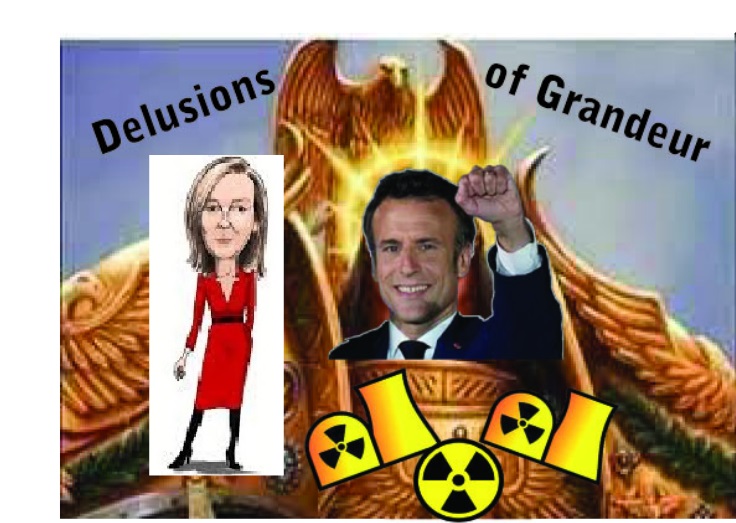
What a pair! They have so much in common. Especially their glorious abandon in going back on previous promises. Macron promised to phase out nuclear power. Truss wanted Britain to stay in the European Union. Then – hey presto! Macron’s all for the nuclear industry, and Liz all for “Brexit” – UK getting out of the EU.
But now, Liz and Emmanuel are besties again, as both go hell for leather for the dangerous, weapons-proliferation, environment-damaging and – oh dear! unaffordably costly nuclear power!
Is this some sort of subconscious Folie à deux – a strange political suicide wish?
They’re committed to work together to get EDF’s Sizewell C nuclear station project happening.
For France – by the end of this year, EDF’s net debt is already forecast to swell to about €60bn, while its French construction programme alone could cost another €52bn.
For Britain – not counting the astronomic cost , ( up to £30 billion, to be paid sort of upfront by the odious Regulated Asset Base ) Sizewell C will be foreign owned, and years to build, with dangerous, hazardous waste and horrendous decommissioning costs – not to mention a potential target for terrorists. Located on low-lying Suffolk coast – vulnerable to rising seas due to global heating.

One point of difference. Liz Truss opposes the idea of Britons conserving energy, whereas the Macron government is promoting energy conservation. Macron’s a bit less nutty?
2022 Nobel Peace Prize award violates the purpose of the prize
2022: Nobel Committee Gets Peace Prize Wrong Yet Again, https://davidswanson.org/2022-nobel-committee-gets-peace-prize-wrong-yet-again/ 7 Oct 22,
The Nobel Committee has yet again awarded a peace prize that violates the will of Alfred Nobel and the purpose for which the prize was created, selecting recipients who blatantly are not “the person who has done the most or best to advance fellowship among nations, the abolition or reduction of standing armies, and the establishment and promotion of peace congresses.”
With its eyes on the news of the day, there was no question that the Committee would find some way to focus on Ukraine. But it steered clear of anyone seeking to reduce the risk of that thus-far relatively minor war creating a nuclear apocalypse. It avoided anyone opposing both sides of the war, or anyone advocating for a ceasefire or negotiations or disarmament. It did not even make the choice one might have expected of picking an opponent of Russian warmaking in Russia and an opponent of Ukrainian warmaking in Ukraine.
Instead, the Nobel Committee has chosen advocates for human rights and democracy in Belarus, Russia, and Ukraine. But the group in Ukraine is recognized for having “engaged in efforts to identify and document Russian war crimes against the Ukrainian civilian population,” with no mention of war as a crime or of the possibility that the Ukrainian side of the war was committing atrocities. The Nobel Committee may have learned from Amnesty International’s experience of being widely denounced for documenting war crimes by the Ukrainian side.
The fact that all sides of all wars have always failed and always will fail to engage in humane operations is possibly why Alfred Nobel set up a prize to advance the abolition of war. It’s too bad that prize is so misused. Because of its misuse, World BEYOND War has created instead the War Abolisher Awards.
Are Putin’s nuclear threats really likely to lead to Armageddon?
The realities underlying the menacing vocabulary are a grey area – it is far from certain that Putin would be prepared to use nuclear weapons
Guardian, by Julian Borger in Washington, Sat 8 Oct 2022
The past week has seen a rapid escalation in nuclear rhetoric, beginning with Vladimir Putin’s threat to use “all forces and means” to defend newly seized territory in Ukraine and ending with Joe Biden’s warning of “Armageddon” if Russia crosses the nuclear Rubicon.
However, the realities underlying the menacing vocabulary are a far greyer area than the bluster suggests. It is far from certain that Putin would be prepared to be the first leader to use nuclear weapons in wartime since 1945, over his territorial ambitions in Ukraine. If his primary goal is to stay in power, that could be exactly the wrong way of going about it.
Even if he did issue the launch order, he has no guarantee it would be carried out. Nor can he be absolutely sure that the weapons and their delivery systems would work.
On the US side, despite the US president’s apocalyptic language at a private fundraiser on Thursday night, it is not at all inevitable that Washington would respond to Putin’s nuclear use with nuclear retaliation. Past wargaming suggests there would be vigorous debate within the administration to say the least.
Like US presidents, Putin is normally accompanied by an aide carrying a briefcase with codes used to authorise a nuclear launch. In the US it is called the football, in Russia it is the cheget. In the Russian system, the defence minister and the chief of the general staff have their own chegets but it is believed that Putin can order a launch without them.
However, the cheget is relevant for the strategic nuclear forces, the intercontinental ballistic missiles (ICBMs) launched from land or sea, or long-range bombers. Because they need to be launched within minutes in case of enemy attack, the warheads need to be deployed, mounted on the delivery systems.
Any nuclear use in Ukraine would be likely to involve non-strategic, or tactical, weapons with shorter-range delivery systems, and which are usually (but not necessarily) less powerful than strategic arms, though on average they are many times more powerful that the Hiroshima or Nagasaki bombs.
The US only has one kind of tactical weapon, the B61 gravity bomb, of which there are about a hundred in Europe and a similar number in the US, according to the Federation of American Scientists (FAS).
FAS estimates Russia has 2,000 tactical weapons, in very many shapes and sizes for use on land, sea and air. The weapons are not deployed on missiles or aircraft, but kept in bunkers in storage sites dotted around Russia. There are 12 national storage sites, known in Russian military parlance as “Object S”, one of which is in Belgorod, right on the Ukrainian border.
There are also 34 “base-level” sites, closer to the delivery systems. In a time of crisis, warheads would be moved from national to base-level sites – and up to now western intelligence agencies say no such movement has been observed.
Any such movement would be carried out by the 12th main directorate of the Russian armed forces, which has the job of storing and maintaining the warheads and then delivering them in specialised trains or trucks to base-level sites, or directly to the unit designated to launch them.
Pavel Baev, a military researcher who worked for the Soviet defence ministry, said that Putin cannot count on these weapons actually working.
“Most of these warheads stored there are very old,” Baev, now a professor at the Peace Research Institute Oslo, said. “Without testing it’s really hard to say how suitable they are because many of them are past their expiration date.”
Baev added that it was also far from clear that the Russian can successfully pair old warheads with the much newer delivery systems that would have to be used, possibly 9K720 Iskander or Kinzhal hypersonic missiles……………………………………………………………………………………………………………………………………….
The key question is more likely to be whether the US and its allies should respond with devastating conventional firepower, as Poland’s foreign minister, Zbigniew Rau, and the former CIA director David Petraeus have suggested. But that would transform the war into one between Russia and Nato, in which escalation to a nuclear exchange could become hard to stop.
According to Eric Schlosser, the author of a book about the nuclear establishment, Command and Control, the Pentagon’s Defence Threat Reduction Agency (DTRA) conducted another war game in 2019 focused on Russian nuclear use in Ukraine. That wargame appears to have been updated, suggesting it is in constant use. The results in 2019 are top secret, but as Schlosser wrote in the Atlantic, one of the participants told him: “There were no happy outcomes.” https://www.theguardian.com/world/2022/oct/07/biden-putin-nuclear-threats-tactical-strike-us-response-analysis
Media hide the fascist ideology of Ukrainian militia who visit U.S. Congress.

The U.S. financed Anti-Corruption Action Center is now promoting the visits of fascists to the center of U.S. power. Democrats are welcoming them. Their hate of anything Russia allows them to ally with even the worst people one can think of while main stream media provide cover for those people’s hateful ideology.
MEDIA HIDE FASCIST IDEOLOGY OF UKRAINIAN MILITIA WHO VISIT CONGRESS
https://popularresistance.org/media-hide-fascist-ideology-of-ukrainian-militia-which-visit-congress/ By Moon of Alabama.,October 5, 2022, Educate!
‘Western’ media continue to denazify Ukraine by pretending that the Nazi formations in that country, which they had long decried, are now a harmless collection of celebrities.
One could follow those changes along various pieces in the New York Times:
On his flak jacket was a symbol commonly used by the Azov Battalion, a Ukrainian neo-Nazi paramilitary organization.
Defenders of the Ukrainian Azov Battalion, which the F.B.I. calls “a paramilitary unit” notorious for its “association with neo-Nazi ideology,” accuse us of being part of a Kremlin campaign to “demonize” the group.
Facebook last week said it was making an exception to its anti-extremism policies to allow praise for Ukraine’s far-right Azov Battalion military unit, “strictly in the context of defending Ukraine, or in their role as part of the Ukraine National Guard.”
These scenes are from videos shared online in recent days by the Azov regiment, a unit in the Ukrainian military, which says they were taken in the mazelike bunkers beneath the sprawling Azovstal steel plant in Mariupol, Ukraine.
As I had written previously:
What was once “a Ukrainian neo-Nazi paramilitary organization” which even the FBI said is notorious for its “association with neo-Nazi ideology” was first relabeled as merely “far right” before it became a normal “unit in the Ukrainian military”.
Today the New York Times topped that evolution by turning a Ukrainian government press release into a tear dripping story about the reunion of freed Azov losers with their families:
Released Azov commanders have an emotional reunion with family members in Turkey.
Commanders of Ukraine’s celebrated Azov Battalion have held an emotional reunion with their families in Turkey, Ukrainian officials said, honoring the fighters released from Russian confinement last month as part of the largest prisoner swap since the start of the war.
Among the 215 Ukrainian prisoners of war released in the exchange were 108 members of the Azov Battalion……………… Ms. Zelenska said she gave the Azov Battalion members “thanks from Ukraine, from the president and all the people for whom they are fighting.”
How can anyone working at the New York Times not be ashamed of this whitewash of a deeply fascists organization.
The NYT is far from the only ‘western’ media doing this. I was easy to find some 40 stories in main stream media which between 2014 and April 2022 which critically discussed the ‘controversial’ Nazi ideology of Azov and other Ukrainian militia. Then the coverage abruptly changed turning those fascist groups into harmless patriots.
Others have done similar analyses:
In order to get a better sense of how Canadian media’s approach to reporting on the Azov Regiment (formerly the Azov Battalion) has changed over the years, we searched for every mention of the group in the archives of the Toronto Star, Globe and Mail, and National Post. We also searched through the CBC News website, as well as some of their broadcasts. All of the 90 unique mentions we found (as of August 10) were compiled, with the description of Azov provided in said article or broadcast being noted for comparison. We found that these news outlets (and the wire services much of their coverage relied upon) went from directly acknowledging Azov’s neo-Nazi ideology to suggesting that the group is merely “controversial” or has a “checkered past.” Some reports included no qualifiers at all, and simply presented the group as just another Ukrainian military unit fighting against Russia.
It is not just the media but also politicians who have done a U-turn from condemning Azov and other Nazi groups to welcoming them as guests in Washington DC.
On March 27 2018 The Hill reported:
Congress bans arms to Ukraine militia linked to neo-Nazis
A little-noticed provision in the 2,232-page government spending bill passed last week bans U.S. arms from going to a controversial ultranationalist militia in Ukraine that has openly accepted neo-Nazis into its ranks. House-passed spending bills for the past three years have included a ban on U.S. aid to Ukraine from going to the Azov Battalion, but the provision was stripped out before final passage each year.
This year, though, the $1.3 trillion omnibus spending bill signed into law last week stipulates that “none of the funds made available by this act may be used to provide arms, training or other assistance to the Azov Battalion.”
White supremacy and neo-Nazism are unacceptable and have no place in our world,” Rep. Ro Khanna (D-Calif.), an outspoken critic of providing lethal aid to Ukraine, said in a statement to The Hill on Tuesday. “I am very pleased that the recently passed omnibus prevents the U.S. from providing arms and training assistance to the neo-Nazi Azov Battalion fighting in Ukraine.”
A year later that language was again stripped from the omnibus spending bill.
Three years on and the very same Nazis are greeted by prominent members of Congress:
California Democrat Rep. Adam Schiff, who pushed the Trump-Russia hoax as hard as anyone, invited neo-Nazis serving in Ukraine’s Azov Battalion to the U.S. Capitol and met with them on Monday. “The American Left is openly aligning itself with Nazis while painting its domestic political opposition as Nazis who present a danger to democracy,” Sean Adl-Tabatabai noted in a Sept. 27 News Punch analysis.
How quickly they seem to forget.
Just three years ago, 40 U.S. senators signed a letter demanding that the Azov Battalion be added to a list of terrorist organizations.
…
When it was reported that the Azov Battalion was in the thick of the fight against Russia’s invasion this year, however, Democrats and their legacy media allies treated them more as heroes than terrorists, critics say.
…
During their visit, the Ukrainian soldiers reportedly thanked the U.S. Congress for the billions in aid it has approved thus far … and then asked for more.
There is whole series of pictures of Democrat congressmen and senators meeting such groups posted by Daria Kaleniuk, the assistant director of a Ukrainian activist group called Anti-Corruption Action Centre. The Anti Corruption Action Center is a U.S. government financed non-government organization in Kiev. Together with Ukraine’s controversial National Anti-corruption Bureau it is a political enforcer which accuses anyone in Ukraine of ‘corruption’ as soon as they divert from the U.S. dictated line. Back in July it even took on Zelenski:
[M]any political experts and anti-corruption activists viewed the removal of Ivan Bakanov, head of Ukraine’s state intelligence service, the SBU, and Iryna Venediktova, the country’s prosecutor general, by presidential decree as Zelenskyy taking advantage of extraordinary wartime authority to consolidate his own power. “It’s not a move to do the right thing. It’s a move to gain more control over our top law enforcement bodies,” Tetiana Shevchuk, a lawyer and activist at the Kyiv-based Anti-Corruption Action Center, said in an interview.
The U.S. financed Anti-Corruption Action Center is now promoting the visits of fascists to the center of U.S. power. Democrats are welcoming them. Their hate of anything Russia allows them to ally with even the worst people one can think of while main stream media provide cover for those people’s hateful ideology.
Liz Truss and Emmanuel Macron get together on promoting nuclear power, especially Sizewell C

Sizewell C nuclear plant between Aldeburgh and Southwold will see joint
support from Liz Truss and Emmanuel Macron. Liz Truss and Emmanuel Macron
have agreed joint support for Sizewell C nuclear power plant. The pair
pledged to work closer on nuclear power and declared their cooperation for
the project, which is to be developed by French company EDF and will see
the plant built on the Suffolk coast between Aldeburgh and Southwold.
Suffolk News 7th Oct 2022
The UK prime minister and France’s president have confirmed joint support
for Sizewell C nuclear power plant. Liz Truss and Emmanuel Macron issued a
joint statement in which they said they were keen to advance cooperation,
on energy in particular. They pledged “full support” for the station set
for Suffolk’s coast, to be developed by French energy company EDF. The
leaders said they expected the “relevant bodies to finalise arrangements in
the coming month”.
BBC 6th Oct 2022
Liz Truss blocks a plan for UK citizens to reduce their energy use

How Liz Truss blocked Jacob Rees-Mogg’s energy-saving public information campaign.
Liz Truss is reported to have blocked the launch of a publicminformation campaign aimed at conserving energy, despite warnings that blackouts could be imposed in the UK if gas imports fall short this winter.
Business Secretary Jacob Rees-Mogg is understood to have backed a £15m “light touch” initiative, according to The Times, encouraging households to reduce their use of gas and electricity by taking a series of simple measures. However, Ms Truss is said to be “ideologically opposed” to such an approach as it could be too interventionist.
iNews 7th Oct 2022
https://inews.co.uk/news/liz-truss-jacob-rees-mogg-energy-saving-campaign-1899019
1 This Month



19 November – Webinar – The Reality of Reprocessing
Time: 11:00 AM Pacific Time (US & Canada) / 2:00 PM Eastern / 7:00 PM UK / 8:00 PM CET
Register for the Zoom Event Here



Shut down the radiation-damaged Heysham nuclear reactors now
To see nuclear-related stories in greater depth and intensity – go to https://nuclearinformation.wordpress.com

Say No to NASA’s Reckless Nuclear Reactor on the Moon
Say No to NASA’s Reckless Nuclear Reactor on the Moon
-
Archives
- November 2026 (22)
- October 2026 (302)
- September 2026 (339)
- August 2026 (330)
- July 2026 (355)
- June 2026 (287)
- May 2026 (306)
- April 2026 (356)
- March 2026 (251)
- February 2026 (267)
- January 2026 (308)
- December 2025 (358)
-
Categories
- 1
- 1 NUCLEAR ISSUES
- business and costs
- climate change
- culture and arts
- ENERGY
- environment
- health
- history
- indigenous issues
- Legal
- marketing of nuclear
- media
- opposition to nuclear
- PERSONAL STORIES
- politics
- politics international
- Religion and ethics
- safety
- secrets,lies and civil liberties
- spinbuster
- technology
- Uranium
- wastes
- weapons and war
- Women
- 2 WORLD
- ACTION
- AFRICA
- Atrocities
- AUSTRALIA
- Christina's notes
- Christina's themes
- culture and arts
- Events
- Fuk 2022
- Fuk 2023
- Fukushima 2017
- Fukushima 2018
- fukushima 2019
- Fukushima 2020
- Fukushima 2021
- general
- global warming
- Humour (God we need it)
- Nuclear
- RARE EARTHS
- Reference
- resources – print
- Resources -audiovicual
- Weekly Newsletter
- World
- World Nuclear
- YouTube
-
RSS
Entries RSS
Comments RSS

