Nuclear Power Isn’t Clean — It Creates Hellish Wastelands of Radioactive Sewage
If you want to remove plutonium from a radioactive wasteland, what do you do so that it doesn’t create another radioactive wasteland? And what does that say about the 90,000 tons of high-level waste sitting at more than 50 U.S. commercial reactor sites?
If you want to remove plutonium from a radioactive wasteland, what do you do so that it doesn’t create another radioactive wasteland? And what does that say about the 90,000 tons of high-level waste sitting at more than 50 U.S. commercial reactor sites?
Harvey Wasserman, Truthout October 12, 2022,
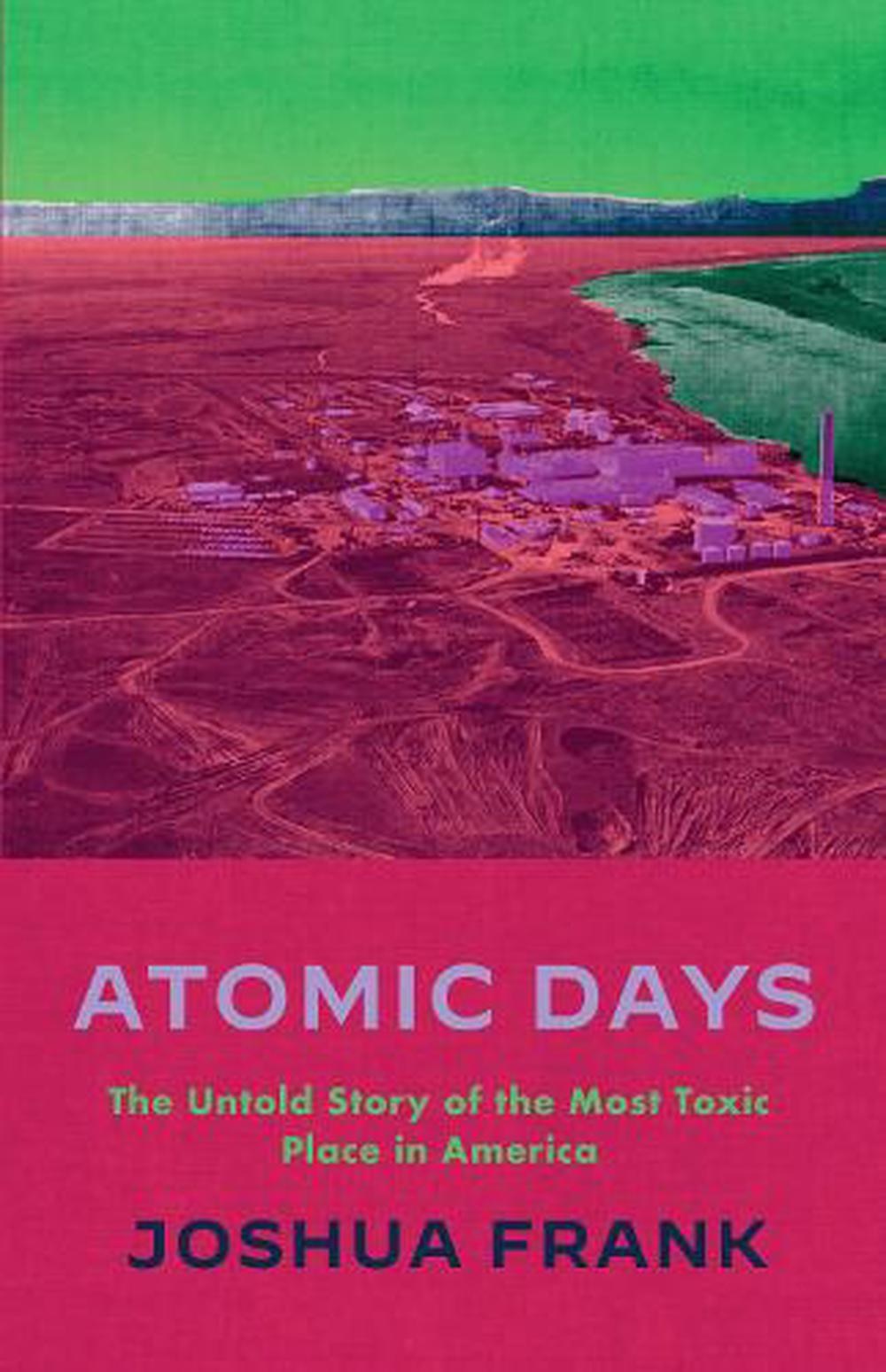
Joshua Frank’s brilliant Atomic Days, from Haymarket Books, takes us deep into the horrific clogged bowels of the failed technology that is nuclear power.
Frank’s excursion into the radioactive wasteland of the Hanford Nuclear Reservation, in eastern Washington State’s Columbia River Valley, is the ultimate real-world nightmare.
Unfortunately, it serves as a wailing siren for what faces us with the atomic wastes from our commercial reactors, now joined at the toxic hip to the global weapons industry.
“Like a ceaseless conveyer belt,” Frank writes, “Hanford generated plutonium for nearly four long decades, reaching maximum production during the height of the Cold War.”
It is now, he says “a sprawling wasteland of radioactive and chemic sewage … the costliest environmental remediation project the world has ever seen and, arguably, the most contaminated place on the entire planet.”
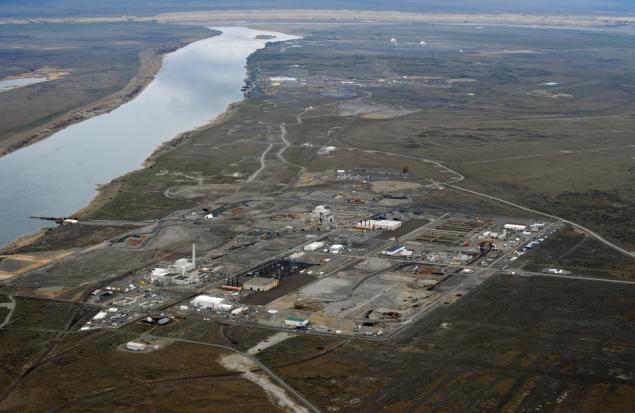
Current cost estimates to clean up the place, says Frank, “could run anywhere between $316 and $662 billion.”
But that depends on a few definitions, including the most critical: What does it mean to “clean up” a hellhole like Hanford? If you want to remove plutonium from a radioactive wasteland, what do you do so that it doesn’t create another radioactive wasteland? And what does that say about the 90,000 tons of high-level waste sitting at more than 50 U.S. commercial reactor sites?
To put it in perspective, we spend $2.6 billion each year just to preserve Hanford as it is. The clean-up estimate, according to Frank, has roughly tripled in the past six years, leaving us to believe that in another six years it could easily be over $6 trillion.
The environmental consequences are colossal. As Frank abundantly documents, Hanford is an unfathomable mess. Giant tanks are leaking. Plutonium and other apocalyptic substances are rapidly migrating toward the Columbia River, which could be permanently poisoned, along with much more. Local residents have been poisoned with “permissible permanent concentration” of lethal isotopes on vegetables, livestock, and in the air and drinking water.
Such exposures have even included a deliberate experiment known as the “Green Run” in which Hanford operatives “purposely released dangerous amounts of radioactive iodine.”
Such emissions are especially damaging to embryos, fetuses and small children, whose thyroids can be easily destroyed (as we are now seeing at Fukushima). But back then the U.S. Army Corps of Engineers wanted to know how fallout would flow in wind currents.
The product was a “death mile” stretching from the Columbia River basin to the ocean, filled with casualties of radioactive poisoning.
After decades of devastating leaks from defective storage tanks, the Los Angeles Times reported that more radioactivity was stored at Hanford “than would be released during an entire nuclear war.”
Thousands of such tanks at Fukushima may soon be given a governmental green light to dump their poisons in the Pacific, with potentially apocalyptic results.
At Hanford, “the waste was so hot it would boil … for decades to come,” i.e., right up to the present day, writes Frank.
Despite official denials, Frank documents a terrifying range of catastrophic leaks into the soil, water tables and streams throughout the reservation. By 1985, he writes, “despite $7 billion spent over the previous ten years, no progress had been made in ridding the aging tanks” of their deadly offal.
To this day “Hanford remains the most complex environmental mess in the United States,” riddled with problems that provide huge profits for corporations that land clean-up contracts and then fail to deliver, exceeding the complexity even of the infamous waste dump at West Valley, New York, and the highly radioactive fallout zone at Santa Susana, California, just north of Los Angeles.
But Hanford’s not alone. Frank also takes us to Chelyabinsk, the site of a Soviet era disaster, and to another wasteland around Kyshtym. Like the 1000-square-mile “dead zone” around Chernobyl, Hanford is full of areas where human life is perilous at best. ………………………………………………….. more https://truthout.org/articles/nuclear-power-isnt-clean-it-creates-hellish-wastelands-of-radioactive-sewage/
Young girls up to 10 times more vulnerable to ionizing radiation, especially girls up to 5 years old.
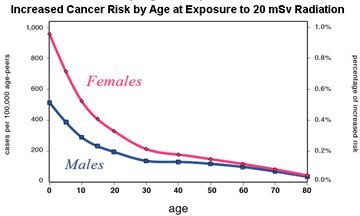
Nuclear Radiation Risk Impacts One Group Far More Than Any Other. Young girls could be up to 10 times more vulnerable to nuclear radiation thanother members of society, with girls aged up to five twice as likely to develop cancer as boys of the same age.
Understanding the risk posed by radiation exposure has been catapulted into public consciousness since
February, when Russia invaded Ukraine. Talk of nuclear war has simmered ever since, with rhetoric ramping up on October 6 when President Joe Biden warned of “Armageddon,” despite the U.S. having no new intelligence that Russian President Vladimir Putin was planning a nuclear strike.
Today, the U.S. Nuclear Regulatory Commission bases its evaluations of the impact of ionizing radiation on the public, and thus its decisions on nuclear licensing and regulation, on a subset of data which describes the “Reference Man.”
The Reference Man, as defined by the International Commission on Radiological Protection, is 20 to 30 years old, weighs 154 pounds, is 5 foot and 6 inches tall, and is Caucasian with a Western European or North American lifestyle. This one-size-fits-all approach describes only a small subset of society.
Newsweek 10th Oct 2022
https://www.newsweek.com/newsweek-com-nuclear-radiation-risk-impacts-one-group-more-other-1750413
MSN 10th Oct 2022
Plutonium and high-level nuclear waste
About plutonium and the “reprocessing” or “recycling” of used nuclear fuel. Gordon Edwards, 12 Oct 22
Plutonium is less than 1/2 of one percent of the used nuclear fuel, but it is a powerful source of energy that can be used for military or civilian purposes (nuclear bomb or nuclear reactors). To get the plutonium out of the used fuel is a very messy operation. The places where reprocessing has been done on a large scale are among the most radioactively contaminated sites in the world. Although NWMO says that plutonium use is not on their agenda, it is included, in writing, as one of their options. Today, in New Brunswick, government funding is going to Moltex Corp. to proceed with plans that require plutonium use. Chalk River is just beginning to build a billion-dollar brand new research facility that will be dealing with plutonium as a priority. A large nuclear industry mural painted on the walls of the Saskatoon Airport states that reprocessing used fuel to get the plutonium out is the last step in the “Nuclear Fuel Cycle”.
(1) Nuclear fuel can be handled with care before it goes into a nuclear reactor. But used nuclear fuel will never be handled by human hands again, at least for several centuries, because of the hundreds of newly-created radioactive materials inside each fuel bundle. These are (a) the broken pieces of uranium atoms that have been spit, (b) the newly-created “transuranic” (heavier than uranium) materials that are produced, and (c) the so-called “activation products” (non-radioactive materials that have been de-stabilized and so are now radioactive). See “Nuclear Waste 101” https://youtu.be/wD2ixadwXW8
(2) Radioactivity is not a thing, but a property of certain materials that have unstable atoms. Most atoms are stable and unchanging. Radioactive atoms are unstable. Each radioactive atom is like a tiny little time bomb, that will eventually “explode” (the industry uses the word “disintegrate”). When an atom disintegrates it gives off projectiles that can damage living cells, causing them to develop into cancers later on. These projectiles are of four kinds: alpha particles, beta particles, gamma rays, and neutrons. These damaging emissions are called “atomic radiation”. No one knows how to turn off radioactivity, so they remain dangerous while they exist.
(The danger lasts for tens of millions of years)
(3) Used nuclear fuel is so radioactive that it can give a lethal dose of gamma radiation and neutrons to any unshielded humans that are nearby. Even the “30-year old” used fuel that NWMO wants to transport to a “willing host community” is still far too dangerous to be handled without massive shielding and robotic equipment. The job of repackaging the used fuel bundles requires the use of shielded “hot cells” — which are specially constructed airtight rooms with thick windows (4 to 6 feet thick) and large robot arms like those used in outer space to protect the workers from being overexposed to radiation. Any damage to the outer metal coating on the fuel bundles will allow radioactive materials to escape from inside the fuel in the form of radioactive gasses, vapours, or dust. That’s why the hot cells have to be air-tight, and why these rooms themselves will eventually become radioactive waste.
See https://youtu.be/g8EPo8BntPQ (below)
(3) Nuclear proponents often point out that the used nuclear fuel – the stuff that NWMO wants to “bury” underground – still has a lot of energy potential and could be “recycled”. That’s because one of the radioactive materials in the waste, called “plutonium”, can be used to make atomic bombs or other kinds of nuclear weapons, and it can also be used as a fuel for more nuclear reactors. But to get plutonium out of the fuel bundles they have to be dissolved in some kind of acid or “molten salt”, turning the waste into a liquid form instead of a solid form. This allows radioactive gasses to escape from the fuel, and makes it much more difficult to keep all the other radioactive materials (now in liquid form) out of the environment of living things. Any plutonium extraction technology is called “reprocessing”.
4) Although NWMO says that reprocessing is not their intention, it has always been considered a possibility and has never been excluded. It is stated in all NWMO documentation that reprocessing remains an option. Once a willing host community has said “yes” to receive all of Canada’s used nuclear fuel, the government and industry can then decide that they want to get that plutonium out of the fuel before burying it. That means opening up the fuel bundles and spilling all the radioactive poisons into a gaseous or liquid medium so they can separate the plutonium (and maybe a few other things) from all the rest of the radioactive garbage. Canada has built and operated reprocessing plants in the 1940s and 1950s at Chalk River. AECL tried but failed to get the government to build a commercial-scale reprocessing plant in the late 1970s. Canada did some experimental reprocessing in Manitoba, when AECL built the “Underground Research Laboratory” to study the idea of a DGR for used nuclear fuel in the 1980s and 1990s. Read http://www.ccnr.org/AECL_plute.html .
(5) The big reprocessing centres in the world include Hanford, in Washington State; Sellafield, in Northern England; Mayak, in Russia; La Hague, in France; and Rokkasho, in Japan. There is also a shut-down commercial reprocessing plant at West Vallay, New York. These sites are all environmental foul-ups requiring extremely costly and dangerous cleanups.
HANFORD: over $100 billion needed to clean up the sitehttps://www.seattletimes.com/seattle-news/hanfords-soaring-cost-of-radioactive-waste-cleanup-is-targeted-as-nw-governors-seek-more-funding/
SELLAFIELD: over 200 billion pounds ($222 billion) for cleanuphttps://www.theguardian.com/environment/2022/sep/23/uk-nuclear-waste-cleanup-decommissioning-power-stations
MAYAK: severe environmental contamination but no cost estimateshttps://bellona.org/news/nuclear-issues/radwaste-storage-at-nuclear-fuel-cycle-plants-in-russia/2011-12-russias-infamous-reprocessing-plant-mayak-never-stopped-illegal-dumping-of-radioactive-waste-into-nearby-river-poisoning-residents-newly-disclosed-court-finding-says
LA HAGUE: widespread contamination, no detailed dollar figure providedhttps://ejatlas.org/conflict/la-hague-center-of-the-reprocessing-of-nuclear-waste-france
ROKKASHO: years of cost overruns and delays – $130 billion for starters
https://www.neimagazine.com/news/newsjapans-rokkasho-reprocessing-plant-postponed-again-8105722
WEST VALLEY: only operated for 6 years, about $5 billion in cleanup costhttps://www.ucsusa.org/resources/brief-history-reprocessing-and-cleanup-west-valley-ny
(6) Newer reprocessing technologies are smaller and use different approaches – but basically, any time you are going to open uo the fuel bundles, you are “playing with fire” and it is much harder to keep all the radioactive pioisons in check once they are out of the fuel bundle.
Read http://www.ccnr.org/paulson_legacy.html
(7) My feeling is that any “handling” or “repackaging” or “reprocessing” of used nuclear fuel should NOT be done in a remote community that does not have the economic or political “clout” to demand that things be done properly. If It is to be dine at all, this should be done back in the major population centres where the reactors are located and people living there can raise a fuss if things are not done safely.
(8) Also, my feeling is that the fuel should not be moved at all until the reactors are all shut down. The radioactive wastes can be very well packaged and carefully guarded where they are. Since NWMO will only move 30-year old used fuel, there will ALWAYS be 30 years worth of unburied waste right at the surface, right beside the reactors, ready to suffer a catastrophe of some sort, no matter HOW fast they bury the older fuel. In fact, the nuclear indusrtry does not really want to “get rid” of nuclear waste at all, but just move some of the older stuff out of the way so that they can keep on making more. The best place to take the waste is where there are no reporters or TV broadcasters or influential wealthy people to blow the whistle if things go badly. Maybe I’m a little over-suspicious, but given the history of waste management, you can’t be too careful.
9) In Germany, they buried radioactive waste in an old salt mine as a kind of DGR for a very long time. When radioactive contamination kept leaking into the ground water and the surface waters, the nuclear scientists in charge did not tell the government or the public for almost 10 years. Then, when it became clear that the environment was being severely affected, the German government decided to take all the waste OUT of the DGR – a difficult and dangerous operation that will take 15-30 years and cost over 3.7 billion euros ($5 billion Canadian equivalent.)
Read https://www.neimagazine.com/features/featureclearing-out-asse-2/
Any potential willing host community would be well advised to insist that all “handling” of individual fuel bundles, of any kind whatsoever, whether repackaging or reprocessing, should not be part of the plan for the willing host community to accept. But it would have to be in writing and legally enforceable.
Of course the decision is entirely up to the willing host community, not me – and hopefully, not the industry either.
WE ARE ON A PATH TO NUCLEAR WAR

WAR ON THE ROCKS, JEREMY SHAPIRO, 12 Oct 22, In war, nothing is inevitable and not much is predictable. But the war in Ukraine has a direction that observers can see and that we should name. What began as a criminal Russian aggression against Ukraine has become a proxy war between Washington and Moscow. The two sides are locked in an escalatory cycle that, along current trends, will eventually bring them into direct conflict and then go nuclear, killing millions of people and destroying much of the world. This is obviously a bold prediction and certainly an unwise one to make — in part because if I’m right, I’m unlikely to be around take credit for it.
President Joe Biden has named this danger, to great criticism, apparently because he believes that acknowledging the danger increases the chances of avoiding such a terrible outcome. Indeed, much can change the current trajectory, but doing so will require purposeful action by both sides specifically intended to avoid direct confrontation. At the moment, neither side seems willing or politically able to take such steps. On the contrary, in Russia nuclear threats are a prominent part of the Russian war strategy. In the United States, commentators condemn those who even name this danger, fearing that doing so will weaken Western resolve. Any mention of such considerations on Twitter, where it is always 1938, inevitably provokes accusations of appeasement and references to Neville Chamberlain.
Despite the opprobrium, not naming the danger is unlikely to reduce it. Think tank analysts prefer instead to talk in terms of “scenarios,” wherein we can bury the most likely outcome amongst a few other less likely possibilities. Such exercises are useful for planning purposes, and they appropriately reflect our general inability to predict events on the ground. But scenarios also serve to hide the relative likelihood of the various outcomes. Here I present just the central scenario of nuclear escalation. I take as a starting point that, although we may experience long periods of relative stalemate and we may never arrive at such a horrific outcome, uncontrolled escalation is the path that we are currently on.
Testing the Red Lines
No rational or even sane leader plans to start a nuclear war. And for all of the Russian regime’s risk taking, it does not show signs of suicidal tendencies. The essence of the problem is more insidious than mere insanity: Once an escalatory cycle begins, a series of individually rational steps can add up to a world-ending absurdity. In Ukraine, both sides have publicly pledged that they cannot lose this war. They hold that doing so would threaten their very way of life and the values that they hold most dear. In the Russian case particularly, a loss in Ukraine would seem to threaten regime survival and even the territorial integrity of the country.
As the war has moved against the Russians, they have drawn numerous red lines to warn the West against escalation. The Russians called the provision of long-range rocket systems near the Russian border “intolerable,” warned against the admission of Sweden and Finland to NATO, and threatened that any attack on Crimea would “ignite judgment day.” In each case, the crossing of these Russian red lines by Ukraine, the United States, or Europe generated some sort of response but fell well short of Russian threats.
As Russian red lines have proven very pink, they are increasingly questioned in the West. Numerous Western commentators now assert that Russia is a paper tiger and dismiss Russian nuclear threats as “bluster.” The most recent Russian red line warns against the provision of long-range missile systems to Ukraine. The Russian government says that if the United States crosses this line, it would become “a direct party to the conflict.” Given all of the red lines already crossed, however, it is doubtful that U.S. decision-makers see such threats as very meaningful.
The problem that the Russians have had in their signaling is that their decision to escalate likely revolves around the progress that the Ukrainians make on the ground, not on any discrete action (such as the provision of new weapons systems) that the West might take. The likelihood of escalation, in other words, has stemmed from developments on the battlefield, not from the crossing of some arbitrary red line. Experts on the Russian military have long suspected that Russian nuclear signaling is an elaborate bluff meant to instill fear and caution in a weak-willed Western enemy. But events in Ukraine and the possibility of a catastrophic military loss may have changed that calculation. Nobody really knows. It is likely that the Russians don’t know either.
What is clear is that both sides have consistently escalated in Ukraine when they fear that they might lose. The United States and its European partners have continually upped their military assistance to Ukraine, in both quality and quantity, regardless of red lines. Under the pressure of war, they decided to deliver weapons and intelligence that just a few months ago they believed carried too great an escalation risk to provide. They have similarly incrementally increased economic sanctions to the degree that they now appear intended to permanently weaken Russia and destroy the Russian regime, as Biden has said is necessary to end the war.
The Russians have consistently responded to battlefield setbacks with their own escalations including energy cut-offs to Europe, increased bombing of civilian targets, and recently through the formal annexation of four Ukrainian provinces and the partial mobilization of Russian manpower reserves. This last step carries obvious risks for the Russian regime, as the multiple protests against it across Russia testify, but the leadership preferred those domestic risks to losing the war.
In taking these escalatory steps, both sides have also increased the domestic and geopolitical costs of compromise, thus increasing the incentive for further escalations. Thus, for example, the Russian annexations are intended to signal to foreign and domestic audiences that the occupied parts of Ukrainian territory will now be defended as if they were Russia itself. But it is not just a signal, it also genuinely reduces Russia’s ability to back down and abandon these provinces. This is essence of an escalatory cycle — it contains a logic of its own wherein previous escalations make future ones more likely.
Of course, wars have often escalated but no war since 1945 has ended in nuclear use. Nuclear powers have at times considered their use for warfighting, notably in Korea in 1953 and in Israel in 1973, but have always stepped back from the brink. In the current situation, both sides have many more steps to take before direct confrontation: ………………………………………………………………………..
This is only a scenario. None of it is inevitable, of course. But this is the path that we are currently on and the likelihood of it coming to pass grows by the day as one side or the other becomes more desperate. The consequences of this path are deeply ruinous. It should be named. https://warontherocks.com/2022/10/the-end-of-the-world-is-nigh/
Crimean Bridge Attack: Ukraine’s Sabotage Teams Take Orders From Washington, Senior Official Reveals
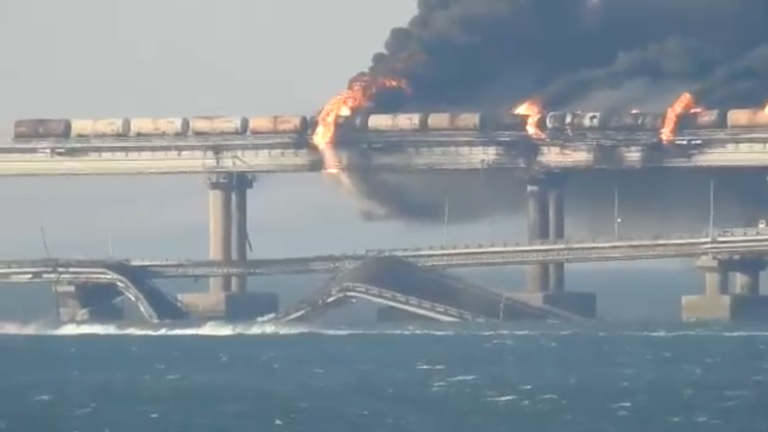
https://sputniknews.com/20221010/crimean-bridge-attack-ukraines-sabotage-teams-take-orders-from-washington-senior-official-reveals-1101698419.html Ilya Tsukanov, 12 Oct 22, The 19-km bridge linking the Crimean Peninsula to the Russian mainland sustained serious damage following the detonation of a truck bomb on one of its road sections on Saturday morning. Ukrainian officials boasted to US media that Kiev was responsible.
Ukrainian officials keep their US counterparts abreast of Kiev’s sabotage ops and other anti-Russian actions, Sergey Pashinsky, the head of the Association of Ukraine’s Defense Enterprises, accidentally revealed.
“We are planning several operations. My position is: we must and are obliged to inform our American partners about them. And those operations which I am conducting right now – I have the opportunity to conduct operations myself, I http://cut channels this is also the CIA http://cut have their own intentions. Because I understand that the US also carries responsibility for them and has the right to veto all of our operations,” Pashinsky said, speaking to infamous Russian pranksters Vladimir ‘Vovan’ Kuznetsov and Alexei ‘Lexus’ Stolyarov, who posed as US officials.
Pashinsky clarified that he has been in charge of some major Ukrainian military actions, including operational planning on Zmeiny (‘Snake’) Island – the small but strategically significant island situated off the western coast of Romania in the Black Sea, and which saw heavy fighting between Ukrainian and Russian forces earlier this year.
“I planned the Zmeiny Island operation, I carried it out personally [using] Ukrainian Bohdan and French Caesar [howitzers]. Yes, this was my operation in its entirely,” the official said.
Pashinsky indicated that operations against a piece of infrastructure like the Crimean Bridge became possible only once the US gives the green light.
“As soon as you tell me that the US approves the sabotage of the Crimean Bridge, the situation can move forward. [Laughs]. A verbal message is enough for me. We don’t want to take responsibility of this scale for ourselves, while Mr. Zelensky – I don’t know, I don’t even want to know about this situation,” Pashinsky said.
“The Crimean Bridge is an important artery, but on the other hand I think you know [Vladimir] Putin better than I do. That is, who can analyze Putin’s actions in the event of sabotage against the Crimean Bridge? Who?” the official asked.
The pranksters did not clarify whether the interview with Pashinsky was conducted before or after Saturday’s sabotage attack.
Two senior Ukrainian officials told the New York Times on Sunday that Ukrainian intelligence were behind the attack on the bridge, one of them grading the success of the attack as “excellent” and saying that the operation “showed the failure of the Russian system to guarantee the security even of the most significant and sacred targets.”
Ukrainian officials also publicly gloated over the act of terror, with presidential advisor Mikhail Podolyak saying the bridge attack was only “the beginning” and that “everything illegal must be destroyed” and “everything stolen must be returned to Ukraine.”
“Today was not a bad day and mostly sunny on our state’s territory. Unfortunately, it was cloudy in Crimea. Although it was also warm,” President Vladimir Zelensky said in a sarcasm-laden address to the nation on Saturday night.
Russia launched a series of missile strikes deep into Ukraine on Monday in the wake of the bridge attack after confirming Ukrainian special forces’ involvement, with the strikes targeting Ukrainian energy infrastructure and military command and communications posts across the country. President Putin warned that strikes would be followed up if Ukrainian attacks against Russian infrastructure continue.
Health Implications of re-licensing the Cameco nuclear fuel manufacturing plant .

“Health Implications of re-licensing the Cameco Fuel Manufacturing plant (CFM)” Gordon Edwards 12 Oct 22
my submission to the Canadian Nuclear Safety Commission, on behalf of the Port Hope Community Health Concerns Committee. Port Hope is in Ontario, on the north shore of Lake Ontario just east of Toronto. This town houses one of the largest uranium “conversion” plants in the world, turning refined uranium into (1) drums of uranium hexafluoride for export to enrichment plants in other countries, and (2) uranium dioxide powder to be turned into ceramic fuel pellets used in Canadian nuclear reactors.
The paper deals with the health implications of the low-level radioactive dust that escapes into the air of Port Hope from the Fuel Fabrication Plant – the plant that manufactures fuel pellets and assembles them into CANDU fuel bundles.
Before they are used, these fuel bundles are weakly radioactive but safe to handle (with gloves, for a short time). After they are used, the fuel bundles are millions of times more radioactive — when freshly discharged from the reactor, one fuel bundle will kill an unshielded human standing one metre away in less than 20 seconds. That’s a very HIGH level of radiation, caused by all the broken pieces of uranium atoms that are left Inside the used fuel bundle and are constantly disintegrating.
But that is not the case in Port Hope. Here we have only naturally occurring radioactive uranium that has been brought to the surface to make fuel for nuclear reactors. The problem is that the uranium dust specks are so tiny they are totally invisible, and when inhaled they “stick” in the lungs and stay there for a long time, damaging the tissue so that it might begin to grow in the wrong way, eventually becoming a lung cancer years later. It is a much slower kind of illness and death that may be caused by LOW level radiation exposure. It’s like a lottery with a negative “prize” – not everyone will be so affected, but the unlucky “winners” will suffer the consequences.
Gordon Edwards
Joshua Frank’s book Atomic Days shows the nuclear industry’s only real role – it is essential for the USA’s ‘permanent war economy’

As the atomic energy business is increasingly priced out of the electricity market by wind, solar, batteries, and increased efficiency and conservation, we will likely see the nuclear power industry increasingly admitting to what it always was — a necessary servant of the nuclear weapons industry.

Nuclear Power Isn’t Clean — It Creates Hellish Wastelands of Radioactive Sewage, Harvey Wasserman, Truthout October 12, 2022,
“……………………………..To put the nuclear power industry in a larger context, Frank guides us through the “permanent war economy” birthed during WWII, and discusses Franklin Roosevelt’s ambivalent relations with the “Malefactors of Great Wealth” who often stood in the way of making the U.S. the “Arsenal of Democracy,” and who once even plotted to kill him.
With the decision to build an A-Bomb, the giant Bechtel Corporation used the 120-square-mile reservation at Hanford to produce 103.5 metric tons of plutonium, perhaps the deadliest substance known to humanity.
But there was no effective solution for what might happen to the place in the aftermath. The Waste Treatment Plant meant to “vitrify” rad wastes into glass began construction in 2002, with plans to open in 2011. It has become, in both cost and area, “the largest single construction operation taking place anywhere in the United States,” now with an estimated price tag of $41 billion and a projected opening in 2036.
With “a string of bungled jobs under its belt,” Bechtel’s failed “Big Dig” in Boston — a much-vaunted tunnel from Logan Airport to downtown — reflected its work at Hanford when a collapse killed a 39-year-old woman and resulted in $357.1 million settlement exempting management from criminal prosecution.
As the U.S.’s fourth-largest privately held company, Bechtel spending $1.8 million on D.C. lobbying in 2019-20 was par for the course. The payback, Frank writes, comes in the tragic diseases suffered by Hanford workers like Abe Garza and Lawrence Rouse, usually amid terse, well-funded official denials. Researchers like Karen Wetterhahn and veterans like Victor Skaar have joined Vietnam victims of Agent Orange in being victimized by exposures they were repeatedly assured were “safe.” Whistleblowers like Ed Bricker were even subjected to intense spying and sabotage by close associates he was deceived into accepting as friends.
Meanwhile activists like Russell Jim of the Yakama Tribe began to force “an immeasurable amount of transparency” around the Hanford disaster. Their decades of hardcore community organizing came with a growing demand for accountability that has changed the political atmosphere surrounding the cleanup.
The debate has carried into the use of commercial atomic power.
Because of Hanford’s nuclear presence, five atomic reactors were constructed in Washington State, promising electricity that would be “too cheap to meter.”
But like the soaring costs of plutonium production and clean-up, the Washington Public Power System plunged into the biggest public bankruptcy in U.S. history, due to massive delays and cost overruns. Only one of the nukes now operates.
Sadly, some self-proclaimed climate activists have fallen into the atomic pit, arguing that in the face of the acute threat of climate change, nuclear power should be pursued as a way to lower emissions.
But they all ignore the big lesson Joshua Frank teaches us about Hanford: All the rhetoric in the world can’t cover for the physical realities of dealing with atomic radiation. And atomic fires burning at 571 degrees Fahrenheit will never cool the planet. The mines, the mills, the fuel fabrication, the reactors themselves, the waste dumps, all that horrendous multitrillion-dollar paraphernalia — they together comprise the most lethal and expensive technological failure in human history.

Many reactor promoters have long vehemently denied any connection between their “peaceful atom” and the scourge of war, but anti-nuclear activists have exposed the falsity of those claims. For example, the Campaign for Nuclear Disarmament, a British advocacy organization that opposes both nuclear weapons and the building of new nuclear power facilities, writes:
The civil nuclear power industry grew out of the atomic bomb programme in the 1940s and the 1950s. In Britain, the civil nuclear power programme was deliberately used as a cover for military activities…. The development of both the nuclear weapons and nuclear power industries is mutually beneficial. Scientists from Sussex University confirmed this once again in 2017, stating that the government is using the Hinkley Point C nuclear power station to subsidise Trident, Britain’s nuclear weapons system.
As the atomic energy business is increasingly priced out of the electricity market by wind, solar, batteries, and increased efficiency and conservation, we will likely see the nuclear power industry increasingly admitting to what it always was — a necessary servant of the nuclear weapons industry.
Fittingly, the only future for atomic reactors will be as a bottomless pit for ecological suicide and massive public subsidies — exactly like Hanford.
Indeed, for readers truly interested in the future of atomic energy, take a good look at how it plays in Joshua Frank’s Atomic Days. Then ask how soon we can cover the whole damn place with solar panels. https://truthout.org/articles/nuclear-power-isnt-clean-it-creates-hellish-wastelands-of-radioactive-sewage/
How nuclear testing leaves lasting environmental scars
https://www.dw.com/en/nuclear-testing-north-korea-environment-biodiversity/a-6341. Edited by: Tamsin Walker 13 Oct 22,
With analysts predicting further nuclear tests in North Korea, the planet stands to lose. The ongoing environmental effects of nuclear testing are felt worldwide and for millions of years.
Since late September, North Korea has launched a flurry of ballistic missile tests as part of what experts believe is a program to develop so-called tactical nuclear weapons. If the reclusive state were to move beyond testing missiles to testing actual nuclear warheads, as some analysts are predicting, it would not only ramp up political tensions, but also pose a significant environmental threat.
In the past, countries such as the United States, the former Soviet Union and the United Kingdom tested their nuclear weapons in the open atmosphere and in the sea — and around Pacific Islands, the Australian desert, mainland US, remote parts of the USSR and other places. These tests left contaminated landscapes and spread their radioactive clouds far afield.
Thanks to global treaties, nuclear tests were largely moved underground after 1963, a slightly preferable scenario environmentally speaking. And since a 1996 test ban, only India, Pakistan and North Korea have tested weapons at all.
North Korea is the only country known to have conducted tests in the 21st century.
The impact of nuclear testing on mammals
“The legacy of nuclear weapons testing has been absolutely catastrophic for humans and for the environment,” said Alicia Sanders, the policy research coordinator at the International Campaign to Abolish Nuclear Weapons.
One of the unique consequences for the environment, she added, “is that it lasts essentially forever.”
Putting aside the development required to set up test sites, the first major effects are felt in the microseconds after the explosion.
A 2015 paper on the environmental impact of military actions found that nuclear blasts represent an extreme threat to local biodiversity.
The massive energy released in the thermal emission from the blast — comprising light and heat — kills any organisms unfortunate enough to be near the epicenter. Depending on the yield of the bomb, even organisms several kilometers away face lethal temperatures. What remains is a charred mess.
The effect from the thermal shock on animals is not well researched, but humans face serious, life-threatening burns even several kilometers away, depending on the power of the bomb. A similar effect is assumed for other mammals. They also suffer from the pressure of the blast, which causes lung damage and hemorrhaging.
And animals that aren’t killed immediately are more likely to die from infections in the days and weeks following the explosion, leading to a localized die-off event, the 2015 review found.
The impact on plants, birds and marine life
Plants are also not spared the effects of a nuclear blast. The sheer force strips trees of their foliage, tears down branches and uproots vegetation.
For fish, meanwhile, the impact is similar to that of a non-nuclear explosion, but on a much larger scale. The US tests in Alaska, and those of France in French Polynesia in the late 1960s and early 70s were associated with large-scale die-offs of fish, as their gas-filled swim bladders ruptured.
Marine mammals and diving birds suffered similarly, post-mortem analysis showed. However, marine non-vertebrates appeared to be more resistant to pressure waves as they do not have gas-containing organs, according to defense studies at the time.
Long-term environmental impacts
During the Cold War, the United States detonated scores of nuclear weapons in atmospheric tests in the Pacific. Entire islands were incinerated and many are still uninhabitable. Local residents were forced to leave. A 2019 study found that some of the affected areas had radiation levels 1,000-times that of those found in Chernobyl and Fukushima.
Significant long-term environmental consequences of nuclear testing are the contamination of surface soil and groundwater, land disturbances in the form of craters or partially collapsed mountains — as in the case of the North Korean testing site — and the addition of radionuclides to sediments in seabeds.
Atmospheric nuclear tests spread radionuclides — unstable particles that releases radiation as they break down — far and wide, contaminating topsoil.
But even in underground testing, high pressure conditions can propel radionuclides into the atmosphere — a phenomenom known as venting — where they can be carried by winds and deposited far away from the test sites and enter food-chains.
Ankit Panda, a senior fellow at the Carnegie Endowment for International Peace’s nuclear policy program, says Pyongyang has thus far avoided the pitfall of venting.
“The North Koreans have actually, with their last five nuclear tests at least, been very effective at preventing the venting of radionuclides,” he said. “Because some of these radionuclides can even offer hints about the specific materials that are being used in the nuclear device.”
At the very least, underground tests deposit huge quantities of radioactive material which will remain there for millions of years. The long-term ecological damage from such contamination is unknown.
The impact on drinking water
Underground testing also poses a threat of radionuclides leeching into drinking water.
Studies at the US nuclear testing site near Las Vegas, found that some contaminants released by underground nuclear tests can get into the surrounding water. Plants and animals are particularly liable to pick up radioactive strontium and caesium, which are easily spread in water.
With a half-life of 30 years, these two radionuclides can cause health issues in the food chain for decades. A common shrub in New Mexico, chamisa, has roots that extend deep into the ground, bringing strontium back up to the surface near the Los Alamos testing site in New Mexico, from where it can be widely distributed as the leaves fall, decay, and contaminate the soil understory.
“Animals will eat from contaminated land and that becomes very dangerous. These can be key sources of food for people,” ICAN’s Sanders said.
Organizations such as ICAN continue to push for complete denuclearization.
Until that happens, one factor that might help clean up the legacy of nuclear testing is a provision in the 2017 Treaty on the Prohibition of Nuclear Weapons, which requires signatories to provide assistance to victims of nuclear weapons and begin to remediate contaminated environments. States should next year begin initial assessments of environmental damage and use that as a basis for future remediation efforts.
Finnish pharmacies run out of iodine pills as Russian nuclear fears increase
SMH 13 Oct22, Helsinki: Many Finnish pharmacies ran out of iodine tablets on Wednesday, a day after the Nordic country’s health ministry recommended that households buy a single dose in a case of a radiation emergency amid increasing fears of a nuclear event due to Russia’s war in Ukraine.
“An accident at a nuclear power plant could release radioactive iodine into the environment, which could build up in the thyroid gland,” the Finnish Ministry of Social Affairs and Health said on Tuesday.
Chemists in many locations in Finland reported on Wednesday they had run out of iodine tablets as citizens rushed to purchase the medicine. Drug wholesalers also said their stockpiles were emptied out.
The ministry said the iodine tablet recommendation is limited to those aged 3-40 because of the potential risks that radiation exposure poses to that age group…………………………
In a case of a radiation emergency, sheltering indoors is the main way for people to protect themselves from hazardous radiation, the Finnish health ministry stressed. https://www.smh.com.au/world/europe/finnish-pharmacies-run-out-of-iodine-pills-as-russian-nuclear-fears-increase-20221013-p5bpef.html
France’s Finance Minister : Priority is to restart nuclear reactors a soon as possible
https://www.reuters.com/business/energy/frances-le-maire-priority-is-restart-nuclear-reactors-soon-possible-2022-10-11/—PARIS, Oct 11 (Reuters) – French Finance Minister Bruno Le Maire said on Tuesday the government’s priority was to restart EDF’s (EDF.PA) nuclear reactors – with more than half of them currently offline – as soon as possible.
During a press conference at the headquarters of grid operator RTE, Le Maire also said the goal was still to go back to 50GW of nuclear production capacity for the network at the start of 2023.
French nuclear power output is at a 30-year low for the year, owing to an unprecedented number of outages at EDF’s fleet of 56 reactors, with more than half offline because of corrosion issues and scheduled maintenance.
EU Taxonomy Labelling Gas and Nuclear as ‘Green’ Faces Legal Challenges
Activists and environmental organisations immediately opposed the decision, saying the new law discredits EU efforts to establish itself as a global leader on climate policy and only risks delaying Europe’s transition to a net-zero economy by further encouraging investments in the fossil fuel industry.
In September, Greenpeace and a separate alliance of environmental groups, including Client Earth and the World Wildlife Fund (WWF), requested a legal review of the decision. Austria’s recent lawsuit is now adding to the legal challenges the European Commission is already facing.
https://earth.org/eu-taxonomy-legal-challenges/ MARTINA IGINIE OCT 13TH 2022
Austria has filed a lawsuit against the European Commission’s decision to label nuclear and gas as ‘green’ investments. The controversial EU taxonomy approved by the European Parliament in July is already facing two other legal challenges from environmental groups.
On Friday, Austria submitted a lawsuit to the Court of the European Union, asking for an overturn of the contentious EU taxonomy.
Approved in July, the legal text designated natural gas and nuclear as environmentally sustainable energy sources, encouraging investments in these energy sources. Under the EU taxonomy, new nuclear and gas-fired plants built through 2030 will be recognised as a transitional energy source as long as they are used to replace dirtier fossil fuels such as oil and coal.
The country’s minister for climate action and Green politician, Leonore Gewessler, described the EU’s decision as “irresponsible” and “unreasonable” and said it was “misleading” to consumers and investors to label gas – a fossil fuel responsible for climate change for its greenhouse gas emissions – as “green”.
However, Brussels reassured that gas and nuclear-related activities may be labeled as “green” only if they meet certain criteria. Particularly, the legal text specifies that gas projects should only be financed if direct emissions are kept under a maximum cap and they switch to fully renewable energy by 2035. Similarly, nuclear power may be funded only in compliance with certain standards for the disposal of radioactive waste.
Activists and environmental organisations immediately opposed the decision, saying the new law discredits EU efforts to establish itself as a global leader on climate policy and only risks delaying Europe’s transition to a net-zero economy by further encouraging investments in the fossil fuel industry.
In September, Greenpeace and a separate alliance of environmental groups, including Client Earth and the World Wildlife Fund (WWF), requested a legal review of the decision. Austria’s recent lawsuit is now adding to the legal challenges the European Commission is already facing.
Despite not joining the legal action, Germany supported the country’s decision to file a lawsuit, adding that “it is good that the objections to the taxonomy regulation will now be reviewed by the courts.”
Georgia nuclear plant’s cost now forecast to top $30 billion
https://www.gpb.org/news/2022/05/09/georgia-nuclear-plants-cost-now-forecast-top-30-billion?fbclid=IwAR3OXo4tKdYJgJPMQxXjl_l4VnbN1cFZkTtiYE7KZ-NEPngOb5_FnB_GpRY May 9, 2022 Associated Press,
A nuclear power plant being built in Georgia is now projected to cost its owners more than $30 billion.
A financial report from one of the owners on Friday clearly pushed the cost of Plant Vogtle near Augusta past that milestone, bringing its total cost to $30.34 billion.
That amount doesn’t count the $3.68 billion that original contractor Westinghouse paid to the owners after going bankrupt, which would bring total spending to more than $34 billion.
Vogtle is the only nuclear plant under construction in the United States, and its costs could deter other utilities from building such plants, even though they generate electricity without releasing climate-changing carbon emissions.
The latest increase in the budget, by the Municipal Electric Authority of Georgia, wasn’t a surprise after lead owner Georgia Power Co. announced delays and $920 million in overruns on March 3. Georgia Power’s costs only cover the 45.7% of the plant it owns, meaning that the cooperatives and municipal utilities that own the majority of the two-reactor project later update their financial projections as well.
MEAG, which owns 22.7% of Vogtle and provides power to city-owned utilities, raised its total cost forecast, including capital spending and borrowing costs, to $7.8 billion from the previous level of $7.5 billion.
Oglethorpe Power Corp., which provides power to 38 cooperatives in Georgia, owns 30% of Vogtle. In March bumped up its cost projects by $250 million to $8.5 billion.
The city of Dalton, which owns 1.6%, estimated its cost at $240 million in 2021. It hasn’t released a public update.
The municipal utility in Jacksonville, Florida, as well as some other municipal utilities and cooperatives in Florida and Alabama are obligated to buy power from the plant.
When approved in 2012, the third and fourth reactors were estimated to cost $14 billion, with the first electricity being generated in 2016. Now the third reactor is set to begin operation in March 2023, and the fourth reactor is set to begin operation in December 2023.
Atlanta-based Southern Co., which owns Georgia Power, has been charging increasing shares of its cost overruns as shareholder losses, saying it’s unlikely that the Georgia Public Service Commission will approve adding amounts to the bills of Georgia Power’s 2.6 million customers. But Oglethorpe, MEAG and Dalton don’t have shareholders, meaning customers are fully exposed to overruns.
Georgia Power’s customers, as well as some Oglethorpe customers, are already paying the costs of Vogtle.
To protect themselves, the other owners signed an agreement with Georgia Power in 2018 specifying that if costs reach a certain point, the other owners can choose to freeze their costs at that level. In exchange for paying more of the costs, Georgia Power would own a larger share of the reactors.
Oglethorpe wants to freeze its costs at $8.1 billion, selling 2% of the reactor to Georgia Power in exchange for Georgia Power paying $400 million more in costs. MEAG also said Friday it wants to freeze its costs, but didn’t say how much it sought to shift to Georgia Power.
Southern has acknowledged it will have to pay at least $440 million more to cover what would have been other owners’ costs, and has said another $460 million is in dispute.
Georgia Power is disputing the cost threshold at which it must shoulder more of the burden and saying it shouldn’t have to pay the other owners’ share of extra costs stemming from COVID-19. The owners are in talks aimed at resolving their disagreements.
“Cost sharing is imminent, however, until the parties reach agreement, Oglethorpe will continue to pay its full share of the construction costs as billed by Georgia Power, but will do so under contractual protest,” Oglethorpe CEO Mike Smith said in March.
All the owners did vote to continue construction on Feb. 25. Also, the owners report that the U.S. Nuclear Regulatory Commission in March completed a follow-up inspection of wiring problems at the third reactor and signed off that problems it identified in November had been fixed, returning the reactor to its less intensive baseline inspection regime.
Death by Nationalism?
The game may be almost over. more http://commonwonders.com/death-by-nationalism/ By Robert C. Koehler, 12 Oct 22,
Medea Benjamin and Nicolas J.S. Davies put it this way:
“The irresolvable dilemma facing Western leaders is that this is a no-win situation. How can they militarily defeat Russia, when it possesses 6,000 nuclear warheads and its military doctrine explicitly states that it will use them before it will accept an existential military defeat?”
Neither side is willing to let go of its commitment: to protect, to expand, a piece of the whole planet, no matter what the cost. The game of conquest — the game of war, and all that comes with it, e.g., the dehumanization of most of humanity, the indifference to its toll on the planet itself — has been going on for thousands of years. It’s our “history.” Indeed, history is taught from war to war to war.
Wars — who wins, who loses — are the building blocks of who we are, and they have managed to consume the various counter-philosophies that crop up, such as religious belief in love and interconnectedness, and turn them into allies. Love thy enemy? Nah, that’s silly. Love isn’t possible until you defeat the devil. And, oh yeah, violence is morally neutral, as per St. Augustine and the “just war theory” he came up with sixteen hundred years ago (as I wrote about last week). This made things so convenient for would-be conquerors.
And that philosophy has hardened into reality: We’re number one! Our empire is better than yours! And humanity’s weaponry — its ability to fight and kill — has advanced, from clubs to spears to guns to . . . uh, nukes.
Slight problem! Nuclear weapons clarify a truth we have previously been able to ignore: The consequences of war and dehumanization always, always, always come home. There are no “nations,” except in our imagi-nations.
So are we stuck with all this power we’ve aligned against ourselves in defense of a falsehood? That seems to be the case, as the war in Ukraine continues and escalates, pushing itself (and all of us) closer to Armageddon. Much of the world is aware of the danger of this falsehood; we even have a global organization, the United Nations, that keeps trying to unite the world, but it has no power to force unity (or sanity) on the planet. The fate of all of us seems to be in the hands of a few leaders who actually possess nuclear weapons, and will use them if “necessary.”
And sometimes I fear the worst: that the only way such leaders will lose their power — to develop and maybe use their nukes — is for one or several of them to, oh my God, launch a nuclear war. Ladies and gentlemen, we’re a split-second decision away from such an occurrence. Seemingly, in the wake of such a war — if human life has survived and is able to begin rebuilding civilization — sanity and a sense of global wholeness might find its way to the core of the human social structure; and our collective thinking, having no other choice, will finally see beyond war and war preparation.
Let me drop the narrative at this point. I have no idea what’s going to happen, let alone what’s going to happen “next.” I can only reach into the depths of my soul and begin praying, you might say, to every God on this planet. Oh Lords, let humanity grow up before it kills itself.
And as I pray, who shows up but the French philosopher and political activist Simone Weil, who died in 1943, two years before the nuclear age birthed itself, but who knew something was deeply wrong. And of course much was already wrong. The Nazis controlled her country. She was able to flee France with her parents, but she died at age 34, apparently of a combination of tuberculosis and self-starvation.
But what she left behind in her writing is a precious pearl of awareness. Is it too late? Here’s where I drop to my knees.
“Weil,” wrote Christy Wampole in a New York Times op-ed three years ago, “saw in her historical moment a loss of a sense of scale, a creeping ineptitude in judgment and communication and, ultimately, a forfeiture of rational thought. She observed how political platforms being built upon words like ‘roots’ or ‘homeland’ could use more abstractions — like ‘the foreigner,’ ‘the immigrant,’ ‘the minority’ and ‘the refugee’ — to turn flesh-and-blood individuals into targets.”
No human being is an abstraction? Is this where the rebuilding starts?
And then a song started playing in my head, in my soul. The song is “Deportee,” written and sung by Woody Guthrie 75 years ago, after a plane crashed over California’s Los Gatos Canyon, killing 32 people — mostly Mexicans, being sent back to Mexico because they were either here “illegally” or their guest worker contracts had expired. Initially the media identified by name only the actual Americans who died (pilot, copilot, stewardess). The rest were simply deportees.
Goodbye to my Juan, goodbye, Rosalita,
Adios mis amigos, Jesus y Maria;
You won’t have your names when you ride the big airplane,
All they will call you will be “deportees.”
What does this have to do with a Doomsday Clock at 100 seconds to midnight, ongoing slaughter and nuclear powers at odds with each other in Ukraine, a world in endless and bloody conflict almost everywhere? I have no idea.
Except, maybe, this: If a nuclear war happens, everyone on the planet is no more than a deportee.
Growing the economy – but growth of what?

Michael Jacobs: Liz Truss dreams of growth – but even if she pulls it off, it won’t help Britain. Fifty years ago, the landmark report The Limits to Growth warned that, unless the composition of growth was
radically changed, its environmental impacts would lead to ecological and social collapse within 100 years.
Many of the projections made by The Limits to Growth have proved prescient. Yet it is also true that developed economies have been able to “uncouple” growth from some environmental
impacts. Over the past 20 years, the UK and others have notably seen rising GDP accompanied by falling greenhouse gas emissions.
Economists have described this as “green growth”, and many have argued that this, rather than growth per se, should be governments’ goal. Some environmentalists argue that environmental sustainability does not allow for any economic growth. Only the “degrowth” of western economies, they claim, is compatible with ecological salvation (and indeed, wellbeing). Others claim that GDP could still grow in a radically greener form. But in present circumstances this is a rather arcane dispute.
Both sides agree that some parts of the economy must degrow, notably the fossil fuel sector and fossil-intensive industries, while growth is clearly needed in others, such as renewable energy and the “care economy” of health, education, social care and childcare. The real question is therefore not “growth or
not?”, but “growth of what?”
Guardian 10th Oct 2022
https://www.theguardian.com/commentisfree/2022/oct/10/liz-truss-dreams-growth-income-stall-gdp
“Pure-play” clean-energy” Brookfield Renewable Partners goes dirty as it partners with Cameco and the nuclear industry

Brookfield Renewable operates one of the world’s largest publicly traded, pure-play renewable power platforms.
Westinghouse Electric, a US nuclear power company, is being bought by a
private equity-backed consortium in a $7.9bn deal four years after it
emerged from bankruptcy, as the war in Ukraine spurs fresh interest in an
industry that had fallen out of investor favour.
Brookfield Renewable Partners, one of the world’s largest clean energy investors, and Cameco,
a supplier of uranium fuel, are buying the company in a bet that climate
and energy security concerns will revive the nuclear sector’s fortunes.
They will purchase the group, which makes technology used in about half the
world’s roughly 440 nuclear reactors, from a separate division of
Brookfield Asset Management that runs its private equity investments. The
sale of Westinghouse represents a large windfall for Brookfield’s private
equity business. It invested $1bn in equity to acquire Westinghouse after
Toshiba, its former owner, put it into bankruptcy in 2017 amid large cost
overruns at projects in Georgia and South Carolina. It will receive roughly
$5.5bn through the sale and dividends.
FT 11th Oct 2022
https://www.ft.com/content/46df2aa9-0963-47a6-881c-f715a18a8527
1 This Month





Shut down the radiation-damaged Heysham nuclear reactors now
To see nuclear-related stories in greater depth and intensity – go to https://nuclearinformation.wordpress.com

Say No to NASA’s Reckless Nuclear Reactor on the Moon
Say No to NASA’s Reckless Nuclear Reactor on the Moon
-
Archives
- November 2026 (12)
- October 2026 (302)
- September 2026 (339)
- August 2026 (330)
- July 2026 (355)
- June 2026 (287)
- May 2026 (306)
- April 2026 (356)
- March 2026 (251)
- February 2026 (267)
- January 2026 (308)
- December 2025 (358)
-
Categories
- 1
- 1 NUCLEAR ISSUES
- business and costs
- climate change
- culture and arts
- ENERGY
- environment
- health
- history
- indigenous issues
- Legal
- marketing of nuclear
- media
- opposition to nuclear
- PERSONAL STORIES
- politics
- politics international
- Religion and ethics
- safety
- secrets,lies and civil liberties
- spinbuster
- technology
- Uranium
- wastes
- weapons and war
- Women
- 2 WORLD
- ACTION
- AFRICA
- Atrocities
- AUSTRALIA
- Christina's notes
- Christina's themes
- culture and arts
- Events
- Fuk 2022
- Fuk 2023
- Fukushima 2017
- Fukushima 2018
- fukushima 2019
- Fukushima 2020
- Fukushima 2021
- general
- global warming
- Humour (God we need it)
- Nuclear
- RARE EARTHS
- Reference
- resources – print
- Resources -audiovicual
- Weekly Newsletter
- World
- World Nuclear
- YouTube
-
RSS
Entries RSS
Comments RSS

