What a recent court win reveals about the Trump administration’s unlawful attacks on climate science

Bulletin, By Rachel Cleetus | Opinion | March 18, 2026
The second Trump administration is taking its hostility to climate science to new levels. In addition to its rhetoric dismissing climate change as a con or scam, recently released government documents show how the administration is seeking to replace scientific facts with propaganda and disinformation.
The Environmental Defense Fund and the Union of Concerned Scientists recently won a court case against the administration which forced it to release of a trove of government documents related to a secretive “Climate Working Group” illegally convened by Energy Secretary Chris Wright. These documents show that the Trump administration secretly enlisted a handpicked group of climate contrarians to write a biased climate report specifically designed to undermine the EPA’s Endangerment Finding. This science-based finding establishes the known harms to human health and well-being from global warming pollution, facts that were clear in 2009 and even more so today, as affirmed by a recent National Academies report……………………………………………………………………………………………………………………………..
Propaganda and disinformation about climate science are now the official position of the US government. Meanwhile, scientists confirm that the world is on the verge of overshooting 1.5 degrees Celsius of global warming within the next few years. Costly and deadly climate impacts—extreme heatwaves, record-breaking floods, intensified storms, catastrophic wildfires—are worsening, and the risks of irreversible, multi-century harms are growing. And yet this deeply anti-science administration continues to prop up fossil fuel interests rather than protecting people’s safety and the health of the planet.
The successful Federal Advisory Committee Act lawsuit has resulted in some crucial wins, including shining a light on the Trump administration’s deceptive tactics to undermine climate science. . And the administration’s harmful actions will continue to be challenged in court. The Union of Concerned Scientists and the Environmental Defense Fund, together with many other groups, have recently joined a lawsuit challenging the unlawful repeal of the endangerment finding. Try as it might, this administration cannot bury the evidence of climate harms so readily apparent to communities across the nation. The American people deserve genuine solutions to the climate crisis, not more self-serving lies.https://thebulletin.org/2026/03/what-a-recent-court-win-reveals-about-the-trump-administrations-unlawful-attacks-on-climate-science/
Deader than a doornail -UK’s new nuclear
Several days after announcing the new cost hikes at Hinkley, news broke about similarly soaring electricity prices predicted for the Sizewell C nuclear power plant, another French twin EPR plant targeted for the steadily eroding and submerging UK Suffolk coast.
by beyondnuclearinternational, https://beyondnuclearinternational.org/2026/03/15/deader-than-a-doornail/
Electricity prices from new nuclear plants will be sky high with more delays to completion while jobs don’t materialize.
If you wanted to sum up the most compelling reasons not to build new nuclear power plants, Hinkley Point C, the two-reactor project under construction in Somerset in the UK, encapsulates almost all of them.
When the UK government, still miraculously led by the clinging-by-his-fingernails beleaguered Labour prime minister, Keir Starmer, announced its Golden Age of nuclear last September, obediently gliding in Trump’s gilded wake, it claimed that the new nuclear power plants planned for Britain “will drive down household bills in the long run.” Nothing could be further from the truth.
Far from driving down consumer costs, the Hinkley Point C project, consisting of two 1,630 MW French Evolutionary Power Reactors (EPR), could see the original agreed strike price of $123.50 per megawatt — already considerably higher than the price Britons were paying at the time it was set in 2012 — soar even higher by the time the plant is finished, since prices are designed to increase annually in line with the Consumer Price Index.
The original estimated cost of $24 billion for the two Hinkley C EPRs has now almost tripled, having sky-rocketed to almost $67 billion as announced last week, along with new delays.
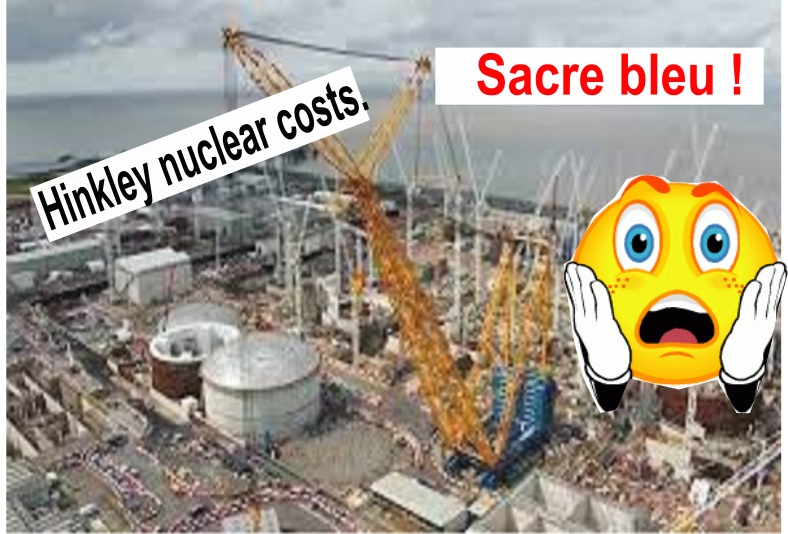
In 2007, when EDF first proposed its Hinkley Point C scheme, an officer with the company predicted locals would be cooking their turkeys using electricity from Hinkley C by Christmas 2017. That’s the same year — in March — that construction eventually began.
The Hinkley C completion date has now been pushed to at least 2030, another deadline extension it probably won’t meet. If the plant does show up in 2030, it will have taken 22 years, 13 longer than planned.
That’s a long time to wait for those new jobs the UK government’s ‘Golden Age’ promised. “Working people will benefit from jobs and growth as companies in the UK and United States sign major new deals that will turbocharge the build-out of new nuclear power stations in both countries,” said that September announcement, embracing yet more hyperbolic rhetoric.
Several days after announcing the new cost hikes at Hinkley, news broke about similarly soaring electricity prices predicted for the Sizewell C nuclear power plant, another French twin EPR plant targeted for the steadily eroding and submerging UK Suffolk coast.
The Sizewell C project was first proposed in 2010 but there are still no shovels in the ground for the plant itself, only site preparation (for that, read tearing up countryside and precious habitat.)
As revealed in an article in the Daily Telegraph, electricity generated from Sizewell C is likely to cost “almost double today’s prices”. The prediction is a staggering $160 per megawatt hour, and that’s according to the government’s own new report.
Incredibly, despite the track record at Hinkley C, with identical reactor designs to Sizewell, this same government report “assumed no escalation in costs” for the Suffolk project. Such an outcome is, to put it mildly, highly unlikely.
In an recent analysis for OilPrice.com, Leonard S. Hyman, an economist and financial analyst, and William I. Tilles, a senior industry advisor and speaker on energy and finance, predicted that “the prospects for new nuclear (both big and small) are deader than the proverbial doornail.”
They viewed the outlook for the so-called small modular reactors that the UK government is poised to green light as even bleaker. (At around 490MW the favored design from Rolls-Royce isn’t actually that small.) Small reactors will have “projected costs that are much higher than gigawatt-scale reactors, making them even less relevant economically,” they wrote.
And yet, the Starmer and Trump governments each press on with their false and fantastical nuclear fantasy plans regardless.
Linda Pentz Gunter is the founder of Beyond Nuclear and serves as its international specialist. Her book, No To Nuclear. Why Nuclear Power Destroys Lives, Derails Climate Progress and Provokes War, can be pre-ordered now from Pluto Press. (Use the scroll menu at the top of the page to select dollars or pounds for payment.)
Pete Hegseth’s War on Journalists (and Iran Too)

Pete Tucker, March 20, 2026, https://fair.org/home/pete-hegseths-war-on-journalists-and-iran-too/
Defense Secretary Pete Hegseth appears to be in the midst of two conflicts, one…in Iran, and the other with the American free press over its coverage of the widening Middle East war.
—MS NOW‘s Sydney Carruth (3/13/26)
Last fall, nearly the entire Pentagon press corps was banned from the Pentagon after refusing to sign Pete Hegseth’s loyalty oath, which would have bound them to only report information “authorized” by the government (FAIR.org, 9/23/25). They were quickly replaced by pundits from Hegseth-approved outlets like One America News, Gateway Pundit and Lindell TV, which is “Pillow Guy” Mike Lindell’s pet project.
But once the Iran War got underway, it dawned on Hegseth that a Defense secretary needs to communicate with the whole country, not just the narrow slice of it reached by his favorite right-wing pundits. So Hegseth reversed course, asking the major networks to bring their cameras back to the Pentagon. They agreed, but on one condition: Some of their reporters had to be allowed to return to the press briefing room, too.
So back they came, albeit now at the back of the room. Few of these reporters—who represent outlets you’ve actually heard of, like ABC, NBC and the New York Times—are called on. Hegseth, a former Fox News weekend host, instead fields questions almost exclusively from handpicked media personalities seated in the front rows. (I’d call them reporters, but if they signed Hegseth’s 2025 oath, as most did, they’re anything but.)
‘Typical gotcha-type question’
When Hegseth stepped to the podium for his first Iran War press briefing on March 2, there was a lot on the line. A skeptical American public wanted to know why President Trump had just launched another regime-change war, the very thing he’d railed against on the campaign trail. But Hegseth had little to offer, aside from “lots of chest-thumping,” a Pentagon reporter told CNN.
For the Q&A, Hegseth “only answered questions from his chosen outlets,” reported CNN’s Brian Stelter (3/4/26), until a journalist in the back lobbed a question about Trump’s changing timeline for the war’s duration. Hegseth initially ignored the interruption, but his anger got the best of him, and he returned to the matter.
“I heard the question about ‘four weeks,’” Hegseth sneered. “It’s the typical NBC sort of gotcha-type question.”
Having veered away from his friendly questioners, Hegseth was off script and had to think on his feet, not exactly a strength.
“President Trump has all the latitude in the world to talk about how long it may or may not take—four weeks, two weeks, six weeks. It could move up, it could move back,” Hegseth said at the opening of a rant that somehow included the word “aperture” and the observation that, “well, I mean, Joe Biden didn’t even know what he was doing.”
‘Only favorable images’
After face-planting at his first Iran War press briefing, Hegseth knew change was needed—only not by him, but with his enemies in the press.
If Hegseth couldn’t kick out any more reporters, who could he get rid of? Scanning the room, he fixed on the photographers.
The Pentagon’s stated reason for banning press photographers after the March 2 briefing was because of space restrictions. But the real reason, the Washington Post (3/11/26) reported, was they took “unflattering” photos of Hegseth.
Now only Pentagon photographers are allowed into briefings, and they are happy to provide the media with approved photos of their boss. Alex Garcia, president of the National Press Photographers Association, told the Post:
Excluding photographers from Pentagon briefings because officials did not like how published images portrayed them shows an astonishingly poor sense of priorities in the midst of a war and is, for a public servant, not a good look…. A free press cannot function if government officials decide that only favorable images of public officials may be created or distributed.
In Hegseth’s March 4 press briefing—without those pesky photographers—he stuck again to his preferred outlets, like the Daily Caller, Daily Wire, Lindell TV and the Washington Times. He also took one question from a mainstream journalist, Tom Bateman of the BBC, who pressed Hegseth on the US bombing of an elementary school in Minab. “We’re investigating it,” Hegseth replied curtly.
‘A snowflake behind a military shield’
Among the many reporters who didn’t get called on was the Atlantic’s Nancy Youssef, although in her case it was because she wasn’t allowed in. “I, along with print photographers, have been denied entry to cover today’s Pentagon briefing,” Youssef wrote on X. “All other media were allowed in.”
By Hegseth’s next briefing, March 19, his banned list had expanded again. “The Pentagon’s own publication, Stars and Stripes, was disinvited from Defense Secretary Pete Hegseth’s latest Iran War press conference—as he continues to clamp down on press coverage,” the Independent (3/19/26) reported.
This came less than two weeks after the Pentagon announced it was taking greater control of Stars and Stripes, a paper Hegseth previously claimed had gone “woke” (Daily Beast, 3/19/26). As former Stars and Stripes reporter Kevin Baron (X, 3/19/26) pointed out, the paper’s
employees are US Army civilians. Their editorial independence is protected by Congress specifically to prevent political leaders from feeding troops propaganda.
“Hegseth spent years on a comfortable Fox News couch building a brand around contempt for the thin-skinned and the easily offended,” wrote Status’s Jon Passantino (3/14/26). “But in office, Hegseth has revealed himself to be exactly that—a snowflake behind a military shield.”
‘An actual patriotic press’
As the US and Israel’s war on Iran continues to worsen, Hegseth’s attacks on the media have also escalated. At his March 13 briefing, Hegseth insisted that “an actual patriotic press” wouldn’t write headlines stating the war is expanding, even as the war has sprawled from an initial three countries—Israel, the US and Iran—to over a dozen.
“Allow me to make a few suggestions,” Hegseth offered. “People look up at the TV and they see banners, they see headlines [like]… ‘Mideast War Intensifies,’” he said. “What should the banner read instead? How about, ‘Iran Increasingly Desperate.’”
Hegseth also singled out a CNN story (3/13/26), headlined “Trump Administration Underestimated Iran War’s Impact on Strait of Hormuz.” That story is “patently ridiculous, of course,” Hegseth said, blithely dismissing the strait’s closure, saying we “don’t need to worry about it.”
Hegseth’s worries were directed elsewhere—at CNN. “The sooner David Ellison takes over that network, the better,” Hegseth said.
Ellison is the 43-year-old nepo baby of billionaire Larry Ellison, a close Trump ally. Having already purchased Paramount, and with it CBS, Ellison is on the verge of closing a $110 billion deal for Warner Bros. Discovery, which owns, among other media and film properties, CNN.
Hegseth’s comments about Ellison taking over CNN “should be a major scandal,” wrote Craig Aaron (Pressing Issues, 3/17/26), co-CEO of Free Press (the media advocacy group, not the right-wing, Ellison-owned outlet of the same name). “But in the chaos of the Trump administration, he’s just a warm-up act.”
‘Sick and demented people’
Indeed, as Trump’s historically unpopular war continues to sour, he’s sought to place blame on a familiar target: news media. Outlets critically covering the war, Trump posted on Truth Social (3/14/26), “are truly sick and demented people that have no idea the damage they cause the United States of America.” The next day (3/15/26), he declared they “should be brought up on Charges for TREASON for the dissemination of false information!” Treason is punishable by death.
Trump’s censorious FCC chair, Brendan Carr, backed up his boss: “The law is clear,” he tweeted (3/14/26). “Broadcasters must operate in the public interest, and they will lose their licenses if they do not.”
Hegseth succinctly outlined what “operating in the public interest” looks like at his March 19 briefing. The press need only say “one thing to President Trump,” he said. “Thank you.”
Drone video from inside a Fukushima reactor shows a hole in pressure vessel, likely fuel debris
Daily Mail. By ASSOCIATED PRESS, 20 March 2026
TOKYO (AP) – A video taken by tiny drones sent into one of three damaged reactors at the Fukushima Daiichi nuclear power plant showed a gaping hole in the thick-walled steel container of the core, with lumps of likely melted fuel debris hanging from it, in a first sighting of a pressure vessel bottom since the meltdown 15 years ago.
The rare footage was taken by micro-drones – measuring 12 by 13 centimeters (4.7 by 5.1 inches) and weighing only 95 grams (3.3 ounces) each – deployed for a two-week mission to collect visual, radiation and other data from inside the Unit 3 reactor. It was released late Thursday.
The March 11, 2011 massive quake and tsunami destroyed cooling systems at the Fukushima Daiichi plant, causing meltdowns at reactors No. 1, 2 and 3.
The three reactors contain at least 880 tons of melted fuel debris with radiation levels still dangerously high. Tokyo Electric Power Company Holdings, which manages the plant, successfully took tiny melted fuel samples from the Unit 2 reactor last year, but internal details remain little known.
TEPCO plans more remote-controlled probes and sampling to analyze melted fuel and to develop robots for future fuel debris removal that experts say could take decades more.
Sending drones as close as possible to the pressure vessel’s bottom was an important goal of the latest probe, according to the plant operator, Tokyo Electric Power Company Holdings……………………………..
TEPCO spokesperson Masaki Kuwajima said officials confirmed there was a hole at the bottom of the vessel and that those hanging objects, lumps and deposits are believed to be melted fuel debris…….
The latest drone mission came nearly a decade after an earlier underwater robot probe provided a less clear picture of the inside of the Unit 3 reactor.https://www.dailymail.co.uk/wires/ap/article-15663749/Drone-video-inside-Fukushima-reactor-shows-hole-pressure-vessel-likely-fuel-debris.html
Coastal erosion raises questions over protection for £40bn Sizewell C nuclear plant

The accelerating pace of coastal erosion after a damaging winter on the UK’s east coast has raised fresh questions over protection for a new £40bn nuclear plant under construction.
19 March 26, https://www.itv.com/news/anglia/2026-03-19/coastal-erosion-raises-questions-over-protection-for-40bn-nuclear-plant
Sizewell C is being built on the Suffolk coast, near the site of two previous nuclear power plants, with an operational and decomissioning timeline stretching for more than 100 years.
But a bruising winter along the coast, which has seen dozens of homes demolished before they fall into the sea, has led to concerns about the wisdom of building the plant on one of the fastest-eroding coastlines in Europe.
Sizewell C said the plant would be built on a “more stable section of the coast between two hard points” and an offshore bank of sediment known as the the Sizewell-Dunwich Bank.
Prof Sir David King, chair of the Climate Crisis Advisory Group, said a secure future for Sizewell lay in adaptable and robust defences.
“The question is no longer should it be built there, because it is being built; but rather ‘How do we protect it?’”, he said.
“I would be constructing a wall around Sizewell B and Sizewell C, and I would see the foundations for this wall going in quite soon.
“Build the foundations now so that in later years, as sea levels rise, we can build them all up to defend appropriately,” he advised.
The plans are for Sizewell C to be built on a platform approximately 7m above today’s sea level.
It will be protected by a sea defence structure more than 14m above today’s sea level, which will take the form of temporary sheet-pile sea defences during construction and will be replaced by permanent structures throughout the plant’s operational lifetime and decommissioning until 2140.
Sizewell C said the plant would be built on a stretch of coastline which had been shown by data to be “comparatively stable”, while the beach will also be enlarged and maintained to form a soft coastal defence.
It adds that it will all be adaptable, meaning if sea levels rise beyond predictions, so too can the defences.
But communities along the coast complain there is an inequality of defence.
While millions are being pumped into defences at Sizewell, others living elsewhere along the coast are being left to fend for themselves and there is a big debate on whether what happens at Sizewell will have an impact on neighbouring areas further down the line.
The campaign group Together Against Sizewell C believes planning approval should not have been granted without Sizewell C demonstrating it had a viable plan to protect the site from an extreme climate change scenario.
Chris Wilson from the group said: “Why was the modelling for flood-risk in the [development consent order] restricted to a site lifetime of 2140 when it was clearly evident that spent fuel would be on site beyond that date?”
“And why was it allowed to be based on an unchanging coastal geomorphology assuming that the protective sand bars… would remain intact throughout the full lifetime of the project?”
There have also been concerns raised about how the defence work to protect Sizewell C will impact further down the coast.
Local resident Jenny Kirtley said erosion had escalated in the past year “far more than anybody thought it would”.
“A worry will be when they start the work out at sea,” she said.
“There will be two jetties built and huge intake and outfall tunnels built under the seabed. We know what’s happened to Thorpeness already. Is this going to make to make it more difficult for Thorpeness? Will these sea defences cause more problems?”
The answers are inconclusive.
Robert Nicholls, professor of coastal adaptation at the University of East Anglia, has studied the coastline for many years.
“The effects of Sizewell become significant if we are forced to protect it”, he said.
“At the current time, Sizewell doesn’t need much protection. So probably I would argue it’s not having a huge effect on its neighbouring coasts, if it suddenly began to erode and you had to protect it, then it might start to have a big effect both on the coast to the north and the south.”
At the village of Thorpeness, 11 families have already lost their clifftop homes to erosion in the last few months.
Residents have been given permission to take matters into their own hands and are raising hundreds of thousands of pounds to place rock bags at the bottom of what is left of the sandy cliff.
But with millions being pumped into defences for Sizewell C, residents want support from the project to help secure their future too.
Dennis Skinner from the Thorpeness Community Interest Company said: “The scientists can do all the studies but, as we’ve seen in the last two months with the amount of erosion here in Thorpeness, I don’t think anyone can be certain about what impact different things are having up and down the coastline
“Sizewell C have got a budget in excess of £50bn, so contributing to Thorpeness will just be a rounding sort of figure.”
A spokesperson from Sizewell C told ITV News Anglia it was monitoring local coastal processes and the situation at Thorpeness.
“We’ve performed thousands of hours of flood risk modelling using the highest plausible estimates for sea level rise and therefore have the highest level of confidence that Sizewell C is in the right location,” they said.
“It’s located on a more stable section of the coast and […] drones are regularly producing 3D maps of changes, coastal erosion, and accretion […] If there are any unexpected developments, we will take action to address them.
“Our assessments show that the power station will be built to withstand a 1-in-10,000-year storm and 1-in-100,000-year surge”.
Roger Hawkins is desperately trying to save his house at Thorpeness from the inevitable erosion.
“We recognise that it’s impossible to defend the whole coast, and there are some areas where you’ve got areas of dense population like towns and docks and infrastructure like Sizewell C, where you can obviously need to have a hard defence.
“But at what point do you stop providing the hard defence?”
UK bets big on homegrown fusion and quantum — can it lead the world?

19 March 2026, Nature, by David Adam
UK government announces multibillion-pound science investments — but what impact will this have on the global race in these fields?
Britain is making an ambitious technological bet. It is investing £2 billion (US$2.66 billion) in quantum-computing development and £2.5 billion in nuclear-fusion energy in a bid to secure technological and energy independence and nurture homegrown scientific talent.
The changes — announced on 16 March as part of an ongoing national science and technology strategy — have been broadly welcomed by the research community. And officials say that the money and increased strategic focus will help to push the United Kingdom to the forefront of both fields globally.
However, some point out that long-term commitments and more money will be needed if Britain is to push past its competitors. Others lament that the funding is not so much a mark of heightened ambition as necessary merely to maintain aspects of the nation’s current scientific capabilities given the disruptive effects Brexit had on its science funding and access to joint European projects.
For example, the United Kingdom withdrew from ITER, a long-running international effort to build an experimental fusion reactor in France.
“You have to go back to Brexit to understand what’s going on now,” says Tony Roulstone, a nuclear-power researcher at the University of Cambridge, UK.
Boost to quantum computing
Officials say that the quantum investment will lay the foundations for the United Kingdom to become the first country to roll out the large-scale use of quantum computers and be the fastest to adopt artificial intelligence in the G7 group of nations.
The £2-billion quantum package aims to support research, infrastructure, skills and commercialization, including funding for hardware and software development, expanded facilities and support for start-ups and industry partnerships.
The government has also pledged to buy and use successful systems as they emerge — echoing the procurement mechanisms used by the United States to promote the development of satellite navigation systems and stealth aircraft.
But Britain faces stiff competition globally. Large-scale quantum computing — systems that offer consistent, practical advantages across multiple sectors — is not yet possible.
Word’s first fusion?
The £2.5-billion fusion investment is similarly ambitious — although how it will compete on a global stage is also unclear. The funds include plans to build a prototype fusion-energy plant called Spherical Tokamak for Energy Production (STEP) on the site of a former coal-fired power station in the centre of the United Kingdom. They also include £45 million for building the nation’s first AI supercomputer dedicated to accelerating fusion-energy research.
Researchers say that STEP is a ‘moonshot’ project, a high-risk initiative that might not prove successful but could still spark scientific breakthroughs. Its aim of producing significantly more power output than the total input — a key requirement for fusion energy — is extremely ambitious.
“It will build a lot of capacity in material science, in magnet engineering, all sorts of things,” says Richard Jones, an experimental physicist who retired last year from the University of Manchester, UK……………………………………………….. https://www.nature.com/articles/d41586-026-00877-2
Israel’s Manipulation of Trump on Iran

The public has noticed who is in charge. According to a soon-to-be-released poll from IMEU Policy Project and Demand Progress, conducted by Data for Progress, voters believe the war is being conducted for Israel’s benefit over America’s by a nearly 2-to-1 margin.
Today on TAP: The worse the Iran war goes, the more blame is likely to be directed at Israel, and by association the Jews.
by Robert KuttnerMarch 18, 2026, https://prospect.org/2026/03/18/iran-israel-joe-kent-trump-netanyahu-antisemitism/
On Tuesday, Joe Kent, director of the National Counterterrorism Center, became the first senior administration official to resign over the Iran war. He resigned not because the war is a debacle, but because of Israel’s role in triggering U.S. involvement.
“I cannot in good conscience support the ongoing war in Iran,” he wrote in a letter to President Trump. “Iran posed no imminent threat to our nation, and it is clear that we started this war due to pressure from Israel and its powerful American lobby.”
Kent has a history of association with far-right white nationalist and antisemitic groups, according to the Associated Press. At the time of his confirmation hearing last February, Rep. Seth Magaziner (D-RI) pointed out, “During his two failed campaigns for Congress, we learned that Kent has ties to white nationalists … [and] sought political support from a Holocaust denier.”
Administration officials and allies spent a frantic 24 hours trying to do damage control, stepping around the question of why a well-documented antisemite should have been given the sensitive post in the first place. The question is doubly awkward, given Trump’s supposed love for the Jews when that posture is convenient to assault universities.
Quite apart from Kent’s record and motives, the issue of Israeli Prime Minister Netanyahu’s manipulation of Trump should be taken seriously. Early in the war, on March 2, Secretary of State Marco Rubio said in a press briefing, “We knew that there was going to be an Israeli action. We knew that that would precipitate an attack against American forces, and we knew that if we didn’t preemptively go after them before they launched those attacks, we would suffer higher casualties.” That’s about right.
Rubio has repeatedly tried to walk that back, but he can’t unsay it. The Israeli attack of February 28, which assassinated top Iranian leaders and effectively set off the war, was reportedly aided by U.S. intelligence, but Netanyahu was determined to launch it whether or not Trump concurred.
Just to rub Washington’s nose in Israel’s habit of escalating war without asking Trump’s permission, on Tuesday of this week top Israeli officials made clear that Trump learned about Israel’s latest assassinations only after the fact. The Wall Street Journal reported, “Israel killed Iran’s security chief, Ali Larijani, in airstrikes Monday night, according to Israel’s defense minister. President Trump would be informed of Larijani’s death, Israel Katz said. ‘Prime Minister Benjamin Netanyahu and I directed the IDF to continue to hunt down the leadership of the terror and oppression regime in Iran and cut off the head of the octopus again and again and prevent it from regrowing,’ Katz said in a statement.”
Let me repeat that, in italics: President Trump would be informed of Larijani’s death, Israel Katz said. Not only was Trump not informed or asked to concur before the assassination. The Israeli defense minister, speaking for himself and Netanyahu, informed Trump via a statement to The Wall Street Journal. That’s even more contemptuous than announcing it on social media, Trump-style. The fact that it was in a deliberate prepared statement means that this was no accidental off-the-cuff blunder. Just yesterday, Israel continued targeting Iran’s leaders, killing the country’s intelligence minister, Esmail Khatib.
The public has noticed who is in charge. According to a soon-to-be-released poll from IMEU Policy Project and Demand Progress, conducted by Data for Progress, voters believe the war is being conducted for Israel’s benefit over America’s by a nearly 2-to-1 margin………..
As the odds increase against Trump finding some kind of exit with dignity, the risk is that he will widen and deepen the war. While Trump is ambivalent, Netanyahu has made it clear that he wants the war to continue, and he acts accordingly. He is just as reckless as Trump, but more strategic.
When a wider war turns into an even bigger crisis, more people who did not start out as antisemites will be inclined to blame history’s favorite all-purpose scapegoats, the Jews. Only in this case, Bibi has provided plenty of ammunition.
Russian hospitals hit, strikes on kindergartens: Does Ukraine think everyone’s distracted by Iran?
At least 23 Russian civilians have been killed in Ukrainian strikes, some using Western-supplied Storm Shadow missiles
13 Mar, 2026 , https://www.rt.com/russia/634854-kiev-strikes-russia-civilians-attention-iran/
On the same day the Ukrainian military used a UK-supplied Storm Shadow missile to attack the city of Bryansk, about 100 kilometers from the Ukrainian border, killing at least seven civilians and wounding at least 42 people. Using such a weapon is impossible without the direct involvement of British military specialists.
On March 8, International Women’s Day and a public holiday in Russia, a family of four, including a six-year-old boy, were killed and twelve others injured by a wave of Ukrainian strikes on the DPR.
On March 6, two people were killed when Ukrainian drone dropped explosives on civilians outside a grocery store in Russia’s Kherson Region. A drone raid on the city of Novorossiysk in southern Russia on March 4 injured seven and caused extensive damage, including to kindergartens.
The DPR, along with the neighboring Lugansk People’s Republic (LPR), seceded from Ukraine following a Western-backed coup in Kiev in 2014. The two territories, along with Zaporozhye Region and Kherson Region, joined Russia following referendums in September 2022.
Civilians in Russia’s border regions have been consistently targeted by Ukrainian drones throughout the conflict, with Moscow accusing Kiev of “terrorism.”
Moscow has insisted that Kiev is attacking civilians because it cannot halt Russian advances on the battlefield. Ukrainian officials claim that inflicting sufficient economic damage will force the Kremlin to abandon its objectives in the four-year conflict.
Beyond civilian casualties, Ukraine has also been attacking energy infrastructure. Pipeline operator Gazprom reported on Wednesday that some of its compressor stations, including one serving the TurkStream pipeline, had been hit. The Russian Defense Ministry has accused Kiev of seeking to disrupt deliveries to European consumers.
‘Iran Posed No Imminent Threat’: Trump’s Counterterrorism Director Resigns in Protest
Trump decided to attack Iran despite Director of National Intelligence Tulsi Gabbard testifying before Congress last year that it “is not building a nuclear weapon,” and that late Iranian Supreme Leader Ali Khamanei—who was assassinated last month by an Israeli airstrike—“has not authorized the nuclear weapons program he suspended in 2003.”
US intelligence agencies have repeatedly come to the same conclusion since the George W. Bush administration.
“I cannot support sending the next generation off to fight and die in a war that serves no benefit to the American people,” the far-right former Army Ranger and CIA officer
Brett Wilkins, Mar 17, 2026, https://www.commondreams.org/news/joe-kent-resigns
National Counterterrorism Center Director Joe Kent announced his resignation Tuesday, accusing President Donald Trump of being manipulated by Israel into launching a war on Iran.
“I cannot in good conscience support the ongoing war in Iran. Iran posed no imminent threat to our nation, and it is clear that we started this war due to pressure from Israel and its powerful American lobby,” Kent—a former Army Ranger and CIA paramilitary officer often described as a white nationalist and conspiracy theorist—wrote in his resignation letter to Trump.
National Counterterrorism Center Director Joe Kent announced his resignation Tuesday, accusing President Donald Trump of being manipulated by Israel into launching a war on Iran.
“I cannot in good conscience support the ongoing war in Iran. Iran posed no imminent threat to our nation, and it is clear that we started this war due to pressure from Israel and its powerful American lobby,” Kent—a former Army Ranger and CIA paramilitary officer often described as a white nationalist and conspiracy theorist—wrote in his resignation letter to Trump.
“Early in this administration, high-ranking Israeli officials and influential members of the American media deployed a misinformation campaign that wholly undermined your America First platform and sowed pro-war sentiments to encourage war with Iran,” Kent continued. “This echo chamber was used to deceive you into believing that Iran posed an imminent threat to the United States, and that should you strike now, there was a clear path to a swift victory.”
“This was a lie and is the same tactic the Israelis used to draw us into the disastrous Iraq War that cost our nation the lives of thousands of our best men and women,” he claimed.
While there is no solid evidence that Israel “drew” the US under then-President George W. Bush into invading Iraq and toppling longtime dictator and erstwhile US ally Saddam Hussein, then-Israeli opposition leader Minister Benjamin Netanyahu said in 2008 that the September 11, 2001 attacks on the United States—which Iraq had nothing to do with—were “benefiting” Israel. He also said two years later that “America is a thing you can move very easily, move it in the right direction.”
Kent, whose first wife, Navy intelligence officer Shannon Smith, was killed in a 2019 bombing targeting US forces invading Syria, said that “I cannot support sending the next generation off to fight and die in a war that serves no benefit to the American people nor justifies the cost of American lives,” said
“I pray that you will reflect upon what we are doing in Iran, and who we are doing it for,” he told the president.
Trump decided to attack Iran despite Director of National Intelligence Tulsi Gabbard testifying before Congress last year that it “is not building a nuclear weapon,” and that late Iranian Supreme Leader Ali Khamanei—who was assassinated last month by an Israeli airstrike—“has not authorized the nuclear weapons program he suspended in 2003.”
US intelligence agencies have repeatedly come to the same conclusion since the George W. Bush administration.
Kent—who has been a staunch Trump loyalist—is the most prominent US official to resign as the president, who infamously campaigned for reelection on a promise of no new wars, has attacked seven countries since returning to the White House and 10 over the course of his two terms.
In contrast to his vehement opposition to waging war on Iran, Kent led an effort to rewrite intelligence so that it did not clash with Trump’s dubious claim that the government of Venezuela was involved with the Tren de Aragua drug trafficking gang ahead of the recent US invasion of the South American country and kidnapping of its president, Nicolás Maduro.
While Kent’s resignation drew praise from many opponents of Trump and the illegal US-Israeli war of choice in Iran, others focused on his troubling record and associations.
“Joe Kent isn’t suddenly a good guy,” former Republican Congressman Adam Kinzinger (R-Ill.) said on X. “He’s a straight-up white nationalist. But there are fissures in the MAGA base.”
MeidasTouch News CEO Ron Filipowski also took to social media, writing, “Just for the record, I’m glad Joe Kent resigned but he is still a POS.”
US Congress near totally complicit in Trump’s criminal Iran war.

Walt Zlotow West Suburban Peace Coalition Glen Ellyn IL 17 March 26
There are 533 congresspersons (2 vacancies) all of whom have allowed Trump to launch his immoral, criminal war on Iran that has failed. Not a single one called out Trump’s criminality before his clear, obvious decision to invade.
Virtually all 271 Republicans are either supportively silent about its criminality or are, like Senator Lindsey Graham and Senator Ted Cruz, ecstatic Trump finally launched the war they have e spent years promoting. Even the lone antiwar Republicans, Senator Rand Paul and Representative Tom Massie, avoid calling out Trump’s criminality by focusing on his usurping Congress’ constitutional power to declare war.
Aside from fanatical Democratic war supporter Senator John Fetterman, the other 261 Democrats oppose the war for two political reasons. They support Rand Paul and Tom Massie’s constitutional argument regarding Congressional primacy in declaring war. But they are more motivated by using the war’s failure and rising US gas prices to demolish the Trump presidency and regain Democratic control of Congress this November. Their cynicism ignoring Trump’s international law criminality killing thousands including 13 US military, causing massive destruction in Iran, Israel and the Gulf States, pushing the world economy into decline is both stunning and reprehensible.
President Trump is a monstrous war criminal who, in a just world, would be answering to his war crimes in the dock at The Hague. But the 533 cowardly congresspersons who either support Trump’s war crimes or simply use them to collapse his presidency are near fully complicit in them. When the war ends and the wages of his sins are totaled up, President Trump can look toward the 533 congresspersons on Capitol Hill and beam…’Couldn’t have done it without you.’
Coalition Grows Against Hochul’s Nuclear Plan
By Karl Grossman South Shore Press 5th March 2026
As Gov. Kathy Hochul pushes to make New York the “center” of a revival of nuclear power in the United States, the third in a series of “Forums for a Nuclear-Free New York” was held last week to counter her drive.
Meanwhile, more than 100 organizations—including Sag Harbor-based Coalition Against Nukes, founded by Priscilla Star, its director, and Huntington-based Healthy Planet, its executive director Bob DiBenedetto—sent an “open letter” to Governor Hochul, with copies to other state officials, pushing back on what it called New York’s “failing energy vision.”
It charged there now is an “increasingly likely failure…of will if not the targets themselves…to meet” the climate goals set by a 2019 state law which emphasizes solar and other renewable energy sources.
The “Forums for a Nuclear-Free New York” have been organized by a coalition of environmental organizations. The first was titled “Safe and Affordable Energy,” featuring Dr. Mark Z. Jacobson, professor of civil and environmental engineering at Stanford University and author of “No Miracles Needed,” a book about how existing green power sources led by solar and wind could provide all the energy the U.S. and world require. Also featured was Joseph Mangano, executive director of the Radiation and Public Health Project, who presented research linking nuclear power plants to cancer and other illnesses in communities near them.
The second forum was titled “Why Nuclear Power is Neither Low-Carbon nor Emissions-Free,” and it featured Susan Shapiro, an environmental attorney, and Dr. Marvin Resnikoff, a nuclear physicist who has worked on radioactive issues in the U.S. and internationally for five decades. A main Hochul claim is that nuclear power is “zero-emission” and thus needed, she says, as an answer to climate change. They countered that the nuclear fuel cycle was heavily carbon-intensive and nuclear power plants themselves emit a radioactive form of carbon, Carbon-14. To claim nuclear is emissions-free “is a fraud on the public,” said Shapiro.
The third forum featured Dr. Gordon Edwards and was titled: “Debunking Nuclear Hopium—Small Modular Nuclear Reactors, Advanced Nuclear Reactors, and Fusion.” Gordon is president of the Canadian Coalition for Nuclear Responsibility. He refuted Hochul’s claim that nuclear power plants are of new “safe” designs, detailing how they continue to be dangerous and expensive………………………………………………………………………………………………………………………………………………..To see and hear the illuminating presentations at the forums, visit: http://www.grassrootsinfo.org/forums
Iran Is Forcing The World To Care About US-Israeli Warmongering
Caitlin Johnstone, Mar 19, 2026, https://www.caitlinjohnst.one/p/iran-is-forcing-the-world-to-care?utm_source=post-email-title&publication_id=82124&post_id=191429893&utm_campaign=email-post-title&isFreemail=true&r=1ise1&triedRedirect=true&utm_medium=email
Israel has bombed the world’s largest natural gas field in southwestern Iran, reportedly in coordination with the United States. Now that a major red line for Tehran has been crossed, retaliatory strikes have already begun pummeling the energy infrastructure of US allies in the region, with Qatar reporting that its primary gas facility has sustained “significant damage” from an attack after Iran issued evacuation warnings for energy facilities in Qatar, Saudi Arabia and the UAE.
Fuel prices are already surging. If middle eastern energy infrastructure starts taking extensive damage on top of the already hugely significant Iranian blockade on the Strait of Hormuz, this war could end up affecting virtually every corner of human civilization in one way or another.
Westerners are largely apathetic about US military explosives landing on populations on other continents. But once it starts having a direct impact on their personal bank accounts, you can expect them to get a lot more interested in US foreign policy.
This war has been a bit odd for me because as an anti-imperialist peacemonger I’m not yet entirely sure what my role is in my commentary here.
Normally I’d be begging westerners to care about another horrific act by the US war machine, but as things stand it looks like westerners are going to be forced to care about this one whether they want to or not.
Normally I’d be writing furiously about how people should not support this war, but the war has exceptionally low public support already.
Normally I’d be trying to help everyone open their eyes and recognize the US warmongers for the psychopaths that they are, but the Trumpanyahu administration is openly waging an unprovoked war of aggression while constantly thumping its chest and boasting about how it’s showing the Iranians “no quarter, no mercy” and saying it can kill whoever it wants with impunity.
Normally I’d be writing about how the mass media are churning out war propaganda to manufacture consent for more US military butchery, but the mass media keep putting out stories about how the US government is lying about a war that should never have happened while Trump administration figures have public tantrums about how the media isn’t churning out war propaganda for them.
President Trump is on social media babbling about how news outlets “should be brought up on Charges for TREASON” for not reporting on an embarrassing story about a US aircraft carrier fire the way he wants, while Secretary of War Pete Hegseth gave one of his fire-and-brimstone podium sermons bitching about how “an actual patriotic press” would be framing this war in a more positive light.
Do you see what I mean? What am I supposed to do with this? Where does that leave dissident fringesters like myself? All I can do is clear my throat and sheepishly go “Uh, yeah, I uh… agree with CNN.”
With Ukraine the mass media fell all over themselves to hide the west’s role in provoking the conflict, framing Putin as an evil maniacal Hitler figure who just spontaneously flipped out and invaded a country on Russia’s border because he hates freedom. With Gaza the western press gave nonstop narrative cover to Israel’s genocidal atrocities, constantly dragging public attention into an endless conversation about antisemitism and Jewish feelings whenever opposition to the slaughter got too hot.
That’s just not happening with Iran. It’s the first US war I’ve ever seen where a big chunk of the imperial power structure just refuses to get on board. The media’s not playing along, US allies are telling Trump to get stuffed when he asks for military assistance with the Strait of Hormuz, and the public’s not buying the lies.
This is a frightening time to be alive — but you can’t say we’re in a period of stasis. Things are moving faster and faster. They might get a whole lot worse. They might get a whole lot better. They might get a whole lot worse and then get a whole lot better. But it seems a safe bet that the situation won’t remain the same.
‘Significant milestone for nuclear sector’ as Hunterston B relicensed for decommissioning
The Office for Nuclear Regulation (ONR) has approved the relicensing of
the Hunterston B nuclear power station, ushering the North Ayrshire site
into its formal decommissioning phase.
From 1 April, Nuclear Restoration
Services (NRS), a subsidiary of the Nuclear Decommissioning Authority
(NDA), will take on full responsibility as site licence holder, replacing
EDF, which operated the Advanced Gas‑Cooled Reactor (AGR) until it ceased
generation in January 2022 after 46 years in service.
This first phase of
decommissioning work at Hunterston B, on the Firth of Clyde, will involve
the removal of all buildings and plant from the site, with the exception of
the reactor buildings and some adjoining structures which will be modified
to create a Safestore structure.
This Safestore is designed to maintain the
reactor buildings in a safe state through the Quiescence phase of around 70
years. Following this, the final site clearance phase will involve the
removal of the reactors and debris vaults housed in the Safestore
structure, making the site available for future use.
New Civil Engineer 19th March 2026 https://www.newcivilengineer.com/latest/significant-milestone-for-nuclear-sector-as-hunterston-b-relicensed-for-decommissioning-19-03-2026/
Scottish National Party face an uphill battle in home of UK’s nuclear subs
FIVE years ago, the SNP fell just one seat short of an overall majority in
the Scottish Parliament, and it perhaps isn’t over-egging the hyperbole to
suggest the one seat in question was Dumbarton.
Of the 11 constituency
seats across the country that the SNP failed to win, Dumbarton was the only
one they should have taken on the basis of national trends. After the
knife-edge result in the previous election, they required less than a 0.2%
swing from Labour to gain the seat, which was below the modest swing from
Labour to SNP of just over 1% that was actually achieved Scotland-wide.
But locally voters bolted in completely the opposite direction, and Labour’s
incumbent MSP Jackie Baillie increased her margin of victory to almost four
percentage points. It can’t be denied that many businesses in Helensburgh
do extremely well out of the presence of a facility that ultimately only
exists to give the UK Government the ability to obliterate foreign cities
at the press of a button.
That very specific type of dependence on the
status quo has created a large segment of the local electorate that is
highly motivated to thwart a party that not only wants Scotland to leave
the UK, but also wants its nuclear weapons to be banished from local
shores.
The National 18th March 2026,
https://www.thenational.scot/news/25948137.snp-face-uphill-battle-home-uks-nuclear-subs/
UK universities getting more enmeshed in the nuclear lobby

Swansea University will play a key role in a new £65.6 million UK Research
and Innovation (UKRI) Doctoral Focal Award in Nuclear Skills, helping to
train specialists essential to future clean energy, national security and
advanced nuclear technologies. As part of DRIVERS (Developing Researchers
with an Interdisciplinary Vision for Engineering Reactor Systems), experts
from the School of Engineering and Applied Sciences will train more than 80
PhD researchers over the next seven years in reactor physics, thermal
hydraulics and through-life structural integrity.
Swansea University 18th March 2026, https://www.swansea.ac.uk/press-office/news-events/news/2026/03/swansea-university-part-of-major-656-million-ukri-investment-to-train-next-generation-of-nuclear-engineers-and-scientists.php
1 This Month

of the week – Shut Down Drone Warfare!


Tell the Ukrainian Government to Drop Prosecution of Peace Activist Yurii Sheliazhenko

Petition to revoke the licensing of the Near Surface Nuclear Disposal Facility (NSDF) at Chalk River. https://www.ourcommons.ca/petitions/en/Petition/Details?Petition=e-7247
To see nuclear-related stories in greater depth and intensity – go to https://nuclearinformation.wordpress.com
-
Archives
- April 2026 (68)
- March 2026 (251)
- February 2026 (268)
- January 2026 (308)
- December 2025 (358)
- November 2025 (359)
- October 2025 (376)
- September 2025 (257)
- August 2025 (319)
- July 2025 (230)
- June 2025 (348)
- May 2025 (261)
-
Categories
- 1
- 1 NUCLEAR ISSUES
- business and costs
- climate change
- culture and arts
- ENERGY
- environment
- health
- history
- indigenous issues
- Legal
- marketing of nuclear
- media
- opposition to nuclear
- PERSONAL STORIES
- politics
- politics international
- Religion and ethics
- safety
- secrets,lies and civil liberties
- spinbuster
- technology
- Uranium
- wastes
- weapons and war
- Women
- 2 WORLD
- ACTION
- AFRICA
- Atrocities
- AUSTRALIA
- Christina's notes
- Christina's themes
- culture and arts
- Events
- Fuk 2022
- Fuk 2023
- Fukushima 2017
- Fukushima 2018
- fukushima 2019
- Fukushima 2020
- Fukushima 2021
- general
- global warming
- Humour (God we need it)
- Nuclear
- RARE EARTHS
- Reference
- resources – print
- Resources -audiovicual
- Weekly Newsletter
- World
- World Nuclear
- YouTube
-
RSS
Entries RSS
Comments RSS
 nuclear-news