2026 George Monbiot Nuclear Greenwash Award goes to the UK Green Party for Abandoning Nuclear Opposition
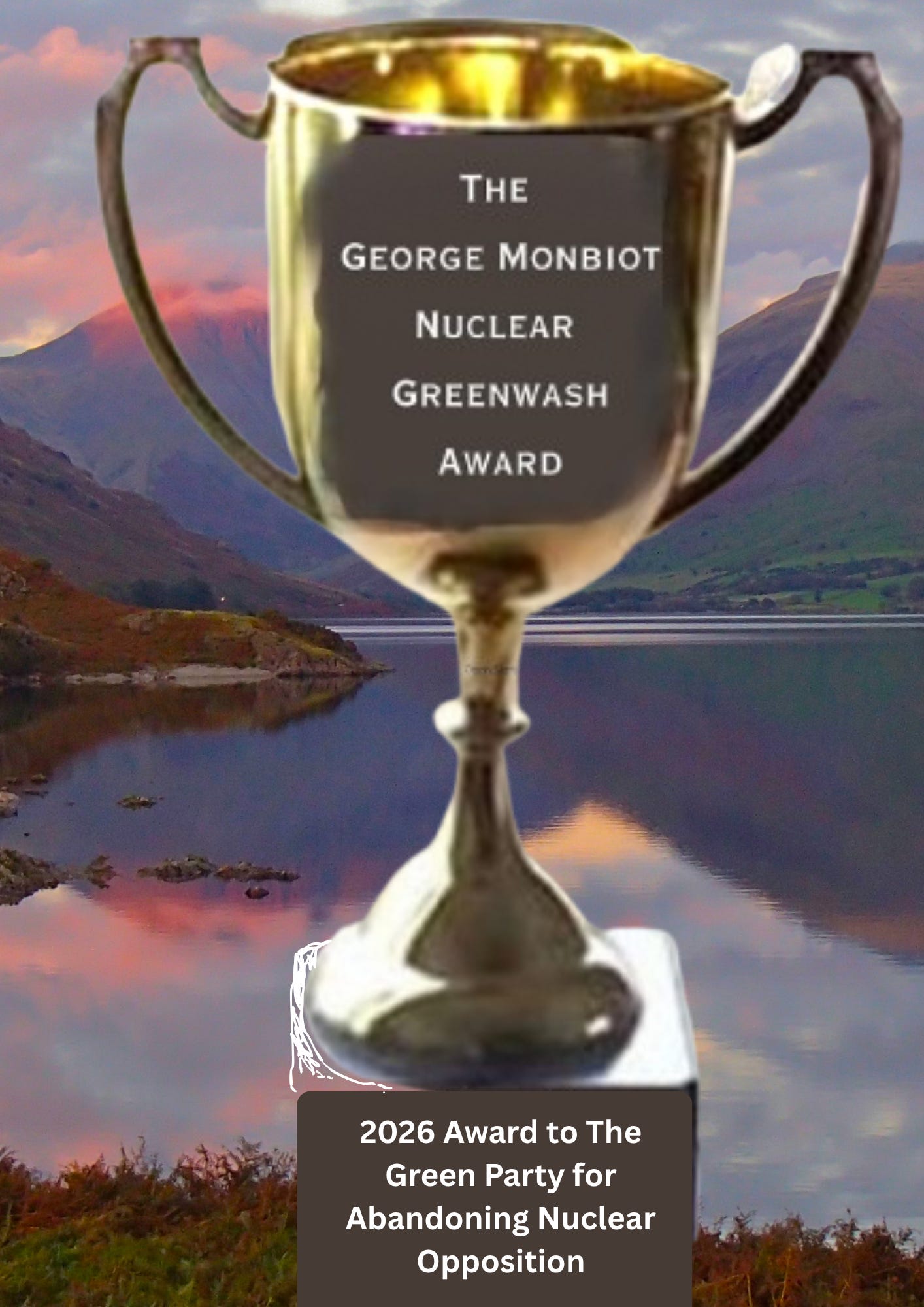
Image: The George Monbiot Nuclear Greenwash 2026 Award to The Green Party for Abandoning Nuclear Opposition. George Monbiot’s famous “I love nuclear” in the wake of the Fukushima disaster deflected an otherwise inevitable crisis of nuclear confidence and was of course key to the push for the building of the first new nuclear plant in the UK in decades at Hinkley C which he now says (after facilitating the damn thing) should be scrapped in favour of, even more dangerous. fast breeder reactors,
Lakes Against Nuclear Dump, Oct 12, 2026, https://lakesagainstnucleardump.com/2026/10/12/2026-george-monbiot-nuclear-greenwash-award-goes-to-the-green-party-for-abandoning-nuclear-opposition/
Just days before the 69th anniversary of the UKs worst nuclear accident to date , the Windscale Fire, the Green Party announced their abandonment of their opposition to nuclear, and with it their reason for being. The Green Party used to call the nuclear industry the “nuclear military industrial complex” for good reason, the “civil” nuclear industry is necessary in order to produce elements for military use, including plutonium, tritium and americium.
Here in Cumbria we won’t notice much difference as the Green Party have spectacularly failed to publicly voice strong opposition or lead any charges against nuclear developments for many years with Green Party members seemingly much more concerned with the horrible nitty gritty of political advancement than protecting the health and wellbeing of the public and our environment from nuclear developments.
Having said that we wait more in hope than expectation to be surprised and delighted by vigorous, strong and principled Cumbrian Green Party opposition to the tsunami of nuclear developments coming our way.
It has not gone unnoticed that despite there being more Green councillors than ever before on Cumberland council, the Council as a whole is like never before, acting as a facilitating arm of the nuclear industry. Cumberland council and its Green Party members are partners in the geological nuclear dump plan and partners in the plan to bring Japanese sodium coolant to Cumbria amongst other things.
Bizarrely the Green Party in Cumbria even had to be persuaded long and hard by Radiation Free Lakeland to oppose the earth quake inducing coal mine near Sellafield with the Green Party’s candidate, in the 2017 Whitehaven hustings Jack Lenox actually saying he was “a big fan of coking coal” this despite its close proximity to Sellafield. The coal mine was finally refused largely on the grounds of induced seismicity.
Professor Chris Busby has this to say: “the Green Party began as an anti-nuclear party in Germany, with Petra Kelly. When I chained myself to the gates of Trawsfynydd Nuclear Power Station in Wales in 1992, Petra Kelly had agreed to come and support our campaign against opening the nuclear site, which was dangerous. The station operators had applied to run the reactors at a high temperature to anneal the cracks in the pressure vessel. This was not long after the experiment at Chernobyl. And the contamination of Wales by Chernobyl (which led to sharp increases in cancer and child leukemia)…..The nuclear police had pistols and we were told they would shoot us. Petra Kelly was assassinated a few months after this. How can I say this? How do I know? Well, of course I don’t know and cannot be sure. But here is something you don’t know about this. The story now widely accepted (look at Wikipedia) is that her man, General Gert Bastiaan killed her.
The police determined that Kelly was shot dead while sleeping by Bastian, who then died of suicide.
Well and Good. But I spoke with Prof Ernest Sternglass about this. He knew both of them, and said it was impossible that Bastiaan would have killed her and himself. They were full of positive energy and life, when he met them in Berlin some 6 weeks before she died. She was very excited. She had received an offer of considerable financial support by German TV to make a series of documentaries with Russian and Belarussian scientists including Dr. Shevchenko, to report on the real health effects of the Chernobyl accident contamination. At the time, the nuclear operators and their tame scientists in the IAEA and the WHO were stating that there were no measurable health effects. It was the same at Fukushima some twenty years later. But back in those days they killed you, rather than using media to destroy your credibility.”
A Shadow of Fear Hangs Over Gazans Amid Israeli Defense Minister’s Threats

October 11, 2026 By Dalia Abu Ramadan, https://scheerpost.com/2026/10/11/a-shadow-of-fear-hangs-over-gazans-amid-israeli-defense-ministers-threats/
This article was originally published by Truthout
Israel Katz says Israel will forcibly displace 1 million Gazans if “even one Israeli soldier” is abducted.
We are about to close out three years and enter another since Israel invaded Gaza, but we are not leaving the war behind to begin a new life. We are entering yet another year without knowing when this war will end — or whether it will end at all.
The fear remains. The destruction remains. The threats remain. It feels as though each passing year does not bring us closer to an end, but closer to the possibility of another war.
Despite everything we are living through in Gaza, we understand what it means to live one day at a time — to hold on to every simple moment we can still have. Imagine planning for another morning, perhaps for the simplest of things: going out with the friends you still have, or taking your family to the sea in the morning, amid all this destruction, simply to experience a moment that feels like life.
Then, as you are planning that ordinary morning, you hear a statement from Israeli Defense Minister Israel Katz, who said on September 22: “If even one Israeli soldier or civilian is abducted, the city of Gaza — with its homes and terrorist towers — will be evacuated southward of its one million residents.”
Words like these are enough not only to disrupt your day, but to shake your entire future. The first question we asked ourselves was: Where would we go? Is there anywhere left for us to go?
“Everyone is talking about how the possibility of an Israeli soldier being captured has become impossible, that it will not happen, and that it could be an excuse to provoke people in Gaza and pave the way for the war to return,” Haneen Salem, a photographer in Gaza City, told me. “I am certain something will happen. No one knows what, but there is a shadow of fear hanging over Gaza’s civilians.”
Even my father said, “Expect it to happen at any moment,” warning that we could be forcibly displaced yet again, especially because we are living through another difficult period in Gaza. The intensity of Israeli bombardment had increased in the weeks leading up to Katz’s statement, and warplanes had not stopped flying overhead at night.
We are being asked to imagine another war while we are still living inside the aftermath of the one that was supposed to have ended.
The so-called ceasefire took effect at noon local time on October 10, 2025. A year has passed since that announcement, but the war has not ended. It is true that the intensity of the escalation and displacement has eased compared to the height of Israel’s war, but the bombardment and destruction have continued. So, what does it mean to hear threats of the war returning with the same ferocity when we have not even begun to recover from what has already happened?
When the “ceasefire” was announced, I believed the war would end as the wars of 2021, 2014, and previous years had ended — with a clear conclusion, a moment when we would know that the war was truly over. I expected that, immediately after the announcement, we would begin clearing the rubble, rebuilding what had been destroyed and slowly putting our lives back together.
But that did not happen.
Instead, it felt as though the war continued in another form, behind the scenes — a reality visible only to the people of Gaza who have been living through its consequences every day. Today, we still have not recovered. Even the most basic medical necessities remain unavailable, the siege is tightening, and the consequences of the war continue to surround every part of our lives.
The collapse of the Al-Sadah building in Tal al-Hawa is one example of what this unfinished recovery looks like. The building had been home to approximately 80 displaced Palestinians. In the early hours of September 16, it collapsed, with parts of the structure also falling onto nearby buildings and tents that were sheltering other displaced families. Rescue teams initially estimated that around 100 people, including at least 50 children, were trapped beneath the rubble. After rescue operations ended, Civil Defense teams confirmed that 21 people had been killed, including 12 children and five women, while 45 injured people were taken to hospitals.
With rubble left uncleared and too little being done to address the dangers left behind by the destruction, many partially damaged buildings across Gaza have been left standing in a fragile state, at risk of collapsing at any moment.
The Al-Sadah building had sustained structural damage from Israeli bombardment during the war and was struck several times in 2024 and again in March 2025. Civil defense teams had warned residents not to return to the building. Yet some had no other choice but to live there. With tents and homes unavailable, displaced Palestinians have been forced to shelter in cracked and damaged buildings, despite the risk that they could collapse around them.
But the danger does not end when people are pulled from the rubble. Those who survive still face a health system struggling to meet even the most basic needs. As World Health Organization Director-General Tedros Adhanom Ghebreyesus said on September 24, “Essential medicines, diagnostics, equipment and fuel remain in critically short supply.”
These shortages are not limited to life-saving medicines and hospital equipment; they reach into the most ordinary forms of care, turning even a visit to the dentist into a struggle.
It may be one of the most basic forms of health care, but anyone who has experienced severe tooth pain knows how unbearable it can be — especially as poor nutrition and the effects of prolonged hunger have taken a toll on people’s dental health.
“Getting dental supplies and materials into Gaza has become extremely difficult,” dentist Dr. Ghalib Zimmo told me. “And when they do enter, they are prohibitively expensive. The cost of dental materials has risen to 10 times what it was before the war.”
The consequences are painful. “Many patients come to us needing root canal treatment, which can involve unbearable pain,” Dr. Ghalib said. “But because of the cost, they choose to have the tooth extracted instead of treating it.”
“Before the war, a root canal cost around $40,” he explained. “Now, it can cost as much as $250.”
Imagine how deeply exhausted we have become. We search for medicine, and it is not there. We search for wheelchairs for those who have lost limbs in the war, and they are not there. We search for the simplest things that make life possible, and they are not there.
Fear has become part of the way we respond to every sound. Sometimes, when we hear a sudden noise, we immediately think it is the sound of a missile just before it strikes. We can even find ourselves startled by the sound of a chair moving.
We are living with a trauma that no one can truly feel the way we do. Three years of relentless bombardment have left their mark on us. We search for life itself, and we cannot find it.
Ukraine’s worst diplomatic nightmare just got closer
The fuel deal’s real significance lies in diplomacy: Trump and Putin found a way to work together without making Ukraine part of the bargainPublished 11 Oct, 2026 12:36 | Updated 11 Oct, 2026 13:40
11 Oct, 2026 , By Sergey Poletaev, information analyst and publicist, co-founder and editor of the Vatfor project, https://rt-english.com/russia/647043-ukraine-diplomacy-trump-putin/
On the evening of October 9, the presidents of the United States and Russia spoke by phone. The announcement that followed was straightforward: Russia would sell the US 1.8 million metric tons of diesel over the next three months, followed by a million tons a month, and the US would issue temporary licenses authorizing the shipments.
The news drew a furious, bordering on hysterical, response from Kiev and stunned silence from Europe.
Let’s look at why this deal matters, what it has to do with Ukraine, and what might come next.
The tug-of-war championship
Ever since US President Donald Trump returned to office, the central aim of Russian diplomacy has been to separate relations with the US from the Ukraine issue. The White House is open to the idea, too: The US needs Russia as a counterweight to China, and there are substantial economic opportunities. But as we explored in an earlier piece, until recently, neither side managed to pull it off.
Ukraine and its supporters in Europe and the US, meanwhile, have pursued the opposite goal: keeping US-Russia relations tied to the Ukraine conflict.
In February and March 2025, Trump relieved America of responsibility for Ukraine’s fate and handed the job of financing it squarely to Europe. The US retained just three commitments: the relatively modest military supply programs already approved under former President Joe Biden, intelligence sharing, and weapons sales for cash, with Ukraine waiting in line like any other customer.
This maneuver cemented a status quo that neither Europe and Ukraine on one side nor Russia on the other would allow to change, with their respective allies in the US also weighing in. Everyone tried to bring Trump over to their side on Ukraine. Nobody succeeded.
This is why the understandings reached in Anchorage went nowhere: Ukraine’s supporters torpedoed them. It is also why those supporters failed to use Trump to escalate the conflict. Russia prevented deliveries of Tomahawk missiles, the expansion of Starlink coverage over Russian territory, and so on.
Despite the apparent stalemate, Russian officials kept talking to Witkoff and Kushner. The aim was to maintain a channel to Trump and deny Ukraine’s supporters an opening to drag the US back into the war on their side or steer him back onto Biden’s course.
This is why Russian officials at every level distinguish between US and European actions, often explicitly contrasting the two.
A few numbers on oil
Russia is one of the world’s largest diesel exporters, supplying just under 40 million metric tons to the global market in 2025. On July 8, 2026, Ukrainian attacks on Russian refineries prompted a temporary ban on diesel and gasoline exports.
Since then, Russia’s refining situation has improved considerably. Gasoline remains in short supply, but a domestic diesel surplus has emerged, and the export ban has begun to loosen in practice. According to Reuters, diesel deliveries to Central Asian countries were already up 19% in September.
A few numbers on oil
Russia is one of the world’s largest diesel exporters, supplying just under 40 million metric tons to the global market in 2025. On July 8, 2026, Ukrainian attacks on Russian refineries prompted a temporary ban on diesel and gasoline exports.
Since then, Russia’s refining situation has improved considerably. Gasoline remains in short supply, but a domestic diesel surplus has emerged, and the export ban has begun to loosen in practice. According to Reuters, diesel deliveries to Central Asian countries were already up 19% in September.
The Krivoy Rog school of diplomacy
Back to geopolitics. Until yesterday, Russia had been unable to separate its relationship with the US from the Ukraine issue. Even the war with Iran failed to do the trick, despite keeping oil and petroleum product shipments from the Persian Gulf blocked for more than six months.
Help came from an unexpected quarter. Hoping to bring US diesel prices down at least a little before the congressional elections, Trump asked Zelensky to stop attacking Russian refineries.
Zelensky responded by demanding a sweeping energy truce. We’ll stop hitting refineries, he effectively said, if Russia stops attacking our energy infrastructure and blockading our ports. And you, Trump, have to supply us with missiles for our Patriot systems, and so on.
Getting nowhere with Zelensky, Trump struck a deal directly with Russian President Vladimir Putin, who offered to supply diesel in exchange for a suspension of sanctions, without any preconditions.
The transaction itself is not particularly consequential. Yes, it could cool speculative trading ahead of the elections and push prices down somewhat. But the 1.8 million metric tons due to arrive over three months will cover just three or four days of American consumption.
For Russia, the US is an ordinary customer in purely commercial terms. Moscow will make some money selling to America, but it could just as easily have sold these volumes elsewhere. Petroleum products are in short supply worldwide, while Russia has a diesel surplus.
Yet the deal gave both sides what they had been seeking since February 2025: a bilateral relationship detached from Ukraine. So far, that applies to just one specific issue, but getting started is the hard part. Zelensky tried to twist Trump’s arm, pushing him to make Putin stop bombing Kiev, and overplayed his hand. Now Kiev can be bombed relentlessly, and Trump has no reason to care. He got what he wanted.
This does not mean sanctions are finished or that the two powers are entering an era of warm friendship. Oil sanctions are probably here to stay, and as soon as global market conditions change, Washington will turn them back up to full blast. But the sanctions wall can now be taken apart brick by brick, restoring ties wherever both sides stand to gain: launching new energy projects in the Arctic, for example, jointly taking over the surviving Nord Stream 2 pipeline, or resolving the sale of Lukoil’s overseas assets. Ukraine no longer has anything to do with that process or any influence over it.
The art of the backroom deal
Cynics insist that the Trump administration is a complete mess, with the right hand oblivious to what the left is doing. The way this agreement came together suggests otherwise.
After the campaign of long-range strikes against Russia went badly off script, Zelensky once again tried to secure a ceasefire through Trump. He has been trying since early 2025, with no success, but he still held out hope.
Trump could have publicly given Zelensky the boot again. But on Ukraine, he faces opposition not only from Congress but also from parts of his own administration. And an election is just around the corner.
Instead of staging a public showdown, Trump’s team spent more than two months visibly engaged in intensive talks with Ukraine about an energy truce. His envoys, Witkoff and Kushner, traveled to Kiev, and Trump himself showered Zelensky with compliments. In reality, all of it proved to be a screen for a quiet, swift, informal deal with Moscow.
It has since emerged that the first tanker carrying diesel to the US left St. Petersburg on September 22 and is expected to reach the US any day now. In other words, the deal was already well advanced three weeks ago, and both sides were confident it would go through.
That takes some skill. This episode shows that Trump keeps a firm grip on his team and can prevent leaks when he needs to. Even Rubio, prone to breaking ranks, played his part exactly as the boss wanted.
And once the deal was done, there was no longer any need to smile at Zelensky in public. The masks came off. For the first time, Trump publicly declared that Ukraine needs a new president and must hold elections.
The liberal media will inevitably say that Trump is repeating Russian propaganda narratives. In fact, he was saying what he thinks.
The diesel deal does not mean Moscow and Washington will now live in perfect harmony. The differences between them are deep and fundamental, and the recently enacted ‘Graham law’ makes lifting any sanctions impossible for at least the next five years.
But this Friday, Putin and Trump finally managed to get past Ukraine and leave it behind. US-Russia relations now depend on Russia and the US alone.
Putin’s Strong Message to Europe at the Valdai Club: Stop the March Towards War
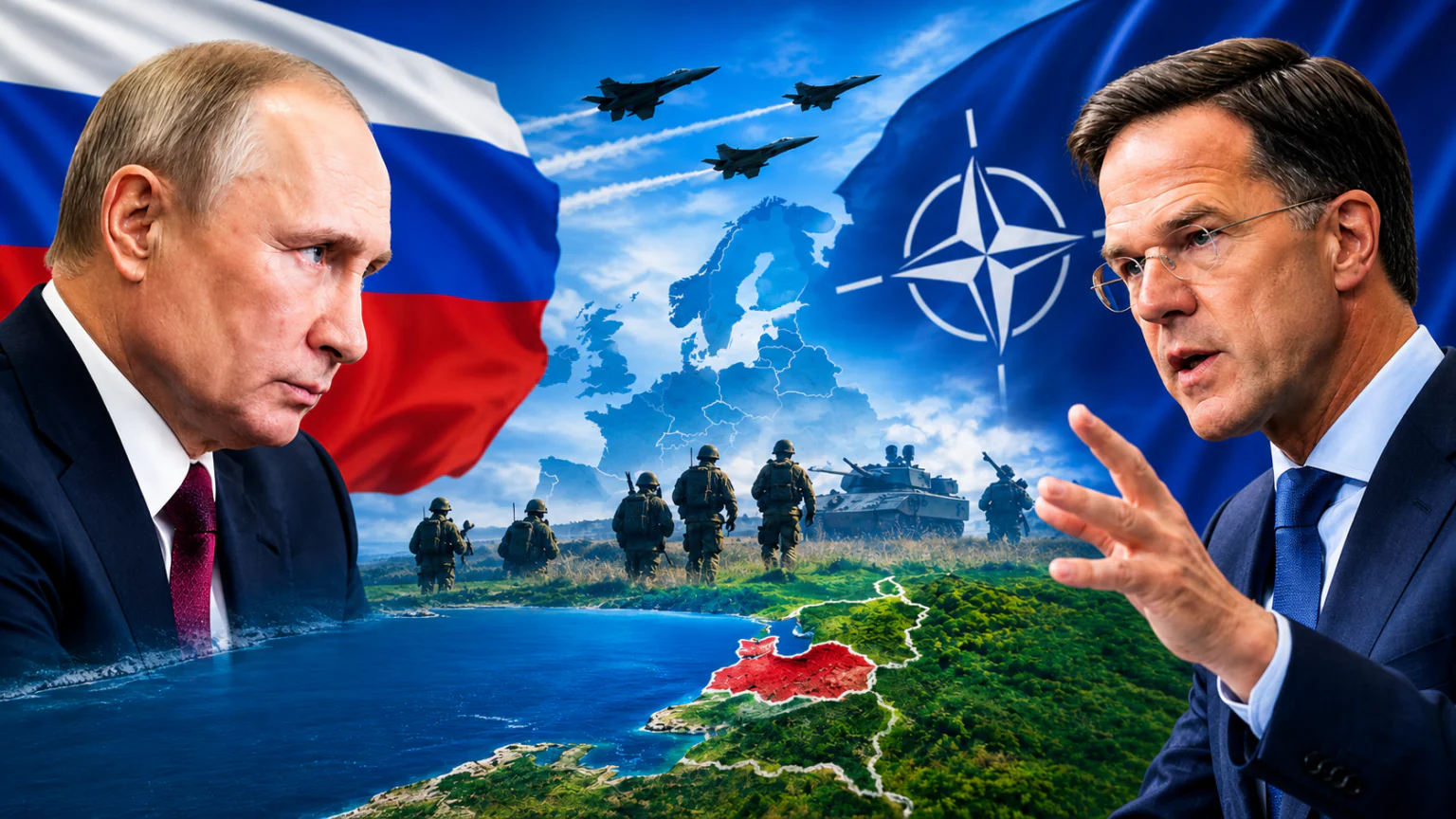
If Russia is weak and having military difficulties, if Putin is intimidated, if NATO is considerably stronger and if there is no immediate threat of a Russian attack, then why is European public opinion always being prepared for a major war?
Europe should therefore pose itself a simple question: is Russia really about to attack NATO — or is Europe preparing for a war that its own rhetoric is helping to make it more plausible?
Ricardo Martins, New Eastern Outlook, October 09, 2026
As NATO Secretary General Mark Rutte and European leaders increasingly warn of a looming Russian threat, Vladimir Putin used the Valdai Discussion Club to deliver a very different message: Europe is feeding an escalation spiral it may no longer be able to control.
Europe is being told to prepare for war, and the rearmament is being crafted as an economic and political project in itself. Europe is manufacturing a permanent war psychology while simultaneously insisting that Russia poses no imminent military threat.
Mark Rutte, the Secretary General of NATO, has on several occasions told that Russia might at some point launch an attack on NATO territory. The European governments are currently considering matters relating to hybrid attacks which can result in a large number of casualties, the establishment of new security arrangements and how to deal with a major confrontation with Moscow. The tone being used is becoming more and more dramatic, alongside unprecedented defence spending record levels.
With this background in mind, Vladimir Putin gave his reply at the Valdai Discussion Club.
His view was not that war was certain, rather it was the opposite—he advocated stopping the escalation before war became irreversible.
Putin’s argument is that Europe is trapped in a dangerous cycle in which military exercises, sanctions, weapons deliveries, threats and counter-threats are producing precisely the escalation that European governments claim they want to prevent.
This clear message is even more evident in what he said regarding Kaliningrad.
Rutte’s Russia narrative: threat, fear and rearmament
Mark Rutte is now one of the most prominent voices in Europe when warning about Russia.
In June 2025 he famously said to the Europeans: “You should learn to speak Russian or spend more on defence”, on the grounds that the possibility of future Russian aggression would mean a need for considerably increased defence spending over cuts on social security and pensions. He then warned that Russia might be ready to use military force against NATO within five years and, more recently, has spoken of Russia “testing us throughout Europe” as well as accusing Moscow of carrying out hybrid attacks, sabotage and attempts to split up the Alliance.
There is an extraordinary contradiction in Rutte’s most recent rhetoric.
On 30 September he stated that Putin was “a bit worried and a bit rattled” since the situation in Ukraine was supposedly not progressing well. He stressed that “Putin is not winning this” and claimed that Putin could never defeat NATO. At the same time, however, Rutte admitted that there was no immediate threat to NATO territory.
Then what is Europe actually getting ready for?
If Russia is weak and having military difficulties, if Putin is intimidated, if NATO is considerably stronger and if there is no immediate threat of a Russian attack, then why is European public opinion always being prepared for a major war?
It is worth posing that question.
The European public is being asked to agree to increased military spending, which could mean cutting back on social priorities, while at the same time a continuous state of insecurity is being fostered concerning Russia. The political message is remarkably consistent in telling people to spend more, to arm more and to get ready more – because Russia might launch an attack.
Fear is a highly effective political tool.
The issue is that fear may also come true on its own.
Putin’s warning over Kaliningrad
When asked about the increasingly aggressive rhetoric concerning Kaliningrad, Putin was especially straightforward.
He denied the notion that Russia was attempting to intimidate Europe, stating that Moscow’s warning was in fact ‘a response to an attempt to intimidate us‘.
He specifically referred to the European statements concerning preparations for a possible war with Russia in 2029 or 2030, the NATO exercises in the Baltic region, and the attempts to detain Russian vessels.
His argument is that this constitutes an escalation, and he gave a warning that was remarkably serious.
According to Putin, if Kaliningrad were the object of a direct attack or blockade, Russia would have to consider putting into use “all the forces and means at our disposal”. He made it clear that this was not necessarily a threat to employ nuclear weapons, but rather an assertion that Russia would make use of whatever measures it regarded as necessary for its defence.
It is exactly the kind of statement which European governments should take seriously — not since it is certain that Russia intends to attack Europe, but because a military confrontation between nuclear powers leaves little room for miscalculation.
The main thing that Putin warned about was an escalation.
His analogy was in the form of a spiral since provocative actions led to countermeasures, these countermeasures in turn caused further escalation, and eventually the process could get to a stage at which no one was completely in control.
That is the true danger.
What is the reason why Europe needs Russia to be its permanent enemy?
Putin’s more general explanation extends beyond Ukraine.
He contends that Europe has never really settled the security arrangements that followed the end of the Cold War. Rather than establishing a true pan-European security structure, NATO extended itself eastward and as a result Russia became increasingly excluded from the European security system.
He referred to Egon Bahr, the late German Social Democrat, who in 1990 had warned that if the division of Europe into hostile blocs was not overcome the Soviet Union would be isolated and a highly unfavourable future would result.
For Putin, Bahr’s warning was foretelling.
He also looked at how relations declined during NATO’s intervention in Yugoslavia, as a result of NATO’s enlargement, the changes that took place after the breakup of the Soviet Union and finally in the case of Ukraine. Even if one does not agree with this view, it does show a consistent way of understanding the past three decades from the Russian perspective: Russia has on numerous occasions sought integration with the West, found that this was not desired, and has in the end come to the conclusion that the European order that emerged after the Cold War was designed against Russia.
That is the reason why the message that Putin gave at Valdai was not merely about Ukraine. The main topic was the future of Europe.
Europe’s war preparation may be hiding a deeper crisis………………………………………………………………..
Putin’s answer: the world is changing
The most important aspect of Putin’s speech at Valdai was not Ukraine. It was his conception of the future international order.
Putin stated that the world is moving from Western hegemony towards a multipolar international system and that this transformation is inevitable, adding that the former hegemony would eventually have to acknowledge the reality of a world in which Asia, Africa, Latin America, the Middle East and other centres of power demand a greater role.
This is the point at which Europe must make its real strategic choice.
It can continue to base its security mainly on NATO, move ever more closely in line with Washington’s strategic priorities and regard Russia as a permanent adversary.
Alternatively, it could try to regain what Europe once said that it stood for: strategic autonomy, diplomacy, and the ability to build bridges between opposing powers.
Putin’s vision is not the kind of vision held by liberals in Europe. It does not have to be one that Europeans accept without question. It is rather a vision of a world which is no longer arranged around a single dominant centre, and Europe will not be able to stop this transformation.
The choice Europe still has
The Valdai speech concluded with a warning which should be heard well beyond Moscow.
The greater the extent to which the confrontation becomes uncompromising and the more openly the strategic defeat of an opponent is declared, the more likely it is that the conflict will reach its most dangerous stage. He cautions against arrogance, overconfidence and the uncontrolled escalation of reciprocal responses.
This is no appeal for Europe to give in. It is a plea to acknowledge the consequences of confrontation.
Europe should therefore pose itself a simple question: is Russia really about to attack NATO — or is Europe preparing for a war that its own rhetoric is helping to make it more plausible?
Rutte states that there is no immediate Russian attack that NATO is much stronger, and that Putin is intimidated and that Russia is having difficulties.
Then why the hysteria? Why the permanent mobilisation? Why the preparation for a war that nobody claims is imminent?
At Valdai, Putin made it clear that the world is changing, that multipolarity is inevitable, and that military escalation is not a replacement for diplomacy.
Although Europe may reject Putin’s worldview, but it cannot ignore his warning. Because the greatest danger is not necessarily that Russia wants a war with Europe. It may be that, after years of escalating rhetoric, Europe forgets how to prevent one. https://journal-neo.su/2026/10/09/putins-strong-message-to-europe-at-the-valdai-club-stop-the-march-towards-war/
Guam Grapples With Pollution As US Military Keeps Expanding
To people who live in Guam, the ongoing Pentagon buildup in the Pacific offers a warning.
Honolulu Civil Beat, By Grist, October 12, 2026
This story by Anita Hofschneider was originally published by Grist and was published in partnership with The Intercept.
Leevin Camacho was brushing his teeth one day last fall when his mother called. The water is contaminated, she said. Moments later she texted him a photo of a flyer issued by the local water authority. “Cancer risk,” it warned. “Increased likelihood of adverse impacts on the liver.” And in bold capital letters, “DO NOT DRINK.”
Camacho stared at the message. Water flowed from the faucets as his children, who were 10 and 12, gulped and spit, their faces reflected in the mirrors above the two bathroom sinks.
Thumbing at his phone, Camacho googled dieldrin. The results included words like “organochlorine” and “insecticide” and “persistent environmental pollutant” that the United States had banned in 1987. Worse, high levels had been detected in his community’s water since at least 2008. “Our kids have been drinking the water,” he realized. “They’ve been cooking with the water for almost their entire lives at this point.”
Today, Guam sits at the center of an ongoing military buildup, one that is reshaping the island even as it spreads across the Pacific. On Yap, more than 1,000 graves could be disturbed to make way for an American seaport and airfield. Indigenous leaders on Palau are suing to protect their lands. Less visible but just as impactful are the climate impacts of this expansion. The Pentagon is already the world’s largest institutional emitter of greenhouse gases, and its buildup will do more than contribute to the destruction of the region’s reefs, forests, and Indigenous sacred sites. It will accelerate the climate crisis that threatens the survival of Pacific islands.
To people who live in Guam, the ongoing Pentagon buildup in the Pacific offers a warning
Camacho lives in Yigo, a northern village on the island of Guam. In time, he would learn that the U.S. Air Force base next to the well serving his house had reported “very high levels” of the pesticide, which it had listed as a “chemical of concern” since at least 1993. The Pentagon’s investigation, led by officials at Joint Region Marianas, is in its early stages. Local officials caution that although they suspect the base is a source of the pollution, there may be others because dieldrin was once widely used.
For Camacho, the news felt like the unfolding of a familiar story — one both predictable and infuriating.
Camacho had grown up as an Army brat, raised to think of the United States as Guam’s liberator from Japan during World War II. But over the past two decades, his understanding of that legacy has changed.
“There are certain actions that the military takes that are contrary to the interests of the people who are from Guam and who live in Guam,” said Camacho, whose measured tone rarely changes, even when discussing something as emotional as what his children have been drinking.
To Camacho, dieldrin is the latest reminder that the people of Guam continue to bear the costs of militarization. Unexploded ordnance litters jungles and lagoons. PCBs contaminate the fish. Pollutants taint the groundwater. The island and its people, who are U.S. citizens, have been inalterably changed by more than a century of American military presence.
Rear Admiral Brett Mietus, the head of Joint Region Marianas, the U.S. Navy’s regional command for Guam and neighboring islands, said he can’t speak to past pollution but the command is committed to protecting the environment and the people of Guam.
“We spend a lot of time and we spend a lot of money making sure that we meet every U.S. regulation when it comes to anything that we’re going to do here,” he told Grist. “We’re meeting every letter of every law for environmental regulations and rules, and we’re doing that while we’re spending a ton of money to defend this island from the most advanced missiles in the world.”………………………………………………………………………………………………………………………………………………………………………………………………………………………………………………….
To Flores, more military presence on Guam heightens the risk of war. In March, President Donald Trump’s decision to bomb Iran prompted military bases on the island to raise their threat level. She feels that, as in World War II, the Indigenous people of Guam are expendable in a broader contest between empires. “What are they really here to protect if there’s so much harm taking place? Are we just collateral damage?” she said. “Because just looking at our history of being occupied by war, being used for weapons testing, it feels like the message is that we don’t matter. Our future doesn’t matter. Our survival doesn’t matter.”……………………………………………………………………………………………………………………………………………………………………………………………………………………..
“We’re faced with the reality that we’re part of a larger strategic vision,” conference organizer and former Guam congressman Robert Underwood said. “All of you are in someone’s strategic plans whether you know it or not, whether you like it or not. All of us are in someone’s strategic plan.”
In Palau, Indigenous people are fighting the Pentagon’s expansion in local courts and international forums. Leaders of Angaur, one of 16 states there, filed a lawsuit accusing the U.S. of violating environmental rules and its treaty with the island nation when it cleared land for a radar facility. Indigenous chiefs from Peleliu are suing to prevent a land transfer that would support American goals. Indigenous Palauan youth filed a complaint at the United Nations alleging the U.S. military violated their right to free, prior, and informed consent to what happens on their land…………………………………………………………………………………………………………………………………………………………….
A Plebiscite On Guam’s Status?
…………………….Camacho wants a plebiscite to determine Guam’s political status. He believes the island’s status as a U.S. territory — without a vote for president or voting representation in Congress — isn’t working………………………………………………………………………………………………..https://www.civilbeat.org/?p=1814370&utm_source=Civil+Beat+Master+List&utm_campaign=4226d57df6-EMAIL_CAMPAIGN_2025_05_12_05_31_COPY_01&utm_medium
Rosatom and Finland’s Fennovoima claim different wins after tribunal ruling
By Reuters,Reporting by Anastasia Lyrchikova, Additional reporting and writing by Alessandra Prentice Editing by Ros Russell, Alexandra Hudosn October 11, 2026,
https://www.reuters.com/business/energy/rosatom-says-it-wins-tribunal-ruling-finnish-nuclear-plant-dispute-2026-10-10/
– Russia’s state nuclear corporation Rosatom and Finnish utility Fennovoima each highlighted different parts of an International Chamber of Commerce (ICC) tribunal ruling as favourable on Saturday, in a long-running dispute over the cancelled Hanhikivi-1 nuclear power project.
The parties have been locked in legal disputes since Fennovoima scrapped the 7-billion-euro ($7.8 billion) project in May 2022, citing significant delays and political risks shortly after Russia launched its conflict in Ukraine.
Rosatom said the tribunal found that Fennovoima had unlawfully terminated the contract for the construction of the planned plant in northern Finland.
“Today’s victory is important, but not final. We will continue to prove that we are right regarding the Finnish project in courts of various instances,” Rosatom Director General Alexey Likhachev said in a statement, which did not refer to any financial outcome.
Fennovoima said the tribunal found that it had not been entitled to terminate the contract, but that it was entitled to receive reimbursements of advance payments and interest in excess of 1 billion euros ($1.12 billion).
It said the tribunal offset both sides’ claims, resulting in Rosatom subsidiaries being ordered to pay Fennovoima a net 606 million euros plus interest.
The ICC did not immediately respond to a request for comment.
The contract to build the 1.2 gigawatt plant was signed in 2013 with Fennovoima, a consortium in which Finnish stakeholders including Fortum, Outokumpu and SSAB originally controlled two thirds through a joint venture, and the Russian side held one third.
After the project’s termination, Fennovoima wound down its operations and is primarily engaged in legal proceedings.
War puts Iran’s nuclear ambiguity under scrutiny
A revisionist argument is emerging in Tehran over Iran’s nuclear strategy:
that its longstanding policy of nuclear ambiguity failed its most important
test when it did not deter the United States and Israel from attacking, and
should now be reconsidered. Nezamoddin Mousavi, a former conservative
lawmaker with longstanding ties to the Islamic Revolutionary Guard Corps
(IRGC), gave unusually explicit expression to that argument this week,
declaring that “nuclear ambiguity did not prevent war” and raising the
prospect of revisiting Iran’s nuclear doctrine and even its membership in
the Nuclear Non-Proliferation Treaty (NPT).
Iran International 10th Oct 2026,
https://www.iranintl.com/en/202610106118
Underground nuclear reactor clears hurdle, but critics say it doesn’t have solid finances

Deep Fission, the company planning a one-mile underground nuclear reactor
in Parsons, Kansas, has passed a regulatory milestone, but at the same time
is facing new financial questions. A financial research organization has
raised questions about the viability of the project.
Then, four stockholder
rights law firms throughout the U.S. launched investigations of the company
after its share price dropped. The progress and challenges could mean an
unclear path forward for the project. Deep Fission’s goal as of right now
is to do further testing at the site. Company officials remain optimistic
and say the criticisms are prompted by financial motivations from the
people making the claims.
LJ World 10th Oct 2026, https://www2.ljworld.com/news/state-region/2026/oct/09/underground-nuclear-reactor-clears-hurdle-but-critics-say-it-doesnt-have-solid-finances/
Officer numbers rise at Civil Nuclear Constabulary
AN ARMED police force guards some of the UK’s most sensitive sites, including Sellafield in Seascale, and data reveal that over the last six years its officer count has grown by more than 10 per cent.
Carlisle News & Star 10th Oct 2026,
https://www.newsandstar.co.uk/news/26620384.officer-numbers-rise-civil-nuclear-constabulary/
China’s Uranium Enrichment Expansion: Worrisomely Large
October 5, 2026 Dr. Hui Zhang, Senior Research Associate at Harvard’s Belfer Center, Occasional Paper 2603
China recently significantly expanded its uranium enrichment capacity. The predominant view of experts and respected non-governmental organizations is that this expansion is needed to supply China’s growing civilian nuclear energy sector.
As of September 2026, China had 64 power reactors (64 GWe) in operation and another 38 units (40 GWe) under construction, making it the world leader in new reactor construction. Its 15th Five-Year Plan (2026–2030) calls for installed nuclear capacity of 110 GWe by 2030, and some authoritative Chinese studies recommend reaching roughly 200 GWe by 2040. China’s nuclear power program is therefore expected to grow steadily over the coming decade, and with it the country’s demand for enriched uranium.
To meet this anticipated demand, China has significantly expanded its indigenous enrichment capacity since 2020. Over the same period, however, China has also rapidly enlarged its nuclear arsenal, raising the question of whether its enrichment buildup serves civilian needs alone. The Federation of American Scientists (FAS) estimates that China possessed about 620 warheads in 2026. The US Department of Defense (DoD) assesses that the stockpile remained “in the low 600s” through 2024—roughly triple its 2020 level—and, while noting “a slower rate of production compared to previous years,” projects that China remains on track to field more than 1,000 warheads by 2030. Much of the Western debate has focused on whether China needs additional plutonium to sustain this buildup. Much less attention has been paid to highly enriched uranium (HEU), which China may also need for new warheads, at least for the secondaries of its modern designs.
Assessing these questions is difficult because China does not officially release information on its enrichment capacity. This paper therefore draws on satellite imagery, Chinese publications, and discussions with Chinese experts to reconstruct the scale and trajectory of China’s enrichment program. Building on the author’s earlier estimates, it incorporates several significant developments, including the commissioning of new centrifuge facilities. By the end of 2026, China’s commercial enrichment capacity is estimated to reach about 15.4 million separative work units (SWU) per year—roughly 2.1 times its 2020 capacity of about 7.4 million SWU/year, or more than a doubling in six years.
This growth has not been steady. After an initial construction boom between 2010 and 2015, undertaken to meet the anticipated growth in demand from nuclear power, the China National Nuclear Corporation (CNNC) slowed its expansion between 2016 and 2019, suspending or postponing several planned or partially built projects, largely in response to slower reactor construction. Since around 2020, China has launched a new construction boom. Whereas the earlier expansion was driven primarily by civilian nuclear power, this paper argues that the current wave serves not only civilian needs but also, and importantly, China’s ongoing nuclear weapons buildup.
The remainder of this paper is organized as follows. Section 2 reviews the development of China’s enrichment industry and technology. Section 3 presents the current status of each of China’s enrichment plants and new capacity estimates. Section 4 compares enrichment supply with civilian demand, estimates how much HEU China would need for an arsenal of 1,000 warheads, and examines whether the timing of the enrichment expansion is consistent with China’s nuclear buildup. Section 5 concludes……………………………………………………………………………………………………………………………………………………………………………………………………………………………………………………………………………………………………………………….. https://npolicy.org/wp-content/uploads/2026/10/Chinas-Uranium-Enrichment-Expansion-Worrisomely-Large.pdf
Huckabee aide suppressed, doctored US cables to whitewash Israeli crimes: Report

Reports on slain Palestinian US citizens and rampant settler violence were buried or rewritten to praise Netanyahu instead
News Desk, OCT 8, 2026, https://thecradle.co/articles/huckabee-aide-suppressed-doctored-us-cables-to-whitewash-israeli-crimes-report
A senior aide to US Ambassador to Israel Mike Huckabee has been blocking and rewriting embassy reports to Washington to whitewash Israeli crimes in the occupied West Bank and Gaza, the New York Times reported on 8 October.
David Milstein, who joined the US embassy in Jerusalem in April 2025 and serves as a de facto chief of staff to Huckabee, oversees much of the mission’s work on the West Bank and Gaza.
According to a dozen people who deal with him in Jerusalem and Washington, he has used that role to repeatedly suppress or doctor cables on illegal Israeli settlement expansion, settler attacks, the killings of Palestinian US citizens, and deadly aid distribution in Gaza.
Among the reports Milstein buried was a March embassy review of the killings of nine Palestinian US citizens by Israeli settlers and soldiers in the West Bank over four years. The latest, 19-year-old Nasrallah Abu Siyam, was shot dead by a settler in February as he tried to stop the theft of his village’s livestock.
The review was compiled after 30 members of Congress, led by Senator Chris Van Hollen, pressed Secretary of State Marco Rubio for answers. It found that most investigations had gone nowhere, some had been closed, and not one person had been charged.
Rather than send it, Milstein pushed for a reply assuring lawmakers that Israel was handling the cases properly. The State Department letter that reached Van Hollen on 4 May withheld the findings, pointing instead to the embassy’s wartime focus on security cooperation with Israel.
“If you don’t get accountability, you endanger more American citizens,” Van Hollen said.
In the summer of 2025, Palestinians seeking food were being shot dead en masse at the sites of the so-called Gaza Humanitarian Foundation (GHF), a US-Israeli scheme that turned aid distribution into a death trap and killed at least 1,400 aid seekers.
As the killing went on, embassy diplomats warned Washington that the operation risked further mass casualties; however, Milstein rewrote the cable to hail it as a success, erasing the dead from the record entirely.
In April – after senior Israeli commanders warned that surging Israeli settler attacks across the occupied West Bank could spark a new Palestinian uprising – Milstein blocked staff reports relaying the warning, and Washington instead received a cable under his name crediting Netanyahu with cracking down on the violence.
In February, when Israel revoked long-standing legal barriers to Israeli land purchases in the occupied West Bank, a move condemned internationally as fast-tracking annexation, the embassy told Washington the policy served settlers’ “humanitarian needs,” without explaining further.
Milstein also reportedly subjected colleagues to loyalty tests, demanding to know whether they were “pro-Israel” or “pro-Hamas,” four officials said, leaving staff afraid to speak.
Under his watch, some stopped writing reports altogether rather than see them censored, and cables on Palestinian affairs dwindled from several a week to a handful a month.
French submarine fires new nuclear weapon
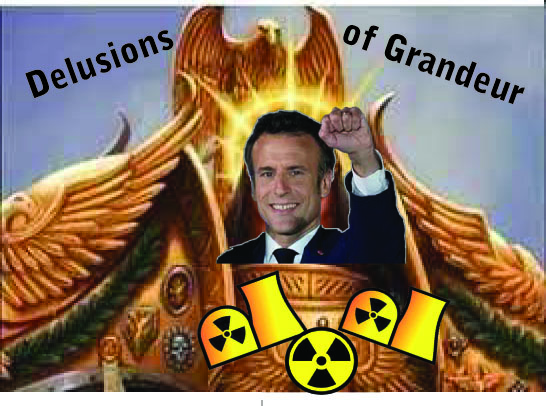
France has fired its latest submarine-launched ballistic missile for the first time from the boat Le Vigilant, with President Emmanuel Macron watching from the deck of a frigate, the president stated in a post published after the launch.
UK Defence Journal 6th Oct 2026,
https://ukdefencejournal.org.uk/french-submarine-fires-new-nuclear-weapon/
Writing in French from aboard the multi-mission frigate Auvergne, Mr Macron said: “Aboard the multi-mission frigate Auvergne, I witnessed the first firing of the new M51.3 ballistic missile from the nuclear-powered ballistic missile submarine Le Vigilant. Very few nations possess such expertise.”
He thanked the defence procurement agency DGA, the Atomic Energy Commission, ArianeGroup, Naval Group and the French Navy, and said: “This technical success is a new demonstration of the credibility of our deterrence, whose sustainability is assured. To be free, one must be feared. And to be feared, one must be powerful.”
The missile was launched off Finistère in western Brittany without a nuclear warhead fitted, and flew to a designated impact area in the North Atlantic several hundred kilometres from any coastline. France has described the trial as validating the operational capability of Le Vigilant’s strategic weapon system after a long refit, and the boat has recently emerged from the major overhaul the French call an IPER before returning to the deterrent patrol cycle.
The M51.3 is the third operational version of the missile, which was declared in service last October with improved range, accuracy and penetration performance over the preceding M51.2, and carrying the newer TNO warhead. ArianeGroup builds the family, which entered service in 2010, and the missiles arm the four boats of the Triomphant class. A further version, the M51.4, was contracted to the same company in August last year and is expected during the next decade, alongside the third-generation submarines that will replace the current fleet.
Published range figures for the M51 run to somewhere between 8,000 and 10,000 kilometres, though France does not confirm them and the real figure is classified.
Mr Macron set the firing against his own record on defence spending, saying he had launched the renewal of French capabilities in 2017 and that the armed forces budget will have doubled over ten years. He added that the programme for hypersonic and manoeuvring strategic missiles that will arm the airborne component of the deterrent was launched this year, a reference to the weapon intended to succeed the ASMP-A carried by Rafale squadrons.
France designs, builds and owns every element of its deterrent, from the warhead through the missile to the boat, whereas the Royal Navy draws its Trident II D5 missiles from a common pool held at King’s Bay in Georgia.
The two countries are also closer on nuclear matters than they have been at any point since the war. Under the Northwood Declaration signed last year, Britain and France agreed to coordinate their deterrents and stated that there is no extreme threat to Europe that would not prompt a response by both, which was the first time either had said so in those terms.
Mr Macron closed by saying that French nuclear deterrence “protects us and will continue to protect us”.
Timeline for Polish nuclear units slips in updated programme

Last October, state-owned public power company PGE signed a preliminary agreement to become the sole shareholder of PGE PAK Energia Jądrowa SA by acquiring the 50% stake held by ZE PAK.
Under the updated programme, the first unit is now scheduled to start commercial operation in 2036, and the plant expected to reach full capacity by 2038 – three years later than previously planned.
WNN, 5 October 2026
Poland’s Council of Ministers has adopted an update to the country’s nuclear power programme – a strategic document outlining the development of nuclear energy in Poland – with the first nuclear power plant now expected to start up in 2036 and the second one in 2040.
In September 2021, it was announced that six large pressurised water reactors with a combined installed capacity of 6-9 GWe could be built by 2040 as part of the country’s plan to reduce its reliance on coal. According to the adopted schedule, the construction of the first nuclear power plant would start in 2026, with the first reactor – with a capacity of 1.0-1.6 GWe – being commissioned in 2033. Subsequent units would be implemented every 2-3 years. The coastal towns of Lubiatowo and Kopalino in Poland’s Choczewo municipality in the province of Pomerania were named as the preferred location for the country’s first large nuclear power plant.
In parallel, work is under way to build a second nuclear power plant with Bełchatów and Konin remaining the preferred locations. The final location selection will be made by the investor after detailed analyses and field studies.
The ministry said a competitive dialogue is under way to select a technology supplier and project contractor. The USA, France, and Canada have joined the process. “The goal is to select a comprehensive offer encompassing both technology and project financing under the best possible terms,” it said. Key milestones for the second power plant are: the selection of strategic partner and technology in 2027; construction to start around 2032; and the first unit to start up around 2040 – one year behind the previous schedule.
………… “It is estimated that Polish companies could contribute approximately 40% of the project’s value during the construction of the first reactor. With the development of subsequent units, as expertise, experience, and the number of certified companies grow, this share could rise to approximately 70%.”
In November 2022, the Polish government announced the first plant, with a capacity of 3,750 MWe, would be built in Pomerania using Westinghouse’s AP1000 technology. An agreement setting a plan for the delivery of the plant was signed in May 2023 by Westinghouse, Bechtel and Polskie Elektrownie Jądrowe (PEJ)…………………………………………………………………..
The ministry said the update provides increased funding for tasks related to the implementation of nuclear energy: support for building competencies in the field of nuclear energy, support for the participation of Polish industry in the Polish Nuclear Power Programme, and strengthening the nuclear regulatory institution, that is, the National Atomic Energy Agency (NAEA). It noted support for the NAEA constitutes the largest financial component of the Polish Nuclear Power Programme………
For the project to construct the first plant – for which preparatory work at the construction site and the implementation of accompanying infrastructure is under way – PLN60.2 billion (USD15.4 billion) has been allocated for the project’s recapitalisation between 2025 and 2030. The financing model assumes a combination of equity and debt financing supported by domestic and international institutions.
Under the updated programme, the first unit is now scheduled to start commercial operation in 2036, and the plant expected to reach full capacity by 2038 – three years later than previously planned.
…….. “It is estimated that Polish companies could contribute approximately 40% of the project’s value during the construction of the first reactor. With the development of subsequent units, as expertise, experience, and the number of certified companies grow, this share could rise to approximately 70%.”
The update to the programme indicates key areas of state action to ensure effective implementation of the programme: development of staff and competences for the nuclear sector; development of transmission infrastructure; increasing the share of domestic industry; strengthening the nuclear and technical supervision system; radioactive waste management; and communication and social education.
Alongside the government’s nuclear power programme, in October 2022, Poland’s Ministry of State Assets, South Korea’s Ministry of Trade, Industry and Energy, ZE PAK and PGE, and Korea Hydro & Nuclear Power signed a letter of intent to develop plans for a nuclear power plant in Pątnów. PGE PAK Energia Jądrowa – a 50/50 joint venture special purpose vehicle formed in April 2023 by ZE PAK and PGE to implement the project – submitted an application for the plant to the Ministry of Climate and Environment in August 2023.
The application included a description of project characteristics, indicating the maximum installed capacity, the planned operating period and details of the APR1400 technology to be used in the construction of the plant. In November 2023, Poland’s Ministry of Climate and Environment issued a decision-in-principle for the plant. Last October, state-owned public power company PGE signed a preliminary agreement to become the sole shareholder of PGE PAK Energia Jądrowa SA by acquiring the 50% stake held by ZE PAK.
There are also plans, led by SGE, for a fleet of as many as 26 BWRX-300 small modular reactors in Poland.
Chernobyl Drone Attacks Gamble With Safety of Millions, UNDP Warns
By Catherine Sadler
Law News 28th Sept 2026
Chernobyl drone attacks are ‘really gambling with the safety of millions of people’, United Nations Development Programme (UNDP) administrator Alexander De Croo warned on Thursday, following a visit to the Chernobyl Nuclear Power Station where he inspected damage firsthand. His warning comes after the International Atomic Energy Agency (IAEA) GOV/2025/11 report concluded that the New Safe Confinement (NSC) enclosing Unit 4 can no longer perform its primary safety function of containing radioactive material from the 1986 explosion.
‘Whether it was a deliberate attack or an accident, this is something which is unacceptable,’ De Croo said. ‘Making sure that drones are not flying above that site is one way of avoiding that things like this could happen.’ He called for urgent international action, stressing that Russia had not been acting in line with international humanitarian law and that ‘even in war, there are rules to be followed.’
The Escalating Pattern of Chernobyl Drone Attacks
The IAEA’s assessment, prepared following a comprehensive safety review requested by Ukraine’s State Nuclear Regulatory Inspectorate (SNRIU), found that a drone strike on 14 February 2025 struck the upper part of the NSC arch, causing fire and structural damage. According to the American Nuclear Society, the strike left a hole larger than 500 square feet in the outer cladding, with efforts continuing to extinguish isolated smouldering areas of the structure’s insulation material.
The pattern of incursions has continued into 2026. According to the IAEA’s GOV/2026/7 report, three drones were detected within five kilometres of the site on 20 January 2026, causing the loss of four off-site power lines for the day; two further drones were detected within five kilometres on 5 February; and eight drones were detected within the monitoring area across 13 and 14 February. On 7 June 2026, a Russian drone struck a building storing spent nuclear fuel near Chornobyl, according to NucNet. …………..
The IAEA has maintained a continuous support and assistance mission at the Chornobyl site since January 2023, deploying additional staff in 2025 to conduct its safety assessment of the damaged NSC, as confirmed in IAEA Director General Update 330. Temporary repairs to restore a degree of confinement function are under way in 2026, with support from the European Bank for Reconstruction and Development (EBRD), according to IAEA Director General Update 331. Full restoration remains contingent on the end of the conflict.
The Chernobyl site’s history makes the current position acutely serious. The 1986 disaster, classified as a level 7 nuclear event, occurred after a reactor went out of control during a poorly managed routine safety test, killing 31 people directly. The IAEA projected that radiation released could lead to around 4,000 cancer-related deaths among those within the affected radius, and between 1991 and 2005 documented at least 5,000 cases of thyroid cancer in children under 14 in Belarus and Ukraine, linked to severe radiation exposure………………………………………………………………………………………………………………………………………………..
With the NSC unable to contain radioactive material and drone incursions continuing, the IAEA’s next reporting cycle and any Security Council response to De Croo’s intervention will indicate whether international pressure translates into enforceable restrictions on airspace above the site. https://www.lawnews.co.uk/legal-news/chernobyl-drone-attacks-gamble-with-safety-of-millions-undp-warns/
British nuclear submarines to use hoses in ‘worst case scenario’ defence despite Russia threat
A Navy source has claimed that high-powered hoses mounted on docked HMS Vanguard submarines are being factored into the defence of the top-of-the-line £3 billion vessels
Liam Doyle, 09 Oct 2026,
https://www.mirror.co.uk/news/uk-news/british-nuclear-submarines-defence-37755122
Britain’s most advanced nuclear submarines only have hoses to protect them from drone incursions, it has been reported.
Vanguard class submarines, the pinnacle of the Navy’s underwater fleet, have “centre-fed reels”, a type of hose connected to a drum that can launch powerful streams of water through a trigger system. They are mainly used to tackle onboard fires, but it has now been claimed that they are also being deployed to fend off drones.
An insider has said submarine crews now “have to use what you’ve got”, while the Government insists its most vital military units are properly protected.
The reels are reportedly placed on deck as a precaution while submarines are tied up alongside the HMNB Clyde in Faslane, Helensburgh, Scotland, a source told the Sun. While there, they are swathed in several layers of defence, including the base’s specialist counter-drone capabilities, patrols, surveillance, monitoring and physical barriers.
But the source claimed the hoses are also meant to factor into the defence, stating: “In a worst case scenario, the plan is to grab the centre fed hose reel and use it to knock a drone off course or even knock it down.”
The hoses, according to official documents, are designed for use primarily to tackle different types of fires and can be found on several different vessel types. An MOD Defence Standard states they are placed on HM Ships, Submarines or Fire Schools “as a first appliance against Class A & B fires”.
Class A fires are caused by solid combustibles, while Class B fires are started by flammable liquids like petrol, diesel or paraffin.
The claims come as drones are increasingly fielded in military conflicts, having found routine use in Ukraine, where they are helping turn the tide of war against Russia, and in Iran. They have also strayed further into eastern Europe, with two ships hit by sea and air drones off the coast of Bulgaria earlier this week.
Officials launched a massive search and rescue operation for missing crewmembers following the incident in the Black Sea on October 6 in which the vessels sent distress signals at around 4am local time (2am BST).
One of the pair “disappeared” from the radar of border police at around 9am local time (7am BST). Rescue teams were able to retrieve 18 sailors on the second vessel, with two of them seriously injured. The remaining 16 crew are reportedly in “good condition”. The origin of the drones has not yet been established.
Bulgarian prime minister Rumen Radev said: “I can’t say yet which country the drones are from, but it’s clear – they’re either Russian or Ukrainian.”
The Royal Navy has also recently brushed with drones, with HMS Dragon having faced them down in the Mediterranean and Red Sea. The Type 45 destroyer spent seven months away protecting UK interests this year by shielding bases in Cyprus, providing maritime security and working with allies and partners across the Middle East.
It returned to Portsmouth today, with General Sir Gwyn Jenkins, the First Sea Lord and Chief of Naval Staff hailing the deployment as showing “the Royal Navy at its best”. Responding to the hose claims, an MoD spokesperson said the Government is taking military security “extremely seriously”.
They said: “The first duty of Government is national security, and we take the security of our people, sites and local communities extremely seriously, in particular those housing nuclear capabilities.
“The protection of our bases is kept under constant review, with a multi-layered approach that includes physical barriers, patrols, surveillance, monitoring, and counter-drone capabilities. Through the Defence Investment Plan, we are investing an additional £470million over the next four years to strengthen the protection of UK military sites.”
1 This Month
23-25 October – on Zoom – World BEYOND War’s annual global conferenc


Shut down the radiation-damaged Heysham nuclear reactors now
To see nuclear-related stories in greater depth and intensity – go to https://nuclearinformation.wordpress.com

Say No to NASA’s Reckless Nuclear Reactor on the Moon
Say No to NASA’s Reckless Nuclear Reactor on the Moon

-
Archives
- October 2026 (247)
- September 2026 (339)
- August 2026 (330)
- July 2026 (355)
- June 2026 (287)
- May 2026 (306)
- April 2026 (356)
- March 2026 (251)
- February 2026 (267)
- January 2026 (308)
- December 2025 (358)
- November 2025 (359)
-
Categories
- 1
- 1 NUCLEAR ISSUES
- business and costs
- climate change
- culture and arts
- ENERGY
- environment
- health
- history
- indigenous issues
- Legal
- marketing of nuclear
- media
- opposition to nuclear
- PERSONAL STORIES
- politics
- politics international
- Religion and ethics
- safety
- secrets,lies and civil liberties
- spinbuster
- technology
- Uranium
- wastes
- weapons and war
- Women
- 2 WORLD
- ACTION
- AFRICA
- Atrocities
- AUSTRALIA
- Christina's notes
- Christina's themes
- culture and arts
- Events
- Fuk 2022
- Fuk 2023
- Fukushima 2017
- Fukushima 2018
- fukushima 2019
- Fukushima 2020
- Fukushima 2021
- general
- global warming
- Humour (God we need it)
- Nuclear
- RARE EARTHS
- Reference
- resources – print
- Resources -audiovicual
- Weekly Newsletter
- World
- World Nuclear
- YouTube
-
RSS
Entries RSS
Comments RSS

