Nuclear Tug of War Intensifies in Brussels
With money and regulations on the table for renewable energy, the EU has become entrenched into two solid blocs with different stances on nuclear power.
Bridget Ryder — April 3, 2023 The European Conservative
With both a package of incentives for green technology and revisions to the Renewable Energy Directive on the table, the fight in Brussels over the place of nuclear power in the ‘green,’ ‘sustainable,’ ‘clean’ energy landscape—and its corresponding regulation—has intensified.
The bloc’s energy ministers met last week to prepare their negotiating points with the EU Parliament over changes to the Renewable Energy Directive. Prior to the March 28th Council meeting, energy ministers pow-wowed in competing breakfast gatherings—one for the French-led nuclear alliance and the other for the Austrian-organised Friends of Renewables group, Euractiv reports.
Nuclear alliance
At the end of their meetings, the nuclear alliance sent out a press release to notify the media—and presumably, both the Commission and their rivals on the EU Council—that they had agreed that nuclear energy was indeed “strategic” in achieving the EU Commission’s environmental goals. This is the opposite position to the one the Commission has taken in the recently proposed Net Zero Industry Act (NZIA), a set of incentives meant to counter U.S. green tech subsidies.
Under French leadership, the nuclear alliance (consisting of Bulgaria, Croatia, the Czech Republic, Finland, Hungary, the Netherlands, Poland, Romania, Slovakia, and Slovenia) first met in February while the Commission was still preparing the NZIA. Its goal was to promote nuclear power as a low-carbon source of electricity and work on “common industrial projects.”
In mid-March, the Commission presented the NZIA draft, but with nuclear power excluded from the list of “strategic” technologies that would qualify for incentives. The one exception was “cutting-edge nuclear” technology, such as small modular reactors (SMRs) which could qualify for some investment incentives. The alliance then met again in March, just before the meeting of energy ministers on March 28th, and announced that they had “fully recognised that nuclear is a strategic technology for achieving climate neutrality.”
The pro-nuclear breakfasts were attended by Italy and Belgium, though only as observers. The two countries made it clear they had not signed on to any agreed position with the group, though they have reasons for desiring a favourable status for nuclear energy.
Belgium, for its part, has had to retract plans to start shutting down the country’s six nuclear reactors. After announcing the closure of a set of nuclear power plants by 2025, the public outcry forced the energy ministry to instead grant them a ten-year extension. ………………..
Friends of renewables
The Friends of Renewables—Estonia, Spain, Germany, Denmark, Ireland, Luxembourg, Portugal, Latvia, and Lithuania, with Austria as leader—are a clear counterweight to the nuclear alliance.
The compromise
After the breakfast gatherings, the two groups had to come together with the rest of the bloc’s member states for the official EU Council Meeting to settle on a negotiating position for the updates to the Renewable Energy Directive (RED).
The nuclear sticking point was whether hydrogen produced using nuclear power should be included in renewable fuel targets. After hours of back and forth, they agreed to label nuclear-produced hydrogen as “low carbon,” in other words, dirtier than ‘green’ hydrogen but better than the ‘brown’ hydrogen linked to fossil fuels.
Nuclear power enters into the debate about renewables in the question of hydrogen gas. Making the gas ‘green,’ a process of separating the hydrogen from water molecules, requires an energy source. When that source is considered ‘green,’ such as solar or wind power, the hydrogen is considered ‘green.’
Negotiators for the EU Parliament then also made room for nuclear power in the Renewable Energy Directive (RED), admitting that it has a “role” to play in reducing carbon emissions and is in a category of its own in the spectrum of environmental friendliness.
The RED now recognizes “the specific role of nuclear power, which is neither green nor fossil,” French MEP Pascal Canfin, chair of the Parliament’s Environment Committee, who participated in the negotiations, tweeted…….
The political agreement reached by the Council and Parliament calls for doubling renewable energy output by 2030.
“The agreement raises the EU’s binding renewable target for 2030 to a minimum of 42.5%, up from the current 32% target and almost doubling the existing share of renewable energy in the EU. Negotiators also agreed that the EU would aim to reach 45% of renewables by 2030,” the Commission said in a statement about the political agreement on the RED.
‘Renewable’ energy currently makes up just over 20% of the bloc’s energy mix.
Further room was made for nuclear by provisions in the agreement by giving member states two options to calculate achieving certain targets: either emission reductions or renewable energy output. This is an advantage for countries like France that have substantial nuclear capacity, as carbon dioxide is not the major by-product of nuclear power production. https://europeanconservative.com/articles/news/nuclear-tug-of-war-intensifies-in-brussels/
Opponents pack Pilgrim Nuclear meeting as potential discharge of radioactive water looms
CAI | By Jennette Barnes, March 28, 2023
Opponents of the proposed discharge of radioactive water from the Pilgrim Nuclear Power Station packed a meeting on the future of the station last night.
Ryan Collins of Bourne received a standing ovation from the audience when he presented a thick binder of signatures from his Change.org petition. The petition calls for a stop to the discharge plan. It garnered more than 200,000 signatures.
The state’s Nuclear Decommissioning Citizens Advisory Panel hosted the meeting at Plymouth Town Hall as part of its regular calendar.
…………………………………… opponents argue that the terms of a state settlement with Holtec would make a release of contaminated water illegal, with or without a permit.
Many members of the audience held orange signs that read, “Protect our bays! No permit!” in reference to the proposed modification of Holtec’s permit under the National Pollutant Discharge Elimination System.
Jo-Anne Wilson-Keenan, of East Dennis, said she’s concerned about contamination. Speaking from the podium, she raised her arm to show the shape of Cape Cod and the location of Dennis.
“We live right here in the elbow, and when the radioactive water comes down from Plymouth, it’s going to land right on our beaches,” she said.
Jim Cantwell, state director for U.S. Sen. Ed Markey, discussed Markey’s March 17 letter to Holtec asking the company to use the ratepayer-funded decommissioning trust fund to pay for an independent scientific study of the risks of discharging the radioactive water stored at Pilgrim.
Last May, at a field hearing hosted by Markey in Plymouth, Singh agreed to allow independent testing.
Meanwhile, state-supervised testing of the Pilgrim water is set to begin with a collection of samples on April 5. Senior staff from the Massachusetts Department of Environmental Protection and Department of Public Health are scheduled to observe, along with a representative of the town of Plymouth.
But Seth Pickering, a deputy regional director with DEP, said the state no longer plans to use the previously identified Colorado lab, Eurofins, to test for non-radioactive pollutants.
The agency will instead rely on Gel Laboratories of South Carolina, which Pickering disclosed is a lab Holtec uses as well.
Members of the audience objected to the idea of using the same lab as Holtec……………. https://www.capeandislands.org/local-news/2023-03-28/opponents-pack-pilgrim-nuclear-meeting-as-potential-discharge-of-radioactive-water-looms
Inside Saudi Arabia’s Global Push for Nuclear Power
Despite qualms in Washington, Saudi officials have pressed the United States to help them develop nuclear power. But they are also exploring other options, including China.
NY Times, By Edward Wong, Vivian Nereim and Kate Kelly, This article was reported from Washington and Riyadh, Saudi Arabia. April 1, 2023
For years, Saudi Arabia has pressed the United States to help it develop a nuclear energy program, as Saudi leaders look beyond oil to power their country.
But talks about a nuclear partnership have dragged on, largely because the Saudi government refuses to agree to conditions that are intended to prevent it from developing nuclear weapons or helping other nations do so, according to officials with knowledge of the discussions.
Frustrated Saudi officials are now exploring options to work with other countries, including China, Russia or a U.S. ally.
At the same time, they are renewing a push with the United States — their preferred partner — by offering to try to normalize relations with Israel in exchange for U.S. cooperation on building nuclear reactors and other guarantees.
New details of the Saudi efforts provide a window into the recent difficulties and distrust between Washington and Riyadh, and into the foreign policy that Crown Prince Mohammed bin Salman is pursuing: greater independence from the United States as he expands partnerships with other world powers, including China……………
The Saudi nuclear efforts raise a specter of proliferation that makes some American officials nervous: Prince Mohammed, the kingdom’s de facto ruler, has said that Saudi Arabia will develop nuclear weapons if Iran does. Any civilian nuclear program has dual-use elements that could aid a country in producing weapons-grade material.
…………………………………………………………….. Saudi officials have refused to commit to the restrictions, which would undermine their goal of enriching and selling uranium. The United Arab Emirates, a Saudi neighbor, and Taiwan have agreements with the United States that include bans on enrichment and fuel reprocessing.
Even if Saudi officials express willingness to sign a 123 agreement, any deal would face significant political obstacles in Washington. President Biden distrusts Prince Mohammed and denounced Saudi Arabia during a blowup over Riyadh’s oil policy in October. And many Democratic lawmakers and some Republican ones say Saudi Arabia has been a destabilizing force…………………………………………………………………………………………………
Flirting With China
As the Biden administration insists on certain safeguards, Saudi officials have continued looking at non-American companies.
An attractive one is the Korea Electric Power Corporation, or Kepco, based in South Korea. A company spokesperson said Kepco is talking to U.S. officials about the nuclear program and is interested in working with Saudi Arabia but declined to go into details, citing a confidentiality agreement with the Saudis.
But the South Korean government, a U.S. ally, would likely bar the company from the project if Saudi Arabia does not enter into a strict nonproliferation agreement with a government or the International Atomic Energy Agency. The company said it hoped “the conditions for participation in the project will be created.” And a complicating factor is a legal dispute between Kepco and Westinghouse over reactor designs.
…………………………… China has built up Saudi Arabia’s ballistic missile arsenal over decades and sends military officers to work on the program, current and former U.S. officials said. And with Chinese technology, Saudi Arabia is now able to build its own missiles, they said. New satellite imagery showing bulldozer activity at previous missile sites indicates Saudi Arabia could be housing a new type of missile underground, said Jeffrey Lewis, a nuclear nonproliferation expert at the Middlebury Institute of International Studies.
………………………………… Chinese nuclear companies have also offered to help explore and develop the country’s uranium resources. In 2017, the China National Nuclear Corporation and the Saudi Geological Survey signed a memorandum of understanding on surveying uranium deposits. In 2021, the Saudi Geological Survey issued a “certificate of appreciation” to the Beijing Research Institute of Uranium Geology for help in exploring uranium and thorium resources……. more https://www.nytimes.com/2023/04/01/us/politics/saudi-arabia-nuclear-biden-administration.html
The cost of being wrong — Beyond Nuclear International

The price of nuclear deterrence failure is too great a gamble
The cost of being wrong — Beyond Nuclear International
Deterrence cannot fail and is therefore not a foundation for peace
By Linda Pentz Gunter
Arguments around nuclear deterrence can become quickly convoluted. But the basic premise, according to those who advocate it, is that we are safer with nuclear weapons than without them. The possession of nuclear weapons by the world’s major powers, they say, has kept the peace. The lethality of nuclear weapons is such that they will inevitably never be used, thus preventing nuclear war, the argument goes.
To the rational ear this sounds breathtakingly illogical. But try tangling with the deterrence crowd and both sides will quickly find themselves tied up in a semantic knot of double and triple negatives.
However, it’s all really quite simple, or it seems so when listening to Austrian diplomat Alexander Kmentt explain it. Kmentt, one of the chief architects of the UN Treaty on the Prohibition of Nuclear Weapons (TPNW), just has a knack for framing the argument against deterrence both clearly and compellingly. Here is how he puts it:
“I can’t prove that deterrence doesn’t work. And I can’t prove that it does. But the price of being wrong if it doesn’t work is too high. It cannot fail.”
Kmentt was addressing an audience of European representatives of International Physicians for the Prevention of Nuclear War at their January 2023 conference in Hamburg, Germany. (I was also a presenter there so enjoyed the privilege of hearing Kmentt’s talk, which was delivered live streamed.)
This rationale makes sense. For deterrence to work, it must be 100% foolproof all the time. But anything governed by human beings — and technology invented by them — can guarantee no such thing. And given the price of failure, the choice is obvious: deterrence isn’t worth the risk.
There is a solution to all this and it is contained in the TPNW, of which Kmentt, and many others, can be so rightfully proud. You can indeed guarantee zero chance of a nuclear war if there are zero nuclear weapons in the world. “With the TPNW, deterrence was rejected,” Kmentt said. A first. In another first, “it is the first treaty that recognizes the injustices done.”
Those injustices are invariably meted out to smaller nations, and it was they who lined up in significant enough numbers to both sign and then ratify the TPNW. “If deterrence fails, small states are the collateral damage,” Kmentt pointed out.
In fact, the TPNW is so innovatory — Kmentt referred to it as “an avant-garde treaty”— that it departed from all earlier treaty scripts by encouraging full inclusion and participation. Framing it was “open to outside voices, to civil society and to academia,” Kmentt told the Hamburg audience. “There were observers.” This set it apart from the halls-of-power treaties that preceded it.
And it remains an open process. “We are clear that we are welcoming to whoever wants to engage with us on arguments around the treaty,” said Kmentt. “If countries didn’t show up, it was not a reaction to something we did.”
There has been —and remains — as Kmnett noted, considerable opposition toward the TPNW, particularly from the nuclear weapon countries. The U.S. Ambassador to the UN at the time, Nikki Haley, now apparently running for president on the Republican ticket, was so frightened by the Treaty that, as ICAN reported, “on the first day of treaty negotiations, she hosted a press conference outside the room where negotiations were to take place, criticizing the pursuit of a prohibition treaty.”………………………………… more https://beyondnuclearinternational.org/2023/04/02/the-cost-of-being-wrong/
North Korea May Be Close to Completing New Nuclear Reactor: 38 North
Satellite images indicate North Korea may be close to completing a new
reactor in its major nuclear complex in Yongbyon, according to 38 North, a
Washington-based website that tracks events in the country. Construction
crews are working on a support building at the site’s Experimental Light
Water Reactor (ELWR) development and water discharges have been spotted
near the ELWR’s pump house that could be associated with testing of the
reactor’s cooling system, the website said.
North Korean leader Kim Jong Un
visited a facility producing nuclear bombs earlier this week and reiterated
his order to massively expand the North’s nuclear arsenal. Kim said North
Korea is ready to use nuclear weapons “anytime and anywhere,” the
official Korean Central News Agency reported. His visit to the facility
came as the nation carried out series of weapon tests including ballistic
missiles designed to deliver a nuclear warhead. The Yongbyon site’s
existing 5 MWe reactor has been running since July 2021 and commercial
satellite images from March show there’s new construction for the reactor’s
spent fuel storage building, according to 38 North.
Bloomberg 2nd April 2023
Ukraine’s Zaporizhzhia power plant: How prepared is Europe for a future nuclear disaster?
It raises the question, too, of whether we should rely on nuclear power at all.
It raises the question, too, of whether we should rely on nuclear power at all.
euro news.next, By Camille Bello 31/03/2023
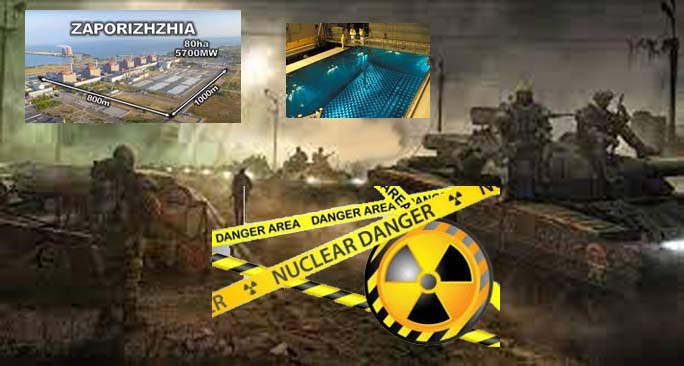
Russia’s invasion has repeatedly knocked out Ukraine’s electricity grid, causing blackouts at the Zaporizhzhia nuclear plant – Europe’s largest – where a constant power supply is needed to prevent the reactors from overheating.
On March 9, the plant blacked out for the sixth time since the occupation, forcing nuclear engineers to switch to emergency diesel generators to power its essential cooling equipment running.
“Each time we are rolling a dice,” Rafael Mariano Grossi, the director general of the United Nations’ International Atomic Energy Agency (IAEA), warned at the time. “And if we allow this to continue time after time, then one day, our luck will run out”.
On Monday, during a meeting with Ukraine’s president Volodymyr Zelensky, Grossi reiterated the situation “isn’t getting any better” as relentless fighting in the area keeps the facility at risk of a disaster.
The IAEA watchdog has called for a “protection zone” around the plant but has failed to devise terms that would satisfy both Ukraine and Russia.
Grossi told the AP on Tuesday he believed a deal was “close”. However, Zelenskyy, who opposes any plan that would legitimise Russia’s control over the facility, said he was less optimistic a deal was near. “I don’t feel it today,” he said.
Is Zaporizhzhia really at risk?
Nuclear power plants are designed to withstand a wide range of risks, but no operating nuclear power plant has ever been caught up in modern warfare.
Because of the repeated crossfire, Zaporizhzhia’s last reactor was shut down in September as a precautionary measure. But external power is still essential to run critical cooling and other safety systems.
Fears about Zaporizhzhia have exacerbated existing concerns around our lack of preparedness for any nuclear-related incident, laying bare anxieties not necessarily around war-related incidents but about climate change and Europe’s old reactors, for instance.
It raises the question, too, of whether we should rely on nuclear power at all.
March 11 marked the 12-year anniversary of the massive earthquake and tsunami that caused the second-worst nuclear accident in history at the Fukushima Daiichi Nuclear Power Plant in Japan.
The anniversary of the catastrophic meltdown that left 160,000 people displaced and cost the Japanese government over €176 billion, was another reminder of the potential threat of a nuclear spill, but a number of other recent events have also raised the alarm in Europe, not least the war in Ukraine.
‘We are not properly prepared’
Europe’s nuclear power reactors are ageing – they were built on average 36.6 years ago – and recent checkups in France have found cracks in several facilities.
Some energy experts have warned that the extreme weather events brought on by climate change could pose a serious threat to the EU’s 103 nuclear reactors, which account for about one-quarter of the electricity generated in the bloc.
Jan Haverkamp, a senior nuclear energy and energy policy expert for Greenpeace, said the chances of Europe seeing a large accident like Fukushima were now “realistic” and “we should take them into consideration”.
“We are not properly prepared,” he told Euronews Next…………………………………………………….
The maintenance of a nuclear plant depends on a number of factors, such as its design and its supervision history. But there are other factors that come into play, such as error-prone humans, earthquakes, tsunamis, fires, flooding, tornadoes or even in the case of Zaporizhzhia, acts of war…………………………………………………………………………………… more https://www.euronews.com/next/2023/03/31/chernobyl-fukushima-europe-prepared-nuclear-disaster-ukraine-earthquake-meltdown-radiation
THE LAST THING THE UKRAINIAN PEOPLE NEED IS DEPLETED URANIUM

27 Mar 2023 • by Kate Hudson, Stop the War Coalition
KATE HUDSON: THE USE OF DU RUNS COUNTER TO THE BASIC RULES AND PRINCIPLES OF INTERNATIONAL HUMANITARIAN LAW
In a shocking development, the government has announced it will be sending depleted uranium (DU) rounds to Ukraine along with Challenger 2 tanks. As we know from several wars in the past few decades, the health consequences for Ukrainian civilians will be high. DU is a chemically toxic and radioactive heavy metal and it’s a by-product of the enrichment process used to make reactor-grade uranium. Its chemical and physical properties have made it popular for a range of military and commercial uses: its density and its ability to self-sharpen attracted the attention of the US Department of Defense (DoD) in the late 1950s. The military was looking to increase the armour piercing capacity of munitions and to strengthen the armour of tanks. DU seemed to fit the bill. But its use has had a devastating impact on the populations caught up in numerous conflicts, with the terrible type of health consequences that we associate with radiation impacts.
………………………. The risk is not that DU munitions will cause a nuclear explosion. It’s that the impact of their use causes toxic or radioactive dust to be released and if this is subsequently inhaled or ingested in other ways, it has very significant negative health consequences. After the first Gulf War the DoD Office of the Special Assistant for Gulf War Illnesses (OSAGWI) identified a number of DU exposure scenarios including through wounds caused by DU fragments, inhalation of airborne DU particles, ingestion of DU residues, or wound contamination by DU residues.
DU munitions were used on a large scale by the US and UK in the Gulf War in 1991 and in Iraq in 2003. Their use has caused a sharp increase in the incidence rates of some cancers, such as breast cancer and lymphoma, in the areas where it has been used. It has also been implicated in a rise in birth defects from areas adjacent to the main Gulf War battlefields. Other health problems associated with DU include kidney failure, nervous system disorders, lung disease and reproductive problems.
A report funded by the Norwegian Ministry of Foreign Affairs in 2013 showed that more than 400 tonnes of DU ammunition were estimated to have been used in 1991 and 2003, the vast majority by US forces. The report showed that the Iraqi government’s Radiation Protection Centre had identified between 300 and 365 contaminated sites by 2006, mostly in the Basra region in southern Iraq. As well as warning of contamination being spread by poorly regulated scrap metal dealers, including children, it also shared evidence that DU munitions were fired at light vehicles, buildings and other civilian infrastructure including the Iraqi Ministry of Planning in Baghdad – in spite of official assurances of military-only armoured targets.
Its use in the former Yugoslavia by NATO forces in 1995 and 1999 led to the same type of consequences. It was also used by the US in Syria in 2015. The impacts have not been confined to local populations – they have also affected the troops involved in or close to their use, and also military clean-up teams sent to deal with the impact of the DU. The severe health consequences have led to the terms ‘Gulf War syndrome’ and ‘Balkan syndrome’ entering our vocabulary. The Ministry of Defence disputes the risks of DU, yet it recommends ‘ongoing surveillance’ for veterans with embedded DU fragments.
No treaty explicitly banning the use of DU is yet in force, but it is clear that its use runs counter to the basic rules and principles of International Humanitarian Law. In 2006, the European Parliament strengthened its previous calls for a moratorium by calling for an introduction of a total ban, classifying the use of DU, along with white phosphorus, as inhumane. Since 2007, repeated UN General Assembly resolutions have highlighted serious concerns over the use of DU weapons. The UK, together with the US, France and Israel are the only states that have consistently voted against the resolutions.
The British government must put an immediate end to its use of DU – inflicting it on the people of Ukraine is the last thing they need. https://www.stopwar.org.uk/article/the-last-thing-the-ukrainian-people-need-is-depleted-uranium/?link_id=14&can_id=6af7fc84f5bc6c4d25d736c71bd0eab7&source=email-europe-for-peace-stop-the-war-in-ukraine-3&email_referrer=email_1865172&email_subject=uniting-european-anti-war-forces
IAEA head warns on danger of intensified fighting near Zaporizhzhia nuclear power plant
The head of the United Nations atomic energy commission said on Wednesday
that intensified fighting near Europe’s largest nuclear power plant poses
a threat to the facility’s safety. The increasing combat makes it urgent
to find a way to prevent a catastrophic nuclear accident at the
Zaporizhzhia nuclear power plant, said International Atomic Energy Agency
director general Rafael Mariano Grossi. “It is obvious that this area is
facing perhaps a more dangerous phase,” he said of the facility, which is
in a partially Russian-occupied part of Ukraine. “We have to step up our
efforts to get to some agreement over the protection of the plant.”
Morning Star 30th March 2023
https://morningstaronline.co.uk/article/w/un-agency-warns-rising-combat-near-ukraine-nuclear-plant
An obnoxious clause in Canada’s draft Act for Implementing the United Nations Declaration on the Rights of Indigenous Peoples (UNDRIP)

First -let’s see what the Assembly of First Nations of Canada (AFN) say about Small Modular Nuclear Reactors
The AFN resolution from 2018 against SMRs, available HERE says:
THEREFORE BE IT RESOLVED that the Chiefs-in-Assembly:
1. Demand that free, prior and informed consent is required to ensure that no storage or disposal of hazardous
materials shall take place in First Nations lands and territories.
2. Demand that the Nuclear Industry abandon its plans to operate Small Modular Nuclear Reactors in Ontario and
elsewhere in Canada.
3. Demand that the Government of Canada cease funding and support of the Small Modular Nuclear Reactors
program.
4. Direct that the National Chief and appropriate staff work to ensure that the Nuclear Industry and the Canadian Government abandon this program.
Now see what the Government includes in this draft Act
In the Environment section of Canada’s draft Act for Implementing the United Nations Declaration on the Rights of Indigenous Peoples (UNDRIP)- the specific SMRs text is found, in Chapter 1, Shared priorities. https://www.justice.gc.ca/eng/declaration/ap-pa/ah/p3.html
The Government of Canada will take the following actions……………
44. Increase capacity for Indigenous peoples to meaningfully engage, make informed decisions, and participate financially in clean energy alternatives like Small Modular Reactors (SMRs). SMRs in Canada are developing along three parallel streams including near-term on-grid, next generation and micro/off-grid, and there is potential for multiple benefits including use in remote Indigenous communities for abating emissions of heavy industry and increasing energy security. (Natural Resources Canada)
China’s new warning to Australia over nuclear submarine deal
China has fired off another dire warning to Australia, amid growing tension over the nuclear submarine deal with the US and Britain.
Carla Mascarenhas, 1 Apr 23
Global superpowers unite against US
‘Anytime, anywhere’: Kim’s nuke threat
Dan appears on Chinese TV
China has fired off a frightening warning to Australia over its nuclear submarines deal with the US and the UK, declaring it may trigger an unpredictable global arms race.
The Chinese foreign ministry said on Thursday that once a Pandora’s box is opened, the “regional strategic balance will be disrupted and regional security will be seriously threatened”.
The United States, Australia and UK this month unveiled details of a plan to provide Australia with nuclear-powered attack submarines from the early 2030s to counter China’s ambitions in the Indo-Pacific.
“China firmly opposes the establishment of the so-called ‘trilateral security partnership’ between the United States, the United Kingdom and Australia,” said Tan Kefei, a spokesman at the Chinese defence ministry, during a regular press briefing.
“This small circle dominated by Cold War mentality is useless and extremely harmful.”
Mr Tan added such co-operation was an extension of the nuclear deterrence policy of individual countries, a game tool for building an “Asia-Pacific version of NATO” and seriously affected peace and stability in the Asia-Pacific region………………………………………………………….
Richard Dunley, a naval and diplomatic historian, said the deal “looks best from Washington – they get major wins in terms of basing, maintenance support and recapitalisation in their yards”.
He noted the Australian perspective was “less clear”.
“The cost is astronomical,” he wrote on Twitter.
Huge but still unknown amounts will be paid to the US in subsidies and then to buy the Virginias. This capability will only realise materialise mid-next decade, and is only a stopgap.”
carla.mascarenhas@news.com.au https://www.news.com.au/world/asia/chinas-new-warning-to-australia-over-nuclear-submarine-deal/news-story/16904f97d0a534af20dd69815f9c1986
Canadian First Nations do not want small nuclear reactors on their lands

Decolonizing energy and the nuclear narrative of small modular reactors https://policyoptions.irpp.org/magazines/february-2022/decolonizing-energy-and-the-nuclear-narrative-of-small-modular-reactors/
Kebaowek First Nation is calling for an alternative to a planned SMR project, one that won’t undermine proper consultation and leave a toxic legacy.
by Lance Haymond, Tasha Carruthers, Kerrie Blaise, February 7, 2022 In early 2021, the Canadian Nuclear Safety Commission began reviewing the application from a company called Global First Power to build a nuclear reactor at the Chalk River Laboratories site about 200 kilometres northwest of Ottawa.
This project, known as a micro modular reactor project, is an example of the nuclear industry’s latest offering – a small modular reactor (SMR).SMRs are based on the same fundamental physical processes as regular (large) nuclear reactors; they just produce less electricity per plant. They also produce the same dangerous byproducts: plutonium and radioactive fission products (materials that are created by the splitting of uranium nuclei). These are all dangerous to human health and have to be kept away from contact with people and communities for hundreds of thousands of years. No country has so far demonstrated a safe way to deal with these.
Despite these unsolved challenges, the nuclear industry promotes SMRs and nuclear energy as a carbon-free alternative to diesel for powering remote northern communities. The Canadian government has exempted small modular reactors from full federal environmental assessment under the Impact Assessment Act. Many civil society groups have condemned this decision because it allows SMRs to escape the public scrutiny of environmental, health and social impacts.
The proposed new SMR in Chalk River, like the existing facilities, would be located on Algonquin Anishinabeg Nation territory and the lands of Kebaowek First Nation – a First Nation that has never been consulted about the use of its unceded territory and that has been severely affected by past nuclear accidents at the site.
At this critical juncture of climate action and Indigenous reconciliation, Kebaowek First Nation is calling for the SMR project at Chalk River to be cancelled and the focus shifted to solutions that do not undermine the ability of First Nations communities to be properly consulted and that do not leave behind a toxic legacy.
While these reactors are dubbed “small,” it would be a mistake to assume their environmental impact is also “small.” The very first serious nuclear accident in the world involved a small reactor: In 1952, uranium fuel rods in the NRX reactor at Chalk River melted down and the accident led to the release of radioactive materials into the atmosphere and the soil. In 1958, the same reactor suffered another accident when a uranium rod caught fire; some workers exposed to radiation continue to battle for compensation.
What makes these accidents worse – and calls into question the justification for new nuclear development at Chalk River – is that this colonized land is the territory of the Algonquin Anishinabeg Nation territory (which consists of 11 First Nations whose territory stretches along the entire Ottawa River watershed straddling Quebec and Ontario). Kebaowek First Nation, part of the Algonquin Nation, was among those First Nations never consulted about the original nuclear facilities on their unceded territory, and is still struggling to be heard by the federal government and nuclear regulator. Its land has never been relinquished through treaty; its leaders and people were never consulted when Chalk River was chosen as the site for Canada’s first nuclear reactors; and no thought was given to how the nuclear complex might affect the Kitchi Sibi (the Ottawa River).
History is being repeated at Chalk River today as the government pushes ahead with the micro modular reactor project without consent from Kebaowek. Assessments of the project have been scoped so narrowly that they neglect the historical development and continued existence of nuclear facilities on Kebaowek’s traditional territory. The justification for an SMR at this location without full and thorough consideration of historically hosted nuclear plants – for which there was no consultation nor accommodation – is a tenuous starting point and one that threatens the protection of Indigenous rights.
The narrative of nuclear energy in Canada is one of selective storytelling and one that hides the reality of the Indigenous communities that remain deeply affected, first by land being taken away for nuclear reactor construction, and later by the radioactive pollution at the site. All too fitting is the term radioactive colonialism coined by scholars Ward Churchill and Winona LaDuke, to describe the disproportionate impact on Indigenous people and their land as a result of uranium mining and other nuclear developments. In country after country, the uranium that fuels nuclear plants has predominantly been mined from the traditional lands of Indigenous Peoples at the expense of the health of Indigenous Peoples and their self-determination.
Kebaowek First Nation has been vocal in its objection to the continuation of the nuclear industry on its lands without its free prior and informed consent, as is its right under the United Nations Declaration on the Rights of Indigenous Peoples (UNDRIP). Despite requests for the suspension of the SMR project, pending adequate provisions for Indigenous co-operation and the Crown’s legal duty to initiate meaningful consultation, Kebaowek has yet to see its efforts reflected in government decisions and Crown-led processes.
Nuclear is a colonial energy form, but it is also bio-ignorant capitalism – a term coined by scholars Renata Avila and Andrés Arauz to describe the ways in which the current economic order ignores the planetary climate emergency, human and ecological tragedies, and the large-scale impact on nature. The narrative of nuclear as a “clean energy source” is a prime example of this bio-ignorance. Decision-makers have become fixated on carbon emissions as a metric for “clean and green,” ignoring the radioactive impacts and the risks of accidents with the technology.
It is more than 70 years since Chalk River became the site for the splitting of the nucleus. The continuation of nuclear energy production on unceded Indigenous territory without meaningful dialogue is a telling example of continued colonial practices, wherein companies extract value from Indigenous land while polluting it; offer little to no compensation to impacted communities; and abide by timelines driven by the project’s proponents, not the community affected. We need to move away from this colonial model of decision-making and decolonize our energy systems.
The challenge of climate change is urgent, but responses to the crisis must not perpetuate extractivist solutions, typical of colonial thinking, wherein the long-term impacts – from the production of toxic waste to radioactive releases – lead to highly unequal impacts.
The authors thank Justin Roy, councilor and economic development officer at Kebaowek First Nation, and M.V. Ramana, professor at the School of Public Policy and Global Affairs at the University of British Columbia, for contributing to this article.
TEPCO visually confirms melted nuclear fuel at Fukushima plant
THE ASAHI SHIMBUN, March 31, 2023 , This article was written by Keitaro Fukuchi, Ryo Sasaki and Takuro Yamano.
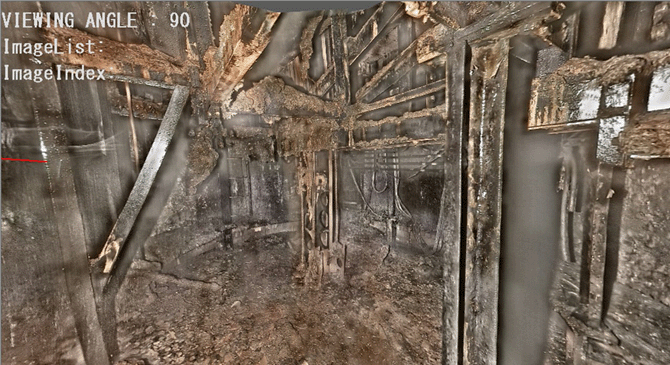
A robotic study provided the first visual confirmation that melted nuclear fuel broke through a pressure vessel at the Fukushima No. 1 nuclear power plant, the government and Tokyo Electric Power Co. said March 30.
Images taken by the robot under the No. 1 reactor at the plant also confirmed heavy damage to a concrete “pedestal” under the pressure vessel.
The inspection by the robot started on March 29. It was the first such study at the No. 1 reactor, one of the three reactors that melted down at the plant following the Great East Japan Earthquake and tsunami in 2011.
More than 90 percent of the nuclear fuel at the No. 1 reactor is believed to have fallen from the pressure vessel.
The robot found a large amount of melted fuel debris under the pressure vessel.
……………. TEPCO still faces the difficult challenge of how to remove the fuel debris and how to protect the damaged pedestal from future earthquakes.
The meltdown at the No. 1 reactor is believed to be worse than those at the No. 2 and No. 3 reactors at the plant.
The International Research Institute for Nuclear Decommissioning estimates the No. 1 reactor building contains 279 tons of melted fuel debris.
Naoyuki Takaki, a professor of nuclear safety engineering at Tokyo City University, said the fuel debris “cannot be taken out unless it is broken down into small pieces.”
Takaki said the method for cutting up such chunks will depend on the ratio and hardness of metal mixed in with the melted fuel.
But the information on objects within the fuel debris is limited so far.
“To put it briefly, it is unknown,” Takaki said.
The No. 1, No. 2 and No. 3 reactors at the Fukushima plant contain an estimated total of 880 tons of melted fuel debris.
TEPCO officials aim to start removal work of the fuel debris at the No. 2 reactor in the latter half of fiscal 2023. The initial plan is to take out a few grams, analyze their elements and hardness, and then increase the amount to be removed.
No timetable is set for such work at the No. 1 and No. 3 reactors.
The damaged pedestal has raised concerns that an earthquake could knock down the structure…………………………….more https://www.asahi.com/ajw/articles/14874722
Germany will complete nuclear phase-out as planned but technology’s risks remain – env min
31 Mar 2023, Benjamin Wehrmann
The era of nuclear power in Germany will end on 15 April as planned, the country’s environment minister has said.
Minister Steffi Lemke stressed that the phase-out would not endanger the power supply security in Germany or other countries, arguing that ending nuclear power will ultimately make the country a safer place.
However, despite nuclear power production in Germany coming to an end, the risk of nuclear accidents remains due to the ageing reactor fleet in neighbouring countries and previously “unthinkable” threats such as sabotage or war-related damage to reactors in Ukraine, Lemke said.
The renewable power industry welcomed the nuclear exit’s completion, stating that wind and solar power are ready to replace the reactors, whereas a survey suggests most people in the country appear to be sceptical whether the energy system is ready to run without them.
The three remaining nuclear plants in Germany will be shut down for good on 15 April, following a three-month extension granted in the context of the European energy crisis, environment minister Steffi Lemke confirmed to journalists in Berlin.
“The technology’s era is over” in the country, Lemke said, arguing that this will make Germany a safer place and put a stop to generating nuclear waste. Germany’s energy security will not be jeopardised by the decommissioning of the three plants, Isar 2 and Neckarwestheim 2 in southern Germany and Emsland in the north, Lemke said……………………………………
31 Mar 2023, 11:38
Germany will complete nuclear phase-out as planned but technology’s risks remain – env min
The era of nuclear power in Germany will end on 15 April as planned, the country’s environment minister has said. Minister Steffi Lemke stressed that the phase-out would not endanger the power supply security in Germany or other countries, arguing that ending nuclear power will ultimately make the country a safer place. However, despite nuclear power production in Germany coming to an end, the risk of nuclear accidents remains due to the ageing reactor fleet in neighbouring countries and previously “unthinkable” threats such as sabotage or war-related damage to reactors in Ukraine, Lemke said. The renewable power industry welcomed the nuclear exit’s completion, stating that wind and solar power are ready to replace the reactors, whereas a survey suggests most people in the country appear to be sceptical whether the energy system is ready to run without them.
The three remaining nuclear plants in Germany will be shut down for good on 15 April, following a three-month extension granted in the context of the European energy crisis, environment minister Steffi Lemke confirmed to journalists in Berlin.
“The technology’s era is over” in the country, Lemke said, arguing that this will make Germany a safer place and put a stop to generating nuclear waste. Germany’s energy security will not be jeopardised by the decommissioning of the three plants, Isar 2 and Neckarwestheim 2 in southern Germany and Emsland in the north, Lemke said.
The country has managed to restructure its gas supply following the loss of Russia as a trade partner, which has been the main cause of the energy crisis, and would replace the capacity of the outgoing reactors with new renewable power installations and gas-fired power stations, said Lemke. Power exports to nuclear power state France reached record levels during the energy crisis, which underlined the fact that nuclear plants do not automatically provide a safeguard in crisis situations, she said.
Completing the nuclear exit in Germany had originally been planned for the end of 2022, but the war in Ukraine and its repercussions had led parliament to decide a limited runtime extension to support the power system and allow Germany and neighbouring countries to ensure supply security. Opposition politicians from the conservative Christian Democrats (CDU) and from the government coalition party Free Democrats (FDP) had repeatedly advocated for further extending the plants’ runtime. However, chancellor Olaf Scholz’s government ultimately restricted the extension to mid-April.
Nuclear power has become expendable and that’s good news. Renewable power will take it from here.
Simone Peter, head of renewables association BEE
“Ageing nuclear plants are one of the greatest risks in Europe” – Lemke
Fully dismantling the roughly 30 plants in the country and deciding on a long-term nuclear waste storage solution are tasks that will take several decades, the Green Party minister said. “These tasks will be a challenge in the next few years,” Lemke said. Nuclear power has been used in Germany for 60 years and it’s now clear that it is “a high-risk technology that ultimately cannot be fully controlled.” Three generations have benefitted from nuclear power use in Germany, but about 30,000 generations will be affected by the ongoing presence of nuclear waste, she argued. Finding a final repository, especially for highly radioactive waste, will now be “a very difficult but unavoidable” task.
At the same time the risk of nuclear accidents would not be completely unavoidable, Lemke added. Ageing reactors in the immediate neighbourhood, sabotage of energy infrastructure and the “previously unthinkable” scenario of reactors operating in an active warzone, such as the Zaporizhzhia plant in Ukraine, continue to pose real danger for people in Germany and elsewhere in Europe, she stressed. “Ageing nuclear plants are one of the greatest risks in Europe,” Lemke said, but stressed that every country had the right to decide on the technology’s use on its own territory.
Inge Paulini, head of the Federal Office for Radiation Protection (BfS), pointed out that seven reactors abroad currently operate within less than 100 kilometres from the German border, which means they still pose a direct threat to the population. “Germany’s nuclear phase-out doesn’t mean all risk is gone,” Paulini said, arguing that the need for an effective and state-of-the-art radiation protection programme had not been forgotten in the country.
The German Renewable Energy Federation (BEE) commented that the nuclear exit’s completion is a step that is both “feasible and necessary” from the energy industry’s perspective. Beyond the immediate risk of nuclear accidents, new plants simply could not compete economically with renewable power and are too inflexible in their use to serve as a capacity backup to iron out fluctuations in renewable power generation, BEE head Simone Peter said.“We cannot afford inflexibility on the power market as the share of renewable energy is growing,” she argued, adding that more nuclear power ultimately meant blocking renewable expansion.
“Nuclear power has become expendable and that’s good news. Renewable power will take it from here,” said Peter………………………………………………… https://www.cleanenergywire.org/news/germany-will-complete-nuclear-phase-out-planned-technologys-risks-remain-env-min
Illinois Senate votes to lift nuclear construction ban
WSIU Public Broadcasting | By Andrew Adams | Capitol News Illinois, March 31, 2023
Environmental, anti-nuclear groups oppose the legislation
The Illinois Senate approved a measure on Thursday that would lift a 1980s-era moratorium on nuclear power plant construction.
Senate Bill 76, sponsored by Sen. Sue Rezin, R-Morris, was approved on a 39-13 vote. The bill now goes to the House of Representatives for consideration………………
Rezin said on the Senate floor that the bill would specifically allow for the construction of small modular nuclear reactors, or SMRs. ………………………………….
Senate proponents of the bill, including Sens. Bill Cunningham, D-Chicago, and Patrick Joyce, D-Essex, said that lifting the ban would help the state attract investment in new technology………………………….
“By lifting this ban, it allows Illinois, should they choose, to go after federal dollars that are provided by this administration, the Biden administration, who is embracing, supporting and investing in advanced nuclear reactors,” Rezin said.
Sen. Ram Villivalam, D-Chicago, said the bill was “still not fully baked,” adding that the question of what is done with nuclear waste still doesn’t have a solution.
“Whether it’s one pound or a thousand pounds, it’s still nuclear waste,” he said. …………
The state’s ban went into effect in 1987 and was intended to remain in effect until the federal government identifies a national nuclear waste disposal strategy. In 1987, Congress identified a site in Nevada as the nation’s repository for nuclear waste, although later opposition from the state and the White House quashed that plan. No national disposal site has been designated.
Some of the state’s largest environmental groups, including the Illinois Environmental Council, oppose the measure. Jack Darin, the head of the Illinois chapter of the Sierra Club, told Capitol News Illinois earlier this month that his organization doesn’t believe nuclear energy is “clean energy,” citing concerns over the environmental impact of nuclear waste.
David Kraft, the head of the Nuclear Energy Information Service, an anti-nuclear advocacy group based in Chicago, has said the bill will weaken the state’s landmark energy policy, the 2021 Climate and Equitable Jobs Act.
“Small modulars are not climate solutions, they’re not job generators until the 2030s and they’ll generate more nuclear waste,” Kraft said in a Thursday interview.
Kraft added he’s worried that lawmakers are not fully considering the safety implications of SMR technology…………………………….. https://www.northernpublicradio.org/illinois/2023-03-31/senate-votes-to-lift-nuclear-construction-ban
Small Modular Nuclear Reactors may not be the holy grail for energy security, net zero
So, if SMRs are the current political flavour of the month, how have we reached this position when there is still no formal approval of the technology from regulators, let alone practical evidence of how it can operate in the real world?
It’s possible to achieve both energy security and the UK’s climate goals without blowing the budget on next-gen nuclear technologies, according to Andrew Warren.
Andrew Warren, Chairman of the British Energy Efficiency Federation. https://electricalreview.co.uk/2023/03/29/smrs-may-not-be-the-holy-grail-for-energy-security-net-zero/
Electrical Review covered in-depth the array of announcements that were made during the Spring Budget, but there was arguably one announcement above all that was most pertinent to the net zero drive. That was when Chancellor Jeremy Hunt reconfirmed – for the fifth time – that the Government intends to create a new Great British Nuclear agency.

It is a name that of itself may bring comfort to all those living on the nuclear-free island of Ireland.
So what will this agency do? Well, the Chancellor explained that, when launched, it will run a competition this year for the UK’s first Small Modular Reactor (SMR). The plan is for it to eventually award £1 billion in co-funding to a winner to build out an SMR plan.
This competition has some distinct echoes. Back in March 2016, the Government launched a competition to identify the best value SMR design for the UK. To the best of my knowledge, nobody has ever claimed that prize, of £250 million.
This re-announcement prompted me to consider the background to this Budget announcement.
It comes at a time in which private sector funding for larger nuclear power stations is proving to be extremely difficult. There is a lengthy list of large pension funds that have publicly refused to get involved with providing capital for the hapless Sizewell C pressurised water reactor project in Suffolk. Meanwhile, European Commission President Ursula von der Leyen is rumoured to be promoting the inclusion of SMRs within the European green investment taxonomy, whilst simultaneously excluding pressurised water reactors which make up most of the existing nuclear fleet.
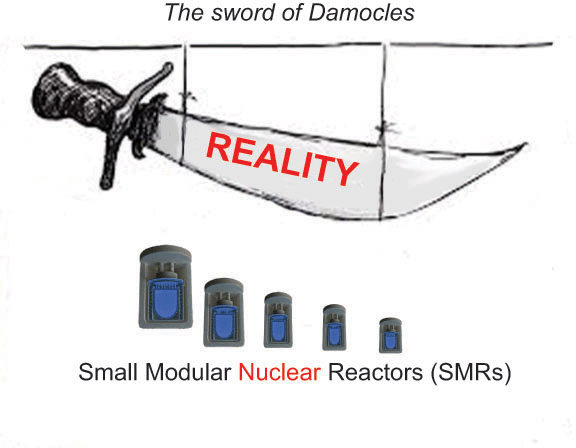
So, if SMRs are the current political flavour of the month, how have we reached this position when there is still no formal approval of the technology from regulators, let alone practical evidence of how it can operate in the real world?

In January, the UK Government announced that six SMR vendors had applied for their designs to be formally assessed with a view to commercialisation in Britain. The companies have joined a much publicised Rolls-Royce-led consortium and will be subjected to an assessment process carried out by the UK’s Office of Nuclear Regulation (ONR), which will look in exhaustive detail at reactor designs proposed for construction.
Designs that successfully complete the Generic Design Assessment (GDA) – which is expected to take between four and five years – will then be ready to be built anywhere in the country, subject to meeting site-specific requirements.
Why do we need new reactor designs?
Recent results of orders placed for larger nukes are uniformly poor, with reactors invariably late and over budget. Some of the worst cases, notorious projects in Olkiluoto, Finland and Flamanville, France, have seen construction periods of 18 years and costs of three to four times above the expected level.

So, SMRs are being increasingly seen as the new saviours for the nuclear industry. This category embodies a range of technologies, uses and sizes, but relies heavily on features that were the selling points for larger designs. They are smaller than current stations which produce 1,200MW to 1,700MW of electricity. Instead, sizes range from 3MW to about 500MW. The Rolls-Royce design is a 470MW pressurised water reactor, which is bigger than one of the reactors at Fukushima in Japan that suffered serious damage in the 2011 tsunami.
These advanced designs are not new – sodium-cooled fast reactors and high temperature reactors were built as prototypes in the 1950s and 1960s – but successive attempts to build demonstration plants have been short-lived failures. It is hard to see why these technologies should now succeed given their poor record.
A particular usage envisaged for some of the technologies is production of hydrogen. However, as Professor Stephen Thomas of Greenwich University recently pointed out to me, to produce hydrogen efficiently, reactors would need to provide heat at 900°C. This, he said, is “a temperature not yet achieved in any power reactor, not feasible for a pressurised water reactor or boiling water reactor and one that will require new exotic and expensive materials.”
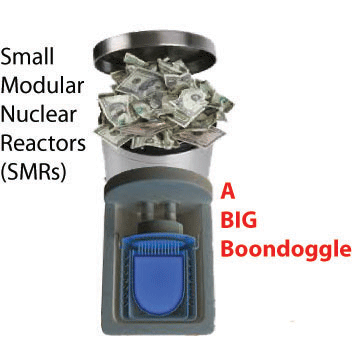
Developers of SMRs like to give the impression that their designs are ready to build, the technology proven, the economic case established and all that is holding them back is Government inactivity. However, taking a reactor design from conception to commercial availability is a lengthy and expensive process taking more than a decade and certainly costing more than £1 billion.
How can the economics of SMRs be tested?
The main claim for SMRs over their predecessors is that being smaller, they can be made in factories as modules using cheaper production line techniques, rather than one-off component fabrication methods being used at Hinkley Point C. The idea is that the module would be delivered to the site on a truck essentially as a ‘flatpack’. This would avoid much of the on-site work which is notoriously difficult to manage and a major cause of the delays and cost overruns that every European large reactor project suffers from.
However, any savings made from factory-built modules will have to compensate for the scale economies lost. A 1,600MW reactor is likely to be much cheaper than 10 reactors of 160MW.
And it will be expensive to test the claim that production line techniques will compensate for lost scale economies. The first reactor constructed will need to be built using production lines if the economics are to be tested. But once the production lines are switched on, they must be fed. Rolls-Royce assumes its production lines will produce two reactors per year and that costs will not reach the target level until about the fifth order. So, if we assume the first reactor takes five years to build, there will be another nine reactors in various stages of construction before a single unit of electricity has been generated from the first, and the viability of the design tested.
This could mean that perhaps about 15 SMRs will need to be under construction before the so-called ‘nth of a kind’ settled-down cost is demonstrated. But once the initial go ahead is given, there will be pressure on the Government to continue to place orders before the design is technically and economically proven, so the production lines do not sit idle.
Will SMRs be a major contributor to meeting the UK’s climate change targets?

The selling point for nuclear power is that it is a relatively low-carbon source of power that can replace fossil fuel electricity generation in the UK and elsewhere. However, by the time SMRs might be deployable in significant numbers, realistically after 2035, it will be too late for them to contribute to reducing greenhouse gas emissions. Electricity is acknowledged to be the easiest sector to decarbonise. If the whole economy is to reach net zero emissions by 2050, then this sector will have to reach that point long before then, probably by 2035. So SMRs appear to be too little, too late.

There is also a fear that SMRs will create more waste than conventional reactors, according to a study recently published in Proceedings of the American National Academy of Sciences. The research notes that SMRs would create far more radioactive waste, per unit of electricity they generate, than conventional reactors by a factor of up to 30. Some of these smaller reactors, with molten salt and sodium-cooled designs, are expected to create waste that needs to go through additional conditioning to make it safe to store in a repository.
And yet, despite the past failures of nuclear power and increasing public scepticism, there remains an appetite within the British Government to give the nuclear industry one more chance.
It remains to be seen whether the Government follows its instinct to continue supporting the sector or whether the amount of public money at risk makes such a decision politically impossible, given the massive underwriting these projects require by consumers and taxpayers.
Nuclear’s specious claims
The claims being made for SMRs will be familiar to long-time observers of the nuclear industry: costs will be dramatically reduced; construction times will be shortened; safety will be improved; there are no significant technical issues to solve; nuclear is an essential element to our energy mix.
In the past such claims have proved hopelessly over-optimistic and there is no reason to believe results would turn out differently this time. Indeed, the nuclear industry may well see itself in this ‘last-chance saloon’.
The risk is not so much that large numbers of SMRs will be built; it is my belief that they won’t be. The risk is that, as in all the previous failed nuclear revivals, the fruitless pursuit of SMRs will divert resources away from options that are cheaper, at least as effective, much less risky, and better able to contribute to energy security and environmental goals. Given the climate emergency we face, surely it is time to finally turn our backs on this failing technology.
Andrew Warren is a former special advisor to the House of Commons environment committee. Special thanks to Greenwich University’s Professor Stephen Thomas for his advice for this piece.
1 This Month
Tell Congress: Prevent Nuclear Catastrophe in Iran

Tell Congress: Prevent Nuclear Catastrophe in Iran

Read the Public Inquiry Report, the Commissioners’ report, Surrendering Australia: The AUKUS Deception is available to download for free at aukuspublicinquiry.com. Or just watch the replay of the National Press Club Luncheon.


Shut down the radiation-damaged Heysham nuclear reactors now
To see nuclear-related stories in greater depth and intensity – go to https://nuclearinformation.wordpress.com

Say No to NASA’s Reckless Nuclear Reactor on the Moon
Say No to NASA’s Reckless Nuclear Reactor on the Moon
-
Archives
- November 2026 (238)
- October 2026 (302)
- September 2026 (339)
- August 2026 (330)
- July 2026 (355)
- June 2026 (287)
- May 2026 (306)
- April 2026 (356)
- March 2026 (251)
- February 2026 (267)
- January 2026 (308)
- December 2025 (358)
-
Categories
- 1
- 1 NUCLEAR ISSUES
- business and costs
- climate change
- culture and arts
- ENERGY
- environment
- health
- history
- indigenous issues
- Legal
- marketing of nuclear
- media
- opposition to nuclear
- PERSONAL STORIES
- politics
- politics international
- Religion and ethics
- safety
- secrets,lies and civil liberties
- spinbuster
- technology
- Uranium
- wastes
- weapons and war
- Women
- 2 WORLD
- ACTION
- AFRICA
- Atrocities
- AUSTRALIA
- Christina's notes
- Christina's themes
- culture and arts
- Events
- Fuk 2022
- Fuk 2023
- Fukushima 2017
- Fukushima 2018
- fukushima 2019
- Fukushima 2020
- Fukushima 2021
- general
- global warming
- Humour (God we need it)
- Nuclear
- RARE EARTHS
- Reference
- resources – print
- Resources -audiovicual
- Weekly Newsletter
- World
- World Nuclear
- YouTube
-
RSS
Entries RSS
Comments RSS

