Renewable energy overtakes nuclear power as the EU’s largest source of primary energy production.
Renewables were the main source of European energy production in 2021,
according to the statistical office of the EU. A Eurostat report suggests
renewable energy has overtaken nuclear power as the largest source of
primary energy production in the European Union. Data shows that in 2021,
renewables made up nearly 41% of the EU’s total energy production, with
solid fuels, natural gas, crude oil and other sources accounting for the
rest.
Energy Live News 4th April 2023
Intergovernmental Panel on Climate Change (IPCC) report fails to mention military or conflict emissions.

The IPCC’s failure to mention military or conflict emissions in its
recent synthesis report points to a deeper problem. Ellie Kinney explains
why solving it will require a concerted effort from states, researchers and
civil society. As the IPCC has made clear, the stakes couldn’t be higher.
Conflict & Environment Observatory 3rd April 2023
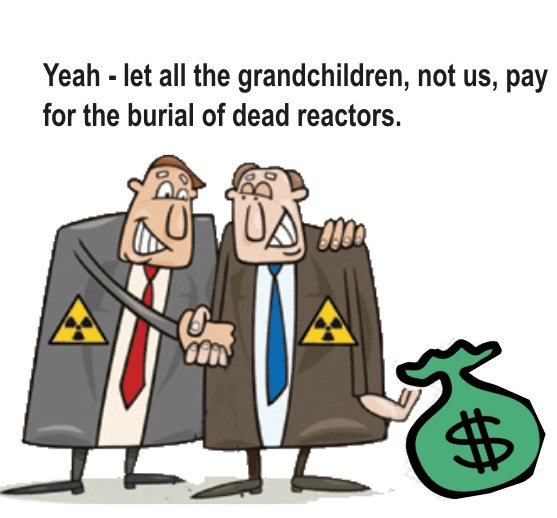
Busting the spin about nuclear wastes – a Letter to the editor of the Hill Times.
(Not sure whether or not the Hill Times will publish this letter)
from: Angela Bischoff Director, Ontario Clean Air Alliance, 5 Apr 23
More happy talk from nuclear advocates is not what Canadians need when it comes to understanding the issue of how to deal with the hundreds of thousands of highly radioactive bundles currently stored in pools and warehouses at Canadian nuclear plants.
In their letter of April 5, two nuclear advocates from the industry-aligned Canadian Nuclear Society trot out the usual assurances that this waste can be safely stored underground for hundreds of thousands of years. That no country has actually done this, and that the industry-owned Canadian Nuclear Waste Management Organization is still struggling to identify a “willing host” community for such a facility in the face of adamant community and First Nation opposition, is blithely ignored.
There have been nuclear power operations in Canada for over 60 years now, yet the industry still has not managed to execute on its preferred strategy of dump-and-run. Comparing deadly radioactive waste to materials like niobium and cadmium is like comparing the likelihood of surviving a multi-vehicle car crash with falling off your bicycle. No one ever died from standing next to a wind turbine magnet.
Trying to paper over the level of risk involved in handling, transporting, and disposing of waste that must remain completely isolated for hundreds of thousands of years, just exposes how the nuclear industry would prefer to avoid hard questions about why it has been allowed to carry on without having an implementable plan for dealing with its deadly toxic waste. What other industry is given a huge free pass like this?
Crowd turns out for town hall on plutonium pits, nuclear waste storage

BY ALAINA MENCINGER / JOURNAL STAFF WRITER, WEDNESDAY, APRIL 5TH, 2023 Albuquerque Journal
“…………………………………………. a town hall meeting, where residents of Santa Fe, Albuquerque, Los Alamos and beyond asked questions and made comments about nuclear production and disposal in New Mexico. The crowd addressed a pair of officials from the National Nuclear Security Administration and the U.S. Department of Energy’s Office of Environmental Management.
There was hardly an empty seat in the auditorium; 150 others attended the town hall virtually.
Speakers at the town hall generally focused on three main issues: increased production of plutonium pits, ramped up disposal of transuranic waste at the Waste Isolation Pilot Plant, and nuclear proliferation.
One attendee, Erich Kuerschner, expressed concerns about health and safety regarding radiation.
“Have you ever seen any pictures of what humans looked like after Hiroshima and Nagasaki?” Kuerschner asked. “It’s horrible, because so many people haven’t — you know, they have no idea of what radiation does to a human being.”
Plutonium pits, bowling-ball-sized hollow spheres of radioactive plutonium, are essential to trigger nuclear reactions.
…………………………………………. many attendees questioned the necessity of adding to the country’s nuclear arsenal, including Santa Fe Archbishop John Wester.
“All your plans for the expanded plutonium pit stores — why is plutonium bomb core production even necessary when it is not to maintain the safety and reliability of the existing tested stockpile?” Wester asked.
He went on to call on the NNSA and DOE to prioritize cleanup at Los Alamos National Lab and beyond, denuclearize the country, and invest in “real national security threats that tangibly impact New Mexicans such as wildfires caused by climate change and preventing the next pandemic.”…………………………..
Other speakers raised concerns about transporting and storing nuclear waste in DOE’s Waste Isolation Pilot Plant in Carlsbad. WIPP is the only repository for transuranic waste — clothes, tools, soil and other materials contaminated with radiation — in the country. The plant was expected to stop taking new waste in 2024; however, a March 2022 report by the Office of Environmental Management titled “WIPP Strategic Vision: 2022-2032”, indicated that the plant “is currently anticipated to operate beyond 2050.”
Activist Cynthia Wheeler said four years ago she bought a house along the route from LANL to WIPP, under the assumption that in 2024, the plant would be closed.
“The federal agencies changed the rules to keep WIPP open for the rest of the century,” Wheeler said. “… I was following the rules. But DOE was breaking promises after the fact.”
………………….. The plant is in the process of renewing its permit. Public comment on the renewal has been extended by the New Mexico Environment Department until April 19 at 5 p.m.
Nuclear life extension plans tested by obsolete components

“Under current license basis 92% of operating reactors would shut down by 2050 and 74 percent would shut down by 2050 with anticipated license renewals. However, if 54 reactors extended operation to 80 years, only 20% of operating reactors would shut down by 2050,”
In fact, with construction times for some plants approaching ten years, many of the parts can be obsolete before the plant has even started generating power
Reuters By Paul Day April 5
- An increasing number of aging nuclear plants are being cleared for long-term operations and suppliers say solving obsolescence will be key to keeping the fleet operating.
– Nuclear operators must be able to swap out old parts for new to keep a reactor running, but when like-for-like is unavailable, original equipment manufacturers (OEMs) are faced with the challenge of finding an alternative while avoiding making any major changes.
“There’s a rule of thumb that if a plant has to do a design change, it’ll cost anywhere from $300,000-$500,000 just in engineering, licensing changes, drawing changes, and that doesn’t include the cost of the required equipment … so we try, wherever possible, to keep our clients from doing a design change,” says Vice President of Westinghouse Parts Business in its Operating Plant Services unit Craig Irish.
However, design changes and other innovative solutions such as additive manufacturing will be needed as an increasing number of nuclear power plant operators extend their plants’ lives from the original 40 years to 60 years or further.
Many of the world’s nuclear power plants were built several decades ago and applications for long-term operations (LTOs) beyond initial lifespans are becoming increasingly common.
At the end of 2020, over 100 nuclear reactors worldwide were operating beyond their initial 40-year licensed periods, with more than 30% of the nuclear fleet operating under LTO conditions, the OECD-NEA says.
In the United States, where nuclear power has supplied 20% of electricity and is currently running 93 reactors with two new units under construction, the average age of the fleet is 41 years including three reactors that started operation 52 years ago, according to the Department of Energy (DOE).
Nine U.S. reactors have active applications with the Nuclear Regulatory Commission (NRC) to extend their lives and 10 reactors have publicly announced plans to extend their licenses to 80 years.
“Under current license basis 92% of operating reactors would shut down by 2050 and 74 percent would shut down by 2050 with anticipated license renewals. However, if 54 reactors extended operation to 80 years, only 20% of operating reactors would shut down by 2050,” the DOE said in its 2022 report on nuclear energy supply chains.
Obsolescence challenge
The challenge, say OEMs, is keeping a supply chain running and up to date for complex, always-on machines that were built with Reagan-era (or earlier) technology.
According to Westinghouse, a leading global parts manufacturer for power stations, approximately 35% of installed equipment in the nuclear industry is obsolete.
In fact, with construction times for some plants approaching ten years, many of the parts can be obsolete before the plant has even started generating power, according to Westinghouse’s Irish.
The high cost of design changes means that many operators, working with a plant that went online in the 1970’s, would work hard to keep it looking the same by the time it is set for decommissioning in 2030, he says.
This was especially challenging when dealing with instrumentation and control (I&C) parts which may have worked with dials and levers when the plant was built but now in many cases can be digitalized.
“They try like hell to keep plants exactly the same, with the same technology, the same parts, though obviously that’s not realistic, so operators have to introduce digital products where it makes sense,” he says.
Internationally, part of the challenge is many of the parts produced for the nuclear industry face varying specifications depending on the regulator they are working under, restricting an already tight market to national boundaries.
Such differences will become even more pronounced with the introduction of a new generation of reactors expected to begin commercial operations within the next decade, with more than 70 SMR designs under development in 18 countries…………………………………………………………..
“The biggest problem is a lot of these discrete components, resistors, diodes, transistors, capacitors, etc are either substantially changed from the 70s and 80s when we built these instruments or they’re not available or they got bought and sold by another company,” …………………………………… https://www.reuters.com/business/energy/nuclear-life-extension-plans-tested-by-obsolete-components-2023-04-05/

Classic Megaproject Early Mistakes Will Create A Fiscal Disaster For Netherlands Nuclear

The Netherlands doesn’t have a plan, just an aspiration. They don’t have a schedule, just a notional target that is close enough to 2030 to sound good. They don’t have a budget, they have a number that they think that they can sell. There’s just so much failure inherent in this proposal that it’s like asking a flatland triangle to successfully build the Pyramid of Giza. Where to start?
As the data shows, 55 nuclear construction projects globally had cost overruns greater than 50%, and the average of those projects were 204% overruns, which is to say that they cost three times more than budgeted for.
The first bias and most evident here, is strategic misrepresentation, aka lying outright or obfuscating the likely truth in order to get something going. When equivalent projects are looked at, €5 billion is clearly a gross understatement of the real costs, but is also clearly the only number that the government believes it can sell.
By Michael Barnard, 5 Apr,23, https://cleantechnica.com/2023/04/05/classic-megaproject-early-mistakes-will-create-a-fiscal-disaster-for-netherlands-nuclear/
Recently, the new coalition government of the Netherlands looked across its decarbonization portfolio, realized that it had failed to meet renewables targets, and so announced that it would build two nuclear power reactors with 1-1.6 GW capacity each. And the government is claiming that it will have them running in 2035, but has only outlined costs through 2030 of €5 billion ($5.5 billion).
The Netherlands’ plan does have a couple of things going for it. The country actually has a small, 50-year old, 485-MW nuclear reactor at Borssele, and they are apparently going to build the new reactors on the same site. They’ve also extended the life of the very old reactor, which has people understandably concerned. So they have operational experience with nuclear, albeit with a very different technology with considerably different operational characteristics, predating as it does most computerization of control systems.
They have already jumped through the International Atomic Energy Agency’s 28 or so major hoops. They already have the seven overlapping, somewhat concentric layers of security from international to internal site high-security areas in place and know what is required. The combination puts them ahead of countries that don’t have existing nuclear reactors, and ahead of projects attempting to site reactors in a new location.
What doesn’t the Netherlands have or know about these reactors?
They don’t know what technology they will use. Some reports say that they will stick with third-generation nuclear technology, which sounds conservative until you realize that Hinkley in the UK, Flamanville in France, Vogtle and Summer in the US, and Olkiluoto in Finland were all third generation AP1000s and European Pressurized Reactors (EPR), and all have suffered massive cost and budget overruns.
They don’t have any trained, certified, or security cleared design or construction resources. The requirements for nuclear design and construction resources are substantially higher than for wind, solar, and other generation options. High security clearances are required for a vastly greater percentage of nuclear construction resources than for other forms of electrical generation, especially as they’ll be doing construction on a running nuclear site. Many people in non-nuclear trades such as boilers, turbines, electricians, and the like who would be acceptable for a wind farm, solar farm, or hydro project will not pass the filters for nuclear projects. In fact, many utility-scale construction projects employ vast numbers of unskilled day laborers that they pick up off street corners at the beginning of the day and drop off again at the end.
They don’t have a significant nuclear engineering program in any of their universities. The nuclear chair in TU Delft retired a decade or so ago and was never replaced. There’s a professor of nuclear engineering at the school, Jan Leen Kloosterman, and he’s clearly excited by this opportunity and hoping that the chair will be re-established with him sitting in it per his public comments.
They have no one who has ever led and run the construction of a nuclear plant. The people who built Borssele are dead or retired to Spain or Portugal, one assumes.
They don’t have a primary contractor, and that’s much more of a problem than it was a decade ago. The three major countries that are building or attempting to build nuclear reactors in other jurisdictions are Russia, China, and France. Russia has made itself an international pariah and clearly wouldn’t pass basic security checks. China has been politically blackballed because it’s stopped being a cheap manufacturer of consumer goods and become instead a major economic competitor which has surpassed the US by several measures and is set to surpass it by most of the rest by 2035. And then there’s France, which has proven to Europe and the world that it is incompetent to build new nuclear reactors, and has had problems operating its own.
The Netherlands doesn’t have a plan, just an aspiration. They don’t have a schedule, just a notional target that is close enough to 2030 to sound good. They don’t have a budget, they have a number that they think that they can sell. There’s just so much failure inherent in this proposal that it’s like asking a flatland triangle to successfully build the Pyramid of Giza. Where to start?
Continue readingNew images from inside Fukushima reactor spark safety worry
Images captured by a robotic probe inside one of the three melted reactors
at Japan’s wrecked Fukushima nuclear power plant showed exposed steel bars
in the main supporting structure and parts of its thick external concrete
wall missing, triggering concerns about its earthquake resistance in case
of another major disaster.
The plant’s operator, Tokyo Electric Power
Company Holdings, has been sending robotic probes inside the Unit 1 primary
containment chamber since last year. The new findings released Tuesday were
from the latest probe conducted at the end of March. An underwater remotely
operated vehicle named ROV-A2 was sent inside the Unit 1 pedestal, a
supporting structure right under the core.
It came back with images seen
for the first time since an earthquake and tsunami crippled the plant 12
years ago. The area inside the pedestal is where traces of the melted fuel
can most likely be found. An approximately five-minute video – part of
39-hour-long images captured by the robot – showed that the 120-centimeter
(3.9-foot) -thick concrete exterior of the pedestal was significantly
damaged near its bottom, exposing the steel reinforcement inside. TEPCO
spokesperson Keisuke Matsuo told reporters Tuesday that the steel
reinforcement is largely intact but the company plans to further analyze
data and images over the next couple of months to find out if and how the
reactor’s earthquake resistance can be improved.
The images of the exposed
steel reinforcement have triggered concerns about the reactor’s safety.
Daily Mail 4th April 2023
Mental illness plagues Japan’s nuclear disaster survivors
Some 37 percent of the survivors of Japan’s Fukushima Daiichi nuclear
power plant disaster of 2011 still suffer from mental illness due to
financial crisis, isolation, and drastic changes in living conditions, says
a survey.
The survey results indicated that the victims suffer from
post-traumatic stress disorder or PTSD due to “anxieties about
compensation and indemnification,” “unemployment” and “nuisances
just by being an evacuee.” The survey was conducted by the Waseda
Institute of Medical Anthropology on Disaster Reconstruction and the
Disaster Relief Assistance Network Saitama, a citizens group, between
January to April 2022 among 5,350 households, the Asahi Shimbun reported on
April 3.
Union of Catholic Asian News 4th April 2023
https://www.ucanews.com/news/mental-illness-plagues-japans-nuclear-disaster-survivors/100894
China on track to triple its terawatt-scale wind and solar target.
The research arm of American banking giant Goldman Sachs has concluded
that China is currently on track to generate almost three times more power
from wind turbines and solar panels than the government has targeted.
According to a report published by Goldman Sachs in late March, combined
capacity from China’s solar and wind energy sector will reach 3.3
terawatts (TW) by 2030. This far outstrips the Chinese government’s
current target of 1.2TWh. The conclusion from the report is that, with such
an accelerated pace for wind and solar deployment, China could become
energy self-sufficient by 2060.
Renew Economy 5th April 2023
Saudi quest to become a nuclear player is coming up short
Bloomberg News | April 5, 2023
Saudi Arabia’s efforts to break into the ranks of global uranium suppliers — and feed a nascent nuclear power program — are coming up short, with exploration investments failing to find any significant deposits of the heavy metal.
The amount worth developing is smaller than that found in Botswana, Tanzania or the US, according to an assessment published by the Nuclear Energy Agency and the International Atomic Energy Agency. This is the first time the Saudi government submitted data for the biennial Red Book, which is used by geologists prospecting for the commodity that fuels nuclear reactors
Saudi Arabia has spent more than $37 million since 2017 searching for deposits but only managed to identify reserves that would be “severely uneconomic” to mine, the report said.
…………………… Saudi Arabia didn’t respond to requests for comment.
………………………. Yellowcake prices have declined in recent decades because of plant shutdowns and public concern over nuclear power. Global expenditures on exploration of about $350 million are near 10-year lows, according to the Red Book…………………………. https://www.mining.com/web/saudi-quest-to-become-a-nuclear-player-is-coming-up-short/
Pentagon fake news about Chinese fast breeder reactors
Assistant Secretary of Defense John Plumb knew better when characterizing Russia-China reactor cooperation as a nuclear weapon threat
Asia Times, By JONATHAN TENNENBAUM, APRIL 3, 2023
The US Department of Defense and numerous private commentators allege that Russian-Chinese cooperation on fast breeder reactors will provide plutonium for large numbers of Chinese nuclear weapons. Assistant Secretary of Defense John Plumb told Congressional hearings on March 8:
“It’s very troubling to see Russia and China cooperating on this. They may have talking points around it, but there’s no getting around the fact that breeder reactors are plutonium, and plutonium is for weapons. So I think the [Defense] Department is concerned. And of course, it matches our concerns about China’s increased expansion of its nuclear forces as well, because you need more plutonium for more weapons.”
The Pentagon knows better than this. Anyone conversant with fast breeder reactor technology is aware that the type of plutonium that can be produced in such reactors is much less suitable for nuclear weapons than the plutonium produced in other reactor types, whose design and construction China has long mastered.
It is therefore nonsensical to charge that the main goal of the Chinese fast breeder program is weapons-related. Rather, the motivation for the program is consistent with that of other nations that have pursued fast breeder reactor designs, including greater efficiency in the utilization of nuclear fuel, reduction in the amount and toxicity of nuclear waste and greater independence from outside fuel supplies.
Here are the details, point by point. They speak for themselves:………………………………………………………………………………… more https://asiatimes.com/2023/04/pentagon-fake-news-about-chinese-fast-breeder-reactors/
France’s nuclear company planning to extend the life of its creaky old reactors.
Electricite de France SA is reviving studies to boost the longer-term
output of some nuclear reactors as part of a plan to extend the life of its
atomic fleet to at least 60 years.
Europe’s energy crisis and rising power
prices have put such considerations back “on the company’s agenda for
2023,” according to Sylvie Richard, who’s in charge of the
state-controlled utility’s €33 billion ($35.6 billion) spending on
reactor maintenance and retrofit for the period from 2022 through 2028. The
upgrades could boost the output of some EDF reactors by 4% to 5%. If that
proves financially viable and gets approved by the nuclear safety
authority, some of the work would take place beyond 2028, Richard told
reporters at the Saint-Laurent nuclear power station in central France
Thursday.
The French nuclear giant has been tasked by President Emmanuel
Macron to extend the lifetime of its 56 reactors and to build at least six
new ones to help the country reduce its reliance on fossil fuels. However,
EDF has been grappling for more than a year with extended reactor repairs
and outages that have worsened Europe’s energy crunch, while triggering a
record loss at the company.
Bloomberg 3rd April 2023
https://www.bnnbloomberg.ca/edf-mulls-reactor-upgrades-to-boost-longer-term-nuclear-output-1.1903718
Germany criticizes Russian role in French nuclear fuel plant
German officials have criticized plans by French firm Framatome to produce
nuclear fuel in a joint venture with Russia’s Rosatom at a facility in
western Germany, and said Thursday that they will consider whether an
application to do so can be rejected.
Officials in the state of Lower
Saxony have received a request for the Framatome-owned ANF facility in
Lingen, near the German-Dutch border, to be allowed to produce hexagonal
fuel rod arrangements used in Soviet-designed water-water energetic
reactors. Such reactors, known by the Russian acronym VVER, are common in
Eastern Europe and the fuel production would take place under license from
state-owned Rosatom.
“Doing business with (Russian President) Putin must
stop, and that also and especially applies to the nuclear sector,” Lower
Saxony’s Energy Minister Christian Meyer said.
Washington Post 30th March 2023
Sizewell C permits approved despite concerns over potential mass fish deaths
Sizewell C permits approved despite concerns over potential mass fish
deaths. The Environment Agency has issued three new permits to Sizewell C,
despite concerns that the approved cooling system and lack of fish
deterrent device could result in “thousands of fish dying every day”.
ENDS 30th March 2023
Divers enter Sellafield’s nuclear pool for first time in 65 years
A GROUP of specialist divers have entered Sellafield’s nuclear pool for the
first time in over 60 years. Divers have been carrying out vital clean-up
and decommissioning work in the oldest legacy storage pond on the
Sellafield site.
The last time a human entered Sellafield’s Pile Fuel
Storage Pond was in 1958, when records show a maintenance operator and
health physics monitor carried out a dive into the newly constructed pond
to repair a broken winch.The pool went out of use in the 1960s but now
divers have returned as part of work to decommission and clean up the site.
Carlisle News & Star 1st April 2023
https://www.newsandstar.co.uk/news/23424414.divers-dip-sellafields-nuclear-pool-first-time-65-years/
1 This Month



Shut down the radiation-damaged Heysham nuclear reactors now
To see nuclear-related stories in greater depth and intensity – go to https://nuclearinformation.wordpress.com

Say No to NASA’s Reckless Nuclear Reactor on the Moon
Say No to NASA’s Reckless Nuclear Reactor on the Moon
-
Archives
- October 2026 (268)
- September 2026 (339)
- August 2026 (330)
- July 2026 (355)
- June 2026 (287)
- May 2026 (306)
- April 2026 (356)
- March 2026 (251)
- February 2026 (267)
- January 2026 (308)
- December 2025 (358)
- November 2025 (359)
-
Categories
- 1
- 1 NUCLEAR ISSUES
- business and costs
- climate change
- culture and arts
- ENERGY
- environment
- health
- history
- indigenous issues
- Legal
- marketing of nuclear
- media
- opposition to nuclear
- PERSONAL STORIES
- politics
- politics international
- Religion and ethics
- safety
- secrets,lies and civil liberties
- spinbuster
- technology
- Uranium
- wastes
- weapons and war
- Women
- 2 WORLD
- ACTION
- AFRICA
- Atrocities
- AUSTRALIA
- Christina's notes
- Christina's themes
- culture and arts
- Events
- Fuk 2022
- Fuk 2023
- Fukushima 2017
- Fukushima 2018
- fukushima 2019
- Fukushima 2020
- Fukushima 2021
- general
- global warming
- Humour (God we need it)
- Nuclear
- RARE EARTHS
- Reference
- resources – print
- Resources -audiovicual
- Weekly Newsletter
- World
- World Nuclear
- YouTube
-
RSS
Entries RSS
Comments RSS

