France and Russia have “a win-win partnership” on the nuclear industry

France to Work With Russia on Hungarian Nuclear Project Despite EU Criticism
France’s energy transition ministry has permitted Framatome, a nuclear energy subsidiary of Électricité de France (EDF), to contribute to the construction of two reactors at the Hungarian Paks-2 nuclear power plant alongside Russian state-run nuclear bigwig Rosatom, according to a report by French news outlet Le Monde on April 27.
………… The said project has been contentious among some EU members, owing to the bloc’s sanctions against Russia.
…………………………. Last month, Hungarian Foreign Minister Péter Szijjártó disclosed that Hungary might increase the contributions of Framatome in the project, after encountering roadblocks with Germany’s Siemens Energy, in the context of Ukraine-linked sanctions and Germany’s reduction of nuclear power as an energy source. Both companies had been contracted to provide control systems for new reactors at Paks-2 as part of a French-German consortium.
“Since the German government is blocking for political reasons the contractual participation of Siemens Energy, we wish to rely more on the French,” said Szijjártó ……………………………………..
Unveiled in 2014 under an agreement between Hungary and Russia, the Paks-2 project aimed to construct two new nuclear reactors by Rosatom and a Russian state loan to bankroll most of the project……..
In wake of the Russo-Ukraine conflict, anti-Russian observers and policymakers saw Framatome’s participation in the setting up of two nuclear reactors in Hungary led by the Russian state-owned group Rosatom as an ill-advised move.
……. , “to date, European sanctions [against Russia] do not target the nuclear industry,” the French ministry said.
………………………… The EU and Ukraine have been mounting pressure on France to fully sever relations with Russia’s atomic sector amid rounds of sanctions against Moscow, ramping up scrutiny of France’s links with Rosatom.
Collaboration with Rosatom has been a hot-button issue among France and other EU countries dependent on Russia for nuclear fuel. While 2022 saw the suspension of a great deal of commercial cooperation, some French state-controlled companies continue to maintain some ties with Rosatom.
…………………………………… Rosatom called the Franco-Russian alliance “a win-win partnership” that is “a driver of development both in the field of nuclear energy and scientific projects.”
……. French companies provide technology to Rosatom whenever the Russian behemoth constructs a nuclear plant abroad, with Rosatom usually spending up to €1 billion per project, encompassing command and control systems from Framatome, Faudon revealed.
……….. Apart from France, the United States also purchased $830 million of enriched uranium from Russia last year. Reactors in Bulgaria, the Czech Republic, Finland, Slovakia, and Hungary obtain fuel from Russia as well…………………………………….more https://thenewamerican.com/france-to-work-with-russia-on-hungarian-nuclear-project-despite-eu-criticism/
US ‘Dangerously Close’ To Another Nuclear Missile Crisis; After Russia, China Could Respond To Deployment Of Nuke Subs To S.Korea
The Eurasian Times, 4 May 23
South Korean President Yoon Suk-yeol was on a state visit to the US from April 25 for six days. The top agenda of the visit was ‘how to contain, control, and neutralize the North Korean nuclear threat.’
Since the beginning of 2023, North Korea has carried out about a dozen missile tests. Kim Jong Un, the North Korean dictator, has been categorical in condemning military exercises being carried out jointly by South Korean and US military and has threatened to retaliate.
South Korea and the US have regularly carried out military exercises. …………………………….
Proposed US Nuclear Submarine Deployment
To protect South Korea from the North Korean nuclear threat, the US has announced that it will deploy SSBN in South Korean waters. The event is yet to take place.
Proposed US Nuclear Submarine Deployment
To protect South Korea from the North Korean nuclear threat, the US has announced that it will deploy SSBN in South Korean waters. The event is yet to take place.
A look at the globe will indicate that US nuclear submarines, equipped with nuclear-warhead Submarine Launched Ballistic Missiles, will also be able to strike mainland China.
However, if the SSBN deployment indeed does take place, it might, and will, be different from the Cuban Missile Crisis due to the following reasons:
a. In 1962, only two nuclear powers, the US and the USSR, challenged each other with a nuclear strike.
b. China, then, was not a nuclear power. China exploded its first nuclear device on October 8, 1964.
c. In 2023, there are nearly a dozen nations in possession of nukes.
d. China is a formidable economic and nuclear power now.
e. In 1962, the USSR’s decision to deploy nuclear missiles in Cuba forced the US to retaliate. Then, the USSR was the initiator. The US was the affected party.
f. In 2023, China will be the affected party, and the USA will be the initiator if the US does not back off from its decision to deploy SSBNs near South Korea.
g. In the event of an escalation, the US will have to face nukes from China and North Korea but also (maybe) from Russia.
Key Issues
The key issue, which might rather lead to a similar situation as the Cuban Missile Crisis, is the US announcement to deploy nuclear weapons capable submarines near South Korea.
Such a deployment aims to protect South Korea from any North Korean military or nuclear misadventure. However, a closer look at the probable region of deployment of nuclear submarines will indicate that the US will be able to threaten the underbelly of China exactly in the same manner as the Soviet missiles threatened the US underbelly. China will almost certainly react or retaliate in the way deemed fit.
Should that happen, will diplomacy succeed yet again and prevent a nuclear holocaust? Global grouping in 2023 is vastly different from what prevailed in 1962………..
SSBNs are extremely difficult to track. China, Russia, or North Korea cannot track and confirm the presence of US Navy SSBNs. If deployed in the abovementioned areas, the SSBN will threaten North Korea, China, and Russia.
China’s Concerns
Beijing has already reacted by describing the planned deployment of SSBNs by the US as a bid to promote the latter’s selfish geopolitical interests.
The US expansion of the nuclear umbrella has been termed an irresponsible action and a threat to world peace. The Chinese spokesperson said, “The United States has put regional security at risk and intentionally used the (Korean) peninsula issue as an excuse to create tensions.
What the US does is full of Cold War thinking, provoking bloc confrontation, undermining the nuclear non-proliferation system, damaging the strategic interests of other countries, exacerbating tensions on the Korean peninsula, undermining regional peace and stability, and running counter to the goal of the de-nuclearisation of the peninsula.
………….. The recently concluded AUKUS treaty has already raised hostility between China and the US. The decision to deploy SSBNs capable of carrying up to 20 MIRVed ballistic missiles in close proximity has invited extremely adverse reactions from China………………………………………………………………………………………
Conclusion
The US decision to deploy SSBNs in South Korea would almost certainly invite adverse reaction and possible retaliation from China, which Russia and North Korea will support. ……………………………………………..https://eurasiantimes.com/us-dangerously-close-to-nuclear-crisis-after-russia/
Newbuild: How Much of Vogtle Nuclear Plant’s Capital Costs Can Southern Recover?

Energy Intelligence Group , Apr 28, 2023, Stephanie Cooke, Washington
As the first of two AP1000 newbuilds ramps up to commercial operation at Georgia Power’s Vogtle plant in the US state of Georgia, an “epic battle” is brewing over how much the operator can recover in capital cost overruns from ratepayers. Preparation for a possible standoff between the Southern Co. subsidiary and staff of the state Public Service Commission (PSC) is already under way against a toxic political backdrop.
Voter rights litigation challenging ossified Republican dominance on the commission is delaying a PSC election previously slated for November. Now the question is to what extent a delayed PSC election, and pressure from the two Democratic contenders, might influence the outcome of “prudency” hearings that will determine how much ratepayers will be on the hook for capital expenditures at the Vogtle-3 and -4 newbuilds.
Much is at stake for Georgia Power and its ratepayers. The latter have been charged for the financing portion — but not the actual capital costs — of Georgia Power’s construction bills since 2011, well before the first concrete was poured for Vogtle-3 on Mar. 2, 2013. By the end of the year, ratepayers will have on average paid approximately $913 per person for the project, according to PSC testimony earlier this year.
Once Unit 3 is in commercial operation, the utility is authorized to include $2.1 billion of capital costs in the rate base. And when fuel loading begins at Unit 4 the PSC will begin hearings to determine the “prudency” of billions more in capital expenditures as a basis for passing on the cost to ratepayers.
Earlier this year PSC staff said Georgia Power may ultimately seek to recover as much as $9.7 billion of its capital costs, translating into a potential rate hike of 15%, or $17.20 extra per month for each customer based on an average monthly bill of $131. This figure is 120% higher than the $4.4 billion in capital costs expected at certification, and both figures are only a fraction of total capital costs, as Georgia Power is only a 45.7% owner of the Vogtle newbuilds. Georgia Power provided no response to Energy Intelligence questions as to what Vogtle capital cost recovery it will seek.
For Southern, the key is getting both reactors into commercial operation, after which all capital expenditures become fair game for inclusion in the rate base…………………
…………. any additional technical glitches — Unit 3 was forced to shut down for a week earlier this month because of an electrical malfunction — could delay recovery of capital costs. And at some point Georgia Power might face a very different PSC. If one or both Democratic candidates succeed in ousting current PSC commissioners, they would likely not shift the majority vote in disputed rate cases, but they would be better positioned to draw media attention to any Georgia Power capital cost recovery requests.
“There’s never been any single financial decision this large in the state of Georgia,” said Patty Durand, a candidate running to unseat Commissioner Tim Echols, whose term technically expired in December. In Georgia, it’s “going to be the epic financial battle of the century.”
Even getting on the ballot has been a challenge for Durand and for Shelia Edwards, who is challenging Commissioner Fitz Johnson, and now both candidates must wait until a federal court case over the PSC electoral process is decided……………………………………………….
…………………………………… Sources close to the PSC suggest that the total Vogtle project cost, including financing costs and on a 100% basis, may ultimately surpass $35 billion. https://www.energyintel.com/00000187-b4f4-d9b3-afdf-f6f7d5780000—
US Secretary of State Antony Blinken embroiled in alleged attempt to influence US officials on Burisma

Hunter Biden joined the board of the allegedly corrupt Ukrainian company Burisma in April 2014, while the US authorities were working with British law enforcement on a financial investigation into its owner, Mykola Zlochevsky.
Secretary of State Blinken and his cabinet secretary wife were embroiled in an alleged attempt to influence US officials on behalf of Burisma – and may have known Hunter was on the board despite telling investigators otherwise.
- Emails show Tony Blinken and his wife Evan Ryan corresponding with a consultancy firm hired by Hunter’s Ukrainian gas company Burisma
- Blinken told Senate investigators under oath that he had ‘no knowledge’ of Hunter Biden’s service on the board of Burisma
- Hunter emailed Ryan to make sure her husband took a meeting with the consultancy firm to discuss ‘some troubling events we are seeing in Ukraine’
By JOSH BOSWELL FOR DAILYMAIL.COM, 2 May 2023
Secretary of State Tony Blinken and his wife, Joe Biden‘s cabinet secretary Evan Ryan, were both embroiled in an alleged attempt to influence US government officials on behalf of Ukrainian gas firm Burisma, emails show.
Blinken told Senate investigators under oath in 2020 that he had ‘no knowledge of Hunter Biden‘s service on the board’ of Burisma, and didn’t know about Blue Star Strategies, a Democrat consultancy hired by the firm in 2015 to improve its image in Washington DC.
But State Department emails show he spoke with Blue Star’s CEO Karen Tramontano at a political event around July 2016 while he was Deputy Secretary of State, and agreed to have a coffee with her to discuss ‘some troubling events we are seeing in Ukraine’.
And July 14, 2016 emails from Hunter’s laptop show the First Son checked in with Blinken’s wife to try to make sure he took a call from Tramontano and her chief operating officer Sally Painter – as well as meeting with Blinken himself at his State Department office in July 2015.
There is no evidence that Blinken or Ryan tried to change US policy on Burisma’s behalf.
But Senator Ron Johnson is now accusing the Secretary of State of having ‘lied bald-faced to Congress’ about his links to the murky influence campaign in 2020 sworn testimony.
Blinken has come under new scrutiny this month over his relationship with the Bidens, after the House Judiciary Committee received testimony that he helped orchestrate a letter by intelligence chiefs claiming Hunter’s laptop was a Russian disinformation campaign just weeks before the 2020 election.
The government and laptop emails obtained by DailyMail.com suggest Blinken, who was Joe’s senior campaign advisor, his Vice Presidential National Security Advisor in the Obama administration and now Secretary of State, may have been more aware of Hunter’s dealings than he has let on.
Blinken was grilled by Senate homeland security committee investigators in December 2020, as part of a probe into Hunter’s business dealings run by Senators Chuck Grassley and Ron Johnson.
Hunter joined the board of the allegedly corrupt Ukrainian company Burisma in April 2014, while the US authorities were working with British law enforcement on a financial investigation into its owner, Mykola Zlochevsky.
When Hunter’s appointment became public soon after, it caused a firestorm of controversy – including among State Department officials, who complained in emails that ‘the presence of Hunter Biden on the Burisma board was very awkward for all U.S. officials pushing an anti-corruption agenda in Ukraine.’
However, the furor apparently passed by Blinken, who told investigators in sworn testimony that he was not ‘aware of any association that Hunter Biden had with Burisma’ while Deputy Secretary of State from 2015 to 2017, had no emails or texts with the First Son, and never discussed Hunter’s financial or business arrangements with him.
Data on Hunter’s laptop shows 26 emails involving Blinken’s personal address and three with his Vice Presidential office address, between 2010 and 2018.
A further 47 emails include his wife Evan’s VP office email and 22 have her personal email address.
A contact book entry for Blinken on Hunter’s laptop includes three numbers labeled ‘mobile’, ‘car’ and ‘other’, as well as his office and personal email addresses.
Speaking to Fox New on Sunday, Senator Ron Johnson, who has been investigating the Biden’s business dealings for four years, accused Blinken of having ‘lied boldface to Congress about never emailing Hunter Biden.’
‘Antony Blinken finally did come in and sit down for a voluntary transcribed interview in December of 2020 because he wanted to be Secretary of State,’ Johnson told Maria Bartiromo.
‘And now, because of more information that’s come out, we know that he lied boldface to Congress about never emailing Hunter Biden. My guess is he told a bunch of other lies that hopefully we’ll be able to bring him and his wife back in. Tell them to preserve their records.’
On May 22, 2015, Hunter wrote to Blinken asking if he had ‘a few minutes next week to grab a cup of coffee? I know you are impossibly busy, but would like to get your advice on a couple of things.’
Blinken replied ‘absolutely’, and copied his secretary to ‘find a good time’. Hunter forwarded the exchange to his business partner and fellow Burisma board member, Devon Archer.
The meeting was postponed due to the death of Hunter’s brother Beau eight days later from brain cancer.
Hunter and Blinken eventually met for lunch at his State Department office on July 22, 2015, but Blinken told Senate investigators they only discussed ‘the loss the family had suffered and how they were coping’.
In November that year Burisma hired Blue Star Strategies to improve the firm’s image in DC.
Blue Star CEO Karen Tramontano played down her relationship with Hunter in her own 2020 testimony to the Senate committee, and claimed at first that she didn’t know Hunter was on its board.
In June 2021 DailyMail.com revealed emails from Hunter’s laptop showing in fact he was the point man for Burisma’s hiring of Blue Star, and that as far back as March 2014 Tramontano had discussed registering her investment banking license with Hunter’s firm Rosemont Seneca.
Tramontano and her COO Sally Painter set about arranging meetings and calls with top government officials, trying to convince them to take a softer approach towards Burisma owner Zlochevsky and refrain from calling his gas firm ‘corrupt’.
Blinken told investigators that although he knew Tramontano and Painter, he was unaware of their firm, Blue Star.
State Department emails obtained by the Homeland Security Committee show that on June 27, 2016 Painter wrote to Blinken’s assistant from her Blue Star email address about a meeting he agreed to when he bumped into them at an event three days earlier.
‘Per my conversation with Tony at the Truman event, Karen Tramontano and I would like to have a brief coffee with Tony at his earliest convenience regarding some troubling events we are seeing in Ukraine. (He said yes),’ Painter said in the email.
‘Karen was President Clinton’s Deputy Chief of Staff and we are just back from Kiev.’
A call appears to have been scheduled for the following month, but when it fell through Hunter got involved – contacting Blinken’s wife and then-assistant secretary of state for educational and cultural affairs Evan Ryan to chase up the contact.
‘Time for a very quick call?’ Hunter wrote to her AOL email address on July 14, 2016. ‘He said neither Karen or Sally called this afternoon,’ she responded.
‘I don’t know what happened. Talked to S and K and they said they called at 5:30 and left message w/ his Asst. Sorry,’ Hunter wrote. She replied: ‘He didn’t get the msg. He said if we can get him their numbers he can call them late afternoon DC time tmrw – let me know if that works.’
The next day Blinken wrote to his aide, ‘Please send me her [Tramontano’s] number. I may call.’
It is unclear if the call took place. Blinken told investigators ‘I don’t recall having a coffee with them.’
influence campaign with the DoJ.
Tramontano’s lawyer said the probe ended when the firm submitted a filing to the government admitting its lobbying activities for the Ukrainian gas firm – more than six years after the fact.
Blue Star’s filing, submitted in May 2022, finally declared its $60,000 of work for Zlochevsky in 2015 and 2016 including ‘to help schedule meetings with U.S. Government officials so counsel for Mr. Zlochevsky could present an explanation of certain adverse proceedings in the U.K. and Ukraine involving Mr. Zlochevsky.’
The filing listed a 2016 ’email and meeting’ with Obama’s energy envoy Amos Hochstein, and also with Under Secretary of State for Economic Growth, Energy, and the Environment Catherine Novelli.
It did not declare any meetings, emails or calls with Blinken.
The danger of artificial intelligence controlling nuclear codes
NEVER GIVE ARTIFICIAL INTELLIGENCE THE NUCLEAR CODES
The temptation to automate command and control will be great. The danger is greater.
The Atlantic, By Ross Andersen, MAY 2, 2023
No technology since the atomic bomb has inspired the apocalyptic imagination like artificial intelligence. Ever since ChatGPT began exhibiting glints of logical reasoning in November, the internet has been awash in doomsday scenarios. Many are self-consciously fanciful—they’re meant to jar us into envisioning how badly things could go wrong if an emerging intelligence comes to understand the world, and its own goals, even a little differently from how its human creators do.
One scenario, however, requires less imagination, because the first steps toward it are arguably already being taken—the gradual integration of AI into the most destructive technologies we possess
Jacquelyn Schneider, the director of the Wargaming and Crisis Simulation Initiative at Stanford’s Hoover Institution, recently told me about a game she devised in 2018. It models a fast-unfolding nuclear conflict and has been played 115 times by the kinds of people whose responses are of supreme interest: former heads of state, foreign ministers, senior NATO officers. Because nuclear brinkmanship has thankfully been historically rare, Schneider’s game gives us one of the clearest glimpses into the decisions that people might make in situations with the highest imaginable human stakes……………………. (Subscribers only) https://www.theatlantic.com/magazine/archive/2023/06/ai-warfare-nuclear-weapons-strike/673780/
Daniel Ellsberg Warns Risk of Nuclear War Is Rising as Tension Mounts over Ukraine & Taiwan
Democracy Now 1 May 23
As we continue our in-depth conversation with Daniel Ellsberg, the famed Pentagon Papers whistleblower talks about his lifelong antiwar activism and responds to the more recent leak of Pentagon documents about the war in Ukraine. Ellsberg also reflects on the many people who inspired him and says others who look up to his example should know that the sacrifices for building a better world are worth it. “It can work,” he says. Ellsberg, who was recently diagnosed with inoperable pancreatic cancer and given just months to live, spoke to Democracy Now! last week from his home in Berkeley, California.
Transcript
………………This is another excerpt from the 2009 documentary The Most Dangerous Man in America: Daniel Ellsberg and the Pentagon Papers. The clip looks at how the Nixon White House responded to the Pentagon Papers leak. You’ll hear White House counsel John Dean; Egil Krogh, who went to prison for his part in Watergate; but first, President Nixon.
DANIEL ELLSBERG:……………………………………………………………………………………… [1969 in Vietnam war] they would send a strong signal to the Chinese. We were prepared to use nuclear weapons right on their border, in the hopes that it would bring Chinese air defenses into the border, and we could pursue them, in hot pursuit, into China and use nuclear weapons against China.………………..
AMY GOODMAN: What about the latest Pentagon leak, the leak of the Pentagon documents, and what they say about the war in Ukraine, and what people understand who are most knowledgeable, who are insiders, about this war?
DANIEL ELLSBERG: It’s shown from the reaction to these leaks, the major leak being, once again like the Pentagon Papers, that when a war appears to be stalemated, it may be stalemated from the inside just as well. That’s what the Pentagon Papers showed, that there is no real prospect for progress and that killing people is, on either side, unjustified by any prospect of any humane result.
Intelligence estimates have shown that a year from now we will probably be in pretty much the same positions — a stalemate — and will not be willing to negotiate. What does that say about our — the people who are making our foreign policy? If that doesn’t define a crisis and emergency, what would? Well, yes, I suppose the prospect that we’re about to lose within a month, and that’s not what either is facing yet.
When Biden is urged to send direct planes, that Ukrainians can’t yet operate, like the F-16, tanks that they cannot yet operate, the tendency to send Americans to operate those tanks and get them right away into business will be very strong along with that. I can only hope that Biden will be pressed by a large part of the public, pressed not to involve the U.S. directly in that war, and to be pursuing negotiations, which it is currently absolutely eschewing, is rejecting the idea of negotiations.
There’s increasing information that one year ago, in early April 2022, Zelensky and Putin essentially had an agreement, were within very close to an agreement, on prewar status quo, returning to a prewar status quo in Crimea and the Donbas, in relation to NATO and everything else, but that the U.S. and the British, Boris Johnson, went over and said, “We are not ready for that. We want the war to continue. We will not accept a negotiation.” I would say that was a crime against humanity. And I say that with all seriousness to the idea that we needed to see people killed on both sides in order, quote, “to weaken the Russians,” not for the benefit of the Ukrainians, but for an overall geopolitical strategy, was wicked.
And however the war started, and, I think, with both incredibly bad judgment by Putin, and aggression and atrocity, and, on the other hand, provocation by the United States, in the sense of policies that were consciously foreseen to increase the probability of a Russian crime of this sort, tells me that I think there were a lot of Americans who wanted this war And they got exactly what they wanted, even better than they could have imagined — huge arms sales to our allies, the U.S. again having an essential role in Europe with an indispensable enemy, an enemy that we could not run the world without, Russia. And Russia stepped into that role very willingly. To say that Russia had no choice but to do what they did do is fairly absurd. That’s like saying you can provoke a person to shoot themselves in the foot or, in this case, to kneecap themselves. Putin had no choice but to kneecap himself and to give himself 800 more miles of adversarial border with Finland and to resuscitate NATO and get these arms sales and so forth — is just absurd.
AMY GOODMAN: I also wanted to bring up China, because in 2021 you revealed that the government had drawn up plans to attack China with nuclear weapons over a crisis in the Taiwan Strait. Can you talk about the relevance of that today, and when you got that information?
DANIEL ELLSBERG: Yes. I revealed that information right after The Economist magazine had a cover with Taiwan on the cover and a big bull’s mark, bull mark, on the front of it, showing that it was, quote, “the most dangerous place” in the world at that point. And what was at stake was a U.S. intervention in the politics of China, namely, supporting a secession movement, an independence movement, by a portion of China regarded almost universally by Chinese as part of China, supporting it in a way which the Chinese were totally forecasting would lead to war, that they would not accept it any more than Lincoln accepted the secession of the Confederacy, in this case.
And we were pressing for that in a way that I have to say I can’t entirely understand. People act as if they want war with China. How can that be? Selling them arms? Yes, I see that. But why they — why they want to change the relation of Taiwan, which has been pretty much the same since 1979, right now in a way that the Chinese guarantee us will lead to war is inscrutable to me. But anyway —
AMY GOODMAN: And you said that these nuclear war plans over the Taiwan Straits were made in 1958?
DANIEL ELLSBERG: ’58, yeah, that’s right. And by the way, there was almost a corresponding crisis earlier, in 1954, ’55, so this was known as the second Taiwan crisis in the ’50s. But the idea there was that we would initiate nuclear war if the Chinese successfully bombarded by artillery islands that were within artillery range, actually within visual range of the mainland, very easy. A couple of them are just a mile or mile and a half off from the mainland. To keep those rocks from control by Beijing, we were prepared to send in U.S. planes to block that blockade — send in U.S. ships to break that blockade. And if the artillery kept that off or there was a danger of losing U.S. ships, we would hit Chinese targets as much as — as far away as Shanghai, which would certainly, in Eisenhower’s terms, and who okayed this, if necessary, if necessary to get through to those islands, we would initiate nuclear war. And he foresaw that as leading to Russian — the ally of China — attacks on Taiwan and on Okinawa, on Guam, even on Japan, which, in turn, guaranteed, in terms of our planning, all-out nuclear war, hitting every city in Russia and China, killing, as our estimates were at that time, 600 million people, a hundred kilowatts —
AMY GOODMAN: And their relevance today?
DANIEL ELLSBERG: — over Taiwan. And that was what they — that’s what they were planning to do then. The number of targets in China has not reduced since then. That was a time when any fighting with the Russians, under Eisenhower, even if it started over Berlin, was guaranteed to include targeting China as a whole, as well. That may have changed to some extent, but to a large extent, at various times, we’ve still continued to say, “Shouldn’t we have a plan for war with Russia that doesn’t include destroying China?” To which the answer is, “Well, do you really want to destroy Russia and not China also? We’ll be destroyed in the process. That would leave China ruling the world.” In short, Russia and China have to be regarded as a joint target complex. OK?
This is insanity. This is a form of insanity as a kind of myth and hoax that has taken over the public. It is as insane as QAnon or as the belief that Trump is the president currently of the United States. And yet, the belief that we can do less bad by striking first than if we strike second is what confronts us in Ukraine with a real possibility of a nuclear war coming out of this conflict — in other words, of most life on Earth — not all, most life on Earth — being extinguished as a matter of the control of Crimea or the Donbas or Taiwan. That’s insane.
Who is going to face up to that? I call again to the young people that Greta Thunberg has mobilized on us to say, “The adults are not taking care of this, and our future absolutely depends on this changing somehow fast, now.”
…………………………. The reason I admire her [Greta Thunberg]so much is not only the brilliance of this movement, her acting on her own initially, taking the initiative, advising others, doing it in the form of a general strike, which is — I think, is a really important way of demonstrating nonviolent action, their withdrawal of support, the withdrawal of support……………………………………………………………………………………………………………………….
AMY GOODMAN: Pentagon Papers whistleblower Daniel Ellsberg. Visit democracynow.org for all our interviews with Dan Ellsberg.
https://www.democracynow.org/2023/5/1/daniel_ellsberg_ukraine_war_pentagon_leak
The Golden Rule, the first boat to protest nuclear weapons is back to inspire a new generation

Now, in the midst of its Great Loop Tour circling the entirety of the eastern United States, the 21st century Golden Rule aims to be more than a history lesson. Veterans for Peace and the project’s many supporters are working for nothing less than igniting a new movement to abolish nuclear weapons altogether.
Waging Non Violence, Arnie Alpert May 1, 2023
65 years ago, the Golden Rule ignited protests that led to a partial ban on nuclear weapons testing. Now it’s back to fight for nothing short of abolition.
Arnie Alpert May 1, 2023
Fredy Champagne has been a peace activist ever since he returned from combat in Vietnam. He’s been kicked out of college, where he was accused of starting a riot. He’s opened health clinics in Vietnam. He’s delivered school buses to Cuba. But in 2010, he received a call that opened his eyes to a story of resistance he had never heard before.
The call was from one of Champagne’s fellow members of Veterans for Peace, or VFP, asking him to go check out a boat that had been hauled out of the water in Humboldt Bay, California — only an hour’s drive north from his home in Garberville, where he was serving as the president of the local VFP chapter.
The boat — named the Golden Rule — wasn’t much to look at. It was far from seaworthy, and those who had already looked it over thought it was better suited for firewood than seafaring. “A lot of the side planking was gone,” Champagne said. “There was absolutely no interior. It was all rotten. And there was no steering mechanism, no mast, no motor, no nothing.”
But there was more to this broken-down old ship than what the eye could see. This vessel was a piece of history — having once played a consequential role in making the world safe from above-ground nuclear weapons testing. In 1958, the Golden Rule’s former owners, a group of peace activists, tried to sail it into the American nuclear weapons testing zone in the Pacific as a form of protest. While the authorities cut their voyage short, the Golden Rule still managed to spark an upsurge of opposition to nuclear testing, leading five years later to the adoption of the Partial Test Ban Treaty.
When Champagne learned this history, he was shook. “I was standing there. It was real quiet at the shipyard… And I felt the boat was talking to me. I felt the boat’s spirit. And you know what it said? I sensed that the boat was telling me, ‘Get off your ass and do something.’”
So, do something he did. Champagne set about restoring the boat along with a small team of several other VFP members. Five years later, the Golden Rule was sailing down the West Coast to the 2015 VFP National Convention in San Diego.
Now, in the midst of its Great Loop Tour circling the entirety of the eastern United States, the 21st century Golden Rule aims to be more than a history lesson. Veterans for Peace and the project’s many supporters are working for nothing less than igniting a new movement to abolish nuclear weapons altogether.
Nuclear dread inspires nonviolent action
The story of the Golden Rule begins, in a sense, with the explosion of the atomic bomb over Hiroshima in 1945………………………………………………………………………………….. more https://wagingnonviolence.org/2023/05/golden-rule-first-boat-protest-nuclear-weapons-testing-veterans-for-peace/
The age of small modular nuclear?

the CEO of Rolls Royce described it as “a Lego kit of parts” for building a nuclear reactor. So it’s not actually an Small Modular Reactor , but why not call it one if you can tap government funding by pretending it is?
BY AGREENERLIFEAGREENERWORLD ON By Jeremy Williams
There was something of a non-sequitur from Britain’s Chancellor Jeremy Hunt recently. “We don’t want to see high bills like this again,” he said of the country’s current energy costs. “It’s time for a clean energy reset. That is why we are fully committing to nuclear power in the UK, backing a new generation of small modular reactors.”
If I was hoping to bring down energy bills, then nuclear isn’t the first place I’d look. The cost of Hinkley Point C, Britain’s first new nuclear power plant in decades, was originally priced at £16 billion. That made it the most expensive building in the world, and that was before costs began to spiral upwards. The latest estimate is that it will cost £32 billion. So it really doesn’t make much sense for Jeremy Hunt to be promising lower bills with nuclear power.
But maybe it’s not about megaprojects like Hinkley. Maybe, as Hunt suggests, the future lies in the much-vaunted Small Modular Reactors (SMRs). A number of agencies are looking for smaller reactors that can be standardised and therefore built quickly and cheaply – cheap being relative in the world of nuclear. It ought to be cheaper to install a chain of SMRs than to build one massive and bespoke power station.
The theory is that if they are small and they are modular, then SMRs would be closer to a manufactured product than a construction project. That would mean economies of scale, and potentially prompt the kind of decline in costs that we’ve seen in solar or in battery technologies.
But SMRs have been discussed for years. How close are we to seeing them as part of a low-carbon electricity grid?
Let’s start with who is working on the idea. A recent overview of the sector from the OECD includes this map of various projects. It’s not exhaustive, but it shows the major players.

Most of the action is in the US, with other projects in China, Britain, France, Russia and a handful of others. Some of these are private enterprises, particularly the American ones. Elsewhere a lot of the work is coming from state-owned nuclear companies such as EDF in France, or Argentina’s CNEA. Anyone who has invested in nuclear power and research in the past is likely to have an SMR project on a drawing board somewhere.
Is anyone actually building them? Sort of, but only China and Russia have working SMRs so far – a demonstration plant in China, and Russia’s pioneering floating nuclear power station, the Akademik Lomonosov. I wouldn’t consider either of those to be good examples of what SMRs are supposed to be, but they’re the ones that get mentioned. Construction on further plants is underway in both countries, along with Argentina. As the OECD notes, “there are currently no SMRs licensed to operate outside of China or Russia.” Everywhere else, SMRs are in various phases of research, design and planning.
This doesn’t tell us much about how long it’s going to take to bring SMRs into the energy mix. That’s because the big obstacle in nuclear power isn’t technology, but regulation. It’s incredibly difficult and slow to bring a new nuclear technology to market, and rightly so, given its dangers. Licensing a new nuclear design in the US takes five years and costs a billion dollars – and that’s before you even apply to build anything. That’s just to confirm that the design is safe.
Things move incredibly slowly in the nuclear world. The concepts for the European Pressurised Reactor that’s being built at Hinkley Point – and which is considered a new design, were being done in the mid-nineties. So of the long list of companies with concepts for SMRs, how many of those will ever get built, and in how many decades? From a climate change perspective, speed matters. We don’t want to accelerate nuclear power at the expense of safety, but at the moment it is going to take too long to bring any of these new reactors online.

Here in the UK, there is one firm that is synonymous with SMRs, and that’s Rolls Royce. Any article on the subject in the UK will mention Rolls Royce and often illustrate the article with a glossy picture of their proposed design – as I’ve done above. What’s odd about this is that Rolls Royce’s design isn’t a small modular reactor. It’s being called that because it’s a buzzword, but it’s 470Mw in capacity. That’s smaller than Hinkley Point C at 3,300Mw, but it’s a whole lot larger than what is generally called an SMR.
Neither does it use modular reactors to achieve its larger power output. What Rolls Royce is doing is using modular construction techniques to build a traditional reactor a bit quicker. On Michael Liebriech’s Cleaning Up podcast, the CEO of Rolls Royce described it as “a Lego kit of parts” for building a nuclear reactor. So it’s not actually an SMR, but why not call it one if you can tap government funding by pretending it is?
Looking at where we are at the moment, I expect there will be a new generation of smaller nuclear power stations at some point in the future. I expect China will do it first, and that the economies of scale will happen there. If it ever reaches the UK, it will be a few years away.
A more urgent question is whether or not a new generation of nuclear power will happen in time to make a difference to climate change. That looks far less certain.
First published in The Earthbound Report.
Preparing for War: The Global Military Budget

2022 proved to be a boon for militarists the world over
May 1, 2023: Dr Binoy Kampmark https://theaimn.com/preparing-for-war-the-global-military-budget/—
US$2.24 trillion is a mighty amount. It’s also a sickening figure when considering the object of this exercise. The flickering tease of war, the promise of bloodshed and an increasingly large butcher’s bill, are inevitable suggestions from such a figure. The scenes are also clear: well-paid suits dazed by theories of the next war; policy wonks jabbering over mock war games. A huge amount of money is being pushed into the venture, and the sceptics are being held at bay.
Much of this news comes from the Stockholm International Peace Research Institute’s latest findings that countries are spending 2.2% of the world’s gross domestic product on armaments. Of that amount, the United States, China and Russia accounted for 56% of the total. Global military spending, the SIPRI report also notes, grew by 19% over 2013-2022, rising every year since 2015.
The amount is slightly more than the previous year, when SIPRI announced that total military expenditure had risen by 0.7% in real terms in 2021 “to reach $2113 billion.” The largest contributors to the binge on that occasion were the United States, China, India, the United Kingdom and Russia. In sum, the five countries accounted for 62% of expenditure.
This reads differently from the more optimistic International Monetary Institute’s assessment from 2021: “Worldwide military spending, when estimated on the basis of unweighted country averages, has declined by nearly half, from 3.6 percent GDP during the Cold War period (1970-90) to 1.9 percent of GDP in the years following the global financial crisis.” When it comes to variations on the figures in this field, best stick with SIPRA.
2022 proved to be a boon for militarists the world over, though there were particular regions that saw more growth than others. In Europe, levels of spending had reached levels unseen since the Cold War, up from 13% from the previous twelve months. The reason commonly given: Russia’s invasion of Ukraine. In East Asia, the justification is the increasingly hostile US-Chinese rivalry, though those in Washington’s corner are ever pointing the finger to the Yellow Horde’s ambitions in Beijing.
The picture in Europe is an ugly one, with concerns being expressed in certain strategic circles that not enough is being done to move away from dependency on the US imperium. The European Council on Foreign Relations (ECFR) has even posited that Europe is the victim of US “vassalisation”, notably in light of the Ukraine War. Visions of strategic autonomy are more distant than ever.
Such sentiments, however, do little to discourage the militarists: whether Europe chooses to throw in its lot with Washington or not, the arms dealers and manufacturers will do a merry jig. To prove that point, the ECFR advocates the deployment of “western European forces to the east in greater numbers, offering to replace US forces in some cases.” The only difference here is the burden shared, rather than the amount spent.
In terms of individual countries, Finland’s military expenditure rose by 36% in 2022 to reach $4.8 billion, the largest in the country’s year-on-year increase since 1962. Polish military expenditure grew by 11%, reaching $16.6 billion over the course in 2022. The passage of the Homeland Defence Act, designed to reorganise the military and raise defence spending, promises to eventually push the levels to 4% of GDP. Warsaw has made no secret of the fact that it wishes to have the continent’s largest army, a daft and distinctly draining exercise.
The figures are also significant given the increasingly proxy nature of the Ukraine War’s balance sheet. Ukraine, for its part, rose from its position at 36 on the league of arms spenders to 11 in 2022, with a figure of $44 billion. But SIPRI has a modest confession to make: it is unable to furnish us “an accurate assessment of the total amount of financial military aid to Ukraine.” This is largely because the donor countries have, for the most part, not released disaggregated data. A rough estimate of $30 billion is provided, which “includes financial contributions, training and operational costs, replacement costs of the military equipment stocks donated to Ukraine and payments to procure additional military equipment for the Ukrainian armed forces.”
Some of this must be factored into the increased budgets of the UK (top European spender at 3.1%), with Germany and France coming in at 2.5% and 2.4% respectively. Of the three, the UK has given the most military aid to Ukraine, and is second only behind the United States, which allocated $19.9 billion.
As for the US itself, the Biden administration has already mooted the idea that it will increase the number of troops deployed to Europe by 20,000 personnel to 100,000. The measure is part of the European Deterrence Initiative (EDI), an effort to, according to the US Department of Defense, “enhance the US deterrence posture, increase the readiness and responsiveness of US forces in Europe, support the collective defense and security of NATO allies, and bolster the security and capacity of US allies and partners.”
While China, with a bill of $292 billion, is leant upon as an excuse for increased military expenditure by other powers, the United States remains the undisputed premier spender, making up a staggering 39% of the global total at $877 billion. Hardly the sort of figure to be sported by a peacemaker.
UK courts Bahrain and the United Arab Emirates for investments to salvage the nuclear dream
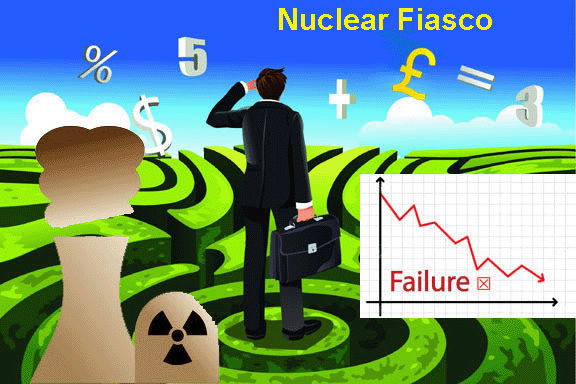
Gulf states poised to bail Britain out of energy crisis
Bahrain and the UAE courted by energy secretary Grant Shapps for fresh nuclear investment
By Rachel Millard, 30 April 2023
Gulf states are poised to help bankroll Britain’s efforts to build new
nuclear power stations to keep the lights on, the energy security secretary
has indicated. Grant Shapps visited the region in January and said he
remains “in constant contact” with investors in the region who are
“very interested” in the nuclear sector. Countries such as the UAE and
Bahrain have built up vast sovereign wealth funds which are now pushing
into clean energy amid global efforts to cut fossil fuel use.
Jeremy Hunt, the chancellor, met with the UAE’s Mubadala, a sovereign investment firm,
in February, and has abandoned plans to toughen tax rules for sovereign
wealth funds. Mr Shapps said: “I was in the Gulf states [this year] and
I’m in constant contact with our friends and colleagues over there. “They
have already been investing massive amounts in renewable energy – and
they’re very interested in nuclear power as well. The scale of their
ambitions are pretty big – watch this space.”
Ministers are trying to drum up investment for EDF’s planned £20bn power plant in Suffolk as well as other nuclear projects as part of a push on the carbon-free [?] power
source. Legal & General, Britain’s biggest money manager with £1.3 trillion
of assets, has said it is focused on supporting other “viable, and
cost-effective” {?] clean [?] energy solutions.
French state energy giant EDF
owns Britain’s nuclear fleet but will need outside investors to build its
planned Sizewell C project in Suffolk. The Government and EDF have pushed
China’s CGN out of the project amid concern about China’s involvement in
critical national infrastructure.
Telegraph 30th April 2023
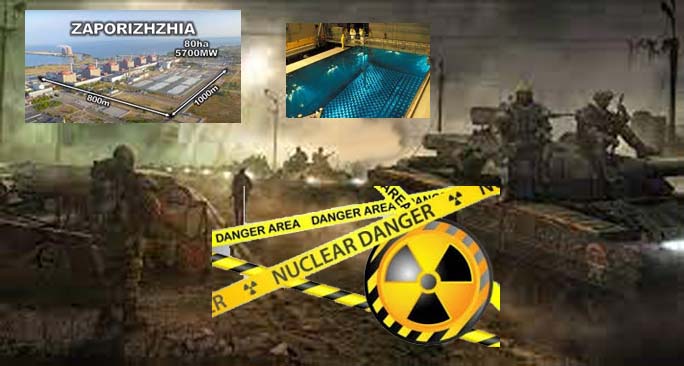
Zaporizhzhya Nuclear Power Plant: a Catastrophe Waiting to Happen
BY CAROL WOLMAN CounterPunch 1 May 23
A meltdown at Zaporizhzhya Nuclear Power Plant grows more likely with every passing day. With a meltdown, radioactive water from the plant would flow into the Dnieper River, which empties into the Black Sea, and thence to the Mediterranean. See below for map. The consequences would be catastrophic for Europe, North Africa, and the Middle East. Clearly this is an international problem. It calls out for an international solution.
Perhaps it is time to send in UN Peacekeeping Forces.
ZNPP has been at risk for a Fukushima-type meltdown since the Russians occupied the plant in March 2022. It sits on the front line of the war, the south side of the Dnieper River. The Russians quickly occupied the south side early in their invasion; the Ukrainians still occupy the north side.
The International Atomic Energy Agency was able to establish a presence at ZNPP after months of lobbying by its Director- General Mariano Grossi. He has personally visited twice and gets daily updates from the IAEA personnel on site. His latest report can be found here.
Grossi has been trying for almost a year to negotiate a safety zone around ZNPP. After his visit to the plant on 3/29/23, Grossi stressed that the increasing combat makes it urgent to find a way to prevent a potentially catastrophic nuclear accident.
He complains that he is not getting support from the UN, and even from his own agency. The EU issued a statement a few months ago but is not keeping the pressure on. Given the potential for catastrophe, it is astounding that more attention is not being given to the need to support Grossi’s efforts.
Instead, the media publishes reassuring articles about how many safety features ZNPP has.
Safety features are useless if the cooling water stops circulating around the nuclear material. The reactors have been shut down, so the pumps need an external power source.
The main power lines cross the Dnieper to the Ukraine energy grid on the north side of the river. The back up lines connect to conventionally fired plants in Ukrainian territory. They are right on the front line, and mortar fire from either side can cut them.
Since the invasion, all the external power lines to the plant- 4 major lines and 2-4 backup lines- have been cut simultaneously at least SIX times, forcing the pumps to rely on emergency diesel generators. As Grossi says ““Each time we are rolling a dice…And if we allow this to continue time after time, then one day our luck will run out.”
Without the constant circulation of cooling water, the nuclear fuel would overheat, resulting in a chain reaction and meltdown. This is what happened at Fukushima Daiichi 1:
; the earthquake and tsunami cut off the power and the pumps stopped working. A huge discharge of radioactive water into the vast Pacific Ocean continued for several years, until an ice wall was built around the damaged reactors.
Within three years after the Fukushima disaster, there were massive die-offs throughout the Pacific. Mollusks in particular suffered, and the result went up the food chain, so that sea mammals were starving and mutated. The sea bird population was decimated.
A meltdown at ZNPP would release large amounts of radioactive water into a much smaller body of water than the Pacific Ocean. The Dnieper River empties into the Black Sea and eventually into the Mediterranean. All the countries which border the Mediterranean would be affected. The consequences are unthinkable.
The circulation of cooling water could fail for another reason. It cycles through a holding pond nearby. Because of the constant influx of warm water from the reactors, still hot even in shutdown mode, the pond is prone to algae growth, which could clog the intake valves and stop the water flow. It is stocked with tropical fish, which eat the algae and keep the water clear.
The cooling pond is at risk. Global warming may cause the pond to overheat this summer, killing the scavenging fish…………………………………………………
Clearly this is an international problem. The danger of a meltdown at ZNPP is real; the consequences would be catastrophic for Europe, North Africa, and the Middle East…………………………………………………………….. https://www.counterpunch.org/2023/05/01/znpp-a-catastrophe-waiting-to-happen/
Is nuclear power attractive or risky? In Minnesota, it’s both.
Christian Science Monitor, By Colette Davidson Special correspondent @kolet_ink May 1, 2023|MONTICELLO, MINN.
At a clearing in the brush, a clunky wooden dock is still pulled onshore for the season amid piles of dirty snow. Usually, this boat landing at the Montissippi Regional Park is a popular spot for amateurs to fish bass and walleye from the Mississippi River.
But after the Xcel Energy nuclear plant – just half a mile away – announced in March that radioactive material had leaked twice from a faulty pipe since November, some locals say they’re worried about what’s in the water. ……………………….
The Minnesota Pollution Control Agency and Minnesota Department of Health say the risks to the public from the leaks of water contaminated with tritium – totaling a little more than 400,000 gallons – are minimal and have not affected public drinking water. Xcel Energy powered down its Monticello plant in mid-March for maintenance, once the second leak had been discovered.
That has done little to assuage the fears of local residents, however, who say the utility company should have notified the public earlier about the leak.
…………………………….. a renewed push for nuclear energy, even among former skeptics. Yet building public trust remains a key challenge, in Minnesota and across the nation – particularly in the wake of incidents like the one in Monticello.
………………………………………………..
Reliance, but also restrictions
The U.S. gets approximately 19% of its electricity from nuclear power, according to the Energy Information Administration. While states need to go through the federal Nuclear Regulatory Commission (NRC) for licensing approval, much of the challenge of building nuclear energy plants or considering new nuclear technologies is getting past state legislation.
Minnesota – which gets 24% of its electricity from two nuclear power plants – is one of 12 states that currently have a moratorium on the construction of new nuclear power facilities. That has led proponents here to focus their efforts instead on the latest technologies, like small modular reactors………..
…………… in the past five years, more Minnesota Democrats have come around to the idea of nuclear energy – an issue that once split along party lines.
This mirrors a wider national trend. In 2023 alone, there have been close to 100 bills across 20 states to repeal moratoriums or study nuclear energy, according to the Nuclear Innovation Alliance, based in Washington, D.C. The U.S. Department of Energy recently invested nearly $2 billion in TerraPower’s construction of a nuclear reactor in Kemmerer, Wyoming, to replace a retiring coal plant. And John Kerry, the special presidential envoy for climate, has openly supported nuclear energy….
Evolving concerns on safety
That’s not to say there aren’t concerns about nuclear from within the climate advocacy community. With the exception of the Vogtle plant in Burke County, Georgia – which boasts next-generation technology – the U.S. reactor fleet is of the same or similar generation as the one involved in Japan’s Fukushima disaster in 2011.
“Whether they’re identical in design or not, they all have the same level of vulnerability,” says Edwin Lyman, a physicist and the director of nuclear power safety at the Union of Concerned Scientists, a national watchdog. …………………………..
Dr. Lyman says the Biden administration, in its enthusiasm to tackle carbon emissions and roll out new nuclear plants, must be careful not to forgo needed safety rules. That becomes even more essential as climate change brings higher winds and flooding, the biggest risks for a reactor short-circuit. Nuclear operators have also struggled with how to store waste long term. New waste is stored in pools before being transferred to dry casks, which can take up land space indefinitely.
Mixed feelings by the Mississippi
The public seems to be on board with putting more time and research into nuclear energy. According to an April Gallup poll, 55% of Americans support nuclear energy, the highest level in a decade.
But for those living near nuclear plants, there are still concerns about safety and security – from the quality of groundwater to the threat of domestic terrorism. Out on the trail at Montissippi Regional Park in Monticello, locals joke that their tomatoes are extra large thanks to their proximity to the Xcel plant. Others say they’ve been drinking bottled water since the leak.
“When those Chinese surveillance balloons flew overhead [in February], I did wonder, would the nuclear plant be a target?” says Betty, out for a walk with her husband Jack. Betty used to work for the city of Monticello and did not want to identify herself by her full name.
While the immediate risks may be small, she says she and her husband “live in the shadow of the nuclear plant,” which is a half mile from their house. Every year, Xcel Energy distributes a free calendar, which includes evacuation information in the event of disaster. …………………………… https://www.csmonitor.com/Environment/2023/0501/Is-nuclear-power-attractive-or-risky-In-Minnesota-it-s-both
Kim Jong Un’s influential sister says North Korea determined to develop nuclear arsenal following US-South Korea summit
ABC News 1 May 23
The powerful sister of North Korea’s leader says her country will stage more provocative displays of its military might in response to a new US-South Korean agreement to intensify nuclear deterrence on the Korean Peninsula.
Key points:
- Kim Yo Jong, sister of Kim Jong Un, is a top foreign policy official for the regime
- She says the new US-South Korea agreement only strengthens the North’s resolve to develop nuclear arsenal
- North Korea’s nuclear deterrence doctrine emphasise pre-emptive strike capabilities
According to Kim Yo Jong, the new agreement between Washington and Seoul to counter North Korea’s nuclear threat shows their “extreme” hostility toward Pyongyang………………………………………………………………………..
North Korean leader Kim Jong Un is widely expected to up the ante in coming weeks or months as he continues to accelerate a campaign aimed at cementing the North’s status as a nuclear power and eventually negotiating US economic and security concessions from a position of strength. https://www.abc.net.au/news/2023-05-01/north-korea-rebukes-us-south-korea-summit-/102285574
Libya lost, then found, 2.5 tonnes of uranium – a red flag for nuclear safety

The Conversation Olamide Samuel.Track II Diplomat and Expert in Nuclear Politics, University of Leicester 1 May 23
Earlier this year the International Atomic Energy Agency Director General Rafael Grossi reported that about 2.5 tonnes of uranium ore concentrate had gone missing from a site in Libya. This was arguably one of the largest quantity of uranium ore concentrate that had ever been misplaced.
Barely a day after the IAEA’s announcement, General Khaled Mahjoub of the self-styled Libyan National Army said the uranium ore had been found about 5km from the warehouse where it had been stored. A week later, the IAEA, which had been monitoring the stockpile occasionally, confirmed that most of the uranium ore concentrate had been found.
Uranium ore concentrate, popularly known as ‘yellowcake’, is a type of uranium concentrate powder obtained after uranium ore has been milled and chemically processed. Yellowcake has very low radioactivity, equivalent to the radioactivity of uranium ore found in nature, and it is produced by all countries where uranium ore is mined.
Yellow cake is further processed to become enriched uranium, which is used to manufacture the fuel for nuclear reactors. However, enriched uranium can also be used to manufacture nuclear weapons. If the technology were available, the 2.5 tons of missing yellowcake would have been half the amount required for a nuclear bomb.
Nuclear material experts had said the Libyan uranium ore concentrate in case posed “no significant security risk” as it required prohibitively sophisticated processing capabilities before it can be suitable for civil or weapons use.
Nevertheless, the news of missing Libyan uranium ore concentrate did highlight serious problems with the national and global governance structures for managing uranium.
Based on my experience in nuclear non-proliferation and politics, I believe that the missing Libyan uranium debacle illustrates two things.
Firstly, it illustrates the dangers of a IAEA that doesn’t have enough resources to monitor uranium ore stockpiles, especially in countries with unstable regimes. And faced with more pressing issues such as the safety and security of nuclear power plants in Ukraine, the IAEA won’t prioritise yellowcake storage.
Secondly, many African countries still struggle to implement nuclear safety and security governance provisions.
A regional destabiliser
Libya has been unstable since the fall of Muammar Gaddafi’s regime in 2011. This plunged the country into a civil war that has destabilised the North African and the Sahel regions, as Libya lost control of the largest and most diverse military arsenals in the region.
Much of this arsenal eventually fell into the hands of various non-state actors. Among them were Boko-Haram which mounted a reign of terror in northern Nigeria, and Ansar Al-Sharia in Tunisia.
Gaddafi had amassed stockpiles of nuclear material and technology as he sought to develop nuclear weapons. He had help from Abdul Qadeer Khan, who had been identified as a key facilitator for the global smuggling of nuclear material and technology.
Gaddafi eventually abandoned the weapons program in 2003, after months of secret disarmament negotiations with the US and British.
Following this deal, the US airlifted about 25 metric tonnes of Libya’s nuclear weapon programme components and documents. The last of Libya’s enriched uranium was removed in 2009. But there remained in Sabha, the southern Libyan city, about 6400 barrels of uranium ore concentrate. It’s this material that was under the control of an army battalion.
Olli Heinonen, a former Deputy Director of the IAEA, has since explained that it would have been very costly to airlift the remaining concentrate. He also said there were incentives for Libyans to holding onto the concentrate until the spot price of uranium was high enough for profitable export.
More questions than answers
Though the missing 2.5 tonnes of uranium have been recovered, questions remain: Why did 2.5 tonnes go missing in the first place? Who would have wanted to acquire it?
…………………………….. more https://theconversation.com/libya-lost-then-found-2-5-tonnes-of-uranium-a-red-flag-for-nuclear-safety-203775
ACTION ALERT: False NYT Spy Claim on Iran Nukes Needs Correction
JIM NAURECKAS, https://fair.org/home/action-alert-false-nyt-spy-claim-on-iran-nukes-needs-correction/ 1 May 23
The New York Times (5/1/23), reporting on Iran’s execution of British spy Alireza Akbari, reported:
The spy had provided valuable information — and would continue to do so for years — intelligence that would prove critical in eliminating any doubt in Western capitals that Iran was pursuing nuclear weapons.
This is not correct; as FAIR has often pointed out (FAIR.org, 10/17/17, 9/9/15, 9/24/13; 1/31/13; Extra!, 3–4/08), the position of US intelligence is that it has no proof Iran has decided to build a nuclear weapon. As the US State Department reiterated in April 2022:
The United States continues to assess that Iran is not currently undertaking the key nuclear weapons–development activities it judge necessary to produce a nuclear device.
This is a serious error that deserves prompt correction.
ACTION:
Please tell the New York Times to correct its false claim that there is no doubt that Iran is pursuing nuclear weapons.
CONTACT:
Letters: letters@nytimes.com
1 This Month



Shut down the radiation-damaged Heysham nuclear reactors now
To see nuclear-related stories in greater depth and intensity – go to https://nuclearinformation.wordpress.com

Say No to NASA’s Reckless Nuclear Reactor on the Moon
Say No to NASA’s Reckless Nuclear Reactor on the Moon
-
Archives
- October 2026 (256)
- September 2026 (339)
- August 2026 (330)
- July 2026 (355)
- June 2026 (287)
- May 2026 (306)
- April 2026 (356)
- March 2026 (251)
- February 2026 (267)
- January 2026 (308)
- December 2025 (358)
- November 2025 (359)
-
Categories
- 1
- 1 NUCLEAR ISSUES
- business and costs
- climate change
- culture and arts
- ENERGY
- environment
- health
- history
- indigenous issues
- Legal
- marketing of nuclear
- media
- opposition to nuclear
- PERSONAL STORIES
- politics
- politics international
- Religion and ethics
- safety
- secrets,lies and civil liberties
- spinbuster
- technology
- Uranium
- wastes
- weapons and war
- Women
- 2 WORLD
- ACTION
- AFRICA
- Atrocities
- AUSTRALIA
- Christina's notes
- Christina's themes
- culture and arts
- Events
- Fuk 2022
- Fuk 2023
- Fukushima 2017
- Fukushima 2018
- fukushima 2019
- Fukushima 2020
- Fukushima 2021
- general
- global warming
- Humour (God we need it)
- Nuclear
- RARE EARTHS
- Reference
- resources – print
- Resources -audiovicual
- Weekly Newsletter
- World
- World Nuclear
- YouTube
-
RSS
Entries RSS
Comments RSS

