Finance for renewable energy
The lessons learned from scaling up wind and solar technologies from an
expensive niche option to arguably the cheapest option for new electricity
generation can act as a framework for the continued growth of the energy
transition and its expansion to emerging economies. This is the conclusion
from a new report published this week by the International Renewable Energy
Agency (IRENA) launched in partnership with the Indian G20 Presidency
entitled “Low-Cost Energy Transition Finance”. The report focuses on
the need for low-cost finance to support the development of newer renewable
energy technologies such as green hydrogen, energy storage, and offshore
wind in both emerging market economies and advanced economies.
Renew Economy 17th May 2023
Zelensky plotted attacks deep inside Russia – Washington Post

https://www.rt.com/russia/576237-zelensky-hungary-russia/ 15 May 23
The Ukrainian leader reportedly wanted to “occupy” Russian cities to gain leverage over Moscow
Despite public assurance that he would limit military action to his own country’s 1991 borders, Ukrainian President Vladimir Zelensky formed plans to conduct attacks deep inside Russia and suggested that Kiev “destroy” the industry of Hungary, the Washington Post reported on Saturday, citing leaked Pentagon documents.
Citing US intelligence reports recently published on a gaming server, the Post described how Zelensky suggested at a meeting in January that his troops “conduct strikes in Russia,” while moving across the border to “occupy unspecified Russian border cities” in order to “give Kiev leverage in talks with Moscow.”
Less than two months later, the Ukraine-based Russian Volunteer Corps launched a cross-border raid that left two civilians dead in Russia’s Bryansk Region. A member of the group told Western media that Kiev had approved the attack, and further assaults have taken place since.
With Ukraine’s Western backers reluctant until recently to provide him with long-range missiles for fear he would use them against targets within Russia, Zelensky suggested to his top military commander, General Valery Zaluzhny, that he use drones to “attack unspecified deployment locations in Rostov” in February, the Post reported.
Prior to and after the alleged meeting, Ukrainian forces used drones to attack infrastructure in Rostov Region, which borders the formerly Ukrainian territory of Lugansk.
In a meeting with Deputy Prime Minister Yulia Svridenko in February, Zelensky reportedly suggested that Ukraine “blow up” the Druzhba oil pipeline, which transports Russian oil to Hungary. According to the US report cited by the Post, Zelensky suggested that “Ukraine should just blow up the pipeline and destroy…Hungarian [Prime Minister] Viktor Orban’s industry, which is based heavily on Russian oil.”
American spies listening to his meeting with Svridenko concluded that Zelensky was issuing “hyperbolic, meaningless threats.” Nevertheless, the Druzhba pipeline has come under attack on several occasions since the meeting, most recently when it was hit by drone-dropped explosives on Wednesday.
The Post’s article corroborates a CNN report last month claiming that US spies have been intercepting Zelensky’s communications.
Contacted by the newspaper, Zelensky dismissed the incidents described in the report as “fantasies,” and claimed that “no one in our country has given orders for offensives or strikes on Russian territory.”
Contacted by the newspaper, Zelensky dismissed the incidents described in the report as “fantasies,” and claimed that “no one in our country has given orders for offensives or strikes on Russian territory.”
The Women of Three Mile Island
CounterPunch BY KARL GROSSMAN 12 May 23
Radioactive: The Women of Three Mile Island is the title of a newly-released documentary feature film directed, written and produced by award-winning filmmaker Heidi Hutner, a professor of environmental humanities at Stony Brook University, a “flagship” school of the State University of New York.
With greatly compelling facts and interviews, she and her also highly talented production team have put together a masterpiece of a documentary film.
It connects the proverbial dots of the 1979 Three Mile Island nuclear plant disaster—doing so brilliantly.
The documentary has already received many film awards and has had a screening in recent months in New York City—winning the “Audience Award for Best Documentary” at the Dances With Films Festival—and Harrisburg, Pennsylvania; Sarasota, Florida; Dubuque, Iowa; Long Island, New York; First Frame International Film Festival in New York City; the Environmental Film Festival in Washington D.C., and is soon the featured film at Kat Kramer’s #SHEROESForChange Film Festival in Los Angeles and the Cinequest Film Festival in San Jose, California, as well as the Uranium Film Festival in Rio de Janeiro in Brazil. And there will be tours across the U.S.
Resident after resident of the area around Three Mile Island is interviewed and tells of widespread cancer that has ensued in the years that have followed the accident—a cancer rate far beyond what would be normal. Accounts shared in the documentary are heartbreaking.
A whistleblower who had worked at the nuclear plant tells Hutner of the deliberate and comprehensive attempt by General Public Utilities, which owned TMI, to cover up the gravity of the accident and its radioactive releases, especially of cancer-causing Iodine-131 and Xenon 133.
An attorney, Lynne Bernabei, involved in litigation in the wake of the accident, says the Three Mile Island “cover-up was one of the biggest cover-ups in history.” Meanwhile, the U.S. Nuclear Regulatory Commission which is “supposed to protect the public” has then and since been just “interested in is promoting the [nuclear] industry. This is corrupt,” says attorney Joanne Doroshow, now a professor at New York Law School and director of the Center for Justice & Democracy. Many examples of this are presented.
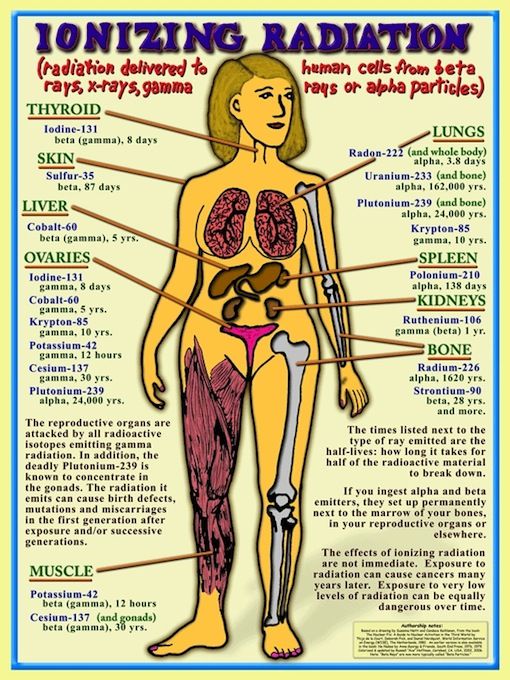
The documentary’s focus on women includes women being far more at risk to the effects of radioactivity than men. Mary Olson, a biologist, founder, and director of the Gender & Radiation Impact Project, says in the film that those setting radiation standards in the U.S. from the onset of nuclear technology in 1942, based impacts on a “25 to 30 years-old” male “defined as Caucasian.” She said, “It has come to be known as the ‘Reference Man.” However, Olson cites research findings that “radiation is 10 times more harmful to young females” and “50 percent more harmful to a “comparable female” than it is to “Reference Man” who is “more resistant” to radioactivity than a woman.
There’s the scientist Dr. Aaron Datesman, who is now pursuing a major chromosomal study regarding the impact of the disaster on the health of people in the area, and how people have been harmed despite the denials of the nuclear industry. This study is based on his recent ground-breaking work, “Radiological Shot Noise,” in Nature.
And more and more.
………………………………… Hutner, in speaking about the focus on women in Radioactivity: The Women of Three Mile Island, explains: “Following health and safety disasters, it is often women on the ground fighting back, and over and over throughout nuclear history, these women are gaslighted, silenced, called hysterical and ‘radiophobic.’ The result of such silencing: we lose significant information about nuclear history, science, and health.”
Hutner goes on: “What I have dug up after over 20 years of ecofeminist research is shocking—Dr. Alice Stewart’s research on the danger of X-rays to fetuses in the womb; Rachel Carson’s writing about radiation and bioaccumulation; Dr. Helen Caldicott’s warnings about the dangers of nuclear weapons and her peace and vital medical health advocacy as a physician (she has been attacked mercilessly and unfairly by male critics on sexist grounds); Mary Olson’s study of the alarming danger of radiation to girls and women, Leona Morgan’s decolonization activism to protect indigenous communities from uranium extraction and poisoning, and the dumping radioactive waste on native lands; poet activist Kathy Jetnil-Kijner’s story-telling about the suffering of women miscarrying in the Marshall Islands after the 67 nuclear test-bombing by the U.S. There are endless stories such as these.”

“By erasing such women’s voices, by gaslighting these women, men have erased significant human stories, science, research,” says Hutner. “This is a classic sexist maneuver. Call women and those who speak up about the dangers of nuclear technology as radiophobic, hysterical, and incapable of understanding science. As the women in Radioactivity explain, when they spoke at the Nuclear Regulatory Hearings and meetings, asking intelligent questions about the verity of the nuclear company’s and NRC’s claims, and armed with detailed information regarding their corruption and cover-ups—what really happened—the women were laughed at, mocked, told to ‘go home and bake cookies.’”
“That’s why we made Radioactive. The public needs to know and understand how they are being lied to, how key aspects of nuclear disasters and radiation impacts have been swept under the rug. And at what cost. This is life and death. An so we focus on buried women stories, and in subsequent film projects we hope to make as part of a series, we will bring in the silenced voices of black, brown, and women’s indigenous groups impacted unequally by nuclear disasters.”
She adds: “The film could not come at a more important time for a number of reasons. With nuclear power being discussed in some circles as an ‘answer’ to our climate crisis, we believe anyone seeing this film will walk away with the unmistakable conclusion that nuclear power must be off the table. TMI is one of a long list of environmental disasters and cover-ups that have caused serious harm to surrounding communities, which will last decades. It was and continues to be the lesson of what happens when a corporation and industry lacking integrity, regulated by an agency completely captured by that industry, is put in charge of people’s lives. TMI happened 44 years ago. But when it comes to systems meant to protect the public’s health and safety from nuclear hazards, nothing has changed and in fact, has only gotten worse.”
Comments about the documentary include:………………………………………………………………………………………..
The documentary website is: https://radioactivethefilm.com/. There you will find listings for upcoming screenings.
Hutner says: “We made Radioactive: The Women of Three Mile Island because the issue of nuclear dangers has ‘died’ as an important cause. It was once a global movement. Front page news. One million people marched in Central Park and so did millions around the world. The big screen popped with blockbusters on the topic. Today: few know or care about nuclear dangers—historical or in the present.”
“Sadly,” Hutner continues, “younger folks are taught nothing in school about nuclear history except a brief lesson (if they are taught anything) on how great nuclear energy is. My students are shocked and aghast at what they learn in my classes (in-depth history and present information). They’ve heard a little bit about Hiroshima and Nagasaki, and they have heard of Chernobyl (barely). They haven’t a clue about anything else. They don’t know what nuclear power is or how it functions. They don’t think about nuclear weapons and the potential for nuclear obliteration.”
“The nuclear industry has won its plan to silence this history and science. They’ve invested heavily in painting a pretty picture, erasing facts, and denigrating concerned citizens, particularly women, as I have explained. There’s no recognition of the great harm done to fetuses, babies, children—especially girl children. There’s a complete disregard for the poisoning of communities of color. Dr. Robert Bullard, the father of the environmental justice movement, and Winona LaDuke, a leading indigenous ecofeminist activist, call this environmental racism.”
“Pronuclear films by Bill Gates, Oliver Stone, Robert Stone, leave out essential information — real experiences of real people who live next to reactors, live with and in disaster zones and highly toxic areas,” Hutner notes. “From what I can see—these guys (note their gender and color) have not spoken with or met the people who live with high rates of cancer and multigenerational cancers in disaster locations. They don’t visit and spend time in these communities. Childhood cancers. Heart disease. Infertility. Deformed babies. Miscarriages. Infertility. On and on.”
“These pro-nuke guys,” Hutner continues, “do not address the science that shows the dangers of radiation exposures or the future of inevitable meltdowns. They blackball this science. They don’t discuss radioactive waste—where and how it’s maintained (poorly—putting all life at risk for thousands of years). And the location of the waste? Mostly indigenous lands and always poorly stored. Waste right on-site at the nuclear facilities, leaving communities located next to and near power plants at risk for thousands of years. They dump nuclear waste in waterways.”…………………………………………………………………………… more https://www.counterpunch.org/2023/05/12/the-women-of-three-mile-island/?fbclid=IwAR0PdDIrL2eXpRa9KFGN2aL7xSLkUwNYVIZFotFrfpKHlRmi8kQSeNCxKUQ
Nuclear’s Dangerous Waste Is ‘Rapidly Catching Up’ With Industry

Jonathan Tirone, Bloomberg News, 15 May 23
- World faces a wave of decommissioning in coming decades: IAEA
- That will create streams of long-lasting, radioactive waste
Swelling inventories of radioactive waste need to be dealt with more effectively if nuclear energy is to become a key tool in combating climate change, the International Atomic Energy Agency said.
While nuclear power stations don’t emit planet-warming greenhouse gases, they do create streams of long-lasting, hazardous waste. It takes engineers and regulators years to plan and execute the decommissioning of a single site, with costs sometimes running into the billions of dollars.
“Even as we look into the future, the past is rapidly catching up,” IAEA Director-General Rafael Mariano Grossi said Monday at a conference in Vienna, where hundreds … (subscribers only) more https://news.bloomberglaw.com/health-law-and-business/nuclears-dangerous-waste-is-rapidly-catching-up-with-industry
France to host pro-nuclear meet to push for EU recognition of climate benefits

Yahoo Sport Kate Abnett and America Hernandez. Mon, 15 May 2023
BRUSSELS (Reuters) -France will host a meeting of ministers from 16 pro-nuclear European states on Tuesday aimed at coordinating expansion of atomic power and urging the EU to recognise its role in meeting climate goals for 2050, the country’s energy ministry said.
The meeting in Paris will include EU Energy Commissioner Kadri Simson and representatives from 14 EU countries including France, Belgium and the Netherlands, plus Italy as an observer and the United Kingdom as a non-EU invitee………………………
Yves Desbazeille, director of EU lobby group Nucleareurope, will also give a presentation, including figures on potential job creation and investment.
A draft of the post-meeting statement seen by Reuters said the countries would encourage the commissioner to integrate nuclear energy into the EU’s energy policy by recognising nuclear alongside other green [?] energy technologies in EU decarbonisation goals.
The talks will cover the EU Net Zero Industry Act, the Hydrogen Bank, definitions of low-carbon hydrogen and hydrogen import strategies among other topics, the French official said.
The draft document also calls for the publication of an EU communication on small modular reactors.
……………………………. EU opponents of nuclear energy – among them Germany, which switched off its last reactors last month, Luxembourg and Austria – cite concerns including waste disposal and maintenance issues that have plagued the French fleet in recent years.
Austria and Luxembourg are taking the EU to court over its decision to officially label nuclear investments as “green”. https://au.sports.yahoo.com/france-host-pro-nuclear-meet-133145776.html
Japanese protesters call for US military to be evicted
https://www.rt.com/news/576288-okinawa-protesters-us-bases-china/ 15 May 23
Increasingly hostile relations between Washington and Beijing have dialed up the urgency of Okinawan protesters’ demands
Thousands of Japanese protesters assembled near Kadena Air Base in Okinawa to protest the US occupation of the island on Saturday, on the 51st anniversary of the island returning to Japanese control.
The annual demonstration comes amid rising regional tensions as the US supplies Taiwan with weapons in what China views as open provocation.
Chanting slogans including “Give us back our peaceful life” and “Osprey get out,” the latter being a reference to US military helicopters, the demonstrators demanded the closure of the US’ Okinawa bases. The island’s inhabitants are weary of the pollution – both chemical and aural – produced by Washington’s military outposts, as well as the high number of crimes committed by American servicemembers, from petty theft and drunk driving to rape and murder.
Governor Denny Tamaki has urged the Japanese and US governments to reduce the Pentagon’s footprint on the island, which hosts 70% of all US military facilities in Japan despite comprising just 1% of the country’s total land area.
The protests come as an increasingly militarized Japan becomes a focal point in the great-power rivalry between the US and China. The US recently fast-tracked a $500 million defense package to Taiwan, just a month after hosting Taiwanese President Tsai Ing-Wen for a hugely controversial “unofficial” visit, eliciting warnings and massive military maneuvers from Beijing.
Last year, Japan’s Ground Self-Defense Force held its first-ever large-scale maritime drill with US troops stationed in Okinawa, enacting scenarios aimed at deterring “competitor and adversary aggression.”
NATO is reportedly even planning to open a liaison office in Tokyo, as the bloc last year discarded the pretense of limiting itself to the ‘North Atlantic’ part of North Atlantic Treaty Organization by inviting its regional allies – Japan, Australia, South Korea, and New Zealand – to its annual summit in a signal of increased focus on Beijing.
Should war break out between the two countries, it is widely understood that the US would use its Japanese bases to stage operations, making Japan a likely target of Chinese retaliation.
Japan approved its largest defense budget ever last year and plans to double defense spending to 2% of GDP by 2027, making its defense budget the world’s third-largest after the US and China, in a drive to acquire “counterstrike capability.” This represents a significant strategic shift away from the solely defensive posture Tokyo has been legally required to maintain since the end of World War II, though the constitution’s language was relaxed in 2017.
Nuclear power and the technocratic system are not compatible with democracy: France’s group in Grenoble that fights this system

The nuclear renaissance is a repeat of the fiasco of 1974. Published in La Relève et La Peste, Text prepared by Laurie Debove, January 30, 2023, Translation by Dennis Riches
Translator’s introduction
This interview published in January 2023 has a message for Oliver Stone and all the other cheerleaders of a nuclear renaissance. Oliver Stone’s new film Nuclear Now is just a rehash of Nuclear Then. The discussion below illustrates that there is nothing new about the nuclear renaissance being promoted as a solution to global warming and fossil fuel shortages caused by war. Anti-nuclear arguments were valid then and they still are now, and there isn’t really anything new to add to them. ……………………..
Introduction
The government is doing everything to revive the nuclear industry in France at a rapid pace, to the detriment of the public debate underway until February 27, a debate which is supposed to take account of the opinion of the population on this subject. To get a historical and technological perspective on this issue, we interviewed two people from Grenoble who belong to “Pièces et main d’oeuvre.” They have been active in the fight against nuclear power since the 1970s. We met in a Grenoble café, and in the text below their answers have been edited and compiled into one common voice.
LR&LP: Could you introduce yourselves and your organization?
“……………………………………………..We produce ideas and participate in demonstrations because we believe that ideas can change and transform the course of the world, that they can oppose technology.
LR&LP: What led you to look at nuclear, and what are the biggest pitfalls you found?
“………………………………Throughout the 1940s, 50s and 60s, a divisive critique of nuclear power developed……………………. it was at this time that US President Eisenhower launched the program “Atoms for Peace,” saying that the atom can also have a civilian application in the form of nuclear power plants and research. It therefore proposed technology transfers from the United States to more than twenty countries that wanted to manufacture reactors.
……………. The moment we manufacture nuclear power, we manufacture the consequences of nuclear power and especially its waste.
As we supply the whole of society with nuclear power, we must maintain a scientific clergy of nucleocrats because it is a very complicated and dangerous technology, and on the other hand we must protect these nuclear power plants, mineral mines, transport, and waste with a dedicated militia because we do not want it to fall into the wrong hands.
With the civilian atom, there is therefore an entire electro-totalitarian society that is being set up with a state apparatus, a police, and a particular political organization. No more dreams and utopias of self-management or anarchy. Nuclear waste cannot be managed by just anyone. There is a ratchet effect in it where there is no turning back…………………………………………………………..
LR&LP: Here we are in 2022, and the Autorité de Sureté du Nucléaire (Nuclear Safety Authority) has launched an alert on the failures of the French nuclear fleet. Having seen both the establishment and the evolution of this fleet, was this predictable, and what do you think of the French nuclear recovery plan, imposed by the government, while we see that the [nuclear power plant] EPR of Flamanville has ten billion euros of additional cost as well as twelve years of delay in its construction?
P.M.O: That nuclear power plants wear out, like all factories, is a banality. The life cycle of a nuclear power plant is 100 years on average, from the time construction starts to the time it is decommissioned. Nuclear power costs a fortune, but no matter how much cheap French electricity is promoted, it is a lie. Over time, the state has financed EDF less so we have maintained the plants less. We have fewer trained specialists, and the private sector has not taken over of the cost.
Today we are witnessing a repeat of what happened in 1974 after the Yom Kippur War, when Arab countries punished the West by tripling oil prices. We did not have oil, but nuclear was an alternative, so Pompidou, Giscard d’Estaing and the Prime Minister at the time, Messmer, launched a plan to nuclearize France to compensate for the deficit in oil imports. The uranium came from Niger. We had the skills because the CEA existed since 1945 [for the bomb program]. EDF placed the orders and they manufactured nuclear power plants at a rapid rate.
It is striking to observe how Pierre Messmer’s speech on TV in 1974 and Emmanuel Macron’s speech in Belfort in 2021 are like twins! The recovery is justified by a drop in supplies: at the time the cause was the Arab countries and today it is the Russia-Ukraine conflict.
In the same way, there was an increase in demand at the time because people were forced to equip themselves with electric household appliances, and today it is the means of electric transport and gadgets like smartphones that create this additional demand. On the one hand, industry creates the demand and therefore the problem, and on the other hand it comes with the solution that the population cannot refuse.
The surprise is that we re-apply the same old methods with the same old arguments. It is a headlong rush to ignore the current disaster. We cannot have such a demand for electricity. It is neither sustainable nor reasonable.
……………..There is also the denial of the poisoning of the environment with radioactivity. We live in a world where radioactivity is anthropogenic. Physics teaches us that this is not going away. We could have anticipated all this.
………………………………………………….. a technocratic class developed. In the same way that technology has become the real politics of our time, the real ruling class of our time is technocracy: the class that has produced and is the product of technology (engineers, business leaders, some elected officials).
………… These people are keeping citizens in ignorance. The elected official will then surround himself with scientific advisors that he cannot control since he does not know how to solve their equations.
……….. The basic citizen has integrated this and understood that he does not understand anything, or not much. The citizen therefore relies on those who know.
…………………the technocratic system and technology have the power to change the world, yet it is not compatible with participatory democracy.
LR&LP: However, a public debate has been launched to ask citizens for their opinion. In your opinion, can participating in this public debate allow the French population to regain control over the decisions made on energy production in France? If not, what should everyone do for an informed debate on nuclear technology?
P.M.O: Public debates are like the bullfighter’s cape. The authorities know very well that there will be rants, foghorns, banners, and they find it very good since then the protest is confined to the “public debate”. Chantal Jouanno, the president of the National Commission for Public Debate (CNDP) said the banners are welcome in 2022 because of a precedent in the history of French public debate…………………………………………………………..
A yes or no outcome will have no impact. Sociologists themselves have defined public debate by saying “involvement is enforced acceptance.” For us, participation is therefore accepting, as we have written about extensively. To believe that they will take into account the opinion of citizens on such a vast social project is illusory.
The only real public inquiry on nuclear power ended in a fiasco. That was in Plogoff. The Bretons there refused the public inquiry and fought for weeks against the police. Every evening, hundreds of people gathered to throw stones and slurry because, for them, every form of pseudo-consultation was a smokescreen. This explains why there has never been a nuclear power plant built in Plogoff while they have been built everywhere else.
LR&LP: Power is in the hands of technocrats. “Participation is enforced acceptance.” Therefore, how can a citizen regain an influence in energy production?
“………………………………………………………..The only force likely to turn the tide would be a collective realization that it is not sustainable to continue to consume so much energy, physically and materially, because of entropy and its effects. We would then have to decide to get rid of this energy-intensive and material-intensive lifestyle, and give up certain habits, but it remains an abstract goal.
The problem is that people do not necessarily demand democracy. They are like passengers on a train who, of course, don’t want to be able to drive it. Most people just want a society that works. The question is how.
Further reading
The latest book published by Pièces et Main d’oeuvre:
Technocracy: The Ruling Class of the Technological Age https://dennisriches.wordpress.com/2023/05/14/the-nuclear-renaissance-is-a-repeat-of-the-fiasco-of-1974/
8 arrested at nuclear protest on Mother’s Day
https://www.kitsapdailynews.com/news/8-arrested-at-nuclear-protest-on-mothers-day/ By Staff report • May 15, 2023
A small group of nuclear arms protesters celebrated Mother Earth on Mother’s Day by getting arrested.
Despite the heat, eight peace activists held banners that read, “The Earth is Our Mother Treat Her With Respect” and “Nuclear Weapons are Immoral to Use, Immoral to Have, Immoral to Make.”
Brenda McMillan, 89, wore a T-shirt with Julian Ward Howe’s plea, “Disarm, Disarm!”
The activists are all with Ground Zero Center for Nonviolent Action in Poulsbo. They were cited and released by state troopers for pedestrian on roadways infractions.
Demonstrators included Lee Alden of Bainbridge Island, Sue Ablao of Bremerton, Carolee Flaten of Hansville and Tom Rogers of Keyport.
Traffic was halted and diverted as the 15-member Seattle Peace Chorus Action Ensemble, sang “The Lucky Ones,” an original composition by director Doug Balcom, to the guards and Navy personnel. The song describes the different stages of personal, regional and global destruction that a nuclear war would inflict on humanity.
The civil disobedience was part of Ground Zero’s annual observance of Mother’s Day, first suggested in the United States in 1872 by Howe as a day dedicated to peace.
Earlier in the day 45 people gathered to plant rows of sunflowers at the Ground Zero Center directly across from the Trident Submarine Base. Naval Base Kitsap-Bangor is homeport to the largest concentration of deployed nuclear warheads in the U.S. The nuclear warheads are deployed on Trident D-5 missiles on SSBN submarines and are stored in an underground nuclear weapons storage facility on the base.
Rogers, a retired Navy captain and former nuclear submarine commanding officer who was cited for participating in the action, said, “The destructive power of the nuclear weapons deployed here on board Trident submarines, is beyond human imagination. The simple fact is, that a nuclear exchange between the great powers would end civilization on our planet.”
Fukushima greets summer with dread as nuclear-contaminated wastewater dumping approaches

Global Times, By Xu Keyue and Xing Xiaojing in Iwaki, May 15, 2023
The Fukushima Prefecture in northeastern Japan is known as “the island of happiness,” which embodies people’s longing for a better life. Summer began in Fukushima in early May when locals normally look forward to intimate contact with the sea.
However, despite strong opposition at home and abroad, the Japanese government and the Tokyo Electric Power Company (TEPCO) are set to go ahead with the plan to dump the nuclear-contaminated wastewater from the Fukushima Daiichi Nuclear Power Plant into the sea this summer.
As summer approaches, the Global Times reporters went to the Fukushima Prefecture. In this first installment of this field investigation, the Global Times reveals the palpable sense of fear and unease hanging over Fukushima, paired with intense opposition from locals who chanted “Never allow arbitrary dumping into the sea!”………………………………………………………………………………………………………
About 54 kilometers away from the Fukushima Daiichi Nuclear Power Plant, the city looks subdued with few passersby along the streets. The excavation of an underwater tunnel for the project to drain the nuclear-contaminated wastewater from the Fukushima Daiichi Nuclear Power Plant was completed in April, and TEPCO announced that it is expected to complete the construction of the tunnel by the end of June. Measuring 1,031 meters long and 1 kilometer away from the coast, the tunnel will allow radioactive wastewater to be dumped into the sea.
…………………………………………………….. Chiyo Oda, co-chairperson of an environmental NGO and city assembly “Stop polluting the oceans!” was one of them.
“Summer is coming. What’s going to happen? Fukushima greets summer with fear!” said Oda, who expressed strong concern about the dumping of nuclear-contaminated wastewater at a conference themed “Don’t Nuke the Pacific” on May 7. “The Japanese government has reached an agreement with the fishing community that nothing will be done without [the fishing community and other stakeholders’] understanding.” Nevertheless, the Japanese government is apparently breaking its promise and is preparing to dump the water which is likely to start this summer.
When the Global Times reporters met Oda, the 68-year-old woman had just returned to Iwaki from Fukushima city, the capital of Fukushima Prefecture. Early that day, with Kazuyoshi Sato, another co-representative of the city assembly, Oda had driven for two hours to the Fukushima prefectural office to hold a press conference to announce that a mass rally called “May 16 Tokyo Action” will be held in Tokyo on May 16 to urge the Japanese government and TEPCO to stop dumping the nuclear-contaminated wastewater.
Oda told the Global Times that the campaign will last all day on May 16, when anti-sea pollution campaigners from all over Japan are meant to gather in Tokyo. As planned, they will gather in front of the TEPCO headquarters at 10:30 am, and then head to the House of Representatives with lawmakers to hold the rally. The rally and petition to the Japanese government and parliament will be followed by a speech at the Hibiya Open Air Concert Hall in the evening. It will then be followed by a massive demonstration in Ginza, Tokyo, which is expected to be attended by more than 1,000 people.
“The sea of my hometown, the Sea of Japan, and the seas of the world must not be polluted,” said Oda.
Oda noted that the Japanese government, TEPCO, the Fukushima Prefectural Federation of Fisheries Cooperative Associations, and the National Federation of Fisheries Cooperative Associations of Japan signed an agreement in 2015, stating it would not “do anything about the nuclear-contaminated water from Fukushima without the understanding and consent of the relevant people,” but now the Japanese government and TEPCO insist on dumping the water despite opposition from all parties, including fishermen. …………………………………………………………………………………………………………………………………………………………………..
“Look! This is the sea we want to protect!” Ikarashi told the Global Times that he and his family have fond memories of living by the sea, eating the catch from the same sea, surfing, and frolicking with their children. The people of Fukushima live just like them, having enjoyed the bounty of the sea for generations. If the nuclear-contaminated wastewater is dumped into the sea, future generations will no longer be able to enjoy the beautiful nature.
Ruiko Muto, who lives in Tamura, Fukushima, is the head of the association for the victims of the Fukushima nuclear accident. After the accident, she worked hard to hold the former management of TEPCO accountable as a member of the legal team for the Fukushima nuclear accident and the criminal prosecution team.
Muto told the Global Times in an email that “ALPS-treated water” used by the Japanese government and TEPCO contains many other radioactive substances besides tritium, making it “not safe at all.” Under such circumstances, attempts to release the radioactive wastewater from Fukushima into the sea must not be allowed.
Muto said that as summer approaches, her group will join forces with other civic groups and continue to express opposition through protests and rallies.
Dumping not only way
In an on-the-spot interview, Global Times reporters noted the intense concern over whether “ALPS-treated water,” as the Japanese government and TEPCO refer to it, is safe, and whether there is an alternative to dealing with the wastewater.
Hideyuki Ban, a Japanese nuclear expert and co-director of the Tokyo-based Citizens’ Nuclear Information Center (CNIC), told the Global Times that “the nuclear-contaminated wastewater contains 64 radionuclides, including tritium, some of which are very long-lived and cannot necessarily be diluted. [The compounds] can accumulate in the ocean and attach to fish and shellfish, and some of them can enter the body of marine organisms, causing human beings to be exposed to nuclear radiation after consumption. Even if [the wastewater] is treated and released into the sea, it is not safe.”
“There is no precedent in the world for dumping such wastewater containing 64 radionuclides into the sea,” he said.
“The capacity of ALPS to remove radionuclides and the amount of the nuclear-contaminated wastewater to be discharged are not fully understood, let alone gaining the understanding and consent of stakeholders. Under such circumstances, it is not allowed to arbitrarily discharge the wastewater,” he said.
Ban noted that there are other ways to dispose of the wastewater. For example, there is the option of “mortar solidification,” where the nuclear-contaminated wastewater is mixed, solidified, and stored in mortar as in cement production. What the Japanese government has done is based on a political decision, not one based on scientific research, Ban criticized……………………………………………………………………….
The problem, however, is that even if the nuclear-contaminated wastewater is disposed of, key issues such as whether nuclear fuel debris can be removed from the Daiichi plant remain unresolved. The government plans to decommission the reactor in the next 30 to 40 years, but it has yet to give a clear explanation of how long it will take to complete the project and in what condition the facility will have to be in order to qualify as successfully decommissioned, according to Muto.
Surrounded by the sea, Japan gives thanks to the gracious sea as a prosperous maritime nation, on “Sea Day” held annually on the third Monday of July, which is one of the statutory holidays in the country.. Born by the sea, the locals reached by the Global Times could not help but express their deep concern and fear that if the sea is polluted, it will be difficult to enjoy the sea’s succor in the future. https://www.globaltimes.cn/page/202305/1290745.shtml
 |
China’s nuclear ambitions get a boost from Russia, but is energy the only goal?

- Moscow is feeding Beijing’s growing appetite for highly enriched uranium, but observers say those supplies could be used for nuclear weapons
- China will replace the US to become the world’s top uranium buyer by 2030, experts say
Liu Zhen, 13 May, 2023, SCMP,
China is importing highly enriched uranium from Russia to produce energy, but observers caution that Beijing also plans to expand its nuclear arsenal. Photo: Shutterstock
The confirmation came last week when Russia said it had agreed to supply highly enriched uranium-235 to energy-hungry China over the next three years.
The announcement backed up reports that the shipments of nuclear fuel – enriched up to 30 per cent – were part of a deal to supply a demonstration fast-neutron power plant, a technology that could help China ease its shortage of nuclear fuel.
…….. with the enriched uranium fuelling a demonstration project for the new technology, China could improve its output of nuclear fuel and go some way to overcoming itst supply problem.
The final product would be plutonium 239, an artificial element that is primarily used in nuclear warheads – and that worries the West.
Although never officially admitted, Beijing is believed to be expanding the country’s nuclear arsenal, in line with President Xi Jinping’s pledge at last October’s 20th Communist Party congress to “strengthen strategic deterrence” as military tensions with the United States and its allies rise.
The US Department of Defence (DOD) has estimated China will increase from 400 warheads today to 1,500 by 2035.
……………………………………………………… With its two 600 megawatt power generators, the CFR-600 is not particularly large and is only considered a “demonstration project”. By comparison, the Daya Bay Nuclear Power Plant near Hong Kong, which has been operating since the 1990s, has two 944 megawatts generators.
In March, US DOD official John Plumb described the China-Russia cooperation deal as “very troubling”, but China’s foreign ministry has defended the arrangement as “perfectly normal and we do not see anything wrong about it”.
………………………… Fast-neutron reactors are an advanced fourth-generation nuclear power plant technology, which function to generate power, multiply nuclear fuel, and incinerate long-lived radionuclides, according to Xue Xiaogang, head of the China Institute of Atomic Energy Science.
……………………………………………. Russia has for decades been a leader in fast-neutron reactor technology, and last year its Beloyarsk BN-800 reactor began running completely on reprocessed spent fuel known as MOX.
But China’s imports of 30 per cent concentrated uranium-235 fuel for the Xiapu CFR-600 meant it was still at an earlier stage of technological development with many obstacles to overcome, said the researcher. https://www.scmp.com/news/china/military/article/3220391/chinas-nuclear-ambitions-get-boost-russia-energy-only-goal
Leak reveals Zelensky privately plots bold attacks inside Russia.(Is his halo slipping?)

They reveal a leader with aggressive instincts that sharply contrast with his public-facing image as the calm and stoic statesman.
Zelensky suggested Ukraine “conduct strikes in Russia”
“Zelensky highlighted that … Ukraine should just blow up the pipeline and destroy likely Hungarian [Prime Minister] Viktor Orban’s industry”
Zelensky then “suggested that Ukraine attack unspecified deployment locations in Rostov,” a region in western Russia, using drones instead, according to another classified document.
The Age, John Hudson and Isabelle Khurshudyan, May 14, 2023
Washington: Ukrainian President Volodymyr Zelensky has won the trust of Western governments by refusing to use the weapons they provide for attacks inside Russia and prioritising the targeting of Russian forces inside Ukraine’s borders.
But behind closed doors, Ukraine’s leader has proposed going in a more audacious direction – occupying Russian villages to gain leverage over Moscow, bombing a pipeline that transfers Russian oil to Hungary, a NATO member, and privately pining for long-range missiles to hit targets inside Russia’s borders, according to classified US intelligence documents detailing his internal communications with top aides and military leaders.
The documents, which have not been previously disclosed, are part of a broader leak of US secrets circulated on the Discord messaging platform and obtained by The Washington Post. They reveal a leader with aggressive instincts that sharply contrast with his public-facing image as the calm and stoic statesman weathering Russia’s brutal onslaught. The insights were gleaned through intercepted digital communications, providing a rare look at Zelensky’s deliberations amid Russian missile barrages, infrastructure attacks and war crimes.
The Pentagon, where senior US military leaders were briefed on the matters outlined in the leaked documents, did not dispute the authenticity of the materials.
In some cases, Zelensky is seen restraining the ambitions of his subordinates; in several others, he is the one proposing risky military actions.
In a meeting in late January, Zelensky suggested Ukraine “conduct strikes in Russia” while moving Ukrainian ground troops into enemy territory to “occupy unspecified Russian border cities,” according to one document labelled “top secret.” The goal would be “to give Kyiv leverage in talks with Moscow,” the document said.
In a separate meeting in late February with General Valery Zaluzhny, Ukraine’s top military commander, Zelensky “expressed concern” that “Ukraine does not have long-range missiles capable of reaching Russian troop deployments in Russia nor anything with which to attack them”. Zelensky then “suggested that Ukraine attack unspecified deployment locations in Rostov,” a region in western Russia, using drones instead, according to another classified document.
In a meeting in mid-February with Deputy Prime Minister Yuliya Svrydenko, Zelensky suggested Ukraine “blow up” the Soviet-built Druzhba pipeline that provides oil to Hungary. “Zelensky highlighted that … Ukraine should just blow up the pipeline and destroy likely Hungarian [Prime Minister] Viktor Orban’s industry, which is based heavily on Russian oil,” the document says.
In detailing the conversation, intelligence officials concede that Zelensky was “expressing rage toward Hungary and therefore could be making hyperbolic, meaningless threats,” a qualification that does not accompany the other accounts of Zelensky suggesting bold military action. Though Hungary is nominally part of the Western alliance, Orban is widely considered Europe’s most Kremlin-friendly leader.
When asked if he had suggested occupying parts of Russia, Zelensky, during an interview with The Washington Post in Kyiv, dismissed the US intelligence claims as “fantasies” but defended his right to use unconventional tactics in the defence of his country.
……………. The use of long-range missiles to hit inside Russia is a particularly sensitive topic for the White House, which has long worried that the Ukraine conflict could escalate out of control and force a catastrophic standoff between the United States and Russia, the world’s largest nuclear powers.
Though Washington has given Zelensky billions of dollars’ worth of advanced weaponry, President Biden has steadily rebuffed the Ukrainian leader’s request for long-range ATACMS, shorthand for the Army Tactical Missile System, capable of striking targets up to 185 miles away. Since the start of the war, Biden has said the United States is “not encouraging or enabling Ukraine to strike beyond its borders”.
When asked about the intelligence indicating he had weighed the use of long-range missiles to hit Russia, Zelensky said it is not something Ukraine is entertaining. “No one in our country has given orders for offensives or strikes on Russian territory,” he said.
It is unclear whether the United States has shared accounts of Zelensky’s plotting with allied nations, but the Ukrainian president continues to enjoy the strong support of Western governments, which have provided him with an increasingly sophisticated array of weaponry.
This past week, Britain became the first Western country to provide Ukraine with long-range missiles. The Storm Shadow, a cruise missile system with stealth capabilities, has a range of 155 miles, far exceeding the 50-mile range of the US-provided HIMARS launchers.
British Defence Minister Ben Wallace said Friday that the missile would give Ukraine “the best chance” to defend itself and would be for use only “within Ukrainian sovereign territory.” A spokesman with the British Embassy in Washington declined to comment on whether Zelensky’s leaked remarks might give London pause about its decision.
The Biden administration says Zelensky’s intercepted comments are not the cause for withholding ATACMS.
“Ukraine has repeatedly committed to employ US-provided weapons responsibly and strategically when needed to counter Russian aggression, and we are confident that will continue to be the case,” said a US defence official who, like others interviewed for this report, spoke on the condition of anonymity to discuss a sensitive topic.
Since last year, Zelensky has promised that Ukraine would never use US weapons to strike inside Russia, a pledge the White House says he has fulfilled.
“President Zelensky has kept the promises he has made to President Biden, and we do not believe that that will change,” said a senior administration official.
One reason for not providing the long-range missiles is the “relatively few ATACMS” the United States has for its own defence needs, General Mark A. Milley, chairman of the Joint Chiefs of Staff, told Defence One in March.
Zelensky, however, said he believes the United States isn’t sending the weapons because it doesn’t trust Kyiv.
“I think they are afraid that we might use them on the territory of Russia,” Zelensky told The Post. “But I would always tell our partners … ‘We have a priority target for which we are spending the ammunition packages we receive, and we spend it on the deoccupation of purely Ukrainian territories,’” he said.
While there is no indication that Ukraine has used Western missiles to strike into Russian territory, the same cannot be said for Kyiv’s use of armed drones.
Explosions caused by unmanned aerial vehicles have become a regular occurrence in Russia, including in Rostov, where a drone crashed into an oil refinery this month. Ukrainian officials are often coy about the incidents, hinting that they’re responsible without directly taking credit.
Two drone attacks in December on Russia’s Engels air base in Saratov, more than 590 kilometres from the Ukrainian border, showed “that we have the ability to reach many kilometres farther than they could expect,” Oleksiy Danilov, secretary of Ukraine’s National Security and Defence Council, said in an interview earlier this year.
Russia this month accused Ukraine of staging a drone attack intended to kill President Vladimir Putin in the Kremlin. Videos circulating on social media and verified by The Post show two drones streaking toward the Kremlin at about 2.30am local time. The allegation was forcefully denied by Ukrainian officials, including Zelensky…………………..more https://www.theage.com.au/world/europe/leak-reveals-zelensky-privately-plots-bold-attacks-inside-russia-20230514-p5d87l.html The Washington Post
Understanding The Highly Complex World Of Western China Analysis

CAITLIN JOHNSTONE, MAY 15, 2023 https://caitlinjohnstone.substack.com/p/understanding-the-highly-complex?utm_source=post-email-title&publication_id=82124&post_id=121463595&isFreemail=true&utm_medium=email
—
Former Pentagon official Elbridge Colby was interviewed on The National Review’s Charles CW Cooke Podcast, where he provided some very high-level analysis on the tensions around China, Taiwan, and the United States.
I will here attempt to explain some of Colby’s comments for the benefit of the average reader, because Colby has been studying these things for many years and his commentary can be a bit advanced and esoteric for the casual punditry consumer.
“The analogy I use is… Taiwan is like a man with a cut in the ocean, and China is like a great white shark, and America is like a man in a boat,” Colby said in the interview.
“The problem is once that great white shark starts moving, you got no time,” added Colby. “You’re done. You know, if you’re not already by the side of the boat, right? Because it’s a great white shark.”
Now bear with me if Colby’s incisive observations went a bit over your head here, but if we break it down I’m confident that we can all catch up to this man’s towering intellect enough to catch a glimpse of his understanding on the matter.
What Colby appears to be saying — and please correct me of you think I’m reading this wrong — is that China is like a Great White Shark, which as we all know is an extremely dangerous aquatic predator with a voracious appetite, capable of gulping down a human being in a few swift bites.
Now, try to imagine being in a situation where you’re out there in the ocean, and there’s a Great White Shark right there with you in the water. And to make matters worse, you’re bleeding — a problem not only due to the wound from whence the blood is emanating, but also because sharks can smell blood in the water! That would be pretty bad, right?
Okay, so are you with me so far? Remember, this is very advanced stuff, so feel free to read back and review as much as you need.
Now, imagine you’re in that situation with the cut and the shark, and there’s a boat that you can go to to get away from the shark. You’d want to hop aboard that vessel as swiftly as possible, don’t you think? I know I would!
So to put it all together, what the esteemed Elbridge Colby is telling us is that China is analogous to the Great White Shark which is eyeing the bleeding man in the water, and the man can be compared to Taiwan, and the United States of America is comparable to the boat that is coming to the rescue of the man.
Make sense? If you’re still struggling to comprehend Colby’s scalpel-like geopolitical analysis, don’t worry, because I’ve obtained this helpful infographic above, to further illuminate your understanding:
Interestingly enough, this is not the first time China has been compared to a Great White Shark in recent western punditry. The Hoover Institution’s Matt Pottinger, a former advisor to President Donald Trump, made a similar comparison in an interview with Nikkei Asia earlier this month:
“We saw a baby shark and thought that we could transform it into a dolphin over time, to become a friendly sort of system,” Pottinger said. “Instead, what we did was we kept feeding the shark and the shark got bigger and bigger and bigger and bigger. And now we’re dealing with a formidable, great white.”
“With a shark you put up a shark cage,” added Pottinger. “The shark doesn’t take it personally. It bumps into the cage. It respects those barriers.”
Again, this is very complicated for the uninitiated layperson, but what Pottinger appears to be saying is that China is not at all comparable to a dolphin, which is an oceanic mammal known to be friendly toward people and easily trained to do tricks in aquatic theme parks. Rather, in Pottinger’s understanding, China is more comparable to a Great White Shark, which as you’ll recall from our discussion earlier in this essay is actually known to be rather dangerous.
If you’re still struggling to make sense of Pottinger’s luminous understanding, here’s another illustration to help make things a bit clearer:
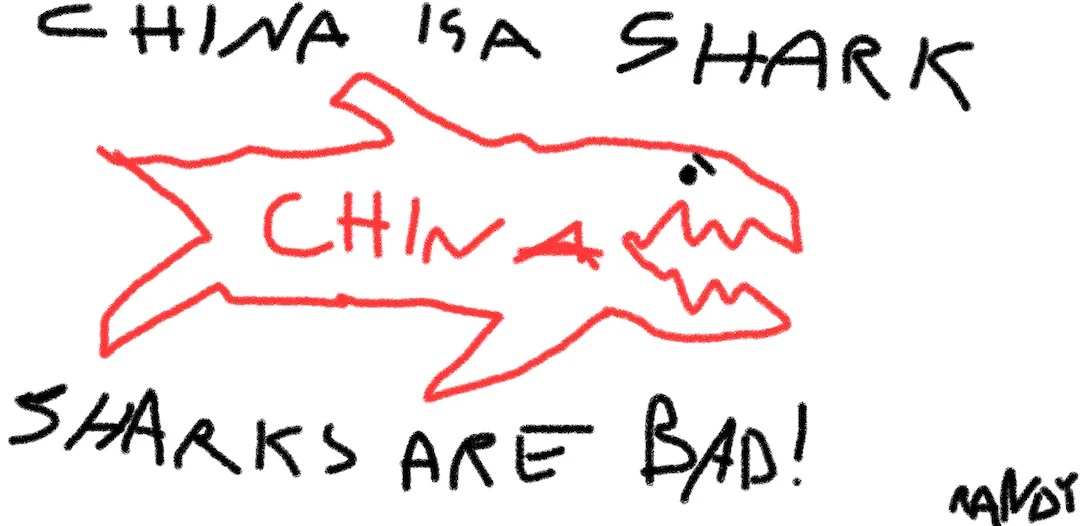
If you need it simplified even further, another way to put it might be, CHINA BAD. SHARK BAD. CHINA LIKE SHARK. CHINA VERY, VERY BAD. BAD CHINA. BAD.
Again, don’t be hard on yourself if you can’t quite wrap your head around the high-level analysis of intellectual giants like Matt Pottinger and Elbridge Colby. If we could understand these things as well as they do, we’d be the ones earning big bucks from Washington think tanks, not them!
Well I think that’s enough work for your gray matter today. Have a rest and a nice sleep and come back fresh tomorrow, where we’ll be discussing some mind-blowing comparisons western analysts have been drawing between Vladimir Putin and Adolf Hitler.
Luck is not a safety plan
“We must act now,” said International Atomic Energy Agency director general, Rafael Grossi. But what is his plan? IAEA efforts at creating a “safe zone” around the Zaporizhzhia reactors, where no fighting could then occur, have collapsed. On the geopolitical stage, both Russia and Ukraine appear to harbor the conviction that their side can win the war. NATO and its allies show no signs of insisting on a diplomatic solution, given the benefit to those countries of a Russian defeat.
War devastation is bad enough without adding a nuclear disaster
Luck is not a safety plan — Beyond Nuclear International
How much more perilous can the situation at Zaporizhzhia nuclear power plant become?
By Linda Pentz Gunter, 14 May 23
Luck is not a sound basis on which to rely when we are dealing with nuclear risks. But luck is again what me must depend on as we watch and wait for the worst to happen — or not — at the six-reactor Zaporizhzhia nuclear power plant in Ukraine.
The plant, located in the southwestern region of the country — the area most directly embroiled in some of the most intense fighting, and with parts of it already “annexed” by Russia — has already experienced some frightening near-misses. These include shelling and missile attacks and frequent losses of offsite power that, if not restored promptly, could lead to a meltdown.
The plant has been occupied by Russian forces since March 4, 2022. Rumors abound that a severely depleted workforce is laboring under stressful and even violent conditions, while other staff have fled or have disappeared.
Now we learn that mass evacuations are underway from communities close to the nuclear plant. These include residents of Enerhodar, the city that houses most of the plant workers and their families……………………….
Fears of a Ukrainian offensive designed to recapture some or all of the Russian-held territory appear to have prompted the sudden evacuation. But are people evacuating away from the conflict or from the prospect of a catastrophic outcome at the nuclear power plant, should it become fully engulfed by the fighting? And if that does happen, what might the consequences be?
As a precaution, all six Zaporizhzhia reactors are currently shut down — officially their status is called “cold shutdown”, which is not as final as it sounds and does not mean they are out of danger.
The fuel in the reactor core still requires electricity to power cooling, as do the pumps that supply cooling water to the fuel pools. This means a meltdown is still possible. Cold shutdown just buys workers more time to restore power should it become lost, but a reliable supply of electricity to the site is still essential to avoid disaster…………
The consequences of such an outcome would be drastic not only for the people of Ukraine and neighboring Russia, but for all of Europe, should any or all of these reactors melt down or suffer a fuel pool fire. We only have to look at the fallout map from the 1986 Chornobyl disaster, a single unit with a far smaller radioactive inventory, to understand the potential scale of such a tragedy.
Chornobyl contaminated 40% of the European landmass with long-lived radioactive fallout and created an effectively permanent 1,000 square mile Exclusion Zone around the stricken nuclear site.
Beyond electrical power, water supply is also essential to keep nuclear power plants out of danger. The thermally and radioactively “hot” irradiated fuel rods sitting in cooling pools, must stay submerged. Electrically powered pumps can maintain a steady water supply. But access to water is critical.
In late March, alarms were raised about a dramatic drop in water levels at the reservoir that supplies cooling water to the plant. Ukrainian officials said the Russians had drained the reservoir, increasing the risk of a meltdown at Zaporizhzhia.
But this month, headlines warned that record high water levels could threaten a dam that, if breached, would send floodwaters pouring onto the nuclear site, inundating the plant’s pumping systems.
War, flooding, and human error are all potential disasters waiting in the wings that could trigger a nuclear catastrophe. But what can prevent it?
“We must act now,” said International Atomic Energy Agency director general, Rafael Grossi. But what is his plan? IAEA efforts at creating a “safe zone” around the Zaporizhzhia reactors, where no fighting could then occur, have collapsed. On the geopolitical stage, both Russia and Ukraine appear to harbor the conviction that their side can win the war. NATO and its allies show no signs of insisting on a diplomatic solution, given the benefit to those countries of a Russian defeat.
All of this brutality already comes at immense cost to the population of Ukraine, but also to Russia, where mothers, too, are losing sons to an unnecessary war. A major strike on Europe’s largest nuclear power plant would extend that tragedy across thousands of miles, affecting hundreds of millions of lives. All we’ve got between us and that disaster is luck, which, like the deadly uranium that fuels nuclear power plants, will eventually run out.
NATO Weapons Go Boom, British Missiles Strike Russia – Ukraine War Escalates
The NATO vs Russia proxy war in Ukraine recently escalated a notch or two, with simultaneous ‘Ukrainian’ airstrikes downing two modern Russian fighter jets and two helicopters… well inside ‘Russia proper’. This came the day after British-supplied, longer-range, cruise missiles struck the city of Lugansk, and hours after Russian airstrikes obliterated another huge store of NATO supplies for Ukraine’s much-vaunted ‘counter-offensive’.
This week on NewsReal, Joe & Niall discuss the latest deceptions in ‘the Ukraine war…. more https://www.sott.net/article/480219-NewsReal-NATO-Weapons-Go-Boom-British-Missiles-Strike-Russia-Ukraine-War-Escalates#
Chris Hedges: Julian Assange – A Fight We Must Not Lose

BY TYLER DURDEN, FRIDAY, MAY 12, 2023,
https://www.zerohedge.com/geopolitical/chris-hedges-julian-assange-fight-we-must-not-lose—
Authored by Chris Hedges via ScheerPost.com, (emphasis ours)
This is a talk Chris Hedges gave in New York City at rally calling for the immediate release of Julian Assange on World Press Freedom Day.
The detention and persecution of Julian Assange eviscerates all pretense of the rule of law and the rights of a free press. The illegalities, embraced by the Ecuadorian, British, Swedish and U.S. governments are ominous. They presage a world where the internal workings, abuses, corruption, lies and crimes, especially war crimes, carried out by corporate states and the global ruling elite, will be masked from the public. They presage a world where those with the courage and integrity to expose the misuse of power will be hunted down, tortured, subjected to sham trials and given lifetime prison terms in solitary confinement. They presage an Orwellian dystopia where news is replaced with propaganda, trivia and entertainment. The legal lynching of Julian, I fear, marks the official beginning of the corporate totalitarianism that will define our lives.
Under what law did Ecuadorian President Lenin Moreno capriciously terminate Julian’s rights of asylum as a political refugee? Under what law did Moreno authorize British police to enter the Ecuadorian Embassy — diplomatically sanctioned sovereign territory — to arrest a naturalized citizen of Ecuador? Under what law did Donald Trump criminalize journalism and demand the extradition of Julian, who is not a U.S. citizen and whose news organization is not based in the United States? Under what law did the CIA violate attorney-client privilege, surveil and record all of Julian’s conversations both digital and verbal with his lawyers and plot to kidnap him from the Embassy and assassinate him?
The corporate state eviscerates enshrined rights by judicial fiat. This is how we have the right to privacy, with no privacy. This is how we have “free” elections funded by corporate money, covered by a compliant corporate media and under iron corporate control. This is how we have a legislative process in which corporate lobbyists write the legislation and corporate-indentured politicians vote it into law. This is how we have the right to due process with no due process. . This is how we have a government — whose fundamental responsibility is to protect citizens — that orders and carries out the assassination of its own citizens, such as the Muslim cleric Anwar al-Awlaki and his 16-year-old son. This is how we have a press which is legally permitted to publish classified information and our generation’s most important publisher sitting in solitary confinement in a high security prison awaiting extradition to the United States.
The psychological torture of Julian — documented by the United Nations special rapporteur on torture, Nils Melzer — mirrors the breaking of the dissident Winston Smith in George Orwell’s novel “1984.” The Gestapo broke bones. The East German Stasi broke souls. We, too, have refined the cruder forms of torture to destroy souls as well as bodies. It is more effective. This is what they are doing to Julian, steadily degrading his physical and psychological health. It is a slow-motion execution. This is by design. Julian has spent much of his time in isolation, is often heavily sedated and has been denied medical treatment for a variety of physical ailments. He is routinely denied access to his lawyers. He has lost a lot of weight, suffered a minor stroke, spent time in the prison hospital wing — which prisoners call the hell wing — because he is suicidal, been placed in prolonged solitary confinement, observed banging his head against the wall and hallucinating. Our version of Orwell’s dreaded Room 101.
The psychological torture of Julian — documented by the United Nations special rapporteur on torture, Nils Melzer — mirrors the breaking of the dissident Winston Smith in George Orwell’s novel “1984.” The Gestapo broke bones. The East German Stasi broke souls. We, too, have refined the cruder forms of torture to destroy souls as well as bodies. It is more effective. This is what they are doing to Julian, steadily degrading his physical and psychological health. It is a slow-motion execution. This is by design. Julian has spent much of his time in isolation, is often heavily sedated and has been denied medical treatment for a variety of physical ailments. He is routinely denied access to his lawyers. He has lost a lot of weight, suffered a minor stroke, spent time in the prison hospital wing — which prisoners call the hell wing — because he is suicidal, been placed in prolonged solitary confinement, observed banging his head against the wall and hallucinating. Our version of Orwell’s dreaded Room 101.
All these crimes, especially after the attacks of 9/11, have returned with a vengeance. The CIA has its own armed units and drone program, death squads and a vast archipelago of global black sites where kidnapped victims are tortured and disappeared.
The U.S. allocates a secret black budget of about $50 billion a year to hide multiple types of clandestine projects carried out by the National Security Agency, the CIA and other intelligence agencies, usually beyond the scrutiny of Congress. The CIA has a well-oiled apparatus, which is why, since it had already set up a system of 24-hour video surveillance of Julian in the Ecuadorian embassy in London, it quite naturally discussed kidnapping and assassinating Julian. That is its business. Sen. Frank Church — after examining the heavily redacted CIA documents released to his committee — defined the CIA’s “covert activity” as “a semantic disguise for murder, coercion, blackmail, bribery, the spreading of lies and consorting with known torturers and international terrorists.”
Fear the puppet masters, not the puppets. They are the enemy within.
This is a fight for Julian, who I know and admire. It is a fight for his family, who are working tirelessly for his release. It is a fight for the rule of law. It is a fight for the freedom of the press. It is a fight to save what is left of our diminishing democracy. And it is a fight we must not lose.
1 This Month



Shut down the radiation-damaged Heysham nuclear reactors now
To see nuclear-related stories in greater depth and intensity – go to https://nuclearinformation.wordpress.com

Say No to NASA’s Reckless Nuclear Reactor on the Moon
Say No to NASA’s Reckless Nuclear Reactor on the Moon
-
Archives
- October 2026 (256)
- September 2026 (339)
- August 2026 (330)
- July 2026 (355)
- June 2026 (287)
- May 2026 (306)
- April 2026 (356)
- March 2026 (251)
- February 2026 (267)
- January 2026 (308)
- December 2025 (358)
- November 2025 (359)
-
Categories
- 1
- 1 NUCLEAR ISSUES
- business and costs
- climate change
- culture and arts
- ENERGY
- environment
- health
- history
- indigenous issues
- Legal
- marketing of nuclear
- media
- opposition to nuclear
- PERSONAL STORIES
- politics
- politics international
- Religion and ethics
- safety
- secrets,lies and civil liberties
- spinbuster
- technology
- Uranium
- wastes
- weapons and war
- Women
- 2 WORLD
- ACTION
- AFRICA
- Atrocities
- AUSTRALIA
- Christina's notes
- Christina's themes
- culture and arts
- Events
- Fuk 2022
- Fuk 2023
- Fukushima 2017
- Fukushima 2018
- fukushima 2019
- Fukushima 2020
- Fukushima 2021
- general
- global warming
- Humour (God we need it)
- Nuclear
- RARE EARTHS
- Reference
- resources – print
- Resources -audiovicual
- Weekly Newsletter
- World
- World Nuclear
- YouTube
-
RSS
Entries RSS
Comments RSS

