Renewables deliver nearly two thirds of power fed to grid in Germany, not including self-consumption

Nearly two thirds of all electricity fed into Germany’s public grid
between July and September 2025 came from renewable power sources, the
country’s statistical office Destatis said, based on preliminary data.
With 98.3 billion kilowatt-hours (kWh), wind turbines, solar panels and
other renewables contributed 64.1 percent to the electricity mix, up from
63.5 percent in the same period last year. Total renewable power production
rose three percent compared to the third quarter of 2024, while total
electricity production increased by two percent. A robust expansion of
renewable power sources led to record output levels for a third quarter:
Wind power production increased by more than ten percent compared to the
third quarter of 2024, reaching a share of over one quarter (26.8%) of the
power mix, while solar PV output rose 3.2 percent to a share of 24.1
percent.
Renew Economy 9th Dec 2025,
https://reneweconomy.com.au/renewables-deliver-nearly-two-thirds-of-power-fed-to-grid-in-germany-not-including-self-consumption/
Japan pulls out of Vietnam nuclear project, complicating Hanoi’s power plans
Japan has dropped out of plans to build a major nuclear power plant in
Vietnam because the time frame is too tight, Japanese ambassador Naoki Ito told Reuters, potentially complicating Vietnam’s long-term strategy to
avoid new power shortages.
Vietnam, home to large manufacturing operations for multinationals including Samsung and Apple, has faced major power blackouts as demand from its huge industrial sector and expanding middle class often outpaces supplies, strained by increasingly frequent extreme weather, such as droughts and typhoons.
“The Japanese side is not in a position to implement the Ninh Thuan 2 project,” the ambassador to Vietnam said, referring to a plant with a planned capacity of 2 to 3.2 gigawatts. The project is part of Vietnam’s strategy to boost power generation capacity.
Asahi Shimbun 8th Dec 2025, https://www.asahi.com/ajw/articles/16208469
The ‘Nuclearity’ of the Marshall Islands, and the Threat of US Testing

By Bea Paduano
ICAN Australia and Bea Paduano, Dec 09, 2025, https://icanaustralia.substack.com/p/the-nuclearity-of-the-marshall-islands?utm_source=post-email-title&publication_id=6291617&post_id=181019673&utm_campaign=email-post-title&isFreemail=true&r=1ise1&triedRedirect=true&utm_medium=email
This article explores how nuclearity exposes unequal power, why some lives are protected, and others sacrificed, and how these dynamics still matter today as talk of renewed US nuclear testing re-enters global politics. To avoid repeating the devastation imposed on the Marshall Islands, strong international support for the Treaty on the Prohibition of Nuclear Weapons (TPNW) is crucial.
Between 1946 and 1958, the United States tested sixty-seven nuclear weapons in the Republic of the Marshall Islands—turning entire atolls into fallout zones and reshaping life for generations. Seen through Gabrielle Hecht’s lens of nuclearity, which asks who decides what counts as “nuclear”, the Marshall Islands become one of the most nuclear places on Earth—yet they’re rarely recognised as such.
What is Nuclearity?
Historian Hecht describes nuclearity as a “technopolitical spectrum that shifts in time and space” that shapes “the degree to which something counts as ‘nuclear’.”1
In simple terms, nuclearity is a lens that reveals who has the power to declare something nuclear—or to deny it—even in the face of clear harm. Nuclearity isn’t only about radiation; it is shaped by history, geography, politics and power, and by the decisions that determine which harms are acknowledged and which are ignored.2
The Marshall Islands: a Nuclear Frontier
Japan seized the Marshall Islands during World War One to secure a strategic position in the Pacific, occupying them until the United States took control in 1944 during World War Two. After the war, the US turned the islands into a nuclear testing ground, beginning with Bikini and Enewetak in 1946. Over the next twelve years, the United States conducted sixty-seven atmospheric, underwater, and airburst tests that vaporised entire atolls, and exposed the whole country to severe radioactive fallout. The Castle Bravo test—the largest in US history—released an explosive yield equivalent to more than seven thousand Hiroshima bombs.
US officials justified these tests as being “for the good of mankind and to end all wars”.3 In other words, the Marshall Islands became a “display case for flexing military muscle” at the expense of the Marshallese people.4
Health, Identity and Culture
The health impacts of nuclear testing on the Marshall Islands were—and remain—catastrophic. Thyroid and other cancers, blood and metabolic disorders, cataracts, stillbirths, miscarriages, and birth defects have all been recorded and continue to affect Marshallese communities.5 The US Atomic Energy Commission’s Health and Safety Laboratory once described the atoll of Utirik as “by far the most contaminated place in the world.”6
Radioactive fallout poisoned staple foods, led to unexpected deaths, and weakened immune systems—patterns still seen in Marshallese communities today. Due to contamination, traditional foods became unsafe, and people were forced to give up practices that carry memory and meaning.
The damage is also cultural. Marshallese identity is deeply tied to land and water. In her poem Tell Them, Marshallese poet Kathy Jetnil-Kijiner writes, “we are nothing without our islands.”7 Nuclear testing destroyed homelands and forced many Marshallese into exile, severing connections to land, knowledge, and practices tied to fishing, food, and ceremony.8
Colonialism, “Remoteness,” and Power
Colonialism has long shaped understandings of remoteness, helping powerful states distance themselves from responsibility.9 This is evident in the US nuclear testing program in the Marshall Islands, where the construction of “remoteness” positioned the Marshallese at the margins. The US commission concluded that testing should take place overseas and away from US population centres until the health implications could be established.10 The location was chosen by spreading out maps and looking for sites considered remote.11 In his assessment of six nuclear testing sites, Jacobs concludes that it is no coincidence that all sites used were considered “remote.”12
The Marshall Islands were not only seen as geographically distant, but also racially distant, drawing on colonial ideas of eugenics. Eisenbud, Director of the AEC’s Health and Safety Laboratory in New York, justified the testing by claiming the Marshallese people were “more like us than the mice.”13 Their race and classification as “other” helped justify the testing and reveal the colonial underpinnings of the global nuclear order. Those considered racially inferior and physically remote have repeatedly been subjected to the harms of nuclear weapons testing. These colonial legacies maintain power dynamics and legitimise nuclear testing on Marshallese land and people.
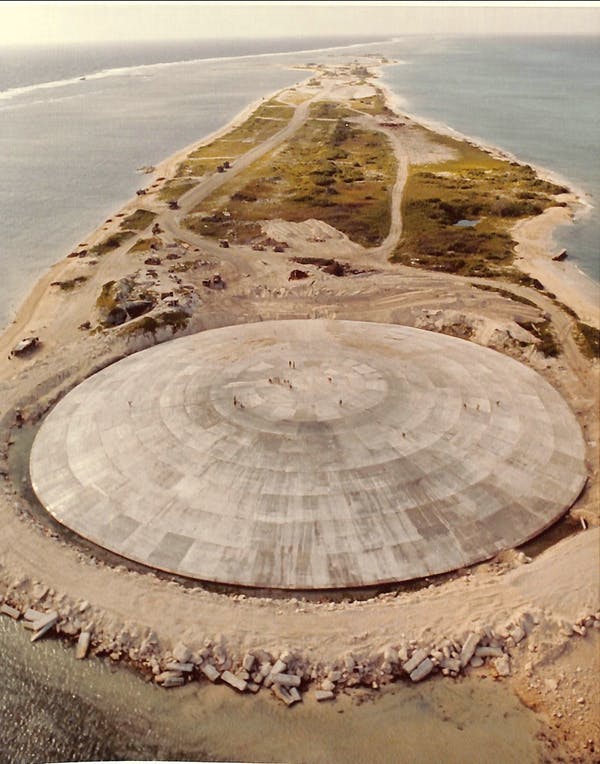
The legacy of this history can be seen in the Runit Dome, the concrete cap covering nuclear waste on Enewetak. As the dome cracks and leaks into the sea, it adds to the already devastating implications of climate change for the Marshall Islands. As sea levels rise, the future of the Marshall Islands remains uncertain.
Who Decides What Counts as ‘Nuclear’?
Hecht’s concept of nuclearity helps explain how authorities can declare certain areas “safe” while people continue to live with radiation and illness.14 Nuclearity does not equate to radioactivity; it is constructed, fluid and changeable, and can be made and unmade by those with the power to define it.
The Bravo test is one example. Communities from Bikini and Enewetak were relocated south before the detonation, yet radioactive fallout still hit the newly inhabited islands. Although the US government claimed that the wind unexpectedly changed, research found that they had six hours’ notice.15 Similar patterns are found in French nuclear testing on the Gambier Islands.16 The US government also imposed arbitrary restrictions such as fishing bans in certain areas of the islands—restrictions that, as Jacobs notes, were not respected by the fish.17 This shows the continued construction of what is considered “nuclear” in specific areas and at specific times, despite ongoing radioactivity.
Kathy Jetnil-Kijiner refers to this denuclearisation in the line: “it’s not radioactive anymore, your illnesses are normal, you’re fine.”18 Despite such claims, the US government restricted visitors from other countries from travelling to the Marshall Islands and restricted the movement of islanders during the tests.19 In this sense, the US government constructed a claim that certain areas would be safe but only for certain individuals, “denuclearising” areas and people despite significant radiation exposure. This draws on Hecht’s concept of nuclearity—that nuclearity “is not the same for everyone, and it is not the same at all moments in time.” 20
Recent US Discussions on Nuclear Testing
These issues are not confined to history. As we watch the current global situation unfold, this article urges us to pay attention to what is considered nuclear and what is not. Donald Trump has suggested that the US should resume nuclear testing to match or surpass other states. Whether this would involve full-scale detonations or ultra-low-yield tests, the political effect is similar: signalling that nuclear threats are back on the table.
Even the discussion of testing changes nuclearity. It designates potential testing sites, shapes perceptions of risk and acceptability, and reinforces harmful colonial power dynamics. Despite no US tests being conducted for decades, and considerable work and commitment to the Comprehensive Nuclear-Test-Ban Treaty (CTBT), this rhetoric threatens the nuclear taboo.
The TPNW, promoted by ICAN, prohibits the testing of nuclear weapons. At the time of writing, seventy-four countries have ratified the treaty. A strong global commitment against testing is needed to confront the harms to health, identity and culture that stretch across past, present and future.
The Marshall Islands illustrate what nuclearity looks like in practice: cancers and contaminated reefs, cracked domes, displaced communities and cultural loss that continues across generations. As talk of renewed nuclear testing returns, we must consider not only where the next “dangerous” place might be, but whose lives will again be treated as expendable.
We cannot allow others to quietly determine what—and who—counts as nuclear.
About the Author
Bea Paduano is a recent graduate of International Relations from the University of Leeds and was a participant in the ICAN-Hiroshima academy 2025 cohort. Her interests include the legacies of social and political injustice, specifically of nuclear testing and migration studies.
References ……………………………………………………………….
China’s New Underwater Drones Could Blindside the U.S. Navy

1945, By Reuben Johnson, 10 Dec 25
Key Points and Summary – China is quietly opening a new front in undersea warfare. Beijing’s latest AI-enabled underwater drones can execute zero-radius turns, recharge at submerged stations, datalink with each other, and reportedly operate below 90 decibels—making them extremely hard to detect.
-Designed to block shipping lanes, threaten warships, and autonomously target and attack, these systems fit neatly into China’s broader effort to keep U.S. and allied navies away from Taiwan.
China continues to make progress in drone technology—especially in aerial combat designs.
Their vehicles are similar to those being developed in the West, such as Collaborative Combat Aircraft or “loyal wingman” programs.
On Sept. 3, observers in Beijing were able to get a glance at one of China’s latest military innovations—a platform that could cause headaches for the U.S. and its allies.
The new design is for an unmanned underwater drone system controlled by what is described as advanced AI capabilities.
This new technology developed for the People’s Liberation Army Navy (PLAN) could be a disruptive development and a ground-breaking capability in anti-submarine warfare.
The new underwater drones are purportedly capable of zero-radius turns and can operate in almost any maritime environment.
They are also promoted as being difficult to detect by modern sonar and other underwater sensor networks, since any noise they generate during operations is below 90 decibels.
According to a recent report by the South China Morning Post, the PLAN’s newest unmanned systems do not have to operate as solo platforms—they will datalink and coordinate with each other to carry out a host of different missions.
These would include blocking shipping lanes, threatening naval vessels at sea, and launching attacks on seaborne targets.
Detection Impossible
China’s new underwater drone systems are reportedly also capable of long-endurance missions, as they can recharge batteries at underwater stations.
Since they will operate in an almost self-aware mode using AI, they will be able to autonomously identify a target, develop a firing solution, and attack any platform they deem a threat.
The endurance capability, ability to operate without a datalink to an operator, and the extreme ranges at which they will be able to strike would all be new advancements in underwater unmanned vehicles.
However, the real worry for adversaries is these undersea drones’ unprecedented ability to evade detection.
As one recent article points out, “this could disrupt the current global maritime security governance.”….. https://www.19fortyfive.com/2025/12/chinas-new-underwater-drones-could-blindside-the-u-s-navy/
Manufactured Narratives: A Century of Distortion and Dispossession in Palestine
9 December 2025 Andrew Klein, https://theaimn.net/manufactured-narratives-a-century-of-distortion-and-dispossession-in-palestine/
A recent report criticising Palestinian schoolbooks has revived a persistent narrative: that Palestinian culture inherently teaches hatred. This framing is not merely inaccurate; it is the latest tool in a century-long campaign to obscure a foundational truth – the establishment of Israel was predicated on the deliberate, violent dispossession of the Palestinian people, known as the Nakba (Catastrophe)¹. To understand the present conflict, one must confront the history of broken promises, calculated ethnic cleansing, and the sustained narrative warfare that has enabled ongoing oppression.
The Foundational Act: The Nakba and Systematic Dispossession
The Nakba (1947-1949) was not a tragic byproduct of war but a deliberate political project of demographic engineering. Following the UN partition plan granting 55% of Palestine to a Jewish state despite Jewish land ownership of only ~7%², Zionist militias executed a coordinated plan.
Mass Expulsion: Approximately 750,000 Palestinians – over half the indigenous population – were expelled from their homes or fled massacres³.
Destruction of Society: Over 500 Palestinian villages and urban neighbourhoods were systematically depopulated and often razed to prevent return⁴.
Massacres as Policy: Dozens of massacres terrorised the population into flight. Key examples include:
- Deir Yassin (April 1948): Over 110 Palestinians were killed by Irgun and Lehi militias⁵.
- Lydda (July 1948): Israeli forces killed an estimated 200 people and expelled 60,000-70,000 in a “death march”⁶.
- Tantura (May 1948): Dozens to hundreds of civilians were killed by the Alexandroni Brigade⁷.
Israeli historian Ilan Pappé terms this process “ethnic cleansing”⁸. By 1949, Israel controlled 78% of historic Palestine, creating a refugee population denied their legal right of return – a direct consequence of foundational violence that continues today³.
The Colonial Blueprint: Broken Promises and Zionist Ambition
The Nakba’s roots lie in colonial politics and political Zionism. As noted in the prompt, critical betrayals set the stage:
- The McMahon-Hussein Correspondence (1915-16): Britain promised Arab independence in exchange for revolt against the Ottomans – a promise later broken⁹.
- The Balfour Declaration (1917): In a colonial act, Britain promised “a national home for the Jewish people” in Palestine, dismissing the indigenous Arab majority as “existing non-Jewish communities”¹⁰.
- The British Mandate (1922-1948): Britain facilitated Zionist immigration and land acquisition, suppressing Arab resistance and fostering a “dual society” that marginalised Palestinians¹¹.
This period established the core dynamic: a colonial-backed settler movement facing indigenous resistance, falsely framed as a clash between two equal national movements.
Weaponising Narrative: From Greenhouses to Textbooks
Distorting history shapes perception and shifts blame. A prime example is the Gaza greenhouses narrative after Israel’s 2005 disengagement.
The propagated story was that Palestinians looted and destroyed valuable greenhouses left for them¹². The documented reality is different:
- Israeli settlers destroyed roughly half the greenhouses before departing¹³.
- The remaining greenhouses were purchased for $14 million by international donors for Palestinian use¹³.
- Palestinian entrepreneurs successfully revived the project, exporting produce by late 2005¹³.
- The project was then strangled by Israeli border closures. The critical Karni crossing was shut for months, preventing export and collapsing the enterprise¹³.
This lie – painting Palestinians as inherently self-destructive – serves to absolve Israel of responsibility for its siege’s economic devastation and to dehumanise Palestinians as incapable of peace¹².
This context is essential for the current textbook debate. While groups like IMPACT-se document concerning content, such analysis is often decontextualised¹⁴. It ignores the living curriculum of military occupation, home demolitions, and trauma that Palestinian children endure daily. Framing the teaching of historical resistance as “incitement” deflects from the occupation’s role as the primary teacher of resentment, misleadingly treating a symptom as the root cause¹⁴.
Gaza: The Continuation of the Nakba
The current assault on Gaza is widely seen as a continuation and intensification of the Nakba¹⁵.
- Scale of Destruction: With over 64,000 killed, widespread displacement, and systematic destruction of civilian infrastructure, the assault aligns with acts prohibited under the Genocide Convention¹⁶.
- Evidence of Intent: Statements by Israeli officials dehumanising Palestinians and invoking genocidal biblical rhetoric have been cited by the International Court of Justice (ICJ) as “plausible” evidence of genocidal intent¹⁷.
- Manufactured Consent: Media hesitancy to accurately describe the violence functions to sanitise the reality for international audiences. As Gaza-based journalist Rami Abou Jamous notes, the intent is clear: “They are not hiding it.”¹⁸
The propaganda that once blamed Palestinians for losing their land now blames them for their own societal destruction, all while displacement continues.
Conclusion: Confronting the Core to Break the Cycle
The Palestinian-Israeli conflict is a land conflict resolved through demographic engineering and sustained by narrative control. From “a land without a people” to blaming Palestinian curricula, the pattern is the denial of Palestinian sovereignty, identity, and victimhood.
Palestinian resistance to erasure is criminalised, and their history of trauma is reframed as incitement. Until the international community confronts the original and ongoing sin of the Nakba and advances a justice-based solution acknowledging Palestinian rights, this cycle will persist. The debate over textbooks is a distraction from the real-time erasure it seeks to obscure..
References…………………………………………………………………….
Zelensky ‘systematically sabotaged’ Ukraine anti-corruption efforts: Report
Close associates of Zelensky recently fled to Israel amid allegations of a $100 million corruption scheme
News Desk, DEC 6, 2025, https://thecradle.co/articles/zelensky-systematically-sabotaged-ukraine-anti-corruption-efforts
Over the past four years, the Ukrainian government “systematically sabotaged” oversight of the country’s state-owned companies and weapons procurement processes, “allowing graft to flourish,” a New York Times (NYT) investigation published on 6 December has revealed.
The investigation details how the government of Volodymyr Zelensky sidelined outside experts from the US and EU serving on advisory boards responsible for monitoring spending, appointing executives, and preventing corruption.
“President Volodymyr Zelensky’s administration has stacked boards with loyalists, left seats empty, or stalled them from being set up at all. Leaders in Kiev even rewrote company charters to limit oversight, keeping the government in control and allowing hundreds of millions of dollars to be spent without outsiders poking around,” the NYT report says.
The investigation was published amid a corruption scandal centering on close associates of the Ukrainian president.
Anti-corruption authorities have accused members of Zelensky’s inner circle of embezzling $100 million from the state-owned nuclear power company, Energoatom.
“Mr. Zelensky’s administration has blamed Energoatom’s supervisory board for failing to stop the corruption. But it was Mr. Zelensky’s government itself that neutered Energoatom’s supervisory board,” the NYT writes.
The investigation also found that Zelensky sidelined the supervisory boards of the state-owned electricity company Ukrenergo and Ukraine’s Defense Procurement Agency.
European leaders have justified funneling billions of dollars in taxpayer funds to Ukraine despite knowledge of the systematic corruption and theft plaguing the country.
“We do care about good governance, but we have to accept that risk,” said Christian Syse, the special envoy to Ukraine from Norway.
“Because it’s war. Because it’s in our own interest to help Ukraine financially. Because Ukraine is defending Europe from Russian attacks,” he added.
Zelensky’s chief of staff, Andriy Yermak, resigned late last month amid the Energoatom corruption scandal and just hours after police raided his home.
Ukrainska Pravda reported that he had left for Israel, of which he is a citizen, just hours before the raid.
Yermak is widely considered the second-most-powerful official in the country, with influence over domestic politics, military issues, and foreign policy, Axios noted.
Businessman Timur Mindich, who co-founded the entertainment company Kvartal 95 with Zelensky, allegedly led the embezzlement scheme.
Mindich also escaped to Israel, where he enjoys citizenship, hours before a separate raid on his luxury apartment by police from the National Anti-Corruption Bureau of Ukraine (NABU).
“Timur had an apartment with golden toilets that was in the same building as Zelensky’s,” a former Ukrainian government official told Fox News.
South Carolina’s abandoned nuclear plants could be revived as company offers $2.7 billion

South Carolina´s stalled nuclear power project could finally finish
construction as a private company has offered to pay $2.7 billion to the
state-owned utility and a small share of the power if they can reach an
agreement to get the two reactors up and running. The half-built reactors
ended up so far behind schedule that the project was abandoned in 2017.
However, the potential deal is a long way from complete. There will be up
to two years of negotiations between utility Santee Cooper and Brookfield
Asset Management on the thousands and thousands of details. The deal would also let Brookfield keep at least 75% of the power generated by the new plant that they could mostly sell to whom they want, such as
energy-gobbling data centers. The exact amount of the rest that Santee
Cooper receives would be determined on how much the private company has to spend to get the reactors running.
Daily Mail 9th Dec 2025, https://www.dailymail.co.uk/wires/ap/article-15368257/South-Carolinas-abandoned-nuclear-plants-revived-company-offers-2-7-billion.html
Britain’s nuclear submarine fleet ‘no longer fit for purpose’.
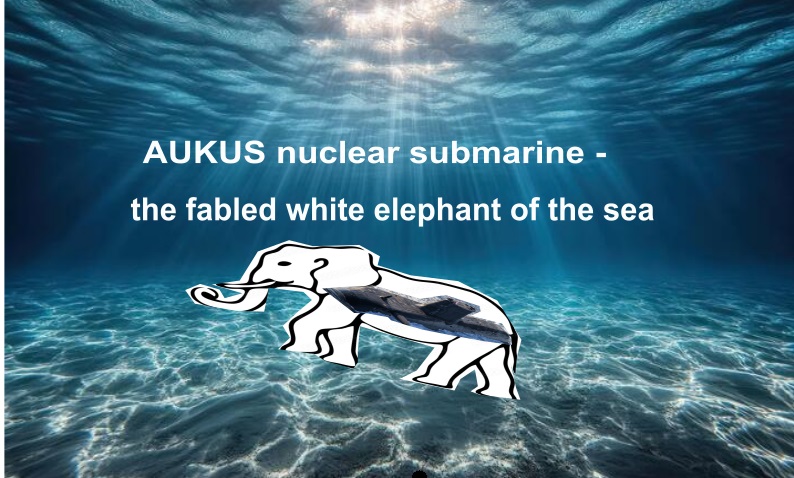
The admiral, who led the Trident value for money review in 2010, called for Britain to pull out of the multi-billion “Aukus” defence deal with America and Australia to build 12 new nuclear submarines.
SSN-Aukus is a submarine which is not going to deliver what the UK or Australia needs in terms of capability or timescale. “Performance across all aspects of the
programme continues to get worse in every dimension.”
Former Navy chief calls for ‘radical’ action to revive programme after catastrophic failures.
Tom Cotterill, Defence Editor, 06 December 2025
Britain is “no longer capable” of running a nuclear submarine programme after “catastrophic” failures pushed it to the brink, a former Navy chief has warned. In an extraordinary critique, Rear Admiral Philip Mathias said the UK’s “silent service” was facing an “unprecedented” situation that it was “highly unlikely” to recover from without a “radical” intervention. The former director of nuclear policy at the Ministry of Defence (MoD) said delays in building new attack boats had reached record levels and had driven up the duration of patrols for crews from 70 days during the Cold War to more than 200 now.
This had led to the “shockingly low availability” of submarines to “counter the Russian threat in the North Atlantic”, the retired submarine commander warned. The admiral, who led the Trident value for money review in 2010, called for Britain to pull out of the multi-billion “Aukus” defence deal with America and Australia to build 12 new nuclear submarines.
“The UK is no longer capable of managing a nuclear submarine
programme,” he said. “Dreadnought is late, Astute class submarine delivery is getting later, there is a massive backlog in Astute class maintenance and refitting, which continues to get worse, and SSN-Aukus is a submarine which is not going to deliver what the UK or Australia needs in terms of capability or timescale. “Performance across all aspects of the
programme continues to get worse in every dimension.”
He added: “This is an unprecedented situation in the nuclear submarine age. It is a catastrophic failure of succession and leadership planning.” The Navy’s fleet of Astute submarines is already facing significant problems, with many having been stuck in port for years. Out of the seven planned, only
six are in service.
He also criticised the role of industry giants for
delays to programmes. He added not a single of the UK’s 23 decommissioned nuclear boats had been dismantled since the first, HMS Dreadnought, left service in 1980. “This is an utter disgrace and brings into question whether Britain is responsible enough to own nuclear submarines,” the admiral said.
Telegraph 6th Dec 2025,
https://www.telegraph.co.uk/news/2025/12/06/britains-nuclear-submarine-fleet-no-longer-fit-for-purpose/
Britain’s “borrowed bombs”

The extreme expense — at least £60 million per plane plus the costs of parts and maintenance — will be a burden on British taxpayers already suffering from cuts to social services.
“reflects a long-standing trend by the UK government to prioritising trans-Atlantic politics over genuine military needs“…………… “an opportunity to appease Trump “
by beyondnuclearinternational, https://beyondnuclearinternational.org/2025/12/07/britains-borrowed-bombs/
New reports shows UK purchase of US nuclear-capable aircraft is political grandstanding with little practical application, writes Linda Pentz Gunter
When the UK government announced its intention last June to purchase 12 F-35A nuclear capable Lightning II Joint Strike Fighter aircraft from the US by 2033 and join NATO’s ‘dual capable aircraft nuclear mission’, it described the decision as the “biggest strengthening of the UK’s nuclear posture in a generation”.
But a new study released on November 11 by two British watchdog groups, Nukewatch UK and Nuclear Information Service, argues that the purchase of the planes will incur massive costs to the British taxpayer while not actually being militarily necessary or advantageous.
The report, “Smoke andMirrors”, concludes that “the government’s decision is based principally on providing political ‘smoke and mirrors’ to distract attention from questions relating to the US-Europe relationship within NATO rather than developing a must-have military capability.”
The purchase of the F35As “serves more as a diplomatic gesture than a military imperative,” the study said, designed to placate US president Donald Trump’s gripes about a perceived lack of financial commitment from NATO partners.
The UK decision to participate in the NATO nuclear sharing mission “is being driven forward by the nuclear lobby within government itself, and raises questions about whether the decision was driven by strategic necessity or political expediency,” the study authors wrote.
The 12 F-35As are far too few to constitute a credible deterrent, according to experts, in large part because the plane’s track record already indicates that all 12 will rarely be in service at the same time.
“On the basis of current performance, at any one time at best only 8 aircraft would be available to take part in a nuclear strike — and possibly even fewer. It is possible that not all of these aircraft would penetrate enemy air defences to reach their targets,” the study said.
The planes are expected to be stationed at RAF Marham in Norfolk. However, as the study noted, this is actually too far away for F35As to reach any meaningful targets inside Russia, for example, as “the maximum distance the aircraft can travel from its base to complete its mission and return without refuelling is 1,000 km,” (about 683 miles).
The F-35A will carry the American B61 nuclear gravity bomb, the only plane in the F-35 class able to do so. The current RAF fleet of F-35Bs and the Eurofighter Typhoon, are not nuclear-capable so the purchase “potentially gives the RAF a nuclear strike capability using this weapon” the Smoke and Mirrors report said.
Further, since the B61 is an American bomb, any deployment will remain under full US control, “rendering the operation entirely dependent on American permission,” the study said.
According to Nukewatch UK, those bombs were already delivered in July to RAF Lakenheath in Suffolk — in reality a US Air Force base despite its name. This would mark the first stationing of US nuclear weapons on UK soil since 2008.
Establishing the programme will also be costly, lengthy and complicated and is unlikely to reach fruition for many years, the study said, due to the many complex steps that will need to be taken before the UK can join the NATO nuclear sharing programme.
The extreme expense — at least £60 million per plane plus the costs of parts and maintenance — will be a burden on British taxpayers already suffering from cuts to social services, the report pointed out. “At a time when public services are struggling to meet demands, there is little public appetite for more military spending,” wrote the report’s authors. “An expensive nuclear weapon system that will not be available for nearly a quarter of a century is a low priority, even on the UK military’s wish list – if, indeed, such a capability is even needed.”
The purchase may also burden the UK military by depriving it of other resources, including the next tranche of F-35Bs. An analysis by Navy Lookout, which delivers independent Royal Navy news and analysis, concluded that a shortfall in F-35Bs could be problematic, “as F-35As cannot operate from carriers and contribute nothing to their strike power,” it said.
The Navy Lookout analysis also argued against using RAF Marham for the planes, given the base “will need expensive refurbishment and regeneration” and recommended Lakenheath instead.
The Smoke and Mirrors study endeavors to extract the reality from the opaque government announcement, made on June 24 on the eve of the NATO Summit at The Hague. After “stripping away all the verbiage,” the study authors concluded that the statement lacked “even basic information such as when the aircraft are intended to be delivered and when their nuclear capability is intended to be operational.”
Even without delays, the report said, “it will be years, rather than months, before they are available for operation.”
The report also points out that the UK’s own 2025 Strategic Defence Review published on June 2, does not include a recommendation to purchase F-35As equipped for US B61 bombs and instead advises a detailed study on such an option. “The fact that it’s not there indicates that we weren’t terribly enthusiastic about it,” the SDR’s lead reviewer, Lord Robertson, a former Defence Secretary and a former Secretary General of NATO, told the report authors.
Despite this, the Starmer cabinet enthusiastically threw its support behind the proposal in what Robertson described as “a decision independent of the Review.” The report authors also point out that “the decision to join the NATO mission appears to have been made before the SDR was even published.”
Continue readingReeves’ £150 cut in UK’s energy bills will be nuked by Sizewell costs, ex-Labour donor claims
Dale Vince’s claims over the impact of paying for Sizewell C on energy bills is one of a number of hidden costs which could see consumers pay higher bills – instead of £150 less
David Maddox, Political Editor
Rachel Reeves’ pledge to take £150 off household energy bills could be wiped out because of the costs of nuclear energy, hidden green levies andnew levies being introduced by the energy regulator, it has been claimed.
In her Budget last week, the chancellor promised to take £150 off
household bills by scrapping the Energy Company Obligation (ECO) scheme.
But former Labour donor and green entrepreneur Dale Vince has now claimed that the impact of paying for building nuclear energy capacity will largely wipe out the £150 because of the £1bn cost in the first year and ongoing costs for nuclear power.
Independent 7th Dec 2025, https://www.independent.co.uk/news/uk/politics/reeves-energy-bill-discount-nuclear-power-budget-b2878907.html
Nuclear (in)flexibility, nearly 100% electricity from solar PV and offshore wind surge!
David Toke, Dec 08, 2025
I keep hearing claims, most recently from the British Government, about how nuclear power can be used flexibly to help balance fluctuating wind and solar. But in reality in most situations around the world nuclear is inflexible and its operation simply pushes wind and solar off the grid. Also, according to a report from Ember, cheaper batteries and proliferating solar can lead to solar on its own cheaply providing all electricity demand for 97-99 per cent of the time in the sunnier parts of the world. Meanwhile back in the UK offshore wind is now surpassing generation from natural gas according to the Energy and Climate Intelligence Unit (ECIU).
Tales of SMRs nuclear (in)flexibility
Looking around the world, it is very difficult to find any examples of nuclear power being flexible. The main example quoted is France. However, France has some close connections with the rest of the European continent. These differ for example, to the connections to the UK and the continent.
Unlike the UK, the French electricity system operator has no choice but to order the scaling down of some French nuclear plant. This is to cope with inflows of wind and solar across its borders that they cannot stop. In Britain where the inflows can be better controlled, as elsewhere, nuclear operators would prefer not to be flexible. Instead, wind and solar power get turned off and the renewable sources are blamed for energy that is really being wasted by inflexible nuclear operations! A study of Scotland, where a lot of wind power is constrained because of a lack of grid capacity, found that most wind power would not have been be wasted if there were no nuclear power station s operating in Scotland (see HERE). And, in practice there is no chance of nuclear power plant being flexible in normal operations, whatever people say!
The current UK Government is struggling to mask the fact that it’s so-called new generation of ‘small modular reactors’ (SMRs) is going to cost even more, MW for MW, than the much-overpriced Hinkley C and Sizewell C Nuclear plant. Rolls Royce is leading the charge here with a proposed 470MW (not small!) nuclear reactor. This will come into operation sometime in the next 20 years or so. According to Rolls Royce this development will be ‘equivalent to more than 150 onshore wind turbines’‘ (See HERE) Ah, so that’s the crack! SMRs are now promised to replace wind turbines! That will please the wideley expected future leader, Nigel Farage! Nigel hates windfarms but loves Rolls Royce and nuclear stuff – so patriotic, he claims!
I must say, it’s pretty small fare. I mean the Rolls Royce ‘SMR’ will only replace 150 onshore wind turbines – and at double or probably triple the price of onshore wind in delivered energy! (currently there are over 11000 wind turbines in the UK). Not much of a bargain really for Nigel, there I’m afraid. But really, as with populists the world round, its the headlines that matter, and never mind the facts!
Of course, as with other policies the Government is struggling to compete in messaging with the far-right. In doing so it feels it has to buy into a lot of myths about nuclear power. As one Government minister was made to say recently (presumably by his pro-nuclear civil servants) in an answer to a Parliamentary Question from a Liberal Democrat MP:
‘The next generation of nuclear, including small modular reactors (SMR), offers new possibilities including faster deployment, lower capital costs, and greater flexibility…..Whilst nuclear energy has a unique role to play in delivering stable, low carbon baseload energy, SMRs may be able to serve the electricity grid more flexibly than traditional nuclear, as well as unlock a range of additional applications in energy sectors beyond grid electricity.’ (See HERE)
What unbelievable nonsense! I would never want to be a government minister and have to spout such rubbish! I’ve already suggested that the SMR(s) will take a long time to emerge at eye-watering cost. But flexibility? Why should this happen? It does not happen now with the PWR plant at Sizewell B. So why should it happen with the Rolls Royce ‘SMR’ which is also a PWR? No reason at all!
In fact the Rolls Royce ‘SMR’ it is even less likely to operate flexibly than Sizewell B (which does not). This is because of the likelihood that, as in the case of Hinkley C, Rolls Royce will be offered a so-called ‘baseload’ contract. This means that the nuclear power plant are paid a set price for every MWh they generate – whenever it is generated. It does not matter whether wholesale prices become negative and wind and solar is forced off the system, nuclear continues to generate.
Rolls Royce will no doubt be given such a contract to ensure that the investors get a virtually guaranteed return. Otherwise it will be virtually impossible to attract private investors to give the required facade of part-private finance to the operation. In reality of course the bulk of the money to finance the equity for the plant will come directly from the taxpayer and the consumers will pick up the bill for the inevitable cost overruns.
To cap it all, the SMR(s) will contribute practically nothing to balancing renewables since that will be done by ‘peak’ gas plant (see my blog post HERE).
Almost 100 per cent 24/7 electricity from solar + batteries
Meanwhile solar PV is advancing around the world at several times the pace of new nuclear and fossil fuel power plant. See my earlier blog post HERE and the Figure below. Now, the energy think tank ‘Ember’ (see HERE) conclude that almost 100 per cent electricity can be delivered cheaply in the sunnier parts of the year using solely solar PV and batteries.
In places like Las Vegas and Oman 97-99 per cent of all electricity demand, 24/7 can be provided solely by solar PV for a cost of $104 per MWh. That is exactly the wholesale power price in the UK. It should be recalled that they are talking about just solar PV and batteries, never mind other renewables………………………………………………………………………………… https://davidtoke.substack.com/p/nuclear-inflexibility-nearly-100
The Story They Forgot to Tell: Ten Years of Ukraine’s Corruption and the Media’s Convenient Timeline

The original of this article shows clear examples of mainstream media coverage of corruption, and also gives telling case studies
How the NYT’s latest “exposé” framing collapses when you place Ukraine’s graft in its full post-coup 2014–2024 context — and why MSM remembers corruption only when it fits partisan politics.
Gregor Jankovič, DD Geopolitics, Dec 08, 2025
When the New York Times ran its December investigation into how Kiev “sabotaged oversight” and allowed a $100-million corruption scheme to take root in state energy firms, many readers saw it as a stinging indictment of President Volodymyr Zelensky’s government — and of the geopolitical consequences of a U.S. retreat. That was the intended reading. But placed against a fuller decade-long record, the NYT narrative looks less like an objective accounting and more like a carefully timed political frame: corruption is old and structural in Ukraine, and it has been tolerated, overlooked, and sometimes protected by Western patrons for years — through multiple U.S. administrations. For evidence of this, we need to look back. It was all reported.
The 2014 “reforms” — impressive on paper, weak in practice
After the Maidan coup (2013–14), Kyiv adopted a series of legal reforms and created new institutions, under pressure from Washington and Brussels — the National Anti-Corruption Bureau (NABU), anti-corruption prosecutors (SAP), and a push for “independent” supervisory boards at state companies. Western donors loudly backed these moves and conditioned assistance on these newly formed “watchdog structures”.
These reforms looked impressive on paper.
In reality:
The institutions were funded by the West but controlled through political appointments.- The supervisory boards were symbolic, frequently ignored, or never fully seated.
- Oligarchs shifted from Yanukovych-style control to a networked, distributed corruption model.
- The existing Ukrainian oligarchic network simply adapted to them, rather than collapsed or lose its hold over the national economy.
Even the EU Court of Auditors admitted in 2016:
“No meaningful progress. Political interference everywhere.”
The NYT now pretends these same paper-thin structures were once strong, credible, and functioning — until Trump broke them.
2017–2020: “Under Trump, Corruption Survives” — but Oversight Was Never Real
Trump’s first term did not “destroy” Ukrainian anti-corruption systems. They never worked to begin with.
Throughout these years:
- The EU repeatedly warned of massive political interference in SOEs.
- The IMF froze loan tranches over corruption concerns.
- Poroshenko used “anti-corruption bodies” as political weapons.
- Supervisory boards existed but were powerless and often ignored.
Trump didn’t weaken Ukrainian oversight.
Ukrainian elites never accepted it in the first place.
But acknowledging this would break the New York Times’ morality play — so the paper skips the entire era.
A notorious and in the Western MSM extremely suppressed story from this period was the case of the then ex-vice-president Joe Biden (tied to the Ukrainian energy company Burisma through his son Hunter Biden), related to his demanding for the removal of Prosecutor General Viktor Shokin in 2016:
Two years after leaving office, Joe Biden couldn’t resist the temptation last year to brag to an audience of foreign policy specialists about the time as vice president that he strong-armed Ukraine into firing its top prosecutor.
In his own words, with video cameras rolling, Biden described how he threatened Ukrainian President Petro Poroshenko in March 2016 that the Obama administration would pull $1 billion in U.S. loan guarantees, sending the former Soviet republic toward insolvency, if it didn’t immediately fire Prosecutor General Viktor Shokin.
“I said, ‘You’re not getting the billion.’ I’m going to be leaving here in, I think it was about six hours. I looked at them and said: ‘I’m leaving in six hours. If the prosecutor is not fired, you’re not getting the money,’” Biden recalled telling Poroshenko.
“Well, son of a bitch, he got fired. And they put in place someone who was solid at the time,” Biden told the Council on Foreign Relations event, insisting that President Obama was in on the threat.
The pattern was not unique to one administration: it was a systemic weakness of Ukrainian governance, which Western capitals tolerated because they preferred an obedient Kiev regime to the chaos of an un-governed vacuum – or even worse – an actual autonomous political leadership, acting in Ukraine’s national interest.
The practical effect: major contracts, procurement lines, and State-Owned Enterprises (SOE) budgets remained lucrative targets. (See EU/IMF concerns and internal audits.)
2021–2023: The Biden Years — Oversight Collapses Behind a Wall of Wartime Secrecy
This is the period NYT absolutely cannot afford to discuss honestly.
Under Biden:
- Western weapons deliveries lacked tracking mechanisms;
- The CBS documentary reporting that “only 30% of Western arms reach the front” was pressured into removal;
- The Ukrainian defense ministry’s food, fuel and procurement scandals exploded;
- Wartime laws classified nearly all budgetary and procurement data;
- Local and international NGOs documented the worst transparency regression since 2014;
- EU institutions quietly complained about “political capture” of state companies.
Biden’s approach was simple:
fund Ukraine massively, ask few questions, conceal accountability problems to maintain wartime unity.
The NYT now pretends this era was a model of transparency — but it was precisely the opposite.
The SMO did change incentives. Massive Western assistance flowed; governments were conveniently reluctant to publicly police Kiev for fear of weakening its war effort or Ukrainian morale. Wartime secrecy and emergency procurement rules further reduced transparency.
The most striking example was the CBS Documentary “Arming Ukraine” in 2022 suggesting that a surprisingly low share of Western weapons could be verified at frontline use — here is the original “unredacted” version:
The story raised alarms and was subsequently revised after huge diplomatic pushback – which was, of course, swept under the carpet. CBS exposed major tracking problems and distribution opacity in a wartime logistics nightmare of super-charging the Kiev junta’s military — and it was, “surprisingly”, quietly downplayed.
The bigger point: weapons tracking, procurement integrity, and transparency were problems long before any 2025 scandals surfaced.
The Editor’s note on the redacted CBS Reports story says it all:
Why military aid in Ukraine may not always get to the front lines
………………………………………………………………………………………………………………………………………………………. Conclusion — What honest coverage would look like?
A responsible investigation would do three things simultaneously:
document concrete corruption cases and who profited;
trace the long arc (2014→2024) showing systemic weaknesses and donor complicity;
and evaluate how wartime necessities reshaped incentives and motives for both Kiev and its backers.
The NYT’s piece does the first well — but the rest of the story is too often left out of concrete framing and reduced to jabs at its political “enemy”.
Readers deserve unbiased coverage that resists tidy partisan narratives and accepts complexity:
Ukraine’s corruption is real, longstanding, and enabled as much by it’s Masters foreign policy choices as by local actors’ greed. https://ddgeopolitics.substack.com/p/the-story-they-forgot-to-tell-ten?utm_source=post-email-title&publication_id=1769298&post_id=180977735&utm_campaign=email-post-title&isFreemail=true&r=1ise1&triedRedirect=true&utm_medium=email
The UK wants to unlock a ‘golden age of nuclear’ but faces key challenges in reviving historic lead.

The U.K.’s Nuclear Regulatory Taskforce called for urgent reforms after identifying “systemic failures” in the country’s nuclear framework. It found that fragmented regulation, flawed legislation and weak incentives led the U.K. to fall behind as a nuclear powerhouse.
The government committed to implementing the taskforce’s guidance and is expected to present a plan to do so within three months. There is not, at the moment, a single SMR actively producing electricity under four revenues. They will all come at best in the 30s,” Ludovico Cappelli, portfolio manager of
Listed Infrastructure at Van Lanschot Kempen, told CNBC.
While SMRs are a “game changer” thanks to their ability to power individual factories or small towns, their days of commercial operation are too far away, he said.
From an investment standpoint, “that is still a bit scary,” he added. To secure the large baseloads needed to offset the intermittency of renewables, “we’re still looking at big power stations,” added Paul Jackson, Invesco’s EMEA global market strategist.
CNBC 6th Dec 2025, https://www.cnbc.com/2025/12/06/the-history-of-nuclear-energy-lies-on-british-soil-does-its-future-.html
UK’s Planning & Infrastructure Bill 2 – worse, and by stealth.
I was wondering why there was no PIB2 in the Budget. Now I understand why. It’s far worse (from an environmental perspective) than I could have imagined.
In his speech yesterday, (1/12/25) Starmer said, “in addition to accepting the Fingleton recommendations… I am asking the Business Secretary to apply these lessons across the entire industrial strategy.”
There are some VERY far-reaching proposals within the Fingleton recommendations. These include,
but are not limited to: modifying the Habitat Regulations, – allowing developers to comply with the Habitats Regulations requirements by paying a substantial fixed contribution to Natural England; – reversing Finch; – reversing the LURA’s enhanced protection for National Landscapes; – increasing Aarhus cost caps. Those are just SOME!
Community Planning Alliance 2nd Dec 2025, https://www.linkedin.com/feed/update/urn:li:activity:7401614251934654464/
Severn Estuary Interests Group responds to Nuclear Review (Fingleton Report) challenging misleading environmental narrative
Friday 5 December 2025, https://www.somersetwildlife.org/news/severn-estuary-interests-group-responds-nuclear-review-fingleton-report-challenging-misleading
The Nuclear Review, or Fingleton Report, calls for a radical reset of Britain’s approach to nuclear regulation and potentially to National Strategic Infrastructure Projects as a whole.
The report and surrounding reporting and commentary perpetuates the damaging government narrative that environmental protections are preventing development.
The original government decision was to build a power station on one of the most highly protected ecological sites in the UK and Europe. The Severn Estuary is both a Special Area of Conservation and a Special Protection Area – a globally significant habitat supporting vast populations of migratory fish, internationally important bird species, and diverse invertebrate communities.
The impact of the nuclear power station on these important and vulnerable habitats and species will be immense and will continue for 70 years. HPC will extract the equivalent of one Olympic-sized swimming pool every 12 seconds, force it through the reactor system at high velocity, and then discharge it back into the estuary significantly heated. The idea that these impacts are trivial is pure misinformation.
The data cited in the Nuclear (Fingleton) Report is inaccurate. It is data collected in relation to Hinkley Point B, an older and now decommissioned nuclear power station, and extrapolated for HPC. The designs of these power stations are not the same.
The data ignore fish behaviour in the estuary resulting in assumptions that much lower numbers will be impacted than the reality. The importance of the estuary for fish spawning is largely ignored and juveniles that can’t be counted but will be sucked through the cooling system. The impact on species and habitats will be extremely damaging in a Special Protection Area and Special Area of Conservation.
It is also important to place current claims about cost increases in a proper context. Hinkley Point C was originally expected to be operational in 2017 at a cost of £18 billion. It is now projected for 2031 at a cost of £46 billion. EDF itself has attributed these enormous delays and overruns to inflation, Brexit, Covid, civil-engineering challenges, and an extended electromechanical phase. Given the scale of these industry-driven issues, it is frankly unworthy to mock those seeking to uphold the legal requirement for EDF to install an acoustic fish deterrent on the enormous cooling-water intakes.
The real issue here is the developer’s approach, not the environmental regulations that function to protect nature. EDF devised the mitigation measures themselves, rejecting offers of collaboration from local experts. This, as with the notorious HS2 bat-tunnel debacle – has inflated costs precisely because expert ecological advice was not incorporated early enough. The continuing narrative that environmental safeguards are the “blocker”, or that only “a few individual animals” benefit from mitigation or compensation, is a deliberate and politically convenient distortion of the evidence.
Simon Hunter, CEO of Bristol Avon Rivers Trust said: “When developers fail to consult meaningfully, ignore local expertise, and attempt to sidestep environmental safeguards, costs rise and nature pays the price. Many countries would never have permitted a development of this scale in such a sensitive location in the first place. The situation at HPC is not an indictment of environmental protection, but of poor planning, weak accountability, and a persistent willingness to blame nature for the consequences of human decisions.”
Georgia Dent, CEO of Somerset Wildlife Trust said: “The government seems to have adopted a simple, reductive narrative that nature regulations are blocking development, and this is simply wrong. To reduce destruction of protected and vulnerable marine habitat to the concept of a ‘fish disco’ is deliberately misleading and part of a propaganda drive from government. Nature in the UK is currently in steep decline and the government has legally binding targets for nature’s recovery, and is failing massively in this at the moment. To reduce the hard-won protections that are allowing small, vulnerable populations of species to cling on for dear life is absolutely the wrong direction to take. A failing natural world is a problem not just for environmental organisations but for our health, our wellbeing, our food, our businesses and our economy. There is no choice to be made; in order for us to have developments and economic growth we must protect and restore our natural world. As we have said all along in relation to HPC, how developers interpret and deliver these environmental regulations is something that can improve, especially if they have genuine, meaningful and – most importantly – early collaboration with local experts.”
The Severn Estuary Interests Group, a collaboration of organisations that prioritise the health and resilience of the estuary for nature and people, is able to say based on decades of experience, that the environmental rules and regulations are not the reason EDF have found themselves spending an alleged £700m on fish protection measures. The Fingleton Report and subsequent reporting has failed to acknowledge some important points with regard to the building of Hinkley Point C:
1 This Month
Chernobyl: The Lost Tapes – A good documentary on Chernobyl on SBS available On Demand for the next 3 weeks– https://www.sbs.com.au/ondemand/tv-program/chernobyl-the-lost-tapes/2352741955560

of the week–London Campaign for Nuclear Disarmament

Tell the Ukrainian Government to Drop Prosecution of Peace Activist Yurii Sheliazhenko
To see nuclear-related stories in greater depth and intensity – go to https://nuclearinformation.wordpress.com
-
Archives
- April 2026 (114)
- March 2026 (251)
- February 2026 (268)
- January 2026 (308)
- December 2025 (358)
- November 2025 (359)
- October 2025 (376)
- September 2025 (257)
- August 2025 (319)
- July 2025 (230)
- June 2025 (348)
- May 2025 (261)
-
Categories
- 1
- 1 NUCLEAR ISSUES
- business and costs
- climate change
- culture and arts
- ENERGY
- environment
- health
- history
- indigenous issues
- Legal
- marketing of nuclear
- media
- opposition to nuclear
- PERSONAL STORIES
- politics
- politics international
- Religion and ethics
- safety
- secrets,lies and civil liberties
- spinbuster
- technology
- Uranium
- wastes
- weapons and war
- Women
- 2 WORLD
- ACTION
- AFRICA
- Atrocities
- AUSTRALIA
- Christina's notes
- Christina's themes
- culture and arts
- Events
- Fuk 2022
- Fuk 2023
- Fukushima 2017
- Fukushima 2018
- fukushima 2019
- Fukushima 2020
- Fukushima 2021
- general
- global warming
- Humour (God we need it)
- Nuclear
- RARE EARTHS
- Reference
- resources – print
- Resources -audiovicual
- Weekly Newsletter
- World
- World Nuclear
- YouTube
-
RSS
Entries RSS
Comments RSS
 nuclear-news