Windfarm bid withdrawn after Ministry of Defence raises nuclear testing station concerns
Midlothian View, by Local Democracy Reporter, Paul Kelly, Wednesday September 13th 2023
A bid for a domestic windfarm in Hawick has been withdrawn after the Ministry of Defence (MoD) raised concerns over its potential impact on a nearby nuclear testing station.
Scottish Borders Council received a planning application for the erection of a 10.4m high turbine on land south east Of Wynburgh Cottage at Langburnshiels.
But the MoD objected to the application due to its potential impact on the Eskdalemuir Seismological Recording Station.
The normally unmanned station was established by the UK Atomic Energy Authority in 1962 as the British contribution to an international network intended to identify and locate underground nuclear tests and, later, monitor compliance with the Comprehensive Nuclear Test Ban Treaty…………………………more https://www.midlothianview.com/news/windfarm-bid-withdrawn-after-mod-raises-nuclear-testing-station-concerns
The Discharge of Fukushima’s Radioactive Water could be a Precedent for Similar Actions

Obviously, it would be misleading to rely on the IAEA’s statements suggesting that radioactive wastewater does not pose any risk to global health. This information strengthens the likelihood that the IAEA did not reveal valid and precise radiation data regarding the Chornobyl accident and Zaporizhia nuclear power plant during the ongoing Ukrainian war either.
Pinar Demircan 7 Sept 23 https://www.dianuke.org/the-discharge-of-fukushimas-radioactive-water-could-be-a-precedent-for-similar-actions/
Underlying the disregard for objections from global civil society and transforming the ocean into a nuclear waste dump lies a bigger goal inspired by capitalist practices that arise from its crisis: to achieve another threshold by normalization of cost-cutting measures for the sake of the nuclear industry.
While the climate crisis is rapidly turning forests and habitats of living creatures into coal and ash with a tiny spark of fire in Turkiye, Greece, and Canada, the planet’s seas, already polluted with plastics and waste, are also being recklessly infused with radioactivity, driven by profit and cost-centered policies. On August 24, within the framework of the procedures carried out by the Japanese government and TEPCO, the discharge of 1.34 million tonnes of radioactive water which is accumulated in tanks at the plant site, started.
The installation of a treatment system costing 23 million USD, the discharge of wastewater without an Environmental Impact Assessment (EIA) is being realized by foregoing safer alternatives such as solidification of wastewater into construction materials or long-term storage costing 100 times more that constitutes ecocide. Clearly, this method of release that is expected to be carried out over the next 40 years, indicates a systemic assault on the global ecosystem that is longer and more severe than presently apparent.
The Japanese Government is not telling the truth about ‘purification’
The discharge process of the wastewater resulting from the complete meltdown of three reactor cores at the Fukushima nuclear facility began in 2011 and is at par with the danger level ascribed to the Chornobyl disaster. This also highlights how the Fukushima discharge differs from the regular discharge processes of nuclear power plants and indicates the extent of danger that nuclear power plants pose. Furthermore, the radioactive isotopes treated in the accumulated wastewater is only half of the whole amount according to what was stated on the website of the Japanese Ministry of the Environment.
A detail that has been overlooked till today is that there is no information regarding the amount of discharge during this 40-year time frame for the disposal of radioactive water into the ocean. This might indicate that the discharged amount may even be equivalent to the period of, for example, 100 years despite the declared duration of 40. In addition, since the present objections have been disregarded, it is worth considering the potential impact of future oppositions at the end of the 40 years.
A threshold to be achieved
Apparently, over the next decade, the radioactive water discharged from Fukushima is anticipated to disseminate into multiple seas worldwide, encompassing the Marmara, Mediterranean, Aegean, and Black Sea, which surrounds Turkiye. A recent scientific study [2] suggests that the evaporation in these seas will escalate industrial radioactivity levels in the ecosystem. Given this backdrop, it is important to ask why TEPCO, the Japanese government, and the IAEA continue to disregard the adverse impacts of the discharge, which also makes them responsible for the potential increases in cancer, DNA damage, increased miscarriages, hormone imbalances, and unhealthy future generations worldwide? Underlying the disregard for objections raised by global civil society, and transforming the ocean into a nuclear waste dump, lies a bigger goal inspired by capitalist practices that arise from its crisis: to achieve another threshold of the normalization of cost-cutting measures for the sake of nuclear industry.
How can we be sure of the exact amount to be released?
It is also possible to consider the above statement with the possibility of adding wastewater from the other nuclear power plants across Japan to the already 1 million 340 thousand tonnes of water accumulated over the past 12 years at Fukushima. While nuclear power plants operate under higher costs and have to cope with four times cheaper renewable energy production costs, the ocean dumping of the radioactive wastewater offers an easy solution for the nuclear industry. Crossing this threshold guarantees the capability to manage climate-induced hazards to nuclear facilities since now, societal consent has been obtained for this plan of action. Imagine how beneficial this course of action will be for the nuclear industry, with the IAEA promising its support for the industry – to the 410 reactors operating worldwide, approximately 50 reactors under construction, and 80 reactors [3] in various stages of maintenance, repair, decommissioning, and dismantling.
Take for example, Rosatom of Russia, the owner of the Akkuyu Nuclear Power Plant which reached its final stage of construction for the first reactor in Turkiye. It has a long history of concealing the Mayak nuclear power plant accident, well into the 1990s. Furthermore, from 1948 to 2004, Rosatom discharged nuclear waste into the Techa River, thus reinforcing its already questionable track record, and also points to how the legalization of nuclear discharge might be beneficial for the industry. It is also easy to predict the potential impact of this approach in the Mediterranean region by a nation with an underdeveloped democratic system and institutional dynamics dominated [4] by political power. This is especially important since an exemption made for the Akkuyu NPP in the article which allows for the discharge water from the facilities around the Mediterranean temperature of the plant and allows the sea temperature to reach up to 35 Celsius and poses serious ecological challenges indicating that Turkiye violates Barcelona Agreement.
The Role of the IAEA
The example of Fukushima’s radioactive water discharge presents us a picture of a political power that has adopted the corporate management mentality prioritizing profits and industry interests under the guise of efficiency and profitability. The International Atomic Energy Agency (IAEA) plays a vital role in ensuring that nuclear energy generation is conducted safely and within established guidelines. However, a leaked document [5] from the IAEA reveals that the agency, which declared its support for TEPCO and the Japanese government, advised them to refrain from making statements that could portray nuclear power plants negatively and disseminate information that influences the press and public opinion. As this scandal brings to light the deep connections between the IAEA, the Japanese government, and TEPCO, it is important to consider the role of the IAEA as a highly regarded global organization.
It is noteworthy to mention that the IAEA’s involvement in the nuclear industry stems from a confidential agreement WHA 12-40 [6] with the World Health Organization (WHO) in 1959, stating that “whenever either organization proposes to initiate a programme or activity on a subject in which the other organization has or may have a substantial interest, the first party shall consult the other with a view to adjusting the matter by mutual agreement”. Consequently, the IAEA, established to promote the growth of nuclear power plants worldwide, refrained from disclosing any potential health hazards posed by these plants.
Obviously, it would be misleading to rely on the IAEA’s statements suggesting that radioactive wastewater does not pose any risk to global health. This information strengthens the likelihood that the IAEA did not reveal valid and precise radiation data regarding the Chornobyl accident and Zaporizhia nuclear power plant during the ongoing Ukrainian war either.
It is important to inform the global society that the IAEA, which focuses mainly on promoting nuclear power, should not be involved in discussions related to public health in line with the principle of separating responsibilities to avoid conflict of interest. Therefore, it is recommended that civil society should inform the international community about the content of the recently disclosed IAEA document and demand an end to the discharge of radioactive water from Fukushima into the ocean. Accordingly, it should be ensured that all processes involved in disposing radioactive contamination in Fukushima are subject to internal and financial control measures performed by a minimum of two separate units.
At this stage, it is essential to take measures by clarifying the issues emphasized by the non-governmental organizations following the processes, and it should be ensured that realistic solutions can only be produced with the involvement of a consortium of neighbouring countries such as South Korea, China, Taiwan and the Pacific Islands. In this regard, the process management for the construction of the steel dome shelter, which was completed in 2016 with financing by 40 countries that came together in 1997 to protect the exploded fourth reactor of the Chornobyl Nuclear Power Plant from external weather conditions, can be taken as an example. [7]
Undoubtedly, the economic and administrative control mechanisms created for Chornobyl due to Ukraine’s lack of financial resources is not acceptable for the technology-giant Japan, which bears the costs of the disaster on its own. However, since global society has not entirely shown its commitment to changing the system, an in-system solution can prevent adding the radioactive disaster to the climate crisis before the transformation of life on the planet hits its constraints. In other words, claiming efficiency and profitability and institutionalization of the logic of ‘running the state like a business’, which has become the common discourse of political powers will at least help to achieve the rationality of emulated corporate management.
” The future of nuclear as an alternative energy source relies on the success of the Fukushima release” – Rafael Grossi.

“more broadly, the future of nuclear as an alternative energy source relies on the success of the Fukushima release,” he said. Though there has been heightened public alarm toward nuclear plants recently – for instance, regarding the Russian-occupied Zaporizhzhia plant in Ukraine – “the problem there is war, the problem is not nuclear energy,” Grossi said.
AEA chief ‘completely convinced’ it’s safe to release treated Fukushima nuclear wastewater .
By Jessie Yeung, Marc Stewart and Emiko Jozuka, Tokyo CNN, 7 July 23
Japan’s plan to release treated radioactive water into the ocean is safe and there is no better option to deal with the massive buildup of wastewater collected since the 2011 Fukushima nuclear disaster, the head of the United Nations’ nuclear watchdog told CNN.
Japan will release the wastewater sometime this summer, a controversial move 12 years after the Fukushima nuclear plant meltdown. Japanese authorities and the IAEA have insisted the plan follows international safety standards – the water will first be treated to remove the most harmful pollutants, and be released gradually over many years in highly diluted quantities.
But public anxiety remains high, including in nearby countries like South Korea, China and the Pacific Islands, which have voiced concern about potential harm to the environment or people’s health. On Friday, Chinese customs officials announced they would maintain a ban on food imports from 10 Japanese prefectures including Fukushima, and strengthen inspections to monitor for “radioactive substances, to ensure the safety of Japanese food imports to China.”……………………..
On Tuesday, Grossi formally presented the IAEA’s safety review to Japanese Prime Minister Fumio Kishida. The report found the wastewater release plan will have a “negligible” impact on people and the environment, adding that it was an “independent and transparent review,” not a recommendation or endorsement……………………….
The 2011 disaster caused the plant’s reactor cores to overheat and contaminate water within the facility with highly radioactive material. Since then, new water has been pumped in to cool fuel debris in the reactors. At the same time, ground and rainwater have leaked in, creating more radioactive wastewater that now needs to be stored and treated.
That wastewater now measures 1.32 million metric tons – enough to fill more than 500 Olympic-sized swimming pools.
Japan has previously said there were “no other options” as space runs out – a sentiment Grossi echoed on Friday. When asked whether there were better alternatives to dispose of the wastewater, the IAEA chief answered succinctly: “No.”
It’s not that there are no other methods, he added – Japan had considered five total options, including hydrogen release, underground burial and vapor release, which would have seen wastewater boiled and released into the atmosphere………………………………………
International skepticism
But some critics have cast doubt on the IAEA’s findings, with China recently arguing that the group’s assessment “is not proof of the legality and legitimacy” of the wastewater release.
Many countries have openly opposed the plan; Chinese officials have warned that it could cause “unpredictable harm,” and accused Japan of treating the ocean as a “sewer.” The Secretary General of the Pacific Islands Forum, an inter-governmental group of Pacific island nations that includes Australia and New Zealand, also published an op-ed in January voicing “grave concerns,” saying more data was needed.
And in South Korea, residents have taken to the streets to protest the plan. Many shoppers have stockpiled salt and seafood for fear these products will be contaminated once the wastewater is released – even though Seoul has already banned imports of seafood and food items from the Fukushima region.
International scientists have also expressed concern to CNN that there is insufficient evidence of long-term safety, arguing that the release could cause tritium – a radioactive hydrogen isotope that cannot be removed from the wastewater – to gradually build up in marine ecosystems and food chains, a process called bioaccumulation…………………………………
more broadly, the future of nuclear as an alternative energy source relies on the success of the Fukushima release, he said. Though there has been heightened public alarm toward nuclear plants recently – for instance, regarding the Russian-occupied Zaporizhzhia plant in Ukraine – “the problem there is war, the problem is not nuclear energy,” Grossi said……….. https://edition.cnn.com/2023/07/06/asia/japan-fukushima-water-iaea-chief-interview-intl-hnk/index.html
Safety fears : the problem of Britain’s ageing nuclear submarines
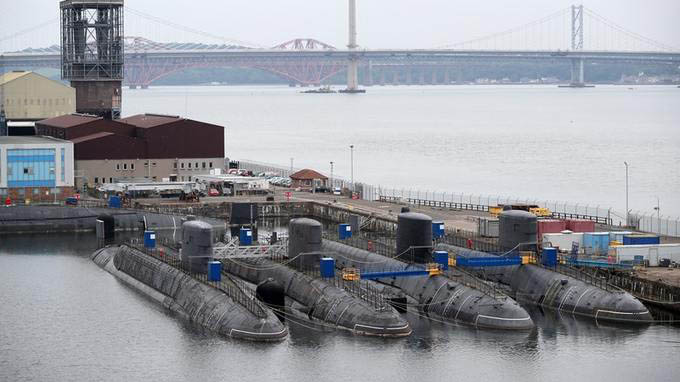
A British nuclear submarine has broken the record for the longest patrol at
sea as safety fears grow over the Royal Navy’s ageing fleet. The
Vanguard-class vessel returned to the Faslane naval base in Scotland on
Monday encrusted with barnacles and covered in slime after a gruelling tour
understood to have lasted more than six months.
Naval experts have raised concerns that the long patrols result in immense physical strain on the vessels and take a psychological toll on the crews. The UK has four
Vanguard-class submarines, which are armed with up to eight Trident
ballistic missiles carrying Britain’s nuclear warheads. At least one
submarine is on patrol at all times to maintain a continuous at-sea
deterrent. The fleet has been effectively reduced to two functioning
vessels, HMS Vigilant and HMS Vengeance, owing to repair works on the other
two.
Times 12th Sept 2023
British activists join Nuclear Free Local Authorities in supporting Swedish Sami against uranium mining
The UK/Ireland Nuclear Free Local Authorities and Lakes against the Nuclear Dump have been joined by activists from twelve anti-nuclear campaign groups in a letter to organisations representing the Sami people of Sweden offering support in their fight against uranium mining.
A ban on uranium exploration, mining and processing in Sweden came into force on 1 August 2018 but, last month, Swedish Climate Minister Romina Pourmokhtari announced that the ban would be lifted and that ten new nuclear reactors would be built over the next twenty years. In the face of international and domestic criticism, the centre-right government has since reined in the commitment to new nuclear by talking instead of a vague commitment to developing ‘green power’, but there has been no roll-back on uranium mining.
Sweden accounts for 80% of the European Union’s uranium deposits and already extracts uranium as a waste product when mining for other metals. Foreign companies, including Aura Energy and District Metals, have already expressed an interest in exploiting reserves. Even if the new government’s nuclear hopes come to naught, there will still be a ready export market for any output. The ongoing conflict in Ukraine has made the surety of uranium supply from Russia and its allies uncertain and the recent military takeover in uranium-producing Niger has shaken the market; consequently, pro-nuclear European nations will be looking for any stable source from a neighbour.
The correspondents fear that any resumption of uranium mining will come at a heavy price to the traditional lands and lifestyles of the Indigenous Sami People, with a degradation of their natural environment and their health. The Sami (or Saami) inhabit the region of Sápmi, which embodies the most Northern parts of Norway, Sweden and Finland, and North West Russia, and are best known for their reliance upon semi-nomadic reindeer herding.
Councillor Lawrence O’Neill, Chair of the NFLA’s Steering Committee, said: “Sadly the world over, uranium mining has been, and still is, often visited upon Indigenous People in their Traditional Lands by large, profit-hungry corporations. In addition, national governments have chosen their lands to carry out nuclear weapons testing and nuclear waste dumping. The impact has been enormous – the lands of Indigenous People have been poisoned, their health destroyed and their culture and traditional way of life decimated.
“Sweden has signed the UN Declaration of the Rights of Indigenous People pledging to defend the lands and lifestyle of the Sami, but the decision to resume uranium mining could, if left unchallenged, lead to their destruction. In sending this collective letter, we, the British and Irish local authorities opposed to nuclear power, with British anti-nuclear groups and activists are pledging ourselves as allies in this fight”.
Co-sponsor, Marianne Kirkby, founder of LAND, Lakes against the Nuclear Dump, added: “Here in Cumbria, we feel so much empathy for the Sami people who have had no say whatsoever in the opening-up of Sweden’s wild areas to the devastation of uranium mining.
“In the UK, we have no uranium mining, but plenty of nuclear plants. We are constantly told that nuclear power is ‘clean’ and ‘home-grown’. This blatant lie is the means by which Sami lands are put under pressure for new uranium mining exploitation in areas where it was previously, and quite rightly, banned as being too destructive to the health of people and planet”.
“This lie of ‘clean nuclear’ is the means by which Indigenous people, whether in Cumbria or in Sweden, whether at the waste end or the fuel end of the nuclear industry, are being exploited by the most toxic industry there is without even a ‘by your leave’. We stand in solidarity with the Sami in saying NO – NO MORE!”
Huge nuclear lobbying aimed at British Parliament

The Nuclear Industry Association will host the third Nuclear Week in
Parliament (NWiP) between the 11th and 13th of September 2023. In January
2023, the rescheduled week saw hundreds of Parliamentarians and industry
representatives engage in various events.
Back in its annual September slot, this year’s NWiP will be packed with multiple events and receptions, plus opportunities for NIA members to hold their complementary meetings.
The week will focus on engaging with Parliamentarians on various topics,
including new build, Advanced Nuclear Technologies, and the fuel cycle.
This will build on our Summer Conference, due to be held in the Concorde
Conference Centre in Manchester on Wednesday, 14 June 2023.
Nuclear Industry Association (accessed) 13th Sept 2023
https://www.niauk.org/nuclear-week-in-parliament-2023-sponsorship-opportunities/
Congress should seek ‘poison pills’ for any US-Saudi nuclear agreement
Federal Times, By Eric Gomez, Jon Hoffman and Jordan Cohen, 13 Sept 23,
Swirling reports of a U.S.-Saudi Arabia deal that would trade normalization with Israel for U.S. security guarantees are raising questions about what Washington will put on the table.
A U.S.-Saudi civil nuclear agreement—also known as a “123 agreement” after the Atomic Energy Act’s section that governs such cooperation — could be part of the broader arrangement, per reports that Saudi Arabia is demanding such cooperation as part of this “grand bargain.”
Any other country that possessed Saudi Arabia’s mix of gross human rights abuses, authoritarian government, malign activities abroad and stated intentions to build a nuclear weapon if Iran gets the bomb would be rightly isolated by the U.S., and not be a serious contender for a 123 agreement.
The U.S. ought to be drawing down its Middle East presence to focus limited resources on more pressing interests in other regions of the world. Nonetheless, if President Joe Biden proceeds, Congress should take steps to make the agreement as stringent and difficult as possible for Saudi Arabia……………………..
The Saudi government claims that it only wants to produce low-enriched uranium, which is suitable for nuclear energy but not weapons. However, a complete nuclear fuel cycle would make it much easier to either covertly manufacture fissile material for a nuclear weapon over time or quickly “sprint” to a weapon on short notice. Past statements by Saudi Arabia’s political leadership that Riyad will develop a nuclear weapon if Iran does should raise alarm bells about the proliferation risks of a Saudi civil nuclear program.
These risks mean that Congress should do everything in its power to introduce so-called poison pills provisions that would make the process of finalizing an agreement as difficult as possible. The legislative body can prevent a 123 agreement from taking effect though a joint resolution of disapproval, but such a resolution can be easily overturned by presidential veto. Regardless, Congress still has tools at its disposal.
The U.S.-India and U.S.-United Arab Emirates 123 agreements provide examples of ways to make a potential U.S.-Saudi nuclear deal more stringent…………………………………….
The U.S. should similarly link any Saudi nuclear deal to end-use monitoring of all weapons transferred to Riyad. Since Saudi Arabia started its war in Yemen, the country has used U.S. weapons to commit vast human rights abuses and endanger U.S. troops. Making a 123 agreement contingent on U.S. end-use monitoring of all weapons sent to Saudi Arabia would improve American security.
Put simply, helping one of Washington’s most problematic allies build a civil nuclear program is non-sensical. The Biden administration should not go ahead with such an agreement in the first place, but if it does Congress should implement poison pills to make the deal as unpalatable as possible for Saudi Arabia. https://www.federaltimes.com/opinions/2023/09/13/congress-should-seek-poison-pills-for-any-us-saudi-nuclear-agreement/
Pentagon’s new plan to counter China includes swarms of smart satellites

Deputy Secretary Kathleen Hicks: DoD wants to “leverage platforms that are small, smart, cheap, and many”
Space News, Sandra Erwin, September 6, 2023
ARLINGTON, Va. — Under a new strategy to counter China’s military buildup, the Pentagon is advocating the use of low-cost autonomous platforms that can be mass produced and deployed at sea, on land, in the air and in space.
“This is about driving culture change just as much as technology change — so we can gain military advantage faster,” Deputy Defense Secretary Kathleen Hicks, said Sept. 6 at the DefenseNews annual conference.
Hicks discussed DoD’s plan to field thousands of autonomous systems across all domains within the next 18 to 24 months. China’s advantage is “mass,” said Hicks. DoD will continue to invest in its traditional platforms but will counter with “mass of our own,” or large numbers of autonomous systems.
DoD would field fleets of tiny drones and swarms of satellites that would be inexpensive to replace.
“Imagine constellations of autonomous, attritable systems on orbit, flung into space scores at a time, numbering so many that it becomes impossible to eliminate or degrade them all,” she said.
The strategy is to “leverage platforms that are small, smart, cheap, and many,” Hicks said. …………………………………………………….
The U.S. military’s Space Development Agency is building a government-owned proliferated constellation. DoD is also a major customer of Starlink, SpaceX’s massive internet in space. ……………….. https://spacenews.com/pentagons-new-plan-to-counter-china-includes-swarms-of-smart-satellites/?utm_medium=email
US incapable of negotiating – Russian diplomat
Rt.com 12 Sept 23
Strategic dialogue with Washington has done nothing for Moscow’s national security, Aleksandr Kramarenko claims
No amount of negotiating with the US has been able to bring about meaningful results, as Washington has repeatedly broken the trust of its partners and refused to respect agreements, acting solely in its own interests, Russian diplomat Aleksandr Kramarenko has said.
In an article for International Affairs published last week, Kramarenko, the director of the Russian Foreign Ministry Institute of Current International Problems, said that despite decades of trying to maintain strategic dialogue with the US, Russia has ultimately been unable to achieve any results in ensuring its national security, and neither has China.
He added that trust between Moscow and Washington was undermined long ago. In 2011, Russia allowed the passing of what seemed to be a humanitarian UN resolution on Libya, which was then used by the West to lay ruin the country.
In 2015, Russia was deceived by the Minsk agreements, which were meant to resolve the internal conflict in Ukraine, but instead were used to buy time to build up Kiev’s army with the goal of inflicting a military or strategic defeat on Russia.
“What kind of trust can we talk about here? Where is the principle of pacta sunt servanda [contracts must be respected]? And what then is the meaning of contracts when everything happens regardless and in spite of any contracts? Apparently, it turns out that Washington is simply unable to negotiate,” Kramarenko wrote, noting that Russia is not the only country to come to this conclusion.

Commenting on the conflict in Ukraine, he recalled the words of US National Security Advisor Jake Sullivan (above)at the recent Aspen Security Forum, who said that the US and its allies are willing to “take risks” with their arms supplies to Kiev. What Sullivan meant, according to Kramarenko, was that Washington is willing to risk nuclear escalation, and that it is willing to do so because the principle of nuclear deterrence does not work for Russia.
“This means we need to think about how to restore trust in it.”
Kramarenko went on to suggest that all the arms control systems that have been destroyed by the US in attempts to maintain strict control over other nations while remaining ambiguous with regards to its own nuclear potential, could soon be replaced by a new process based on a multipolar world. ………. https://www.rt.com/russia/582797-us-incapable-of-negotiating/
Crooked Canadian company Lavalin trying to sell ?zombie nuclear technology to China and UK

 Canada now dominates World Bank corruption list, thanks to SNC-Lavalin, Financial Post Armina Ligaya | September 18, 2013 Canada’s corporate image isn’t looking so squeaky-clean in the World Bank’s books — all thanks to SNC-Lavalin.Corruption’s double standard: It’s time to punish countries whose officials accept bribes
Out of the more than 250 companies year to date on the World Bank’s running list of firms blacklisted from bidding on its global projects under its fraud and corruption policy, 117 are from Canada — with SNC-Lavalin and its affiliates representing 115 of those entries, the World Bank said.
“As it stands today, the World Bank debarment list includes a high number of Canadian companies, the majority of which are affiliates to SNC Lavalin Inc.,” said the bank’s manager of investigations, James David Fielder.
“This is the outcome of a World Bank investigation relating the Padma Bridge project in Bangladesh where World Bank investigators closely cooperated with the Royal Canadian Mounted Police in an effort to promote collective action against corruption.”
As a result of the misconduct found during the probe, the Montreal-based engineering and construction firm, and its affiliates as per World Bank policy, were debarred in April 2013 for 10 years, as part of a settlement with SNC-Lavalin. And in one fell swoop, 115 Canadian firms were blacklisted by the World Bank, making Canada seemingly look like the worst offending country.
It’s quite the jump from 2012, when no Canadian companies were barred……..http://business.financialpost.com/2013/09/18/canada-now-dominates-world-bank-corruption-list-thanks-to-snc-lavalin/

Lavalin looks to expand nuclear enterprise in China http://www.theglobeandmail.com/report-on-business/industry-news/energy-and-resources/lavalin-looks-to-grow-in-china/article17950935/ SHAWN MCCARTHY – GLOBAL ENERGY REPORTER OTTAWA — The Globe and Mail, Apr. 13 2014, SNC-Lavalin Inc. is hoping to revitalize its international nuclear business through an effort with its Chinese partners to burn reprocessed fuel in a Candu reactor as a way to reduce radioactive waste.
Officials from Candu Energy Inc. are leading a Canadian nuclear industry mission to China this week, which will include a visit Monday to the Qinshan nuclear power station south of Shanghai where two heavy-water Candu 6 reactors are in operation. Candu Energy is the former Atomic Energy of Canada Ltd., and is now wholly owned by SNC-Lavalin
The Mississauga-based nuclear vendor has been working with the Chinese operator of the Qinshan plants to fashion reprocessed fuel from the waste products of competing light-water reactors. The Candu could, in effect, become the blue box of the nuclear industry, company executives said in an interview.
“We’re very excited that this advances the discussion we can have about introducing more Candus into China,” Jerry Hopwood, the company’s vice-president of marketing and product development, said.
Candu reactors use heavy water, which includes a hydrogen isotope called deuterium, both for coolant and to moderate atomic reactions. Light-water reactors use ordinary water for both purposes.
Each approach offers different benefits, but the world market is dominated by light-water reactors, which require enriched uranium as fuel. In contrast, the heavy-water Candus can burn natural uranium as well as reprocessed fuel.
Mr. Hopwood said China now has 21 light-water reactors that produce two streams of energy-rich waste: spent fuel from the reactor itself and depleted uranium from the enrichment process. China plans to more than double its number of light-water reactors to meet the demands of its growing economy.
“Those reactors are going to produce a lot of waste fuel and China has a plan to recycle all the waste fuel from its reactor,” Mr. Hopwood said. “We believe there is a very strong opportunity to sell a significant number of Candu units in China.”
He said the partners have completed all the development and licensing work, and the Chinese operators expect to begin running reprocessed fuel in the two Candu reactors at an industrial level by the end of the year.
The company is also working with Chinese partners to modify the existing Enhanced Candu model so it will more efficiently burn the recycled fuel but also run on thorium, an abundant alternative to uranium that produces less highly radioactive waste. China has vast reserves of thorium but must import uranium, and develop a thorium-fired reactor.
As well, Candu Energy is one of two finalists in the United Kingdom’s competition to select a reactor design that will eliminate a stockpile of plutonium. “We think this work in China is paving the way for other options where Candu’s fuel-cycle ability is a benefit, notably in the U.K.,” Mr. Hopwood said.
The trade delegation will include Ontario’s Minister of Research and Innovation, Reza Moridi, who is a nuclear physicist, and several business leaders from the Organization of Canadian Nuclear Industries, an Ontario-based suppliers’ group that is eager to land export and service business in the world’s fast growing reactor market.
Critics contend the Candu 6 is an outdated design that lacks safety features included in newer reactors, and that it is a technology that the international marketplace has largely rejected since the 1990s.
“So yeah, the industry is trying to say Candu isn’t dead. Never say die,” said Shawn-Patrick Stensil, a nuclear campaigner at Greenpeace Canada. “If Candu isn’t dead, it’s a zombie.”
Nuclear Free Local Authorities back councillor’s call to preserve bunker as museum to folly of nuclear war
The UK/Ireland Nuclear Free Local Authorities is backing the recent call of
an Oldham Councillor for the preservation of the town’s nuclear bunker in
the name of peace. In January 2016, at a time when North Korea was testing
nuclear weapons, the Mirror newspaper posed a question of its readership:
‘Where are the best places in the UK to survive nuclear war?’ with the
surprising number one answer being the northern town of Oldham. Why?
Because when the new municipal Civic Centre was built, designers Cecil
Howitt and Partners built a bunker of reinforced concrete and brick beneath
it.
NFLA 12th Sept 2023
Blinken: US Does Not Oppose Ukrainian Attacks Inside Russia With US-Supplied Missiles

By successfully winding down the clock babbling about what Ukraine has a right to do, Blinken avoided discussing the real issue of what the US itself is doing.
What’s being debated is whether the US should be backing those attacks, because doing so could lead to nuclear war.
Caitlin’s Newsletter CAITLIN JOHNSTONE, SEP 11, 2023
During an appearance on ABC’s This Week with Jonathan Karl, Secretary of State Tony Blinken explicitly said that the US would not oppose Ukraine using US-supplied longer-range missiles to attack deep inside Russian territory, a move that Moscow has previously called a “red line” which would make the United States a direct party to the conflict.
“We understand that the United States is considering sending those long-range missiles that Ukraine has been asking for for a long time,” Karl said in the interview. “These are long-range missiles, 200 miles in range. Are you okay if those missiles allow Ukraine to attack deep into Russian territory?”
“In terms of their targeting decisions, it’s their decision, not ours,” answered Blinken after some bloviation………………………………………………………………………………..
By successfully winding down the clock babbling about what Ukraine has a right to do, Blinken avoided discussing the real issue of what the US itself is doing. Nobody disputes that Ukraine has a right to attack Russian territory; Russia is attacking Ukrainian territory, so of course Ukraine has a right to retaliate. That is not being seriously debated anywhere. What’s being debated is whether the US should be backing those attacks, because doing so could lead to nuclear war.
A year ago when Ukraine first started urging the United States to send it the Army Tactical Missile System (ATACMS) — which has nearly four times the range of the HIMARS weapons the US has been supplying — Russia’s Foreign Ministry spokeswoman Maria Zakharova immediately responded with a warning that their use on Russian territory would make the US a direct participant in the conflict, and Russia would respond accordingly.
“If Washington decides to supply longer-range missiles to Kyiv, then it will be crossing a red line, and will become a direct party to the conflict,” Zakharova said, adding that Russia “reserves the right to defend its territory.”
As Michael Tracey noted on Twitter, Blinken was saying last year that Ukraine had provided assurances to the US that it would not use the other weapons systems the US has been supplying “against targets on Russian territory.” Going by Blinken’s current statements and the attacks we’ve been seeing from Ukraine inside the Russian Federation, this agreement appears no longer to be in place. Blinken has already previously voiced support for Ukrainian use of US-supplied weapons in Crimea, and now he’s saying the US is fine with any US-supplied weapons being used on any Russian territory.
Which means there appears to have been yet another massive escalation between nuclear superpowers, which is once again going alarmingly under-reported by the western press.
In an article published in Antiwar this past July titled “ATACMS: Be Very Afraid of This Acronym,” West Suburban Peace Coalition president Walt Zlotow wrote that this missile system “has potential to draw the US and NATO into all out war with Russia”:
ATACMS are long range US missiles that can strike up to 190 miles. Top US officials, likely including President Biden, are seriously considering giving ATACMS to Ukraine in their battle to take back all Russian gains in Ukraine, including Crimea. They can reach both Crimea and the Russian mainland.
If so used by Ukraine to attack Russia, it may be a missile too far that could ignite Russian tactical nuclear weapons in Ukraine. Further escalation into nuclear confrontation between Russia and the US/NATO alliance seeking Russia’s defeat becomes more likely.
The US and its allies keep providing Ukraine with more and more offensive weapons that they had previously refused to supply for fear of getting drawn into the war and provoking a nuclear conflict. Last year Ukrainian Defense Minister Oleksii Reznikov correctly predicted that the US would wind up supplying the tanks, F-16s and ATACMS it had previously deemed too escalatory, because that had already been established as the trend from the beginning of the war.
“When I was in D.C. in November, before the invasion, and asked for Stingers, they told me it was impossible,” Reznikov told The New Yorker last year. “Now it’s possible. When I asked for 155-millimetre guns, the answer was no. HIMARS, no. HARM, no. Now all of that is a yes.” He added, “Therefore, I’m certain that tomorrow there will be tanks and ATACMS and F-16s.”
As Branko Marcetic explained earlier this year in an article for Responsible Statecraft titled “Mission Creep? How the US role in Ukraine has slowly escalated,” this continual pattern of escalation is actually incentivizing Russia to start taking aggressive action against western powers so that its warnings and red lines will cease being ignored.
“By escalating their support for Ukraine’s military, the U.S. and NATO have created an incentive structure for Moscow to take a drastic, aggressive step to show the seriousness of its own red lines,” Marcetic writes. “This would be dangerous at the best of times, but particularly so when Russian officials are making clear they increasingly view the war as one against NATO as a whole, not merely Ukraine, while threatening nuclear response to the alliance’s escalation in weapons deliveries.”
“Moscow keeps saying escalatory arms transfers are unacceptable and could mean wider war; U.S. officials say since Moscow hasn’t acted on those threats, they can freely escalate. Russia is effectively told it has to escalate to show it’s serious about lines,” Marcetic added on Twitter.
And it’s just so strange how this isn’t the main thing everyone talks about all the time. The fact that we are drawing closer and closer to nuclear conflict should dominate headlines every single day, and the subject of how to avoid planetary disaster should be the constant focus of mainstream political discourse. But it isn’t, because that would interfere with the grand chessboard maneuverings of a globe-dominating empire working to secure unipolar planetary domination by undermining disobedient nations like Russia and China.
It’s hard to think about the end of the world. It’s hard to even wrap your mind around it, much less stand staring into the harsh white light of deep contemplation about what it is and what it would mean. A lot of cognitive dissonance and discomfort comes up, and it’s easier to shift one’s attention to something easier to chew on like the presidential race.
But this is something that urgently needs to be looked at. Because the people steering our world today appear to be driving blind. https://www.caitlinjohnst.one/p/blinken-us-does-not-oppose-ukrainian?utm_source=post-email-title&publication_id=82124&post_id=136928224&utm_campaign=email-post-title&isFreemail=true&r=1ise1&utm_medium=email
Guam residents inch closer to compensation for US nuclear testing

By Marian Faa, 11 Sept 23, https://www.abc.net.au/pacific/programs/pacificbeat/guam-nuclear-compensation-us-government-testing/102838844
Guam residents are one step closer to being eligible for compensation from the US government if they’ve suffered exposure to nuclear testing.
The US Senate recently endorsed a major expansion to the Radiation Exposure Compensation Act, which would include Guam and New Mexico.
President of the Pacific Association for Radiation Survivors, Robert Celestial, has spent years lobbying for compensation to include Guam.
His campaign started when he was researching de-classified US documents to understand his own exposure to radiation as an army veteran who worked in the Marshall Islands.
With long-range missiles for Ukraine, US crosses own red line
The US will reportedly send ATACMS to Ukraine — yet another advanced weapons system that the White House had previously ruled out.
Substack AARON MATÉ, SEP 12, 2023
The Biden administration is reportedly close to authorizing yet another weapons system for Ukraine that it had previously ruled out. According to ABC News and the Financial Times, the US will send Army Tactical Missile Systems, or ATACMS, a high priority for Kiev and its most hawkish backers. The long-range missiles, which travel up to 190 miles, would bolster Ukraine’s capacity to hit Crimea and possibly mainland Russia.
The White House previously invoked that very capability to rule out the ATACMS as too dangerous an escalation. As National Security Advisor Jake Sullivan explained in June 2022, President Biden was “not prepared to provide” long-range missiles, given the “key goal” of avoiding “the road towards a third world war.”
Just over one year later, the road towards a third world war is no longer closed…………………….. (subscribers only) more https://mate.substack.com/p/with-long-range-missiles-for-ukraine?utm_source=post-email-title&publication_id=100118&post_id=136923393&utm_campaign=email-post-title&isFreemail=true&r=ln98x&utm_medium=email
If The US Really Were What It Pretends To Be

CAITLIN JOHNSTONE, SEP 12, 2023 https://www.caitlinjohnst.one/p/if-the-us-really-was-what-it-pretends?utm_source=post-email-title&publication_id=82124&post_id=136958632&utm_campaign=email-post-title&isFreemail=true&r=1ise1&utm_medium=email
It’s wild to consider how many of the world’s problems would not exist if the US really was the thing it advertises itself as.
Ukraine would not be at war right now, because the US empire would not have provoked that war, since the US really would be an upholder of peace and international order.
The world would not be staring down the barrel of nuclear armageddon, because the US really would be a normal country that respects the sovereignty of other nations instead of the hub of a globe-spanning undeclared empire which keeps ramping up aggression against nuclear-armed states who refuse to consent to its planetary rule.
China would not be preparing for war, because the US military really would be used for the defense of the United States instead of rapidly encircling the US empire’s top geopolitical rival with massive amounts of war machinery.
The middle east would not have spent the 21st century being ripped to pieces by western aggression, because the US really would care about the lives of the people who live there and not just pretend to in order to promote regime change interventionism.
Mountains of human corpses would not have been amassed in Yemen by violence, starvation and disease, because the US really would oppose tyrannical dictatorships like Saudi Arabia instead of enthusiastically facilitating their war crimes.
The information ecosystem of the western world would not be strangled by empire propaganda, internet censorship and Silicon Valley algorithm manipulation, because the US really would value free speech and free thought instead of churning out a continual barrage of mass-scale psychological operations designed to dominate the way people think, speak, work, act and vote.
Julian Assange would not be languishing in prison, because the US really would support press freedoms instead of working to set a legal precedent normalizing the persecution of journalists for reporting inconvenient facts.
The people of the United States would not be floundering in poverty and broken infrastructure, because they really would live in a democracy that allows them to influence government policy instead of an oligarchy rigged to benefit the rich and powerful at the expense of normal human beings.
The US would not be a tyrannical police state with the largest incarceration rate on the planet, because the US government really would care about civil rights and liberty instead of only caring about the profits that can be harvested via prison slavery and private prisons from those citizens who don’t make good cogs in the capitalist machine.
Developing nations would be thriving a lot more, because the US really would support their national sovereignty and independence instead of doing whatever’s necessary to facilitate the imperialist extraction of their wealth.
Human civilization would be far more just and equitable than it currently is, because the US really would value every nation’s right to forge its own path, and therefore would not have spent generations aggressively stomping out every attempt to move toward socialism everywhere in the world.
The planet would not be circled by hundreds of foreign US military bases and continually terrorized by US wars of aggression, proxy conflicts, CIA coups and starvation sanctions, because all the US government secrecy which makes this malfeasance possible wouldn’t exist, since the US really would value truth and transparency instead of power and domination.
The world would be a much more healthy and harmonious place if the US really was the peace-loving, tyranny-opposing democracy that it and all its propaganda systems frame it as. But because the US government is actually the most tyrannical regime on earth and values nothing apart from its own ability to dominate as many members of the human species as possible, we live in a world of far greater peril and abuse than we otherwise would.
I write so much about the US empire because that’s just what you find yourself doing when you set out to describe the problems of our world with an open mind; trace those problems back to their origins, and many of them revolve around this strange and profoundly abusive power structure which manages to evade much criticism and scrutiny because it has the most sophisticated soft power narrative control systems ever devised.
The US empire depends on keeping the world asleep to its abusiveness. And the world depends on everyone waking up to it.
1 This Month
Tell Congress: Prevent Nuclear Catastrophe in Iran

Tell Congress: Prevent Nuclear Catastrophe in Iran

Read the Public Inquiry Report, the Commissioners’ report, Surrendering Australia: The AUKUS Deception is available to download for free at aukuspublicinquiry.com. Or just watch the replay of the National Press Club Luncheon.


Shut down the radiation-damaged Heysham nuclear reactors now
To see nuclear-related stories in greater depth and intensity – go to https://nuclearinformation.wordpress.com

Say No to NASA’s Reckless Nuclear Reactor on the Moon
Say No to NASA’s Reckless Nuclear Reactor on the Moon
-
Archives
- November 2026 (224)
- October 2026 (302)
- September 2026 (339)
- August 2026 (330)
- July 2026 (355)
- June 2026 (287)
- May 2026 (306)
- April 2026 (356)
- March 2026 (251)
- February 2026 (267)
- January 2026 (308)
- December 2025 (358)
-
Categories
- 1
- 1 NUCLEAR ISSUES
- business and costs
- climate change
- culture and arts
- ENERGY
- environment
- health
- history
- indigenous issues
- Legal
- marketing of nuclear
- media
- opposition to nuclear
- PERSONAL STORIES
- politics
- politics international
- Religion and ethics
- safety
- secrets,lies and civil liberties
- spinbuster
- technology
- Uranium
- wastes
- weapons and war
- Women
- 2 WORLD
- ACTION
- AFRICA
- Atrocities
- AUSTRALIA
- Christina's notes
- Christina's themes
- culture and arts
- Events
- Fuk 2022
- Fuk 2023
- Fukushima 2017
- Fukushima 2018
- fukushima 2019
- Fukushima 2020
- Fukushima 2021
- general
- global warming
- Humour (God we need it)
- Nuclear
- RARE EARTHS
- Reference
- resources – print
- Resources -audiovicual
- Weekly Newsletter
- World
- World Nuclear
- YouTube
-
RSS
Entries RSS
Comments RSS

