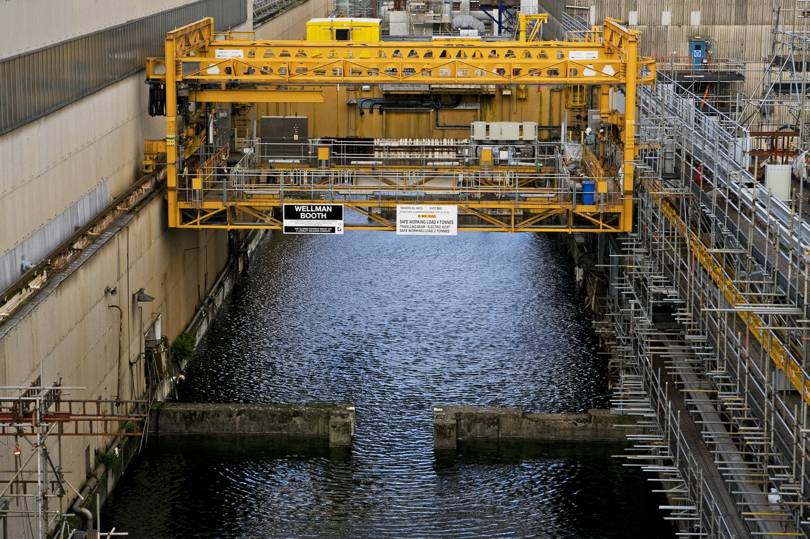
Sellafield, Europe’s most hazardous nuclear site, has a worsening leak from a huge silo of radioactive waste that could pose a risk to the public, the Guardian can reveal.
Concerns over safety at the crumbling building, as well as cracks in a reservoir of toxic sludge known as B30, have caused diplomatic tensions with countries including the US, Norway and Ireland, which fear Sellafield has failed to get a grip of the problems.
The leak of radioactive liquid from one of the “highest nuclear hazards in the UK” – a decaying building at the vast Cumbrian site known as the Magnox swarf storage Silo (MSSS) – is likely to continue to 2050. That could have “potentially significant consequences” if it gathers pace, risking contaminating groundwater, according to an official document.
Cracks have also developed in the concrete and asphalt skin covering the huge pond containing decades of nuclear sludge, part of a catalogue of safety problems at the site.
Sellafield, a sprawling 6 sq km (2 sq mile) site on the Cumbrian coast employing 11,000 people, stores and treats nuclear waste from weapons programmes and nuclear power generation, and is the largest such facility in Europe.
A document sent to members of the Sellafield board in November 2022 and seen by the Guardian raised widespread concerns about a degradation of safety across the site, warning of the “cumulative risk” from failings ranging from nuclear safety to asbestos and fire standards.
A scientist on an expert panel that advises the UK government on the health impact of radiation told the Guardian that the risks posed by the leak and other chemical leaks at Sellafield have been “shoved firmly under the rug”.
The report said events that could trigger an atmospheric release of radioactive waste at the plant included explosions and air crashes.
Such is the concern about its safety standards that US officials have warned of its creaking infrastructure in diplomatic cables seen by the Guardian. Among their concerns are leaks from cracks in concrete at toxic ponds and a lack of transparency from the UK authorities about issues at the site. The UK and the US have a decades-long relationship on nuclear technology.
Concerns about how Sellafield is run have also led to tensions with the Irish and Norwegian governments.
On Saturday, Britain’s Ministry of Defence (MoD) said that the Royal Air Force (RAF) would carry out surveillance flights over Gaza.
A joint statement by the Ministry of Defence, Foreign, Commonwealth & Development Office, and Home Office, headed “UK military activity in the Eastern Mediterranean”, announced, “In support of the ongoing hostage rescue activity, the Ministry of Defence will conduct surveillance flights over the eastern Mediterranean, including operating in air space over Israel and Gaza.”………………
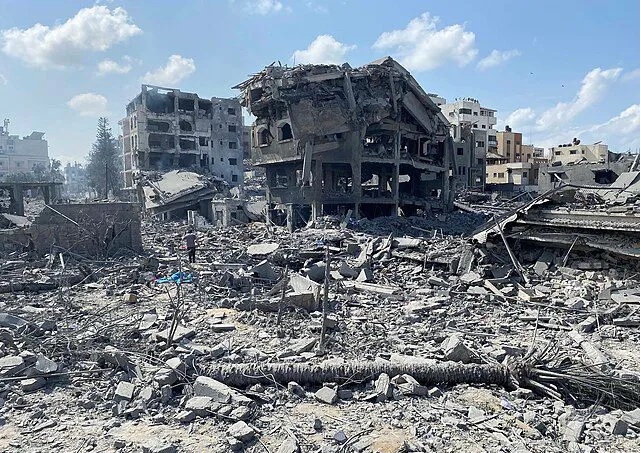
Britain has been up to its neck in the arming of the Israeli regime that has killed tens of thousands, mainly civilians and the vast majority women and children, and reduced Gaza to rubble. Now everyone is expected to believe that the RAF will be carrying out blanket surveillance of Gaza and a large part of the eastern Mediterranean with no military purpose and will not make information gathered available to its main military ally in the region.
British imperialism is gearing up for an escalation of the war in the Middle East and putting the necessary resources in place. Just two days before the drone surveillance announcement, Defence Secretary Grant Shapps revealed that the UK is sending one of its most lethal warships to the Gulf, HMS Diamond, a Type 45 destroyer with the ability to shoot down missiles…………………………………………..
Britain’s role in supplying Israel’s war-machine is critical. According to the Campaign Against Arms Trade (CAAT), “UK industry provides 15% of the components in the F-35 stealth combat aircraft that are currently being used in the bombardment of Gaza. The contract for the components is estimated… to be worth £336m since 2016.”
Israel has 50 F-35s on order from the US, with 22 already delivered by the end of 2022, reports CAAT. The organisation estimates that “each aircraft involves around $12 million to UK industry. This would imply a value of $72 million (£58m) for total UK deliveries of F-35s to Israel in 2022…”
Much of what the UK sends to Israel’s military is not even documented, with CAAT noting, “Between 2018 and 2022, the UK exported £146m in arms sales via Single Issue Export Licences. However, a large proportion of military equipment exported is via Open General Export Licences. These open licences, which include the F-35 components, lack transparency and allow for unlimited quantities and value of exports of the specified equipment without further monitoring.”………………………………………………….
The Sunak government refuses to confirm whether it has troops on the ground already in Gaza. On Monday, MPs were allotted just one hour to ask the government questions of the “Humanitarian Situation” in the Strip; a debate which hardly any of the mainly pro-war MPs across all parties showed up for.
Former Labour leader Jeremy Corbyn—who remains a party member but sits as an Independent having been expelled from the parliamentary party three years ago by leader Sir Kier Starmer—said in his comments that “Israel is clearly undertaking an act of cleansing of the entire population of Gaza”, which “is illegal in international law.” He then asked, “What is the role, purpose and military objective of British military participation in the whole area? Can he [Leo Docherty, a parliamentary under-secretary of state at the Foreign Office] assure us that there are no British soldiers on the ground in Gaza?”………
Britain’s military role in the region is maintained to ensure its ruling elite profit from the spoils of genocide and war, as the trusted partners of US imperialism. Bloomberg and Newsweek reported in October that the Biden administration is considering sending in “peacekeepers for the Gaza Strip”, once Hamas is wiped out and Gaza depopulated, and that the “Multinational force could include American, UK, French troops.”
Despite a November 1 statement by White House spokesperson John Kirby that there are “no plans or intention to put US military troops on the ground in Gaza, now or in the future”, Bloomberg reported that the Biden administration “is still talking to partners about what a post-conflict Gaza should look like. US Secretary of State Antony Blinken said, “if that means some sort of international presence, then that’s something we’re talking about.”
Bloomberg reported that “one option would grant temporary oversight to Gaza to countries from the region, backed by troops from the US, UK, Germany and France.”
On Monday, John Bolton, the former Republican US national security adviser, proposed at the UK’s Foreign Affairs Select Committee that the Gaza Strip should be split into two territories, with Gaza north of the Wadi Gaza River administered by Israel and an area to the south run by Egypt.
This would be initiated after the ethnic cleansing of most Palestinians and facilitate the transfer of those that remain. No Palestinians would be allowed to settle in Israel, which Bolton said would not even provide work visas, but must all be resettled in other countries. https://www.wsws.org/en/articles/2023/12/05/ttog-d05.html
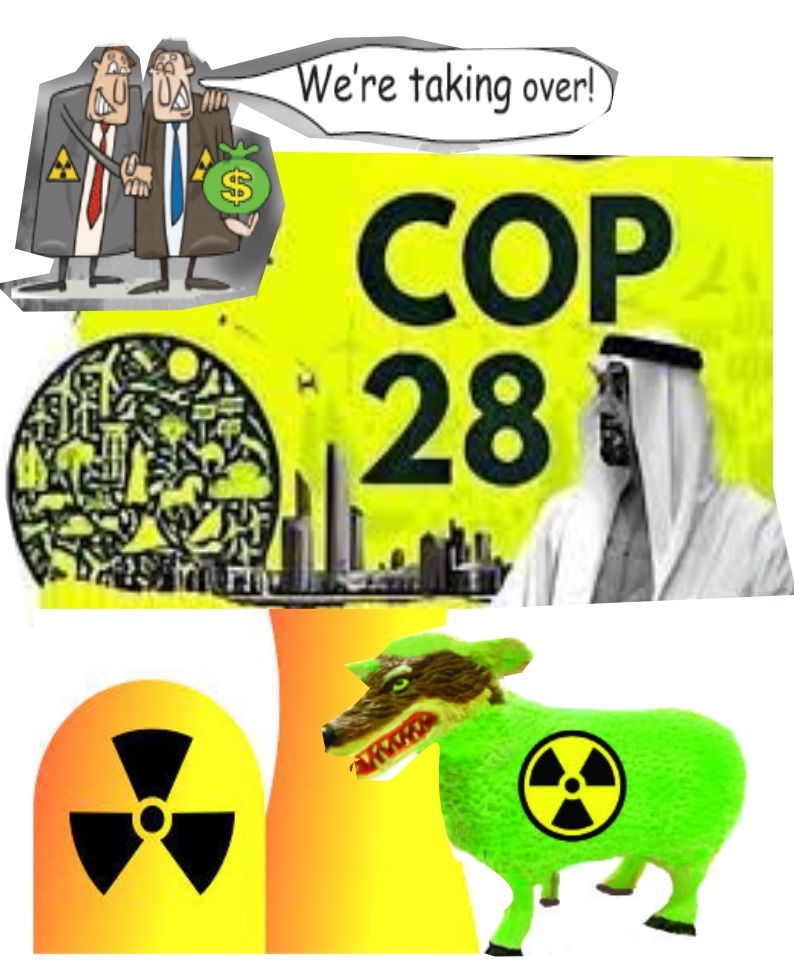
Following the launch of a programme aimed at leveraging its experience in successfully delivering a nuclear power plant project, the UAE’s Emirates Nuclear Energy Corporation (ENEC) has signed a number of agreements with small modular reactor and micro-reactor vendors to explore opportunities for the commercialisation and global deployment of their designs.
For decades, the Defense Department made little or no connection between China’s civilian nuclear power program and its military nuclear weapons buildup. No longer.
For the last three years, the Pentagon has explicitly linked Beijing’s “peaceful” fast reactor power program to China’s ramped-up weapons plutonium efforts and the projection China will acquire more than 1,000 nuclear warheads by 2030. In its latest annual China military power report, the Defense Department went further and revealed that China is using its civilian nuclear reactors to produce tritium to fuel its thermonuclear weapons.
China is doing this by placing lithium rods in power reactors and bombarding the rods with neutrons. This produces tritium, which subsequently is separated, much like how America makes its weapons tritium. It’s unclear if China uses all its power reactors—American, Canadian, Russian, French, or Chinese-designed—for this purpose.
The Pentagon report, however, notes that China uses a tritiated heavy water extraction process to cull tritium produced when hydrogen atoms absorb neutrons and become tritium atoms. The only reactors in China that use heavy water are located in Haiyan and operated by China National Nuclear Power Corporation (CNNC)—Beijing’s premier nuclear weapons contractor.
Canada supplied these reactors through Atomic Energy of Canada Limited (AECL), a Canadian government-owned firm. In addition, AECL agreed to work with CNNC on advanced heavy water reactors and related technologies. In 2011, AECL sold its heavy water reactor business to SNC-Lavalin Inc. (recently renamed AtkinsRealis). AtkinsRealis continues to collaborate with CNNC on its heavy water reactors.
However, Canada’s nuclear transfers to China aren’t limited to reactors. In late October, the Canadian firm Cameco, one of the world’s largest uranium suppliers, announced it had contracted to sell more than 97,500 metric tons of uranium to CNNC. Cameco says it will send the CNNC more than 12,700 metric tons annually for the next four years. 12,700 metric tons is roughly 200 to 300 metric tons more than China’s entire civilian sector consumes annually. The 200-to-300-ton surplus alone could fuel as many as 100 bombs each year.
This should raise eyebrows. With poor domestic uranium resources, China insists it’s only building up its uranium reserves for future nuclear power use. Perhaps, but there is no agreed way to verify this. The same is true with tritium. Currently, there are no effective controls on either nuclear substance to assure their peaceful end-use. Both, however, are critical to making nuclear weapons, and CNNC, China’s top weapons vendor, controls these materials.
What should be done?
First, our government needs to name and shame firms exporting critical nuclear materials and technologies to America’s nuclear-armed rivals. This would require spotlighting Canada’s Cameco and AkinsRealis. It also would require listing France’s nuclear firm, EDF, which this spring announced it would work with CNNC in developing advanced spent fuel recycling, a process critical to producing weapons plutonium. Yet, another entity that deserves dishonorable mention is Rosatom, Russia’s prime nuclear weapons developer, in addition to firms in business with the company. The House has already spotlighted Rosatom as a bad actor, asking the White House to sanction it for assisting China’s fast reactor program.
To expose these entities further, the Departments of Defense and the Intelligence Community should produce an unclassified annual report clarifying which domestic and foreign firms might be transferring nuclear materials and technologies to hostile states’ nuclear weapons entities.
Second, the U.S. government should prohibit government purchases and subsidies to these firms. Congress and the White House may be reticent to sanction firms for trading with hostile states’ nuclear weapons entities. But our government should, at least, not buy goods from such firms or subsidize them.
Finally, the United States and other like-minded nations should call on the International Atomic Energy Agency to track and safeguard tritium and unenriched uranium to prevent their diversion to make bombs. Fortunately, there is little commercial demand for tritium. Most of what is produced is then extracted from reactors for occupational safety reasons and is accounted for.
Similarly, most uranium ore is used to fuel legitimate civilian reactors. Yet, it too is critical to make nuclear weapons, and it is not currently tracked or safeguarded. Given that the government already tracks and sanctions certain oil and gas transfers—a daunting task—it’s difficult to understand why we don’t do the same for uranium and tritium. In the lead-up to the next Nuclear Nonproliferation Treaty Review Conference in 2026, the United States should close this gap.
Henry Sokolski is the executive director of the Nonproliferation Policy Education Center in Arlington, Virginia, and the author of Underestimated: Our Not So Peaceful Nuclear Future (2019). He served as deputy for nonproliferation policy in the office of the U.S. Secretary of Defense during the George H.W. Bush administration.
Zakaria Baker and his family were forced from their home in Al-Shati refugee camp by Israeli bombs on November 7. As they traveled south over 15 kilometers they witnessed incredible horrors and not everyone survived the journey. This is their story.
[Mondoweiss] Editor’s Note: The following testimony was given by Zakaria Baker on November 11, 2023. The testimony was collected by Amplify Gaza Stories, an organization working on the ground in Gaza to collect and translate testimonies from Gazans, ensuring their stories of struggle, resilience, and survival are heard.
November 11, 2023
am Zakaria Baker, one of the people who were displaced from their homes four days ago in November 2023 – around November 7, 2023.
The beginning of the displacement is as follows: An Israeli intelligence officer called one of my cousins. There were about 20 of us sitting on chairs. The bombing of Al-Shati Refugee Camp did not stop for a single second. The missiles that were fired at the camp – we couldn’t see or hear them. They were barrel bombs. When they were dropped on a residential block of six or seven houses, they destroyed them completely. The scariest and most painful thing is that these missiles are fired at houses crowded with people. The bodies in Al-Shifa Camp are still under the rubble. We could smell the bodies.
The Israeli intelligence officer called one of my cousins who was sitting with us and said, “Bakers, why haven’t you left? Your neighbors have evacuated. You have 30 minutes to leave for your safety. If you don’t go, we will drop death on you.”
Ok, half an hour… What do we do? We are families and children and have to get ready to leave?
Less than half an hour later, about 20 minutes, maybe less, the bombing started a few meters away from us. It was targeting houses that were just two or three houses away. We couldn’t take anything with us, just some medication because I had had open heart surgery. So we walked – women, children, and elderly – as we kept walking, the bombing got closer to our houses. Whenever we passed a house, it was destroyed behind us.
The bombardment continued to Rono Mosque near Al-Shifa Hospital. When we were under the mosque, a bomb hit its minaret. Thousands of people were in the street. Some of them came from the hospital too. Many elderly people were with us. There were 160 people from our family in the street, and from our extended family, there were around 4 or 5 thousand.
We all started walking. When we reached the Al-Shifa there were thousands of people there. Most of them were residents from around Al-Shifa Hospital, or people who were seeking shelter inside the hospital who fled because the hospital was targeted.
We reached Dola interchange, some five to six kilometers we had already covered. We saw a scruffy-looking bus, but it was working, and we asked the driver to take us to the Dola interchange. He asked for 80 shekels, and we were approximately 40 people. We agreed on 80 shekels to take us to the Dola roundabout near Salah al-Din. We reached the Dola interchange, and we got off the bus, and we walked approximately one kilometer after the Kuwait roundabout, and we saw huge crowds, you know, don’t say hundreds or 1000s or 10s of thousands, there were hundreds of thousands of people and horrific scenes – women 80 and 90-year-olds, old men of 70 and 80 years old, some of them were wounded, some carrying children. We kept walking until we met a donkey and cart, and the owner said 20 shekels, so we loaded everything onto this cart – women, children, all our luggage, everything that we could get on the cart. Halfway up, the donkey was struggling, so the driver asked us to push. So we pushed it for the sake of helping the elderly and the children.
. We pushed until we were within 100 meters of the Israeli IDF. We got down, and we were asked to show our IDs. I picked up my grandson and played with him in order to assure him and for him to be assured by me. We walked within 10 meters of the soldiers. They said, “Stop.” We stopped. We saw three tanks move in front of us. Once they passed, we were told to walk on.
We only had one suitcase each. There were bodies everywhere. Some decomposed, some were charred. We saw a car with a person inside it dead. His bottom half was intact, his upper half was decomposed. Horrific scenes, enough to make a stone cry. Enough to make a stone cry. We left the area with the tanks, and we moved to Wadi Gaza Bridge, and they said to us now you are in a safe zone. From the area with the tanks to Wadi Gaza, my grandson was crying, he was hungry.
There was a small wall, and we let his mother use it to hide behind it so that she could breastfeed him and stop him crying just for a few minutes, about five minutes. In general, we felt easier and a little bit calmer after my grandson was fed. We continued walking in an enormous stream of humans in a column
On the bridge, we were not allowed to stop. It was forbidden to stop, in fact, one of the old women with us, who was married to my relative, she was 86 years old, her name was Kefah Bakr. She fell down from fatigue and died, she couldn’t survive the journey, the walking. She was kinda lucky because she died 10 meters after passing through the Israeli IDF-controlled area, and so she was taken to hospital.
Back in the tank area, you’re not allowed to look left or right. You must keep looking straight.
(Question from Mohammed Ghalayini, a volunteer with Amplify Gaza Stories: Were the instructions from the soldiers given by loudspeakers?)
Answer: No, the instructions were passed from one person to another. The people in the front were instructed to do something, and they would tell it to someone behind them and so on, and the instructions would be spread to all the others.
Many of the old people fell down and were left. People would walk past them. One person dropped his suitcase. His name Alaa Abu-Stata. He bent down to pick up his suitcase, and he was shot dead. Many of the old women couldn’t withstand this hard work, and they fell down to the ground. No one dared to stop to help them, they would shoot dead all those who would help her. So we had to sacrifice one old person to save 10 or 20 others from being shot or humiliated. I saw four cases, one person was called by name by loudspeakers. They stripped him down naked, and he was arrested, and no one knows where he has been taken. No one knows anything about him. This is what I have seen at a distance of 100 meters, and others have seen similar cases of arrests.
We kept on walking until Burej. Imagine! From Al-shati’ to the bridge – something like 15 kilometers. At Burej, there were no cars, only lorries. One lorry driver came along, and I told him we wanted to go to Khan Younis or the Hamad area. He said 300 shekels. I said, never mind just get us out of here. We reached Hamad, and we had another torturous journey at Hamad.
(Question: Did you find accommodation in Hamad?)
No, we couldn’t find any rooms. We spent three nights sleeping rough on the floor, unprotected, under the skies—cold nights. On the third night, only on the third night, we switched on spotlights to repel insects and flies from the eight and nine-month-old babies. On the 4th day, we managed to sort out the situation. We broke a partition that belongs to the council – some 4 meters square, and we put 40 people in it. This was my project. I made a makeshift tent from it with used plastic sheets, and six families were able to shelter there.
Since 12:00 yesterday, we haven’t been able to find a piece of bread. We have one meal a day – for two reasons: to avoid going to the toilet and because we can’t find any food. It’s a hunger war. No tinned food. We went to all the supermarkets and could not find anything. Women slept in the same clothes they left home with. This water I was given by Abu Mohammed. We were subjected to pain, suffering, anger, humiliation. I can’t talk anymore about this.
Since this story was recorded, Baker, his family, and thousands of others seeking refuge were again forced to leave their shelter in Hamad City, Khan Younis,on December 2 after receiving an evacuation order from the Israeli military.
Nuclear Leaks, a year-long Guardian investigation, has uncovered problems with cyber hacking, radioactive leaks and toxic workplace culture at Sellafield, the UK’s most hazardous nuclear site.
It has also revealed how a small corner of the UK has an outsized influence on its special relationship with the US, with the countries bound by the shared history of nuclear weapons development. Britain’s neighbours in Europe, particularly Norway and Ireland, also keep a sharp eye on the site, from where previous pollution incidents and radioactivity as a result of a fire have made it to their shores.
Originally named Windscale, the industrial complex dates back to the cold war arms race, and was the original site for the development of nuclear weapons in the UK in 1947, manufacturing plutonium, as Britain raced to build an atomic bomb.
It was also home to the world’s first full-scale commercial nuclear power station, Calder Hall, which was opened in 1956 and ceased generating electricity in 2003.
The site, which has almost 1,000 buildings, has a workforce of 11,000, with its own railway, road network, laundry services for normal and potentially radioactive garments, and its own police force with more than 80 dogs.
Great Britain still has a group of nuclear power plants, majority owned by France’s EDF, which generate about 16% of the electricity for the power network.
The UK is also building new nuclear power stations, including Hinkley Point C in Somerset, although their waste will eventually be buried in a new geological disposal facility.
The hack was one of a series of cyber issues at the site, and was covered up by senior managers. Other concerns included external contractors being able to plug memory sticks into the system while unsupervised and staff at remote sites being able to access its computer servers.
The UK’s nuclear watchdog, the Office for Nuclear Regulation (ONR), put the site into a form of “special measures” for consistent failings on cybersecurity.
Sources said cyber breaches were first detected as far back as 2015, when experts realised sleeper malware – software that can lurk and be used to spy on or attack systems – had been embedded in Sellafield’s computer networks. It is still not known if the malware has been eradicated. It may mean some of Sellafield’s most sensitive data on activities, such as moving radioactive waste, monitoring for leaks of dangerous material and checking for fires, have been compromised.
What is leaking?
The investigation revealed a worsening leak of radioactive liquid from one of the “highest nuclear hazards in the UK” – a decaying silo from which radioactive material is leaking into the ground. The leak is likely to continue to 2050.
The Guardian also revealed concerns about B30, a pond containing nuclear sludge from corroded nuclear fuel rods, whose concrete and asphalt skin is ribboned with cracks. These cracks have worsened in recent months, according to sources.
Why are Norway, Ireland and the US so worried and how bad could it get?
Concerns over safety at Sellafield have caused diplomatic tensions with countries including the US, Norway and Ireland. Norwegian officials are concerned that an accident at the site could lead to a plume of radioactive particles being carried by prevailing south-westerly winds across the North Sea, with potentially devastating consequences for Norway’s food production and wildlife. Radioactive contamination from the 1957 Windscale fire reached Norway’s shores.
Fire safety is a key area of concern. The Guardian investigation revealed an internal document in November 2022 warned of a “cumulative risk” posed by failings in a range of areas, from nuclear safety to managing risks from fire and asbestos. “They can’t handle fire or asbestos on site, let alone the crumbling of nuclear containment materials,” one senior Sellafield employee told the Guardian………………………………………………………………………. more https://www.theguardian.com/business/2023/dec/06/nuclear-leaks-uk-nuclear-site-sellafield-hacking
GAZA (Reuters) -Israel ordered Palestinians to leave parts of the main southern city in the Gaza Strip on Monday even as its bombs rained down on areas where it had told them to go.
Israeli troops and tanks also pressed the ground campaign against Hamas militants in the south of the enclave after having largely gained control of the now-devastated north.
Israel’s military posted a map on social media platform X on Monday morning with around a quarter of the city of Khan Younis marked off in yellow as territory that must be evacuated at once.
Three arrows pointed south and west, telling people to head towards the Mediterranean coast and towards Rafah, near the Egyptian border.
Desperate Gazans in Khan Younis packed their belongings and headed towards Rafah. Most were on foot, walking past ruined buildings in a solemn and silent procession.
But Rafah itself was coming under Israeli fire. The head of the United Nations agency in Gaza (UNWRA), Thomas White, said people there were themselves being forced to flee.
“People are pleading for advice on where to find safety. We have nothing to tell them,” he said on X.
Bombing at one site in Rafah overnight had torn a crater the size of a basketball court out of the earth. A dead toddler’s bare feet and black trousers poked out from under a pile of rubble. Men struggled with their bare hands to move a chunk of the concrete that had crushed the child…………………………………………….
Gaza’s health ministry said on Monday that at least 15,899 Palestinians, 70% of them women or under 18s, have now been killed in Israeli air and artillery strikes on the enclave since Oct. 7. Thousands more are missing and feared buried in rubble. As many as 80% of Gaza’s 2.3 million people have fled their homes in the Israeli bombing campaign that has reduced much of the crowded coastal strip to a desolate wasteland………………………………..
The United Nations said the areas in the south that Israel has ordered evacuated in the three days since the truce had housed more than 350,000 people before the war – not counting the hundreds of thousands now sheltering there from other areas.
“We were sleeping at 5 a.m. when we felt things collapse, everything went upside down,” she told Reuters. “They told (people) to move from the north to Khan Younis, since the south is safer. And now, they’ve bombed Khan Younis. Even Khan Younis is not safe now, and even if we move to Rafah, Rafah is not safe as well. Where do they want us to go?”……………………………………………….. (Reporting by Mohammed Salem and Roleen Tafakji in Gaza, Maayan Lubell, Ari Rabinovich and Emily Rose in Jerusalem, Maggie Fick in Beirut, Andrew Mills in Doha, Writing by Peter Graff and Angus MacSwan; Editing by Mark Heinrich and Alex Richardson) https://www.msn.com/en-us/news/world/israel-orders-more-gazans-to-flee-bombs-areas-where-it-sends-them/ar-AA1kZ4rK
Cybersecurity vulnerabilities at the UK’s most hazardous nuclear site must be urgently addressed and explanations given for any shortcomings, a cabinet minister has demanded.
Claire Coutinho, secretary of state for energy security and net zero, wrote to the chief executive of the Nuclear Decommissioning Authority (NDA), David Peattie, saying allegations by the Guardian about failings in cybersecurity at Sellafield in Cumbria needed “urgent attention”.
Coutinho said: “The allegations are a worrying reminder of the longstanding nature of some of these issues, specifically cybersecurity at Sellafield, which I understand has been under enhanced regulatory scrutiny since 2014.”…………………………………………………………………………….
Carla Denyer, co-leader of the Green party, which opposes nuclear power, said: “This toxic legacy of nuclear weapons and nuclear power poses a serious risk to life and public health as well as poisoning relations with other countries, especially Norway, that would be devastated by a radioactive plume if ever there was a major incident at Sellafield.
“This extreme and cynical Republican resolution does nothing to combat antisemitism,” said Rep. Ilhan Omar, stressing the importance of “legitimate criticism” of the Israeli government and its war on Gaza.
As Israel continued to wage what critics are calling a genocidal war on the Gaza Strip, just 13 U.S. House Democrats and one Republican on Tuesday voted against a GOP resolution that conflates anti-Zionism and antisemitism.
House Resolution 894 passed with support from 95 Democrats and 216 Republicans, including its sponsors, Reps. David Kustoff (Tenn.) and Max Miller (Ohio), who are both Jewish. Almost as many Democrats—92—voted present.
The resolution, which embraces the International Holocaust Remembrance Alliance’s controversial working definition of antisemitism, was widely condemned by progressive and Jewish groups this week ahead of the vote.
Republican Congressman Thomas Massie (Ky.) joined the 13 Democrats who opposed H.Res. 894: Reps. Jamaal Bowman (N.Y.), Cori Bush (Mo.), Gerry Connolly (Va.), Jesús “Chuy” García (Ill.), Raúl Grijalva (Ariz.), Pramila Jayapal (Wash.), Summer Lee (Pa.), Alexandria Ocasio-Cortez (N.Y.), Ilhan Omar (Minn.), Ayanna Pressley (Mass.), Delia Ramirez (Ill.), Rashida Tlaib (Mich.), and Bonnie Watson Coleman (N.J.).
“This extreme and cynical Republican resolution does nothing to combat antisemitism, relies on a definition that conflates criticism of the Israeli government with antisemitism, paints critics of the Israeli government as antisemites, and falsely states that anti-Zionism is antisemitism,” Omar said in a statement about her vote. “We must stand against any attempt to define legitimate criticism of this war and the government perpetrating it as antisemitism.”
According to The Hill, Bowman said after the vote that while he “strongly condemn[s] antisemitism and hate in all of its forms,” he voted against H.Res. 894 because “it fuels division and violence, conflates criticism of the Israeli government with antisemitism, and ignores one of the greatest threats to the Jewish community, white nationalism.”
Bowman and Omar are among the House progressives facing serious primary challenges for the next cycle, in part because of their criticism of the Israeli government and its war on Gaza that has killed nearly 16,000 Palestinians in under two months.
They joined with Bush, Lee, Massie, Ocasio-Cortez, Ramirez, Tlaib, and Reps. André Carson (D-Ind.) and Al Green (D-Texas) in October to oppose a bipartisan resolution, which declared that the House unconditionally “stands with Israel as it defends itself against the barbaric war launched by Hamas and other terrorists,” and did not mention Palestinian suffering.
Walt Zlotow, West Suburban Peace Coalition, Glen Ellyn IL 6 Dec 23
President Biden, struggling to gain support for his $105 billion weapons boondoggle to further US wars against Russia and Gaza, sent out his chief advocate for perpetual war, Defense Secretary Lloyd Austin, to hammer away at advocates for a sane, peaceful US foreign policy.
Austin told the Reagan National Defense Forum in California, actually a forum for perpetual war, that Americans for peace are “Americans who prefer isolation to engagement…try to pull up the drawbridge. They try to kick loose the cornerstone of American leadership. The’re Americans trying to undermine the security architecture that has produced decades of prosperity without great-power war. And you’ll hear some people try to brand an American retreat from responsibility as bold new leadership. So when you hear that, make no mistake: It is not bold. It is not new. And it is not leadership,”
Austin, shilling for his Commander in Chief Biden, seeks to keep funneling endless billions to support America’s proxy war that’s enabled hundreds of thousands of deaths in Ukraine. He’s also ensuring the genocidal ethnic cleansing of 2.3 million Palestinians in Gaza that could not happen without US weapons and immoral support.
Defense Secretary Lloyd Austin should resign forthwith. So should his boss, President Biden, who appears bent on destroying Gaza and Ukraine for reasons having nothing to do with American national security interests. Their replacements might realize perpetual war is utterly self destructive to the individuals promoting it, America; indeed, the world. It might just inspire them to pivot to peace before they get drawn into the same vortex of defeat as their predecessors.
The following is a statement from Extinction Rebellion, UK, in light of misrepresentations of their movement by a former team member now working for a pro-nuclear front group.It alleges that Environmental Progress, its new employee, Zion Lights, its founder, Michael Shellenberger, and the group’s predecessor, Breakthrough Institute (still operating as well) have ties to big corporations and to climate denial.
There have been a number of stories in the press in the last few weeks with criticisms about Extinction Rebellion by Zion Lights, UK director of the pro-nuclear lobby group Environmental Progress. It appears that Lights is engaged in a deliberate PR campaign to discredit Extinction Rebellion.
For any editors who might be considering platforming Lights, we would like to make you aware of some information about the organisation she works for and her employer, Michael Shellenberger.
ENVIRONMENTAL PROGRESS & MICHAEL SHELLENBERGER
Environmental Progress is a pro-nuclear energy lobby group. While the group itself was only established in 2016, its backers and affiliates have a long and well-documented history of denying human-caused climate change and/or attempting to delay action on the climate crisis. A quick look at groups currently promoting Zion Lights through their social media channels include climate deniers and industry lobbyists such as The Global Warming Policy Foundation and the Genetic Literacy Project (formerly funded by Monsanto).*
The founder of Environmental Progress, Michael Shellenberger, has a record of spreading misinformation around climate change and using marketing techniques to distort the narrative around climate science. He has a reputation for downplaying the severity of the climate crisis and promoting aggressive economic growth and green technocapitalist solutions.
Shellenberger appeared on the Tucker Carlson Show on Fox News just last week to say that the forest fires currently raging in California are due to “more people and more electrical wires that they’ve failed to maintain because we’ve focused on other things like building renewables” and we’ve been “so focused on renewables, so focused on climate change.”
In his recent book Apocalypse Never: Why Environmental Alarmism Hurts us All, Shellenberger argues that there are no limits to growth and that environmental problems can be solved by everyone getting richer. The book has been widely criticised by many respected scientists both for its central premise and its misunderstanding, misinterpretation and misuse of the facts. (See here and here.)
His stance on fundamental and vitally important points of scientific consensus around the climate crisis is flat out wrong. In his essay promoting his book published in June of this year on the Environmental Progress website and The Australian – ‘On behalf of environmentalists, I apologise for the climate scare’ –he claims that “climate change is not making natural disasters worse” and that “Humans are not causing a ‘sixth mass extinction”. He also argues that “fires have declined 25% around the world since 2003,” and, “The build-up of wood fuel and more houses near forests, not climate change, explain why there are more, and more dangerous, fires in Australia and California.” These claims contradict reports from the IPCC and misrepresent the discussion taking place in the scientific community.
One science advisor with Environmental Progress, respected MIT climate expert Professor Kerry Emanuel, spoke publicly about being “very concerned” about the essay, and felt unsure whether he would remain involved with the organisation.
The article was published in Forbes, before being pulled offline the same day for violating its code of ethics around self-promotion.
A key tactic from the climate delayer playbook used in the essay is that of the repentant environmentalist, according to investigative journalist, Paul Thacker. After gaining credibility by aligning themselves with a section of the environmental movement, the repentant environmentalist then performs a volte face and attacks their former position.
This tactic has also been used by Zion Lights, who first overstated her role within Extinction Rebellion (she was a member of the media team, not ‘co-lead’ as stated on the Environmental Progress website) and then denounced the movement following an apparent change of heart.
BREAKTHROUGH INSTITUTE
Shellenberger is co-founder of the Breakthrough Institute, a lobbying group masquerading as a “think tank”. The Breakthrough Institute has “a clear history as a contrarian outlet for information on climate change [which] regularly criticises environmental groups”, according to Paul Thacker. Breakthrough has also been described as a “program for hippie-punching your way to fame and fortune.”
Shellenberger co-founded the Breakthrough Institute with Ted Nordhaus, nephew of economist, William Nordhuas. William Nordhaus features in Merchants of Doubt – Naomi Oreskes and Erik Conway’s examination of the PR strategies used both by the tobacco and fossil fuel industries. His interventions in the 1990s helped set back essential action on climate change by decades.
Other figures associated with Shellenberger and the Breakthrough Institute include:
Owen Paterson, one of the UK’s most prominent climate deniers who helped with the UK launch of the group’s Ecomodernist manifesto in 2015.
Matt Ridley, coal mine owner, once hereditary Conservative Peer and famous climate delayer / ‘lukewarmist’ who spoke at the UK launch event. (more…)
Ministers who visit Sellafield for the first time are left with no illusions about the challenge at Europe’s most toxic nuclear site.
One former UK secretary of state described it as a “bottomless pit of hell, money and despair”, which sucked up so much cash that it drowned out many other projects the economy could otherwise benefit from.
For workers, it is a place of fascination and fear.
“Entering Sellafield is like arriving in another world: it’s like nuclear Narnia,” according to one senior employee. “Except you don’t go through a cupboard, you go through checkpoints while police patrol with guns.” Others call it nuclear Disneyland.
Sellafield, a huge nuclear dump on the Cumbrian coast in north-west England, covers more than 6 sq km (2 sq miles). It dates to the cold war arms race, and was the original site for the development of nuclear weapons in the UK in 1947, manufacturing plutonium. It was home to the world’s first full-scale commercial nuclear power station, Calder Hall, which was commissioned in 1956 and ceased generating electricity in 2003.
It has been at the centre of disaster and controversy, including the Windscale fire of 1957. The blaze was considered one of the worst nuclear incidents in Europe at the time, and carried a plume of toxic smoke across to the continent. The milk from cows on 200 sq miles of Cumbrian farmland was condemned as radioactive.
Sellafield began receiving radioactive waste for disposal in 1959, and has since taken thousands of tons of material, from spent fuel rods to scrap metal, which is stored in concrete silos, artificial ponds and sealed buildings. A constant programme of work is required to keep its crumbling buildings safe and create new facilities to contain the toxic waste. The site is expected to be in operation until at least 2130.
The estimated cost of running and cleaning up the site have soared. Sellafield is so expensive to maintain that it is considered a fiscal risk by budgetary officials. The latest estimate for cleaning up the Britain’s nuclear sites is £263bn, of which Sellafield is by far the biggest proportion. However, adjustments to its treatments in accounts can move the dial by more than £100bn, more than the UK’s entire annual deficit. The cost of decommissioning the site is a growing liability that does not count towards the calculation of the UK’s net debt.
Sellafield is owned by the Nuclear Decommissioning Authority, a quango sponsored and funded by the Department for Energy Security and Net Zero that is tasked with cleaning 17 sites across the UK.
The site has a workforce of 11,000, with its own railway, road network, laundry services for normal and potentially radioactive garments, and its own police force with more than 80 dogs. It has almost 1,000 buildings.
Sellafield’s impact on the environment has been a longstanding concern. Local animals, including swallows, have been found to carry radioactive traces from the site with them. Debate rages locally over just how toxic the “atomic kittens” – stray cats that inhabit the site – may be. Sellafield says cats are screened for radioactivity before they are rehomed.
The activities at the site are a matter of significant scrutiny to countries including the US, Norway and Ireland, given that Sellafield hosts the largest store of plutonium in the world and takes waste from countries such as Italy and Sweden.
Excellent table here on original, showing current status of the world’s nuclear reactors
Norwegians have long feared the effects of an accident at the site, with modelling suggesting that prevailing south-westerly winds could carry radioactive particles from a large incident at the site across the North Sea, with potentially devastating consequences for its food production and wildlife.
Jobs at Sellafield are often considered to be a golden ticket, according to sources, as the site offers long-term employment with above-average wages in a region with few big employers.
Sellafield is at the heart of the so-called “nuclear coast” in West Cumbria, sandwiched between the Lake District national park and the Irish Sea. At its southern end, BAE Systems in Barrow-in-Furness builds nuclear submarines. Land neighbouring the site has long been earmarked for a new nuclear power station but plans for Moorside collapsed in 2018 when the Japanese conglomerate Toshiba walked away.
The Air Force is expanding its study of whether service members who worked with nuclear missiles have had unusually high rates of cancer after a preliminary review determined that a deeper examination is needed
abc news, ByTARA COPP Associated Press, December 5, 2023
WASHINGTON — The Air Force is expanding its study of whether service members who worked with nuclear missiles have had unusually high rates of cancer after a preliminary review determined that a deeper examination is needed.
The initial study was launched in response to reports that many who served are now ill. The Air Force isn’t making its initial findings of cancer numbers public for a month or so, but released its initial assessment Monday that more review is necessary.
“We’ve determined that additional study is warranted” based on preliminary analyses of the data, said Lt. Col. Keith Beam, one of several Air Force medical officers who updated reporters on the service’s missile community cancer review.
The findings are part of a sweeping review undertaken by the Air Force earlier this year to determine if missileers — the launch officers who worked underground to operate the nation’s silo-launched nuclear missiles — were exposed to unsafe contaminants. The review began after scores of those current or former missile launch officers came forward this year to report they have been diagnosed with cancer.
In response, medical teams went out to each nuclear missile base to conduct thousands of tests of the air, water, soil and surface areas inside and around each of its three nuclear missile bases; Malmstrom Air Force Base in Montana, Minot Air Force Base in North Dakota and F.E. Warren Air Force Base in Wyoming.
The B-2 Spirit stealth bomber aircraft has become the first U.S. warplane to be cleared to carry the B61-12, the newest nuclear bomb on the block. The clearance featured in the Stockpile Stewardship and Management Plan (SSMP) for Fiscal year 2024 was unclassified by the National Nuclear Security Administration (NNSA) last week.
The B61 series is one of the longest-serving weapons in the US stockpile, the first iteration having debuted in the 1960s. The B61-3, -4, and -7 continue to be part of the nuclear lineup available with the U.S., even as plans are afoot to phase them out. Details of the phase-out plan remain unknown for now……………………………………………………
The 825-pound (lb), or ~374 kilograms (kg) bomb project is being undertaken at a cost of nearly $8.3 billion, with experts suggesting that costs could rise to $10 billion, Popular Mechanics reported. Around 480 of these bombs are expected to be made using the B61-4 bombs. The effective cost of making these bombs exceeded the cost of their weight in gold…………………………………..
The US Air Force has plans to equip its F-35, F-15, and F-16s with the B61-12, even though the timeline for these clearances remains unknown for now. The availability of F-35s with NATO allies also means that the B61-12 could also serve US allies in the future, and earlier this month, the Royal Netherlands Air Force confirmed that its F-35As had received an initial certification for the weapon with the German and Italian Tornado fighter bombers also in the queue to use the B61-12………………………….. https://interestingengineering.com/culture/b2-spirit-b61-12-nuclear-bombs
The question of whether a nuclear deterrent might be necessary for South Korea has experienced a resurgence over the past few years, becoming a “mainstream feature of South Korea’s national security discourse”. With recent escalation in the pace of North Korea’s nuclear provocation, China’s aggressive buildup of its nuclear arsenal, and waning confidence in the U.S. commitment to extended deterrence, the public perception in South Korea has reflected a sense of increased vulnerability. Consequently, public polling in January of this year found that 71 percent of South Koreans support the return of nuclear weapons to their country — even if it means engaging in indigenous development. In 2023, South Korean President Yoon Suk-yeol spoke openly, for the first time, of the perceived need to either redeploy American non-strategic nuclear weapons on the Korean Peninsula or build their own. The reality is that it is not in South Korea’s national interest to have a nuclear weapon — politically, militarily or economically.
Despite this, the debate on the Peninsula is real and the country’s legitimate security concerns should be considered. With the North making regular threats, the trepidations of South Koreans are understandable and the need to take measures to reduce the threat from the North clear, but it remains questionable if nuclear weapons would serve such a purpose. More likely, a South Korean nuclear weapon would serve to fuel a destabilizing arms race in Asia and could actually undermine South Korea’s negotiating position vis-a-vis North Korea.
Politically, a nuclear weapon would not make South Korea safer. As an active member of multiple non-proliferation agreements including the Nuclear Non-Proliferation Treaty (NPT) and the 1992 Joint Declaration on the Denuclearization of the Korean Peninsula, South Korea uses these agreements to condemn North Korea’s proliferation and mobilize international support against the nuclear activities of its adversary. South Korea’s own proliferation would jeopardize its ability to do so as well as damage its standing in the international community and its relationship with its primary security ally, the United States.
Militarily, a nuclear weapon would not make South Korea safer. The ROK already has the conventional capabilities needed to strike any target in North Korea through the use of short-range ballistic missiles and precision strike weapons, has recently committed $81 billion toward strengthening its pre-existing defense capabilities, and has established a strategic command to oversee its “three-axis” defense system. Nuclear weapons would add little while increasing paranoia north of the DMZ.
To reinforce reliability of the U.S. commitment to extended deterrence, Presidents Joe Biden and Yoon announced the Washington Declaration in early 2023, as well as the creation of the bilateral Nuclear Consultative Group. In early November, the two countries updated their Tailored Deterrence Strategy agreement for the first time in a decade to reflect their “ironclad” commitment to collective security underscored by the symbolic deployment of major U.S. military assets to the country, such as a nuclear ballistic missile submarine and a nuclear capable B-52 bomber. South Korea is not only conventionally capable of deterring a nuclear attack by North Korea, but it is also protected by a renewed commitment to extended deterrence by the United States, making the development of a nuclear weapon redundant and escalatory.
Economically, a nuclear weapon would not make South Korea safer. A withdrawal from the NPT would bring an array of potential sanctions with the ability to cause real economic damage. Even if the impact of these sanctions is mitigated by allies to protect regional security interests, the impact of potential Chinese sanctions would be severe. Moreover, this withdrawal would impact international cooperation with Seoul’s nuclear energy program, an economic and energy priority.
Thus, although a nuclear weapon might make South Koreans feel safer, at least temporarily, it would not make the country any more secure. Conversely, creation of a nuclear weapon will undermine South Korean efforts to protect itself against a North Korean threat. Instead, the legitimate security concerns voiced by South Koreans could be addressed by strengthening conventional capabilities as well as engaging with international arms control efforts and dialogue across the DMZ. Such measures would do more to promote confidence among Korean citizens than engaging in a destabilizing arms race.