From Alaska to Florida, people in the US once again took to the streets en masse to demand a permanent ceasefire in Israel’s war on Gaza and an end US aid to Israel. The Shut It Down for Palestine Coalition, composed of several organizations including the International Peoples’ Assembly, the Palestinian Youth Movement, the ANSWER Coalition, and National Students for Justice in Palestine, called for a day of action on December 8, to continue putting pressure on Israel and the US one week after Israel resumed its genocidal violence against Gaza. This coalition of organizations is bringing together the Palestine solidarity movement to disrupt major centers of power across the country.
Many of the December 8 actions happened simultaneously to the United States vetoing a UN Security Council draft resolution that would have demanded an immediate humanitarian ceasefire.
Early in the morning, the demonstration was brought directly outside of Secretary of State Antony Blinken’s home in McLean, Virginia. Demonstrators chanted, “Blinken Blinken rise and shine, you’re committing genocide!” Last week, Blinken met with Israel’s war cabinet in occupied Jerusalem, after which he urged Israel to limit civilian casualties. Many suspect that he gave the greenlight for Israel to end its temporary pause in aggression and resume full-scale attacks. The death toll of Palestinians killed by Israel in Gaza has crossed 17,700……………………………………………………………………………………………………………………………………. https://scheerpost.com/2023/12/10/as-the-us-vetoes-un-ceasefire-resolution-the-people-take-the-streets-for-palestine/
The reputation of the ICC could be completely destroyed if crimes against Palestine are not thoroughly investigated, says American attorney Stanley Cohen
In the first weeks of the Gaza-Israel war, the ICC’s prosecutor issued a statement in which he said that impeding aid to Gaza could be a crime, but was later revealed to have traveled to Israel and is being accused of stalling the courts investigation into war crimes. “If this is not a case that calls for an international tribunal, then the Rome Statute should be null and void,” says American attorney Stanley Cohen, speaking to RT.
On October 29, International Criminal Court (ICC) prosecutor, Karim Khan, issued a warning to the Israeli government that impeding the transfer of aid into Gaza could give rise to “criminal responsibility” under the Rome Statute. However, during his speech delivered in the Egyptian capital, Cairo, Karim Khan notably placed much greater focus on the Hamas-led attack of October 7 than on anything the Israeli military had committed in the Gaza Strip. Following the ICC prosecutor’s remarks, there have been questions raised as to whether the court will prove useful in addressing crimes committed across Palestine-Israel.
Renowned American attorney Stanley Cohen addressed Karim Khan’s remarks in Cairo. Cohen said that Khan “made rather affirmative declaratory arguments about what Hamas, what the Qassam brigades, did do, how, when, where, what happened. In the absence of any independent examination, in the absence of any independent evidence, based upon, to some degree, propaganda distortion, alternative intelligence information, which was put out there.” Cohen went on to state that “if I were one of the attorneys representing Palestinians in front of the ICC, given the commentary that the prosecutor made, I might ask him to recuse himself.”
In March of 2021, the ICC officially opened a probe into what it says are war crimes that may have been committed in Palestine – by all parties involved – since June 13, 2014. This would technically mean that crimes recently committed could be subject to an investigation and those responsible may, in theory, be prosecuted. Also, in 2021, Israel’s top human rights group, B’tselem, along with Human Rights Watch, declared that the Israeli government was operating a regime of Apartheid against the Palestinians. In 2022, Amnesty International followed suit, issuing its own lengthy report that demonstrated why it also had decided to accuse Israel of the crime of Apartheid. The ICC has the right, under the Rome Statute, to prosecute those who commit the crime of Apartheid.
However, as the US-based think tank Arab Center Washington DC noted in September, “little has been done” over the past two years by the ICC, despite the prosecutors’ “professed desire to improve the credibility of the court and his private protestations that he cares about the question of Palestine.” Despite Israel having stated that it “will not cooperate” with the ICC, protesting its announced probe into war crimes in 2021, the families of Israelis killed on October 7 have urged the court to launch an investigation into alleged crimes committed by Hamas. This puts the Israeli government in a tough position, as it has repeatedly stated that the ICC has no jurisdiction in their territory. Hamas, on the other hand, welcomed the ICC probe into war crimes, while defending its own actions.
Commenting on the question of why the ICC has yet to move towards indicting those responsible for crimes committed in the occupied Palestinian territories, Stanley Cohen replied:
“They returned an indictment against Putin on the basis of ex parte claims, certainly probable cause, within four days. In the case of Israel you’ve had nine years to find, investigate and corroborate systemic violations of international law, the violation of the law of war, human rights violations, collective punishment, violations of the humanitarian code, crimes against humanity. War crimes.”
Cohen also added the following: “I don’t know why it’s taken two years… There should be an ongoing investigation right now. I was involved in the preliminary applications for the ICC. There have been, just hundreds and hundreds and hundreds of declarations, of affidavits, of videos, of films, of admissions, of statements over the last nine years now, that the ICC has. The cynic in me imagines or wonders whether this, the same piece would’ve taken the speed if the targets were African, if they were black, because the ICC has a history of moving with deliberate speed when it involves African defendants or targets, or people of color.”
Since the child death toll in Gaza alone, as a result of Israel’s war on the besieged coastal enclave, is more than six times times higher than the total Israeli civilian death toll from October 7, it begs the question as to whether the ICC is viewing crimes committed against Palestinians with the same seriousness. If that case goes forward, and investigates the never ending list of war crimes committed across Palestine-Israel, it could perhaps rescue some of the legitimacy of the court, which has been repeatedly accused by African leaders of wrongful targeting. In fact, due to the majority of the ICC’s indictments having been handed out to those on the continent of Africa, some have even suggested that the ICC should be renamed the African Criminal Court.
To make matters worse, once it was revealed that ICC prosecutor Karim Khan had traveled to Israel, he quickly made plans to meet with Palestinian President Mahmoud Abbas and Palestinian human rights groups. However, human rights groups based in the occupied territories rejected his request to meet. Ammar Al-Dwaik, director general of the Independent Commission for Human Rights (ICHR) said that “the way this visit has been handled shows that Mr Khan is not handling his work in an independent and professional manner.”
According to Stanley Cohen, “there are lots of options” beyond the International Criminal Court when it comes to the prosecution of war crimes, including the International Court of Justice (ICJ). “You also then have the situation of courts with universal jurisdiction such as South Africa and Spain and about a dozen or so other countries, which I have no doubt will also be initiating investigations under universal jurisdiction,” he said.
Whether the ICC acts now will either be its saving grace, or irreparably stain the reputation of the court forever. The sheer scale of the atrocities that are now being committed in Gaza is difficult to even describe, with more tonnage of explosives being dropped on the besieged territory than the nuclear bomb used by the United States against Hiroshima. Meanwhile, food, water, medical aid, fuel and electricity are being prevented from entering, or in other cases are being severely limited. Some 1.5 million civilians have been displaced and around 20,000 people killed, while upwards of 30,000 have been injured.
US Deputy National Security Advisor Jon Finer said Thursday that the Biden administration has not set a deadline on Israel’s war in Gaza and reiterated US opposition to a ceasefire.
“We have not given a firm deadline to Israel, not really our role. This is their conflict. That said, we do have influence, even if we don’t have ultimate control over what happens on the ground in Gaza,” Finer told the Aspen Security Forum.
Financial Timesreported last week that the Israeli onslaught is expected to last over a year. US officials told CNN that they expect the current phase of the war, which involves constant airstrikes and a ground operation, would continue into 2024, and then Israel would narrow down its targeting to specific Hamas members, possibly by January.
Finer said the US supports Israel’s goal of ensuring that “Hamas can no longer govern,” although Israeli Prime Minister Benjamin Netanyahu has repeatedly stated his objective is the elimination of Hamas altogether. Finer said the US is “not in place yet of asking Israel to stop or for a ceasefire.”
There’s no indication that Israel is successfully taking out Hamas fighters, as its bombardment has incurred a massive civilian death toll. Gaza’s Health Ministry said Thursday that 17,177 Palestinians have been killed since Israel unleashed its campaign on October 7, and about 70% of the dead are women and children.
Fierce battle raging over Sizewell C in Suffolk is in stark contrast to the tranquil nature of this picturesque historic fishing village. Despite its relaxing vibes, this tiny historic fishing village is at the centre of a bitter battle over whether a massive nuclear power station should be built on its shores.
It is a struggle that could not only determine Sizewell’s future, but the whole of Britain’s. Were it not for its existing power station and plans to build an even bigger one next door, you would never have guessed that this small, remote place would be at the centre of a struggle of national importance.
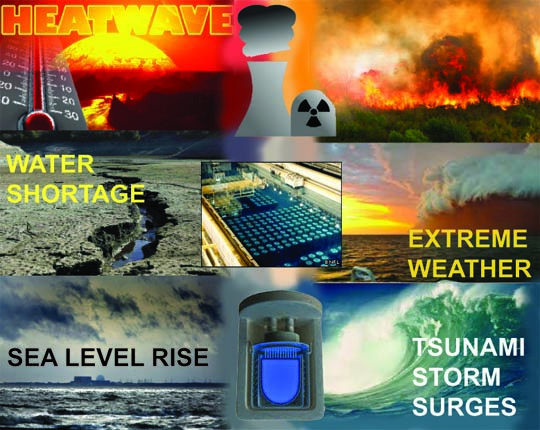
Changing ambient temperatures are already posing serious risks to nuclear plants across the world. Nuclear regulators cannot wait until sea-level rise coupled with storm surges begin impacting operational safety of their plants—they must act now.
Note: This is part two of a two-part blog series on the impacts of climate change on nuclear power plants. Check out our first blog post on the impact of increasing ambient temperatures.
Climate action isn’t simply about reducing emissions—it’s also about addressing local environmental concerns and minimizing risks to human health and safety. With that in mind, if nuclear power is going to have a role in addressing climate change, stronger safety and environmental regulations will be needed.
Unfortunately, this approach is missing from the U.S. Nuclear Regulatory Commission (NRC), which in January voted in a 3-to-2 decision to water down recommendations from its own staff to reevaluate seismic and flooding hazards at nuclear sites. “This decision is nonsensical,” Commissioner Jeff Baran wrote in his dissent, “Instead of requiring nuclear power plants to be prepared for the actual flooding and earthquake hazards that could occur at their sites, NRC will allow them to be prepared only for the old, outdated hazards typically calculated decades ago when the science of seismology and hydrology was far less advanced than it is today.”
The January ruling came almost eight years after staff scientists released a list of recommendations in direct response to the 2011 Fukushima nuclear meltdown. With the approval (and pending approvals) this year to rollback multiple safety regulations , the U.S. nuclear fleet, the oldest in the world, cannot afford to wait another decade to strengthen safety and environmental regulations in preparation of climate change–in this case, rising sea levels.
What are the Risks?
Nuclear power plants require huge amounts of water to prevent fission products in the core and spent nuclear fuel from overheating (incidentally making nuclear the most water intensive energy source in terms of consumption and withdrawal per unit of energy delivered). That’s why over 40 percent of the world’s nuclear plants are built along the coasts, with that number rising to 66 percent for just plants under construction. Unable to run on the electricity it generates itself to power the pumps that provide cooling water to the core and to the spent nuclear fuel stored onsite, a nuclear plant must rely on the grid or backup generators to ensure cooling water circulation. Any hazard that cuts off access to those sources of power restricts access to cooling water, ultimately risking a nuclear meltdown and off-site release of radiation, as happened during the flooding of Fukushima.
Flooding evaluations conducted by the NRC concluded that 55 of the 61 evaluated U.S. nuclear sites experienced flooding hazards beyond what they were designed to handle. Even more alarming, in 2014, the flood barriers at Florida Power & Light’s St. Lucie Nuclear Plant–one of the few plants reported to be prepared for disaster but which had been missing proper seals for decades–gave way to 50,000 gallons of water after heavy rainfall.
Storm surges like the one at St. Lucie Nuclear plant and extreme weather events, as witnessed in Fukushima, pose very real risks to both operational and decommissioned plants, almost all of which (in the US) will continue to store nuclear waste onsite for decades until a permanent storage solution is found. Coupled with increasingly rising sea-levels, these risks will continue to grow. Even under a very low scenario of 1°C warming by midcentury, the 2018 U.S. National Climate Assessment reports that the “frequency, depth, and extent of both high tide and more severe, damaging coastal flooding will increase rapidly in the coming decades.” And the Intergovernmental Panel on Climate Change concluded that 1.5°C of warming could be reached in as little as 11 years.
While all energy technologies will be impacted in some way by the increasing severity of natural disasters and sea level rise, the failure of nuclear power plants can result in irreversible health and environmental consequences on top of social and economic damages, including worst of all the release of radiation that can remain lethal for thousands of years. Under government estimates, the Fukushima meltdown resulted in the displacement of 165,000 people, cleanup and compensation costs of up to $200 billion, and a timeline of 30 to 40 years. Experts say, however, that true costs could reach $500 billion and decontamination timelines could be underestimated by decades.
Nuclear in East Asia
Despite initial vocal opposition from the public in many East Asian countries that have slowed down nuclear buildout after Fukushima, the direction of government policies for nuclear development in East Asia remain mostly unchanged, and have simply resulted in rather a more conservative, moderate pace. In fact, this pace has sustained much of nuclear development in East Asia, home to many countries that have found nuclear power as an attractive solution to addressing the dilemma between achieving energy security for an increasing population and decarbonizing to mitigate global climate change.
Of the 56 nuclear power plants currently in construction around the world, 33 of them are in Asia; 16 in China alone. As observed in the graph below, [on original] if all nuclear units that are currently under construction reach completion, East Asia is slated to become the region with the largest number of operating nuclear power plants, 93 percent of which will reside along the coast.
What is alarming is that East Asia and the Pacific region is uniquely vulnerable to sea-level rise. A 2015 report by Climate Central found that of the top 10 countries most likely to be affected sea level rise for 4°C warming, seven are in Asia. Similarly, in a study by the World Bank, China and Indonesia will be the most vulnerable to permanent inundation. Given the heightened flooding risks in Asia, strengthening the authority of regulatory structures that oversee the safety of nuclear build out will be increasingly important.
What’s the Plan?
Fukushima was a lesson to the global community that even one of the world’s most technologically advanced and experienced countries can fail to prevent a nuclear meltdown. To prepare for the realities of rising sea levels that pose unique risks to different nuclear plants, regulators must require climate adaptation plans and heightened safety oversight. Nonetheless, at the international scale, not much work is being done to address these sea-level rise concerns.
The Nuclear Energy Agency (NEA), in recognizing that the “world is ill-prepared for the risks from a changing climate,” conducted a study on the vulnerability of nuclear power plants to climate change, which is not yet available to the public. Since 2014, the International Atomic Energy Agency (IAEA) has begun to include a section about the impacts of climate change on nuclear energy in its annual Climate and Nuclear Power Report. Yet even as these international organizations detail the many hazards changing climate poses to nuclear reactors, preventative and/or adaptation measures do not seem to be prioritized or encouraged, especially for existing nuclear plants.
“Outside of their Scope” at Home
Similar attitudes are held here in the U.S. Perched at the southern tip of Florida, the Turkey Point Nuclear Generating Station is seeking to be the first U.S. nuclear plant permitted to run for 80 years. Initially refusing to consider sea-level rise in the environmental review of the license extension, the Nuclear Regulatory Commission (NRC) released a revised draft this year, only to come to the following conclusion: It’s outside of the scope of the agency.
If new information about changing environmental conditions (such as rising sea levels that threaten safe operating conditions or challenge compliance with the plant’s technical specifications) becomes available, the NRC will evaluate the new information to determine if any safety-related changes are needed at licensed nuclear power plants,” the NRC report said.
The report arrives at this conclusion by utilizing lower-bound sea level rise estimates from the 2018 U.S. Climate Change assessment, rationalizing that the report “assigns very high confidence to the lower bounds of these projections and medium confidence to the upper bounds.” As highlighted by this Bloomberg analysis released this year, nuclear plant operators are not only allowed to perform their own flood risk estimates but are also able to decide what assumptions are made, with review from the NRC.
The uncertainty that comes with sea-level rise projections obviously exists. In securing the safety of such critical infrastructure, however, using the highest sea-level rise estimates is the only way to ensure that all actions that can be taken against a potential threat are taken. On the other hand, relying on the lowest storm surge estimates is akin to receiving a warning about a potential threat, and taking the bare minimum actions to prepare for it.
Changing ambient temperatures are already posing serious risks to nuclear plants across the world. Nuclear regulators cannot wait until sea-level rise coupled with storm surges begin impacting operational safety of their plants—they must act now. With the world’s scientists calling attention to the climate crisis ahead of us, action must be taken to ensure nuclear plants are part of the solution, not the problem.
New Mexico’s congressional delegation has expressed outrage with the U.S. House leadership’s move to block compensation for people sickened by exposure to radiation during nuclear weapons testing and the mining of uranium during the Cold War
SANTA FE, N.M. — All members of New Mexico’s congressional delegation expressed outrage with the U.S. House leadership’s move to block compensation for people sickened by exposure to radiation during nuclear weapons testing and the mining of uranium during the Cold War.
Originally, the bill expanded eligibility for compensation under the Radiation Exposure Compensation Act, offering up tens of thousands of dollars in compensation to residents of New Mexico, Colorado, Montana, Guam and Missouri — as well as those in some parts of Arizona, Nevada and Utah — who suffered the effects of nuclear testing or uranium mines and who are not covered under the current program.
The Santa Fe New Mexican reported that the compensation was included in a massive defense spending bill that won Senate approval in July. But the GOP-controlled House removed those provisions from the act Wednesday, rendering New Mexicans — including those stricken with ailments from the radioactive fallout of the first atomic bomb — still ineligible for federal help unless it is reattached to the final bill.
“Generations of New Mexicans and their families have gotten sick and died from the radiation exposure and the lasting impacts of the Trinity Test,” said Sen. Ben Ray Luján, referring to the first-ever atomic bomb test in the New Mexico desert in 1945. “For New Mexico to have been ground zero for the first nuclear weapon — and left out of the original RECA program — is an injustice.”
Luján, a Democrat, has introduced radiation exposure compensation bills in every Congress since he was first elected to the U.S. House in 2008.
The hit summer film “Oppenheimer” about the top-secret Manhattan Project and the dawn of the nuclear age during World War II has brought new attention to decades-long efforts to extend compensation for families who were exposed to fallout and still grapple with related illness.
Advocates also have been trying for years to bring awareness to the lingering effects of radiation exposure on the Navajo Nation, where millions of tons of uranium ore were extracted over decades to support U.S. nuclear activities.
This factsheet analyzes the role of nuclear energy in global climate scenarios. It shows that a global tripling of nuclear capacity until 2050 is neither realistic nor is it needed to achieve climate targets according to the Paris agreement.
The factsheet presents an analysis of nine global climate scenarios that achieve climate targets according to the Paris agreement as well as two non-target scenarios with an emphasis on the role of nuclear energy.
In order to assess how realistic these top-down scenarios are, it compares these figures with the plans and programs of governments for the expansion (or phase out) of nuclear power.
A tripling of today’s nuclear capacity of 370 GW would require 1.110 GW net electrical capacity to be operational in 2050. If we assume a very high sixty year lifetime for all nuclear reactors in operation and under construction today, roughly 210 GW of the current nuclear fleet would still be online in 2050.
Thus, a total of nearly 900 GW would have to be constructed additionally between 2024 and 2050. Assuming a linear increase in the rate of new construction up to 2050, starting with the amount of new nuclear connected to the grid in 2023, in 2050 more than 60 GW would need to be connected to the grid to meet the tripling nuclear target, compare Figure 10.
This would be approximately twice the maximum historic capacity connected to the grid in a single year. On average, more new capacity would have to be added every year over 25 years as was the case at the historical maximum in 1985. From these numbers, it is evident, that a tripling of nuclear capacity until 2050 is neither realistic nor is it needed to achieve climate targets according to the Paris agreement.
Yesterday, 22 countries including the United States, the United Kingdom, South Korea, Canada, Hungary, and the Netherlands signed a pledge to triple nuclear deployment by 2050.
TerraPower and the UK have stalled on discussions around UK projects, but nuclear on the whole is another energy front on which the UK is currently losing ground.
The target of 24 GW by 2050 was first conceived in the Energy Security Strategy of 2021 but precious little progress has been made since.
Even with the reactor plans it has been able to conceive, the sector remains repeatedly hamstrung by bureaucratic process and the absence of a long-awaited nuclear road map that is likely delayed once more to 2024.
A significant factor halting development is that nuclear investment is still not labelled green, despite being promised by the Chancellor back in March.
Examining the UK’s current stock showcases the problem even further. British nuclear capacity stands at 5.9 GW, 4.7 GW of which retires in less than five years.
Through completing Hinkley Point C, Sizewell C and securing a life extension to Sizewell B, the UK could reach 7.7 GW; less than one third of the 24 GW target.
In the 12 years since the UK restarted nuclear development, only one project has proceeded to a Final Investment Decision (HPC in 2016).
To get to 24 GW of capacity by 2050, the UK nuclear needs to build and start operations on another six Hinkley Point C-size projects and move the stymied Sizewell C project into production.
………………………………….those within the sector believe the government is still avoiding making short-term capital investments to shore up the long-term energy security set out in 2021.
One official involved in the UK nuclear industry told City A.M: “They’re slow and hesitant, we know what happens when you have government money tied up in multi-billion pound projects and a sniff of a cost increase comes along, they opt to slow down and rethink”.
Others believe that despite union backing for large job creators like Hinkley Point, a Labour government isn’t in a position to speed up the nuclear timeline.
With its supply of Western weapons dwindling and little sign of change from the NATO powers, Ukraine will be incapable of launching another counteroffensive like last summer, an analyst told Sputnik. However, barring a mutiny or political crisis, a collapse of the Ukrainian war effort isn’t necessarily imminent.
White House Office of Management and Budget Director Shalanda Young told federal lawmakers on Monday that the US was “out of money to support Ukraine in this fight.”
According to Pentagon statistics, the US has sent Ukraine some $44 billion in military aid since February 2022, as well as $76 billion in other types of support, including budget financing and humanitarian aid. US President Joe Biden has asked for billions more to be approved, but the Republican majority in the House, now led by Ukraine skeptic House Speaker Mike Johnson (R-LA), has remained cool to the idea without improvements in oversight.
Moscow-based international relations security analyst Mark Sleboda told Radio Sputnik’s The Final Countdown on Monday that Ukrainian President Volodymyr Zelensky was correct in a way: Ukraine is indeed entering a new phase of the conflict – a defensive phase, as it waits and hopes that time will bring favorable changes to the situation.
“But it is definitely having an effect on the battlefield in Ukraine. There was already a trend because of the US and collectively NATO’s inability to ramp up their own industrial production to provide their Kiev Regime proxy with enough of the war basics like artillery shells, air defense missiles, and many other things that it needed. And now, that is coupled with the fact that Kiev is competing with Israel for many of the same things, which have been on the demand list … for Israel for what it needs for its conflict. And Zelensky is finding himself second-fiddle, vying not only for attention and supplies and funding” from the US and European Union, which he said had hit a “speed bump” in attempting to support both Kiev and Jerusalem at once…………………..
Over the weekend, NATO Secretary-General Jens Stoltenberg said the alliance “should also be prepared for bad news” from Ukraine, noting that wars “develop in phases” and that the West should continue to support Kiev “in both good and bad times.”
“For Zelensky, this is really a case of ‘the emperor has no clothes,’” Sleboda said, noting that other figures had turned against him, too, including anti-Russian journalist Simon Shuster, who quoted Ukrainian officials calling Zelensky “delusional” and claiming he won’t hear talk of Ukraine losing the conflict, and Kiev Major Vitaly Klitschko had called Zelensky “authoritarian.”
“I guess the Western propaganda is failing, and when the mainstream media is already out in front of him, even Jens Stoltenberg has to turn it around and admit certain things, although it must be said that these admissions are not coming in front of the media, they’re coming behind it, he simply no longer has any propaganda spin for maneuver.”
Sleboda said he agreed with Zelensky that Ukraine had entered a new phase of the conflict.
“Their offensive days are over, there is no large new offensive package from the West anywhere within sight, there’s not even enough maintenance aid to continue basic supplies of anything at this point. So the next year is solidly about desperate defense, building defensive lines, and a much-talked-about new total mobilization, meaning mass, forced conscription, that could possibly include 17- to 70-year-olds now and possibly women being conscripted for combat roles. And, evidently, it is going to be privatized, the last months of conscription having failed miserably, they are now evidently going to turn to private companies, which literally means Westerners coming in and help press-gang Ukrainians off the streets and putting them in the trenches.”
Andrey Yermak has called for more funds for Kiev as Congress remains at loggerheads
President Vladimir Zelensky’s chief of staff has admitted that there is a “big risk” that Ukraine will lose its conflict with Russia unless the US Congress approves more funding to support Kiev. Andrey Yermak was among a number of Ukrainian officials who “swarmed Washington” ahead of a Senate vote on a White House request for over $100 billion in aid for Kiev, Israel and Taiwan, according to the New York Times.
Republican lawmakers are adamant that they will not approve the spending, unless the Democrats compromise on the issue of southern border security. President Joe Biden called their resistance “crazy” and “totally wrong.”
Yermak made the case for more funding during an appearance at the US Institute of Peace, a Washington-based government-funded think tank. He claimed that his country had inflicted casualties on Russian forces at a ratio of 1:10, and was capable of defeating it on the battlefield in the long run. However, he admitted that even a delay in the provision of American aid could pose a challenge for Kiev. Such an outcome would “give the big risk that we can be in [the] same position [where] we are located now,” he said, speaking in English, presumably meaning a lack of progress in retaking land from Russia. “Of course, it make with very high possibility impossible to continue liberate and give the big risk to lose this war,” Yermak added.
Zelensky’s chief-of-staff was ostensibly promoting the so-called “peace formula” that was first floated by the Ukrainian president last year. It would involve full control over pre-2014 territories for Kiev, while Russia would pay war reparations and face a tribunal. Moscow has dismissed these demands as detached from reality.
Yermak claimed that helping Ukraine to beat Russia was of strategic importance to the US and its allies. Zelensky himself was scheduled to make a virtual appearance at a closed Senate hearing, during which senior White House officials gave lawmakers a briefing on the importance of appropriations. He canceled at the last moment.
The Republican-controlled House has previously declined to include Ukraine aid in stopgap spending bills on two previous occasions, which kept the US government from shutting down this year.
Speaker Mike Johnson has demanded a “full accounting of how prior US military and humanitarian aid” to Ukraine was spent and a plan for “an accelerated path to victory” from the White House. Lawmakers opposed to bankrolling Ukraine have cited concerns over corruption in Kiev and the cost to American taxpayers as key objections.
The US Department of State and US Export-Import Bank (EXIM) have announced a suite of financial tools to support the deployment of advanced nuclear energy systems to help reach net-zero goals. They also announced plans to mobilise more than USD4.2 billion of investment in enrichment and conversion capacity through the five-nation Sapporo 5 collaboration.
Following in the footsteps of the European Parliament last month, EU member states in the Council have also included nuclear energy alongside renewables among the technologies promoted by the EU’s Net-Zero Industry Act (NZIA).
…………………….As a result, nuclear power will benefit from streamlined licensing procedures: a one-stop-shop in each EU country and full digitisation of procedures to ensure that authorisations can be obtained within nine to 12 months………………..
France and eight other EU countries – Bulgaria, Croatia, Czechia, Hungary, Poland, Romania, Slovakia and Slovenia – submitted a joint declaration before the meeting reiterating the importance of supporting nuclear power and its financing at the EU level.
On the German side, the pill is harder to swallow…………………
As for other nuclear technologies that are not on the list of “strategic” technologies, these have been retained as “net zero” technologies and, as such, enjoy certain advantages.
Next battle: Financing
The key remaining battle now for pro-nuclear countries is to secure financing at EU level.
“Technological neutrality must also apply to financing,” French Industry Minister Roland Lescure told the Council, even though the NZIA “is not a financing text but a regulatory text,” as his office pointed out.
Indeed, “there are no financial provisions in the text, except that it does not contain any financial provisions, which Germany was keen to point out,” Lescure’s office added.
Germany, meanwhile, is leading the opposition.
“EU funds cannot be used for technologies that are not supported by all member states,” Giegold said. “It was, therefore, crucial for us to exclude funding issues from the NZIA and to leave existing European rules untouched,” he added.
The NZIA will, therefore, have no impact on whether or not EU funds can finance nuclear power or not.
But according to Lescure’s office, the status quo on this point is not a problem for now. Indeed, the door is still open for nuclear technologies to be financed by the European Investment Bank (EIB) and other upcoming EU funds, possibly the Strategic Technologies for Europe (STEP) platform for example, which is currently under discusssion.
“EU funds that do not finance nuclear power should do so in the future,” said a declaration adopted in July by the French-led Nuclear Alliance of 14 EU countries, which called for “impartiality” between nuclear power and renewables when it comes to EU funding.
In addition, the European Parliament’s position proposes that 25% of the revenues from the EU carbon market should be earmarked for financing the technologies listed in the NZIA.
The Council did not take up this possibility, which will be discussed at the forthcoming trilogue talks scheduled on 13 December.
“We can now begin negotiations and complete them before the European elections,” said Christian Ehler, Parliament’s rapporteur on the NZIA, on X.
Since October 7, the day the escalation in Israel/Palestine began (FAIR.org, 10/13/23), American media outlets have persistently described the fighting as an “Israel-Hamas war.” From October 7 through midday on December 1, the New York Times, Wall Street Journal and Washington Post have combined to run 565 pieces that use the phrase “Israel-Hamas war.”
This paradigm has been a dominant way of covering the violence, even though Israel has been clear from the start that its assault has not been narrowly aimed at Hamas. At the outset of the Israeli onslaught, Israeli Defense Minister Yoav Gallant (Times of Israel, 10/9/23) said: “I have ordered a complete siege on the Gaza Strip. There will be no electricity, no food, no fuel, everything is closed.” Oxfam later said that such restrictions on Palestinians’ ability to eat—which left 2.2 million people “in urgent need of food”—mean that Israel is deploying a policy wherein “starvation is being used as a weapon of war against Gaza civilians.”
A day later, Israeli military spokesperson Adm. Daniel Hagari (Guardian, 10/10/23) said that “hundreds of tons of bombs” had already been dropped on the Gaza Strip, and admitted that “the emphasis is on damage and not on accuracy.”
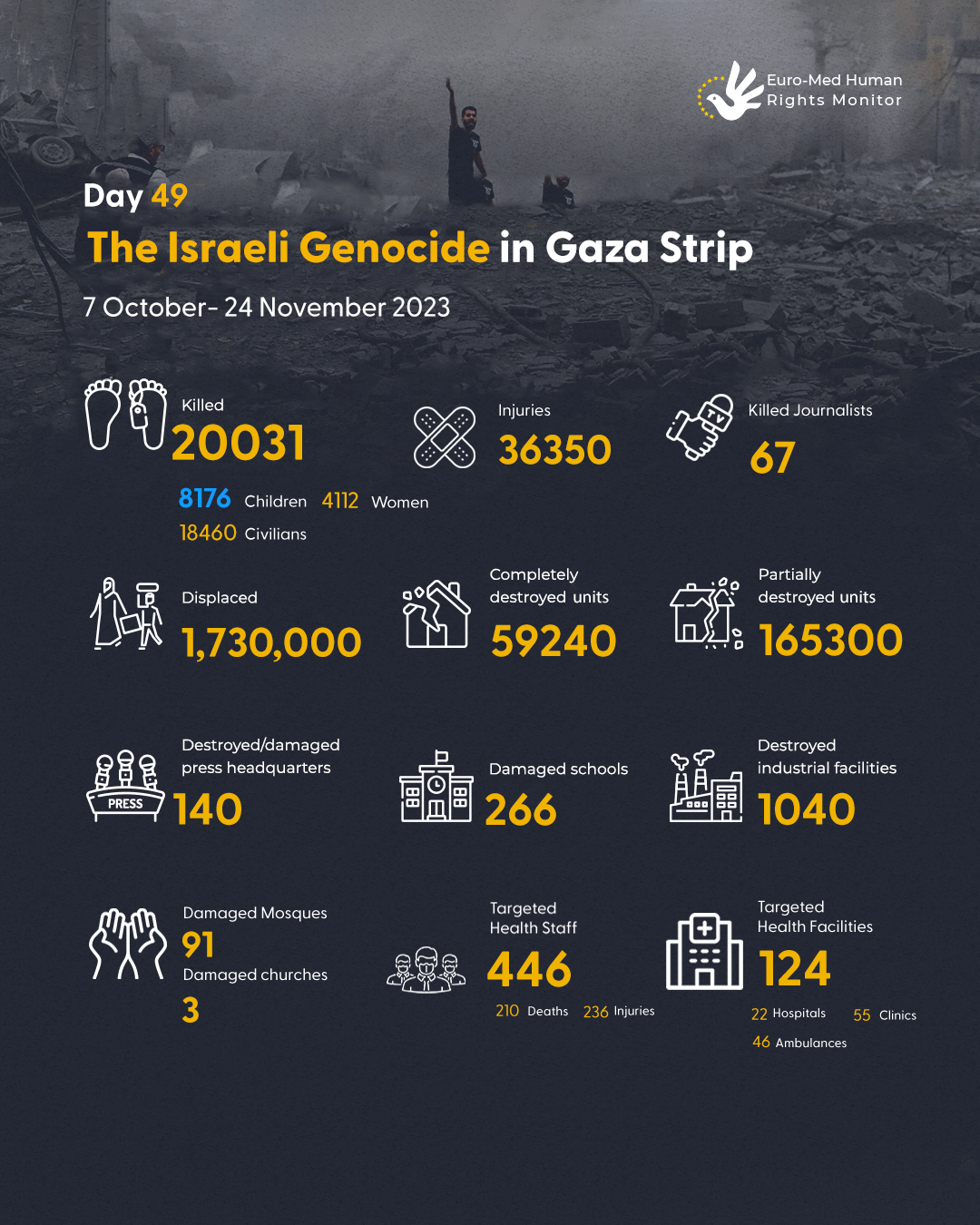
The indiscriminate nature of Israel’s assault is clear. The United Nations Office for the Coordination of Humanitarian Affairs reported on November 24 that “over 1.7 million people in Gaza, or nearly 80% of the population, are estimated to be internally displaced.” On November 25, the Swiss-based Euro-Mediterranean Human Rights Monitor reported that Israel had killed 20,031 Palestinians in Gaza, 18,460 of whom (or 92%) were civilians, since October 7.
Thus, while Israel has openly acknowledged that it is carrying out indiscriminate violence against Palestinians, US media outlets do Israel the favor of presenting its campaign as if it were only aimed at combatants. “Israel-Gaza war” comes closer to capturing the reality that Israel’s offensive is effectively against everyone living in Gaza. Yet “Israel-Gaza war” appears in 265 pieces in the three papers, exactly 300 fewer than the obfuscatory “Israel-Hamas war.”
Consider also the Euro-Mediterranean Human Rights Monitor finding that Israel has slaughtered 8,176 children. If 41% of all the Palestinians Israel has killed in the first seven weeks of its rampage have been children, and 8% have been combatants, then it is less an “Israel-Hamas war” than an Israeli war on Palestinian children.
Characterizing what has happened since October 7 as an “Israel-Hamas war” fails to adequately capture the scope and the character of Israel’s violence. Describing the bloodbath in Palestine this way obscures that grave violence is being visited upon virtually all Palestinians, whatever their political allegiances and whatever their relation to the fighting.
Cognitive dissonance
Corporate media have often stuck to the “Israel-Hamas war” approach even when the information the outlets are reporting shows how inadequate it is to conceive of Israel’s attacks in that way. For instance, the New York Times (10/20/23) ran a story about Israel ordering 1.2 million Gaza residents to evacuate their homes, and still classified the evacuation as part of the “Israel-Hamas war.” The Izz ad-Din al-Qassam Brigades, Hamas’ armed wing, is estimated to have 30,000–40,000 fighters (Axios, 10/21/23).
The Wall Street Journal published a short piece (11/6/23) that noted:
The United Nations said that the Israel-Hamas war has killed the highest number of UN workers in any single conflict. The UN said that over 88 workers in its Relief and Works Agency [UNRWA], the largest humanitarian organization in the Gaza Strip, have been killed since October 7.
But UNRWA did not itself use the “Israel-Hamas war” narrative in the report to which the Journal referred, instead opting for “escalation in the Gaza Strip.” Indeed, Israel killing UN workers at a rate of almost three each day would seem to fall outside the bounds of an “Israel-Hamas war,” but that’s how the paper categorizes the violence. (“Israel’s war on the UN” falls well outside the bounds of the ideologically permissible in the corporate media.)……………………………… more https://fair.org/home/israel-hamas-war-label-obscures-israels-war-on-palestinians/
The West is reportedly disappointed with Kiev’s failed counteroffensive and doubts its ability to score a victory against Russia
British diplomats may soon start to put pressure on Ukraine to hold peace negotiations with Russia, Politico’s UK editor has suggested, citing “chatter” in diplomatic circles. Wider media reports suggest that the West has grown concerned at Kiev’s ability to score a battlefield victory.
Speaking on Monday on the latest episode of the ‘Politics at Jack and Sam’s’ podcast, Jack Blanchard noted that “Ukraine’s big counteroffensive was not anything like the success people hoped, and that is raising big questions about Ukraine’s ability to win this war in any meaningful military way.”
In light of this, Blanchard claimed that there are rumors in British “diplomatic circles” about “putting pressure on Kiev to sit down and negotiate.”
His comments come on the heels of a Washington Post article claiming that Ukraine ignored a counteroffensive strategy devised by American and British officers that recommended a focused attack on a single sector of frontline in April, and that it chose to delay the operation until June, and to spread its forces along multiple axes.
“Nothing went as planned,” the Post stated, adding that Ukraine’s insistence on following its own tactics and timeline generated “friction and second-guessing between Washington and Kiev.”
According to the latest figures from the Russian Defense Ministry, Ukraine has lost 125,000 service personnel and 16,000 pieces of heavy equipment in the six months since its counteroffensive began.
Blanchard is not the first journalist to claim that Kiev’s patrons are ready to push for peace. Last month, German tabloid Bild alleged that the US and Germany are rationing their weapons deliveries to Ukraine in a bid to nudge Ukrainian President Vladimir Zelensky into talks with Russia, without explicitly asking him.
The US State Department dismissed Bild’s report, with spokesman James O’Brien stating that the decision of when to sue for peace “is a matter for Ukraine to decide.”
Speaking at the Halifax Security Forum in Canada several days before that report was published, Aleksey Danilov, the secretary of Ukraine’s National Security and Defense Council, said that “Ukraine is concerned by the fact that discussions among certain partners have intensified regarding the need for negotiations…with the Russians.”
Danilov insisted, like Zelensky repeatedly has since the start of the conflict, that “Ukraine and the Ukrainian people will fight to the end. We are sure of our victory.”
Hundreds more civilians have been slaughtered since Blinken’s remarks. In other words, Israel ignored him. As long as it’s only talk, Israel can afford to.
So far not one bullet, nor one penny has been withheld from Netanyahu’s vicious regime
The U.S. vice president, secretary of state and defense secretary are using unusually blunt language against Israel’s massacres of Palestinians. But the money and weapons keep flowing, says Joe Lauria.
In the midst of an Old Testament-style genocide against the Palestinian people, there is a paraphrased line from the Book of Daniel that has come into full view for the Biden administration: “The writing is on the wall.”
Everywhere in the U.S. that prominent administration officials go, they are hearing it from a public increasingly alarmed about their complicity in genocide. It is not criticism they can easily ignore.
For one thing, if they have a shred of conscience left they cannot avoid seeing that Israel’s military campaign is “deliberately inflicting on the group [Gazans] conditions of life calculated to bring about its physical destruction in whole or in part,” as the Convention on the Prevention and Punishment of the Crime of Genocide defines the supreme crime.
But even if their hearts are stones, political warnings are scratched on the wall in a fast-approaching presidential election in which increasing numbers of Democrats are affixing “genocide” to Biden’s first name.
Thus Biden, though not Biden himself, was spurred in the past few days to dispatch his top deputies to deliver the sternest message to Israel.
At the climate summit in Dubai on Saturday, Vice President Kamala Harris told a press conference: “The United States is unequivocal: International humanitarian law must be respected. Too many innocent Palestinians have been killed.”
On the same day Harris spoke, in what appears to have been coordinated by the White House, Defense Secretary Lloyd Austin said in a speech at the Reagan National Defense Forum in Simi Valley, CA, that, “I have repeatedly made clear to Israel’s leaders that protecting Palestinian civilians in Gaza is both a moral responsibility and strategic imperative.”
“In this kind of a fight, the center of gravity is the civilian population,” Austin said. “And if you drive them into the arms of the enemy, you replace a tactical victory with a strategic defeat.” Even then, Austin couched his remarks in military and not moral terms. Still the message was clear to Israel: Stop killing so many civilians.
Harris’s and Austin’s remarks followed by two days comments by Secretary of State Antony Blinken during his third jaunt to Jerusalem since Oct. 7.
After meeting Israeli Prime Minister Benjamin Netanyahu, Blinken told the press:
“We discussed the details of Israel’s ongoing planning and I underscored the imperative for the United States that the massive loss of civilian life and displacement of the scale that we saw in northern Gaza not be repeated in the South. …
As I told the prime minister, intent matters, but so does the result. … Israel has one of the most sophisticated militaries in the world. It is capable of neutralising the threat posed by Hamas, while minimising harm to innocent men, women and children. …
That means taking more effective steps to protect the lives of civilians, including by clearly and precisely designating areas and places in southern and central Gaza, where they can be safe and out of the line of fire.”
Israel responded with some maps supposedly outlining safe areas for civilians to go to. But the bombing in the south of Gaza, where 1.8 million Gazans are displaced from the north, has been among the most intense in two months of Israeli attacks.
Hundreds more civilians have been slaughtered since Blinken’s remarks. In other words, Israel ignored him. As long as it’s only talk, Israel can afford to.
An unconfirmed report from Israel’s Channel 12 following Blinken’s meeting with Netanyahu said the secretary of state supposedly “linked American military support to certain conditions, including proof that the I.D.F. plans to take into consideration the civilian population in Gaza, reduce civilian evacuations from their homes to a minimum, and provide more safe areas for non-combatants.”
Leverage
On Monday, Sen. Bernie Sanders, a Biden ally, said according to the AP: “’The truth is that if asking nicely worked, we wouldn’t be in the position we are today,’ Sanders said in a floor speech. It was time for the United States to use its ‘substantial leverage’ with its ally, the Vermont senator said. ‘And we all know what that leverage is,’ he said, adding, ‘the blank-check approach must end.’”
Until such leverage is used — and Washington has let two months go by with more than 16,000 dead, 7,000 missing and 40,000 injured — these are mere words.
Such talk from these Biden officials and allies will not fool many people, except for fools, and will not scare Netanyahu.
So far not one bullet, nor one penny has been withheld from Netanyahu’s vicious regime.
This is Biden’s quandry: continue to support Israel’s genocide and see his poll numbers continue to plummet. The dilemma he must answer is: what would damage him more, sticking with Israel through its murderous campaign or risk the Israel Lobby’s consummate skill at destroying American politicians?
On Nov. 5, 2024, American voters will weigh Biden in the balance and, as Daniel told King Belshazzar, he may be found wanting.